

SIMPLE LIFE
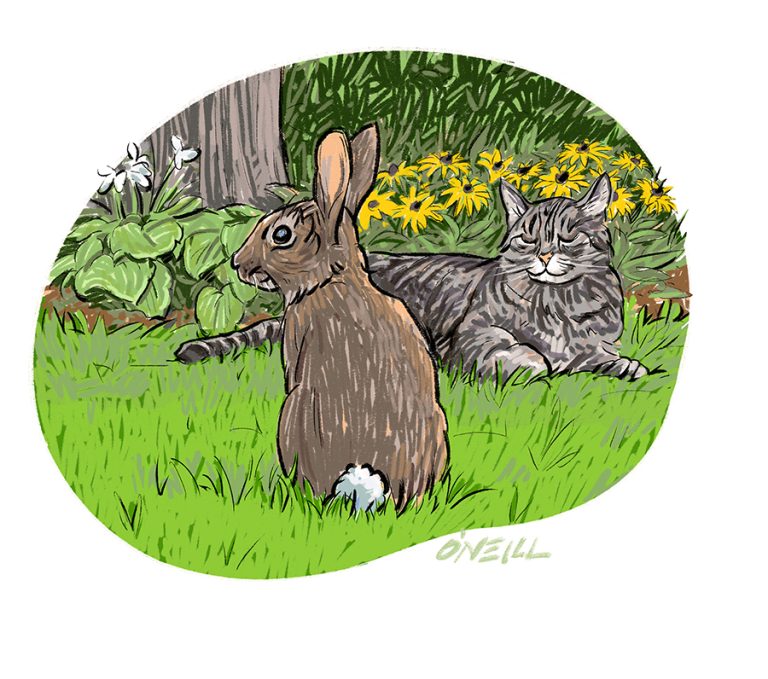
Life in Rabbit Land
Hare, There and Everywhere
By Jim Dodson
Illustration by Gerry O’Neill
Is there anything nicer than a summer evening after a surprise rain shower cools off the world?
I think not. Of course, being in the “evening of life” myself, I am perhaps not an entirely objective source on the matter.
On the other hand, Homer’s grandkids seem to agree with me. Homer is the rabbit that has made my yard his home for several years. Or, at least, that’s what I nicknamed him.
I was sitting here quietly by myself moments ago beneath Old George, our elderly maple tree at the garden’s edge, enjoying the cooler air and an evening drink, when they suddenly appeared — three young rabbits racing directly past me into the front yard, chasing, tumbling and hopping joyfully over each other like a circus troupe of acrobats entering the center ring. I watched them race around until they settled down to nibble grass in the newest section of the yard.
I call them Homer’s grandkids because young kits appear every spring from the burrow where they reside beneath an ancient oak stump near my east garden gate, a well-protected enclave. I have no idea if Homer was the original patriarch (or, for that matter, matriarch) of the burrow, but a decade or so ago he captured our affections by showing up every morning and evening like clockwork to hang out with our old, gray tiger cat, Boo Radley. The two would often sit together in the garden as evening fell, just watching the day’s peaceful end. Theirs was an improbable “friendship” that went on for several years until Boo passed on and Homer went, well, wherever aging eastern cottontail rabbits go. I was inspired to write a whimsical book for my own grandkids, wondering at the time if I would ever have some. My artist friend, Harry Blair, drew the illustrations.
We live in Starmount Forest, so-named because its former wealthy owner was determined to keep the old-growth hardwoods intact — until he built a country club in the middle of it and passed the forest on to other owners, whose heirs — legend holds — began turning the forest into a postwar neighborhood of attractive suburban houses.
Fortunately, it still retains some of its character as an urban forest of mighty oaks and maples, and remains one of the oldest and most popular neighborhoods in the city. Growing up in Starmount, I have a keen boyhood memory of the abundant rabbits in the yards and gardens of the neighborhood half a century ago. They clearly preceded humans in lovely Starmount Forest. And will likely outlive us all.
My mom, a dedicated gardener, liked to say that we were the “newcomers to Rabbit Land,” hence their natural “nibbling rights” in a special section of her backyard garden she set aside for them. She planted things rabbits love to eat — snapdragons, morning glories, daisies and black-eyed Susans — thereby keeping them away from her beloved peony border and roses. Decades later, I adopted a version of her strategy when I built a large woodland garden in Maine and included a huge patch of hosta plants at the back of our property, designed to keep the whitetail deer out of my flower beds. It worked like a charm.
Like my mom, I find something comforting and even magical about our neighborhood rabbits. They’re all around us and simply part of daily life here, a reminder that nature is never far away. On an average morning or evening walk around the block, you’re liable see at least a couple dozen of them feeding peacefully in yards or resting under shrubs from the heat of a long summer day.
I’m sure part of my affection for them stems from growing up in a generation of kids weaned on Beatrix Potter’s beloved Tale of Peter Rabbit, the classic 1902 children’s book about a mischievous young rabbit who disobeys his mother and gets into big trouble in Mr. McGregor’s vegetable garden. It ends with Peter making a wild escape during which he loses his clothes and is put to bed with chamomile tea while his sisters, Flopsy, Mopsy and Cottontail, enjoy a nice supper. It was a fable meant to remind young ones to always mind their mama. I still own my childhood copy of the book, which I plan to soon pass along to my new granddaughter, June Bug. The wee book on Homer and Boo will soon follow.
Another book that will wend its way to her is a beautifully illustrated first edition of Richard Adams’ Watership Down, an allegorical adventure story about a group of brave rabbits who set off to find a safe haven after their rural Hampshire warren is slated for destruction and development — a tale that holds echoes of today’s headlines about immigrants.
Critics uniformly hailed Watership Down as a modern classic by comparing its epic motifs of spiritual faith, flight and survival to Homer’s Odyssey and Virgil’s The Aeneid. Adams himself described it merely as simple tales he improvised during a long family road trip to entertain his young daughters, Juliet and Rosamund. They pestered him to write down the story, which he eventually did, reading each bit as he finished it to his daughters. Rejected by seven major publishing houses before London-based, independent press Rex Collings published it in 1972, Watership Down quickly became a runaway bestseller in both Britain and America.
I read it the summer before my sophomore year in college and still rank it among my favorite books.
•
It’s no surprise that rabbits have a magical presence across mythology and human culture. The science, lore, mystery and magic of what some believe to be the world’s most misunderstood herbivore have been an integral part of our own evolution as a species.
Rabbits, either hunted or raised domestically, have been revered for ages for their meat and fur. They are also held in high regard for their prodigious reproductive abilities — averaging four to 12 kits per year. Rabbits reportedly flourish on every continent save for Antarctica.
Seen around the world as symbols of fertility, cunning and innocence, they also appear in the mythology of nearly every human society, from ancient Aztec to Asian. Native American peoples regarded the “Great Rabbit” to be the creator of the world. The rabbit is also one of the 12 celestial animals of the Chinese zodiac, where it is the symbol of longevity, peace and prosperity. Someone born under the sign of the rabbit is believed to be vigilant, witty, quick-minded and ingenious.
In Western society, the Easter Bunny evolved from German folklore. It joins Br’er Rabbit, Alice’s White Rabbit and the immortal Bugs Bunny as iconic figures in our narrative lore. In his unpublished memoirs, Bugs’ creator, Friz Freleng, claimed to have modeled Bugs Bunny on Clark Gable’s wily, fast-talking character in the 1934 hit comedy film It Happened One Night.
This may explain why my neighbors in the old Starmount Forest seem to share my affinity for our ever-present rabbits.
Life in Rabbit Land is good.
In a current world that lately seems out of balance and frequently beyond our daily comprehension, the presence of peaceful cottontails at dawn and dusk reminds us of life’s beauty, brevity and sweet hope of renewal.































 Clyde Edgerton was inducted into the North Carolina Literary Hall of Fame in 2016. He is the
 Jill McCorkle was inducted into the North Carolina Literary Hall of Fame in 2018. Her first two novels were published simultaneously in 1984 by the newly launched Algonquin Books of Chapel Hill. The author of seven novels and five short-story collections, her many accolades include the John Dos Passos Prize for Excellence in Literature and the North Carolina Award for Literature.
 Daniel Wallace will be inducted into the North Carolina Literary Hall of Fame in 2026. He is the author of six novels, a memoir, a short story collection and a children’s book. Wallace is the J. Ross MacDonald Distinguished Professor of English at the University of North Carolina at Chapel Hill, his alma mater.
 Michael Parker will be inducted into the North Carolina Literary Hall of Fame in 2026. He is the author of eight novels and three collections of short stories. He has received fellowships in fiction from the North Carolina Arts Council and the National Endowment for the Arts, as well as the Hobson Award for Arts and Letters, the North Carolina Award for Literature, and the 2020 Thomas Wolfe Prize.
 Joseph Bathanti was inducted into the North Carolina Literary Hall of Fame in 2024. Among his many awards are the Sam Ragan Fine Arts Award, the Sherwood Anderson Award and the North Carolina Award for Literature. He is the author of over 20 books, including poetry, novels, short stories and nonfiction. He was North Carolina’s poet laureate from 2012-14 and joined the faculty of Appalachian State University in 2001.
 Shannon Ravenel will be inducted into the North Carolina Literary Hall of Fame in 2026. Born and raised in Charleston, South Carolina, she was editor of the Best American Short Stories series for 13 years and one of the founders of Algonquin Books of Chapel Hill. In 1986 she introduced the annual anthology New Stories from the South. During her time at Algonquin, Ravenel nurtured and advanced the work of numerous writers from the American South, including Clyde Edgerton and Jill McCorkle.