Dissecting a Cocktail

DISSECTING A COCKTAIL

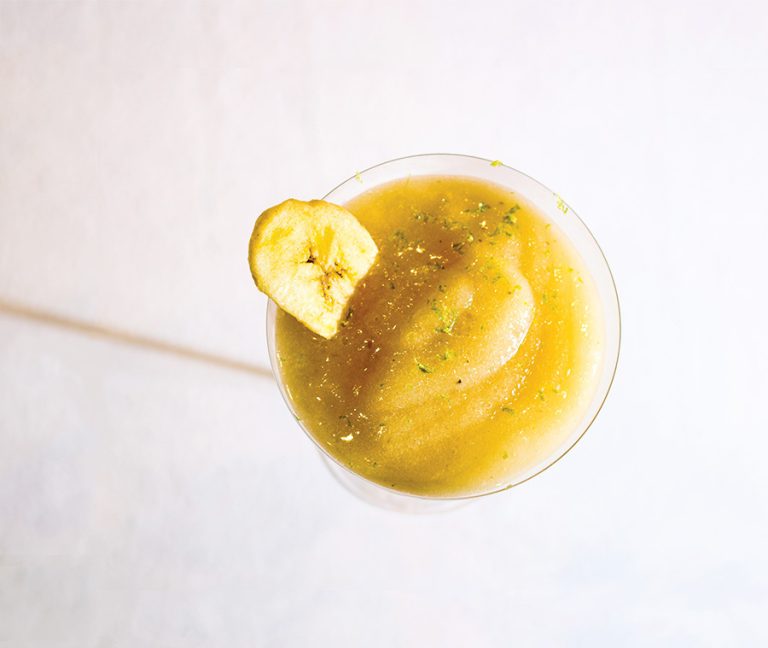
Frozen Banana Daiquiri

By Tony Cross

My earliest recollection of a frozen daiquiri dates back to 1993-1994, when I lived on Kadena Air Base in Okinawa, Japan. There were many Saturdays that my parents, brother and I would go to the bowling alley in the late afternoon. There was a bar counter that served food and drinks, and behind it was a medium-sized black machine that had two neon colors of frozen slush rotating up and down, back and forth.

“Frozen Daiquiris” the machine read.

I vaguely remember sneaking a sip of my mother’s one night. “Eww, disgusting!” I thought. In a million years I would never have believed that a daiquiri would be my favorite drink in the world. But here we are. The frozen daiquiris of my bowling alley days were indeed disgusting. Artificial ingredients, corn syrup, and zero balance — one might wonder why this was even a thing. But frozen cocktails were most definitely a thing, especially the banana daiquiri.

Quoting from Garret Richard and Ben Schaffer’s book, Tropical Standard: Cocktail Techniques & Reinvented Recipes, “Harry Yee (who is known for the famous cocktail Blue Hawaii), has claimed to have been the first to put a banana in a daiquiri, in the 1950s.” Yee, who spent more than 30 years as head bartender at the Hilton Hawaiian Village, started adding bananas to blended daiquiris, helping to put Hawaii on the exotic drinks map. Yee-haw to that!

These days, there are bartenders who use high-quality banana liqueurs in their daiquiris (I’ve gone this route), leaving the blender behind. But Richard’s adaptation of Yee’s daiquiri was all the rage in my kitchen a couple of years ago. There is chemistry in these ingredients — some of my favorite rums have notes of banana. Pro tip: Make sure to keep the rum in the freezer; this will help the temperature drop quicker in the blender with less water dilution. You’ll notice that the banana liqueur is optional in the specs — it’s something I like to add to Richard’s recipe.

Specifications

2 ounces Flor de Cana 4-year-old rum (keep at freezer temperature)

1/2 ounce Giffard Banane du Bresil (optional)

1/2 ounce strained lime juice

1 tablespoon sugar mix*

60 grams unrefrigerated very ripe/overripe banana (usually 1/2 of a whole banana)

5 drops salt solution**

1/4 teaspoon xanthan gum

Lime zest (garnish)


Execution

Combine all ingredients, sans xanthan gum, in a blender. Dry blend (without ice). Once sugar is dissolved, slowly add the gum while blending. Add 170 grams of crushed ice while continuing to blend. Pour unstrained into a large, chilled coupe. Garnish with lime zest.

*Sugar mix: equal parts (by weight) of turbinado and cane sugar

**Saline solution: combine 80 grams of water and 20 grams of salt into a dropper bottle

Tea Leaf Astrologer

TEA LEAF ASTROLOGER

Leo

July 23 — August 22

Well, you’re gonna love this. This month, the solar eclipse in your sign spells all eyes on you. Imagine starring in your own sitcom, navigating plot twists and obstacles with charm, wit and flawless hair. Everyone notices. Dream come true, right? But here’s the kicker: You must drop the performance. It’s raw or nothing, baby. As for the lunar eclipse at month’s end, ask yourself this: Is it retail therapy or a shopping addiction?

Tea leaf “fortunes” for the rest of you:


Virgo (August 23 – September 22)  

Two words: early bird.

Libra (September 23 – October 22)

Think of it as an initiation. 

Scorpio (October 23 – November 21)

Stock up on chocolate. 

Sagittarius (November 22 – December 21)

Stretch those hip flexors. 

Capricorn (December 22 – January 19)

You don’t have to do it alone. 

Aquarius (January 20 – February 18)

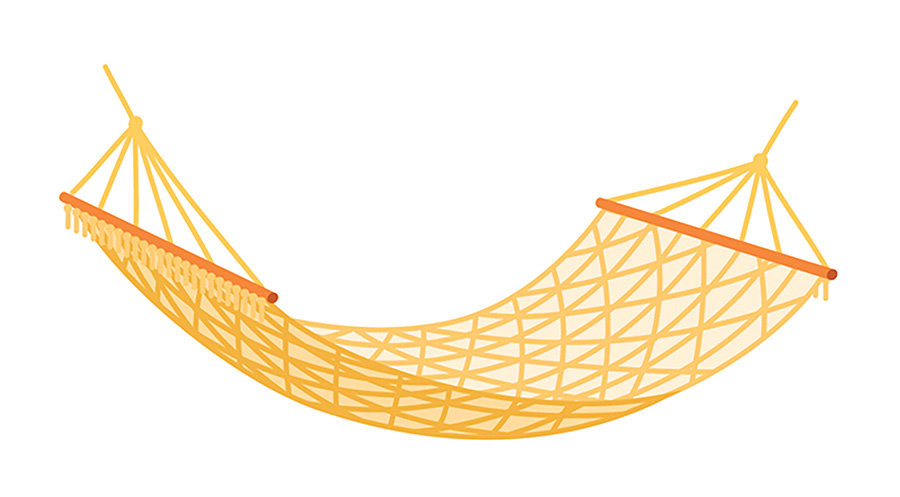
Bring a hammock.

Pisces (February 19 – March 20)

You’re in the weeds, darling. 

Aries (March 21 – April 19) 

Pause before texting back. 

Taurus (April 20 – May 20)

Freeze your pesto. 

Gemini (May 21 – June 20)

Bookmark the recipe. 

Cancer (June 21 – July 22)

Trust your body’s wisdom. 

PinePitch August 2026

PINEPITCH

PinePitch

August 2026

Live After 5

Dance at least part of the night away to the Chapel Hill-based, 10-piece band Liquid Pleasure at Live After 5 on Friday, Aug. 14, at the Village Arboretum, 375 Magnolia Road, Pinehurst. Scarlet Tantrum cranks things up at 5:15, and the music ends at 9 p.m. There will be stuff to keep the kids happy and food trucks for anyone who works up an appetite. For more information go to www.vopnc.org.

Money Monsters

Ever wonder where all that money went? Well Doug Lynam, the author of Taming Your Money Monster will break your problem down into nine “personalities” and offer a way to tame each one of them at 10:30 a.m. on Saturday, Aug. 29, at the Southern Pines Public Library, 170 W. Connecticut Ave., Southern Pines. For more information go to www.sppl.net.

Hot Time in the Old Town

If it’s August it must be First Friday. Florencia & The Feeling, a funk, jazz, Latin-flair pop quintet from Johnson City, Tennessee, takes the stage at 5 p.m. (or thereabouts) on the greenspace beside the Sunrise Theater, 250 N.W. Broad St., Southern Pines, on, yes, Friday, Aug. 7. The band starred at the 2025 FloydFest and the 2024 MerleFest, if all that festing sounds good to you. The local rules don’t change just because it’s hot as you-know-what. No doggies, no outside moonshine. Well, fact is, there isn’t even any inside moonshine, but there will be beer and wine for sale. For more information you can always check out www.sunrisetheater.com

Double Vision

The dueling art openings for August happen on Friday, Aug. 7. The Arts Council of Moore County’s opening reception for the Fine Arts Festival is from 6 – 8 p.m. at the Campbell House, 482 E. Connecticut Ave., Southern Pines. The art will remain on display through Aug. 26. For more information go to www.mooreart.org. The Artists League of the Sandhills’ opening reception for “More Than Miniatures — Small Wonders” is from 5 – 7 p.m. at 129 Exchange St., Aberdeen. The art hangs until Aug. 28. Get more information at www.artistleague.org.

Wrap Your Arms Around This

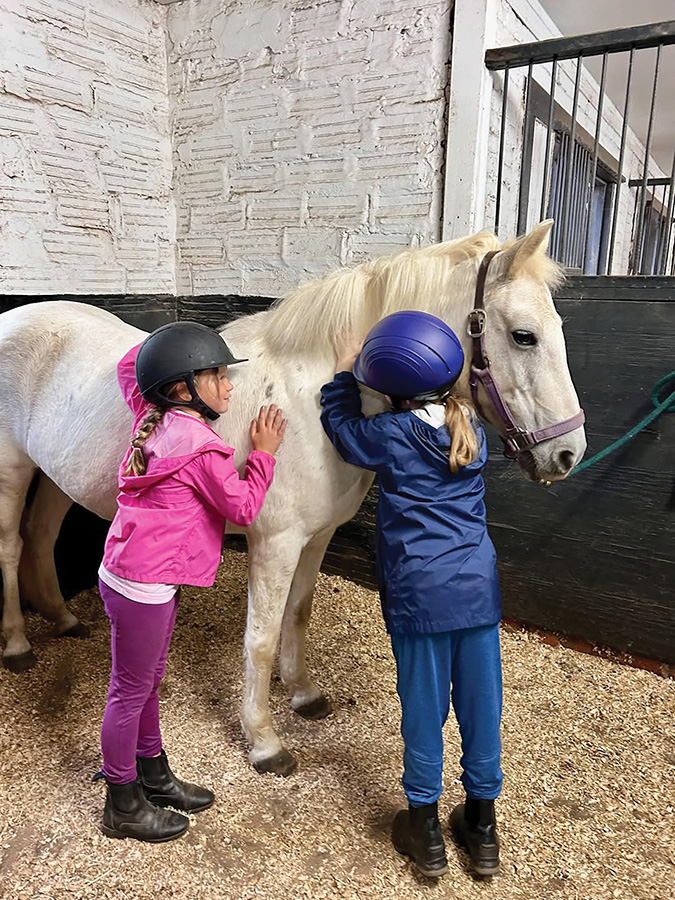
Weymouth Equestrians will hold two sessions of “Hug-a-Horse” at 10 a.m. and 11 a.m. on Saturday, Aug. 22, at the Weymouth Center barn, 555 E. Connecticut Ave., Southern Pines. The squeezing, hugging and patting are free, but tickets are required and limited to 15 per session. For more information go to www.weymouthcenter.org

Pinkie Fingers Up

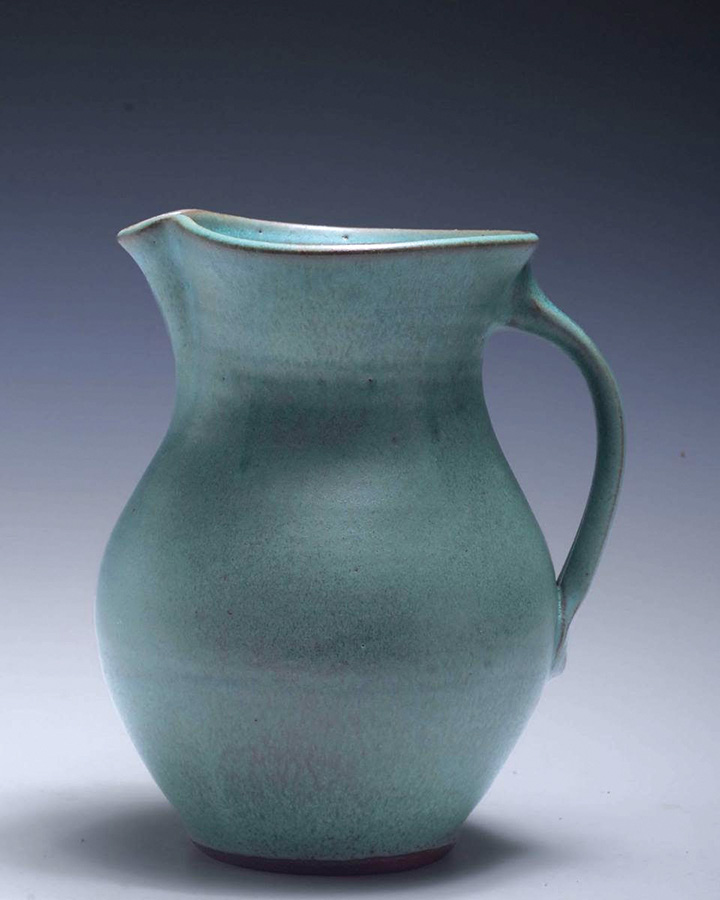
Enjoy a spot of tea and a gallery crawl in Seagrove on Saturday, Aug. 8, visiting Blue Hen Pottery, Dean & Martin Pottery, Eck McCanless Pottery, From the Ground Up, Red Hare Pottery and Thomas Pottery. You can run hot and cold with fancy new tea ware or iced tea pitchers and tumblers. Shops are open from 10 a.m. to 5 p.m. along the N.C. Pottery Highway. Maps are available at all the shops. Each stop will have tea from Carriage House Tea, and homemade treats and samples from The Table in Asheboro and the Seagrove Café. 

Get Your Pollen On

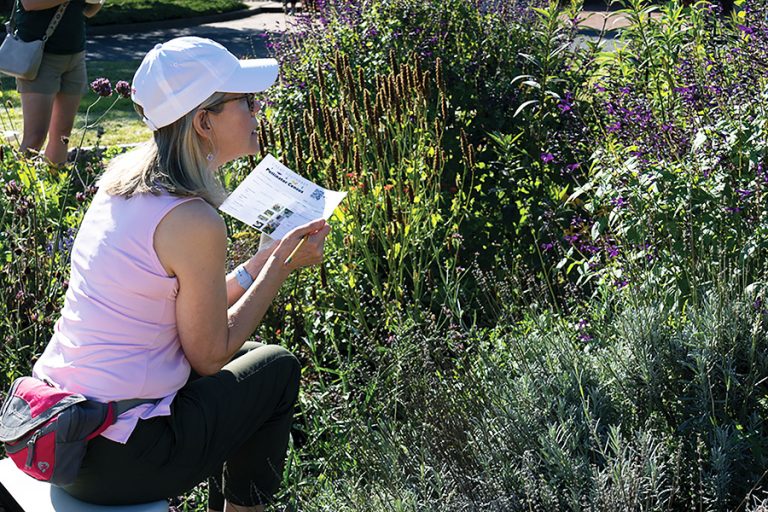
On Friday, Aug. 7, the Southern Pines Public Library and Moore County Master Gardeners will give a presentation at SPPL, 170 W. Connecticut Ave., at 10:30 a.m. on what a pollinator is and why they’re important. Then you can put that knowledge to good use on Saturday, Aug. 22, at 9 a.m., by joining citizen scientists all across the Southeast when you gather data counting pollinators in the gardens at Sandhills Community College. Registration is required. For info on the pollinator presentation go to www.sppl.net, and to join the pollinator census go to www.sandhills.edu/gardenevents.

All Jazzed Up

The Come Sunday Jazz series presents the Brian Felix Organ Trio on Sunday, Aug. 23, at 2 p.m. on the lawn of the Weymouth Center for the Arts & Humanities, 555 E. Connecticut Ave., Southern Pines. Rooted in organ-driven jazz, funk and soul, the trio blends reggae, samba, gospel and surf rock into its distinctive, unified vision. For additional info go to www.weymouthcenter.org.

Cruising Altitude

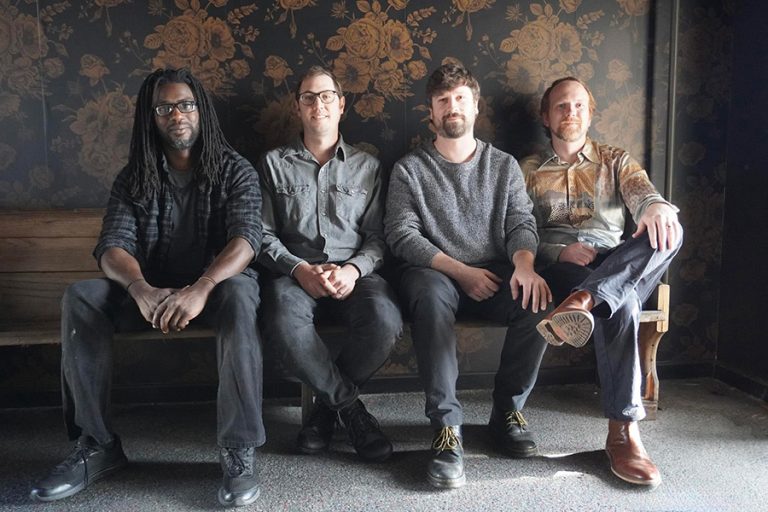
The Nashville-based jam band Airshow performs live with special guest Retrograde at 6:30 p.m. on Saturday, Aug. 22, at The Jive Hive, 2151 Vass-Carthage Road, Carthage. Formed by Cody Chelius and Steve Gallagher, along with Bill Baker and John Rodrigue, the foursome delivers a unique contrast of acoustic and mind-bending electric sounds. For information and tickets go to www.ticketmesandhills.com.

End the Summer Swingin’

The Sandhills Community College Jazz Band takes the stage at BPAC’s Owens Auditorium, 3395 Airport Road, Pinehurst at 6:30 p.m. on Monday, Aug. 10, for “Swingin’ Under Blue Skies.” The concert is free but tickets are required. For info and tickets go to www.ticketmesandhills.com.

State of Mind

STATE OF MIND

Out of Bounds

The good, the bad and the laughable

By Tommy Tomlinson

Illustration by Gary Palmer

This time of year provides one of the great pleasures in life: the golf nap.

I’m not much of a fan of watching golf on TV. I’m a huge fan of falling asleep in the middle of the final round of the Zero Turn Radius Lawn Mower Open or whatever the PGA Tour happens to be running on a given weekend.

The long stretches of quiet . . . the reverent tones of the announcers . . . the polite applause from the crowd . . . they’re better than melatonin washed down with warm milk. When I go down for a golf nap, sometimes I dream of my real-life golf adventures. Not that I was a good golfer. Never broke 100 in my life. But I do have a few stories.

I’m just going to come right out and say this one, even though it will sting every real golf lover like a chest hair wax: I played Augusta National, home of the Masters.

If you are not a golf fan, this is sort of like saying I stowed away in an Apollo capsule and walked around on the moon. Mortals are not supposed to do such things. You basically don’t get to play Augusta National unless you are: 1. a pro golfer; 2. a billionaire; or 3. you know a 1 or a 2.

Except . . . every year the club has a media day — or used to — where the shlubs who cover the tournament get to play. I’m told it’s a lot tougher to get an invitation now. But in the mid-’80s, if you worked for the Augusta paper — which I did — you got one.

Here are the lights, high and low:

• I played with a set of mismatched clubs and wore a pair of Converse high-tops.

• Our playing partners accidentally put their cart into a power slide on a wet patch of grass on No. 10. If the course superintendent had spotted them, we might still be serving time.

• I carded a tidy 13 on No. 12, the short par-3 famously known as one of the thorniest holes in golf. You know one way to make it thorny? Knock four balls into Rae’s Creek.

• My final score was 118, a tidy 46-over.

• However! I parred No. 16, the par-3 where Tiger Woods holed his famous chip in 2005. Almost birdied it myself. (I told you there was a highlight.)

Believe it or not, that was not my most stressful day of golf. My most stressful day of golf was a few years later, in 1992, when I followed through on a pitch I made to my editors at the Charlotte Observer: What if I played all the miniature golf courses in Myrtle Beach in one day?

It soon became clear that, barring teleportation, there was no way to play all the courses in the Myrtle Beach area in a day — there were more than 60 back then. So I restricted my playing area to within 10 miles of the old Myrtle Beach Pavilion. That still left 16 sites, some with more than one course. It took 14 hours — which included drive time between the courses, occasional pee breaks, and waiting for two preteen boys who were in front of me at one course and argued after every single hole. Not that I still think about them or anything.

I played 369 holes in 851 strokes. On the last course I ended up playing with three French tourists. There was no possible way I could explain to them what I was doing.

I had a few other notable moments in my golfing life. I snap-hooked a drive onto a cart path one time and the ball rolled halfway to the next county, a good 500 yards, like that scene in Tin Cup when Don Johnson wins Kevin Costner’s car. I had to shake hands on the first tee of a tournament with a guy who, for reasons too convoluted to go into here, I was pretty sure was going to punch me. (He didn’t.) I watched a friend get so mad he threw his 5-iron up in a tree, then got his 6-iron stuck up there trying to knock it out.

But my playing career ended on a midweek morning at the old Renaissance Park course in Charlotte, now called the Harry L. Jones Sr. Golf Course. I was playing with some friends who were way better than me. Their drives found the fairway. My drives found the rough and the woods and the out-of-bounds markers. At one point I drove my cart across the fairway to track down a wayward shot, and a groundskeeper on a tractor roared over to yell at me for driving off the cart path. (Some courses let you stray from the path, others don’t; I hadn’t known the rules for this course.) He said he had a good mind to throw me out. I have enough stress in my life. I don’t need to get hollered at on a golf course by a guy in a John Deere hat on a John Deere.

A few holes later, I hit my best drive of the day — right down the middle. I don’t think I mentioned that one of the features of this particular course is the large boulders in some of the fairways. My shot hit one of those boulders as square as if I’d aimed it there. The ball rolled halfway back to me. My friends tried, and failed, not to laugh.

In that moment I could hear the golf gods speaking.

Put down the clubs, they said. Go home and have a nap.

The Naturalist

THE NATURALIST

Boxed In

Why the turtle crossed the road

By Todd Pusser

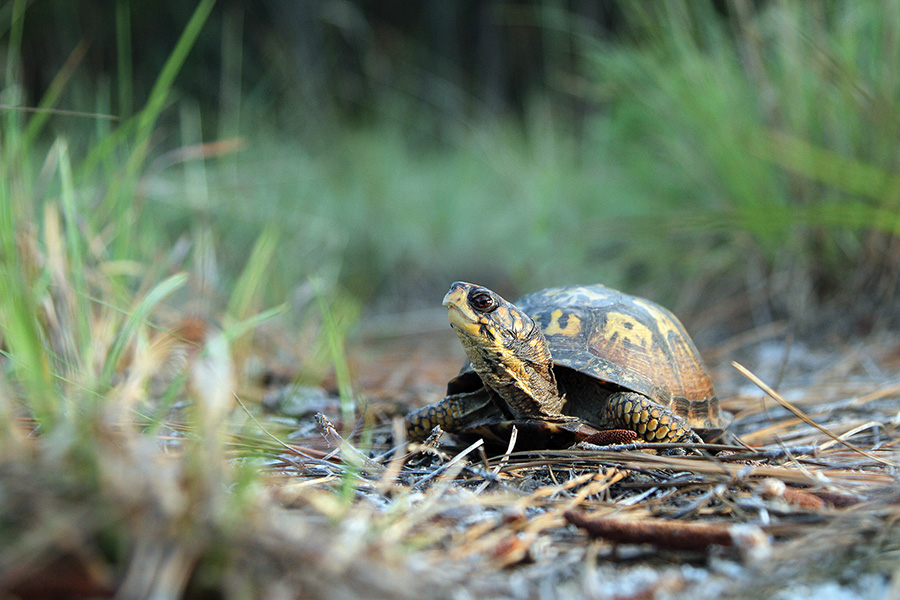
Rays of sunlight penetrate the grey skies hanging heavy over a rural backroad near Jackson Springs. Shallow puddles, left over from an earlier thunderstorm, dot the highway. Up ahead in the road, on a long straightaway, I spot the familiar shape of a box turtle in the opposite lane, near the white line, just making its way onto the asphalt. With head high, the turtle seems determined to get to the other side of the road. Checking for cars in the rearview mirror and not seeing any, I slow down and pull completely off the road onto a grassy shoulder. Hopping out of my car, I look both ways for traffic, then walk briskly back toward the turtle.

Seeing me, the turtle quickly withdraws deep inside its shell. The bottom of a box turtle’s shell is hinged, which allows the reptile to pull all of its body parts, including the tail, head and legs, safely inside, sealing them in like — you guessed it — a box. It makes for an effective defense against predators, but is no match for an automobile.

Box turtles possess high-domed shells that are covered in a smorgasbord of brown, yellow and orange blotches. The patterns of individual turtle shells are as unique as human fingerprints. The turtle on the highway is brightly colored and quite attractive. At over 8 inches in length, I can immediately tell that it is an adult.

Box turtles are long-lived reptiles. On Long Island, New York, researchers found a box turtle in 2002 with distinct markings carved onto the bottom of its shell by a well-known naturalist way back in 1921. At that time, the naturalist, John Treadwell Nichols, counted 22 individual growth rings on a single scute (a large, protective scale) on the side of the turtle’s shell, indicating that the turtle was over 20 years of age. That means when the turtle was rediscovered in 2002, it was over 100 years old.

I reach down and gently pick up the turtle and closely examine its scales, trying to determine its age. Unlike the growth rings of a tree, the individual lines on this box turtle are worn and ill-defined. But they are plentiful. While no centenarian, the turtle has clearly lived a long life. I wonder how many times it has ventured across this highway during its lifetime. Unlike most other roads in Moore County, this particular blacktop is lightly traveled, allowing the box turtle to reach a ripe old age.

I walk the turtle across the road in the direction it was traveling. Had I placed it back on the side of the road from where it had traveled, the turtle would have only attempted to cross the road again once I left, doubling its chances of getting hit by a car.

A box turtle’s home range is small, typically only a few acres in size. As they age, box turtles instinctively familiarize themselves with each and every nook of their range. They memorize where food can be found, where drinking water is located, where the best places are to bury down into the soil for the winter and lay eggs in the summer. Over the course of their lifetime, box turtles use their strong homing abilities to return to those specific locations within their range as they are needed. It does not matter if their routes cross roads filled with cars. All they know is that they need to get back to those familiar spots they are accustomed to using. It is for this very reason that people should never move box turtles from one location to another.

Before I get to the woods on the opposite side of the road, the box turtle surprises me by extending its head from inside its shell. Its bright red eyes tell me it is an adult male. Females have brown colored eyes. Why the turtle was crossing the road here will never be known, but I can guess. Perhaps it was venturing across the asphalt to reach a well-known patch of mushrooms, a favorite food item, on the other side. Or perhaps it was looking for a mate.

In 1979, the N.C. General Assembly recognized the box turtle as the state’s official reptile, due to in large part to their familiarity and cute demeanor. Since then, populations of box turtles across North Carolina have suffered steep declines. Habitat destruction, death by lawn mowers and automobiles, over-collecting for the pet trade, and disease have all contributed to fewer turtles on the landscape.

Reaching the edge of the woods, I gently place the box turtle down onto a bed of golden pine needles. Fully extending its head and legs from its shell, the turtle glances briefly in my direction, then slowly walks deeper into the forest. I wish him luck. Turning back toward my car, I climb in and drive away.

Omnivorous Reader

OMNIVOROUS READER

The Ryan Express

Will we see his like again?

By Anne Blythe

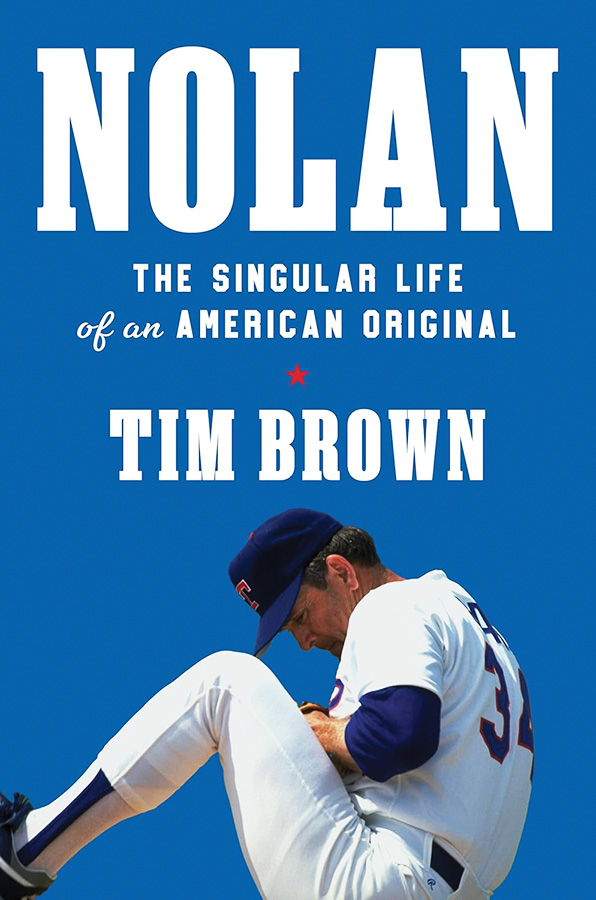
As Major League Baseball enters its stretch run, separating pretenders from true contenders for post-season play, Raleigh-based sportswriter Tim Brown has a new book that diamond purists will want to tuck into.

Although you can’t write a comprehensive Nolan Ryan life story without mentioning the record 5,714 career strikeouts and seven no-hitters, Brown chases a different plotline. In his biography Nolan: The Singular Life of an American Original, Brown goes beyond the box scores that detail the feats of the Hall of Famer with the longest playing career in MLB history. He takes his readers down to Alvin, Texas, the gritty, close-knit small town that shaped the ethos of the league’s ultimate power pitcher whose unparalleled longevity spanned 27 years.

“I think the essence of Nolan Ryan is here, in Alvin” Brown told a contemporary of the pitcher at a senior center Bingo game. “These are the towns that make men like him.”

Alvin doesn’t hide its pride. It has a statue of Ryan, a museum room dedicated to him, and a high school baseball field, junior high and community center named for him. Restaurants proudly display photos of the famous (infamous) headlock that Ryan threw on Chicago White Sox batter Robin Ventura in a 1993 game when the third baseman rushed the mound after a fast ball struck him on the arm. Brown dedicates a whole chapter to that legendary scene and one of the most replayed baseball clips of all time.

Through interviews with people who grew up with Ryan and knew his whole family as well as his wife, Ruth — Nolan’s high school sweetheart — Brown delivers much more than a baseball book. It’s a story of a family, a state and a way of life that led to a relentless work ethic. Brown’s profile of a man who has been the subject of dozens of books also embodies a good bit of myth-busting, while creating a few of its own.

With the gift of vivid storytelling that often sets sportswriters apart from the pack, Brown shows you the young boy pedaling his bike down narrow roads to “dusty ballfields.” You can almost hear the Texas drawl of the longtime Alvin residents swapping their Ryan stories that often have only a tangential connection to the development of the hometown boy’s famous pitching arm.

“Undertake a retelling of Nolan Ryan’s life through the prism of time and discover that the stories of cowboys far outnumber the actual cowboys, which doesn’t make them any less entertaining,” Brown writes. “In real life, we’ve moved on to the drugstore kind, to keyboard outlaws and Fortnite addicts and snowplow parents and participation trophies and cars that drive themselves. Starting pitchers who beg out after five innings and then get handshakes for it.

“Call it evolution if you must,” Brown continues. “What survives in the witnesses is the gooey insides of old age, the pixel-free highlights, and the romantic version of a game played on the last tendril of an ulnar collateral ligament.”

Ryan, the youngest of six children born to Martha Lee (Hancock) Ryan and Lynn Nolan Ryan Sr., was initiated into a tireless work ethic at a young age. He was up before dawn, rolling and delivering the now defunct Houston Post with his father, who also worked in the oil fields. He was steeped in the ranching culture, and grew up in a world where men were taught to do the work and own the outcome, no excuses. They were taught to speak only when necessary and stand by their word.

Brown acknowledges the adversity that Ryan faced in his career — his boom-or-bust years with the Mets, and the lingering feeling that he was unable to live up to his potential coming out of high school as a skinny kid with a triple-digit fastball. And it’s no secret that Ryan’s all-or-nothing pitching style — likely influenced by the Alvin mindset baked into him — led to a high number of free tickets to first base for the batters at the other end of his fast balls. Like another pitcher of his era — we’re thinking Bob Gibson — taking the mound was nothing less than taking charge. Pitcher and hitter were mano a mano.

In an interview incorporated in the prologue of Brown’s book, Ryan takes us to where he is now and the evolution of the sport that has made him an unmatched statistical anomaly and a seemingly untouchable benchmark for pitching durability. Surrounded “by the reminders of a life — not just a career, but a life — built on the ideal of finishing what he’d started,” Brown writes, Ryan leans back in his leather chair, hoists a leg on the edge of the desk and says, simply, “The game has changed.”

“Not mad. Not put out. Just saying,” Brown writes.

Then Brown offers something for the purists to ponder as modern baseball bullpens rely on a parade of specialized relievers for the starters who rarely, if ever, stay on the mound for an entire game.

“Going on six decades after he arrived, that something like a Nolan Ryan happened in the same game that is today’s version is almost inconceivable,” Brown writes. “That it might again is unthinkable. Then, it’s fair to wonder if the game has changed all that much. Or if the men who play it have. That’ll have to work itself out.”

Almanac August 2026

ALMANAC

Almanac

August 2026

By Ashley Walshe

August is a sunflower labyrinth; constellations of black-eyed Susans; the first yellow leaf, descending.

Summer fades like fawn spots: subtly. It’s hard to notice when you’re in the thick of it. When earth bursts with coneflower and primrose. When the forest floor is flush with chanterelles and electric red-orange cinnabars.

We are cradled by lushness.

Wasn’t it yesterday that we were weaving among wild bramble, plucking warm berries, enlivened by the prickly kiss of thorn? Weren’t the fireflies just twinkling, making magic of these balmy nights? Honeysuckle lingers in the sultry air. Bumblebees bustle as if summer, too, were gaining speed.

The garden continues its wild giving. Thistle goes to seed. Apples begin knocking upon the sweetly turning earth.

Back when the fields were soft with daisies, spotted fawns hid in plain sight, silent as dappled sunlight. Then, they knew only mother’s milk and stillness. Now, they know of woody browse, wildflowers, movement.

Hummingbirds flit among cardinal flowers.
The carnival of butterflies delight in all directions.
A golden leaf slow-dances toward the forest bed.

In our nectar-drunken state, we are living beyond time. Dreaming, almost. Lulled by the hum of bees and a purple blur of blazing star.

Summer holds us to her chest. We want for nothing. But something is shifting in the soil that we can’t yet name.

Perhaps it’s the tender ache of being weaned. Of sensing the inevitable. Of letting yourself get swept up in the dreamlike wonder of a seemingly endless summer. 

Homemade Ice Cream

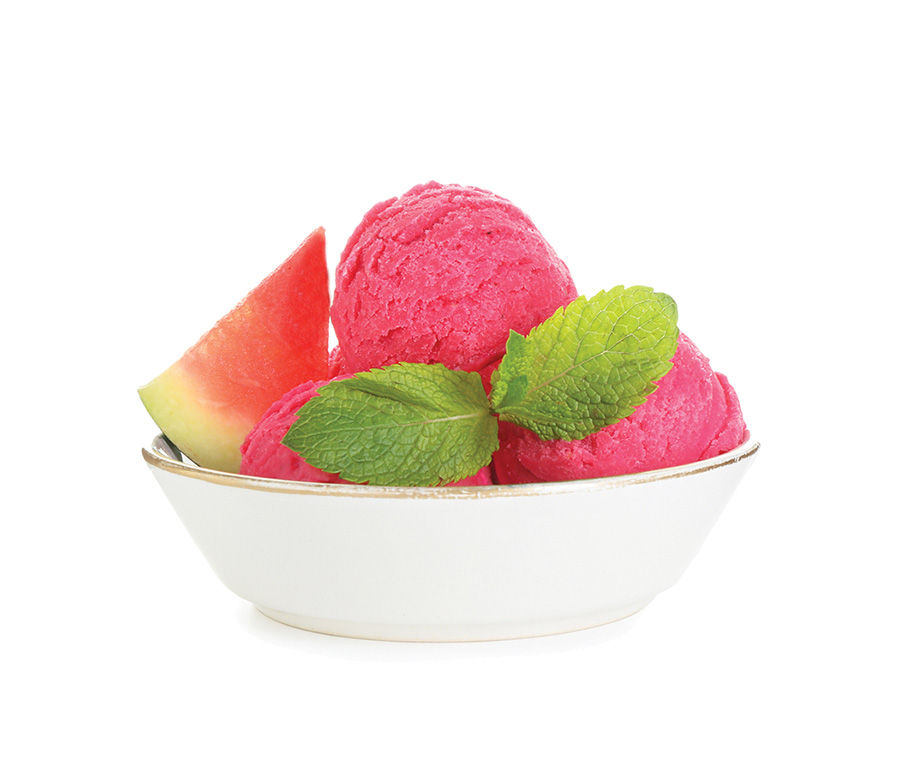
Watermelon ice cream. Nothing says late summer magic quite like it. Especially when you make it yourself.

And it can be simple.

A quick internet search unearths recipes that require as few as two ingredients: frozen watermelon plus (coconut, almond or sweetened condensed) milk or yogurt. Add a pinch of salt for an added pop. Got a blender? Fresh ice cream in no time.

It’s sweet. It’s refreshing And, c’mon, it’s pink.

Serve with a sprig of fresh mint to take it to the next level.

August was nearly over — the month of apples and falling stars, the last care-free month for the school children. The days were not hot, but sunny and limpidly clear — the first sign of advancing autumn.
— Victor Nekrasov

The Big Squeeze

How to get the biggest squeeze of summer:

Freeze your pesto.

Pickle something.

Make honeysuckle sun tea.

Slice a tomato, straight off the vine.

Drift among flowers as a butterfly. 

Listen for the whippoorwill at twilight.

Let the field crickets lull you to sleep.

Wake up and smell the ginger lily.

Watch the clouds reshape themselves.

Arrange a bouquet of wildflowers.

Dip your feet in a tinkling creek.

Nap in a hammock.

Repeat.

Poem August 2026

POEM

Day at the Beach

I’d like to feel again, my six-year-old self

skimming a long, sea oat-surrounded trail

to the ocean like a skipping stone, the wind

in my dark hair, legs pumping like pistons.

And oh, that first plunge into the water, the

squealing — how it felt to be hit by a wave

and tumble to the shore, as light as a shell.

Now, it’s hard to walk the trails to the beach.

Each step works my calf muscles, my bare

feet sinking deep into hot sand. And the sun

is like a blowtorch, not the gentle source of

warmth that I remember, the ocean rife with

dangers I knew nothing about as a child. So

I settle into a folding chair with a book, my

aging body slathered with the highest SPF,

and watch a couple of kids scoop wet sand

into bright plastic buckets while others splash

in shallow pools, their faces the definition of

delight. If only I could snap my fingers, step

out of a body that has become too weary and

cumbersome, and run to the water like I used

to — limbs weightless as a plover, my thoughts

no heavier than a beach ball, a paper kite rising.


— Terri Kirby Erickson

The Leap

THE LEAP

The Leap

Fiction by Ashley Walshe

Illustration by Keith Borshak

I’m not from here. Not exactly.

It’s complicated.

My brother and I were the most celebrated circus performers of our day — and not just because we were twins. We were acrobats, famous for our high wire and flying trapeze act, although you’d have loved to have seen us on horseback. As kids, we were fearless — always climbing something treacherous; doing aerial backflips off any and all surfaces; launching from each other’s shoulders to great and ever-surprising heights.

We grew up in Brooklyn, drawing crowds everywhere from the beer garden to the market to the city park, where a big top scout saw us. Since our parents were German, folks called us “The Wúnderbirds.” The name stuck. Even as teenagers, it was always “Wúnderboy” and “Wúndergirl.” Most people didn’t even know we had real names (Lukas and Mia, in case you were wondering).

Life on the road wasn’t always glamorous. It certainly wasn’t easy. But we loved it. Curious as they were, our troupe was our family. The old-timers became surrogate grandparents, especially Madam Clara, the palm reader who gave us French Chews and spoke exclusively in couplets. We shared sleeping quarters with a mute clown named Prattle and a burlesque dancer named Peep, but most of our downtime was spent coddling Smoke and Mirror, the albino elephant “twins” who went bananas for chin scratches and wildflowers.

Did I mention that we also loved to travel?

The circus took us from one glittering city to the next, and eventually to Europe, where the opulent Old World architecture was unlike anything we’d ever seen. Sometimes we revisited our favorite places in our sleep. In fact, it wasn’t uncommon for us to wake up describing the same alleyway or brasserie or limestone garden fountain — as if we’d both been there. Every once in a while, we even popped into each other’s dreams. We never really tried to do it. It’s just something that we did.

As it would turn out, we could travel like this in waking life as well — something we also discovered by accident.

It was 1896. We were gearing up for another tour, had just spent nearly six hours practicing our aerial routine, and were taking a rest, sitting back-to-back with our eyes closed. We weren’t quite awake, but we weren’t quite asleep. Just some hazy space in-between. And then something indescribable happened. We — how do I say it? — jumped through space. One minute we were sitting beneath the high wire, the next we were standing in front of the soda fountain in the middle of town. I guess we’d both been thinking about ice cream sodas when — whoosh!

It was all quite surreal, quite thrilling. A bit like launching off the swinging trapeze. No one saw us, but when we made it back — two sodas and 12 miles later — Madam Clara gave us “the look.” She knew, and we knew she knew. She gave us a handful of Chews, shook her head, then leaned in close.

“Careful dancing between realms,” she whispered, “lest you’re sure you’re at the helm.”

We knew she was right. Still, after our first leap through space, we were eager to do it again. Who wouldn’t be? And it’s not like we were afraid to jump.

After a great deal of trial and error, Lukas and I learned how to travel through space and time. I can’t really explain it, but it had a lot to do with not trying so hard. That, and we had to be touching. Either sitting back-to-back or holding hands. We were vaguely aware that we were completing some kind of circuit. But what did we really know? Not much.

On our off days, we practiced traveling short distances — five miles or five minutes or maybe both — careful to keep our little stunt to ourselves. Although Clara was on to us, Smoke and Mirror were the only souls who ever watched us leave or return. They never seemed too concerned, especially since we brought them treats. Sunflowers were always a big hit.

We weren’t bored with our little adventures, per se, but we were curious to know just how far we could jump. A decade? A hundred years? It seemed like a bit of a risk, but, then again, risks were kind of our specialty.

So, we made a pact. We’d attempt to leap forward one century, buy ourselves an ice cream soda, then jump back.

That was that.

The night before the big launch, once Prattle was mewing in his sleep and Peep was off “entertaining” a guest, we snuck out of our quarters to meet at the elephant barn, where we’d jump at dawn. Knowing we were coming, Madam Clara was there, sitting in the dark. She’d already seen how things would play out, but she never meddled. She knew we wouldn’t listen if she tried.

“I am not here to change your fate. I’m here to kiss you at the gate,” she told us, wrapping her frail arms around each of us before placing her cracked lips on our foreheads.

We promised we’d be back for breakfast.

“How grand to see the future first,” we chimed.

Clara held her tongue. She placed a French Chew into each of our palms, took our hands for a quiet moment, then said something that still gives me chills:

“If one shall remember and one shall forget, begin anew with no regret.”

We hadn’t a clue what Clara meant her ditties often made sense only in hindsight — but we nodded anyway.

Once Clara left, we climbed into the stall with Smoke and Mirror, whose pink eyes cracked open when they whiffed the treats we brought them. We emptied our tote of the wild sea of ragweed we’d snagged from the roadside at golden hour. The elephants loved it, munching blissfully as we fed them flower spike after delicious yellow flower spike until — achoo!

I sneezed first. Then Lukas. Then me again.

On and on this went until Smoke doused us with a trunkful of water from her trough. What a time to find out we were allergic to ragweed, but if the circus taught us anything, it was the show goes on. Within the hour, at the first blush of light, Lukas and I prepared for takeoff. We held hands, set the intention of jumping 100 years through time, felt that familiar buzz of energy, and — we must have both sneezed — and let go of each other’s hands.

I landed here, in 1989. Seven years shy of a century! Thirty-seven years ago! And Lukas? I still don’t know. We were 18 when we jumped. We’ve been apart longer than we were together.

Sometimes, as I’m drifting off to sleep, I can feel his presence. Like he’s traveling toward me, if only for a visit. But even if we do find each other again, I know now that we can never go back. Not really. Because, here’s the truth: You can’t jump without letting go and beginning anew with no regret. 

PS Profiles August 2026

PS Profiles August 2026

PS Profiles August 2026

The People + Businesses Making Our Community a More Vibrant Place to Live and Work

Photographs by Lolly Nazario