
THE NATURALIST

Boxed In
Why the turtle crossed the road
By Todd Pusser
Rays of sunlight penetrate the grey skies hanging heavy over a rural backroad near Jackson Springs. Shallow puddles, left over from an earlier thunderstorm, dot the highway. Up ahead in the road, on a long straightaway, I spot the familiar shape of a box turtle in the opposite lane, near the white line, just making its way onto the asphalt. With head high, the turtle seems determined to get to the other side of the road. Checking for cars in the rearview mirror and not seeing any, I slow down and pull completely off the road onto a grassy shoulder. Hopping out of my car, I look both ways for traffic, then walk briskly back toward the turtle.
Seeing me, the turtle quickly withdraws deep inside its shell. The bottom of a box turtle’s shell is hinged, which allows the reptile to pull all of its body parts, including the tail, head and legs, safely inside, sealing them in like — you guessed it — a box. It makes for an effective defense against predators, but is no match for an automobile.
Box turtles possess high-domed shells that are covered in a smorgasbord of brown, yellow and orange blotches. The patterns of individual turtle shells are as unique as human fingerprints. The turtle on the highway is brightly colored and quite attractive. At over 8 inches in length, I can immediately tell that it is an adult.
Box turtles are long-lived reptiles. On Long Island, New York, researchers found a box turtle in 2002 with distinct markings carved onto the bottom of its shell by a well-known naturalist way back in 1921. At that time, the naturalist, John Treadwell Nichols, counted 22 individual growth rings on a single scute (a large, protective scale) on the side of the turtle’s shell, indicating that the turtle was over 20 years of age. That means when the turtle was rediscovered in 2002, it was over 100 years old.
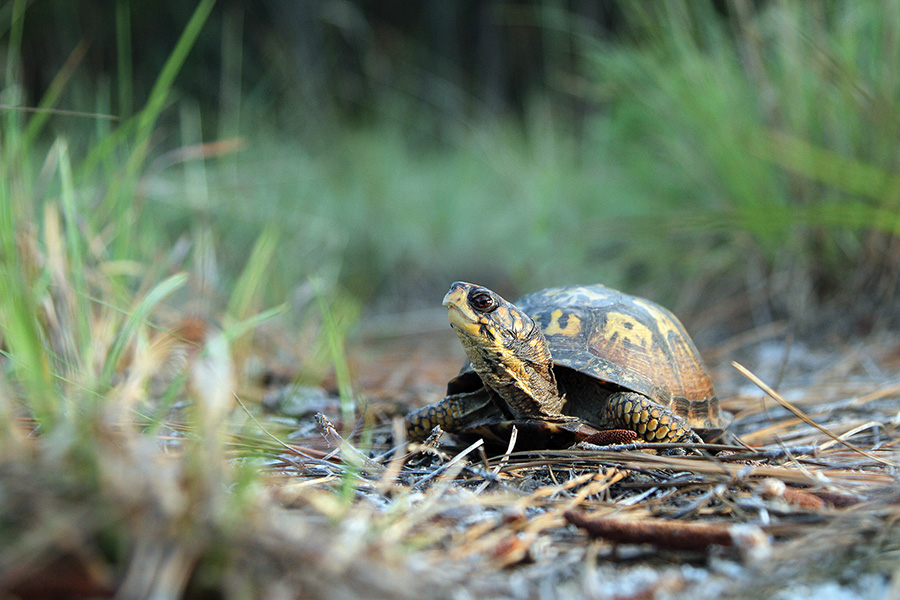
I reach down and gently pick up the turtle and closely examine its scales, trying to determine its age. Unlike the growth rings of a tree, the individual lines on this box turtle are worn and ill-defined. But they are plentiful. While no centenarian, the turtle has clearly lived a long life. I wonder how many times it has ventured across this highway during its lifetime. Unlike most other roads in Moore County, this particular blacktop is lightly traveled, allowing the box turtle to reach a ripe old age.
I walk the turtle across the road in the direction it was traveling. Had I placed it back on the side of the road from where it had traveled, the turtle would have only attempted to cross the road again once I left, doubling its chances of getting hit by a car.
A box turtle’s home range is small, typically only a few acres in size. As they age, box turtles instinctively familiarize themselves with each and every nook of their range. They memorize where food can be found, where drinking water is located, where the best places are to bury down into the soil for the winter and lay eggs in the summer. Over the course of their lifetime, box turtles use their strong homing abilities to return to those specific locations within their range as they are needed. It does not matter if their routes cross roads filled with cars. All they know is that they need to get back to those familiar spots they are accustomed to using. It is for this very reason that people should never move box turtles from one location to another.

Before I get to the woods on the opposite side of the road, the box turtle surprises me by extending its head from inside its shell. Its bright red eyes tell me it is an adult male. Females have brown colored eyes. Why the turtle was crossing the road here will never be known, but I can guess. Perhaps it was venturing across the asphalt to reach a well-known patch of mushrooms, a favorite food item, on the other side. Or perhaps it was looking for a mate.
In 1979, the N.C. General Assembly recognized the box turtle as the state’s official reptile, due to in large part to their familiarity and cute demeanor. Since then, populations of box turtles across North Carolina have suffered steep declines. Habitat destruction, death by lawn mowers and automobiles, over-collecting for the pet trade, and disease have all contributed to fewer turtles on the landscape.
Reaching the edge of the woods, I gently place the box turtle down onto a bed of golden pine needles. Fully extending its head and legs from its shell, the turtle glances briefly in my direction, then slowly walks deeper into the forest. I wish him luck. Turning back toward my car, I climb in and drive away.