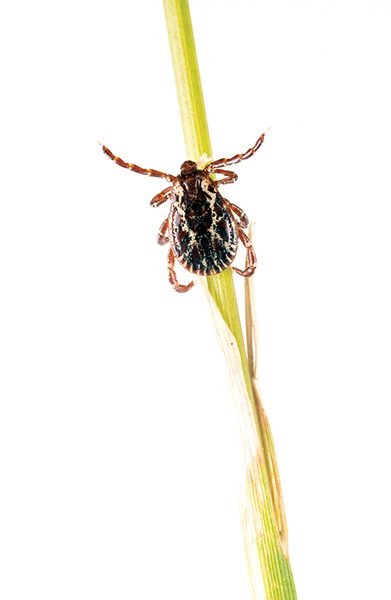
 Vampires are real, though they look nothing like the Hollywood stereotypes who wear dark capes and speak in strange European accents. True vampires possess eight legs as adults (six in larval form) and are not much bigger than a peppercorn kernel. An estimated 900 species can be found crawling the globe, primarily in warm, humid forests across every continent except Antarctica. Some specialize in sucking the blood of rabbits. Others prefer the blood of bats. One species only laps up blood from the inner ears of cows. A surprising number are cold-blooded connoisseurs, preferring the taste of turtles and the occasional snake. And yes — a very small percentage of species bite humans and suck their blood from time to time.
I am speaking, of course, of ticks, the bane of hikers, dog walkers, campers, hunters, gardeners and outdoor enthusiasts everywhere. Despite ticks’ notoriety for sucking blood, most of the general public know very little about them.
Here’s a little factoid to tuck into your memory rolodex — it may be of use the next trivia night down at the local pub. Ticks are not insects. They are arachnids, most closely related to spiders and scorpions, and have been sucking blood for over 120 million years. While T. Rex was chowing down on a Triceratops, chances are good that ticks were chowing down on it.
That’s all well and good. Everything has a right to make a living.
However, it’s what ticks carry in their saliva that make them public enemy number one. Tick spit can harbor a smorgasbord of pathogens — everything from bacteria and protozoa to viruses. The list of diseases that ticks can transmit to humans is fuel for nightmares and fodder for medical journals. Typhus. Rickettsialpox. Q fever. Colorado tick fever. Babesiosis. Hemorrhagic fever. Tick-borne meningoenchephalitis. Bourbon virus (definitely not a disease that causes one to crave Jack Daniels). Tick paralysis. Rocky Mountain spotted fever. Ehrlichiosis. Tularemia. Lyme disease. Heartland virus. Anaplasmosis. The list goes on and on.
One in particular, a strange disease known as Alpha-gal syndrome, has been dominating news headlines of late, due to its rapid spread across the eastern half of the United States. The syndrome, transmitted through the bite of a lone star tick, causes an allergic reaction to a sugar molecule that is found in the red meat of mammals, like cows and pigs. For those unlucky enough to acquire it, the simple act of eating a cheeseburger or a sausage biscuit can trigger an outbreak of itchy skin, bad heartburn, vomiting and shortness of breath. A severe reaction can even result in death. The disease seems to affect people differently. Some have mild reactions to meat. Others are so allergic that even drinking a glass of milk can cause life-threatening anaphylaxis. Some carry the allergy for the remainder of their lives. Others may completely lose the allergy after a few months.
“I woke up in the middle of the night covered in hives,” former Dismal Swamp State Park ranger Tony DeSantis recently told me by phone. His experience was back in 2008, well before Alpha-gal syndrome was mentioned in the news media and on the radar of most clinical physicians.
“It was bizarre,” continued DeSantis. “I could not figure out if I had bug bites or if it was some other rash. It happened a couple of times, and I could not piece it together.” Eventually, he realized that the rash would develop only after eating beef.
“Every time that I ate beef, several hours later, I would break out from head to toe in intense hives,” he said. “It was bizarre. I never had any issues with eating beef before.” Why the sudden change?
The breakthrough came a few months later, when a fellow park ranger pointed DeSantis to a scientific paper linking the bites of lone star ticks to an allergy of the sugar molecule, alpha-galactose, found in the meat of mammals. “That’s when it clicked for me,” DeSantis said. “I knew my rash was the result of a tick bite.” Working at the state park for six years, pulling ticks off clothing and skin while walking the trails, had become a daily routine — just part of the job. DeSantis recalled one researcher, who had visited the swamp years before, remarking that “it was the tickiest place that they had ever seen.” Lying along the border of southeastern Virginia and northeastern North Carolina, the state park is nestled within the Great Dismal Swamp, an enormous wilderness area of nearly 150,000 acres. It is the largest remaining swamp in the Eastern United States.
Finally linking tick bites to his beef allergy gave DeSantis some peace of mind, but it required making a committed lifestyle change. “Since 2008, I have just avoided beef and have never had a problem,” DeSantis said.
This past summer, I ventured onto a friend’s property bordering the Great Dismal Swamp with Maurice Cullen, a retired Virginia Beach science teacher and amateur lepidopterist. Our goal that evening was to find and photograph caterpillars and moths. Over six hours, we documented dozens of species. Returning home late that night, I jumped into the shower before bed and immediately discovered three lone star ticks, easily recognized by the large white dot on their abdomen, embedded deep in my skin. One was attached to my shoulder, another to the back of my neck at the edge of my hairline, and the third . . . well, let’s just say it was somewhere less pleasant.
I texted Maurice warning him about the ticks. He replied that he had not found a single one on his clothes or skin. Lucky me. I guess I am a tick magnet.
With tweezers, I carefully removed each one and flushed them down the toilet. I have been bitten by dozens of ticks in my lifetime, and thus far, I have yet to experience any serious reactions to their bites. Knock on wood. Still, over the following weeks, I paid close attention to what my body was telling me, constantly checking for weird rashes and noting any feverish symptoms. As someone who relishes a good cheeseburger, I am not sure I have enough willpower to change my diet like DeSantis.
While tick diseases are certainly scary, there is no need to fear the outdoors. It is important to understand that not every tick carries a disease. If you do find a tick crawling on you, remember that it needs to bite you in order to transmit disease. Even then, research suggests that a tick needs to be attached for at least 24 to 48 hours to transmit most diseases. Checking your body thoroughly soon after each outing is the most effective defense against the little vampires.
So go on that hike. Take the dog for a walk. Take your kid camping. The wonders of the outdoors far outweigh the risks. PS
Naturalist and photographer Todd Pusser grew up in Eagle Springs. He works to document the extraordinary diversity of life both near and far. His images can be found at www.ToddPusser.com.