Jack’s Lanterns

Jack's Lanterns

Jack's Lanterns

The joy and wonder of carved pumpkins

Story and Photographs by Todd Pusser

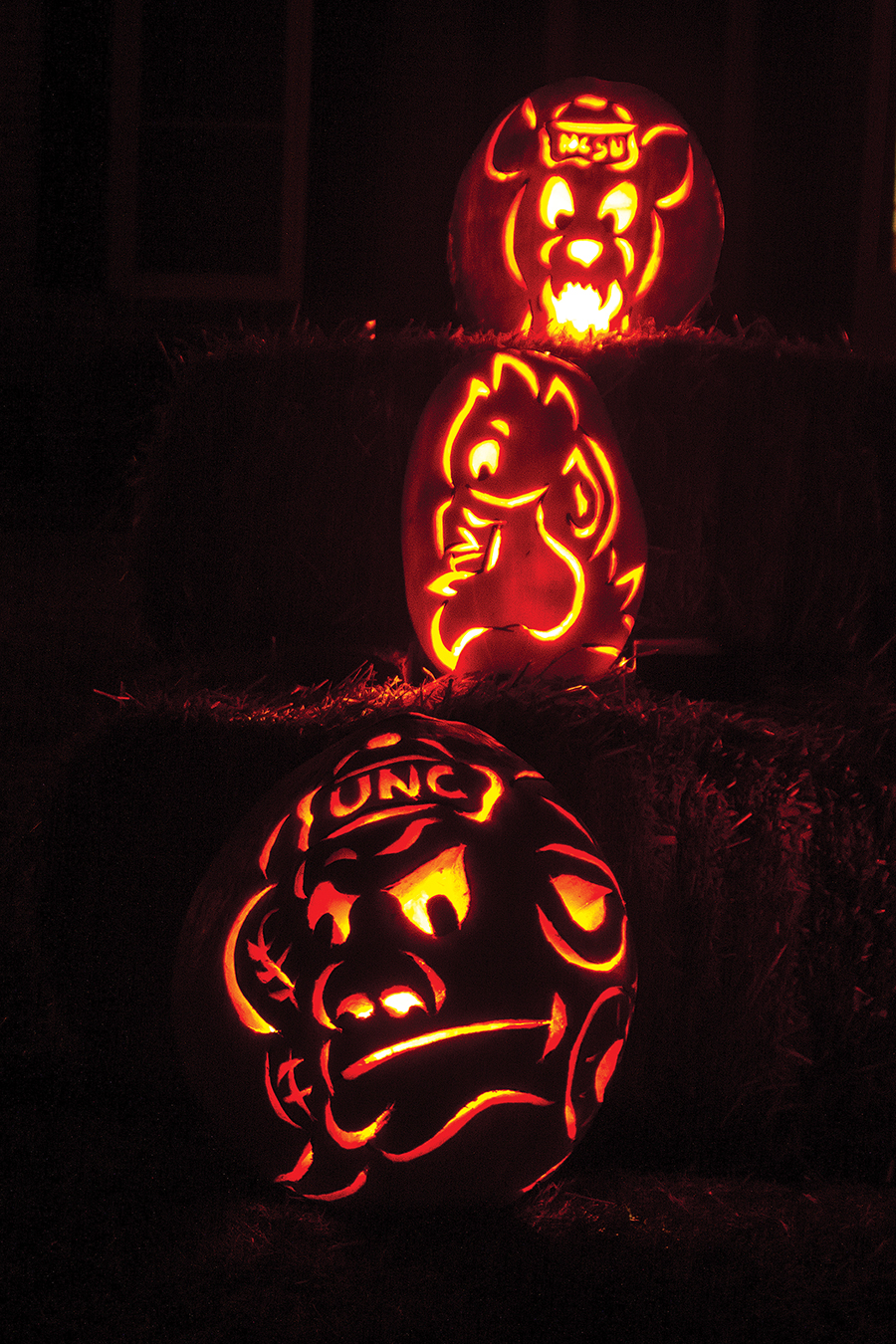
In the fall of 2011, our family displayed one last, grand pumpkin show. It was an event that my parents still talk about to this day. That year, the autumn weather was glorious, filled with bright, warm sunny days and cool, crisp evenings. A full week was spent prepping the front yard for the throngs of people that would venture out to our rural Eagle Springs home just to see a display of carved pumpkins. These were not just any run-of-the-mill jack-o’-lanterns with triangular eyes and teeth, mind you, but pumpkins that glowed with the faces of popular cartoon characters, collegiate mascots, famous movie stars and wild animals. Bales of hay were stacked high across the front yard. Scarecrows were staked into the ground. And tiki torches lined the drive.

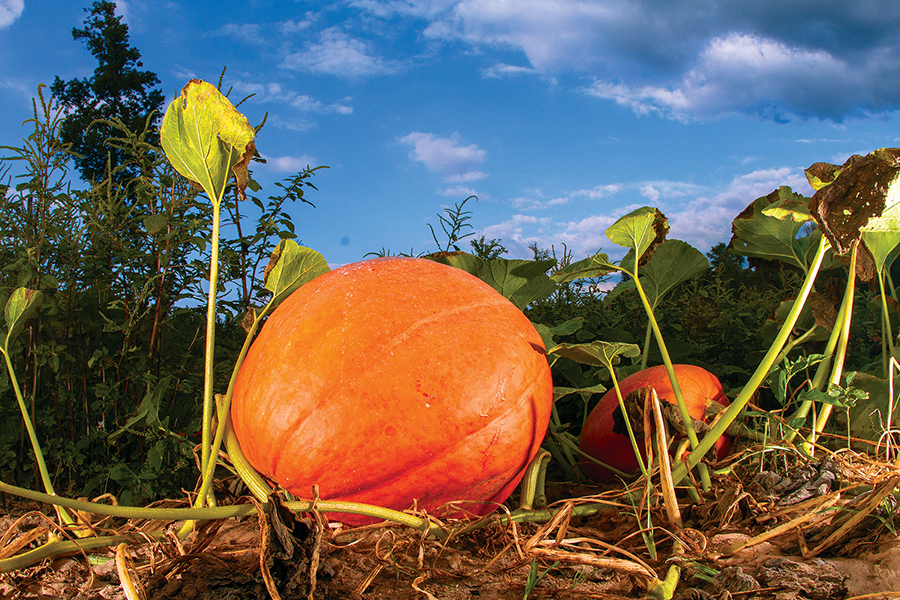
A local farmer, Charles Martin, had kindly volunteered to grow us a crop of pumpkins on a portion of his property. We picked the pumpkins, an extra-large heirloom variety known as Mammoth Gold, from his dusty field the first week of October, and by the time Halloween weekend rolled around, I had carved over 200 of the giant gourds. Mammoth Gold pumpkins average around 40 pounds in weight and are bright orange. Their skin is relatively soft and pliable, making them much easier to carve compared to store-bought pumpkin varieties, like Sugar Pies or Connecticut Field pumpkins, which have thick skins, dense fibrous insides and long stems.

Over 8,000 people visited the yard during the three nights that we displayed the pumpkins. People had traveled all the way from Greensboro and Fairmont just to see jack-o’-lanterns glowing beneath a star-filled sky. We asked that visitors donate cans of food for local charities, which they did by the truckload. It was the highlight of our year.

Jack-o’-lanterns displayed on the front doorstep on Halloween night are as iconic as Christmas trees and baskets of Easter eggs. They are holiday symbols that have become fully ingrained in our American culture over the last 150 years. In her book Pumpkin: The Curious History of an American Icon, author Cindy Ott notes that the first published image of a carved jack-o’-lantern appeared in an 1867 issue of Harper’s Weekly magazine. However, the origin story of jack-o’-lanterns takes place on the far side of the Atlantic, in the woodlands and moors of the Old World.

Centuries ago, ancient Celts of Ireland and Scotland celebrated the end of the harvest season in a festival known as Samhain. The festival commenced at sunset on Oct. 31 (Samhain’s Eve) and continued until sunset on the following day. During that first night of celebration, the Celts believed that the spirits of the dead would walk about the land, freely among the living. In order to ward off those restless souls, people would dress in frightening costumes and carve scary faces into root vegetables like turnips and potatoes.

Originally cultivated in North America over 7,000 years ago, pumpkins, a type of winter squash, were at the time completely unknown to Europeans. They would not encounter pumpkins until much later, when the first Colonists arrived on our shores and discovered Native Americans growing the fruit (yes, pumpkins are scientifically a fruit and not a vegetable) as a crop. Among those early European settlers were Irish immigrants who brought with them the legend of Stingy Jack.

Though countless versions of this tale have circulated through the centuries, all agree that Jack was an unlikeable character who had a penchant for tricking people. In one recurring tale, Jack even tricked the devil. Not one to trifle with, the devil banned Jack from hell when he died. Due to a lifetime of mischievousness and immorality, Jack had already been denied access to heaven. He was soon cursed to wander between both worlds for eternity, with only an empty turnip lantern to guide his way. Eventually, the devil felt pity for Jack and granted him a single ember of coal to light his lantern on his journey through purgatory. And the jack-o’-lantern was born.

My fascination with carved pumpkins dates back to my earliest childhood days in Eagle Springs. Like most kids, I loved Halloween. I planned my costumes months in advance. Devouring Mary Janes and Bit O’Honey candies, as well as Reese’s Peanut Butter Cups, acquired from a night of tricks or treats was one of life’s great pleasures. To no surprise of anyone who knows me, It’s the Great Pumpkin Charlie Brown was, and still is, my favorite TV show.  So, when my parents took me to see a display of jack-o’-lanterns at a local farm one crisp October night, I quickly became obsessed with the glowing gourds. The farmer, Otis Boroughs (who taught in Moore County schools for 30 years and would later become my driver’s ed teacher), grew a large field of pumpkins each summer near my grandmother’s house.

Turns out Mr. Boroughs also had an artistic side. He would carve extraordinary scenes into the pumpkins he harvested and display them each and every Halloween night for all to see. People traveled from all parts of the state to see his magnificent jack-o’-lanterns. Dozens and dozens of glowing pumpkins lined his yard and the loft of his old red barn. Everything from Mickey Mouse to Bugs Bunny and E.T. to the N.C. State wolf mascot were on display. One of his most popular was of a horse-drawn carriage, carved over multiple pumpkins, with Cinderella sitting inside.
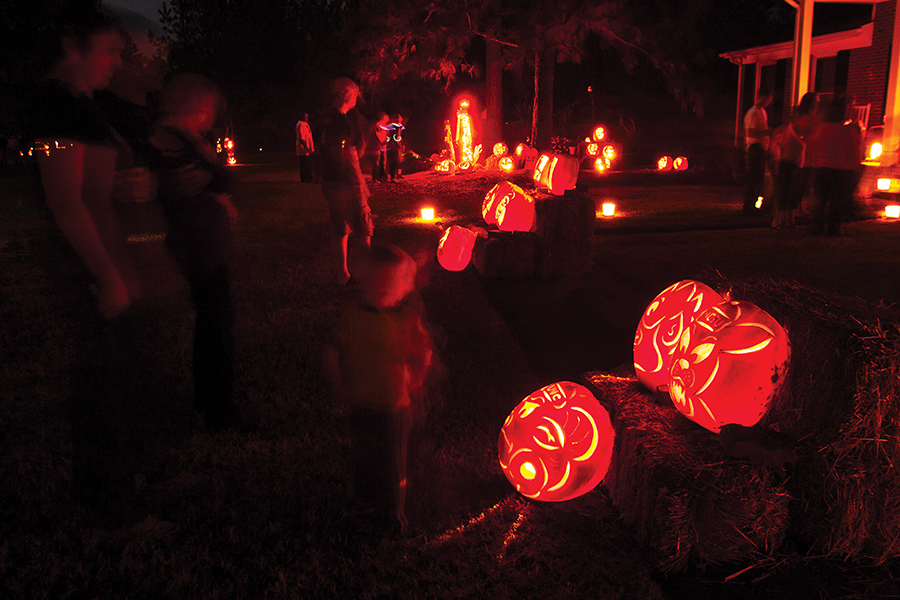
For a kid who loved to doodle and had notebooks full of drawings of dinosaurs and snakes, I could not figure out how he had carved such intricate characters into the sides of the giant gourds. I would spend hours walking among his glowing creations as the aroma of baked pumpkin pie (from the candles burning inside) hung heavy in the cool, evening air. It was magical.

For years, I pestered Mr. Boroughs to teach me how to artfully carve a pumpkin. Finally, one Saturday afternoon, after the fall harvest, he relented. I was around 10 years old at the time. That day in his workshop, surrounded by tools and tractors, he taught me the trick to great pumpkin carving.

First, you must choose a pumpkin that fits the design that you have in mind. That day, I had brought with me some permanent markers to draw the Demon Deacon, the mascot of Wake Forest University — my dad’s favorite team — on the side of a pumpkin. Mr. Boroughs picked out a rather tall, oblong-shaped pumpkin that was able to stand upright on its own. It matched well with the long face of the Deacon. After a few minutes, I had completed my drawing.

Next came the most important part, choosing the proper knife to carve out the design. Mr. Boroughs’ tool of choice was a 12-inch compass hand saw with a small metal handle. The narrow, finely serrated blade enabled him, and me, to work magic on a pumpkin. With that simple blade, I easily cut out the sharp corners and intricate patterns, like the eyes and bowtie, of the Demon Deacon. It was much easier to use than the large straight-edged blades I was accustomed to using when cutting out the stereotypical triangular eyes, nose and mouth of past jack-o’-lanterns.

The crowning glory was when Mr. Boroughs placed a candle inside the pumpkin and turned off the lights in the workshop. The face of the Demon Deacon exploded to life, casting a golden glow throughout the tool hed. It was jaw-dropping. No doubt, this is what those early Irish immigrants felt when they put candles in those first pumpkins instead of turnips.

With that afternoon’s pumpkin carving class fully embedded into my memory bank, I went on my way. That Halloween, I carved out a half-dozen jack-o’-lanterns, following the outlines of my hand-drawn designs, including a ghost and caricatures of Mickey Mouse and Godzilla. The only people to see them were my parents and grandmother. My father loved the Demon Deacon. Still, Mr. Boroughs insisted that I tell no one the secret sauce for carving extraordinary pumpkins.
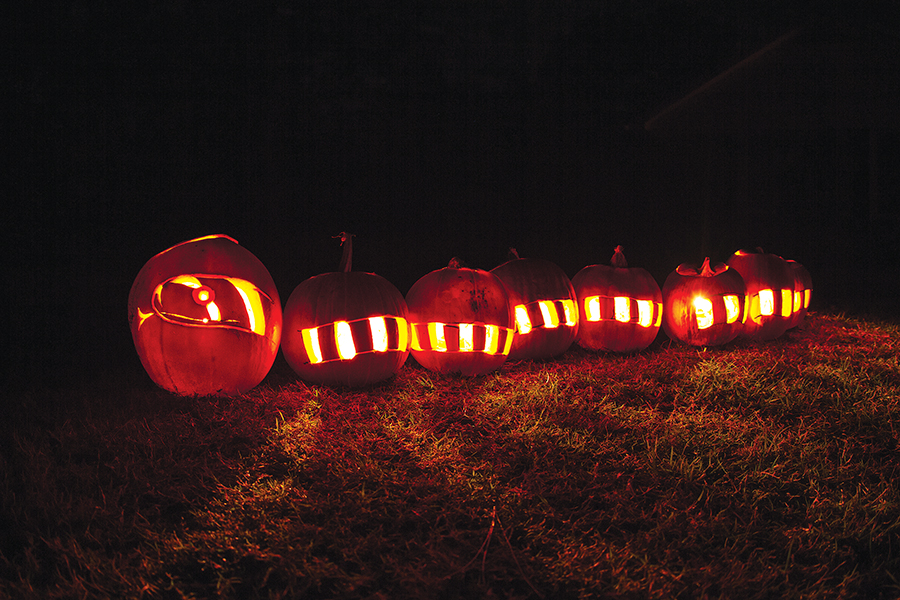
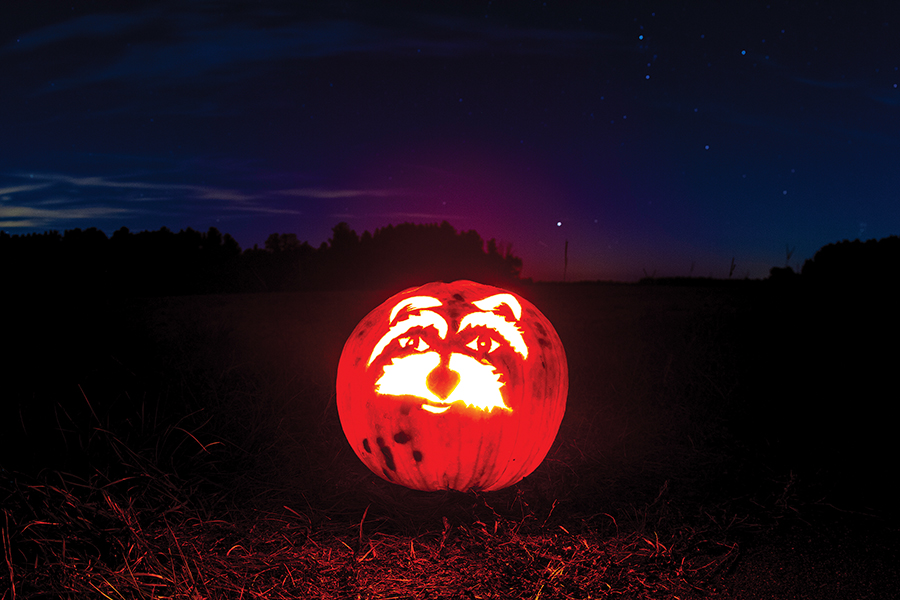
Throughout my teen years, Mr. Boroughs continued his annual display of jack-o’-lanterns, drawing ever larger crowds. His pumpkins were featured in newspapers and on local television stations. Despite being distracted by the usual teenage boy preoccupations of sports and girls, I made it a tradition to visit his farm each and every Halloween.

But alas, all good things come to an end. Father Time finally caught up with Mr. Boroughs. The toll of tending a pumpkin field and carving over a hundred jack-o’-lanterns each year became too much, and he eventually closed his grand pumpkin show for good in the late 1990s. To say I was disappointed is an understatement. His pumpkin display had meant so much to the communities of Eagle Springs and Jackson Springs. The thought of local kids not experiencing the same kind of wonderment that I had experienced as a child viewing his marvelous jack-o’-lanterns was simply too much to bear.

After a couple years of dark Halloween nights, I decided to follow in the footsteps of Mr. Boroughs and create a pumpkin show of my very own, this time in the yard of my childhood home, just a few miles from his farm. The yard was just shy of 2 acres and could easily accommodate many pumpkins, as well as long lines of people. And that is exactly what I did for nearly a decade, culminating in that last pumpkin display in 2011. By that time, life and work had begun to take me far away from Eagle Springs. It became impossible to commit to the time necessary to produce such a large show, so I hung up my carving knives.

Since then, things have changed dramatically. The secret sauce for great pumpkin carving is now readily available to everyone, with mass-produced pumpkin carving kits showing up on store shelves well before Labor Day. Countless online stencils, of every subject imaginable, can be downloaded and applied to pumpkins for easy carving. One can even buy artificial carving pumpkins so you can preserve your jack-o’-lantern for years to come.

Mr. Boroughs passed away in 2024, at the ripe old age of 87. Eagle Springs farmer Charles Martin followed soon after, in February of this year.

I am now a proud parent to a precocious 7-year-old girl named Ella. She has an artistic side herself. Every year, we try and make a point to carve at least one jack-o’-lantern for Halloween. Perhaps this year she will want to carve out a character from the hit K-Pop Demon Hunters since she is constantly singing the movie’s songs on the way to school. Or, after seeing Toy Story 5 this past summer, she may want to try a Buzz Lightyear.

Or maybe, just maybe, I can convince her to carve a horse-drawn carriage with Cinderella sitting inside — for old times’ sake.  PS

Prost, Y’all

Prost, Y'all

Prost, Y'all

Pines, ponies, porch swings and a stein full of Bavaria

By Warren Henry Lewis

Photographs by John Gessner

Feature photo: Ben Lewis, Emily Von Cannon and Warren Henry Lewis at Railhouse Brewery

Remember when we lived in a small town, the kind of place where you gave directions like “if you get to Red’s Exxon you’ve gone too far”? We’ve grown up some since then — a few more roundabouts, which I don’t want to discuss, a few more golf courses, and some great new neighbors up the road — but nothing’s touched the two things that matter most: the pine trees and our unshakable belief that any excuse to gather outside is a good one.

In October, somewhere between the second julep and the third round of “who makes the best pimento cheese,” Moore County goes full Bavaria. So what if Munich’s version begins in the middle of September and runs until the first Sunday in October? At least we’re in the queue. For a few golden weekends, we swap the porch for the biergarten and nobody blinks. Bavaria gave the world lederhosen, oompah bands, and a beer stein you need two hands and a chiropractor to lift. We gave the world the steeplechase, the pine-shaded front porch, and a fierce, decades-long opinion about how to dress a pimento cheese sandwich. Different heritage, same instinct: get dressed up, stand in a field, toast to nothing in particular. By November we’re back to seersucker and sweet tea.

We already gather by the thousands for a golf tournament and treat it like a religious observance. And we’ve been known to put on our finest tweed to watch horses jump over things. Adding a polka band and a plate of bratwurst to the calendar isn’t a stretch. It’s just one more excuse.

None of this is new for us, if I’m honest. I’ve lived here long enough to watch the county become a little bit of everywhere. Retirees roll in chasing sunshine. Military families cycle through Fort Bragg, importing a piece of wherever they’ve come from. Golfers from around the world bring their love of the game and our community. Riders and trainers show up every autumn from as far away as Kentucky and overseas for horse country season. By now, Moore County isn’t really one thing, it’s a lot of things, filtered through tall pines and slow afternoons. A German beer garden is just the latest arrival at the party.

I’ll admit the setting helps the illusion along. Bavaria has its Black Forest, dark and fragrant with fir. We’ve got the longleaf pines, and on a crisp evening at Weymouth Woods, with that turpentine smell in the air, it isn’t hard to squint and think you’re somewhere far grander and colder. Swap the fir for the longleaf, the alpine chill for a Sandhills breeze that still remembers summer, and you’ve got a passable Bavarian backdrop. Minus the yodeling. (Tell the truth, did you hear the Ricola ad in the back of your mind?)

The village of Pinehurst throws its own Oktoberfest at Tufts Memorial Park. Kinderfest opens the evening — a couple of hours of music, crafts, bubble artistry and a nod to Halloween for the kids — before the grownups take over with German music, food and beverages that need no translation. It’s free, it’s friendly, and the crowd is exactly what you’d expect: a few actual dirndls, several ambitious attempts at lederhosen, golf carts neatly parked in rows, and a lot of people who simply came as themselves, beer stein in hand.

There’s something wonderful about watching a man who spent his afternoon in seersucker switch by evening into suspenders and knee socks; or a woman who traded her sundress for a dirndl like she’d been doing it her whole life. The Sandhills needs no excuse to play dress-up.

A bit down the road, Railhouse Brewery has been running an honest-to-goodness Oktoberfest for more than a decade. I go most years for the curry brats and stay for the hammerschlagen, which, if you’ve never seen it, is kinda like cornhole for people who enjoy hitting things with a hammer while a crowd of strangers cheers them on. There’s stein-holding too, which separates the casual reveler from the truly committed, and relay races that end, as most good ideas in the Sandhills do, with everyone a little out of breath and ready for another round.

None of this makes us honest-to-God Bavarians, and I’m not claiming otherwise. What it makes us is a place willing to borrow a good time when we see one — take a festival built for beer halls and mountain villages, and set it down happily among the pines, the ponies and the porch swings. We’ve spent more than a century collecting traditions from elsewhere and making them feel like home: the hunt from England, golf from Scotland, sweet tea from points South, and now, on a crisp weekend each fall, a beer garden from Bavaria. Does life get any better than that?

So pour something cold, find a polka you can stomp along to even if you can’t name it, and raise a glass to the strangest, most delightful thing about Moore County: We’ll find any excuse — horses, hounds or hops — to get dressed up, gather outside, and celebrate together. I hope my lederhosen still fit! Prost, y’all.

————

Let’s talk curry brats. Delicious. Pair them with a great stone-ground mustard and my potato salad. Below is a recipe for the brats, but it’s really OK to pick them up in a good supermarket or meat market if you don’t want to make your own.

Curry-Flavored Bratwurst

Yield: 12 sausages

Preparation time: 30 minutes, plus chilling time

Ingredients

(It’s important to keep everything nice and cold while you’re making these or any sausage.)

2 pounds (900 grams) ground pork, preferably 20–25 percent fat

1 1/2 tablespoons mild curry powder

1 1/2 teaspoons kosher salt

1 teaspoon ground coriander

1 teaspoon ground cumin

1/2 teaspoon turmeric

1/2 teaspoon black pepper

1/4 teaspoon ground ginger

1/4 teaspoon cayenne pepper, optional

2 cloves garlic, finely minced

1/2 cup cold beer, broth or water

2 tablespoons finely minced onion

1 tablespoon brown sugar

1 tablespoon Dijon mustard

1/4 teaspoon ground nutmeg

Sausage casings, if making links


Directions

1) Chill the pork, mixing bowl and grinder parts until very cold.

2) In a small bowl, combine the curry powder, salt, coriander, cumin, turmeric, black pepper, ginger, cayenne pepper, garlic, onion, brown sugar, Dijon mustard and nutmeg.

3) Add the seasoning mixture to the cold ground pork. Pour in the cold beer, broth or water.

4) Knead the mixture for 2–3 minutes, until it becomes sticky and holds together.

5) Fry a small sample of the mixture in a skillet. Taste and adjust the seasoning as desired.

6) Cover and refrigerate the sausage mixture for at least 1 hour, or preferably overnight.

7) Stuff the mixture into sausage casings and twist into links. Alternatively, shape it into patties.

8) To cook, place the bratwurst in a skillet with a small amount of water or beer. Cover and cook gently for about 10 minutes.

9) Remove the lid and continue cooking, turning often, until the bratwurst is browned and reaches an internal temperature of 165°F

Serving Suggestions

Serve with sauerkraut, German mustard, my warm potato salad, grilled onions or crusty bread.


Warm Potato Salad

1 1/2 pounds red bliss potatoes, quartered

1 tablespoon blended oil

1/3 cup shallots, sliced into rings

4 cloves garlic, smashed

1 tablespoon balsamic vinegar

2 tablespoons red wine vinegar

1 teaspoon unsalted butter

2 tablespoons chopped parsley

Kosher salt and fresh cracked black pepper


Wash your potatoes well.

Put them in a pot large enough to cover them with water by 2 inches. Add enough kosher salt until you can just barely taste the salt.

Bring the water to a boil, and then lower to a simmer. Cook the potatoes until a bit more than fork tender, but not falling apart.

Let’s multitask: at the same time, in a pretty large sauce pan, warm until the oil starts to shimmer.

Add the shallots and garlic.

While the shallots and garlic are slowly doing their thing, drain the potatoes. Now, toss the potatoes with the shallots and garlic. Toss them rough enough to kinda bust the potatoes up.

Turn the heat off. Add the two vinegars, the butter and parsley.

Season with salt and pepper.

Bookshelf

Bookshelf

October Books

FICTION

Peck & Peck, by Bonnie Garmus

It’s 1982, New York City. Crime is on the rise, muggings are in the streets, and Batter Gray, a recent college graduate with a skill that no one wants — an “ear” for poetry — is worried about his future. While all of his friends have real jobs, he’s folding T-shirts at the Gap. As for love? No. Not unless you count Sallie Mae, the student loan tyrant. He hears from Sallie all the time. But when Batter gets a dream job at Peck & Peck, the most prestigious poetry quarterly in the world, his life moves into the literary fast lane. Soon Batter is knee-deep in the secret war between the two editors-in-chief, the famous Peck brothers — twins and enemies — as well as being privy to the private affairs of their 39 editors, whose professed mission is the same: Find originality. Reward creativity. Burn the rest. And by burn, they mean incinerate.

Odette Rising, by Julianne Edwards

It’s 1896 in Sèvres, France, and from her bedroom window, Odette Huré watches a funeral procession carry her father’s coffin away. She is 21 and has not left the house for 10 years. Odette looks on as her life passes, reading and soothing herself with food. But with the sudden death of her father, the walls she has built around herself begin to crumble. Forced into the world, she discovers that she’s responsible for her father’s considerable fortune and his celebrated stockings factory — renowned for its exquisite designs that adorn the slender ankles of Parisian femmes célèbres. Now Odette must try and navigate the world she has hidden from for so long. In doing so, she unearths secrets left behind by her father and the shocking truth of her own identity.

Luna, Phoenix, Queen, by Julie Orringer

Dava and Barr Pennington, professors at a Midwestern university, both harbor potent secrets. Fiction writing is his specialty; English literature is hers. But Dava is unhappy in their marriage, and secretly in love with a colleague, Svetlana White, who teaches in the Russian Studies department. Spurred by their complicated liaison, she spends her nights working on a novel about two women who run a domestic violence shelter in coastal Maine. Though she loves the work and the refuge it provides, the writing becomes increasingly difficult as her memory begins to fail; tests reveal that she’s suffering from early-onset Alzheimer’s. After a precipitous decline, she moves to a memory care facility in a neighboring town. Soon afterward, her husband, alone in the house at night, discovers her hidden manuscript, which he reads with envy, and then with anger. Over the next two years he rewrites the novel and publishes it as his own, to wide acclaim. But persistent feelings of guilt lead him to confess his theft to an unlikely party, who leads others to the truth. Luna, Phoenix, Queen tells its tale of artistic and marital betrayal in a chorus of voices.

NONFICTION

Simply Ina: A Barefoot Contessa Cookbook, by Ina Garten

Through her years of experience as a home cook, Garten has learned that the best food is often the simplest. With just a little thought and a few good ingredients, you can make truly impressive dishes without spending hours in the kitchen. Simply Ina, a new collection of 85 easy yet impressive recipes for every meal of the day, celebrates the delicious results of streamlined cooking, sharing expert tips and tricks for achieving the best flavor with the least amount of effort. Each recipe has a secret that makes preparing it easier than you thought. Whether you’re feeding unexpected guests, pulling together a Tuesday night dinner after work, or hosting a dinner party and don’t want to miss all the fun cooped up in the kitchen, you’ll be happy to have these simple, satisfying and completely doable recipes. Because simple food shouldn’t just save you time, it should let you enjoy the people you love.

CHILDREN’S BOOKS

This Is How to Spot Animals!
by Aline Portman

Shhh! Don’t move! Bear is spotting animals. One day he hopes to find a red-breasted goose. A beautiful animal! And very rare. But today he has no luck. There is nothing to see. Spotting animals is not easy. But he’s good at it and will tell you how it should be done. Dramatic irony ensues as Bear leads readers through a day of wildlife watching. He insists there’s nothing to see, but readers will be delighted as animal after animal appears — a snail, a bird, a fox, even the rare red-breasted goose.  (Ages 3 – 7.)

An Octopus Named Houdini, by Zana Fraillion

Houdini the octopus lives in an aquarium, but she misses her home in the wild sea.

All day long we can hear
that Sea howl prowling wild
inside our brains and every part of us is straining
to feel it taste it twirl it whirl it swirl it
inside our body
again.

In this novel in verse, Houdini doesn’t like the visitors who bang on her tank. Or the way she can’t feel the sun on her skin or the wind rippling the water. It’s a dull existence for a creature with nine brains. Then one day she meets someone who is different from the others. Juno’s busy brain buzzes with so many questions and thoughts that Houdini’s skin tingles with wonder. But the singing of the sea is growing stronger and harder to resist. Can Houdini make Juno understand what she needs before it’s too late? (Ages 8 – 12.)

Duel, by Shawn Harris 

Mirror images tell the story of two queens, two knights, and a duel over one shared hill in this astonishingly symmetrical picture book. Two castles sit on a hill, home to two queens. But the queens would rather not share, and each sends a knight to joust for the land. There’s just one problem — when the winner stands up in the middle of the field, no one is sure which side he came from. Maybe neighborly sharing is back in vogue! After all, they have so much in common. The illustrations in Duel follow one simple rule: Each pair of facing pages is perfectly symmetrical, mirrored over the gutter of the book, resulting in a visually arresting and effortlessly funny picture book that kids are sure to ask for over and over again. (Ages 4 – 8.)

Compiled by Kimberly Daniels Taws, manager of The Country Bookshop

Hometown

Hometown

Local Heroes

Cheering for the Blue Knights

By Bill Fields

The strong right arm of Sonny Jurgensen turned me into a Washington Redskins fan before I was old enough for Midget League, but my first favorite football team played much closer to home.

Prior to seeing Sonny sling Sunday afternoon spirals on our black and white Zenith, I had become attached to the Blue Knights of East Southern Pines High School, which my sisters had graduated from in 1963 and ’64 respectively when I was still busy dumping sand out of a Tonka truck.

I couldn’t yet read the inscriptions that classmates had written to Dianne and Sadie in their copies of The Lance, the school yearbook, but I pored over the pictures. As a sports-minded kid, I was particularly drawn to the pages showing the athletes.

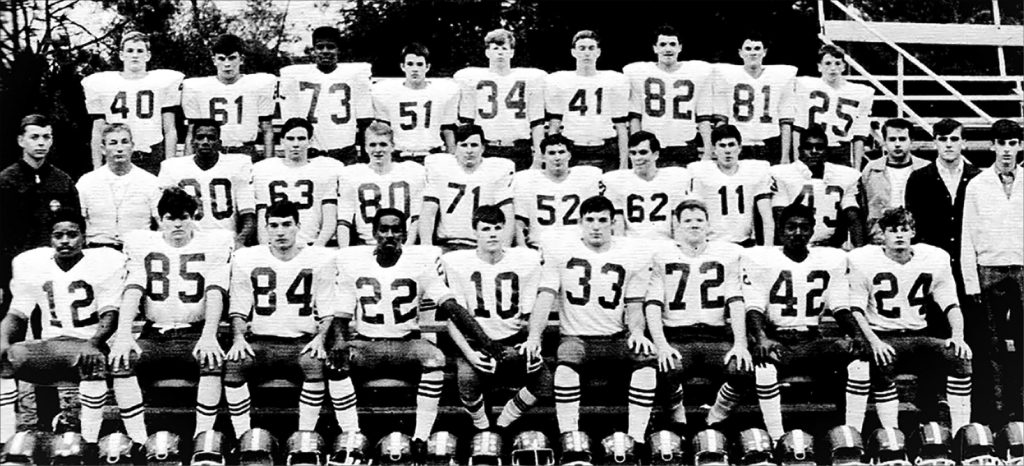
Numbered and padded, the teenage football players seemed larger than life to a child unable to heave a ball 10 yards. Photographs showed them in dramatic poses: lineman ready to pounce from a three-point stance; quarterback, ball in hand and passing arm cocked; lunging linebacker frozen in midair by a flashbulb; the team picture showing the players with backs straight and eyes focused, ready for business.

A few years after my sisters had gone away to college, the Blue Knights became more than images in an annual. Beginning in 1966, for three seasons, I tagged along with my father to watch them play on Friday nights in the fall at Memorial Field, the town ballpark at the corner of Morganton Road and Bennett Street.

The Blue Knights — coached by John Williams, a fixture in Moore County sports for decades — were members of the Central Tar Heel 2A Conference with other area schools of similar size: Union Pines, North Moore, East Montgomery, West Montgomery, Chatham Central, Pittsboro, Siler City, Rohanen (east Rockingham) and archrival Aberdeen.

Randy Arnold, a son of one of my father’s friends, played center, so we tried to keep an eye on No. 52 in blue and white when the home team had the ball. But given that my mind wandered to the prospect of a concession-stand Coke or catching one of the mini footballs thrown into the crowd at halftime, I wasn’t paying close attention to every down.

Other Blue Knights also became familiar figures: Harry Jones, No. 22, one of the few African Americans on the predominantly white squad, starred as a halfback in 1966 and ’67; quarterback Billy Strickland, No. 10, was a three-sport letterman; Bill Little, No. 33, stayed very busy as fullback, linebacker and placekicker; end Tim Roschy, No. 80, later was my coach on the Midget League Cowboys (we had a mimeographed playbook) before I realized I wasn’t cut out for the gridiron. The game program rosters of the late 1960s were filled with familiar Southern Pines surnames: Buchholz, Cuff, Sessoms, Warlick, Tate, Martin. The better athletes played offense and defense.

With West Southern Pines — where Blacks attended high school during segregation — not having the money to field a 1968 team, the Blue Knights benefited from the presence of talented sophomore end Charles Waddell that fall in their final season before the opening of consolidated Pinecrest High in 1969. Waddell would go on to star at Pinecrest and UNC-Chapel Hill, where he was the university’s last three-sport letterman.

The Blue Knights lost two of their opening four games in ’68, then hit their stride. After a 14-14 tie with West Montgomery, they finished with five straight wins. The last one, against Aberdeen on Nov. 8, 1968, was the biggest.

It was a good thing we weren’t late getting to the big game. On the Blue Knights’ first play from scrimmage, Skip Caldwell ran 50 yards through the Red Devil defense for a touchdown. They scored on their next possession too, a 25-yard run by Strickland. Final score of the final game: 14-6.

When the lights came on the following fall, boys from both towns would be wearing the green and gold colors of a new home team. PS

Bill Fields’ memoir, A Quick Nine Before Dark: A Life in Golf, is available at The Country Bookshop in Southern Pines and other places books are sold.

Omnivorous Reader​

Omnivorous Reader

Madcap Mayhem

In a zany debut novel​

By Anne Blythe

Remember Best in Show, that quirky Christopher Guest mockumentary that pokes fun at eccentric dog owners and the competitive world of breeding and showing purebreds? Fast forward 25 years.

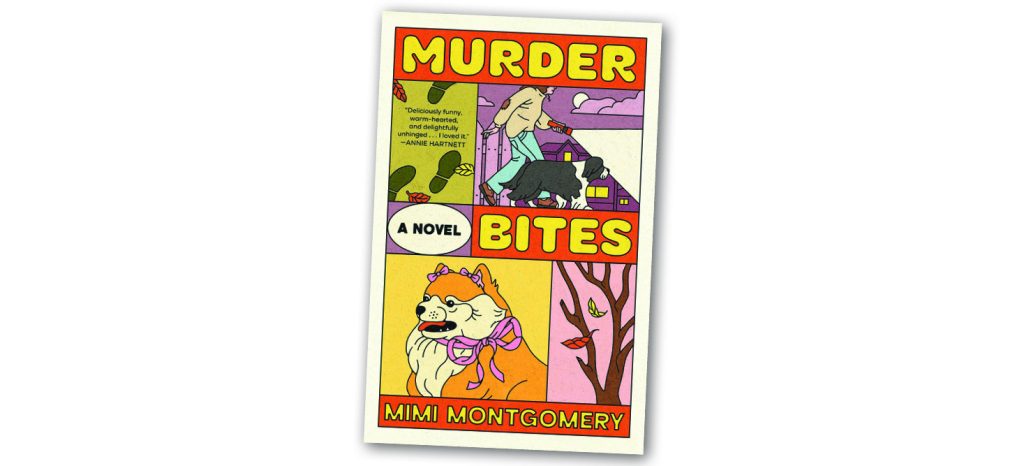
Mimi Montgomery, a Washington-based Axios reporter who hails from Gaston County, has taken that same chaotic culture, given it a modern twist, dropped in a body count, and delivered a wacky spoof of millennial dog culture in her debut mystery, Murder Bites.

In this suburban satire, Montgomery takes us to the fictitious Glenville, South Carolina, where protagonist Margot Cartwright stands out like a sore thumb. Margot is thrust into a sea of cliquey moms when her husband inherits his childhood home and moves her and their two children into an unfamiliar culture, a world away from the life they knew and liked in the nation’s capital.

She detests her new life. And when we first encounter the willing outcast, she is preoccupied with the whole town’s seeming obsession with a TV reality show called Pawsh and the lengths to which her neighbors will go to get their bougie pups a chance at prime time.

Margot’s mutt, Sid Vicious, did not measure up to the show’s standards, but even if he had, she would not have subjected her lovable companion to such drama.

This was a town where Quinn Chandler and her Lhasa Apso wore matching pelts. Tippi Hayburn carried her pug in a pink BabyBjörn on her chest. And Sally-Claire Foster, Hattie O’Connor and Weezie Whiteagle wrangled their dogs into matching floral rompers, “making them dead ringers for the von Trapp children’s curtain wear.” With a Pawsh camera crew in town from Los Angeles, dogs romp across the center green in their “jaunty, tartan, smoking jackets” and “custom-fitted shearling booties.”

Margot is a woman who considers “public disruption an art form,” and she counts herself among the masters of her craft, just as Leonardo da Vinci was in his artistic world. That might mean strapping a homemade sandwich board onto Sid Vicious calling for an end to designer puppy mills and keeping Pawsh out of Glenville. She had no qualms about sneaking around in the cloak of darkness to yank “Everything is Pawsh-ible” signs — planted by members of the “Mommy Mafia” —  out of her Stepford-esque neighborhood.

“The Mafiosas,” Montgomery writes, “had swiftly shunned Margot upon her arrival to town, and so she studied them with the fringe fascination of Jane Goodall perched under a jungle leaf in Tanzania, watching as they carpooled their children around in $80,000 luxury SUVs, ginormous wedding rings sparkling, or as they carried out the kind of hobby-jobs well-off women dabble in when bored — professional organizing, assembling charcuterie boards, mid-level marketing schemes.”

What Margot found “perhaps most integral to the Mommy Mafiosos,” Montgomery continued, “were the companions perpetually nestled in the cradle of their sculpted biceps, the kind of squirrel-dog hybrids that weighed about the same as a head of lettuce while also costing about the same as a year of in-state tuition.”

When signs go missing, protests become disruptive or one of the more insufferable dog moms receives weekly orders of unsolicited Lord Farquaad bob wigs to match her hairstyle, Margot usually is behind the antics.

So when Boomer, the local dog walker, is found dead in a front yard Halloween display with Home Depot skeletons, Margot, persona non grata in the neighborhood, quickly becomes suspect number one. Only this time, she didn’t do it.

Margot sets out to clear her name, but she can’t do it alone. Two unlikely neighbors band together to help her with the sleuthing — Anne, the stylish, 70-something widow who relishes reigning over the neighborhood HOA with an iron fist, and Sally-Claire, who sours on the Mommy Mafia and their judgey ways.

Madcap investigations ensue. Twists and turns occur, keeping readers guessing.

Montgomery’s debut novel is zany, laugh-out loud funny in places, and a complete joyride, packed with entertaining characters and cultural caricatures deftly planted throughout the pages.  OH

Anne Blythe has been a reporter in North Carolina for more than three decades covering city halls, higher education, the courts, crime, hurricanes, ice storms, droughts, floods, college sports, health care and the many wonderful characters who make this state such an interesting place.

State of Mind​

State of Mind

Fair Is Fair​

Games of chance and deep-fried everything

By Tommy Tomlinson

We used to meet at the sow.

That was our gathering spot every year at the Cleveland County Fair in Shelby. For years, my wife and I and some of our friends would go to the fair every fall. Every year they’d have a sow that either had just given birth or was about to. So we knew we’d have a place to meet, and maybe some cute piglets to fawn over. It was a lovely way to start a lovely night.

This is the time of year for county fairs all over North Carolina, plus the big state fair in Raleigh. The fair in Shelby is officially called the Cleveland County Agricultural Fair. The timing has long been tied to the harvest — by now most all the crops are in, and farmers can show off their bounty. Most county fairs have “agricultural” or “industrial” somewhere in the title. In Brunswick County they call it the Agricultural Fair and Expo, just to get a little fancy.

There are no smells quite like fair smells. Back in the ag area, it’s a blend of cowflop and fresh hay and horse shampoo. You can always tell the city kids who wander back to the animal sheds. They’re in sensory overload. Their noses and ears and eyes don’t know what the hell is going on. It’s one thing to see a goat on TV. It’s a whole other thing to hear them bleat in stereo, or to look close enough to see that their pupils are not only rectangular but horizontal. No wonder goats show up in horror movies.

I think some farmers hope the fair will lead others to be drawn to the farming life. But I do wonder if some folks come out of there thinking: Nope, don’t need to see that again, get me to someplace with concrete.

You don’t have to wander far until the smells change. Pretty soon you’ll catch the scent of batter dipped in cooking oil, and you are likely to float that way like a cartoon bear drifting toward a honeycomb. When you get there, Lord knows what you’ll find in the deep fryer. Every year fair food looks and tastes more and more like Guy Fieri’s dreams.

When I was a kid, county fair food was mostly corn dogs and funnel cakes. Now, at the state fair, the corn dogs are Korean and you can get them in flavors ranging from cinnamon mozzarella to Flamin’ Hot Cheetos. The funnel cake at the Beaver Concessions booth was the Food Network’s choice for the best item at last year’s state fair. That particular funnel cake is infused with Cheerwine — both in the batter and the icing. Just writing that sentence made me diabetic.

Every county fair worth its grease now has fried Oreos, fried Snickers, fried corn, fried pickles, fried cookie dough, fried burgers, fried turnip greens and fried banana pudding. (I thought I made up those last two. Then I went and checked. They have fried banana pudding at the Texas state fair. America continues to be a land of innovation.)

One pro tip for the fair: Do not scarf down too many fried whatevers before going on the rides. Rides at the fair are designed to flip your insides upside down.

There’s always some sort of ride named after mountains — the Matterhorn or the Himalayas or some such — that runs backward around an oval at speeds that don’t look scary until you’re actually on the thing. There’s always some sort of Flying Dutchman thing that pendulums from side to side while you sit in a replica of a boat and make out your will. There’s always some sort of Gravitron cylinder that spins so fast it pins your back against the wall, which is a good place to be when the bottom drops out. That last one is a perfect example of centrifugal force, which can be explained by Newtonian mechanics. While you are on it, you will pray that Newton got the formulas right.

I will confess that I have never been much of a ride guy. I’m not getting on anything that rotates my body in three dimensions at the same time. I’d much rather spend my money on games I have almost no chance of winning. The good news is that every fair is full of those, too.

The problem is, you only have to win once to think you’re a winner. Thirty-some years ago, I took a date to the state fair and played one of those games where you toss dimes into dishes. Normally, even if you’re a good shot, the dimes bounce out and land harmlessly on the ground. But this time I got a lucky carom and my dime landed in a tiny cup. The prize was a giant stuffed bear. My date and I had to haul that thing around for the rest of the night. Another pro tip, I guess: Wait to play for the big stuffed bear until you’re done with everything else.

There were two prizes I won as a kid that I kept for a long time. I think I won them both in that game where you throw darts at balloons. One was a belt buckle with the logo of the band Kansas — they were famous in the ’70s for “Carry On Wayward Son” and “Dust in the Wind.” In the Jeopardy! category of Bands Named For Places, they rank behind Boston and Chicago but ahead of Asia.

The other prize was the Farrah Fawcett swimsuit poster that was such a sensation back in 1976. I’ll admit, 62-year-old me feels a little cringy that I once had that on my bedroom wall. But 12-year-old me? He was sure glad he went to the fair. OH

Tommy Tomlinson is the author of two books, The Elephant in the Room and Dogland. He was a longtime columnist for the Charlotte Observer and has written for Esquire, The Atlantic, ESPN the Magazine and many other publications. His online newsletter is called The Writing Shed. He lives in Charlotte with his wife, Alix Felsing.

Simple Life​

Simple Life

My October Surprise

To be like Blue (and maybe Lao Tzu, too)

By Jim Dodson

At the start of every summer, I vow to my wife, Wendy, that this will be the year I finally make peace with the heat and humidity of my least favorite season.

And every year, I fail miserably.

By Wendy’s birthday in mid-July, I’ve turned into a grumpy gardener who prays for rain that never arrives and shakes his fist at broiling, sunny skies. Even my golf game wilts.

This summer, however, I took a different approach.

I decided to be like Blue. And maybe Lao Tzu, too.

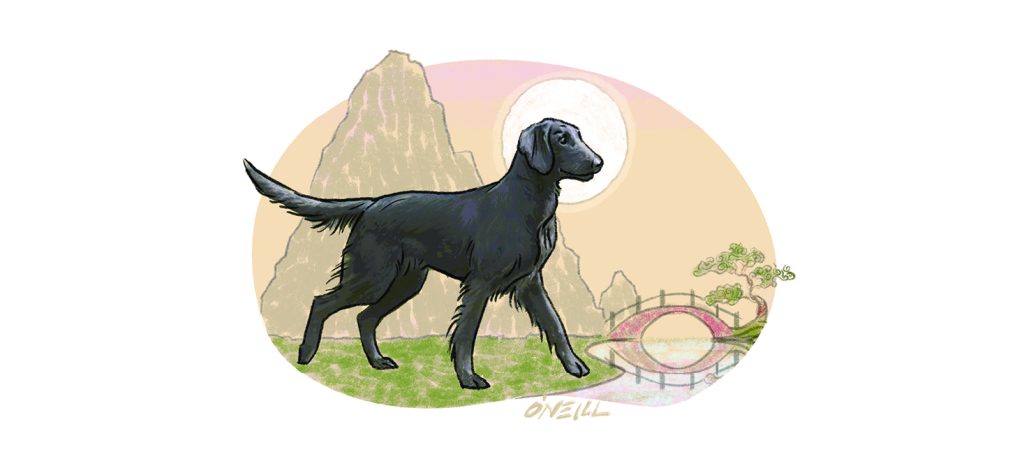
Blue is my dog, a big, black, super-friendly, 65-pound flat-coated retriever with golden eyes, a thoroughly laid-back disposition and a blue-tipped tongue. A friend steeped in Native American lore insists that his golden eyes and blue tongue mean that he is probably descended from wolves and is a true spirit-animal guide. American Indians apparently revered their dogs for just this reason. 

Lao Tzu, of course, is the legendary 6th-century Chinese philosopher credited with writing the Tao Te Ching, the foundational text of Taoism. In college a million years ago, I took a course in Eastern religions and developed a shine to the old guy’s wise sayings, as have philosophers and spiritual teachers across the ages. It was Lao Tzu who pointed out that “a journey of a thousand miles begins with one step,” a catchphrase appropriated by every tourism flack since the Middle Ages.

My favorite Lao Tzu aphorism advises, “Be content with what you have; rejoice in the way things are. When you realize there is nothing lacking, the whole world belongs to you.”

Blue seems to embody these words like no other four-legged creature I’ve ever known except one — my late dog Mulligan. I fondly called her “Miss Mully.”

Three years ago, at the end of another blazing hot summer, Wendy and I said a tearful goodbye to Mully, our soulful flat-coated retriever. She was 17 and failing fast. Our hearts ached  as we watched her take one last slow circuit around the back garden she’d watched me build before lying down at my feet and placing her noble head on my shoe. Putting her down was maybe the toughest thing I’ve ever had to do. She truly was this man’s best friend.

As that October arrived, a month that typically brings cool relief and nice surprises, I was still deep in grief. Wendy and I were having a drink in the same back garden, watching the first golden leaves of autumn drift to the ground. She asked me how I was doing.

“Not great,” I admitted. “I hate to think I’ll never have another dog like Mully.”

We have other rescued critters in our home, including a sweet, old Staffordshire pit bull named Gracie, a spunky, young border collie-spaniel mix named Winnie, and a mischievous calico cat named Juno that Wendy found as a week-old kitten abandoned in the Walmart parking lot. I love them all — even if they seem to love Wendy more than me. 

As usual, like Lao Tzu, Wendy was one step ahead of me.

She tapped her smart phone and handed it to me. “How about this dog?”

It was a photograph of a young Mully from our adventuring days together. Or so I thought until Wendy shook her head.

“It’s not Mully. This is a young male from Tennessee. Last night I typed ‘flat-coated retriever’ into my search bar and he magically appeared. Can you believe it? He could be her twin brother.”

She explained that he was rescued by an all-volunteer group called Critter Cavalry based in Franklin, Tennessee. The resemblance to Miss Mully was truly incredible, almost spooky.

“As it happens,” Wendy casually added, “he’s going to be passing through Western Virginia two nights from now in case you would like to give this big fella a new home.”

I asked how she knew this.

“Because I got in touch with Critter Cavalry, paid the adoption fee and we’ve been cleared by our vet to get him.” She added that several times a month the organization transports rescued dogs to qualified new owners up and down the East Coast.

She smiled and added, “He’s your October surprise. I think Mully sent him to take care of you.”

•

We drove up to Fancy Gap, Virginia, that Friday evening and, as instructed to do for the rendezvous, parked behind a Wendy’s restaurant off the interstate to await the delivery. I joked that it felt like we were part of an undercover stakeout or waiting for an illicit drug delivery.

Other cars soon pulled in around us. Eventually, a tall, white van with big, purple dog paws on its side rolled up and folks began getting out of the automobiles and heading toward it. Every one of them was smiling with anticipation. We were, too.

There must have been two dozen dogs of every size and breed traveling in neatly stacked crates, all headed to forever homes. Our big, black fella was one of the last to exit the van.

He climbed out of the van and calmly looked at me with glimmering, golden eyes. I let him sniff my hand. He licked it.

“He has a blue-tipped tongue,” Wendy pointed out. So, we named him Blue.

The first thing Blue did in Wendy’s car was take a giant poop on her back seat. We joked that it was a long ride from Tennessee without bathroom breaks and gave him a drink of cool, bottled water during the clean-up stop.

We weren’t back on the road more than five minutes when Blue climbed forward onto the middle console and laid his head on my right thigh.

It stayed there all way all the way home.

Blue turned out to be an extraordinary dog. He leads our morning walks and sleeps on the floor directly beside me. Nothing rattles him. He remains cool and calm in every situation, happily responding with his golden eyes shining. He rarely barks except when he suddenly rolls joyfully around on the floor, yipping with childlike glee at finding his forever home. He loves big hugs and lets life flow past with the ease of an ancient Chinese philosopher.

Methinks Lao Tzu would love Blue — for he seems to realize nothing is lacking; the whole world belongs to him. Our artist friend, Harry Blair, was so taken with Blue’s aura, he decided to sketch him. He captured Blue’s “Tao” perfectly.   

As our journey of a thousand miles begins, Blue probably has no idea that he’s become both my best pal and my four-legged teacher. This past summer brought record drought and punishing heat waves, during which our air conditioning even went caput.

But, vowing to “Be like Blue,” I took it all in stride, better than ever, in fact.

I think Miss Mully would be pleased.  OH

You can learn more about Critter Cavalry’s important work at crittercavalry.com.

Jim Dodson is founding editor of O.Henry.

Writer’s Valhalla

Writer's Valhalla

Writer's Valhalla

Celebrating the North Carolina Literary Hall of Fame

By Bill Case

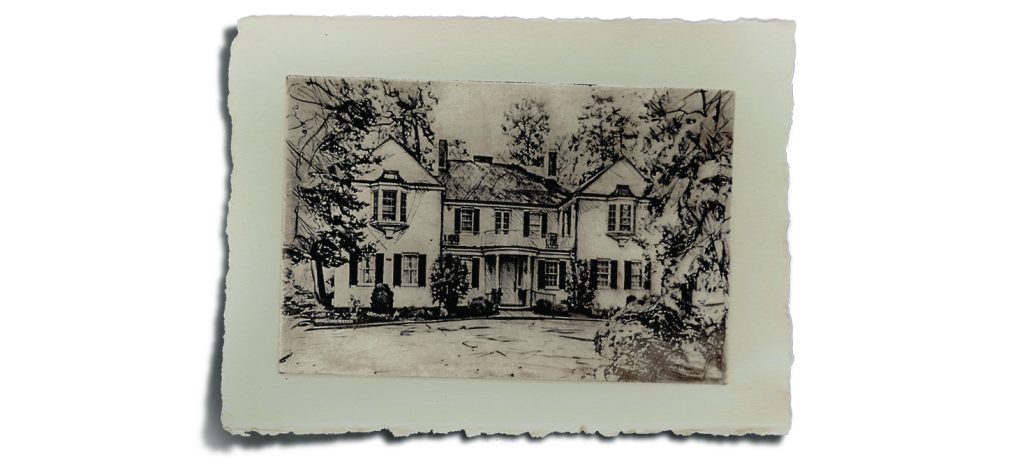
Feature photo: Etching of Weymouth Center for the Arts & Humanities by Denise Baker

There are 30 rooms, give or take,  in the sprawling Boyd House, and if the walls of those rooms could talk, they would have plenty to say about the country manor’s storied literary history, especially the parade of renowned writers who graced the home as guests of James and Katharine Boyd long ago.

The great room would remember a January morning in 1937 when the nonplussed Boyds found Thomas Wolfe (Look Homeward Angel, among other works) asleep on the sofa. Arriving in Southern Pines on the 4 a.m. train, Wolfe trudged uphill to the estate and, after finding the doors locked, gained entry by scrunching his 6-foot, 7-inch frame through an unlocked window.

The cozy Boyd library witnessed the cringeworthy 1935 incident in which an overserved F. Scott Fitzgerald (The Great Gatsby, among other works) insultingly critiqued his host’s most recent novel. Boyd’s first historical novel, Drums, published by Charles Scribner’s Sons in 1925, was touted at the time as “the finest novel of the American Revolution that has yet been written.” The well-oiled Fitzgerald would pen a letter of apology.

From 1932 until his untimely death in 1944, Boyd dictated his books while standing at the middle window at a built-in writing ledge in his second-floor study. From this elevated perch, he could gaze down on his foxhunting horses and hounds quartered nearby. Fifty-two years after his passing, the spacious study would become the home of the North Carolina Literary Hall of Fame, the ultimate embodiment of Weymouth’s literary heritage. The walls of Boyd’s study speak with a decidedly bookish vibe, covered with photos and biographies of the 80 members inducted from its founding in 1996 through this October’s class of 2026.

Revered by those who appreciate great writers and their works, the hall’s biennial induction ceremony at the Weymouth Center for the Arts & Humanities is an eagerly awaited date on the calendar. Though a fixture of the state’s literary scene for 30 years, the road to the Hall of Fame’s founding and location at Weymouth was full of twists and turns. The idea for a state literary Hall of Fame arose from a program adopted by the Library of Congress in 1977, called the “Center for the Book,” designed to “stimulate public interest in books, reading and libraries.” States were encouraged to participate in the project by centralizing their library and writing programs. National Book Week was initiated under this umbrella.

In August 1992, North Carolina’s then-state librarian, Howard McGinn, proposed that North Carolina enact legislation to designate Southern Pines as the site of the state’s “Center for the Book.” McGinn also recommended that the proposed center house a newly created literary Hall of Fame for North Carolina. It would be the first of its kind in the country.

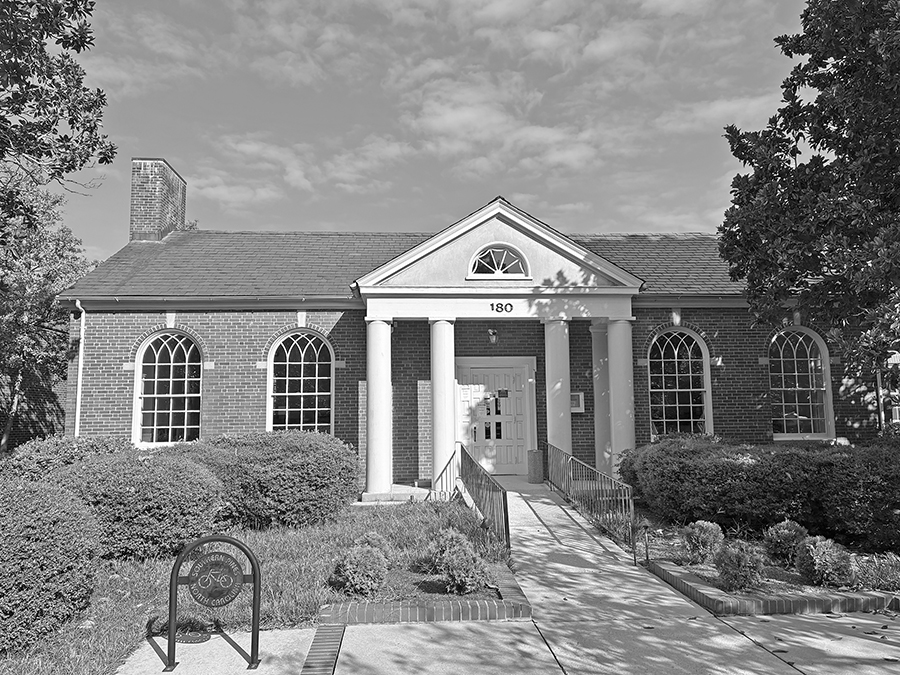
His plan was tied to the availability of a specific building on Broad Street that, at the time, housed the Southern Pines Public Library. For the project to work, the existing library would need to be relocated. McGinn’s suggestion contemplated the construction of a new public library for Southern Pines at a vacant lot on Connecticut Street. He proposed that following the library’s move to new quarters, the old library would become the home of the Center for the Book and a Hall of Fame situated in the vaulted main reading room and “patterned after the Baseball or Football Halls of Fame.” The state librarian envisioned the hall attracting regional and national writing conferences and the performance of plays.

The old library already possessed a connection to North Carolina’s literary heritage. In 1948, Katharine Boyd contributed funds to add a new wing to the building. It included the James Boyd Room, dedicated to her late husband. McGinn agreed with Southern Pines government officials that the town needed a new public library facility, but many citizens opposed moving from the charming old building designed by Aymar Embury II. They included Sam Ragan, the owner-editor of the town’s newspaper, The Pilot. An affirmative vote of the Town Council was required prior to any such move and, given that certain members of the council and the influential editor of the paper had misgivings, that approval was far from certain. 

Bolstered by McGinn’s support, the proposal to purchase the Connecticut Street property for the purpose of constructing a new library squeaked through the council by a 3 to 2 vote on February 10, 1993. With the prospect of his community (and the old library) becoming the epicenter of North Carolina literature, Sam Ragan jumped on board too. The soft-spoken son of Granville County tobacco farmers would become a tireless advocate for the project.

With McGinn’s proposal for a Hall of Fame heading to the state legislature, Ragan used his formidable statewide influence to assure its passage. In addition to his own writing credentials, Ragan’s clout stemmed from his years as the executive editor of The News and Observer in Raleigh. A country gentleman nattily attired in a fedora hat and bowtie, Ragan was known and respected by North Carolina’s movers and shakers, especially those in state government. Diligently working his contacts, he persuaded key legislators to fast-track the resolution establishing the center and the Hall of Fame in Southern Pines. He arranged for the measure to be introduced under the name of Paul Green, author of The Lost Colony and a great friend of the Boyds.

To explore potential financing for the project, Ragan, together with Marsha Warren, then executive director of the North Carolina Writers’ Network, met with the state’s Secretary of Cultural Resources Betty Ray McCain. She indicated her department would be in a position to make a one-time grant once the center became a reality; a figure of $100,000 was discussed.

On July 23, 1993, the measure establishing Southern Pines and the old library building as the home for North Carolina’s Center for the Book and the literary Hall of Fame was passed by joint resolution of the House and Senate. According to its text, the placement of the center in Southern Pines would “build upon the significant contributions made by Sam Ragan and former Secretary of Cultural Resources Sara Hodgkins [who lived in Southern Pines] and the many other authors and journalists from North Carolina.”

Left: Sam Ragan

Right: The Former Southern Pines Library

Southern Pines Mayor Alex Bowness said, “I am very thrilled that everything is on track and the N.C. Center for the Book is becoming a reality.” In his Pilot editorial, Ragan expressed delight “that the present library building will not only be preserved but will become a distinguished statewide cultural site which is sure to attract nationwide visitors.” Town officials offered to lease the old library for a nominal amount, perhaps as little as $1 a year.

But to run the center like a sports hall of fame, as envisioned by McGinn, more funds would be required. Marsha Warren, who in addition to managing the Writers’ Network was working hand-in-glove with Ragan to make the center and Hall of Fame a reality, recalls their mutual mindset on funding. “Sam and I were aware we could probably count on $100,000 from Betty Ray McCain’s department,” Warren remembers. “Betty was on board with granting the money to the Writers’ Network, because it was a 501(c)(3) organization qualified to receive the funding and manage the project. The grant would get the project started. We hoped Southern Pines might do more also. But we weren’t thinking too far ahead. We’d figure it out as we went.”

The new Southern Pines public library building opened on July 5, 1995. Later that month, Ragan scheduled a tour of the vacant old library for attendees of the North Carolina Writers’ Conference at Weymouth. According to his editorial in The Pilot, the visitors “praised it for the excellent condition in which they found it and its special character and suitability for the Center and Hall of Fame.”

But that same month, Sam expressed uneasiness regarding the direction of the project in correspondence with the town’s new mayor, Mike Fields. “I also hope that the Town of Southern Pines will take action immediately in the necessary steps to make this splendid program a reality,” wrote a concerned Ragan. “I will assist in any way I can. The potential for Southern Pines is so great it would be a tragedy to see the program falter through any delay.”

But it did falter. By October 1995, it had become clear that occupancy of the old library by the Center for the Book and the North Carolina Literary Hall of Fame was not going to happen. A Ragan editorial reported one explanation for the jettisoning: the town manager’s determination “that the old library was needed for space to locate several town agencies.” (It would eventually house the town’s utilities office.) Marsha Warren wrote about a second daunting concern — an inspecting engineer had estimated that, “it would cost, conservatively, $250,000 to bring the aging building up to code.” Warren, who was inducted into the North Carolina Literary Hall of Fame in 2018, remembers that Ragan was “heartbroken” by the staggering estimate. “We knew raising that kind of money was beyond our reach,” she says.

Without the old library, could the project be salvaged? Warren believed that it could. “Betty McCain indicated she was still prepared to grant the Writers’ Network $100,000 even if we had to scale back the project. With that assurance, we could abandon the larger undertaking of a Center for the Book and focus entirely on a literary Hall of Fame. And James Boyd’s studio at Weymouth was an obvious place to put it.” The term “Center for the Book” would become associated with State Library programming and not a specific physical location.

Ragan welcomed the revised plan. After all, he had played a major role in forming the Weymouth Center for the Arts & Humanities, as well as saving the Boyd House from the wrecking ball in the 1970s.

After McCain formally issued the $100,000 grant to the Writers’ Network in November 1995, Ragan began greasing the skids with the Weymouth Center board. His efforts resulted in a long-term lease between Weymouth and the Writers’ Network enabling the latter to operate and manage the Hall of Fame at Weymouth. The Writers’ Network tendered a one-time payment of $10,000 to Weymouth and agreed to reimburse its expenses for upkeep of the former Boyd study.

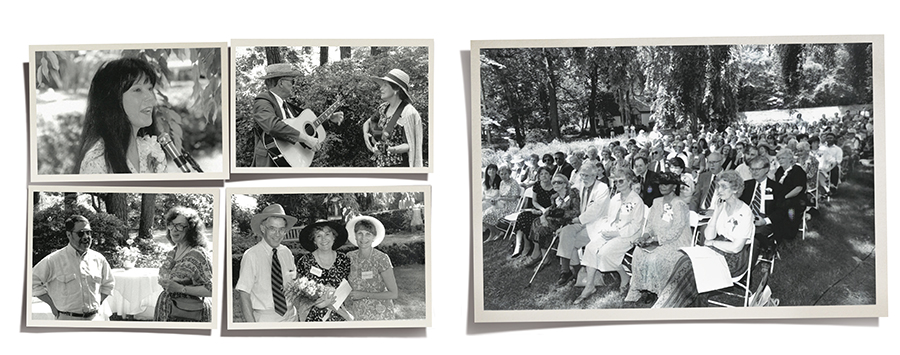
After the financial niceties were resolved, it was determined that the first Hall of Fame induction ceremony would take place on May 18, 1996, beneath the flowering cherry trees on Weymouth’s grounds. Marsha Warren, with input from Ragan, took the laboring oar in addressing the details: the adoption of the hall’s mission statement; determining criteria for election; selection of judges; identifying presenters for the inductees; preparing written materials; staging the ceremony and the reception afterward.

It was decided that the inaugural class should honor the state’s deceased literary figures. On March 13th, 1996, the judges announced their selections: James Boyd, Charles Waddell Chestnut, Jonathan Daniels, Inglis Fletcher, Paul Green, Bernice Harris, O. Henry (William Sydney Porter), George Moses Horton, Randall Johnson, Guy Owen, Thad Stem, Richard Walser, Manley Wade Wellman and Thomas Wolfe.

A proud Ragan, who was scheduled to emcee the event, wrote a glowing editorial following the announcement. “Under the guidance of Marsha Warren and the Writers’ Network, the dream is quickly becoming a reality. . . . The first induction promises to be a lively affair.”

The gathering turned out to be more poignant than spirited. During the month preceding the festivities, the 80-year-old Ragan’s health suddenly deteriorated. He passed away on May 11, one week before the inductions. His generous spirit and unflagging support of the Hall of Fame were mentioned by virtually every speaker at the blisteringly hot ceremony, including newsman David Brinkley, who forwarded a moving video tribute. Ragan had given the famed broadcaster his first job in journalism, hiring Brinkley as a reporter for the Wilmington Star in the late 1930s.

Ragan’s unflagging support for Weymouth and the Hall of Fame barely scrapes the surface of his literary interests. In addition to penning editorials and columns for The Pilot, he authored books of nonfiction and six volumes of verse. His poetry was lauded by Tom Wicker, a North Carolinian who worked at the New York Times, who noted, “It could only have been written out of a Tar Heel’s sense of place.” His poetic achievements (twice nominated for the Pulitzer Prize) led to Ragan being named the state’s poet laureate in 1982, a position he kept the rest of his life.

Ragan also taught creative writing and journalism at local colleges and was a prime catalyst in establishing Weymouth’s Writers in Residence program in 1979. His writing colleagues began referring to Sam as North Carolina’s “Literary Godfather.”

“Sam swam in many literary streams,” says poet and Weymouth board member Pat Riviere-Seel. “Bringing the North Carolina Literary Hall of Fame to Weymouth allowed him to channel those streams into one big literary river.”

Six writers were inducted in the Hall of Fame’s second year, 1997, including Ragan. His daughter, Talmadge Ragan, accepted on behalf of her father. After the 1998 ceremony inductions were scheduled every other year and, after three steamy ceremonies during which attendees wilted in the heat, the ceremony was moved to October.

The number of judges who selected the inductees was fixed at 15. All were required to have a strong literary background. A candidate for induction must be a “North Carolina writer,” defined as someone who is, “significantly shaped by his or her time in the state; and/or (b) identified in the public’s mind as a North Carolinian; and/or (c) self-identified as a North Carolinian.”

In 2008, the Writers’ Network approached other literary institutions and requested they collaborate with it and Weymouth in producing the induction ceremony and promoting the Hall of Fame. The Center for the Book at the State Library, the North Carolina Humanities Council, and the N.C. Collection of the Wilson Library at the University of North Carolina all agreed to assist. The resulting collaboration reduced the out-of-pocket costs of the induction ceremony, helping to preserve the fund created by the Department of Cultural Resources grant. Ed Southern became the Writers’ Network’s executive director in 2008, a position he still holds.

The 80 inductees to date have come from virtually every corner of literary life. They include short story master O. Henry; diverse poets like Ragan, Maya Angelou, George Moses Horton, and Shelby Stephenson; news journalists Jonathan Daniels and Tom Wicker; illustrator and children’s book author Glen Rounds; Lincoln biographer Carl Sandburg; historian Wilbur J. Cash; newspaperman (and ambassador to the Court of St. James) Walter Hines Page; and iconic novelists Thomas Wolfe and Lee Smith.

The five newest inductees — D.G. Martin, Shannon Ravenel, David Sedaris, Daniel Wallace and Michael Parker — are to be enshrined in the hall on October 4 and likewise hail from diverse literary backgrounds.

D.G. Martin, who passed away last December, was the host of “North Carolina Bookwatch” on UNC-TV (now PBS NC). Martin was no softball questioner. He probed writers to find out what made them, and their books, tick. He also wrote a syndicated weekly column covering politics, cultural issues, and anything else occurring to his fertile mind. “D.G. had his finger in every pie,” says his close friend Ravenel. A graduate of Davidson College and Yale Law School, he practiced law in Charlotte before joining the University of North Carolina as its vice president for public affairs. A devotee of diners and cafés, Martin authored a chatty book on the subject, North Carolina’s Roadside Eateries.

Shannon Ravenel’s literary journey involved editing and publishing. She provided invaluable exposure for numerous Southern writers, including several fellow Hall of Fame members. Following her graduation from Hollins College in Roanoke, Virginia, the Charleston, South Carolina, native worked for publishers in New York, Boston and St. Louis. She became editor of the annual anthology Best American Short Stories. In 1982, she partnered with her former English professor, Louis Rubin, to start Algonquin Books of Chapel Hill (where she eventually moved), providing an important outlet for the work of Southern writers. Through Algonquin, Ravenel edited another annual short story anthology, New Stories from the South. Fellow Hall of Fame member Jill McCorkle will present Ravenel for induction. She will be returning a favor. It was Ravenel who presented McCorkle at her induction in 2018.

Self-deprecating humorist David Sedaris became a national phenom after his uproarious comedic appearances on a Chicago radio program led to frequent gigs on National Public Radio. In his first NPR appearance, he read an essay titled “Santaland Diaries,” describing his job as a Christmas elf at Macy’s. That smash success led to Sedaris authoring sardonic essays for Esquire and The New Yorker. Several of his essay collections became New York Times bestsellers. His book, Me Talk Pretty One Day, describes many hilarious (though often mortifying) vignettes from his childhood in Raleigh, North Carolina. The book won the 2001 Thurber Prize for American Humor. In explaining why so much of the humor in his writings concerns his own misbegotten experiences, Sedaris says, “There are two types of people: those who pay to tell others about their problems, and those who get paid to tell others about their problems. I prefer to be in the latter group.” Sedaris has resided in Paris, London and New York City, but he retains a seasonal presence in North Carolina, vacationing in Emerald Isle.

Daniel Wallace was born in Birmingham, Alabama. He attended college at UNC-Chapel Hill, but left school early because his father, owner of an import/export company doing business in Japan, persuaded his son to join him in that enterprise. By Wallace’s own admission, his employment in Japan was a bust. Returning to Chapel Hill, he worked in a bookstore and began writing novels. His first five efforts were summarily rejected by publishers, but his sixth, Big Fish: A Novel of Mythic Proportions, became a bestseller and was made into a movie directed by Tim Burton. A 2008 graduate of UNC-Chapel Hill, he teaches creative writing at his alma mater. Of his ill-fated employment in Japan — as well as the rejection of his early novels — Wallace says, “Sometimes, failure is not failure. Perhaps I never would have figured out I could be a writer if Japan had worked out. And the many mistakes in my rejected novels taught me what not to do.”

A product of rural North Carolina, Michael Parker was born in Siler City and grew up in Clifton. His father was a newspaper editor and his mother a teacher. As a schoolboy, Parker woke at 4:30 a.m. to deliver newspapers. His short fiction has resulted in his winning three O. Henry Awards. He has also authored seven novels, including The Watery Part of the World, a haunting tale set on a nearly deserted barrier island off the coast of North Carolina. The book contains an element of historical fiction — the supposed survival of Theodosia Burr, Vice President Aaron Burr’s daughter, lost at sea in 1812. A graduate of UNC-Chapel Hill Parker taught in the MFA writing program at UNC-Greensboro for nearly 30 years. He lives in Durham. “The fact that this state treasures writers so much, particularly in an era when our culture does not support and promote the arts as much as it once did, makes receiving the award especially fulfilling,” he says.

When the new inductees climb the stairs to Boyd’s study they may linger at the bronze bust of Sam Ragan, the man most responsible for making the Hall of Fame a reality. As Marsha Warren wrote in her foreword to Lewis Bowling’s book Sam Ragan: North Carolina’s Literary Godfather, the founding of the literary Hall of Fame was “Sam’s last and greatest gift to the state.” They’ll also find new photographs on display — their own — giving the walls more stories to share.  PS

Pinehurst resident Bill Case is PineStraw’s history man. He can be reached at billcasewrites@gmail.com.

Poem October 2026

Poem October 2026

Poem October 2026

Lenard D. Moore

Like Windblown Sand

No favorite fictional character comes

to the forefront, though feature films

open doors to other places

open doors to other cuisine

open doors to other rhythms.

I do not long to list characters,

because some actors could be left off

like a burst of milkweed

like the last unpicked apple

like a raw peanut in the sun.

I imagine watching the films —

decades of them unwinding

and rewinding over and over again.

Who would not be remembered?

Would the name be streaming

on the wind like a movie?

Now I offer these lines

as an aching to know

before too many minutes tick away

like windblown sand.


Out of the Blue

OUT OF THE BLUE

California Dreamin’

The princess of Montecito

By Deborah Salomon

Once upon a time, an attractive young woman from a Los Angeles neighborhood described as “modest” and “interesting” decided to become a princess.

Duchess, actually. Still impressive.

Sure, hon. Don’t we all.

Only two methods work: Be born into a royal family or, more likely, marry a prince. Hey, movie star Grace Kelly did it.

Never mind that this prince has wiry red hair and a wild streak. Its story line echoes those found in literature pre-dating the pyramids, the Bible, the tabloids.

So the presumption is that current maiden with the alliterative name took the same yellow brick road to fame: wrangle an introduction, hang around, smile a lot.

She met her prince, Harry by name, on a blind date — yeah, really — arranged by a mutual friend whose identity has been kept secret. Within weeks the smitten kittens were off on a camping trip to Botswana while the British press panted at the fence. The royal family managed smiles in public, gnawed their nails over tea and crumpets (biscuits passing as English muffins).

American! Actress! Divorced! Black! was whispered at polo matches. But to their credit, the royals stiffened those upper lips and, in true British style, carried on.

And carried on, to co-habitation, then marriage, sealing the deal with the birth of red-haired Prince Archie, followed by Princess Lilibet, strategically named for her great-granny, the Queen.

Thus ensconced, our American TV actress Meghan pulled off her biggest coup, many years in the planning: relocate from smoggy London to a sunny California neighborhood where her $20 million estate felt comfier than Buckingham Palace.

But beware, fair lady: Your glamour is shrinking while the bills, they groweth apace. The tennis court needs resurfacing. And the guesthouse could use a rainforest shower head. Oprah can’t dig you out of this one.

Then, a brotherly plot . . . er, feud . . . escalated over security during a planned trip to introduce grandkids to King Charles, who is ill. He received them at one of his country estates, more suitable than having the monarch show up at a bouncy-house birthday party. Can’t you just see Camilla in face paint?

All the while, Prince Harry was being ripped from the bosom of his bloodline, with sweet Kate (from non-royal mercantile wealth) doing most of the ripping, or so the press chatters. Otherwise a cold shoulder here, an unkind remark there, with little to no brotherly love emanating from William, whose frown shouts “off with his head.”

Reconciliation? Fat chance, shared the California fashionista who can hardly pay the pool boy.

What a kettle of Dover sole, fast becoming rather tiresome, enlivened only by a parade of glossy TV specials à la Diana and Charles, JFK Jr. and wife Carolyn, with subheads proclaiming Americans “can’t let go the monarchy.”

Yet every little girl dreams of being a princess. At least a Duchess, dressed to kill, who still calls the shots.