
Going South
Going South
The 1991 Tour Championship: Pinehurst’s pivotal event
By Bill Case
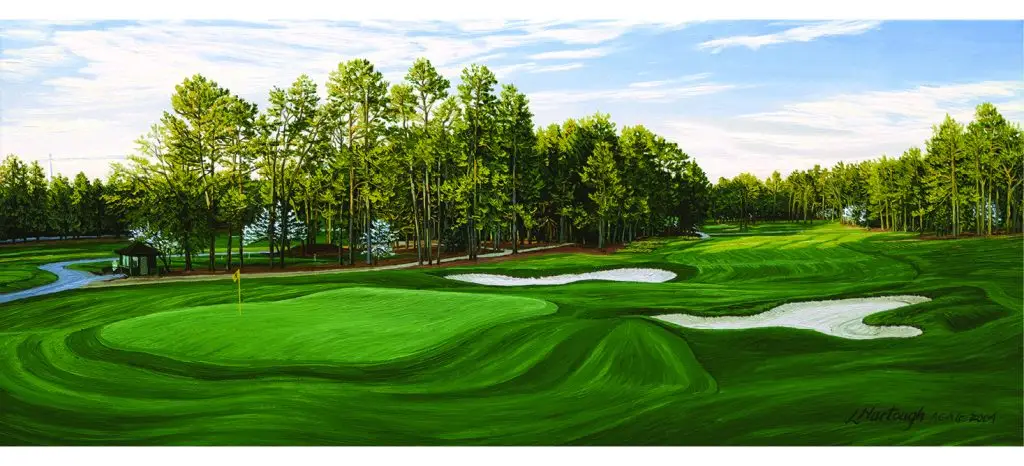
Feature image – Painting by Linda Hartough
On Sept. 9, 2020, the United States Golf Association issued a groundbreaking announcement naming Pinehurst Course No. 2 as its first anchor site for the U.S. Open. The Open would be contested on No. 2 in 2029, ’35, ’41 and ’47 in addition to the already scheduled 2024 championship.
Pinehurst owner, Bob Dedman Jr., expressed profound gratification with the singular honor. “Eight U.S. Opens in less than 50 years is a real testament to our partnership” said Dedman. “As players have often said, ‘It’s not just what you win, but where you win that matters.’”
For the Pinehurst Resort and Course No. 2 to achieve such recognition would have seemed like a pipe dream 40 years before. Following a decade of ill-fated management decisions by the resort’s then-owner, Diamondhead Corporation, the floundering company’s assets had been placed under the control of a consortium of its creditor-banks in 1980. And those lenders, looking to find a liquid buyer to take the resort’s assets off their books, were understandably loath to pour fresh money into Pinehurst.
As annual losses exceeded $1,000,000, the banks grew increasingly desperate to find a buyer. Most of the major hotel chains kicked the tires but shied away, concluding the property was ruined beyond redemption.
The lone exception was Dallas-based ClubCorp, which operated over 140 clubs — city as well as golf and country clubs — throughout America. The company’s charismatic owner and founder, Robert Dedman Sr., was intrigued with Pinehurst. “It was a logical fit,” he said. “We were already into golf in a big way, and we knew more about managing golf than other companies.”
Dedman Sr. also viewed Pinehurst’s tradition and history as major pluses. “It had held a PGA Championship and a Ryder Cup,” he said. “Course No. 2 was one of the best in the world. It had Donald Ross and all the magic that goes along with that.” However, he had no interest in acquiring the Carolina Hotel (then the Pinehurst Hotel) as part of the transaction. When the banks’ representative insisted it be included, Dedman reluctantly agreed. ClubCorp bought the resort in its entirety in 1984.
Three years later, looking to hire a new president to oversee and upgrade the resort’s operations, Dedman hired 36-year-old Pat Corso. Prior to his arrival in Pinehurst (where he first managed the Holly Inn), the Logansport, Indiana, native had spent his adult life working in the hospitality industry in Michigan — famously beginning as a singing waiter. Never had he dealt with a property in such dire condition as Pinehurst. “The entire infrastructure, inside and out, was in bad shape,” remembers Corso. “The ice bin floor in the kitchen fell through and a worker with it. A section of the porte-cochere at the Carolina’s front entrance collapsed. The hotel rooms had shag carpeting from the ’70s that had to go. All the windowpanes were rotting off.”
The golf courses also needed work. Longtime director of golf course maintenance Bob Farren says that when he joined the greenkeeping staff in 1982, the courses were in “horrible condition.” ClubCorp promptly began the long and expensive task of rehabbing the resort, inside and out.
Despite his relative inexperience in the golf business, Corso quickly sensed that for Pinehurst to regain its lost stature it needed to bring important tournaments back to Course No. 2. “Everyone working at the resort knew No. 2 was our greatest asset,” he says, “and staging big events on it was the way to put the course, and Pinehurst itself, back on the map.” How big? Why not aim at the pinnacle — the U.S. Open? “We realized that obtaining the Open would be an incredible challenge, but whether we achieved that goal or not, we believed that by trying, a lot of good things would happen along the way.”
First, Dedman Sr. needed to be convinced that luring major championships to Course No. 2 was a financially worthwhile objective. Diamondhead had staged an annual PGA Tour tournament on Course No. 2 from 1973 to 1982 (successively the World Open Golf Championship, the Colgate Hall of Fame Classic, and the Hall of Fame Tournament). Attendance had gradually declined, Colgate ended its sponsorship, and the event was unceremoniously terminated. Hosting a tournament would involve upfront costs and lost revenue.
“I would say Bob Sr. was initially skeptical,” says Corso, “but he was a boss who really trusted his people. His management philosophy was, ‘The less I do, the better we do.’ Once he gave the go-ahead, Bob became an enthusiastic backer.”
Pinehurst’s director of golf in 1987 was Mike Sanders, a prominent PGA pro who shared Corso’s vision. He was able to arrange for Pinehurst to host two prestigious, though admittedly low-key, tournaments on No. 2: the 1988 PGA Club Professional Championship, and the 1989 U.S. Women’s Amateur. Both Corso and Sanders considered those tournaments to be good preliminary steps toward the ultimate goal. Shortly after the tournaments were announced, Sanders resigned from the resort to focus on a new golf development, Pinehurst National (much later, Pinehurst Course No. 9).
With the PGA Club Pro Championship looming, Corso needed a new and experienced director of golf, and fast. He reached out to a fellow Hoosier, Don Padgett II, the 39-year-old general manager at Firestone Country Club in Akron, Ohio. A ClubCorp sister club, Firestone hosted the NEC World Series of Golf in ’87 and had been the site of three PGA Championships.
Padgett wasn’t ready to leave Firestone but did have a recommendation. “What you need is someone like my dad,” he said. The elder Don Padgett, then 62, was known throughout the golf industry. He was president of the PGA of America in ’77 and ’78. The list of golf contacts in his Rolodex (a thing back then) was voluminous.
Corso was taken by surprise. “I’ve heard so much about your dad for so many years,” he said. “I thought he must be dead.”
Given the importance of the hire, Corso sought advice from LPGA great Peggy Kirk Bell. He drove over to Pine Needles Lodge & Golf Club, found Peggy in the lobby, and asked her opinion. “You could not make a better choice,” she said.
“Mrs. Bell’s endorsement made a young guy making a big decision confident he was heading down the right path,” says Corso.
When it was offered, Don II urged his father to take the position but it took some doing — the elder Padgett had recently accepted a club position out West. Eventually on board, however, Padgett promptly established collegial relationships with both Corso and Dedman Sr. “My dad and Bob Dedman Sr. were kindred spirits,” says Padgett II. “Both of them came from almost nothing.”
When Padgett arrived on the scene, he took Corso under his wing. “The fact that meaningful people like Padge believed in me meant everything,” says Corso. “We went to all the big tournaments together. He introduced me to everyone he thought I needed to know. He’d station us around the putting green, or the clubhouse or by the big oak tree at Augusta — places he figured we would be most likely to encounter decision-makers. For a golf guy, Padge possessed immense political skills.”
During these forays, Padgett also made an effort to connect with those tour players having a past history with No. 2. Many had fond memories of playing the course in the Hall of Fame tournaments, the North & South Amateur, or collegiately. When the PGA Club Professional Championship arrived in October 1988, Padgett and Corso gladhanded most of the 360 club pros in attendance. A significant number were Padge’s longtime friends. “We made sure the pros, whether they played well or not, had a great experience,” says Corso. “The thought was they would go home and spread the word to their members that Pinehurst was back.”
Staging the event in the fall showed off No. 2 in optimum condition. The greens, recently planted with a new strain of Penncross bentgrass, were at their firmest that time of year, much more so than in July or August when the course was closed because of heat stress to the greens. Corso, Padgett and maintenance head Brad Kocher were aware that No. 2’s greens would never provide the firm, fast, putting surfaces the USGA would require for a U.S. Open in June.
Pinehurst’s quest for ideal putting surfaces had been ongoing since at least 1922, when Donald Ross, hoping to replace the resort’s sand greens with turf, experimented unsuccessfully with various mixtures of fertilizer and Bermudagrass on the Holly Inn’s lawn. “I am more or less puzzled,” Leonard Tufts wrote Ross in 1929, “why good putting greens are possible at Augusta Country Club and not here? There isn’t much difference in the temperatures.”
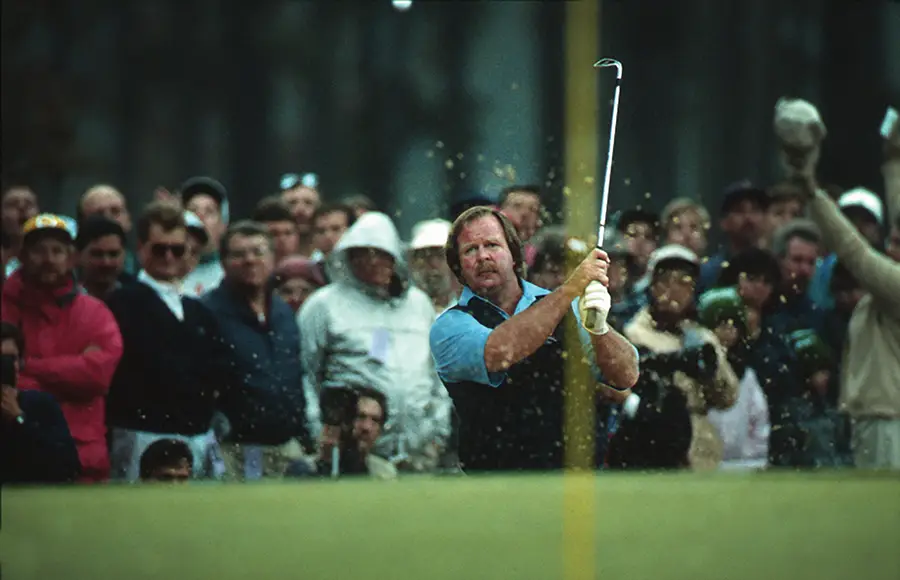
Craig Stadler
Photos Courtesy of The Tufts Archives, Pinehurst, NC
The hunt for growable grass continued. Finally, in 1934, Ross and greenkeeper Frank Maples found a strain of Bermuda hardy enough to withstand winter weather. Combining that grass with a new irrigation system led to No. 2 sporting grass putting surfaces when the club hosted the 1936 PGA Championship in November.
Bermuda was Pinehurst’s grass of choice for No. 2’s greens until 1972, when Diamondhead converted them to bent prior to the first World Open. But as Ross had learned a half century before, Pinehurst’s climate — located in what turf scientists referred to as an agronomic transition zone — was far from ideal for growing the types of grass then available. It was a Goldilocks dilemma: Pinehurst was too hot for bent and too cold for Bermuda. The resort had yet to discover grass that was “just right.”
It was no surprise that No. 2’s greens were in noticeably iffy condition when Pinehurst hosted the U.S. Women’s Amateur in July 1989. Following the event, P.J. Boatwright, the USGA’s executive director of rules and competitions and the man who was responsible for setting the conditions of play in a U.S. Open, remarked that Course No. 2 would never host the Open. In his judgment, the Women’s Amateur proved bentgrass wouldn’t work at Pinehurst and that Bermudagrass in June would never offer surfaces fast enough for an Open. Adding to the sting of his remarks was that P.J. was a Pinehurst alum, having previously served as the Carolinas Golf Association executive director.
While Boatwright oversaw rules and competitions, in 1980 the USGA had appointed a boyish-looking, bow tie-wearing David Fay as the organization’s overall executive director. Fay was determined to take the U.S. Open to publicly accessible venues beyond iconic Pebble Beach, the only such course to host the championship. Fay was open to considering venues like No. 2, Bethpage Black, Erin Hills and others. He also believed that the championship should go to every section of the country, even if one of those places was in the North Carolina Sandhills, far from major metropolitan areas and even farther from the blue blood clubs the USGA was so accustomed to in the Northeast.
“They called what I was proposing ‘Fay’s Folly,’” says Fay. “I felt that if my concept didn’t work out, my job could be on the line.” Nonetheless, the possibility that the USGA might eventually consider Course No. 2 for a future Open was music to the ears of Pinehurst’s execs. They just weren’t sure how to go about making that happen.
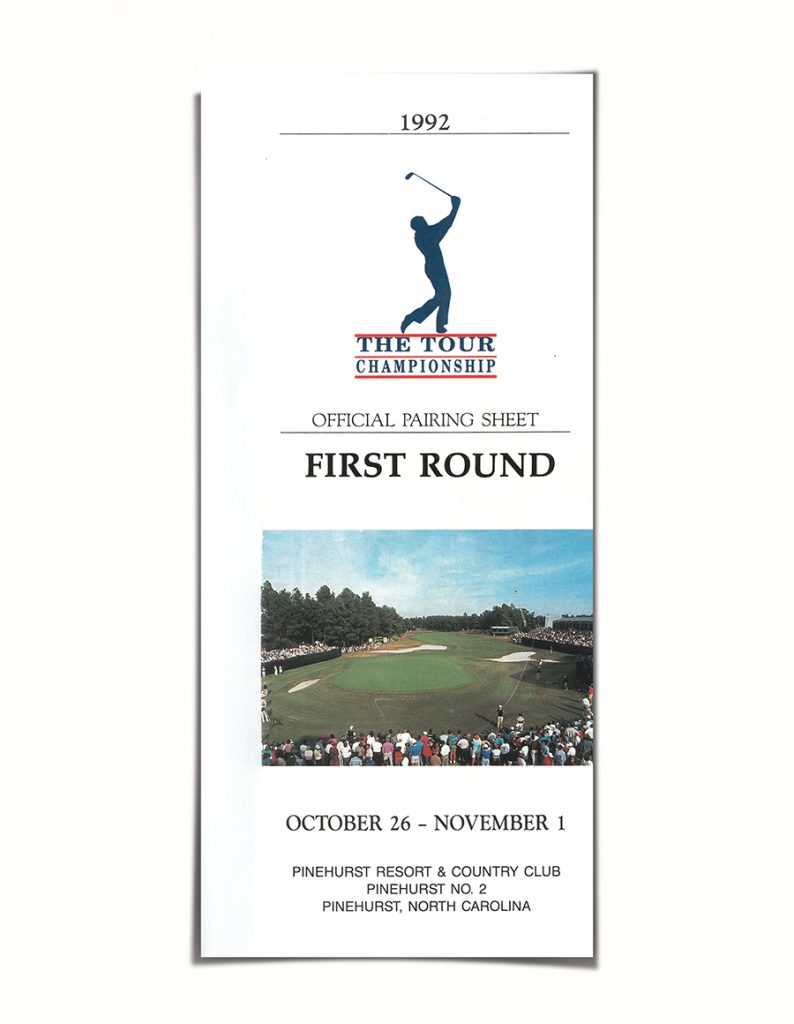
In the fall of 1990, an unanticipated breakthrough occurred when Don Padgett received a telephone call from an old friend, PGA Tour Commissioner Deane Beman. As a member of the PGA Tour’s Player Advisory Council, Padge had played a significant role in Beman’s initial hiring as commissioner. The subject Beman wanted to discuss was whether Pinehurst would be interested in hosting the Nabisco Tour Championship the following October.
The Tour Championship was first conceived by Beman in 1987 as a means of extending the tour’s golf season and bringing it to an exciting conclusion. Only the season’s top 30 money winners qualified for the event, and the $3 million purse was the highest on tour. The first four Tour Championships were contested from ’87 to ’90 at revered venues: Oak Hill, Pebble Beach, Harbour Town and Houston Champions.
A shrewd negotiator, initially Beman wanted Pinehurst to pay a site fee of $500,000 and hold the championship in early October — high season for golf vacationers in Pinehurst. Padgett refrained from making any commitment to Beman. He reported the call to Corso and asked him what he wanted to do. Corso turned the question around. “What do you want to do?” And though hosting the championship would represent another giant step for the resort and No. 2, Padgett replied, “Let’s play hard to get.” So they did.
Like many current and former players, Beman had a sentimental side when it came to Pinehurst. During his collegiate years at the University of Maryland, he and his golf teammates made frequent trips to the Sandhills, and he became a huge fan of Course No. 2. A two-time U.S. Amateur champion and four-time winner on the PGA Tour, Beman had competed on the course both as an amateur in the North & South, and as a professional in the World Open. Believing No. 2 was being unfairly “overlooked,” Beman was eager to return the Donald Ross masterpiece to the limelight.
Since the Tour already had a relationship with ClubCorp through its tournaments at Firestone and Don Padgett II, the relationship with the resort was something of a known commodity. Beman dropped his demand for a site fee and agreed to move the tournament’s starting date to Oct. 31 — Halloween.
Beman knew there would likely be “several guys qualifying who, like me, had played No. 2 collegiately or at Hall of Fame tournaments. I knew they’d appreciate the chance to compete on the course again and would work hard to make the field.”
He was right about that. Chip Beck, reared in Fayetteville and a two-time winner of the Donald Ross Junior Invitational on Course No. 2, was “thrilled out of my mind” to be playing No. 2 after qualifying 16th on the money list. Wake Forest alumni Lanny Wadkins and Billy Andrade qualified 12th and 14th, respectively. In his time at Wake, Andrade and his Demon Deacon teammates frequently drove from Winston-Salem to play No. 2. “It was just enough warmer in Pinehurst to be good for golf, and it was beautiful,” says Andrade, who had also won the 1986 North & South Amateur.
The Tour Championship featured all of 1991’s major champions: the wee Welshman Ian Woosnam (Masters), sartorially splendent Payne Stewart (U.S. Open), urbane Australian Ian Baker-Finch (Open Championship) and sensational young bomber John Daly (PGA). Stars like Fred Couples, Nick Price and leading money winner Corey Pavin also made the field. Longer shots Craig Stadler and lefthander Russ Cochran qualified in the bottom third of the field of 30. Cochran had won that year’s Western Open, but former Masters champion Stadler had gone winless in America for seven years.
For Corso, Pinehurst demonstrated a magical quality during the championship. “It had something to do with starting on Halloween, the crisp weather, and big-time golf returning to No. 2,” says Corso. “Also, the cooler weather was perfect for our bentgrass greens.”
David Fay rarely attended PGA Tour events. But given his interest in staging majors on publicly accessible courses, he was not going to miss this one. “I was very interested to see how the course would play for the Tour Championship,” he says. “I was interested to see if people would get romantic about the course. I was anxious to see if time had passed it by.”

Pat Corso and Don Padgett
Photograph from Pat Corso
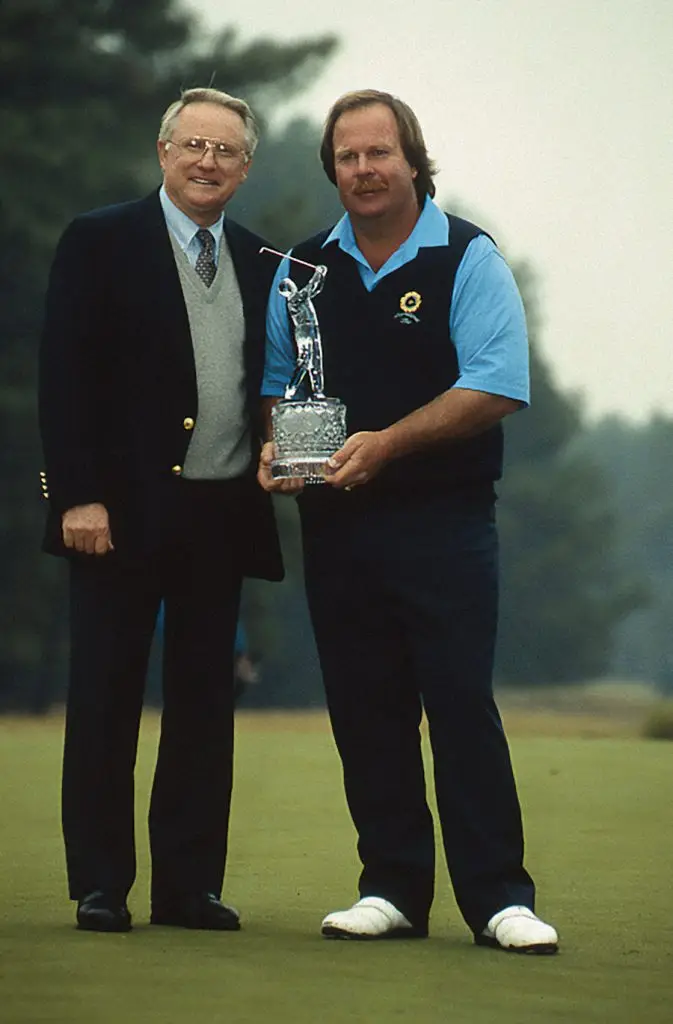
Deane Beman and Craig Stadler
Photos Courtesy of The Tufts Archives, Pinehurst, NC
Thursday’s first round resulted in a four-way tie at the top, which included Daly and Baker-Finch along with Stadler and Cochran all shooting nifty 68s. Stadler, nicknamed the Walrus, bunked in at Pine Needles, where he reunited with collegiate golf buddy and former Tour player Pat McGowan. “Bonnie (Pat’s wife) and I had a great time with Craig and his wife. Mrs. Bell (Pat’s mother-in-law) was there too,” says McGowan. “We ate lots of barbecue. The fact that Stads was playing well made it especially fun.”
McGowan remembers that his friend complained about having trouble hitting his 3-wood and turned to a 1-iron instead. “I handed him a Founders Club 3-wood of mine, and he hit a few with it,” says McGowan. “He liked the club and stuck it in his bag.”
In the second round, Stadler and Cochran shot 68 again. They were joined at the top of the leaderboard by Nick Price and Paul Azinger. As temperatures dropped during round three, the scores went up. Despite shooting one-over-par 72s, Stadler and Cochran remained tied at the top. Cochran advised the press that he “hated” the prevailing chilly weather, that he’d rather play in the rain. When the Walrus was asked his strategy for dealing with the cold, he pithily answered, “I’ll put my sweater on.”
Stadler and Cochran were paired together in the fourth round’s final grouping. They were still tied for the lead on the 18th, where Stadler faced a 5-foot putt to force a playoff. To his relief, he rolled it in. “I made a good putt on 18, and that was more of a surprise than anything,” he said. The playoff commenced in a drizzle on the par-5 16th, where both players made birdies with Stadler smashing a terrific second shot onto the green with McGowan’s 3-wood.
On the 190-yard par-3 17th, Stadler struck a brilliant 5-iron that spun to a stop 6 feet from the hole. Cochran’s shot came up well short of the green. “Somebody was jumping around in the bleachers right when I took it back,” the frustrated southpaw said. He recovered well to within 4 feet of the cup, but Stadler sealed the deal by holing his birdie putt. The record prize of $360,000 catapulted him to second on the money list behind Pavin.
The jubilant Stadler celebrated by treating McGowan and the Pine Needles contingent to $300 worth of Chinese food. “$300 bought a lot of Chinese food in 1991,” says McGowan with a smile.
Just about everyone associated with the tournament was happy. Padgett had been concerned that No. 2 might not pose a stiff enough challenge for the current crop of PGA stalwarts, but Stadler’s winning total of 5-under-par 279 demonstrated otherwise. “Where has this been all my life?” said Baker-Finch. “You could play a U.S. Open here, without rough, without doing anything.” Beman quickly requested that Pinehurst host the Tour Championship again in 1992.
David Fay gushed praise for everything he’d witnessed at the championship: the smooth logistics, the large crowds, the support of the event from distant North Carolina companies, and the magical atmosphere of the town and Course No. 2. As a baseball aficionado, he likened the ambience of No. 2 to baseball cathedrals like Fenway Park and Wrigley Field. If Fay had harbored reservations about Pinehurst and No. 2 as a U.S. Open site, the Tour Championship had dispelled them — except for the condition of the greens.
The tournament was a hit in the press, too. Corso remembers the eloquent and heartfelt praise both the town and course received on television and in print from golf writers Ron Green Sr., Tim Rosaforte and Jaime Diaz, as well as broadcaster Jack Whitaker. “Whether it was the church bells pealing, the legacy of Donald Ross, or the quaint New England town the Tufts built,” says Corso, “their pieces captured Pinehurst’s unique atmosphere.”
Riding the wave of the Tour Championship and the golf world’s rediscovered affection for Pinehurst, the resort’s bid to obtain a U.S. Open was gaining steam. It seemed that goal was within reach in June of 1992 when the USGA’s Championship Committee invited the resort to send a delegation to a meeting in Pebble Beach at that year’s Open. The committee was considering Course No. 2 as a potential venue for the 1999 U.S. Open. The moment Dedman Sr., Corso and Padgett thought might never come to pass was suddenly at hand.
Corso recalls that early on in the meeting, M.J. Mastalir, a committee member from Colorado, made an impassioned argument that the USGA should “Go west!” in ’99. Alarm bells began clanging for the Pinehurst delegation. Then committee chair Reg Murphy, destined to be a future USGA president, stepped in and cut Mastalir off. “No!” said Murphy with authority. “The ’99 Open is going south!”
“When Reg said that,” Corso recalls, “the air went out of my lungs. I knew ‘south’ meant Pinehurst.” Still a bit in disbelief at what he’d just heard, Corso glanced over at his director of golf. “When I saw Padge smile and nod his head, I knew that we were going to get the Open at long last.”
There was more discussion, of course. The committee sought assurance that No. 2’s greens would be changed out, and that course superintendent Brad Kocher would partner with the USGA’s agronomist in the process. The Pinehurst representatives immediately agreed.
Kocher already had a new type of creeping bentgrass in mind. Joseph Dutch was busy at Penn State developing a new strain (Penn G-2), which was being hailed as well-suited for Pinehurst. With that understanding, the committee approved No. 2 as the prospective site for the 1999 U.S. Open. The USGA formally announced its selection the following year at Baltusrol Golf Club’s U.S. Open.
In 1992, Pinehurst hosted its second Tour Championship. Paul Azinger won with a score of 276. The course was “as tough as any I’ve seen,” said Azinger. In ’94, No. 2 was the site for the U.S. Senior Open. By then, Corso had established a new entity to operate tournaments for Pinehurst. It included Jon Wagner, formerly from the PGA Tour; Reg Jones, who later joined the USGA; and Tom Pashley, now Pinehurst’s president. No. 2’s greens were converted to Penn G-2 bentgrass in time for the ’99 Open. (The strain had been initially planted on the greens of Pinehurst’s new No. 8, opened in 1996.) Kocher had the new greens in spectacular condition for Payne Stewart’s final putt, the most legendary moment in Pinehurst’s incredible golf history.
Bob Dedman Sr. and Don “Padge” Padgett were in attendance. Both savored what they had wrought, but neither lived to see Pinehurst’s second Open in 2005. Corso would retire from the presidency in 2004, moving on to other ventures. Don Padgett II succeeded his father at the resort, and together with Bob Dedman Jr. further shepherded Pinehurst into its remarkable renaissance, including one more revamping of the greens to Champion Ultradwarf Bermuda. After a century of efforts, Pinehurst finally discovered a grass that was “just right.”
The younger “Padge” is the first to acknowledge what the Tour Championship meant. “It brought Course No. 2 back into the center of big-time golf,” he says. “The ’99 Open would never have happened without the Tour Championship.” PS
Pinehurst resident Bill Case is PineStraw’s history man. He can be reached at billcasewrites@gmail.com.