Simple Life

Simple Life

Something Old, Something to Renew

Third Time Was the Charm

By Jim Dodson

Not long ago, with family and close friends in attendance, my wife, Wendy, and I celebrated 25 years of marriage by renewing our wedding vows in our garden.

Our original wedding took place in late June 2001, but we decided a day this past September was more appropriate for renewing our vows because ours was an autumn romance that led to a summer wedding three years later. As I noted back in July, the way we met and fell in love was something out of a madcap romantic comedy.

Briefly, it involved three blind dates during a major October fundraiser weekend where I was the featured speaker, two of which were comic dating disasters followed by a third that transformed my life in the most unexpected and wonderful way.

Her name was Wendy Anne Buynak, a gifted baker and beautiful mother of two small boys who was in the process of divorcing her husband. After a quiet afternoon first date to a local park, we decided to take our budding romance out of town and motored along New York’s beautiful Cayuga Lake on a beautiful November morning and lunched at a winery, where we met a minibus full of five young, married couples who invited us to join them on a tour of the Finger Lakes wine country.

On a lark, trailing their bus, we joined them for three wineries in a row. At each stop, the couples toasted us and demanded to know more about our romance and my intentions. 

“I have a great idea! You guys should get married today,” one of the young wives blurted out, prompting cheers from her tipsy companions. “We’ll even find a minister!”

We politely demurred, pointing out that we had a dinner reservation at a legendary  restaurant in Ithaca, but thanked them and wished them well. Also, a safe journey home.

On the way to the restaurant, we passed an old-fashioned roadhouse called Glenwood Pines, set charmingly in the woods above the lake, and decided to stop for a cold longneck beer. We had such fun talking to the owners and playing shuffleboard bowling that we decided to skip the restaurant in favor of a cozy Glenwood Pines supper for two. At one point, Wendy wiped away a tear and I asked her if all was well. “I’ve never felt so happy,” she simply replied.

A full harvest moon was shining and the owners told us about a great spot by the lake in Ithaca where they courted once upon a time. An hour or so later, we were doing what couples in love do by a beautiful lake under a full moon when a cop tapped gently on our steamed-up window with a flashlight.

“Are you OK, ma’am?” he politely asked Wendy.

“I’m fine, officer,” she replied. “We’re just talking about our children and what a lovely November day it’s been.”

“She’s in danger of being proposed to very soon,” I chipped in.

“In that case,” he said with a smile, “you folks have a nice evening — and great life together.”

A few weeks later, we met once again at a historic inn in Williamstown, Massachusetts, for our official third date. I read Wendy a poem I’d written inspired by our wonderful day in wine country.

•

Three years later, on what would have been my parents’ 58th wedding anniversary, we got married on a rainy June afternoon in Maine, only Wendy’s parents, my widowed mom and two dear friends from Georgia in attendance, Susie and Rick Berta. Susie, who sang with a famous Atlanta chorale, did a beautiful version of John Lennon’s  “Grow Old with Me,” with its perfect lyric: Grow old along with me. The best is yet to be.

We postponed our reception until early September 2001 — a lobster roast under the stars with an Irish fiddle band for 100 friends and family who were coming from everywhere.

I was buying flowers for the party that clear, blue Tuesday morning, however, when the World Trade Center’s towers fell and America stood still in grief and disbelief. Since air travel was cancelled nationwide, we cancelled our lobster roast. Besides, the American Red Cross had reserved a thousand lobsters for a major fundraiser in New York. All the available local lobsters were spoken for.

Two days later, however, something wonderful happened. Susie and Rick phoned to say they planned to drive all the way to Maine, wanting just to be with us at such a sad time for America. Their call opened a cosmic floodgate. The phone never stopped ringing with friends far and wide who wanted to do the same, including the lobster guy, who called to say the Red Cross fundraiser was postponed and he had several hundred lobsters on his hands that were already paid for. We could get them for a dollar apiece.

The lobster bake was suddenly back on.

Locals in town who’d planned to go away for the week also called to ask if they might come and bring friends and children. Naturally, we said yes.

Instead of 100 guests, we had almost 200, including kids and dogs. Wendy’s amazing wedding cake vanished before I could even get a taste. Because none of our guests except Rick and Susie had been at our wedding, we did a brief repeat of our wedding vows plus a blessing  for the victims and families of 9/11. The music, the dancing and the tears went on until midnight.

•

This past September, as our grown children, new granddaughter, and a dozen or so close friends gathered in our front garden on a balmy evening, I marveled how quickly time had passed. Susie was there despite having suddenly lost Rick last January after 46 years of a extraordinary marriage. When I told her she wouldn’t have to sing “Grow Old with Me,” she laughed and said, “I’m not sure I could!” Her simple presence was the perfect gift.

I surprised my bride of Irish heritage with a small, gold necklace featuring the Celtic symbol of eternity, and she surprised me by appearing in a gorgeous new wedding dress — an upgrade from the one that was ruined in the rain at our first wedding ceremony.

Before Rev. Ginny Inman conducted her short but beautiful renewal of our vows, I told our gathered friends about our first three dates 26 years ago and read the poem I proposed with. They seemed to dig it.

Maybe the third time really is the charm. This time, I finally got to taste Wendy’s marvelous wedding cake.  PS

Jim Dodson’s 17th book, The Road That Made America: A Modern Pilgrim Travels the Great Wagon Road, is available at The Country Bookshop

Thanksgiving Reminiscences

Thanksgiving Reminiscences

Thanksgiving Reminiscences

Add Your Heading Text Here

Byline

The call went out. Send us your wild, your sweet, your huddled histories of Thanksgivings gone by yearning to be shared. Here are a few, from minor disasters to major memories.

Now it’s time to make some more.

When I was growing up in Winnetka, Illinois, a suburb of Chicago, my family traveled every year to our farm in Tryon, North Carolina, for Thanksgiving.

In 1965, after the holiday weekend, we flew back to Chicago from Asheville. We were already seated when a group of gentlemen boarded the plane, walked by us and sat a few rows behind us. My father recognized one of the gentlemen — describing him as a great man who would change the history of our country — and encouraged me to go talk to him.

Never shy, even at the awkward age of 12, I approached the gentleman and introduced myself: “My name is Marilyn Barrett, and my father says you are a great man and I need to meet you.”

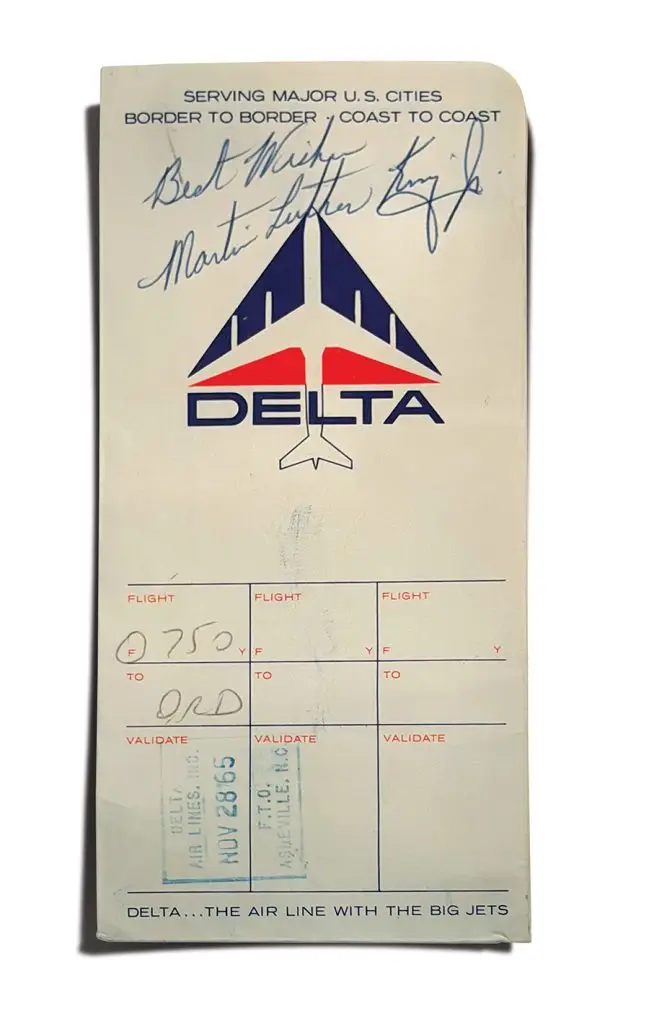
He looked up at me, smiled a brilliant smile, heartily shook my hand, and said something to the effect of, “Thank your father for me.” We talked a bit and when I asked him for his autograph, he pulled a pen from his suit pocket and signed the only paper I had with me: my ticket jacket for Delta Airlines Flight 750, from Asheville to Chicago-O’Hare, stamped November 28, 1965.

He wrote, “Best Wishes, Martin Luther King, Jr.” 

— Marilyn Barrett

Thanksgiving is my favorite holiday. It comes in the fall with the possibility of experiencing beautiful fall foliage, if conditions have been right.

To me, Thanksgiving is a color, or a few colors: golds, reds, browns, orange, tan. I love the beautiful gold presented by the gingko tree at the corner of East Massachusetts Avenue and South East Broad Street in Southern Pines, and if you look into the woods you’ll see the lovely tans presented by American beech trees. All these colors are a part of what Thanksgiving is to me.

Of course, there is the food — usually too much food — and home-cooked is the best. There has been only one Thanksgiving that didn’t work out so well for me, and it was my own fault. Every year, somehow, when I fix my plate to eat, I think I have to eat a good portion of EVERYTHING. Mistake! One year, at my late mother’s home, I ate too much. Oh, the pain! I spent much of that day trying to recover. I can laugh about it now, and Thanksgiving remains my favorite holiday. Food, family, friends and if we’re lucky, beautiful fall weather.

— Linda Pearson

I’m not a baker, but in 2018, I found what looked like a foolproof recipe for a spiced pound cake with buttermilk glaze. It was the first Thanksgiving my parents hosted in North Carolina after years of chilly, sometimes snow-covered Thanksgivings in Pennsylvania. I had just gotten married that May and, feeling like I was officially entering adulthood, I was determined to contribute.

I got a store-bought spiced pound cake and placed it on a decorative plate, which meant I only needed to make the four-ingredient glaze.

My first attempt turned into something resembling cement. I blamed the butter and my lack of patience for maybe not whisking enough. I threw it out and headed to my parents’ house for attempt No. 2.

I double- and triple-checked the ingredients because I didn’t want to mess up my first Thanksgiving contribution as an “adult.” I carefully measured 2 cups of powdered sugar, 3 tablespoons of melted butter, 1 teaspoon of vanilla extract and 2 tablespoons of buttermilk.

Same result, glue!

I had a bright idea to put it over high heat, add some water and declared it good enough. At least I was able to drizzle it over the pound cake, only to discover after a bite or two that the glaze — now room temperature — was completely inedible.

That Thanksgiving, I learned an important lesson. Buttermilk and buttermilk pancake mix are not the same thing. For Thanksgivings to come, I’ll stick to my Pinterest board veggie platters.

— Erika Leap

My now-husband and I had just started dating. My momma took a little while to love him as I did. He would come for homemade suppers quite often. The night that the ice was broken was a hot dog and hamburger supper night. We all came together, joined hands, prayed over our prepared food and family.

Now, my momma, being Southern, could make cole slaw that would make you stop in your tracks. You can put it on a hot dog, a burger, eat it as a side. After supper, he told Momma, “That’s the best cole slaw I’ve ever had!” That was all it took, one compliment, and she loved him forever. I could walk in her house first, and she’d want to hug him first.

I was never mad, I enjoyed seeing their relationship grow. After that, no matter the dish, there was cole slaw — spaghetti and meatballs, we had cole slaw; chicken and dumplings, cole slaw; we could make a sandwich, there was cole slaw! Everyone knew that was my husband’s cole slaw, made just for him.

After years of this routine, on a Thanksgiving, we gathered at the table, joined hands, and my brother began to bless our well-prepared meal. We all sat quietly with heads bowed. Suddenly Momma raised her head and said, “Wait, Jesus, hold that thought.” She shot up from her chair and said, “I forgot the COLE SLAW!”

We all looked at one another and a slow laugh began. Momma had just told Jesus to hold that thought, in the middle of prayer, to make cole slaw.

My momma has since gone home to our Lord. I’ve done my best to replicate her cole slaw, but it will never be good enough to tell Jesus to “hold that thought.”

— Sonya Valk

Grandma was an identical twin, but only “Grandma Aunt Jacky” is still living. Throughout nine decades together, the twins’ shared DNA kept them close, so Dad was close with his cousins, and Thanksgivings have always involved extended family referred to as aunt and uncle, who are actually first cousins once removed.

My parents sometimes hosted Thanksgiving when I was young. Other times, we’d travel through the crisp Pennsylvania fall weather. I’d shower and pull on something fancy just to change into sweatpants for two-hand-touch after an hourlong car ride. The logistics never made any sense.

It was often a full game with knit hats marking the corners of a lopsided field. At worst, it was a couple of the youngest and three adults tossing a pigskin. Dad was always one of them, and still is. He has a sense of duty to tradition. It’s why we always made the drive, and why I still do, up from the Carolinas.

With the last points scored, I’d go inside, change back into my holiday best, more rumpled than before, and sit down to a feast a day’s drive north with aunts, uncles and first cousins once removed. Logistics be damned.

— Jenna Biter

Getting off a long flight from Mumbai to Sydney, Darling Husband and I were greeted by our old friends Zena and Paul, who whisked us off to their home outside the city. It was November 2005. The next night they surprised us with a Thanksgiving dinner, which they had researched as they do not celebrate this very American holiday in Oz. Turkey, a bold attempt at dressing, and green beans, along with a lovely Australian wine to round it out.

No dinner was ever more thoughtfully put together for two displaced Yanks. The sheer joy of being in their lovely home was cause enough for giving thanks, but Zena and Paul produced a feast for two weary travelers to bring both cultures together. It was a time to be truly grateful for life, good food so lovingly prepared, and friends on the other side of the world we so seldom saw.

Not a Thanksgiving goes by that I don’t think of them and how they rekindled the meaning of coming together in gratitude for friendship and living a blessed life. And since DH’s passing, these memories warm my soul.


— Joyce Reehling

My Thanksgiving story is pretty mundane, compared to most people’s. Except for my sister, who lives up North, all the family is gone now. Even cousins are gone, except for a small handful who are scattered throughout the country; who knows where. Thanksgivings for me over the last 10 years have consisted of photographing the Moore County Hounds’ annual Blessing of the Hounds — Opening Meet. Afterward, I race home to get the pictures ready for The Pilot, and then prepare a meal for a horse friend who comes over and who is even less of a cook than I am. But I wing it, and we are both fine with the food; after all, it’s the coming together to share the meal on that day that matters.

But if I reminisce, which I tend to do even more now as time passes, Thanksgiving in my family was shared with the aunts and uncles who would travel down from Jersey to be with us, as we would travel up there to visit for Christmas every year. In the very early days in the 1960s, the cousins came too, and it was a great time to see and be with family again. My mother always cooked all the traditional foods and desserts, and it would be way more than we could eat, with loads of leftovers. But now I savor as many of those memories as I can, holding them in my mind and in my heart.

— Diane McKay

After my mother died, my father wanted to take on the Thanksgiving meal. His children (myself and husband, sister, and brother and wife) returned home each year to share the special occasion. Dad was a good cook and the meals were simple — only two side dishes even for holiday feasts. One year he decided to put the frozen turkey out on the front porch overnight to thaw for cooking the next day. When he woke up early in the morning to check on it, he discovered that a wild animal had feasted on it during the night. It might have been the neighbor’s cat!

After we all had a good laugh, Dad found a turkey loaf in the freezer and continued cooking the mashed potatoes and gravy and a green bean casserole. Sometimes good memories can come from bad times.

— Diana Staley

Fry Thanksgivings were always filled with family, friends, food (so much food) and fun. The day probably started with the men off to “hunt”; one never saw any game come back but lots of happy smiles. Women in the kitchen!

Us kids had a ball on the farm and were into every building and barn all over the place. I don’t remember a big turkey, but more of a big ham, lots of chicken, roast beef and every veggie one could think of, from potatoes to squash, along with all the relishes, pickles and molded salads from the latest recipe in the paper.

Two long freezers in the hallway were topped with pound cake (the all-time favorite), chocolate cake, fresh coconut cake, caramel cake and a neglected fruit cake.

Oh, and what pies! Every fruit that one can imagine, to pecan, chocolate cream, lemon meringue, and pumpkin and sweet potato!

All topped off with Grannie’s sugar cookies!

The Amazing Grace Farm is still known for its love of family, friends, fun and food.

— Glenda Kirby

Thanksgiving Recipe — Main Course

(Taken from the cookbook Joy of Heavenly Cooking)

Select 18 lbs. (or more) of Blessings

Stuff with Gratitude

Season with Kindred Broth

Roast with the Warmth of Humor

Baste with the Oil of Kind Words

Serve on a Platter of Goodwill

Carve some Savory Memories

Pass the Gravy of Compliments

Ladle lavishly with Love

Taste the Flavor of Fellowship

Enjoy a Hearty Feast of Grace

All from the hand of God


— Sandra Fischer

Lorem ipsum dolor sit amet, consectetur adipiscing elit. Ut elit tellus, luctus nec ullamcorper mattis, pulvinar dapibus leo.

My family tends to be creatures of habit without really meaning to be, just comfortably leaning into what’s already there and not questioning what has been. To me, this gentle compliance is most prominent on Thanksgiving. Once on a phone call, my brother simply stated, “There’re just little traditions, that’s all,” but I swear it’s more than that because our beats and actions feel so intentionally woven into the day.

Sometimes that table is quiet, everyone taking the day to just be after a year of moving, and working, and adjusting to the needs of others. Other years it’s loud with stories of the aunts that feel like the worn pages of a favorite book, or making up songs with our forks and a random toy whistle.

But no matter what, the overall day remains the same. Nonna arriving late, annoyed and mumbling, “The pie’s not good, that damn oven.” A game on the TV no one watches but stays on anyway. Promising we won’t fill up on cheese before dinner like last year. My sister and I whispering inside jokes across the table. A cat nudging your ankle for scraps. Vibrant paper crowns. Ma’s smile. Warmth, consistent warmth.

— Victoria Landers

Two Thanksgiving Gentlemen

Two Thanksgiving Gentlemen

Two Thanksgiving Gentlemen

Fiction by O. Henry

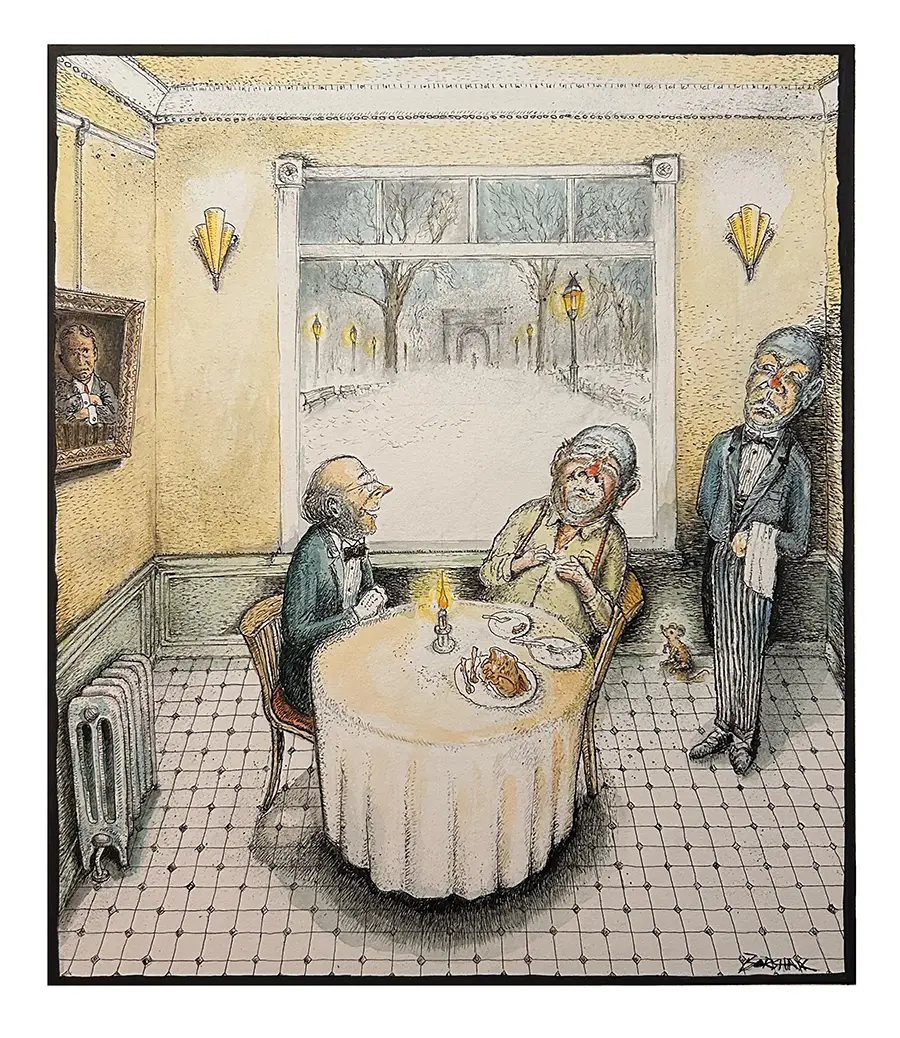
Illustration by Keith Borshak

There is one day that is ours. There is one day when all we Americans who are not self-made go back to the old home to eat biscuits and marvel how much nearer to the porch the old pump looks than it used to. Bless the day. It is the one day that is purely American. Yes, a day of celebration, exclusively American.

And now for the story which is to prove to you that we have traditions that are becoming older at a much rapider rate than those of England are — thanks to our git-up and enterprise.

Stuffy Pete took his seat on the third bench to the right as you enter Union Square from the east, at the walk opposite the fountain. Every Thanksgiving Day for nine years he had taken his seat there promptly at 1 o’clock. For every time he had done so things had happened to him — Charles Dickensy things that swelled his waistcoat above his heart, and equally on the other side.

But today Stuffy Pete’s appearance at the annual trysting place seemed to have been rather the result of habit than of the yearly hunger which, as the philanthropists seem to think, afflicts the poor at such extended intervals.

Certainly Pete was not hungry. He had just come from a feast that had left him of his powers barely those of respiration and locomotion. His eyes were like two pale gooseberries firmly imbedded in a swollen and gravy-smeared mask of putty. His breath came in short wheezes; a senatorial roll of adipose tissue denied a fashionable set to his upturned coat collar. Buttons that had been sewed upon his clothes by kind Salvation fingers a week before flew like popcorn, strewing the earth around him. Ragged he was, with a split shirt front open to the wishbone; but the November breeze, carrying fine snowflakes, brought him only a grateful coolness. For Stuffy Pete was overcharged with the caloric produced by a super-bountiful dinner, beginning with oysters and ending with plum pudding, and including (it seemed to him) all the roast turkey and baked potatoes and chicken salad and squash pie and ice cream in the world. Wherefore he sat, gorged, and gazed upon the world with after-dinner contempt.

The meal had been an unexpected one. He was passing a red brick mansion near the beginning of Fifth Avenue, in which lived two old ladies of ancient family and a reverence for traditions. They even denied the existence of New York, and believed that Thanksgiving Day was declared solely for Washington Square. One of their traditional habits was to station a servant at the postern gate with orders to admit the first hungry wayfarer that came along after the hour of noon had struck, and banquet him to a finish. Stuffy Pete happened to pass by on his way to the park, and the seneschals gathered him in and upheld the custom of the castle.

After Stuffy Pete had gazed straight before him for ten minutes he was conscious of a desire for a more varied field of vision. With a tremendous effort he moved his head slowly to the left. And then his eyes bulged out fearfully, and his breath ceased, and the rough-shod ends of his short legs wriggled and rustled on the gravel.

For the Old Gentleman was coming across Fourth Avenue toward his bench.

Every Thanksgiving Day for nine years the Old Gentleman had come there and found Stuffy Pete on his bench. That was a thing that the Old Gentleman was trying to make a tradition of. Every Thanksgiving Day for nine years he had found Stuffy there, and had led him to a restaurant and watched him eat a big dinner. They do those things in England unconsciously. But this is a young country, and nine years is not so bad. The Old Gentleman was a staunch American patriot, and considered himself a pioneer in American tradition. In order to become picturesque we must keep on doing one thing for a long time without ever letting it get away from us. Something like collecting the weekly dimes in industrial insurance. Or cleaning the streets.

The Old Gentleman moved, straight and stately, toward the Institution that he was rearing. Truly, the annual feeding of Stuffy Pete was nothing national in its character, such as the Magna Carta or jam for breakfast was in England. But it was a step. It was almost feudal. It showed, at least, that a Custom was not impossible to New Y — ahem! — America.

The Old Gentleman was thin and tall and sixty. He was dressed all in black, and wore the old-fashioned kind of glasses that won’t stay on your nose. His hair was whiter and thinner than it had been last year, and he seemed to make more use of his big, knobby cane with the crooked handle.

As his established benefactor came up Stuffy wheezed and shuddered like some woman’s over-fat pug when a street dog bristles up at him. He would have flown, but all the skill of Santos-Dumont could not have separated him from his bench. Well had the myrmidons of the two old ladies done their work.

“Good morning,” said the Old Gentleman. “I am glad to perceive that the vicissitudes of another year have spared you to move in health about the beautiful world. For that blessing alone this day of thanksgiving is well proclaimed to each of us. If you will come with me, my man, I will provide you with a dinner that should make your physical being accord with the mental.”

That is what the Old Gentleman said every time. Every Thanksgiving Day for nine years. The words themselves almost formed an Institution. Nothing could be compared with them except the Declaration of Independence. Always before they had been music in Stuffy’s ears. But now he looked up at the Old Gentleman’s face with tearful agony in his own. The fine snow almost sizzled when it fell upon his perspiring brow. But the Old Gentleman shivered a little and turned his back to the wind.

Stuffy had always wondered why the Old Gentleman spoke his speech rather sadly. He did not know that it was because he was wishing every time that he had a son to succeed him. A son who would come there after he was gone — a son who would stand proud and strong before some subsequent Stuffy, and say: “In memory of my father.” Then it would be an Institution.

But the Old Gentleman had no relatives. He lived in rented rooms in one of the decayed old family brownstone mansions in one of the quiet streets east of the park. In the winter he raised fuchsias in a little conservatory the size of a steamer trunk. In the spring he walked in the Easter parade. In the summer he lived at a farmhouse in the New Jersey hills, and sat in a wicker armchair, speaking of a butterfly, the ornithoptera amphrisius, that he hoped to find some day. In the autumn he fed Stuffy a dinner. These were the Old Gentleman’s occupations.

Stuffy Pete looked up at him for a half minute, stewing and helpless in his own self-pity. The Old Gentleman’s eyes were bright with the giving-pleasure. His face was getting more lined each year, but his little black necktie was in as jaunty a bow as ever, and the linen was beautiful and white, and his gray mustache was curled carefully at the ends. And then Stuffy made a noise that sounded like peas bubbling in a pot. Speech was intended; and as the Old Gentleman had heard the sounds nine times before, he rightly construed them into Stuffy’s old formula of acceptance.

“Thankee, sir. I’ll go with ye, and much obliged. I’m very hungry, sir.”

The coma of repletion had not prevented from entering Stuffy’s mind the conviction that he was the basis of an Institution. His Thanksgiving appetite was not his own; it belonged by all the sacred rights of established custom, if not, by the actual Statute of Limitations, to this kind old gentleman who had preempted it. True, America is free; but in order to establish tradition some one must be a repetend — a repeating decimal. The heroes are not all heroes of steel and gold. See one here that wielded only weapons of iron, badly silvered, and tin.

The Old Gentleman led his annual protégé southward to the restaurant, and to the table where the feat had always occurred. They were recognized.

“Here comes de old guy,” said a waiter, “dat blows dat same bum to a meal every Thanksgiving.”

The Old Gentleman sat across the table glowing like a smoked pearl at his cornerstone of future ancient Tradition. The waiters heaped the table with holiday food — and Stuffy, with a sigh that was mistaken for hunger’s expression, raised a knife and fork and carved for himself a crown of imperishable bay.

No more valiant hero ever fought his way through the ranks of an enemy. Turkey, chops, soups, vegetables, pies, disappeared before him as fast as they could be served. Gorged nearly to the uttermost when he entered the restaurant, the smell of food had almost caused him to lose his honor as a gentleman, but he rallied like a true knight. He saw the look of beneficent happiness on the Old Gentleman’s face — a happier look than ever the fuchsias and the ornithoptera amphrisius had ever brought to it — and he had not the heart to see it wane.

In an hour Stuffy leaned back with a battle won. “Thankee kindly, sir,” he puffed like a leaky steam pipe; “thankee kindly for a hearty meal.”

Then he arose heavily with glazed eyes and started toward the kitchen. A waiter turned him about like a top, and pointed him toward the door. The Old Gentleman carefully counted out $1.30 in silver change, leaving three nickels for the waiter.

They parted as they did each year at the door, the Old Gentleman going south, Stuffy north.

Around the first corner Stuffy turned, and stood for one minute. Then he seemed to puff out his rags as an owl puffs out his feathers, and fell to the sidewalk like a sunstricken horse.

When the ambulance came the young surgeon and the driver cursed softly at his weight. There was no smell of whiskey to justify a transfer to the patrol wagon, so Stuffy and his two dinners went to the hospital. There they stretched him on a bed and began to test him for strange diseases, with the hope of getting a chance at some problem with the bare steel.

And lo! an hour later another ambulance brought the Old Gentleman. And they laid him on another bed and spoke of appendicitis, for he looked good for the bill.

But pretty soon one of the young doctors met one of the young nurses whose eyes he liked, and stopped to chat with her about the cases.

“That nice old gentleman over there, now,” he said, “you wouldn’t think that was a case of almost starvation. Proud old family, I guess. He told me he hadn’t eaten a thing for three days.”  PS

Born in Greensboro, North Carolina, O. Henry (William Sidney Porter, 1862-1910) published “Two Thanksgiving Day Gentlemen” in 1907 in the collection The Trimmed Lamp and Other Stories. It has been lightly edited for a 21st century audience.

PinePitches November 2026

PinePitches

PinePitches November 2026

Lorem ipsum dolor sit amet, consectetur adipiscing elit. Ut elit tellus, luctus nec ullamcorper mattis, pulvinar dapibus leo.

The Last First

Time to, um, “extinguish” the fire and call in the dogs, the last First Friday of the 2026 season is Friday (Whoa, what are the odds?), Nov. 6, at the usual place — the grassy slope next to the Sunrise Theater, 250 N.W. Broad St., Southern Pines — at the usual time, the fun starts at 5. Appropriately, the closing act is Fireside Collective, a hybrid bluegrass, folk, funk and classic rock band based in Asheville. Outside alcohol is verboten and, as for the dogs, leave all four-legged creatures at home. The cost is nada. For more info go to www.sunrisetheater.com. A little traveling music, please.

A Mouse King and a Sugar Plum Fairy

Gary Taylor Dance presents the enchanting holiday ballet The Nutcracker, in BPAC’s Owens Auditorium, 3395 Airport Road, Pinehurst, in three performances: 7:30 p.m. on Friday, Nov. 20;
2 p.m. on Saturday, Nov. 21; and 2 p.m. on Sunday, Nov. 22.
Come early to the Saturday matinee to meet some of Clara’s
favorite characters in the lobby. For tickets and info go to
www.ticketmesandhills.com.

Some Good Luck on Friday the 13th

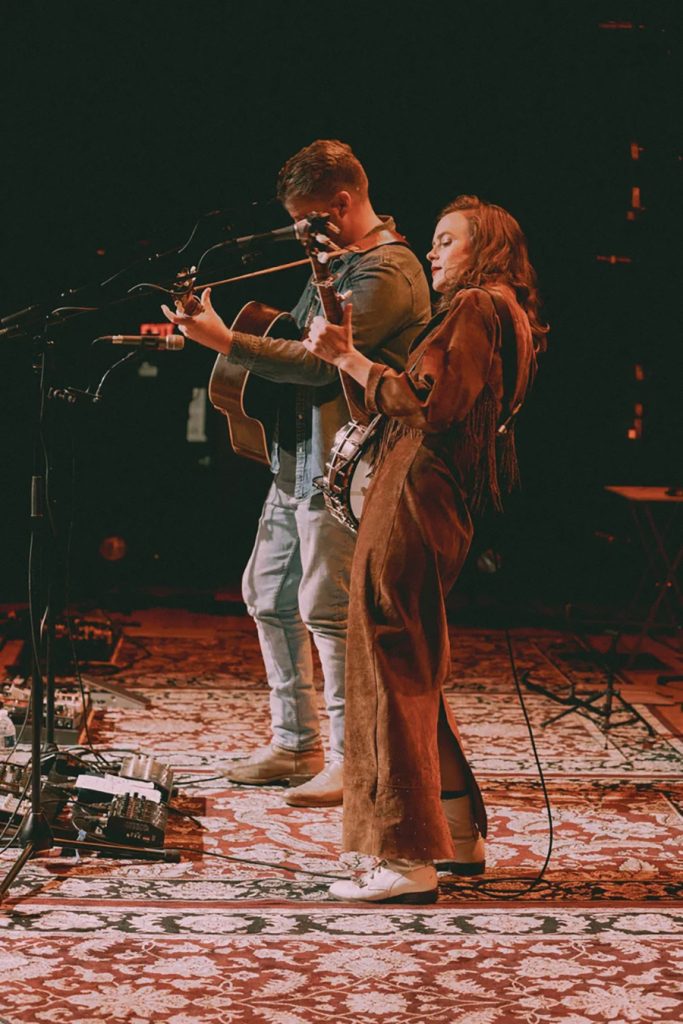
For an intimate, story-driven concert experience, join the Chatham Rabbits at 7:30 p.m. on Friday, Nov. 13, at the Sunrise Theater, 250 N.W. Broad St., Southern Pines. The band, led by the husband and wife duo Austin and Sarah McCombie, blends folk and traditional bluegrass with conversational banter. Ballad singer Murphy Campbell will be a special guest performer. For info and tickets go to
www.sunrisetheater.com.

Flip the Switch

Bring family and friends to the village of Pinehurst tree lighting on Friday, Dec. 4, at Tufts Memorial Park, 1 Village Green Road W., Pinehurst. Beginning at 5 p.m. there will be music, food, holiday cheer and a jolly old elf. The lighting takes place at 6:30 p.m. For more information go to www.vopnc.org.

Tour de Force

Take a wild ride through musical history with the Baxter Clement Variety Show benefiting the Boys and Girls Club of the Sandhills, on Wednesday, Nov. 18, at 7 p.m. at the Sunrise Theater, 250 N.W. Broad St., Southern Pines. For tickets and information go to www.sunrisetheater.com.

Thank a Vet

The Southern Pines Veterans Day parade is Saturday, Nov. 7, up and down Broad Street, from 10 a.m. to noon. Wave a flag and applaud all who served. Freedom comes at a cost. If you need additional information call (910) 692-7376 or visit www.southernpines.net.

In the Mood

The Sandhills Community College Jazz Band presents “Up and Down Broadway,” at 6 p.m. on Monday, Nov. 9, in BPAC’s Owens Auditorium, 3395 Airport Road, Pinehurst. The Union Pines High School Jazz Band is the opening act. Admission is free, but tickets are required. For those, and more info, go to www.ticketmesandhills.com.  PS


Ruth Pauley Speakers

Tom Murphy, a retired Navy captain and former SEAL — whose career included command of the much-publicized SEAL Team Six — provides a rare look into military combat experience and its enduring effects on the mind, body and spirit, on Tuesday, Nov. 10, at 7 p.m., in BPAC’s Owens Auditorium, 3395 Airport Road, Pinehurst. The program, “Beyond the Trident: A Navy SEAL’s Search through Trauma for Meaning in Life,” shares deep introspection into PTSD and recovery. The lecture is free, but tickets are required. For info and tickets go to www.ticketmesandhills.com or visit www.ruthpauley.org.

Weymouth Wonderland

Grab a treat, a warm drink, visit with Santa, shop local artisans and vendors, tour the decked-out Boyd House and listen to some holiday tunes when the Weymouth Center for the Arts & Humanities holds its holiday market beginning at 10 a.m. on Saturday, Dec. 5. For more info go to www.weymouthcenter.org.

Garden of Lights

Beginning at 5 p.m. on Friday, Nov. 27, the Sandhills Horticultural Gardens, 3245 Airport Road, Pinehurst, will present its Garden of Lights. More than a million lights and illuminated displays will transform the pathways. The display lasts through Jan. 9.
For information go to www.sandhills.edu/gardenevents.

Going South

Going South

Going South

The 1991 Tour Championship: Pinehurst’s pivotal event

By Bill Case

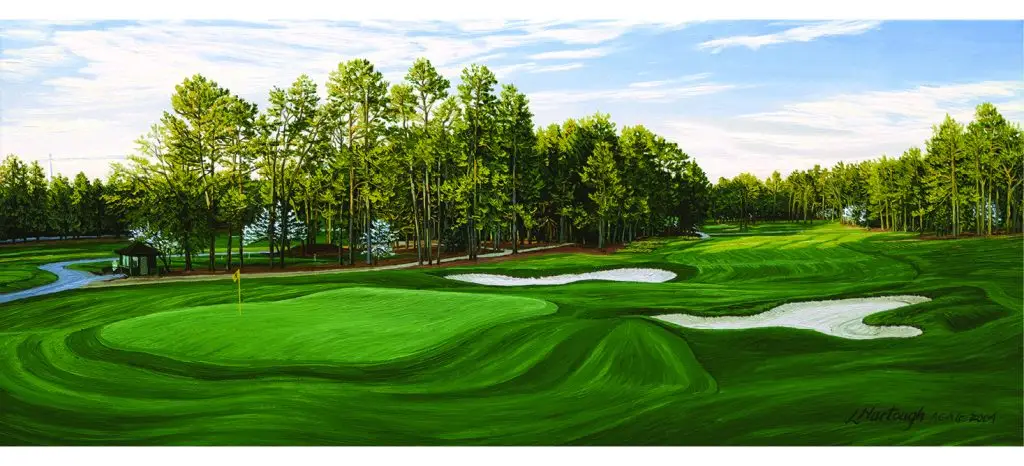
Feature image – Painting by Linda Hartough

On Sept. 9, 2020, the United States Golf Association issued a groundbreaking announcement naming Pinehurst Course No. 2 as its first anchor site for the U.S. Open. The Open would be contested on No. 2 in 2029, ’35, ’41 and ’47 in addition to the already scheduled 2024 championship.

Pinehurst owner, Bob Dedman Jr., expressed profound gratification with the singular honor. “Eight U.S. Opens in less than 50 years is a real testament to our partnership” said Dedman. “As players have often said, ‘It’s not just what you win, but where you win that matters.’”

For the Pinehurst Resort and Course No. 2 to achieve such recognition would have seemed like a pipe dream 40 years before. Following a decade of ill-fated management decisions by the resort’s then-owner, Diamondhead Corporation, the floundering company’s assets had been placed under the control of a consortium of its creditor-banks in 1980. And those lenders, looking to find a liquid buyer to take the resort’s assets off their books, were understandably loath to pour fresh money into Pinehurst.

As annual losses exceeded $1,000,000, the banks grew increasingly desperate to find a buyer. Most of the major hotel chains kicked the tires but shied away, concluding the property was ruined beyond redemption.

The lone exception was Dallas-based ClubCorp, which operated over 140 clubs — city as well as golf and country clubs — throughout America. The company’s charismatic owner and founder, Robert Dedman Sr., was intrigued with Pinehurst. “It was a logical fit,” he said. “We were already into golf in a big way, and we knew more about managing golf than other companies.”

Dedman Sr. also viewed Pinehurst’s tradition and history as major pluses. “It had held a PGA Championship and a Ryder Cup,” he said. “Course No. 2 was one of the best in the world. It had Donald Ross and all the magic that goes along with that.” However, he had no interest in acquiring the Carolina Hotel (then the Pinehurst Hotel) as part of the transaction. When the banks’ representative insisted it be included, Dedman reluctantly agreed. ClubCorp bought the resort in its entirety in 1984.

Three years later, looking to hire a new president to oversee and upgrade the resort’s operations, Dedman hired 36-year-old Pat Corso. Prior to his arrival in Pinehurst (where he first managed the Holly Inn), the Logansport, Indiana, native had spent his adult life working in the hospitality industry in Michigan — famously beginning as a singing waiter. Never had he dealt with a property in such dire condition as Pinehurst. “The entire infrastructure, inside and out, was in bad shape,” remembers Corso. “The ice bin floor in the kitchen fell through and a worker with it. A section of the porte-cochere at the Carolina’s front entrance collapsed. The hotel rooms had shag carpeting from the ’70s that had to go. All the windowpanes were rotting off.”

The golf courses also needed work. Longtime director of golf course maintenance Bob Farren says that when he joined the greenkeeping staff in 1982, the courses were in “horrible condition.” ClubCorp promptly began the long and expensive task of rehabbing the resort, inside and out.

Despite his relative inexperience in the golf business, Corso quickly sensed that for Pinehurst to regain its lost stature it needed to bring important tournaments back to Course No. 2. “Everyone working at the resort knew No. 2 was our greatest asset,” he says, “and staging big events on it was the way to put the course, and Pinehurst itself, back on the map.” How big? Why not aim at the pinnacle — the U.S. Open? “We realized that obtaining the Open would be an incredible challenge, but whether we achieved that goal or not, we believed that by trying, a lot of good things would happen along the way.”

First, Dedman Sr. needed to be convinced that luring major championships to Course No. 2 was a financially worthwhile objective. Diamondhead had staged an annual PGA Tour tournament on Course No. 2 from 1973 to 1982 (successively the World Open Golf Championship, the Colgate Hall of Fame Classic, and the Hall of Fame Tournament). Attendance had gradually declined, Colgate ended its sponsorship, and the event was unceremoniously terminated. Hosting a tournament would involve upfront costs and lost revenue.

“I would say Bob Sr. was initially skeptical,” says Corso, “but he was a boss who really trusted his people. His management philosophy was, ‘The less I do, the better we do.’ Once he gave the go-ahead, Bob became an enthusiastic backer.”

Pinehurst’s director of golf in 1987 was Mike Sanders, a prominent PGA pro who shared Corso’s vision. He was able to arrange for Pinehurst to host two prestigious, though admittedly low-key, tournaments on No. 2: the 1988 PGA Club Professional Championship, and the 1989 U.S. Women’s Amateur. Both Corso and Sanders considered those tournaments to be good preliminary steps toward the ultimate goal. Shortly after the tournaments were announced, Sanders resigned from the resort to focus on a new golf development, Pinehurst National (much later, Pinehurst Course No. 9).

With the PGA Club Pro Championship looming, Corso needed a new and experienced director of golf, and fast. He reached out to a fellow Hoosier, Don Padgett II, the 39-year-old general manager at Firestone Country Club in Akron, Ohio. A ClubCorp sister club, Firestone hosted the NEC World Series of Golf in ’87 and had been the site of three PGA Championships.

Padgett wasn’t ready to leave Firestone but did have a recommendation. “What you need is someone like my dad,” he said. The elder Don Padgett, then 62, was known throughout the golf industry. He was president of the PGA of America in ’77 and ’78. The list of golf contacts in his Rolodex (a thing back then) was voluminous.

Corso was taken by surprise. “I’ve heard so much about your dad for so many years,” he said. “I thought he must be dead.”

Given the importance of the hire, Corso sought advice from LPGA great Peggy Kirk Bell. He drove over to Pine Needles Lodge & Golf Club, found Peggy in the lobby, and asked her opinion. “You could not make a better choice,” she said.

“Mrs. Bell’s endorsement made a young guy making a big decision confident he was heading down the right path,” says Corso.

When it was offered, Don II urged his father to take the position but it took some doing — the elder Padgett had recently accepted a club position out West. Eventually on board, however, Padgett promptly established collegial relationships with both Corso and Dedman Sr. “My dad and Bob Dedman Sr. were kindred spirits,” says Padgett II. “Both of them came from almost nothing.”

When Padgett arrived on the scene, he took Corso under his wing. “The fact that meaningful people like Padge believed in me meant everything,” says Corso. “We went to all the big tournaments together. He introduced me to everyone he thought I needed to know. He’d station us around the putting green, or the clubhouse or by the big oak tree at Augusta — places he figured we would be most likely to encounter decision-makers. For a golf guy, Padge possessed immense political skills.”

During these forays, Padgett also made an effort to connect with those tour players having a past history with No. 2. Many had fond memories of playing the course in the Hall of Fame tournaments, the North & South Amateur, or collegiately. When the PGA Club Professional Championship arrived in October 1988, Padgett and Corso gladhanded most of the 360 club pros in attendance. A significant number were Padge’s longtime friends. “We made sure the pros, whether they played well or not, had a great experience,” says Corso. “The thought was they would go home and spread the word to their members that Pinehurst was back.”

Staging the event in the fall showed off No. 2 in optimum condition. The greens, recently planted with a new strain of Penncross bentgrass, were at their firmest that time of year, much more so than in July or August when the course was closed because of heat stress to the greens. Corso, Padgett and maintenance head Brad Kocher were aware that No. 2’s greens would never provide the firm, fast, putting surfaces the USGA would require for a U.S. Open in June.

Pinehurst’s quest for ideal putting surfaces had been ongoing since at least 1922, when Donald Ross, hoping to replace the resort’s sand greens with turf, experimented unsuccessfully with various mixtures of fertilizer and Bermudagrass on the Holly Inn’s lawn. “I am more or less puzzled,” Leonard Tufts wrote Ross in 1929, “why good putting greens are possible at Augusta Country Club and not here? There isn’t much difference in the temperatures.”

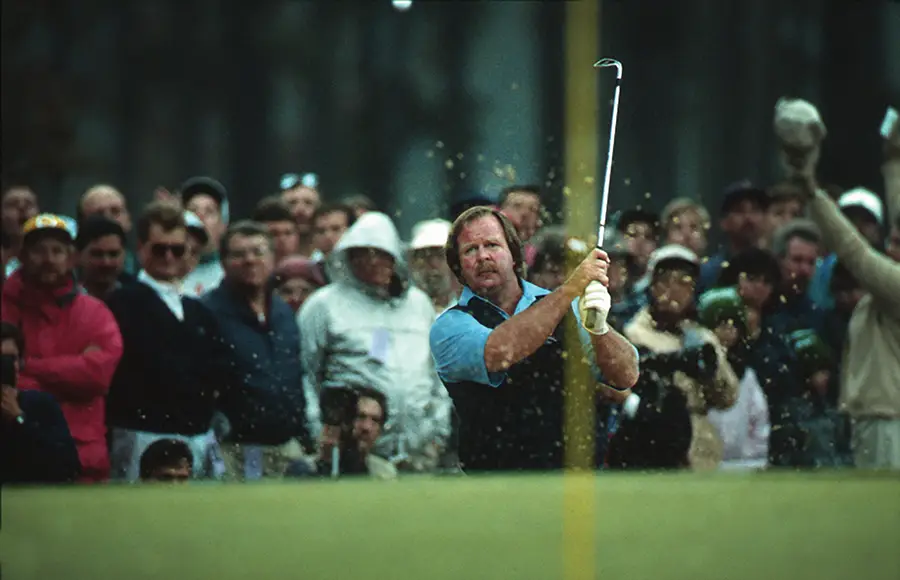
Craig Stadler

Photos Courtesy of The Tufts Archives, Pinehurst, NC

The hunt for growable grass continued. Finally, in 1934, Ross and greenkeeper Frank Maples found a strain of Bermuda hardy enough to withstand winter weather. Combining that grass with a new irrigation system led to No. 2 sporting grass putting surfaces when the club hosted the 1936 PGA Championship in November.

Bermuda was Pinehurst’s grass of choice for No. 2’s greens until 1972, when Diamondhead converted them to bent prior to the first World Open. But as Ross had learned a half century before, Pinehurst’s climate — located in what turf scientists referred to as an agronomic transition zone — was far from ideal for growing the types of grass then available. It was a Goldilocks dilemma: Pinehurst was too hot for bent and too cold for Bermuda. The resort had yet to discover grass that was “just right.”

It was no surprise that No. 2’s greens were in noticeably iffy condition when Pinehurst hosted the U.S. Women’s Amateur in July 1989. Following the event, P.J. Boatwright, the USGA’s executive director of rules and competitions and the man who was responsible for setting the conditions of play in a U.S. Open, remarked that Course No. 2 would never host the Open. In his judgment, the Women’s Amateur proved bentgrass wouldn’t work at Pinehurst and that Bermudagrass in June would never offer surfaces fast enough for an Open. Adding to the sting of his remarks was that P.J. was a Pinehurst alum, having previously served as the Carolinas Golf Association executive director.

While Boatwright oversaw rules and competitions, in 1980 the USGA had appointed a boyish-looking, bow tie-wearing David Fay as the organization’s overall executive director. Fay was determined to take the U.S. Open to publicly accessible venues beyond iconic Pebble Beach, the only such course to host the championship. Fay was open to considering venues like No. 2, Bethpage Black, Erin Hills and others. He also believed that the championship should go to every section of the country, even if one of those places was in the North Carolina Sandhills, far from major metropolitan areas and even farther from the blue blood clubs the USGA was so accustomed to in the Northeast.

“They called what I was proposing ‘Fay’s Folly,’” says Fay. “I felt that if my concept didn’t work out, my job could be on the line.” Nonetheless, the possibility that the USGA might eventually consider Course No. 2 for a future Open was music to the ears of Pinehurst’s execs. They just weren’t sure how to go about making that happen.

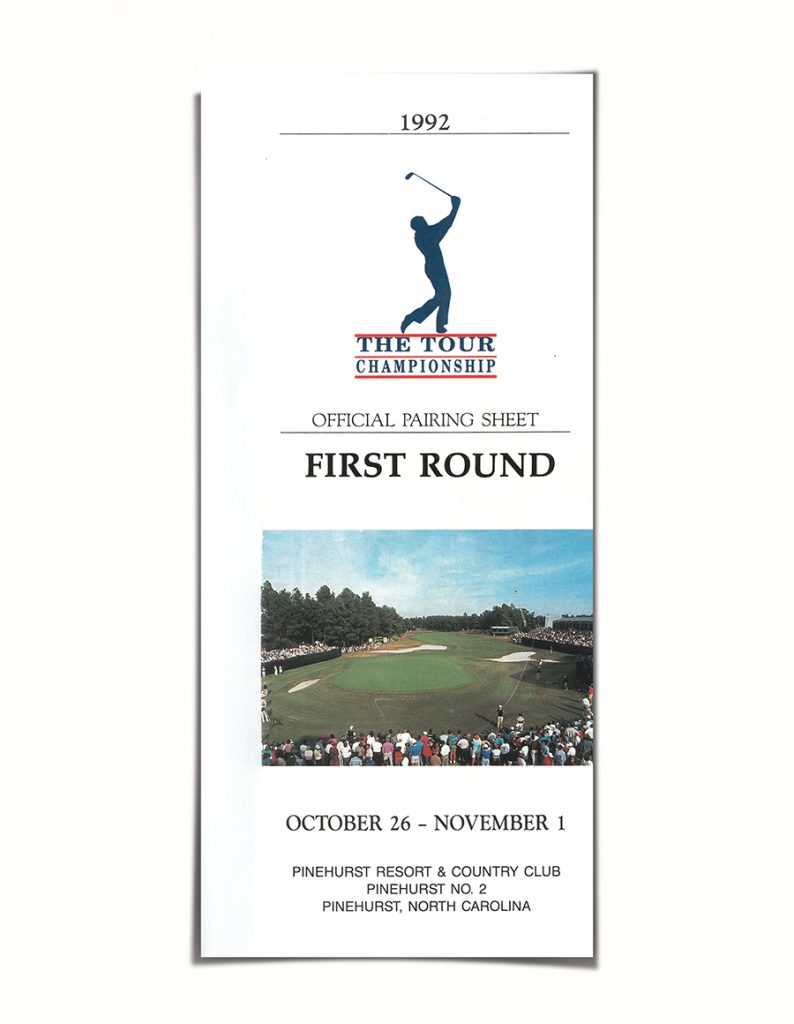
In the fall of 1990, an unanticipated breakthrough occurred when Don Padgett received a telephone call from an old friend, PGA Tour Commissioner Deane Beman. As a member of the PGA Tour’s Player Advisory Council, Padge had played a significant role in Beman’s initial hiring as commissioner. The subject Beman wanted to discuss was whether Pinehurst would be interested in hosting the Nabisco Tour Championship the following October.

The Tour Championship was first conceived by Beman in 1987 as a means of extending the tour’s golf season and bringing it to an exciting conclusion. Only the season’s top 30 money winners qualified for the event, and the $3 million purse was the highest on tour. The first four Tour Championships were contested from ’87 to ’90 at revered venues: Oak Hill, Pebble Beach, Harbour Town and Houston Champions.

A shrewd negotiator, initially Beman wanted Pinehurst to pay a site fee of $500,000 and hold the championship in early October — high season for golf vacationers in Pinehurst. Padgett refrained from making any commitment to Beman. He reported the call to Corso and asked him what he wanted to do. Corso turned the question around. “What do you want to do?” And though hosting the championship would represent another giant step for the resort and No. 2, Padgett replied, “Let’s play hard to get.” So they did.

Like many current and former players, Beman had a sentimental side when it came to Pinehurst. During his collegiate years at the University of Maryland, he and his golf teammates made frequent trips to the Sandhills, and he became a huge fan of Course No. 2. A two-time U.S. Amateur champion and four-time winner on the PGA Tour, Beman had competed on the course both as an amateur in the North & South, and as a professional in the World Open. Believing No. 2 was being unfairly “overlooked,” Beman was eager to return the Donald Ross masterpiece to the limelight.

Since the Tour already had a relationship with ClubCorp through its tournaments at Firestone and Don Padgett II, the relationship with the resort was something of a known commodity. Beman dropped his demand for a site fee and agreed to move the tournament’s starting date to Oct. 31 — Halloween.

Beman knew there would likely be “several guys qualifying who, like me, had played No. 2 collegiately or at Hall of Fame tournaments. I knew they’d appreciate the chance to compete on the course again and would work hard to make the field.”

He was right about that. Chip Beck, reared in Fayetteville and a two-time winner of the Donald Ross Junior Invitational on Course No. 2, was “thrilled out of my mind” to be playing No. 2 after qualifying 16th on the money list. Wake Forest alumni Lanny Wadkins and Billy Andrade qualified 12th and 14th, respectively. In his time at Wake, Andrade and his Demon Deacon teammates frequently drove from Winston-Salem to play No. 2. “It was just enough warmer in Pinehurst to be good for golf, and it was beautiful,” says Andrade, who had also won the 1986 North & South Amateur.

The Tour Championship featured all of 1991’s major champions: the wee Welshman Ian Woosnam (Masters), sartorially splendent Payne Stewart (U.S. Open), urbane Australian Ian Baker-Finch (Open Championship) and sensational young bomber John Daly (PGA). Stars like Fred Couples, Nick Price and leading money winner Corey Pavin also made the field. Longer shots Craig Stadler and lefthander Russ Cochran qualified in the bottom third of the field of 30. Cochran had won that year’s Western Open, but former Masters champion Stadler had gone winless in America for seven years.

For Corso, Pinehurst demonstrated a magical quality during the championship. “It had something to do with starting on Halloween, the crisp weather, and big-time golf returning to No. 2,” says Corso. “Also, the cooler weather was perfect for our bentgrass greens.”

David Fay rarely attended PGA Tour events. But given his interest in staging majors on publicly accessible courses, he was not going to miss this one. “I was very interested to see how the course would play for the Tour Championship,” he says. “I was interested to see if people would get romantic about the course. I was anxious to see if time had passed it by.”

Pat Corso and Don Padgett

Photograph from Pat Corso

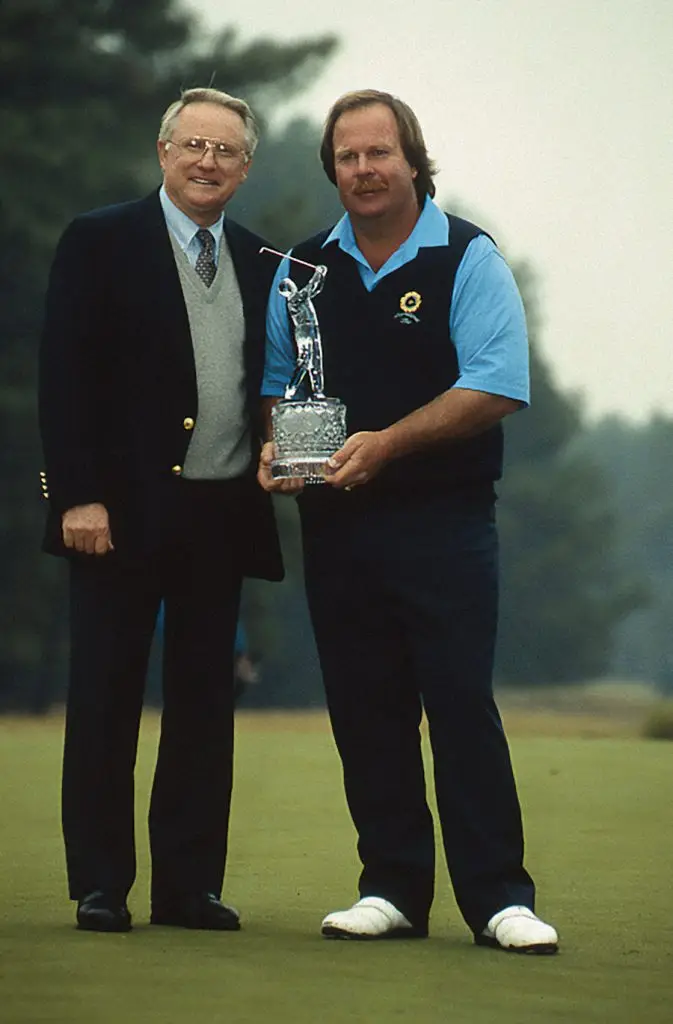
Deane Beman and Craig Stadler

Photos Courtesy of The Tufts Archives, Pinehurst, NC

Thursday’s first round resulted in a four-way tie at the top, which included Daly and Baker-Finch along with Stadler and Cochran all shooting nifty 68s. Stadler, nicknamed the Walrus, bunked in at Pine Needles, where he reunited with collegiate golf buddy and former Tour player Pat McGowan. “Bonnie (Pat’s wife) and I had a great time with Craig and his wife. Mrs. Bell (Pat’s mother-in-law) was there too,” says McGowan. “We ate lots of barbecue. The fact that Stads was playing well made it especially fun.”

McGowan remembers that his friend complained about having trouble hitting his 3-wood and turned to a 1-iron instead. “I handed him a Founders Club 3-wood of mine, and he hit a few with it,” says McGowan. “He liked the club and stuck it in his bag.”

In the second round, Stadler and Cochran shot 68 again. They were joined at the top of the leaderboard by Nick Price and Paul Azinger. As temperatures dropped during round three, the scores went up. Despite shooting one-over-par 72s, Stadler and Cochran remained tied at the top. Cochran advised the press that he “hated” the prevailing chilly weather, that he’d rather play in the rain. When the Walrus was asked his strategy for dealing with the cold, he pithily answered, “I’ll put my sweater on.”

Stadler and Cochran were paired together in the fourth round’s final grouping. They were still tied for the lead on the 18th, where Stadler faced a 5-foot putt to force a playoff. To his relief, he rolled it in. “I made a good putt on 18, and that was more of a surprise than anything,” he said. The playoff commenced in a drizzle on the par-5 16th, where both players made birdies with Stadler smashing a terrific second shot onto the green with McGowan’s 3-wood. 

On the 190-yard par-3 17th, Stadler struck a brilliant 5-iron that spun to a stop 6 feet from the hole. Cochran’s shot came up well short of the green. “Somebody was jumping around in the bleachers right when I took it back,” the frustrated southpaw said. He recovered well to within 4 feet of the cup, but Stadler sealed the deal by holing his birdie putt. The record prize of $360,000 catapulted him to second on the money list behind Pavin.

The jubilant Stadler celebrated by treating McGowan and the Pine Needles contingent to $300 worth of Chinese food. “$300 bought a lot of Chinese food in 1991,” says McGowan with a smile.

Just about everyone associated with the tournament was happy. Padgett had been concerned that No. 2 might not pose a stiff enough challenge for the current crop of PGA stalwarts, but Stadler’s winning total of 5-under-par 279 demonstrated otherwise. “Where has this been all my life?” said Baker-Finch. “You could play a U.S. Open here, without rough, without doing anything.” Beman quickly requested that Pinehurst host the Tour Championship again in 1992.

David Fay gushed praise for everything he’d witnessed at the championship: the smooth logistics, the large crowds, the support of the event from distant North Carolina companies, and the magical atmosphere of the town and Course No. 2. As a baseball aficionado, he likened the ambience of No. 2 to baseball cathedrals like Fenway Park and Wrigley Field. If Fay had harbored reservations about Pinehurst and No. 2 as a U.S. Open site, the Tour Championship had dispelled them — except for the condition of the greens.

The tournament was a hit in the press, too. Corso remembers the eloquent and heartfelt praise both the town and course received on television and in print from golf writers Ron Green Sr., Tim Rosaforte and Jaime Diaz, as well as broadcaster Jack Whitaker. “Whether it was the church bells pealing, the legacy of Donald Ross, or the quaint New England town the Tufts built,” says Corso, “their pieces captured Pinehurst’s unique atmosphere.”

Riding the wave of the Tour Championship and the golf world’s rediscovered affection for Pinehurst, the resort’s bid to obtain a U.S. Open was gaining steam. It seemed that goal was within reach in June of 1992 when the USGA’s Championship Committee invited the resort to send a delegation to a meeting in Pebble Beach at that year’s Open. The committee was considering Course No. 2 as a potential venue for the 1999 U.S. Open. The moment Dedman Sr., Corso and Padgett thought might never come to pass was suddenly at hand.

Corso recalls that early on in the meeting, M.J. Mastalir, a committee member from Colorado, made an impassioned argument that the USGA should “Go west!” in ’99. Alarm bells began clanging for the Pinehurst delegation. Then committee chair Reg Murphy, destined to be a future USGA president, stepped in and cut Mastalir off. “No!” said Murphy with authority. “The ’99 Open is going south!”

“When Reg said that,” Corso recalls, “the air went out of my lungs. I knew ‘south’ meant Pinehurst.” Still a bit in disbelief at what he’d just heard, Corso glanced over at his director of golf. “When I saw Padge smile and nod his head, I knew that we were going to get the Open at long last.”

There was more discussion, of course. The committee sought assurance that No. 2’s greens would be changed out, and that course superintendent Brad Kocher would partner with the USGA’s agronomist in the process. The Pinehurst representatives immediately agreed.

Kocher already had a new type of creeping bentgrass in mind. Joseph Dutch was busy at Penn State developing a new strain (Penn G-2), which was being hailed as well-suited for Pinehurst. With that understanding, the committee approved No. 2 as the prospective site for the 1999 U.S. Open. The USGA formally announced its selection the following year at Baltusrol Golf Club’s U.S. Open.

In 1992, Pinehurst hosted its second Tour Championship. Paul Azinger won with a score of 276. The course was “as tough as any I’ve seen,” said Azinger. In ’94, No. 2 was the site for the U.S. Senior Open. By then, Corso had established a new entity to operate tournaments for Pinehurst. It included Jon Wagner, formerly from the PGA Tour; Reg Jones, who later joined the USGA; and Tom Pashley, now Pinehurst’s president. No. 2’s greens were converted to Penn G-2 bentgrass in time for the ’99 Open. (The strain had been initially planted on the greens of Pinehurst’s new No. 8, opened in 1996.) Kocher had the new greens in spectacular condition for Payne Stewart’s final putt, the most legendary moment in Pinehurst’s incredible golf history.

Bob Dedman Sr. and Don “Padge” Padgett were in attendance. Both savored what they had wrought, but neither lived to see Pinehurst’s second Open in 2005. Corso would retire from the presidency in 2004, moving on to other ventures. Don Padgett II succeeded his father at the resort, and together with Bob Dedman Jr. further shepherded Pinehurst into its remarkable renaissance, including one more revamping of the greens to Champion Ultradwarf Bermuda. After a century of efforts, Pinehurst finally discovered a grass that was “just right.”

The younger “Padge” is the first to acknowledge what the Tour Championship meant. “It brought Course No. 2 back into the center of big-time golf,” he says. “The ’99 Open would never have happened without the Tour Championship.”  PS

Pinehurst resident Bill Case is PineStraw’s history man. He can be reached at billcasewrites@gmail.com.

Golftown Journal

Golftown Journal

Whisper Campaign

Freshening up a Maples classic

By Lee Pace

Flashback to 1959: The baby boomers are entering adolescence. The Korean War is finished, Vietnam yet to come. Alaska and Hawaii become the 49th and 50th states. Frank Sinatra wins his first Grammy Award for best album with Come Dance With Me. Art Wall wins the Masters and Billy Casper the U.S. Open. Closer to home, a long-hitting teenager with a blond crew cut wins the North and South Amateur on Pinehurst No. 2 — Jack Nicklaus would turn pro the following year.

And it had been more than 30 years since a new golf course opened in the Sandhills.

A.B. Hardee changed all that when he opened a sparkling new residential, golf and country club community around a series of lakes just northeast of Pinehurst. He hired Ellis Maples, son of the former Pinehurst greenkeeper Frank Maples, to design the golf course, and called it the Country Club of Whispering Pines.

“Whispering Pines was one of the most renowned courses in its time,” said Woody Davis, whose Pinehurst-based golf management company owned the facility in the early 2000s. “It’s nearly 50 years old, and there’s a lot of history here. But a lot of people don’t know we’re here. It’s a true jewel. It’s a hidden secret.”

Kelly Miller had just moved to Southern Pines in the mid-1980s after marrying Peggy Ann Bell and going to work in management at the Bell family’s Pine Needles Lodge & Golf Club (and later the family would acquire Mid Pines Inn & Golf Club and Southern Pines Golf Club). Whispering Pines was one course on a rota of venues that a group of up to 16 golfers would play regularly, the group including Warren “Bullet” Bell and noted area club pros like Harvie Ward and Andy Page.

“I have fond memories of Whispering Pines,” Miller says. “It has great corridors. The routing is really good. I have always been intrigued in the lineage to Pine Needles and Mid Pines because Ellis as a young man worked on the construction of both those courses.”

Hardee, a developer from Lexington, N.C., was intrigued in the mid-1950s with the lake-studded area between roads that are now U.S. 15-501 leading to Pinehurst and U.S. 1 going to Southern Pines. The cornerstone to this section was Thagards Pond, which at some 6 miles in circumference was more of a lake than pond.

Hardee envisioned a community of lakeside homes, water sports and picnic facilities along with a golf and country club. It would be a self-contained town, complete with sewer, fire and police. His construction crews worked around an ancient cemetery, and he lowered the lake 6 feet to remove stumps and logs as a safety measure for boaters. The lake was stocked with nearly 20,000 warm-weather trout. Playing on the area’s beacon as a golf resort, Hardee built three buildings of villas for out-of-town guests. The club opened for golfers in 1959.

“It’s a perfect haven for retiring people, within easy driving distance of resort centers in Southern Pines and Pinehurst, and military facilities at Fort Bragg,” Hardee proclaimed.

Donald Ross, the famous golf architect who had designed seven Sandhills area courses (Pinehurst Nos. 1-4, Pine Needles, Mid Pines and Southern Pines Country Club) had been dead for a decade, so Hardee went to the next best thing in the Carolinas architecture business. Ellis Maples as a teenager worked for his father in building and maintaining the first four courses at Pinehurst Country Club, and later he worked in the golf shop at Pinehurst and as assistant greenkeeper at Mid Pines and Pine Needles. Maples supervised the construction of the last Ross design, Raleigh Country Club, in the late-1940s, and in 1953 decided against becoming a golf professional and focused on architecture.

His career over three decades before his death in 1984 included Grandfather Golf & Country Club and the Country Club of North Carolina (Dogwood Course), two of the finest courses in the state.

“Dad and I were pretty much alike in a couple of ways,” says Dan Maples, Ellis’ son and himself a noted golf architect. “We both belong to the Donald Ross school, which includes designing courses for all golfers. That’s more difficult to accomplish today than in Dad’s day because we now have to deal with environmental issues.”

Miller never forgot playing at Whispering Pines back in the day, and in 2025, the opportunity arose for Miller and business partner Haresh Tharani to form a management concern called Rolling Pines LLC that purchased Whispering Pines (as well as Foxfire Country Club to the west of Pinehurst). Their first move was to hire golf architect Kyle Franz to renovate the Pines Course (the original layout at Whispering Pines), and it opened in late September.

“When I first saw the course, I saw loads of incredible potential,” Franz says. “It’s a really cool piece of land and a really cool golf course. The bones were there. It just needed freshening up. It’s on a great, sandy site with excellent drainage. I could not be any prouder of how it’s turned out.”

Franz first came to the Sandhills in 2010 to work on the construction crew for Bill Coore and Ben Crenshaw on their restoration of Pinehurst No. 2. He soon met Miller, and over the next decade handled restorations at Mid Pines, Pine Needles and Southern Pines, each a golf course designed by Ross. In his research on Ross, Franz learned much about the Maples family.

“I have a huge fascination with their family and Frank Maples’ influence on Ross and Ellis,” Franz says. “All the press in the mid-1900s went to Dick Wilson and Robert Trent Jones, but in my mind, Ellis was the best architect operating during that period. This routing feels like a Ross routing. He worked for Ross for 25 years, so some of Ross rubbed off on him. The routing is Ross-like, the green pads feel very Ross-like.”

At Whispering Pines, Franz rebuilt all the greens and bunkers, and adjusted some fairway widths and angles. The greens have been planted with Mini-Verde Bermuda, the same grass used on the parent company’s other three courses.

“If we did a blindfold test and took people out on our four courses here and did not tell them who designed them or any of the details, a bunch of people would say Whispering Pines is their favorite of the four,” Franz says. “Ellis’ work deserves more attention and credit.” PS

Lee Pace has written about the Pinehurst experience for more than three decades from his home in Chapel Hill. Write him at leepace7@gmail.com and follow him @LeePaceTweet.

The Wild West Comes East

The Wild West Comes East

The Wild West Comes East

Design for community, utility and beauty

By Jenna Biter

Photographs by John Gessner

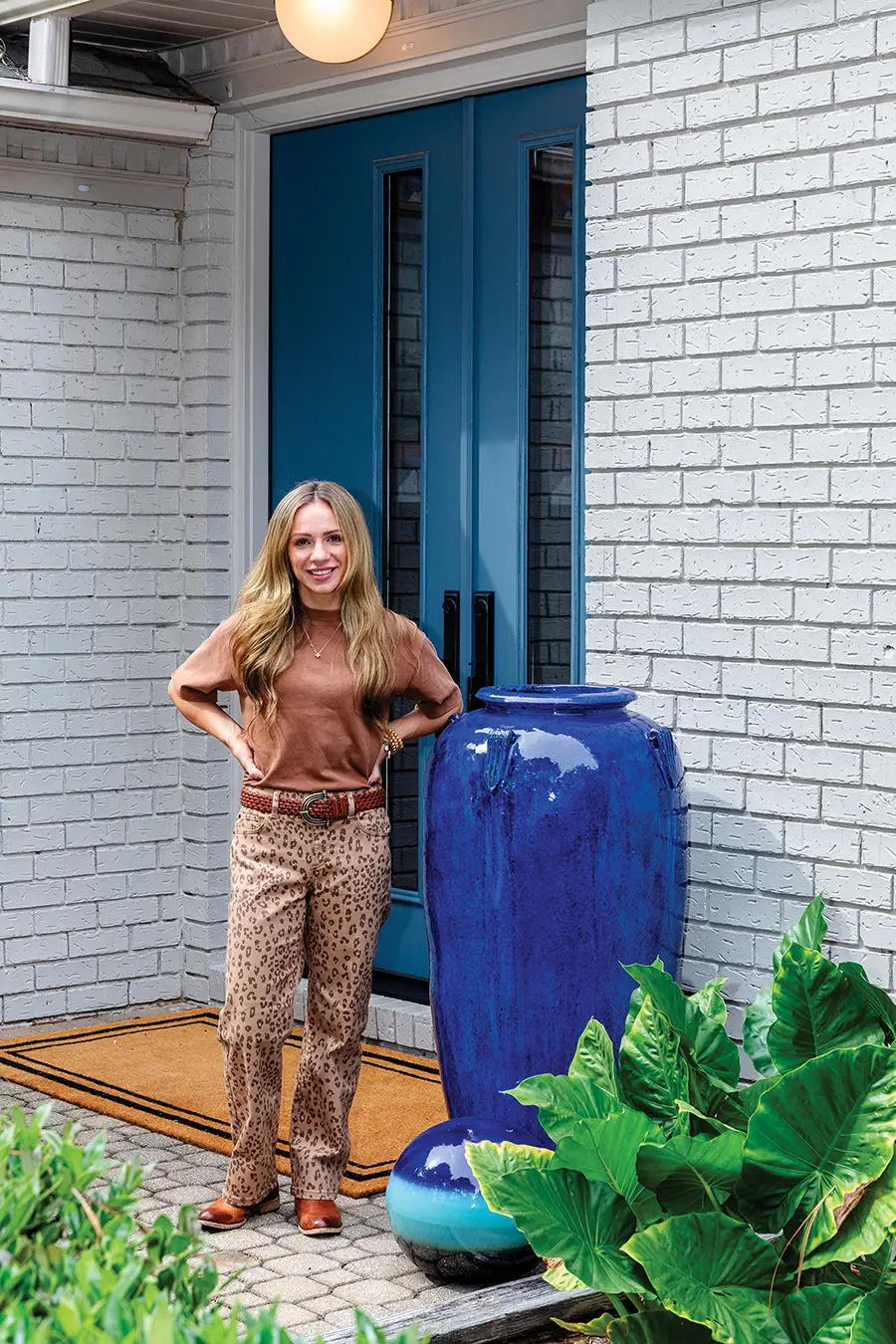
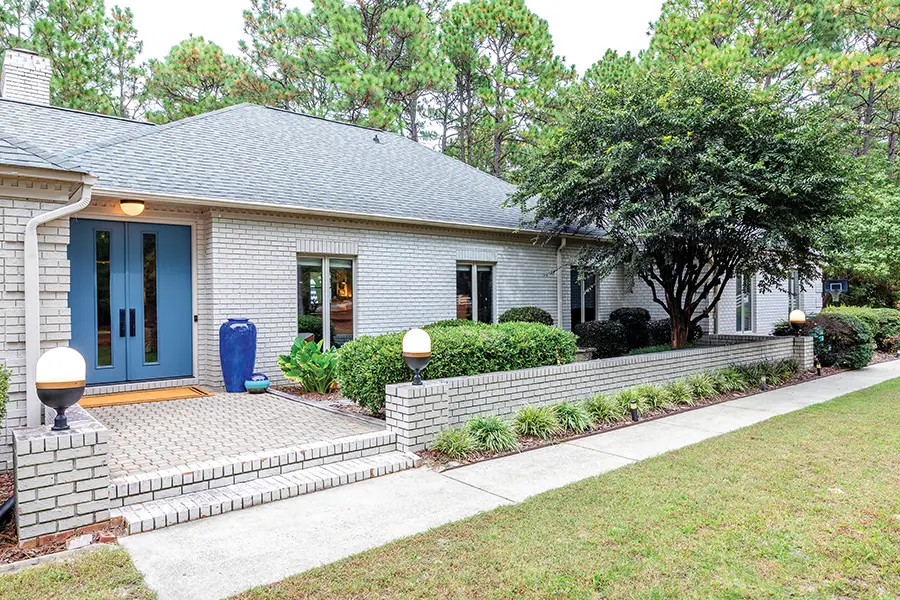
Slate blue doors open into a rancher that’s full. Four kids ages 9 to 13 pad through the halls, and friends gather in the kitchen on Soup Sundays and Muffins and Mimosas. Dogs and cats lounge on the deck. Several are permanent members of the family; the rest are visitors.

More than a hundred puppies and kittens have sheltered with the Quinlans since they moved into the buff brick house eight years ago. “We foster animals, and it’s really fun,” Sarah Quinlan says. “The kids get really involved in their care.”

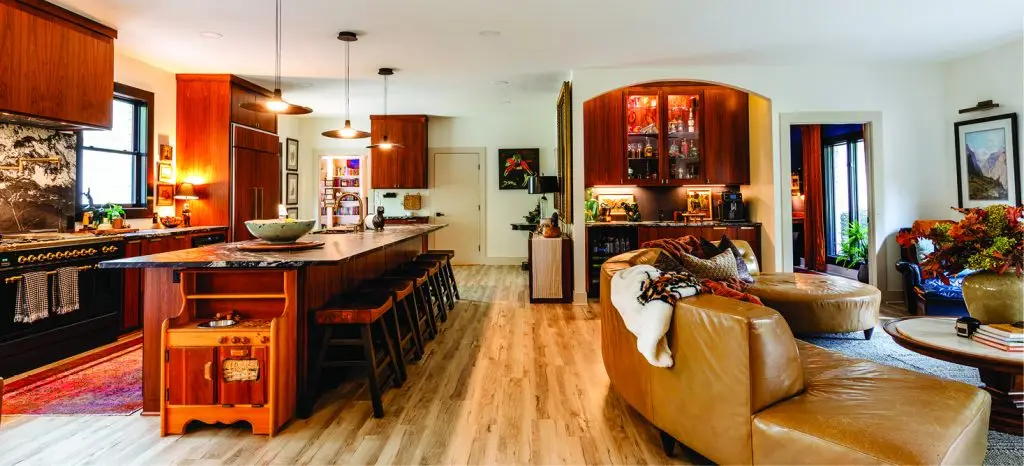
When the family of six moved into the 4,000-square-foot house near Reservoir Park, Quinlan intentionally remodeled the space to accommodate all the traffic and love of a young family, without sacrificing beauty. “There are a lot of people out there who think when they have young kids it’s not the time to invest in making their house nice,” she says. “And to me, it’s the opposite.” Quinlan values community, utility and beauty in her approach to interior design. That’s true whether she’s designing for her family or her clients.

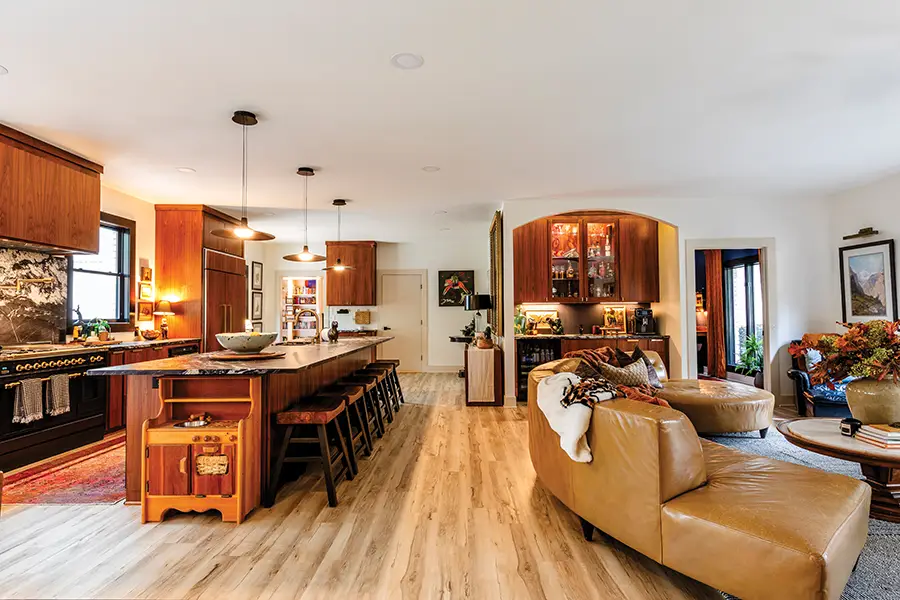
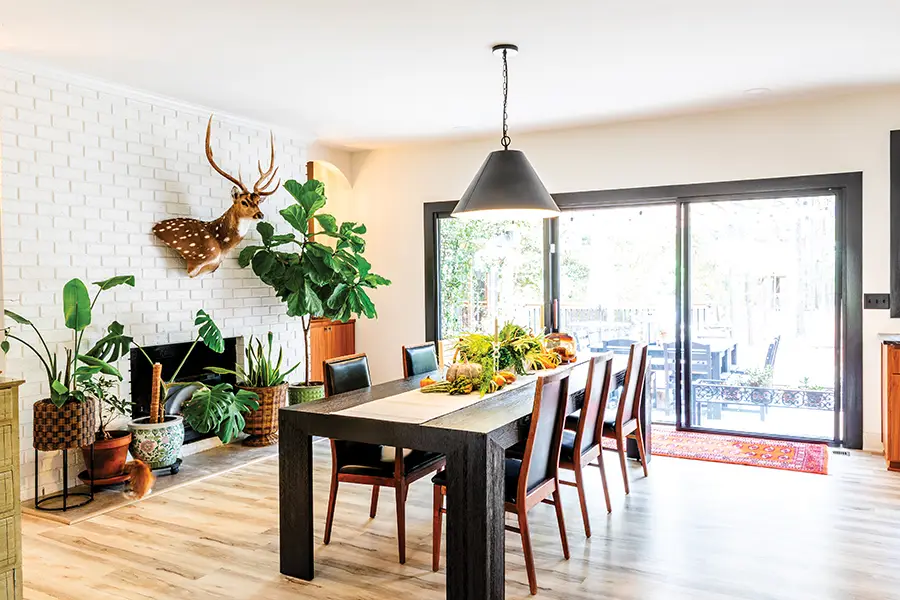
Quinlan launched her home-staging and interior design firm, The Bold Buffalo, a year ago. “It has a distinctly Western style,” says Quinlan, who grew up in Butte, a small town in wide-open Montana. She still misses home, so she brings home to her through interior design. The aesthetic has been well received in the Sandhills, so she leans in. “Some of the color palette is the Ralph Lauren hunting lodge vibe that people who are into horses really like,” says Quinlan. The mount of an axis deer hangs over the fireplace. A neutral palette complements wood, leather, wool and stone, all served up in generous portions.

Quinlan likes maximalism and the oversized. She also likes a good deal. “Literally everything in the house is thrifted,” she says. She shopped Facebook Marketplace and thrift stores around town. Part of that decision was necessity. To achieve her vision on the family’s single military income, Quinlan had to do it on a budget.

“My husband jokes that I play Price Is Right anytime anyone walks in because as soon as they’re like, ‘Oh, I like your couch,’ I’m like, ‘Guess how much I paid for it?’” Quinlan says. A steal of a half-moon leather sofa is a main feature in the yawning, 1,500-square-foot living/dining/kitchen space that wasn’t always so open. The space was originally sectioned off into four rooms, but Quinlan had the walls demolished.

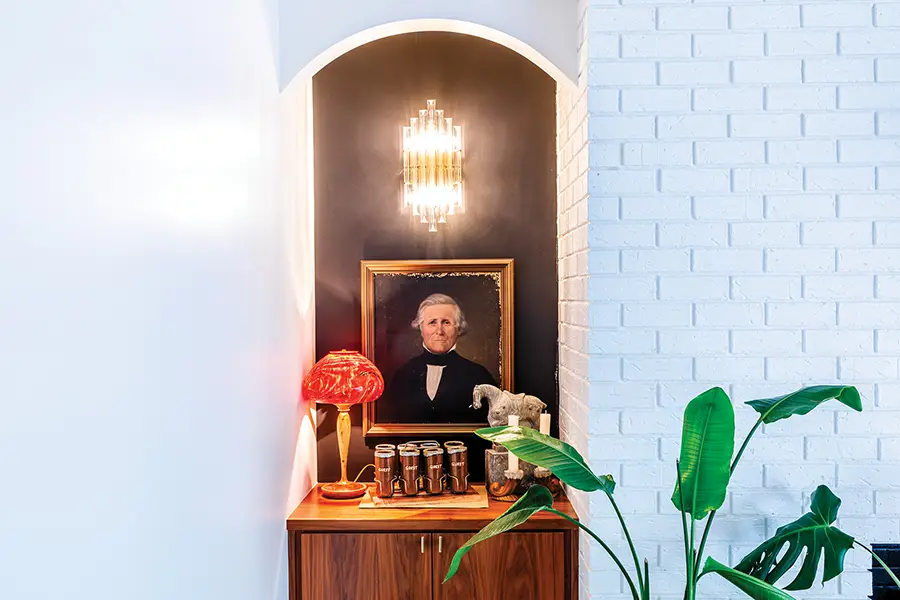
“People could not see it,” she says, guessing at why the house sat on the market for two years before the Quinlans moved in. They replaced red front doors with the slate blue and totally remade the foyer. She heightened the drama by dousing the space in black and accenting it with floral wallpaper. A dramatic seascape sails across one wall.

When it comes to art, Quinlan’s philosophy is buy big; if it’s not big, hang it in a space where it looks big; more is better; and buy original when possible. One of her favorite pieces is the 19th-century Danish original she purchased for less than $500 on Facebook Marketplace. As for family photos, she prefers a candid shot to a staged portrait that lacks personality. “If I can’t tell what your favorite animal is or where you’ve gone on vacation by walking through your house, then it’s not doing its job of telling a story,” says Quinlan.

She designed the kitchen so dishes could be put away by a 4-year-old, and the iron-legged barstools under the island’s overhang were an intentional choice. “I know kids are going to sit there kicking their feet on the barstools, and I know foster puppies love to chew the legs of everything,” Quinlan says. “I make very specific decisions on materials and on things being dual purpose so that we can gather and have community here.”

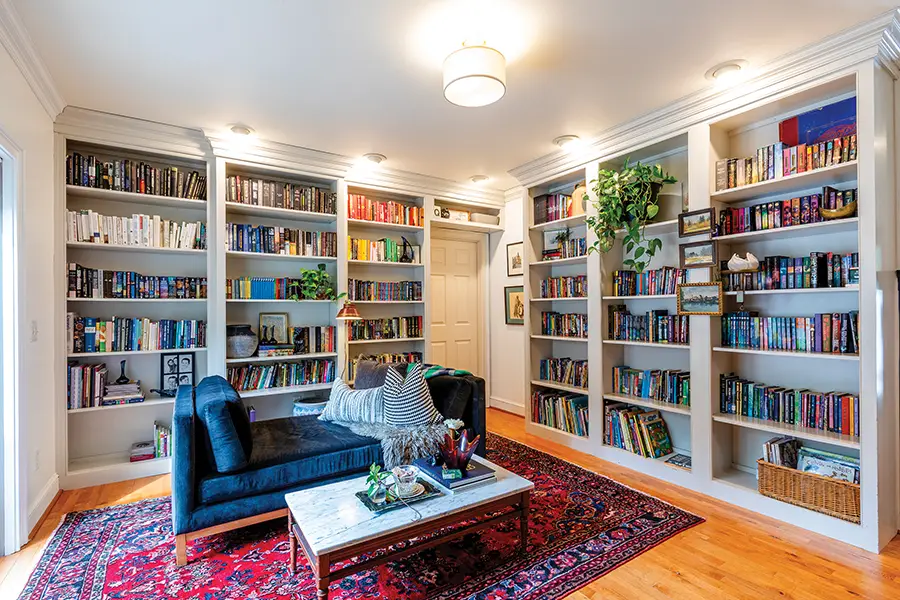
Quinlan has filled the gap of extended family back home with military family and neighborhood community. Local kids check books in and out of the Quinlans’ library with a stamp. Military friends come over multiple times per month for recurring events. Every year, they host a comedian in their outdoor living space with at least 50 guests comfortably in attendance.

“I’ve seen a lot of people that have comfortable homes, and I’ve seen a lot of people that have beautiful homes,” Quinlan says. She aims to deliver both.  PS

Discover Sarah Quinlan’s services and portfolio at theboldbuffalo.com. Jenna Biter is a writer and military wife in the Sandhills. She can be reached at jennabiter@protonmail.com.

Alamanc November 2026

Alamanc

Alamanc November 2026

By Ashley Walshe

November says come to the table, come hungry, come as you are.

The collards are slow cooking with onion. Aromatics sizzle on the stovetop. Outside, chickadees and titmice chatter in the underbrush.

Come as you are.

Through the window, a swirl of crimson leaves takes flight, stripping the maple of its autumn color. You study the tree’s thin, ascending branches; its nakedness; its graceful surrender. Your face and shoulders soften.

Who are we beneath the surface, beneath the armor, beneath our own resistance?

The cornbread is ready. Company arrives with casserole and pie. The children arrive as invited, sneaking cookies from the countertop before bounding back outside.

Hands keep busy. Place settings and chairs are rearranged. An old guitar is being tuned on the front porch.

The kitchen is a whir of movement and chatter. Through the window, the children shuffle leaves into crimson landing pads. A wren blasts his brassy song through the neighboring forest.

At last, let us gather at the table with our joys and our sorrows. The heaviness of our losses. The grace of our endless blessings.

Look around. Take in the beauty of these hands — all they have built and held and tended; all they have released.

Study these eyes, the laugh and worry lines, the wisdom and the innocence.

Are we not just like the trees, shaped, too, by wind and sun? Surrendering to life’s seasons in our own perfect timing? 

May we be gentle with each other. May we seek the simple wisdom of the earth and her children. May we nourish ourselves completely.

November Scavenger Hunt

A buck moth on a bright autumn day.

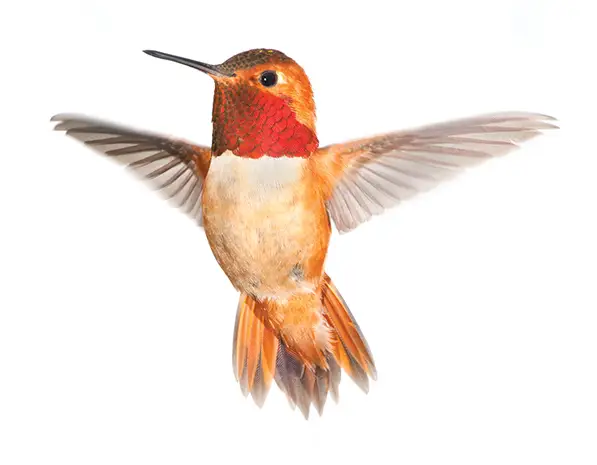
Vagrant rufous hummingbird.

Red, orange, yellow and burgundy leaves.

Snapdragons.

A bark-stripped tree from a white-tailed buck.

White-throated sparrows.

Chimney smoke.

Flowering witch hazel.

Wood ducks on the water.

It was one of those early November mornings that are as beautiful as any in spring. There was gold everywhere, drifts of it on the elm tree, flakes of gold under our feet, gold dust on the hedges, liquid gold in the refracted falling light.

— Elizabeth Goudge, The Dean’s Watch

Songs of Thanks

The trees offer their leaves back to the earth that holds them.

Can you hear the soil humming songs of thanks?

And what of the caterpillars? Luna moths spin their silk cocoons among leaf litter, where woolly bears lie frozen until the return of spring.

Firefly larvae tuck themselves beneath the thick, damp duff.

Frogs, toads, turtles, snakes and salamanders nestle beneath its safety, too.

Spring herself will give thanks for this humble offering; this blanket of darkness; this quiet, maternal embrace.

You’re welcome, the trees sing back. And thank you.

Native Identify

Native Identify

Native Identify

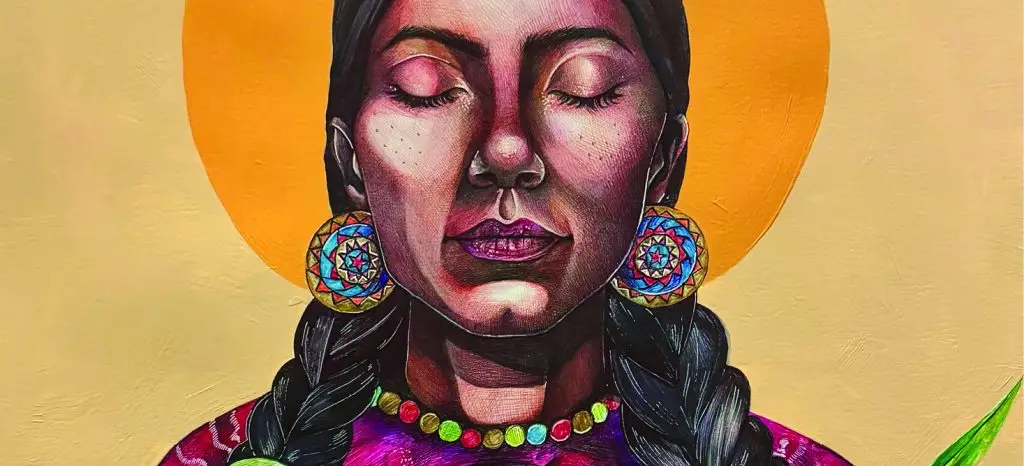
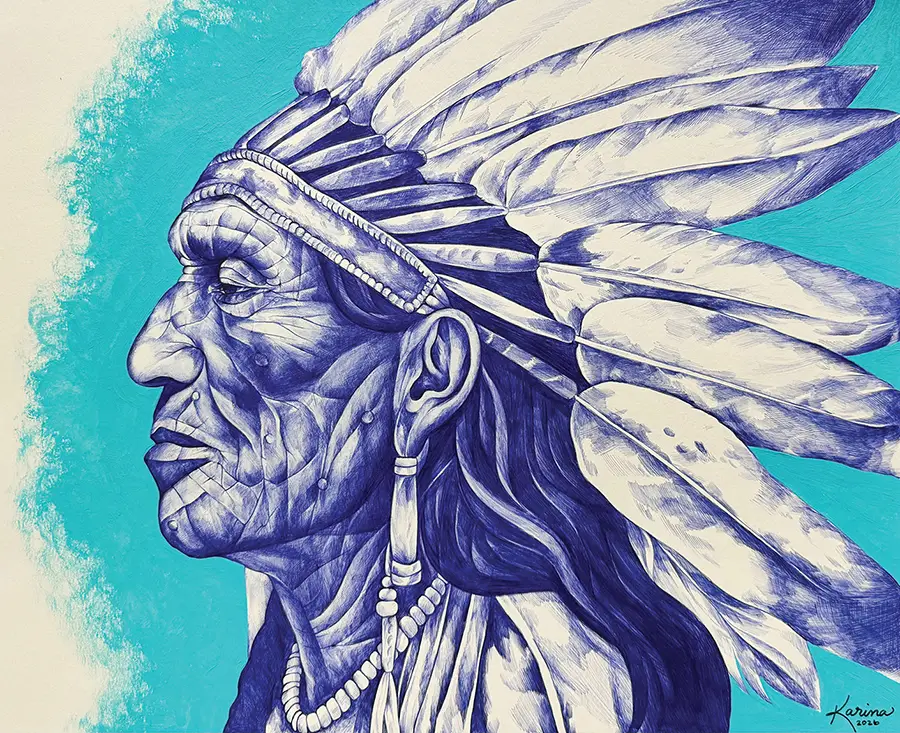
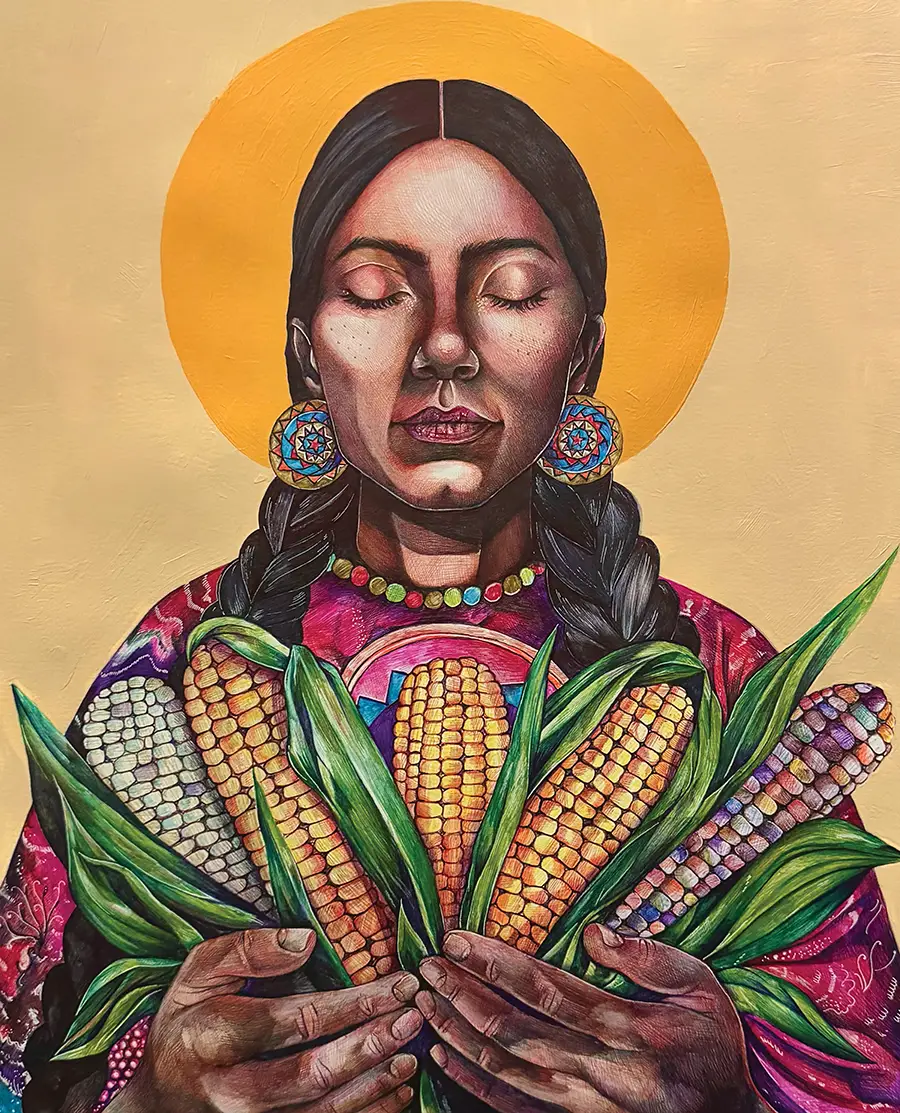
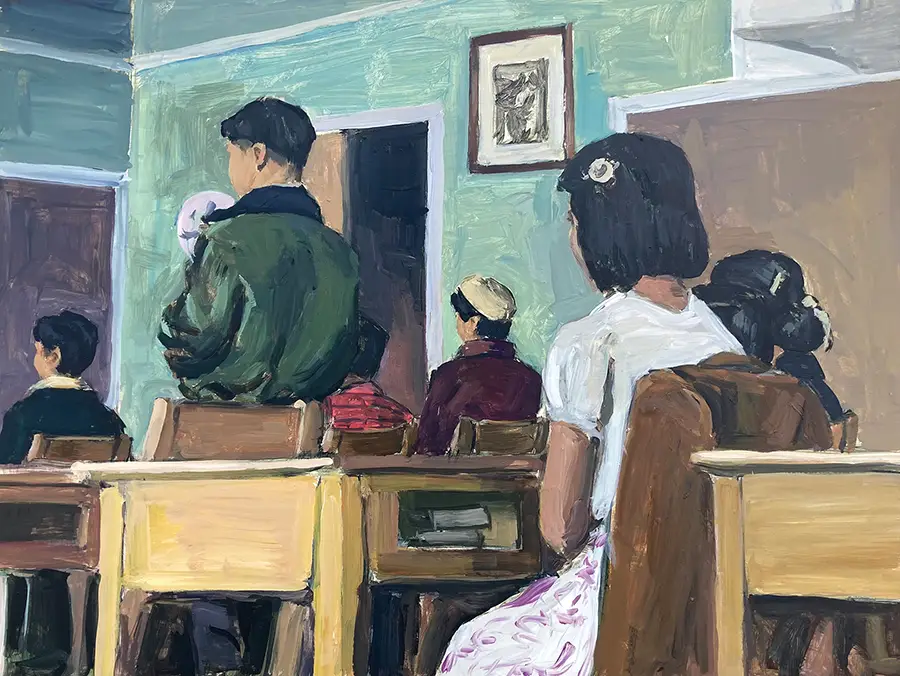
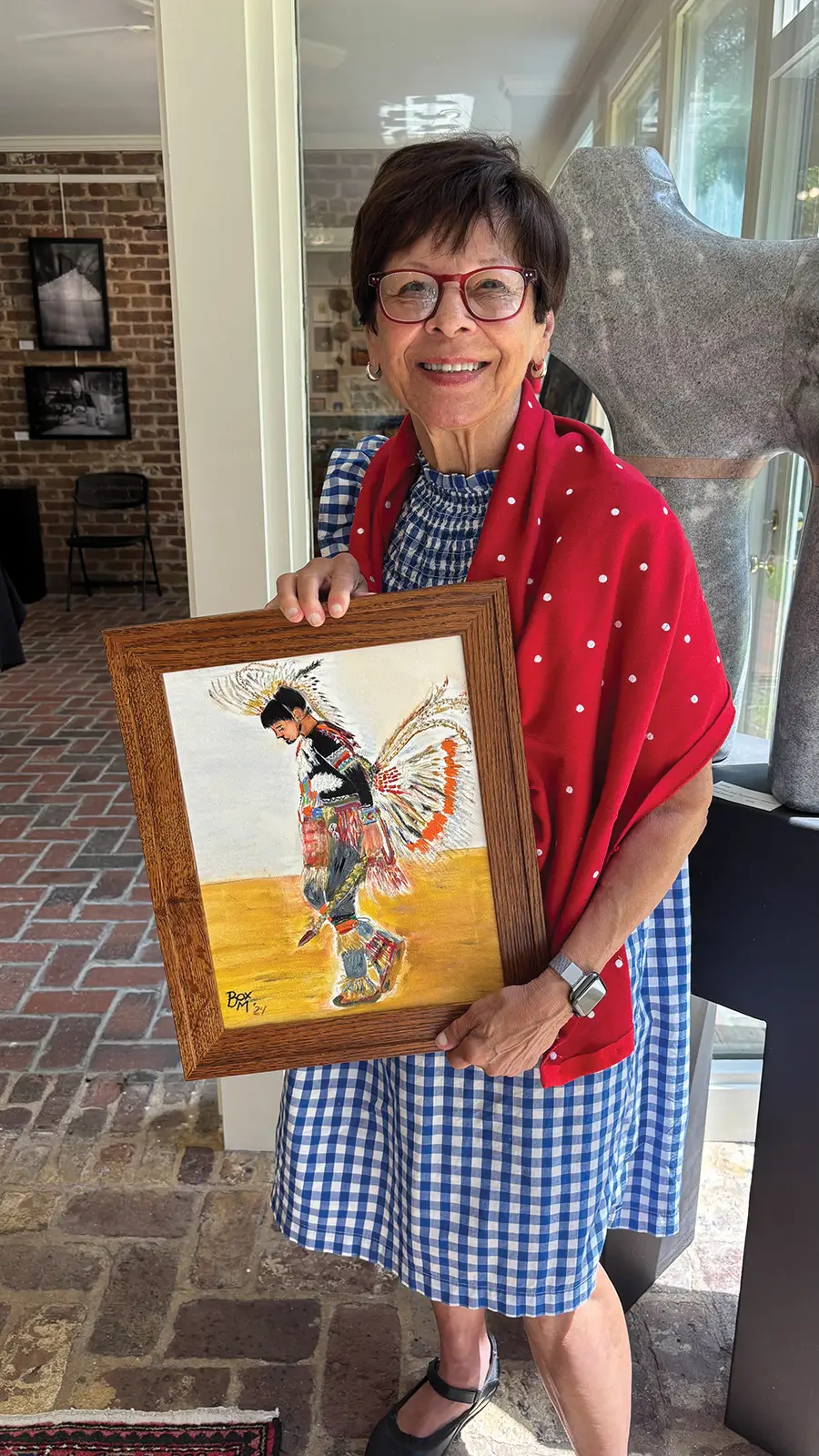
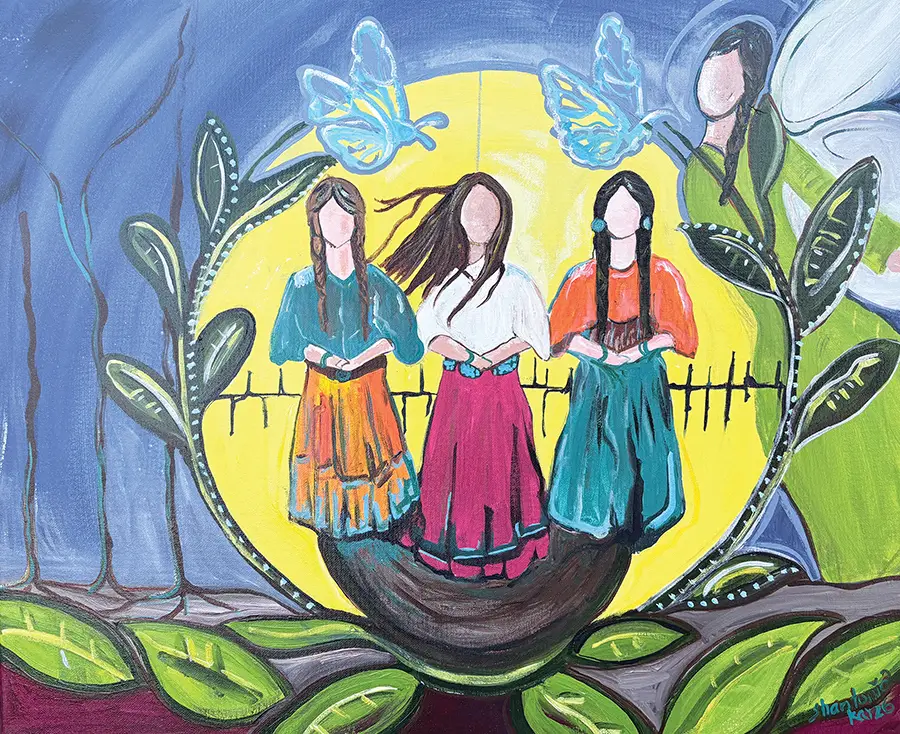
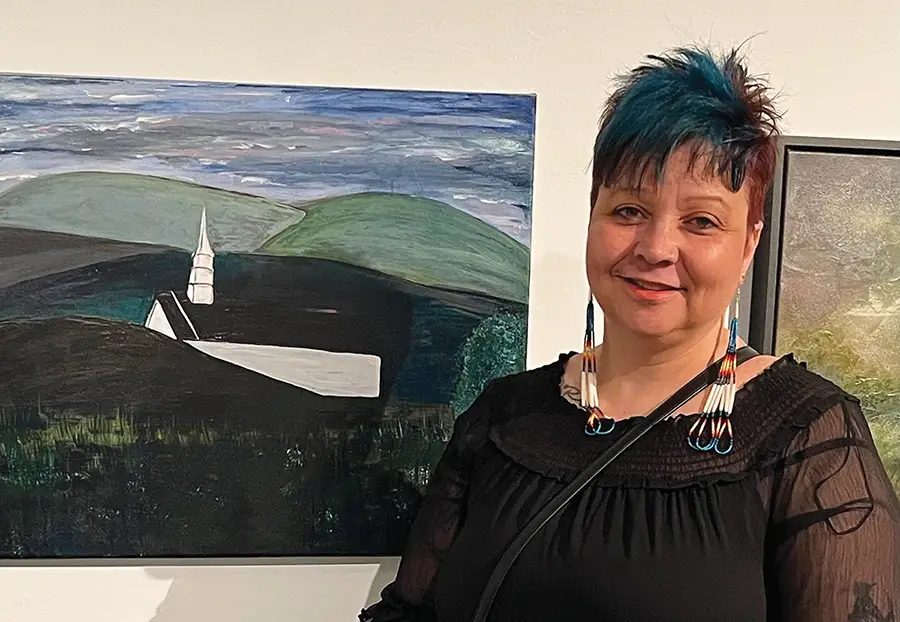
In honor of National Native American Heritage Month the Arts Council of Moore County will showcase the works of four local Native American artists, Karina McMillan, Marcus Dunn, Shantonia Chavis-Bullard and Betty Mangum, in an exhibit titled “Native Identity,” opening on Friday, Nov. 6, at the Campbell House Galleries, 482 E. Connecticut Ave., Southern Pines, and running through Saturday, Dec. 19. McMillan, Chavis-Bullard and Mangum all share Lumbee Tribe heritage, while Dunn is Tuscarora. “It’s been kind of on our radar for a long time,” says Kate Curtin, the programs and gallery director. “I grew up in the Northeast, and the artistry, the traditions were everywhere.” Here’s a chance to explore a few of them.

Karina McMillan

“When the artist Karina McMillan was growing up in rural Robeson County, she spent long days outside in the woods and in the surrounding fields of cotton, soybean and tobacco near her house, and long hours with her family, steeped in the culture of the Lumbee Tribe of North Carolina. Never far from her side were the ballpoint pens and paper she used to draw all of it, and all of them,” wrote Liza Roberts in the May edition of PineStraw. Those pens have propelled McMillan’s art to extraordinary heights.

“I am especially drawn to the possibilities of ballpoint pen as a medium. What is often viewed as an ordinary, everyday tool becomes a way to create intricate, intentional compositions built through layers of line, texture and detail,” says McMillan.

“My work explores identity, memory and cultural continuity through the lens of my experience as a Lumbee artist. Through drawing, printmaking, painting and mixed media, I create visual narratives that reflect the connections between personal history, Indigenous heritage and the stories carried across generations.”

“Karina McMillan’s work is extraordinary,” says Sara Segerlin, director of the Gregg Museum of Art & Design at N.C. State University. “Her paintings carry a power that goes far beyond color or technique. She brings forward portraits of resilience, memory, pain and strength, stories that refuse to be forgotten.”

Marcus Dunn

An art professor at Richmond Community College in Hamlet, Marcus Dunn has exhibited his work at the SCAD Museum of Art in Savannah, Georgia (where he earned an MFA), and the Institute of American Indian Arts Museum of Contemporary Native Arts in Sante Fe, New Mexico, to name just two. He is the 2022 South Arts Southern Prize recipient for North Carolina and is an alumnus of the Skowhegan School of Painting & Sculpture. Dunn is also an active participant in the United Kahtenuaka Longhouse, with a focus on language and traditional song and dance practices honoring his native Tuscarora heritage. Through his art, Dunn has spent years scouring archives for photographs of boarding schools and related forms of assimilationist educational practices, transforming such images into richly textured impressionist paintings, giving presence to the lives transformed by the boarding school system. “The most dramatic formal aspect of a Dunn painting is that it has a swift one-pass-of-the-brush feel,” writes Stephen Knudson in ARTPULSE. “This way of painting leaves holes in objects and figures. It is just enough, and it is the language of something forming and of something disappearing — the primary thesis of this work.”

Betty Mangum

Now in her late 80s, Betty Mangum grew up on the campus of the University of North Carolina at Pembroke, where her father was the dean of students when it was still known as Pembroke State College. She took up painting after attending a “paint ‘n sip” class given by Jane Castinelli at Elliott’s on Linden just eight years ago. “Mind you, my drawing is not good at all, but I love slapping paint on a canvas,” says Mangum. Her preferred medium is oil paint. “I tried acrylic, but it dries too fast. I make a lot of mistakes. Oil you can go back and rework it lots of times,” she says. “I’m a big picture person. I’m not a small detail person. That doesn’t seem to be my personality. I just have a folksy style.” Mangum is drawn to both water scenes and faces as subjects. “I don’t seem to have a wide variety of things that I enjoy painting, but water I find very soothing, and people’s faces I find very interesting,” she says. Though she came to painting late in life, Mangum was always a lover of the arts, particularly music and theater. “I’m just kind of drawn to beautiful things,” she says. “I’m Lumbee Indian. I like colors. If you’ve looked at Indian regalia or have been around Indian people, they mostly are colorful personalities and wear a lot of color. The regalia is always very bright. Nothing subdued about it. I tend to paint kind of loudly.”

Shantonia Kai Chavis-Bullard

“Art grounds me,” says Shantonia Kai Chavis-Bullard. “As a Lumbee artist, my work connects deeply with my community and reflects my personal interpretation of the world.” A retired art teacher with bachelor’s and master’s degrees from the University of North Carolina at Pembroke, Chavis-Bullard works mainly in acrylic but also enjoys batik, pastels and ceramics. “Acrylics are my favorite because they allow me to build layers, experiment with texture and work intuitively as ideas develop,” she says. “My work explores themes of memory, identity, spirituality, womanhood, healing and the emotional landscapes we carry within us. As a Lumbee artist, I am inspired by my culture, family history and the strength of Native women, as well as by my Christian faith and personal experiences. Rather than creating traditional portraits, I use symbolic figures and expressive environments to tell stories that invite viewers to find pieces of their own journeys reflected in the work. I paint the unseen — those quiet places where memory, spirit and emotion shape who we become.”  PS

Sporting Life

Sporting Life

Memories on the Wing

By Tom Bryant

“Our dead are never dead to us until we have forgotten them.”  — George Eliot

So it’s hot. July in North Carolina. What do you expect? I opened all the car doors on the 4Runner, cranked it while leaning inside and turned the air conditioner to full blast. Linda, my bride, was standing at the arbor door giving me encouragement while I tried to get the Runner habitable.

“You be careful, and say hey to Bubba.” She went back inside and closed the door to the heat.

It was a mixed blessing kind of trip. Even though I looked forward to seeing Bubba, I kinda really didn’t want to. The word from the old-timers and outdoor geezer friends had gotten to me. He was in a bad way, one that didn’t seem to be promising.

Bubba had moved to a retirement/healthcare village, leaving his wonderful home, and when I heard that he had put his favorite place in the world up for sale, I knew that things were not right. I made plans to visit. I couldn’t get him on the phone for some reason, so we communicated by text, and I told him I was coming and to get ready ’cause he was gonna buy me lunch.

It’s about a two hour ride up to Bubba’s new place, and since I was in no hurry I kinda meandered along. Random thoughts about our friendship bubbled in my brain, one reflection leading to another. We met many years ago, and part of our first conversation had something to do with duck hunting versus Canada goose hunting. I remember Bubba was pro goose, and I was heavy in favor of the ducks.

“After all,” I said as we closed our argument, pro and con, “there aren’t any geese around here. You gotta go to Maryland to find any numbers and to the coast maybe to even catch sight of one.”

In those days that statement was true, before the geese figured out that migrating was a waste of time. Why expend all that energy when you can live and prosper in one spot? Now they’re grazing the greens on about every golf course in North Carolina.

“I’m gonna invite you to a goose hunt next season,” he responded, “and I’m sure you’ll change your mind.” He did, and I did. We made our first trip to the Eastern Shore of Maryland, hunting with Bill Meyers on his Plimhimmon plantation, and I was hooked on Canada goose hunting.

I pulled up to the check-in gate at the retirement village a little before 11 a.m. and asked the attendant how to get to his villa. “Take a left turn after three streets. He’s in number 312. It’ll be on your right.”

The place had the same fresh ambience of an expensive country club. Lush plantings surrounded miniature lily ponds, and oak and maple trees were in abundance. Sidewalks curved around the surroundings with benches spotted here and there. The atmosphere was lavishly luxurious in an understated way, but as I drove through, slowing for the inevitable speed bumps, up the little hill to turn and find Bubba, I wondered if he was happy here.

The front door of the villa was open with a glass see-through storm door slightly ajar. I eased through the door. “Hey Bubba. You in there?”

A weak voice responded, not like him at all. “Come on in, Coot. I’ve been waiting on you to get here.”

I hoped that I didn’t visibly show how shocked I was at seeing my thin, longtime friend supine on the couch. “Coot, sometimes you really piss me off,” he said. “You never change.”

“Bubba, you know that’s not true. Remember the folks at Duke removed half my innards. I’m walking around now several pounds lighter.” He laughed and coughed and said, “Look in the fridge in the kitchen and pour us a glass of wine. We got some catching up to do before lunch.”

I poured us two glasses out of an open bottle of red wine and went back to the living room. The couch was on one wall, on the opposite were shelves with several mounts of game Bubba had gotten over the years. “Yeah, Judson brought those from home to kind of make this place a little more habitable.”

“I don’t remember seeing that ptarmigan before,” I replied. The bird was half in its winter color and half in summer. A beautiful specimen.

“I got that on my last winter trip to Canada.”

We sat silently, neither of us knowing what to say. I broke the silence. “Bubba, you don’t look too good. What’s up?”

“I had to move over here. I kept falling down at home, and now the docs here are trying to fix it. Not having much success. Hell, let’s go eat. The restaurant is down the road a piece. You’ll have to help me.”

It was a chore. Not physically, but mentally. To see my good friend in such debilitating health was a shock. I helped him get in the car and then on the walk to the dining room. He used his cane on one side, and I held his arm on the other.

Lunch was short, and so was the conversation. I don’t remember what we had or said, but we were glad when it was over.

Back at his house, we poured another glass of wine. I asked, “Bubba, you sure it’s OK for you to be drinking this stuff?”

“What’s it gonna hurt?” he said, laughing. “I tell you what, Coot, if this is it, and realistically, I think I’m on the way out, I’ve had a great ride. I’ve been getting rid of things, sold most of my guns, and have given all the rest of the household stuff to the kids. They’re helping me with the bride, you know.” Bubba’s bride of many years was having her own health problems, and the children were taking turns looking after her.

“I want you to have my swan. Remember? You were with me at Currituck when I got my first one. We were hunting with Old Man Woodrow. You got that redhead duck you had mounted, I recall. We ate that first swan. The swan I want you to have, I got in Montana. It’s hanging over the fireplace at home.”

When I hesitated he said, “Coot, we’ve been friends for a long time, and by taking the swan, every time you look at it, you’ll recollect some good adventures. It’ll be a way for me to be around a little longer.”

He died three weeks later. I didn’t get to see him again. I heard he had moved back to his beloved home, set up a hospital bed in his study overlooking the wood duck pond, hired a couple of round-the-clock nurses, and spent his last days there.

Right before he passed on, I called him and got his voicemail. I can’t recall the message I left. What can you say to a good friend who’s dying?

It turns out Bubba had the last word after all, because he left a message on my phone a few days later.

“Hey Coot, got a few folks in here. Not prepared for a lengthy conversation. Hope all is well. Maybe tomorrow we’ll get up together and have us a little bit of a leisurely chat. Take care of yourself, bud.”

We never had that leisurely chat, but now that swan hangs over the door leading to the roost, so every time I walk under it, I can remember the good times and one of my best friends. Bubba’s ashes have been sprinkled on a ranch in Montana, one of his favorite hunting locations.

Out of the multitude, he was one of the rarest. He walked to his own drummer. No apologies or excuses given. He’s missed.  PS

Tom Bryant, a Southern Pines resident, is a lifelong outdoorsman and PineStraw’s Sporting Life columnist.