Cork & Bottle

Cork & Bottle

Gearing Up

Wines for the holidays

By Janeen Driscoll

It’s holiday season and time to get your pre-game on, before the party really begins. Think wine is on the decline? Don’t listen to everything you hear. People are choosing quality over quantity as we round out 2026, but value is yours for the taking. Don’t be surprised if some unexpected gifts fill your holiday stocking as producers push exceptional inventory before the end of the year. Here are a few ideas and trends to get your juices flowing.

Bless Your Heart

Tailgating at Blessing of the Hounds? Bedazzle my new boots. Spain and Italy are delivering high-quality sparkling wine without the sticker shock of the real French thing. Skip the orange juice in favor of the Campo Viejo Cava Brut and/or the Cantina Castelnuovo Del Garda Blanc de Blancs, which will easily cut through the fat of a warm country ham biscuit on a cold morning. We recommend you don’t go heavy here, given the all-day celebration about to unfold. A winter white among friends? Try the Pine Ridge Chenin Blanc-Viognier blend. It’s a perpetual favorite and easy on the budget.

Proud to be an American

Thanksgiving is our holiday, after all. The tariff wars give you a terrific reason to explore the U.S., from sea to shining sea. Whether roasted, smoked or deep-fried, your turkey will pair perfectly with a pinot noir — we love Sonoma’s Hartford Court’s Land’s Edge. It won’t overpower Grandma’s gravy and hits the right notes on side dishes. Need to drown your post-Thanksgiving sorrows in leftover mashed potatoes? While it’s getting a worse rap than marshmallows on sweet potatoes, Napa’s own Rombauer Chardonnay is the butter and cream you crave.

Man Up

Girls love football too, but you’re going to need a brawny bottle to foil the beer-drinking crowd at game time. GSM is that delectable combination of grenache, syrah and mourvèdre that unearthed luscious Châteauneuf-du-Pape and gave way to a more modern Paso Robles and Washington State trend. These are the secret power wines that go well with crockpot roasts, steaks on the grill and brisket sliders. Full of juicy fruit with a backbone stronger than the Seahawks defense, it will impress everyone during bowl season. The Domaine Lafage Tessellae Old Vines is a good place to start.

Vary the Varietal

If you’re gifting a grocery store cabernet on your way to the holiday party, you’re cheating. It’s the perfect excuse to go tiptoeing through the wine aisle and test a few unknown labels that spark your fancy. Let your creative juices flow with a bottle they’d die to try. Wines from Greece are rising in popularity, especially the mineral-driven white assyrtiko and the bolder mandilaria reds (man-dee-LAR-ea-ah). We blind-tasted the Seiradi Cuvee Premno and it was an immediate hit among men who love their wine inky and impressive. Or, you can pick an Italian — but make sure the bottle neck carries the premier DOCG label, if you’re gifting it to the boss. Spain’s Barambán, a blend of garnacha and tempranillo, is also a great choice, as feisty as it is smooth. 

Cheers and Toasts

French Champagne production is down, which could cause availability to decrease and prices to increase before the year is over. If tiny bubbles are what you crave after the mistletoe, buy them early. I love Veuve Clicquot for the back story (veuve means “widow” — take it from there), but Moët and others offer reasonable price points if you’re ready to shop. Since most restaurants and bars offer a variety of sparkling wine choices by the glass during the holiday season, it’s a good time to sip and savor. Wine is bottled poetry, a famed writer once penned. Taste test and let the magic inspire your next toast.

Janeen Driscoll and her husband, Patrick McKee, own Cork Community Spirits, a craft cocktail and wine bar in downtown Southern Pines.

Tea Leaf Astrologer

Tea Leaf Astrologer

Scorpio

(October 23 - November 21)

By Zora Stellanova 

Know what’s sweeter than overseeing karmic justice? Redirecting that soul-piercing energy back to your own life. The first half of the month will bring opportunities for some tending and mending, especially when it comes to financial dealings and joint ventures (read: no bridge-burning required). And when Mercury and Venus station direct on Nov. 13, try letting things feel easy for a while. You deserve the break, darling. 

Tea leaf “fortunes” for the rest of you:

Sagittarius (November 22 – December 21)

Drink more water.

Capricorn (December 22 – January 19)

Run your own race, darling.

Aquarius (January 20 – February 18)

You’ll laugh about it later.

Pisces (February 19 – March 20)

Wear thicker socks.

Aries (March 21 – April 19)

Explore lumbar support.

Taurus (April 20 – May 20)

Two words: candlelit dinner.

Gemini (May 21 – June 20)

Honesty is a grace.

Cancer (June 21 – July 22)

Try adjusting your lens.

Leo (July 23 – August 22)

Can you let it be simple?

Virgo (August 23 – September 22) 

There’s nothing to prove.

Libra (September 23 – October 22)

You can’t fix what’s not broken.  PS

Zora Stellanova lives in the N.C. mountains with her wolfdogs, Venus and Lilith. Although she prefers divining with loose-leaf pu-erh, she recommends a mugwort and passionflower blend for those seeking wisdom and clarity from the dream realm. 

Omnivorous Reader

Omnivorous Reader

Golf’s Greatest

A list of the unforgettables

By Jim Moriarty

If it’s possible to turn an intellectual exercise into a quasi-coffee table book, Mike Purkey has done that just in time for the holidays with The Immortals of American Golf. It’s the latest in the “Immortals” series that includes boxing, motocross and, for all you Richard Petty fans out there, NASCAR.

Purkey hails from Gastonia, where he broke into the newspaper business about a thousand years ago as a teenager answering phones in the sports department. I can say that because I’ve known Mike for almost that long. We worked opposite sides of the street as competitors and comrades for most of our careers in golf, he for Golf magazine and me for Golf Digest/Golf World. He also did time at the Charlotte Observer, was one of the founding editors of Global Golf Post and worked for the ill-fated Saudi-backed experiment, LIV Golf, for three years. And I can say without fear of exaggeration that Purkey was always among the best of us.

The book doesn’t tip the traditional coffee table scales at the weight of, say, the Wannamaker Trophy — the silver PGA Championship swag that winners typically have to powerlift at the prize giving — but it’s beautifully displayed with fine art selections and Purkey’s insightful writing.

As golf exercises are wont to do, this one is broken into the traditional set of 18 (players, of course, not holes) and follows more or less in chronological order, with the customary amount of overlap, since the game has been fortunate enough to be graced with more than one immortal at a time. Quibble about his selections if you will; of the 18 American players he picks and makes the case for, there isn’t one that you would throw out without thinking long and hard about it. And in the off chance you want to discard a name or two, he offers a group of honorable mentions you can draft from to fill the slots.

I won’t pretend to be a golf historian — many of my colleagues know much more about the history of the game and of its great champions than I do — which is another reason I found Purkey’s list of immortals so engaging. I learned something I didn’t know, or had forgotten, about almost all of them.

The book begins with Walter Hagen, and Purkey finds a classic quote from the great Charles Price to pull off the perfect portrait. “He (Hagen) was supremely confident, and he knew the virtue of the grand gesture. Bumptious, sparkling, with wisecracks, dressed in bandbox clothes, Hagen played the game with the aplomb of a man who held the mortgage on the club.”

Hagen is followed by his two rivals of the 1920s, Gene Sarazen and Bobby Jones. Purkey quotes Sarazen: “I’d never seen my name in print before,” he said. “I’d look at it and look at it. Eugenio Saraceni. It looked to me like a violin player, not a golfer. So, I changed it to Gene Sarazen, because there was no such name in the whole world, not even in Afghanistan.” If Sarazen had the “shot heard round the world” in the 1935 Masters (then the Augusta National Invitation Tournament), Jones had the “impregnable quadrilateral” comprised of the U.S. and British Amateurs and the U.S. and British Opens — the Grand Slam — in 1930. The Emperor Jones was greeted with his second ticker tape parade in New York City and retired from competitive golf. 

The first of the great female players Purkey lists is the incomparable Babe Didrikson Zaharias, perhaps the finest true athlete ever to play the game. The Babe won two golds (in the hurdles and javelin, setting world records in both) and a silver (in high jump, though she actually tied for first) in the 1932 Olympics in Los Angeles. As an aside, I once visited the neighborhood where Babe grew up in Port Arthur, Texas. The hedges separating the yards — her training ground for the hurdles — were still there.

The other two women Purkey includes in his list of 18 are Mickey Wright and Nancy Lopez. You certainly can’t carp about the woman who possessed one of the greatest golf swings ever, Wright, or the woman who won five LPGA tournaments in a row in 1978 as a 21-year-old rookie. In fact, I’d argue (and if you have a list, aren’t you supposed to argue?) that somehow or other room needs to be made for another woman, Kathy Whitworth. All she did was win 88 times. But, of course, to make room for Whit, you’d need to oust one of the guys. No easy task.

After Jones, Purkey turns to the triumvirate that proved 1912 was one of the greatest years in the history of the game. That was the year Byron Nelson, Ben Hogan and Sam Snead were all born. And, like George Hamilton says in Doc Hollywood (exactly 35 years ago if you’re into anniversaries), you’d have to be a “bovine, clodpated, citified moron” not to list them among the immortals.

In one of the great successions of all time, The Big Three — Arnold Palmer, Gary Player and Jack Nicklaus — join the list just as Nelson, Hogan and Snead are exiting the stage. The oft overlooked name of that generation is Billy Casper, but Purkey is quick to include the man who won 51 PGA Tour events and enlists Johnny Miller to defend the choice. “There should never have been just the Big Three,” said Johnny Miller, himself a Hall of Fame player. “It should have been the Big Four. That was an absolute crime.”

North Carolinian Raymond Floyd serves as the bridge from Nicklaus to Tom Watson, the five-time Champion Golfer of the Year. The immortals who began in golf with wooden drivers and finished in the era of titanium include Payne Stewart and Phil Mickelson. And, of course, Tiger Woods is the book’s finishing hole.

The criteria Purkey describes to make the list are, almost by definition, gossamer. “The questions that must be asked where immortality is concerned are: Were they the best at their craft in their own era? Did they have a particular accomplishment — or multiple — that separates them from the rest? Were they significantly influential or did they make a singular difference in the game? Was their entire body of work broad and deep? Is there something distinctive about them that people have always remembered or will remember?” says Purkey. The whole point is that there is nothing cut or dried about any of it. It’s an amusing exercise, like trying to imagine how Tiger Woods would fare in a match against Bobby Jones.

And, of course, time marches on. What are we to do with, say, Brooks Koepka and Scottie Scheffler? I suppose we’ll have to wait for the next edition.  PS

Jim Moriarty is the editor of PineStraw. He can be reached at  jjmpinestraw@gmail.com

Bookshelf

Bookshelf

November Bookshelf

FICTION

The Unfinished Work: A Novel of Abraham Lincoln,
by Jeff Shaara

“It is for us the living, rather, to be dedicated here to the unfinished work which they who fought here have thus far so nobly advanced.” — The Gettysburg Address, 1863. Shaara, who is renowned for his body of work exploring the conflicts and personalities surrounding key moments in American history, turns his attention to Abraham Lincoln, one of the most consequential figures during one of the most critical points in American history. Beginning with Lincoln’s election as president in 1860, through his time in the Oval Office, Shaara reveals the complexities behind the man who refused to let the deep divisions and conflicting emotions permanently sunder the country itself.

Peregrine Hill, by Nina de Gramont

At the dawn of the 20th century, widow Isabelle Bishop still believes in love, but she knows only money can save her. After losing her husband and three of her children in a shipwreck, she has one chance to rescue all that remains of her family — her daughter Mariah and her elderly mother. When Isabelle captures the attention of John Whitten, one of New York’s wealthiest men, she dares to hope that fortune might finally favor her. But Whitten’s interest is not in Isabelle — it’s in 18-year-old Mariah, still reeling from a romantic but disastrous scandal. When Whitten discovers the secret mother and daughter have tried to keep buried, he uses it to his advantage, threatening to expose them unless Mariah accepts his proposal. For the sake of their survival, Isabelle makes a devil’s bargain: She will urge her daughter into a marriage she knows could destroy her. Mariah quickly realizes her husband’s home is a gilded cage. Finding an unexpected ally in her ambitious maid, Hetty, she dares to imagine a life beyond her constricted world. Together, they risk everything to claim a measure of power and self-determination in a world that attempts to deny them both.

NONFICTION

Going the Distance: Stallone, Philly, and the Story of Rocky,
by Mike Sielski

Armed with his intimate knowledge of Philadelphia’s texture, culture and history, Sielski delivers the definitive account of the film’s making, the factors that drove Sylvester Stallone to write and star in it, and its everlasting emotional connection to Philadelphia. Stripping away the myths about Rocky, it traces how and why it came to be made, and reveals fresh details and anecdotes that will surprise even the film’s biggest fans. Through extensive research and exclusive insights from some of the movie’s legendary collaborators — including producer Irwin Winkler and composer Bill Conti — Sielski tells Rocky’s story in a completely new way, showing Stallone’s rise from an aimless kid to an ambitious artist, one who was willing to do whatever he had to do to succeed in Hollywood. This is more than a book about a movie on its 50th anniversary, it’s a fascinating ride all its own.

The Nuremberg Women: The Untold Story of the Eight Women Who Brought the Nazis to Justice,
by Natalie Livingstone

In November 1945, the eyes of the world turned to Nuremberg, Germany. Humanity was seeking not only the truth about Nazi crimes but also a vision of what justice might look like in their aftermath. The trials are traditionally associated with a roll call of famous men, but they were only part of the story. Not only were there women involved in the trial in every role — as journalists, researchers, lawyers, interpreters, court reporters, witnesses, artists and even defendants — but they were pivotal in the trial’s outcome. The Nuremberg Women tells the story of eight women: a brilliant American lawyer; three pioneering journalists; an iconoclastic artist; a beautiful refugee aristocrat; a dauntless survivor of Auschwitz; and a young Russian translator. They demonstrate that the trial was remarkable not because it was perfect but because, against all odds, it happened. Thanks to these women and many others, justice was served.

CHILDREN’S BOOKS

Berry and the Mushrooms, by Dev Petty

Nature is all about balance — and in winter, it’s time to rest. But when a strange blue moon rises in the sky, it brings out the cutest, weirdest mushrooms the forest has ever seen! Their aggressively adorable chatter wakes hibernating bears Glen and Berry. While Glen worries these peculiar plants and the “mushmoon” that summoned them are a sign nature is out of whack, Berry adopts the vivacious newcomers as pets. With the mushrooms’ motivations murky at best, will they mean the end of Glen and Berry’s friendship — and, possibly, the end of Glen and Berry? (Ages 4 – 8.)

The Wondrous Tale of Lavender Wolfe, by Karen Foxlee

Lavender Wolfe’s world is small: her mother, the pockets they pick together, and the wharf where they scrape by day to day. But when Lavender is left waiting on the harbor steps, she is swept aboard the Good Marchioness — a magical pirate ship unlike any other. The ship’s cook, Big Agatha, insists Lavender has been abandoned. Worse, she says Lavender has magic. Now renamed Hans Whitby and recruited as a kitchen rat, Lavender finds herself among a crew of extraordinary children, a captain with a wing instead of an arm, a ghost-fetcher, a mysterious shell that was once a boy, and a curse that threatens to turn everyone aboard into sand. To break the curse, the crew must recover a stolen treasure before time runs out. As Lavender is drawn deeper into the ship’s secrets, she begins to wonder whether she has truly been stolen — or whether she has finally found where she belongs. (Ages 8 – 12.)

Compiled by Kimberly Daniels Taws, manager of The Country Bookshop

Southwords

Southwords

Kin and Kindred

It’s all relative

By Emilee Phillips

Illustration by Miranda Glyder

Like most kids with an inseparable best friend, I dreamed of my chosen sister somehow becoming my real sister. One Thanksgiving it almost happened . . . or so we thought.

With a nod to the holidays, Zoé and I were like mashed potatoes and gravy. Growing up we did everything together. Our parents swapped us out every weekend, her house, then mine, then hers. Looking back, it may have been as much for their convenience as ours, but never mind — we were together. Living in a small town came with perks; everyone was nearby.

One year, a close friend of my father’s invited my family over for a Thanksgiving lunch potluck. I was around 13 and would’ve preferred hanging out with my own friends, though Johnny’s house was always a favorite of mine. It was down the road from our house, kind of a country cottage straight out of a children’s storybook complete with chickens running amok, an outdoor kitchen just for fun, and lush landscaping because everything he planted grew. I spent a good bit of time there as a kid, mostly because Johnny couldn’t possibly harvest all the ever-ripening crops from his gardens fast enough, and an extra pair of hands was always welcome. I’m sure those gardens account for my endless love of fresh cucumbers, straight off the vine.

That Thanksgiving we arrived with a dish in hand to add to the array of folding tables covered with fresh Southern foods set up on Johnny’s lawn. There were a lot of people I didn’t recognize, and my folks began mingling right away. Out of nowhere a girl ran up behind me and grabbed my arm as if she was ready to yank me out of the way to get to a Black Friday deal — you know, pre-internet. I spun around before my fight-or-flight kicked in and it was Zoé. My Zoé.

“OH MY GOD ARE WE ACTUALLY RELATED? I KNEW IT!” she exclaimed.

Before I realized what was happening, Zoé’s grandmother materialized right beside her. What were the odds we both got invited to the same cookout and had no idea that the other would be there? Zero.

The potluck was actually a family reunion, and Zoé had made the leap to genealogical hyperspace. Her grandma — we call her Nini —was explaining how she was distantly related to Johnny. We were too busy giggling to fully understand what cousin was removed from what other cousin to make the lineage make sense. It didn’t need to, because in those parts you usually just said you were kin to someone and that was that.

I think it was my father who burst Zoé’s (and my) bubble, explaining how we were no relation at all, we were just the friends who made the invite list. Johnny was amused. Zoé had never been to his cottage before that day, at least not that she could remember. In a way, I had more of a claim on Johnny than she did.

Lunch was served and, naturally, Zoé and I took our seats next to each other, plotting ways to become real sisters — or cousins-in-law (we weren’t picky).

To the dismay of our 13-year-old selves, we didn’t end up marrying brothers or finding some other loophole to link our family trees, but we are still best friends. And her son is going to call me Aunt Em — as soon as he learns how to talk.

We’re family, no matter how you slice it.  PS

Emilee Phillips is PineStraw’s director of social media and digital content. 

Crossroads

Crossroads

California Dreamin’

But you can check out anytime you like

By Kaye Gibbons

Thirty-five or so years ago my husband, Michael, and I started thinking about moving to California. Or rather, he started thinking, and I started worrying. I didn’t know if I’d be able to write out there. I wondered and worried pretty much nonstop until I was able to ask Eudora Welty what she thought about it.

Whenever I was in Jackson, Mississippi, the owner of the Lemuria bookstore would drive me to her house along with a bottle of bourbon and a large bag of M&Ms. I knew whatever she told me would be remarkable and right, and it was. I was sitting on the living room sofa. She was in her chair in the corner. We chatted for a minute, and then I told her that Michael and I were thinking about moving. If I left North Carolina and lived somewhere else, like California, I asked her, would I still be a Southern writer?

She leaned forward and said, “If your cat has her kittens in the oven, would you call them muffins?”

I always tried to sound intelligent around her, but I said, “Huh?”

She said it again, slowly, “If your cat has her kittens in the oven, would you call them muffins? Think about it.”

And I did, a great deal, after I got over the stroke it caused.

What she meant, I decided, was that I carry the will and the desire and the need to write inside of me, within. Whatever circumstances or external factors happened to be outside and around me, things without, didn’t matter as much. It sounded to me pretty much like I could move to New Jersey or Alaska or Antarctica and still be a Southern writer. So after some planning and preparation, we packed up and left. I remember when the move was because I was writing Charms for the Easy Life and had to ship boxes of notes and things like Bing Crosby and the Andrews Sisters records and tapes of old radio shows that I was scared would get lost or damaged in transit.

We’d bought a house without seeing it in person, and so I had no idea what the neighborhood was like until we got there. It was in Marin County, north of San Francisco, in the San Geronimo Valley. The neighborhood, turns out, was just us. You got to the house by driving through a mile of massive redwoods, like the ones in The Petrified Forest, the Humphrey Bogart and Bette Davis movie. I remember standing in the front yard of this house that was also made of redwood — dark, with heavy doors with black iron trim — and telling the Realtor that this was all a little scary. Maybe we’d made a mistake. Thinking, I suppose, that it’d impress us, she told us that the actor Klaus Kinski, of Nosferatu the Vampyre, lived a couple of miles away.

There were no flat green lawns with white painted houses or sandy hills like those you drive through on the way from Raleigh to Pinehurst. There was no flat white sandy beach or gentle waters and tidepools for our girls to play in. The nearest shoreline was all rugged cliffs and crashing waves. There wasn’t a Harris Teeter, no Crabtree or Kmart. In Raleigh, when Michael used to get home from work, I’d often run up to Crabtree and walk around Sears to change gears and relax. I’d stop at the candy counters on the way out. Then I’d go home and cook supper. After everything was done, and the girls were in bed, I’d sit on the couch with Michael and read what I’d written that day. Out there, we grocery-shopped at places I felt like I had to change clothes to go to. I remember not knowing how to clean the house with the redwood floor-to-ceiling everywhere without Clorox Clean-Up and Windex. I couldn’t tell if the floor was clean by looking at it.

Maybe I was lazy and didn’t try hard enough to thrive outside the South, but I just didn’t like it there. I was like a plant that’s set in the wrong window and keeps bending toward the sun. I didn’t adjust to my new surroundings or to anything without. Within was unchanged and wanted to go home. I don’t remember exactly how long I was there, but it was probably no more than five, maybe six months. It certainly wasn’t long enough to be able to test Miss Welty’s cat-in-the-oven theory. I didn’t write a word in the redwoods.

The South Miss Welty was referencing when she spoke to me that day lives, for the most part, in my memory, and thank God for it. The Raleigh I live and write in today has moved on past the days when you wouldn’t have been shocked to hear a story about so-and-so’s backwoods country cousin whose cat had her kittens in the oven. Writing about my childhood, growing up in Nash County, I’ve had the privilege to be able to bring back to life a family who lived down the road from me. They lived in a lopsided shotgun house on the Tar River, perilously close to the water. They had a lot of ringwormy-looking children. They’d boarded up the house and were mainly living in the yard. A girl on the bus told me that they’d broken all the plates and were eating off records. A boy, she said, had been seen eating cornbread off a 45.

They also had heating and storage issues, of course, and often left the oven door open. I didn’t hear that a cat had had her kittens in it, but I did hear that some squirrels or opossums or something like that were living in it. I love that there was a possibility of kittens being born in an oven, and that the oven was Southern, like the interior place where my memories are kept, safe with my need and desire to write.  PS

Kaye Gibbons is a novelist and a member of the North Carolina Literary Hall of Fame. She’s currently working on a memoir.

Dissecting a Cocktail

Dissecting a Cocktail

Caramel Apple Sour

Story and Photograph by Tony Cross

American apple brandy dates back to the 1600s, when Colonists planted orchards to harvest “spitter” apples for hard cider.

Later, they would leave the barrels of alcohol outside overnight to freeze — a method, known as “jacking” that allowed them to separate the alcohol from the ice remaining in the barrels, producing a strong spirit they called “applejack.” Today’s applejack is a blend of apple brandy and neutral grain spirits, while apple brandy is distilled entirely from fermented apples.

The caramel apple sour comes from the holiday cocktail book of a Chicago bar, The Aviary. According to the authors, the book’s drinks are good “for every party, event, dinner, or game day that you host between Thanksgiving and the Super Bowl. These cocktails are custom created to be accessible, delicious and a bit ambitious.”

The Aviary is known for having cocktails that require a Ph.D. in all things culinary as a prerequisite, but don’t let the instructions for this drink scare you — this is a very easy cocktail to create.  PS

Tony Cross is an on-again, off-again bartender who founded and runs Reverie Cocktails, a kegged cocktail distribution company that has been represented everywhere from dive bars to baseball stadiums. 

Specifications

2 ounces apple brandy

1 1/4 ounce pomegranate caramel*

3/4 ounce fresh lemon juice

3/4 ounce egg white

1 lemon peel

Execution

Place two cubes of hibiscus ice** into a medium rocks glass. Combine all ingredients (except lemon peel) in a cocktail shaker. Dry shake until frothy. Add ice and shake again vigorously until chilled and diluted, then strain into the rocks glass over ice. Express the lemon peel over the glass. Discard the peel.

*(Pomegranate Caramel)

250 grams dark brown sugar

7 grams cinnamon sticks

5 whole cloves

2 whole star anise pods

1/2 vanilla bean, split and scraped

1 gram salt

360 grams POM pomegranate juice

200 grams sweetened condensed milk

In a medium saucepan, combine the brown sugar, cinnamon, cloves, star anise, vanilla seeds and pod, salt and 60 grams of the pomegranate juice. Bring this mixture to a boil over medium high heat, and boil for 6 minutes, stirring constantly to keep any of the ingredients from scorching. Remove the pot from the heat, and slowly add the remaining pomegranate juice, stirring to combine. Add the condensed milk and mix thoroughly. Strain the mixture through a fine mesh strainer, discarding solids. Transfer to an airtight container and reserve in the refrigerator.

**(Hibiscus Ice)

285 grams water

83 grams sugar

10 grams dried hibiscus flowers or hibiscus tea

1 small pinch salt

86 grams POM pomegranate juice

45 grams ruby port wine

35 grams lemon juice

1 gram rosewater

Combine the water, sugar, hibiscus and salt in a medium saucepan and bring to a boil over medium heat, whisking to dissolve sugar. Remove from heat, cover and allow to steep for 1 hour. Strain the mixture using a mesh strainer, discarding solids. Add the remaining ingredients, stirring to combine. Fill a 1 1/4-inch square ice mold with the mixture. Freeze into cubes until completely solid.  PS

Out of the Blue

Out of the Blue

There’s Always Chocolate

Nothing else even comes close

By Deborah Salomon

November: Gateway to “the holidays,” a warm, happy time of family togetherness, good will to all. Except the world faces a mess. Santa is overdrawn at the bank, and the flotilla of Christmas toys hasn’t arrived from China. So, beyond the religious significance, let’s think of something cheery. It may not be tinsel and colored lights, the must-have electronic gadget or the trendiest cowboy boots. How about a whole-family gift like an SUV or a trip to DisneyWorld?

Forget it. Hiring Santa’s sleigh would be cheaper.

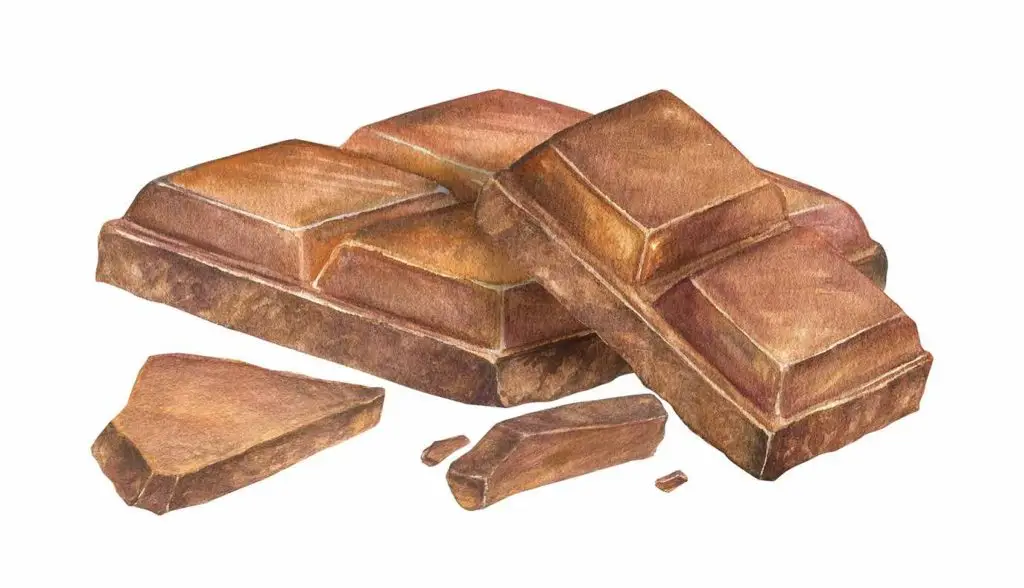
My unlikely suggestion is chocolate. Everybody loves chocolate despite its unpopular color. Solid brown as opposed to brown print/plaid found on sofas, rugs, sweaters, dresses, ties doesn’t pop. Black may be elegant, but brown’s a drag. Even high-fashion TV news anchors wouldn’t chance a chocolate-brown suit. Yet the joy of chocolate overwhelms any negative. Picture little Halloween ghosts picking through the candy basket for Hershey Kisses and Miniatures. Easter means brown eggs and bunnies.

Chemistry may play a part. Chocolate triggers the release of endorphins, the “happy hormones.” Americans, however, seem to prefer heavily sweetened/diluted “milk” chocolate. Law regulates percentage of cacao present in some products. Watch out for “chocolatey” on cookie labels . . . not a good sign.

Depending on the source, cacao beans have been identified in Spain and South America from 3-to-5,000 B.C., mainly as a beverage. Weather and disease decimated a recent cocoa harvest in Ghana, the major African producer of the cocoa plant, precipitating a worldwide shortage, hence price increases.

I adore chocolate. This adoration evolved from deprivation. My mother disallowed “candy’’ because I was a problem eater. I love dairy products but wouldn’t drink milk. She wouldn’t count chocolate pudding as milk. So, at about age 7, I approached her with a treaty: one square Hershey’s for one glass of milk. My absolute favorite, however, was the Good Humor (white truck, jingling bells) bittersweet chocolate sundae cup, scooped up with a little wooden “spoon.’’

As an adult I discovered dark, “bittersweet” chocolate bars, preferably imported. Now, in old age, every evening I put one square under my tongue and let it melt . . . slowly.

Never two, just one.

I once purchased a Toblerone bar the size of a baseball bat at the Zurich airport.

Many decades ago I added a “blackout” sour cream chocolate layer cake to my baking repertoire . . . indescribable. I’m working on chocolate cheesecake. A European friend taught me to put a square of top-quality imported chocolate in a warmed cup and pour steaming black coffee over it. Stir until the chocolate begins to melt. Sip slowly; scrape up remnants with a spoon.

So grown-up. So addictive, but that’s another story.

I am not advocating an unhealthy diet. How could anything so pleasurable be unhealthy, in moderation, during challenging times? I remember World War II, when “care” packages sent to troops contained Hershey bars, not broccoli. Even now, after a distressing day I know chocolate is waiting should I need it.

So why not add chocolate to Thanksgiving, Christmas, New Year’s, Kwanzaa? At Hanukkah children are traditionally showered with gold foil-covered chocolate coins.

I’m not suggesting chocolate will ever replace pumpkin pie or peppermint, turkey stuffing or cranberry sauce. But remember — when discouragement happens, there’s always chocolate.  PS

Deborah Salomon is a contributing writer for PineStraw and The Pilot. She may be reached at debsalomon@nc.rr.com.

Hometown

Hometown

Pointers from a Pro

A treatise on the art of writing

By Bill Fields

During college in the late 1970s, not long after I’d begun spending afternoons typing at The Daily Tar Heel offices instead of studying at the library, a fellow student journalist recommended a book: On Writing Well: An Informal Guide to Writing Nonfiction, by William Zinsser.

After saving a few dollars by forgoing a meat-and-three supper at the Porthole, I purchased a copy of the slender volume, 150 pages including the index, at the UNC campus bookstore. That paperback — its yellow cover smoke-stained from a fire that sent me fleeing from an Aberdeen cottage in 1984, and its thin spine splitting — has survived the decades and multiple moves along the Eastern Seaboard.

I still pull On Writing Well off my bookshelf every so often and am reminded what a good primer it is each time I reread Zinsser’s advice, including passages I highlighted as a young man:

“Clear thinking becomes clear writing.”

“Notice the decisions that other writers make in their choice of words and be finicky about the ones that you select from the vast supply. The race in writing is not to the swift but to the original.”

“If your nails are weak, your house will collapse. If your verbs are weak and your syntax is rickety, your sentences will fall apart.”

“The good writer of prose must be part poet, always listening to what he writes.”

Using examples of writing, good and bad, Zinsser stresses simplicity. “Clutter is the disease of American writing. We are a society strangling in unnecessary words, circular constructions, pompous frills and meaningless jargon.” On Writing Well was first published in 1976, and these days, every time I hear a football analyst say a receiver is “out in space” or a political reporter refer to something happening “in real time,” it’s clear the book is needed now more than ever.

Bill Zinsser wrote his book — of which there have been many editions selling more than 1.5 million copies — to complement The Elements of Style. His how-to took what he later called the “pointers and admonitions” of Strunk and White and showed how to apply them to various forms of nonfiction. On Writing Well grew out of a nonfiction writing course Zinsser taught at Yale University after a long career as a newspaper and magazine writer.

“At the end of class, Bill would return our papers from the previous week, each illuminated with his editing suggestions and provocative marginalia,” Mark Singer, a former student, recalled in The New Yorker. “I still wince at his dead-on appraisal of my travel piece: ‘You’ll notice that I stopped marking this halfway through. What you’ve written is interesting only to you.’”

As an aspiring sportswriter I pored over Zinsser’s chapter about the genre, delighted that he cited Red Smith, whose brilliance I was just discovering, as a writer who “avoided the exhausted synonyms” and strived for “freshness elsewhere in the construction of a sentence.” Zinsser quoted Smith writing that a quarterback was “scraped off the turf like apple butter” and “a luncheonette on 53rd Street that has long since vanished in a cloud of bicarbonate.”

Zinsser had plenty of game too, and like his fellow New Yorker, the more widely known writer Roger Angell, wrote well for a long time. When he was in his late 80s, his vision dimmed by glaucoma, Zinsser won a National Magazine Award for a series of online essays for The American Scholar.

“Today no magazine cover would be wide enough for Rockwell,” Zinsser wrote in one column, “Thanksgiving Day Repainted.”

“He would need a Chinese scroll to accommodate the disparate crowd assembled to eat turkey or some dietetically certified substitute: single moms, single dads, partners, companions, half-brothers, half-sisters, stepchildren, ex-spouses, live-ins, live-outs, in-laws, outlaws, and dogs of rarefied lineage. Only an artist from a post-Rockwell school of painting could hope to catch the overlapping fluidities of the modern American tribe.”  PS

Bill Fields’ memoir A Quick Nine Before Dark is available at The Country Bookshop in Southern Pines and other places books are sold.

Poem November 2026

Poem

Dish Towel

By erri Kirby Erickson 

One of my parents’ dish towels

hangs on the handle of our stove.

It is aqua-blue, covered with red

and yellow poppies. How many of

their dishes this towel must have

buffed, plus silverware, glasses,

cookpots and pans. For decades

Mom washed them and Dad did

the drying. But after he died, she

stood alone at their sink, letting

the water grow cold — soap suds

like glaciers slipping into the sea.

Six months a widow and she, too,

was gone, leaving a lone bowl in

the drainer, a single spoon, a fresh

dish towel draped just so on a ring.


Terri Kirby Erickson is the author of eight collections of award-winning poetry, including The Light That Follows Us Home.