The Naturalist

Backyard Bandits

Observing the private lives of a raccoon family

Story and Photographs by Todd Pusser

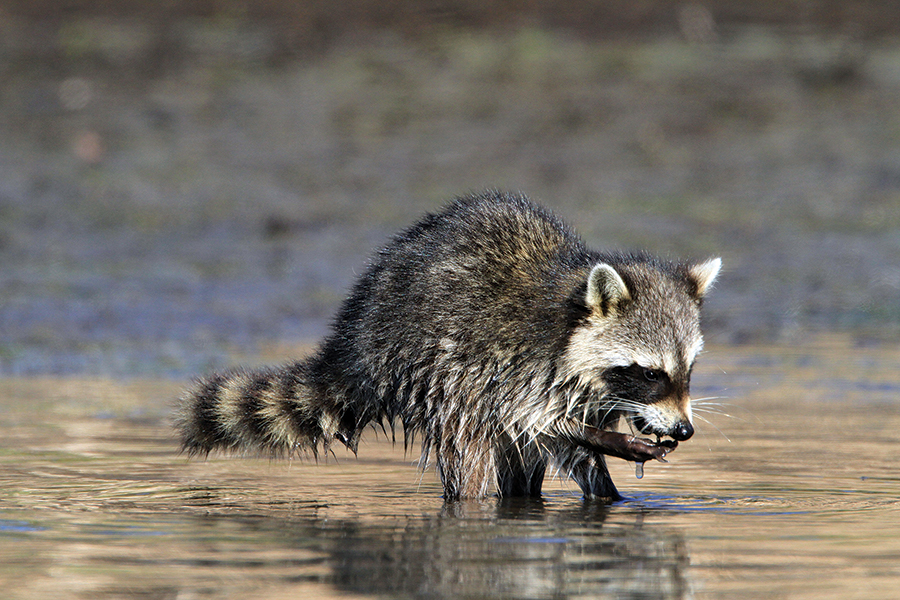
As I was walking past our living room window on a bright, winter’s night, something caught my eye. Out in the front yard, beneath a birdfeeder, stood a bandit. The full moon high above illuminated its distinctive hunched back, pointed ears, dog-like snout and bushy tail. Dexterous paws busily scooped up sunflower seeds from the ground, spilled earlier in the day by hungry cardinals and gray squirrels.

I stood quietly and watched as the raccoon turned its attention to the birdfeeder hanging high above its head. Standing on its hind legs, while simultaneously extending its front legs upward, the raccoon grasped the feeder with its paws and slowly rocked it back and forth, emptying more seed onto the ground. The ease at which the precocious critter performed the task left me with the distinct feeling it had done this before.

Over the next 15 minutes, the raccoon repeated this behavior numerous times, eventually emptying the birdfeeder of its contents. Satiated, or perhaps simply because there was nothing left to eat, the raccoon slowly ambled toward the edge of the yard and disappeared into the night, no doubt looking for more mischief elsewhere.

With their striped tails, large eyes, and distinctive black and white markings wrapped around a cute puppy-dog face, raccoons are among the most recognizable of North American mammals. Incredibly adaptive and intelligent, they make their homes in a wide assortment of habitats ranging from remote forests to heavily urbanized cities.

Growing up in rural Eagle Springs, along the western edge of the North Carolina Sandhills, raccoons were always present on the landscape but I rarely saw them. My most memorable childhood encounters with the crafty critters were among the pages of Sterling North’s Rascal and Wilson Rawls’ Where the Red Fern Grows, two beloved novels that still feature prominently on my bookshelf. It was not until I moved to a densely populated Virginia city that I was able to observe raccoons, outside in their natural environment, with any detail.

Our 3-acre suburban yard bordered a tidal river and contained a mixture of loblolly pines and hardwood trees. One impressive tree, a tall sweetgum, with a large, open cavity about 15 feet off the ground, stood just outside our second-story bedroom window.

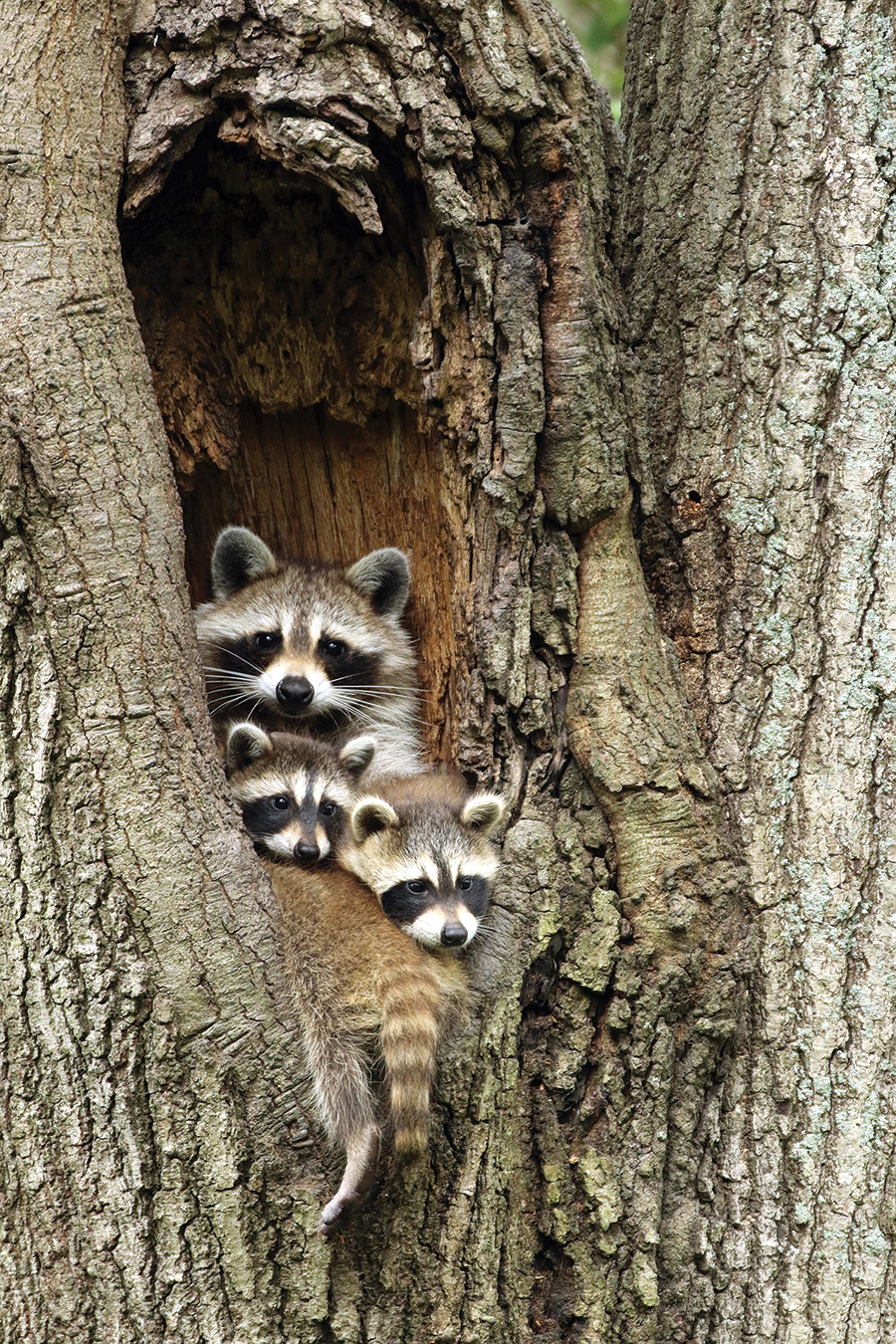
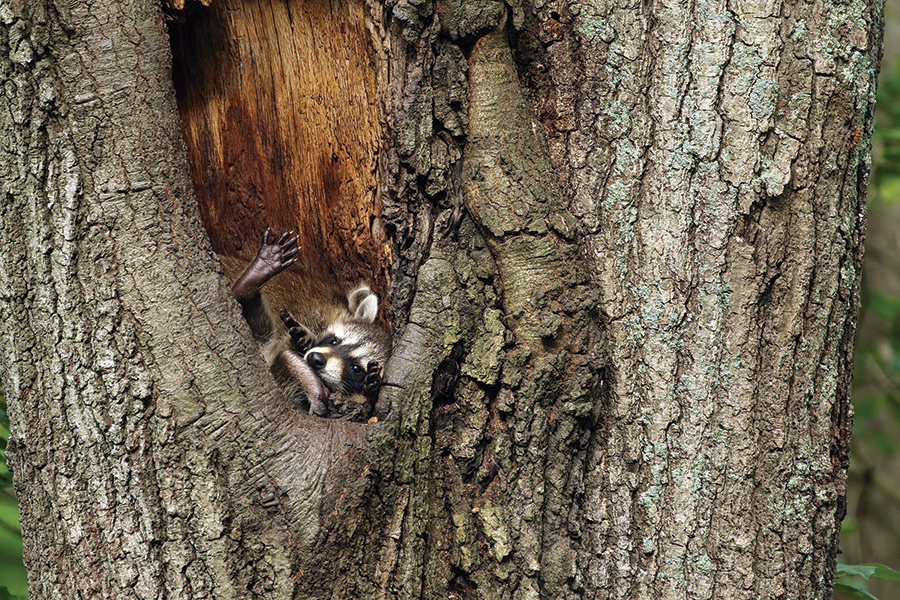
One April morning a few years back, I noticed a raccoon curled up in a tight ball at the cavity entrance. The animal remained there for several days, rarely moving, except to occasionally lift its head and stare at me when I mowed the lawn. After a couple of weeks, I began to worry that the animal might be sick. Toward the middle of May, I woke one morning to find three tiny, young raccoons peering out from the cavity along with the larger animal. The raccoon had not been sick, as I had feared, but was simply pregnant and had given birth to a trio of impossibly cute kits whose antics provided hours of entertainment.

Being able to observe the intimate details of the lives of animals is a rare treat, and so it became a morning routine, with a cup of coffee in hand, to watch the raccoon family for a couple of hours before work. Mother raccoons are attentive, loving and tender, and this one proved to be no exception. Throughout the day, she constantly groomed and nursed her young. As the kits grew, she would often leave the increasingly cramped tree cavity and bask quietly on a nearby tree limb, obviously treasuring a moment of solace from her rambunctious young.

Over time, her routine became predictable. She stayed nestled in the tree cavity with her young for much of the day, occasionally basking on nearby tree limbs when it was hot. At night, she ventured out of the cavity to look for food, always returning by sunrise. Toward the middle of summer, she began to take her young on her nightly forays.


The raccoon family utilized the entire yard but frequented the azalea garden and the patch of dirt beneath the bird feeders, where they eagerly gobbled up spilled sunflower seeds. Several times that summer, I observed the young foraging elbow deep in the river and marveled at the dexterity of their paws as they “washed” their food.

By early fall, mother raccoon weaned her kits and sent them on their way. I am not sure where they eventually settled, but on occasion, I would see a young raccoon dash across a nearby neighborhood street late at night in front of my car and wonder if it might be one from our yard.

We ended up moving away from that riverfront property over six years ago. From time to time, I still think about that mother raccoon and wonder if she might still be alive. With abundant food and adequate shelter — which our yard had in spades — raccoons can live for well over a decade. It is entirely possible she is. Perhaps this spring will find her raising another family of young kits inside the cozy tree cavity just outside our old bedroom window.

Thinking about that now, I can’t help but smile.  PS

Naturalist and photographer Todd Pusser grew up in Eagle Springs. He works to document the extraordinary diversity of life both near and far. His images can be found at www.ToddPusser.com.

The Naturalist

The Bucket List Fish

The wish of a lifetime comes true

Story and Photographs by Todd Pusser

I suppose my bucket list is different than most. Firmly in the grip of middle age, with likely more life behind me than in front, my list has remained constant since the days of my youth. Unsurprisingly, for those who know me, most of the items revolve around natural history in some form or another, and frequently involve travel to remote locations to see rare or poorly known animals. Over the years, I have been fortunate enough to check off a few items from the list but one, in particular, holds a special place above all others.

It all started back in the early 1980s when, as a 12-year-old kid, I stumbled upon a photo in National Geographic Magazine of famed shark researcher Eugenie Clark, clad in a wetsuit and scuba tank, grasping the tall dorsal fin of a whale shark off Baja, Mexico. Such behavior is frowned upon today but, back then, the sight of a person grabbing onto the world’s largest fish and taking it for a ride a hundred feet below the ocean’s surface, down into the abyss, sparked my imagination. I wanted more than anything to see a whale shark in the wild, and above all else, I wanted to swim with one, up close and personal, in its own element.

Fast forward to 1996. While standing on the flying bridge of a research vessel over 100 miles off the west coast of Florida, I encountered my first whale shark. The shark, nearly 40 feet in length, cruised gently beneath the placid surface of the Gulf of Mexico, its white polka-dot body practically glowing in the brilliant blue water, as it passed by within a stone’s throw along the starboard side of the ship. To say I was ecstatic is an understatement. I was completely over the moon with joy, having seen the beast of my youthful dreams.

Over the following 25 years, I encountered the immense fish a dozen more times in such varied locations as Hawaii, Mexico, Panama, Costa Rica and, once, off the coast of my home state of North Carolina. However, all of my sightings were made from the vantage point of steel decks on large ships, high above the surface of the sea. I never had the opportunity to actually get into the water and swim with these amazing animals. My National Geographic moment eluded me, until recently.

Isla Mujeres is an island located off the coast of Mexico’s Yucatan Peninsula. It is here, in the clear blue water surrounding this tiny speck of land, that the largest known gathering of whale sharks on the planet was recently discovered. Upon learning this, my partner, herself a marine biologist, and I hopped onto a plane and headed south to observe this phenomenon for ourselves.

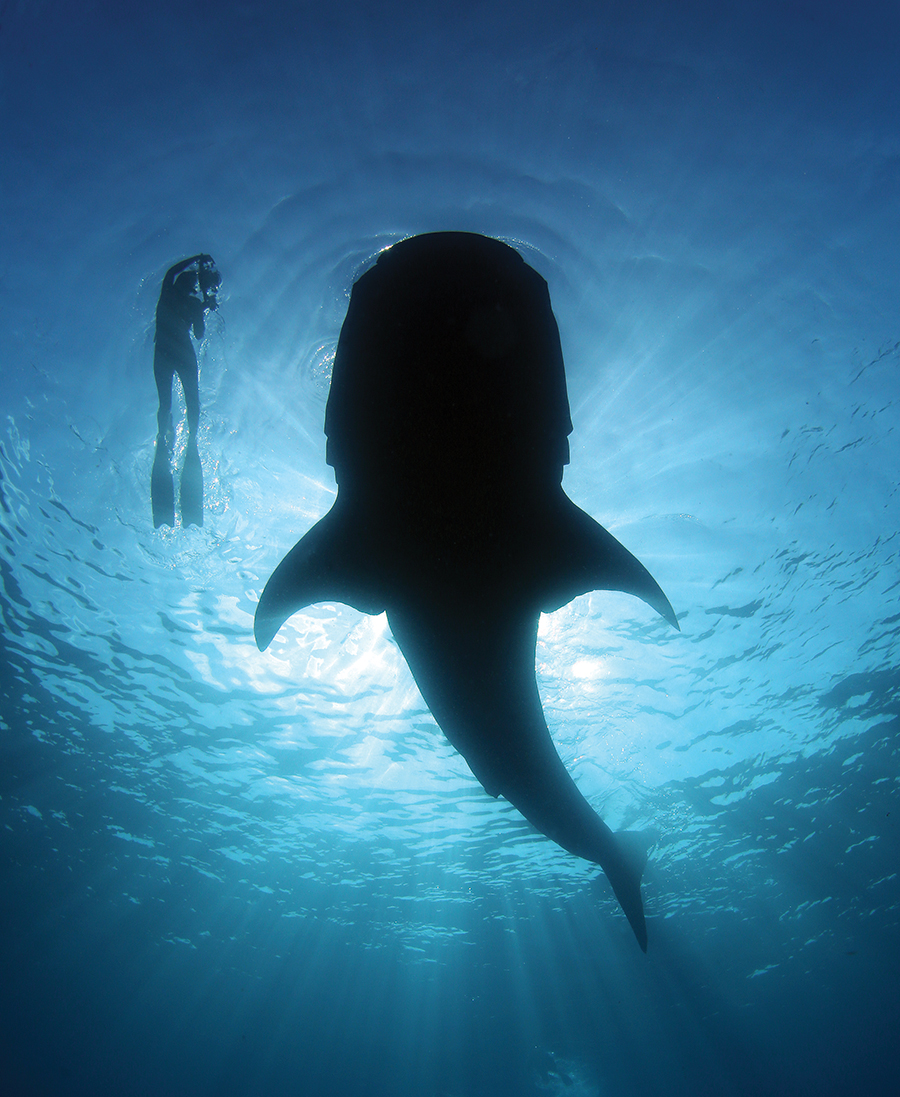
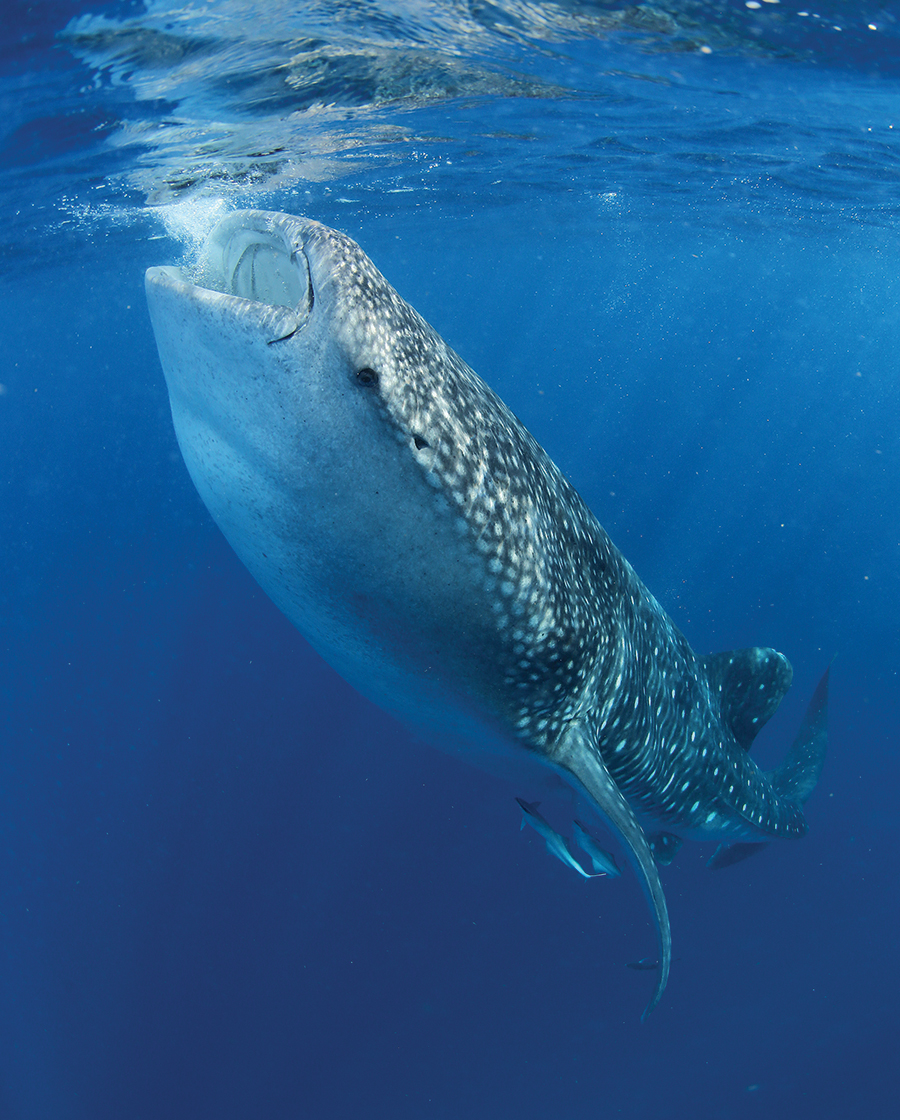
Capable of reaching lengths of over 45 feet and weights approaching 15 tons, a whale shark owes its common name to its immense size. Admittedly, it’s a name that can be quite confusing to the average person. Is it a whale or a shark, or some strange hybrid between the two? A whale shark is in no way related to the warm-blooded mammals known as whales, but rather is a cartilaginous fish — one of over 530 species of sharks currently known to science.

Understandably, some may question the sanity of wanting to swim with a fish the size of a school bus. However, whale sharks have extremely small, pointed teeth, and feed primarily on zooplankton and tiny fish, unlike the more carnivorous habits of their famous cousin, the great white shark.

Whale sharks flock to the waters off Isla Mujeres each summer to feed on the eggs released by spawning schools of false albacore tuna. A thriving tourist industry has built up in the area, and thousands of people have experienced the thrill of swimming with these gentle giants.

During our week there, we encounter well over 300 whale sharks, an astonishing number for such a rare fish. Though global whale shark populations are unknown, the species is considered endangered. At one point, as our boat drifted quietly on the calm Caribbean Sea, we could see whale sharks, with their immense polka-dot dorsal fins breaking the water’s surface, clear out to the horizon.

Donning a mask and snorkel, I finally have the opportunity to slip into the water among the sharks. Lying motionless at the surface and staring out into the infinite blue, I find myself unconsciously humming the theme to Jaws.

After a few minutes, near the edge of my vision, a dark shape appears. As it nears, I take note of the large mouth set on the front of a square-shaped head, and an immense body covered in a unique pattern of white spots. Powered by a tail spanning over 10 feet from tip to tip, the enormous fish swims closer and closer. Raising my underwater camera, I frame the shark in the viewfinder and press the shutter as it swims by within arm’s reach, completely ignoring me. Never before have I been so close to such a large creature.

Enthralled and feeling more than a bit humbled, I continue to watch the leviathan as it swims slowly out of sight, disappearing into the infinite blue void — a childhood dream, carried nearly four decades, finally realized.  PS

Naturalist and photographer Todd Pusser grew up in Eagle Springs. He works to document the extraordinary diversity of life both near and far. His images can be found at www.ToddPusser.com.
The Naturalist

Ghosts Among the Pines

The white squirrels of Rockingham

Story and Photographs by Todd Pusser

Hop on U.S.  in Aberdeen and take it south, out of town. Cross over the floodplain of Drowning Creek at the Richmond County line and continue through the small hamlet of Hoffman, past the majestic stands of longleaf pine and wire grass of the Sandhills Game Land, and the old NASCAR motor speedway. Approaching the city limit signs of Rockingham, take a right turn into any of the suburban neighborhoods bordering the road and keep your eyes peeled. Among the patchwork of ranch-styled houses, manicured lawns and forest edges, you might just see a ghost.

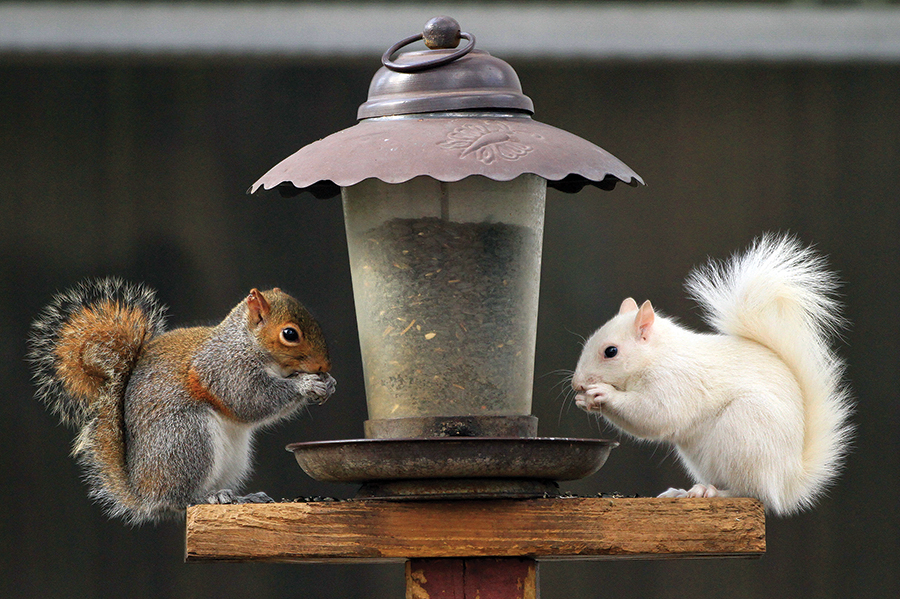
It was my late uncle, Lamar, who first told me about them. The ghosts in question are part of a unique population of the grey squirrels that call this Sandhills town home. The squirrels here are not your average run-of-the-mill bushy-tailed rodents that are the bane to backyard gardeners and bird feeders everywhere. Many, instead, sport unusual, brilliant, snowy white fur coats and feature dark blue eyes.

I first set out to see the white squirrels of Rockingham one cold December day over 12 years ago. About a mile off U.S. 1, along a small section of road bordered by large oak trees and old homes, I counted a dozen white squirrels scattered here and there among the grassy yards. One yard in particular, with a large birdfeeder mounted atop a wooden pole next to a window of a single-story brick home, held four individual white squirrels.

After I stopped and rang the doorbell of the house, a kind, soft-spoken elderly man met me at the door. When I requested permission to photograph the white squirrels in his yard, his eyes lit up. He remarked that the white squirrels held a special place in his heart, reminding him of his late wife, who had filled the birdfeeder next to their living room window with sunflower seeds every day just so she could watch their antics. It was a tradition he had continued long after her passing, and it thrilled him that someone else had taken an interest in “her” squirrels.

“You go ahead and photograph the squirrels to your heart’s content,” he said.

With that, I lugged my camera gear out of the car, sat down quietly at the edge of the yard, and waited. Cardinals and chickadees, typical yard birds for the area, flew back and forth from the birdfeeder to a hedgerow, their incessant calls breaking the silence of an otherwise quiet winter’s day.

Before long, a luminescent white squirrel emerged from a hollow cavity 20 feet off the ground in a robust oak tree along the edge of the driveway in the front yard. Walking out onto a long vertical limb, it made a flying leap onto a nearby powerline that stretched across the width of the front yard. Like a miniature tightrope walker, the squirrel nimbly ran the length of the powerline and jumped off onto a pine tree. Scampering down the trunk, it hopped to the ground and raced over to the birdfeeder next to the window.

Watching it reminded me of another, more celebrated North Carolina population of white squirrels. Each spring, Brevard, a quaint town nestled within the mountains of Transylvania County, holds a weekend-long “White Squirrel Festival,” attracting thousands of tourists from across the state. The town is so enamored with their white squirrels that it created a sanctuary for the pale mammals, making it illegal for anyone to hunt, trap or kill one within city limits.

Stark white animals have captured the imagination of mankind for millennia, and figure prominently in myth and legend. Many Native cultures across the globe view albino animals as deities or omens of good luck. Albino animals feature prominently in popular culture as well, perhaps none more so than the great white whale pursued by the obsessed Captain Ahab in Herman Melville’s literary classic Moby Dick.

The white squirrels in both Rockingham and Brevard are not actually albinos, but are what biologists refer to as leucistic animals. Like albinos, leucistic animals lack pigment in their skins but retain small amounts in certain parts of their bodies, especially the eyes. Both albino and leucistic animals are rare in nature. Their stark white coloration makes them especially vulnerable to predators, and logic dictates that populations of white squirrels should remain low in areas where foxes, red-tailed hawks and feral cats are common. However, the populations of white squirrels in both Carolina towns appear to be thriving.

Back in Rockingham, a normal-colored grey squirrel came bounding across the yard and hopped up onto the bird feeder across from the white one. Together, they enjoyed mouthfuls of sunflower seed as the afternoon sun drifted across the Carolina blue sky. The yin and yang contrast between the two provided a wonderful photo opportunity, and I raised my camera. Framing the two squirrels in my viewfinder, I noticed the elderly man sitting quietly inside the nearby window admiring them. He was smiling.

Pressing the shutter, I smiled back. PS

Naturalist and photographer Todd Pusser works to document the extraordinary diversity of life both near and far. His images can be found at www.ToddPusser.com.

The Naturalist

Legion of the Night

The beauty of moths

By Todd Pusser

Butterflies get all the love. All around the world, festivals are held in their honor. Entire gardens are planted specifically to attract them. Poems praise their beauty. Kids even dress up as butterflies for Halloween.

Moths, on the other hand, are frequently overlooked and ignored by most people. If noticed at all, moths generally get a bad rap. Gardeners despise hornworms, the large caterpillars of sphinx moths, feeding on tomato plants in the backyard. Gypsy moth caterpillars, capable of defoliating entire trees, are the bane of property owners throughout areas of the Northeast.

Even in popular culture, moths are frequently associated with superstition and death. The calling card of the serial killer from the popular 1990s movie Silence of the Lambs was the cocoon of a death’s-head hawkmoth (yes, there is such a thing) placed inside the mouths of his victims.

About the only time moths have received any positive press is when Mothra dragged Godzilla by the tail out of Tokyo.

Cecropia Moth

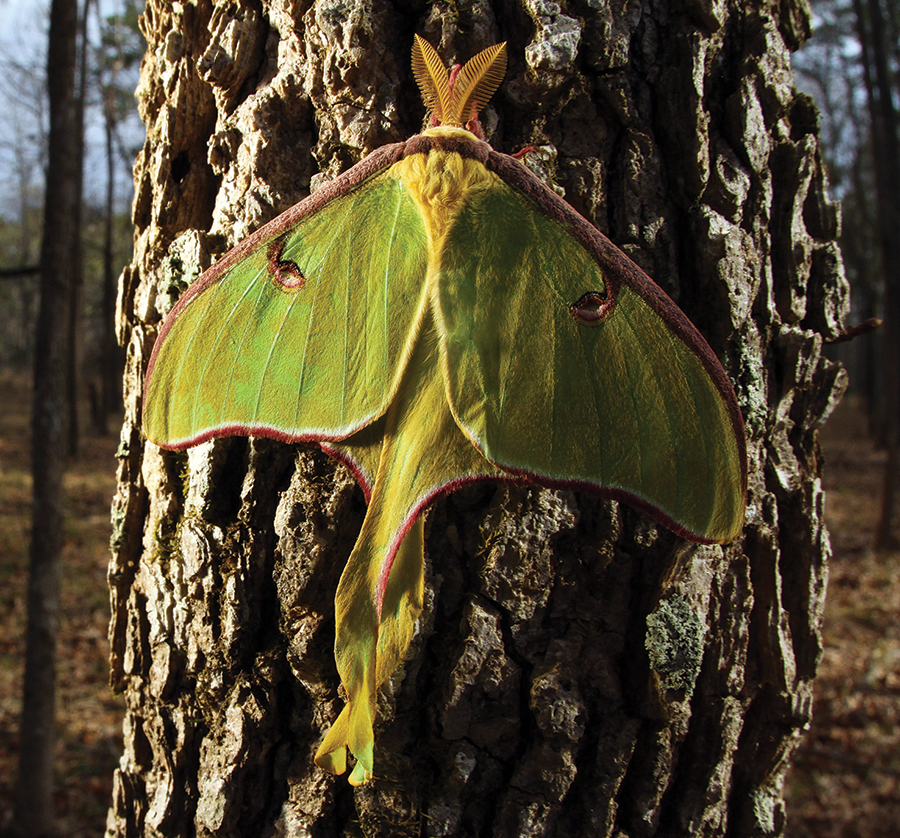
Last July, on a hot and humid night, I pulled into the parking lot of a brightly lit gas station along the edge of the Dismal Swamp in the northeastern corner of the state. It was during the height of the pandemic, and few other cars were around. In need of caffeine, I stepped out of my vehicle and walked along the side of the building toward the front door. Casually glancing up, I was stunned to see a large luna moth clinging to the side of the building, its striking lime-green wings contrasting sharply with the white paint.

The gentle luna moth is the teddy bear of the insect world, sporting a plump, furry body, feathery antennae, and a pair of 3-inch-long sweeping tail streamers. It is among North Carolina’s largest and most spectacular moths. I was so pleased to see one that I casually mentioned it to the station’s clerk while paying for my beverage. A blank stare was my only response. Finally, she asked quizzically, “You saw a what?”

I said again, “There’s a luna moth outside your front door.” Blank stare once more.

“Oh,” said the clerk with a nervous smile. “Have a nice night.”

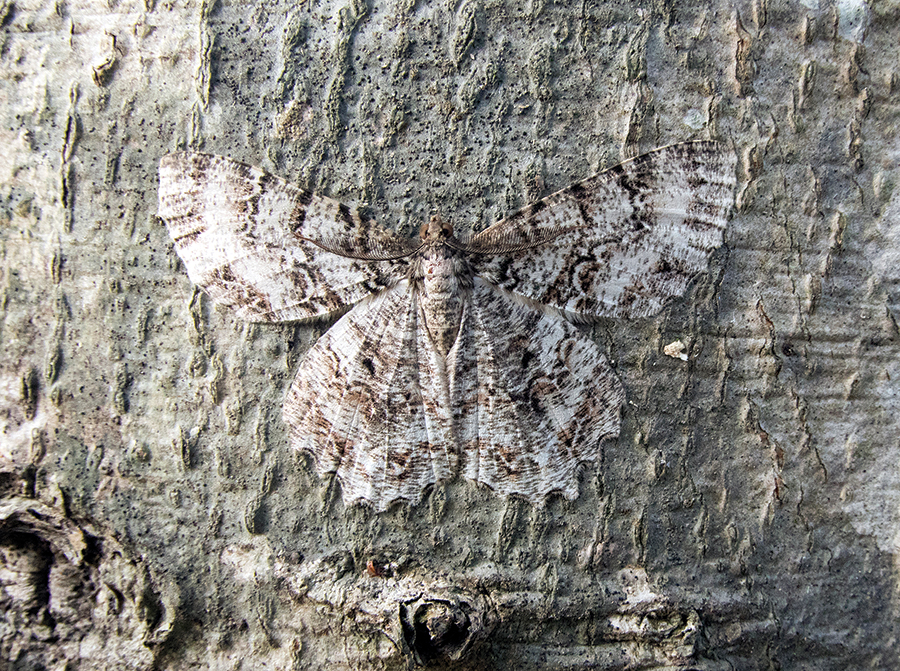
Most people think of moths as drab and boring. It is true that many moths possess muted shades of brown or grey colors, but a surprising number are as colorful and intricately patterned as any butterfly. Take, for example, the giant leopard moth, common to many parts of North Carolina. Looking like a flying Dalmatian, it is a large, bright white moth covered in an array of black polka dots. An entire family of moths known as underwings sport drab tree-bark-patterned forewings and brightly colored hindwings, which they only flash when frightened by a predator.

Luna moth (Actias luna), freshly emerged from its cocoon in early spring in the Lowcountry of South Carolina

Speaking of underwing moths, many possess common English names reflecting a marital theme, a quirky tradition started by Carl Linnaeus, the father of modern taxonomy. Among the more descriptive ones are the tearful underwing, the betrothed underwing, the dejected underwing, the divorced underwing, and the oldwife underwing. Clearly, entomologists have a sense of humor (and perhaps one too many beers) when it comes to naming moths. Or perhaps they are just in need of a good marriage counselor.

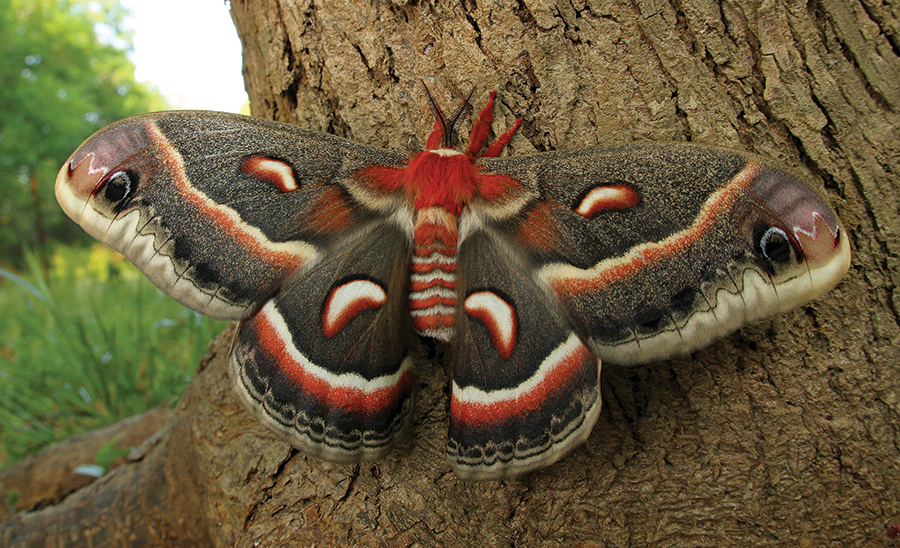
Moths are among the most diverse groups of animals on the planet (surpassed only by beetles), with over 200,000 species (and counting) found worldwide compared to just over 17,000 species of butterflies. They come in an infinite variety of shapes and sizes. Many of our state’s smallest species, known as micro moths, could easily fit onto the head of pin. The largest species in North America, the cecropia moth, possesses enormous wings that stretch 7 inches from tip to tip, making them larger than many species of bat. A member of the spectacular silk moth family, the cecropia (and the luna moth mentioned earlier) does not feed as an adult and relies on stored energy from its caterpillar stage. As such, the cecropia lives for only a few days, leaving it precious little time to find a mate and perpetuate the species.

Unlike the showy silk moths, many night-flying moths are masters of disguise and closely resemble bark and leaves to help them blend into their surroundings during the day. Some even look like bird droppings.

Not all moths are nocturnal. Many fly during daylight hours. Those that do tend to mimic other insect or animal species, such as bees and wasps. One well-known day-flying moth is the hummingbird clearwing, which mimics the size, shape and flight pattern of the ruby-throated hummingbird. Like its namesake, it is frequently observed hovering over flowers in urban gardens.

Tulip tree beauty moth

Just this past April, I was admiring a cherry tree in full bloom in a friend’s yard when I did a double take. What I initially thought was a bumblebee hovering over a blossom above my head turned out to be a moth known as Nessus sphinx. With two bright yellow bands wrapping around a black abdomen, the moth was a perfect replica for the stinging insect. As I followed it from blossom to blossom, I realized the rapid wings of the moth even sounded like the buzz of a bumblebee.

Like bees, moths are important pollinators of many flowers and crops. Throughout all their life stages, from caterpillars to adults, moths serve as a critical food resource for many birds and other animals. Studies have shown that moth caterpillars are the preferred food for nesting birds, such as eastern bluebirds, as they are both easy to digest and full of protein.

Unfortunately, moths have suffered serious declines in their populations due to habitat loss, light pollution, and the extensive use of pesticides on the landscape. Their ecological importance and the impact that they have on the world around us is difficult to understate.  PS

Naturalist and photographer Todd Pusser works to document the extraordinary diversity of life both near and far. His images can be found at www.ToddPusser.com.
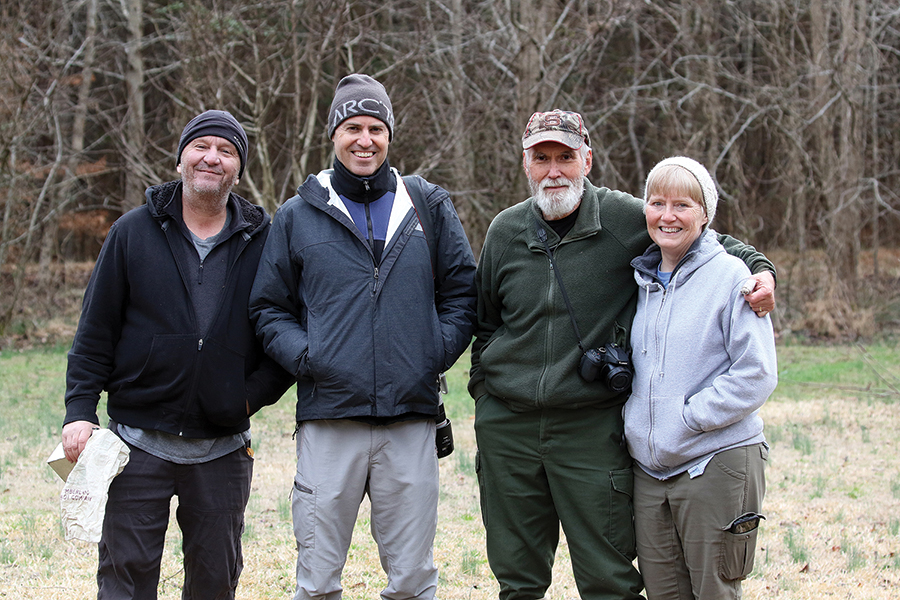
His favorite book is Where the Red Fern Grows by Wilson Rawls.

The Naturalist

Like Son, Like Father

A manatee, a rattlesnake, and a change of perspective

By Todd Pusser

Putting on a wetsuit is an ordeal, especially if you have never done it before. The process of pulling a thick piece of neoprene up over your legs and torso is exhausting. So it was as I strained with all my might, trying in vain to pull the crushed rubber material up over the last few inches of my father’s shoulders.

Finally, with a few extra twists and turns, I was able get to Dad fully suited up. Pulling the zipper up his back, I turned him around to inspect how well the rented contraption fit him. Standing there on the bow of our aluminum jon boat, Dad looked like an aging superhero with his white hair, all aglow under a bright January sun, contrasting sharply with his skintight black wetsuit.

I handed him a mask and snorkel and he promptly belly flopped over the side of the boat. Dad had never snorkeled before, not even in our backyard swimming pool. I figured this was as safe a place as any for his first try. Our boat was anchored near a large, freshwater spring, many miles away from the ocean, and the calm water was only 8 feet deep.

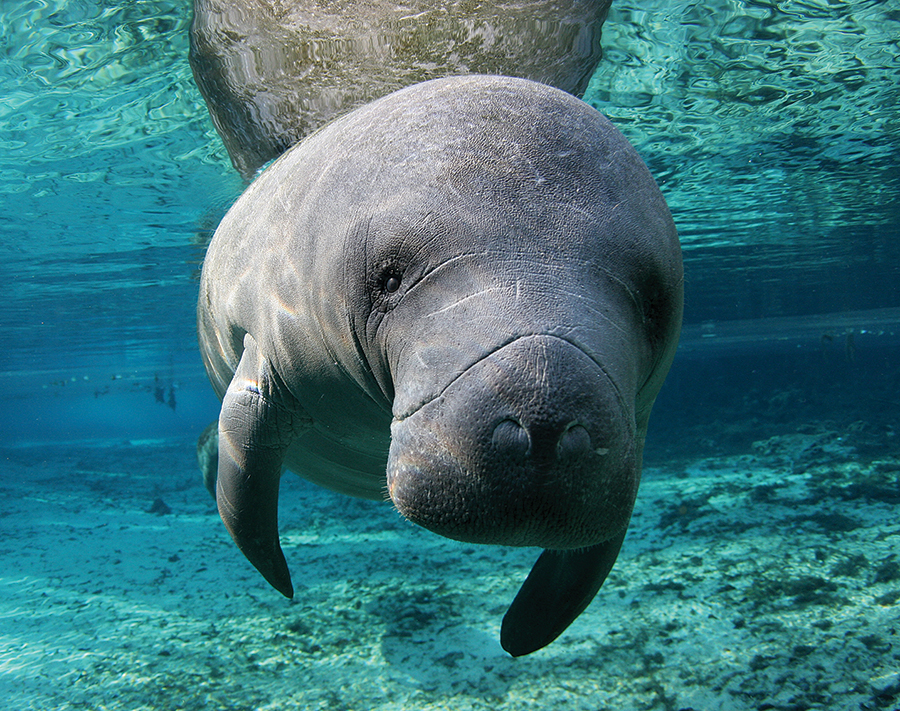
I had asked Dad to join me for a trip to Crystal River, Florida, to dive with mermaids, something he agreed to without hesitation. Errr . . . I meant manatees. I wasn’t trying to mislead my father — after all, lovesick, old-timey sailors frequently mistook the sea cows for voluptuous sirens. No, I had asked Dad to come along with hopes that he could gain a better understanding of the career path I had chosen for myself.

I have always had a strong love for nature, especially creatures of the ocean. Despite growing up in landlocked Eagle Springs, over a hundred miles from the nearest beach, my passion for the sea was innate, though a chunk of it was certainly inspired by Sunday afternoon viewings of the Undersea World of Jacques Cousteau at Granny’s house.

Dad never fully understood my obsession with nature, but he tolerated it. More importantly, he and Mom always encouraged and supported me, especially when they asked what I wanted to be when I grew up. The answer was always the same — a marine biologist.

As soon as Dad hit the water, a manatee appeared from out of nowhere. Dad gave an audible “grunt” in his snorkel, obviously surprised by the sofa-sized mammal that had snuggled up next to him. Despite their size, manatees can be quite curious, even playful, and this particular one nuzzled its head up under Dad’s hand, wanting a scratch like some overgrown puppy. (Disclaimer: This interaction took place over decade ago. Touching manatees is no longer permitted.)

As quietly as I could, I slipped into the water, fumbling with the controls of my underwater camera. The manatee, ever curious, kept swimming circles around me and my father. Occasionally it would pause to scratch its back on the anchor line that ran from the bow of the boat to the river bottom. After 10 minutes or so, it swam off. Dad climbed back into the boat, shivering from the cold water but clearly exhilarated by the whole experience. The sparkle in his eye told me everything I needed to know. No longer would he wonder about what motivates his son in life.

The following summer, I asked Dad to join me once again in the field, this time in the Albemarle Peninsula of coastal North Carolina. A wild, sparsely settled region of the state, with immense tracts of farmland surrounded by thick, pocosin swamps full of bears, bobcats and red wolves, the peninsula is one of my favorite places.

As a kid, Dad and I did not spend much time together outside. The family carpet business in West End took up most of his time. He and Mom worked hard, busting their butts Monday to Saturday, through all hours of the day, providing for our family.

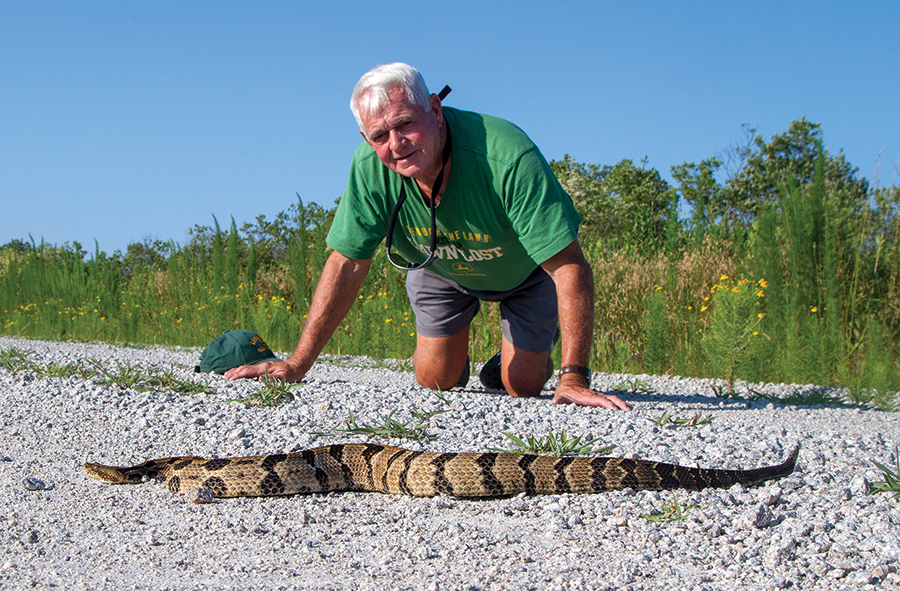
It was the first afternoon of a planned four-day trip, when Dad and I encountered the rattlesnake. We came upon the venomous serpent stretched out in the middle of a long dirt road that cut through a dense patch of forest. Its yellow and black scales glistened in the late afternoon light.

I stopped the car about 20 feet in front of the snake and slowly opened the door with camera in hand. Dad, reluctantly, did the same.

I find snakes, all snakes, to be beautiful creatures. Always have. Dad, on the other hand, emphatically does not. An insufferable ophidiophobe, his mantra in life (perhaps many of you can relate) is, “The only good snake is a dead snake.” As a kid, whenever a snake appeared in our rural Eagle Springs yard, Dad always assumed it was venomous and promptly dispatched it with a deft stroke of a shovel. As I matured, I realized that not all snakes seen in the yard were venomous, so I would plead with Dad not to kill them. Sometimes, if I whined long enough, he would relent and allow me to catch and move them unharmed to a nearby patch of forest.

Back at the dirt road, I asked Dad to go and kneel down behind the rattlesnake so I could take a photo that would give a sense of scale (no pun intended) to the 4-foot-long serpent. He cocked his head, raised an eyebrow, and calmly replied, “Hell no.”

I tried to explain that rattlesnakes are not aggressive and that they do not attack people. I explained that most venomous bites occur when people try to kill a snake. I even described how snakes are beneficial to have around and that they eat a variety of pests, many of which carry ticks that harbor disease. This failed to impress and Dad remained steadfast. I figured as much.

Wanting to get a few shots of the snake in habitat, I took out my wide-angle lens and lay down on the dirt road, just out of strike range of the venomous serpent. The rattlesnake remained perfectly still, neither flicking its tongue nor vibrating that famous tail. It was simply biding its time, waiting for us to leave it in peace.

After a few minutes of watching me, Dad, realizing there was nothing to fear, agreed to take a knee behind the snake. As I framed him in the camera, he even managed to crack a nervous smile. I wondered to myself if perhaps Dad was changing his point of view about snakes.

A few months later, I got my answer. Mom called to tell me a most unusual story. While driving down a rural Jackson Springs road, she and Dad encountered a rattlesnake in the center lane. Instead of running it over, Dad pulled the car over to the shoulder of the road, got out, and fetched a tree limb. Stopping oncoming traffic, he coaxed the venomous reptile off the road into the safety of the woods, all the while explaining how beneficial snakes are to the environment to Mom and the other exasperated drivers.

I have never been more proud.  PS

Naturalist and photographer Todd Pusser works to document the extraordinary diversity of life both near and far. His images can be found at www.ToddPusser.com.
The Naturalist

Requiem for a Dolphin

Pondering extinction in a river far away

Story and Photographs by Todd Pusser

On February 18, 1914, Charles Hoy, the teenage son of an American missionary in the Hunan Province of China, went duck hunting on Dongting Lake, an offshoot to that country’s longest river, the Yangtze. Instead of procuring waterfowl that cold winter day, young Hoy shot and killed an unusual freshwater dolphin. A naturalist at heart, Hoy kept the skull of the dolphin as well as several photos documenting his trophy, which he presented to the Smithsonian Institution upon his return to America.

Gerrit Miller Jr., a scientist at the renowned museum, examined the skull and declared that it belonged to a new genus and species of dolphin, which he christened Lipotes vexillifer in 1923. The name Lipotes comes from the Greek word lipos meaning “fat,” and the difficult-to-pronounce species name vexillifer is Latin for “flagbearer.” Scientific jargon aside, the dolphin is commonly known as the Yangtze river dolphin or baiji (pronounced Bi-gee).

Fast forward 83 years later, to December 2006, when our research vessel pulled into the enormous port city of Wuhan, China, along the shores of the Yangtze River. The city, with a population of more than 11 million people, was still many years away from achieving notoriety as the origin of a global pandemic that continues, as of this writing, to cripple economies and destroy lives.

At the time, despite it being a city larger than New York City, few Americans had ever heard of Wuhan. I confess to only having a vague understanding of where the city sat geographically within the vast country of China before that trip. I had traveled to the bustling city to join a team of two dozen scientists, gathered from around the world, to conduct a survey of the Yangtze River for the dolphin.

Since the species description in 1923, a major revolution and world war had prevented Western scientists from studying the unusual animal in more detail. In 1979, China opened its borders to the outside world, and the first surveys were conducted for the dolphin. A joint team of Chinese and European scientists found the baiji to be exceedingly rare and determined that only a few hundred individuals occupied the Yangtze, the only place in the world where the species is found.

By the time of our survey, it was estimated that the entire population numbered just a dozen individuals, and the baiji was widely considered the most endangered large animal on the planet.

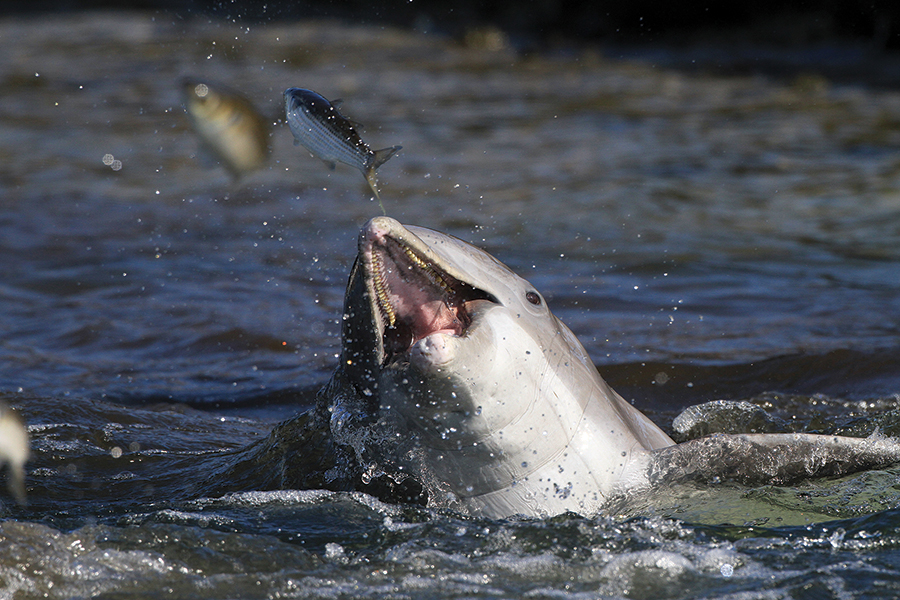
Most people know dolphins, in particular the bottlenose dolphin, from attractions at large aquariums such as Sea World, or (if you are of a certain generation) television shows like Flipper. But few would recognize the baiji as a dolphin. With a long snout filled with scores of needle-sharp teeth, small beady eyes, broad flippers and a tiny fin on its back, the animal looks downright prehistoric.

For six weeks, our research boats, using high-powered binoculars and towing sophisticated underwater hydrophones to record any sounds the dolphins might make, combed the Yangtze River from one end to the other. Twice. We failed to see a single dolphin.

The Yangtze River is the third longest river in the world, behind the Amazon and the Nile, and has dozens of tributaries (most of which are dammed) and two main, large lakes. Aside from its wide mouth near Shanghai, the Yangtze is a relatively narrow river, averaging just over 1 mile in width throughout its course. It is entirely possible we missed an individual baiji or two but, considering the amount of effort involved and the thoroughness of the survey, it seemed unlikely a sustainable population remained in the river.

The results of our survey were published the following year declaring that the baiji was likely extinct in the wild. One of the lead scientists, Samuel Turvey, published a book, Witness to Extinction, chronicling the events of the survey. For a brief time, media outlets ran stories on the demise of the dolphin, both online and in major newspapers. But within a few weeks, the baiji was largely forgotten. The chances are good that — other than its mention here — you have never even heard of a baiji.

Extinction is something that we are taught in elementary school. We know that dinosaurs once walked this planet, and that wooly mammoths are relics of the last Ice Age. But the concept of extinction happening today remains a bit abstract and insignificant.

The loss of the baiji had no effect on global stock markets. There are no days marked on our calendars commemorating its demise. All that is left of the baiji’s time on this planet are a few dusty skeletons and remains preserved in vats of formalin, scattered in museums around the world.

In the nearly 100 years since the baiji was described, we still know virtually nothing about it. Basic questions about its home range, preferred habitat, what it liked to eat, even its average lifespan remain unanswered. What is more certain, the dolphin was a part of the vast tapestry of life unique to this planet, and its untimely demise should provide food for thought. It simply lived its life trying to survive and provide for its own, just like the rest of us.   PS

Naturalist and photographer Todd Pusser works to document the extraordinary diversity of life both near and far. His images can be found at www.ToddPusser.com.
The Naturalist

The Dweller of Sandy Places

A new species described from the Sandhills

Story and Photographs by Todd Pusser

One might assume in this age of globalization and the internet that there is nothing left to discover on the planet. If there are any new species of plants and animals yet to be observed by human eyes, they must exist in some poorly explored corner of Earth, tucked away in a remote Amazonian rainforest or at the bottom of the deep sea.

Of course, the trouble with assumptions is that they are frequently wrong. 

We are living in an era many naturalists have dubbed “a new age of discovery.” Thousands of new species are being described each year — everything from monkeys to brightly colored tropical birds. Indeed, many new species are found in faraway jungles and at the bottom of the sea, but a surprising number are discovered right in our own backyards.

1n 1995, an entirely new species and genus of tree dubbed the Wollemi Pine, which grows over 130 feet tall, was found just outside of Australia’s largest city, Sydney. In 2010, biologists lifted a rock in the middle of an eastern Tennessee stream and found a new crayfish. At nearly half a foot in length, the Tennessee Bottlebrush Crayfish looks more like a Maine lobster than a denizen of a backwater creek.

Perhaps most spectacular of all, a new species of whale — a whale — was described in 2002 from specimens that washed ashore on the crowded beaches of San Diego in the 1970s. Originally thought to be a rare species of beaked whale from the Southern Hemisphere, biologists using advance genetic techniques, revealed that the cast-ashore leviathans were in fact a new species, which they named Perrin’s Beaked Whale after the biologist who first examined them. Despite their swimming in waters offshore our most populous state, humans have yet to observe a member of this odd species of whale alive in the wild.

In biological circles, North Carolina is frequently described as “the salamander capital of the world.” With 64 species found within its borders, North Carolina has more of the cold-blooded amphibians than any other state. Some, like the eel-like greater siren, a resident of murky, coastal swamp waters, can grow to lengths of over 3 feet. Others, such as the pygmy salamander, barely reach an inch in length and are among the smallest amphibians in the world.

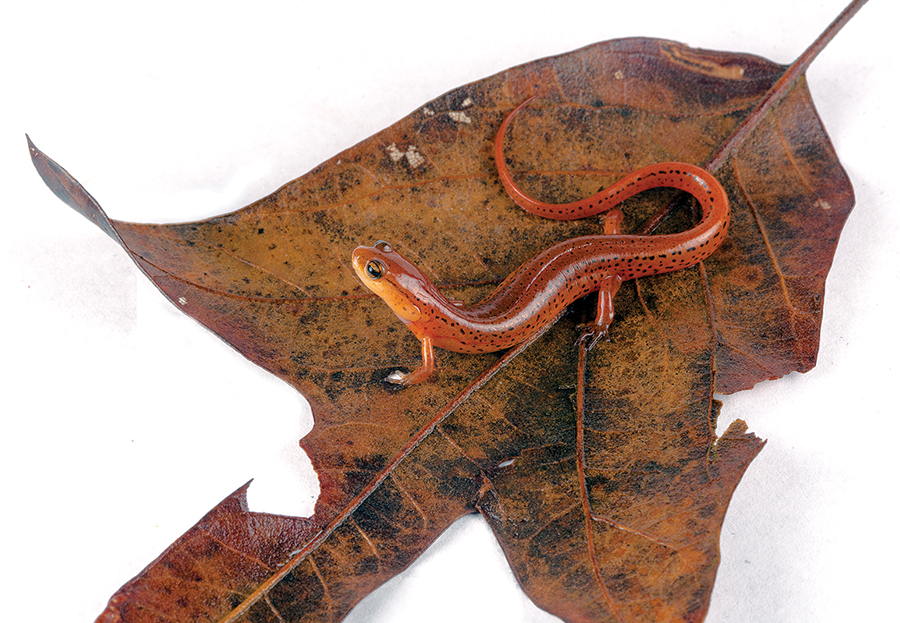
Fifty years ago, Alvin Braswell, then an assistant curator of lower invertebrates at the North Carolina Museum of Natural Sciences in Raleigh, examined an unusual red salamander that had been found in the Sandhills region of the state. He initially thought the tiny 3-inch-long amphibian was just an unusual red variant of the Southern Two-lined Salamander, a common species found throughout much of North Carolina.

As more and more of the unusual salamanders were brought to the attention of the museum, Braswell began to suspect that they might be something new. Over time, it became clear that the little red salamander was found only along the margins of small creeks that meander through the Sandhills, and nowhere else.

In this day and age, describing a new species is a long, painstaking process that requires a lot of time and energy. Exact, minute, morphological measurements, as well as DNA analysis, need to be made across a series of collected specimens and then compared with those of closely related species. Often, the specimens were collected many decades ago, and their remains are preserved in jars of formalin tucked away in dusty museum cabinets scattered around the globe. Tracking each one down to make a proper comparative study is daunting and time-consuming.

Over the ensuing decades, Braswell worked his way through the ranks of the museum and eventually became the assistant director. Other duties called, and the description of the little red salamander was put on the back burner.

Enter Bryan Stuart, who began work at the museum in 2008 as the curator of reptiles and amphibians. Stuart, an expert in amphibian genetics and no stranger to working with new species, has found and described dozens of snakes, frogs and salamanders from the remote forests of Vietnam and Laos in Southeast Asia throughout his career.

With Braswell’s blessing, Stuart took over the study of the little red salamander and in December of 2020, published a paper (with Braswell as a co-author) formally introducing the Carolina Sandhills Salamander to the world.

Since 1735, when Swedish botanist Carolus Linnaeus introduced the concept of taxonomy, every living thing on the planet has been assigned a two-part Latin name. For the Carolina Sandhills Salamander, Stuart chose the Latin name Eurycea arenicola, which translated means the dweller of sandy places.

Though small in size, the salamander was big news in scientific arenas, and garnered worldwide coverage in the popular media. It was prominently featured on many end-of-the-year lists of the top species discoveries of 2020, right up there with a new monkey from Myanmar, a snake from India, and an orchid from Papua New Guinea.

For those who care about wildlife, the discovery of the Carolina Sandhills Salamander was a rare bright spot in the rather bleak year that was 2020. It also highlights just how little we know about this planet we call home. Who knows what other wonders are still out there, just outside the back door?  PS

Naturalist and photographer Todd Pusser, who grew up in Eagle Springs, N.C., works to document the extraordinary diversity of life both near and far. His images can be found at www.ToddPusser.com.

The Naturalist

Among Kings and Killers

Abundant life on an island at the end of the world

Story and Photographs by Todd Pusser

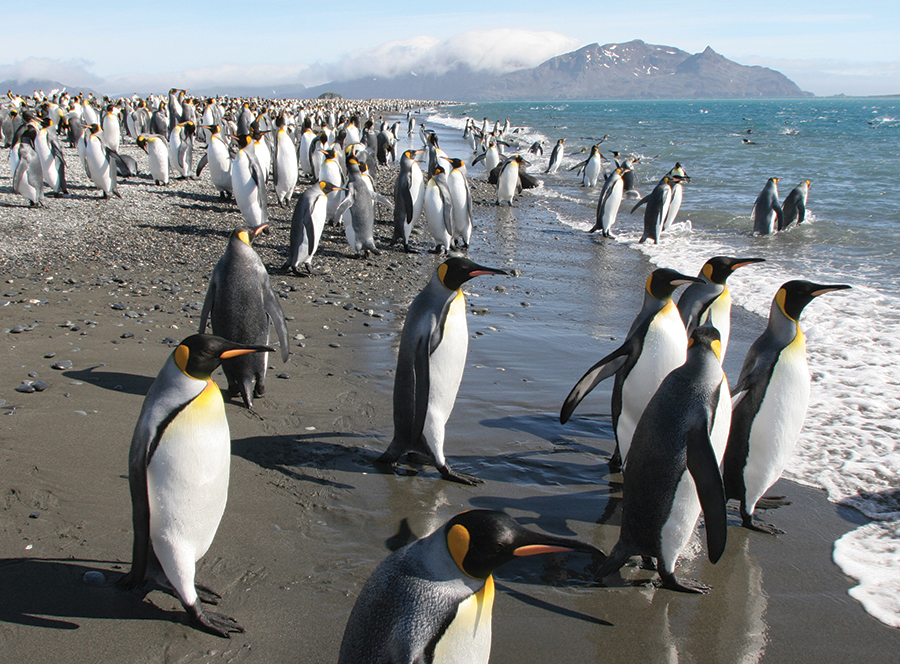
Words cannot describe it. Photographs will never do it justice. It has to be experienced, firsthand, to fully appreciate the sheer scale and magnitude. Standing before me, as far as the eye could see, were thousands upon thousands of penguins, all packed tightly together, each bird over 3-feet tall and weighing 25 pounds.

The immense rookery was full of frenetic energy, with birds constantly coming and going, tending to young, and greeting one another with rapid head nods and throaty, guttural calls. It was a complete sensory overload, a bit like standing in the middle of Times Square during a pre-COVID rush hour. I was on one of the most remote spots on the planet, about as far away from humanity as one can get, witnessing one of Earth’s greatest wildlife spectacles.

Lying just north of Antarctica and surrounded by the nutrient-rich waters of the southern Atlantic Ocean, South Georgia is a crescent-shaped island, 100 miles long, and full of rugged, 10,000-foot tall snowcapped mountains. A British territory, the island was first observed in 1675 by London-born Antoine de la Roché, whose ship had been blown off course while traveling from South America to England.

The 150,000 pairs of king penguins stretched from the shoreline all the way up the side of a mountain that was flanked by two broad, icy glaciers. The rookery on Salisbury Plain, near the northwest corner of South Georgia, is the largest on the island and one of the largest in the world.

King penguins are the world’s second largest species of penguin, surpassed only by their close cousins, the emperor penguins, who prefer to nest on the icy continent of Antarctica just to the south. Their regal-like plumage, befitting their common name, is composed of a layer of densely packed black and white feathers (to help shield against the cold) and a brilliant orange facemask.

Working as a naturalist for a tour company that specialized in travel to remote locations around the world, I had landed on the beach earlier that morning with 10 other passengers. As we carefully made our way along the sandy shoreline, dodging a caravan of penguins returning to the beach from an offshore foraging venture, we paused to watch a pair of massive southern elephant seal males (so named for their immense noses) bellow territorial warnings to one another.

Southern elephant seals, like king penguins, are creatures of superlatives. As the largest seal on the planet, males can grow to 16 feet in length and reach weights of 4 tons.

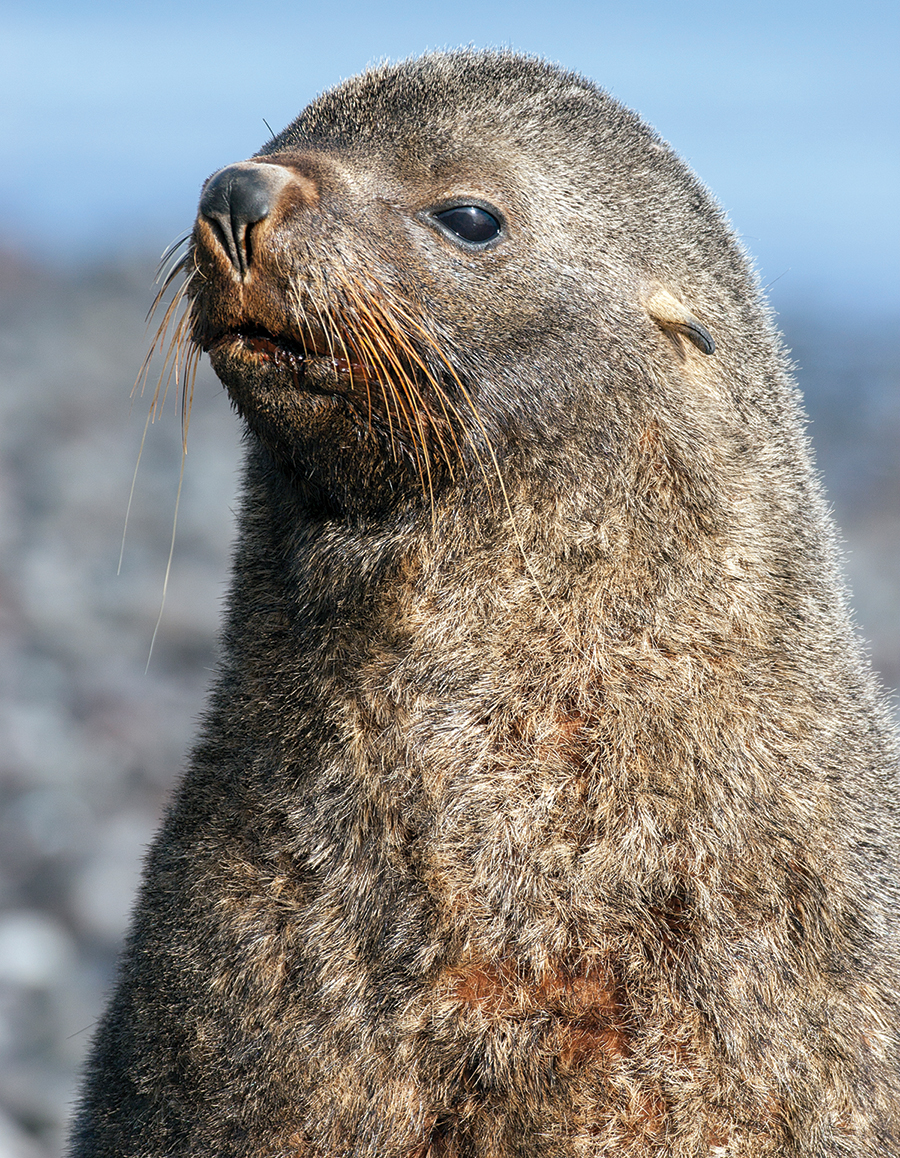
Scattered among the elephant seals and penguins are hundreds of Antarctic fur seals. Most were sleeping, stretched out on their bellies on the sandy beach, but some were sitting high up on tussocks of tall grass, surveying their surroundings. Looking a bit like domestic dogs, with dense fur coats, small heads and pointed snouts, Antarctic fur seals, as well as the larger elephant seals, are living testaments to the resiliency of Mother Nature.

When the famous sea captain James Cook landed on the island in January 1775, claiming it for the British crown and naming it after King George III, he found the land to be barren and inhospitable. However, he reported on the vast numbers of seals found along its rugged shores. Within five years, commercial ships from Britain and the United States descended upon the island in droves to hunt and harvest the abundant pinnipeds.

Elephant seals were killed for their oil and the fur seals harvested for their coats. In just a single year, one British vessel took 3,000 barrels of oil and over 50,000 fur seal skins. That kind of hunting pressure was not sustainable, and soon seal populations were nearing total collapse. Commercial sealing activities folded because there were simply not enough animals left alive to the make the business profitable. In 1972, international laws were established to protect marine mammals around the world, and since that time, populations of elephant seals and fur seals have made a remarkable recovery.

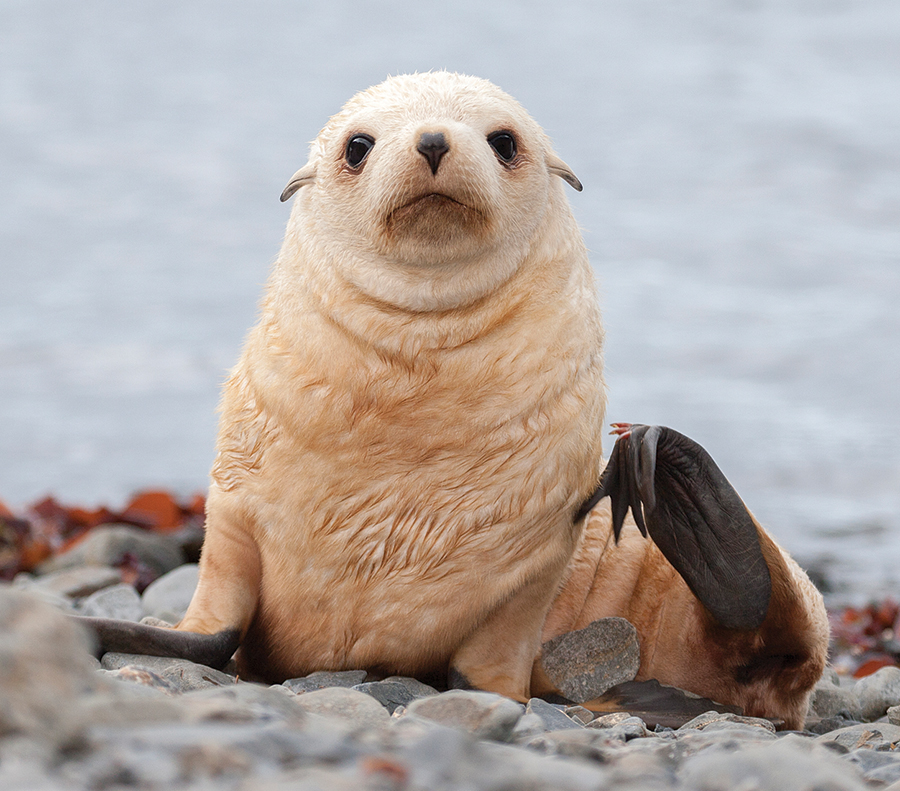
As we toured the immense penguin rookery, one young fur seal caught my eye. Unlike the other seals on the beach, which were dark brown, this one was a striking honey-blond color. This pale condition, likely a recessive genetic trait akin to albinism, is rare in fur seal populations and occurs in just 1 percent of the population. Our group stopped and aimed long telephoto lenses at the youngster, who seemed just as curious about us as we were about him.

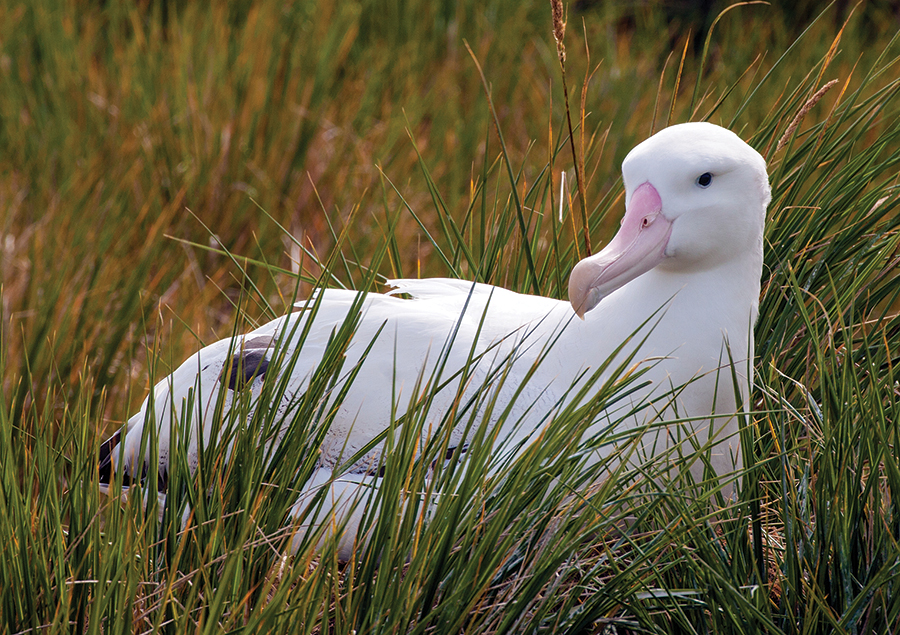
Glancing out to sea, just beyond the blond fur seal, I caught sight of another superlative creature flying high above the waves. With a wingspan approaching 12 feet, the wandering albatross is Earth’s longest-winged flying bird, inspiring generations of sailors with its immense size and ability to glide effortlessly through the air in the strongest of gales. Later in the day, we would stop on nearby Prion Island, a small islet in the bay, to observe wandering albatrosses on their nests.

Albatrosses, penguins and seals, oh my. South Georgia is truly one of the great wildlife meccas on the planet. Even the waters surrounding the island host a tremendous diversity of life. Just the day before, as our ship approached the island from the west, we stumbled upon one of the greatest concentration of marine creatures I have ever seen in 25 years of sailing the high seas.

Under a brilliant blue-sky day, with only a light breeze blowing across the surface of the ocean, we stumbled upon an immense gathering of whales. As far as the eye could see, the tall blows of fin whales, the second largest animal on the planet (capable of reaching lengths over 80 feet and 70 tons), rose above the surface of the water. Dozens of the immense creatures were in view at any one time. Scattered here and there among the fin whales were rotund southern right whales and the occasional humpback whale.

As our ship transited carefully through the area, a long line of seabirds, consisting of prions, petrels and albatrosses, followed. A small group of hourglass dolphins rushed over to play in the wake left behind by the moving vessel. Life was everywhere.

We had crossed the Antarctic Convergence, a zone where the cold currents from Antarctica meet the warmer waters of the Atlantic Ocean. The meeting of these currents can vary from year to year and our ship just happened to be in the right place at the right time.

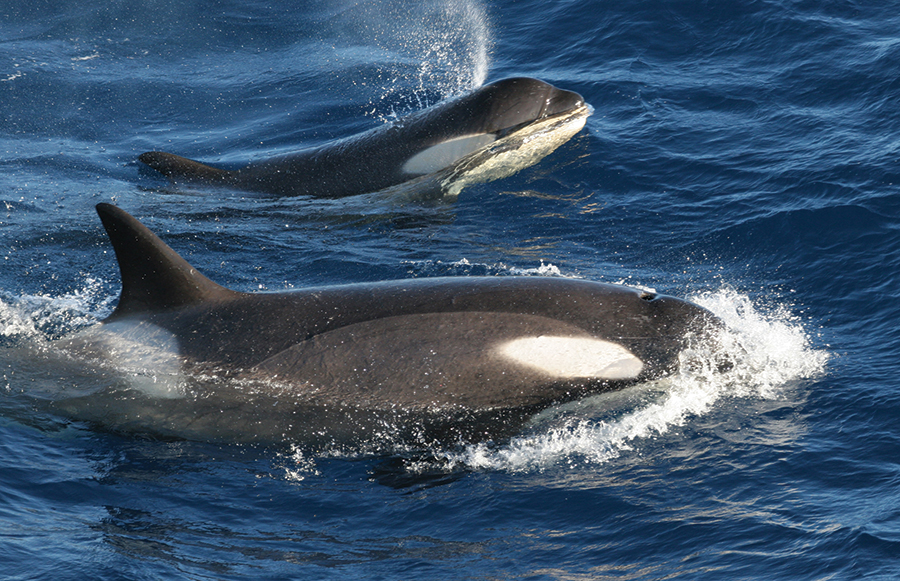
The sighting of the day happened just after noon, when a large group of killer whales approached the ship. Killer whales (a bit of a misnomer, as they are not actually a whale but rather the largest member of the dolphin family) have striking panda-like black and white markings, and when a mother and her calf surfaced close to the bow of the ship, numerous oohhs and aahhs erupted from passengers and crew alike. The group of 20 or so killers accompanied the ship for the better part of an hour and left a lasting impression on all those onboard.

I frequently look back at the images I took during my time around South Georgia. To witness such an abundance of wildlife, especially during this day and age, when so much of the natural world is feeling the negative effects of humanity, was an extraordinary privilege. It also offers a glimmer of hope for the future. If our society — all seven billion of us — can achieve the economic and political resolve to mitigate the decline of the natural world, humans and the other wild creatures that call this planet home, will flourish.  PS

Naturalist and photographer Todd Pusser, who grew up in Eagle Springs, N.C., works to document the extraordinary diversity of life both near and far. His images can be found at www.ToddPusser.com.
The Naturalist

The Natural History of Pumpkins

There’s more to the orange gourds then just pie and jack-o’-lanterns

Story and Photographs by Todd Pusser

Pumpkins have always evoked strong memories of childhood and my Moore County home. I vividly recall each fall season my parents taking me to view the giant pumpkin display at the county fair in Carthage. I would stand dumbfounded, staring at the enormous behemoths weighing hundreds of pounds, and wonder how on earth a vegetable could grow so freakishly large.

As October rolled around, pumpkin decorations plastered the halls of West End Elementary School. My class would gather in the library to watch Ichabod Crane dodge a flaming pumpkin tossed by the Headless Horseman in the old 1949 cartoon The Legend of Sleepy Hollow. Speaking of cartoons, I’m pretty sure I can repeat every line from Linus’ Halloween ritual of waiting through the night, in his most sincere of pumpkin patches, for treats from the mythical Great Pumpkin. Thank you, Charles Schulz. 

However, it was Otis Boroughs who really sparked my interest in pumpkins. Otis grew several acres of pumpkins, and throughout the 1980s, he, along with his wife, Nancy (who happened to be my kindergarten teacher), hosted an incredible jack-o’-lantern display each Halloween. People would travel from all over the state to their farm in Eagle Springs to see his artfully carved faces of famous cartoon characters, sports mascots and wild creatures. It was a magical feeling, standing beneath starry skies, staring at the flickering light dancing from the jagged cuts of dozens of pumpkins. Heat, given off by candles deep inside the large, orange orbs, created a scent of warm pumpkin pie that permeated the night air.

Realizing how much I liked the pumpkin display, Otis and Nancy invited me over one Saturday, to teach me how to carve jack-o’-lanterns. This was long before the days when you could buy mass-produced pumpkin carving kits at Walmart. For much of that afternoon, Otis, using a special handsaw, patiently taught me how to carve Mickey Mouse and the Demon Deacon mascot of Wake Forest University (my father, a fan, was dismayed when I later attended the University of North Carolina in Chapel Hill). Otis sent me home with a couple of large pumpkins to practice on, and from that day forward, I was hooked on carving jack-o’-lanterns.

When Otis and Nancy finally retired from showing their jack-o’-lanterns to the masses, I wanted to continue the tradition, so I took up the baton and started my own pumpkin show nearby. As well as traditional scary faces, I cut everything from Star Wars characters to rattlesnakes into the orange gourds, some years carving as many as 200 jack-o’-lanterns.

The simple act of placing a candle inside a carved pumpkin has long been a staple of Americana. According to Cindy Ott, author of Pumpkin, the Curious History of an American Icon, one of the first illustrations of a pumpkin jack-o’-lantern appeared in an 1867 edition of Harper’s Weekly. The image depicts a trio of young boys lifting up a carved pumpkin with triangle-shaped eyes, a triangle nose, and a jagged mouth, to the top of a fence post on a family farm. The candlelight emanating from the sinister face appears to frighten two young girls (perhaps their sisters) and a small dog walking down a dirt path.

Today, pumpkins are the quintessential symbols of the fall season, like conifer trees are to Christmas and rabbits are to Easter. Pumpkin pie is a prerequisite for a traditional Thanksgiving dinner. Images of pumpkins adorn horror movie posters and the covers of children’s books. In recent years, a pumpkin spice craze has swept the country, due in large part to the popularity of Starbucks lattes featuring the mix (typically a blend of clove, cinnamon, nutmeg, and ironically, very little, if any, pumpkin). One can find hundreds of pumpkin spice products, everything from beer to granola and doughnuts to potato chips, in the aisles of grocery stores come October. There is even such a thing as (blech) pumpkin spice toothpaste.

Yet, for all its cultural familiarity, have you ever stopped to think about exactly what a pumpkin is or where it comes from?

It is a common misconception to think of a pumpkin as a vegetable. (I even refer to pumpkin as a vegetable at the beginning of this piece, but hey, I was only a kid, so what did I know?) Pumpkins, by botanical definition, are a fruit, just like apples, bananas and berries. They are essentially a seed case covered in a wall of flesh (the plant’s ovaries), formed when the flower of the plant is fertilized through pollination. Vegetables, like lettuce and celery, are just the non-fruit part of plants, such as leaves, stems and roots.

Pumpkins are herbaceous vines of the gourd family found within Cucurbita, a genus of plants that contain well over a dozen species. The true ancestors of pumpkins looked nothing like the head-shaped, orange globes we all know and love today. Originating in Central America and Mexico, early pumpkins were small (just a few inches in diameter), thin, hard-shelled gourds. Archaeologists found 10,000-year-old domesticated pumpkin seeds in the Oaxaca Highlands of Mexico, making them among the first plants to be cultivated by humans in North America.


Since that time, Cucurbita have been selectively bred into many of our grocery store staples, such as zucchini, acorn squash, yellow squash, butternut squash, and, of course, pumpkins. The sheer number of pumpkins cultivated today is mind-blowing. With catchy names such as Ghost Rider, Casper, Sugar Baby, Big Mac, Jack Be Little, and Possum-nosed (a personal favorite), pumpkins come in an infinite variety of colors, shapes, and sizes. Some are even larger than small cars. Consider the current Guinness World Record Pumpkin, which, at a hefty weight of 2,624 pounds, is 600 pounds heavier than a Mitsubishi Mirage.

Of course, if it were not for pollinators, we would not have any pumpkins, or any of our food crops for that matter. The primary, natural pollinators of pumpkins are bees, especially squash bees of the genus Peponapis. Like most native bees, squash bees are solitary and nest in the ground. Typically, they forage for nectar and pollen at pumpkin plant flowers during early morning hours. To help increase yield, farmers often enlist the aid of honeybees, a species native to Europe, to help supplement pollination of pumpkin crops.

Unfortunately, in recent years, honeybees, as well as one-quarter of North America’s 4,000 species of native bees, have seen dramatic declines in their population numbers. As to why so many pollinators are being affected, scientists are not exactly sure. It is likely due to a combination of factors, including the increase use of pesticides, extensive loss of habitat, and a warming climate.

One thing is more certain. Pollinators keep this planet functioning, and without the services they provide, free of charge, crops would fail, ecosystems would falter, and Earth, in general, would be less habitable.

That is a thought more scary then even the most frightening of jack-o’-lanterns.  PS

Naturalist and photographer Todd Pusser works to document the extraordinary diversity of life both near and far. His images can be found at www.ToddPusser.com.
The Naturalist

The Road Home

Well-traveled trails still hold surprises

Story and Photographs by Todd Pusser

Unlike much of the rest of Moore County, State Road 1137 has changed very little since the days of my youth. Running north to south for just over 4 miles and through two different ZIP codes, the weathered two-lane blacktop is still bordered by open fields and pine forest. Interspersed here and there along its route is the occasional ranch-style house and double-wide trailer, all pretty much looking exactly the way they did in the early 1970s.

About the road’s midway point, in a sharp bend that cuts through a patch of turkey oak and longleaf, is my childhood home. It is a modest, single story, red brick house, with tall white columns extending up from the front porch, and a grey tin roof surrounded by a large well-manicured yard of centipede grass and acres of forest. The property sits atop a gently sloping hill in the far western edge of the Carolina Sandhills, near where the sandy, xeric soils of the Coastal Plain meet the densely packed clay-based soils of the Piedmont.

The skies here are wide open and free of light pollution. At night, the stars shine thick and bright and the Milky Way feels so close you can almost reach out and touch it. By day, the sky is the most brilliant shade of blue. On summer afternoons, deep purple clouds mushroom up from the east, and the sound of thunder echoes through the pines. During mid-winter, on those rare days when snow falls from somber grey clouds, one can actually hear the flakes hitting the ground.

The road itself is not much to look at and is easily taken for granted. It is not an especially scenic drive and looks pretty much like any other rural strip of asphalt throughout the Sandhills. The fields and forests that line its border do not reveal their secrets easily. But rest assured, there are wonders here.

Drive its route often enough and pay attention, as I have for nearly 47 years, and you will learn its rhythms. On most winter evenings, as the sun dips over the horizon, herds of white-tailed deer feed in the open fields that border the north end of the road near its junction with Hwy. 211. By day, brightly colored kestrels, North America’s smallest falcons, perch on the power line that cuts through those same fields. Early mornings in spring will find shiny black fox squirrels, the size of housecats, standing upright on the road’s shoulder near grandmother’s house with pine cones clasped tightly between their front paws. Blue flowers from Sandhills lupine brighten the roadside. Drive slowly on moonlit nights in May, with the windows rolled down, and you will be serenaded by the frenetic calls of whip-poor-wills. Come summer, abundant blackberries provide tasty treats for those who know how to spot their thorny shrubs growing beneath the power line cut. Heat lightning dances across the sky on most humid evenings, and fireflies blink on and off beneath the pines. The turkey oak leaves turn a deep burnt umber color in late October signaling the onset of fall. Eyeshine from grey foxes slinking across the road in front of the car late in the night is a common sight this time of year.

Yet, for all its familiarity, the road can still surprise. Just this past January, on an evening when torrential rains had supersaturated the ground for much of the day, the car headlights revealed a miniature marvel not far from the driveway to the house. Hopping out into the steady drizzle with flashlight in hand, I approached to find a 6-inch-long spotted salamander, so named for the brilliant dayglow yellow spots decorating its body, slowly walking across the road. Over all the years and thousands of times driving the road, I have never before observed this beautiful amphibian here.

Spotted salamanders need ephemeral ponds (temporary bodies of water that dry up for part of the year) to breed and lay their eggs. After a few weeks, the eggs hatch into a larval form complete with long tails and a bouquet of gills. When the ponds dry up in the spring, the larvae transform, like frog tadpoles, into terrestrial adults. The adults leave their pond and migrate far away, sometimes up to 1 mile, and then bury themselves underground, where they will remain for a year until the next breeding season’s rains begin and they start the cycle all over again. Considering the fact that spotted salamanders can live 30 years, I may well encounter the adult found near the edge of the yard once again.

My whole childhood was oriented toward animals and the outdoors. The natural curiosity was innate. And, like many kids in rural towns, I longed to get away. Eagle Springs just seemed too small. Magazines, such as Ranger Rick and National Geographic, as well as television shows like The Undersea World of Jacques Cousteau, fueled my daydreams of exploring far-off lands in search of exotic beasts. I wanted to swim with the sharks and catch snakes in tropical jungles.

Fortunately, I have been able to live out most of those daydreams. My work has taken me around the world. I have dived with great white sharks off Mexico and caught snakes in the rainforests of Panama. After two decades of travel, I have developed a deeper appreciation for the natural world and all its wonders, from the exotic to the familiar.

Though I live far from the Sandhills today, I try to get back as often as I can. The last time I turned down the road home, it was just after sunset in late May and the sky was filled to the brim with stars. As I so often do here, I turned off the radio and rolled down the windows. About a half-mile or so from its junction with Hwy. 211, the bright beams of my headlights illuminated a herd of two dozen deer standing in the middle of the field, their eyes glowing a greenish yellow. Many lifted their heads with mouths full of grass calmly staring at the approaching vehicle. Another half-mile down the road and a grey fox dashed across the highway. Eagle Springs seemed anything but small.

Rounding the bend to the old brick house, a whip-poor-will called.  PS

Naturalist and photographer Todd Pusser will be a regular contributor to PineStraw. He works to document the extraordinary diversity of life both near and far. His images can be found at www.ToddPusser.com.