The Allure of March

On the cusp of good eating

By Jan Leitschuh

March can either frost us or tempt us with promises of spring. Dreams of fresh produce awaken the taste buds. It’s a good time to clean up the garden, even plant a few items.

Early March, we can put in the sugar snap peas, some beets, carrots, spinach, radishes and Swiss chard. Your odds are good. Tough transplants of broccoli, cauliflower, parsley, cabbage, chives and onions can go in now if a glance at the weather forecast looks promising. Set out your potatoes. Hold off till at least month’s end (if not longer) for corn, tomatoes, squash, peppers, eggplant, basil and cucumbers.

Have a cover ready for that inevitable night in the mid-20s. Cross your fingers, and hope the deer and the bunnies steer clear.

Yet we know that many here in the Sandhills will never plant so much as a seed — and that’s fine. Life is busy, your soil is poor, there’s little interest, the neighborhood or the sun exposure doesn’t support the growing of produce, the old knees aren’t what they used to be. But, if you still love a strawberry, those sweet early greens, juicy fresh peaches, spring asparagus and tender sweet corn, the next best way to experience the freshest tastes is to buy just-picked produce from a Sandhills someone who did.

With the advent of produce programs outside the area, including Amazon moving into the fresh food space, it’s good to distinguish items grown right here by our fellow citizens, enriching our local economy and preserving our local green spaces.

“For every dollar you spend on truly local produce, it circulates within our economy,” says Lorraine Berman, acting general manager of Sandhills Farm to Table Cooperative (SF2T). “If we buy local produce, and the farmer hires and spends locally, well, it really contributes a lot more than if you spent those food dollars outside the area.”

Besides, she adds, “Fresh, local produce just tastes amazing.”

I’ve said it before, but the in the early decade of this century, Moore County virtually led the nation for loss of farmland. This tide has stabilized, in part due to the support of the community in creating a market for local tastes. In fact, one essential aspect of the new 2018-2020 Moore County Economic Development Strategic Plan is simply “to keep Moore County farmers farming.”

“Because agriculture is 25 percent of our local economy,” says Pat Corso, executive director of Moore County Partners in Progress.

Your support does this. You provide the markets that keep Sandhills farmers farming.

There are a number of ways to enjoy the tastes of the Sandhills. Finest of all is to visit a local farm during fruit-picking season. Strawberries top the popular list in mid-April, and in the giddiness of early spring, what could be finer than taking the kids to a pick-your-own field? A month or two later, you can find pick-your-own blueberries, blackberries and maybe even grapes during the summer season. Don’t delay; the season for any juicy fruit crop is short. A farmer’s own stand will offer a cornucopia of summer bounty.

Another way is to visit local farmers markets for a variety of seasonal treats, meats and cheeses. At peak season, you can buy fresh almost every day of the week. You can speak to your producers directly, pick up preparation tips, learn something about how your produce was grown, run into your friends and neighbors. Local farmers markets also kick off in April, with the market on Morganton Road open Thursdays throughout the year with meats, greenhouse produce and more.

Another program with genuine impact on the local farm economy is the Sandhills Farm to Table box program, distributing the full bounty of the Sandhills season. Entering its ninth year, the community-owned program requires a certain number of subscriptions by April each year to remain viable, but the positive impact on local farmers is undeniable. “It makes a difference,” says John Blue of Highlander’s Farm. “It really does.”

Many Sandhills farmers enjoy picking a crop the afternoon before, or even that morning, and delivering wholesale quantities to the SF2T packing house, getting better than wholesale prices for their labor and the day free to do what they do best — grow food. They take their stewardship of the land and “their” subscribers very personally, going the extra mile to replace any item (packed by community volunteers) deemed sub-optimal after delivery.

This year, SF2T will kick off its subscription drive March 1, with a public community celebration at the Sunrise Theater, screening the film Sustainable, followed by local bites and spirits at 305 Trackside. Tickets for the movie-and-food event are available at the Sunrise website. Subscription to SF2T boxes of weekly or biweekly produce is available at the movie event or email info@sandhillsfarm2table.com.

“We are often overwhelmed by the news and problems of the world, convinced that we are helpless to effect change,” says Berman. “But all things large start out small; every marathon starts with that first step. Eating local food and subscribing to Sandhills Farm to Table is that first step toward better health, to protecting the environment, toward improving our local economy, and toward a kinder community and better quality of life.”

Jan Leitschuh is a local gardener, avid eater of fresh produce and co-founder of the Sandhills Farm to Table Cooperative.

Roll, Honey, Roll…

If you’ve been there, you feel my pain

By Clyde Edgerton

If you’ve been “down in the back,” raise your hand.

If you didn’t raise your hand, you might find the following about as interesting as a pharmaceutical commercial.

But if you’ve been there, then as you read on you may nod your head in agreement here and there.

During our early January Arctic cold spell, I ventured under our house to turn off water to some outside pipes. At about six steps in through the low door that leads under the house — bending way over — I looked up and, whoops, felt a sharp pain in the middle of my lower back. A quiet voice said: “That was not good.” I finished with the pipes, got out from under the house and thought, Maybe it’s not too bad. I hauled in a load of wood for the fireplace, built a fire, messed around in the backyard, thinking: Something is wrong with my lower back. But it’ll be better in the morning.

Next morning, when I started to get out of bed, a sledgehammer hammered a spike into my lower back. A pain so severe that had it continued over a few seconds I’d been yelling constantly to the high heavens. “Stabbing pain” sort of gets at it, but I feel like I need a new word — not spasm, but: Stabazm!

I yelled, and fell back into bed. The universe had attacked. Oh my goodness.

Kristina, my wife, who’s had back problems off and on for a decade, said, “If you want to get up, you need to roll. Roll out of bed. Don’t just pull up. You’ve got to roll. And breathe.” After a long struggle and several more stabazms, each bringing a yell and sweat, I got up and slowly made my way — holding onto furniture — to the bathroom and then to the living room couch. Kristina helped me get propped up on my back with pillows under my knees, ice on my back and a laptop in lap for work. While helping me onto the couch, she said, “Roll. You’ve got to roll.” When I was later trying to get back up she again said, “Roll, honey, roll,” and the word roll got funny for some reason . . . to both of us. I started to laugh — but the laughing brought on — yikes! Stabazm!

“Please don’t make me laugh,” I whispered through clenched teeth.

Next I found that I could not cough without initiating a stabazm.

I remained inside the house, hobbling back and forth from bed to couch for one week. I would figure out yet another way to not move, and then: BAM, another you-know-what. After a week, I visited my doctor. She gave me a muscle-relaxer drug, an inflammation drug and said if it wasn’t better in another week to get an X-ray. It got a little better, but not much. I decided to wait two weeks to see if I really needed that X-ray. Inside the house I was using a cane that I was too proud to use outside the house. I finally started driving. A car entrance looked a little like . . . I don’t know — a turtle climbing onto a motorcycle?

At the beginning of the third week — two days ago as of this writing — I got that X-ray and then went to UNCW for a faculty meeting. I was somewhat better, no stabazms in three days. I was happy to be up and about — careful about every move. But I was five minutes late to the meeting, hobbling along carefully.

I met a student who said, “Hi.”

“Hi,” I said. I wondered if I was supposed to know him. He was smiling.

“Hi,” he said again.

I was a bit confused. I had pencil and pad in hand, ready to go into
the meeting.

Then he pointed . . . and said what he’d been saying all along: “Fly!”

“Oh. Thanks,” I said, grabbed at my pants, dropped the pencil, zipped up and then bent down to pick up the pencil.

Stabazm! I was unable to muffle a yell.

If you’ve been there, you know how it feels.

If you haven’t been there, then when it happens, and you have to get out of bed: Roll.

Clyde Edgerton is the author of 10 novels, a memoir and most recently, Papadaddy’s Book for New Fathers. He is the Thomas S. Kenan III Distinguished Professor of Creative Writing at UNCW.

A Cut in Time

Carving out a piece of art

By Haley Ray     Photographs by John Gessner

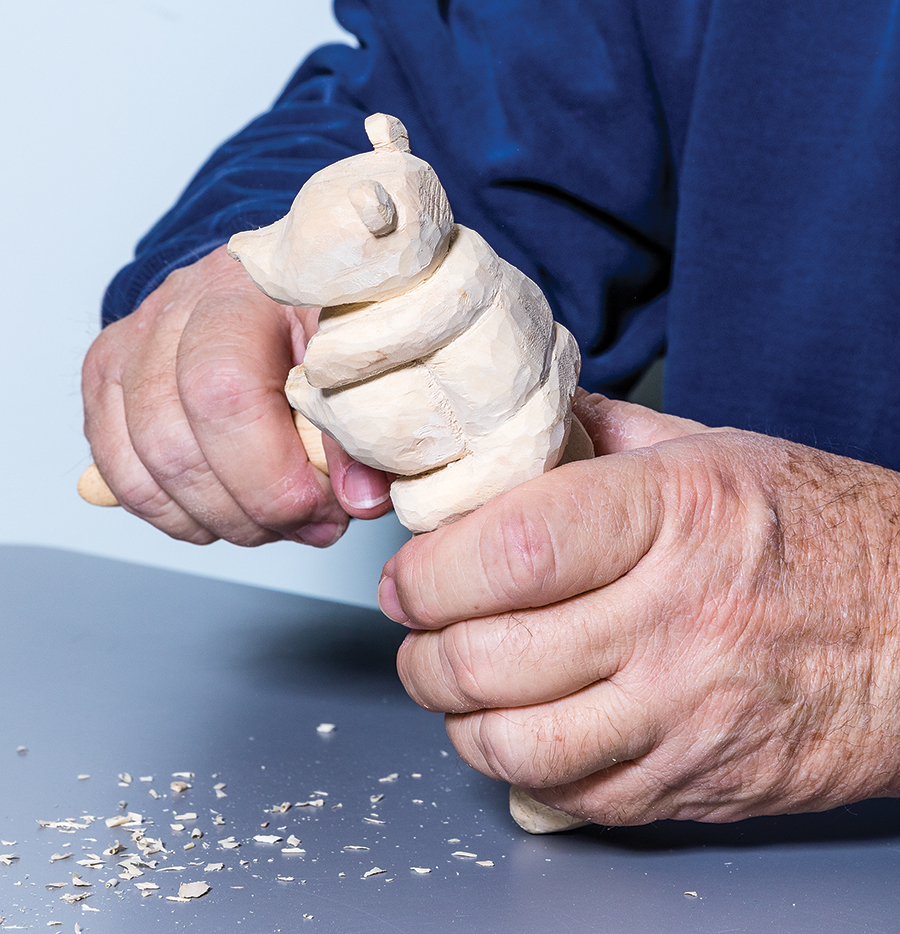
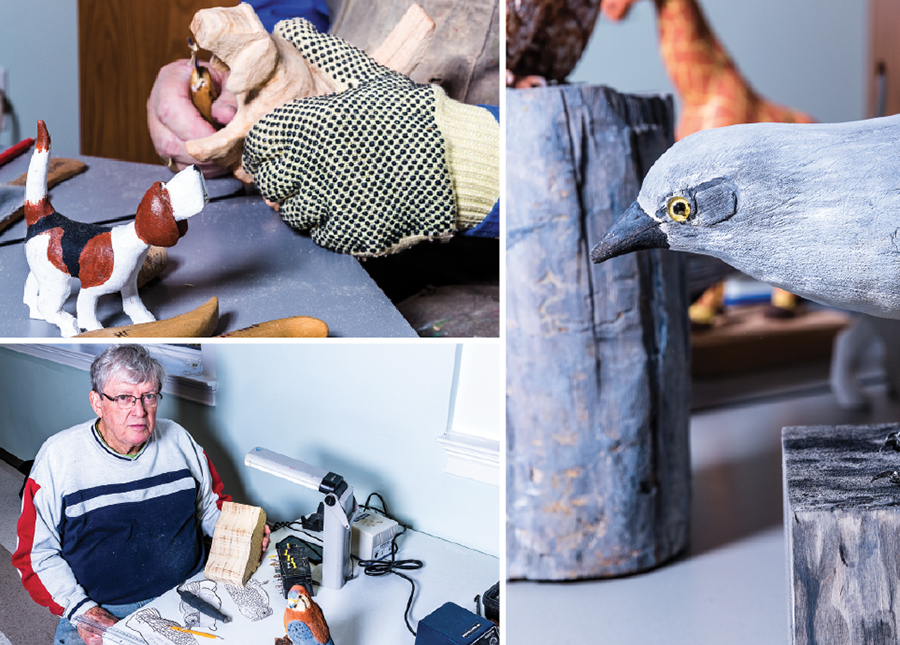
Scars have a tale to tell. Some are the hieroglyphics of awkward accidents or perhaps the traces of regrettable choices you’d rather let slip from memory. For the Sandhills Woodcarvers, however, each scar is a testament to persisting through the beginner stage of the woodcarving craft, a skill rife with small nicks to the hands. Most of the cuts aren’t deep and fade faster than the playful stories attached to them, the price tags of fellowship.

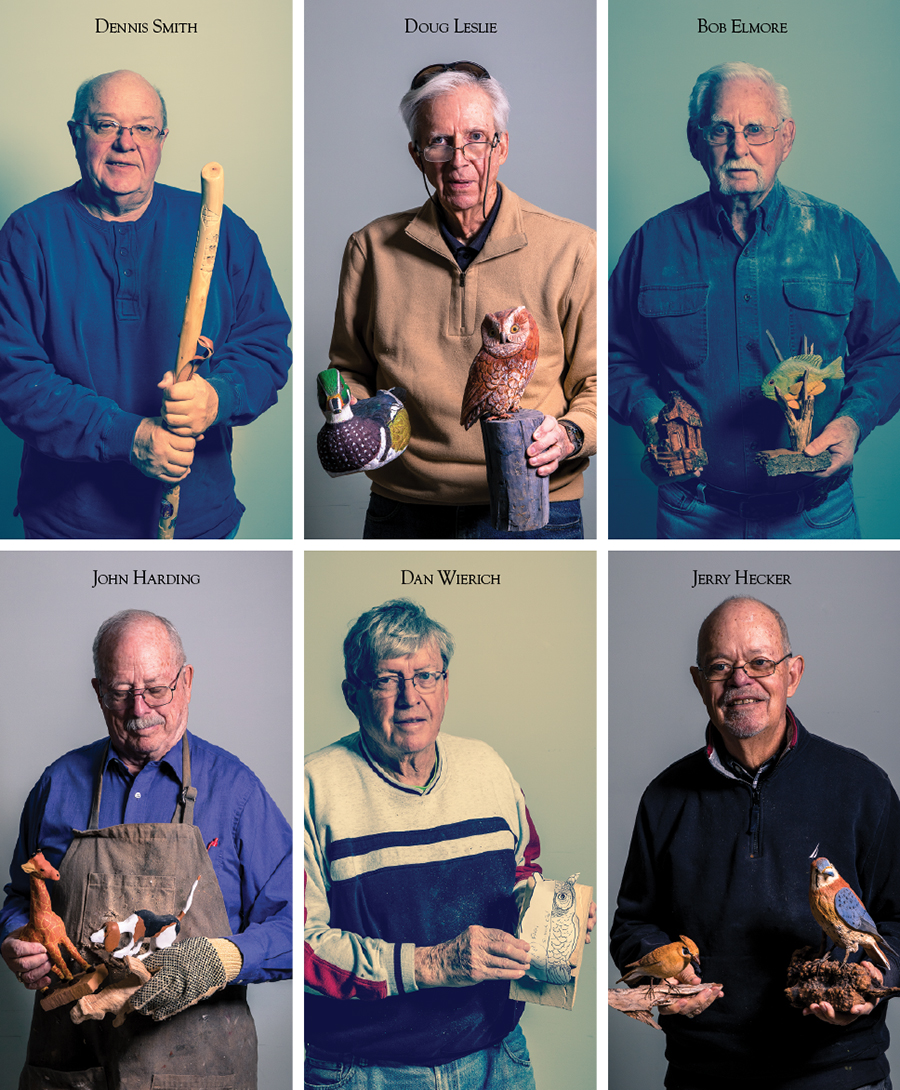
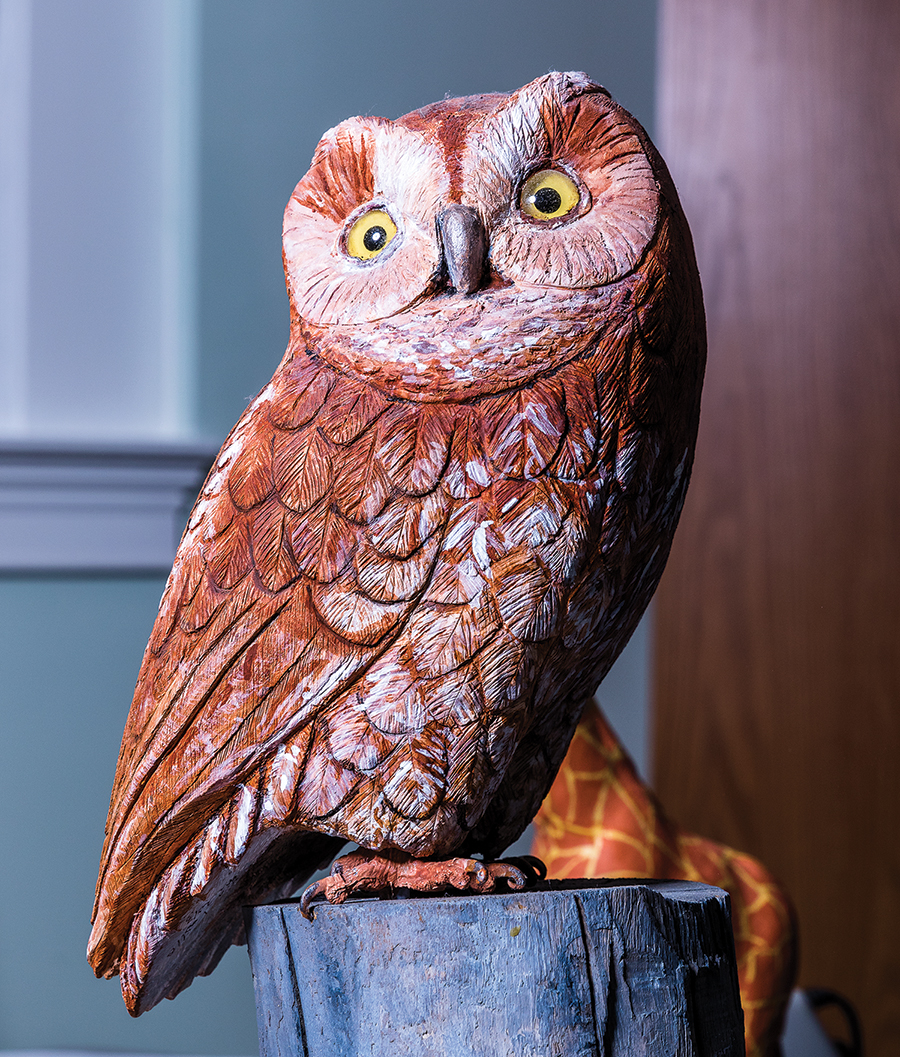
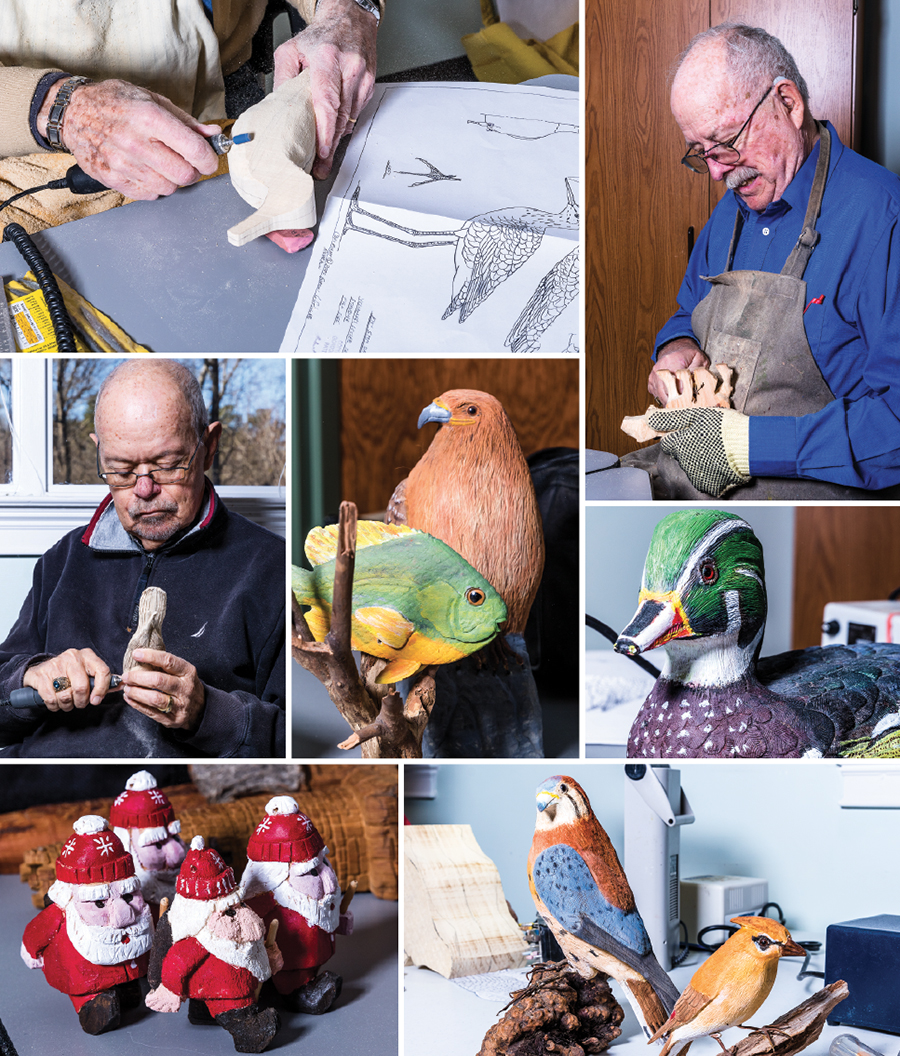
The group meets every Monday afternoon, from 1 p.m. to 3 p.m., in the Senior Enrichment Center off U.S. 15-501. The member list comprises both longtime carvers and newbies who took to the hobby as a form of relaxation and social stimulation. Around 12 to 15 people arrive each week, deftly sculpting trees, hiking sticks, life-size birds, tiny detailed houses, and a variety of other knick-knacks.

Abundant gift giving is a conspicuous commandment of the woodcarving craft, a product of having any number of finished tokens lying around the house with no other use. John Harding picked up the gouge and chisel after he lost his favorite game, tennis. “I hurt my shoulder, and I couldn’t play anymore,” Harding says. “So I found this woodcarving group about eight years ago.” Every spare Monday he carves highly personalized gifts for friends and family, completing over 300 comfort crosses with smoothed edges made to fit peacefully in an enclosed palm.

“It’s so satisfying, about my crosses. I get calls saying, ‘My wife passed away and she was holding your cross.’ It makes me feel that I did some good,” Harding says.

Another memorable carving Harding worked on was for his son-in-law, a second generation Russian-American. He crafted a typewriter spelling out ‘Merry Christmas’ in Russian. For the wedding anniversary of his son-in-law’s parents, he carved a dancing Russian bear. It was the hit of the event, celebrated in St. Petersburg. But the comfort crosses are what make his Mondays fulfilling.

Sixteen-year-old Lonnie Poynter also makes a habit of gifting his creations.

“When you’re finished you can’t wait to give it away,” he says. “You get tired of looking at it.”

Lonnie and his sister Gretchen are oddities in a room otherwise filled with retirees. About six years ago they were introduced to the group by their older brother, who had been encouraged to join by one of the original founders, Don McCluskey. They started at ages 8 and 9, and haven’t stopped since. Although no longer a beginner, Lonnie remembers the novice experience and has a nickel-sized scar decorating his thumb to commemorate the days of yore. The siblings laugh at the memory.

“He was using a dull carver, which will hurt you more than a sharp one,” explains Gretchen. “It slipped and took a chunk out of his hand. He said he had something to show me, and it was just his hand bleeding everywhere.”

Sibling moments, even the gory ones, aren’t the only chances for bonding in the carving club. The retired members of the Sandhills Woodcarvers discovered a sense of kinship when they picked up their carving tools.

“One of the best parts is the camaraderie and picking things up from other people,” says Hal Williams.

The skill set travels, extending well beyond a room in the Senior Enrichment Center. During summer travels to National Parks from Yosemite to Yellowstone, Dennis Smith would often find himself sitting at a picnic table, carving away on the hiking sticks he adorns with the park medallions. Without fail, curious people would start up conversations wondering what, exactly, he was working on.

“It generates a lot of interest. A lot of people know someone who carves,” he says.

The Woodcarvers are eager to teach new members the basics, no matter how long it may take or how many cuts are accrued in the process. They don’t want to hoard all that companionship. They prefer to give it away.

Haley Ray is a Pinehurst native and University of North Carolina-Chapel Hill graduate, who recently returned from the deserts of Southern California.

Dateline: Carmichael

When good things came in smaller packages

By Bill Fields

I’m not sure how my reading ability stacked up to that of my elementary school classmates, but I’m certain having the sports pages of the Greensboro Daily News at the breakfast table didn’t hurt. There were some big words in there.

The newspaper was very specific about where it was covering an out-of-town contest. After North Carolina moved into its new basketball facility in 1965, the dateline for Tar Heel home games spilled over into a second line of narrow-column type.

CARMICHAEL AUDITORIUM, Chapel Hill—

Occasionally, if the slot man was swamped and the typesetter was sloppy, it looked like this next to my bowl of grits:

CARMICHAEL AUDITORI-
UM, Chapel Hill—

Regardless of how it appeared in the paper, the building’s name stood out because it was where my team played. It was not CAMERON INDOOR STADIUM, Durham; or REYNOLDS COLISEUM, Raleigh; or other Atlantic Coast Conference basketball venues.

We had no family ties to Carolina, notwithstanding a summer school Spanish class my UNC Greensboro sister took there. My other sister went to Wake Forest, and while I proudly wore the black-and-gold sweatshirt she gave me, I was a Carolina kid. It was one of those decisions those of us in ACC country made early, before you were even able to write the name of your favorite basketball player in cursive.

I was in first grade when the Tar Heels played their first game in Carmichael, defeating William & Mary 87-68 on Dec. 4, 1965. Although I didn’t see the place in person until I got to campus as a freshman a dozen years later, I felt I knew it.

Aside from newspaper stories and box scores, there were the radio broadcasts. In the late-1960s — when Carolina won the ACC Tournament and advanced to the Final Four three straight years — play-by-play was handled by Bill Currie, a crazy-uncle type known as the “Mouth of the South” and starting with the 1971-72 season by Woody Durham, who was “The Voice of the Tar Heels” for four decades.

Televised games were rare when I first became a fan. We had to be content when a Carolina contest was on the Wednesday or Saturday C.D. Chesley network. And “The Dean Smith Show” was weekly Sunday morning viewing, with Smith always much more effusive about assists or hustle than how many points someone had scored.

One of my first memories of basketball on television is the NCAA title game on March 23, 1968, when the Tar Heels played UCLA. It was a 7 p.m. tipoff in Los Angeles, which made it a very late night for an 8-year-old in Southern Pines. I stayed awake until early in the second half, when the Bruins were well on their way to a 78-55 victory.

Nine years later Carolina played for another championship but had its heart broken by Marquette. I attended my first game in Carmichael in the second semester of my freshman year, a two-point victory over Wake Forest on Jan. 15, 1978. Working my way up the pecking order of The Daily Tar Heel sports department, I traded a seat in the student section for one on the press row-catwalk above it. When things went well for the team wearing light blue and white, it was deafening either place. After home games, reporters huddled around Smith in a corridor outside the locker room as he smoked a cigarette and looked forward to a Scotch.

My first time on a commercial flight, on Dec. 3, 1979, I sat beside then-assistant coach Roy Williams going from RDU to Tampa-St. Petersburg to cover Carolina vs. South Florida. Prior to the start of the 1980-81 season, I had a 90-minute interview with Smith in his office. I was DTH sports editor at that point, but, needing to mind my grades as a senior, left the job well before Carolina lost to Indiana in the 1981 NCAA championship game.  The following spring, I was back on Franklin Street as a fan — and graduate — enjoying the Tar Heels’ win over Georgetown.

Carolina men’s basketball relocated to the Smith Center in 1986. It has twice the seats of Carmichael, but if one grew up with the latter, not twice the charm. Carmichael Auditorium is no more, having been renamed Carmichael Arena in 2010 following an extensive modernization. They sold small commemorative pieces of the hallowed hardwood from the old building in 1998. I didn’t buy one then, but it might be time to check on eBay.

Southern Pines native Bill Fields, who writes about golf and other things, moved north in 1986 but hasn’t lost his accent.

A Generous Voice

The distinguished reign of a poet laureate

By Stephen E. Smith

I have seen the ones I love leave this world as shadows without wings.

The purple martins that come up every year from Somewhere

Leave as easily as they jetted into their gourds in March.

And I have held my father’s hand as he was dying

And my mother’s, lying in her lap like dried peas . . .

From Paul’s Hill

Shelby Stephenson

North Carolina Poet Laureate

With the death of Poet Laureate Sam Ragan in 1996, the office of state laureate ceased being a lifetime appointment, and sitting governors began selecting poets laureate (with recommendations from the state’s writing communities) who would promote an appreciation for an often misapprehended genre. Recent laureates have been chosen for the excellence of their work, their influence on other writers, and “an appreciation for literature in its diversity throughout the state.” The revised guidelines grant tenures ranging from a standard two-year term to five years, depending upon the governor’s readiness to select a new laureate and the willingness of the poet to serve. With the exception of a disquieting hiccup during the McCrory administration, governors have chosen poets laureate who exhibit exceptional talent and generosity — and the process has been, thank God, more or less devoid of politics.

But the job of poet laureate, the physical act of getting behind the wheel of a car and driving to every corner of the state to give readings and workshops, has turned out to be anything but cushy. In fact, it’s full-time work, offering little in the way of compensation and requiring immense dedication. Beginning with Greensboro’s Fred Chappell, who was the first of the new poets laureate and whose Midquest is the finest book (poem) written by a poet of his generation, and continuing with Kathryn Stripling Byer, Cathy Smith Bowers, Joseph Bathanti and Shelby Stephenson, our poets laureate have been barnstorming nonstop for more than 20 years.

From December 2014 to January 2018, Stephenson has given 315 readings, lectures and workshops, traveling from Hatteras to the Tennessee border, twice, and driving more than 25,000 miles within the state. Stephenson, who officially leaves office when a new laureate is appointed later this month, has gently touched the lives of thousands of North Carolinians, and he leaves us with an ambitious 52-part poem, Paul’s Hill: Homage to Whitman (Sir Walter Press), which is the logical and artistic culmination of his past work framed within the hard edges of the perplexing new world in which we find ourselves.

Raised in a large family that farmed in Johnston County, Stephenson is deeply rooted in a rural environment and possessed of a strong sense of longing for a particular time and place that’s never failed to offer the purest vision. His primary subjects, the foundation upon which he’s shaped most of his poems, are family, the natural world, the cycle of life, even the plank house where he was born, and despite a reliance on memory and the intensely personal nature of his poetry, there’s a restrained use of nostalgia in his work. When reading his leapfrogging lyrical lines, the reader is left with an overwhelming appreciation for the life the poet has lived and his eagerness to share his most personal moments.

The light plays shadows where once cordwood readied the woodbox.

My mother’s lost in the steam of her kettle.

I rub my face, as if parting curtains,

Wonder if I see myself in the rose-blue feathers smeared on the picture-window.

Bliss fades into pattern I’ll ride later, dross and all.

White moon, hold me in your arms.

Bathe my thoughts so wild onions may climb the cold

Sister Night to say to morning, “Hello, again.”

A mix of spoken language and the rhymes and rhythms, the literary tongue is interspersed with hymns, dogs, goldfinches, tulip poplars, cornstalks, collards and  country music resonating in song titles and country lyrics, even in the irony of a long-forgotten radio advertisement sung by Arthur Smith and the Crackerjacks:

If your snuff’s too strong it’s wrong

Get Tuberose get Tuberose

To make your life one happy song

Get Tuberose get Tuberose.

Stephenson’s early poems took their inspiration from the land, but in the last 25 years he’s dealt critically with the guilt posed by slavery, the destruction of the natural environment, the dangers of romanticism, the relationship of the past to the present, and the twitches and ticks of contemporary life all infused into Paul’s Hill, anchored steadfastly in the present by the inclusion of the mundane elements of daily life and a use of language that dissolves the distinction between precincts of poetry and prose. His is the voice of a man viewing the present with skepticism, occasional distaste and a trace of anxiety.

The flag of the Oklahoma-bombing holds one tiny baby, fire-scarred

And that September, towering out of words, humble beyond relief,

Some hint of lushness — and you among the moon’s heaving night —

listening to whispers . . .

Judged by productivity, Shelby Stephenson has, for 50 years, created poetry of high quality. Beginning with Middle Creek Poems and moving forward through his 10 books to Paul’s Hill, he’s demonstrated continued growth and has perfected a distinctly individual voice cultivated with a single-minded devotion to his vision of a North Carolina in transition. As he’s matured as a writer, he’s stepped out of the tobacco rows, assuming the role of critic, teacher, reviewer, social commentator — and, most importantly, a distinguished and generous poet laureate.

Stephen E. Smith is a retired professor and the author of seven books of poetry and prose. He’s the recipient of the Poetry Northwest Young Poet’s Prize, the Zoe Kincaid Brockman Prize for poetry and four North Carolina Press awards.

Long Live Loblolly

The halls are alive, with the sound of . . . a new generation

By Deborah Salomon   •   Photographs by John Gessner

Ah, the good old days, the Roaring ’20s, when Southern Pines throbbed with urban intelligentsia wintering in cottages and mansions — the most prestigious built by New York architect Aymar Embury II — while they partied with author James Boyd’s coterie. Picture life in the Gatsby era as described by F. Scott Fitzgerald, a Boyd house guest. Perhaps he strolled over to Loblolly. Embury had taken on this second project for James’ aunt, Helen Boyd Dull, in 1918. Auntie Helen, founder of the Southern Pines Civic Club, christened it Loblolly, honoring the indigenous pines which she had lobbied her father to save from the booming turpentine industry.

Nearly a hundred years after Helen Dull’s death in 1924, ghostly echoes of Jazz Age soirees, heated discussions and philosophical musings compete with the barking of five dogs and the laughter of three small children kicking a soccer ball or playing fort in the bamboo grove.

Loblolly, purchased by Erin and Mitch Lancaster in 2011, is once again alive and lively, like a fashionably dressed dowager whirling across the ballroom floor in the arms of John Travolta.

Possible, since Loblolly actually has a ballroom — or so it was called.

“We call it the Big Room,” Erin says. Indeed, at 7,000 square feet total, big is Loblolly’s operative word. The house, including two guest suites with kitchens, sleeps 14  comfortably. The Lancasters have hosted a wedding on the terrace, with reception complete with dance floor in the Big Room.

The stock market crash and ensuing Great Depression silenced the ’20s roar, but Loblolly stands witness to the history that shaped Weymouth Heights.

When James Boyd lured his Princeton classmate, already a “society architect,” to Southern Pines no architectural style prevailed in the nascent enclave.  While Embury developed the Boyd homestead as Classical Revival, he shook, not stirred, Loblolly. Instead of a rectangular footprint the house stretches longitudinally as far as the eye can see.  Sources provided by the Moore County Historical Association describe it as “recognizable but difficult to define, not quite English Norman cottage, or French, not Art Nouveau — with stuccoed clay tile, checkerboard brick, bell-cast and hipped and gabled slate roofs with tile ridges.” Which boils down to a divine mishmash that established prototypes influencing subsequent homes in growing Weymouth Heights.

After Mrs. Dull’s death, Loblolly was sold to the Vale family, who retained ownership until the 1970s. A fire in 1926 caused the Vales to hire Embury to rebuild and add the ballroom wing.

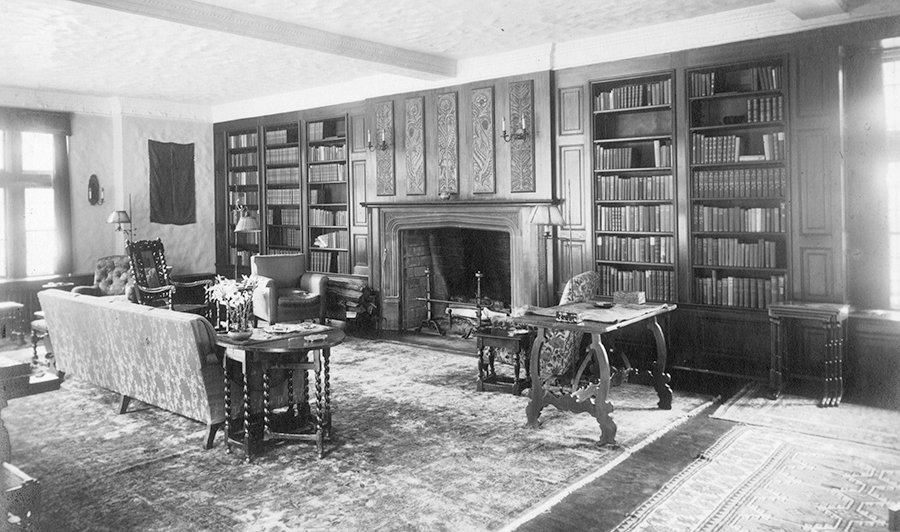
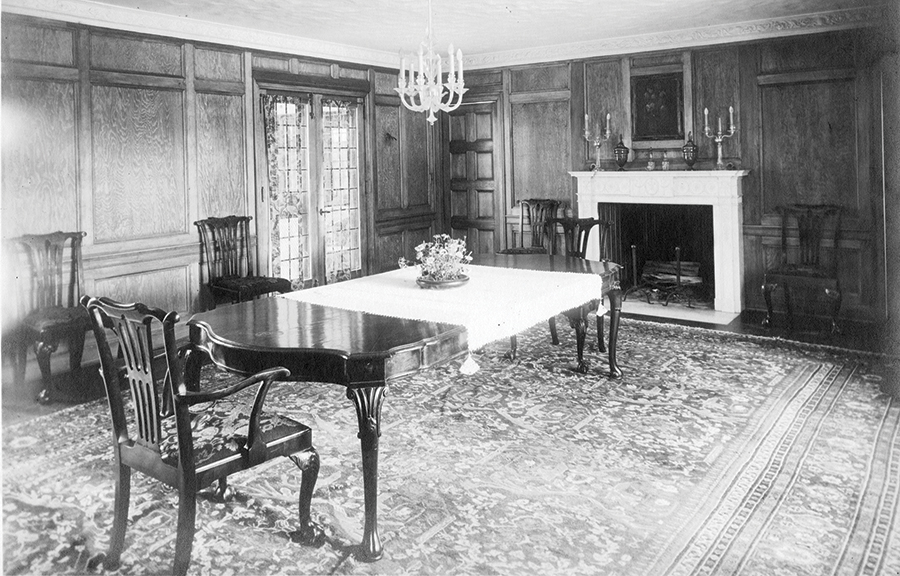
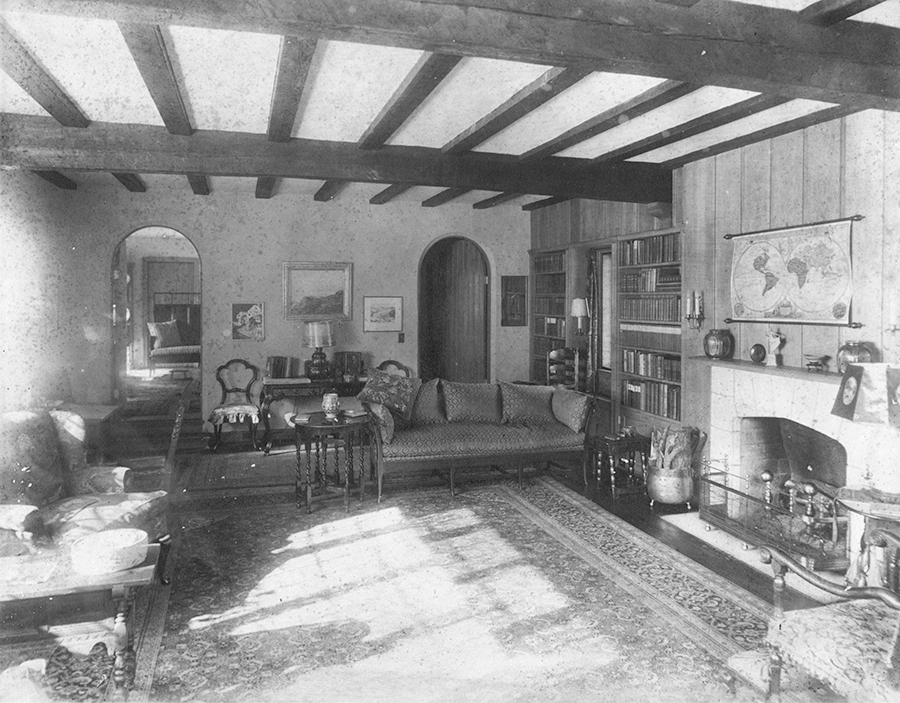
The tennis court is gone, the swimming pool filled in, the acreage divided.  Inside Loblolly seemed dark and imposing by today’s standards, with its hewn beams, teak and walnut floors and miles of built-in bookcases — hardly a tempting project for a young family.

“I didn’t even want to move (to Southern Pines),” Erin Lancaster says. She is from Richmond, Virginia, Mitch from historic Windsor, North Carolina. They met in Raleigh. His parents lived at Woodlake. The young couple, then with a baby and toddler, were looking to relocate — a possibility, since Mitch operates his businesses from home.

“We were visiting friends and loved the idea of walking downtown,” he says. For fun, they looked online. Loblolly popped up. That was on a Sunday. They viewed the property on Tuesday, made an offer on Friday, which was accepted the following Sunday.

“Not much had been done — it needed a few upgrades,” Erin remembers, charitably. “It had that ’80s look, with faux marble.” The Lancasters knew what might be involved from remodeling their Raleigh home. Full speed ahead — systems and big jobs first.

But making a historic property livable and practical goes beyond fresh paint and new carpet. “We wanted it to be comfortable, not stuffy,” Mitch says. In other words, Erin adds, no no-touch zones.

Here, architectural features dictate interior décor: Paned metal casement windows decorate walls like paintings. Sculpted moldings in the dining room channel French chateaux.  Plaster walls hand-rubbed into an undulating pattern throughout were likely the work of craftsmen imported from New York by the builder.  Built-ins dominate public rooms.

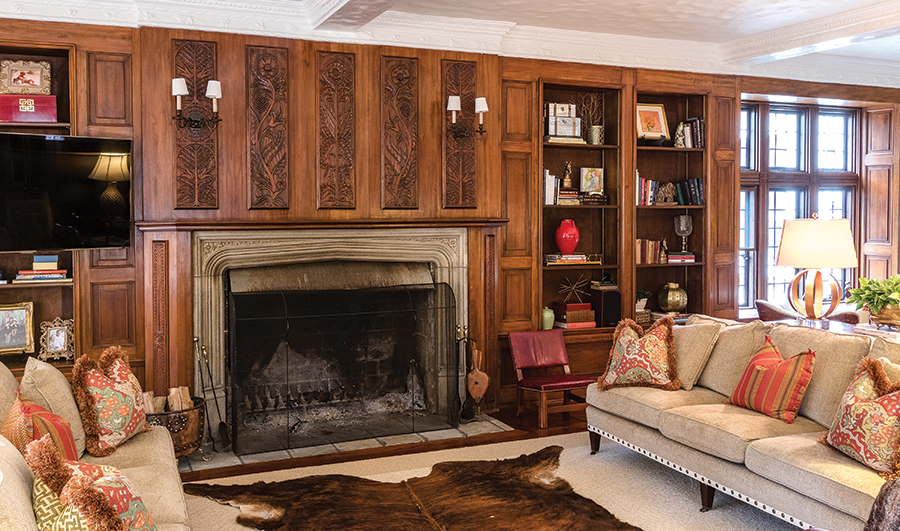
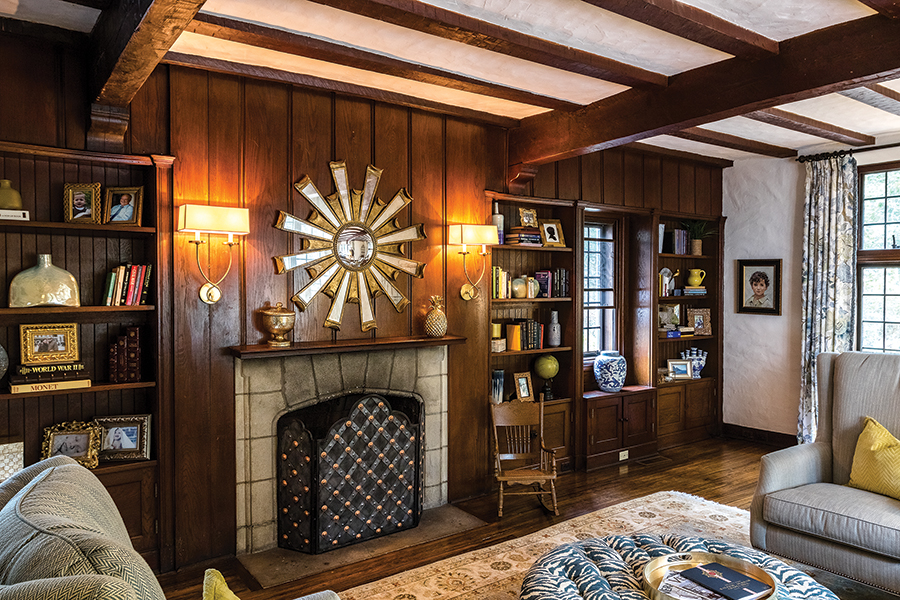
For participants in the Southern Pines Garden Club Home & Garden Tour on April 14, a walk through the Lancaster-era Loblolly will be a magical mystery tour, beginning with a dark, wide, slightly monastic foyer whose only decoration is Erin’s favorite Biblical verse, from Isaiah, stitched on fabric in the shape of a cross, framed, and hung on the wall — her talisman. To the left, through a paneled round-topped door is the formal living room with beamed ceiling and an entire wall of bookcases, also of dark woods, which convey a library effect.  The Lancasters call this the Christmas Room, perfect for their big tree.

“We wanted traditional (furnishings) to match the house,” Erin says. What they brought from their previous home fit beautifully. High-backed upholstered chairs, a circular upholstered coffee table/ottoman, her desk and side pieces — even a bread trough under a window shelf — are oversized to match the living room’s dimensions. Yet, she reports, the kids have enough space to run laps around the sofa.

Erin’s interior designer, Susan Brown of Raleigh, chose light solids and patterns (some classic Schumacher) for upholstery and drapes to relieve the dark paneling and floors, which are original, gorgeous and sparsely covered by Orientals.

“Susan worked with me on our house in Raleigh,” Erin says. “She knows me so well.”

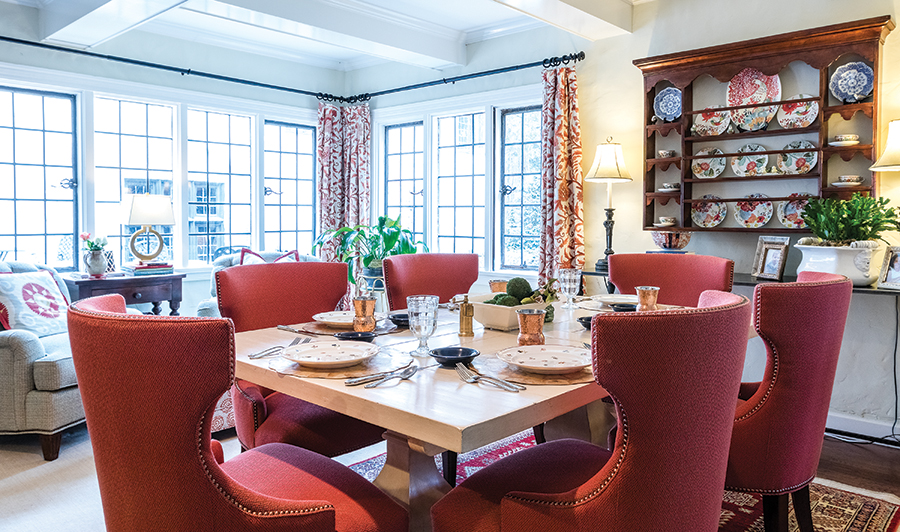
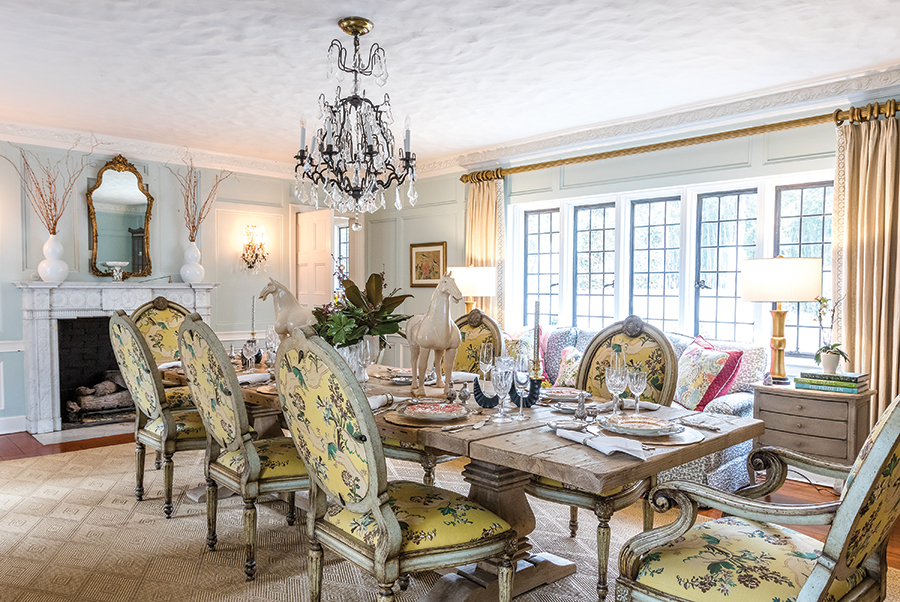
Nowhere is the scale of Loblolly’s original footprint more evident than in the dining room, which accommodates 12-foot table, a full-sized sofa under the window, an exquisite French china cabinet filled with Minton bunnies (Erin’s trademark) and other pieces without crowding.

Here, Susan and Erin created a wild juxtaposition that works: The tabletop is made from wide, roughly textured planks while the Papa Bear-proportioned chairs have ornate French Provincial frames upholstered in a floral fabric. Under the table, a sisal all-weather rug, in neutral sand because, Erin points out, “The kids run through here on the way to the kitchen.”

The kitchen, of course, required gutting. A small bedroom and pantry behind it were removed to open up space for a family sitting/dining area. The kitchen itself displays an unusual arrangement of two parallel islands, with sink on one and range, ovens, refrigerator against the walls. Carrara marble tops the massive bureau-style walnut cabinetry. A ceramic tile backsplash adds another texture. “Mitch has the good brains about how a kitchen functions,” Erin says, understandable since he’s the family chef.

When it comes to colors, Erin and Mitch part ways. She adores the pale aqua predominant in the dining room and on some fabrics. He likes red. Erin and Susan Brown have softened his bright primary into a rosy rust, which lives peaceably with Erin’s choice throughout the house, but especially in the family dining area.

The Big Room, sunken a half-dozen steps below the main floor, elicits disbelief. Approximately 40-by-25 feet with a high ceiling of the same undulating plaster, built in bookshelves lining two walls, paneling elsewhere, a wood-burning fireplace and two TVs, the space is arranged as the baby grand piano area, the conversation area and the bar added by the Lancasters, where a small kitchen with dated metal cabinets once stood. Beside the bar, a grouping of two pale yellow leather chairs, made in New Zealand, seem lifted from a modern art museum. “We were at a gallery in Las Vegas, looking for paintings,” Erin explains. “Mitch saw the chairs and sat down on one. He said, ‘Oh, these are comfortable.’” Others have noted that Elvis might share his opinion.

Pack ’em up, ship ’em east.

Loblolly has no grand staircase. The elevator has been removed. The second floor remains a maze of wings and narrow hallways, dormer niches with light streaming onto a heirloom slipper chair or table. But the bedrooms (eight, total, including the garage apartment) are enormous, with window seats and sitting areas. Son Milum’s room has two four-poster beds from Mitch’s childhood, while daughter Beverly uses Erin’s small  chests of drawers and plays with her mother’s stuffed bunny collection. The kids have a designated Lego room. One small bedroom has become Erin’s closet/dressing room. At the end of the hallway the master suite with soaring ceiling and windows on three sides looks out over terraces, gardens and two-plus fenced acres bordered by ancient trees — another world, another story

Loblolly represents not only an extinct lifestyle, but materials and workmanship impossible to duplicate. The trick is dressing old bones in new clothes. “We’ve been chipping away at it for seven years,” Erin says. “We’re about halfway done.” During that time, the Lancasters had a third child, adopted several rescue dogs, enticed Erin’s sister and her family to a house down the road. Mitch entered city politics. And a renewed Loblolly is once again the scene of dinner parties, meetings, play dates and social events.

“It’s a God thing that we ended up down here,” Erin concludes. “OK, here’s your path, God told us. So if this is where we’re supposed to be, let the house pass inspection.”

Loblolly is one of six homes featured on the 70th Annual Southern Pines Home & Garden Tour, from 10 a.m. to 4 p.m. Saturday, April 14. Also included, an exhibit at Campbell House recounting how club members shaped the landscape of the community through their projects and initiatives. Proceeds from the tour support local beautification and horticultural scholarships. Tickets: $20 in advance, $25 day of tour (at sites). Advance tickets are available at The Country Bookshop in Southern Pines and Pinehurst Woman’s Exchange, or through the club website: www.southernpinesgardenclub.com.

Night Work

Exploring deep space in Jackson Springs

By Jim Moriarty

Celestial Photographs by Jeff Haidet   •   Earthbound Photographs by John Gessner

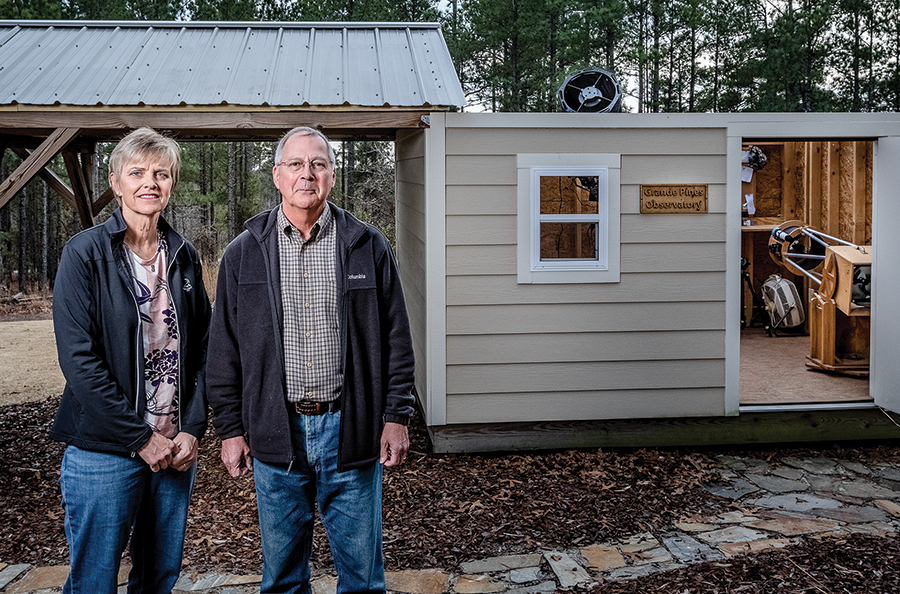
It’s not necessary to climb a mountain to reach the stars, but sometimes you have to dress like it. During the great January freeze of 2018, when the polar vortex decided to dispatch its nose-hair-freezing temperatures south, Jeff Haidet spent his evenings in the Grande Pines Observatory with the roof open, staring into deep space and a case of frostbite at the same time. Maybe not frostbite. His base camp, well, house is less than a hundred yards away. Nonetheless, here is a man who makes hay when then the sun doesn’t shine. Or the moon. “Everyone he knows, knows he hates the moon,” says Jeff’s wife, Vicki. If your intention is to draw a bead on the Running Man nebula in the constellation Orion, the glow of the moon is nothing more romantic than a bad case of light pollution.

The Grande Pines Observatory is as likely to be mistaken for the Gemini Telescope as Jackson Springs is for the top of Mauna Kea, but it’s surprising what can be seen if you know where to look. Most people have a shed for gardening tools. The Haidets have one for citizen science. The official observatory code of the 10-by-12-foot building is W46, the number associated with the data Haidet voluntarily supplies to the Minor Planet Center, part of the Smithsonian Astrophysical Observatory, and to the Lunar and Planetary Laboratory at the University of Arizona. One is the worldwide clearinghouse for all things asteroid, the other is Near Earth Objects.

One does not provide data to these institutions by picking up the phone, calling an 800 number and saying, “Dude, write this down.” They won’t talk to you until they know you’re worth listening to. “You have to send them data to prove you can get to the tolerances they want. You’re getting down to an accuracy of less than an arc second,” says Jeff. “An arc second is a dime at 2.4 miles. Put a dime somewhere down in Foxfire, and we can measure it from here with the right techniques and the right equipment. That’s the kind of accuracy you have to get.”

When the Minor Planet Center publishes its astrometric observations in its Circulars, Jeff may have 20 line items in it. The big boys might have 50 pages. “The pros do this a different way,” he says with a smile. The Lunar Planetary Lab is part of a mission that will likely reach its target, the asteroid 101955 Bennu, this August. “They’re going to sample material from the asteroid and bring it back,” says Jeff. “So they had a citizens science program to provide them with data on other possible targets after they’re done with Bennu. They put out a list: We need data on these six this month. They use it in their planning. It was science that I had the equipment and the methodology to do.”

So, back to this unusual shed. For one thing, the sliding garage door is on the top. Then inside, instead of a riding lawnmower, there’s a Losmandy Gemini 2 mount held in place by 700 pounds of concrete pillar poured into the ground. You could jump up and down on the detached plywood floor and the telescope from Guan Sheng Optics, a Taiwanese company, won’t even know you’re in the same state. Jeff’s astronomical camera, acquired just before Christmas last year from QHYCCD, completes the outfit while the Lenovo laptop processes the data.

“I was doing visual observing, which you do until your eyes start to go a little bad,” says Jeff. “Mostly you’re looking at faint galaxies, nebula, so, if you want to stay in astronomy you do imaging. It’s almost all working together now. There’s a lot of moving pieces. When it works it’s kind of fun, but when it doesn’t work, it’s frustrating. It takes patience and time to learn how to do it. The other night I was taking pictures of this one nebula and I’m looking at some of the pictures when I got back in the house, and there’s an airplane going right through it. Throw that away.”

Naturally, no workplace is complete without a few personal touches, like the Grande Pines Observatory sign the Haidets’ son, Brian, an N.C. State University physics and engineering graduate who is working on a Ph.D. at UC-Santa Barbara, made to hang near the observatory’s doorway. Then there’s the tiny homemade heater Jeff rigged up to prevent dew forming on the optics on cool mornings. Addressing the tobacco barn effect of the summer heat is high on the to-do list. And, he’ll eventually replace the weights he has duct-taped to the telescope mount. “The scope and the equipment weighed more than I anticipated. I found some barbell weights and strapped them on there,” he says. Gravity doesn’t seem to resent improvisation. The paper bags suspended beneath the crown of the roof at either end are key pieces of environmental engineering. When the observatory was first built, pre-telescope installation, wasps seemed to be of the opinion the building had been erected as their personal clubhouse. Jeff solicited advice among astronomy bloggers and found the solution — scarecrows for wasps. “Take an empty brown bag, blow it up, tie it off and hang it up there,” he says. “Apparently wasps, the type that would nest in here, are very territorial. So they’ll come in and see it and think that’s a nest. It actually works. I have not had a wasp since.”

There have been a lot of different reasons to move to the Sandhills. Pinehurst’s founder, James Walker Tufts, thought people would come for the cleansing ozone of the pines. The Haidets, however, might be the only people who ever moved to Moore County for the dark. “We were looking for dark skies and warm weather and I’m a golfer,” says Vicki, who plays off a sporty seven handicap. Having horse farms nearby was particularly enticing. Open spaces. No street lights. No floodlights from the neighbors. Five and a half years ago they found the perfect lot in Grande Pines and with the removal of a modest number of trees, created the southern horizon Jeff needed to scan the sky.

Ohioans both, she grew up in Toledo and he in Alliance. Vicki learned to play golf at Inverness Golf Club, another of Donald Ross famous courses, and Jeff learned astronomy with the help of Dr. James Rodman, the astronomy professor at Mount Union College who was a friend of his parents — Lavern and LaVerne — and lived a few blocks down the street. “I don’t know how it would have gone without him, but he helped a lot,” says Jeff, who attended Case Western Reserve when it was still the duopoly of Case Institute of Technology and Western Reserve University. “We had the distinction at Case Western Reserve, when they merged, of having the nation’s two worst football teams,” says Jeff. “We got beat by Carnegie Mellon one year 72-6.” At least they scored — some solace for an institution that has an affiliation, one way or another, with 17 Nobel laureates.

“When I was about 5, I got a telescope for Christmas, and I forget now what it was — either Saturn or Jupiter — was in the sky that morning,” says Jeff. The oohs and aahs were followed by serious study. He built his own telescope; in fact, he has built several, grinding and polishing the mirrors himself. “When you’re a boy, you have no money but you have time, so you build things,” he says.

It wasn’t as though Jeff could go to YouTube and download a “How to Build a Newtonian Telescope video onto his smartphone. Think library. Think books. Think Dr. Rodman. “Imagine these two round discs of glass. One is going to be your mirror and one’s called a blank,” he says. For hours at a time, day after day, you apply a heavy grit. “It’s all in the pattern you use,” he says. Eventually, one piece becomes concave, the other convex. When it reaches the curvature you want, you test the focal length. If that’s where you want it, you begin using finer grits for a smooth finish. After that comes the polishing with optical rouge, similar to what jewelers use. “The problem is, you don’t want it to be a perfectly spherical mirror,” says Jeff. “It needs to be parabolic.” Enter the pitch lap. And so on. “Grinding it wasn’t that bad,” says Jeff. “Polishing it would take a lot of time. The tolerances are very tight and it would take weeks to get it right unless you’re really lucky.”

Jeff graduated from Case (he stuck with the old diploma) with a degree in astronomy and physics. When he graduated in ’72, the National Science Foundation budget had mostly dried up, so he left astronomy behind, using his computer proficiency to land a job with Owens Corning. He got a Master’s degree in computer science and engineering from Ohio State and spent his career at Owens integrating the shop floor equipment with the enterprise systems until he retired in 2008. Vicki graduated from Bowling Green State University, met Jeff when they both worked at Owens Corning and, after Brian turned 4, struck out on her own as a marketing consultant until she retired three and a half years ago.

It wasn’t until the late ’90s that Jeff was able to get back into astronomy. But Sylvania, Ohio, hard by Toledo, wasn’t the place for it. Every night session was a road game. “You had to travel about 45 minutes to get to where you had a dark sky. It’s a pain to drag all your equipment out and get all set up and aligned and calibrated,” says Jeff. Wouldn’t a backyard observatory be so much simpler?

Thanks to his “store bought” telescope with the Ritchey-Chretien optical design that matches up well with the big sensors in the new camera, deep space is only a few yards away. Auto-guiding allows him to expose the camera for an hour and be spot on the entire time. “Primarily what I had been doing is precise measuring, but with this camera I can do really good deep sky photography,” he says. “The new cameras, you take a series of exposures through different filters and then you stack those together to make the color image. Those really fancy pictures you see, those aren’t by accident. Those take time. A lot of knowledge, how to get the colors right, get the gradient across the background right, get all the noise out of the picture. It’s a serious thing.”

And best done in the dark.

Jim Moriarty is senior editor of PineStraw and can be reached at jjmpinestraw@gmail.com.

Rush, Rush, Rush

You said you need a what?

By Renee Phile

A few months ago, around 6:50 a.m., the boys and I were on our way to school when David, my 14-year-old, from the backseat says, “I guess I’m not going to my band concert tonight. It’s really not a big deal.”

I nearly swerved off the road. There are only two concerts a year, and they are both quite the events. “What? Of course you’re going. Why would you say you aren’t?”

“My white shirt and the black pants are too small.”

I nearly swerved off the road again. “Really? When were you going to tell me?”

“I forgot.”

“So you decide to tell me on the way to school on the day of the band concert when you know I have to work all day.”

“Sorry. I don’t need to go. It’s not a big deal. My band teacher will understand.”

“Oh, so she has been preparing you for months for this concert and you think she will totally understand if you don’t go because you failed to tell your mom in time that you need new clothes?”

“Maybe.”

I was afraid of anything that might spill out of my mouth and I guess they were, too, because  we drove to school in silence.

After work I rushed to Kohl’s to find the required white dress shirt and black pants and, of course, they weren’t on sale. What choice did I have? I was being held up at the point of a band concert. I bought the clothes and picked up David from wrestling practice 30 minutes before he had to be at the concert.

“You really didn’t need to worry about it Mom. My band teacher would understand. She’s pretty reasonable.”

Um, you’re welcome.

***

A few weeks later Kevin and I were sitting at David’s wrestling match. Now, these matches typically last around three hours or more, so a wrestling match night is a late night. Kevin, my 9-year-old, between bites of popcorn, said in the most nonchalant voice, “Mom, can we stop by Walmart on the way home?”

“Why?”

“I need something for a project.”

“What project?”

“Something about solar systems. It’s due tomorrow.”

“Kevin, please tell me this is a joke.”

“I forgot about it until just now.”

Frantic, I sent a text to his teacher, apologized for bothering her at home, and said Kevin told me he has a project due tomorrow and this is the first time I have heard anything about it. (No smiley face.)

She texted back promptly and said that, yes, there was a discovery project on the solar system due in the morning, and it was also the end of the grading period, so he couldn’t turn it in late.  (Smiley face and a thumbs up.)

That night was spent gluing and coloring Mercury, Venus and Mars. Around and around we go.

The rules are simple: Tell me your due dates; give me notes from school when you get them; let me know what you need for a project a week ahead of time. Nowhere in the rules do the words “last minute” appear. I know they’re genetically capable of advance planning because when a friend is having a birthday party in two weeks, Kevin hands me the invitation right away and reminds me about it five times a day. They can do it, I just know they can.

Renee Phile loves being a mom, even if it doesn’t show at certain moments.

Almanac

Something primal awakens within you on the first day of spring.

You rake the lawn, re-seed bare patches, feed the compost, prune the
fruit trees, repair the wooden trellis, and celebrate the new buds on the heirloom azalea.

Soon, the banksia rose will be a waterfall of fragrant yellow blooms, and foxglove will swoon from the tender kiss of a ruby-throated hummingbird.

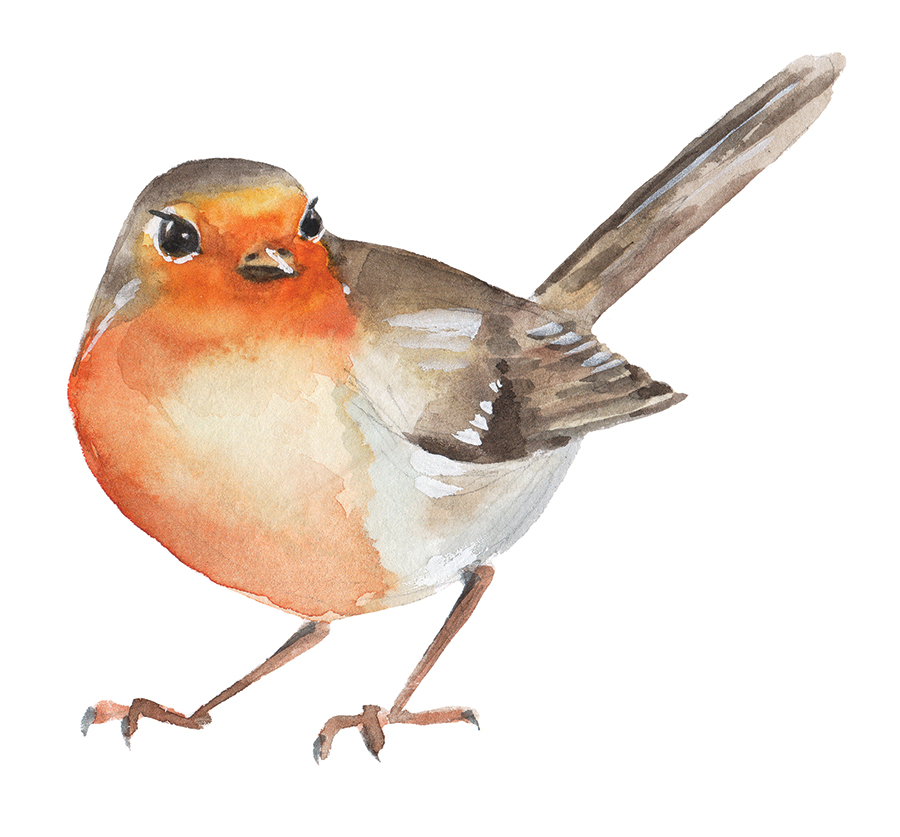
Spring is synonymous with life, and each breath is nectar to your soul. As robin exhales mirthful tunes of snowdrop, crocus and daffodil, you find yourself whistling along. Today: songs of iris, thrift and pussy willow. Tomorrow: ballads of blue speckled eggs. 

When the soil is workable, you sow the first of the peas, spinach, lettuce and leeks, sealing each seed with a silent prayer.

Tuesday, March 20, officially marks the vernal equinox. Urban legend has it you can keep an egg balanced upright at the exact moment that the sun crosses the plane of the Earth’s equator. Perhaps. Although you might have a better chance of cutting a deal with the wisteria.

Interview with a Leprechaun

If ever there were an optimal day to spot a leprechaun, surely it would be March 17. That’s what an Irish-blooded friend of mine stands by. As a young girl, Mary would wake with the birds on St. Patrick’s Day morn — the day before her birthday — and lie in the grass in her front yard.

“I thought for sure I would spot a leprechaun there at sunrise,” she recently told me. “I could feel it in my bones.”

Year after year she tried, but on the day before her 11th birthday, she gave up. Perhaps it was silly to believe in the magic of St. Paddy’s Day.

Or maybe it wasn’t.

At sunrise on her 11th birthday, something told her to lie in the yard once more.   

“I saw a quick movement out of the corner of my eye,” she remembers, then ran across the yard to discover a perfect four-leaf clover in the grass.

“I still swear a leprechaun guided me there,” she says.

Flash forward 20-plus years to a Welsh pony farm in western North Carolina where, this time of year, when the weeping cherry is in bloom, Mary finds four- and five-leaf clovers on a daily basis — sometimes by the dozen.

Halloween of 2015, while scanning a favorite field for an hour and a half, she found 117 four- and five-leafers, which she handed out to trick-or-treaters.

“I dressed up as a leprechaun for the occasion.”

How on this clover-loving Earth does she find them?

“Sometimes I see them as movement, and sometimes I hear their vibration,” she explains. “Nature speaks to those who listen.”

If the leprechauns aren’t guiding her, then perhaps the luck is simply in her blood. I’m inclined to believe that both are true.

The best thing about finding clovers?

“Giving them away,” says Mary. “I love seeing the smile on the face of someone who has never seen a four-leaf clover in person.”

The Lunar Report

Two full moons this month. On Thursday, March 1, celebrate the Full Worm Moon by sowing the season’s first root crops and fruiting perennials. Named by the Native Americans who so intimately knew and loved the land, this year’s third full moon signifies a softening Earth and the return of the robin. A second full moon falls on Sunday, March 31. Celebrate by doing that once-in-a-blue-moon something.

Bird Messenger

In Frances Hodgson Burnett’s classic children’s novel, a cheerful robin helps 10-year-old Mary Lennox unearth a rusty key to a long-abandoned garden.

The Secret Garden isn’t just a story of forgotten roses and the promise of spring. It’s about the healing properties of the Earth, and how, within and without, love can transmute the bleakest and most dismal places. Listen to the robin: The key is in the soil beneath you.

Green with Envy

Doing St. Paddy’s Day the Southern way

By Tom Allen

You are what your ancestors ate. And drank. Sometimes.

Credit English forebears for my fish and chips hankering. Hot tea, too. But a recent Ancestry.com search shows a wee bit o’ green pulsing through my veins. Therefore the Irish branch on my family tree should support corned beef and cabbage. But no. A split decision. I love cabbage. Ditto potatoes and soda bread slathered with Kerrygold butter.  But, even on St. Patrick’s Day, I can’t stomach corned beef. Maybe that’s because nobody in Ireland eats the Americanized permutation, which replaced bacon — too expensive for poor Irish immigrants.

Funny thing is, I’m a deeply rooted Southerner who doesn’t appreciate a thick Better Boy tomato slice on white bread, made mushier with mayo. Duke’s, of course.  “Unheard of,” some folks say.  “Treason,” others sneer.  My reply?  “Sorry, it’s a texture thing.”

Leprechauns aside, March 17 marks the feast day of Ireland’s beloved patron saint.  In Ireland, until later in the 20th century, the day was more religious than raucous.  While family and faith are important to the celebration, pubs and parades now mark the occasion as well.  An estimated 33 million pints of Guinness are downed in that 24-hour period.

In America, St. Patrick’s Day is a one-day deal, but the Emerald Isle spends several days tipping its hat to the good fellow credited with Christianizing the island nation and driving out those legendary snakes.  According to a friend with Irish roots, lots of folks wear green, even live shamrocks, but pinching is purely American.  Pinch an Irishman who’s not wearing green and you’re liable to catch a left hook.

As for Irish food, colcannon, not corned beef, is a St. Patrick’s Day staple.  The mixture of creamy mashed potatoes and cabbage or kale is served with bacon, a combination that makes me smile.  But who whips up colcannon around here?

I’m a foodie traditionalist.  Therein lies the pickle.  Give me Hoppin’ John on New Year’s Day, burgers and dogs on July 4, turkey from Thanksgiving to Christmas.  But what’s a Southern boy, with a bit of Irish ancestry, supposed to eat on St. Paddy’s Day?  If not corned beef, perhaps a pork option honoring those frugal Irish immigrants who gave up their pricey bacon?  Try cured and fried.  Make mine country ham, sliced paper thin and seared in an iron skillet.  Perfect, I say, with a plate of steamed cabbage.  Pair with some buttermilk biscuits, spread with Kerrygold butter, of course, and dig into a fine pot of gold at the end of the rainbow.

Speaking of pickles, St. Patrick’s Day always falls during Lent, a season when some abstain from meat on Fridays.  Last year, the feast fell on a Friday.  Fortunately, some bishops in communities with large Irish-American populations relaxed the rule, granting one-day dispensations, so the faithful didn’t have to choose between sinning and nibbling on their beloved corned beef.

No such pickle this year, since St. Patrick’s Day falls on Saturday.  So simmer a pot of cabbage. Load up that slow cooker with a slab of corned beef brisket, or, if you’re like me, fry up some slices of North Carolina’s WayCo country ham.  Don a bit of green, offer a word of thanks for good souls like Patrick, then sit down to a salty feast that’s sure to keep those Irish eyes smiling.  Erin go bragh!

Tom Allen is minister of education at First Baptist Church, Southern Pines.