Art Here, Art There, Art Everywhere

A cozy family home doubles as a gallery for animal behaviorist

By Deborah Salomon     Photographs By John Koob Gessner

A sandy, rutted, quarter-mile driveway off Pee Dee Road ends at a white clapboard house with enough wings to take flight. Its front yard is a grass pasture sized for soccer, or football, or equestrian trials. Somewhere on the 150-acre estate are remnants of a tennis court. Yet the exterior suggests a family home, more comfy than pretentious, despite its 6,000-square-foot interior.

The sign by the front porch reads Whitehall — not for London’s government center, but because the man who built it during the development of Knollwood in the 1920s was named White, or Whitehouse.

One legend has this wealthy New Yorker losing his fortune in the 1929 stock market crash — and committing suicide.

Lacking a documented pedigree, Whitehall speaks for itself through Dr. Barbara Sherman — veterinarian, author, respected animal behavioral specialist, clinical professor at N.C. State College of Veterinary Medicine — who has occupied the house for 20 years.

From the outset, Sherman saw it as more than a sprawling residence offering both beauty and privacy. “The light, the bay windows and curved walls, the moldings, the space” suggested a gallery. She is a connoisseur and collector of sculpture,  pieces displayed on pedestals acquired during travels to galleries and showings, preferably where the artist is present.

“I am intrigued and often moved by artistic expression — not sure why, but some contemporary art speaks to me,” she says. “I feel pleasure living with it and by purchasing it, supporting the artists, learning how they found their way.”

Understandable, since “my parents collected sculpture.”

Her involvement, more likely passion, begins with the sculpture outside the front door, which she describes as an ocean stone rounded by the sand and inexorable movement of the sea, with contrasting sharp lines of the artist’s cut and the potent symbolism of the center circle, all mounted on a steel base.

“It almost seemed an altar to the miracle of nature.”

Once inside, Sherman lovingly strokes a ceramic elephant fossil displayed in the small sitting room off a foyer where a wall-mounted metal torso flanks the front door.

Now, first-time visitors know what lies beyond.

The house, purchased from the Drexel family, was once a hub for the six Drexel children and their friends. To accommodate the crowd, in addition to a huge living room, the Drexels added an even larger family room, where over the fireplace hangs a piece of geometric fiber art designed by Alexander Calder.

David Drexel was a popular Boy Scoutmaster who held events at Whitehall, recalled fondly by Scout Bob Ganis: “We would walk from Whitehall to a small pond in the woods to swim. That pond still exists as a water feature at Talamore golf course.”

Daughter Tina (Drexel) Adams remembers raising chickens and pigs: “I used to ride along in Dad’s truck delivering eggs.” She also recalls giving birth to her middle daughter there.

Sherman spent a year renovating without altering Whitehall’s character or floor plan. The rooms, like a maze, connect with each other rather than radiating from a hallway. A garage and screen porch were added, where Sherman sits and watches red-tailed hawks and deer. Original heart pine floors were refinished but not stained. Cherry cabinetry in the new kitchen channels the Arts and Crafts period. Even here a pedestal supporting a buffalo sculpture fronts a bare window, while another flat piece hangs over the sink. Large abstract paintings and landscapes, one by Evelyn Dempsey, decorate the passageway from kitchen to family dining room, delineated by an Oriental rug, one of dozens throughout the house.

The renovation included skylights and all systems, but not bathrooms tiled in that 1950s froggy green rarely seen since. “Look at the tiles, the workmanship,” Sherman says. “Before they came (in sheets), each tile was laid individually.”

Of all Whitehall’s randomly situated rooms, one stands out. Located just beyond the small sitting room, this might have been a sunroom, with tall windows on three sides and the arched ceiling. Aside from several pedestals and a carpet, its only occupant is a jointed life-sized wooden block figure reclining on the floor, titled The Pine Man, which Sherman found in Cleveland.

When art comes first, integrating furnishings can be tricky. Sherman respected no boundaries. “My mother was an interior designer” who contributed many exquisite European pieces, including an inlaid dining table, lovely enough to leave bare when in use. Just as impressive, several burled highboys and a glass-front cabinet displaying a collection of about 40 fine china demitasse cups, some rimmed in gold. They belonged to Sherman’s grandmother, who lived in Greensboro.

“Do I look like a demitasse person?” Sherman smiles, wryly.

The showpiece, however, is a table piano dated 1791 made by Sebastien Erard, an 18th century French instrument crafter who received commissions from Louis XVI and Marie Antoinette. According to a music history, Beethoven, Chopin, Liszt, Verdi, Wagner and Mendelssohn also owned Erard pianos.

For the rest, Sherman chose plain, stocky tables, sandy-neutral leather chairs and upholstered sofas that do not draw attention away from the art and antiques. “Simple, handcrafted, esthetic” were her requirements.

For years Sherman drove almost daily to Raleigh. Once home, Whitehall fulfilled her need for nature. “I love being in the woods and observing the natural world around me.” This fulfillment has been shared with the public since David Drexel approached the newly formed Sandhills Area Land Trust (SALT) to establish a conservation easement. Therefore, the Whitehall Trail, a 2-mile loop and 57 acres surrounding it, will be reserved for public use forever. The rough, often leaf-covered trail is open to walkers (with or without dogs), joggers and cyclists, but not horses.

Sherman’s daughter is grown and gone. Since retirement, she and scruffy rescue terrier Jasper don’t need 6,000 square feet on 150 acres. They are moving closer to the horses she loves and understands, and a human community of the like-minded. Perhaps Whitehall will find new purpose as a proper gallery, or an organization’s performance/educational/arts space, she muses.

“Life has changed. I want to divest myself of so many material things, have less to be responsible for, live at a different rhythm.” This applies to mowing the pasture on a ride-on, but not to her collections.

“It is remarkable that people can create such things,” she says. “I will always want to be surrounded by art and nature.”  PS

Papadaddy’s Mindfield

Summer Daze

When being outdoors was a terrifying adventure

By Clyde Edgerton

It was a hot summer day. 1951. In my memories of my seventh year, all summer days were hot ones, calling for me to go outside and get into them. There was no air conditioning yet in any home in our neighborhood, so there were no cool, enticing places except by a creek in the woods. You wouldn’t be caught dead inside a house — even looking at the little Emerson black and white TV. You couldn’t pull up a Minecraft adventure, or a video game, or a YouTube on that little machine. Life was outside.

Don Mitchell and Norris Campbell were on their bikes out in the yard. Did
I want to go see a dead snake? Of course I did.

We were off, down the dirt road we lived on — on our bicycles — a right turn into the Goodwins’ driveway, which kept going behind their house, straight ahead on through the church graveyard, onto school grounds, by the ballfield, and on to a less familiar place down behind the school. They were in the lead, we were pedaling right along.

My Roy Rogers bike (Roy was a cowboy movie star back then) had a saddlebag like a horse and a small molded head of Roy’s horse, Trigger, between the handle bars. (Bumping along on my bike, I could never have dreamed nor been persuaded that Roy Rogers would one day be unknown to most anyone alive.) Don veered slightly to the left around a large, ground- level square of cement; Norris veered right. I saw no reason to avoid it — it was about the size of a room. I didn’t notice that a deep ditch filled with growing green grass was around the perimeter of the cement.

The bike’s front wheel dropped into the ditch, the bike stopped, I kept going, my hands out in front of me. When I gained some sense of where I was, I was sitting on the cement, staring at my right hand. Where the thumb connects to the hand looked like no thumb joint I’d ever seen; the thumb was off at an angle, and a bone was pushing up from somewhere, but not breaking through the skin; it looked absurdly irregular. I screamed and started crying loudly. I have a vague sense that Don and Norris were with me all the way home, one of them pushing my bike.

My next clear memory is of my mother staring at my hand, asking me to sit on the front steps of our house, while she goes into the neighborhood to find a car so she can take me to the emergency room. My father is at work with our car. And next comes Teresa . . . oh gosh, last name escapes me. Teresa stands before me. She’s my age.

“What happened?” she asks.

“I think I broke my thumb,” I say, between sobs. I’m crying from fear as much as from pain — my thumb is deformed.

Teresa reaches out and gently takes my arm, turns it so she can get a good look. She announces: “They might have to take it off.”

Those words seared me — are still seared into my memory.

I tell the story above because it’s a story. And because it happened in my childhood — outdoors. These days, I drive through neighborhoods and I often see no children out of doors on bikes. Maybe I’m in the wrong neighborhood. Maybe I’m in the wrong town. Maybe I’m in the wrong century.

A careful parent, or a glazed-eyed teenager, might say, “You don’t get hurt when you stay inside.”

Yes, you do.  PS

Clyde Edgerton is the author of 10 novels, a memoir and most recently, Papadaddy’s Book for New Fathers. He is the Thomas S. Kenan III Distinguished Professor of Creative Writing at UNCW.

Hometown

Matchless

Low mileage, one owner, gently used

By Bill Fields

My ’66 Mustang needs a paint job, and the wheels are wobbly on my ’62 Ferrari. But compared with my ’63 Vauxhall Estate Car, whose windows are broken and back hatch is missing, the first two vehicles are looking good.

Now, I’m not really a car collector. I’m not even a real collector of these 1:64 scale miniatures that had so many of us hoping we had 49 cents in our pocket — approximately two visits from the tooth fairy — for a purchase years ago. My dozen were rescued from the corner of a closet where they had been garaged for a long time.

Lots of things shout “child of the ’60s,” but does any toy do it better than a Matchbox car?

As the advertising copy said: “For boys and girls of all ages . . . built of pressure die-cast metal by English craftsmen . . . nothing to assemble, ready to use . . . colorful nontoxic baked enamel finish, authentic in every detail.”

I’m glad I never snacked on my vehicles, just in case, but the Matchbox Series did have a lot going for it. Detroit might not have ever been usurped as a car capital if its workmanship had been as fine as that in the toys manufactured in England by Lesney Products.

Although small enough to fit in a child’s hand, some of the models consisted of more than 100 parts. They were finely assembled, with details that mirrored the real thing. Automakers on both sides of the Atlantic, happy with the publicity, shared specifications with the toy company that allowed for great authenticity in the replicas.

As a kid who loved small things — a pocket magnetic checkers set, tiny stapler, mini-football helmet pencil sharpener, miniature golf — Matchbox cars were right in my wheelhouse.

Lesney began after World War II in London, a collaboration of friends and military veterans Leslie Smith and Rodney Smith, who used syllables from each of their first names as the company moniker. Toys weren’t the focus of the die-cast business until another man, Jack Odell, joined the original partners.

The Matchbox brand sprouted from Odell’s initial Lilliputian design — a brass steamroller he built in 1952 for his daughter that met her school’s edict that students couldn’t bring toys larger than a matchbox. Odell and Leslie Smith started producing their line of vehicles in 1953, Rodney Smith having sold out to his partners two years earlier. Their first design was a miniature gilded coach for the coronation of Queen Elizabeth II, a hot seller that was followed by a bulldozer, fire engine and, in 1954, Lesney’s first car, an MG.

Lesney was producing more than a million vehicles a week by the early 1960s as Matchbox cars were being sold in great numbers all over the world. “We produce more Rolls-Royces in a single day,” Odell told The New York Times, “than the Rolls-Royce company has made in its entire history.”

My fanciest Matchbox model is a ’64 Lincoln Continental, sea-foam green, whose trunk was just big enough to hold a piece of candy corn. I like my oldest model, a ’61 gray and red “Bedford Tipper” truck that I probably was given before I was old enough to really bang it around, which could explain why it looks as if it just came off the lot.

I was well-equipped for emergency response, owning a ’62 ambulance, ’65 wrecker and ’66 firetruck, its removable plastic ladder on the roof and ready to rescue someone trapped on the second story. There are versions of the Dodge Wreck Truck that make them a rare and valuable collectible because of a manufacturing quirk, but mine is run-of-the-mill and a little sad, its tow hook gone. I’ll blame the snapped-off part on my nephews, who were playing with my little cars on visits to their grandparents about the time I was getting my driver’s license.

New generation, same old fun.  PS

Southern Pines native Bill Fields, who writes about golf and other things, moved north in 1986 but hasn’t lost his accent.

2019 Summer Reading Issue

Well-Versed

A pocketful of poets & photographers reflect on summer

Ask a poet to show you a glimpse of summer and they will not give you words on a page.

“OK,” they will tell you, tying a silk cloth over your eyes, and then they will take your hand, guide you to the end of the sidewalk, where you will leave your shoes.

The earth feels wet and cool beneath your feet, each step like a distant memory, and the more you trust the ground beneath you, the more you will notice that everything is alive. Whether or not you’ve been here before, or think you have, there is something foreign within the familiar, and the possibility of discovery ignites you.

Just beyond a swollen creek, where chorus frogs shriek in the wake of an August rain, something will demand your attention — a fragrance, perhaps. Or filtered light flickering across your face and skin. Or the sense of nearby movement. You will know when it arrives, and when it does, it will draw you closer to the source.

Before the cloth slips down below your eyes, you will feel a shift in the air. And then you will see it: a moss-laced grove, a golden field, the garden of a lover who still haunts you. The poet who led you here is gone, and in the midst of this enchanted dreamscape, you have unearthed something within yourself, a pain or a delight — an awakening that cannot be reversed.

This is the beauty of poetry. Sweet or bitter, subtle or Earth-shaking, whatever truth has been revealed reminds you of the exquisite cauldron of human emotions that you might stumble upon at any instant.

For our annual August Reading Issue, we invited a number of our favorite poets (including two Poet Laureates) to take us somewhere special with their words, matching them with a gifted photographer to illustrate their vision.

In this dreamy, golden season dripping with raw honey and memory, each moment is ripe with surprises. You’ll see. You can leave your shoes behind. You need only be open to discovery.  Ashley Wahl


In the Spirit

Lock and Key

A very special birthday gift

By Tony Cross

One of my favorite traits that my best friend, Charles, possesses is his ridiculous knack for always making me laugh with his acutely dry sense of humor. That, and he can dish up killer Mexican food.

Before he was married, we lived together while working at the same restaurant. During our friendship, I developed a fondness for cocktails and used him as a guinea pig. Charles has always been very particular about what he drinks; he would (and still does) shoot straight with me when testing my humble cocktail creations. Over the course of the past seven years, I have never understood his disdain for mescal; how he always holds his liquor better than me (he’s had nine more years experience, mind you); and why he prefers The Black Keys to The White Stripes.

On the flip side of things, Charles has turned me on to a few things himself: Modelo Especials with a back of ice-cold blanco tequila, Mad Season, and close-to-freezing Ketel One vodka with fresh-squeezed grapefruit juice in the morning. When we were roommates, the ritual every year for birthdays and the holidays was the same: a nice bottle of booze. Usually it was high-end tequila or bourbon. However, there was a catch when I was on the receiving end of the gift giving. Every time I looked, my bottle of spirit seemed a little lower. I even made the mistake of asking my girlfriend at the time, “Have you been drinking my tequila?”

Oh, boy. Wrong. She exclaimed, quite matter of factly, “It’s Carter!” (OK, he goes by Carter. Charles is his government name.)

Many birthdays later, I don’t worry quite so much about anyone getting into my booze — unless you count my pup, Daphne, who on paper is extremely smart, but in reality is so, so dumb. When I arrived home one night last month, I could see in the distance, on my kitchen counter, a bottle of liquor that looked very familiar. It was Jefferson’s Reserve bourbon.

I had previously owned a bottle of Jefferson’s, but they have quite the selection, so I almost flew across my kitchen to see which one Carter had gifted me. In all, the distillery currently has 13 different offerings, everything from their flagship Jefferson’s Reserve, to their Jefferson’s Ocean series (barrels of Jefferson’s Reserve that sit, or rock back and forth, rather) on a ship for many months, each voyage crossing the equator four times and stopping at around 30 ports. They even bottle up their own barrel-aged Manhattans.

However, it was one of Jefferson’s Cask Series that ended up on my kitchen counter for my birthday. Actually, it was a week late. Ten-plus years of friendship, he still has a key to my pad and can’t get my birthday right.

There are five different whiskey experiments in the Cask series: Grand Selection Chateau Suduiraut, Sauternes Cask Finish, Grand Selection Chateau Pichon Baron Cask Finish, Groth Cask Finish, and the one now on my counter, the Jefferson’s Pritchard Hill Cabernet Cask Finish. Each cask-finished style starts with either the Jefferson’s Straight Bourbon Whiskey or the Jefferson’s Reserve, and fills up old wine barrels. They usually “hotbox” the barrels for the first few months, and then let them sit for another four.

The hotbox method involves increasing temperatures up to 120 degrees, in turn, bleeding out the wine from the barrels into the whiskey immediately. Afterward, it marinates, balancing the flavors of wine and whiskey. The Pritchard Hill starts with the Reserve whiskey, originally using a 15-year-old bourbon that makes up 50 percent of the mash bill (I’ve read that it’s a slightly younger aged bourbon these days), and then three more bourbons are added (anywhere from 8 to 18 years old). They take this Reserve bourbon whiskey and age it for one year in freshly dumped French oak casks that contained Pritchard Hill Cabernet Sauvignon.

The end result is very tasty, indeed. The barrels that bleed into the whiskey add notes of berries, chocolate, espresso, vanilla and clove. It’s not in your face; it’s subtle. Take your time with this whiskey — add an ice cube and let it open up. This isn’t a mixing bourbon, but if you must, just do an Old-Fashioned, or something where the other ingredient(s) will be minimal. Actually, I don’t care. Do what you want, but I’ll leave a recipe for an Old-Fashioned below.

There’s plenty of my newly gifted bourbon left. I have a decent collection of spirits in my kitchen closet and some, I could’ve sworn, used to be more than half full. Carter has had a key to my place for years. Alas, I better enjoy this bourbon while I can.

Old Fashioned

2 ounces Jefferson’s Reserve Pritchard Hill

1/4 ounce rich demerara syrup

1 dash Angostura bitters

3 drops Crude “Big Bear” coffee and cocoa bitters

Orange peel

Combine all ingredients except orange peel in an ice-cold mixing vessel. Add ice and stir until proper temperature and dilution occur. Strain over ice in a large rocks glass. Express oils of an orange peel over the cocktail and add into drink.  PS

Tony Cross is a bartender who runs cocktail catering company Reverie Cocktails in Southern Pines.

Wine Country

Dog Days and Cool Wines

Beat the heat with something refreshing

By Angela Sanchez

August can be brutal with its long, hot, humid days. If there’s rain, it’s usually in the form of a reckless thunderstorm, leaving the air even stickier. We need cool wines to keep us cool.

A few of my favorites are off-the-beaten-path wines with high acidity, fruit- forward characteristics and zesty herbal notes. Grüner veltliner and vinho verde are light and clean, offering enough flavor for the avid wine drinker in the summer and a chance for the novice to try something new.

If you haven’t heard of grüner veltliner, that’s not unusual. It’s a dark green, late-ripening grape varietal produced predominantly in Austria. The soil of the region is much like parts of France’s Burgundy. Limestone and chalk run throughout, and impart a characteristic minerality and acidity that make it the perfect wine for the hottest days of the year.

Grüner veltliner is a favorite of sommeliers the world over for several reasons. It’s not widely planted or easily found on wine lists, making it a great wine to recommend instead of better known wines like sauvignon blanc and pinot grigio. Also, its light, bright, zesty characteristics pair really well with foods that are not easy to pair with wine, like asparagus, artichokes and greens. It has the racing acidity of sauvignon blanc and the fruit forwardness of pinot grigio, but also a layer of minerality and herbaciousness with lemon and lime to grapefruit citrus, green pepper and lavage characteristics.

Pair it with a zesty green salad of buttery lettuce, asparagus and tomatoes topped with a beautiful cheese, or a cold pasta salad with buttery olives, marinated artichokes and cheese. And as long as you are going off the beaten path for your wine choice, try it with an equally little-known cheese. Calvander from Chapel Hill Creamery is an Asiago-style cheese with a creamy, buttery, nutty taste, perfect for grating over salads and pastas. It’s a raw grass-fed cow’s milk delight named after the crossroads just down from the creamery.

Another perfect wine for the dog days of summer and their relentless heat is the refreshing  vinho verde. Literally translating to mean “green wine” or “young wine,” this slightly effervescent Portuguese wine is a summer must. Produced in the north of Portugal to the border of Spain, it’s made to be consumed young, 3-6 months of production after harvest, and the addition of carbonation to add an ever so slight effervescence. The carbonation isn’t enough to categorize the wine as semi-sparkling, just enough to give a bright little lift on the palate. When it’s hot outside, the cool, clean, light, refreshing style of vinho verde is a welcome taste.

Obscure — at least to the rest of the world’s wine-growing regions — white grapes like alvarinho and louveiro make up the majority of the white vinho verde produced. Red varietals are used for both red and rosé versions of the wine. Vinho verde is almost like a wine spritzer, but the best ones have a dry fruitiness and little characteristics of citrus and peach. It pairs well with a ripe North Carolina peach salad that includes a fresh North Carolina goat cheese like Paradox Farm Natural Cheese Louise — fresh cheese at its best, with a creamy soft, almost whipped, texture. Its natural tartness and lemon character lend a lift to the sweetness of the peaches and complement vinho verde’s clean style.

Cool yourself off with the cool wines of grüner veltliner and vinho verde during the most intense days of the summer. Chill them down, set out a cold snack with North Carolina cheese and enjoy.  PS

Angela Sanchez owns Southern Whey, a cheese-centric specialty food store in Southern Pines, with her husband, Chris Abbey. She was in the wine industry for 20 years and lucky enough to travel the world drinking wine and eating cheese.

A Simple Moment

Finding life through the lens

By Will Harris     Photograph By Laura Gingerich

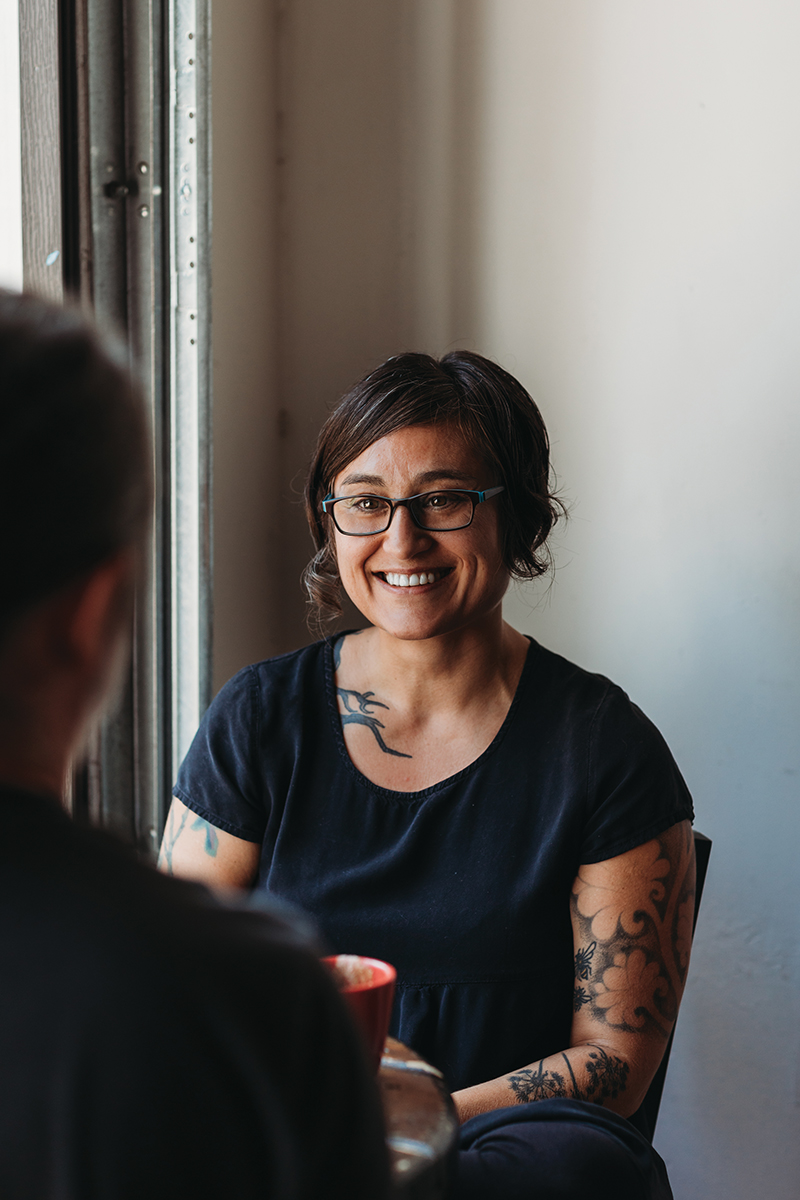
Outside the entrance of the only amusement park in Havana, Cuba, a photographer assembled a pop-up studio to take pictures of visiting families. He developed the film and sold the prints to them as they left, the keepsakes of a special day. That enterprising photographer was Joaquin Ruiz, the patriarch of a family of three generations of photographers. His granddaughter, Neily Ruiz, has journeyed a long way to arrive, at least metaphorically, in the same place.

“I grew up seeing the darkroom and the photography and all of it,” Ruiz says. “I fell in love with it at an early age. It pays my bills, and this is what I do full-time. But it’s more the happiness and the joy I get when I have that camera. I would do it for free if I had to.”

Ruiz, who is opening a photography studio on Pennsylvania Avenue in Southern Pines, immigrated to the United States when she was 15 years old. When she was growing up, electricity and fresh water were unreliable resources. When the water was running — sometimes as infrequently as once a week — the family stored it in a large cistern. During shortages the children showered together outside using buckets. When the lights went out, they invented games to pass the time.

Food was rationed by the Cuban government, allotted to families according to a prescribed formula. Each family could only buy what their particular entry in a notebook specified they could buy, no more. A few bottles of milk, a couple of pounds of rice and beans, and several ounces of oil were typical monthly provisions.

“And if you have five kids, how are you going to do it? They don’t care how many kids you have, it’s your problem,” Ruiz says. Playing childhood games with dead-eye purpose, she and her cousins threw rocks to knock mangoes and coconuts out of the trees. She remembers it fondly. “My childhood was so perfect; there was a lot of happiness. How do you grow up so happy, with so little?” she says. “It’s fascinating. I learned to appreciate things. It was always a creative moment.

“Maybe that’s what made me a dreamer. That’s where my creativity was born, out of the hard times.”

Ruiz’s father, named Joaquin like his father, was disenchanted with Cuba’s lack of opportunity. When Ruiz was 14 years old, Joaquin decided to take his chances in America. The only question was whether the family, including Ruiz’s 3-year-old sister, Leiny, could make the dangerous journey, too. Ruiz’s mother, Xiomara, left the decision to her.

“And she said to me, ‘If you want to stay, your dad is going to have to go alone. But if you’re going, I’m going. We are all facing the same fate together,” Ruiz said.

They were only too aware of the danger. “I had neighbors who died on the ocean. I had neighbors who were eaten by sharks. They were all together in a boat and a shark ate two of them, and the rest are going to have to live with that for the rest of their lives. We go through these things in Cuba all the time,” Ruiz says.

She decided to go. Her father made the arrangements, but they had to wait for months. Ruiz was away at school studying to be a teacher, when she woke up feeling very sick. She asked her father to come get her and take her home. The call came when they got there. It was time to go.

“A Blank Space”

Had Ruiz not fallen ill, she would have been left behind, unable to get home in time by herself. All family members packed a small backpack and they left that night, telling no one — not even Ruiz’s grandmother.

The family traveled to a coastal town outside Havana where two smugglers would pick up their human cargo from the end of a jetty. A flashlight signal from a 31-foot boat meant the way was clear. The family signaled back. The smugglers turned off the engines, and the boat drifted to the jetty. Seventeen people got on board. Nine were children.

“I don’t think my brain ever understood how I left alive, to wake up in a different place and call it alive,” Ruiz says. “That has always been a mystery to me.” She calls it “a blank space.”

“It was six hours and a half on the ocean,” Ruiz says. “I had my sister on top of me. I was talking to her and telling her we were in a train, and the train was going to get there soon. And we got here, and we faced this reality. There are no neighbors that we know, there’s no grandmother anymore. There’s no cousins and friends. We’re alone.”

The family settled in Miami. Her father had a difficult time finding a job, and no one in the family spoke English. Ruiz had two pairs of pants, one dress and a single pair of red shoes to wear while she attended high school. She was bullied along with other non-American students, in part because of the sparingly few pieces of clothing she was able to bring with her.

“It was brutal,” Ruiz says. “I cried forever. I wanted to be with my grandmother; I wanted to go back. Adjusting here was so hard.”

Ruiz got a job at a McDonald’s. She recalls one particular businesswoman who came into the restaurant frequently. She spread out her papers and worked for hours. The woman, a lawyer, told Ruiz that she, too, had worked at that exact same McDonald’s, and she came back to remind herself of her past. She told Ruiz that if she wanted to, she could do great things, a message Ruiz passes on whenever she goes to a McDonald’s now.

Photography Beckons

After high school, Ruiz studied criminal justice, though she remained connected to the art of photography, even taking a job in an Eckerd’s photo lab. She had nearly completed her criminal justice degree when she saw banners for a private photography school’s new semester. She left the criminal justice program and began formally training to be a photographer. Then she got a job photographing newborn babies at Miami hospitals for a private company. Soon after, she rented a space for her own studio photographing newborns and their parents. By 2005 she had become a citizen of the United States.

Ruiz got involved in the Spanish-speaking photography community through social media, eventually starting her own networking group when she moved to North Carolina. Through her connections, she began teaching technical classes for photographing newborns throughout the United States, Peru and Mexico.

“This has brought me to some amazing places. I never imagined that I was going to teach photography,” Ruiz says. “If I had the opportunity to choose again, I would be a photographer. And I would have started even earlier.”

Ruiz will be teaching a class in Cuba this October. In her Southern Pines studio she’ll photograph newborns and expand into fine art photography, weddings, and quinceañeras — Catholic celebrations of a girl’s 15th birthday.

“I was always in love with photography. It’s just incredible; you can do so many things,” she says. “Out of one moment there are so many images, so many ways of seeing an image. So many feelings you can capture out of one simple moment.

“It’s just amazing. I will always love it.”  PS

Will Harris served an internship at PineStraw to complete his business journalism undergraduate degree at the University of North Carolina at Chapel Hill. He works locally as a carpenter, enjoys playing tennis, sailing, and spending time with his dog, Bear.

Drinking with Writers

Southern Holy Smoke

Matthew Register’s quick rise from roadside to barbecue fame

By Wiley Cash     Photographs by Mallory Cash

For Garland, North Carolina, native Matthew Register, it all started with a dream, a dream of teaching his three young children how to cook barbecue.

“In eastern North Carolina, you’re always around barbecue,” he tells me on a warm July day. The two of us are sipping pale ales from Foothills Brewing on the back deck of his family’s vacation home in Kure Beach. “Soon I realized that I could stand outside and drink beer and listen to music and nobody would bother me if I was cooking. And then I read John Shelton Reed’s book Holy Smoke, and it changed me. I began experimenting with recipes and giving barbecue away. People started calling and asking if I’d make barbecue for their family reunions.”

Once the people of eastern North Carolina, a place so steeped in barbecue history and culture that it has its own style of barbecue, came calling, Matthew and his wife, Jessica, knew they were on to something. They opened a roadside stand and sold barbecue sandwiches for $5. They wanted to sell 30 on the first day; they sold 150 instead.

“We couldn’t believe it,” he says. “It all happened so fast.” And then the Sampson County Health Department got involved. “I have a really good relationship with the health department now, but back then they made pretty clear that I couldn’t be selling sandwiches on the side of the road.”

Matthew and Jessica began the search for a spot to open a small restaurant, and a former fish market seemed like the perfect place. In April 2014, Southern Smoke opened in downtown Garland, and the dream of teaching his children about barbecue exploded into something Matthew never could have imagined. Since then he has appeared on The Today Show. He has been featured in magazines and spoken at conferences around the country. And, in May, Register released his first cookbook, Southern Smoke: Barbecue, Traditions, and Treasured Recipes Reimagined for Today.

Even after all those hallmarks of success — a thriving restaurant, national acclaim and a cookbook — Matthew, as he writes in the book’s introduction, “didn’t set out to become a chef. In fact, even once cooking all day was my full-time job, I was uncomfortable with the title.”

I ask him if he has grown more comfortable with being considered a chef in recent years.

“A little,” he says. “When I think of the word chef, I think, that’s what Keith Rhodes is. That’s what Dean Neff is. That’s what Ashley Christensen is. I’m slowly growing more comfortable with it.” He takes a sip of his beer and looks at his book, where it sits on the table between us. “But now I’ve got this cookbook, and I’m dealing with those same feelings when people call me author.”

Make no mistake: Matthew Register can cook barbecue, but he can also write about it. While there are plenty of wonderful recipes in Southern Smoke, there are also the stories behind them. For example, the recipe for Smoked Chicken Quarters with Papa Nipper’s Church Sauce tells the story of Jessica’s grandfather, Jimmy Nipper, a man who “spent much of his youth shoveling hardwood coals into pits night after night, cooking whole hogs.” While he went on to join the North Carolina highway patrol, Jimmy continued to cook for fundraisers and church functions.

One of my favorite recipes is for Saltine Cracker Fried Oysters, which features a secret passed down from his great-grandmother Grace Jarmen Hart. The recipe also features instructions for making his grandmother Dorothy Hart’s tartar sauce with Duke’s mayonnaise, to which Matthew dedicates a short essay that argues for Duke’s being the best mayonnaise around. Don’t use it? “That’s a shame,” writes Matthew.

I ask him about the stories and historical information that accompany the recipes, and he tells me it was important both to honor his family as well as the diverse backgrounds of the people who have contributed to Southern cuisine.

“With Southern food, there may be five different wives’ tales about a dish, but you still don’t know where the food came from. A lot of people don’t understand how important West African food and culture are to Southern cuisine and vegetables like okra, for example. Our barbecue style is from the West Indies. A lot of our cuisine came from other parts of the world. But this is our story. This is what we are.”

Aside from writing the recipes, I ask him about the experience of making a cookbook. “We shot the photographs for the whole cookbook in four days,” he says, his forehead breaking out in sweat at the mere memory of it. “It was late July, early August, 100 degrees. We made 16 to 18 dishes a day. We just cranked out food.” Perhaps that is what Matthew is best at: cranking out food that is personal, consistent, and brimming with history.

“We opened Southern Smoke and had a long line on the first day, and the line hasn’t stopped,” he says.

Later, after telling Matthew and his family goodbye, I notice a plaque hanging just outside the front door. It reads, “Be careful with your dreams. They may come true.”

Matthew Register should have been more careful.  PS

Wiley Cash lives in Wilmington with his wife and their two daughters. His latest novel, The Last Ballad, is available wherever books are sold.

Crossroads

Of Heat and Hummingbirds

Winged wonders evoke happy memories

By Tom Allen

T.S. Eliot called April the cruelest of months. I respectfully beg to differ. August gets my vote. Heat, humidity, and gnats, gnats, gnats. Tomato vines wilt, squash plants squeeze out their last fruits, and summer annuals droop, save the ones tended by those who brave the August oven to deadhead and water for late-season bloom.

Yet after canning your last quart of beans or freezing that final harvest of Silver Queen corn, August has its beauty, its small backyard wonders that, like those gnats, aren’t ready to make an exit. Unlike gnats, they are welcome guests outside our windows. Hummingbirds, those iridescent, winged beauties, just keep hanging around.

My hummingbird memories go back more than 30 years, to a summer evening in 1986, when my dad called my seminary dorm room. Rarely did my father ever call. Mom would call or I would call and Dad might pick up the line but this time, Dad’s voice was on the other end.

“Hey, son, how ya doing?”

“Good, Dad. What’s up?”

“Well, I’m gonna be on television, on Channel Four.” That’s how our family referred to PBS, public television. Someone called UNC-TV, told them about Dad’s newfound retirement hobby — feeding hummingbirds. A reporter was coming to interview him as part of a documentary on nature lovers in North Carolina. My father, a rather stoic fellow, sounded elated.

He crafted an unusual feeding station from an English clothesline — an octagonal-shaped contraption — and hung a dozen or more hummingbird feeders from the lines. My folks, as well as our neighbors, got a real treat watching scores of hummers, in a feeding frenzy, dart back and forth from feeders to trees.

I smiled at his phone call, and recall thinking (in my 20s at that time), how odd, how sort of old man-ish, to spend retirement days feeding hummingbirds. A friend invited you to go duck hunting in Canada, buddies invited you on a fishing trip to the Bahamas, and you’re feeding hummingbirds, playing with old bird dogs, phoning your dermatologist to make an appointment. He, like you, saves heirloom tomato seed. It’s time for a skin and a seed swap. How odd, I thought, some 30 years ago. Not how I’ll spend my retirement.

The documentary aired a few months after our phone call. Dad was so proud of his two minutes of fame. UNC-TV sent my father a videotape of the episode. He really wanted me to watch it, but I never did. After my parents died four years ago, and I cleaned out their house, no videos were found. Mom, in one of her spring cleaning modes, perhaps not realizing what she was doing, probably tossed it.

Funny, the odd things we do after a loved one dies, how we try to recapture a moment or a memory we somehow missed. Not long ago someone posted a video on Facebook of an English clothesline with hummingbird feeders and hummers in their feeding frenzy. It sparked a memory, so I emailed UNC-TV and asked about a documentary made in 1986, about nature lovers in North Carolina, and one of those nature lovers was my father, and he had this contraption he used to feed hummingbirds.

“I was wondering if you might be able to locate that clip?” The reply, “I’m sorry, we were unable to locate your request from our archives,” came a few days later. Sadly, I missed that moment of wonder.

But today, I have two hummingbird feeders, a bluebird box and lots of other bird feeders in my backyard, because they remind me of my dad, of how he so easily found wonder, in the world and people around him, and so, like him I seek to keep my eyes and ears open, because I don’t want to miss those moments of wonder . . . again. 

Hummers visit our feeders until the middle of October, then zip away to winter in warmer locales. Until they leave, almost every day I’ll catch a glimpse of one, maybe two ruby-throated wonders, vying for sweet sips before buzzing off to watch and wait. I’ll keep those feeders filled until the last bird is gone, store them until April when they return.

Like lots of folks, I’ll smile when I see my first spring hummer, but I’ll also be grateful for a father who was wise and kind and never, whether in April or August, in any way, ever cruel.  PS

Tom Allen is minister of education at First Baptist Church, Southern Pines.