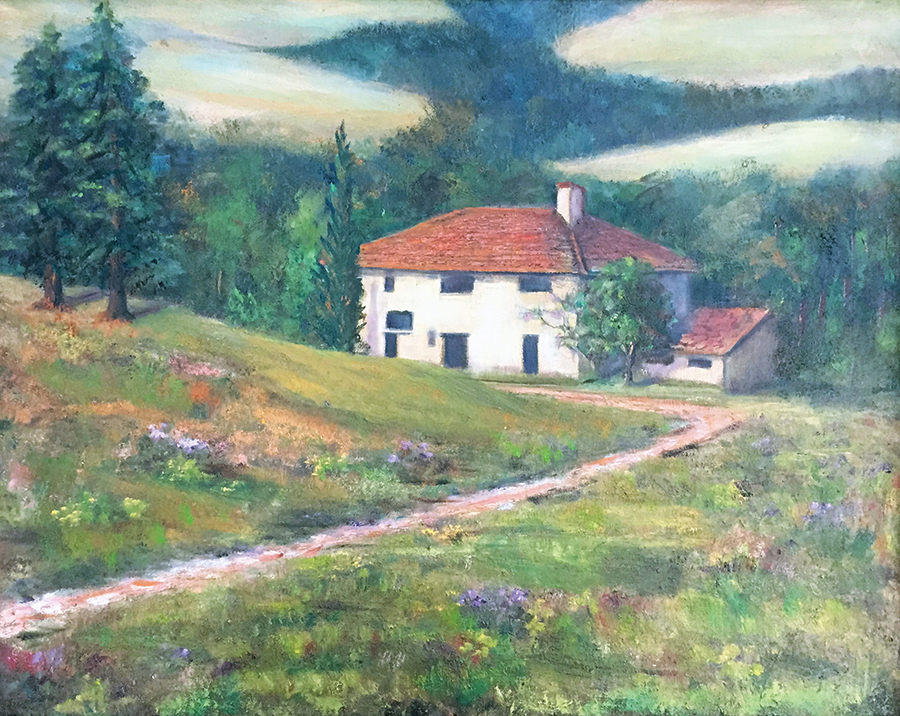
“Round here jus’ ain’t the place to be, come August,” the old farmer said. “Too damn hot.”
How true. I’m more cool cookie than red hot mama. I get nauseated just thinking about the poor souls left in the Sandhills, pre-AC, after the rich snowbirds flew home, or to Nantucket, or to mountain lodges overlooking frigid lakes. I remember childhood summers spent grudgingly in Greensboro with my grandparents, in the house on Lee Street where my mother was born. All we had were fans, popsicles and the occasional movie at the big theater with an “Air Cooled” banner fluttering above the marquee. Exiting, after we’d sat through the movie twice, was like hitting a wall.
If I were in the Oval Office, the Oval Office would be in Caribou and Florida wouldn’t have been admitted to the union.
At least an August oven is better tolerated elsewhere as summer’s last gasp. Here, suffering extends through September, sometimes later.
Which got me to ruminating on methods, real or imagined, for stayin’ alive minus AC.
Feet first: I remember the old folks sitting on the porch, soaking their feet in round porcelain basins (white, with blue rim and chips aplenty) filled with cold water. Only works up to size 9. Plastic isn’t the same.
Face second: Ever hear of a watermelon facial? Probably not, ’cause I just invented it. Cut a chilled small watermelon in half. Squish the interior of one half with your fingers until mush. Remove makeup, put on a shower cap, lean over and submerge face in mush. Come up to breathe only when absolutely necessary. Repeat until the cool trickles down your neck. Makes a mess, feels great.
Blowin’ in the wind: Find one or two loose, gauzy all-cotton tops and wear them every day. Who cares what people say? Guys, your operative is madras. If men in India don’t know how to stay cool, who does?
Hot to trot: Speaking of India . . . in the Middle East, North Africa and the tropics, folks sip hot drinks to cool off. The heat promotes perspiration, nature’s cooling process. Maybe for Lawrence of Arabia. I’m sticking with club soda and lime.
Peas, please: A bag of frozen peas is malleable enough to tuck anywhere, for a quick cooldown. Try the forehead, nape of neck, inner thighs, small of back. No cauliflower or broccoli. Too spikey.
The Real Thing: Locate some plastic or glass Coke bottles with waists. Fill three quarters full with water and freeze. Lie down; tuck bottles behind bent knees or elbows, maybe under wrists.
Fan-tastic: I am told that stepping out of the shower, dripping wet, buff naked, then standing in front of an electric fan going full blast works wonders. Make sure you lock the door.
Ticket to ride: On the coast of Maine, the surf is cold enough to anesthetize body parts in 45 seconds. Take a plaid jacket because the early maples start turning end of month.
Work on it: Get a job stocking frozen food in a supermarket. Offer to clean out a restaurant walk-in cooler. Enroll in med school; operating rooms are kept at about 60 degrees, year-round.
I’m not sold on mind over matter — especially heat matter — but if these handy dandy ploys fail, you could try closing your eyes and imagining giant snowflakes falling on your face, melting and running off like tears. For me, tears of joy when autumn finally arrives.PS
Deborah Salomon is a staff writer for PineStraw and The Pilot. She may be reached at debsalomon@nc.rr.com.
Set in the dark underbelly of a high-end Toronto restaurant kitchen, The Dishwasher is a tragicomedy that follows a down-on-his-luck 30-something artist with a fabulous taste in music and a little gambling addiction. As much a philosophical dive into life, love, trust, obsession and heavy metal as it is a good story, The Dishwasher will make you laugh, cringe, shake your head and drool over the amazing food. It’s hard to put this quirky but cool debut novel by Canadian author Larue down. Perfect for fans of David Sedaris or Anthony Bourdain.
The Passengers, by John Marrs
At a time when advances in artificial intelligence are making some people uneasy in the real world, Marrs has upped the ante in his new novel. Eight people are riding in their self-driving cars when suddenly the doors lock and their routes change. A voice tells them they’re going to die. The hacker who has trapped them leaves their fate to a committee of five and social media to decide which passenger should be saved. What makes one person more valuable than another? And what secrets are the hacker, the passengers and the committee hiding? The Passengers is thrilling ride!
The Swallows, by Lisa Lutz
In a blistering, timely tale of revenge and disruption, The Swallows shows us what can happen when silence wins out over decency for too long. When Alexandra Witt joins the faculty at Stonebridge Academy, she’s hoping to put a painful past behind her. Then one of her creative writing assignments generates some disturbing responses from students. Before long, Alex is immersed in an investigation of the students atop the school’s social hierarchy and their connection to something called the Darkroom. She inspires the girls who have started to question the school’s “boys will be boys” attitude and encourages their resistance. Just as the movement gains momentum, Alex attracts the attention of an unknown enemy who knows a little too much about her, and what brought her to Stonebridge in the first place.
Hollow Kingdom, by Kira Jane Buxton
S.T., a domesticated crow, is a bird of simple pleasures: hanging out with his owner Big Jim, trading insults with Seattle’s wild crows (those idiots), and enjoying the finest food humankind has to offer — Cheetos. Then Big Jim’s eyeball falls out of his head, and S.T. starts to feel like something isn’t quite right. His most tried-and-true remedies — from beak-delivered beer to the slobbering affection of Big Jim’s loyal but dim-witted dog, Dennis — fail to cure Big Jim’s debilitating malady. S.T. is left with no choice but to abandon his old life and venture out into a wild and frightening new world with his trusty steed Dennis, where he discovers that the neighbors are devouring each other and the local wildlife is abuzz with rumors of dangerous new predators roaming Seattle. Humanity’s extinction has seemingly arrived, and the only one determined to save it is a foul-mouthed crow whose knowledge of the world around him comes from his TV-watching education. Hollow Kingdom is a humorous, big-hearted romp.
A Nice Cup of Tea, by Celia Imrie
Foodie fun, a Cote d’Azur setting, five outrageous friends, and a rogue grandchild all combine to make this page-turning cottage mystery the absolute perfect choice for a day on the beach. The third book in the “Nice” series by Imrie, this continuation of the story of five expats who own a restaurant in the Bellevue-Sur-Mer also serves as a stand-alone, and will delight both series fans and those just looking for a quick trip to the South of France
NONFICTION
The Mosquito: The Human History of Our Deadliest Predator, by Timothy C. Winegard
Winegard takes us on a fascinating and delightful journey through the annals of human history, showing us just how much we owe our existence to the lowly mosquito. Were it not for the mosquito, America, Britain and numerous other nations would not exist in their present form, and the victors of countless wars would have otherwise been defeated. No other creature has transformed human civilization and evolution so profoundly, and no other book has told this epic story from a global perspective in this extraordinary look at the mosquito’s impact on our modern world order.
The Ghosts of Eden Park: The Bootleg King, the Women Who Pursued Him and the Murder That Shocked Jazz Age America, by Karen Abbott
In this true crime story from the New York Times best-selling author of Sin in the Second City and Liar, Temptress, Soldier, Spy, a German immigrant named George Remus quits practicing law and starts trafficking in whiskey, quickly becoming a multi-millionaire, controlling 35 percent of all liquor sold in Prohibition-era America by 1921. The King of the Bootleggers, and his second wife, Imogene, have Gatsby-esque parties at their Cincinnati mansion, passing out party favors of diamond jewelry and cars. Pioneering prosecutor Mabel Walker Willebrandt is determined to bring Remus down, and she dispatches her best investigator, Franklin Dodge, to do the job. Remus is quickly imprisoned for violating the Volstead Act and, with her husband in jail, Imogene begins an affair with Dodge. Together, they plot to ruin Remus, sparking a bitter feud that can only end in murder.
NFL Century: The One-Hundred-Year Rise of America’s Greatest Sports League, by Joe Horrigan
The NFL has come a long way from its founding in Canton, Ohio, in 1920. In the 100 years since that fateful day, football has become America’s most popular and lucrative professional sport. The former scrappy upstart league that struggled to stay afloat has survived a host of challenges — the Great Depression and World War II, controversies and scandals, battles over labor rights and competition from rival leagues — to produce American icons like Vince Lombardi, Joe Montana and Tom Brady. Its extraordinary and entertaining history is recounted by Horrigan, perhaps the greatest living historian of the NFL, who draws upon decades of NFL archives. Compelling, eye-opening and authoritative, NFL Century is a must-read for anyone who loves the game of football.
CHILDREN’S BOOKS
The King of Kindergarten, by Derrick Barnes
The king of kindergarten eats a good breakfast, dresses himself, and has a loving mother to kiss him goodbye. He is confident, kind and open to new experiences. He rests a bit, plays a bit, and shares. He has infectious enthusiasm for learning. The first day will be a breeze for the king of kindergarten! This wonderful little book should be required reading for every new king. (Ages 4-6.)
The Pigeon HAS to Go to School!, by Mo Willems
What’s the best thing about school for a pigeon? The school bus! This fun new Pigeon book from the rock star children’s author Willems (Elephant and Piggie series) will have everyone excited about going to school in the fall. (Ages 4-6.)
Even Monsters Go to School, by Lisa Wheeler
A back-to-school book that’s out of this world, Even Monsters Go to School is just perfect for giggle-inducing, first-day-of-school reading. (Ages 3-6.)
Dog Man: For Whom the Ball Rolls, by Dav Pilkey
Howl with laughter with Dog Man, the No. 1 New York Times best-selling series from the creator of Captain Underpants. In the newest installment of the wildly popular series that explores universally positive themes like empathy, kindness and persistence, Dog Man must face his fears and Petey the Cat learns the difference between being good and doing good. Readers will enjoy taking part in Pilkey’s #DoGood focus for the fall by doing good deeds of their own. (Ages 7-12.)
Scouts, by Shannon Greenland and James Patterson
Annie, Beans, Rocky and Finn are scouts headed out for a hike to the perfect spot to watch a meteor shower, but when a meteor hits, they find themselves on a bigger adventure than they ever imagined. An awesome adventure book for kids who love the outdoors and are looking for a quick fun read. (Ages 9-13.)
Sorcery of Thorns, by Margaret Rogerson
As the only foundling ever to be raised in one of Austermeer’s Great Libraries, Elisabeth Scribner has strength and powers like none other, powers she has gained from living among the books, among the Grimoires, and from the ink that seemingly runs in her veins. And if Elisabeth is going to save Austermeer from imminent evil, she is going to need all the power she can muster. Along with her inherited sword Demonslayer, the handsome, clever, tortured Magister Nathaniel Thorne, his mysterious demon and a few helpful friends along the way, Elisabeth will give her all to save both the Great Libraries and the world she loves. Fabulous fantasy for book lovers and adventure seekers alike, Sorcery of Thorns is an absolute page-turner from the very first inky scene. (Ages 14 and up.)PS
Be kind to our feathered friends by gardening with local plant species
By Susan Campbell
During these dog days
of summer, if you are looking for a reason to shirk tasks such as weeding or abandoning your attempts to grow the perfect lawn (not to mention spending less time watering), I may have some good news for you!More and more folks are abandoning conventional landscaping to take advantage of local plants — from towering trees right down to ground-hugging grasses, even mosses in order to produce patches of native habitat. And this is very good news for our birds and our pollinators — actually an invaluable turn of events for literally scores of wildlife species.
Anyone who has been a backyard gardener will probably give you more than one argument for shunning vast lawns and alien ornamental plantings. The list is endless: pest problems, irrigation, expensive fertilizers, dangerous herbicides and pesticides, plus the cost and pollution from gas-operated trimmers and mowers. Using local species is not only likely to result in better success but it provides a “sense of place.”
But the real and lasting bonus to embracing native landscaping has a more global reach. It restores vestiges of original ecosystems — so much of which were lost as a result of agriculture, forestry and other land use changes since the Industrial Revolution.All of those small patches of habitat being created represent a new hope for bees, birds, reptiles, amphibians and even mammals that have been displaced over the decades. Relatively few large tracts of land are available for preservation these days: Our best hope for the future literally lies in each and every one of our own backyards.
Dare I begin with exotics? Sadly, many have escaped and turned into an invasive species nightmare. Water hyacinth smother ponds. Rapacious Japanese wisteria or rampant Japanese honeysuckle gobbles up trees and shrubs. Popular privet hedges and the Bradford pears crowd out native species. Worse yet, the drought-tolerant nandina, whose berries are loaded with cyanide, can actually kill birds, including cedar waxwing, American robin, Northern mockingbird and Eastern bluebird.
Buy local and get good local advice on native species. Better yet, visit the N.C. Botanical Garden in Chapel Hill where you can see native flora growing during the course of the entire year. For a good online source, type “NCSU Native Plant Resources” into Google to get expert advice by region.
Finally, should you reside in a community with restrictions on landscaping that may make this sort of yard challenging (such as here in Pinehurst), I would suggest looking into National Wildlife Federation’s backyard certification program by typing “nwf certified wildlife habitat” into Google. With hope, an official designation as well as the signage that goes with it, your project will be justified and understood as beneficial by the powers-that-be.PS
Susan would love to hear from you. Send wildlife sightings and photos to susan@ncaves.com.
The large, jolly-old-elf planet moves direct from its retrograde phase, bearing gifts along the way
By Astrid Stellanova
Four months ago in April, Jupiter went retrograde. On August 11, Jupiter is going direct. This means (stellar Star Children that y’all are) that you can finally put to good use the knowledge you’ve been saving up for God-knows-how-long, but definitely too long. Mid-August, the full moon is in Aquarius. Dance on fertile ground and allow that psychic energy to rise up in you from your tippy toes. Meanwhile, don’t settle for humdrum but spice it up — douse them collard greens with peppers and vinegar!
Leo (July 23-August 22)
A tub of the world’s finest cellulite cream won’t straighten out the wrinkles from last month’s fiasco when your vanity got the better of you. A sweet-talking somebody sold you on a ridiculous number of superficial fixes. (Not literally, Sugar, the metaphorical kind.) What you really crave and need is straight talk. Learn to fight desperation with hope that ain’t found in a jar. Besides, a blind mule ain’t afraid of darkness.
Virgo (August 23–September 22)
You’re a creative spitfire, known to let the pot boil over when you are in the middle of a project. Virgo season begins August 23, and that will signify a season of planning and cogitating. Give your sensitive self the time to reach those who matter.
Libra (September 23–October 22)
You wiggled around an issue like a worm in hot ashes. Now get a grip, because you are so whizbang amazing at so many things you seem to fixate on those teensy things you aren’t good at. Sweet thing, move into the big picture stage of your life.
Scorpio (October 23–November 21)
Sulking and bitching are bad enough when you’re a teenager, but downright unattractive when you’re middle-aged. Don’t bother your besties unless you are on fire. Fergoddsakes give them a break. Buy ’em coffee, wine, whatever. Period.
Sagittarius (November 2–December 21)
You went all Jesus, judgment and cheetah print when under pressure. Back up and clean it up and say you’re sorry. If you can somehow remedy that situation, then you deserve a gold star. The next lesson is learning grace when things are going well.
Capricorn (December 22–January 19)
This month may feel like a repeat of when you spilled sweet tea all over the place and it was noticed. The good news is your devoted friends just rolled their eyeballs. Now you get to return the favor when someone else spills something all over the place.
Aquarius (January 20–February 18)
Sugar bun, the full moon on the 15th is like magic time for you and the causes dearest to you. Use the light of the big, round orb to guide you and your steps. You have the platform to help those poor Muggles who don’t have your super powers.
Pisces (February 19–March 20)
Is there a loud, louder, loudest dog barking? Any signs of guilt you’ve overlooked? Be perceptive. Not to say jump to conclusions, just be aware. Late this month is a second full moon, which may give you surprising powers and light.
Aries (March 21–April 19)
You’re in for a spell of unexpected events, which is a lot like saying it’s hotter than hell in Texas. Aries born are born for the unexpected, which you will take to like a wizard to a wand. Fried okra and Jesus may figure into this month’s events.
Taurus (April 20–May 20)
If you practice and repeat your newfound skills, you have opportunities open that you have never experienced. The question is, will you, or is it irresistible to you to break wind in the spiritual elevator and pretend you didn’t?
Gemini (May 21–June 20)
There’s you, elbowing your way ahead, whether it’s a 75 percent-off sale or a spiritual crusade. Sugar, sometimes your ambition isn’t just blind — it is plain wrong. Bite back that impulse to power to the front and give somebody else an (unbitten) hand.
Cancer (June 21–July 22)
Now that you have survived a down-to-the-wire scary time, you look worse than death on a saltine cracker. Take care of yourself, put your face back on, pull up your britches and take a respite. Remember, you can almost always disarm with charm.PS
For years, Astrid Stellanova owned and operated Curl Up and Dye Beauty Salon in the boondocks of North Carolina until arthritic fingers and her popular astrological readings provoked a new career path.
America’s sudden passion for heirloom fruits and vegetables means glorious varieties like Santa Rosa and Mirabelle plums are widely available
By Jane Lear
One of my earliest food memories is of a high-walled garden somewhere along the Cape Fear. It belonged to friends of my parents, and while they sipped long cool drinks in the shade of a venerable live oak, I was allowed to explore and eat pretty much anything I could find. Blueberries, raspberries, the pears reached by shinnying up a knotted rope to a convenient branch. Figs, plump and sweet with ultra-delicate skins.
And there were wonderful plums. I found their thin, taut red skins and gold flesh mesmerizing. Their rich aroma and full-on sweet-tart flavor were a revelation, and their texture — well, after my mother tried one, it was the first time I heard the word “lush.”
Those beauts were worlds apart from the characterless supermarket plums that are so common today. For ages, I thought those plums I enjoyed as an 8-year-old couldn’t possibly have been as magical as I remembered.
Until, that is, about 15 years ago on a visit to northern California, when I first bit into a plum from Frog Hollow Farm. The cultivar was ‘Santa Rosa,’ I discovered, and I felt as though I’d found a long-lost friend.
Santa Rosa has a grand American history. It was bred in 1906 by the celebrated horticulturalist Luther Burbank (1849–1926) at his plant research center. Named for its birthplace, the plum is arguably his crowning achievement. It’s no surprise that our family friends, both enthusiastic home orchardists, would have gotten their hands on some trees.
The tight skin of a perfectly ripe Santa Rosa pops when you bite into it, and when devouring the flesh (“lush” is exactly what it is), it’s best if you’re leaning over the kitchen sink. I have this image of the modernist poet William Carlos Williams doing so, whisking his tie out of the way at the last second, before turning guilt into art in “This is Just To Say”:
“I have eaten / the plums / that were in / the icebox / and which / you were probably / saving / for breakfast. / Forgive me / they were delicious / so sweet / and so cold.”
Any high school English teacher will tell you that this much-anthologized poem, written in 1934, can have a number of different meanings, including temptation and the triumph of the physical over the spiritual. But it’s also a great example of how to offer a non-apologizing apology after inconveniencing a loved one. The subsequent parodies (the first, by Williams himself) continued for decades and indeed have been given new life as a meme on Twitter:
“I have closed / the tabs / that were in / the browser / and which / you were probably / saving / to read / Forgive me / they hogged memory / and were / so old,” wrote stvnrlly@stvnrlly.
Happily, America’s increasing passion for heirloom varieties of fruits and vegetables means a wider array of interesting plum varieties is available, including Santa Rosa and the small ‘Mirabelle,’ which is yellow blushed with crimson and intensely sweet. (In France, it’s used to make plum eau-de-vie.) Keep your eyes open, and if you see juicy looking tree-ripened plums for sale anywhere, snap them up.
The Williamses and their icebox aside, plums won’t continue to ripen if chilled. Keep them at room temperature and out of direct sunlight instead. If you must refrigerate them (they’re a magnet for fruit flies), don’t wash the ripe fruit beforehand, and bring to room temperature before eating. Another tip? Never cluster or stack plums or any stone fruit — that leads to uneven ripening or bruising. So spread out your bounty onto a platter instead of piling it into a bowl.
Whenever I see promising plums, I always buy too many, because I can’t decide what to do with them. A galette is always appealing, as is an upside-down cake. But I often take the path of least resistance and roast them, a technique I picked up from cookbook author and all-around culinary goddess Georgeanne Brennan. She roasts her stone fruit in a wood-fired outdoor oven, but a regular old oven works fine too, even though it isn’t nearly as romantic. And her trick of serving the roasted fruit with crème fraîche worked into fresh ricotta is a keeper: The thickened cream gives the fluffy, uncomplicated ricotta a nutty sweetness, a little tang, and voluptuous body.
I love the rich, faintly spicy flavor of roasted plums all by themselves, but you could easily use peaches or a combination of stone fruits — plums and nectarines, say. And you could substitute a dollop of mascarpone or softly whipped heavy cream for the creamy ricotta.
Roasted plums are versatile. They swing homey or haute, and are ideal if you aren’t a baker or need a gluten-free dessert, because there is no crust or crumble topping involved. They cook quietly all by themselves and make the kitchen smell heavenly. And, if you are fortunate, there will be a spoonful or two left for tomorrow morning.
Then again, you could just eat your plums out of hand, leaning over the kitchen sink.
Roasted Plums with Creamy Ricotta and Honey
1 cup fresh ricotta
About 1/4 cup crème fraîche
A dash of pure vanilla extract
Sugar
6 to 8 plums, depending on size, or a mixture of plums and nectarines and/or peaches
Extra-virgin olive oil
Honey, for drizzling
1. Preheat the oven to 475º. Stir together the ricotta, crème fraîche, vanilla and about 2 tablespoons sugar, or to taste, in a bowl. Pop that into the fridge until ready to use.
2. Cut the plums from stem end to bottom, first down one side, then the other. Gently twist the halves together; if they separate from the pit easily, that means they are freestone. Otherwise, they’re clingstone, so cut the flesh away from the pit in largish wedges. Put the plums in a shallow baking dish just large enough to fit them in 1 layer. Drizzle with about 1 tablespoon oil and turn them a few times to coat. Generously sprinkle with sugar and turn once or twice more. Roast until the plums have just collapsed and are tender and just caramelized enough, about 20 minutes.
3. Serve the plums in small bowls with the creamy ricotta and honey, for drizzling, on the side.PS
Jane Lear, formerly of Gourmet magazine and Martha Stewart Living, is the editor of Feed Me, a quarterly magazine for Long Island food lovers.
When the United States Amateur Championship makes its fourth trip to the Sandhills of North Carolina this August, it brings with it the promise of great achievement and the baggage of great expectations. Whoever survives two rounds of stroke play qualifying followed by six matches will have reached the pinnacle of his amateur career and earned the scrutiny that just naturally accompanies winning a national championship. August will bring the heat, but the U.S. Amateur brings a little of its own.
It has been won by mortals and immortals. It’s been won by the greatest players who ever lived — Robert T. Jones Jr. (five times), Jack Nicklaus (twice) and Tiger Woods (three times in succession). It has been won by players who capture the odd major championship without scooping up double handfuls of them and still other players who have solid professional careers, winning tour events here and there along the way. It was won in back-to-back years by one of Pinehurst’s favorite sons, Harvie Ward. It’s been won by players who disappear almost entirely from the golf horizon and by others who become barons of the game, say, a president of the USGA (William C. Campbell) or the chairman of the Augusta National Golf Club (Fred Ridley).
Labron Harris Jr. won the title on Pinehurst’s No. 2 course in 1962 with Dwight Eisenhower in the gallery. Hal Sutton lifted the Havermeyer Trophy — named for the first president of the USGA, a Wall Street sugar tycoon — at the Country Club of North Carolina in 1980. And Danny Lee pushed aside Tiger Woods’ record to become the youngest winner of the championship when it returned to Pinehurst No. 2 in 2008. It was a record that would last for all of one year.
This year’s championship will be conducted on Pinehurst’s No. 2 and No. 4 courses, the latter recently revamped by Gil Hanse. The 312 entrants will play 36 holes, one round on each of the courses, to winnow the field to 64 for match play. The first five rounds of matches will be conducted on No. 2, and the 36-hole final will be played on No. 4 in the morning and No. 2 in the afternoon, a first for the 119-year-old championship.
Sutton’s victory in 1980 was, at the time, thought to be mere prelude. That summer he’d entered five tournaments, winning four — Pinehurst’s North and South, the Western Amateur, the Northeast Amateur and the U.S. Amateur. He was unbeaten in match play. The only title to elude him was the Southern Amateur, a stroke play event won by Bob Tway. Sutton’s father, Howard, owned an oil business in Shreveport, Louisiana, and there was talk of Hal becoming the next Bob Jones, someone who could afford to remain an amateur and who had enough game to compete with the professionals. He was, in fact, an amateur long enough to try, unsuccessfully, to defend his U.S. Amateur title — something that won’t happen this year, since the defending champion, Norway’s Viktor Hovland, has become a pro.
Photo shows Hal Sutton at the 1980 U.S. Amateur. (Copyright Unknown/Courtesy USGA Museum)
After winning the PGA Championship at Riviera Country Club three Augusts after he won the U.S. Amateur, instead of becoming the next Bob Jones, Sutton was in line to be “the next Nicklaus.” Neither happened. He did, however, win 14 times on the PGA Tour, including the ’83 PGA, where he led wire-to-wire, holding off a charging Nicklaus, the five-time PGA Champion, by a single shot. He also won the Tour Championship in 1998 and The Players Championship twice, once in ’83 and again in 2000, when he outdueled Woods, the man who truly was “the next Nicklaus,” also by a single stroke. A clip of Sutton’s approach to the 18th green at TPC Sawgrass can still be found on YouTube. “Be the right club today!” has become Sutton’s trademark.
Sutton won the U.S. Amateur on the 50th anniversary season of the Impregnable Quadrilateral when Jones won both the U.S. and British Amateurs and U.S. and British Opens in 1930. Unlike Jones, there was no ticker-tape parade for Sutton, just dinner at the old JFR Barn. Sutton would return to Pinehurst in October to play for the Eisenhower Trophy in the World Amateur Team Championship on the No. 2 course. He won that, too, taking the individual title by six shots. The U.S. team won by 27.
“I just loved No. 2,” Sutton says. “It favored a real good ball-striker, especially a good iron player. It kind of weeded out the weak. I think that’s what really makes great golf courses; they’re fair to people that hit the ball where they’re looking, and they’re much more difficult for people that can’t.”
Sutton is one of the players who felt the burden that can accompany a U.S. Amateur title. “At the time it was by far the largest thing I’d ever done,” he says. “It was a sense of great accomplishment, I remember that. I hoped it would be the beginning of big things.
“Everybody that wins the U.S. Amateur, it elevates the expectations for them. It causes people to watch to see what you are able to do. I think as you age you begin to realize that the only expectations that really matter are your own. I was the turtle instead of the rabbit most of the time.”
Big Easy Ranch, Sutton’s hunting, fishing and golf academy, is about 70 miles west of downtown Houston. He suffered a mild heart attack in 2014, the same year he had his second hip replacement. Now 61, Sutton was sufficiently inspired by Woods’ 2018 Tour Championship victory to give the Champions Tour one last go. He dropped 45 pounds but, even so, the body wouldn’t cooperate. He played a few events but was forced to withdraw from his last two by a left knee that needs replacing as much as the hips did.
In the final of the 1980 U.S. Amateur, Sutton beat Bob Lewis, 9 and 8. Lewis was 35 at the time, a professional who had regained his amateur status. Lewis was hobbled by blisters on the backs of his heels, giving him a painful, bowlegged gait. “He wasn’t as old as I am right now,” says Sutton, “but health issues do catch up with us. We’re certainly not what we once were.”
Labron Harris Jr., the son of the legendary Oklahoma State University golf coach Labron Harris Sr., won the first U.S. Amateur held on Pinehurst’s No. 2 course, coming back from a five-hole deficit to beat A. Downing Gray, an insurance salesman from Pensacola, Florida, 1 up. “I went there with the idea of not winning,” says Harris. “I’d check out of the hotel every day and I’d keep winning matches and I’d check back in. You don’t conceive of winning the U.S. Amateur. You shoot your 75 on the right day and you win if you play someone that shoots 77. That’s the beauty of match play and the fallacy of match play.”
One of Harris’ victims was Morganton’s Billy Joe Patton, the local favorite. “It was probably the least popular victory ever in North Carolina,” says Harris.
Gray held a 5-up lead through 21 holes of the final match. He set his afternoon’s cascading misfortunes in motion with a poor drive on the fourth, losing that hole, and then dropping the next four straight to two birdies and two pars, squaring the match after the eighth. On the 11th, Gray drove it against a formidable stand of love grass and Harris went 1-up.
Former President Eisenhower watched only four holes in the afternoon, taking his leave after the golfers hit their tee shots on the par-3 15th. The commander of D-Day was in a golf cart back in the 14th fairway when the two players were invited to meet him before he left. Harris went.
“A USGA man says, ‘Do you want to meet President Eisenhower?’ I said, ‘Sure.’ I’ve got a picture right here in my bedroom, a young man shaking hands with an ex-president.” Gray, his fortunes dwindling, wanted to concentrate on his golf. The next day the headlines read, “Gray Snubs Ike.” Ouch and ouch.
Harris played on the PGA Tour from 1964 to ’76 and won once, beating Bert Yancey in a playoff in the 1971 Robinson Open Golf Classic. “I played good for about half the years,” he says. After his playing career ended, he worked for the Tour for five years.
“I was the No. 2 man (to commissioner Deane Beman) but there were only 10 people in the office,” says Harris. “I did everything. I did the scheduling; the purse negotiations; ran the qualifying schools. I developed the senior tour. The money breakdown they play with now is my money breakdown. I came at the right time to be pretty effective. I was fortunate I worked with good people.”
After he left the Tour, he was the executive director of the Kemper Open for five years. Oh, and he won the Par 3 Contest at the Masters in 1964. There’s no golden trophy for that, but there is crystal.
Danny Lee with the trophy after winning the 2008 U.S. Amateur at Pinehurst Resort and Country Club, course No. 2, in Pinehurst, N.C. on Sunday, August 24, 2008. (Copyright USGA/John Mummert)
When the Amateur last visited Pinehurst, it was won by an 18-year-old Korean-born New Zealander, Danny Lee, who beat Drew Kittleson, 5 and 4. Lee was six months younger than Woods was when he won the first of his three U.S. Amateurs in 1994. An Byeong-hun of South Korea blew that record out of the water the very next year, winning at age 17.
Lee’s professional career has been an up-and-down affair with an Official World Golf Ranking that’s gone as high as No. 34 (in 2016) and as low as 444 (in 2010). He won the Greenbrier Classic in 2015 and had seven other top-10s that year. He’s won once in Europe (when he was still an amateur) and once on the Web.com, now the Korn Ferry Tour. He shot an opening-round 64 at Bethpage Black in the PGA Championship in May to trail the eventual winner, Brooks Koepka, by a shot. On social media he’s best known for the practical jokes — traffic cones tied to cars; shaving cream in shoes; so forth and so on — he and Rickie Fowler seem to enjoy playing on one another.
In 2017, Lee suffered a torn ligament between L4 and L5 in his back. “I felt something and the only place I could go was lying on the ground,” he recalled during the PGA. “The next morning when I got up from my bed, I could not move my legs.” Since recovering, Lee has been working with California instructor George Gankas to get longer off the tee. “At first I wasn’t hitting it far enough to compete out here in a PGA Championship or U.S. Open.” Now he does.
That hasn’t altered the vagaries of Tour life much. “Some of the top 20 guys make it look easy, but it’s not always fairy tales and unicorns out here,” Lee said. “When you are fighting for your Tour card every year, it’s basically where you work. How would you feel when you lose your job tomorrow? And you put a lot of effort into it. You’ve tried your best and you did everything you could do and you don’t have a job tomorrow. That’s the same feeling we have. When the results are not there, it definitely gives you a little heartbreak and a little bit of terror, and some of the media is expecting me to do better than that.”
That’s a long way from 2008 when Lee, who had no intention of turning pro at the time, was reminded that the U.S. Amateur champion is traditionally paired with the defending champion at the Masters the following year. That just happened to be Woods. “Oh, my God,” he said. “That’s a special thing. Wow. I’m gong to beat him.”
Winning the U.S. Amateur is a great achievement, a long and arduous climb to the top of a grand hill — a vantage point where it’s possible to see just how heavy the mantle of potential can be.PS
Jim Moriarty is senior editor of PineStraw and can be reached at jjmpinestraw@gmail.com.

Some North Carolina literary old-timers remember a special link between North Carolina and Brooklyn.
In 1943 Harper & Brothers published the best-seller, A Tree Grows in Brooklyn, one of America’s most-loved novels. The North Carolina connection?
Although its author, Betty Smith, based the novel on her experiences growing up in Brooklyn, she wrote the book in Chapel Hill. As a struggling divorcée with two children, she had moved to North Carolina to work at the University of North Carolina as a part of Paul Green’s writing program. The money she earned kept her going until the success of her book gave stability to her economic life.
This year the literary connection between Brooklyn and North Carolina has been renewed by two debut novelists, each with connections in both places. It happened earlier this year when Smith’s publisher, now HarperCollins, released A Woman Is No Man, the debut novel of Etaf Rum.
Like Smith, Rum based her novel on her life growing up in Brooklyn. Like Smith, the divorced Rum moved to North Carolina. Like Smith, she had two children. Like Smith, she found work in higher education, in Rum’s case, community colleges near where she lives in Rocky Mount.
Rum’s Palestinian immigrant family and neighbors in Brooklyn in the 1990s and 2000s are not the same as Smith’s families, whose roots were in Western Europe. Still, both books deal with women’s struggles to make their way in families and communities dominated by men.
The central character in the first part of Rum’s book is Isra, a 17-year-old Palestinian girl whose family forces her into marriage with an older man, Adam. He owns a deli and lives with his parents and siblings in Brooklyn. Adam and Isra move into his family’s basement. Isra becomes a virtual servant to Adam’s mother, Fareeda. She pushes the couple to have children, males who can make money and build the family’s reputation and influence. When Isra produces only four children, all girls, she is dishonored by Fareeda and by Adam, who begins to beat her regularly.
Isra and Adam’s oldest daughter, Deya, becomes the central character of the second part of the book. Adam and Isra have died, and Fareeda raises their children.
When Deya is a high school senior, Fareeda begins to look for a man in the Palestinian community for her to marry. Deya wants to go to college, but she is afraid to bolt from her family and the community’s customs.
Though fiction, A Woman Is No Man is clearly autobiographical. As such, Rum explains, the book “meant challenging many long-held beliefs in my community and violating our code of silence.”
“Growing up,” she writes, “there were limits to what women could do in society. Whenever I expressed a desire to step outside the prescribed path of marriage and motherhood, I was reminded over and over again: A woman is no man.”
She writes that “what I hope people from both inside and outside my community see when they read this novel are the strength and resiliency of our women.” It will stir readers for other reasons, too. Its themes of conflict between a drive for individual fulfillment and the demands of community and family loyalty are universal.
The author’s well-turned and beautiful writing makes reading this debut novel a pleasure. Finally, her careful, fair-minded, sympathetic descriptions of complicated and interesting characters give the story a classic richness. Whether or not A Woman Is No Man attains the beloved status of A Tree Grows In Brooklyn, it will surely be a widely appreciated treasure.
Another debut novel connects Brooklyn and North Carolina. This time it is a North Carolina native who moves to Brooklyn from Elizabeth City. From there, De’Shawn Charles Winslow moved to Harlem, where he wrote In West Mills, a book about African-Americans living and struggling in eastern North Carolina from roughly 1940 to 1987. There are no major white characters, and no focus on Jim Crow racism. There is almost nothing about racial conflict or the civil rights struggle. Putting these themes aside, Winslow shows his characters grappling with universal challenges that people of all races confront as they deal with the human situation.
West Mills is a fictional small town in eastern North Carolina, somewhere between Elizabeth City, where the author grew up, and Ahoskie, where the main character of the novel was born and reared.
That main character, Azalea Centre, or Knot, as she is called by everyone, has moved to West Mills from Ahoskie, where her father is a dentist and a bulwark of the local church. Knot, however, wants to get away from her family and make her own way.
She finds a teaching job in West Mills. Knot loves 19th century English literature. That sounds good for a teacher, but she also loves cheap moonshine and bedding a variety of men. One of them, Pratt Shepherd, wants to marry her. But after a session of enthusiastic lovemaking, she tosses him out of her life.
Soon after Pratt leaves, Knot learns she is pregnant. She does not want to end the pregnancy, but wants nothing to do with the child after its birth. To the rescue comes a dear friend, Otis Lee Loving, and his wife, Penelope, or “Pep.” They find a local couple to adopt Knot’s daughter. Only a few people in the community know that Frances, daughter of Phillip and Lady Waters, is really Knot’s birth child.
Shortly after she recovers from her delivery, Knot becomes pregnant again. Otis Lee comes to the rescue once more. He finds a place for the new baby with local storeowners, Brock and Ayra Manning. They name the baby Eunice.
When they grow up, Frances and Eunice, not knowing about their common origin, come to despise each other and fight for the attention of the same man. On this situation, Winslow builds a series of confrontations and complications that challenge the comfortable order of the West Mills community.
Meanwhile, as time passes, the community seems immune to the racial conflicts developing in other parts of the state. In one of the book’s few mentions of racial conflict, Otis Lee hears stories in 1960 about “the young colored people in Greensboro who had organized a sit-in a couple of months earlier” and pronounced it a terrible thing. Winslow writes, “Greensboro hadn’t come to them yet. And Otis Lee hoped things would get better so that it wouldn’t have to.”
Otis Lee is not only Knot’s loyal friend and rescuer, he becomes a major character. In a flashback to prohibition days he travels to New York City to rescue an older sister who is trying to pass for white. That effort fails, but his relationship with that woman provides a poignant thread that carries the book to one of its surprising endings.
Gathering early praise, Charlotte Observer critic Dannye Powell wrote of In West Mills, “Within its confines lies all you need to know of human nature — its stubbornness and grit, its tenderness and devotion, its longing and its sorrow, and how the best-kept secrets will threaten to take apart the heart, chamber by chamber.”
She concludes, “You’ll be hearing more about Winslow and his stunning debut novel.”
You will be hearing more about Winslow and Etaf Rum. Betty Smith would be amazed and proud. PS
D.G. Martin hosts North Carolina Bookwatch Sunday at 11 a.m. and Tuesday at 5p.m. on UNC-TV. The program also airs on the North Carolina Channel Tuesday at 8 p.m. To view prior programs go to http://video.unctv.org/show/nc-bookwatch/episodes/
I am naturally a see-the-glass-empty type of person. Not half-empty. Death Valley dry. Especially in the summer, when it’s scorching hot and I walk outside for just a minute and by the time I dive back into the AC, I’m stewing in my own juices. Sweaty summers are not on my list of favorite things.
One of my dear friends once told me to make a list of all the things I was grateful for. Think of it as an intervention. I looked at her and thought, “What a silly-Thanksgiving-lunch-elementary-school-pop-psychology-Dr.Phil thing to say.”
“No, really,” she said. “Try it.”
So, I did. I thought I might be able to come up with five things. Max. The usual. Family. Friends. Blah. Blah. But by item 86 (popcorn) and 87 (raspberry white chocolate mochas), I had it going on. That list — it’s 117 things and counting — helped me stay more positive. So, now I practice gratitude. And by practice, I mean, it really takes practice.
It’s not just the good things that are easy to be grateful for. The magical mind shift (now there’s a left-brain term for you) happens when you can take the bad stuff, drop it in the mental lettuce spinner and pump the handle until you see something good inside.
Gratitude works. I’ve seen it in action.
It works when I am overwhelmed with grading papers and final exams and students in sheer panic. Gratitude: I have a job. And I like it.
It works when I forget to make dinner and Chinese food appears on the table. Gratitude: We have food. And a table. And a Chinese take-out place five minutes from the house.
It works when I have gained three pounds this week. Gratitude: Those doughnuts were delicious.
It works when my 15-year-old son, David, needs to be at five different places in the time span of three hours. Gratitude: At least I can still drive him. Next year he will be driving himself. OMG.
It works when my dog wakes me up at 5 a.m. every morning. Every morning. Gratitude: I have a dog that never barks at me in a disrespectful tone of voice; never says things like, “What’s for dinner? Ugh! I hate Chinese food.”
It works when my kids are semi-sick and beg to stay home from school. Gratitude: I give them a dose of Tylenol and a list of chores to complete by the time I get home. Usually that makes them feel much better the next day.
It works in Wal-Mart when that person with 27 items (three of which need price checks) cuts in front of me and my five-item cart in the checkout line. Gratitude: I have more time to catch up on how Oprah Winfrey lost weight — this time — from the magazines in the magic aisle. I call it that because stuff magically appears in my cart: gum, Reese’s Peanut Butter Cups, nose hair trimmers. The essentials.
It works when the heat index is 101. Gratitude: At least my AC works, even if it wheezes like it’s having an asthma attack. I do need to change the air filter soon.
It works when my credit card bill arrives and I not so subtly notice the interest payment for the month. Gratitude: Um. I’ll get back to you on this one. Still working on it.
I’m sure there’s some Freudian explanation behind all this, or some neuroscientist somewhere who can explain what happens when your dopamine throws a headlock on your endorphins, but all I know is that being grateful works.
If a natural pessimist like me can do it, anyone can.PS
When Renee is not teaching English or being a professional taxi driver for her two boys, she is working on her first book.
The Arts Council of Moore County will be featuring artists from all over the country on Friday, Aug. 2, from 6-8 p.m. at the Campbell House Galleries, 482 E. Connecticut Ave., Southern Pines. For more information, call (910) 692-2787 or go to www.mooreart.org.
119th United States Amateur Championship
One of the oldest and most prestigious amateur golf championships in the world begins with qualifying on Pinehurst’s No. 2 and No. 4 courses on Aug. 12. After 36 holes the field will be trimmed to 64 players for match play. All matches will be played on Pinehurst No. 2 until the 36-hole final on Aug. 18 that will be contested on both the No. 2 and No. 4 courses, the first time the championship match has ever been played on two golf courses. For more information, go to www.usga.org.
Bocce Bash
Watch or play — or both — in the 12th Annual Sandhills Children’s Center Backyard Bocce Bash at the National Athletic Village, 201 Air Tool Road, Southern Pines, on Saturday, Aug. 17, at 9:30 a.m. Each team will play three games in a round-robin format. Teams check in at 8:30 a.m. Donations begin at $25 per player in this Children’s Center benefit. For information and registration, go to www.sandhillschildrenscenter.org.
U.S. Kids Come to Town
Beginning in late July and lasting until Aug. 4, more than 1,500 junior golfers from over 50 nations come to Pinehurst and Southern Pines for a weeklong golf experience that includes a Parent/Child Tournament, Team Challenge, Parade of Nations, three rounds of championship play and a closing ceremony. Following the three-day championship, the World Van Horn Cup — a one-day best ball tournament featuring the top 12-year-olds from the United States squaring off against the top 12-year-olds from the rest of the world – is contested on Pinehurst No. 2. For more information, go to uskidsgolf.com.
Summer Classic Movies
The Sunrise Theater closes out its Summer Classic Movie Series in August with three titles on consecutive Thursdays, beginning Aug. 1 with Hook, sponsored by The Ice Cream Parlor. On Aug. 8, Southern Whey is sponsoring Goodfellas, and the series concludes with This Is Spinal Tap, sponsored by Murphy Insurance Nationwide. Doors open at 6:30 p.m. and the movies begin at 7:30 p.m. Tickets are $6 at the Sunrise Theater, 244 N.W. Broad Street, Southern Pines. For more information, call (910) 692-3611 or go to www.sunrisetheater.com.
Evening with the Authors
Visit the Given Memorial Library and Tufts Archives, 150 Cherokee Road, Pinehurst, on Monday, Aug. 19, at 7 p.m. to kick off a new series highlighting Moore County authors. Local authors will be there to speak and answer questions about their books. The event is free and open to the public. For more information, go to www.giventufts.org.
Conversation Cafe
Stop by to listen, reflect and share ideas at the Southern Pines Public Library, 170 W. Connecticut Ave., on Sunday, Aug. 11, at 3 p.m., where the topic will be “When Are We Most Challenged to Find and Show Love.” The event is an open, hosted dialogue lasting about 90 minutes. For more information, call (910) 692-8235 or go to www.sppl.net.
First Friday
Come out to see the Love Canon at the First Bank Stage on the green space at the Sunrise Theater, 250 N.W. Broad Street, Southern Pines, on Aug. 2, from 5-8 p.m. Admission is free and there will be food and alcohol for sale, but no outside alcohol is permitted. This edition is sponsored by Realty World Properties of the Pines and ritualx CBD. For more information, call (910) 692-8501 or go to www.sunrisetheater.com.
Broadway on Broad
Kinky Boots, a Broadway hit filmed in high definition on the London stage, comes to the Sunrise Theater screen on Sunday, Aug. 18, at 6 p.m. Tickets are $15, and the event is sponsored by Sandhills PRIDE. There will be another showing at the Sunrise Theater, 244 N.W. Broad St., Southern Pines, on Monday, Aug. 22, at 10 a.m. For more information, call (910) 692-3611 or go to www.sunrisetheater.com.
Ruth Pauley Lecture Series
Celebrating its 33rd season, the Ruth Pauley Lecture Series at Sandhills Community College presents nationally known, thought-provoking speakers. The lectures, all beginning at 7:30 p.m., are free, open to the public and conclude with a Q&A session. For more information, go to www.ruthpauley.org. This year’s lineup includes:
Thursday, Oct. 10 — “A Conversation with Diane Rehm.” The longtime radio talk show host and best-selling author has won awards and honors such as The National Humanities Medal and the Peabody Award. Her lecture at Pinecrest High School’s Lee Auditorium is hosted by the American Association of University Women.
Wednesday, Oct. 30 — “A Crazy Little Thing Called OCD.” Barbara Claypole White presents the second lecture in the series, also at the Sunrise Theater, hosted by the League of Women Voters. White’s son was diagnosed with obsessive-compulsive disorder as a child, and she has since published five books on the subject, the last of which, The Promise Between Us, won the Nautilus award, given to books that foster positive change in the world.
Thursday, Dec. 5 — “Leaving the Madhouse: The Path to Climate Change.” The series returns to Owens Auditorium at SCC for a lecture by Michael Mann, a distinguished professor of atmospheric science at Penn State University and head of their Earth System Science Center. He has received numerous awards on climate science communication and is the author of over 200 peer-reviewed publications and four books on climate change.
Thursday, Feb. 6, 2020 — “Conserving the Southeast’s Amazing Natural Resources in an Era of Climate Change.” Hosted by SCC at Owens Auditorium, Mark Anderson, who was awarded the Nature Conservancy’s Conservation Achievement Award in 2017, will showcase his research with the Eastern Conservation Science team.
Forget the bottle, just bring your bag — your reusable shopping bag. It would be a great habit to adopt now if you haven’t already. Let’s do our part to take care of our environment so our families have a safe and less toxic world to live in.
New York was one of the first states to enforce a ban on the use of plastic shopping bags. Other states, maybe even North Carolina, could one day follow that lead. Lawmakers in New York approved the ban on these single-use shopping bags and gave local governments the option to charge extra for paper bags. New York City recently put that into effect, adding a nickel for each paper carry-out bag a customer uses at retail and grocery stores. The goal is not to make money but rather to encourage people to bring their reusable bags. New York City alone collects 30,000 tons of paper bags each year, and more counties are following suit.
Paper bags have their own set of issues. They cost stores quadruple what plastic bags cost, and it takes more energy to make a paper bag. The manufacturing involves the use of chemicals released into the atmosphere at the same rate as plastic bags.
Plastic bags are made from oil and natural gas. It takes 12 million barrels of petroleum to produce the plastic bags that our country uses yearly. The bags have a lifetime of 500 to 1,000 years, slowly breaking down into small toxic particles.
Plastics are collecting in our oceans at an alarming rate. They travel from city storm drains to creeks, rivers and streams and, finally, to the oceans with harmful consequences for our marine and coastal wildlife. It’s estimated that 1 million birds, 100,000 turtles and countless other forms of sea life die each year from ingesting plastic. The animals and birds confuse floating plastic bags (and other pieces of plastic) with plankton or jellyfish. Once ingested, it blocks their digestive tract and they starve to death.
The Environmental Protection Agency has been collecting statistics on plastic bag use for more than a decade. About 2 percent of plastic bags actually get recycled in the U.S. The rest live on for hundreds of years in landfills or the oceans, where they destroy wildlife and leach toxins. Plastic bags have been found as far north as the Arctic Circle and as far south as the Falkland Islands.
Sustainability starts with each one of us. Get reusable bags and keep them in your car. Make them a staple in your everyday shopping routine. One person using reusable bags over his or her lifetime can remove over 22,000 plastic bags from the environment. What’s a better incentive than that?PS
Karen Frye is the owner and founder of Nature’s Own and teaches yoga at the Bikram Yoga Studio.
Used to determine whether a user is included in an A / B or Multivariate test.
18 months
_ga
ID used to identify users
2 years
_gali
Used by Google Analytics to determine which links on a page are being clicked
30 seconds
_ga_
ID used to identify users
2 years
_gid
ID used to identify users for 24 hours after last activity
24 hours
_gat
Used to monitor number of Google Analytics server requests when using Google Tag Manager
1 minute
_gac_
Contains information related to marketing campaigns of the user. These are shared with Google AdWords / Google Ads when the Google Ads and Google Analytics accounts are linked together.
90 days
__utma
ID used to identify users and sessions
2 years after last activity
__utmt
Used to monitor number of Google Analytics server requests
10 minutes
__utmb
Used to distinguish new sessions and visits. This cookie is set when the GA.js javascript library is loaded and there is no existing __utmb cookie. The cookie is updated every time data is sent to the Google Analytics server.
30 minutes after last activity
__utmc
Used only with old Urchin versions of Google Analytics and not with GA.js. Was used to distinguish between new sessions and visits at the end of a session.
End of session (browser)
__utmz
Contains information about the traffic source or campaign that directed user to the website. The cookie is set when the GA.js javascript is loaded and updated when data is sent to the Google Anaytics server
6 months after last activity
__utmv
Contains custom information set by the web developer via the _setCustomVar method in Google Analytics. This cookie is updated every time new data is sent to the Google Analytics server.
2 years after last activity
SourceBuster is used by WooCommerce for order attribution based on user source.
Name
Description
Duration
sbjs_current_add
Timestamp, referring URL, and entry page for your visitor’s current visit to your store
session
sbjs_migrations
Technical data to help with migrations between different versions of the tracking feature
session
sbjs_first
Traffic origin information for the visitor’s first visit to your store (only applicable if the visitor returns before the session expires)
session
sbjs_current
Traffic origin information for the visitor’s current visit to your store
session
sbjs_first_add
Timestamp, referring URL, and entry page for your visitor’s first visit to your store (only applicable if the visitor returns before the session expires)
session
sbjs_session
The number of page views in this session and the current page path
30 minutes
sbjs_udata
Information about the visitor’s user agent, such as IP, the browser, and the device type