Sporting Life

SPORTING LIFE

For the Record

A stack of journals and a chilly day

By Tom Bryant

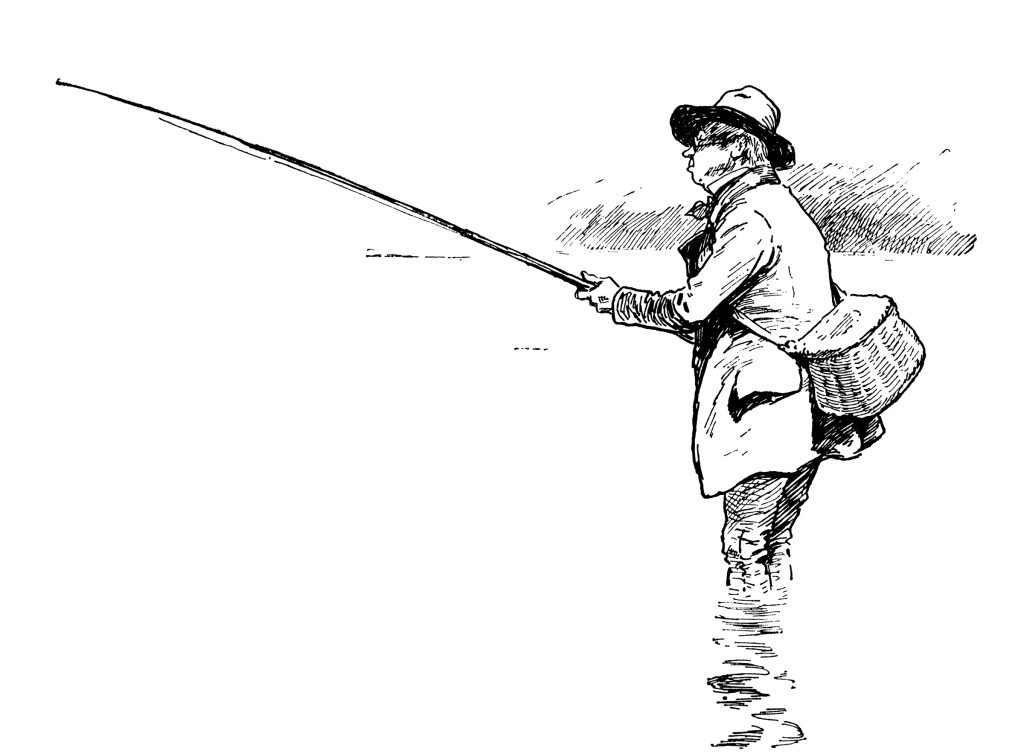
It was one of those cold, gray, wet late winter days that reinforced the groundhog’s prediction of six more weeks of bad weather. I was up in the roost, the little apartment over our garage where I go to write or go through damp duck hunting gear in preparation for storing it until next season. It’s also a great place to make plans for hunting, fishing or camping trips. On this day, though, I was just sorting through some old journals that I began many years ago.

There was a little female cardinal huddled on a dogwood branch right outside the window next to my desk. If the window had been open, I could have reached out and touched the little bird. Her feathers were puffed up as if she had on a fluffy down vest. She looked in at me with one eye closed as if to say, “Man, it’s cold out here.” I watched for a couple of minutes until she flew away, and then I picked up one of my journals.

I started keeping hunting diaries, sometimes daily, sometimes weekly, back in the late ’70s. It was the same time I started a newspaper, and during the unpropitious years of the Carter recession, I was constantly trying to generate enough revenue in advertising to pay the folks working for me. One of the first journals I started was right in the middle of those tumultuous times when every work week was a struggle. One entry reads: “January 20, George came by and wanted to know how business was doing. I told him to keep his fingers crossed that I would have the bank payment next week.” George was my banker at Wachovia, before they were taken over by Wells Fargo during their own hard times. The loan was on money I had borrowed to help start the paper. Interest, 8 percent, floating. Before the loan was settled, I was paying 21 percent to my good friend George and Wachovia Bank.

I chuckled to myself. “Reminder, never borrow money to start a newspaper.” The newspaper remained viable, along with other ancillary businesses, for 17 years before it was sold and I escaped the responsibility of a weekly payroll.

The journals I started during that period mostly pertained to hunting, fishing and camping experiences, dates, weather and other observations. Brief and to the point.

The missives are stacked in the bookcase in no particular order, so I glanced briefly at the year and moved on. One thing I discovered was that my years always started in March, not January. The seasons for hunting, fishing and camping described my yearly doings. A good example: March was the planning month, a time to put away hunting gear and get ready for fishing. Spring would be turkey hunting and camping, hiking and more fishing. In the summer, July and August brought along more laid-back camping and fishing. September, October, November, December, January and February were for bird hunting, duck hunting and late fall surf fishing. Then comes March and the cycle starts again.

Some of the journals have more entries than others, and some are right eloquent in describing the events of the day, such as “Shot three Canada geese while Bryan was parking the truck.” Or, “Bryan stepped in over his waders in the marsh at Hester’s. As he was falling, he hollered, ‘I’m going in.’” Hester’s duck hunting club at Mattamuskeet is one of the finest in the country. We hunted there numerous times and got a lot of fun out of Bryan Pennington, a good hunting buddy.

Another entry was set in motion by my good friend and sidekick John Vernon. It read, “When we paddled up the river to the location of the Haw River blind, it was gone.” Off and on the summer before the fall duck season, John and I had built the finest duck blind on the lake. A major rainstorm, right before legal duck shooting, washed the blind downriver and we never saw it again. We still laugh about that, vowing never to waste time on a permanent blind again.

I continued to browse, and remembering the recent snow, pulled out the one from January 2000. That was the month of what became known as the great blizzard. According to the notes I made, over 28 inches of snow fell. And that led to the first ever bulldog edition of The Pilot.

Moore County was a disaster. The snow started early that afternoon, forecast to be only 4 to 5 inches. Publisher David Woronoff and I met at lunch when the snow first started falling, and he decided to let the employees go home early before it got too deep. Little did we know that the weather people had totally missed it. That night we were smothered in sleet, ice and snow.

The writing in the journal continued, “Pine trees down everywhere, had a hard time getting to the office.” I was the only one at the paper who had a four-wheel drive vehicle, and after trying different routes, I found one that wasn’t blocked by fallen trees. David also made it, along with a few other much-needed employees. He decided to put out a bulldog edition (old newspaper jargon meaning a rare and very infrequent publication, usually before the regular printing). It detailed the disastrous results of the storm.

Our carriers couldn’t deliver the paper, so we split up the county. Dennis, our circulation director, took the area toward Pinehurst. David, Southern Pines and nearby hotels and motels. I did the same toward Aberdeen, and we hand-delivered the four-page section. I ended that episode of the journal, “No power for 6 days.”

The journals rolled right along until last year. My grandfather always told me there were no bad times in life. It just depended on how you interpreted them. I believed that until 2024. For me, there is no redeeming factor in that annum.

One bad time after another followed me that year. First, a knee replacement. A good call in the end, but recovery time was longer than I anticipated. My brother passed away after a lingering deadly disease, then I was diagnosed in late summer with a debilitating aliment that would lay me low for several months and put a crimp in my lifestyle.

It turns out that my granddad was right, though. After I changed my attitude about my sickness and began looking at it like an adventure, things started to fall in place.

I met wonderful folks, health care professionals and patients. The health care industry deserves a feature all its own, and someday I plan to write that story. The patients, what can I say? Never before have I run across such optimism and value of life.

A great example was the afternoon we were leaving after an appointment. Linda was outside the hospital getting the car from valet parking, and I was sitting on a bench inside the lobby. A wheelchair rolled up beside me with a shrunken old man holding on with some apprehension. He and I talked. He was from New Zealand and was getting ready to head home on a morning plane. He had a wonderful smile, and after a short conversation, he and his caregiver headed for the sliding door. I wished him well.

“No worries,” he said. “Me and Jesus be mates.”

On the last page at the end of the empty journal I had designated for 2024, I added the caption. “To Be Continued.”

Birdwatch

BIRDWATCH

Heard But Not Seen

Eastern phoebes tuck their nests away

By Susan Campbell

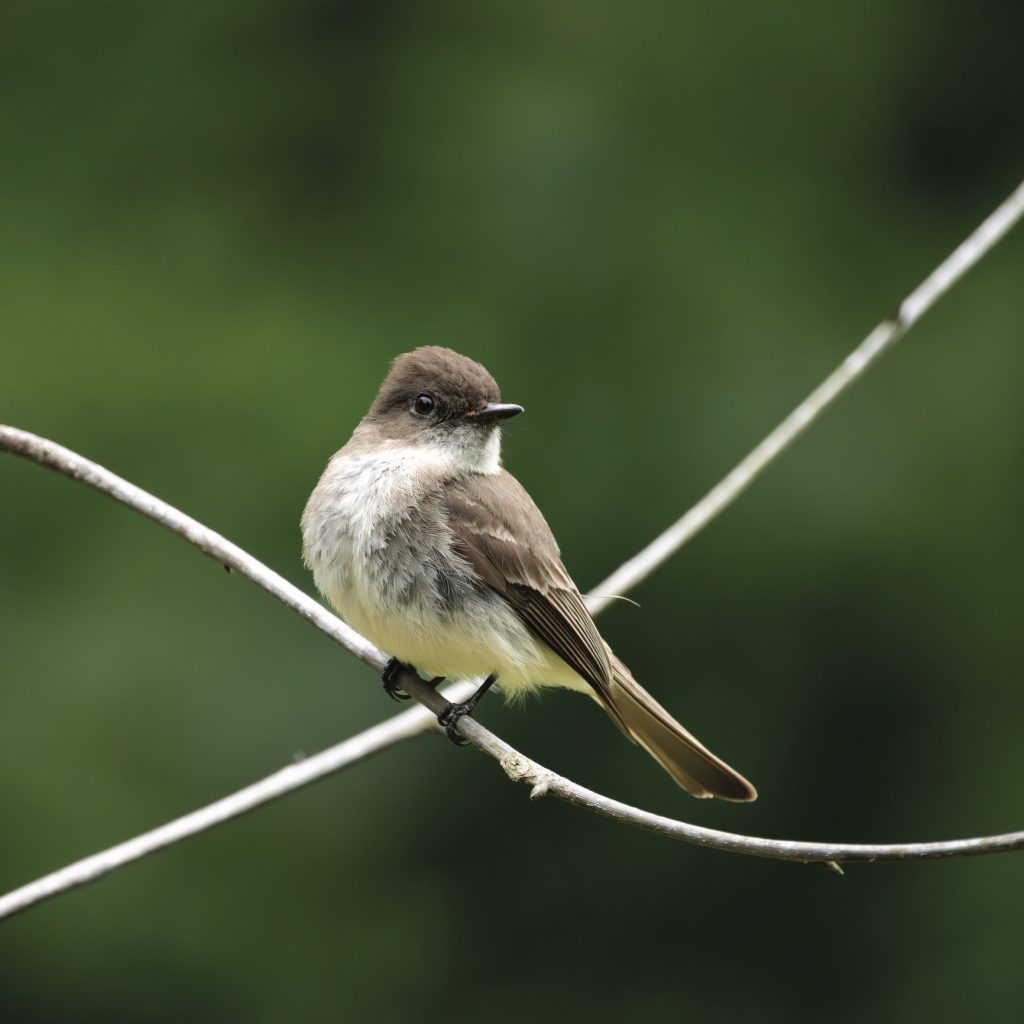
Eastern phoebes are small black and white birds that can be easily overlooked — if it wasn’t for their loud voices. Repeated “fee-bee, fee-bee” calls can be heard around wet areas all over our state. The farther west one travels through the Piedmont and into the foothills of North Carolina, calling males become more and more evident. From March through June, males declare their territory from elevated perches adjacent to ponds and streams. Even on warm winter days, these little birds can be heard loudly chirping or even singing a phrase or two.

Phoebes have an extensive range in the U.S., from the East Coast to the Rockies, and up and across central Canada. In the winter they can be found in Southern states from the Carolinas over to Texas down into Mexico and northern Central America. They are exclusively insectivorous, feeding on beetles, dragonflies, moths — any bugs that will fit down the hatch. Although they do not typically take advantage of feeders, I have seen one that did manage to negotiate a suet cage one winter. Because their feet are weak, they’re not capable of clinging, so this bird actually perfected a hovering technique as it fed in spurts.

Originally eastern phoebes utilized ledges on cliff faces for nesting. We do not know much about their habits in such locations since few are found breeding in those places now. Things have changed a lot for these birds as humans have altered their landscape.

While phoebes can be easy to locate as a result of their loud calls, in our area their nests may not be. Although they are good-sized open cup structures, they will be tucked into out-of-the-way locations. Typically, they will be on a ledge high up on a girder under a bridge or associated with a culvert. They may also be up in the corner of a porch or other protected flat spot. Grasses and thin branches are woven and glued together with mud to form the nest; therefore it’s critical that the location be close to water.

The affinity eastern phoebes have for nesting on man-made structures in our area may indicate that these are safer than more traditional locations. Climbing snakes are not uncommon in the Sandhills. Black rat snakes and corn snakes are not as active on buildings as they are on bridges and other water control structures. The phoebes may be adapting their behavior in response to these predators and others less likely to be found so close to human activity.

If you have, or have had, phoebes on your property in summer, I’d like to hear about it. I continue to record locations and details on nesting substrate for the species in the Sandhills. The variety of locations that these little birds choose has been very curious. Light boxes and fixtures, gazebos, porch support posts and more have been used, if they are covered by at least a slight overhang. Not only is water a necessity for phoebes in summer, but they require mature trees for perching and foraging as well. Keep an ear out and perhaps you will find one of these adaptable birds nearby — and be sure to let me know!

Out of the Blue

OUT OF THE BLUE

It’s in the Bag

The clutch that says it all

By Deborah Salomon

Back in the 1940s, radio personality Art Linkletter would go through women’s purses, creating profiles based on what he found.

He was usually spot-on. Sometimes embarrassing, always hilarious.

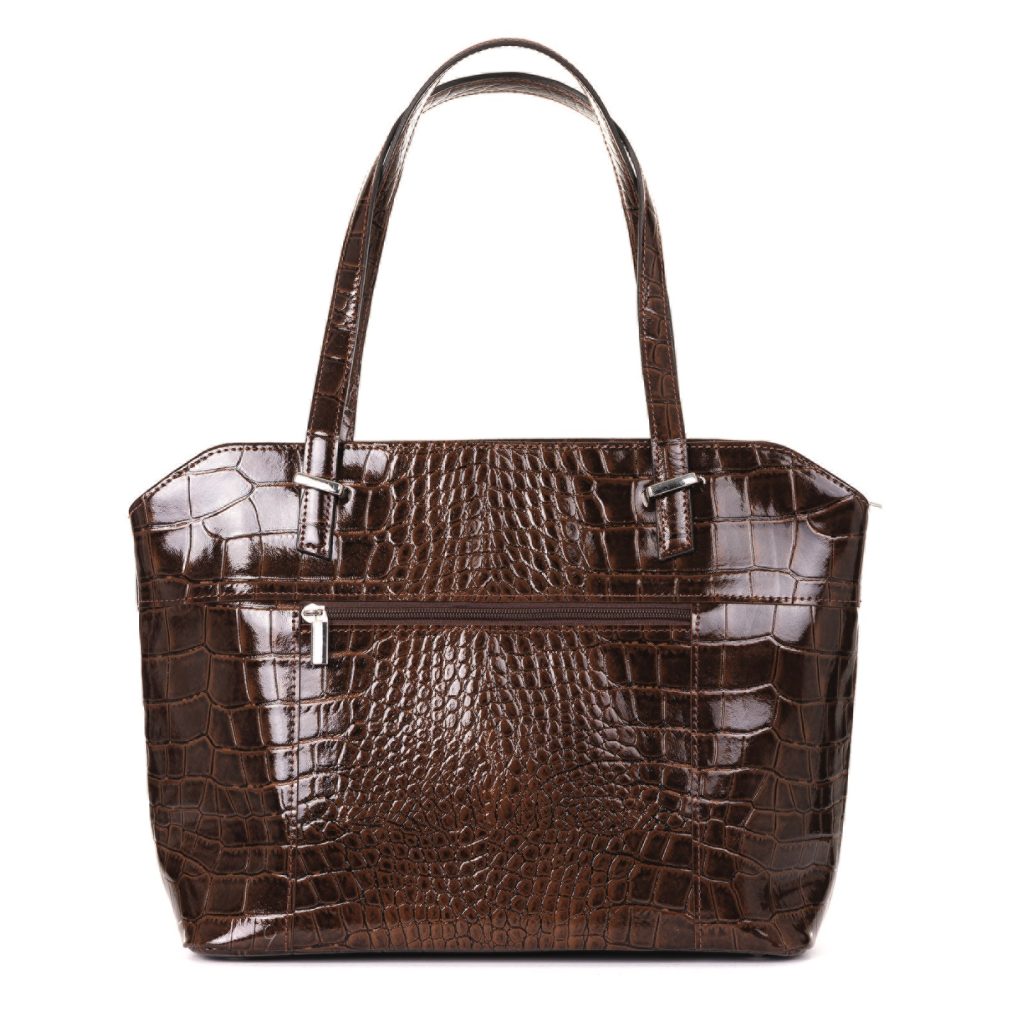
Not sure if the Smithsonian has a nook devoted to purse profiles. If not, maybe it oughta make room for this revealing artifact. But instead of a dive into contents, I’ll extrapolate information from the purse itself, notably what sets it apart from ancestors.

In a word . . . compartments.

Some ladies like ’em inside, others prefer the exterior. Notice that both interior and exterior may or may not have zipper, snap or Velcro closures. Some side compartments are narrow with no closure, designed to stash eyeglasses but prone to losing them. Others, square and flat, accommodate a tablet.

No, not the kind with lined yellow pages.

Most women designate one compartment for lipstick and a comb. “Compacts” are so Art Deco, along with bright red lipstick and loose powder. Nothing dates a purse more than a skinny flip-phone compartment . . . except maybe the material it’s made from.

Back in the day, ladies’ winter handbags were hand-held leather of various grades, from coarse cowhide to fine calfskin. Queen Elizabeth II set the style. Call it grandmotherly. Spring meant shiny black patent leather. Come summer, you switched to straw or quilted cotton. The advent of vinyl/plastics resulted in stiff imitation leather adorned with brassy bling. They were big and heavy, even empty. A worse affront: designer knockoffs, an insult to YSL, Louis Vuitton and Chanel, sold on Manhattan street corners. But they did establish one rule: A brown YSL goes with any color outfit.

As for shape/size, shoulder bags took over when women ditched the bridge club for a business forum, a court hearing, surgery schedule or middle-school soccer game. Princess Diana put clutches on the map, primarily to hide her cleavage when emerging from a Rolls. A shoulder bag that left hands free to text Chinese take-out became roomy enough to stash leotards for a workout on the way home from the office. 

Contents, or the lack thereof, offer another readout. Here’s what you won’t find in the modern woman’s handbag: a checkbook; cigarettes and lighter; a wad of “emergency” cash; Chiclets; a single-function car key; an address book; a rain bonnet; movie ticket stubs; a Neil Diamond CD; a map; a pencil; bobby pins; stamps; a tiny metal aspirin container; a handkerchief; a safety pin for the dreaded bra strap malfunction.

How come only men carry handkerchiefs?

Speaking of men . . . remember the man bag, which made a splash in the 1990s? Before the invention of pockets, Renaissance noblemen carried coins in “girdle pouches” without incurring ridicule. And a 5,000-year-old mummy named Ötzi the Iceman was found in the Alps beside his purse. No such luck for 20th century gents when, as I recall, even a plain leather crossbody drew giggles.

These days, the most coveted clutch might be a little thing hardly big enough for an iPhone, designed by Judith Leiber, who isn’t above wrapping a snake around black sequins and charging a few thousand for it at Bergdorf’s.

Now if only I didn’t need four new tires . . .

Pleasures of Life

PLEASURES OF LIFE

By Ruth Moose

Acronyms these days are driving me OOMM. Out of my mind. There is a new one every day. Prolific as mosquitoes, they buzz around and are joined by others, both old and new, like some strange alphabetic mating ritual.

“BRB,” I heard someone say. “What?” I asked. “Be right back,” she repeated for my benefit, with just a hint of pity in her voice. They’ve cracked the seal on print and text and have invaded speech, turning it into a game of Hangman.

The acronyms of my youth came from postal letters: PS added after a signature meant “postscript” to signify an additional thought. Is this the granddaddy of them all? The AOA? The Australopithecus of acronyms? I remember notes and letters that ended with the acronym SWAK. “Sealed with a kiss.” Oh, how sweet. And even later still, letters signed TSTSA: “Too sweet to sleep alone.” Naughty, naughty.

Next thing I know it’s OMG everywhere I looked. Oh My God. I admit, I heard that one before I saw it. LOL. That one showed up in an email. Lots of love? Lots of luck? Oh, right. Laugh out loud.

Are we really so busy with texts and emails that the entire word has been rendered obsolete? Reader’s Digest (RD to you), a stalwart American institution of reasonably good taste, recently devoted a whole page to . . . acronyms, replacing the page usually devoted to vocabulary. Codes taken from everywhere, every day. Acronyms that most everyone would (or should) know: TBD (to be determined); ESL (English second language); GMO (genetically modified organism); ROM (range of motion); SPF (sun protection factor); TMI (too much information). I thought I was getting the hang of it until I got to SEP (someone else’s problem) and the last one on the page, JGI. JGI?

Just Google it.

It seems every profession has its own acronyms. Real estate ads have WICs — walk in closets. Book reviewers have ICPID — I couldn’t put it down. Wedding planners never know what to do with the MOG — mother of groom.

Lurking in our everyday, text-heavy world are ones like FWIW (for what it’s worth) or ICYMI (in case you missed it). There is even an online magazine by that five-letter name. Poor thing. Personally, I’d rather spell it out like National Geographic. And, oh, wouldn’t I love to go back in Time?

If an acronym has you totally stumped and you have to ask someone, you might as well paste the scarlet L (thumb and forefinger) on your own forehead — Loser. Face it, you’re hopelessly OOTL (out of the loop). Horrors. You may, from time to time, come across someone who will laugh kindly and decode the acronym for you. This is a WW (win-win). You get to go on your way with a brand new bit of alphabet slang to hang on your belt and then part company with the satisfaction of having behaved like the Good Samaritan.

Recently I sent an email responding to an upcoming event I planned to attend. At the end I added LW.

My recipient fired back, “What is LW?”

Lord Willing.

I thought everybody knew.

Focus on Food

FOCUS ON FOOD

Open Season

It’s strawberry o’clock somewhere

Photograph and Story by Rose Shewey

Eating seasonally makes for an interesting lifestyle. The practice of only buying and eating foods that are grown locally and harvested at peak flavor is a worthy undertaking but also a commitment I’m not ready to make just yet. I can easily enjoy locally harvested foods all summer long, especially in North Carolina, where we grow an abundance of exciting warm weather crops — but I don’t foresee myself mastering the art of exclusively eating root vegetables and canned goods for months on end during the winter.

I do have some principles, though. These past few months at the grocery store, I had to use all my power of persuasion to talk my 6-year-old out of bagging strawberries that were grown thousands of miles away and, frankly, a bit pale and sorry looking. So, that’s a “no” to buying imported berries, as well as “winter tomatoes,” the epitome of blandness. On the other hand, I have a hard time turning down avocados from south of the border, or especially plump and juicy-looking citrus from across the country, if the opportunity presents itself.

In the case of the strawberry, which is native to Northern America, it makes a lot of sense to wait for the local harvest. Not only will the berries look better, they’ll be their most nutritious and aromatic. But here again, I fall off the wagon by stretching the term “locally grown.” As soon as the first strawberries harvested anywhere in the Southeast hit the shelves, all bets are off.

So, come March — the month I typically start noticing Florida-grown strawberries in the markets — we’re in the strawberry business, just a few weeks before our (truly local) Sandhills strawberries are ready to be picked. To bridge the gap between the cold season and the tender beginnings of spring, I like to prepare a strawberry fruit salad and mix in wintry grapefruit. Make it into a meal and serve this fruit salad with waffles. A grain- and gluten-free almond and oat waffle is the ideal accompaniment to this fruity affair — and not just for breakfast.

Strawberry and Grapefruit Salad with Almond Oat Waffles

Fruit Salad

(Serves 4)

2 grapefruit, peeled

400 grams strawberries

2 tablespoons strawberry syrup or other liquid sweetener (optional)

Dice grapefruit (peel off the membrane, if desired) and slice the strawberries. Add cut fruit to a bowl and toss with strawberry syrup or sweetener of choice. Refrigerate until ready to use.

Almond Oat Waffles

(Makes 4-6 waffles)

1 cup oat flour

1 cup almond flour

3/4 teaspoon baking powder

Pinch of salt

3/4 cup milk (nut milk or whole milk)

2 tablespoons honey (softened) or granulated sugar

3 eggs

2 teaspoons vanilla extract

3 tablespoons butter (melted) or coconut oil

Preheat your waffle iron. Combine oat flour, almond flour, baking powder and salt in a bowl and whisk to combine. In a separate bowl, whisk together the milk, honey or sugar, eggs, vanilla extract and butter. Pour the dry ingredients into the wet ingredients and stir until well combined. Ladle batter into your waffle iron and cook until golden and slightly crisp.

Bookshelf

BOOKSHELF

March Books

Fiction

Count My Lies, by Sophie Stava

Sloane Caraway is a liar. Harmless lies, mostly, to make her self-proclaimed sad little life a bit more interesting. So when Sloane sees a young girl in tears in the park one afternoon, she can’t help herself — she tells the girl’s (very attractive) dad she’s a nurse and helps him pull a bee stinger from the girl’s foot. With this lie, and chance encounter, Sloane becomes the nanny for the wealthy and privileged Jay and Violet Lockhart — the perfect New York couple, with a brownstone, a daughter in private school, and summers on Block Island. But maybe Sloane isn’t the only one lying, and all that’s picture-perfect harbors a much more dangerous truth. The thing about lies is that they add up, form their own truth and a twisted prison of a world. Be careful what you lie for.

The River Has Roots, by Amal El-Mohtar

In the small town of Thistleford, on the edge of Faerie, dwells the mysterious Hawthorn family. There, they tend and harvest the enchanted willows and honor an ancient compact to sing to them in thanks for their magic. None are more devoted than the family’s daughters, Esther and Ysabel, who cherish each other as much as they cherish the ancient trees. But when Esther rejects a forceful suitor in favor of a lover from the land of Faerie, the sisters’ bond and their lives will be at risk.

Tilt, by Emma Pattee

Annie is nine months pregnant and shopping for a crib at IKEA when a massive earthquake hits Portland, Oregon. With no way to reach her husband, no phone or money, and a city left in chaos, there’s nothing to do but walk. Making her way across the wreckage of Portland, Annie experiences human desperation and kindness: strangers offering help, a riot at a grocery store, and an unlikely friendship with a young mother. As she walks, Annie reflects on her struggling marriage, her disappointing career, and her anxiety about having a baby. If she can just make it home, she’s determined to change her life.

Wild Dark Shore, by Charlotte McConaghy

Dominic Salt and his three children are caretakers of Shearwater, a tiny island not far from Antarctica. Home to the world’s largest seed bank, Shearwater was once full of researchers, but the Salts are now its final inhabitants until a woman, Rowan, mysteriously washes ashore. Long accustomed to protecting herself, Rowan starts imagining a future where she could belong to someone again, but she isn’t telling the whole truth about why she set out for Shearwater. And when she discovers sabotaged radios and a freshly dug grave, she realizes Dominic is keeping his own secrets. They all must decide if they can trust each other enough to protect the precious seeds in their care and if they can finally put the tragedies of the past behind them to create something new, together.

Nonfiction

Raising Hare: A Memoir, by Chloe Dalton

In February 2021, in the English countryside far away from her usual London life, Chloe Dalton stumbled upon a newborn hare — a leveret — that had been chased by a dog. Fearing for its life, she brings it home, only to discover how impossible it is to rear a wild hare, most of whom perish in captivity from shock or starvation. Through trial and error, she learns to feed and care for the leveret with every intention of returning it to the wilderness. Instead, it becomes her constant companion, wandering the fields and woods at night and returning to Chloe’s house by day. Though Chloe feared that the hare would be preyed upon by foxes, stoats, feral cats, raptors and even people, she never tried to restrict it to the house. Each time the hare leaves, Chloe knows she may never see it again. Raising Hare chronicles their journey together, while taking a deep dive into the lives and nature of hares, and the way they have been viewed historically in art, literature and folklore.

Children's Books

Sunrise on the Reaping,
by Suzanne Collins

The long-awaited fifth book in the runaway bestselling “Hunger Games” series, Sunrise on the Reaping, arrives this month. As the day dawns on the 50th annual Hunger Games, fear grips the district of Panem. Twice as many tributes will be taken from their homes. When you’ve been set up to lose everything you love, what is there left to fight for? (Ages 14 and up.)

Over in the Garden, by Janna Matthies

There are fun books and cute books. Then there are books that will become part of the family canon. Over in the Garden has the makings of a family classic. Counting, color and compost are rounded out with a delightful repeatable rhyme. This one is perfect for Earth Day or any nature-loving family. (Ages 2-6.)

Little Freddie Two Pants, by Drew Daywalt

First it was crayons, and now its pants. Author of The Day the Crayons Quit takes the everyday and makes it ridiculous! Perfect as a read aloud, this picture book will have young readers dreaming up all the new ways of putting on pants. (Ages 2-6.)

The Cranky-Verse: Cranky Chicken Book 4, by Katherine Battersby

Cranky Chicken, a kid favorite in the early graphic novel section, is back for another adventure with three hilariously cranky stories about Cranky Chicken, Speedy the Worm and their new friend, a little turtle. Join them on a set of illustrated adventures as they learn how to take care of each other, navigate a cranky injury, and go on a camping adventure. (Ages 6-9.)

The Silver Scot’s Shangri-La

THE SILVER SCOT'S SHANGRI-LA

The Silver Scot’s Shangri-La

Legendary Great Tommy Armour and Pinehurst

By Bill Case     Photographs from the Tufts Archives

He had survived — a luckier fate than that suffered by millions of World War I soldiers — but his battlefield injuries were grievous. A German mustard gas explosion had totally blinded the young Edinburgh native. One lung was badly burned by the gas. In another engagement, shrapnel from an enemy shell caused serious injuries to his head and left arm, necessitating the implanting of metal plates. Lying battered and helpless in a British military hospital bed, the odds seemed heavily against Tommy Armour ever resuming a normal life.

Serving in the Black Watch Regiment’s tank corps from 1914 to 1918, Armour rose from the rank of private to staff major and achieved widespread notoriety for his machine-gunning prowess. He assembled, loaded and fired his weapon faster than anyone in the Army. This singular talent required superior manual dexterity but, in addition, his hands were remarkably strong: While singlehandedly capturing a German tank, Armour strangled the tank’s commander to death when he refused to surrender.

Prior to the war, those formidable hands had served him well. Among his talents, Armour was a virtuoso violinist and a high-level bridge player, but his favorite pastime was golf. Armour, his older brother Sandy, and lifelong friend Bobby Cruickshank toured Edinburgh’s Braid Hills Golf Course at every opportunity. “In the summer,” Armour later recalled, “I would be on the first tee at 5 a.m. and in the evening . . . play a couple of rounds.”

Throughout his convalescence, Armour kept up his spirits by dreaming of playing golf again. While it took six months, sight gradually returned to his right eye, though he remained blind in his left. The recuperating 23-year-old would play golf again, but could his limited vision scuttle any hope of regaining his previous form? The preternaturally confident Tommy Armour believed otherwise.

Armour joined Edinburgh’s Lothianburn Golf Club with the expectation of not just recovering his game but elevating it. Adapting to his partial blindness, he steadily lowered his scores, though his putting was erratic. The blindness in his left eye was distorting his depth perception. One day, in a fit of pique, he hurled his collection of putters off the Forth Rail Bridge into the firth below. It was these all-too frequent episodes of balky putting that would one day prompt him to coin the phrase “the yips.”

Despite his weakness on the greens, Armour began making his presence felt in tournaments, finishing runner-up in the 1919 Irish Amateur at Royal Portrush. He really raised eyebrows when he won the French Amateur in July 1920. Soon afterward, Armour sailed to New York, looking to test his game against America’s best. While aboard ship he met Walter Hagen, the game’s top professional golfer. The two men found they had much in common: Both enjoyed parties, the company of attractive women, and the consumption of copious amounts of alcohol. As author Mark Frost wrote in The Grand Slam: Bobby Jones, America, and the Story of Golf, the young Scot had a capacity for liquor surpassing his older friend. “Whereas ‘The Haig’ often watered down drinks to polish his reputation as a boozer,” wrote Frost, “Armour’s glass was never half-empty.”

Hagen took the young man under his wing, setting up an exhibition match for the visiting amateur’s American debut. On July 25 the fellow bon vivants squared off against Jim Barnes and Alex Smith in New London, Connecticut. The Armour-Hagen team lost the match 1-down, but The New York Times reported that Armour’s “long driving surprised the gallery,” and that his mashie play “stamped him as a golfer who will be hard to beat.”

In early August 1920, Armour entered the U.S. Open at Inverness Country Club, in Toledo, Ohio, finishing 48th, 22 strokes behind winner Ted Ray. But those who assumed the hype regarding this Scottish upstart had been overblown were in for a surprise two weeks later at the Canadian Open. Playing brilliantly throughout, Armour finished the championship in a three-way tie at the top with Charles Murray and J. Douglas Edgar, eventually losing the playoff to Edgar. The Scot followed that promising finish with another, reaching the quarterfinals of the U.S. Amateur at Engineers Country Club in Roslyn, New York.

While stateside, Armour found time for other pursuits. An October 29, 1920, New York Times article reported that the golfer had wed 26-year-old Consuelo Carreras de Arocena the previous day. A son, Thomas Dickson Armour Jr., would be born to the couple a year later.

Though Armour had played creditably that summer, he had yet to achieve a victory on U.S. soil. That changed in November after he arrived in Pinehurst to compete in the resort’s inaugural Fall Amateur-Professional Best Ball Tournament on course No. 2. The event attracted many leading players, including Gene Sarazen, the aforementioned Douglas Edgar, and Leo Diegel, later a two-time PGA champion.

Already recognized as a tournament hotbed, the Pinehurst resort successfully lured top players for tournaments on their way south for the winter and then again on their way northward in the spring. March and April were the months when the United North and South Amateur championship and the North and South Open were held. The tournaments attracted resort visitors looking to spot their favorites both on and off the course. What could be more appealing to a devout golf fan than encountering the legendary Walter Hagen in The Carolina Hotel bar?

Pinehurst appealed to Armour as well. Partnering with Diegel, the two ham-and-egged their way to the Amateur-Professional title, posting a four-round best ball score of 275. The win provided the Scot a measure of revenge against Edgar, whose team finished runner-up. The euphoric Armour extended his stay, competing in the resort’s match play Fall Tournament. He reached the quarterfinals before bowing to Frances Ouimet. After that, Armour and his bride sailed home to Great Britain.

Back in Scotland, Armour continued to polish his game in amateur tournaments. In May 1921, he joined a team of British amateur stars for a match against a formidable American team that included Bobby Jones, Chick Evans and Ouimet. The informal match, held at Royal Liverpool Golf Club and won by the U.S., drew over 10,000 spectators and sparked the institution of the Walker Cup matches the following year.

Having experienced the good life in America, Armour yearned to return. Following the 1921 slate of British golf championships, he was back in the U.S. competing in tournaments. In October he informed the press he intended to make America his permanent home. Armour’s brother Sandy and Braid Hills running mate Cruickshank also chose to emigrate. The New York Times observed, “The British golf world is faced with the odd spectacle of its previous defenders against American invasions being members of future attacking parties.”

Still an amateur, Armour looked to establish himself in America and, once again, Hagen came to the young man’s aid, making the connections that led to Armour being hired as the secretary of Westchester-Biltmore Country Club in Rye, New York. A sprawling complex, the club featured two golf courses, a polo field, racetrack and 20 tennis courts, built at a cost of $5 million.

Armour’s natural social skills made him ideal for the post. He deftly saw to the needs of the Biltmore’s guests and entertained them as well, regaling patrons with raucous stories evoking paroxysms of laughter. Byron Nelson considered Armour the most gifted storyteller he ever knew. “He could take the worst story you ever heard,” said Nelson, “and make it great.”

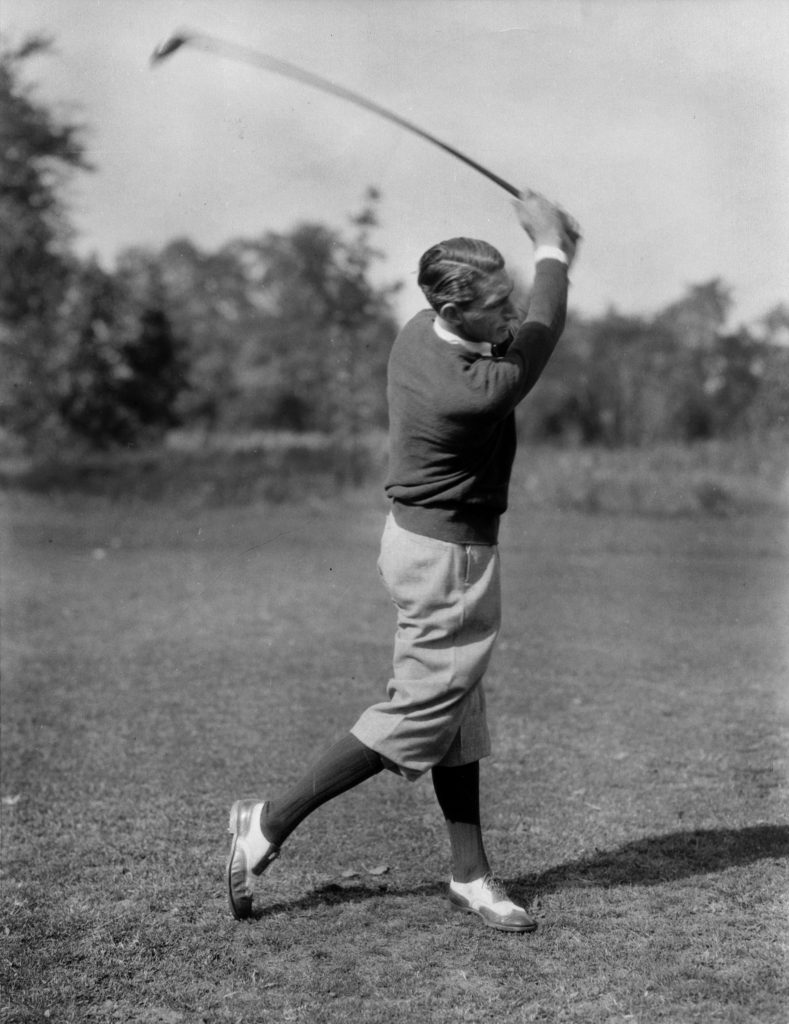
Armour’s job kept him busy during the warmer months, but when the weather turned chilly, he headed to Belleair, Florida, where he played numerous matches and tournaments against top players. Convinced he could hang with golf’s upper echelon, he turned professional in 1924. Soon after, Armour became the professional at Whitfield Estates Country Club, a Donald Ross-designed golf course (now Sara Bay Country Club) that was part of a Sarasota real estate project. Lifetime amateur Bobby Jones was also on-site, earning some extra dough peddling lots as the project’s assistant sales manager. Armour played golf daily, frequently in the company of either Jones or Hagen, who was affiliated with a nearby golf community.

In March 1925, Armour won the Florida West Coast Open, his first victory as a pro. With the North and South Open approaching, the triumph did not go unnoticed in the Sandhills. A piece in the Pinehurst Outlook reported that the word coming out of Florida was to “watch Tommy Armour!” The transplanted Scot played admirably in the North and South, finishing fourth.

Though Armour was rapidly progressing up the pecking order of top players, his share of tournament purses was never going to be enough to make a decent living. Even the game’s greatest supplemented their incomes by competing in exhibitions and securing club pro affiliations for both the summer and winter. Armour landed a premier summer gig as pro at Congressional Country Club in Bethesda, Maryland. Over the years, he would prove something of a vagabond in his northerly club employments: Medinah in Chicago, Tam-O-Shanter in Detroit, and Rockledge in Hartford would be featured among his other stints.

Armour’s primary goal, however, was to win tournaments. After two years adjusting to tour play, he skyrocketed to superstar status, winning five titles in 1927, including the U.S. Open held at America’s most demanding course, Oakmont Country Club. Trailing Harry Cooper by a shot as he arrived at the green of the championship’s final hole, Armour faced a birdie putt from 10 feet to force a playoff.

Bobby Jones, who was in the gallery, overheard two spectators debating whether any golfer would be able to successfully handle the pressure of such a critical moment. Jones calmly informed the bystanders that a man who had snapped the neck of a German tank commander with his bare hands was unlikely to be bothered by a 10-foot putt, regardless of its import.

Armour cooly drained it. In his 18-hole playoff victory over Cooper, Armour took just 22 putts over Oakmont’s diabolical greens. Perhaps he wasn’t such an awful putter after all.

The victory, coupled with his charismatic persona, thrust Armour into golf’s spotlight. Tall, dark, handsome and, like Hagen, impeccably attired, Armour, was a hit with the ladies, an attraction he did nothing to discourage. A penchant for heavy gambling, particularly on the course, also drew attention. Golf great Henry Cotton expressed uncertainty as to what Armour liked best, the golf or the betting. “He is not satisfied,” claimed Cotton, “unless he is wagering on every hole, every nine, each round, and if he can, on each shot.”

Augmenting Armour’s swagger was the occasional wearing of a patch over his left eye. He sported the best nickname on tour — The Black Scot — referring to the jet-black hue of his luxurious head of hair.

More victories followed. By the time Armour arrived at Fresh Meadows Country Club in Flushing, New York, for the 1930 PGA Championship, he had eight more tournament titles to his credit, including the prestigious Western Open. In his quarterfinal match at Fresh Meadows against Johnny Farrell, Armour found himself 5-down after six holes before rallying to win. Fighting his way to the championship’s final match, he took on Gene Sarazen in a nailbiter, beating “The Squire” on the 36th hole.

By 1930 Armour’s domestic life was in turmoil. In the course of his wanderings, he had met Estelle Andrews, the widow of an iron manufacturer. They started an affair, a fact unappreciated by Armour’s wife, Consuelo, who responded by initiating a series of lawsuits. Eventually, the differences were resolved; Armour got divorced, married Estelle, and adopted her two teenage sons, Ben and John. “Love and putting are mysteries for the philosopher to solve. Both are subjects beyond golfers,” said Armour.

In 1931, he won what, given his Scottish background, was his most meaningful title, the Open Championship at Carnoustie. An early finisher in his final round and sitting in a distant third place, Armour anxiously sipped whisky in the clubhouse while awaiting the two men ahead of him — Jose Jurado and Macdonald Smith — to complete their rounds. “I’ve never lived through such an hour before,” he told reporters. Jurado and Smith both collapsed, and Armour won the championship by one stroke, giving him a victory in all three of the major championships then available.

The rigors of travel and competition were beginning to take a toll on Armour, hastening the graying of his hair which, in turn, necessitated a nickname modification. Henceforth he was the Silver Scot.

Armour began slowing things down a bit by lengthening his sojourns in Pinehurst. His affection for the town would blossom into a full-blown love affair. His first extended visit occurred in the fall of 1932. After winning  the resort’s Mid-South Best Ball Tournament with partner Al Watrous, the Armours, Tommy and Estelle, stayed over at The Carolina for several weeks’ rest before decamping to Boca Raton Hotel and Club, a winter head professional gig Armour would keep for the remainder of his life.

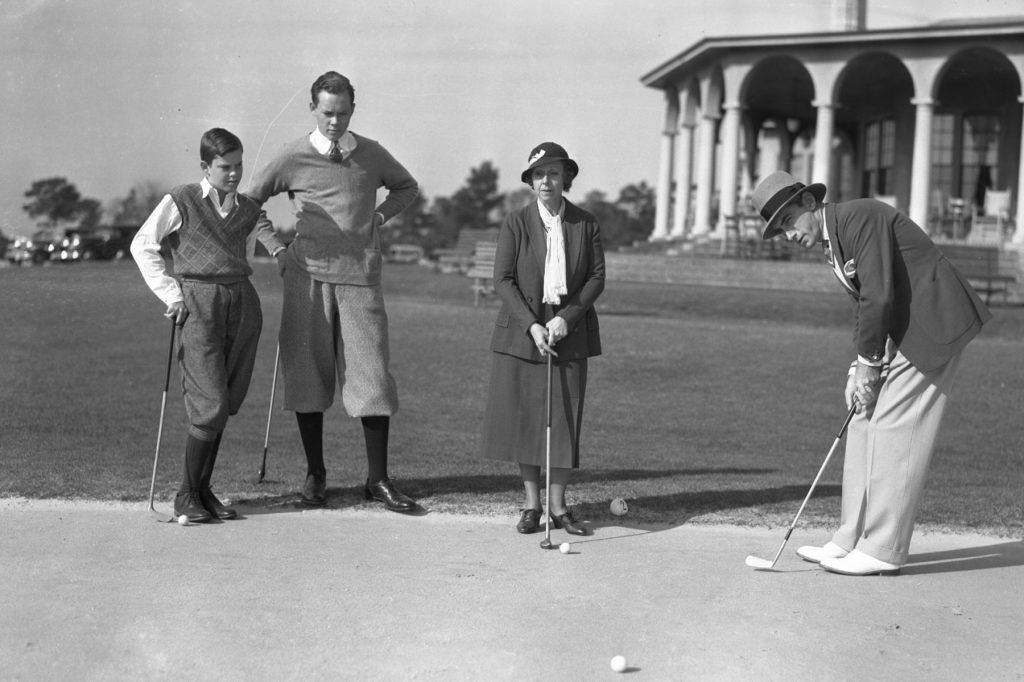
While in Pinehurst, the couple relaxed and socialized like any other guests of the resort. They brought sons Ben and John, both cadets at New York Military Academy, to Pinehurst for the holidays. The couple’s frequent movie attendance at the Pinehurst Theatre was dutifully reported in the Outlook. The Armours attended a dinner hosted by Southern Pines Country Club professional Emmett French, himself a three-time tour winner and runner-up in the 1922 PGA Championship. The Armours reciprocated, inviting the Frenches to dinner at The Carolina.

And, like most visitors to Pinehurst, Armour played loads of golf, generally with excellent players like French, Halbert Blue and poet Donald Parson, all reported in the Outlook. As the Armours prepared to depart Pinehurst in mid-January 1933, the paper recapped Tommy’s sensational scoring: “For a stretch of two weeks there was not one day in which Armour failed to equal or better the par of 71 for the No. 2 course. He had as low as 65 one day, this figure failing by one stroke to equal a round of his last month which tied the course mark.” And Armour revered No. 2, saying, “it is the kind of course that gets in the blood of an old trooper.”

In the spring of 1933, the Armours arrived early for the North and South and stayed two weeks after. Ben and John visited again, and Tommy played rounds with Pinehurst’s young phenom, George Dunlap Jr. Later that year, Dunlop won the U.S. Amateur, attributing significant credit for his victory to Armour. “Watching him play, of course, was a lesson in itself,” said Dunlop.

In December 1933, the Armour family once again celebrated the Christmas holidays in Pinehurst, and Armour was elected an associate member (later designated as an honorary member) of Pinehurst’s venerable golf society, the Tin Whistles. Returning in the fall of ’34, he paired with his boyhood friend Cruickshank to win the Mid-South Scotch Foursomes. After the victory Tommy and Estelle remained in Pinehurst, enjoying an array of social functions and attending the theatre, until the second week of January.

After 1935, Armour was competing only sparingly on tour. He was hired by MacGregor Golf in 1936 and, unwilling to simply sit back and endorse the company’s clubs, actively involved himself in their design. As a result, MacGregor became the industry-leading club manufacturer. “Tommy Armour” brand clubs are still made and marketed today.

Armour achieved fame as an instructor, despite delivering frequent tongue lashings to his pupils. An article by H.K. Wayne described his unique teaching methods: “His preferred style involved sitting in the shade in Boca Raton each winter or in Winged Foot each summer, with his trademark tray of gin, Bromo-Seltzers and shots of Scotch and passing judgment on his wealthy pupils, all of whom feared him.” Armour would subsequently author, with the assistance of golf writer Al Barkow, How to Play Your Best Golf All the Time, a bestseller, still in print. 

Armour continued making pilgrimages to Pinehurst. The more time he spent in the Sandhills, the more he rhapsodized about how wonderful it was to be there. His fawning quotes were undoubtedly appreciated by the resort’s public relations department. “I’ve seen strangers, jaded and dull, come to Pinehurst, and after a few days be changed into entirely delightful fellows,” said Armour. Pinehurst’s practice ground elicited quotable praise. “Maniac Hill is to golf,” he asserted, “what Kitty Hawk is to flying.”

In yet another homage, he declared, “I can’t help it. Pinehurst gets me. From morning firing practice at Maniac Hill, to vespers at the movies, Pinehurst is the way I’d have things if it were left to me to remold this sorry scheme of things entirely. . . . It’s the last in the vanishing act of fine living.”

In a sense, Armour promotes Pinehurst even today. Exhibited in the resort clubhouse’s hallway of golf history is a rotating display that provides another Pinehurst tribute from the Silver Scot. It neatly combines in one statement his sentimentality and occasional brusqueness, reading, “The man who doesn’t feel continually stirred when he golfs at Pinehurst beneath those clear blue skies and with the pine fragrance in his nostrils is one who should be ruled out of golf for life.”

When Armour came to Pinehurst in November 1938 to play the resort’s two professional events — the Mid-South Professional Best Ball and the Mid-South Open — he was semi-retired from competition. His last individual tournament victory had taken place three years prior at the Miami Open. Inspired by his surroundings, the 42-year-old rekindled his old form. Not only did he and sidekick Cruickshank tie for the best score in the best ball, Armour won the individual title, too. It would be his 25th and last PGA Tour victory.

One of the few titles to elude Armour’s grasp was the North and South. This gnawed at him both because of his love of the venue and because of the tournament’s prestige. Runner-up twice, Armour dwelled on his near misses, ruminating that “there are five traps on this course (No. 2) that have cost me the North and South five times.” He continued competing in it long past his competitive heyday. He even had a shot at victory after the tournament’s first two rounds in 1948 when his 143 total left him just three strokes out of the lead, but an 81 in round three ruined the aging veteran’s bid.

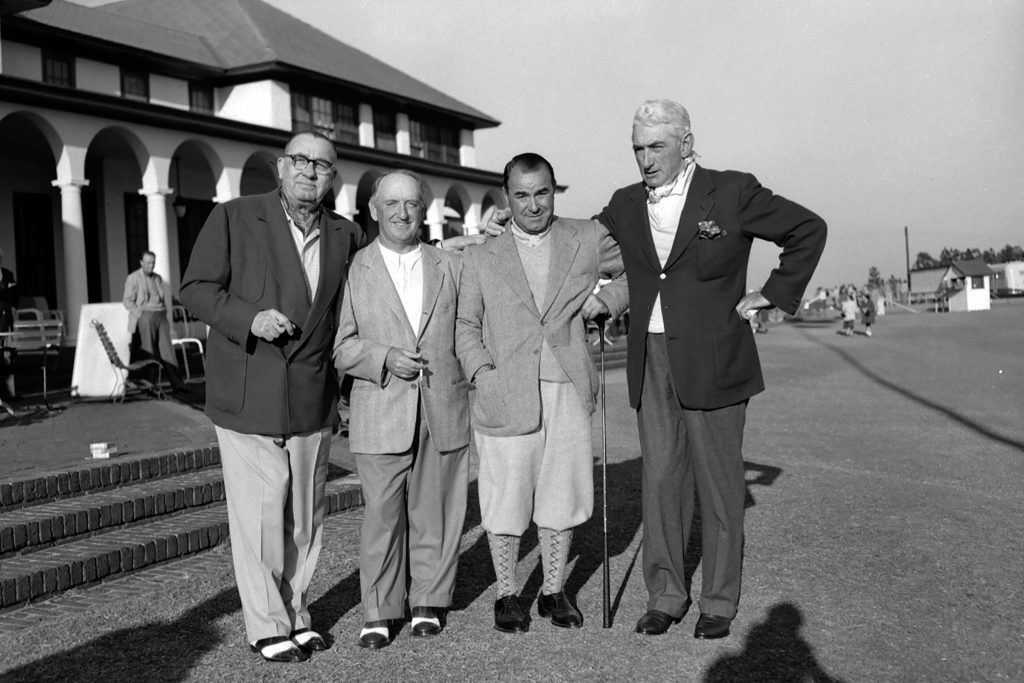
In 1951, Armour attended Pinehurst’s lone Ryder Cup. It turned into a delightful reunion for the 54-year-old. Longtime friends Hagen, Sarazen and Cruickshank were also on hand, and Armour delightedly joked and hobnobbed with the old stalwarts. When Hagen held a driver for a photo op with his fellow legends, Armour, ever the scolding instructor, pointed out, “You never gripped a club that way in your life!”

The North and South immediately followed the Ryder Cup, and Armour gave it one final try, missing the cut by two shots. The ’51 event also marked the end of the line for the North and South itself — the result of a brouhaha between the PGA tour and Pinehurst resort owner Richard Tufts. He had resisted efforts by the tour to have the amount of prize money bumped from $7,500 to $10,000 — the tour minimum. In response, several American Ryder Cuppers left Pinehurst following the matches, effectively boycotting Tufts’ event. Only one team member, Henry Ransom, completed all 72 holes. Reciprocating the hard feelings, the miffed Tufts terminated the North and South after a 50-year run.

In Armour’s later years, he kept on playing, teaching, storytelling, gin playing, gambling and cocktailing. In a 1978 Sports Illustrated article, Scottish writer and an excellent golfer in his own right John Gonella recounted an experience 30 years before when Armour hosted him at the Boca Raton Hotel. The writer was amazed at how the hotel’s management cheerily indulged Tommy’s every whim, happily picking up a multitude of expensive tabs for him and his parade of guests. After the young Gonella, short on funds at the time, and Armour teamed up to win a golf bet, Armour generously shared the winnings with his broke writer friend.

At lunch in the grillroom afterward, Armour asked Gonella if he would like to meet Walter Hagen. When the reply was affirmative, Armour called to the bartender and commanded, “Get me Hagen on the phone: Detroit Athletic Club, last stool at the left end of the bar. And bring us a phone!” According to Gonella, Tommy had Walter on the line two minutes later, and greeted The Haig with, “Hello, you old has-been. There’s a friend of mine here from Scotland I want you to meet.”

Armour, a 1976 inductee into the World Golf Hall of Fame, passed away in 1968 at the age of 71. Shortly before his death, he shared a visit with his 8-year-old grandson, Thomas Dickson Armour III. The fruit would not fall far from the tree (though perhaps skipping a generation). Tommy III became a fine player himself, winning twice on the PGA Tour and setting a 72-hole scoring record. Now semi-retired from competitive play, Tommy III resides in Las Vegas, where his reputation for living the high life tends to overshadow his golf achievements. He even has his own nickname, “Mr. Fabulous.”

Given his tender years at the time of the childhood visit, it’s understandable Tommy III doesn’t remember much about his grandfather. But it did stick in his memory that the elder Armour was very handsome and, even in the late stage of life, exceptionally strong. Those hands never weakened.

Hometown

HOMETOWN

Never Too Late

The career path of a classmate

By Bill Fields

Not long after Sara E. Johnson and I began a recent phone call, I couldn’t resist reminding my Pinecrest High School classmate what she had penned a long time ago in my senior yearbook.

“When you’re a rich and famous news man and I’m a rich and famous news lady,” she wrote on a back page in my Spectrum, “let’s get together and talk over old times.”

The words were the earnest well-wishes from one eager aspiring journalist to another. Sara LeFever and I were on the staff of The Courier, the student newspaper, for a couple of years, and officers in the Quill and Scroll club. We alternated weeks reporting high school news in The Pinehurst Outlook, with fresh-faced class pictures as our respective column sigs.

Neither of us fulfilled the futures mentioned in her message. I gravitated to sports, specializing in golf coverage. A stay-at-home mother of three until earning a master’s degree from UNC and becoming a reading specialist in her 40s, Johnson contributed articles on family and education to newspapers in Chapel Hill and Raleigh.

When we talked in January, the conversation didn’t revolve around our high school days (although we agreed it can be tough to review examples of our early, raw writing) but rather newer, exciting developments in Johnson’s life, which should be an example for anyone of a certain age. 

“I was 60 when my first novel came out in 2019,” she said. “People need to know it’s never too late.”

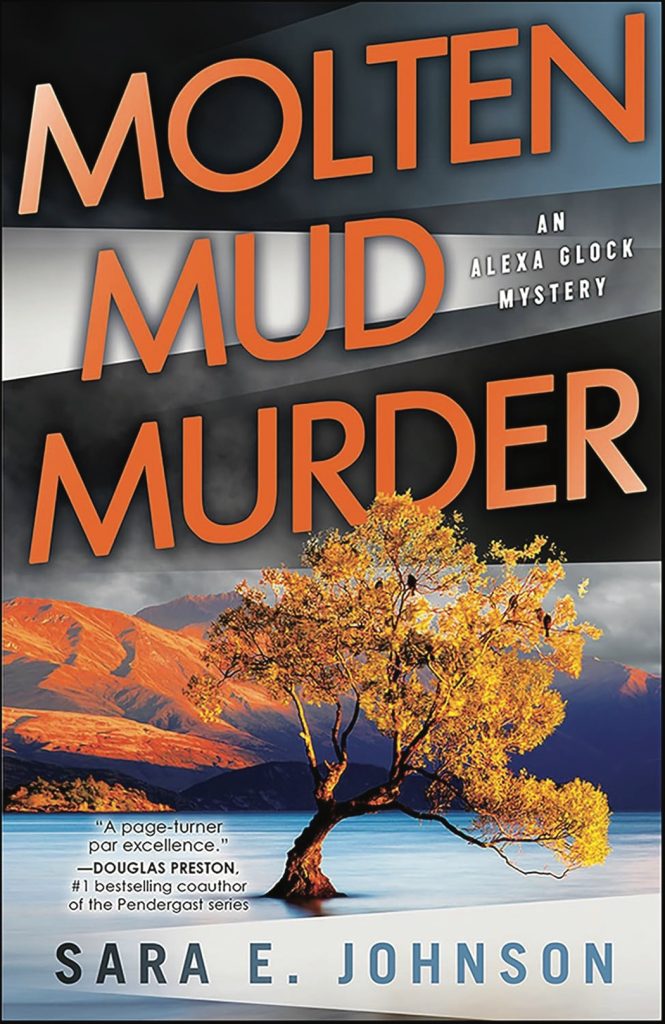
Johnson’s debut book, Molten Mud Murder, was the first installment in the “Alexa Glock Forensics Mystery Series.” The central character is a plucky and slightly geeky American investigator living in New Zealand, a traveling forensic who uses teeth to solve crimes. The debut has been followed by The Bones Remember, The Bone Track, The Bone Riddle and The Hungry Bones. The final book in the series, Bone Chilling, will be published this year.

The mysteries resulted from the nine months Johnson and her husband, Forrest, who live in Durham, spent exploring New Zealand in 2014. After returning home from a fascinating land that had intrigued her greatly, she pursued the notion of writing a book, something I had encouraged her to do in an email when we reconnected more than 20 years ago. “You said if you want to write a book, you can do it,” Johnson said. “Your message really stuck with me.”

Johnson has always been a wide reader, including mysteries. She has been enamored of the genre since she was 10 and read The Bungalow Mystery, a Nancy Drew book given to her mother in 1942. She spent a year writing Molten Mud Murder. Then came the hard part, which required much patience and persistence.

“I think I had 66 rejections from literary agents, but then the 67th came along,” Johnson said. “I don’t know where the cutoff would have been. Would I have contacted 75 or 100 agents? I don’t know. I was getting some positive rejections — people saying, ‘I like this and this, but don’t like that.’ What I call the positive rejections kept me going, and I kept honing the manuscript.”

Johnson informs her books with meticulous research provided by a cadre of professionals to ensure accuracy in her scenes. “I have wonderful experts who read over what I’ve written,” she said. “One forensic pathologist can spend two pages telling me how to flip a body on an autopsy table.”

At work on her seventh book, revolving around a coroner in northern Minnesota, Johnson will incorporate the forensics knowledge she gained producing the Alexa Glock series. She tries to write 1,000 words a day while relying on important assessments along the way from fellow writers.

“Hands down, the biggest help for me is being in a writers’ group,” Johnson said. “We meet weekly, not just mystery authors but folks in all kinds of genres. We bring 10 pages, read them, and people critique them. Reading your work aloud and getting good feedback is so valuable. I can’t thank them enough.”

As for others who might want to tap into their creative side later in life, Johnson believes it isn’t a mystery. “Sit down and do it,” she said. “If you have a dream to write a book, it’s possible.”

Contemporary and Comfy

CONTEMPORARY AND COMFY

Contemporary and Comfy

A modern vision for a family

By Deborah Salomon    Photographs by John Gessner

If you think an interior designer’s house should knock your socks off, you’d be right. Especially a designer with international credentials who conceived the house from the ground up and the studs out.

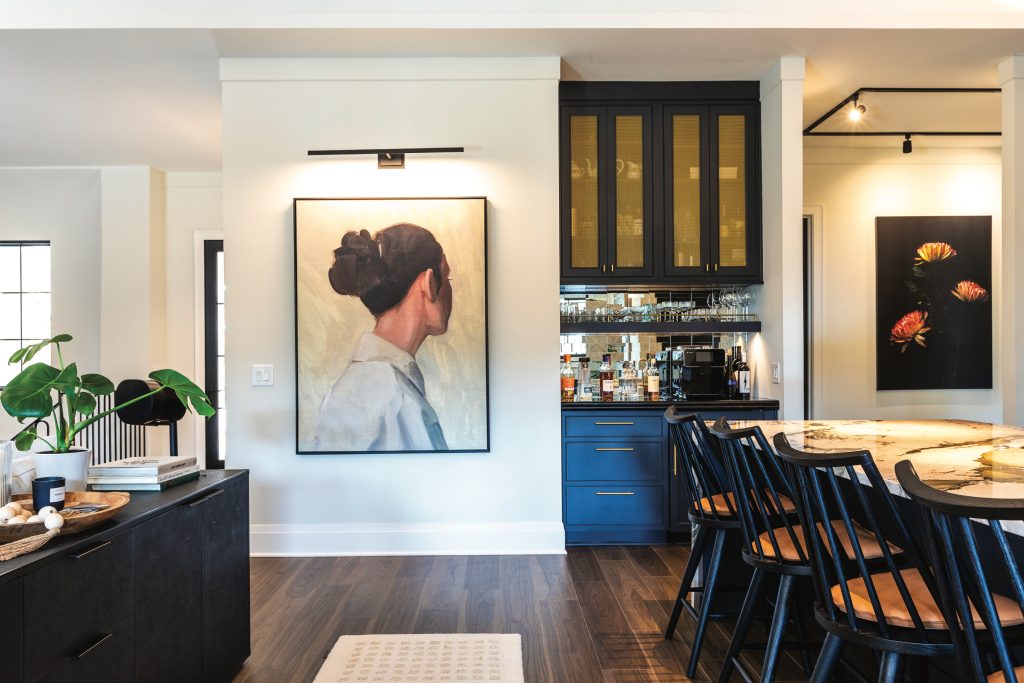
The designer is Liz Valkovics. The location is lakeside, in a gated Pinehurst golf community. The exterior is Carolina casual to blend with surroundings but inside is a magazine layout, contemporary in vision, curated for practicality, incorporating an ice bath and sauna for daily use and wellness events, a ground-level game room with pool table, movie screen, guest quarters and kitchenette. Because . . . sophistication notwithstanding, this house is also home to Luke, 11, Sophie, 4, and golden retriever Gus, whose fur matches the oatmeal-textured low-slung sofa in front of the glowing tubular fireplace. The result: stunning yet comfortable for a young family.

“The kids don’t have to be too careful,’’ Liz says.


Over the mantel a frame surrounds the wall-mounted TV. The whole equals a study in earth tones with a generous nod to black, from set-in houndstooth rugs to matte charcoal kitchen cabinets and a matching Hallman (Italian) six-burner range with a grill top, where Luke and Sophie make pancakes on weekends. Even the quartzite countertops — hard as granite, beautiful as marble — have undulating waves of gray. “I’ve done a purple kitchen but this was for us, no clutter, happy and inviting,” Liz says.

Liz paints. Her choice of art, some digitally achieved, is wide ranging. A computer program that moves furnishings within a room and performs other diagnostics aid her decorating decisions. She studied and taught art, became a full-time painter, and earned a degree from the London School of Interior Design. Her specialty: hospitality venues, restaurants and commercial space. The jewel in her crown is a boutique hotel in Dubai, although she also served as creative director for a Florida hotel, worked in Baku, Azerbaijan, and undertook design projects at London’s Gatwick Airport.

Her husband, Paul, a British national, traveled the world in operations and management of sporting events, including the summer Olympics and FIFA World Cup. He also partners in his wife’s design business. Liz is from Ohio, but she met Paul in Cape Town, South Africa, a stopover on one of life’s adventure tours.

So, with world-wide connections, why choose Pinehurst for home base?

Simple. “My parents retired here,” Liz says. And it doesn’t hurt that Paul and Luke are enthusiastic golfers.

Liz and Paul absorbed the cosmopolitan feel of the area while renting a golf-front condo during their home’s construction year. It enabled Liz to participate in day-to-day decisions like the high windows and window seats flanking the living room fireplace — a space usually filled by bookcases. “It’s perfect for curling up with a book and a glass of wine,” she says. Look up: Some ceiling fixtures feature circles of small round globes, “like golf balls,” she smiles. Almost all furnishings are new, sourced from her international and High Point providers.

Some pieces qualify as both unusual and practical, like the elongated dining room table positioned on a pedestal for comfortable seating. The table is set against a wall lined with a wipe-clean leather banquette. A bench opposite provides flexible seating, while Mom and Pop chairs at either end, now reupholstered in a wild abstract, come from Liz’s family. Over the table is a row of smallish paned windows with black frames, a Liz signature throughout the house. This fluid seating arrangement in a modest space has accommodated a dozen at Thanksgiving.

Sophie’s room and the master suite opening onto a deck overlooking the lake complete the main floor, with Sophie’s bathroom doubling as a powder room.

If the main floor illustrates how Liz interprets contemporary icons, the lower level — opening onto the patio and grill — has what Liz calls a “playful feel,” beginning with the pool table. Luke’s quarters are there along with a guest room and the office for Liz’s design business. Shelves hold all the classic board games.

Here, Liz has adopted Paul’s favorite green, reminiscent of his Yorkshire childhood, on kitchenette cabinets. True, it is more jalapeño than mint, but still a pleasant surprise. Nearby stands another relic from relatives, a velvet-upholstered settee, poised as if it’s awaiting the arrival of a time-traveling Louis XIV. Wellness devotees, Liz and Paul’s home gym occupies a garage bay.

Contemporary homes and their contents are often labeled cold, stark. Not here. Who would guess that this modest, creamy white cottage located on a cul-de-sac in a prime golf enclave might, beyond the front door, reveal 3,200 square feet of family-friendly space sparked with art and design, sprinkled with whimsy?

“We tried to be respectful of the area, which meant sometimes going back to the drawing board,” Paul recalls. “Our forever home? It sure is. I plan to be buried in the backyard.”

PinePitch

PINEPITCH

PinePitch March 2025

In the Bookshop

The Country Bookshop, 140 N.W. Broad St., Southern Pines will be hosting Ada Calhoun as she discusses her novel Crush, on Wednesday, March 12, from 6 to 7 p.m. Then, on Wednesday, March 19, also from 6 to 7 p.m., Eddie Huffman will be in the bookshop to talk about his recent release, Doc Watson: A Life in Music. More information and tickets can be obtained at www.ticketmesandhills.com.

Wee Bit o’ the Green

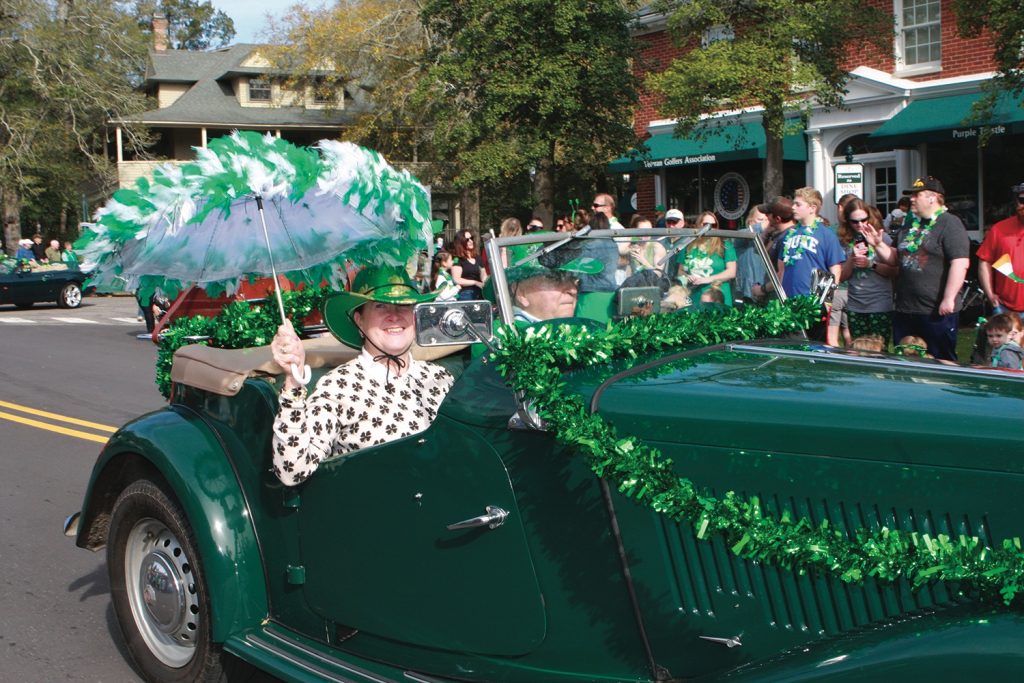
Pinehurst turns the whole village green when the Irish take to the streets for the annual St. Patrick’s Day Parade on Saturday, March 15, beginning at 10 a.m. If you put your folding chair down at James W. Tufts Memorial Park, 1 Village Green Road W., you won’t miss a single leprechaun. For more blarney go to www.vopnc.org.

Just Another Lazy Sunday

Bring a blanket or a folding chair and a picnic basket, kick back and listen to saxophonist Sarah Hanahan outdoors on the lawn from 2 p.m. to 4 p.m. at the Weymouth Center for the Arts & Humanities, 555 E. Connecticut Ave., Southern Pines, on Sunday, March 23. There will be a cash bar with mimosas, beer, wine and non-alcoholic offerings. For info see www.weymouthcenter.org

One Man, One Microphone

Have a problem with old age? The great Garrison Keillor is here to provide a little perspective. Despite its inconveniences, old age brings the contentment of “less is more.” Your mistakes and big ambitions are behind you. There’s nothing left to prove. And small things give you great pleasure because, well, that’s what’s left. “Garrison Keillor Tonight” is an evening of wit, storytelling, audience song and poetry on Friday, March 28, at 8:30 p.m. on the main stage of Owens Auditorium in the Bradshaw Performing Arts Center, 3395 Airport Road, Pinehurst. The show features sonnet singing, limericks and musical jokes. And there’s news from Lake Wobegon, a town booming with new entrepreneurs, makers of artisanal firewood and gourmet meatloaf, breeders of composting worms, and dogs trained to do child care. Age aside, there are some things that endure, and Garrison Keillor is one of them. For additional information and tickets go to www.ticketmesandhills.com.


Trunk o’ Flowers

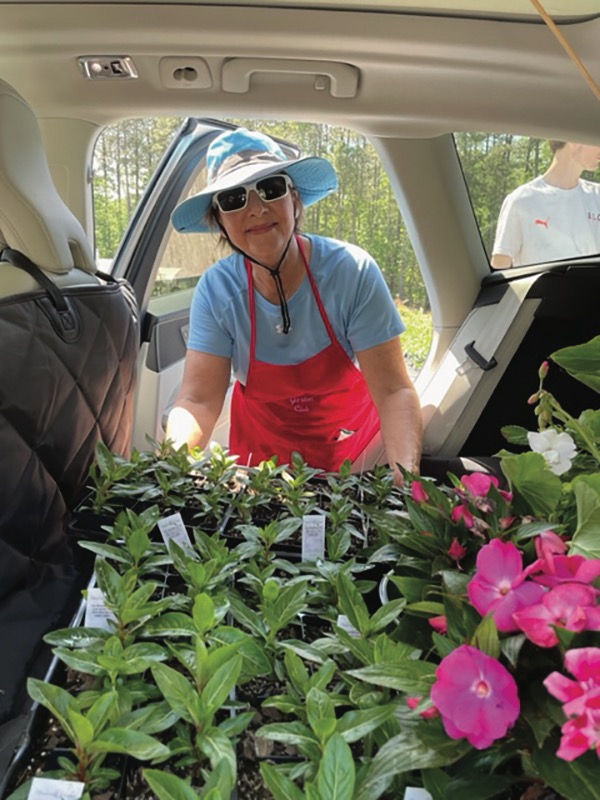
The Pinehurst Garden Club wants your sunny disposition, water, a little fertilizer and for you to buy their plants during the annual garden pre-sale that runs from March 16 to April 10. You can check out the flower options and order online at pinehurstgardenclub.org, or by contacting a member. The pickup is Sunday, April 27, at the Green Haven Farm, 255 Green Haven Lane, Carthage. Just drive up and pop the trunk. The sale supports two students in the horticultural studies program at Sandhills Community College.

Gala for Guide Dogs

Mira USA, a national nonprofit organization providing guide dogs to blind children ages 11-17, will host its annual Mira-cles Happen Gala on Saturday, March 8, at 6 p.m., at the Country Club of North Carolina, 1600 Morganton Road, Pinehurst. Guests will have the chance to meet two 2024 guide dog recipients: 12-year-old Elijah with his guide dog, Maple, and 15-year-old Shaelin with her guide dog, Guiro. The evening includes a gourmet dinner, live music and entertainment, along with silent and live auctions. Individual tickets and sponsorship packages are available by visiting www.miraevents.org/mira-cles-happen-gala.

When 24 Hours Isn’t Enough

If your salute to the old sod lasts longer than just St. Patrick’s Day, grab a seat for Andy Clooney’s Irish Celebration on Tuesday, March 18, from 7 to 9 p.m., at the Fair Barn, 200 Beulah Hill Road S., Pinehurst. The show features Ireland’s comedy duo Mick Thomas and Sean Finnerty along with The Emerald Fire Irish Dancers backed by the Guinness Irish Band. For information and tickets go to www.cooneyshows.simpletix.com. Cheers.

Back in Bloom

The Garden Club of the Sandhills will host its 2025 “Blooming Art” exhibit featuring professional floral designers, local garden club members and local artists on Saturday, March 29, from 10 a.m. to 4 p.m., and on Sunday, March 30, from noon to 4 p.m., at the Campbell House, 482 E. Connecticut Ave., Southern Pines. Tickets are good for either day. For information go to www.ticketmesandhills.com.

Put a Little Spring in Your Step

Kids ages 3 – 12 can celebrate the arrival of spring at the Spring Fling in the Downtown Park, Southern Pines, on Friday, March 28, from 5:30 to 7:30 p.m. The afternoon festivities include games, face painting and bounce houses, and will be followed by an outdoor movie, Moana 2. Concessions will be available for purchase. For additional information call (910) 692-7376.

It’s a Pine Thing

The Party for the Pine, the festival celebrating the oldest longleaf pine in the world, will be from 10 a.m. to 3 p.m. at the Weymouth Woods Boyd Tract meadow, Weymouth Woods, 555 E. Connecticut Ave., Southern Pines, on Saturday, April 5. The celebration features games, food trucks, turpentine demonstrations, lessons on the native habitat and, weather permitting, a live prescribed burn. For additional information call (910) 692-2167