Stormy Seas

STORMY SEAS

Judson Theatre Company presents The Caine Mutiny Court-Martial

by Jim Moriarty

Herman Wouk, the author of both the novel The Caine Mutiny and the play The Caine Mutiny Court-Martial, took great pains to let his audience know that nothing that happened aboard the fictional ship the USS Caine occurred in the very real campaigns he experienced during his World War II service in the Pacific Theater. A note to the play says, “The Caine Mutiny Court-Martial is purely imaginary. No ship named U.S.S. Caine ever existed. The records show no instance of a U.S. Navy captain relieved at sea under Articles 184-186. The fictitious figure of the deposed captain was derived from a study of psychoneurotic case histories, and is not a portrait of a real military person or a type; this statement is made because of the existing tendency to seek lampoons of living people in imaginary stories. The author served under two captains of the regular Navy aboard destroyer-minesweepers, both of whom were decorated for valor.”

The Judson Theatre Company will bring Wouk’s courtroom drama, informed by his service aboard the USS Zane and USS Southard, to life in five performances starring John Wesley Shipp and David A. Gregory, beginning Thursday, April 24, and running through Sunday, April 27, in BPAC’s Owens Auditorium, 3395 Airport Road, Pinehurst. The novel, published in 1951 in a wave of post-war literature that included books like Norman Mailer’s The Naked and the Dead, earned Wouk a Pulitzer Prize. The play debuted on Broadway in January 1954, directed by Charles Laughton. That June the movie The Caine Mutiny was released, gaining seven Oscar nominations, including one for best actor for Humphrey Bogart’s riveting performance as Lt. Com. Philip Francis Queeg.

The play is performed in two acts, organized simply with the first act as the prosecution and the second the defense. “If you think about the film and even the book, they both literalize what happened on the ship,” says Judson Theatre’s executive producer, Morgan Sills. “With the play, the audience gets to piece together what happened on the ship from what they glean from all the different testimony they hear. In the end, the audience has a job to do, to decide what they believe is the real story. And that’s theatrically interesting. It can change from night to night the way that live performances change from night to night and books and films do not.”

Shipp, who returns to Judson Theatre after playing the role Juror No. 8 in its 2016 production of 12 Angry Men — Henry Fonda’s part in the 1957 movie — takes the part of Queeg, the ship’s commander relieved of duty during a vicious storm by Lt. Stephen Maryk. He’s played by Jacob Pressley, whose Judson summer theater festival credits include Gutenberg! The Musical, The Last Five Years and They’re Playing Our Song. Maryk’s defense counsel is Lt. Barney Greenwald, played by Gregory. Coincidentally, Fonda played Greenwald in the original Broadway production.

Though tasked with defending Maryk, Greenwald has no particular fondness for his client. On the other hand, he knows that in order to perform his sworn duty to zealously represent him, he will have to cross-examine Queeg in the most brutal manner, a prospect that gives Greenwald no pleasure. At its dramatic height Greenwald and Queeg go head-to-head. And it’s there that Judson’s production of The Caine Mutiny Court-Martial benefits from the long working relationship between Shipp and Gregory.

In his role as Eddie Ford on One Life to Live, Shipp — whose credits and awards (including two Emmys) over a 38-year acting career are too numerous to mention —  was frequently at loggerheads with Gregory, who played his son, Robert, on the daytime drama. “I was the abusive father and he was my oldest son, Bobby Ford,” says Shipp. “I had three sons and I treated them all differently. Bobby was the one who would push back. We had a great time. It’s just one more reason I’m so excited to get on stage going head-to-head with this man because I know how talented he is, how resourceful he is. The thing I love about David is he brings his A game all the time. I feel like we challenged each other.”

Moving at the speed of a soap opera, between scenes Shipp and Gregory would occasionally swap their character’s lines if they thought it deepened the connection. “We have a shorthand with each other, working 15-16 years ago on the soap where we would have to clash,” says Gregory. “We know what that territory is, but we haven’t experienced it with this play and these words.”


One Life to Live isn’t their only collaboration. Gregory wrote a scripted podcast, Powder Burns, about a blind sheriff in the Old West. It premiered on Apple Podcasts in 2015 with Shipp in the role of the sheriff. Critically acclaimed, it earned Gregory a Voice Arts Award in 2017. They’ve also worked together on a two-person play Gregory wrote about Jimmy Stewart and Henry Fonda called Hank & Jim Build a Plane, which Shipp and Gregory performed in a workshop in New Orleans in 2018, the last time they appeared on stage together. As opposed to their One Life to Live personas, Hank & Jim is about two men, famous for their shared model airplane hobby, who are at odds with one another over pretty much everything else — including a woman — and who won’t, or can’t, challenge one another. In something of a metaphor for our time, it’s about what Hank and Jim, sharing the same tiny garage space, can’t say to one another. “It may have been Jimmy Stewart’s daughter who said the interesting thing you’ve done is that you’ve taken two men of very few words and written what they would have said to each other if they could have,” says Shipp.

Finding the right words won’t be the problem in The Caine Mutiny Court-Martial. “Plays like this get done so often because they’re very, very good,” says Gregory. “The author has meticulously made this as perfect as possible. We just get to add on top of that. It’s a blast.”

Shipp sees only one real drawback: “My only complaint is that it’s too short.” 

Dissecting a Cocktail

DISSECTING A COCKTAIL

The Wandering Path

Story and Photograph by Tony Cross

In the 2022-23 time frame, alcohol sales increased by 1 percent, but the sales of non-alcoholic wine, beer and liquor grew by over 32 percent. “An increasing consumer focus on moderation, health and wellness is having a positive impact on all no-alcohol sub-categories, with growth rates higher than their full-strength equivalents,” says Susie Goldspink, head of no- and low-alcohol insights at IWSR (originally known as International Wine and Spirits Record, though they now deal in beer and ready-to-drink beverages as well).

Indeed, the market is starting to get flooded with all things alcohol-free. My business operates out of a health store and, in the past couple of years, I’ve seen more brands like these than I can count.

A lot of folks, me included, take breaks from alcohol even when it’s not “dry January.” We’d like to have something to drink that makes you feel good without being high or drunk (canned THC cocktails are a whole other story). My problem with most of these RTDs (ready-to-drink) is simple: They don’t taste great; they use buzzwords for sales (e.g., ashwagandha); and they’re pricey. I haven’t had the opportunity to try tons of spirit-free liquors, but every one that I’ve tasted (besides Seedlip) has been uninspiring, to say the least.

Enter Pathfinder, a non-alcoholic spirit made from a distilled hemp-based liquid. Pathfinder has a lot going on, made from Douglas fir, orange peel, ginger, sage, wormwood, juniper, etc. On the palate, it’s similar to an amaro — think Cynar — and is perfect for cocktails. Speaking of, I found this delicious recipe, The Wandering Path, from bartender Jeffrey Morganthaler’s blog. It was created by his business partner, Benjamin Amberg, at their acclaimed bar, Pacific Standard. This sour cocktail is as easy to make as it is delicious.

Specifications

2 ounces Pathfinder

1 ounce fresh grapefruit juice

3/4 ounce fresh lemon juice

1/2 ounce simple syrup (2:1)

1/2 ounce egg white

Execution

Combine all ingredients in a shaker, add ice, shake hard until cold, and double strain into a coupe glass (a sour glass is pictured). No garnish.

Character Study

CHARACTER STUDY

A Sandhills Treasure

Leading from behind the podium

By Tony Rothwell

As the last note dies away, Anne Dorsey turns to face the audience. She bows, then turns back to face the chorus, sweeping a hand from one side of the stage to the other, passing on the applause to every singer and musician in the Moore County Choral Society. It’s a love affair that has lasted 22 years.

On April 27, the Moore County Choral Society will hold its 50th anniversary concert in the Robert E. Lee Auditorium at Pinecrest High School. Dorsey has wielded the baton in very nearly half of them. Befitting the occasion, the Choral Society will be joined by a professional chorus, local high school choruses, the Arc of Moore County Joyful Noise and a full orchestra.

Dorsey will have chosen a program with a careful balance between old favorites and new, or lesser-known, pieces — perhaps from a different country or in a foreign language — adding up to a memorable performance. It’s what she has done, time and time again.

To get the chorus to where it needs to be, rehearsal after rehearsal, Dorsey’s approach depends on the situation, but humor is her main weapon. She is witty, quick with words, and has an infectious smile that radiates from behind the podium. And the chorus works hard for those smiles. One place you don’t want to be is on the end of her black look. It happens when she has just told a section, or indeed the whole chorus, precisely what she is expecting — a clean cutoff at the end of a phrase or a particular vowel pronunciation — and it is not delivered. It’s a well-practiced skill she developed studying with the legendary, and fear-inducing, Dr. Lara Hoggard and the Carolina Choir at UNC-Chapel Hill.

“Choir was everything,” she says of her undergrad days. “I never missed. I was never late. I wanted to be like him.”

Born in Rockingham, Dorsey sang her first solo at the age of 3 in a recital in Ellerbe. In junior high school she sang alto, “because I could read music and hear a harmony part which helped me develop a musical ear,” she says. Inspired by the Carolina Choir, it was during her high school years in Henderson that Dorsey decided she wanted to be a school choral director. “I heard them sing and I’d never heard anything like that sound,” she says. “I wanted to be part of it and learn how to make it.” 

With a music education degree from UNC in one hand and a teaching certificate in the other, Dorsey moved to Moore County in the fall of 1977, too late to land a teaching position, but not too late to be hired by organist Paul Long at the Community Congregational Church of Southern Pines as choir director. “The ink was still wet on my diploma, and I got a job with a Juilliard genius,” says Dorsey. At roughly the same time she discovered the Moore County Choral Society, then in its infancy, and joined as a member under Dr. Armand Kitto. It was the beginning of an incredible 48-year relationship.

Dorsey did finally get that teaching job — in the Hoke County School System. Over the course of her career as an educator, she taught grades 4-12 and did children’s choir work at church and in the community. “Every grade, every class and every student taught me something — probably more than I taught them,” she says.

In the spring of 2002, Dorsey filled in for John Shannon, then the conductor of the Moore County Choral Society, and upon his resignation she was offered the job of director. She found that working with adults is both the same and different from working with young people.

“I sometimes forget who I am dealing with, but I have largely been forgiven for that,” she says with a smile. “I have certainly been stretched, and I have, in turn, tried to stretch those who sing with MCCS. No year should lack musical challenge; no season should be without something new, something difficult, something different, and also be appealing to our audiences.”
Chris Dunn, executive director of The Arts Council of Moore County and a brass trumpeter in MCCS, says, “As a musician who has played many concerts with Anne, I marvel at how nothing seems to faze her. One example was at the beginning of a concert the entire brass section missed an entrance. Anne turned to us with a stern look but continued conducting as if everything was fine. We can laugh about it now, but not then.”
Twenty-two seasons bring with them a sense of perspective. “The talented members of MCCS have brought fine choral art to the Sandhills for half a century,” says Dorsey. “The conductors — only five of them in 50 years — have been blessed with hardworking singers whose talent and passion for choral music have been freely shared year after year to bring beauty to our audiences. I believe that arts organizations enrich the communities they serve. What an honor it is to be part of one so fine.”

At the April concert, the Anne Dorsey Scholarships, now in their 36th year, will be awarded to two gifted Moore County students who intend to study music beyond their high school years, a fitting reminder of Dorsey’s roots in music education.

“I look at a piece of music like a sculptor looks at a slab of marble,” she says. “It is beautiful but it doesn’t speak. The artist must shape it, refine it, and polish it until its beauty shines and is unforgettable. My favorite job as a conductor is to dig into the tiniest details of a piece — the dynamics, phrasing, tempo, style — because therein lies the beauty.”

A beauty she has revealed for over two decades, and counting. 

Be Our Guest

BE OUR GUEST

Be Our Guest

Creating the perfect guest bedroom Madcap Cottage style

By Jason Oliver Nixon and John Loecke     Photograph by Bert VanderVeen

There’s truly an art to hosting guests. To making a visitor feel supremely welcome without having to kowtow to their every whim and whimsy.

John and I love entertaining in all its forms, and we really raise our game when it comes to hosting houseguests at our High Point home, the House of Bedlam. Think The Ritz Paris by way of North Carolina, but cozier, softer, and a lot more fun. Dining room disco, anyone? We just had an international guest arrive from London, and we wanted her stay to be as comfortable and memorable as we could make it. Quite simply, we want every one of our houseguests to feel like they’re at home and leave them wanting for nothing. A good mattress and a clean room are a given, but we are all about the small touches, the personal ones that focus on our guests’ comfort.

That said, we are very clear about our “deliverables.” This isn’t a restaurant. We aren’t the maids. Yes, please strip the bed when you depart. We will have coffee and English muffins ready every morning; we don’t make eggs. And a gift or dinner out on the town is always welcome.

Here are a few tried-and-true recipes for the ultimate guest bedroom from your friends at Madcap Cottage . . .

— We love to put flowers next to the bed. Flowers truly make the room feel fresh, alive and cared for. You know your guests well, so think about their favorite blooms and adorn the nightstand with that particular blossom. At this time of year, what is more cheerful than a simple vase abundant with daffodils? A great stack of books is always welcome, too.

— Place either a bottle of water next to the bed or fill a glass decanter with water and accompany it with a lovely crystal glass.

— Email a week before to ask your guests’ must-haves or food preferences. Oat milk, almond milk, gluten-free bread? The Madcaps have you covered. Our recent guest wasn’t fussy but she is a chocoholic. We had some of our Hammond’s chocolate bars on standby for her, so she could try some Southern sweet treats.

— Add lovely toiletries pillaged from a hotel to your guest bathroom. Save the Hermès for really good friends or treat them to some of your favorite toiletry brands. We love to leave our guests with some of our French lavender bath bombs from the Old Whaling Company to help them relax and unwind during their stay.

— Have a plug-in outlet with USB port easily visible and plugged in near the bed. When they’ve retired for the evening after a long journey, the last thing a guest needs is to be crawling around on the floor trying to find an accessible plug.

— Good towels, well fluffed. The bigger and bouncier, the better.

— Extra toilet paper in a basket atop the toilet. Be kind and save your guests the indignity of having to request more TP.

— A soft rug next to the bed. We have small accent rugs next to every bed in our house. Besides the fact that they make the room cozier and look more layered, they make getting out of bed that much easier when you’ve got a soft landing to look forward to.

So there you have it. That’s how we host a house guest, the Madcap way.

Enjoy!

Poem April 2025

POEM APRIL 2025

Greedy

The catbird is pecking away

at two ripe tomatoes.

I wave my hands and shout,

My tomatoes! as though 

I’d produced them

from my breasts or belly.


The catbird aerializes

on the tomato cage,

jabbing and jabbing the red fruit.

I have more on the counter

that I won’t eat before they rot,

or that I’ll give away.


It’s unseemly, this stinginess,

a memory of not-enough,

the necessity of preserving

a crop from rabbits and deer,

the otherwise marvelous

round-backed bugs, grasshoppers

flaring red underwings,


or birds like this one,

gray as a civil servant,

an actuary of ripeness,

that tilts its head to eye the fruit

and flaunts its rusty bottom

in salute.

— Valerie Nieman

Birdwatch

BIRDWATCH

Long Trek North

Louisiana waterthrush leads the way

By Susan Campbell

In early spring, birdwatchers such as myself are eager to spot the first returning migrants of the season. These are northbound birds that have spent the cooler months far to our south, in Central or South America. There, the living is easy, with plentiful food and a mild climate. But as the days begin to lengthen, these birds begin their return flight to the breeding grounds. Many may fly both day and night as the urgency of their mission increases. Hormone levels drive them to make their way swiftly to their natal area. Some return to the exact patch of woods, marsh or lake where they themselves hatched.

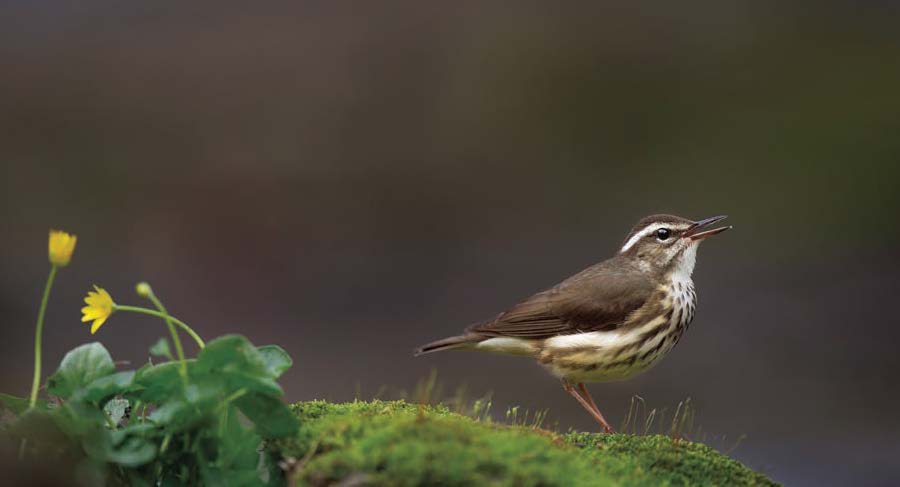
One of the earliest to return here in central North Carolina is the Louisiana waterthrush. A small, drab warbler, it is far more likely to be heard than seen at first. Its plumage is streaky brown and white. Birds can be recognized by their prominent broad white eyebrows and pink legs. As its name implies, the species prefers wet habitat, being at home along streams and rivers where it not only feeds in the trees, but along banks and around rocks at the water’s edge.

In the spring, Louisiana waterthrushes will call or sing as they move from place to place. As with so many species, the male’s vocalizing serves not only to attract a mate, but to establish territory. They have a loud, melodic song that carries well over the sound of moving water. The species’ call note, too, is a high volume “chip” that is easy to pick up in thick vegetation or above a gurgling stream.

Louisiana waterthrushes are insectivorous and so will consume any fly, midge or beetle that it sees. Also, waterthrushes will pick hatching aquatic insects such as mayflies or stoneflies out of the water. Individuals may wade in the shallows as they forage, making short jabs at potential prey items.

After pairs find one another and begin to raise the next generation of waterthrushes, they become virtually silent. This no doubt enables them to protect their nesting site and their young from would-be predators. Nests are built on or near the ground, making them relatively vulnerable to disturbance. Secretive behavior also reduces the chances that they will be parasitized by brown-headed cowbirds, which are known to seek out open cup nests such as those made by waterthrushes to deposit a single egg. The resulting nestling will be unwittingly cared for by waterthrush parents to the detriment of their own young.

Being one of the earliest warblers to return in the early spring, they are also likely to disperse in early summer after their young leave the nest. They may return to their Central American wintering grounds by the end of July. If you are fortunate enough to encounter a Louisiana waterthrush in the weeks to come, enjoy it because it is not likely to be around for very long.

Stoneybrook Remembered

STONEYBROOK REMEMBERED

Stoneybrook Remembered

A springtime tradition like no other

By Chrissie Walsh Doubleday and Tara Walsh York

Elevated to one-word status, the locals simply called it Stoneybrook. But it was much bigger than just a day at the races.

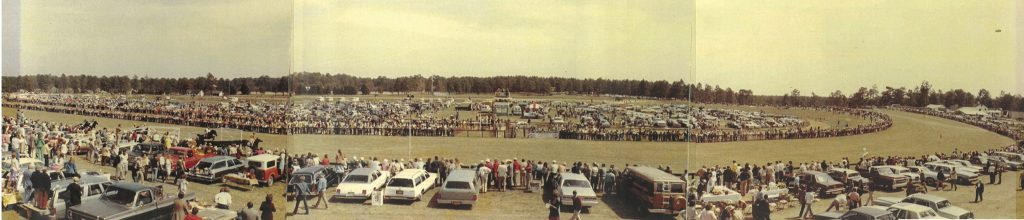
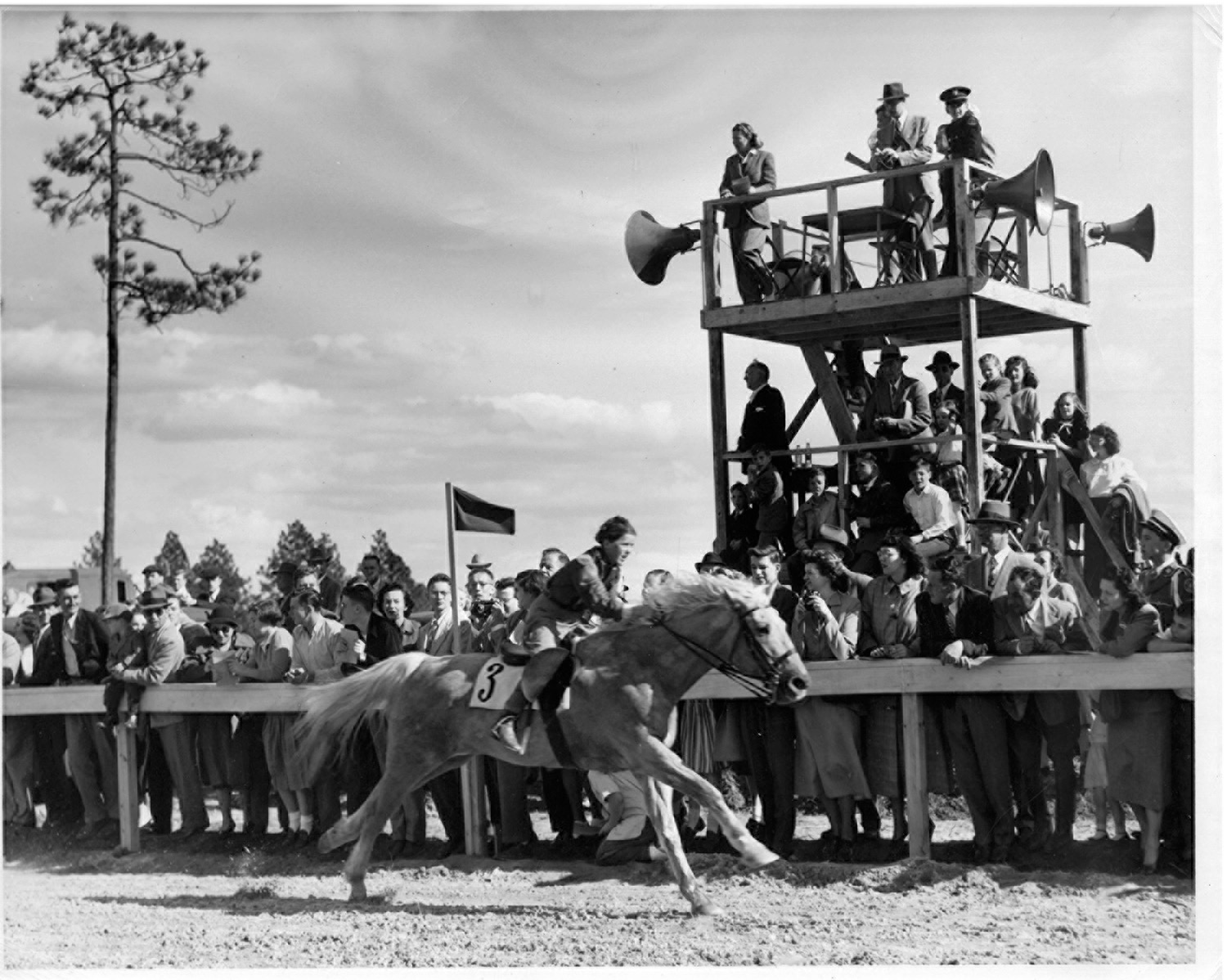
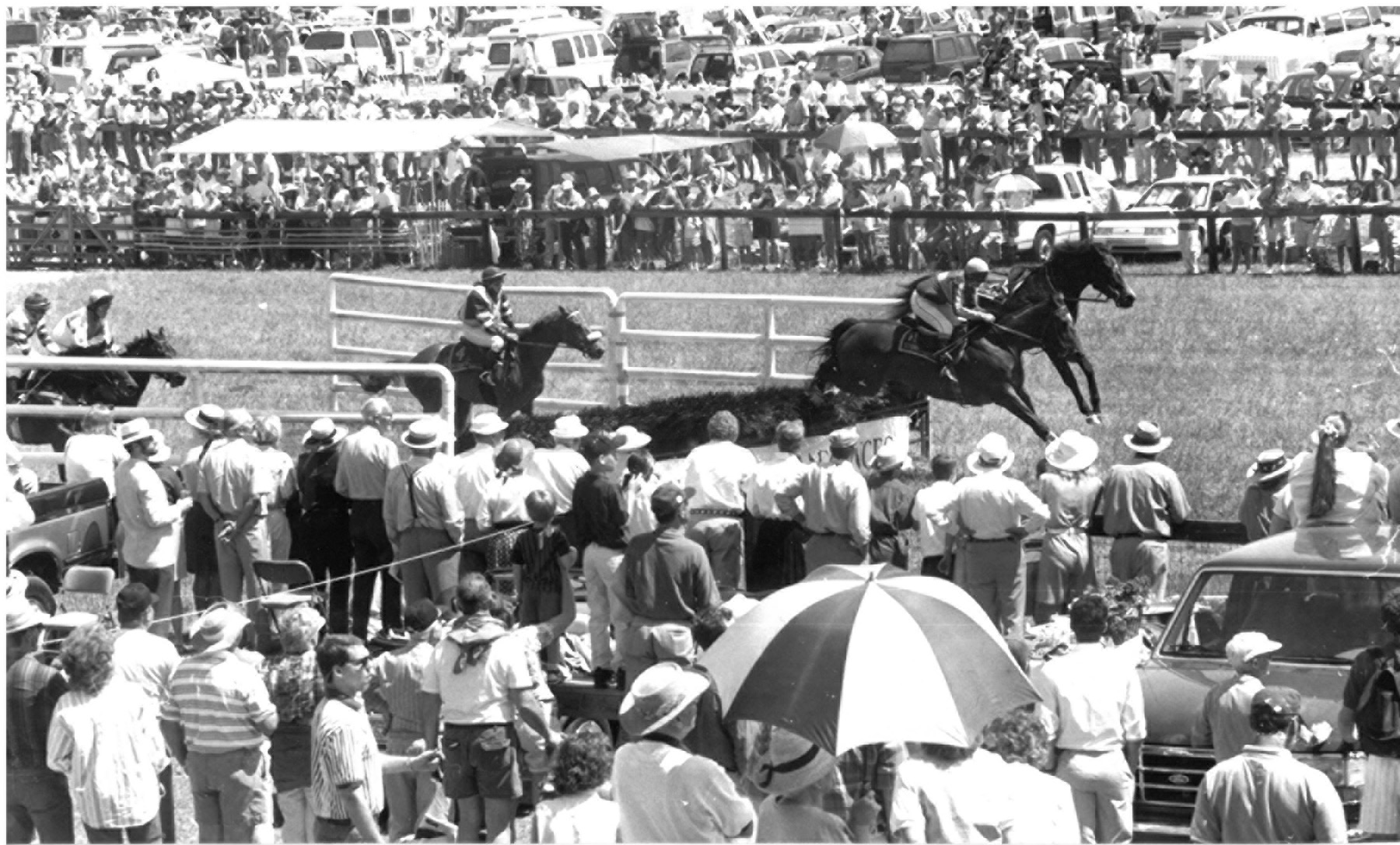
The Stoneybrook Steeplechase was an outdoor cocktail party rivaling the grandest in the Southeast, and once you went, you never wanted to miss it again. Whether folks donned fancy hats and dined at banquet tables adorned with fine linens and chilled Champagne, sat on the back of a pickup truck with a bucket of Kentucky Fried Chicken and a cooler of beer, or spread a blanket on the grass with a picnic basket, it was the place to be. More than just a lively celebration, though, Stoneybrook embodied the thrill of horse racing.

The perfect parking spot was as coveted as a family heirloom. People arrived on foot or by bus, in cars or by limo, but regardless of how they got there or where they came from, when they heard the announcer say “The flag is up!” they raced to the rails to watch. At its peak, nearly 40,000 spectators packed into Mickey Walsh’s Stoneybrook Farm, transforming it into a carnival of energy and tradition. It was the first sunburn of spring, and the ultimate mingling of community and family.

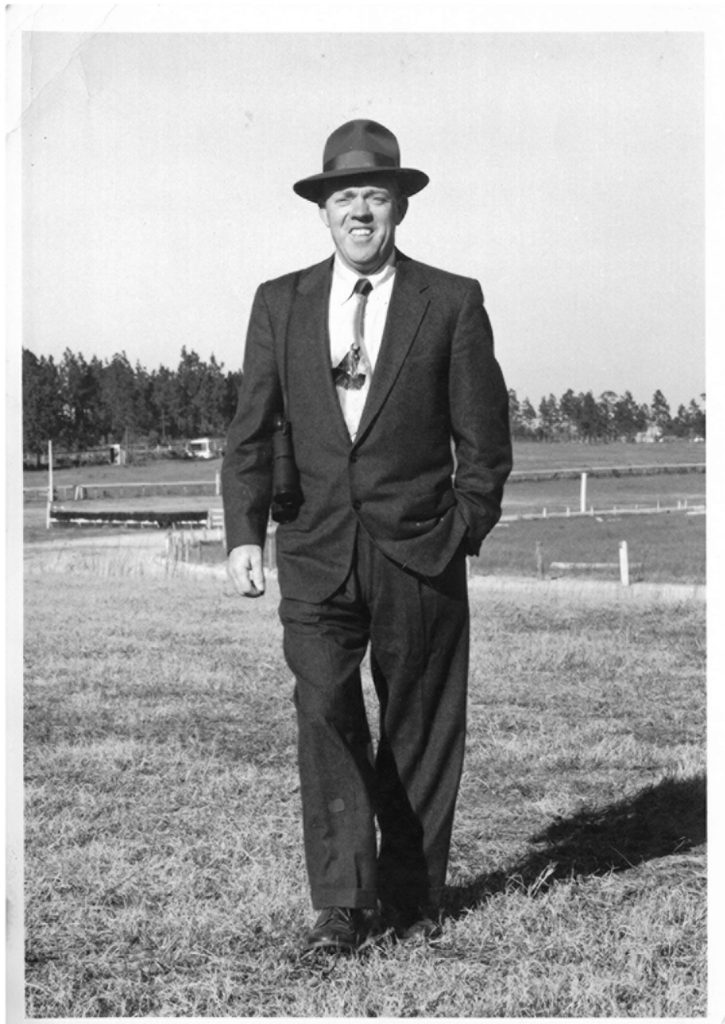
On St. Patrick’s Day 1947 Michael G. “Mickey” Walsh, an Irishman from Kildorrery, County Cork, Ireland, brought his dream of starting a steeplechase race to life on his 150-acre farm in Southern Pines. That year, the first Stoneybrook Steeplechase set the stage for nearly half a century of camaraderie, equestrian excellence and cherished memories — not just for the thousands who attended, but especially for Mickey’s own family.

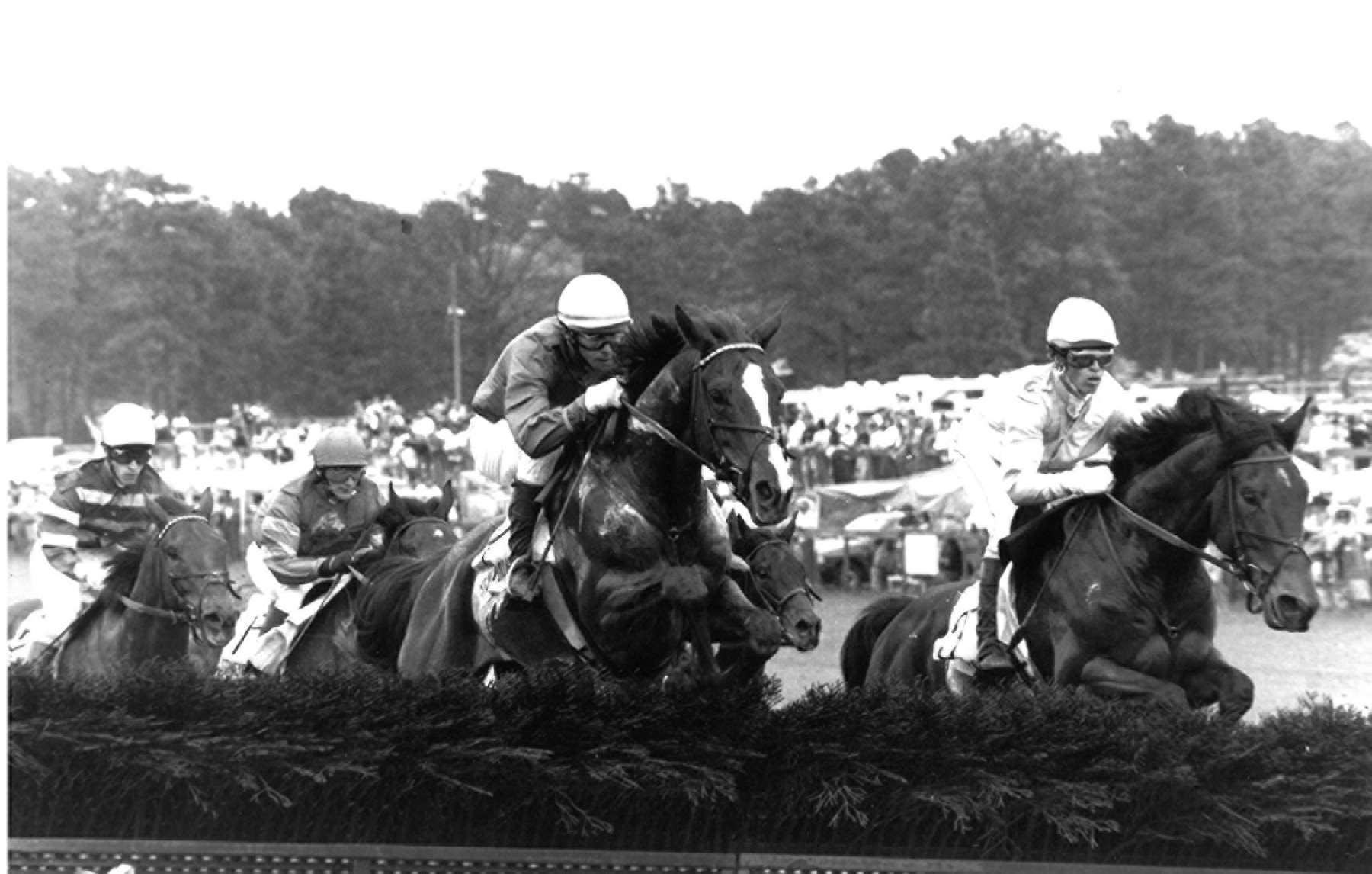
After immigrating to the United States in 1925, Walsh gained fame in the show jumping world, where his horse, Little Squire, achieved a remarkable three consecutive wins at Madison Square Garden. With ambitions that stretched beyond show horses Walsh settled in Southern Pines in 1944 with his wife, Kitty, and transitioned to steeplechase racing, where he became the nation’s leading trainer from 1950 to 1955. The Stoneybrook Steeplechase would become part of the National Steeplechase and Hunt Association in 1953 and one of the premier horse races in the Southeast.

The success of Stoneybrook relied heavily on the community. The Knights of Columbus organized the parking logistics and directed the influx of visitors on race day, and in the spirit of community that defined Stoneybrook, profits from the event were donated to St. Joseph of the Pines, a nursing home. Within the Walsh family, the event was a labor of love. Marion Walsh, Mickey’s daughter-in-law, managed the Stoneybrook office for many years before the responsibility fell to Phoebe Walsh Robertson, Mickey’s youngest daughter. From selling parking spots to securing sponsorships or working with the horses, all the Walsh women played a vital role in sustaining the tradition.

For the Walshes, Stoneybrook was far more than a public event — it was a cornerstone of their lives. The farm was a haven for Mickey’s children and grandchildren, who spent their days riding horses, playing in hay barns and absorbing the rhythms of farm life. Duties like mucking stalls and riding racehorses before school cultivated a deep appreciation for hard work and horsemanship.

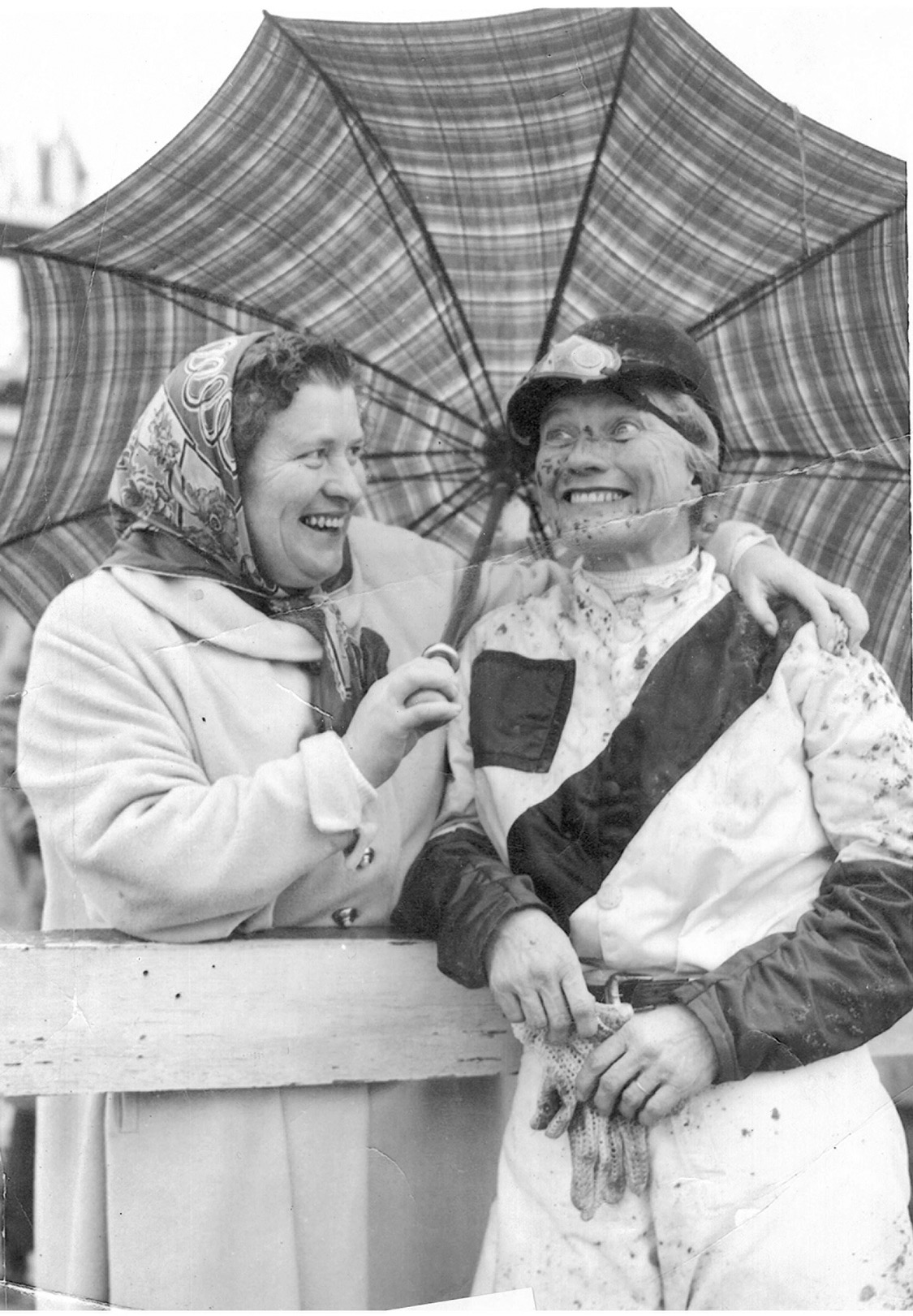
Mickey’s daughters Cathleen, Joanie, Audrey and Maureen were accomplished riders, and raced a time or two. Later, his grandson, Michael G. Walsh III, followed in their footsteps, becoming a leading amateur jockey. In one poignant moment Mickey watched his grandson race at Stoneybrook, riding every jump in spirit alongside him. When young Michael crossed the finish line in first place, Mickey’s pride was unmistakable, his joy radiating through his smiling Irish eyes. His siblings and cousins shared in the pride, racing to the winner’s circle to surround him for the winning photo.

Stoneybrook weekend was a cherished reunion for the entire family. With seven children and 29 grandchildren, the gathering brought relatives from across the country, including Oklahoma, Boston and New York. Close friends, like the Entenmann family — famous for their baked goods — also attended every year, adding sweetness to the occasion.

The festivities extended beyond race day, beginning with the Stoneybrook Ball on Friday night. On race morning, Grandmom Kitty hosted her renowned Owners, Trainers and Riders Brunch, preparing all the dishes herself. Following the races, the celebration continued with an evening reception for horse owners, trainers and jockeys, featuring music, food and drinks. Sunday brought the weekend to a close with a lively bocce ball tournament hosted by Mickey’s son, Michael G. Walsh Jr.

As each Walsh family member reached adulthood, they embraced the full spectrum of Stoneybrook’s traditions, bringing their friends to share in the magic. The event became a rite of passage, a chance to create lifelong memories and forge lasting connections. Even as the races drew thousands, the essence of Stoneybrook remained intimate for the Walsh family. It was a tapestry of laughter, camaraderie and shared experiences. This sense of togetherness extended to the broader community, where old friendships were rekindled and new ones blossomed.

Mickey Walsh’s passing, in 1993, marked the end of an era. The races at Stoneybrook Farm eventually ceased in 1996, but their impact lingered in the hearts of all who had been part of them, spectator and family alike.

For the Walshes, the memories of those weekends — the excitement of the races, the joy of reunion, the shared pride in their heritage — remained indelible. Though the races ended just shy of 30 years ago, the memories endure, a lasting tribute to Mickey Walsh and the indomitable spirit he embodied.

Survival of the Trickiest

SURVIVAL OF THE TRICKIEST

Survival of the Trickiest

There is more than meets the eye in mother nature

Story and Photographs by Todd Pusser

Spending the better part of the morning cleaning up limbs and pinecones left over from the previous night’s storm, I slowly make my way around our suburban yard. Ominous clouds finally give way to bright blue sky and a blazing August sun. Near the brick steps leading up to the front door, I pause. At the top of a waist-high spicebush, a single curled leaf, nestled among a bouquet of more “normal-looking” straight leaves, catches my eye. My pulse quickens.

Over the past few years, I have made a concerted effort to replace the ornamental shrubs and non-native flowers that line our walkway with more wildlife-friendly native plants. It’s been a slow process, but the obvious increase in pollinators in the yard, in the form of bees, moths and butterflies, has shown that the work is starting to pay dividends.

A small shrub native to eastern North America, spicebush produces abundant red berries throughout summer and fall that the local birds love. Named for its aromatic leaves, which smell like citrus and allspice, spicebush also attracts the attention of one very special butterfly, the aptly named spicebush swallowtail. These black, palm-sized butterflies lay their eggs on the shrub’s fragrant leaves. Upon hatching, the caterpillar larvae munch the spicebush leaves (their primary food resource) with gusto, much in the same way I tear into a bag of barbecue potato chips.

I have monitored the spicebush every day since I planted it two years ago. Noticing the curled leaf, a telltale sign of an enclosed caterpillar, it looks like I have finally lured in a customer.

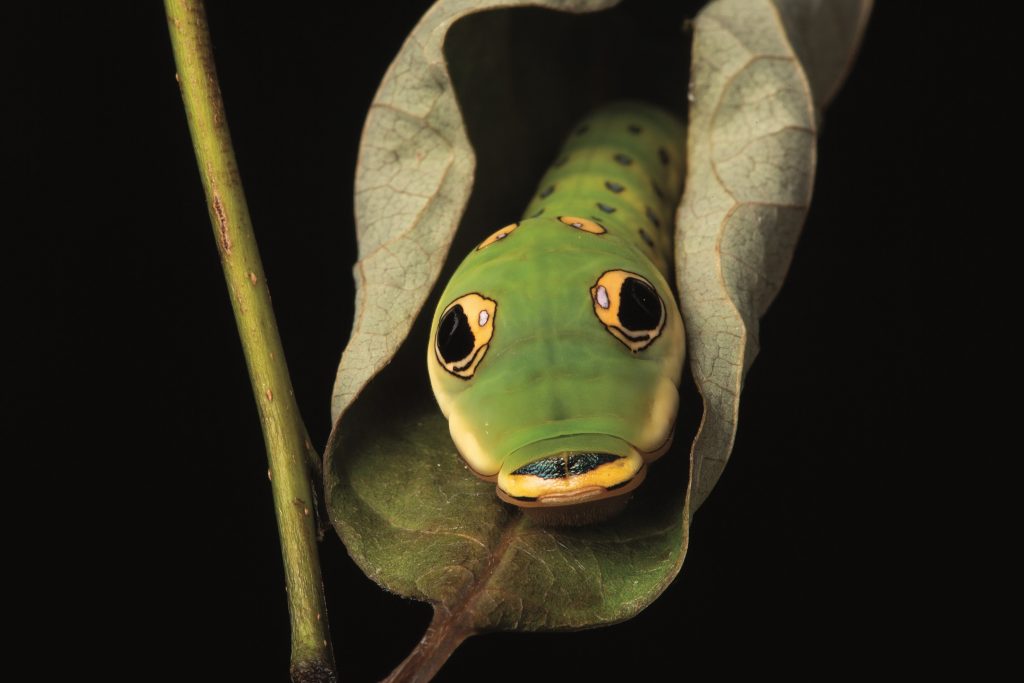
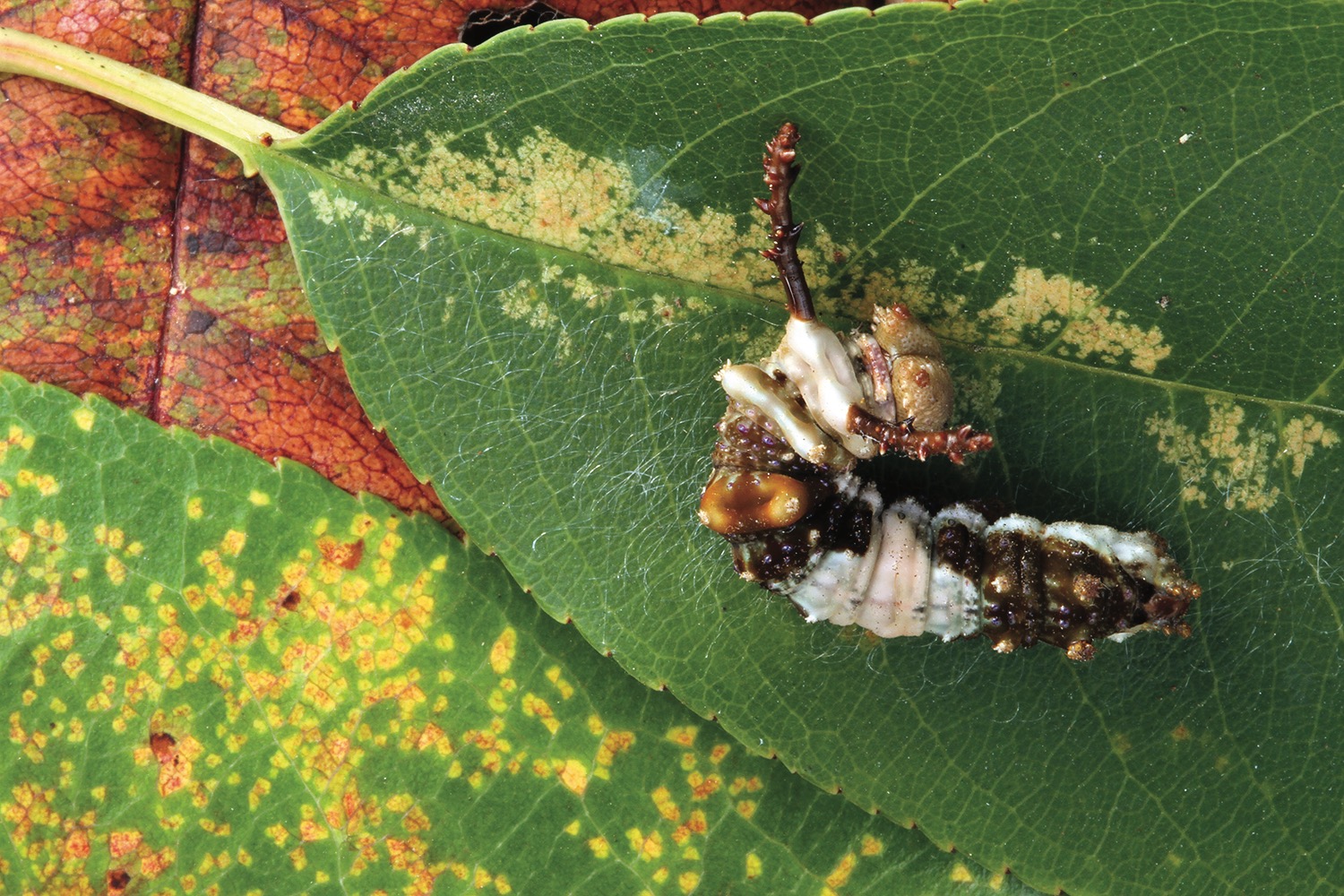
Like a kid on Christmas morning, eager with anticipation, I bend over and slowly unfurl the edges of the leaf, revealing a half-inch-long caterpillar. Immediately, two large yellow eyespots on its head grab my attention. Despite knowing what to expect, it is still a bit startling. Imagine how a hungry bird, like a cardinal, might respond.

You see, this special caterpillar is a snake mimic, and a darn good one at that. Its false eyes come complete with large black pupils. There is even a tiny white spot, a “catchlight” in each, which only adds to the illusion. Throughout the day, the caterpillar remains in its shelter, with the edges of the leaf pulled around its body, always with its head pointed up toward the tip of the leaf. That way, if a foraging bird were to encounter it, the first thing it would see would be the “face” of the snake.

For most of my life, I have been battling the misconception that one has to travel to far off tropical islands and jungles to find wild wonders. As a child, fed on a steady diet of television shows like The Undersea World of Jacques Cousteau and Mutual of Omaha’s Wild Kingdom, I could not wait to escape the confines of little ol’ Eagle Springs and explore the world. Now in my 50s and burdened by the usual hurriedness and complexities of adult life, I have to constantly remind myself that there are marvels to be found close to home. Discovering something like a caterpillar that mimics a snake right outside the front door never fails to illicit that childlike wonder of a world filled with infinite possibilities.

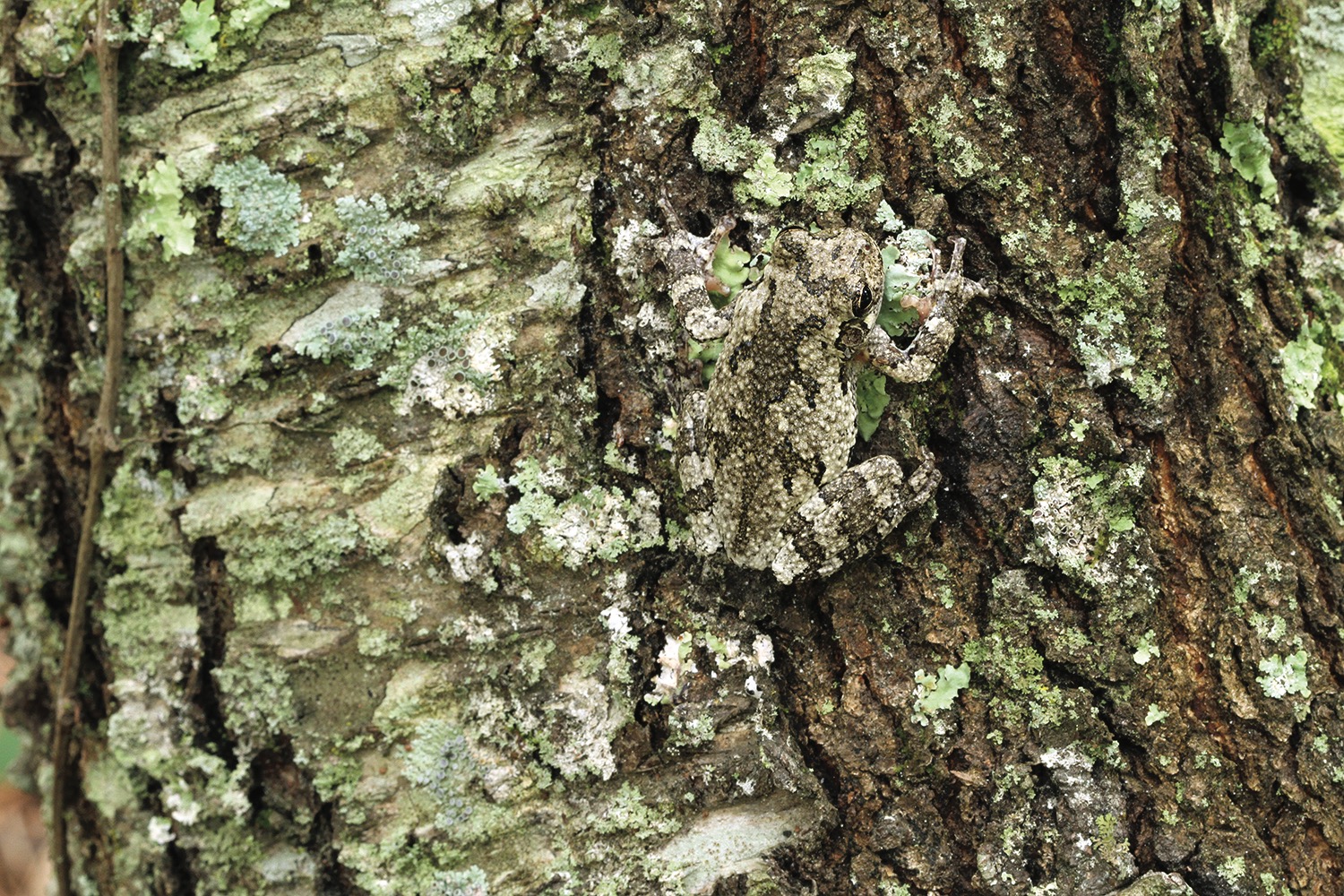
The drama between life and death plays out every second of every day across every nook and cranny of the wild. It’s an eat-or-be-eaten world out there. To gain a level of advantage, countless organisms utilize deception in their never-ending bid to stay alive. Camouflage and mimicry are the templates for survival. Optical illusions abound.

Take caterpillars, for instance. As they grow, all species shed their skins many times before pupating into a butterfly or moth. Biologists refer to each of these skin-shedding molts as instars. Caterpillars are packed with protein and many animals love to eat them, especially birds. One study found that a single clutch of young chickadees can consume up to 6,000 caterpillars before they fledge.

To avoid becoming a meal, caterpillars resort to all manner of trickery throughout different stages of their life cycles. Many resemble tree bark; others, twigs. Some look like lichen. A few possess vicious-looking armaments to deter would-be predators. A hickory horned devil, the largest caterpillar in North America, sports a pair of huge horns on its head. When disturbed, the devil thrashes its head violently from side to side, slamming its horns into its aggressor. Though intimidating, the hot dog-sized caterpillar is completely harmless. The snake-mimicking spicebush swallowtail caterpillar, mentioned earlier, is an even more surprising trickster in an early instar form, when its mottled black and white coloration resembles an unappetizing splatter of bird poop.

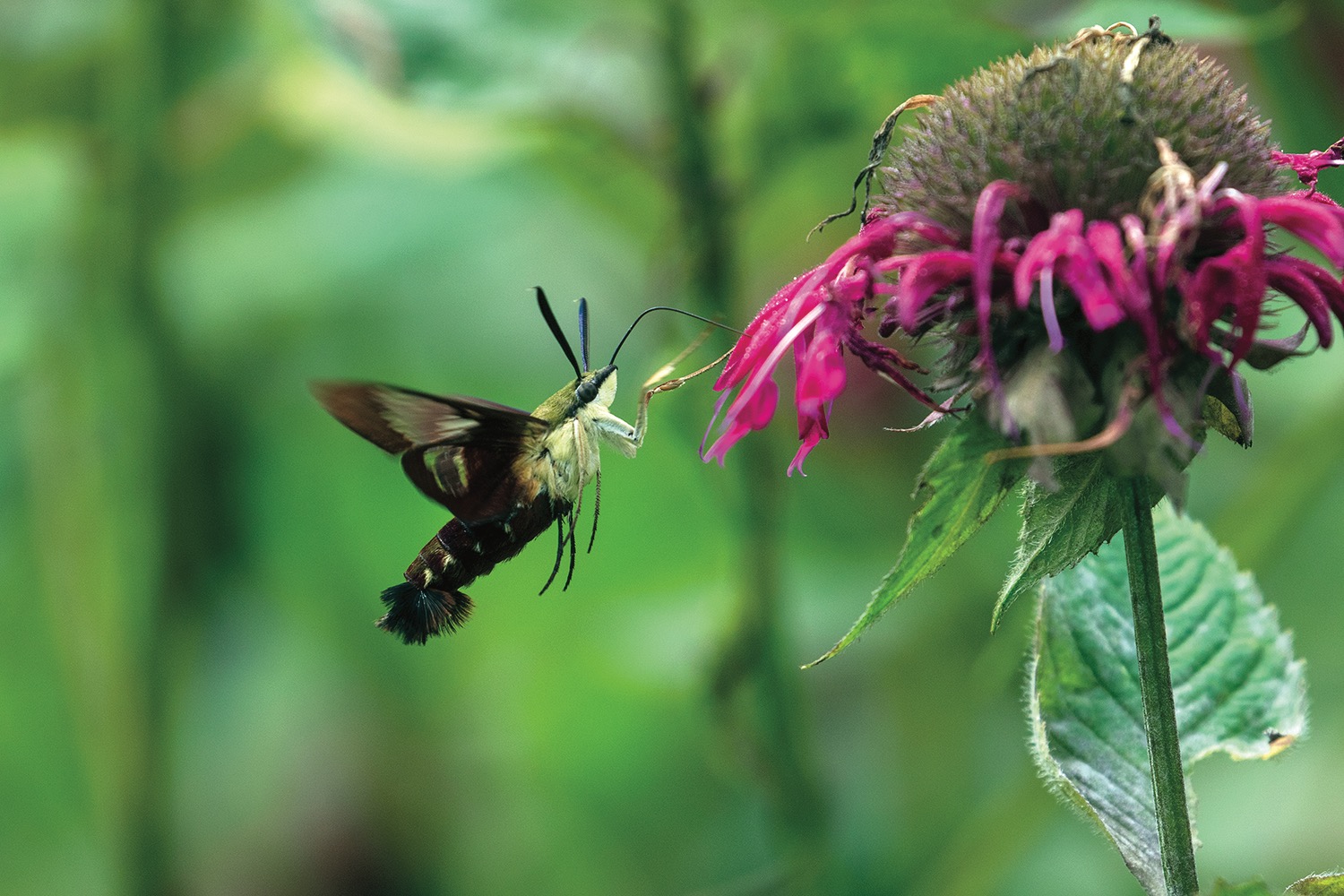
All caterpillars eventually metamorphose into butterflies and moths. And like their pupa, these winged wonders are relentlessly pursued by predators. As such, many of our native butterflies and moths rely on camouflage and mimicry to avoid becoming an easy meal.

Last summer, while walking along the edge of my parents’ Eagle Spring’s yard, I paused to look at a wasp perched atop a grapevine leaf. Underappreciated and loathed animals, such as wasps, hold a special place in my heart, and I cautiously stepped closer to examine the brightly colored insect in more detail. I realized something was a little off. For one thing, it had clear wings. Most wasp wings are opaque or dark. It also had a pair of bushy antennae and a wide waist — very unwasplike. Finally, I noticed that hairy tufts extended out from the tip of its abdomen instead of a stinger. It suddenly dawned on me. I was not looking at a paper wasp at all, but rather a day-flying moth known as a graperoot borer. Its disguise was on point.

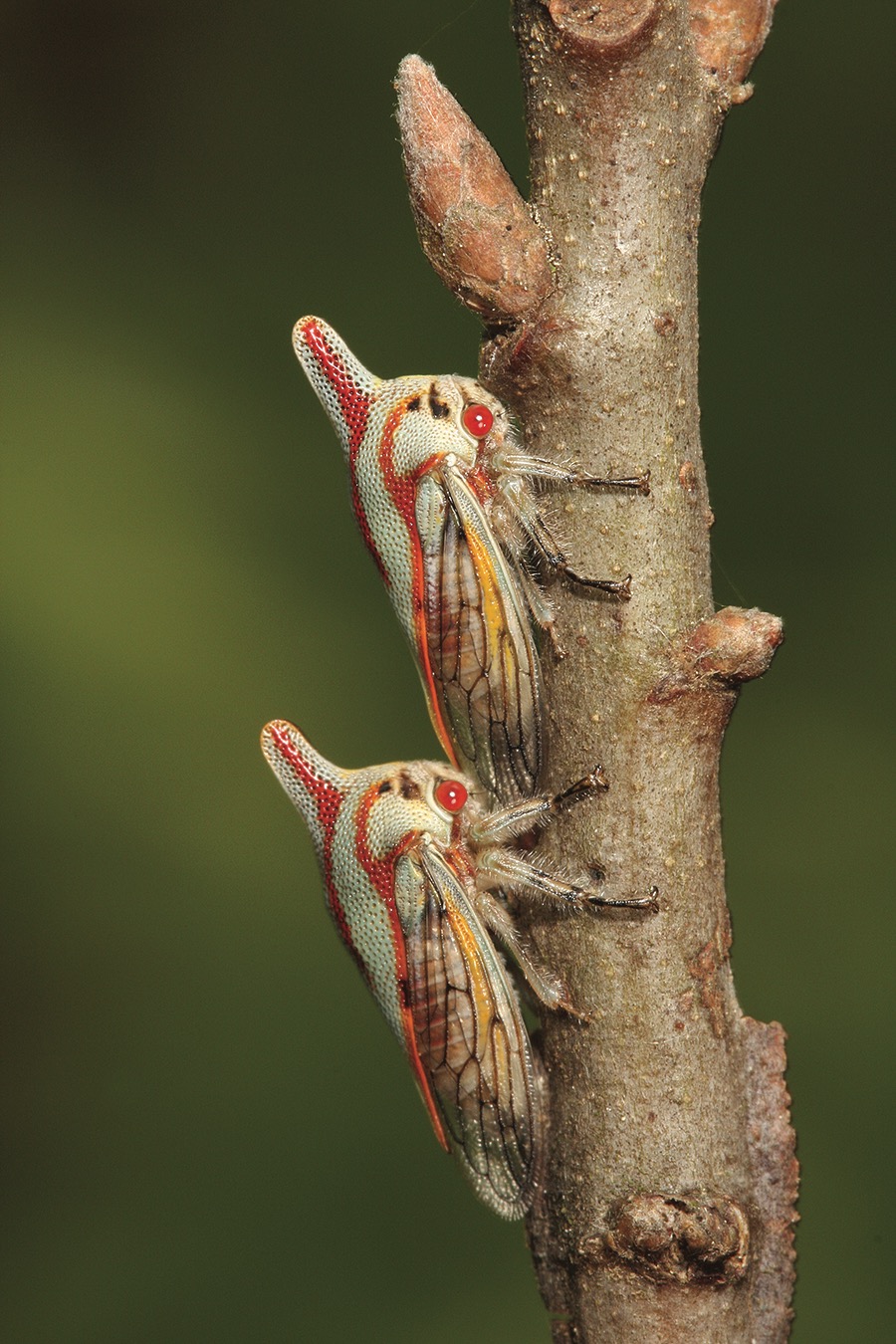
Many insects, especially flies, beetles and moths, mimic stinging bees and wasps. Defenseless organisms that mimic dangerous ones employ an evolutionary survival strategy that biologists refer to as Batesian mimicry. Named for the Victorian naturalist Henry Walter Bates, who first described the phenomena in the humid jungles of the Amazon, this form of mimicry is surprisingly common and is not limited to insects.

Here in the Sandhills of North Carolina, the secretive and beautiful scarlet kingsnake is a dead ringer (pun fully intended) for the venomous coral snake. Both snakes possess alternating colorful bands of red, yellow/white and black and can be hard to tell apart. I still recall a little rhyme taught by Larry Dull, my sixth-grade science teacher at West End Elementary, to help distinguish between the two. “If red touches black, that’s a friend of Jack’s. If red touches yellow, it will kill a fellow.”

Several years back, while walking along the edge of Drowning Creek on my great-grandfather’s farm, I almost had a heart attack. While I was casually stepping over a fallen tree on a spring afternoon, a wild turkey suddenly flew out from underneath my feet. The sound and commotion of a 12-pound bird, with a 5-foot wingspan, launching into the air right in front my face, was startling to say the least. It got my attention. My cholesterol levels instantly bottomed out. Thoroughly shaken, I had to sit down on the log for several minutes and compose myself.

Turns out, I had flushed a hen off her nest. On the ground, next to the fallen tree, were a dozen large white eggs nestled in the leaf litter. How I failed to see such a large bird, sitting there at close range, still baffles me. Her muted brown, grey and black feathers blended in seamlessly with the highlights and shadows of the forest floor on that bright sunny day.

In 1890, a British zoologist named Sir Edward Poulton wrote the first book about camouflage in nature. Poulton, an ardent supporter of Charles Darwin, wrote that camouflage and mimicry in the wild was proof of natural selection. Not long after, an American painter, Abbott Thayer, expanded on Poulton’s ideas and began creating photographs and pieces of camouflage art using countershading and disruptive coloration, culminating in his own 1909 book, Concealing Coloration in the Animal Kingdom. Thayer’s illustrations, showing how objects could “disappear” into the background when they were painted in such a way as to cancel out their shadow, became quite popular and soon attracted the attention of the military. By World War I, armies around the globe were incorporating camouflage into equipment and the uniforms of their soldiers. Long gone were the days of Paul Revere and the brightly attired Redcoats.

Camouflage has even become fashionable. Most popular clothing brands offer an array of camo products, everything from hats to wedding dresses, and shoes to underwear (though I am not entirely sure as to what purpose the latter serves). Even luxury lines like Louis Vuitton have jumped in.

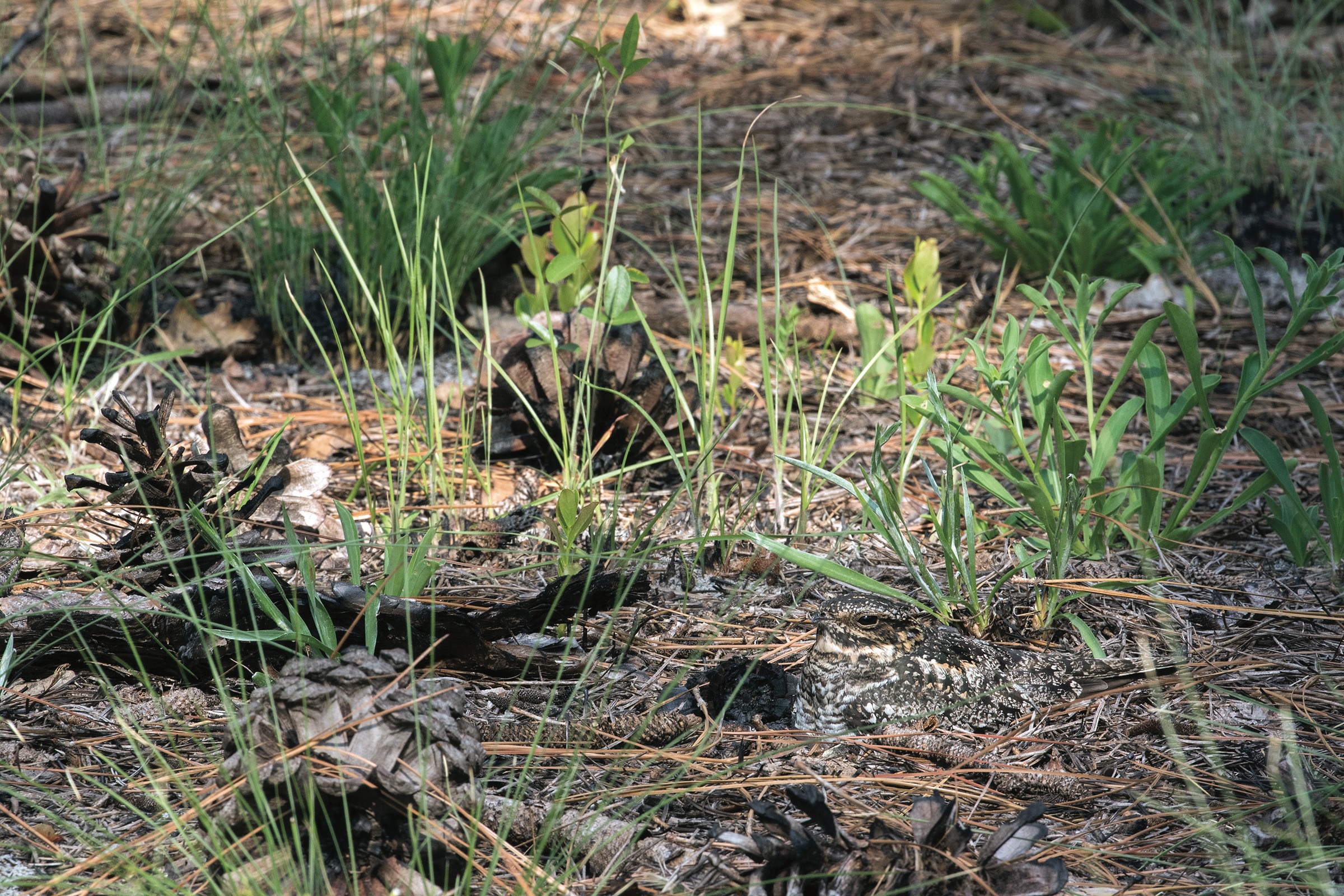
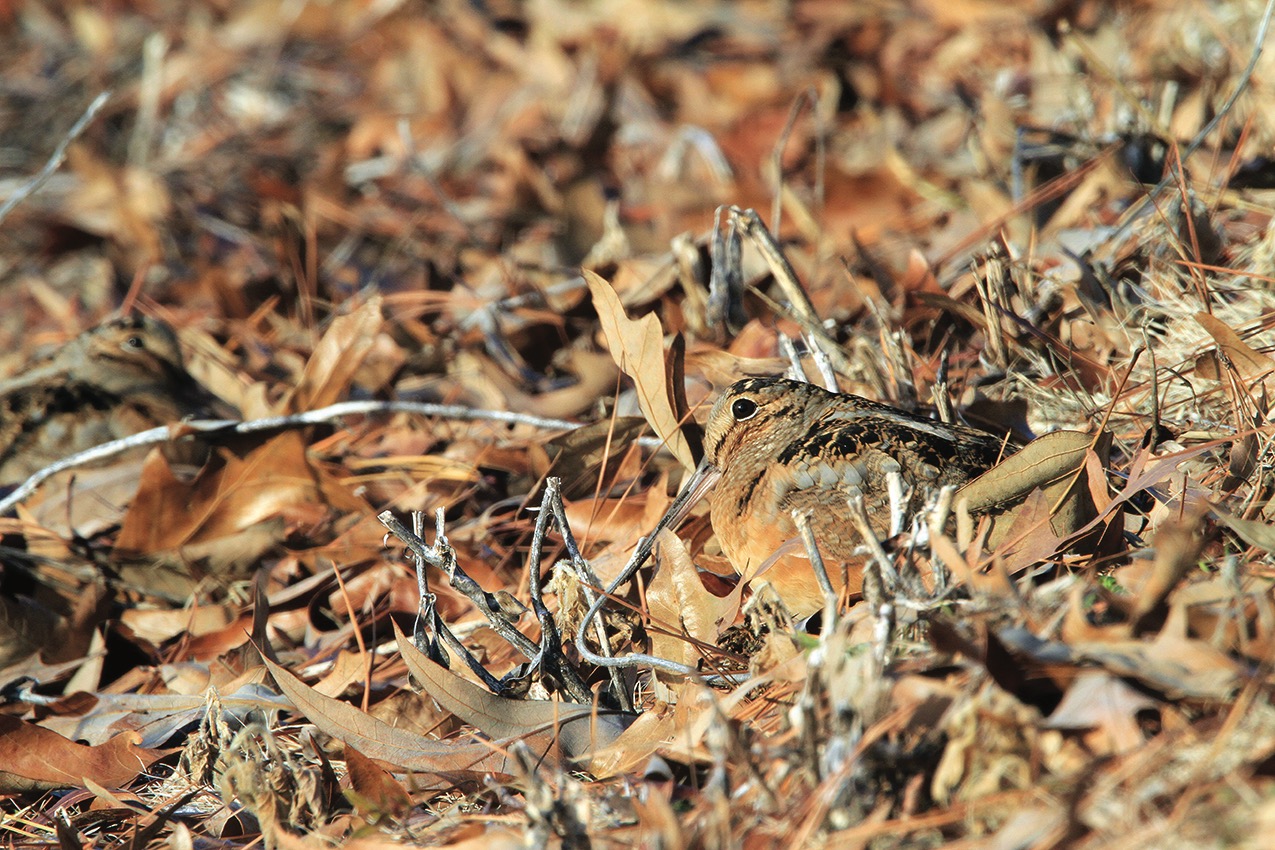
Of course, all of this fashion is modeled after animals in the wild and few wear camouflage as well as the nightjars. These ground-nesting birds, of which there are roughly 98 species recognized worldwide, are the masters of cryptic coloration. In the North Carolina Sandhills, three species are found: the common nighthawk, the chuck-will’s widow, and the whip-poor-will. Each year, I celebrate the first nocturnal calls I hear of the whip-poor-will (usually heard around Eagle Springs in late March) as the harbingers of spring and warmer days ahead.

Nightjars are extremely difficult to find due to their cryptic camouflage. As a result, I have very few photographs of them in the wild. Recently, I received a tip from a local biologist about a nesting common nighthawk on the Sandhills Gamelands. He gave me a GPS point and noted that the bird could be found between two small turkey oaks flagged with bright pink tape.

With that information in hand, I ventured out onto the dirt roads of the Gamelands in early June with hopes of obtaining a few images of the secretive bird. Being extremely careful not to disturb the nesting nighthawk, I slowly approached the GPS point and stood back at a distance of over 10 yards when I saw the bright pink flags up ahead. Raising binoculars to my eyes, I slowly scanned the ground between the two turkey oaks trying to locate the bird. Remember those “Magic Eye” paintings that were so popular in the ’90s? It took several minutes of intently staring at the leaves on the ground before I had the “aha” moment of finally seeing the bird.

The thrill of discovering animals hidden in plain sight never gets old. I still recall with great fondness hiking through the woods one spring day and stumbling upon a young white-tailed deer fawn, curled up tightly on the forest floor beneath a canopy of cinnamon ferns, the white spots on its back allowing the hapless mammal to blend in seamlessly with its background.

Then there was the time I saw an American bittern fly up from the side of the road in the Outer Banks and land in a nearby patch of marsh, where it stood perfectly still with its head pointed to the sky. Its mottled brown plumage perfectly matched the surrounding spartina grass.

One winter, years ago, a Pinehurst resident pointed me to a tree where an Eastern screech owl could be seen basking daily in an open cavity about 20 feet off the ground. Even now, looking at the photos of that owl, it is hard to tell the difference between the owl’s grey feathers and the bark of the tree.

When camouflage fails, some animals will resort to the ultimate form of trickery, mimicking death. The term “playing possum” comes from the behavior of the Virginia opossum, North America’s only native marsupial, which feigns death when threatened by predators. As it turns out, a number of our native animals will resort to that tactic as a last resort. Perhaps the most famous “death actor” is the eastern hognose snake. When confronted by a threat, this robust, 3-foot long serpent, with a distinctive upturned snout, puts on a performance that would make members of Hollywood’s Screen Actors Guild envious.

One of my most memorable encounters with an eastern hognose snake happened years ago near West End. One summer afternoon, a family friend phoned to tell me that she had just found a copperhead in the yard. She asked if I could come over, catch the snake and move it to safe spot (i.e., somewhere far away from her). Surprised, and impressed that she did not want to kill the snake, I hurried over. As I said before, I am a sucker for loathed animals.

When I arrived, I saw my friend standing in her front yard pointing to a small snake coiled tightly several feet away. A neighbor, whom she had called in a panic before dialing me, was standing close by with a shovel in hand. Walking over, I instantly realized it was not a venomous copperhead but a harmless eastern hognose snake. My friend nearly fainted when I casually reached down to pick it up. Her face completely drained of color when the snake began to violently thrash about in my hands. It was only then that I informed her the snake was completely harmless and placed it back down on the ground. There, it continued to writhe back and forth, as if in pain, rapidly throwing coils up over its head. Then it proceeded to defecate all over itself. Finally, the snake lay perfectly still, belly up and mouth agape, its tongue sticking out.

Of course, it wasn’t physically harmed in any way. It simply wanted to make itself appear unappetizing. An especially nice touch, I thought, was covering itself with its own poop.

How these death-feigning tactics evolved over eons of time simply boggles the mind. It certainly threw my friend for a loop. I reached down and slowly turned the snake right-side up. Immediately, it flipped back over onto its back, presenting itself once again as the quintessential dead snake. I smiled. Charles Darwin would have been proud.

Poem March 2025

POEM

March 2025

The Opal Ring

When I was thirteen, my grandmother gave me an opal ring.

I like to wear it when I dress up to go out.

It is so delicate most people never notice it.

My grandmother whispered, It’s from some old beau.

I wear the ring, her memory, to feel magical.

Three small iridescent stones, a gold band worn thin.

Only when I asked did she whisper her secret.

Did you ever look deeply at the displays of color,

opaque stones holding quiet fire? The band’s worn thin.

The last time you betrayed me I slipped on the ring.

Iridescent means plays of color. So few truly look deeply.

She called me to her room, opened a sacred drawer.

This is the last time you betray me. I slip on the ring,

its blue-green, pink lights so delicate. You never noticed.

In her room, she handed me a velvet-lined box.

My grandmother gave me her opal ring. I was only thirteen.

—Debra Kaufman

Golftown Journal

GOLFTOWN JOURNAL

Two for Pinehurst No. 2

Visionaries join Carolinas Golf Hall of Fame

Don Padgett II
David Eger

By Lee Pace

On the fourth Saturday in March, a banquet will be held in a room at the Pinehurst Resort to inaugurate two new members of the Carolinas Golf Hall of Fame: David Eger and Don Padgett II. The venue is appropriate to the honorees because it’s just a quick stroll down the weathered steps of the clubhouse to the first tee of the No. 2 course, where Eger won the Donald Ross Junior as a 17-year-old and the North & South Amateur as a 38-year-old, and where Padgett competed in the PGA Tour’s one-and-done 144-hole World Open in 1973.

It’s also a golf course on which both left an indelible administrative imprint — Eger in helping reintroduce No. 2 to the world of competitive golf in the 1990s, and Padgett for his vision to suggest and then oversee the Coore & Crenshaw renovation in 2010-11.

“David was a key voice in the USGA’s decision to take the 1999 U.S. Open to Pinehurst,” says David Fay, the USGA executive director from 1989-2010. “He is someone whose opinions on golf courses were taken most seriously by me and others at the USGA.”

“Don created the vision for restoring No. 2 to is original state, an incredibly gutsy undertaking for a course that had hosted two very successful U.S. Opens,” says Mac Everett, the chairman of the Presidents Council that led corporate sales efforts for the 2014 U.S. Open and U.S. Women’s Open at Pinehurst. “But his vision was only a start. There remained the planning, execution and completion of the project. This is where Don excelled.”

The Carolinas Golf Hall of Fame is an august body comprised of crack golfers from the South Carolina coast (Beth Daniel) to the North Carolina mountains (Billy Joe Patton) to the Sandhills (Peggy Kirk Bell). There are professionals (Raymond Floyd to Betsy Rawls), amateurs (Harvie Ward to Estelle Lawson Page), architects (from Donald Ross to Tom Fazio), club professionals (Dugan Aycock to Gary Schaal) and administrators (Richard Tufts to Hale Van Hoy). In general, two to three new honorees are recognized every other year.

It’s not at all by design but rather providential timing that two with such deep connections to Pinehurst should be recognized one year after Pinehurst staged its fourth U.S. Open, and its first with the sparkling new USGA Golf House Pinehurst and World Golf Hall of Fame buildings sitting in the backdrop.

When Pinehurst and its owner Bob Dedman Sr. were digging their way out of the Diamondhead bankruptcy messiness in the 1980s, Eger remembers the resort presenting itself to the PGA Tour, hat in hand. He was five years into his career with the tour, running tournaments and serving as a rules official, and two of his mentors had deep Pinehurst roots — P.J. Boatwright, who ran USGA competitions, and Clyde Mangum, who lived in Pinehurst in the mid-1900s while running the CGA as executive director.

One day in 1987, Eger got a call from Ron Coffman, the longtime managing editor of Golf World magazine (published in Southern Pines at the time) who was also friends with Don Padgett Sr., who had just been appointed director of golf at Pinehurst.

“Ron invited me to come up and play No. 2 with him and Padge,” Eger says. “I had always thought of Pinehurst as a wonderful, wonderful place, but obviously it fell on hard times for a while. We were playing the course and Padge assured me if the Tour was interested, they would bend over backward to do anything within reason to have another event. Lo and behold, we were looking down the road for a new spot for our Tour Championship. Pinehurst in late October, after it had cooled off and the bent was healthy and firmed up, would be a perfect spot.”

Eger was impressed with everything he saw and heard and reported back to PGA Tour Commissioner Deane Beman. That’s how the 1991 Tour Championship came to be, with Craig Stadler beating Russ Cochran in a playoff for the title. Eger looked at the leaderboard during the final round and noted that only Stadler and Cochran were in red numbers.

“Two players under par,” he mused. “That looks like a U.S. Open.”

A portend of things to come, no doubt.

Fay was in Pinehurst that week, closely inspecting the logistics, the course, the accommodations, the traffic, the galleries and the overall ambience. He came away with a thumbs-up. He believed a U.S. Open at Pinehurst could be “Tracy-and-Hepburnesque, a match made in heaven.” That week led to the announcement less than two years later that the USGA would stage the 1999 U.S. Open at Pinehurst.

“The players loved Pinehurst, but not all of them loved the golf course,” Eger says of that first Tour Championship. “So many didn’t understand this was a golf course where you did not necessarily shoot right at the pin to get the ball close. You had to play these undulations and angles. The sooner they understood that the better. If they refused to buy into that philosophy, they were not going to score well. It was a difficult thing for players accustomed to taking dead aim at a pin to have to aim 30 feet away.” 

Padgett II watched all of this from a distance as he was running the golf operation and later the entire resort at Firestone Country Club through the early 2000s. His father retired at Pinehurst in 2002, and two years later longtime CEO Pat Corso left to establish a club management firm. Padgett II became Pinehurst’s new CEO. He kept a low profile during the 2005 Open, all the prep work having been done before his arrival, but he watched and listened closely.

Padgett, a man who had played three years on the PGA Tour, shot a 66 in the third round of a U.S. Open and kept close ties with current players, had quite the sharp eye. He    was struck by how much the buzz about the golf course seemed to have quieted between Pinehurst’s first and second U.S. Opens.

“The difference between ’99 and ’05 was amazing,” Padgett says. “So much of what you read and heard in ’99 was how great the golf course was. But in ’05, you didn’t hear that.”

Over the next three years, Padgett came to believe that narrowing the fairways of No. 2 and allowing the rough to grow had stripped the course of the essence of the Sandhills and obscured the similarities in the landscape that architect Donald Ross had drawn to his homeland in Scotland. The final nail was playing No. 2 with Lanny Wadkins in June 2008 and Wadkins ripping the course as being a shell of what it was during its so-called “golden era” of the mid-1900s.

That gave Padgett the confidence to suggest to owner Bob Dedman Jr. they flip the palette from the lush green look everyone coveted in golf to a haphazard display of hardpan sand and wire grass, gnarly edged bunkers and fairways watered only with a single-row irrigation system. The work by Coore & Crenshaw began in February 2010 and was complete 13 months later.

Eger, who left golf administration in the late 1990s to play the PGA Champions Tour — collecting four tournament wins there — was among the first golfers to play No. 2 in March 2011 after the course had been closed all winter

“The distinction between grass and the sand is wonderful,” he said. “It’s the way golf courses from the golden age looked. Pinehurst had that distinctive look of the scrub rough areas and wire grass. Putting it back took a lot of courage, but ultimately it was the right thing to do.”

The modern age of Pinehurst No. 2 is 40 years in the making. The Carolinas Golf Hall of Fame is properly saluting two of its major protagonists.