Hometown

HOMETOWN

Never Too Late

The career path of a classmate

By Bill Fields

Not long after Sara E. Johnson and I began a recent phone call, I couldn’t resist reminding my Pinecrest High School classmate what she had penned a long time ago in my senior yearbook.

“When you’re a rich and famous news man and I’m a rich and famous news lady,” she wrote on a back page in my Spectrum, “let’s get together and talk over old times.”

The words were the earnest well-wishes from one eager aspiring journalist to another. Sara LeFever and I were on the staff of The Courier, the student newspaper, for a couple of years, and officers in the Quill and Scroll club. We alternated weeks reporting high school news in The Pinehurst Outlook, with fresh-faced class pictures as our respective column sigs.

Neither of us fulfilled the futures mentioned in her message. I gravitated to sports, specializing in golf coverage. A stay-at-home mother of three until earning a master’s degree from UNC and becoming a reading specialist in her 40s, Johnson contributed articles on family and education to newspapers in Chapel Hill and Raleigh.

When we talked in January, the conversation didn’t revolve around our high school days (although we agreed it can be tough to review examples of our early, raw writing) but rather newer, exciting developments in Johnson’s life, which should be an example for anyone of a certain age. 

“I was 60 when my first novel came out in 2019,” she said. “People need to know it’s never too late.”

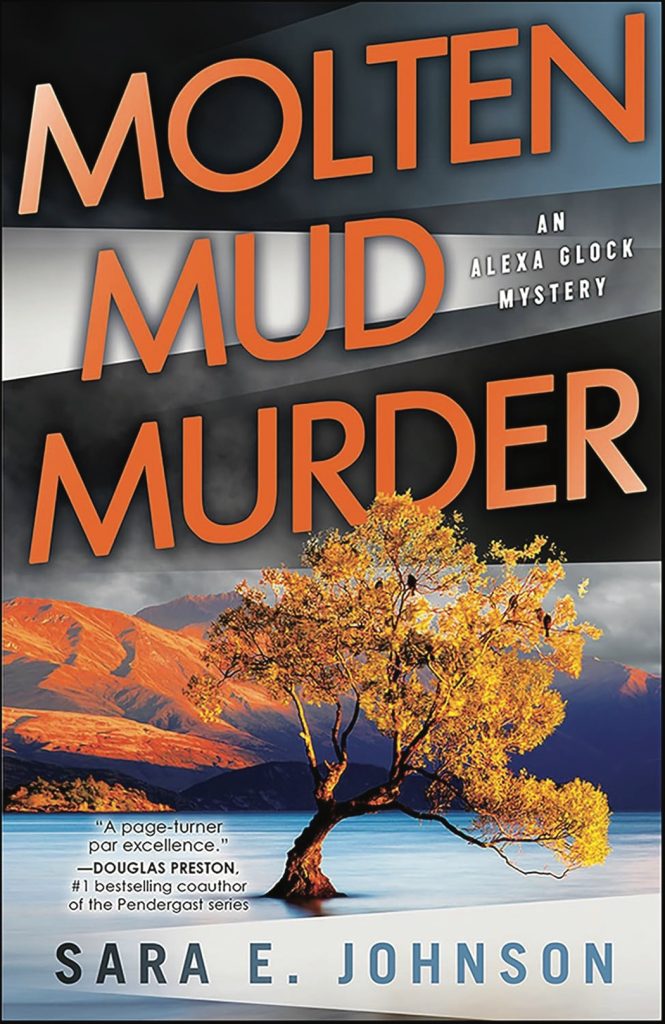
Johnson’s debut book, Molten Mud Murder, was the first installment in the “Alexa Glock Forensics Mystery Series.” The central character is a plucky and slightly geeky American investigator living in New Zealand, a traveling forensic who uses teeth to solve crimes. The debut has been followed by The Bones Remember, The Bone Track, The Bone Riddle and The Hungry Bones. The final book in the series, Bone Chilling, will be published this year.

The mysteries resulted from the nine months Johnson and her husband, Forrest, who live in Durham, spent exploring New Zealand in 2014. After returning home from a fascinating land that had intrigued her greatly, she pursued the notion of writing a book, something I had encouraged her to do in an email when we reconnected more than 20 years ago. “You said if you want to write a book, you can do it,” Johnson said. “Your message really stuck with me.”

Johnson has always been a wide reader, including mysteries. She has been enamored of the genre since she was 10 and read The Bungalow Mystery, a Nancy Drew book given to her mother in 1942. She spent a year writing Molten Mud Murder. Then came the hard part, which required much patience and persistence.

“I think I had 66 rejections from literary agents, but then the 67th came along,” Johnson said. “I don’t know where the cutoff would have been. Would I have contacted 75 or 100 agents? I don’t know. I was getting some positive rejections — people saying, ‘I like this and this, but don’t like that.’ What I call the positive rejections kept me going, and I kept honing the manuscript.”

Johnson informs her books with meticulous research provided by a cadre of professionals to ensure accuracy in her scenes. “I have wonderful experts who read over what I’ve written,” she said. “One forensic pathologist can spend two pages telling me how to flip a body on an autopsy table.”

At work on her seventh book, revolving around a coroner in northern Minnesota, Johnson will incorporate the forensics knowledge she gained producing the Alexa Glock series. She tries to write 1,000 words a day while relying on important assessments along the way from fellow writers.

“Hands down, the biggest help for me is being in a writers’ group,” Johnson said. “We meet weekly, not just mystery authors but folks in all kinds of genres. We bring 10 pages, read them, and people critique them. Reading your work aloud and getting good feedback is so valuable. I can’t thank them enough.”

As for others who might want to tap into their creative side later in life, Johnson believes it isn’t a mystery. “Sit down and do it,” she said. “If you have a dream to write a book, it’s possible.”

Contemporary and Comfy

CONTEMPORARY AND COMFY

Contemporary and Comfy

A modern vision for a family

By Deborah Salomon    Photographs by John Gessner

If you think an interior designer’s house should knock your socks off, you’d be right. Especially a designer with international credentials who conceived the house from the ground up and the studs out.

The designer is Liz Valkovics. The location is lakeside, in a gated Pinehurst golf community. The exterior is Carolina casual to blend with surroundings but inside is a magazine layout, contemporary in vision, curated for practicality, incorporating an ice bath and sauna for daily use and wellness events, a ground-level game room with pool table, movie screen, guest quarters and kitchenette. Because . . . sophistication notwithstanding, this house is also home to Luke, 11, Sophie, 4, and golden retriever Gus, whose fur matches the oatmeal-textured low-slung sofa in front of the glowing tubular fireplace. The result: stunning yet comfortable for a young family.

“The kids don’t have to be too careful,’’ Liz says.


Over the mantel a frame surrounds the wall-mounted TV. The whole equals a study in earth tones with a generous nod to black, from set-in houndstooth rugs to matte charcoal kitchen cabinets and a matching Hallman (Italian) six-burner range with a grill top, where Luke and Sophie make pancakes on weekends. Even the quartzite countertops — hard as granite, beautiful as marble — have undulating waves of gray. “I’ve done a purple kitchen but this was for us, no clutter, happy and inviting,” Liz says.

Liz paints. Her choice of art, some digitally achieved, is wide ranging. A computer program that moves furnishings within a room and performs other diagnostics aid her decorating decisions. She studied and taught art, became a full-time painter, and earned a degree from the London School of Interior Design. Her specialty: hospitality venues, restaurants and commercial space. The jewel in her crown is a boutique hotel in Dubai, although she also served as creative director for a Florida hotel, worked in Baku, Azerbaijan, and undertook design projects at London’s Gatwick Airport.

Her husband, Paul, a British national, traveled the world in operations and management of sporting events, including the summer Olympics and FIFA World Cup. He also partners in his wife’s design business. Liz is from Ohio, but she met Paul in Cape Town, South Africa, a stopover on one of life’s adventure tours.

So, with world-wide connections, why choose Pinehurst for home base?

Simple. “My parents retired here,” Liz says. And it doesn’t hurt that Paul and Luke are enthusiastic golfers.

Liz and Paul absorbed the cosmopolitan feel of the area while renting a golf-front condo during their home’s construction year. It enabled Liz to participate in day-to-day decisions like the high windows and window seats flanking the living room fireplace — a space usually filled by bookcases. “It’s perfect for curling up with a book and a glass of wine,” she says. Look up: Some ceiling fixtures feature circles of small round globes, “like golf balls,” she smiles. Almost all furnishings are new, sourced from her international and High Point providers.

Some pieces qualify as both unusual and practical, like the elongated dining room table positioned on a pedestal for comfortable seating. The table is set against a wall lined with a wipe-clean leather banquette. A bench opposite provides flexible seating, while Mom and Pop chairs at either end, now reupholstered in a wild abstract, come from Liz’s family. Over the table is a row of smallish paned windows with black frames, a Liz signature throughout the house. This fluid seating arrangement in a modest space has accommodated a dozen at Thanksgiving.

Sophie’s room and the master suite opening onto a deck overlooking the lake complete the main floor, with Sophie’s bathroom doubling as a powder room.

If the main floor illustrates how Liz interprets contemporary icons, the lower level — opening onto the patio and grill — has what Liz calls a “playful feel,” beginning with the pool table. Luke’s quarters are there along with a guest room and the office for Liz’s design business. Shelves hold all the classic board games.

Here, Liz has adopted Paul’s favorite green, reminiscent of his Yorkshire childhood, on kitchenette cabinets. True, it is more jalapeño than mint, but still a pleasant surprise. Nearby stands another relic from relatives, a velvet-upholstered settee, poised as if it’s awaiting the arrival of a time-traveling Louis XIV. Wellness devotees, Liz and Paul’s home gym occupies a garage bay.

Contemporary homes and their contents are often labeled cold, stark. Not here. Who would guess that this modest, creamy white cottage located on a cul-de-sac in a prime golf enclave might, beyond the front door, reveal 3,200 square feet of family-friendly space sparked with art and design, sprinkled with whimsy?

“We tried to be respectful of the area, which meant sometimes going back to the drawing board,” Paul recalls. “Our forever home? It sure is. I plan to be buried in the backyard.”

PinePitch

PINEPITCH

PinePitch March 2025

In the Bookshop

The Country Bookshop, 140 N.W. Broad St., Southern Pines will be hosting Ada Calhoun as she discusses her novel Crush, on Wednesday, March 12, from 6 to 7 p.m. Then, on Wednesday, March 19, also from 6 to 7 p.m., Eddie Huffman will be in the bookshop to talk about his recent release, Doc Watson: A Life in Music. More information and tickets can be obtained at www.ticketmesandhills.com.

Wee Bit o’ the Green

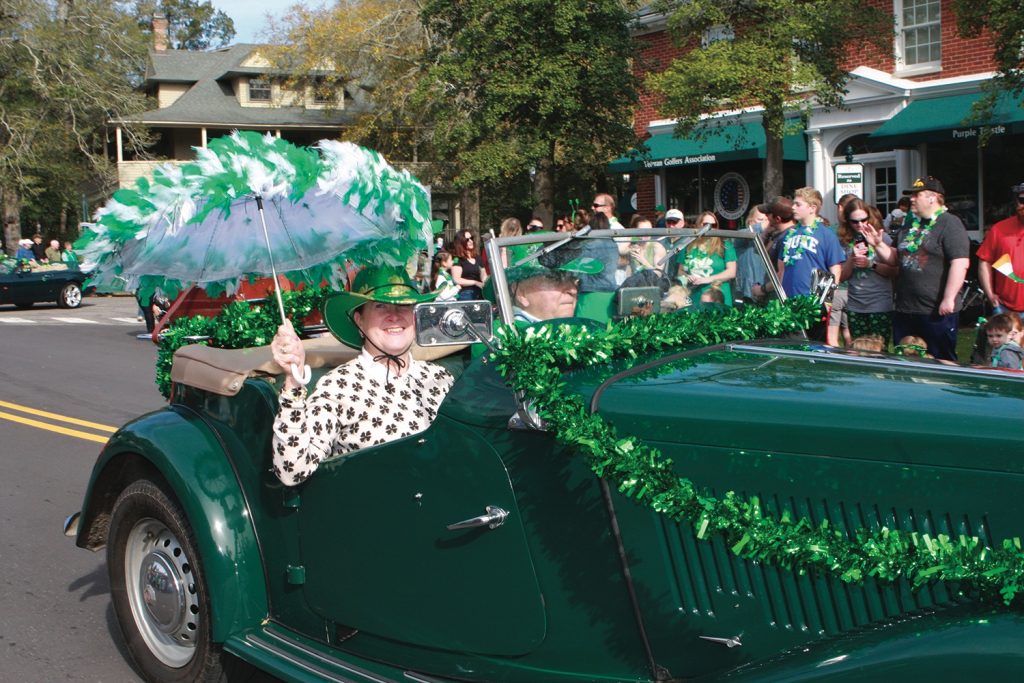
Pinehurst turns the whole village green when the Irish take to the streets for the annual St. Patrick’s Day Parade on Saturday, March 15, beginning at 10 a.m. If you put your folding chair down at James W. Tufts Memorial Park, 1 Village Green Road W., you won’t miss a single leprechaun. For more blarney go to www.vopnc.org.

Just Another Lazy Sunday

Bring a blanket or a folding chair and a picnic basket, kick back and listen to saxophonist Sarah Hanahan outdoors on the lawn from 2 p.m. to 4 p.m. at the Weymouth Center for the Arts & Humanities, 555 E. Connecticut Ave., Southern Pines, on Sunday, March 23. There will be a cash bar with mimosas, beer, wine and non-alcoholic offerings. For info see www.weymouthcenter.org

One Man, One Microphone

Have a problem with old age? The great Garrison Keillor is here to provide a little perspective. Despite its inconveniences, old age brings the contentment of “less is more.” Your mistakes and big ambitions are behind you. There’s nothing left to prove. And small things give you great pleasure because, well, that’s what’s left. “Garrison Keillor Tonight” is an evening of wit, storytelling, audience song and poetry on Friday, March 28, at 8:30 p.m. on the main stage of Owens Auditorium in the Bradshaw Performing Arts Center, 3395 Airport Road, Pinehurst. The show features sonnet singing, limericks and musical jokes. And there’s news from Lake Wobegon, a town booming with new entrepreneurs, makers of artisanal firewood and gourmet meatloaf, breeders of composting worms, and dogs trained to do child care. Age aside, there are some things that endure, and Garrison Keillor is one of them. For additional information and tickets go to www.ticketmesandhills.com.

Trunk o’ Flowers

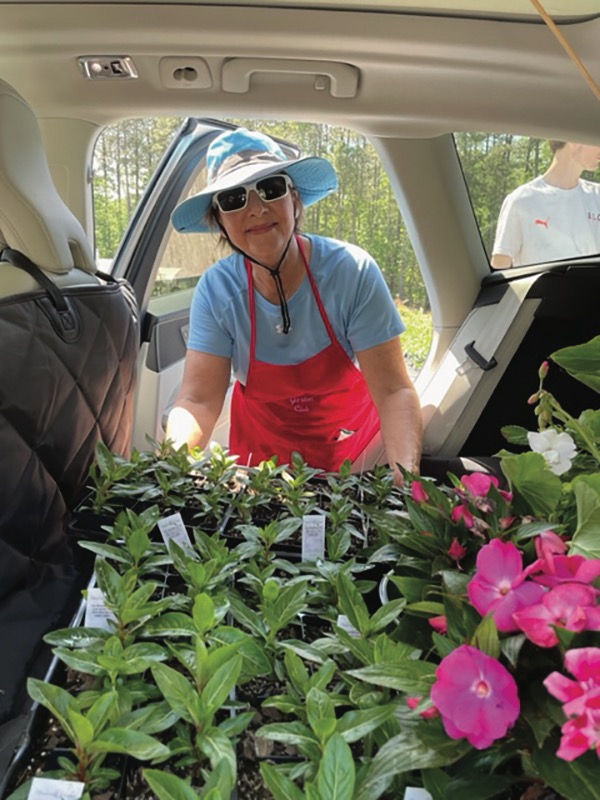
The Pinehurst Garden Club wants your sunny disposition, water, a little fertilizer and for you to buy their plants during the annual garden pre-sale that runs from March 16 to April 10. You can check out the flower options and order online at pinehurstgardenclub.org, or by contacting a member. The pickup is Sunday, April 27, at the Green Haven Farm, 255 Green Haven Lane, Carthage. Just drive up and pop the trunk. The sale supports two students in the horticultural studies program at Sandhills Community College.

Gala for Guide Dogs

Mira USA, a national nonprofit organization providing guide dogs to blind children ages 11-17, will host its annual Mira-cles Happen Gala on Saturday, March 8, at 6 p.m., at the Country Club of North Carolina, 1600 Morganton Road, Pinehurst. Guests will have the chance to meet two 2024 guide dog recipients: 12-year-old Elijah with his guide dog, Maple, and 15-year-old Shaelin with her guide dog, Guiro. The evening includes a gourmet dinner, live music and entertainment, along with silent and live auctions. Individual tickets and sponsorship packages are available by visiting www.miraevents.org/mira-cles-happen-gala.

When 24 Hours Isn’t Enough

If your salute to the old sod lasts longer than just St. Patrick’s Day, grab a seat for Andy Clooney’s Irish Celebration on Tuesday, March 18, from 7 to 9 p.m., at the Fair Barn, 200 Beulah Hill Road S., Pinehurst. The show features Ireland’s comedy duo Mick Thomas and Sean Finnerty along with The Emerald Fire Irish Dancers backed by the Guinness Irish Band. For information and tickets go to www.cooneyshows.simpletix.com. Cheers.

Back in Bloom

The Garden Club of the Sandhills will host its 2025 “Blooming Art” exhibit featuring professional floral designers, local garden club members and local artists on Saturday, March 29, from 10 a.m. to 4 p.m., and on Sunday, March 30, from noon to 4 p.m., at the Campbell House, 482 E. Connecticut Ave., Southern Pines. Tickets are good for either day. For information go to www.ticketmesandhills.com.

Put a Little Spring in Your Step

Kids ages 3 – 12 can celebrate the arrival of spring at the Spring Fling in the Downtown Park, Southern Pines, on Friday, March 28, from 5:30 to 7:30 p.m. The afternoon festivities include games, face painting and bounce houses, and will be followed by an outdoor movie, Moana 2. Concessions will be available for purchase. For additional information call (910) 692-7376.

It’s a Pine Thing

The Party for the Pine, the festival celebrating the oldest longleaf pine in the world, will be from 10 a.m. to 3 p.m. at the Weymouth Woods Boyd Tract meadow, Weymouth Woods, 555 E. Connecticut Ave., Southern Pines, on Saturday, April 5. The celebration features games, food trucks, turpentine demonstrations, lessons on the native habitat and, weather permitting, a live prescribed burn. For additional information call (910) 692-2167

NC Surround Sound

NC SURROUND SOUND

Dropping In

Return of the Carolina Chocolate Drops

By Tom Maxwell

It all started in April 2005, at the first “Black Banjo: Then and Now Gathering.” The event, held at Appalachian State University in Boone, was part scholarly pursuit and part throwdown, featuring four days of “lectures, jams, workshops, down home frolics, and performances” with a view to bringing the “funky, plunky instrument” back home to Black America. Dom Flemons, a 23-year-old student at Northern Arizona University, attended.

“I was the young person at the event,” Flemons says. He had been playing banjo for a few years already, busking on street corners and devouring records by the Memphis Jug Band and Dave Van Ronk, as well as ’20s songster music of people like Gus Cannon, who had a late-in-life hit when the Rooftop Singers covered his 1929 stomper “Walk Right In,” and Henry Thomas, whose Texas ragtime tunes were covered by ’60s folk/rock stalwarts Bob Dylan, The Lovin’ Spoonful and the Grateful Dead, among others.

So, like many young people who fall in love with old music, most of Dom’s musical heroes were dead — even if their music was very much alive. But in Boone he was about to enter the musical land of the living.

“When I met Joe Thompson, a light bulb went off in my head,” Flemons says. “I heard him playing at the opening ceremony for the Black Banjo Gathering, and all of a sudden I understood the music that connected people like Henry Thomas to Gus Cannon. When I heard Joe’s music, I heard that flavor of fiddle and banjo music that these guys were referencing, playing and living next to generationally. And that inspired me to move out to North Carolina. I sold everything I owned, packed up my car, and took Route 66 east, headed for North Carolina to be near the music.”

Thompson, born in 1918, had been playing African American string band music for 80 years by the time Dom Flemons heard him perform at the Black Banjo Gathering. An Orange County native, Thompson joined his family on fiddle (after studying his father’s old-time technique, which was handed down by his own father, a former enslaved person) playing square dances, parties and dances after corn shucking or tobacco stripping. Joe considered quitting music after his cousin and musical partner, Odell Thompson, died in the ’90s, but picked it back up basically by popular demand. Even a stroke in 2001 couldn’t slow him down. “I got to sit with Joe and play music,” Flemons remembers, “and it was a powerful experience just to be in his presence. I also tried my best to play banjo behind his fiddle playing. I knew that I was connected to the tradition from there.

“There’s magic in the excitement and drama and the wealth of culture that is translated through a live performance,” Flemons adds. “It’s something beyond just music. It’s a feeling as well and, if you’re deep in the culture, you understand the nuances of that feeling. In the ’50s, they talked about old-time music and analyzed it a certain way. So, when you read books about it, you can understand it to a degree. But once you’re in it, that’s when you can take on a whole other quality.”

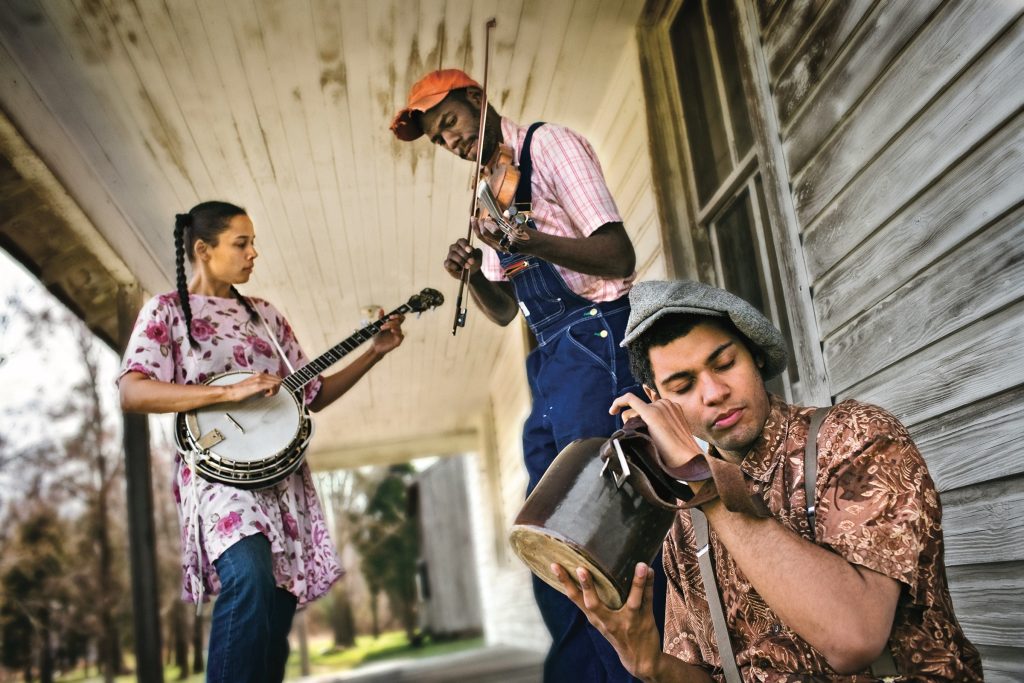
Two years after his performance at the first Black Banjo Gathering, Joe Thompson became a National Endowment for the Arts National Heritage Fellow. He also started mentoring Dom Flemons’ new band. Local musicians Rhiannon Giddens and Justin Robinson also saw Thompson at the Black Banjo Gathering and had been playing music at his Mebane house for several months by the time Dom, newly graduated from college, moved to North Carolina. The three youngsters decided to form a band of their own. “These are the years leading into Obama being elected,” Flemons says, “and culturally, people were ready for a Black string band. They could handle it.”

Flemons, Giddens and Robinson called their band the Carolina Chocolate Drops. “With the combination of all three of the original members of the trio, we created a sound that was very authentic and raw, but also landed right,” Flemons says. “I always compare it to The Beatles because we had a gestation period where we mostly played square dances. So, we always had a rock solid rhythm. I leaned 100 percent into that, because being a fan of the Grateful Dead and stuff like that, I understand that give and take with the audience.”

All traditions, an accomplished jazz musician once observed, meet at the root. In their career, the Carolina Chocolate Drops were seamlessly able to blend Civil War-era Black string band music, ’60s folk-rock, jazz and hip hop. It’s no surprise — but still an absolute delight — that the band covered Blu Cantrell’s 2001 R&B Top 40 hit “Hit ’Em Up Style (Oops!)” on their Grammy-winning album Genuine Negro Jig.

“I was a fan of Old Crow Medicine Show,” Flemons says, “so I always thought about fast old-time as being a genre. Fast old-time is something that people have always enjoyed, and it was becoming very popular at that time. When we were arranging songs with the Carolina Chocolate Drops, they would usually do a Joe Thompson number. I came up with the jug and took a combination of what I thought about with traditional jug bands, as well as people like Charles Mingus, and applied that to ‘Georgia Buck.’ There were parts I came up with that were a Charles Mingus-inspired type of bebop bass lines. That gave us a unique sound from a traditional old-time string band.”

The Carolina Chocolate Drops went on to have a stellar career, releasing five albums, opening for luminaries like Taj Mahal and Bob Dylan, making numerous television appearances, and performing several times at the Grand Ol’ Opry. But as all fiery combinations do, they burned bright, then out. Robinson left in 2011; Flemons followed suit two years later. By 2014, the group functionally disbanded. Until now.

“Rhiannon wants us to do this festival she’s putting together, Biscuits & Banjos,” Flemons says. The festival will be held in Durham April 25 – 27th and will feature not only a reunited Carolina Chocolate Drops, but also solo appearances by Flemons and Giddens. Rounding out the stellar lineup are legacy acts like Taj Mahal, promising newcomers Infinity Song, Tar Heel native Shirlette Ammons and many more. In the tradition of the Black Banjo Gathering — and countless others since time immemorial — there will be artist talks, workshops, a biscuit bake-off (Giddens is a self-described “avid biscuit baker”) and a community square dance. The festival website characterizes the event as “dedicated to the reclamation and exploration of Black music, art and culture in North Carolina.”

Indeed, all American musical traditions do meet at the root. Blues, jazz, rock-and-roll — and a sizable chunk of country music — owe their very existence to African American musical idioms and cultural expressions. We are all the better for it, and when you combine this history with Southern food and an old-school hootenanny, life gets very good indeed. And North Carolina is one of the few places in America where something like this could happen.

“North Carolina is such a wellspring of culture in general,” Flemons says, “and I believe that it has done a lot of things right when it comes to expressing the culture of the state. It is one of the very first states, so it has a deep history. There’s a lot of different musicians coming out of North Carolina — they’re doing traditional music but also jazz and gospel. I think it’s something in the way that the land is structured and the way people are raised. Because a lot of times they have this particular connection to the land, and a foot in both the country and the city. That is very unique.

“The Carolina Chocolate Drops did school shows in almost every city and town in North Carolina, so I got to see everything from Edenton all the way up to Asheville and Black Mountain and Hot Springs. Every part of North Carolina has something beautiful and unique, and the music reflects that.”

Omnivorous Reader

OMNIVOROUS READER

Coin of the Realm

The history of Rome in loose change

By Stephen E. Smith

If you believe the ancient Romans had little to do with your life, look at your feet. They gave us the concept of left and right footwear. They also left us their checkered history, of which there’s too damn much. If you’ve tackled Gibbon’s unabridged The History of the Decline and Fall of the Roman Empire, you know that a manageable history of ancient Rome requires a framing device that places events and characters in perspective.

Historian/numismatist Gareth Harney has devised an agreeable gimmick. He has selected what he believes are the 12 most significant coins minted during the Empire’s 800-plus years, and he’s written A History of Ancient Rome in Twelve Coins, connecting the coinage to the emperors and events that influenced their minting.

Roman coins were struck from alloys of gold, silver, bronze, orichalcum or copper — materials that gave them resilience — and they are discovered still in Welsh fields and Polish barnyards. You can buy a pile of uncleaned Roman coins on eBay for $30.

First introduced in the third century BCE, Roman coins were used well into the Middle Ages, and during a denarius’ existence, it would likely have passed between millions of hands. Many of the coins are worn smooth, obscuring the profile of the emperor or god whose likeness was meant to ensure political stability and economic security.

In crisp, energetic prose, Harney opens each chapter as if he were writing historical fiction. “The vision was surely his alone,” he writes of Constantine’s moment of conversion. “Yet the confused shouts of his soldiers seemed to claim otherwise. As the marching column ground to a halt before the spectacle, men raised their arms to the clear sky, calling out to their emperor to witness the unfolding miracle. It took shape, by all accounts, in the rays of the midday sun. A glowing halo surrounding the solar disk, sparkling with additional rival suns where it was intersected by radiating horizontal and vertical beams — all shimmering like jewels with spectral color.”

Harney guides the reader through the history of Rome from Romulus, suckled by a wolf on an early Roman coin, to the last emperor, who was deposed by the German general Odoacer in 476 CE. In the early years of the Empire, coins illustrated mythical scenes and various gods and goddesses, but that changed, as did much of Roman life, when Julius Caesar issued coins bearing his likeness. “Even in an age of giants — Pompey, Cicero, Antony and Cleopatra — Caesar would tower above all,” Harney writes, “bestriding the world like a colossus.” The appearance of Caesar’s profile on the Roman denarius in 44 BCE is acknowledged as a transformative moment in Roman history. The new coin violated ancient law, tradition, and the sacred delineation between military and civic authority. Caesar went so far as to order the minting of a denarius with the likeness of the defeated Gallic leader Vercingetorix, an enemy of the Roman Republic.

The Julio-Claudian dynasty receives its due — Tiberius, Caligula, Claudius, Nero, Vespasian, et al. — and Harney explains the events leading to the coinage produced by each emperor. Bits and pieces of Roman excess and debauchery are reviewed in tolerable detail, and readers are occasionally treated to new depravities, of which there was no shortage in an empire populated with leaders who were murdered almost as quickly as they took power.

For many of these upstart emperors, assassination was often a merciful escape. In 260 AD, for example, the emperor Valerian was defeated by King Shapur I and was taken prisoner. He lived out his years in slavery, falling to his hands and knees to act as a step for Shapur to mount his horse. The emperor of Rome had become a human footstool for an enemy king who later had him skinned, stuffed and placed on display.

Harney’s discussion of the various currencies makes the constant shuffling of Roman emperors slightly less confusing, but the devaluation of Roman coinage is his most significant and timely lesson. The emperors, unable to pay for Rome’s defense, lessened the amount of silver or gold in each coin. “By 270, the ‘silver’ coins of Rome held less than 2 percent precious metal. Nothing more than crude scraps of copper rushed out of the mint, without a thought of quality control. A thin silver wash on the coins only served to insult the intelligence of the Roman people, and quickly wore off to reveal the depressing base metal below.” Any belief in a reliable gold or silver standard vanished from the monetary system. As coinage ceased to hold its value, Romans returned to barter as a method of exchange. When new coins were issued, they dulled more quickly, and they felt light in the hand, signaling debasement. Each degraded coin is part of the puzzle whose final piece reveals the complete collapse of the Roman state.

A History of Ancient Rome in Twelve Coins will appeal to a broad audience. Excluding the rare reader who has a comprehensive knowledge of Roman history and the numismatist specializing in Roman coinage, the majority of readers (those who saw an episode or two of I, Claudius or the movie Gladiator) will find Harney’s history well-written, informative and sophisticated — high-end Monarch Notes for Gibbon’s six-volume Decline and Fall. They may even feel inspired to start collecting Roman coins.

Harney doesn’t claim that his research offers profound insights into our contemporary political divisions or the teetering state of our democracy, but readers will likely infer whatever lesson appeals to their politics. One truth, however, is inescapable: Empires rot from the inside out.

Dissecting a Cocktail

DISSECTING A COCKTAIL

Blood and Sand

Story and Photograph by Tony Cross

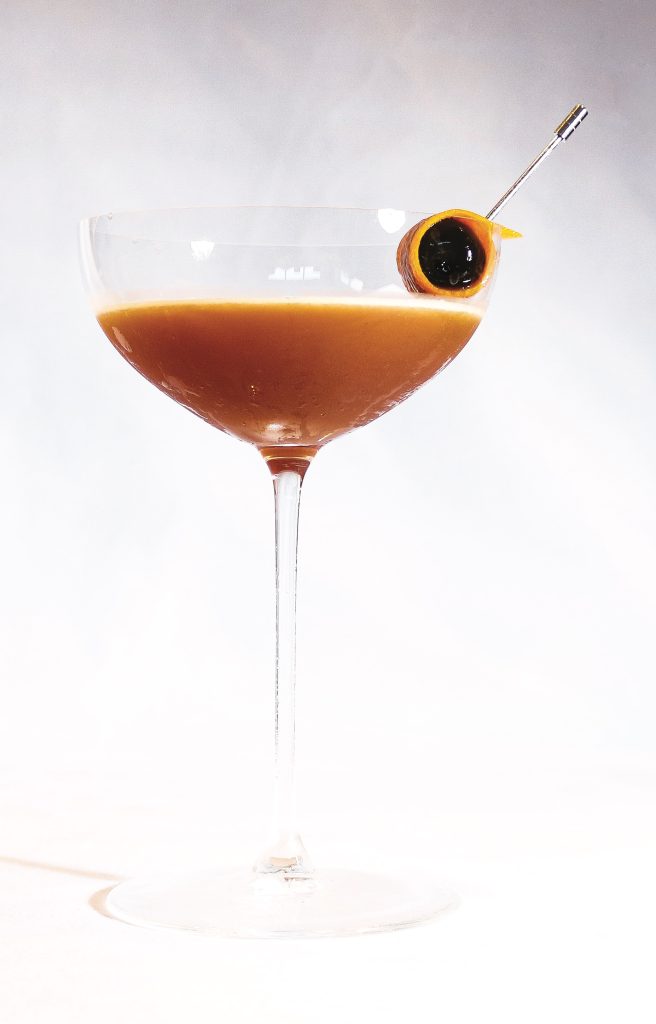
I hereby present to you a cocktail that I’ve never really enjoyed: the “Blood and Sand.” Well-known to bartenders, it’s a relatively unknown classic cocktail to drinkers. Even though the creator of this cocktail is a mystery, it originally appeared in Henry Craddock’s The Savoy Cocktail Book in 1930. The Blood and Sand takes its name from the 1922 silent film Blood and Sand, starring Rudolph Valentino. The movie follows a matador, Juan Gallardo, whose rise from poverty to become one of Spain’s greatest bullfighters ends in tragedy, romantic betrayal and death.

On paper, the ingredients for the cocktail don’t seem to make sense: equal parts Scotch whisky, cherry Heering, sweet vermouth and orange juice. Admittedly, it does taste better than the specs would lead you to believe. The problem, as I saw it, is that it has never tasted great. Enter acid-adjusted juices. Adding citric and malic acids to juices like grapefruit, orange and pineapple allows you to have one juice in the mix instead of two. More juices means more dilution, means more of a balancing act with your sweetener and alcohol.

When I learned of acid-adjusting from bartender Dave Arnold, one of the first drinks I thought of was the Blood and Sand. Orange juice on its own is missing that citric punch, something that this drink is lacking. Ingredients are meant to be toyed with, and by playing around with these specs, we can take a drink that is just OK to a drink that’s really good. You’ll also notice that I do away with “equal parts” as I up the amount of whisky.

Specifications

1 1/4 ounce Scotch whisky (do not use one that is over-peaty)

3/4 ounce acid-adjusted orange juice*

1/2 ounce cherry Heering

1/2 ounce sweet vermouth

Execution

Combine all ingredients into a cocktail shaker, add ice, and shake hard for 10-15 seconds. Strain into a chilled cocktail coupe. Garnish with orange peel and brandied cherry.

*Acid-adjusted orange juice: per 100 ml of fresh orange juice, mix in 5.2 grams of citric acid.

Almanac

ALMANAC

Almanac March 2025

By Ashley Walshe

May your thoughts be as glad as the shamrocks,

May your heart be as light as a song,

May each day bring you bright, happy hours,

That stay with you all the year long.

— Irish Blessing

March is an arrival, a revival, tender life still wet from birth.

Listen.

A purple martin sings at dawn, hollow bones weary from 5,000 miles of flight.

“Join me,” he broadcasts to the others. “Over here! On past the flowering redbud. The air is sweet, and spring is nigh!” 

Yes, spring is nigh. We’ve much to celebrate. The journey through winter was long and arduous.

On the forest floor, where trout lily and bloodroot grace the softening earth, fiddleheads unfurl like soundless party horns.

One by one, swallowtails emerge from chrysalides as yellow confetti propelled in slow motion. Winged maple seeds sing in scarlet, cascading from naked branches like blazing garlands.

A chorus of peepers screams out.

Squirrel kits nuzzle nursing mothers in their dreys. Born pink and blind, their world is all warm milk and wriggling bodies. When they open their eyes, the violets will have opened, too.

In the garden, a cottontail kindles her first litter. Deadnettle and dandelions mingle with delicate grasses. A bluebird crafts her cup-shaped nest.

Can you sense your own revival? Your own tender blossoming? Spring is here, and so are you.

Emerge from brumation as the snake does. Wiggle your toes in the feather-soft grass. Let the sun melt the winter from your skin and bones as the sparrow trills rejoice!

Once in a Red Moon

According to National Geographic, two of the nine “must-see sky events” of 2025 are happening this month, beginning with a total lunar eclipse and blood moon on Friday, March 14. During the total eclipse, visible from 2:26 – 3:31 a.m., Earth’s shadow will cause the moon to appear otherworldly, glowing in shades of “pumpkin orange to coppery red.” Can you say le fantastique? Night owls: No reason to miss it. 

Next on the docket of celestial sensations is a deep partial solar eclipse on Saturday, March 29. Early birds: This one’s for you. Bust out those eclipse glasses for a show that will peak at sunrise.

A Time to Sow

The soil is thawing. The birds are twittering. The worms are back in business.

Earthworms are key to healthy, nutrient-rich soil. And did you know that just 1 acre of land can host upwards of 1 million of the cold-blooded wigglers? The more, the merrier.

As a new season begins, we, too, return to the garden.

In early March, sow carrot, spinach, radish, pea and turnip seeds directly into the softening earth. Chives, parsley, onion and parsnips can be planted mid-month. At month’s end, bust out the beet and arugula seeds.

Broccoli, cauliflower and cabbage seedlings can be transplanted outdoors mid- to late-month. Ditto kale, Swiss chard, lettuce and kohlrabi.

As robin exhales mirthful tunes of crocus and tulip and plump, soil-laced worms, you gently hum along.

Tea Leaf Astrologer

TEA LEAF ASTROLOGER

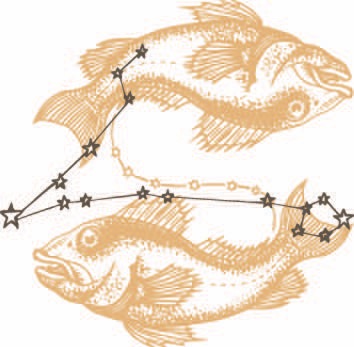
Pisces

(February 19 – March 20)

In case you need the reminder: Yellow does not mean gun it. And only a Pisces needs to hear that it doesn’t mean drift into oblivion, either. Proceed with caution, yes. But stay the course. Be aware of your surroundings and navigate accordingly. When Venus goes retrograde on March 27, it’s time to tend a karmic wound before it festers. In other words: Identify the pattern so you can break it. When in doubt, a salt bath ought to help.

Tea leaf “fortunes” for the rest of you:

Aries (March 21 – April 19) 

Scrap the old story.

Taurus (April 20 – May 20)

Opt for the silk ones.

Gemini (May 21 – June 20)

Steady your hand.

Cancer (June 21 – July 22)

Keep on keeping on.

Leo (July 23 – August 22)

Don’t miss your cue.

Virgo (August 23 – September 22)

Too much salt will wreck the meal.

Libra (September 23 – October 22)

Cast a wider net.

Scorpio (October 23 – November 21)

Get some fresh air.

Sagittarius (November 22 – December 21)

Try washing behind your ears.

Capricorn (December 22 – January 19)

Fix your gaze on the horizon.

Aquarius (January 20 – February 18)

Plant the seed, then let it be.

Simple Life

SIMPLE LIFE

The Art of Healing

With the dawn of spring, we begin again

By Jim Dodson

If you live long enough, the saying goes, you will discover that healing takes time.

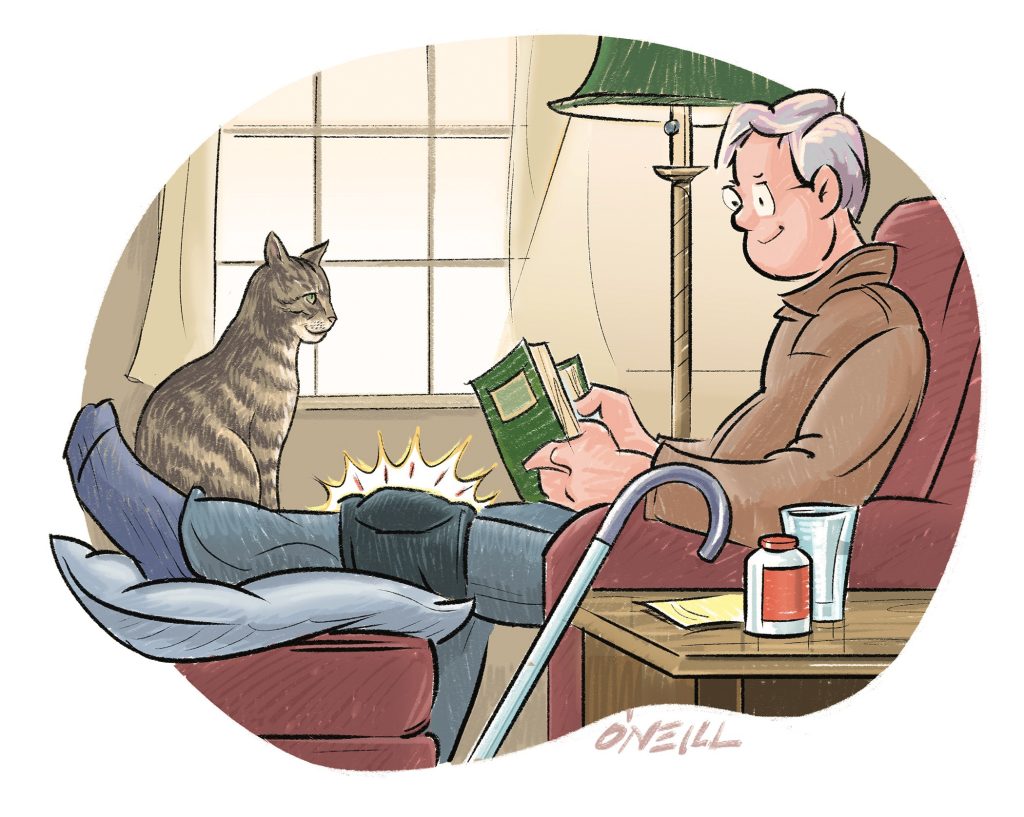
This ancient wisdom is being driven home to me because 15 days before I sat down to write this column, I received a complete left knee replacement.

Friends who’ve been down this path were quick to assure me that the pain and discomfort that accompanies major joint surgery can only be mitigated by time, patience and committing to an aggressive program of physical therapy.

Owing to a lifetime of sports injuries and a fulsome style of landscape gardening my cheeky bride, Wendy, once called a “blood sport with bushes and trees,” I suppose I’ve always downplayed my naturally high tolerance for pain — until now.

“Did you happen to catch the number of the city bus that ran over my leg?” I groaned to my wife on post-op day three, often described as the peak moment of pain during joint recovery.

“Just relax and let your body heal,” was her response. “By March, you’ll be back in the garden and playing golf with a brand-new knee that feels great. It just takes some time to heal, babe.”

Of course, she was right. So, I shut my yap and let my body get on with its healing business without further interference from me.

It proved to be a wise move. Upon completing my second week of physical therapy, not only did I learn that I was a week and a half ahead of the normal recovery rate from knee replacement, but had also begun to regain the ability to walk without the assistance of a cane. The pain was also slowly vanishing — so much so that I did a walking tour of my garden to assess the winter damage. 

This adventure got me thinking about how waiting for the pain to stop and the healing to begin is a common experience that touches every aspect of our lives.

As children, we fall down or cut a finger and run to Mom or Dad, who applies the bandage and a kiss that makes the injury soon forgotten.

Every day on the news, however, we learn about children who live in war zones or are victims of child abuse. Their young lives will forever be damaged by the trauma they’ve suffered — a pain that will likely never quite vanish, leaving a wound that may never heal.

On a much larger scale, the recent devastation of homes and lives lost from Hurricane Helene and the raging wildfires of Los Angeles have produced pain and suffering on an apocalyptic scale, something that will take decades for communities to rebuild and heal. The outpouring of love and assistance from complete strangers to our mountain neighbors, however, speaks volumes about our shared human instinct for healing. A similar outpouring is already underway in the City of Angels.

On the scale of normal, everyday life, a lover’s broken heart may only require a few healing months of intense self-care, a good therapist and a new pair of shoes to begin the mending process.

The psychic pain of losing a job, sending a child off to college, ending a close friendship, or saying goodbye to a loved one or special place you may never see again can impose their own unique weight on the human heart. In time, only memory and gratitude for what was may soften the pain.

That, at least, is my hope.

One evening over this past Christmas, as we sat by the fire watching a holiday movie, our beloved cat, Boo Radley, suffered a sudden massive seizure. Boo was a large, gray tiger cat who entered our lives 14 years ago when Connor, Number Two son, brought him home as a tiny feral kitten found at the Southern Pines train depot on a winter night.

Connor named him “Nico” and kept him in his upstairs bedroom for several weeks before he moved on to Boston to accept a new job. At that point, we renamed the inherited young cat “Boo Radley” and watched him quickly take over the house. One minute he was grooming the ears of our big golden retriever, Ajax, the next sleeping in kitchen pots and pans. He was always up to some amusing mischief that made us all smile.

For some reason, Boo took a particular shine to me, showing up at my desk every morning to playfully tap my computer keys as I wrote. The first time I let him outside, he followed me entirely around the backyard watching me plant roses and mow the lawn.

One summer evening near dusk, I saw Boo bolt across the backyard being chased by a young gray fox. Before I could come to his rescue, I saw the young fox running back the other way — chased by Boo. Crazy as it sounds, their game of tag went on for weeks.

When we moved to the old neighborhood where I grew up in the Gate City, Boo really found his stride. He supervised as I re-landscaped the entire property and faithfully came to sit under the trees with me every afternoon when the day’s work was done. Likewise, for over a decade, he never failed to appear from his nighttime rounds to sit together under the early morning stars while I sipped coffee and had a friendly chat with the universe. He usually snuggled up in my lap as the Almighty and I sorted things out. On most afternoons, he napped in the golden-hour sun in his favorite part of the garden, which I eventually named “Boo’s Garden.”

Like the original Boo Radley, he particularly didn’t care for strangers, and proved to be fiercely territorial, ready to chase off any feline intruder foolish enough to get too close.

Wendy liked to say Boo was simply guarding his turf — and his best buddy.

I do believe this may be true.

On the fourth night after my knee replacement, however, during the deepest pain of my recovery, Boo suffered his sixth seizure in five weeks. The promising medication he’d been on for a month simply didn’t work, proving the art of healing is as much mystery as it is science.

Following a sleepless night, we made the painful decision to end Boo’s suffering. Hours later, a lovely vet from Lap of Love came and put my best pal to sleep on his favorite blanket. I don’t think I’d ever felt such emotional pain. Over a cat, no less.

Every moment of this life, as my late Grandmother Taylor liked to say, someone is waiting beneath a clock for a birth or a death or a chance to begin again.

The return of spring brings winter’s long wait to an end. It’s nature’s moment to heal and begin again.

With my brand-new knee, I can’t wait to get out into the garden.

But my best friend is gone, a pain that will probably take years to heal.

Southwords

SOUTHWORDS

Wanna Bet?

The bad luck of the draw

By Jim Moriarty

Games of chance have never been profitable for me. I’m convinced there is a genetic component to the deficiency. My father, who I did not know well, was a non-professional gambler. By this I mean he bet on the horses lavishly but was very bad at it. From what I gather, a lot of bettors study the racing sheet like they’re preparing to take the law boards. My father, on the other hand, was one of those gamblers who bet on a horse because he thought its name was cute or the jockey had just the right shade of blue in his silks. It wasn’t a method that held great promise, and he derived exactly the amount of success from it that you would anticipate.

This carried over to my lone experience betting at the Stoneybrook Steeplechase, that springtime Moore County tradition that was like no other. Since Stoneybrook frequently happened the same week as the Masters, work most often called me to Augusta, Georgia, instead of to the Walsh family farm off Youngs Road. One year, however, the two events diverged, and I was able to attend the races with what seemed like half the state of North Carolina. It was a springtime extravaganza in ways I cannot begin to explain.

Naturally, our tailgating group organized a pool to bet on the races, a practice as common as big hats and cold beer. Given my background, I harbored no illusions of either win, place or show. My expectations were low but were, somehow, exceeded. We drew our numbers from a hat. This alleviated any chance of my putting my father’s methodology to use, which, to be candid, I viewed as something of a plus. I don’t remember what number I drew but, like everyone else, I bellied up to the rail to watch the start of the race.

Just like that, they were off. A thundering herd. I searched among them for my horse. He must be hidden in the pack, I thought. The earth shook as they pounded past. I double-checked the number on the slip of paper in my hand. My horse had gone missing.

Confused, I looked back toward the starting line. My horse wasn’t there, either. In fact, he had never gotten beyond it. When the flag went up and the rope dropped, my trusty steed had wheeled in the opposite direction and put a surprising amount of distance between himself and the rest of the horses, until he found a likely spot to jump the fence into the infield, where, presumably, he was meeting friends for a mint julep. My father would have been so proud.

As poor as this wager might have been, it wasn’t my worst gambling faux pas. That came in a Ladbrokes bet shop in the town of St. Andrews, Scotland. The Open Championship was there in 1990. By then Tom Watson was in his 40s and, to be bluntly honest, his championship game had gone to seed. Still, he had very nearly beaten Seve Ballesteros on the old links six years before.

The odds on Watson were 50-1. I thought, how could this not be worth a few quid?

And so I stepped to the window and put down £20 pounds on my sentimental favorite, the eight-time major championship winner. I walked out of the shop in one of St. Andrews’ back alleys into the bright July sunshine, dreaming of what I would buy when my aging ship came in. As luck would have it, at that very moment a sea gull the size of a nuclear submarine flew directly overhead and dropped a load of sewage on me that could have put out a forest fire. Without hesitation, I tore my ticket in half and tossed it into the nearest trash bin.

Watson and I both missed the cut.