NC Surround Sound

NC SURROUND SOUND

Dropping In

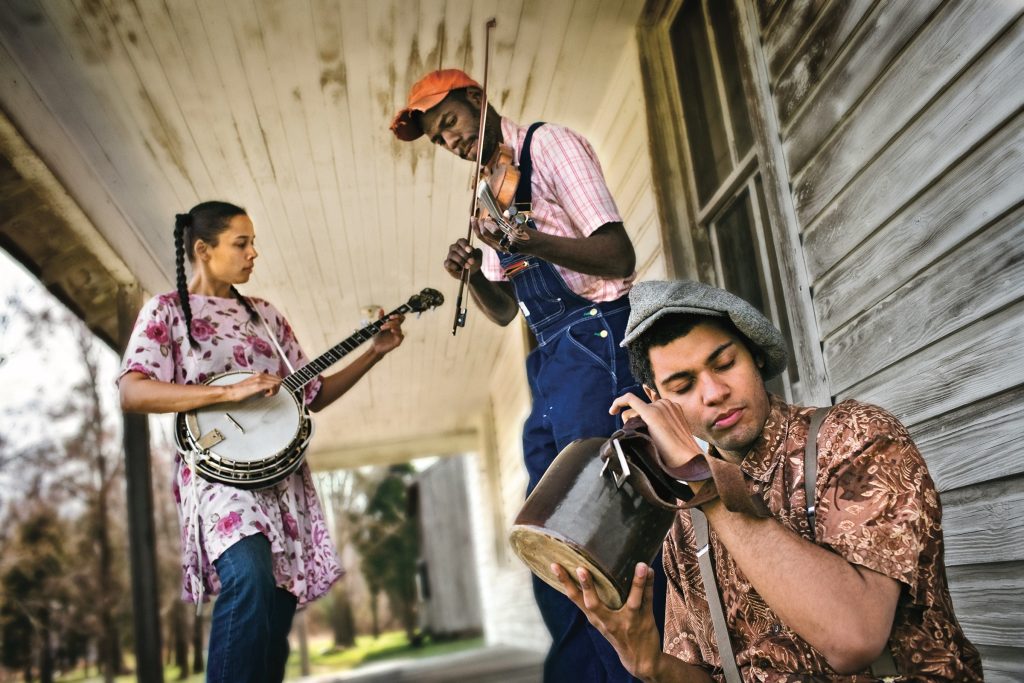
Return of the Carolina Chocolate Drops

By Tom Maxwell

It all started in April 2005, at the first “Black Banjo: Then and Now Gathering.” The event, held at Appalachian State University in Boone, was part scholarly pursuit and part throwdown, featuring four days of “lectures, jams, workshops, down home frolics, and performances” with a view to bringing the “funky, plunky instrument” back home to Black America. Dom Flemons, a 23-year-old student at Northern Arizona University, attended.

“I was the young person at the event,” Flemons says. He had been playing banjo for a few years already, busking on street corners and devouring records by the Memphis Jug Band and Dave Van Ronk, as well as ’20s songster music of people like Gus Cannon, who had a late-in-life hit when the Rooftop Singers covered his 1929 stomper “Walk Right In,” and Henry Thomas, whose Texas ragtime tunes were covered by ’60s folk/rock stalwarts Bob Dylan, The Lovin’ Spoonful and the Grateful Dead, among others.

So, like many young people who fall in love with old music, most of Dom’s musical heroes were dead — even if their music was very much alive. But in Boone he was about to enter the musical land of the living.

“When I met Joe Thompson, a light bulb went off in my head,” Flemons says. “I heard him playing at the opening ceremony for the Black Banjo Gathering, and all of a sudden I understood the music that connected people like Henry Thomas to Gus Cannon. When I heard Joe’s music, I heard that flavor of fiddle and banjo music that these guys were referencing, playing and living next to generationally. And that inspired me to move out to North Carolina. I sold everything I owned, packed up my car, and took Route 66 east, headed for North Carolina to be near the music.”

Thompson, born in 1918, had been playing African American string band music for 80 years by the time Dom Flemons heard him perform at the Black Banjo Gathering. An Orange County native, Thompson joined his family on fiddle (after studying his father’s old-time technique, which was handed down by his own father, a former enslaved person) playing square dances, parties and dances after corn shucking or tobacco stripping. Joe considered quitting music after his cousin and musical partner, Odell Thompson, died in the ’90s, but picked it back up basically by popular demand. Even a stroke in 2001 couldn’t slow him down. “I got to sit with Joe and play music,” Flemons remembers, “and it was a powerful experience just to be in his presence. I also tried my best to play banjo behind his fiddle playing. I knew that I was connected to the tradition from there.

“There’s magic in the excitement and drama and the wealth of culture that is translated through a live performance,” Flemons adds. “It’s something beyond just music. It’s a feeling as well and, if you’re deep in the culture, you understand the nuances of that feeling. In the ’50s, they talked about old-time music and analyzed it a certain way. So, when you read books about it, you can understand it to a degree. But once you’re in it, that’s when you can take on a whole other quality.”

Two years after his performance at the first Black Banjo Gathering, Joe Thompson became a National Endowment for the Arts National Heritage Fellow. He also started mentoring Dom Flemons’ new band. Local musicians Rhiannon Giddens and Justin Robinson also saw Thompson at the Black Banjo Gathering and had been playing music at his Mebane house for several months by the time Dom, newly graduated from college, moved to North Carolina. The three youngsters decided to form a band of their own. “These are the years leading into Obama being elected,” Flemons says, “and culturally, people were ready for a Black string band. They could handle it.”

Flemons, Giddens and Robinson called their band the Carolina Chocolate Drops. “With the combination of all three of the original members of the trio, we created a sound that was very authentic and raw, but also landed right,” Flemons says. “I always compare it to The Beatles because we had a gestation period where we mostly played square dances. So, we always had a rock solid rhythm. I leaned 100 percent into that, because being a fan of the Grateful Dead and stuff like that, I understand that give and take with the audience.”

All traditions, an accomplished jazz musician once observed, meet at the root. In their career, the Carolina Chocolate Drops were seamlessly able to blend Civil War-era Black string band music, ’60s folk-rock, jazz and hip hop. It’s no surprise — but still an absolute delight — that the band covered Blu Cantrell’s 2001 R&B Top 40 hit “Hit ’Em Up Style (Oops!)” on their Grammy-winning album Genuine Negro Jig.

“I was a fan of Old Crow Medicine Show,” Flemons says, “so I always thought about fast old-time as being a genre. Fast old-time is something that people have always enjoyed, and it was becoming very popular at that time. When we were arranging songs with the Carolina Chocolate Drops, they would usually do a Joe Thompson number. I came up with the jug and took a combination of what I thought about with traditional jug bands, as well as people like Charles Mingus, and applied that to ‘Georgia Buck.’ There were parts I came up with that were a Charles Mingus-inspired type of bebop bass lines. That gave us a unique sound from a traditional old-time string band.”

The Carolina Chocolate Drops went on to have a stellar career, releasing five albums, opening for luminaries like Taj Mahal and Bob Dylan, making numerous television appearances, and performing several times at the Grand Ol’ Opry. But as all fiery combinations do, they burned bright, then out. Robinson left in 2011; Flemons followed suit two years later. By 2014, the group functionally disbanded. Until now.

“Rhiannon wants us to do this festival she’s putting together, Biscuits & Banjos,” Flemons says. The festival will be held in Durham April 25 – 27th and will feature not only a reunited Carolina Chocolate Drops, but also solo appearances by Flemons and Giddens. Rounding out the stellar lineup are legacy acts like Taj Mahal, promising newcomers Infinity Song, Tar Heel native Shirlette Ammons and many more. In the tradition of the Black Banjo Gathering — and countless others since time immemorial — there will be artist talks, workshops, a biscuit bake-off (Giddens is a self-described “avid biscuit baker”) and a community square dance. The festival website characterizes the event as “dedicated to the reclamation and exploration of Black music, art and culture in North Carolina.”

Indeed, all American musical traditions do meet at the root. Blues, jazz, rock-and-roll — and a sizable chunk of country music — owe their very existence to African American musical idioms and cultural expressions. We are all the better for it, and when you combine this history with Southern food and an old-school hootenanny, life gets very good indeed. And North Carolina is one of the few places in America where something like this could happen.

“North Carolina is such a wellspring of culture in general,” Flemons says, “and I believe that it has done a lot of things right when it comes to expressing the culture of the state. It is one of the very first states, so it has a deep history. There’s a lot of different musicians coming out of North Carolina — they’re doing traditional music but also jazz and gospel. I think it’s something in the way that the land is structured and the way people are raised. Because a lot of times they have this particular connection to the land, and a foot in both the country and the city. That is very unique.

“The Carolina Chocolate Drops did school shows in almost every city and town in North Carolina, so I got to see everything from Edenton all the way up to Asheville and Black Mountain and Hot Springs. Every part of North Carolina has something beautiful and unique, and the music reflects that.”

Omnivorous Reader

OMNIVOROUS READER

Coin of the Realm

The history of Rome in loose change

By Stephen E. Smith

If you believe the ancient Romans had little to do with your life, look at your feet. They gave us the concept of left and right footwear. They also left us their checkered history, of which there’s too damn much. If you’ve tackled Gibbon’s unabridged The History of the Decline and Fall of the Roman Empire, you know that a manageable history of ancient Rome requires a framing device that places events and characters in perspective.

Historian/numismatist Gareth Harney has devised an agreeable gimmick. He has selected what he believes are the 12 most significant coins minted during the Empire’s 800-plus years, and he’s written A History of Ancient Rome in Twelve Coins, connecting the coinage to the emperors and events that influenced their minting.

Roman coins were struck from alloys of gold, silver, bronze, orichalcum or copper — materials that gave them resilience — and they are discovered still in Welsh fields and Polish barnyards. You can buy a pile of uncleaned Roman coins on eBay for $30.

First introduced in the third century BCE, Roman coins were used well into the Middle Ages, and during a denarius’ existence, it would likely have passed between millions of hands. Many of the coins are worn smooth, obscuring the profile of the emperor or god whose likeness was meant to ensure political stability and economic security.

In crisp, energetic prose, Harney opens each chapter as if he were writing historical fiction. “The vision was surely his alone,” he writes of Constantine’s moment of conversion. “Yet the confused shouts of his soldiers seemed to claim otherwise. As the marching column ground to a halt before the spectacle, men raised their arms to the clear sky, calling out to their emperor to witness the unfolding miracle. It took shape, by all accounts, in the rays of the midday sun. A glowing halo surrounding the solar disk, sparkling with additional rival suns where it was intersected by radiating horizontal and vertical beams — all shimmering like jewels with spectral color.”

Harney guides the reader through the history of Rome from Romulus, suckled by a wolf on an early Roman coin, to the last emperor, who was deposed by the German general Odoacer in 476 CE. In the early years of the Empire, coins illustrated mythical scenes and various gods and goddesses, but that changed, as did much of Roman life, when Julius Caesar issued coins bearing his likeness. “Even in an age of giants — Pompey, Cicero, Antony and Cleopatra — Caesar would tower above all,” Harney writes, “bestriding the world like a colossus.” The appearance of Caesar’s profile on the Roman denarius in 44 BCE is acknowledged as a transformative moment in Roman history. The new coin violated ancient law, tradition, and the sacred delineation between military and civic authority. Caesar went so far as to order the minting of a denarius with the likeness of the defeated Gallic leader Vercingetorix, an enemy of the Roman Republic.

The Julio-Claudian dynasty receives its due — Tiberius, Caligula, Claudius, Nero, Vespasian, et al. — and Harney explains the events leading to the coinage produced by each emperor. Bits and pieces of Roman excess and debauchery are reviewed in tolerable detail, and readers are occasionally treated to new depravities, of which there was no shortage in an empire populated with leaders who were murdered almost as quickly as they took power.

For many of these upstart emperors, assassination was often a merciful escape. In 260 AD, for example, the emperor Valerian was defeated by King Shapur I and was taken prisoner. He lived out his years in slavery, falling to his hands and knees to act as a step for Shapur to mount his horse. The emperor of Rome had become a human footstool for an enemy king who later had him skinned, stuffed and placed on display.

Harney’s discussion of the various currencies makes the constant shuffling of Roman emperors slightly less confusing, but the devaluation of Roman coinage is his most significant and timely lesson. The emperors, unable to pay for Rome’s defense, lessened the amount of silver or gold in each coin. “By 270, the ‘silver’ coins of Rome held less than 2 percent precious metal. Nothing more than crude scraps of copper rushed out of the mint, without a thought of quality control. A thin silver wash on the coins only served to insult the intelligence of the Roman people, and quickly wore off to reveal the depressing base metal below.” Any belief in a reliable gold or silver standard vanished from the monetary system. As coinage ceased to hold its value, Romans returned to barter as a method of exchange. When new coins were issued, they dulled more quickly, and they felt light in the hand, signaling debasement. Each degraded coin is part of the puzzle whose final piece reveals the complete collapse of the Roman state.

A History of Ancient Rome in Twelve Coins will appeal to a broad audience. Excluding the rare reader who has a comprehensive knowledge of Roman history and the numismatist specializing in Roman coinage, the majority of readers (those who saw an episode or two of I, Claudius or the movie Gladiator) will find Harney’s history well-written, informative and sophisticated — high-end Monarch Notes for Gibbon’s six-volume Decline and Fall. They may even feel inspired to start collecting Roman coins.

Harney doesn’t claim that his research offers profound insights into our contemporary political divisions or the teetering state of our democracy, but readers will likely infer whatever lesson appeals to their politics. One truth, however, is inescapable: Empires rot from the inside out.

Dissecting a Cocktail

DISSECTING A COCKTAIL

Blood and Sand

Story and Photograph by Tony Cross

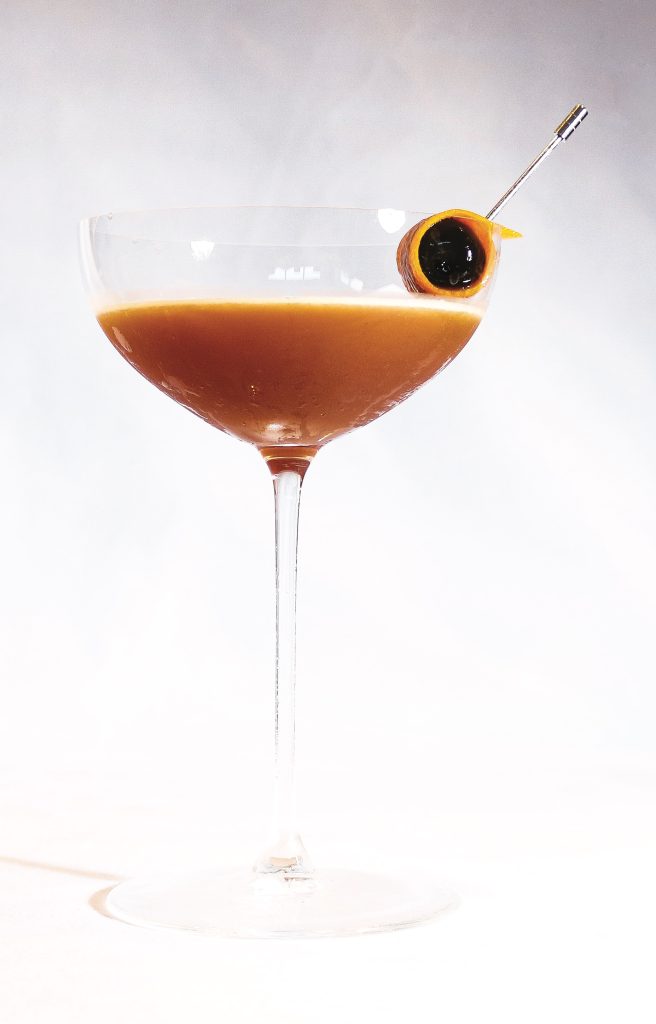
I hereby present to you a cocktail that I’ve never really enjoyed: the “Blood and Sand.” Well-known to bartenders, it’s a relatively unknown classic cocktail to drinkers. Even though the creator of this cocktail is a mystery, it originally appeared in Henry Craddock’s The Savoy Cocktail Book in 1930. The Blood and Sand takes its name from the 1922 silent film Blood and Sand, starring Rudolph Valentino. The movie follows a matador, Juan Gallardo, whose rise from poverty to become one of Spain’s greatest bullfighters ends in tragedy, romantic betrayal and death.

On paper, the ingredients for the cocktail don’t seem to make sense: equal parts Scotch whisky, cherry Heering, sweet vermouth and orange juice. Admittedly, it does taste better than the specs would lead you to believe. The problem, as I saw it, is that it has never tasted great. Enter acid-adjusted juices. Adding citric and malic acids to juices like grapefruit, orange and pineapple allows you to have one juice in the mix instead of two. More juices means more dilution, means more of a balancing act with your sweetener and alcohol.

When I learned of acid-adjusting from bartender Dave Arnold, one of the first drinks I thought of was the Blood and Sand. Orange juice on its own is missing that citric punch, something that this drink is lacking. Ingredients are meant to be toyed with, and by playing around with these specs, we can take a drink that is just OK to a drink that’s really good. You’ll also notice that I do away with “equal parts” as I up the amount of whisky.

Specifications

1 1/4 ounce Scotch whisky (do not use one that is over-peaty)

3/4 ounce acid-adjusted orange juice*

1/2 ounce cherry Heering

1/2 ounce sweet vermouth

Execution

Combine all ingredients into a cocktail shaker, add ice, and shake hard for 10-15 seconds. Strain into a chilled cocktail coupe. Garnish with orange peel and brandied cherry.

*Acid-adjusted orange juice: per 100 ml of fresh orange juice, mix in 5.2 grams of citric acid.

Almanac

ALMANAC

Almanac March 2025

By Ashley Walshe

May your thoughts be as glad as the shamrocks,

May your heart be as light as a song,

May each day bring you bright, happy hours,

That stay with you all the year long.

— Irish Blessing

March is an arrival, a revival, tender life still wet from birth.

Listen.

A purple martin sings at dawn, hollow bones weary from 5,000 miles of flight.

“Join me,” he broadcasts to the others. “Over here! On past the flowering redbud. The air is sweet, and spring is nigh!” 

Yes, spring is nigh. We’ve much to celebrate. The journey through winter was long and arduous.

On the forest floor, where trout lily and bloodroot grace the softening earth, fiddleheads unfurl like soundless party horns.

One by one, swallowtails emerge from chrysalides as yellow confetti propelled in slow motion. Winged maple seeds sing in scarlet, cascading from naked branches like blazing garlands.

A chorus of peepers screams out.

Squirrel kits nuzzle nursing mothers in their dreys. Born pink and blind, their world is all warm milk and wriggling bodies. When they open their eyes, the violets will have opened, too.

In the garden, a cottontail kindles her first litter. Deadnettle and dandelions mingle with delicate grasses. A bluebird crafts her cup-shaped nest.

Can you sense your own revival? Your own tender blossoming? Spring is here, and so are you.

Emerge from brumation as the snake does. Wiggle your toes in the feather-soft grass. Let the sun melt the winter from your skin and bones as the sparrow trills rejoice!

Once in a Red Moon

According to National Geographic, two of the nine “must-see sky events” of 2025 are happening this month, beginning with a total lunar eclipse and blood moon on Friday, March 14. During the total eclipse, visible from 2:26 – 3:31 a.m., Earth’s shadow will cause the moon to appear otherworldly, glowing in shades of “pumpkin orange to coppery red.” Can you say le fantastique? Night owls: No reason to miss it. 

Next on the docket of celestial sensations is a deep partial solar eclipse on Saturday, March 29. Early birds: This one’s for you. Bust out those eclipse glasses for a show that will peak at sunrise.

A Time to Sow

The soil is thawing. The birds are twittering. The worms are back in business.

Earthworms are key to healthy, nutrient-rich soil. And did you know that just 1 acre of land can host upwards of 1 million of the cold-blooded wigglers? The more, the merrier.

As a new season begins, we, too, return to the garden.

In early March, sow carrot, spinach, radish, pea and turnip seeds directly into the softening earth. Chives, parsley, onion and parsnips can be planted mid-month. At month’s end, bust out the beet and arugula seeds.

Broccoli, cauliflower and cabbage seedlings can be transplanted outdoors mid- to late-month. Ditto kale, Swiss chard, lettuce and kohlrabi.

As robin exhales mirthful tunes of crocus and tulip and plump, soil-laced worms, you gently hum along.

Tea Leaf Astrologer

TEA LEAF ASTROLOGER

Pisces

(February 19 – March 20)

In case you need the reminder: Yellow does not mean gun it. And only a Pisces needs to hear that it doesn’t mean drift into oblivion, either. Proceed with caution, yes. But stay the course. Be aware of your surroundings and navigate accordingly. When Venus goes retrograde on March 27, it’s time to tend a karmic wound before it festers. In other words: Identify the pattern so you can break it. When in doubt, a salt bath ought to help.

Tea leaf “fortunes” for the rest of you:

Aries (March 21 – April 19) 

Scrap the old story.

Taurus (April 20 – May 20)

Opt for the silk ones.

Gemini (May 21 – June 20)

Steady your hand.

Cancer (June 21 – July 22)

Keep on keeping on.

Leo (July 23 – August 22)

Don’t miss your cue.

Virgo (August 23 – September 22)

Too much salt will wreck the meal.

Libra (September 23 – October 22)

Cast a wider net.

Scorpio (October 23 – November 21)

Get some fresh air.

Sagittarius (November 22 – December 21)

Try washing behind your ears.

Capricorn (December 22 – January 19)

Fix your gaze on the horizon.

Aquarius (January 20 – February 18)

Plant the seed, then let it be.

Simple Life

SIMPLE LIFE

The Art of Healing

With the dawn of spring, we begin again

By Jim Dodson

If you live long enough, the saying goes, you will discover that healing takes time.

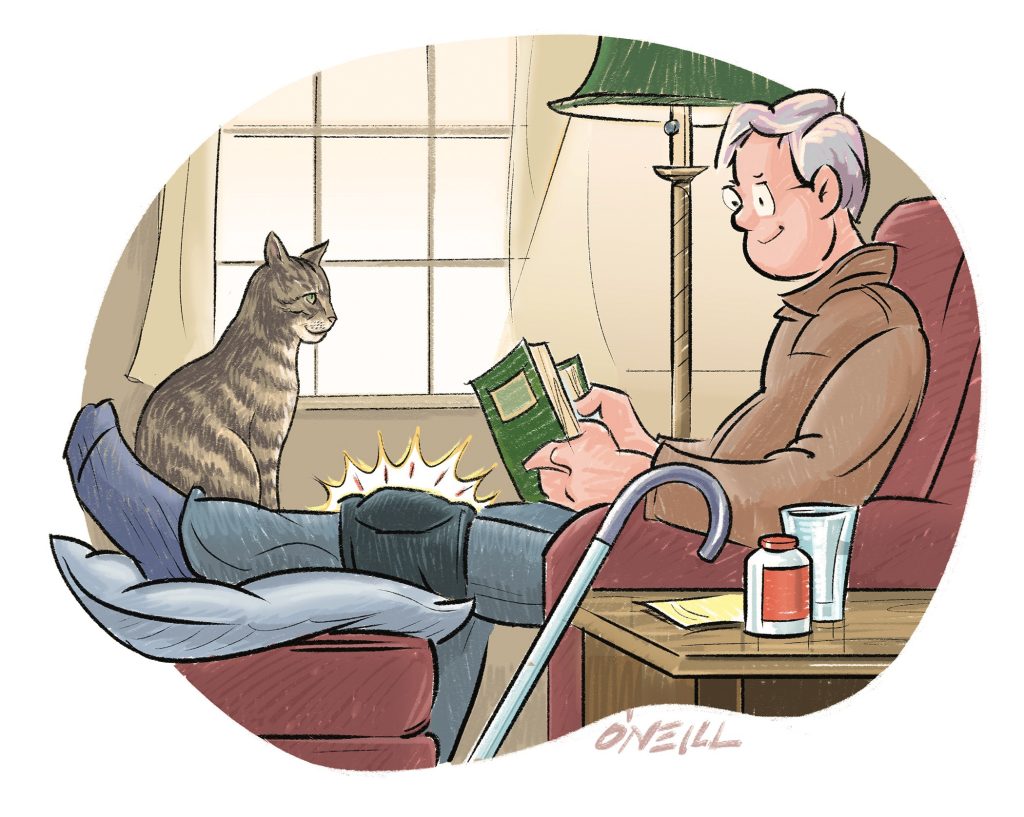
This ancient wisdom is being driven home to me because 15 days before I sat down to write this column, I received a complete left knee replacement.

Friends who’ve been down this path were quick to assure me that the pain and discomfort that accompanies major joint surgery can only be mitigated by time, patience and committing to an aggressive program of physical therapy.

Owing to a lifetime of sports injuries and a fulsome style of landscape gardening my cheeky bride, Wendy, once called a “blood sport with bushes and trees,” I suppose I’ve always downplayed my naturally high tolerance for pain — until now.

“Did you happen to catch the number of the city bus that ran over my leg?” I groaned to my wife on post-op day three, often described as the peak moment of pain during joint recovery.

“Just relax and let your body heal,” was her response. “By March, you’ll be back in the garden and playing golf with a brand-new knee that feels great. It just takes some time to heal, babe.”

Of course, she was right. So, I shut my yap and let my body get on with its healing business without further interference from me.

It proved to be a wise move. Upon completing my second week of physical therapy, not only did I learn that I was a week and a half ahead of the normal recovery rate from knee replacement, but had also begun to regain the ability to walk without the assistance of a cane. The pain was also slowly vanishing — so much so that I did a walking tour of my garden to assess the winter damage. 

This adventure got me thinking about how waiting for the pain to stop and the healing to begin is a common experience that touches every aspect of our lives.

As children, we fall down or cut a finger and run to Mom or Dad, who applies the bandage and a kiss that makes the injury soon forgotten.

Every day on the news, however, we learn about children who live in war zones or are victims of child abuse. Their young lives will forever be damaged by the trauma they’ve suffered — a pain that will likely never quite vanish, leaving a wound that may never heal.

On a much larger scale, the recent devastation of homes and lives lost from Hurricane Helene and the raging wildfires of Los Angeles have produced pain and suffering on an apocalyptic scale, something that will take decades for communities to rebuild and heal. The outpouring of love and assistance from complete strangers to our mountain neighbors, however, speaks volumes about our shared human instinct for healing. A similar outpouring is already underway in the City of Angels.

On the scale of normal, everyday life, a lover’s broken heart may only require a few healing months of intense self-care, a good therapist and a new pair of shoes to begin the mending process.

The psychic pain of losing a job, sending a child off to college, ending a close friendship, or saying goodbye to a loved one or special place you may never see again can impose their own unique weight on the human heart. In time, only memory and gratitude for what was may soften the pain.

That, at least, is my hope.

One evening over this past Christmas, as we sat by the fire watching a holiday movie, our beloved cat, Boo Radley, suffered a sudden massive seizure. Boo was a large, gray tiger cat who entered our lives 14 years ago when Connor, Number Two son, brought him home as a tiny feral kitten found at the Southern Pines train depot on a winter night.

Connor named him “Nico” and kept him in his upstairs bedroom for several weeks before he moved on to Boston to accept a new job. At that point, we renamed the inherited young cat “Boo Radley” and watched him quickly take over the house. One minute he was grooming the ears of our big golden retriever, Ajax, the next sleeping in kitchen pots and pans. He was always up to some amusing mischief that made us all smile.

For some reason, Boo took a particular shine to me, showing up at my desk every morning to playfully tap my computer keys as I wrote. The first time I let him outside, he followed me entirely around the backyard watching me plant roses and mow the lawn.

One summer evening near dusk, I saw Boo bolt across the backyard being chased by a young gray fox. Before I could come to his rescue, I saw the young fox running back the other way — chased by Boo. Crazy as it sounds, their game of tag went on for weeks.

When we moved to the old neighborhood where I grew up in the Gate City, Boo really found his stride. He supervised as I re-landscaped the entire property and faithfully came to sit under the trees with me every afternoon when the day’s work was done. Likewise, for over a decade, he never failed to appear from his nighttime rounds to sit together under the early morning stars while I sipped coffee and had a friendly chat with the universe. He usually snuggled up in my lap as the Almighty and I sorted things out. On most afternoons, he napped in the golden-hour sun in his favorite part of the garden, which I eventually named “Boo’s Garden.”

Like the original Boo Radley, he particularly didn’t care for strangers, and proved to be fiercely territorial, ready to chase off any feline intruder foolish enough to get too close.

Wendy liked to say Boo was simply guarding his turf — and his best buddy.

I do believe this may be true.

On the fourth night after my knee replacement, however, during the deepest pain of my recovery, Boo suffered his sixth seizure in five weeks. The promising medication he’d been on for a month simply didn’t work, proving the art of healing is as much mystery as it is science.

Following a sleepless night, we made the painful decision to end Boo’s suffering. Hours later, a lovely vet from Lap of Love came and put my best pal to sleep on his favorite blanket. I don’t think I’d ever felt such emotional pain. Over a cat, no less.

Every moment of this life, as my late Grandmother Taylor liked to say, someone is waiting beneath a clock for a birth or a death or a chance to begin again.

The return of spring brings winter’s long wait to an end. It’s nature’s moment to heal and begin again.

With my brand-new knee, I can’t wait to get out into the garden.

But my best friend is gone, a pain that will probably take years to heal.

Southwords

SOUTHWORDS

Wanna Bet?

The bad luck of the draw

By Jim Moriarty

Games of chance have never been profitable for me. I’m convinced there is a genetic component to the deficiency. My father, who I did not know well, was a non-professional gambler. By this I mean he bet on the horses lavishly but was very bad at it. From what I gather, a lot of bettors study the racing sheet like they’re preparing to take the law boards. My father, on the other hand, was one of those gamblers who bet on a horse because he thought its name was cute or the jockey had just the right shade of blue in his silks. It wasn’t a method that held great promise, and he derived exactly the amount of success from it that you would anticipate.

This carried over to my lone experience betting at the Stoneybrook Steeplechase, that springtime Moore County tradition that was like no other. Since Stoneybrook frequently happened the same week as the Masters, work most often called me to Augusta, Georgia, instead of to the Walsh family farm off Youngs Road. One year, however, the two events diverged, and I was able to attend the races with what seemed like half the state of North Carolina. It was a springtime extravaganza in ways I cannot begin to explain.

Naturally, our tailgating group organized a pool to bet on the races, a practice as common as big hats and cold beer. Given my background, I harbored no illusions of either win, place or show. My expectations were low but were, somehow, exceeded. We drew our numbers from a hat. This alleviated any chance of my putting my father’s methodology to use, which, to be candid, I viewed as something of a plus. I don’t remember what number I drew but, like everyone else, I bellied up to the rail to watch the start of the race.

Just like that, they were off. A thundering herd. I searched among them for my horse. He must be hidden in the pack, I thought. The earth shook as they pounded past. I double-checked the number on the slip of paper in my hand. My horse had gone missing.

Confused, I looked back toward the starting line. My horse wasn’t there, either. In fact, he had never gotten beyond it. When the flag went up and the rope dropped, my trusty steed had wheeled in the opposite direction and put a surprising amount of distance between himself and the rest of the horses, until he found a likely spot to jump the fence into the infield, where, presumably, he was meeting friends for a mint julep. My father would have been so proud.

As poor as this wager might have been, it wasn’t my worst gambling faux pas. That came in a Ladbrokes bet shop in the town of St. Andrews, Scotland. The Open Championship was there in 1990. By then Tom Watson was in his 40s and, to be bluntly honest, his championship game had gone to seed. Still, he had very nearly beaten Seve Ballesteros on the old links six years before.

The odds on Watson were 50-1. I thought, how could this not be worth a few quid?

And so I stepped to the window and put down £20 pounds on my sentimental favorite, the eight-time major championship winner. I walked out of the shop in one of St. Andrews’ back alleys into the bright July sunshine, dreaming of what I would buy when my aging ship came in. As luck would have it, at that very moment a sea gull the size of a nuclear submarine flew directly overhead and dropped a load of sewage on me that could have put out a forest fire. Without hesitation, I tore my ticket in half and tossed it into the nearest trash bin.

Watson and I both missed the cut. 

Zeppole

ZEPPOLE

Zeppole

A Love Story

Fiction by Joseph Bathanti     Illustration by Mariano Santillan

My mother swears she’s pregnant. She wants to cook. Which she never does. In our house, my father handles the cooking. As recently as yesterday she wasn’t even speaking to us, but this baby — the baby, she says — has her happy and she wants to make zeppole. Little patties of dough fried in hot olive oil, then sprinkled with sugar. She has a craving. The way her mother used to make them. I don’t remember ever eating them, but my mother assures me I have. At my grandmother’s. But we hardly see her anymore, and I’m not certain I’d recognize her if she crashed through the roof.

My mother produces a white prayer book with a tiny lock like an antique diary’s. With a key the size of an infant’s thumbnail she opens it. Should she drop to her knees, mumbling antiphonies like those insane Calabrian widows on Good Fridays at the graveyard, I will fall over dead in astonishment, and my father will join me. But she does not pray. Rather, she takes from the prayer book’s withered secret pages a slip of frayed paper and, reading from it as she puffs on a Chesterfield, assembles the grayish-yellow mound of dough.

My father sits reading the obituaries at the kitchen table. Wearing a long white terrycloth robe with a black hex sign on the back, he looks like a prizefighter. He tells my mother that Philly Decker died and is laid out at Febraro’s.

“Did somebody shoot him or did he just eat himself to death?” she asks.

“Doesn’t mention,” says my dad.

“I thought he was too in love with himself to die. How will the world keep spinning?”

“I think we should go see him, Rita.”

“You go. I never liked him, but please tell him I said hello.”

“Your mother has no respect for the dead, Fritz,” he says to me. “Or for the living.”

He gets up and takes the newspaper into the living room. I follow him, lie on my stomach on the floor with the comics and doze off. As I sleep, the dough, hunkered in a glass bowl covered with a tea towel, miraculously doubles in size.

When I wake, I walk toward the kitchen. My mother, in a pink summer nightgown, stands at the ironing board running the steaming wedge back and forth across the collar of the black dress she’ll wear to work. The iron occasionally hisses. From the radio, volume hiked way up, Elvis Presley, in a whispery voice, sings “I Can’t Help Falling in Love with You.”

She sings along as she irons, fervently, churchy, then sways, guided by Elvis over the dance floor of dream. She has not noticed me. There are tears in her eyes. Behind her, like excelsior, sun sprays the window, silhouetting her, the gown chiseled in relief, her hair spun at her crown in filigrees, her face a marbled shadow of backlight out of which drifts a disembodied yearning not clearly my mother’s. And for that instant I am blinded and do not see until the sun flares off the Pentecostal flames from the ignited oil in the skillet raging behind her.

“Mom,” I scream. She looks up surprised and smiles, still singing unabashedly: Take my hand, take my whole life too.

Then she turns and sees the fire licking at her. She grabs the wooden skillet handle. The flames leap from the skillet to her gown, pour over it like liquid, and she is instantly engulfed. The music like requiem, Elvis Presley like the cantor at High Mass looping incense over his mesmerized flock as the church burns down. I can’t move. I can’t take my eyes off her, no longer my mother, like sacred art restored, an angel wedding fire.

My father storms by me and scoops up my mother. He kicks open the screen door. There is an audible suspiration as he too catches fire, stumbling down the three concrete steps to the yard where he drops her, still clutching the spouting skillet, in my swimming pool, then simply steps out of his fiery robe and leaps in the water beside her.

The pool has sat in the little yard all winter. Leaves float on its surface. Neighborhood dogs drink out of it. The blue plastic bottom, patterned with yellow cartoon fish with long-lashed eyes and huge puckered lips, is slick with algae. The round aluminum frame is caving.

Unharmed, my mother and father sit next to each other in the pool. Laughing. She in what’s left of the charred pink gown. Bit by bit it falls off her body and floats on the water like scraps of flesh. My father is naked. Together they splash water on his burning robe until the flames die down, and there is the sodden smell of fried terrycloth, the nubs at the end of each thread brown on white like blackened marshmallows.

Tea Leaf Astrologer

TEA LEAF ASTROLOGER

Aquarius

(January 20 – February 18)

Those who know and love you can attest: Humdrum just isn’t in your wheelhouse. This month, when life sprinkles a few so-called obstacles in your path, consider it a boon. Not only will you rise to the occasion, you’ll also land in the good graces of someone whose unconventional thinking both complements and challenges your own. Trust that any perceived failures are but compost for the goodness to come. Your life will be anything but boring.

Tea leaf “fortunes” for the rest of you:

Pisces (February 19 – March 20)

Take two whopping steps back.

Aries (March 21 – April 19) 

Read the subtle cues.

Taurus (April 20 – May 20)

It’s going to be worth all the mess.

Gemini (May 21 – June 20)

Deeper breaths, darling.

Cancer (June 21 – July 22)

Two words: lemon and cayenne.

Leo (July 23 – August 22)

Best to take smaller bites.

Virgo (August 23 – September 22)

It’s time for a new playlist.

Libra (September 23 – October 22)

Resist the urge to fold.

Scorpio (October 23 – November 21)

The laundry is behind you.

Sagittarius (November 22 – December 21)

Tend to your nervous system.

Capricorn (December 22 – January 19)

Don’t forget to stretch.

Omnivorous Reader

OMNIVOROUS READER

The Heart of Appalachia

Discovering a long-forgotten love

By Anne Blythe

Appalachia and its resilient people have been in the news digging out from the path of destruction carved through the mountainous region by the powerful remnants of Hurricane Helene. Vice President JD Vance rose to political prominence, in part, based on his 2016 depiction of the region in Hillbilly Elegy: A Memoir of a Family and Culture in Crisis. Isabel Reddy, a science writer based in Chapel Hill who has turned her hand to fiction, tells another story of Appalachian life in her debut novel, That You Remember.

Reddy takes readers to the fictional Otter Creek Hollow, a Kentucky coal country “holler” full of men with “miner’s mascara” — that perpetual dark smudge of coal around the eyes — and the cast of women who rile, nurture and support them. Reddy, herself the daughter of a former coal company president, brings the miners, company executives and townspeople to life in a poignant page-turner about love, self- discovery and impending catastrophe.

The story starts when Aleena Rowan Fitzgerald receives a box from her brother with her deceased father’s desk diaries enclosed. It’s 2019, and Aleena, the mother of two college-age daughters, is in the midst of a divorce that has forced her to examine who she was, who she is, and who she wants to be.

Aleena’s dad, Frank Rowan, spent much of his working life away from their Connecticut home, either at his New York City office or on the road. “Here was a man who, from looking at his desk diaries, could schmooze with politicians and owners of large conglomerates, who flew all over the place and dined at the most fashionable hotels and restaurants,” says Aleena. After the family company bought Otter Creek Mining Company, an acquisition Rowan initially described as “another truck mine teetering on the edge of bankruptcy in a backwoods ravine,” Frank visited Otter Creek Hollow often, trying to learn the lay of the land. 

As Aleena flips through pages about her father’s work life, including his trips to Otter Creek, she finds a slip of paper with the name “Sara” scrawled on it three times. If it had been only once, it might not have piqued her interest, but three times sets Aleena on a journey from her Connecticut home to Kentucky coal country. “I wondered what Sara was like. If there even was a Sara,” Aleena adds.

Frank Rowan and Sara Stone come to life as Reddy blends the past with the present, taking readers down into the coal mines with the clanks, rumbles, smells and signs of peril while fleshing out the characters who live their lives above ground in the restaurants, homes and businesses. They are not the caricatures of Appalachia so often portrayed in modern literature and art. The people of Otter Creek Hollow are warm, giving and protective of one another while often exhibiting a hard-won, home-grown worldliness. The protagonists are multilayered and complex, much like the geography of the region itself. They offer pearls of down-home wisdom, and encircle one another during their trials and tribulations. Reddy crafts them with sensitivity and an understanding gained through her own trips to Appalachia, and the conversations she had with the people who live in the hills and valleys there.

Sara has an enigmatic air when the mere mention of her name in the beginning pages of Reddy’s novel opens the door to Aleena, inviting her into the narrative. But when she and Aleena come face to face and Sara invites her into her home, Reddy flashes back almost 50 years to 1970, before Otter Creek Hollow is obliterated by a Thanksgiving Day dam breach that sends a 30-foot tidal wave of black, fiery slurry and debris through the hollow, scooping up homes, people, cars and infrastructure in its path.

It is long ago, before the disaster, when Sara and Frank meet at a fishing hole, two people caught in a world they don’t necessarily want to be in. Dead-set against getting romantically involved with a miner, Sara has dreams of leaving the valley, going to college and finding a more fulfilling job than being a waitress. Frank is a fledgling executive entrenched in a family business that seems more focused on profits than the safety of the coal country communities.

Their bond is quick, but both want to keep it secret. He’s married, with an alcoholic wife and three children (including Aleena) at home. She has brothers who would not be so warm and inviting if they found out she was being romanced by an “operator,” the generic name for the owners and operators of the mines.

The novel is loosely based on Reddy’s discovery of her own father’s work diaries and the 1972 Buffalo Creek mining disaster in West Virginia that killed 125 people and left nearly 5,000 without a home after three coal waste lagoons failed and sent a 30-foot wave careening through a 10-mile hollow at 35 miles per hour. The fictional Otter Creek Hollow disaster also left 125 dead and nearly 4,000 homeless — a cataclysmic event still very much on the minds of survivors 50 years later, when Aleena finally meets Sara in the flesh.

“This long journey, which seemed so foolish, had such a surprising result,” Aleena concludes at the end of her hunt. “I felt like I’d been given the father, the one I’d always wanted, my dad. He was a complicated man, but a loving one.”

Reddy’s writing is as fast-paced and vivid as the dam break she describes, tugging and pulling at the hearts and sensitivities of readers as they go along. The disaster looms as large as the love story, half a century old. “Your father was a unique man, I’d say,” Sara tells Aleena of the brief affair. “I suppose there was that tough businessman side of him, but that’s not the side he showed me. Our time together was kind of separate from the world.”

Then after a pause, Sara adds: “He had a good heart.”

That You Remember does, too.