A quarter-century before Payne Stewart dropped his 20-foot putt for par to win the 1999 U.S. Open, there was another dramatic and electrifying moment on the 18th hole of Pinehurst No. 2. A PGA Tour event was hanging in the balance. A popular golfer crouched behind his ball, some 15 feet to the right of the cup, to get the proper read. Record crowds circled the green.
Ray Floyd struck his putt and the ball hung on the edge of the cup for a millisecond. Some in the gallery thought it had stopped for good, the first strains of “Awwww . . . ” rising in their throats.
Finally, the putt had just enough juice left to tumble over the edge. Floyd balled his fist and thrust it above him. The crowd erupted in celebration. Over to the side, Jerry McGee winced.
“I was positive in my mind I could birdie 18,” Floyd said. “I’d made only one birdie all day. I was playing too well to just make one birdie.”
McGee thought he’d won the tournament only moments before when he made a 25-foot putt for birdie to go up by one stroke on Floyd, the 34-year-old who was a leading contender for 1976 PGA Tour Player of the Year.
“Somehow that ball fell uphill,” McGee noted incredulously.
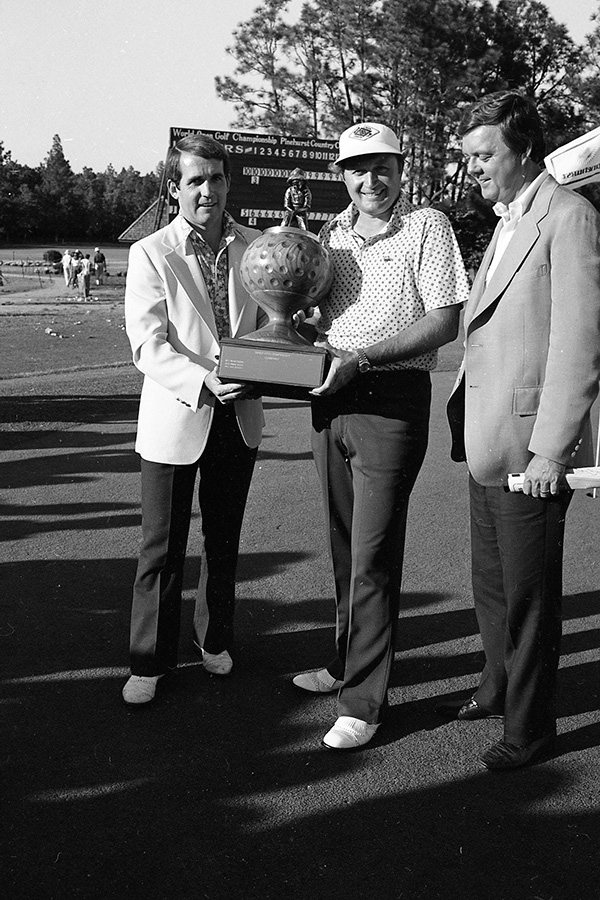
Floyd and McGee proceeded to the first tee for a playoff in the 1976 World Open. Floyd, the Fayetteville native who helped draw a record gallery of some 24,000 spectators on the final day, drove his ball into the rough to the right of the fairway. McGee was comfortably in the middle of the fairway. The advantage appeared solidly in McGee’s favor.
But Floyd caught a good lie and stuck his approach to 4 feet, and McGee missed the green on his second shot. Floyd rolled his birdie putt into the cup and collected the $40,000 first prize.
“I was lucky,” Floyd said. “I drew a good lie from the rough and hit a terrific shot.”
That was 50 years ago. Pinehurst was six years into a new ownership regime, with the Diamondhead Corporation led by Maxton native Malcom McLean having bought the resort, club and five golf courses from the founding Tufts family at the end of 1970.
It was halfway into a decade of having a regular PGA Tour event and wrestling (as it would for many years) to find the proper strain of grass for its greens — bent grass to be pure and smooth during the resort high-seasons of spring and fall, or Bermuda to hold up during hot Southern summers? At that moment in 1976, the greens were bent after a 1972 conversion. But these PGA Tour events were held in late August or mid-September, and the putting surfaces were left defenseless. Players like Hale Irwin said the greens “were like sponges” when he shot a 62 in 1977.
The victory in 1976 for Floyd, the reigning Masters champion, was his eighth on the PGA Tour but his first significant triumph in the shadow of his hometown. Floyd was born in Fayetteville in 1942, and his father, L.B., was a career Army man and in charge of Stryker Golf Course, the Fort Bragg course used by enlisted men. Floyd was more of a baseball fan growing up and even played the game in the minor leagues. He never had an amateur career to speak of and retains only spotty memories of traveling to Pinehurst as a boy to play golf on No. 2.
“I remember my first trip was in the winter and the grass was dormant,” Floyd says. “And I remember how tough it played, especially the front nine. I was excited because it was a treat to be leaving town to play another golf course, but I wasn’t even aware of the history or tradition. Back then, there was no such thing as rough. There was sand and pine straw, and the natural environment was the rough.”
The big names in pro golf in the mid-1970s were Jack Nicklaus, Johnny Miller, Tom Weiskopf and Tom Watson. The 1976 competition was significant because it marked the end of Nicklaus’ streak of 105 consecutive PGA Tour events without missing a cut. He had last missed the 36-hole cut in October 1970 and was bearing down on Byron Nelson’s run of 113 straight made cuts set in the 1940s. Nicklaus shot rounds of 72-74 for a 146 total, missing by one shot.
“The record had been brought to my attention — weekly,” Nicklaus said. “Sure, I’m disappointed I didn’t get it, but the streak is over.”
The ’70s were a decade of change around Pinehurst — some for the good, some for the bad — and after that 1976 World Open there was another interesting development.
When the PGA Tour returned in 1977, it was no longer the World Open. It was now the Colgate Hall of Fame Classic.
There were only a few corporate names attached to tournaments on the PGA Tour in the ’70s. The 1976 schedule included events named for Eastern Airlines, Mutual of New York, Kemper Insurance and Buick. It was star power that ruled the day, with other tournaments named for entertainers or star golfers like Bing Crosby, Bob Hope, Glen Campbell, Andy Williams, Jackie Gleason, Byron Nelson, Danny Thomas and Sammy Davis Jr.
David Foster was the president and chairman of Colgate-Palmolive and in the early 1970s recognized the marketing power of golf. He partnered with actress and singer Dinah Shore in 1972 to launch the Colgate Dinah Shore Winner’s Circle at Mission Hills with an unheard-of purse for the time of $110,000. His company’s investment in golf led Foster to a seat on the board of directors of the World Golf Hall of Fame, which was launched in Pinehurst in 1974 — ergo Foster’s connection to Pinehurst and his decision to have Colgate as a title sponsor for Pinehurst’s PGA Tour event from 1977-79.
The pro tour wasn’t long for Pinehurst, though, fizzling out in the early 1980s amid bad dates, a soft golf course and Diamondhead’s financial struggles that led to losing the resort to a consortium of banks. The table was being set for the resurrection that began when Robert Dedman Sr. of Dallas bought the resort in 1984.
After his win at Pinehurst in 1976, Floyd would collect 10 more titles in six years and be a member of the World Golf Hall of Fame when the Tour Championship visited Pinehurst in 1991 and ’92. He failed to qualify among the top 30 players for the 1991 competition, but he was a contender in 1992 and tied for fifth place. Two years later, Floyd had turned 50 and was among the favorites for the 1994 U.S. Senior Open at Pinehurst.
“I was really impressed with the course in the 1994 Senior Open because it was in such great condition,” Floyd says. “Among the players, No. 2 was known as a great golf course, maybe top five or top 10 in the world, but that wasn’t for its conditioning. It was just such a great layout.
“But the week of the Senior Open, the course was in superb condition. I had never seen it like that.”