
Omnivorous Reader

OMNIVOROUS READER

Seeing Spirits

And the decisions that haunt us

By Jim Moriarty

Let’s dispense with the easy part. “Gram calls photographs paper ghosts. She says they’re the only ghosts everyone can see.” So says Willamena Wester — Wills to her friends — the central character of Sarah Addison Allen’s new novel, Paper Ghosts. The real apparitions show up later.

Gram is Alice Wester, the dowager of Hen Town. Nothing escapes Alice’s ability to know it or divine it in some quasi-mystical way. “Rewind,” the first of the novel’s three parts, takes place in 1976. Wills is a teenager, and her posse is known as The Feathers, named for their teased-to-the-max hairstyle. “By the time the bell rang, Wills had managed to get Dorothy’s feathers back in place, though she’d used so much hair spray that Dorothy was now combustible,” writes Allen.

We meet Andy Smooth, the head of a traveling musical group, and Jack Vaughn, the band’s youngest member and the person Wills falls desperately in love with. “He was quoting Shakespeare again, while dancing to a song no one could hear under an umbrella when there wasn’t a storm, with his hand to her waist as if it was meant to be there.” Ratted out by one of The Feathers — with a Polaroid, of course, of the young clandestine couple — Gram is determined to keep Willamena in Hen Town and tries to buy off young Jack, who accepts the money as a get-out-of-town stake, then tries to convince Wills to go with him.

“And I lie awake at night thinking about a beautiful girl I just met whose grandmother has made her believe that she can only exist here, that she will vanish like magic if she steps outside of this place, so she’s afraid to leave. And I can’t stay,” says Jack.

A tussle ensues in Gram’s “redbrick, federal-style home . . . three stories tall and imposing with more windows to see what was going on than any other house in town.” Jack tumbles down a flight of stairs — perhaps or perhaps not helped along by Gram — and dies. He’s buried in the basement but his ghost remains.

And so does Wills. We “Fast Forward” in part two, and Wills, who married (and outlived) the man she was supposed to marry before Jack came along, has remained in Wester House and, in almost every respect, morphed into her grandmother. Her nickname, to the living, has morphed, too, into Mim. At the door are her widower son, Tug (Terrance), and her granddaughter Bailey, who are moving in. “‘You’re a remarkable woman, Wills, but even you can’t open a door without turning the knob first,’ she heard Jack say from behind her.”

Tug gives Bailey the tour. “For the next half hour, the presence in the house followed them as Tug made sure Bailey knew every nook and cranny, most of it off-limits due to what he called the Wester Rules,” writes Allen. “The Wester Rules weren’t actually his rules. They were Mim’s. And they weren’t made up on the spot, either. They’d been around for a long time.” Those rules included no visitors, no music and a double-lock on the basement door.

Bailey, it turns out, can see Jack if Jack wants to be seen. “To her astonishment there was now a handsome young man standing next to the piano. He looked like someone from decades ago with his dark hair touching his shoulders and a shaggy mustache shaped like a horseshoe. His jeans had bell bottoms so long they touched the floor, and the snaps of his shirt were undone nearly to low-rise at this hips. There was a yellow rose pinned to the wide collar. He seemed so happy to see her that he didn’t know what to say. Or maybe he was just happy for her to finally see him.”

Mim becomes as protective of Bailey as her grandmother had been of her, a choice that leads to a different kind of disaster when Bailey is accosted, not by a true love like Jack, but by a thug of a man named Clutch, which calls for a different kind of accident altogether. Let’s just say, Clutch gets his — another mystery solved in the end. “I know I made you dependent on only me and your father for companionship, but I thought it was the one thing that would keep you safe until you could make your own decisions,” says Mim. “But what really happened was you grew up desperate to feel connection, which led you to Clutch. If I had just told you this story of the man I fell in love with, instead of imposing on you something you didn’t understand, things would have ended differently.”

Allen writes in the opening of her epilogue, “Once upon a time, there was a family of witches. But witches, it turns out, are sometimes only women who have been hurt, and are determined not to be again.” The toing and froing through the generations can get a bit confusing at times, but the trip is worth it. The great fiction writer Raymond Chandler once counseled others to try to put three things on every page that mean something to you as a writer. A sentence, a description, maybe just a word. The cumulative effect will be quality. Allen’s ability to turn a phrase is a fine example of it.

Of Jack: “It was such a vulnerable moment, his guard down, loneliness beaming through the cracks.”

Of Mrs. Orr, the housekeeper: “. . . taking every smudge on the furniture as a personal insult . . .”

On Jack: “It was Jack. Her beautiful Jack. He looked so out of place, a wildflower in a manicured garden.”

On Wester House: “This was an old house and the floorboards creaked like knee joints.”

On the neighborhood in Hen Town: “There was a curious element of the unseen, like if money could haunt you, it would haunt you here, where the air was as soft and cottony as a veil.”

When Mim leaves the house: “People immediately got on their phones and called their neighbors, tracking her movements across town the way they might have tracked a grizzly bear that wandered out of the woods.”

On Bailey: “Every time she colored her hair, she liked this moment best — looking in the mirror and seeing someone she didn’t recognize, hoping it was someone she finally wanted to be.”

And so on. They were among the many little treats that made Paper Ghosts a pleasure to read.

Sporting Life

SPORTING LIFE

Gearing Up

September, a personal new year

By Tom Bryant

You could feel it coming in late August, when the shadows grew longer and the dogs were not digging in the shrubbery, trying to find some cool. And sometimes early in the evening, a soft breeze would settle in for a spell, making everything a little cooler. September was about here, and my new year was about to start.

Most folks I know celebrate their new year the first of January. A new start, in with the new, out with old. Good for them. I used to be like that, but the older I got and the more time I spent in the great outdoors, September became my renewable time. Mornings were brisker. The warm, misty grayness was gone from the atmosphere, replaced by a little crispness in the air and a promise of things to come. It was a time to get out surf fishing gear, pull out the shotguns and rifles, and make sure everything was in order for the busy, exciting times ahead.

Late August was kinda like the first days of December. The real fun time was ahead, but planning all the fun things was as important as celebrating the actual event. Dove season was the kickoff, usually beginning the first Saturday before Labor Day. Good time things got started and didn’t slow down until the end of January, when duck season expired.

Even going back to school in September had a few redeeming values. The new jeans and crisp shirts and even sometimes a brand new pair of leather shoes eased the pain of school regimental requirements. You got to see old friends you hadn’t seen since June and make friends with the newcomers, sometimes even a pretty girl or two. Football practice was cranking up; a sense of excitement prevailed those first few early days of September school.

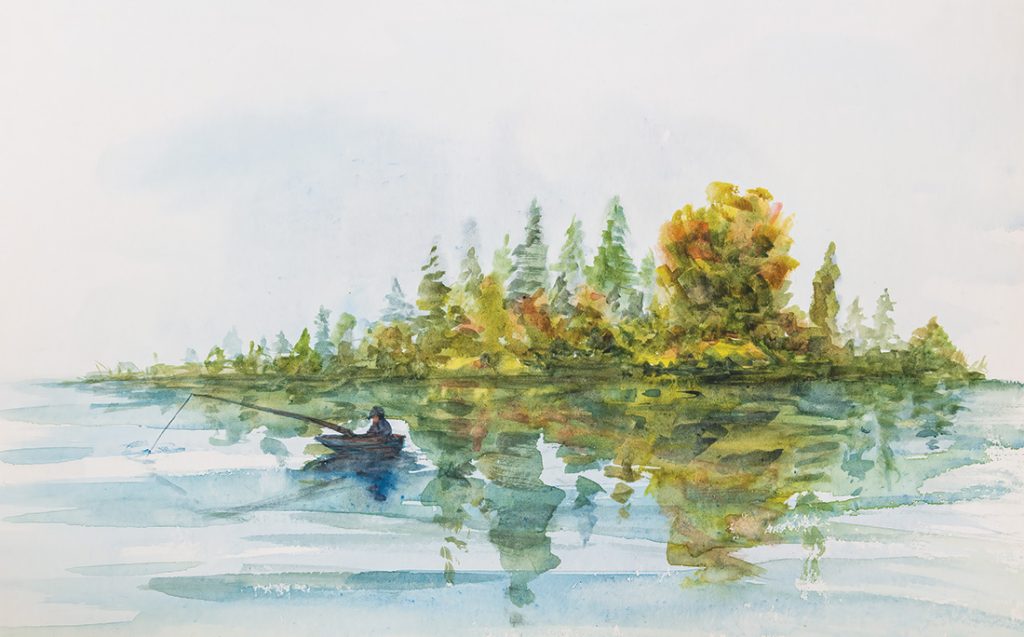
Before I had a summer job and the beginning of responsibilities, probably about the ripe old age of 13, I’d spend the last couple of weeks in August down in the Low Country of South Carolina on my granddad’s farm. Now Granddad was a stickler for work when the time was ripe for it, but he was also just as enthusiastic for a good time when the work was done. His idea of a good time was fishing on the Little Pee Dee River. And when he went fishing, he went fishing. None of this afternoon, or just a day, of the sport. He would go for a week or 10 days. I was fortunate at a young age to go with him on these long fishing forays.

Granddad had a fish camp on the river, nothing fancy, a one room shack built with rough boards and a salvaged tin roof, a makeshift bed on one side of the little space and a counter on the other. There was an old aluminum sink that drained into the side yard. The counter had open shelves where the cast iron skillets were stored. Put it all together and you had a kitchen. Shelves were built on the back wall to store gear, and there was one screened-in window over the bed. An outdoor privy was about 40 yards behind the compact camp. A watchful eye for snakes was required if you had to venture to the facility in the dark.

I never knew when Granddad would pull the plug on work. Late August and early September were the money months. All the spring and summer plantings held forth for harvest, predicting a good or bad year, a time of celebrating, or a time to batten down the hatches and survive to another planting season. Even though modern farming has more up-to-date information and science to help forecast a successful crop, it’s still a gamble. I reckon most folks who make their living successfully from the fields are good poker players.

My last late summer and early fall weeks spent on the farm came during a breathing space for farmers. A record tobacco crop promised happy times along with a good crop of corn, soybeans and milo.

Granddad was a smiling man when we loaded the pickup for our trek to the river. We’d get to the camp a little before dark, and he would check out the little cabin before we carried all our gear inside. “Let me go in first, son. After being away from here for a while, I’ve found a snake or two lying about in the shack. They like to get out of the heat in the middle of the day.”

I was perfectly willing to let him go right ahead. The Little Pee Dee grew some mighty big cottonmouths.

After we unloaded all the gear, it was time for supper. Granddad was a stickler for good eats, and eggs usually played a big part in his menus. He had a small two-burner Primus gas stove that had almost a permanent home in the pickup. It was his favorite tool for cooking and on any outing that required his country culinary art, it was right there. We carried mostly fixin’s: eggs, bacon, ham, beans, grits, bread, homemade butter, a can of Crisco and coffee. Sometimes Grandma would bake us a pound cake to tote along for dessert. As for the rest of our meals, we lived off the land, and that meant fish, mostly fried.

“The menu tonight, son, is ham and eggs and grits and toast and a little red-eye gravy. What do you think?”

I’ve had the opportunity in my lifetime to eat at some of the finest restaurants all across this country, and I have never found one to beat those simple meals cooked on the banks of that blackwater river.

Cooking aside, the next day we got down to business and some serious fishing. That summer of my 13th year went by too fast, and it was the last I would spend fishing with my granddad.

In those early days of my outdoor learning, I didn’t think much about time passing. It just seemed I was always in a hurry, wishing for one season or another. In the fall, dove shooting and surf fishing. Winter ushered in duck and deer hunting. In spring, there was camping and pond and river fishing. Summer opened a plethora of outdoor fun and adventures, mostly camping and river fishing. As a youngster, all those good times rolled around pretty fast.

Now in fall, winter, spring and summer, when I really think about the seasons and my time of life, every month is a blessing and the dawn of good times ahead.

Dracula Diana

DRACULA DIANA

Dracula Diana

A lunar eclipse in bloom

By Jason Harpster     Photograph by Jeremy Losaw

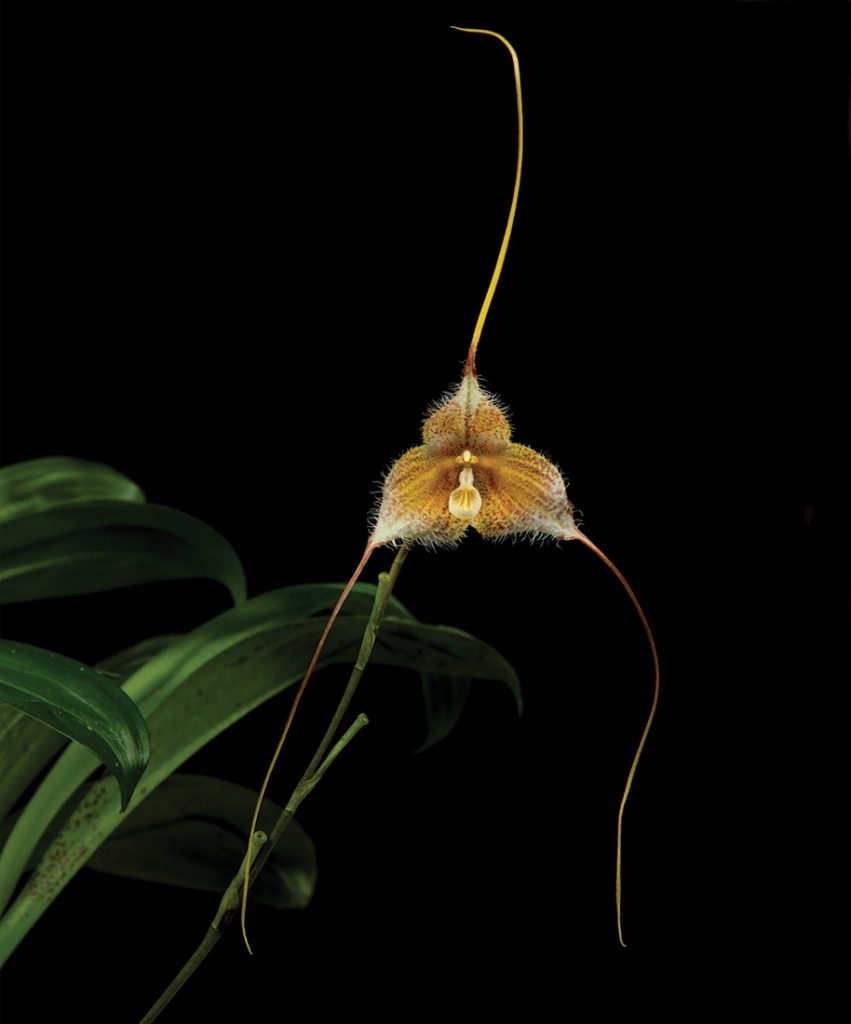
The Ides of August marked the Festival of Torches, a three-day Roman celebration to honor the goddess Diana. More than two thousand years later, Diana remains closely associated with the moon, from classic mythology to modern spiritual traditions. Southern Pines now has its own connection to that legacy with Dracula diana f. xanthina ‘Southern Pines Lunar Eclipse ‘ AM/AOS, awarded on June 15, 2024.

Dracula diana is a species from western Colombia that grows in cloud forests at elevations around 4,000 feet to 5,250 feet where temperatures rarely exceed 75 degrees Fahrenheit. Arguably the most attractive species in the genus, Dracula diana is typically recognized for its creamy white flowers accented with golden-yellow overlays and maroon markings. The xanthina (yellow) form replaces the usual creamy palette with glowing yellows and oranges that make the flowers look like they are ablaze.

Horticultural color forms of different orchid species are inherently exciting as they allow you to re-imagine what’s possible. Some varieties can also be very hard to find or rare. Although ‘Southern Pines Deity’ remains the highest-scored award ever granted to the species, ‘Southern Pines Lunar Eclipse’ stands apart for an entirely different reason; its exceptionally rare xanthina color form. Alba forms lack anthocyanin pigments, while xanthinic flowers retain carotenoids that produce yellow and orange coloration. Regardless of the science and vocabulary, these flowers are absolutely spectacular. In addition to being visually striking with stripes and spots, the flowers invite a gentle touch with their soft, fuzzy texture.

Sometimes the rarest of flowers don’t redefine a species, they simply reveal another side of its beauty.