Living with a Legend

Donald Ross, up close and personal

By Gil Hanse


Historical photos from the Tufts Archive/Village of Pinehurst

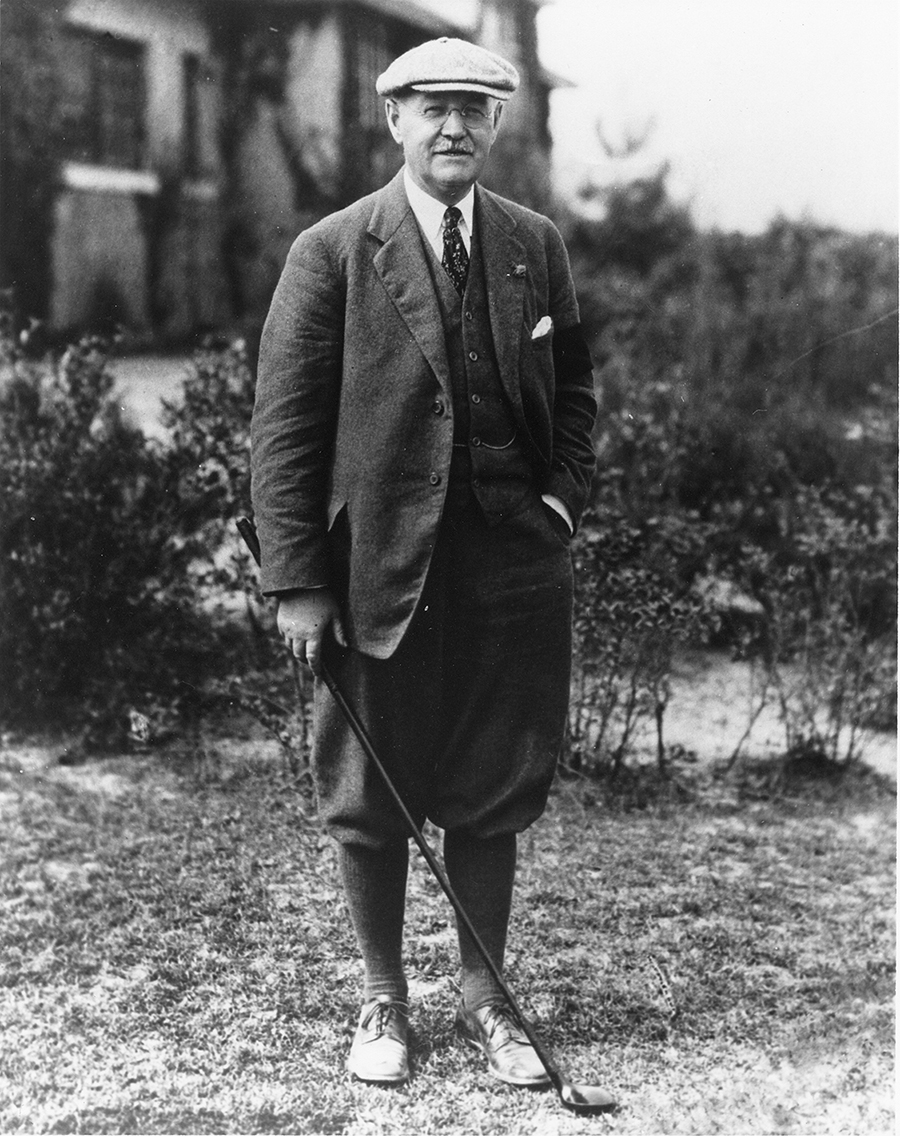
Donald Ross was born 150 years ago this month in Dornoch, Scotland. Obviously, as a student of golf architecture, I had read about him. All of us involved in the art, and the business, of golf course design follow in his footsteps to some degree. There probably isn’t a place in America where Ross’ presence is felt more keenly than it is in Pinehurst, and my own relationship with him became more personal while I was there working on the renovation of Pinehurst’s No. 4 course.

I honestly can’t remember the first Donald Ross golf course I ever walked on. It was probably a little nine hole course up in the Catskills in New York where I went to high school. It’s called Rip Van Winkle Country Club now, and I’m sure Ross never visited it after laying it out. The first course of his that my partner, Jim Wagner, and I ever worked on was Plainfield Country Club, which I still think is one of his best. It’s not a flashy, glitzy spot. It’s not on the ocean. But pound-for-pound, as far as a piece of property, it really is spectacular. And the way he used it was incredible. Courses evolve and change and, hopefully, we’re respectful and thoughtful enough that, when we finish our work, it looks a lot like what he would have done.

When I was in the landscape architecture program at Cornell University, I would try to go and see everything I possibly could. I went to Pinehurst for the first time in the late ’80s, maybe early ’90s, on a study trip, kind of touring through that part of the country to see whatever I could see. I wouldn’t say I was particularly studying Ross’ work but, if it happened to be Ross and I was there, great. Obviously, Pinehurst was an important place to stop.

Unless you go to Seminole Golf Club or Aronimink Golf Club or Pinehurst No. 2 — among the ones he spent a ton of time on — Ross courses seldom seem spectacular but are always solid. You would never go out there and say, “Oh, my God, I’ve never seen anything like that before,” but you never left thinking it was a bad golf course or one with significant flaws. It was always just solid. That’s a helluva legacy. If you do 400-plus golf courses and the worst they are is solid, that’s pretty good.

His early stuff had to have been compromised somewhat by the fact that he was still playing professionally and still teaching. His position was golf professional. And then there was a middle phase where he transitioned from a playing career to being a golf course architect solely. Take something like the Country Club of Rochester, for example. It was built in 1916 and the greens were nice but they weren’t terribly complex. Then he came back in the late ’20s and early ’30s and added some greens. The complexity and the beauty and the aesthetics of those were off the charts.

You also see it in his plans. The early work was just stick drawings and little sketches. Then, as he started to do more and more work — and he needed those drawings to communicate to the people who were building the courses — they became more intricate and more detailed.

But the courses Ross actually spent his time on will always be the pinnacle of his work. There’s no way he could physically do all 400 and give it the time and the energy and the effort the way he did the 15 or 20 that he actually put his heart and soul into. There’s no better example of that than Pinehurst No. 2.

In 2017, when we were getting ready to work on Course 4, I ran into Bob Dedman and Tom Pashley at the Walker Cup at Los Angeles Country Club. We were chatting and Bob told me they had purchased Dornoch Cottage, Donald Ross’ house. He talked about how they were going to use it for corporate entertaining and as a resource for the resort and then he said, “But we’re not going to do any of that until you live there while you’re renovating Course 4.”

My jaw just about hit the ground. It was the nicest honor that has ever been extended to my wife, Tracey, and me while working on these projects. Bob, I think, knew how important that would be for us and how meaningful it would be. It was just an incredible opportunity.

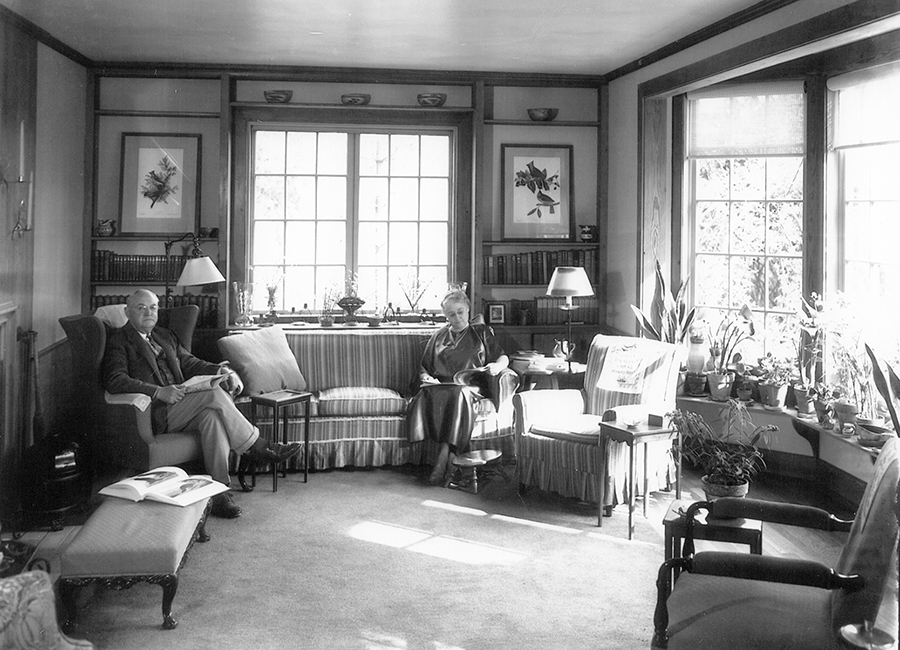
As things are wont to happen, the renovations on the house took a little longer than they thought, so we started out in a little cottage in the village and then ultimately moved into Dornoch Cottage. How often do you get the chance to go out your back door, walk to work across one of the greatest golf courses in the world and draw inspiration from that? It’s 10 or 15 minutes walking through Course 2 to get to Course 4 and you’re looking at beautiful landforms and beautiful bunkers and greens. I know it wasn’t his desk, but sitting in his office and working on plans and drawings, it was incredible.

One night while we were there Tracey and I woke up around 3:30 in the morning. We both heard somebody say “goodnight” and we looked at each other. I’m sure it was one of us talking in our sleep but the fact that we both woke up and we both heard the exact same thing was a little scary. Hopefully, if his spirit is in the house, he was happy we were living there. I know we were.  PS

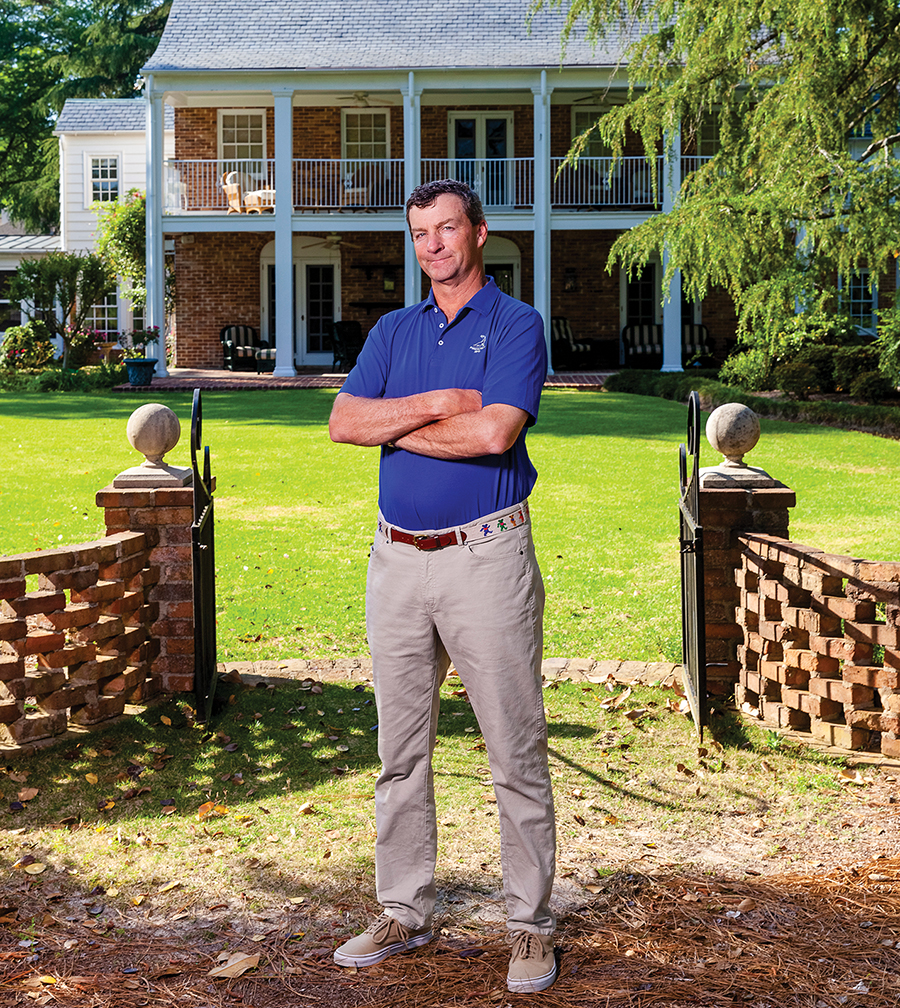
Gil Hanse is one of the world’s most respected golf course architects. His projects have included a major renovation of Pinehurst No. 4; The Cradle; The Olympic Golf Course in Rio de Janeiro, Brazil; and the Castle Stuart Golf Links in Inverness, Scotland.

Space Well Spent

Blinkbonnie is larger than life

By Deborah Salomon

Photographs by John Gessner

Styling by Matt Hollyfield


Bigger-than-big. Practically enormous. This residence is proportioned for an era of grandeur.

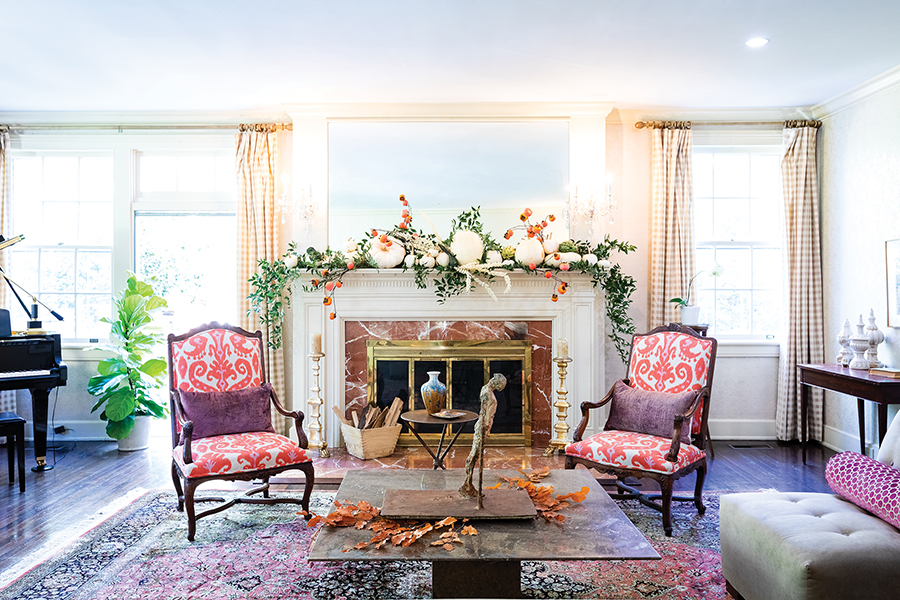
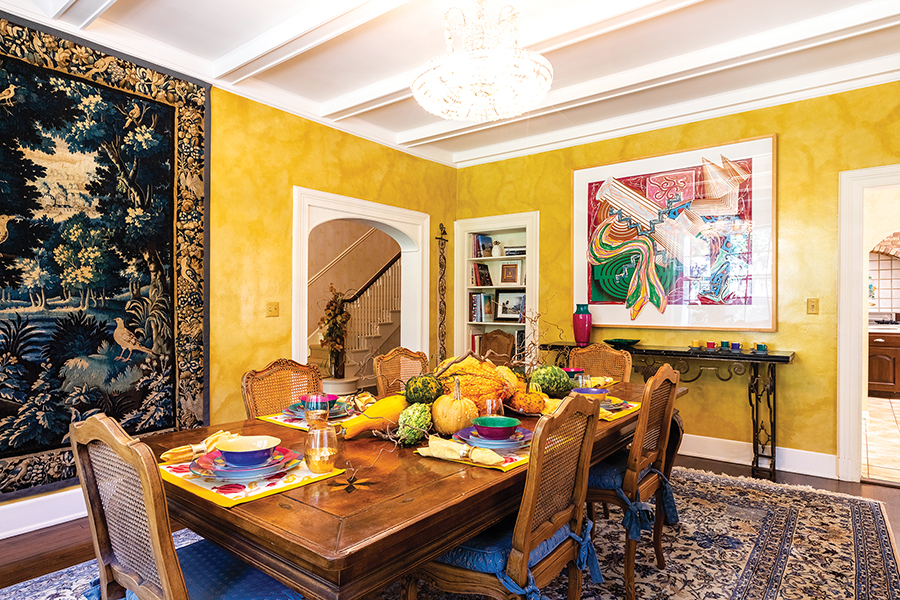
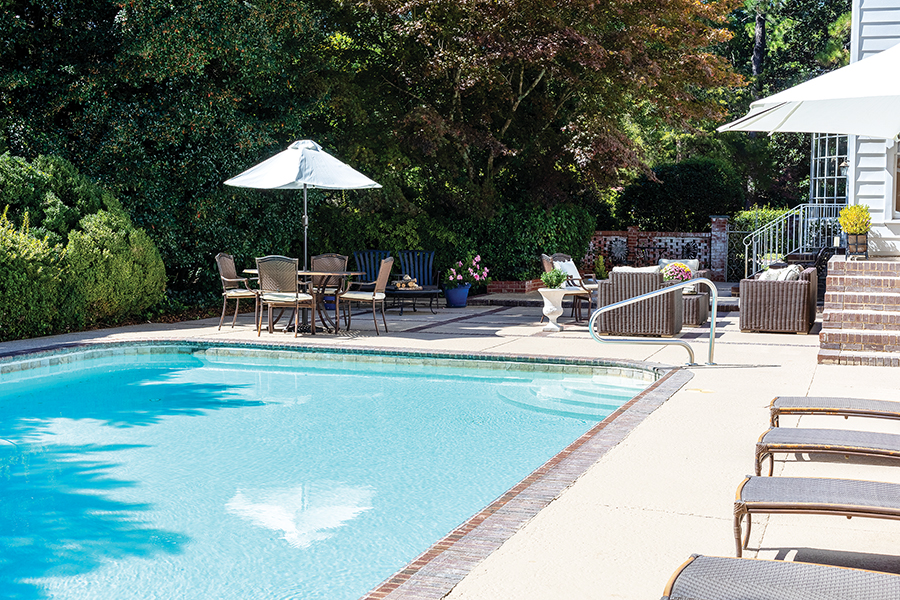
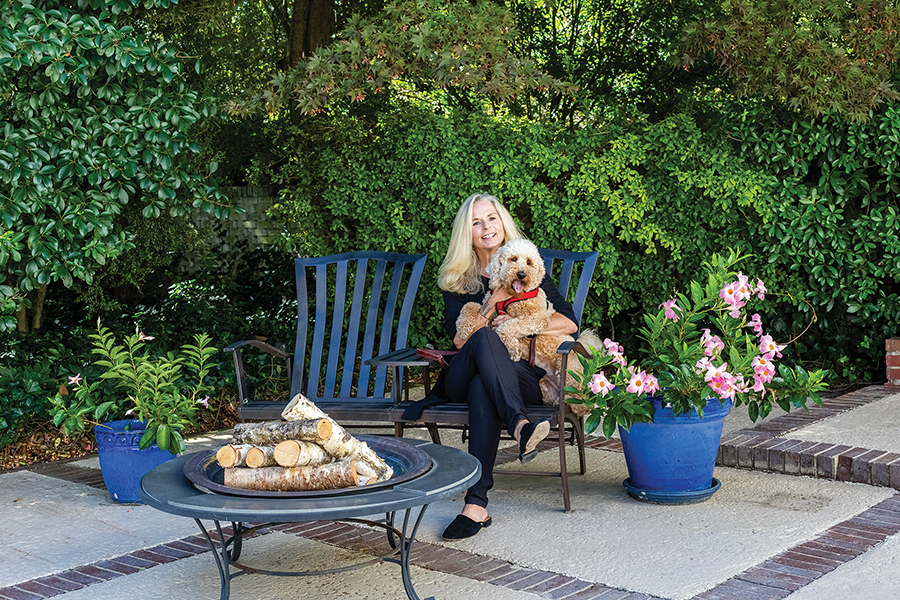
Scarlett would recognize the Tara-esque columns, while the European antiques gleam as though polished by Mr. Carson, the butler on Downton Abbey, who might appreciate the triple-sized butler’s pantry, too. Remove the runner and its length suits bowling. A grandfather clock reaches for the ceiling. The pool and pool house/sauna would eclipse those of most hotels. There are five bedrooms, six bathrooms, three home offices, a basement of ballroom dimensions, multiple gardens, even a fenced dog park for mini goldendoodle Lilly.

Just living there could be an aerobic workout.

Of course Pinehurst Old Town centenarian Blinkbonnie has been updated, enlarged and repurposed by several occupants. An added-on portico may seem incongruous to the Dutch Colonial architecture with gambrel roof, yet the house clings in spirit to an original purpose: genteel, happy times when conversation was an art and money flowed like prohibition whiskey during Pinehurst’s fashionable winter “season.”

But times have changed, as has Blinkbonnie — Gaelic for “a glimpse of beauty.” Its most recent iteration: a refuge where owner Lisa Youngclaus escaped COVID by floating on the pool with her friends or, on a rainy day, dawdling in the 2,000-volume library where books are color-coded, or maybe even having a go at the full-sized billiards table in the finished basement where her son and friends once hung out.


The story starts, as do other Pinehurst homestead histories, in the early days of the 20th century. In 1917, Simon Chapin of New York, a major developer of Myrtle Beach, got word of the vacation enclave the Tuftses were building. Liking what he found, he built what is now called While-Away Cottage for his family on Blue Road and this larger estate for his sister, Mary Alice Chapin May, on nearby McCaskill. She wasn’t there long. In 1920 the house, by then owned by Dickenson Bishop, was christened Bishop’s Cottage. Several owners followed, including someone identified as “well-known sporting figure” Jay Hall, and Pinehurst mayor Steve Smith and wife, Becky.

Golf drew Bill and Lisa Youngclaus, both advertising executives living in Chicago, to Pinehurst, where they owned a weekend home at Country Club of North Carolina. After their son was born in 1996, Lisa retired and the family moved to Pinehurst full time.

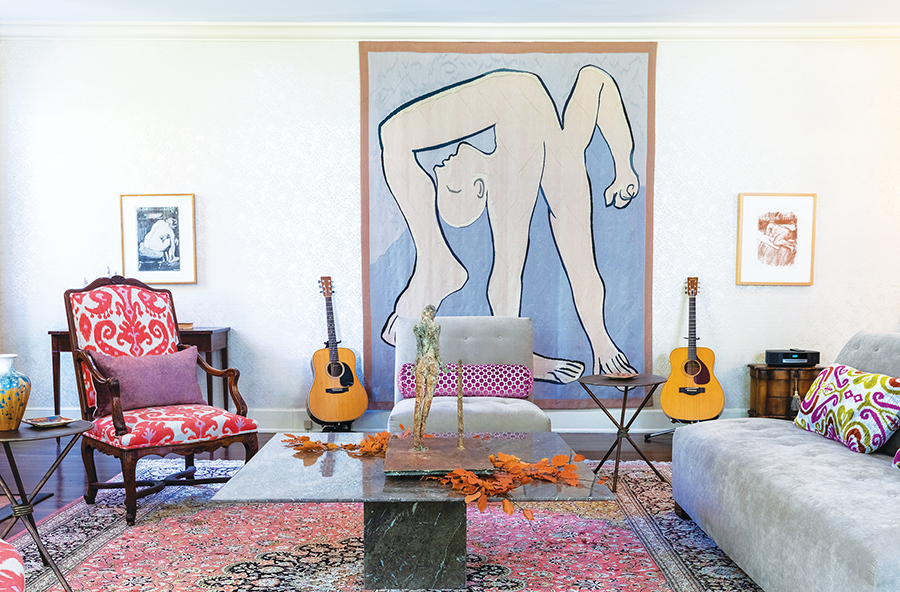
But the CCNC pied-à-terre wasn’t big enough for gatherings of the blended family. Besides, Lisa and Bill had spent a year in Paris, where she collected antiques on a grand scale, as well as art and assorted museum-quality objets begging a suitable venue. How many houses offer a double-wide foyer, intricate eyebrow moldings, bay windows, high ceilings, interesting wallpapers, chandeliers by Baccarat of Paris, a 30-foot-square living room dominated by a baby grand piano, drums, and an Aubusson tapestry of Pablo Picasso’s painting The Acrobat? The contorted abstract is flanked by contemporary armless sofas and antique French tables. Complementing this Picasso are several look-alikes Lisa found on Bald Head Island and had framed. On the floor, a silk rug from London. On the ceiling, strategically placed recessed lighting.

Yet, amid such splendor, Lisa chose checked gingham drapes hanging from a dowel rod. “I like to mix the old and the new,” she says, which explains a TV den with grasscloth walls, and sectional sofa in rust and sand tones that she calls her winter room. There are surprises, too, like the bathroom with a stained glass window and clawfoot tub, and a sunroom enhanced with blues, wicker and graceful ceiling details.


Throughout, a clever architect sited rooms with windows on two, sometimes three sides for maximum all-day light.

“I couldn’t believe it when we first walked around the house. I could see how our furniture fit the spaces. There was a place for everything,” including a giant French poster circa 1888, advertising an art exhibit in Brussels, that dominates the staircase landing.


Lisa remodeled the kitchen when they moved in but left the dark wood cabinetry, which she preferred to sterile all-white. She also kept Venetian plaster walls in a creamy hue but refreshed the master suite in blues and white, which continues into an adjoining sun/yoga room, her “serene retreat.”

Lisa is a yoga instructor who has traveled to India to import icons and other merchandise for studio boutiques. In her own home she successfully juxtaposes these pieces with formal European furnishings, a 17th century tapestry and contemporary art. Yet, given copious space and absence of clutter, each piece stands out, ready to tell its story.


Time passes, circumstances change. Bill died in 2006. Their son, a musician, is still close by, but Lisa’s step-grandchildren are grown. “When your family changes you make a new family, with friends,” Lisa says, recalling a recent birthday binge given by 15 girlfriends, her sisterhood. “I’ve matured with the house, from babies to kids hanging out in the basement.” To now.

But for Lisa one thing remains constant: “When I get up in the morning and walk down the stairs I think, OMG, look at the arched windows, the doors and everything else. I’m so lucky.”   PS

Poem

Chime

We were birds then

at thirteen, a chime

of wrens chirping,

carbonated goddesses

blowing bubbles,

spilling secrets,

dancing the latest dances,

we did each others’ hair,

practiced kissing,

gossiped (a girl’s

first step toward insight),

we shook the magic eight ball,

could not imagine

a path toward our future —

we only knew we didn’t want

our mothers’ lives,

taking dictation,

cleaning up messes,

hiding tins of money,

we were angels falling,

wingless, trusting

the wind to lift

our bodies of light

far above the silver

water tower,

to let us down kindly

somewhere, anywhere

wild and broad and new.

— Debra Kaufman

Debra Kaufman’s latest collection of poetry is God Shattered.

Caught In A Trap

Agatha Christie’s classic turns 70

By Jim Moriarty    Illustration by Miranda Glyder

The world’s longest-running play, written by the world’s most successful female playwright, who also happens to be the world’s bestselling novelist, will celebrate — at least in part — its 70th anniversary on the Owens Auditorium stage of the Bradshaw Performing Arts Center. Dame Agatha Christie’s classic, The Mousetrap, premiered in London’s West End on Nov. 25, 1952. Its BPAC performances on Nov. 17-20 will also serve as an anniversary celebration for the Judson Theatre Company as it closes out its 10th season of bringing live, professional theater to the Sandhills.

“Judson Theatre Company was selected to be one of the theater companies all over the world given the rights to produce a 70th anniversary production of The Mousetrap,” says Morgan Sills, Judson’s co-founder, executive producer and a Sandhills native who assumed the role of BPAC’s executive director last March. “I love it. It will be our third Agatha Christie after And Then There Were None and Witness for the Prosecution, each of which broke our box office record at the time.”

It also marks the first time one of Judson Theatre Company’s previous headliners will return. Alison Arngrim, best known for her character Nellie Oleson on the long-running television series Little House on the Prairie, was in Judson’s production of And Then There Were None five years ago. She’s the author of the autobiographical book Confessions of a Prairie Bitch: How I Survived Nellie Oleson and Learned to Love Being Hated, which became a one-woman show.

“I get this text from Morgan, just a heads up: ‘I’m on the phone with your agent. You wouldn’t want to come and act in an Agatha Christie again, would you?’ And I’m like, ‘Which one?’ It’s Mousetrap,” says Arngrim, whose character in the play is Mrs. Boyle. “I’m a sucker for a villain role and I’m like, wait, isn’t this the really mean, terrible, remorseless English woman who dies at the end of Act I? I enjoy mean, cruel and remorseless older English ladies who die in Act I. I’m totally there. I love Agatha Christie and I love Judson Theatre. I had an absolute blast the last time I did it.”

After a half-dozen out-of-town shakedown cruises that started at Theatre Royal in Nottingham in October of ’52, The Mousetrap — which began as a radio play that morphed into a short story that evolved into a stage play — has run continuously in London’s West End since it premiered there, with the exception of a brief shutdown from March 2020 to May 2021 caused by the COVID-19 pandemic.

Set in the great hall of Monkswell Manor, “this collection of characters from different backgrounds gets trapped in a snowstorm,” says Sills. “There’s been a murder and you find out whodunnit. It’s got a classic Christie plot and a surprising resolution. I’ve been looking forward to doing it for a while and when the anniversary came up, we knew this was the year to do it.”

By tradition, at the end of the play, the audience is asked not to reveal the killer’s identity to anyone outside the theater to avoid spoiling the surprise for future audiences. That the play has become a London tourist and theater-going staple was a surprise to even Christie herself, who imagined it might enjoy as much as an eight-month run. In 2011, a telegram sent in 1957 from playwright Noël Coward to Christie was discovered in a piece of furniture purchased from the Christie estate. It said, “Dear Agatha Christie. Much as it pains me I really must congratulate you on The Mousetrap breaking the long run record. All My Good Wishes. Noel Coward.”

While a 10-year anniversary can seem insignificant stacked up against the 70-year history of a theatrical institution like Mousetrap, Judson Theatre’s decade of success, including as it does the years when all of Broadway was shut down by the pandemic, is impressive in its own right. Ten years ago Joyce DeWitt starred in Judson’s first production, with the late Tab Hunter. “Love Letters ended up being one of the happiest experiences of my life, doing that play with Tab,” DeWitt says. “He is one of the most underrated actors in the history of Hollywood. He was so good in that role, so powerful, so present, so simple and so nakedly honest that I just fell inside what he was doing.”

After 10 seasons, the number of classic plays and the actors who brought them to life is too long to list. A good sign. “There’s been so much joy,” says Sills, who co-founded Judson with artistic director Daniel Haley. “So many of the stars we’ve had have been wonderful on the stage — because they’re not hired for their celebrity, they’re hired for their talent — but they’ve been wonderful off stage, too. To see our students and interns interact with them, the way the legacy of theater is passed on by working with them, has been beautiful.”

Involvement with the community has been at the heart of Judson’s mission. “Daniel and I are especially proud of the education program,” says Sills. “The Mousetrap will be part of that. The students get a copy of the book. We have a study guide written. They attend the show. We pay for transportation, their ticket, and substitute teachers. They get a field trip and a one-of-a-kind experience.” Combined, there will be something in the neighborhood of 600 students attending from North Moore, Union Pines and Pinecrest high schools.

“I’m grateful that we’ve managed,” says Sills of their first decade. “It’s always been challenging but the challenges change and the joys of doing it change. There hadn’t been true professional theater here in such a long time. The inspiration came from what they used to do in Pinehurst’s Theater Building with stars and plays, everything.”

But it wouldn’t have been possible without Sills’ Sandhills upbringing and connections. “It’s very much to do with Morgan being from there,” says Arngrim. “It’s hard to do any project from a charity to a theater to anything in any community where people think it just blew in from outside and it’s not part of ‘our’ community. If it was just someone coming from New York into Pinehurst, North Carolina and saying, ‘Hey, I’m going to do theater here’ it might not catch on the way that it did.”

And, having worked in theater in nearly every capacity known to man doesn’t hurt. “It really comes down to the fact that Morgan’s just a really fine theater manager,” says DeWitt. “He not only knows and understands the theater but he loves it, so his passion matches his talent. What he and Daniel have done there, it’s really kind of beautiful.”  PS

Jim Moriarty is the editor of PineStraw and can be reached at
jjmpinestraw@gmail.com.

Remembering Frank Jr.

A tribute to a leader

By Jim Jenkins
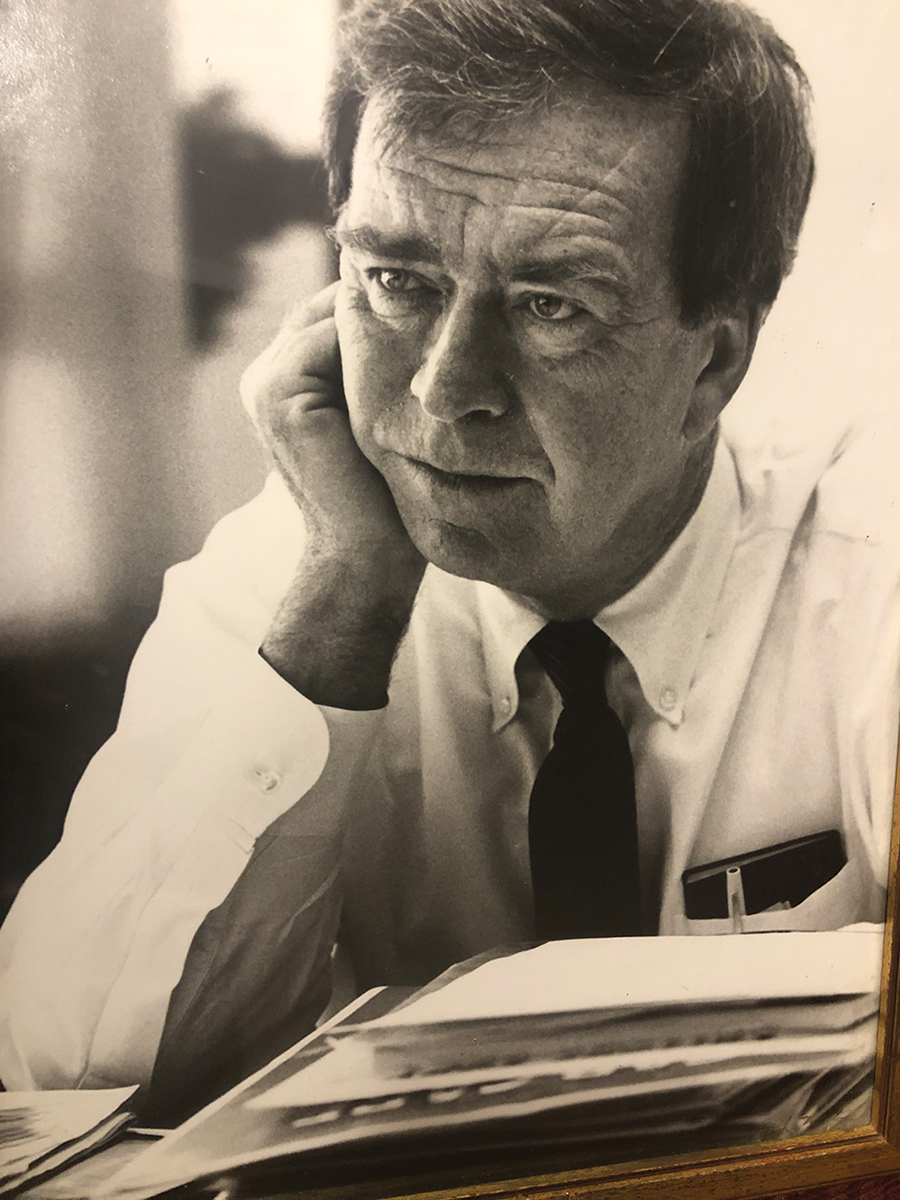
Frank Arthur Daniels Jr. died at the age of 90 on June 30, 2022, in his hometown of Raleigh. It was the peaceful conclusion of a life full of professional accomplishment, financial success, and contributions to his community and his state. But for his multitudes of friends and family, Frank Jr. — as just about everybody called him — is remembered for his capacity to give and receive love.

Sitting in the cavernous dining area of her parents’ home on White Oak Road, Julie Daniels, Frank Jr.’s daughter, and her husband, Tom West, scan the many family portraits and mementos. There is one of her father, then 65, in front of a printing press.

Look!” she says. Hes got the little red book in his pocket. He always had that.”

Yes, Frank Jr. always carried a book with the names of his best friends, their phone numbers and their birthdays. When he was younger, hed send cards; as he got older, he found it easier to call them and sing to them (and anyone who was with him would be expected to sing along).

Julie is one of two children of Frank Jr. and his wife, Julia, and her memories are exactly what her father would want them to be. “Oh, they had fun — parties all the time, events at the paper, things like that,” she says. But they always put me and my brother first. I dont remember that they had all kinds of money — and they didnt think of themselves that way. But when you ask me, what was his happiest day, Id say just about every day was his happiest.”
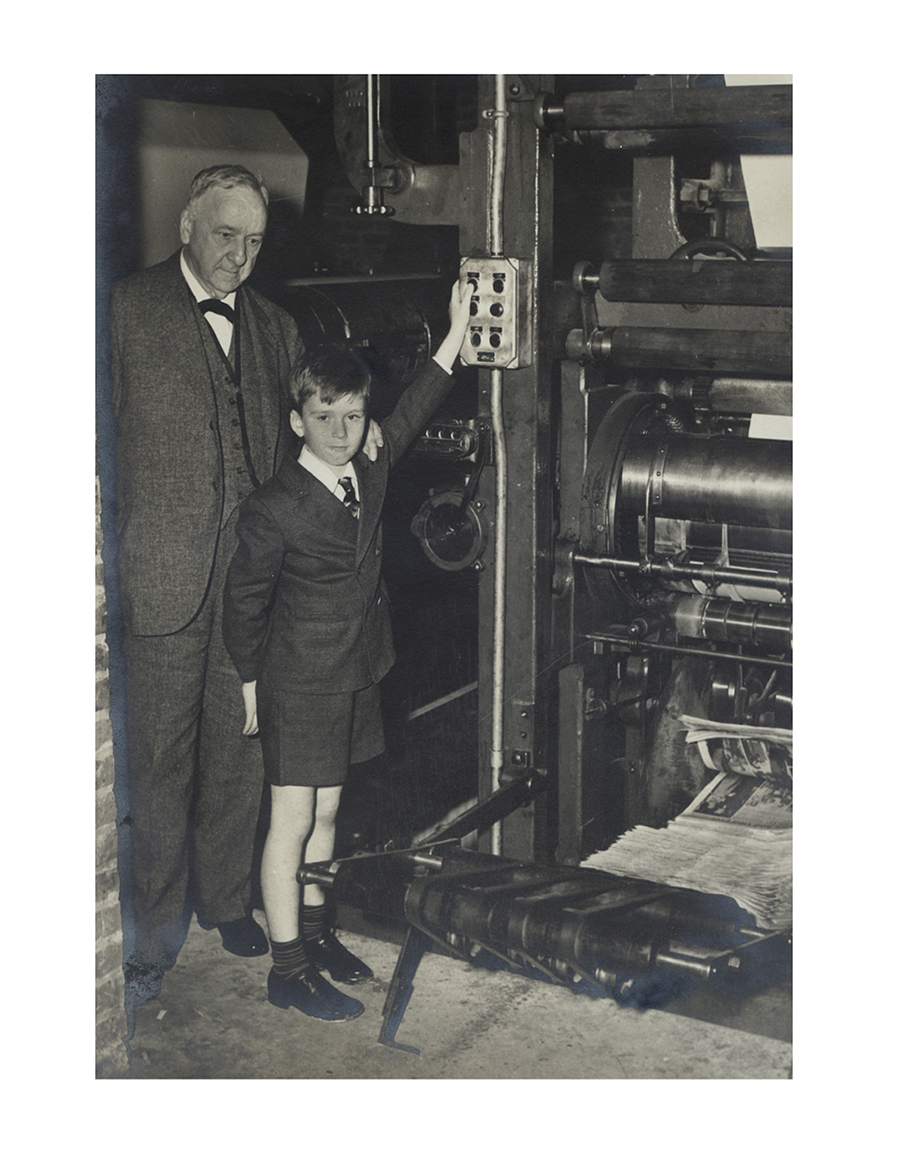
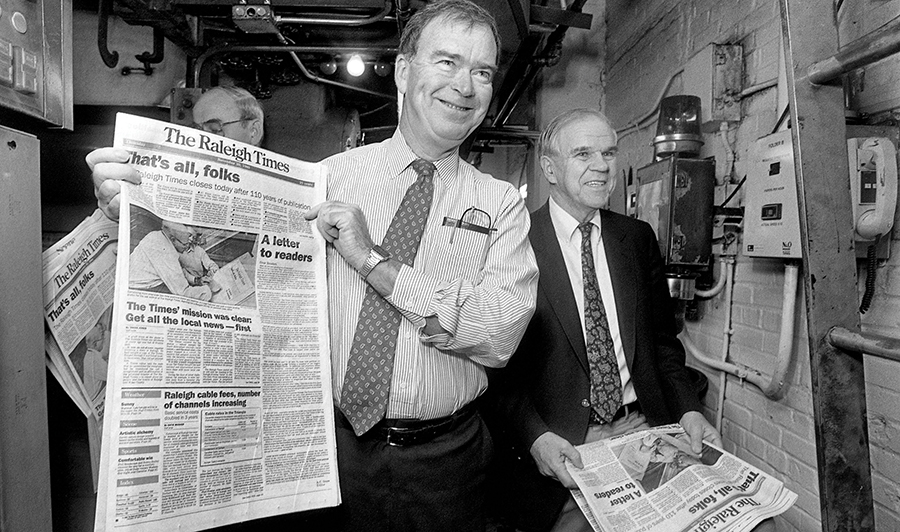
Left: Publisher Frank Daniels Jr. and Raleigh Times Editor A.C. Snow look over the final edition of the Raleigh Times.

Right: Frank Jr. at press with grandfather, Josephus Daniels in 1939.

Frank Daniels Jr. was born at the Old Rex Hospital,” on Sept. 7, 1931. His father, Frank Daniels Sr., was one of four brothers, three of whom were active in running The News & Observer, which was owned by Frank Jr.s grandfather, Josephus Daniels. He attended Woodberry Forest School near Orange, Virginia, and graduated from the University of North Carolina at Chapel Hill in 1953. He did two years in the U.S. Air Force in Japan and tried a year of law school but was inevitably drawn back to The N&O, which turned out to be more than his birthright — it was his destiny.

Though he and his sister, Patsy, were raised in comfort and power, Frank Jr. was a righteous man. He had a sense of right and wrong that transcended the views of the generation from which he came, and of the family from which he descended. His son Frank Daniels III recalls going to the ACC basketball tournament with his father in 1968, when he was 12. It was the first varsity year for Charles Scott, a UNC sophomore who was the first Black basketball player for the Tar Heels.

A man behind them began taunting Scott. It was something Franks dad tolerated until he heard the n-word. He turned around and told the guy to shut the hell up and then said, ‘We dont need you here.’ The guy left,” says Frank III. That really took something.”

Frank Jr. worked various jobs in all departments at The N&O and was popular with the other workers at the paper. Sometimes he chafed a bit working for his father (who, as the publisher, ran the business operations) and his uncle Jonathan, the editor, but he stayed the course and, after working his way up, became publisher in 1971.

A big man for his time, Frank Jr. was 6 feet, 3 inches tall and burly. He had huge hands and a booming bass voice that carried through a room, though his eyes possessed a mischievous twinkle and he loved a good joke.
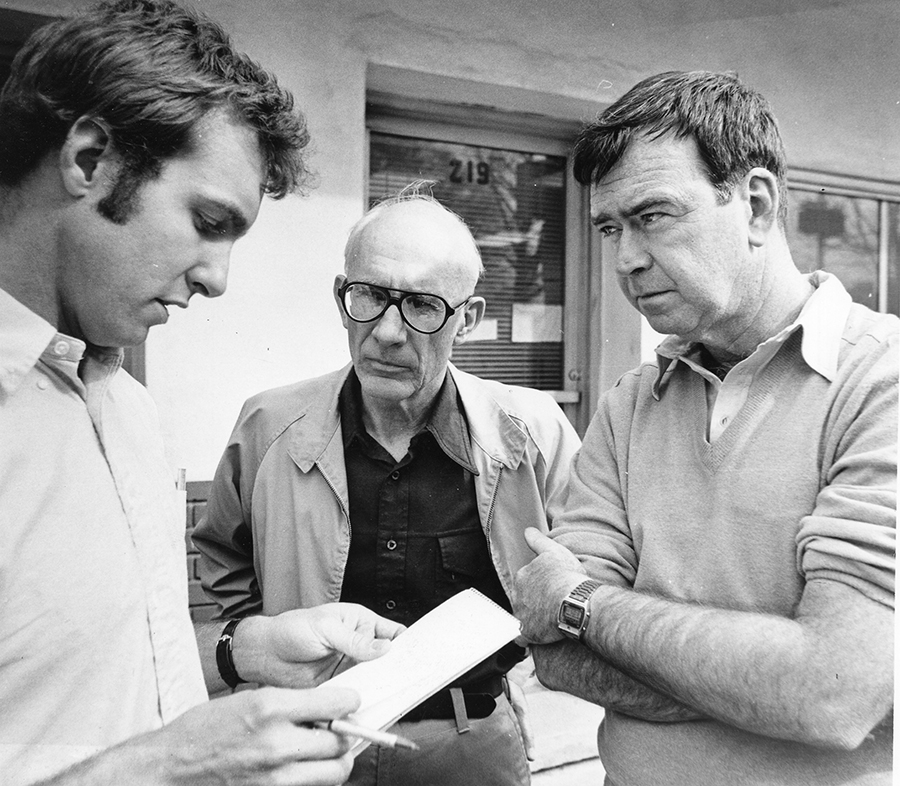
     

Left: Asst. city editor Ted Vaden, editor Claude Sitton, and publisher Frank Daniels Jr.

Right: Frank Jr. and David Woronoff.

Gary Pearce, a longtime political strategist, remembers his boss from his own early days as an assistant city editor at The N&O in the mid-1970s. Hed walk through the newsroom every day about 5 oclock to go talk to Claude Sitton,” says Pearce, referring to the editor of the paper at the time. One day, Franks walking through and theres a phone ringing at an empty desk. No ones there, so Frank — the publisher, now — puts down his briefcase, answers the phone, puts a piece of paper in the typewriter and takes down the item, a minor news brief. Then he sticks it in the basket, gathers his stuff and walks on down the hall, not saying a word to anybody. Most publishers wouldnt have done it. That told me a lot.”

While at The N&O, Frank Jr. took some courageous stands as a fellow who owned a newspaper too liberal for many local business and community swells. He pushed for a merger of the Wake County and Raleigh schools, supporting a controversial change that led to vastly improved, integrated schools. He supported civil rights and womens rights and didnt balk when the newspaper started asking troubling questions about the war in Vietnam.

In addition to leading the paper, Frank Jr. rose to the top of dozens of professional associations. He was chairman of The Associated Press, and part of the leadership of nearly every civic organization in Raleigh — from United Way to school support groups to the YMCA board to chairing the boards of the North Carolina Museums of History and Natural Sciences. His board memberships and chairmanships over nine decades were too numerous to name, but his son says that his favorite post was chairman of the Smithsonian Institutions National Board. He arranged partnerships between the Smithsonian and North Carolinas history and science museums. They reflected his lifelong belief that everyone, at every station in life, deserved to know about art, history and science, and that the knowledge should be free.

Frank III says that his fathers seemingly natural capacity for leadership always put him in charge of whatever organization he had been asked to join. Every group he was in, he rose to the top,” Frank III says. I think it was his capacity for empathy. He could see what people needed, and it was important for him to help them.”

The Daniels family sold The News & Observer to the McClatchy newspaper company in California in 1995, and Frank Jr. remained as publisher until he retired in 1996.

In retirement, he became busier than ever, continuing his board memberships, staying active particularly in Democratic Party politics. Virtually every governor paid him a call. No one is sure if he ever gave a campaign contribution to a Republican. During his tenure, as with his grandfather and father, The N&O never endorsed a Republican candidate for office.

Frank Jr. bought a building on Fayetteville Street in downtown Raleigh and established an office on the sixth floor, where he entertained movers and shakers and fellow board members and politicians. Through his membership in social and golf clubs he influenced another two generations of businesspeople, candidates and entrepreneurs. Until the very last month of life, he rarely had an empty lunch date or an evening without some kind of activity.
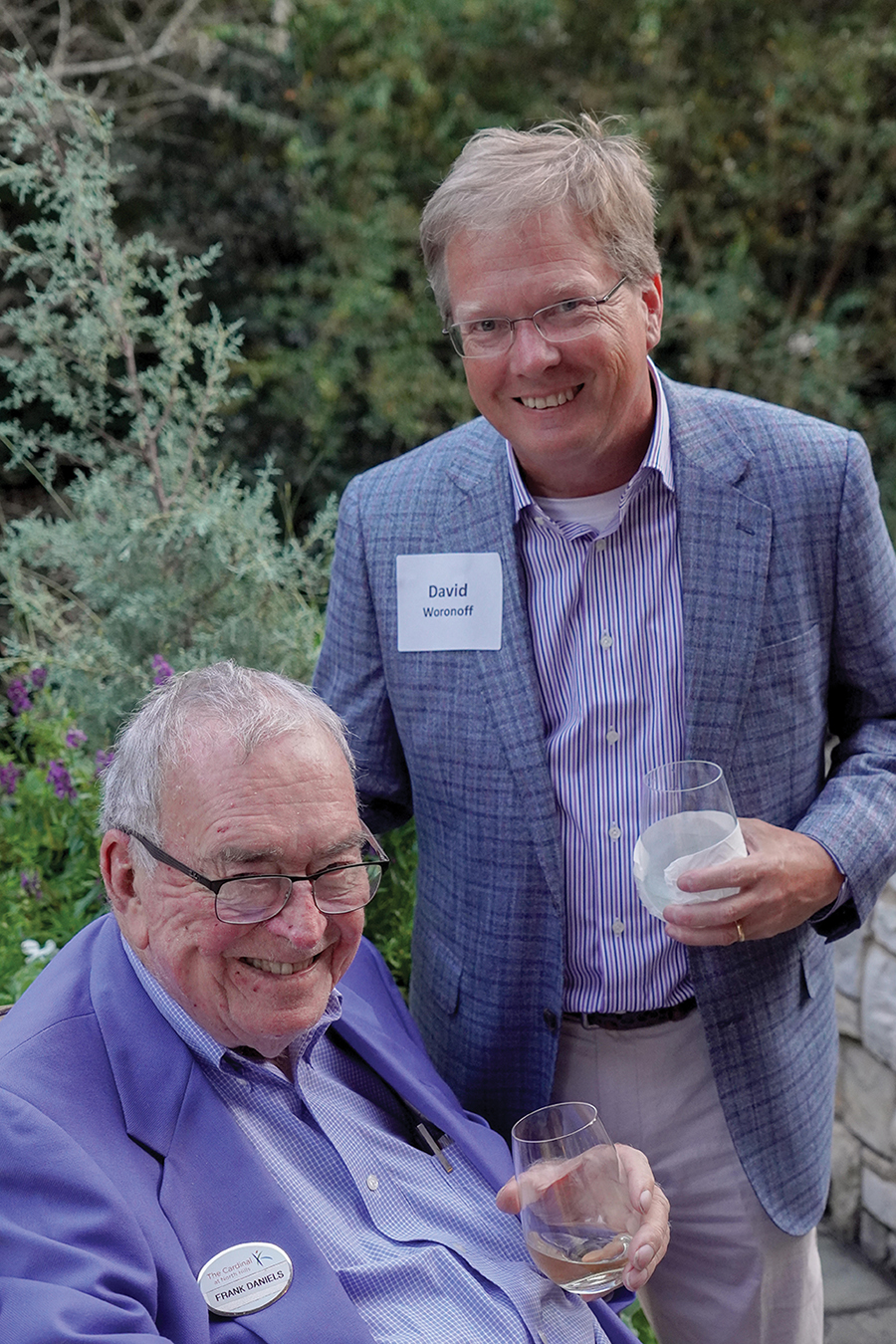
     

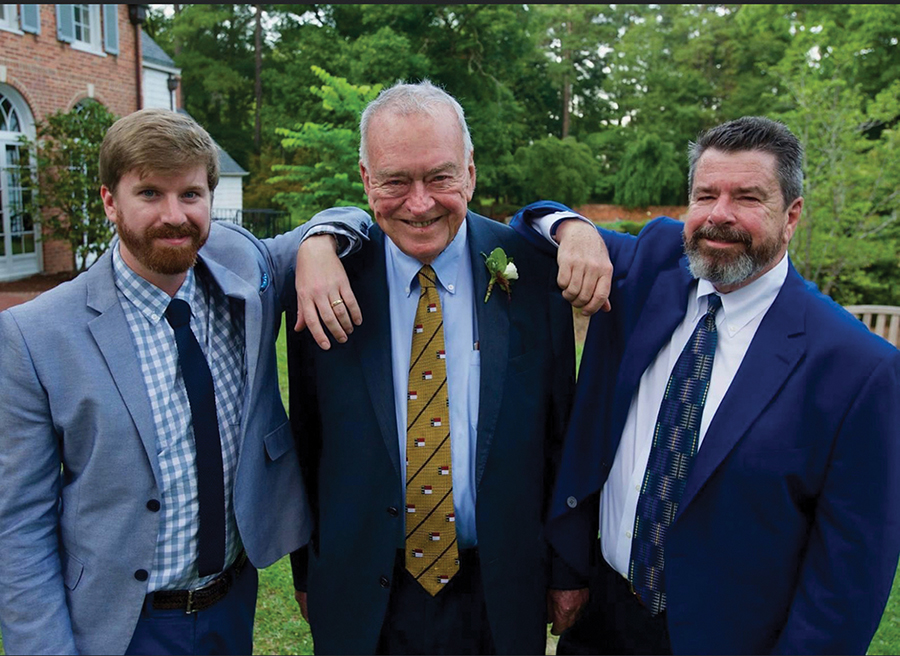
Left: Frank Jr. and David Woronoff.

Right: Frank IV, Frank Jr., Frank III

Even after his departure from The N&O, Frank Jr. supported new ventures and publications. Shortly after his retirement, he and four others bought The Pilot in Southern Pines, then owned by Sam Ragan. Why did he do it? It just gets in your blood,” was all he ever said.

One of the other owners is David Woronoff, Frank Jr.s nephew. Woronoff, who runs the business for the partnership, was young at the beginning, confident but willing to ask his uncles advice. Hed never let me call up and say, ‘This happened, what should I do?’” Woronoff laughs. But hed give advice — not that he expected you to take it.”

In one case, a prominent Pinehurst businessman called Woronoff, the publisher of The Pilot, after the newspaper was critical of a venture in which the businessman was involved. He was screaming at me,” says Woronoff, really rough stuff.” Woronoff called his uncle and the advice Frank Jr. gave him was unequivocal. He said, ‘David, you never go wrong punching the biggest bully in town in the nose. What would be wrong would be if you didnt give the person in need a hand up.’”

Frank Jr. stayed involved in the publishing group until his death, as it added The Country Bookshop, another community paper and five magazines — Business North Carolina, PineStraw, WALTER, O.Henry and SouthPark — to its stable.

Frank Jr. built friendships from childhood that lasted him a lifetime, but what he enjoyed most about all his associations was just learning. His granddaughter, Kimberly Daniels Taws, who runs The Country Bookshop, remembers visiting the beach with her grandfather when she was young. She joined him on the deck, where he was sitting next to a foot-tall stack of unusual reading material: clippings, folders, magazines, books. I said, ‘What are you doing?’” she says. And he said, ‘Well, Im trying to figure out how I feel about nuclear power.’”

Many years ago, Frank Jr. hired attorney Wade Smith to help with some legal issues involving the newspaper. That led to a deep, lifelong friendship. To me, Frank was larger than life, but Frank was real,” Smith says. “There was no putting on airs about him. He would be straight with you in all ways, and I liked that about him.”

Communications consultant Joyce Fitzpatrick met Frank Jr. when she rented space in a downtown building he owned some 20 years ago. She began regular lunches with him and Smith once or twice a month. He was a hyper-social person,” she says. He loved to have his lunches planned. We always typed out an agenda. It covered everything — politics, world events. People would come over to sit with us, wanting to know the latest.”

One thing he didnt seem to have was inhibition. Oh,” Fitzpatrick says, wed switch from politics to golf to what happens when we die. In the last few lunches, Wade would give comfort: Well see each other again.”

Perhaps, in the end, Frank Arthur Daniels Jr. is proof that a man can be great without being perfect. Frank Jr. was the first to laugh at his own flaws; he enjoyed off-color humor, indulged in profanity and played practical jokes. But if he felt hed been too rough on someone, hed apologize.

From him I learned the beauty of friendship and being with other people. The importance of generosity. And that sense of humor!” says his daughter Julie. Sometimes you dont realize the great gifts.”

In a eulogy at his father’s funeral at White Memorial Presbyterian Church, his son, Frank III, shared a note that Frank Jr.’s longtime personal assistant, Julie Wood, found on his desk after he passed: Feed the hungry. Clothe the naked. Forgive the guilty. Welcome the stranger and the unwanted child. Care for the ill. Love your enemies.

Its a list of what he thought religion — and we — should teach,” says Frank III, who closed the eulogy with: Well do our best.”  PS

Jim Jenkins is an award-winning writer who has received North Carolina’s highest honor, the Order of the Long Leaf Pine. He retired from The News & Observer in 2018 after 31 years as an editor, columnist and chief editorial writer.

Cabin Confidential

Rough-hewn exterior belies the comfort within

By Deborah Salomon • Photographs by John Gessner


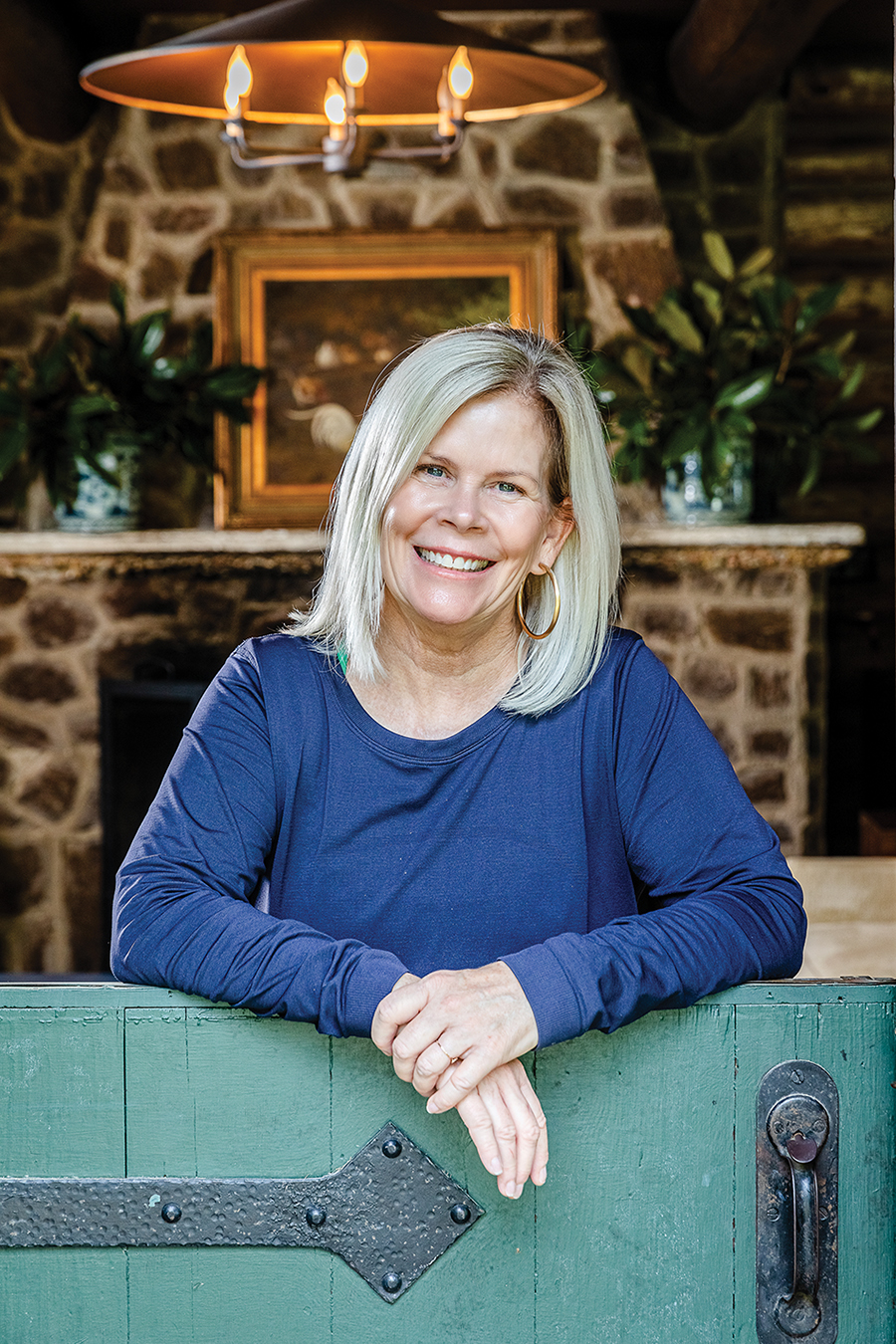
The image of a cabin as a lowly dwelling lacking basic amenities evolved long ago from 19th century shelter into 21st century mountain retreats, ski lodges and vacation hideaways. Abe Lincoln may have been born in one, but it bears no resemblance to the adaptation Kelly Rader has wrought in Pinehurst. Based on comfort and informality, her rebuild may look rustic on the outside but within, soft jazz wafts from a sound system. Half a dozen flat screen TVs hang from walls that remain log only in the living room. Mile-high duvets cover queen-sized beds except for built-in bunks awaiting grandchildren. A screened porch opens onto a stone terrace and, from the new second story, dormers look onto a quiet lane leading into the village.

There is nothing oversized, nothing pretentious. Everything is welcoming. Call it rustic elegance. It was a formidable undertaking for a woman who admits preferring her elegance rustic-free like her former homes — a stately Georgian brick built in 1913 with carriage house and pool in St. Louis, or an Upper East Side Manhattan apartment.

Kelly grew up in Montclair, New Jersey, a town known for its fine residences. Her mother, Pat Johnstone, was a golfer on the amateur circuit. When her parents retired to Pinehurst Kelly wanted to be near them. No better place than the village, a theme park for retirees from everywhere strolling the lanes, rocking on porches, eating at cafés, shopping at farmers markets, living the good life in restored 1920s cottages.

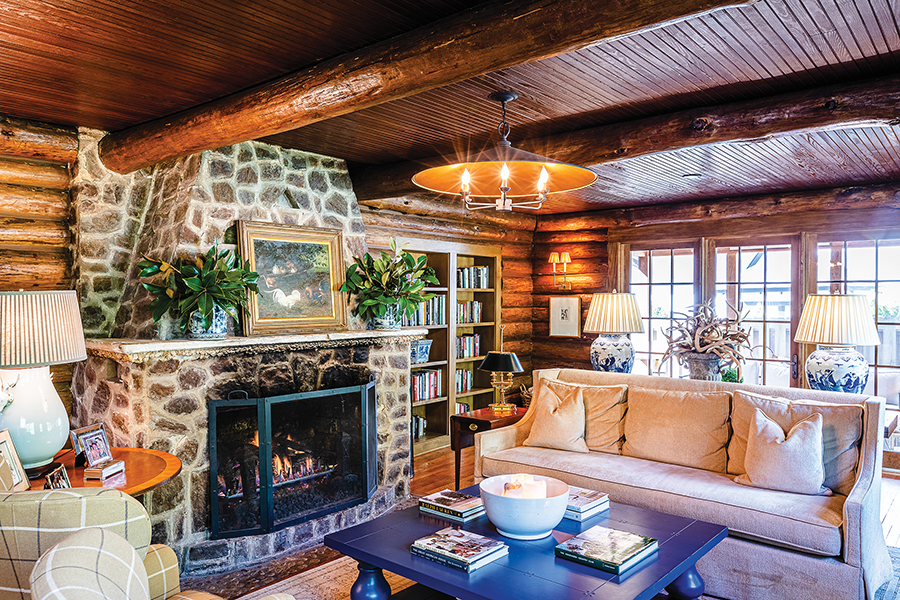
The most likely prospect was a small log home built about 1925 for glove czar Percy Arnold for $5,000 — at the time considerably pricier than its neighbors. Exterior and interior walls were logs, and the ceiling beams massive tree trunks. A stone fireplace dominated the living room. Streetside, Kelly recalls, “It didn’t look like it belonged.”


But it was for sale, and they were curious. Coincidentally, Bill Rader had noticed it advertised online three years before. Let’s take a look, they decided.

“We walked in . . . and fell in love with the fireplace,” Kelly recalls. Both appreciated the cabin ambience — Bill’s family owns a resort in Pennsylvania composed of 39 log cabins.

“My Cabin,” as it was known, had passed through many hands and undergone several upgrades, including a kitchen fashioned from a one-car garage.

They purchased the cabin in 2015. Planning the renovation took a year, construction two. According to town regulations, they could build up but not out. A full second story with dormers was added, giving the footprint more substance. Weathered logs were removed and replaced with new ones in the living room. Elsewhere, interior walls were faced with conventional materials. “It was too dark. I’m a white-and-beige person. I like a Ralph Lauren feel,” Kelly says.

Her desire for light is served by multiple small-paned windows, some with shutters, installed at various heights, most surrounded by wide moldings which themselves enhance the décor. Rather than depending entirely on lamps or ceiling fixtures, Kelly chose sconces wired directly into the wall, to avoid visible cords. Also absent: clutter.

Doors leading from the living room into the now light-walled master suite were sealed (to increase privacy), with the space retooled as built-in bookcases. Dutch doors to the outside were added, along with an old-fashioned manual doorbell and wood-framed screen door. A small garden is fenced and quiet.


They gutted the kitchen and raised the ceiling. Now a little gem — almost a culinary sculpture gallery — the modest kitchen displays statuesque Italian SMEG brand toaster and juicer, soaring glass-front cabinets, knotty pine floors, a tall, narrow refrigerator and a refectory table surrounded by banquette seating in front of windows facing the sidewalk.

“It’s like a fishbowl. We sit here and wave at people walking by, so much fun,” Kelly says.

Instead of stark white, kitchen walls and cupboards are painted a variation with the slightest tinge of green. There is no dining room. Eight can eat comfortably at the kitchen table. On holidays, an empty space at the end of the living room is filled by a hunter’s table with leaves that fold out to accommodate at least another eight.

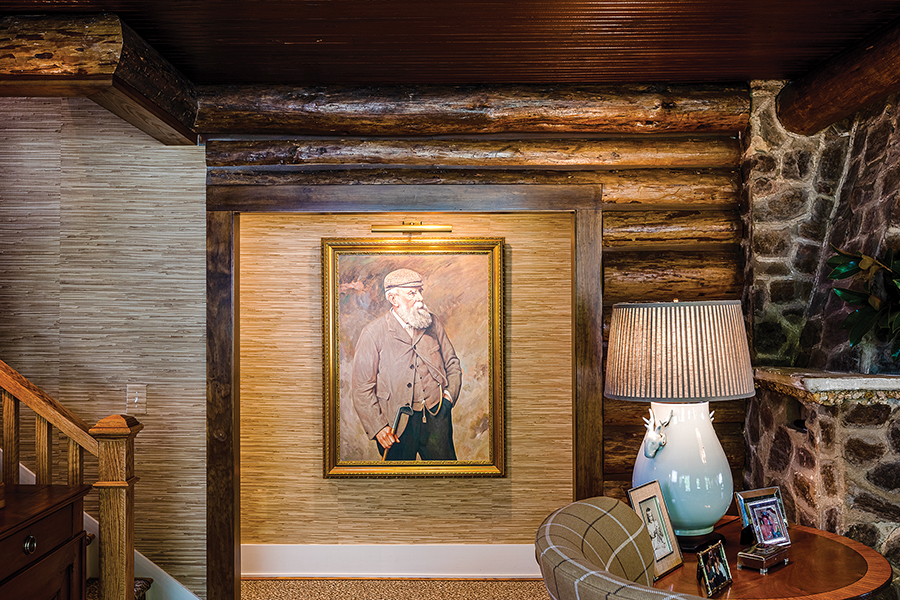
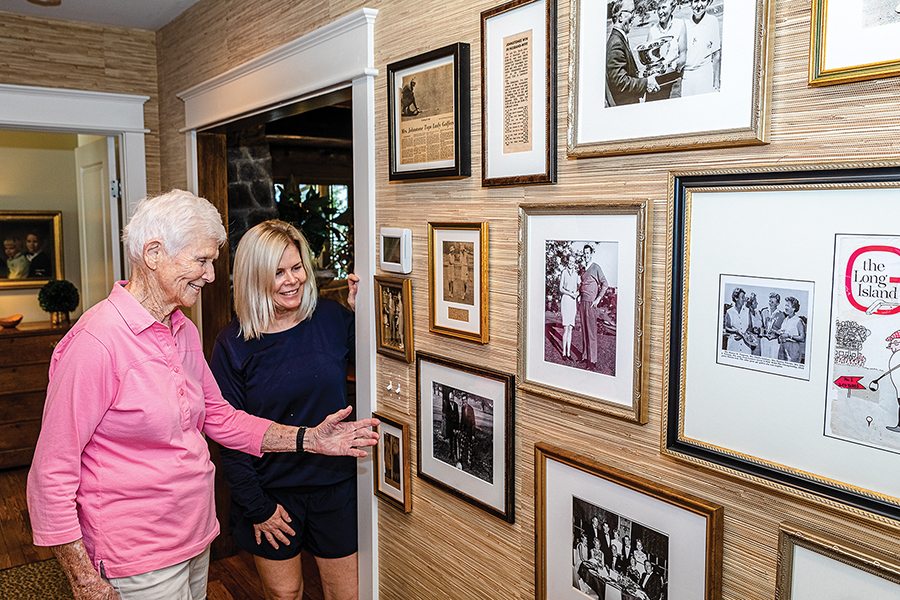
Hallways are covered in rough grasscloth for texture and practicality. They wipe clean. Kelly devoted one hallway to framed clippings from her mother’s golf career. A larger-than-life portrait reproduction of legendary golf pioneer Old Tom Morris is visible to passers-by, through a front window.

All four bathrooms are light, bright and new, lots of white and glass with contrasting navy blue. Off the living room, a perfect little screened conversation porch opens onto a terrace.


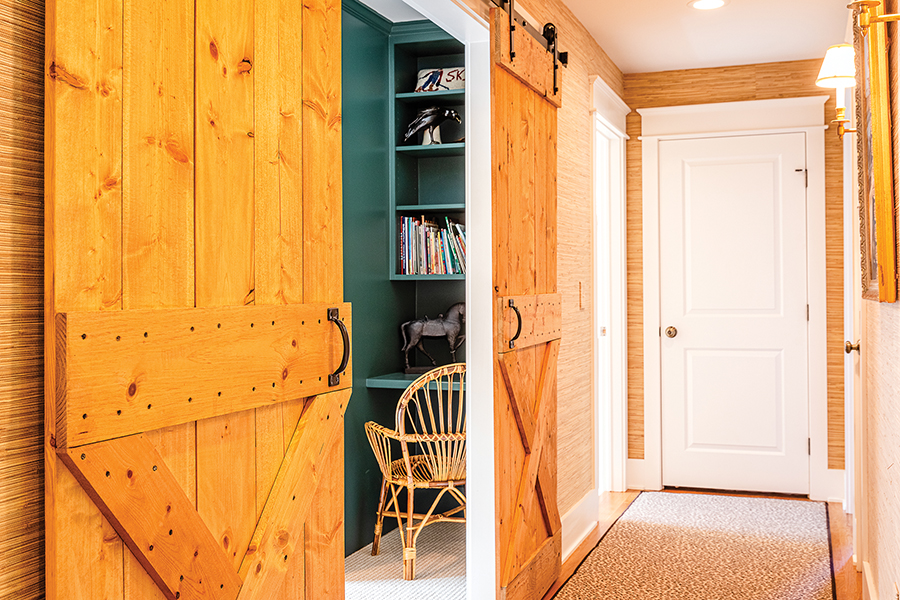
But the upstairs bedroom with sliding barn door and four built-in bunks painted hunter green, covered with tartan plaid quilts, elicits the biggest smiles.

Furnishings defy period or classification but illustrate a trend popular with downsizing retirees: out with the old, start afresh, which doesn’t always mean new. Kelly haunts Design Market in Aberdeen, estate sales and other sources for tables, chairs and case pieces. In the living room two upholstered chairs swivel, allowing their occupants to grab hors d’oeuvres off the massive square coffee table, then spin back to a TV mounted over a breakfront. Bent bamboo chairs accent the master bedroom. A well-worn blanket chest from Bill’s childhood found a place along with an antique metal disc player and a painting by Bill’s mother.

For fun, leopard-print runners cover stairs and hallways. Waffle-weave carpets add more texture. Old golf clubs and bag anchor a corner of the living room. Deer antlers twist out of a vase. Happily, it hangs together beautifully, creating an atmosphere more livable than grand.


Kelly and Bill moved from St. Louis in 2018. A plaque on the fence announces their ownership: “House of Rader, established Dec. 10, 1988,” their wedding day.

“What I wanted was a gathering space for our family,” Bill says.

The cabin, now with five bedrooms and four bathrooms, is ready for Thanksgiving, when the Raders’ three adult children and other guests will number 22. At least 12 will bunk down at the cabin and the holiday feast will be there.

Mission accomplished.  PS

Truth & Tales

A Fresh Take on Blackbeard the Pirate

By Addie Ladner & Reyna Crooms

Illustration by Miranda Glyder


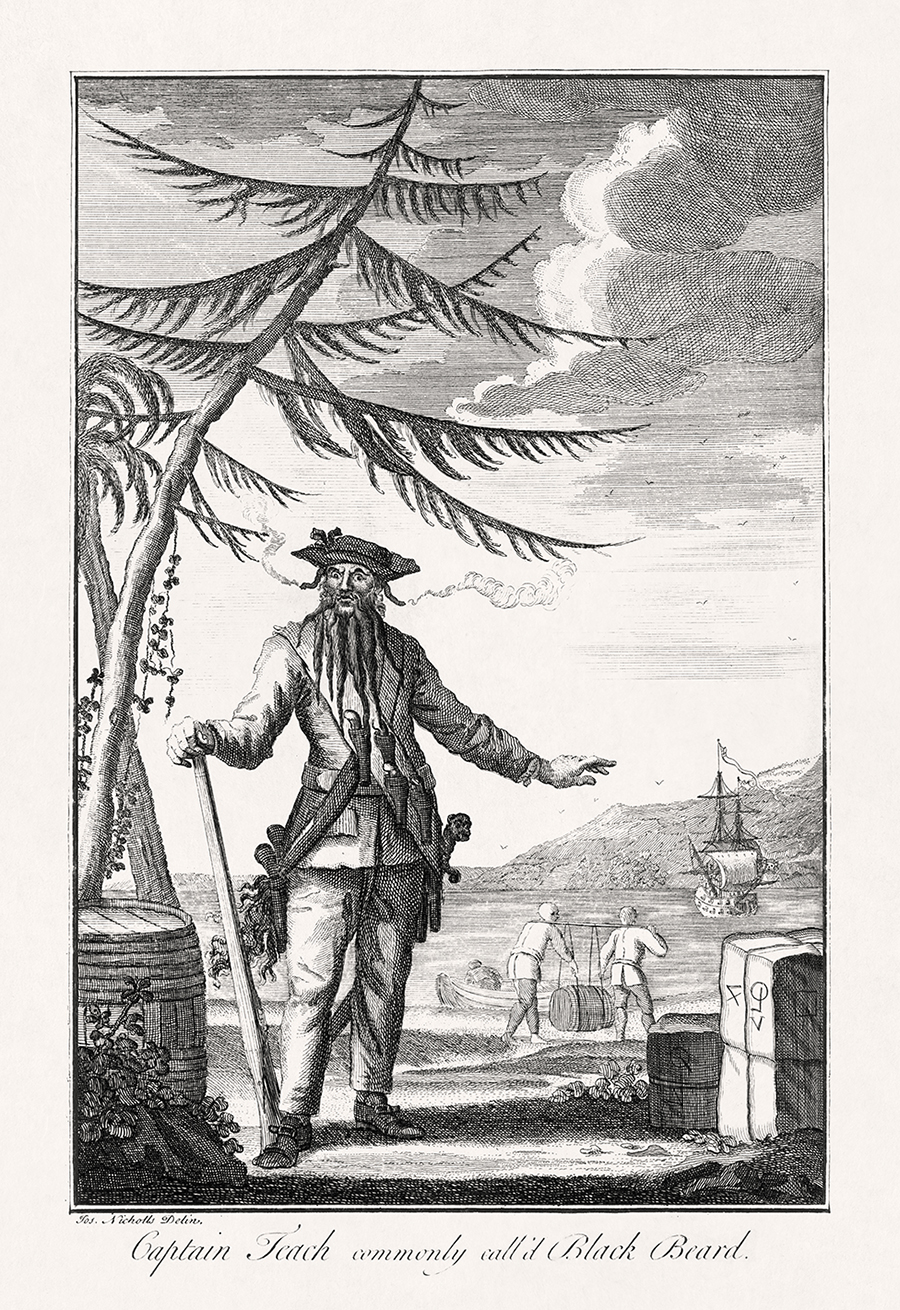
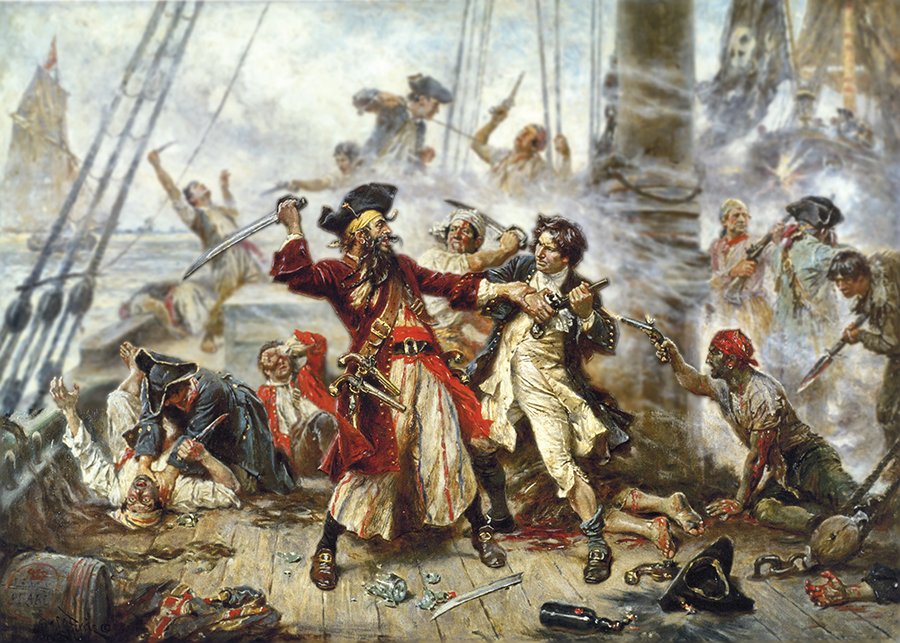
It’s 1715, just off the colonial North Carolina coast. A sloop flying a black flag decorated with a horned skull approaches. At its helm: Blackbeard the pirate, a gruesome sight with smoke streaming from his braided hair and a severed head in his hands. His crew swings onto the deck, swords in hand, ready to strike down any other ship in their bloodthirsty, unrelenting quest for treasure.

According to North Carolina research historian Kevin Duffus, very little of that is true. “Most everything you’ve ever read about Blackbeard is wrong,” Duffus claims. Read on for clues to sort between the truths and tales of this famed pirate — and for ideas to get out and do some exploring for yourself.


Revisiting History

An interview with a man who is on a mission to uncover the truth about Blackbeard.


Kevin Duffus first became fascinated by pirates as a young boy, when he watched the 1968 film Blackbeard’s Ghost. “At the time I didn’t understand that history can be fictionalized — I was just so interested in this Blackbeard,” says Duffus. Shortly after, Duffus’ father, who was in the Air Force, was posted in Greenville, North Carolina. Duffus started researching the area’s history and discovered that the infamous character he’d seen in the movies had died not far away, in Ocracoke.

So, at 17, Duffus and two friends hopped on their bikes to visit the barrier island and experience the history for themselves. “It took us over two days to get there. That was the beginning of my quest to find Blackbeard,” Duffus says. He explored the coast, looking for the landscapes he saw in the film, like the high cliff where, in the movie, Blackbeard had built himself an inn from salvaged timber. But when Duffus asked locals at a community store where to find that cliff, “they said, son, the highest point here is only about 8 feet,” Duffus says. “I began to realize you shouldn’t learn history by watching movies.”

Since then, Duffus, a longtime television producer who now owns a production company focused on history and tourism, has logged thousands of hours conducting primary research on pirates, and on Blackbeard in particular. He spent a week in England’s National Archives, going through log books and correspondence of Royal Navy ships stationed in Virginia in the early 1700s. He has also done research on foot: He once discovered a grave, covered in vegetation, along the banks of the Tar River. “Even trusted institutions like museums and park services have helped to perpetuate the historical fraud of the legendary pirate,” Duffus says. “I’ve been working to winnow out all of the unsupported claims, to weed out the three centuries of myth and legend.”

In 2008, he published The Last Days of Black Beard the Pirate, which is now in its fourth edition and one of six books he’s authored about maritime history. In 2014, Duffus was honored as North Carolina Historian of the Year by the North Carolina Society of Historians. We spoke to Duffus to learn why he believes that Blackbeard’s story is more complicated — and more important to North Carolina’s history — than the popular narrative suggests.

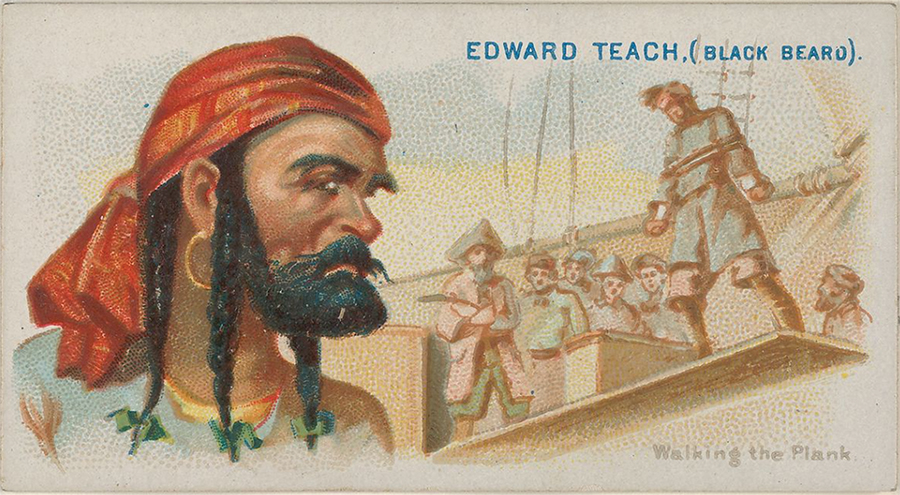
Blackbeard as depicted on an Allen & Ginter cigarette card.

You say pirates don’t match up with what many of us have in our heads — Why?

Pirates were indistinguishable from the rest of society. They dressed the same, they talked the same. There’s no such thing as pirate clothing, eye patches, earrings or tattoos — that’s been largely invented.

So often, popular culture portrays pirates as living in their own little world at sea, without the external events and forces that would have shaped real life. Blackbeard’s world was complicated. It involved wars between nations, economic distress, social stratification, legal irregularities and lost or destroyed official records. In Colonial America in the 1700s, the era considered the Great Age of Piracy, it was hard to establish a life. People who lived here would do whatever was necessary to survive.

Around the town of Bath, North Carolina, the years before Blackbeard became a pirate were marked by political discord, drought, famine and yellow fever. Often, a group of down-and-out sailors would set out by boat to raid a merchant’s vessel to quickly raise some funds. They’d fire a gun or cannon, then they’d raise the black flag signaling they were pirates; the merchant ship would typically be outnumbered and surrender. Battles and bloodshed were rare. Usually, these pirates would simply detain their victim’s vessel for an hour or two while they searched their cargo for valuables like food, wine and shoes.


So pirates were everyday people?

Yes, they were everyday mariners. It was a way to make some quick money, then return to your family and normal life. And there’s some gray area, too: Some professional mariners were privateers, which meant they were authorized to attack enemy ships. England was gearing up for war with Spain, so they’d enlist these mariners to do their work. There were no police, there was no one preventing this pirating from taking place, so there was no real danger of being caught. It became so popular that there are records of hundreds of men doing it.

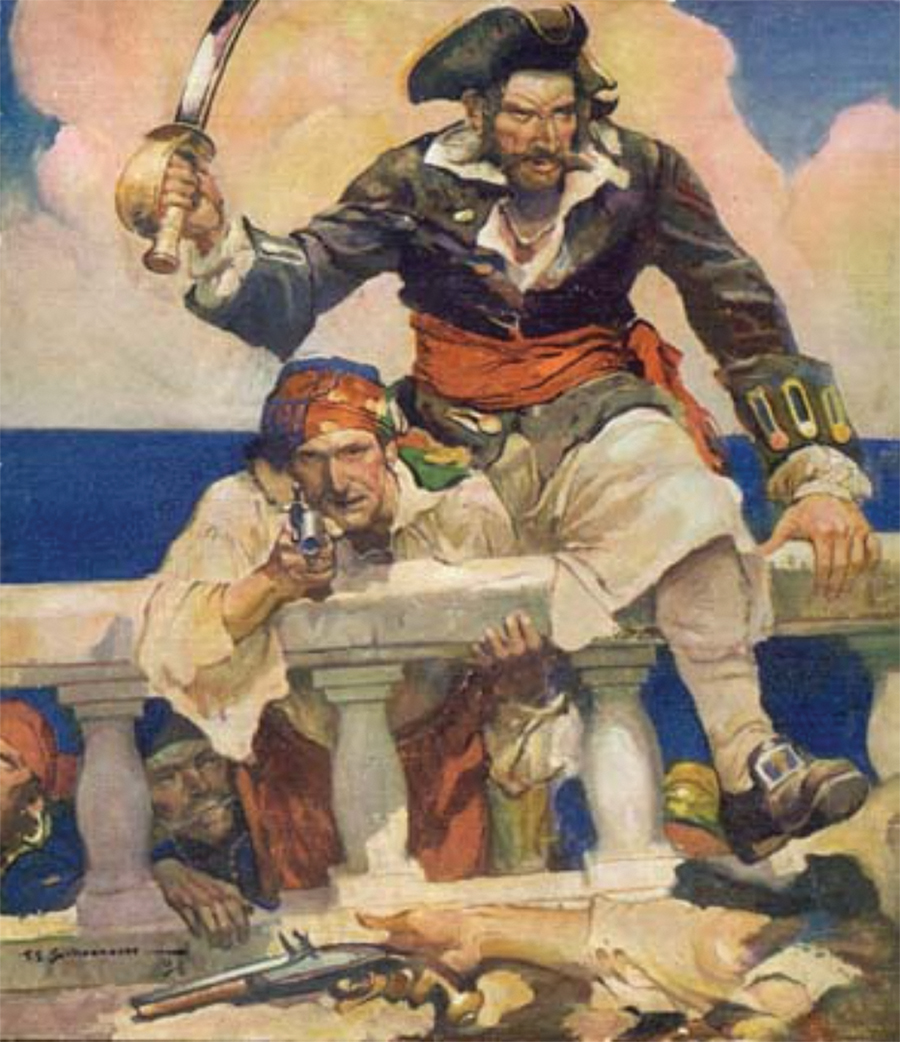
Blackbeard Buccaneer, a 1922 painting by Frank Schoonover.

When did the current version of a pirate become popular?

Only once people started making money off the legends. Around the late 1800s, there were a number of artists, like Howard Pyle, who began creating illustrations of pirates. Then came a number of films that romanticized the pirate life, starting in the mid-1900s. That’s when the distinctive pirate look and manner of speaking coalesced. No one said “Arrgh!” until Robert Newton played Long John Silver in the 1950 film Treasure Island.

What about the idea of buried treasure?

Buried treasure is also a ridiculous myth. If you took a small chest, let’s say 6 cubic feet, and filled it with gold, it would weigh 9,500 pounds! How would you move that, let alone bury it? The rumor probably came about because during that time, if you had valuables and didn’t have a safe, you’d bury them in your backyard.

What’s been your biggest revelation about Blackbeard?

A year or so into my research, some records showed that Blackbead had a sister, Susanna White, who lived on the banks of the Tar River near Washington where he’d visited. After searching this swampy area, I found the headstone of Susanna White near a bridge over the Tar River in Grimesland. When I read the tombstone, I realized she couldn’t have been his sister: She was born 37 years after Blackbeard died. For many years after that, I’ve been haunted by her identity and why folklore associated the two.

I finally proved her identity by poring over the deeds at the Pitt County Courthouse. It listed a transfer of property from a Salter family member to her “children and grandchildren,” including Susanna White. She was the granddaughter of barrelmaker Edward Salter, who plays a huge role in the narrative of that time. For a while, history told us Salter was a pirate with Blackbeard and was hanged. But after research in England’s National Archives and the North Carolina Archives, I discovered he wasn’t hanged. After he was pardoned and released from custody, Salter returned to Bath. He became a representative of Bath at the colonial legislature and a patron for the construction of St. Thomas Episcopal Church, and had a productive life and a family.

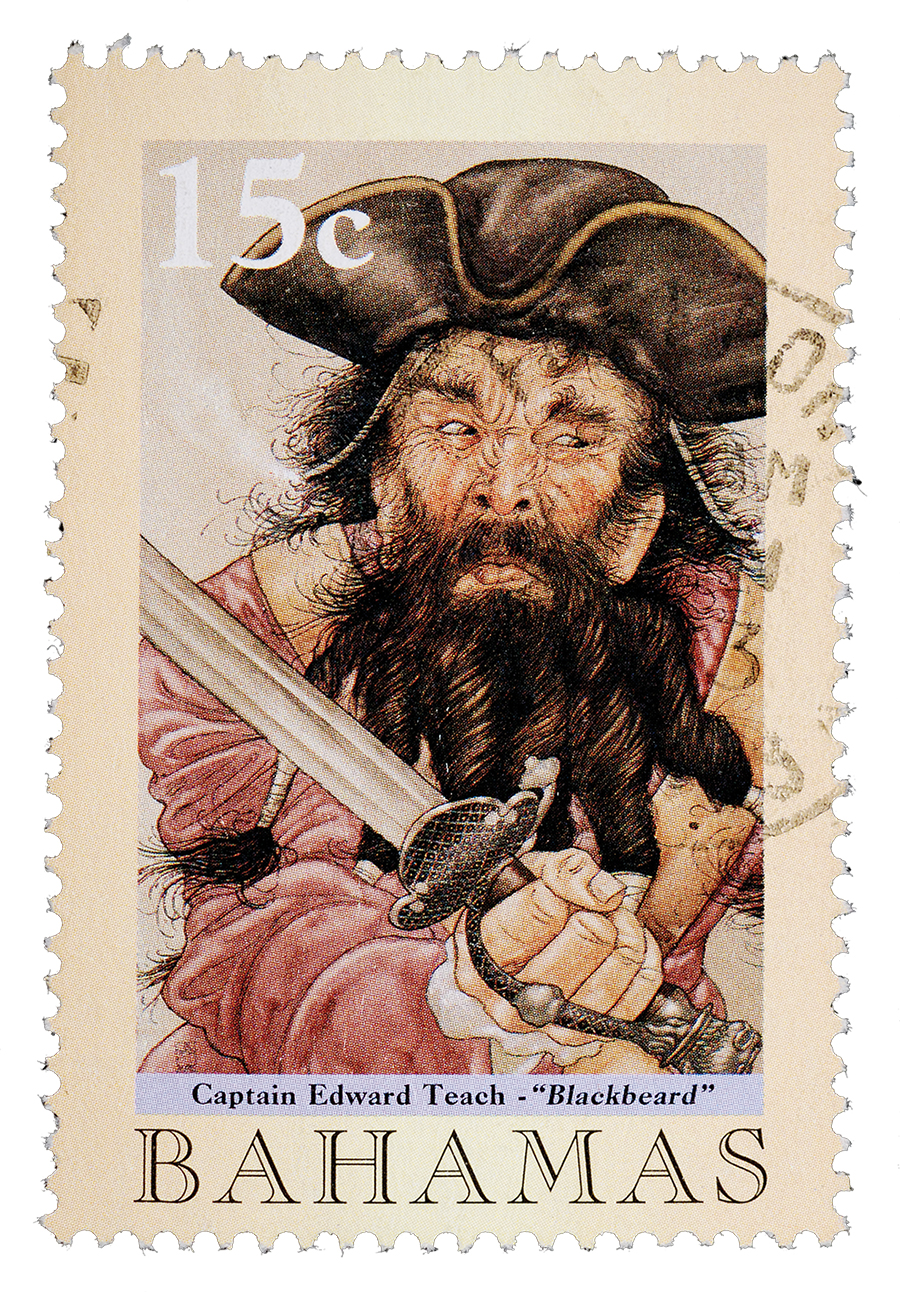
A Bahamian stamp featuring Blackbeard.

What have your findings led to?

The majority of Blackbeard’s inner circle of officers were from Bath and the Pamlico region of North Carolina. He had close relationships with the colony’s collector of customs, Tobias Knight, an enslaved Black man named Caesar and John Martin, the son of the town’s founder. This leads me to believe that Blackbeard himself was from this area or had strong ties to the town.

That contradicts a lot of the accepted history. People believe that Blackbeard’s real name was either Edward Thatch or Edward Teach, and that he was from Bristol, England or the Caribbean. But it never made sense to me that an out-of-towner could sail to Bath and tell people what to do, or that even someone from Jamaica would have strong, trusting relationships with locals. These people were willing to fight and die for him.


What do we know about Blackbeard’s last days?

It was a time of great uncertainty, danger and betrayal. A number of Blackbeard’s former pirates left him to return to honest lives. I believe that he would have done the same, but by the autumn of 1718, Blackbeard had become notorious throughout the colonies for some of his acts of piracy, one of which was a blockade of the port of Charleston. By this point, his ship, the Queen Anne’s Revenge, would have been crowded with as many as 400 pirates — he’d have had no choice but to continue committing acts of piracy to keep everyone fed and mildly intoxicated.

He tried to return to Bath, where colonial governor Charles Eden had given him a pardon. But it was worthless — he had violated its terms and everyone knew that, including Virginia’s lieutenant governor, Alexander Spotswood, who hoped to burnish his reputation as a vanquisher of pirates. About that same time, rumors were afloat that the King of England had issued a new pardon for pirates, with more generous terms, but no one knew when it would arrive.

So Blackbeard and his crew were laying low at Ocracoke, not sure of where to go or when or if they were being hunted.

They waited too long. They were surprised by Royal Navy Lieutenant Robert Maynard, who Spotswood had hired to capture Blackbeard, with a crew of 60. Maynard shouted that they were there to take Blackbeard dead or alive. Hoping to stand his ground, Blackbeard fired the first shots — an act of treason! And in fewer than six minutes of hand-to-hand combat, the king’s men bested the pirates. A highlander with a broadsword was said to have slashed Blackbeard from behind, cutting off his head. Yet, Spotswood’s invasion of his neighboring colony was illegal: He had no authority to arrest or kill pirates within the inland waters of North Carolina. Three weeks after Blackbeard’s death, the king’s new pardon arrived in Virginia.

I reconstructed this based on three sources. One was a letter I found in the British National Archives written by Royal Navy captain Ellis Brand, who supervised the expedition — it’s the most detailed and reliable. Maynard wrote a letter to a friend that added a few more details. The third source, based on hearsay but reasonably trustworthy, was a news report published in a Boston newspaper that recounts eyewitness testimony about the battle at Ocracoke.


What’s next in your research?

I’m searching in Charleston and Philadelphia for more that could help us complete his story. A great mystery I’d love to pursue is what happened to Blackbeard’s log book. On January 3 of 1719, Maynard returned to the James River in Virginia with Blackbeard’s head. Letters found in my research say he recovered Blackbeard’s “pocketbook,” which would have been a diary with a list of receipts and other papers. When Blackbeard was killed, the Royal Navy took the log book from his sloop to London, but from there, it disappeared.


Who was Blackbeard to you?

After years of research and analysis, I still don’t know Blackbeard’s true identity or origins with absolute certainty. Despite being a hugely popular historical figure, he remains a silhouette in the fabric of time.

That’s the ultimate Blackbeard treasure: his identity.  PS

This interview has been condensed and edited for clarity.

Mending Fences: the Movie

Fiction by Daniel Wallace

Illustration by Mariano Santillan

I bought a car from one of those grassy roadside lots, paid in cash that arguably wasn’t mine and disappeared into the night like the smoky tail of a dying match. I was in the next state by morning, at a Waffle Shoppe full of truckers and farmers and dropouts, all of them wearing baseball caps, none of them backwards. I turned mine around.

I found a booth in the back. Waitress caught my eye and winked. “Be right with you, hon,” she said, same as they always do, like it’s from the handbook. Tangerine lipstick and penciled-in eyebrows, thin tinsel gray hair in a ponytail. She was my age probably but looked twice that, weary but indestructible, like she’d been standing up her entire life and be buried that way too. She walked over to me with the pot, veins like river maps beneath her skin, face that had been through a lot, too much, but she smiled with a warmth that was so real I felt it in my heart. Nametag: Kate.

“Morning, baby. Coffee?”

I nodded, she poured. “What can I do you for, sweetie?” Like she might take me in her arms and rock me to sleep.

I kept my face low reading from the menu but when I looked up to order her eyes were fixed on me. She blinked once, kept staring. I could see her tongue resting against the top of her bottom teeth, her mouth hanging open just that much.

“Good lord.” She gave me the once over twice. “You’re — aren’t you — ?”

I turned away. There was a TV on the wall and I wondered if I’d been on it already, but nothing I’d done would make the news. That’s what I told myself. I thought I was faster than my past. But maybe nobody is that fast.

She pointed at me.

“You’re Dustin — Dustin — lord, my brain has gone to mush. I just saw you.”

Impossible. Never in my life. And I’m no Dustin. “Sorry?”

“Last night. The movie, your movie. Oh, you know — San Francisco Nights! With Julia Roberts!” An exclamation point, like she’d just won a prize. “Dustin Evers. You are Dustin Evers and I cannot freaking believe it. Oh good lord.”

Her smile made her makeup flake and her lipstick crack.

I shook my head. “I think you have me confused with somebody else.” Matter of fact, a little gruff, putting her off without pushing too hard.

But her eyes wouldn’t let me go.

Dustin Evers, I thought.

Dustin Evers, the actor.

Okay.

“You got me,” I said.

I’d seen that movie too. A pastry chef and a fireman fall in love when her bakery burns down. I shrugged and almost smiled and she shivered like a woman about to freeze. She motioned a cohort over, a girl who might have been her daughter, twins basically separated by 20 or 30 years.

“Lucy,” she said, in a whisper. “Get over here. Look at this.”

Lucy dragged herself over and looked at me with her dull dead sleepy eyes. “Hey, sugar,” she said. Then to Kate: “What am I looking at?”

“You’re looking at Dustin Evers,” Kate said. “San Francisco Nights?”

Lucy took a minute to fall into the magical world Kate made for her and then just like that she was all in. She opened her mouth but no words came out.

“Oh, oh, oh wow,” she said, finally. “Wow wow wow.” Then, blushing: “I’ve had a crush on you since I was 12.”

They laughed. I laughed. Like I’d heard it all before.

“Well, thank you, I guess,” I said. “The camera is kind to me.”

“God was kind to you,” Kate said. “That face of yours is a gift from God.” She looked at Lucy. “I can’t believe I’m saying this to Dustin Evers!”

“Dustin Freaking Evers.”

“What’s she like?” Lucy said. “Julia Roberts. They say she’s nice but I think, I don’t know, she might be full of herself.”

I sipped my coffee. “She’s an absolute angel,” I said.

“Is there a movie around here you’re making?”

“Yes,” I said. “There is. Right down the road.”

“Wow,” Lucy said. “Wow wow.”

“That how you hurt your hand?”

She was addressing the blood lines on my knuckles.

“Yes. I do my own stunts.”

“His own stunts.”

Lucy and Kate looked at each other, because did they ever have a story to tell now.

“What’s it about?” Kate said.

“Yeah,” Lucy said. “What’s it all about?”

“What it’s all about?” Philosophers now. “Well, I guess it’s about a man who did some things he wished he hadn’t done, tries to run away from it all, meets a woman on a farm who sees him for who he could be, deep down, then hires him on to mend fences, and they, well, you know.”

“Sounds like my kind of movie. What’s it called?”

“Mending Fences,” I said, and I saw it unfolding before me. The woman on the farm — tall, copper hair, a widow maybe, tough unyielding eyes at first but deep pools of goodness and almost spiritual power, me working the land for her, sleeping in the barn on a bale of old hay, her scraggly mutt my first best friend, that mutt follows me around everywhere, and I was milking cows, riding horses, saving her life from that snake — a rattler — that almost bit her, how we picnicked beneath that big old oak tree, the one her granddad planted 100 years before, and then how one thing led to another and I kissed her beneath a sickle moon, and finally I told her everything, everything I did leading up to the night I got that car from the roadside lot, all of it, I couldn’t live that lie a minute longer but figured when I told her she would leave me and she almost does, she almost leaves me but she doesn’t, and she says hon, sweetheart, sugar, baby, damn it if I don’t love you, but you gotta go back and make things right, have to before we can move into the next thing, into the rest of our lives, together. And so in the movie I do, I go back and I see the girl and I see the man and my mother and my father and I do what I can to make it right, and then I come back to her and she takes me in her arms and the music swells and finally I’m happy, we are happy, and that’s why it’s called Mending Fences. I told them the whole thing, and by the time I was done I was surrounded by all of them, the truckers, the farmers, the dropouts, and a short order cook to boot. They loved me so much. Someone even bought my breakfast. And then it was over: I told them I had to get back on set. But I want to thank the Academy and my great director and Julia for being the best costar a guy could ask for . . . but more than all of them put together I have to thank Kate and Lucy for that morning, for the greatest gift I ever got in my life, to be another man for just those few minutes, to be famous for not being me.   PS

Daniel Wallace’s memoir, This Isn’t Going to End Well, will be published by Algonquin Books in April, 2023.

Here’s to the Next Hundred Years

From suffragettes to leading ladies, more than just a book club

By Jenna Biter          

Photographs by Tim Sayer

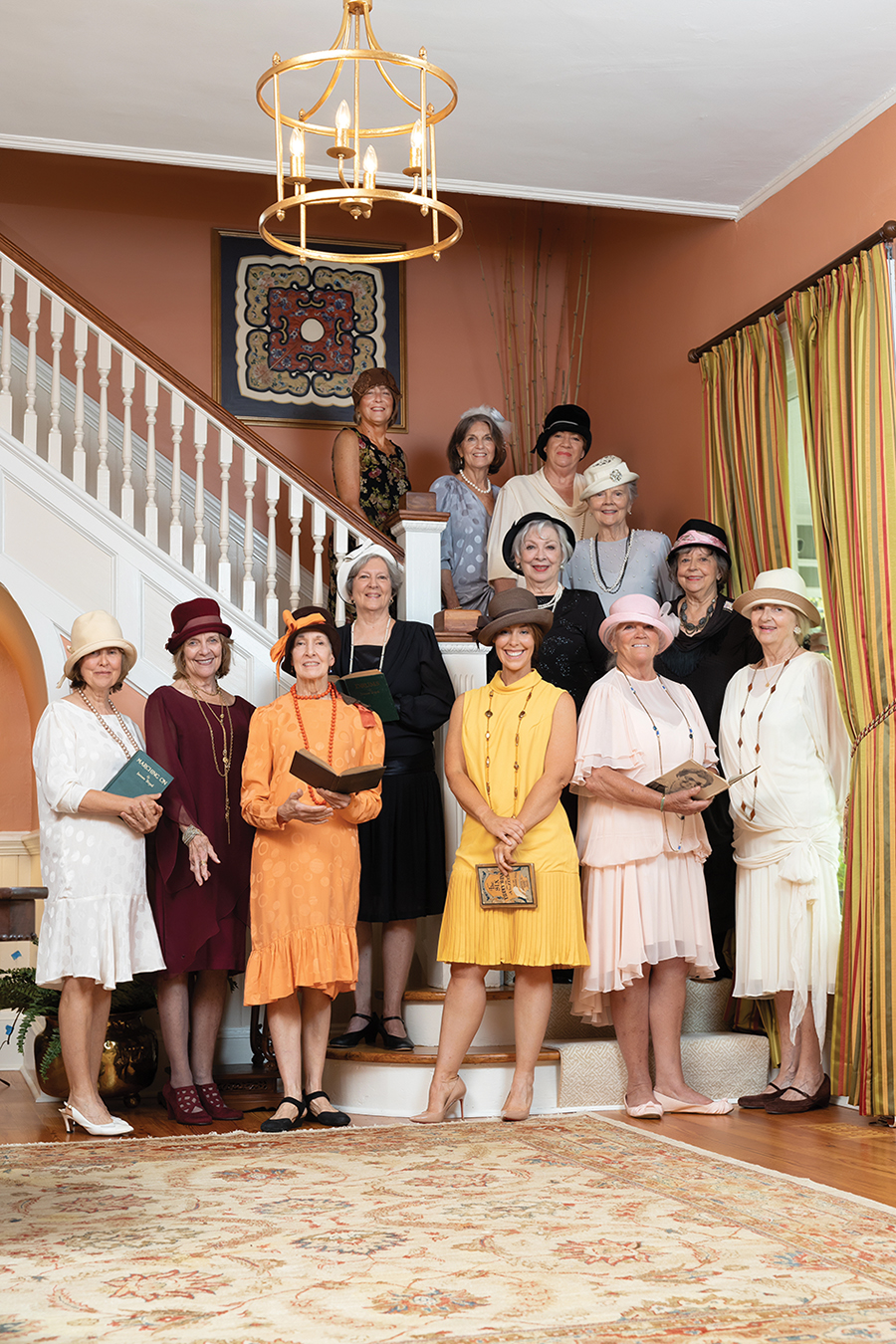
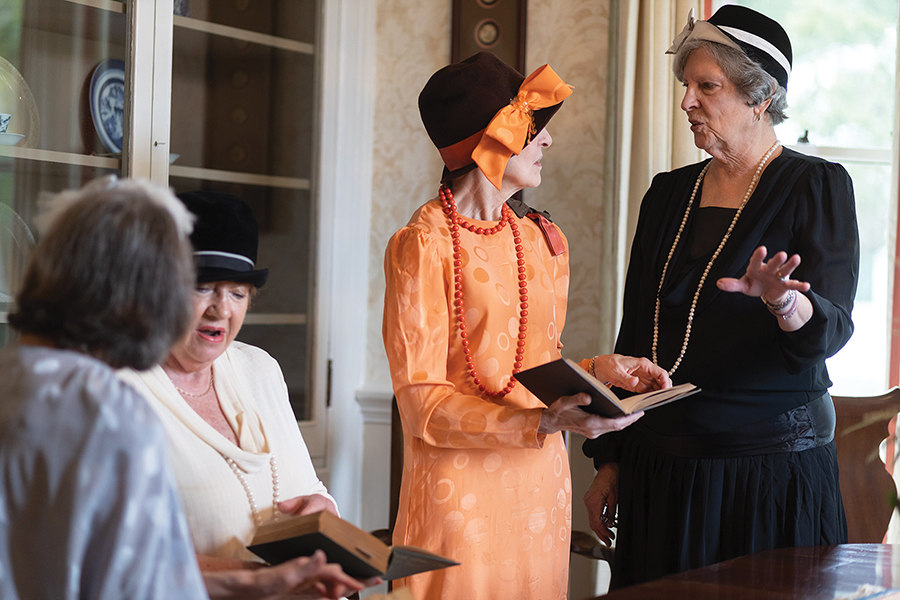
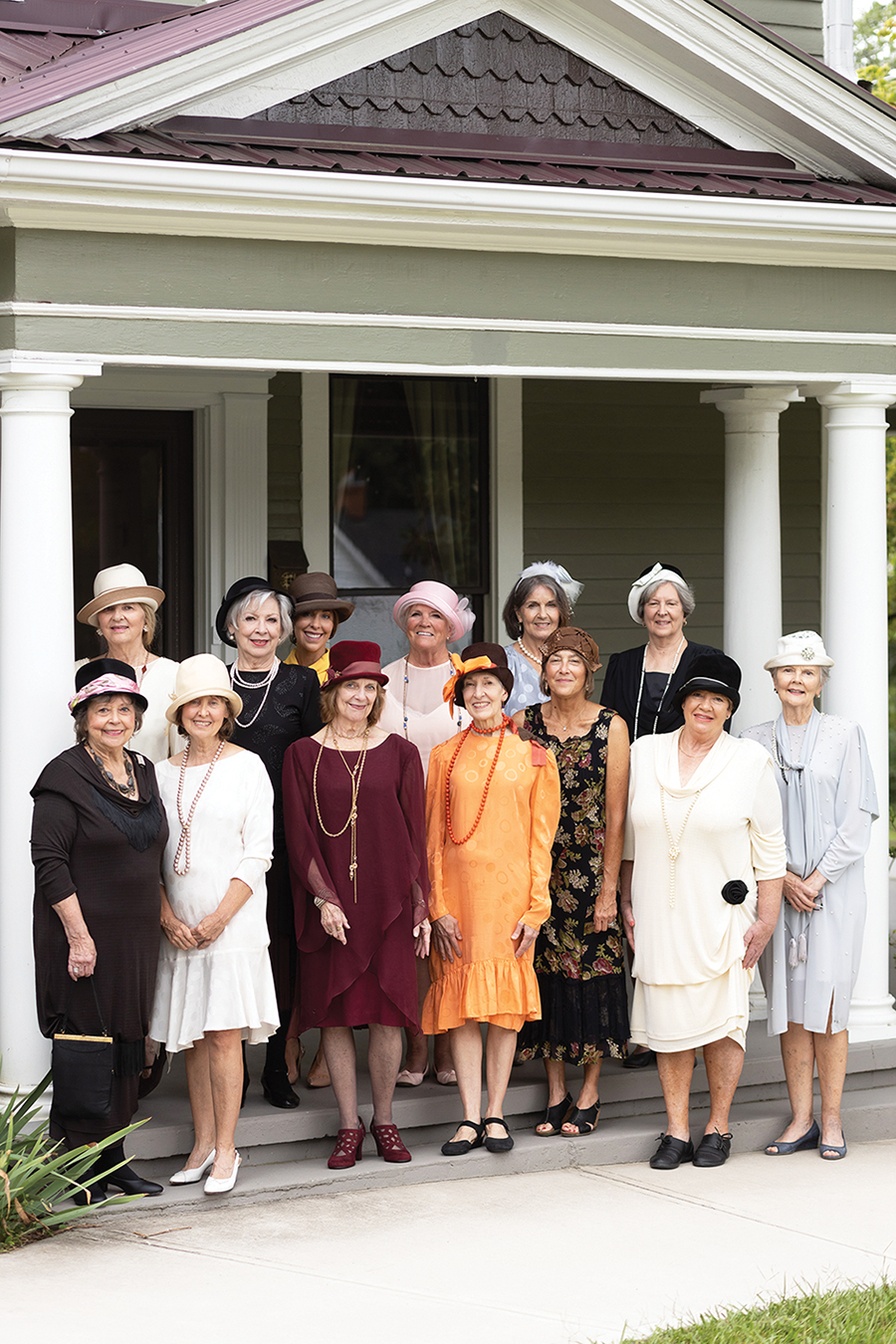
Aberdeen’s daughters filter into the restaurant’s back room, chittering amicably among themselves. If the town was a medieval state, these would be the ladies of the court. “Oh, how have you been?” passes between childhood friends, and swift introductions welcome new faces. With the arrival of each member, conversation swells, and the history of Aberdeen becomes flesh. The guests call out connections across a makeshift banquet table like they’re tossing a ball of yarn back and forth, from woman to woman, until the process knits fiber into fabric.

Betsy Mofield, decorated in red-rimmed glasses almost as sharp as her wit, was Aberdeen’s mayor for 14 years, and Laura Farrell’s husband, Robbie, is currently in office. Someone’s mother was everyone’s favorite English teacher, but she was also Aberdeen High School’s only English teacher. “Your grandfather was my dentist for over 40 years,” another adds in a side conversation. Even the women who say, “I don’t know why I have been invited to this book club,” always lingering on the “I” with their lilting Southern drawls, have lived in town for 40-plus years and married men who grew from Moore County soil.


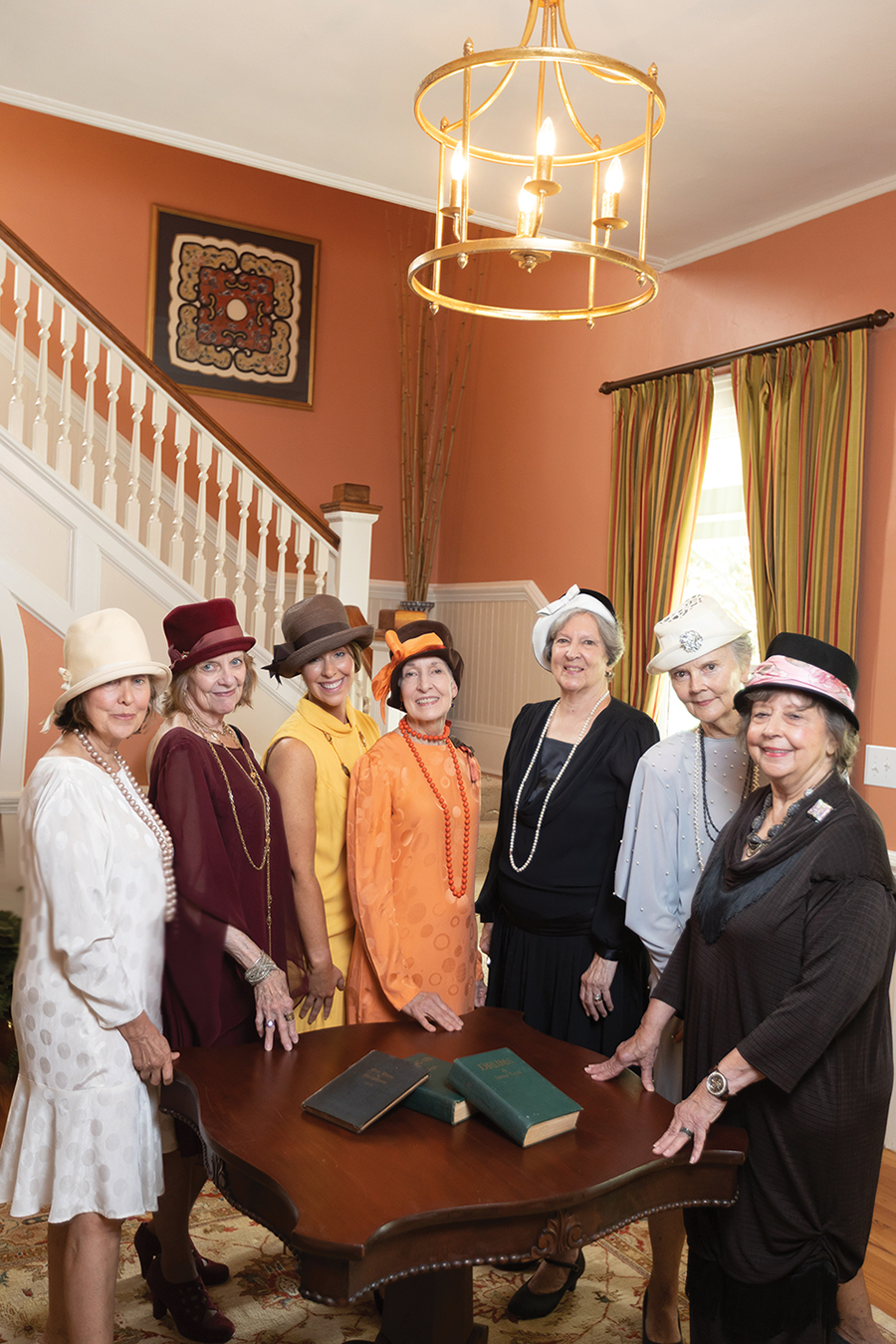
The organization is the Walter Hines Page Book Club. Lynn Page Anderson, an impressive, soft-spoken woman, currently serves as the president. It’s “the oldest active book club in North Carolina and perhaps the oldest in the country,” she says. It derives its name from Walter Hines Page, a distinguished Sandhills citizen who is buried in Old Bethesda Cemetery off Old Bethesda Road. He served as U.S. Ambassador to Great Britain during World War I. In 1935, over a decade after the club’s founding, the members voted to rename their Thursday Afternoon Book Club after the late local giant.

Anderson lifts her fork and pings a water goblet to quiet the room, but the chatter persists. She makes a face, somehow politely. A louder voice intervenes, and the meeting begins. New member introductions roll into lunch, and dessert rolls into a review of the last meeting’s minutes, then the current meeting’s agenda. Eager hands and voices raise to second motions approving donations and the formation of committees.

“We’re very democratic,” Anderson says. “Something comes up, and we vote on everything.”

Democracy is the gilded baton they pass gingerly from predecessor to successor; no woman wants to drop it on the handoff. Anderson ponders the women who founded the club in 1921, a year after they got the vote. “I wonder how many of them were suffragettes, or how many of them understood that women can have a more important life than being relegated to cooking and cleaning? At the time, the population of Aberdeen was about 852 people, and here were these 22 women. That’s a big chunk of the population, and they decided they wanted to share experiences and culture with their friends.”

Membership has expanded to 24, but advancing culture and community remains their North Star. Monthly meetings feature speakers from local nonprofits like the Prancing Horse Center for Therapeutic Horsemanship, and Camp Dogwood for the Blind and Visually Impaired, or sometimes local artists and authors. After the program, they vote on whether to donate to the cause, and they always vote “yes.”


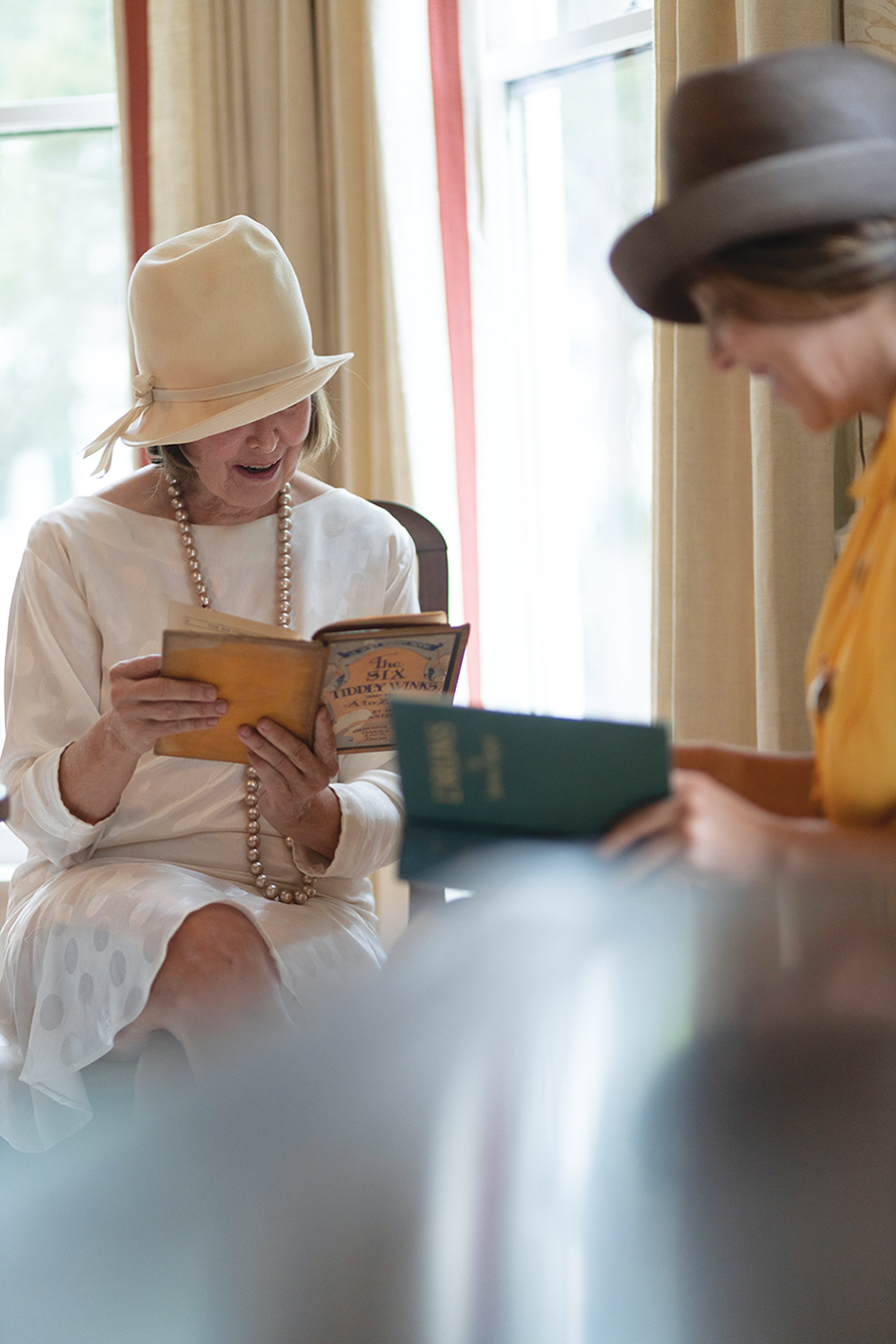
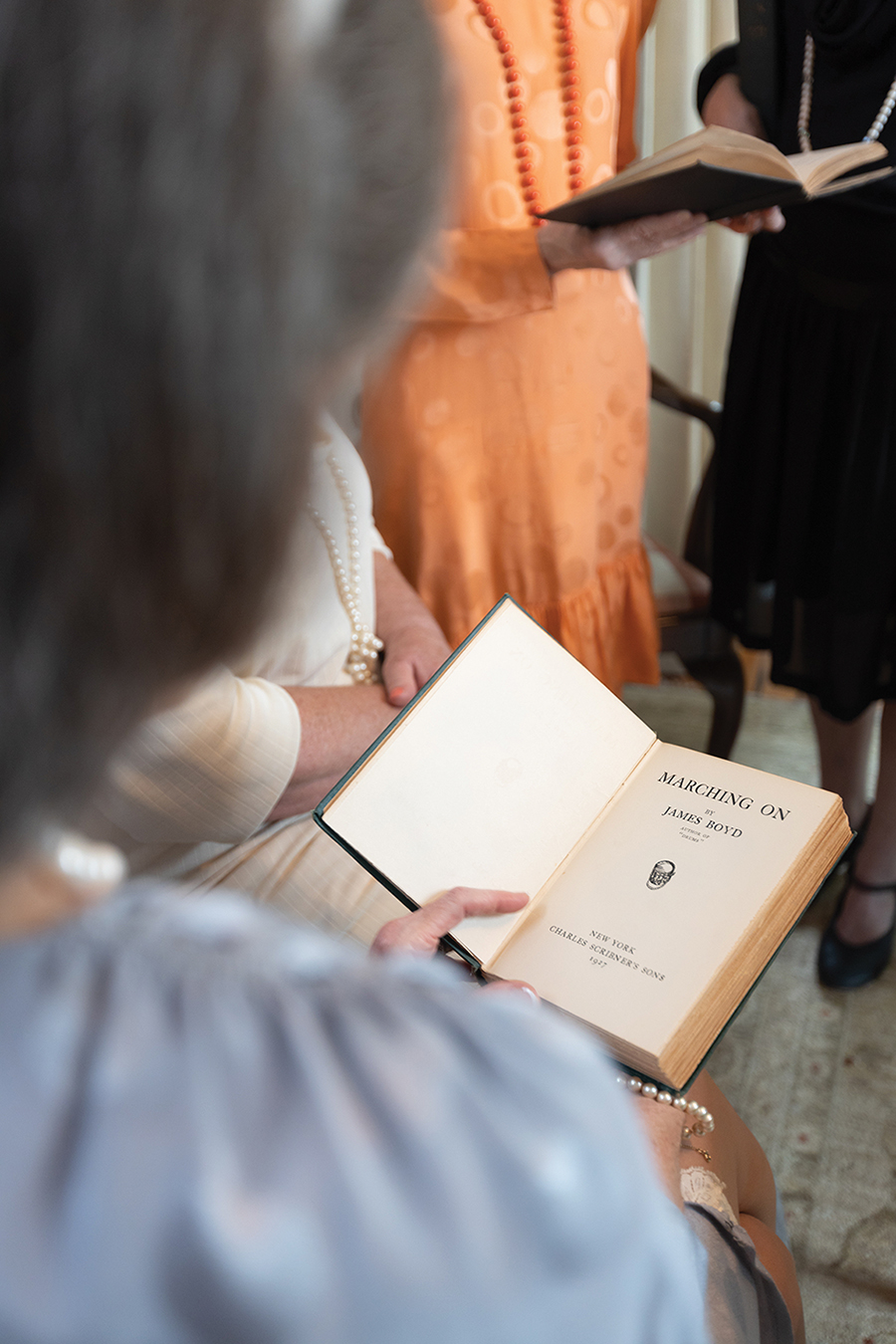
Hardbacks lying on the white tablecloths are the only clue this group convenes under the guise of a book club. Each member buys one copy of a current book, and they circulate from woman to woman per a list inserted into the copies like library borrowing cards. They read the books consecutively, not synchronously, and they don’t have to read the books at all. “You get a chance to read the books, and you can talk about them . . . if you want.” Anderson says. After two years, the books have rotated through all 24 members, and each woman gets hers back. They select new titles, and the process repeats.

Anderson drives the meeting forward — the annual “white elephant” and, at last, the centennial celebration. Instantaneously a committee forms to handle the catering and venue. Over a century after their first meeting on October 21, 1921, in an Aberdeen living room, the book club still meets on the second Thursday of the month, but third-party luncheons have replaced home gatherings.

The Walter Hines Page Book Club celebrated its 100th anniversary last October, but the pandemic relegated the celebration to modesty. They’re planning a bigger bash for this year: “How’s Saturday, October 22? One hundred one years and a day since the founding,” Anderson asks. Eager hands and voices raise to second the motion.  PS

Jenna Biter is a writer, entrepreneur and military wife in the Sandhills. She can be reached at jennabiter@protonmail.com.

Poem

Cardinal

Like a spot of blood against the blue sky,

a Cardinal perches on the shepherd’s hook

where I hang suet and a cylinder of seed-feeders

I gave Sylvia for her last Mother’s Day.

The birds are a gift to me now. Her beautiful

ashes fill a marble blue urn and rest

near one of her crazy quilts in the foyer to welcome visitors.

Buddha is there on a table and guards her keepsakes,

a cleaned-out bookshelf holds her high school portrait,

a cross-stitch she made for me. Every little corner

has its memory of how short a sweet life can be.

— Marty Silverthorne

From Collected Poems of Marty Silverthorne