Ready to Ride

Ready to Ride

A French feel in the Sandhills

By Deborah Salomon


Credit James Boyd, and mild winters, for enticing foxhunters to Moore County. Eventually, some branched out to eventing, dressage, jumping. The Walthour-Moss Foundation furthered the equestrian cause. Soon horse people from Northeastern cities began wintering their steeds in Southern Pines, accessible by rail and so much closer than Florida. They built small apartments — “hunt boxes” — over the barns, graduating to year-round estates.

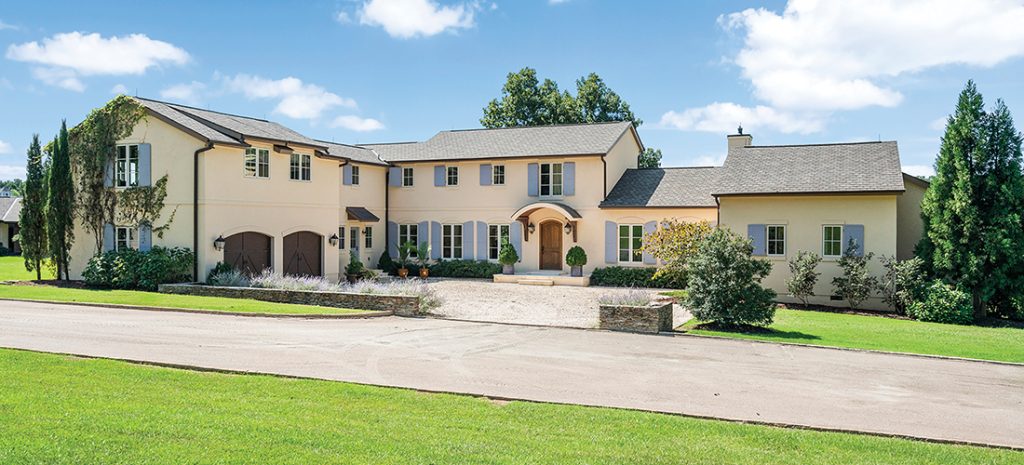
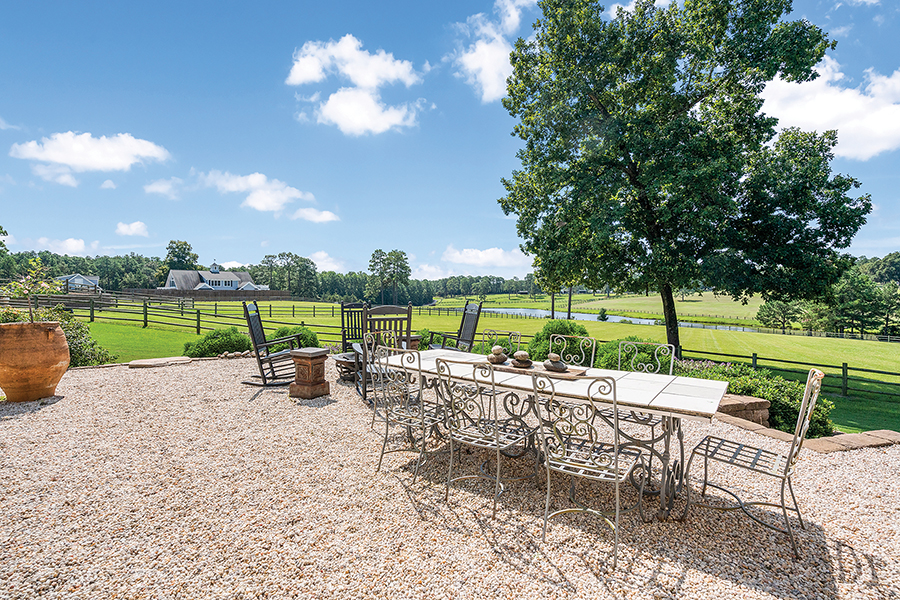
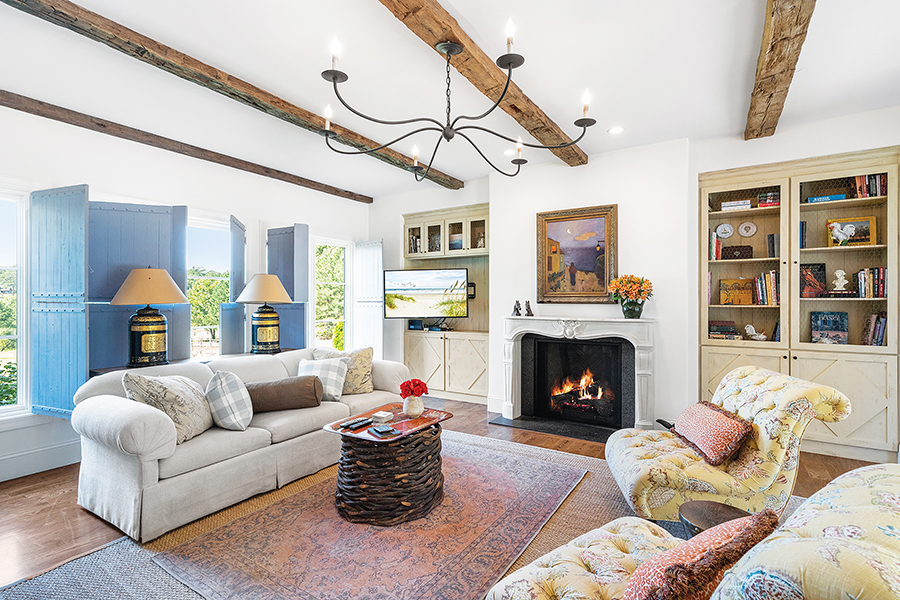
This tight-knit community created and maintained an active social life. Their houses, located between Connecticut Avenue and Youngs Road, grew bigger, better equipped and less rustic. Positioned near the top of this heap is the retirement home of Chris and Sallie Lowe, 5,000-plus square feet styled à la French chateau, on 10 grassy acres sloping to a pond.

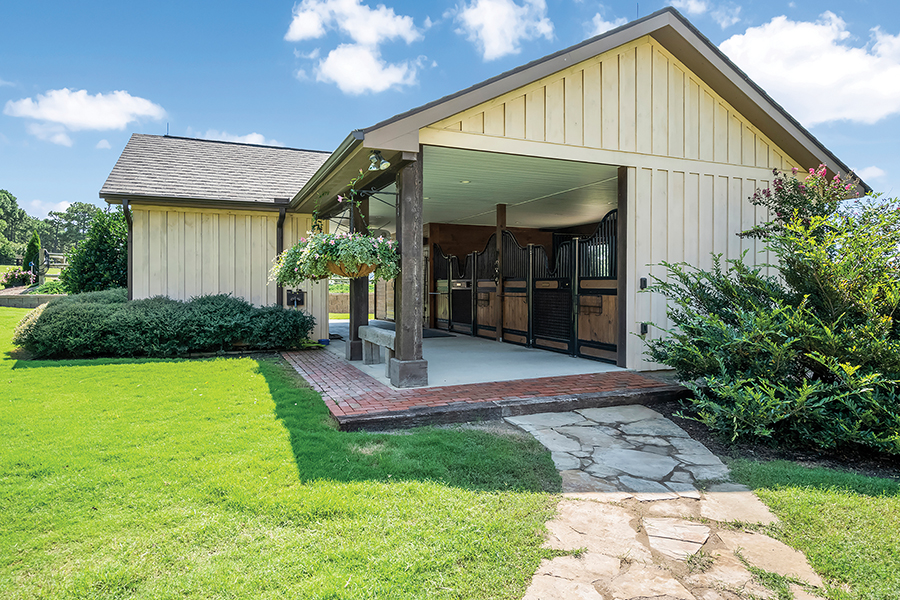
In the barn (with tack room), two stall doors are topped with wrought metal. A full-sized dressage arena borders split-rail pasture fences while a row of tall, thick elaeagnus bushes separates the chateau from a narrow private road.

Sallie rides the horse, Chris rides the tractor, which has its own garage. Both are Virginians by way of Vermont.

How this happened could be a story written by Boyd himself, or maybe his buddy Thomas Wolfe.


Most equestriennes start young. Not Sallie. Her parents, suspicious of the lifestyle, guided her into high school sports, where at 6 feet tall and athletic, she excelled. In 2011, now married, a mother and teacher living in Vermont but hating the cold winters, she won a trip to Southern Pines at a fundraiser. “This is it,” she decided, after driving around. “This is where I want to spend the rest of our lives.”

No problem for Chris, who dubbed her adult riding quest “keeping Sallie sane.” In 2011 they bought a property close to town but with “a country feel,” and rented a place during construction . . . of what?

A year spent in France left its mark on Sallie. She looked for an architect who would interpret her ideas rather than imposing current trends. Research led her to Designing Your Perfect House and other titles by William Hirsch. Perfect! Imagine Sallie’s surprise, discovering that the internationally lauded architect and author lives in Seven Lakes. Chris, whose father was a contractor, worked happily alongside builder Mark Lally’s crew.

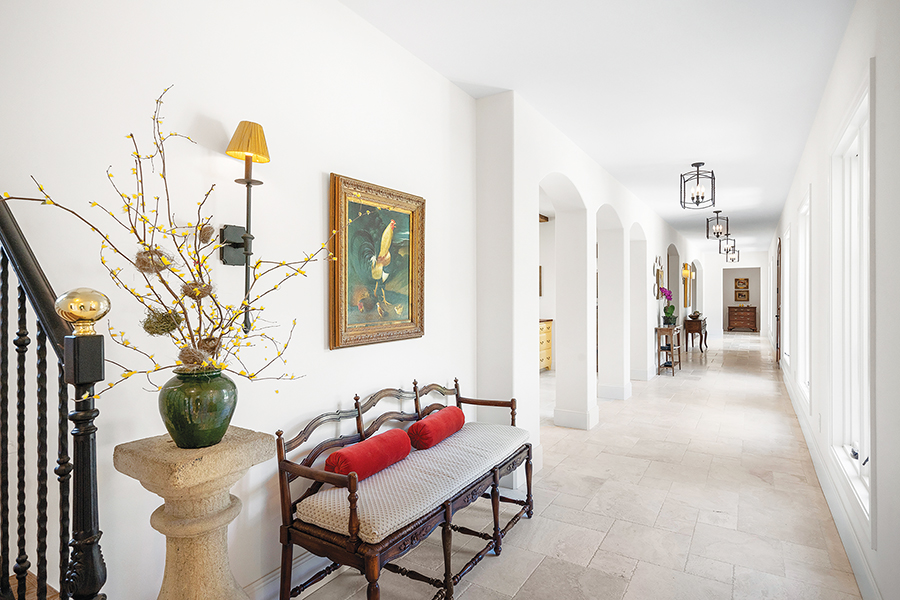
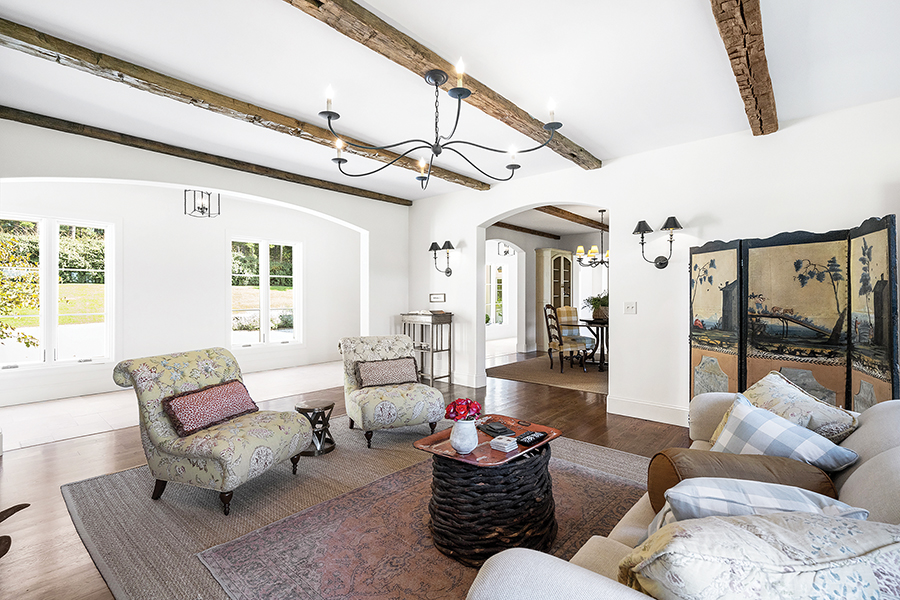
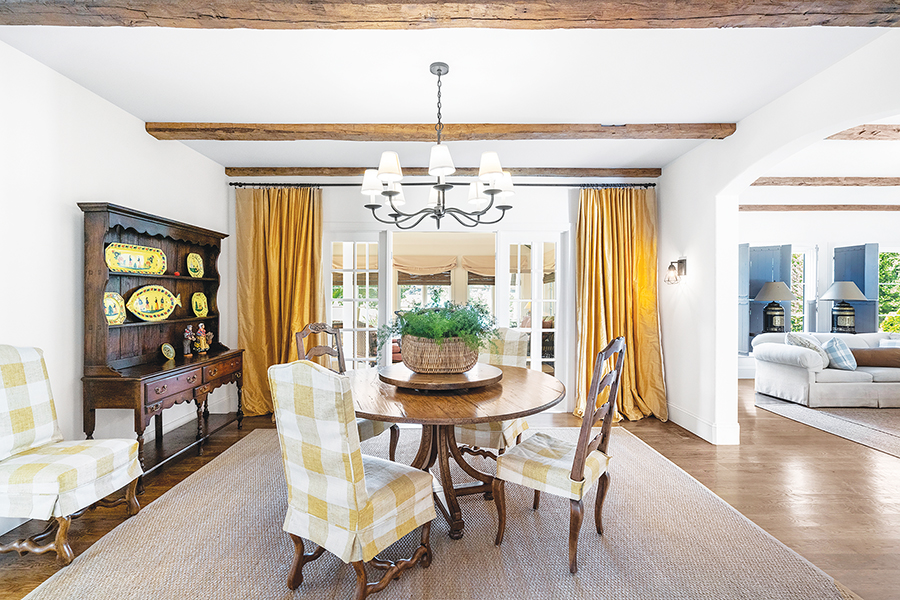
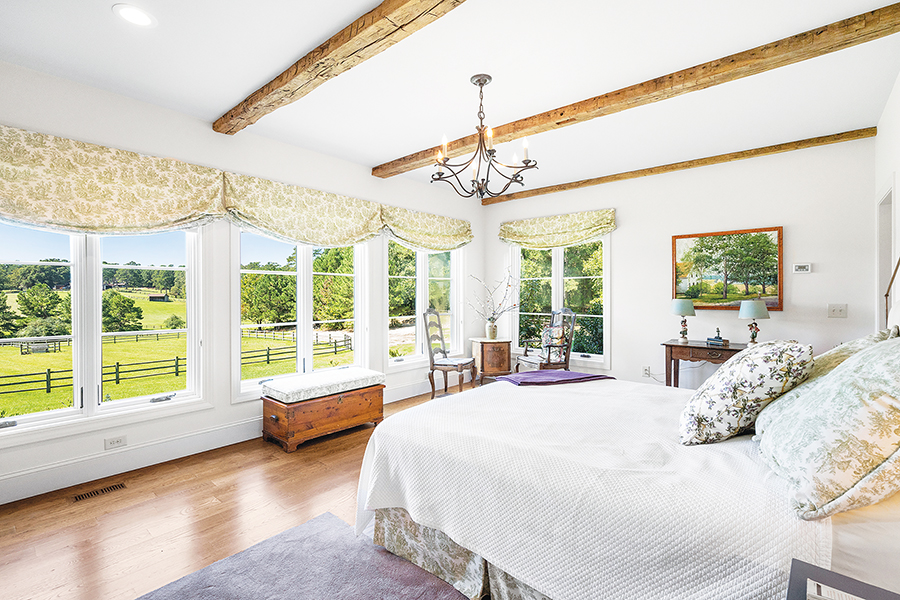
Sallie presented Hirsch with some unusual requests. She had learned that authentic provincial chateaux are not grand at all, but rather informal country homes, sometimes with animals occupying the lower floor. “I’m not a fan of big open spaces,” she says. As a result, the main floor, although enormous, is a succession of moderately sized rooms — workroom, kitchen, sunroom, dining room with unusually small round table and large lazy Susan, living room, all with arches opening onto a 90-foot loggia (front hallway) with white travertine floor blocks arranged randomly.

At one end of the loggia, a triple garage; at the other, the master suite. Windows everywhere, allowing unobstructed pasture vistas to become part of the decor. Quimper pottery, made in Brittany for 300 years, hangs from the walls. Paintings depict Parisian scenes. A massive antique French armoire approaching the 9-foot ceiling dominates the master bedroom. Laundry equipment is part of his-and-hers dressing rooms.

“The mother in me needed a room for each son,” Sallie admits. They have three — two are married, one with a grandson — all accommodated upstairs, which includes a guest apartment with sitting room, bedroom, kitchenette and one of five bathrooms which are bright and attractive but hardly spas. 

A French chateau doesn’t do spas.

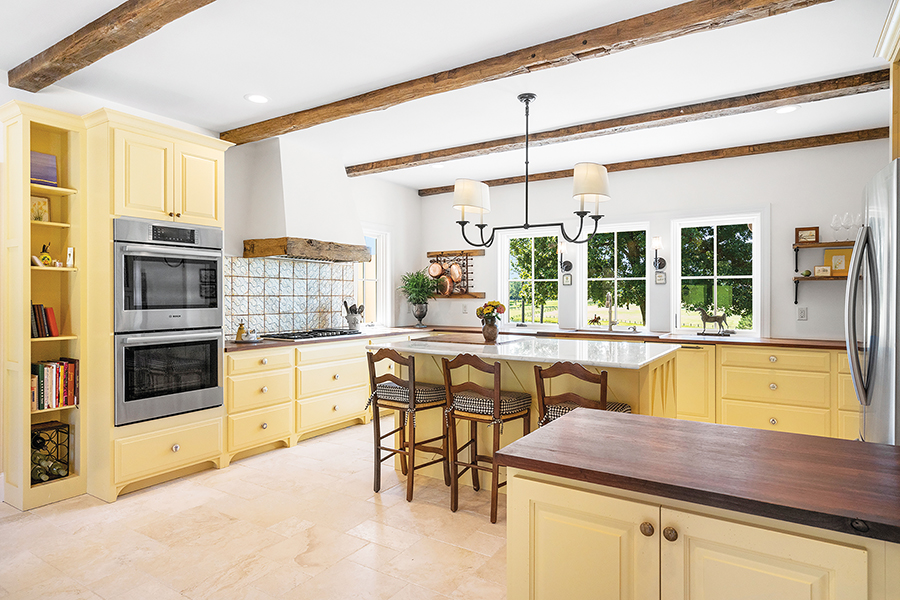
The French experience also influenced Sallie’s palette, with yellow coming out the winner — not lemon or daffodil but a muted hue, perhaps butter diluted with crème fraîche, or a silky béchamel. This hue covers exterior walls with contrasting purplish-blue shutters and, surprisingly, the footed kitchen cabinets.


Ah, the kitchen, showplace of the American luxury home. Sallie wasn’t interested in sterile white or professional-grade appliances; more important to her, a backsplash composed of weathered, hand-painted tiles in colors and motifs that continue the European country chic feel. Chris points proudly to the top of a Vermont sugar maple chopping-block table inserted into the island. “It’s from my parents’ home. When I was young I would sit on it and talk to them.”

Furnishings combine antiques with spotlight pieces. In the living room, a coffee table contrived from twisted vines is topped by a toile tray, and a pair of oversized, heavily tufted slipper chairs face two Asian lamps made from tea canisters. In the sunroom the drawer of a game table, from Sallie’s lineage, holds a Washington Post front page dated 1882.

“We’re not super-formal,” Sallie concludes, “but we give plenty of dinner parties with china and crystal. I wasn’t ready to give that up.”

Not your ordinary horse farm, even in an area known for elaborate installations. “I knew what I wanted and I held my ground,” Sallie says. Meaning custom-designed and custom-built, right down to the baseboards. Geothermal heating and cooling. A courtyard covered with pebbles, not grass. Splintery decorative ceiling beams from the Amish. A sweet rescue pup named Gracie. Outbuildings — one containing Chris’ man cave — that complement, but don’t detract from the main house which, sadly, Sallie and Chris never got around to naming.

How about Pièce de Résistance?  PS

Towering Inferno

Towering Inferno

Sixty years ago a wildfire ravaged the Sandhills

By Bill Case
The day dawned brilliant and balmy at Tom and Nancy Howe’s Aurora Hills farm in Pinebluff, North Carolina. It was a gorgeous spring morning on Thursday, April 4, 1963, except for the gusty winds that would blow throughout day. Tom finished breakfast with Nancy and the couple’s two young boys, Tommy Jr. and John, climbed into his pickup truck and drove to Pinehurst, where he worked at Clarendon Gardens, owned and operated by his father, Frank Howe.

Today, Clarendon Gardens is an upscale neighborhood off Linden Road, but in 1963, it was a magnificent, nationally acclaimed 160-acre botanical garden, attracting thousands of tourists who marveled at Frank Howe’s vast array of azaleas, rhododendrons and hollies. Springtime was Clarendon Gardens’ high season, and Tom Howe anticipated a busy day. The 25-year-old could never have foreseen the harrowing, grueling hours he and other Moore County residents were about to endure. 

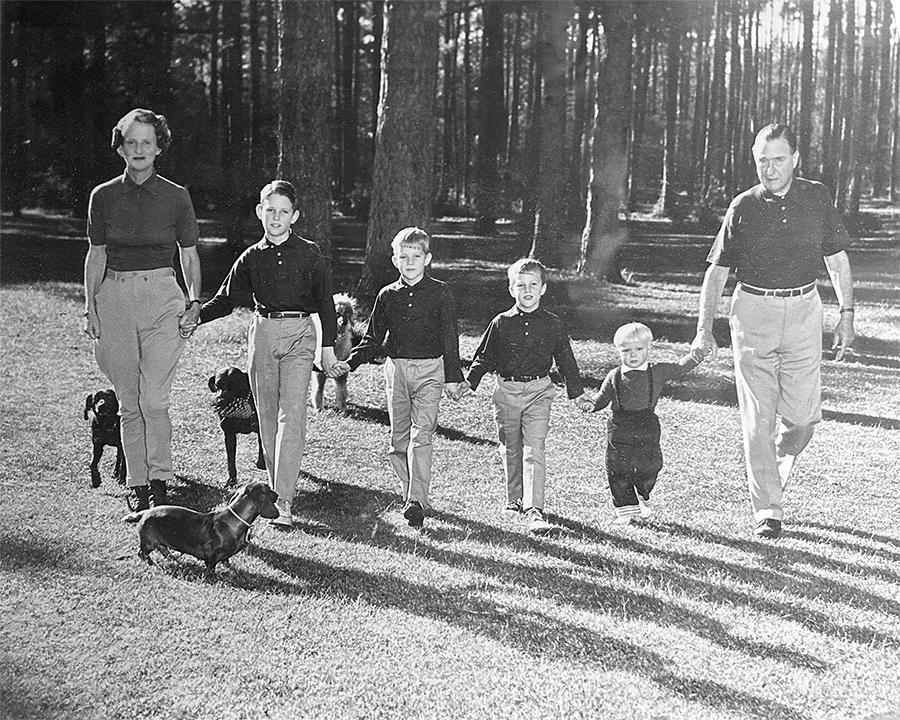
Two miles down Linden Road, west of Clarendon Gardens, lies the nearly 2,000-acre Sandy Woods Farm. Owners Mr. and Mrs. Q.A. Shaw McKean (Shaw and Katharine), having just arrived from Europe, were experiencing a bit of jet lag that morning. Their 6-year-old son, David, was playing in the McKeans’ rambling brick house while his three older brothers — John, Tom and Robert — were away at boarding school in the family’s home state of Massachusetts.

Shaw, a 1913 Harvard University grad and standout polo player, had amassed his fortune in banking and investments. His wife, the former Katharine Winthrop, was descended from Puritan John Winthrop, the first governor of the Massachusetts Bay Colony. She’d been a top-ranked tennis player during the late 1930s and early ’40s, winning the 1944 United States Indoors title.

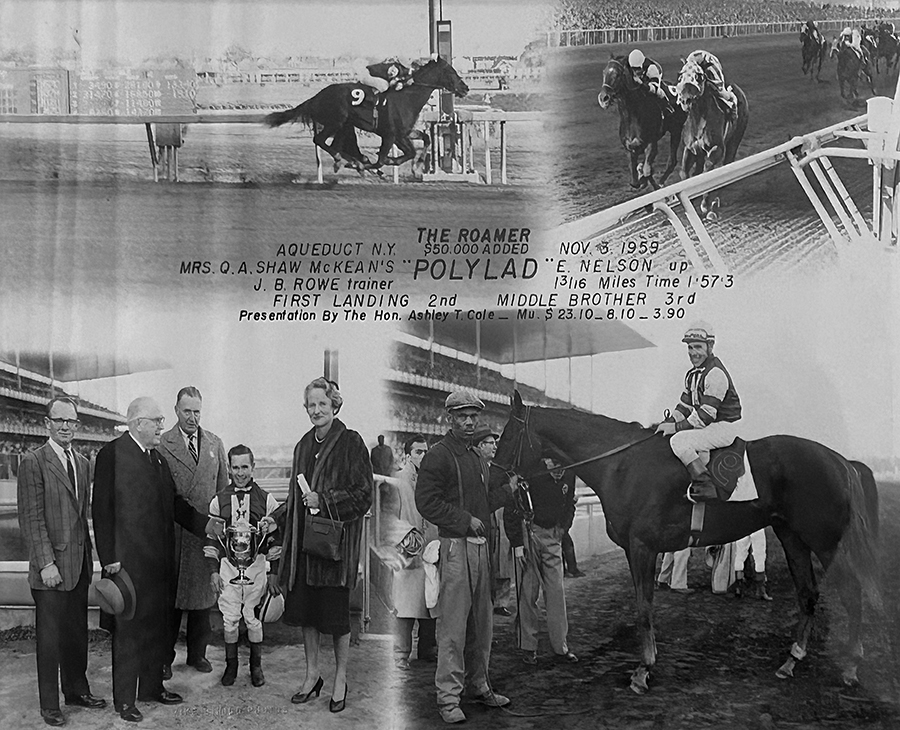
Active participants in big-time Thoroughbred racing, the McKeans maintained an impressive stable of two dozen horses at Sandy Woods. The most prized was Polylad, winner of several important races including the 1961 Massachusetts Handicap in which the 5-year-old horse was spurred to a photo-finish victory by Hall of Fame jockey Eddie Arcaro. With major summer races upcoming, Shaw and Katharine would have been eager to catch up with head trainer John Donahue regarding the fitness of Polylad and his stablemates.

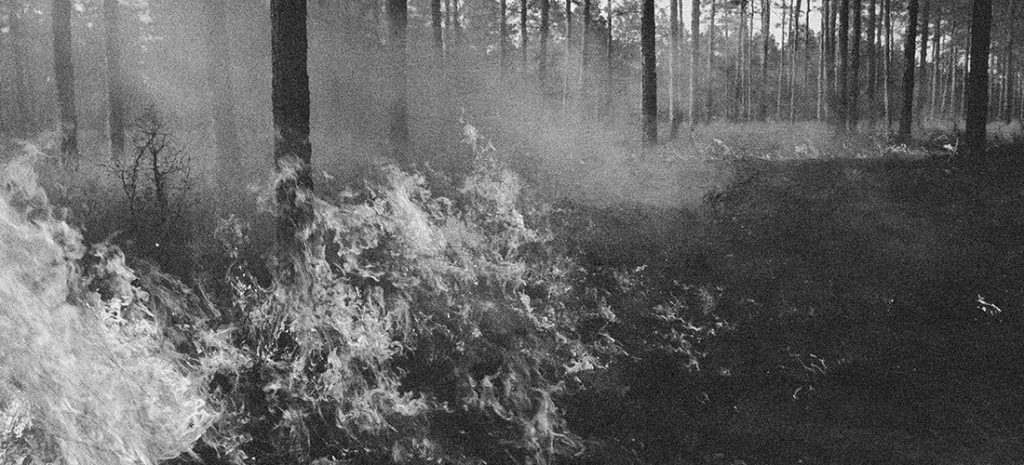
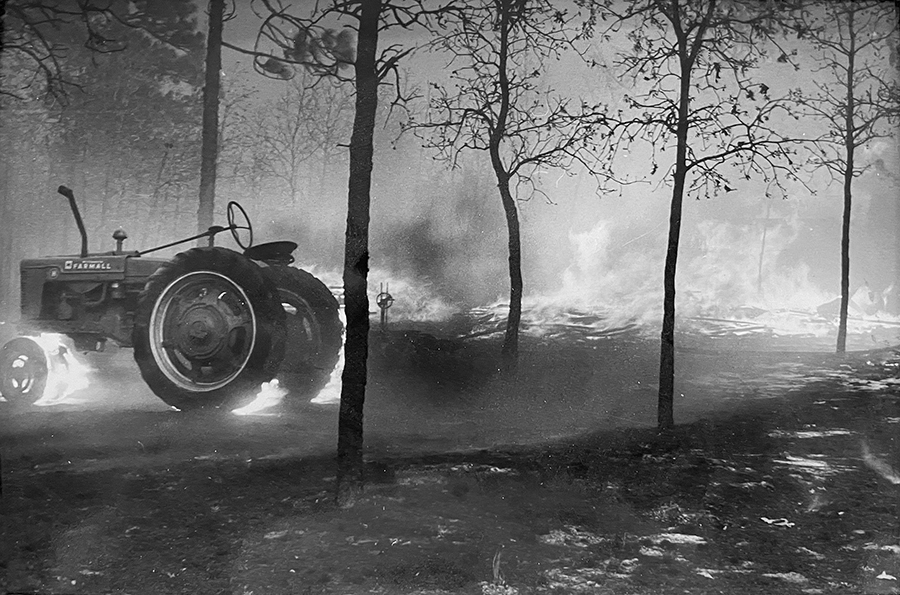
At around 10:30 a.m., when Donahue knocked on the McKeans’ front door, he was carrying more pressing news. A forest fire was burning several miles west of the farm. The operator of a small sawmill in West End had left a saw running while taking a water break. The unattended equipment threw off a spark, which in turn ignited a small brush fire. Before anyone knew what was happening, flames began spreading through the pine forest, supercharged by the wind and tinder box-dry conditions.

There was the prospect that intervening county roads could provide an effective firebreak, keeping the blaze away from Sandy Woods and populated areas. Given the prevailing wind, even if the fire leapfrogged the roads, it seemed likely to follow a path that would keep it north of the farm. While not an immediate threat to Sandy Woods, the situation was worrisome enough that Donahue and the McKeans considered the steps necessary to protect the property and themselves if the fire headed their way.

Meanwhile, Moore County forest ranger Travis Wicker was growing increasingly alarmed. He feared the exceedingly dry conditions, coupled with high winds (gusts between 40-50 miles per hour), were a recipe for disaster. Later, Wicker said the danger became magnified when the towering flames “jumped the old Jackson Springs Road. It got hot (out of control), and we knew we had a monster on our hands.”

It seemed nothing could stop or slow the fire. According to The Pilot, the blaze “skipped over roads and fields as if they weren’t there.” Driven by the wind, long prongs of intense flames licked out in multiple directions. The monster became multi-headed, and it was difficult to predict its precise path. There were fears the fire would strike downtown Pinehurst, then vault into the area’s other populated communities. Moreover, three lesser (albeit substantial) fires were burning in other parts of the county.

Fire departments from Moore County and elsewhere were dispatched to far-flung areas of the Sandhills. Coordinating them presented an organizational nightmare. The emergency code 911 didn’t yet exist, and radios didn’t link the volunteer fire departments to a central command center. “When we needed a rural fire truck to do a particular job, we had to send out another truck to hunt him up and give him the instructions,” said Wicker.

When the wind abruptly swung 45 degrees south, the path of the blaze shifted away from Pinehurst and straight in the direction of Sandy Woods’ stables and kennels. The McKeans and Donahue were suddenly faced with a worst-case scenario. But help was on the way, not only from local fire departments but also the McKeans’ friends and neighbors. Among them was Tom Howe, who hauled Clarendon Gardens’ spraying equipment to the scene.

He and other volunteers endured treacherous drives to the farm, blindly feeling their way down Linden Road through intense, spark-bearing black smoke. Given the near-zero visibility, they risked driving right into the inferno. Two brave responders were forced to dive under their truck and lie flat on the pavement until surrounding flames passed by them.

Donahue’s first priority was the evacuation of the horses. Using Sandy Woods’ own horse trailer along with another furnished by legendary harness racing great Octave Blake, Donahue transported 10 of the McKeans’ 24 horses, including Polylad, to safety. But before the trailers could return for a second load, the flames had reached the paddock area. Donahue faced an intractable dilemma. The remaining horses were doomed if he turned them out into the now fiery paddock. Hoping against hope that the blaze would skirt the stables, the trainer decided holding the frightened horses in their stalls was their best bet for survival.

Tragically, they were doomed. The Pilot reported that “with the gale shifting winds, there was no safety anywhere. In a second’s time, it seemed, the stables were ablaze from heat and flying sparks as well as the kennels, and all were engulfed in the inferno.” 

The wildfire now loomed within striking distance of the McKeans’ brick home, a half-mile from the stables. Responders feverishly dug a firebreak trench around the periphery of the house while Howe, horseman Pappy Moss, and firefighters from Vass and Pinehurst drenched the structure and surrounding vegetation.

David McKean, now 65, has vivid recollections of his mother appearing at the back of the house and telling him, “We have to leave right now!” The anxiety in her voice was in such marked contrast to her usual unflappable demeanor that 6-year-old David realized the situation was gravely dangerous.

The McKeans hustled to the family car. On their way out the door, they managed to grab a silver trophy commemorating one of Polylad’s victories and a cherished 18th century oil painting by English artist George Morland.

Exiting the farm proved more perilous than it would have been to sit tight at the house. The farm’s mile-long drive to Linden Road had become impassable due to the fire at the stables, so Shaw and Katharine chose a seldom-used back way through the property that led to Roseland Road. David recalls that as his mother drove down the remote path, “there was a burning tree in front of the car — I don’t remember if it fell as we were driving, or if it was already there — and she attempted (unsuccessfully) to drive over it.” With the fire spitting at the McKeans from the rear, it was impossible to back the vehicle out of danger. David and his parents abandoned the car and ran to an adjacent field.

They were spotted by Pinehurst Harness Track veterinarian Dr. John Peters, who came to their rescue and transported them to safety. The McKeans’ house, though scorched in places, escaped serious damage, but their automobile was burned to a crisp. Also destroyed were Polylad’s trophy and the Morland painting, both left behind in the trunk.
Returning home from Chapel Hill in the early afternoon, Pinebluff Mayor E.H. Mills noticed black smoke in the sky west of Pinehurst. Mills followed the smoke to its source at Sandy Woods. Arriving at the farm, the mayor witnessed the frenzied efforts of volunteers to create firebreaks and he, too, pitched in to help until he was met by reporter Valerie Nicholson, covering the disaster for The Pilot.

“Mayor,” she said, “you better get to Pinebluff. The fire is headed there. Your town could burn up.” Mills ran to his car and drove through the haze toward home. On the way, he pondered how his community of 600 could marshal the resources to repel the fire. Tom Howe, concerned with the safety of his wife, children and farm, also rushed home after the blaze at Sandy Woods was under control.

As the fire moved south toward Pinebluff, it caused considerable damage. According to the Sandhills Citizen, it “licked out a vicious tongue at the farming community of Roseland, two miles from Aberdeen, gobbling up two homes and nearly all outbuildings with some 10,000 chicks in two farmyards.” At the Country Acres subdivision off Sand Pit Road (then Gravel Pit Road), it consumed a house and trailer. “With the fire burning right into the yards,” reported the Citizen, “the homeowners watched in an anxious group from the highway intersection.” Several houses caught fire and responding firefighters beat out the flames.

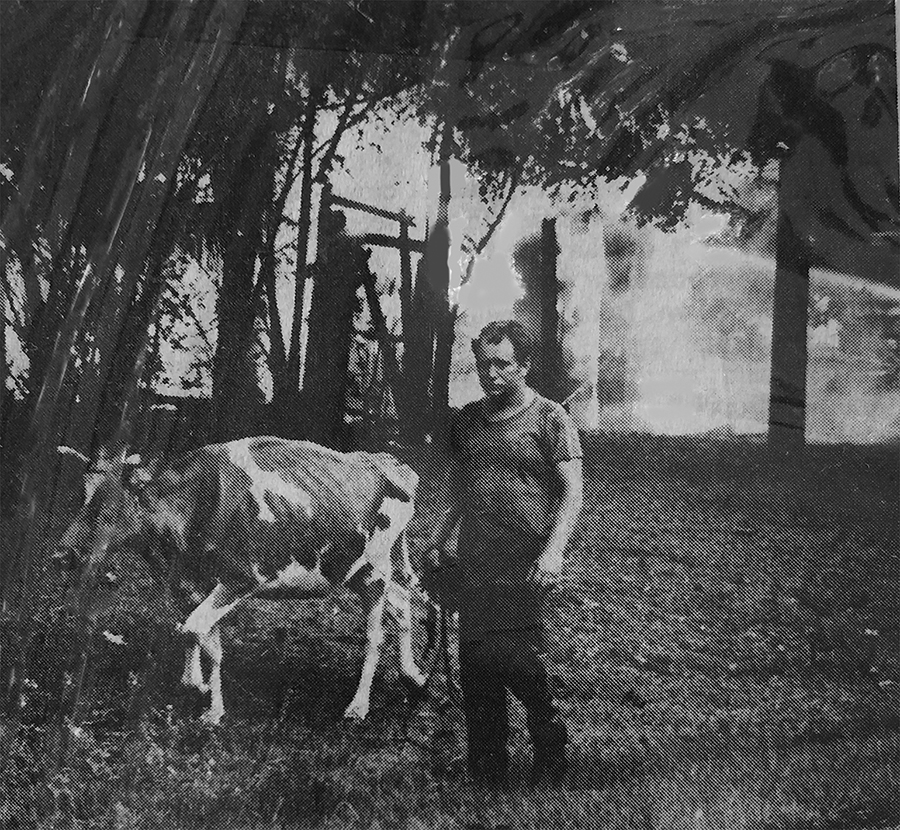
Howe’s route home brought him within sight of Country Acres but, as Tom turned off Route 5 onto Sand Pit Road, he noticed something else. A herd of clearly distressed cows, enveloped by smoke, were straining at the fence alongside the road. A former dairy farmer himself, Tom stopped his truck, cut the fence and freed the cows, who meandered down Route 5 toward Aberdeen.

Back in his pickup, Howe was unable to proceed further because firetrucks blocked progress down Sand Pit. Desperate to assist his family, he maneuvered around the trucks by ramming his pickup through the fence where he’d just freed the livestock, flattening it.

Meanwhile, the fire near Sand Pit Road was bearing down on Elmore Smith’s small dairy operation located off West Baltimore Street just outside Pinebluff. Riding his tractor, Smith, 61, caught sight of approaching dense smoke. Since the blackness seemed far off, he assumed there would be time to take any necessary precautions. Comforted by the fact that his farm and outbuildings were surrounded by open fields and pasture — the woods were 500 feet away — Smith expected his operation would escape serious damage.

Within minutes, a breathtaking tornado of fire catapulted over Smith’s field and came down on his farm. “The sky was filled with fire, boiling in the air, an inferno 100 yards high,” said Smith. The gusty wind had caused the fire to crown, rocketing immense flames skyward a half-mile or more ahead of the heart of the blaze. According to The Pilot, Smith turned out his mule and seven cattle, “smacking them to run off and save themselves.” Elmore’s wife and 18-year-old son ran from the house. The family escaped, but the Smiths’ house, barns, chicken houses, two autos and two pickup trucks were consumed.

After wreaking havoc at Smith’s farm, the fire roared toward downtown Pinebluff. Fire Chief W.K. Carpenter, Jr. sounded the siren. Around 5 p.m., the flames crossed over U.S. 1 at the approximate location of today’s Dollar General Store. It had taken only seven hours for the fire to cover the 14 miles from West End to Pinebluff. According to the Sandhills Citizen, it “leapfrogged from tree to tree and crept relentlessly on the ground through thick pine needles from yard to yard.” A separate prong of the fire jumped the highway south of town.

A veritable army of firefighters from far and near, the District Forester’s office headed by Chief J.A. Pippin, members of rescue squads, as well as ordinary citizens, were poised to fight the blaze in Pinebluff. So, too, were soldiers. It was Tom Howe’s mother, Mary, who persuaded Fort Bragg military brass to authorize aid to the town.

Back at the Howe’s Aurora Hills farm, Nancy was unaware of these happenings when sister-in-law Susan Howe Wain began pounding on her door and shouting, “I need to get on your roof with the garden hose!” According to her memoir titled Dear Owie, when Nancy went outside and looked up, she was aghast to see hot burning embers “falling and dancing on the roof, bouncing up and down, and sailing through the air like they were dissatisfied with my roof and were looking for a better place to land.”

When Tom pulled in the driveway and jumped from the truck, his face, recalled Nancy, was completely blackened and covered with soot, “except for his eyes that peered out from his glasses, like a frog looking for a fly to eat.”

Howe gave urgent instructions, detailed in Dear Owie. “I want you to pack up important papers and a few clothes, food, and water, and be ready to leave. If it gets bad, you all get in the car and drive as hard as you can into the middle of the plowed field across from the house.” Nancy wound up huddled in the field with her boys. While the fire would miss them and their home, Tom’s work was far from over. He rushed to assist others in town where the battle to contain the fire had become a house-by-house struggle.

Hot embers relentlessly dripped from neighborhood pines onto homeowners’ roofs, igniting scores of little fires. Many houses caught fire “again and again only to have the flames put out by workers converging solidly upon them,” wrote the Citizen. Not all the proliferating fires could be extinguished in time to save homes. The residences of Richard Graham and Cad Bennett were destroyed, and countless others sustained severe damage.

Pinebluff’s town council had been scheduled to meet the evening of April 4. Madeline Charles, the town clerk, took the town’s books to her home so she would have them ready for the meeting. The Citizen reported that when the fire jumped the highway, “right in front of the Charles’ home, she searched wildly for a safe place to stash the books.” She wound up stuffing them in the family freezer before running off to fight the fire raging on her lawn.

With a second swath of the blaze threatening the south end of town, the Robbins Rescue Squad and several Fort Bragg soldiers, as a precautionary measure, moved to evacuate residents of the Pinebluff Sanitarium, now long gone. That second swath fortunately failed to reach either the sanitarium or residential areas. Farther south down U.S. 1, David Spence, a machinist whose unique enterprise involved the specialized forging of horseshoes for harness racing horses, was not so lucky. His building and equipment were totally wiped out, causing an estimated loss of $40,000. The Addor area also was hit hard.

So much water was thrown on the fire that the Pinebluff water tank ran dangerously low, and Chief Carpenter ordered his trucks to start drafting from the lake. “We have a fine water system,” said the chief, “but no small town is prepared for a thing like this.”
   

Those residents not involved in fighting the fire contributed in other ways, manning the Red Cross food station or retrieving lost pets. Carpenter’s own children, Cathy, 13, and Billy Jr., served food past midnight. “They wanted to help,” remarked their mother, Marion, “and I let them stay up even though they are so young. After all, this is their town.”

By 11 p.m. the danger to the town and Moore County was over as the fire blew farther south, ravaging acreage in Camp Mackall before finally petering out at Drowning Creek. The final toll was staggering: 26,000 acres burned, two-thirds of them woodlands; 5,000 acres of planted areas lost; engagement of 4,000 firefighters; the razing of 14 dwellings, 25 barns, two business buildings, and the death of an untold number of animals. Fortunately, no human lives were lost.

The nightmare wasn’t over for Tom Howe. Katharine McKean asked him to bury the horses destroyed at Sandy Woods. Howe told his wife it was the most gut-wrenching experience of his life.

Howe eventually started a nursery business at Aurora Hills, which he operated until his death in 2015. His two sons still run the business. Nancy continues to live in Moore County, as does Susan Howe Wain.

The McKean family still owns Sandy Woods, though the stables no longer house racehorses. Shaw and Katharine have long since passed on. Son John lived at the farm until his death in 2019. His brother Tom, a retired Massachusetts attorney, now looks over the property. Brother David, who escaped the fire that day, became a diplomat, serving as ambassador to Luxembourg and director of policy planning for the Department of State. He’s a successful author of books about 20th century American history.

Could the wildfire of 1963 happen today? One factor that reduces the chances of a similar catastrophe is the increased use of controlled burning. Forest fires require fuel to accelerate and, especially in a longleaf pine forest, much of that fuel comes from the wiregrass and scrub oak underlying the trees. Jesse Wembley of West End, whose mission locally is educating area landowners and farmers about the benefits of controlled burning, says, “We have to learn to live with fire. Particularly here in the Sandhills, it is part of the natural process. With it, we get an improved ecosystem and peace of mind.”

There was little piece of mind that day in April. Lifetime Pinebluff resident John Mills, son of the former mayor, says, “It is a miracle the fire missed Pinehurst and a double miracle it didn’t burn all of Pinebluff to the ground.”  PS

Pinehurst resident Bill Case is PineStraw’s history man. He can be reached at Bill.Case@thompsonhine.com.

Shooting the Stars

Shooting the Stars

Spacing out with a Sandhills photographer

By Jenna Biter   

Photographs by Larry Pizzi

Feature photograph: The Western Veil Nebula or Witch’s Broom is the remains of a star that exploded more than 10,000 years ago


Left: Comet NEOWISE C/2020 F3 over Lake Auman in Seven Lakes

Right: NGC 1499 the California Nebula is shaped like the Golden State. It’s a nearby neighbor — only 1,000 light years from Earth.


At the end of another day, the Earth turns its face from the sun, and dusk stretches its long arms over the horizon, tucking half of the globe under the heavy blanket of night. In the thick of North Carolina pine country, drowsy towns go dim but not yet dark, like fires burnt to embers.

Somewhere in Seven Lakes, on a wide corner lot occupied by an agreeable yellow house, one Northerner-come-south seems immune to the lullaby of night.

As a neighbor’s kitchen light goes out, the yellow house stirs. Its garage door rolls up, and a man dressed in a vacation-style shirt fit for Georges Seurat’s La Grande Jatte steps onto his driveway under the purple fresco of Starry Night. He pushes a tripod fixed atop caster wheels into the middle of the blacktop, then steps back to eye the mechanical spider. It has one oculus instead of eight, a 21st-century Cyclops capable of probing the heavens.

Larry Pizzi rolls the telescope forward and back, left to right, manually repositioning the tripod before fine-tuning the focus and field of view with swipes on an iPad.

“My telescopes, you don’t look through them,” Larry explained earlier in the living room inside the agreeable yellow house. Antique clocks chattered from the walls, their pendulums tick-tocking as they waved hello and goodbye. Like a chorus of teakettles whistling with steam, the clocks burst into chirps and chimes and dings at set intervals — like clockwork.

Left: SH2-275, the Rosette Nebula, is a star incubator. Its gasses and dust allow stars to form in it.


“Sorry about that,” Larry said.

“That’s his other hobby,” his wife, Wendy, said, seated on the floor. Beside her, their small pooch, Dibley, champed at a stuffed alligator. He ripped with such enthusiasm that he seemed to understand the irony.

“There are a hundred clocks here, and a hundred still in storage in the garage,” Larry said, then returned to his other passion. “My telescopes, they’re like really big camera lenses.”

Larry’s dad, Joe, surprised him with his first telescope when he was in fourth grade. He didn’t get his first camera until a year later. Of course, Larry unscrewed screws and peeled back metal housings to investigate both gadgets, as little boys are prone to do.

“I was good at taking things apart, not really great at putting them back together,” he admitted. “I ruined that camera.” His tone sagged with momentary regret.

“God bless digital cameras,” Wendy cracked, bringing her husband back.

He grinned. “I had to know how it worked, you know?”

Left: M33, the Triangulum Galaxy

Right: M45, the Pleiades or the Seven Sisters is easy to spot with the naked eye in the constellation Taurus, the Bull.


Larry kept up with photography through three careers and the lion’s share of his almost 70 years, focusing mostly on eye-level wonders, from the covered bridges of Pennsylvania Amish country to Appalachian waterfalls. It was almost as though he had forgotten to look up.

“It was in high school that I really got into astronomy and started a little bit of astrophotography,” Larry said. “But then life intervened for about 40 years.”

It wasn’t until 2018, when the Pizzis moved south to the Sandhills, that Larry resurrected a telescope from the bowels of his garage and days gone by.

“Clear skies,” he said. “We came from New Jersey.”

“Plus, you were retired when you moved here,” Wendy pointed out. “You no longer had your day job.”

After serving in the Army for 21 years and working with nonprofits for another decade, Pizzi retired from his third and favorite career in 2016. A classics major, he taught English and Latin for a dozen or so years in the part of New Jersey that thinks it’s Philadelphia.

Back outside, Larry, though no longer a teacher, diagrams his telescope with the quiet confidence of a veteran professor lecturing on the human skeleton. “This is the main camera,” he says, pointing to a cylinder at the butt of the telescope’s yard-long tube where the eyepiece would normally seat. “This is the guide telescope, and this is a guide camera.” He finishes the anatomical tour before gazing up at the now-black sky.

“Tonight’s target is a nebula,” he says. Like many of the clouds swirling with cosmic dust and gas, this nebula located deep within the Cepheus constellation, beyond the reaches of the naked eye, has no name, only a designation: NGC 7822. Nebulae reveal the life cycle of the gods. Either they’re the birthplaces of the stars, like this night’s target, or they’re like overturned funeral urns, spilling the ashes of luminescent giants into the void. On this particular night, this particular nebula arcs through the band of sky perfectly visible — between rooflines and the crowns of longleaf pines — to the Cyclops in the middle of Larry’s blacktop.


Left: Part of a large complex of nebulae in the constellation of Orion. Upper left is the Flame Nebula. The dark formation is the Horsehead Nebula. The largest is M42, the Great Orion Nebula.

Right: A part of NGC 7000, the North America Nebula. The bright part is called the Cygnus Wall, a formation of very hot gasses and dust actively giving birth to stars.


“Taking the pictures is actually the easiest part,” Larry says. Once the telescope locks onto its target, the oculus, like a landbound guardian angel, watches the cosmic traveler move through the sky, snapping photos all the while.

“When you’re taking a picture, you don’t take a picture,” he says, hanging onto the ‘A.’ “You take dozens if not hundreds of short exposures.” Larry usually shoots 100 to 150 frames in a session. “And sometimes, you do it over multiple nights, the same target.”

After shooting, Larry stacks the frames on top of each other like a digital layer cake. Then he attends to each frame individually, checking them for the taillights of stray aircraft or the glow of the neighbor’s kitchen, before combining the unflawed frames into the final photo.

“It’s at least eight to 12 hours to process the photos,” he says. The process happens on a pair of computer monitors at a corner desk in a corner room that Larry dubbed “the digital darkroom.” Of course, a clock chatters happily from the wall behind.

“The way I take pictures is the exact same way the James Webb Telescope takes a picture,” Larry says. “Webb is just a little more sophisticated.”

Once the telescope finds its target, Larry turns away. He wheels around shooting a green laser into the dark and circles constellations. There’s Draco, Cygnus the Swan, and the W-shaped Cassiopeia. He points out stars like a maestro lost in the music of space and time, conducting the celestial orchestra.

“I think the reason he’s rekindled this passion is that retirement is a challenging season in life, and I think that this has made retirement a plus instead of a minus,” Wendy says.

“This is a great outlet,” Larry says. “I think I’m a frustrated artist.”  PS

Jenna Biter is a writer and military wife in the Sandhills. She can be reached at jennabiter@protonmail.com.

Poem January 2023

Change this heading to match Post Title

Talking in the Dark

Talking in the dark can be a way to begin

falling in love or becoming friends

again after a difficult day

in summer when late light walks away,

when the kitchen knives splayed on the table

hold galaxies that remind us to be playful

despite the sharp edges that the sun showed us.

Paired in the dark, in passion, night knows us

in ways we don’t know ourselves.

Something in us — coded into our cells? —

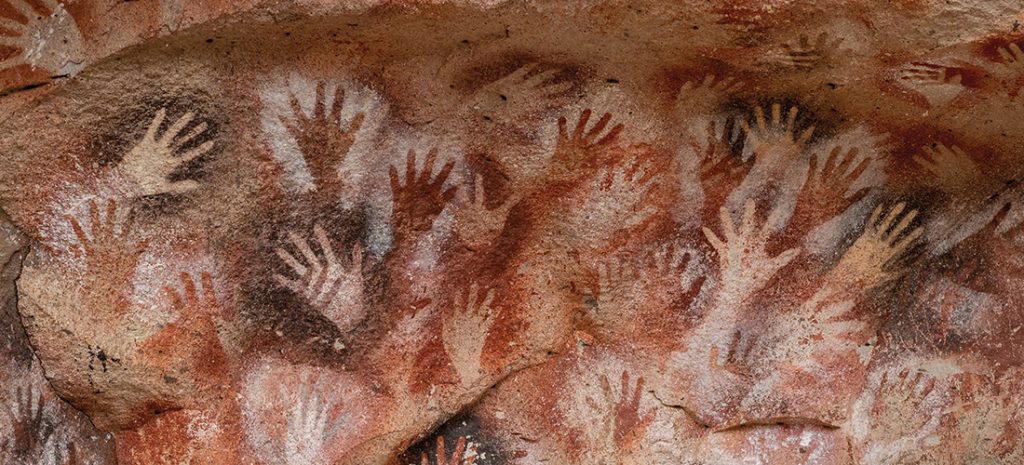
goes back to the time of sleeping in caves

when words were made to be believed,

where the walls were painted for dreams, for magic,

for hunts with spears, daggers, and hatchets.

The people on the walls are working together.

They have no anger. They have only hunger.

  Paul Jones

Paul Jones’ most recent book is Something Wonderful.

December 2022 Poem

Small Prayer

We see this ground as if through a spaceship’s

faceted metal eye. Having seen the blue round

as small as a child’s ball, having solved just enough

of mystery to be lost in what we think

we know. We’ve thought to play with it,

to make the planet smaller yet.

Now we do with it what we will,

forgetting how its vastness left us

speechless, worshipping. We lose

forest and furrow where we began.

And the kindred animals have begun

to leave. The water’s gone

that married time and loved the stone

into a canyon’s grace. We’ve forgotten

how to stay — how to say: this place.

Let the earth grow large enough again

that only clouds and stories can

encircle it entire. Let rockets land

for good, satellites fall dumb,

and wires unspan enough that distances

grow wide to dwarf our wars.

May mystery loom large enough again

to answer prayers and keep us.

  Betty Adcock

Betty Adcock is the author of Rough Fugue.

Story of a House

Touch of the Orient

Aberdeen’s John W. Graham House
is a colorful work of art

By Ashley Walshe     Photographs by John Gessner

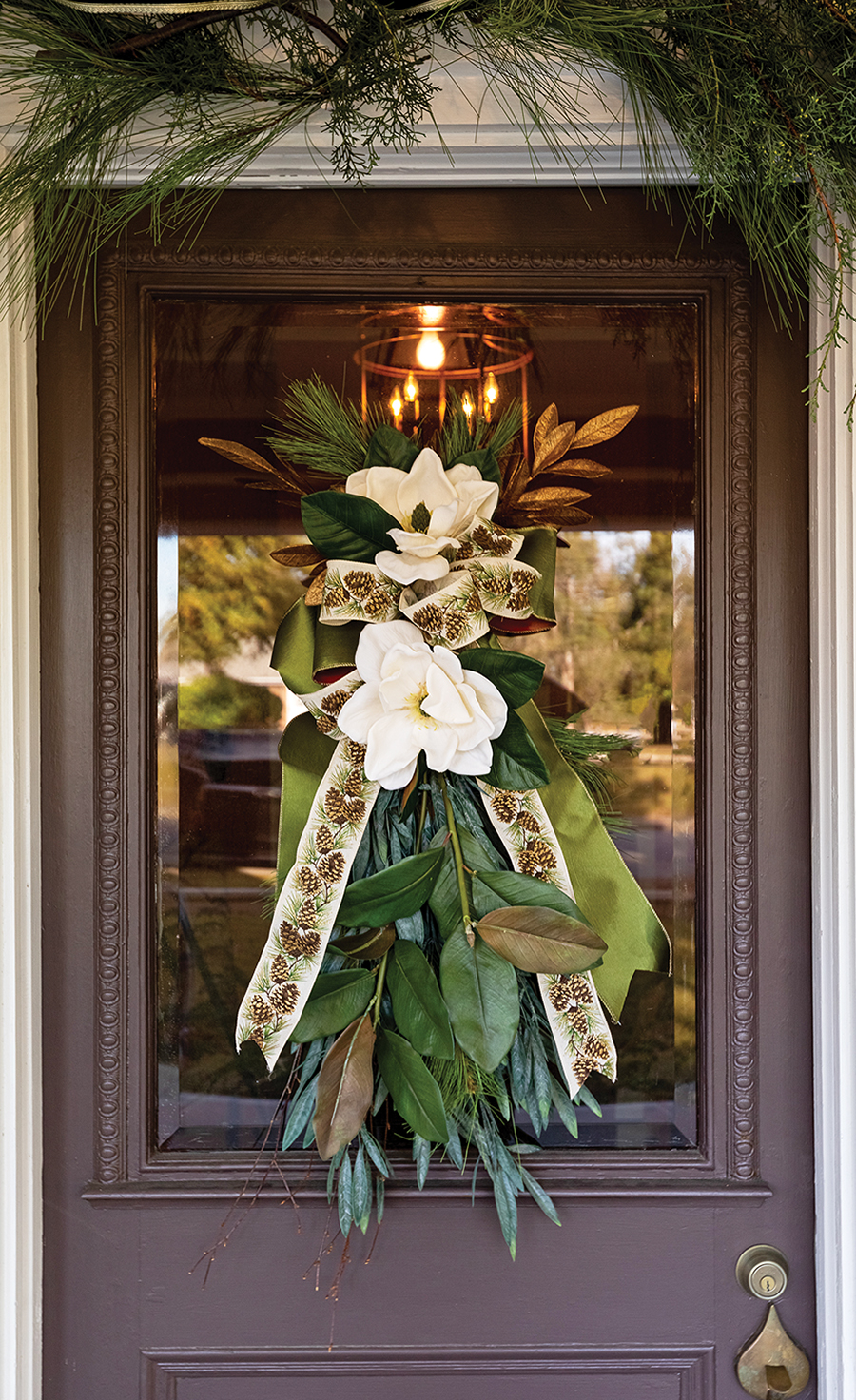
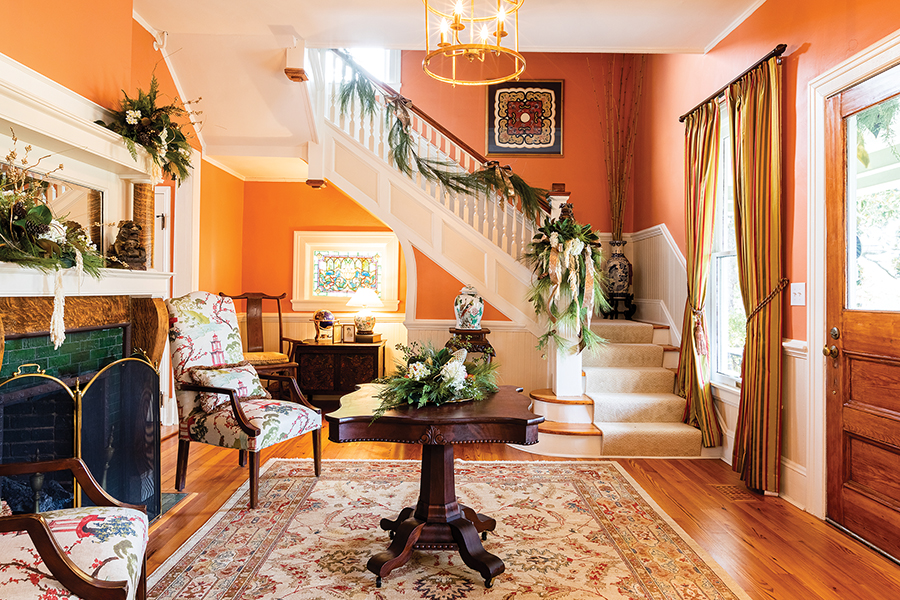
Christmas Styling by Hollyfield Design


In the late 1990s, Bart Boudreaux was living in Beijing, China, with his wife, Lynel, when a friend invited him to visit Pinehurst.

“It was a lot different back then,” says Boudreaux, a Louisiana native whose work in the oil business had taken him all over the globe. “Very quiet, calm. Not much traffic. That’s what we were looking for . . . especially coming from China.”

Of course, the world-class golf was part of the draw. “Unmatched,” says Boudreaux.

Life in Pinehurst became the pin on the narrowing horizon. In 2012, the couple bought and restored one of the 1895 James Walker Tufts cottages (The Woodbine) in Old Town Pinehurst, where the couple have lived since Bart’s retirement in 2015.

But this isn’t a story about that house, nor is it a story about Pinehurst. Ultimately, this is a marriage story. It begins with one man’s love of old houses.

“I can’t explain it,” says Boudreaux, trying to put his passion for restoration into words. “I needed to find something to do outside of golf.”

Perhaps his time in New Orleans influenced his taste for old houses. “Not everyone’s cup of tea,” he admits.

Regardless, buying and restoring them became his accidental pastime. In addition to the Pinehurst home, Boudreaux revamped the house next door (another one of Tufts’ original 38 cottages), renovated a 1930s Sears Roebuck on Dundee Road, then flipped one, two, three more fixer-uppers, all in Pinehurst.

Which brings us to his seventh and most recent project: a 1909 Victorian in downtown Aberdeen.

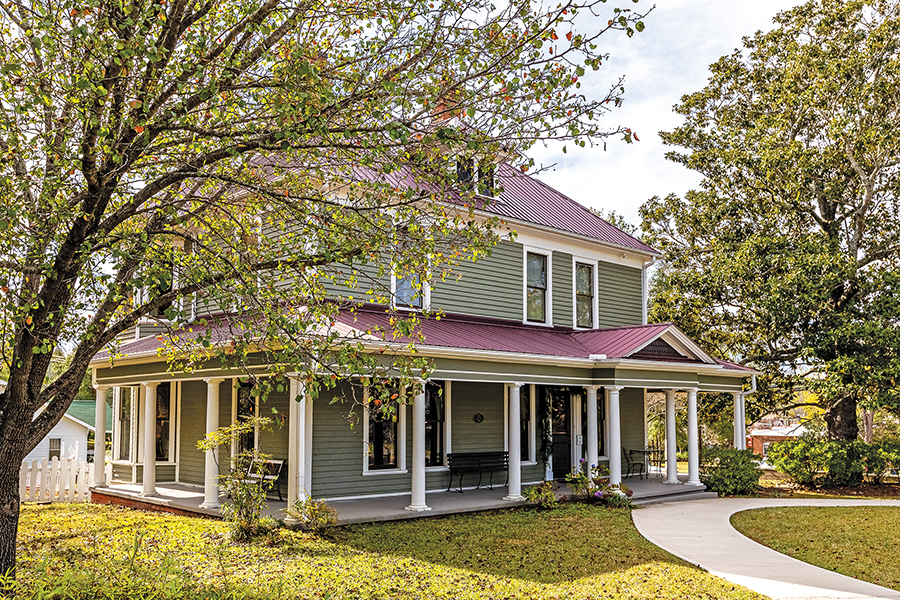
Situated on a spacious corner lot on High Street, the sage green double-pile with the classical Tuscan columns and wraparound porch once belonged to John W. Graham, son-in-law of Aberdeen and Rockfish Railroad founder John Blue. The exterior is grand yet understated, with an air of timelessness and restraint typical of Colonial Revival architecture. Boudreaux bought the National Register property in February of 2021 and devoted one year to its transformation.

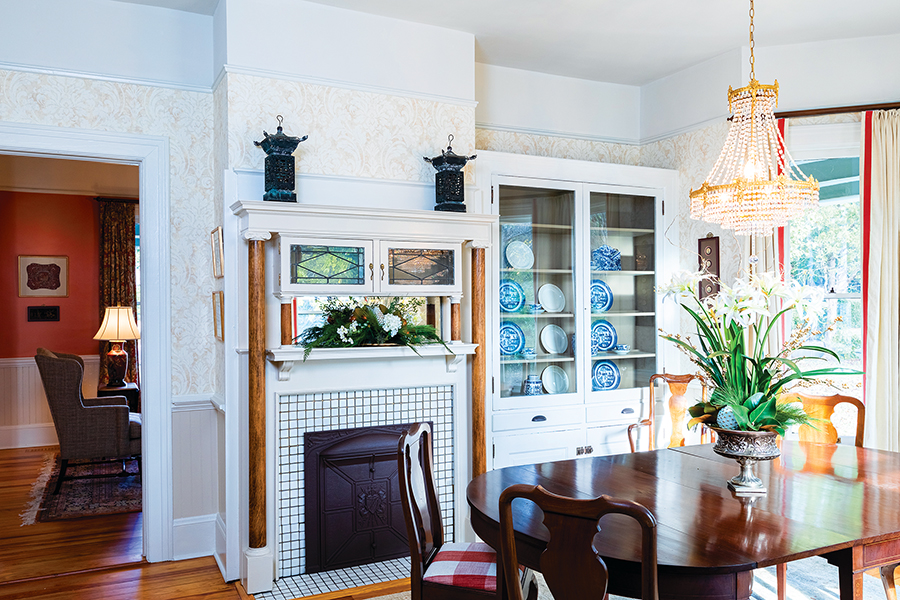
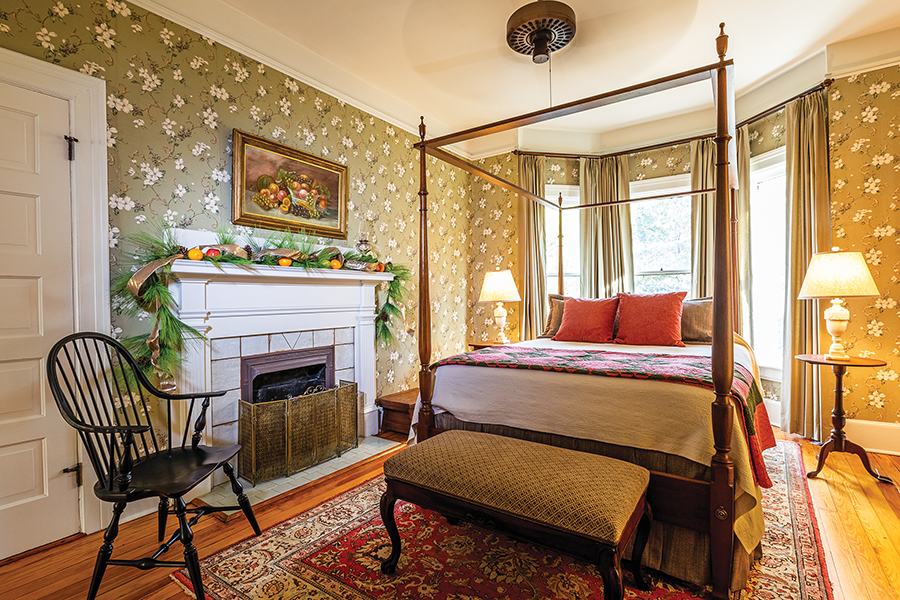
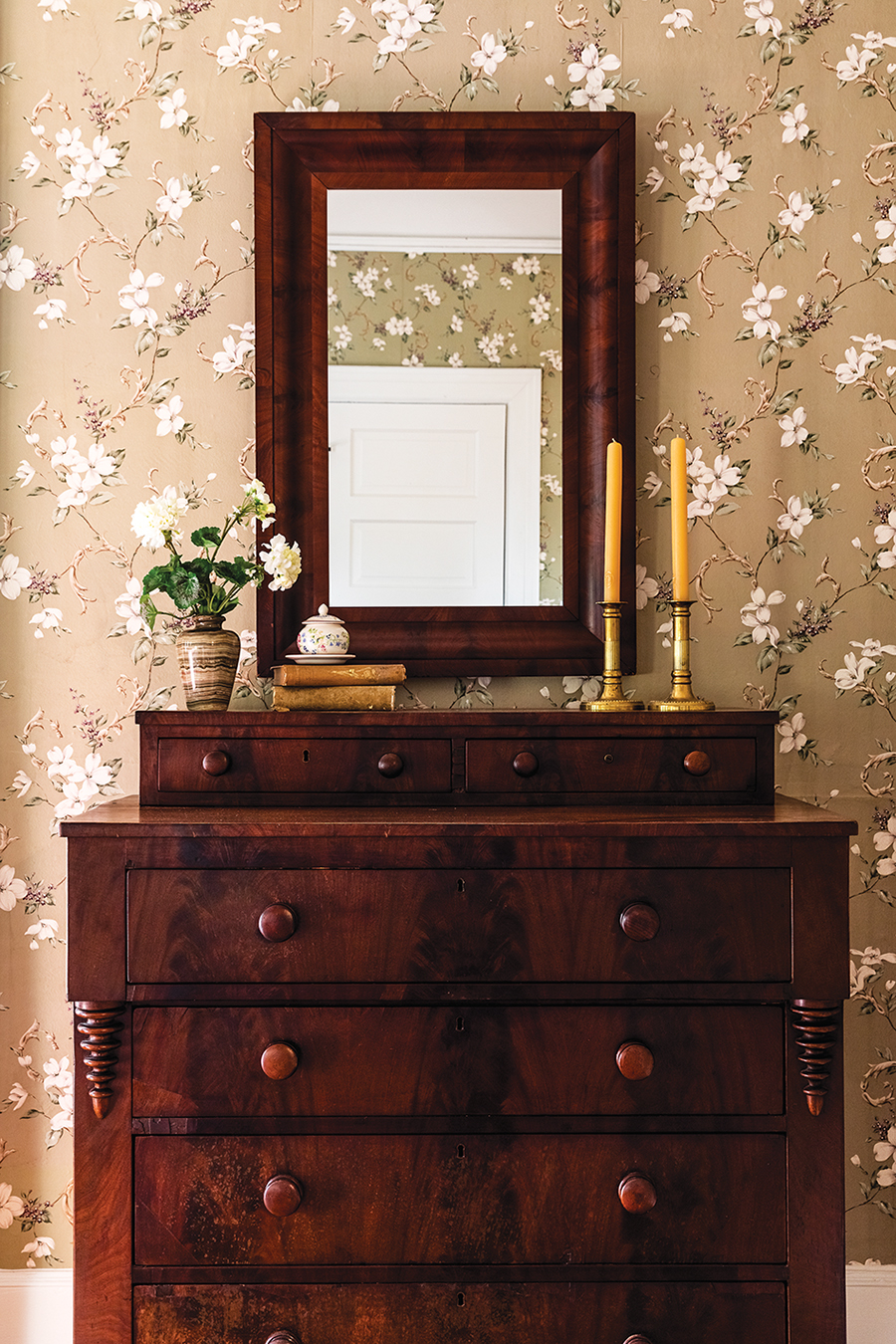
“It’s got tremendous character,” he says, noting the 10-foot ceilings and crown molding, the butler’s pantry, the two-story semi-octagonal bay, original dogwood wallpaper in one of the upstairs bedrooms, and five charming fireplaces throughout.

An original stained-glass window defines the nook beneath the half-turn staircase. Natural light floods every inch of the 2,500-square-foot space. Upstairs, transom windows above bedroom doors offer charm and function.

“I fell in love,” he says.

Heart pine flooring was repaired and restored. Old doors and tiger oak mantels, once hidden beneath layers of paint, are now among the home’s most striking features. Ditto the banister, stairs and newel caps.

“Almost killed me,” says Boudreaux of all the stripping. He did what he could himself and hired help to do the rest.


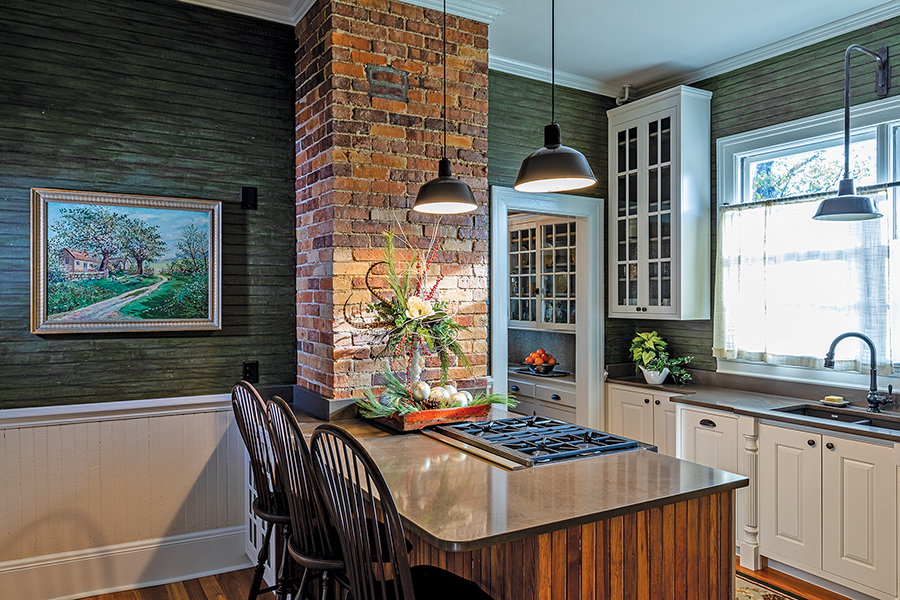
Boudreaux upgraded and reconfigured the kitchen, reintroducing an old entrance and constructing a small island with salvaged beadboard. He retiled and revamped existing baths (one full and one half); added a full bath upstairs; installed new cabinetry and quartz countertops; tinted original windows; exposed a bit of brick; updated plumbing, electrical wiring and appliances; replaced ductwork; and insulated the crawl space.

But he didn’t stop there.

Throughout the house, period-appropriate light fixtures (complete with ceiling medallions), fabric and furniture complement the architecture. 

“I just love the search for antiques,” he says, which is how he crossed paths with interior designer Jane Fairbanks of The Old Hardware Antiques in Cameron. “I know what I like. Jane’s got it.” 

Fairbanks helped Boudreaux outfit two of his Pinehurst homes in American country décor. “What he truly loves,” says the designer.

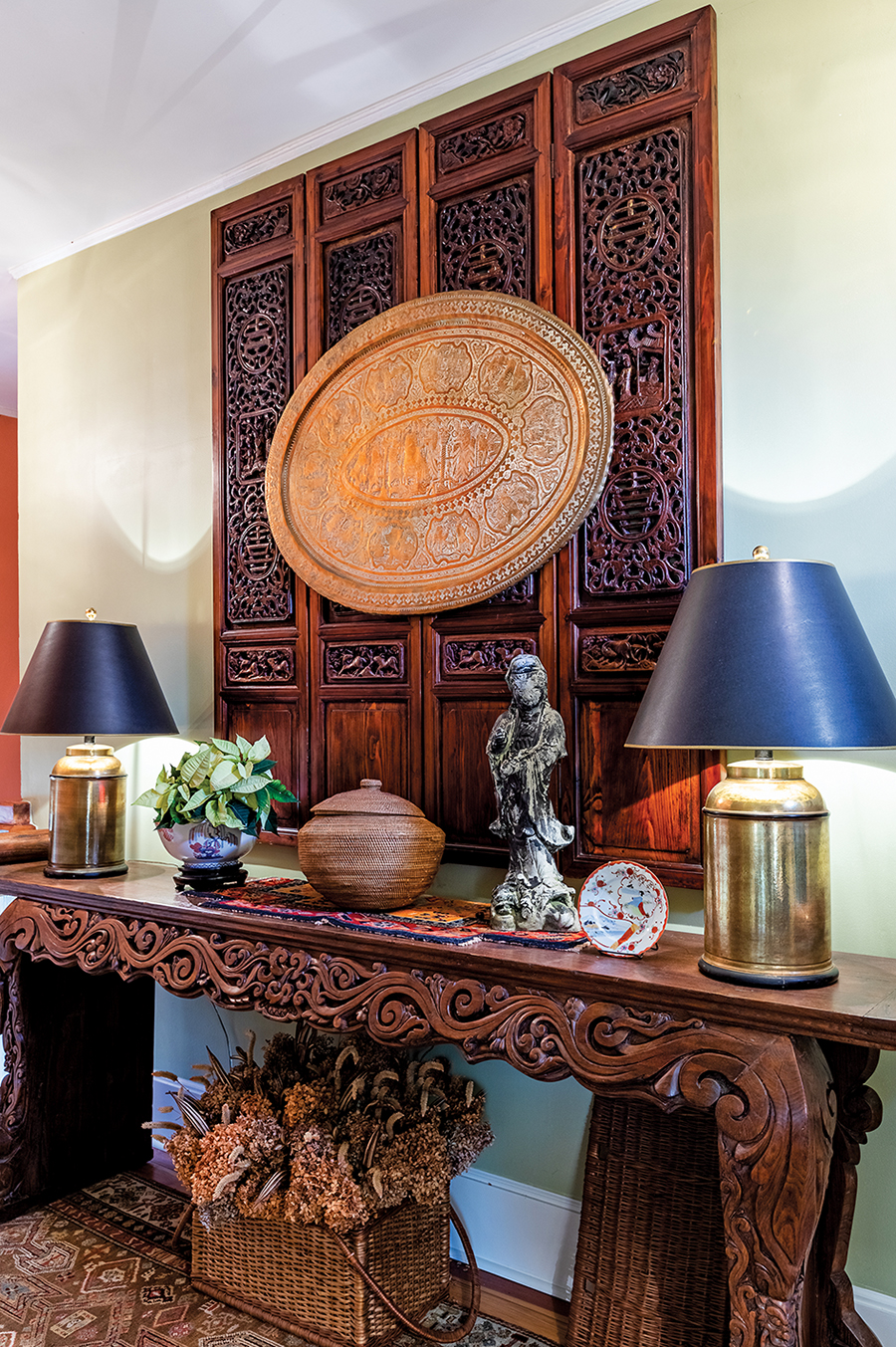
The interior of the Graham house is distinctly different. It’s an amalgam of color, texture and Victorian-era furnishings with a heavy emphasis on Oriental antiques —a marriage of tastes, his and hers. Flash back to China in the late 1990s.

“The oil company I worked for allowed us to transport one shipping container full of Chinese furniture back to the States on their nickel,” says Boudreaux.

Lynel, who worked as the assistant general manager at the Hilton Beijing, loaded up on ornate altar tables, hand-painted cabinets and intricate Chinese artwork — textiles in particular. Bart took Fairbanks to sift through the haul, in storage for over 20 years. Forgotten treasures were promptly dusted.

“They sort of became the inspiration for everything,” says Fairbanks.

Especially the colors. In the front parlor, coral walls pop against crisp white molding and cream-colored beadboard wainscoting. A hand-embroidered silk opera collar is framed and displayed on the wall above the staircase. Asian accent chairs covered in pagoda-themed fabric flank the fireplace, and a pair of wooden foo dogs (Chinese guardian lions) draw the eye to the quarter-sawn tiger oak mantel.

Beneath the stained-glass, a hinged easel frame displays photos of original homeowners John W. Graham, a cashier and officer of the Bank of Aberdeen, and his bride, Kate Blue Graham.

One wonders what Kate might think of the vibrant paint and forbidden stitch embroidery.


Beyond yellow pine pocket doors — “massive and heavy as led,” adds Fairbanks — coral walls spill into the living room, where a silk rug and custom curtains soften the space with delicate pink hues. This is where worlds begin to collide in a surprising way: an American country cherry corner cupboard (1840s), for instance, opposite a Chinese wedding cabinet featuring traditional brass hardware and a hand-painted imperial dragon.

For Lynel, each piece has a story, like the statuette of Guan Yin (female Buddha), positioned between the living and dining rooms.
“I bought her in a Beijing dirt market from a little blind man,” Lynel recalls. The vendor assured her that the wooden figure was quite old.

“Lǎo de, lǎo de,” he repeated.

It wasn’t. The Buddha split in half a few weeks later. 

“Sounded like a gunshot,” Lynel says between bouts of laughter. “She was new, made to look old . . . but I love her anyway.”

In the upstairs hallway, a teak altar table paired with a carved wooden screen make a bold and elaborate statement. The walls? Georgian Green by Benjamin Moore.

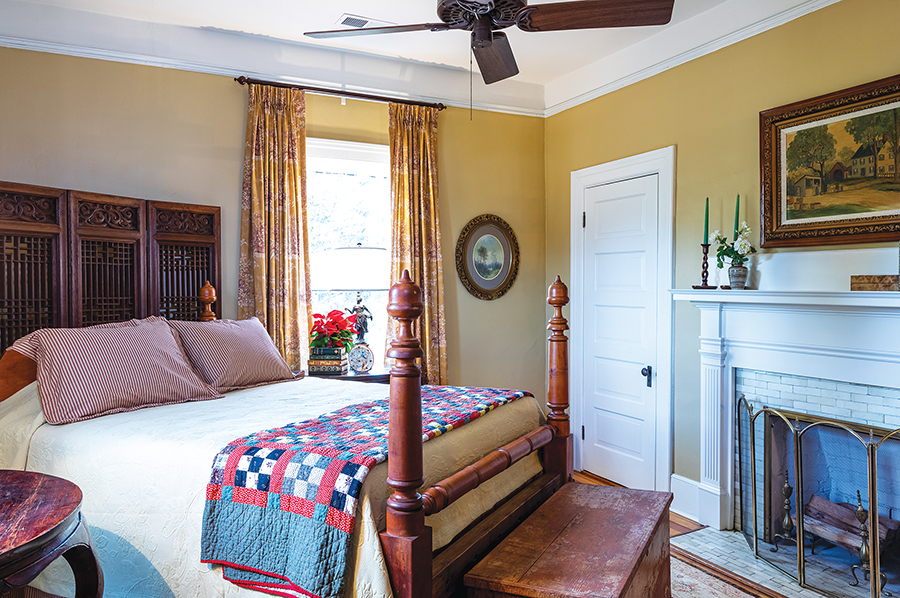
Bedrooms are handsomely outfitted. For one, an 1840s maple rope bed with curly maple headboard. A four-poster bed in another. The third features a faux curly maple queen anchored by an early 1840s blanket chest. Mounted oriental hair pins and an embroidered baby bib (and matching shoes) add color and whimsy.

“It’s just amazing how things can come from so many places and end up working so well together,” Fairbanks says.

The designer played a major role in bringing Bart’s vision for the house to life. “Big time,” he emphasizes.


All parties seem equally delighted by how it turned out. In the past, Boudreaux’s modus operandi has been to revamp and resell. But the John W. Graham house is a keeper. 

“Our Pinehurst house is on the market,” he explains.

Towns and dreams change. Bart and Lynel are moving back to Louisiana to be closer to family. The house on High Street will be their vacation home.

“Aberdeen is having a bit of a Renaissance, don’t you think?” says Lynel.

Bart’s golf clubs are there waiting. The house itself — a harmonious blend of tastes — is a labor of love ready to be enjoyed.  PS

Ashley Walshe, the former editor of O.Henry, lives up country and is dreaming up her next grand adventure. 

Through Rose-Colored Glass

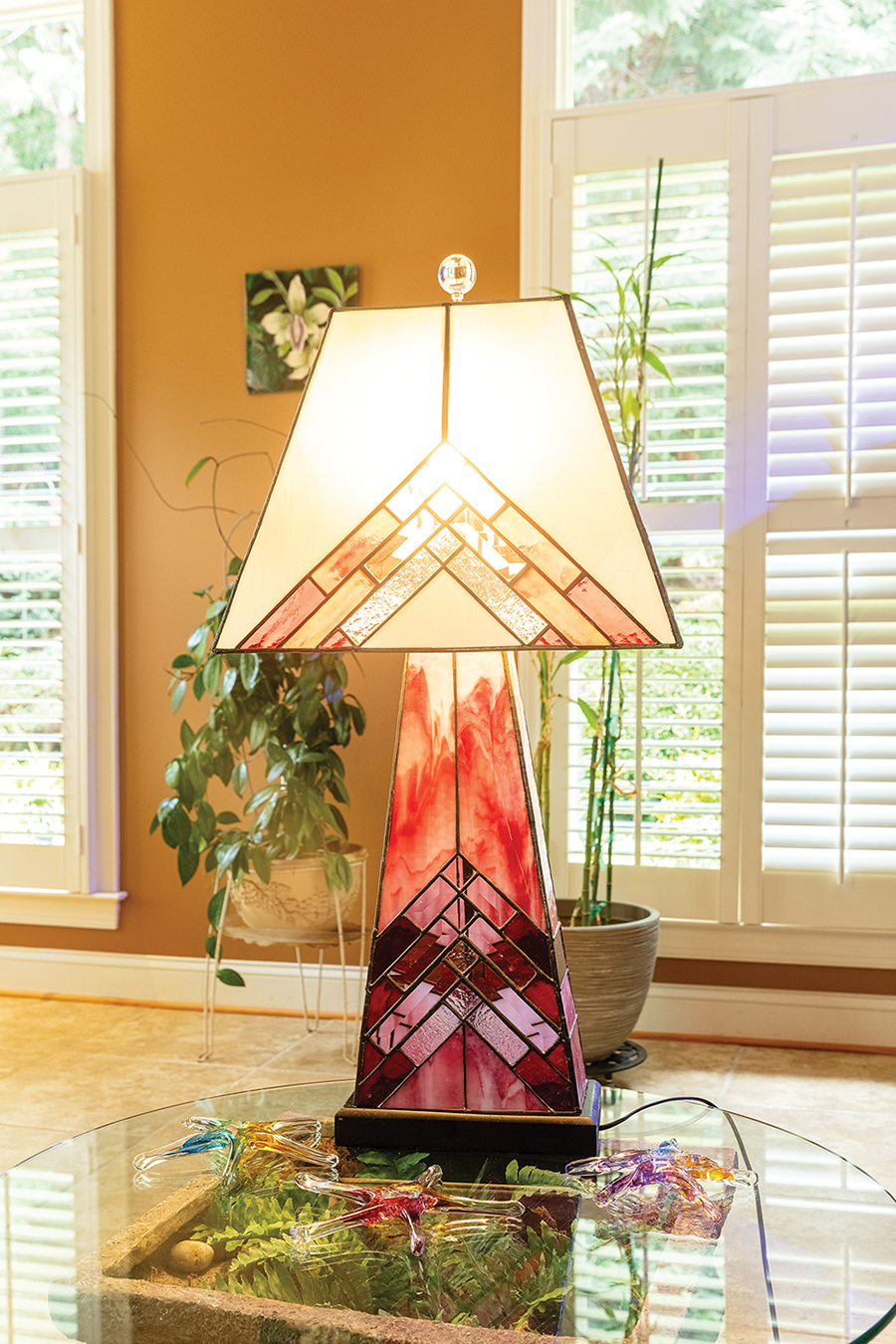
The art of working with stained glass

By Jenna Biter

Photographs by John Gessner


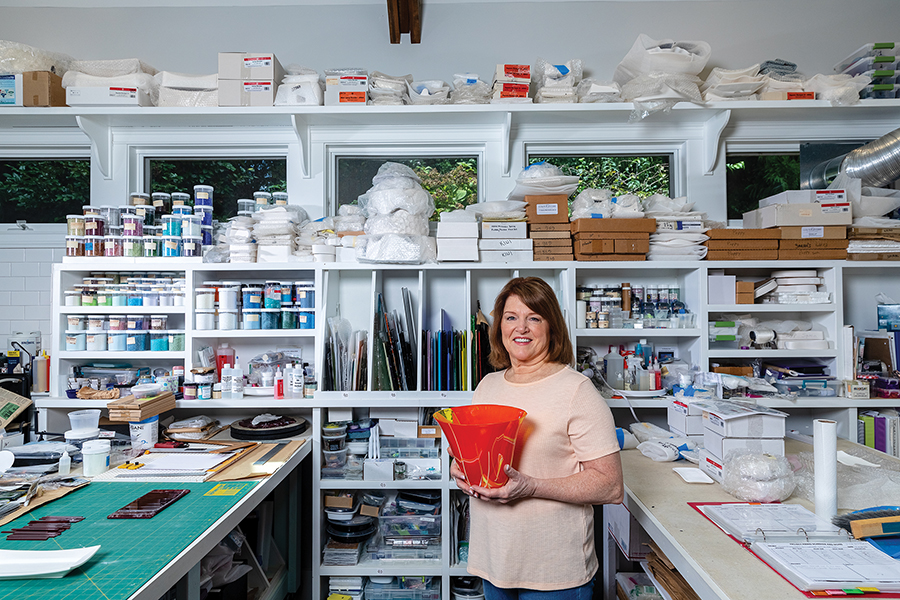
An oversized sheet of white craft paper unrolls across the worktable. “So, what I do,” Sarah Cawn says, her voice trailing off, distracted by a half-open box. “This is a big lamp I’m supposed to repair.” She lifts a cardboard flap and fingers the dome of a Tiffany-style glass shade.

“OK,” she says, gathering herself to explain the process of making beautiful things with stained glass. “This one I just finished.” She points to a drawing on unfurled paper. The contours of wavy-edged poppies and their swan-like stems arc through rectangles configured like the eight windowpanes they represent.

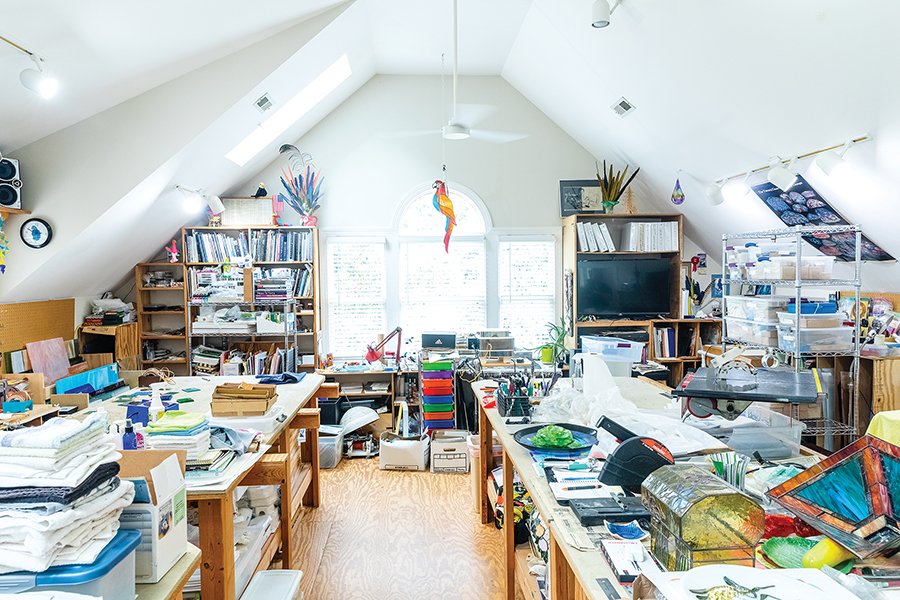
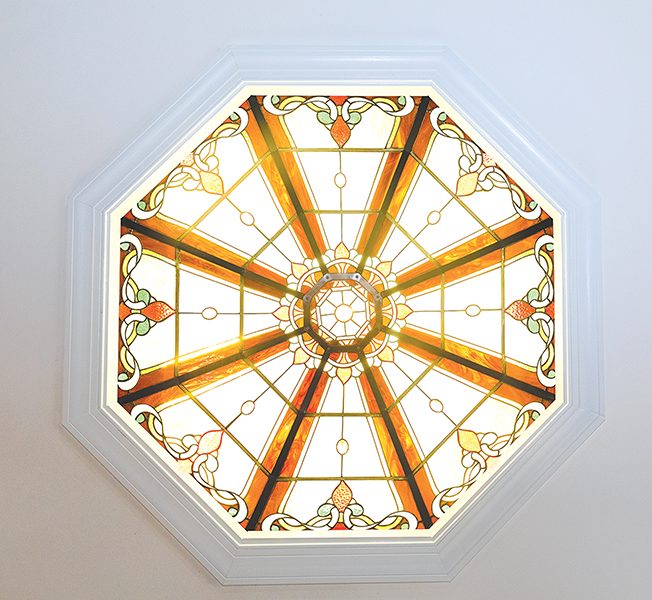
A gilded light casts itself across the drawing. Cawn points at the studio ceiling. “When we built the house, I had the builder box up the skylight so I could put that in there,” she says, her head tipped back. Above her a glass cupola of yellows and browns, trimmed in a filigree of rose and sea foam, warms the drawing below, willing it from the second dimension into the third.

Each section of the drawing, from the size of a button to the palm of a hand, whether it represents a petal, stem or sliver of background, wears a number as its name tag, all the way through 332, like a grown-up’s paint-by-number.

Cawn starts with the obvious. “I roll paper out and cut off as long a piece as I need.” She traces an index finger around each rectangle. “I had already drawn out the perimeters of each window, then put it up over there.” She points to a blank wall on the far side of the studio, half hidden by a table crowded with a collection of glass baubles: iridescent charms reminiscent of abalone, an amber chest overgrown with irises, a heart-shaped box, stacks of colored glass sheets, and a retro lampshade turned on its head.


She plucks the heart-shaped box from the menagerie like a client perusing the wares at a fine arts bazaar. “This is something that I inherited from somebody that got out of the business,” she says, holding the red vessel up to the light. “I thought if I fixed it, maybe I could — I don’t know.” Cawn turns the box over in her hand and inspects the soldering. She wrinkles her nose.

“It looks kinds of crummy, though. I don’t really want to sell it, so I probably should just junk it.” She sets the box down. “I just don’t feel right about selling something that isn’t mine.”

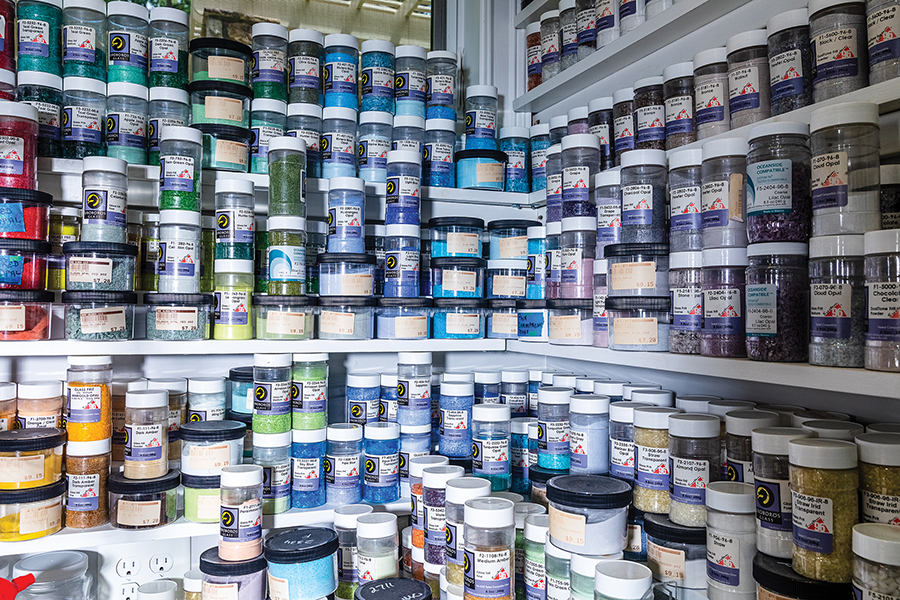
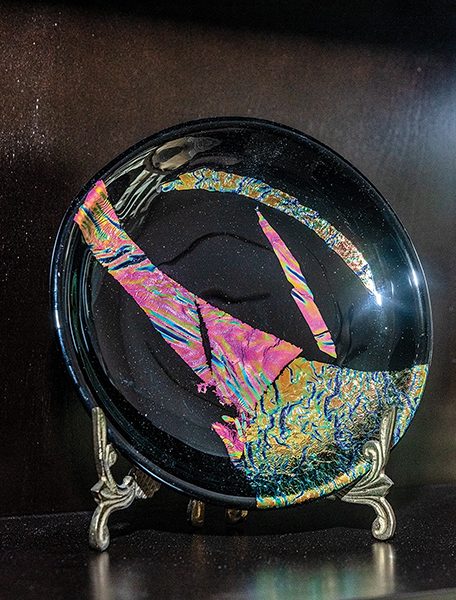
Cawn thumbs through colored glass sheets as if they’re playing cards, and she’s searching for the right one to start building a hand. Clack, clack. Each glass sheet is a different color, striated like the hard insides of a geode. Clack. There are emeralds and milky jades, electric blues and smoky blacks. One sheet is a galaxy of amethyst and mulberry; another swirls angrily like the eye of Jupiter, but in the soft nudes of a conch shell’s aperture.

“I thought it would be fun if I put them together like a patchwork and make cool wall hangings,” she rearranges the pieces like they’re quilt squares, thinking out loud,  “if I do the colors right.”


A scarlet macaw perched at the opposite end of the studio stares past Cawn at the half-hidden wall. The bird isn’t real — Cawn made it of glass — but it occupies the space of a live macaw, giving the impression, from the periphery, that it might squawk in its own colorful language.

She points back to the wall where she has tacked up the paper and penciled in the poppy design. “I’m going to be honest now, for the poppies — I do have an overhead.” She describes adjusting the projector until the blooms cast onto the paper create a convincing field of flowers, then she traces the pencil lines with black marker to finalize the design.

Cawn began making stained glass 40 years ago, give or take, at a Maryland shop (whose name she can’t remember and which has since closed) and has, ever since, been polishing her process as if it was, itself, a panel of stained glass.

“For me, it was like a drug,” she says with a shrug. “My husband made me a little workbench down in the basement and, at 10 o’clock at night, he’d go, ‘Are you coming to bed?’”

Through their moves to California, then throughout the Research Triangle in North Carolina, Cawn packed up her glass and tools — marked with a band of cheetah-print tape — and taken her craft with her.

In San Ramon, California, her studio was half the garage. “In the wintertime, I’d have to keep the big glass pieces in the house, so they’d be warm,” she says, explaining that glass can shatter when its temperature rapidly rises or falls.

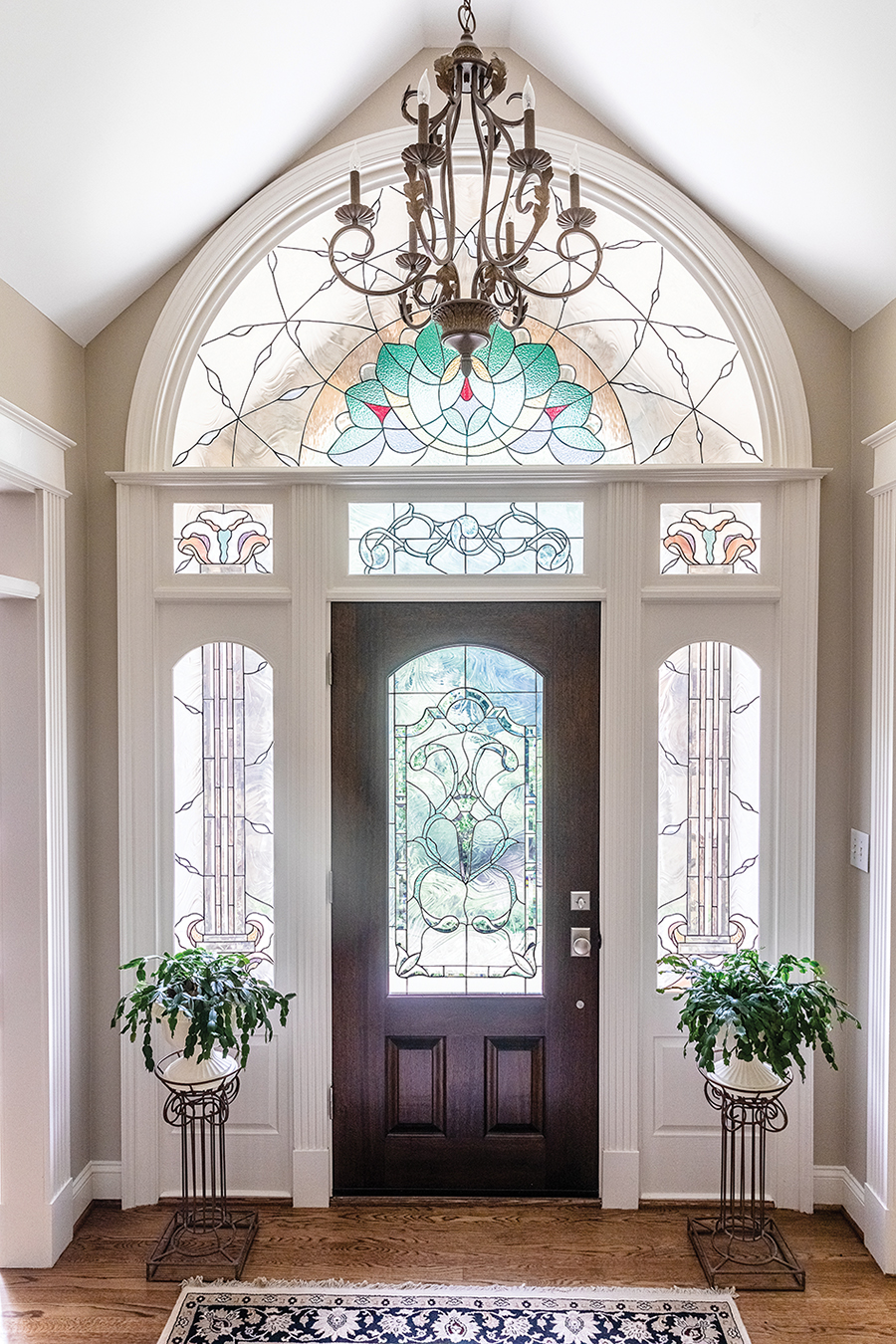
When the Cawns moved to Cary in the early ’90s, Sarah got her first real studio, but it was on the third floor. She crosses her eyes and groans, “Ughhhhhh,” imagining herself carrying sheets of heavy glass up three flights of stairs. They built their current house, a stone hideaway tucked into the woods just outside of downtown Raleigh, in 1996, and Cawn’s studio is a bonus room above, not in, the garage. An arched windowpane of wispy lines and pastel orbs over the front door welcomes guests into their home and silently announces the workshop upstairs.

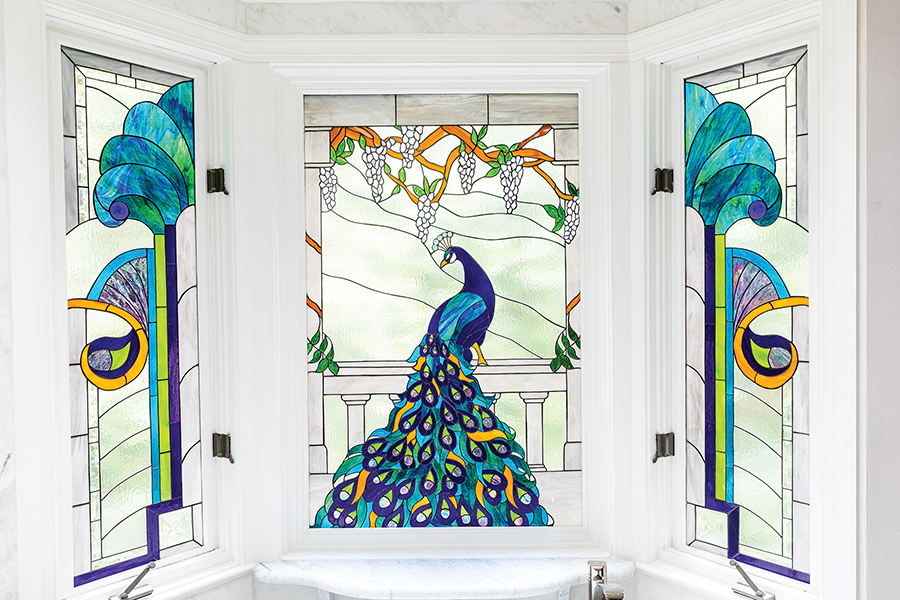
“It started here,” Cawn says of her business, Sarah’s Glass Art, taking off. “In the ’90s everybody wanted stained-glass windows above their bathtub or around their door.” She grins sheepishly. “If I was lucky, they did both.”

Stained glass, and the inspiration for it, infuses the property like a visual perfume. Outside, in the backyard, tangerine, fiery red and pale pink koi glint like glass shards in the afternoon sun as they circle an ornamental pond. One fish resembling a golden dragon, with his trailing whiskers and billowing fins, swims near the surface, as if it were a water-bound Icarus waiting to be immortalized in glass like the scarlet macaw.

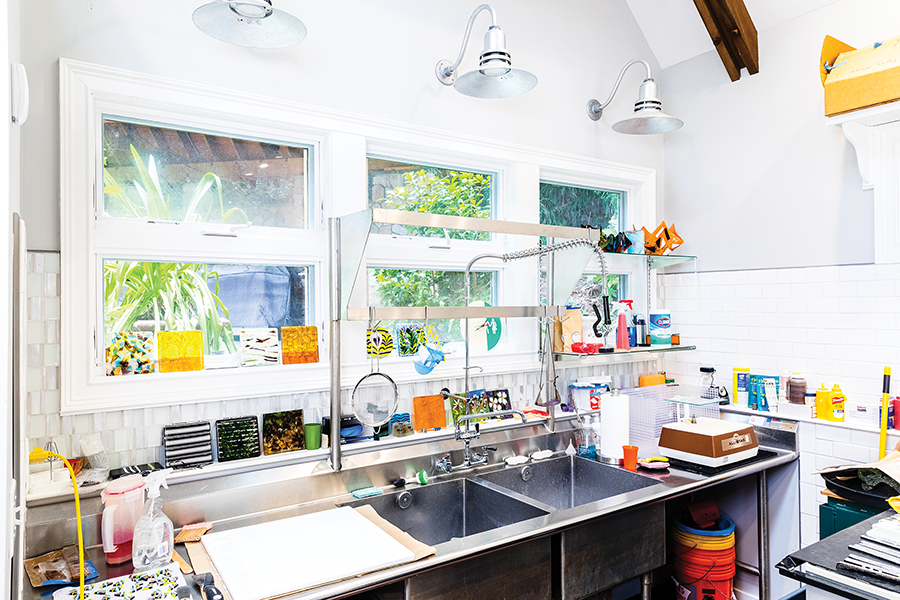
Later, the Cawns built a second studio, this one detached from the house, where Sarah makes fused glass, a craft she picked up two decades ago. It’s also where she teaches students to work with stained glass, something she started last year.

With the poppy pattern complete, Cawn traces a copy. “Some people take it to Kinkos, or some place that will copy it, but I don’t know how accurate that will be, so I’ve just never done that,” she says. “And I know, I’ve been told, ‘You’d save yourself a lot of time.’” She waggles an index finger. But why fix what’s not broken?

Keeping the original pattern as a template, she fits a jig — a device reminiscent of a picture frame — around the drawn windowpanes and fixes the jig to the worktable. It is the stage where all the pieces will come together. “Nothing’s going to turn out square if you don’t put a border around it,” she says. “If it’s not square, it will look like crap.”

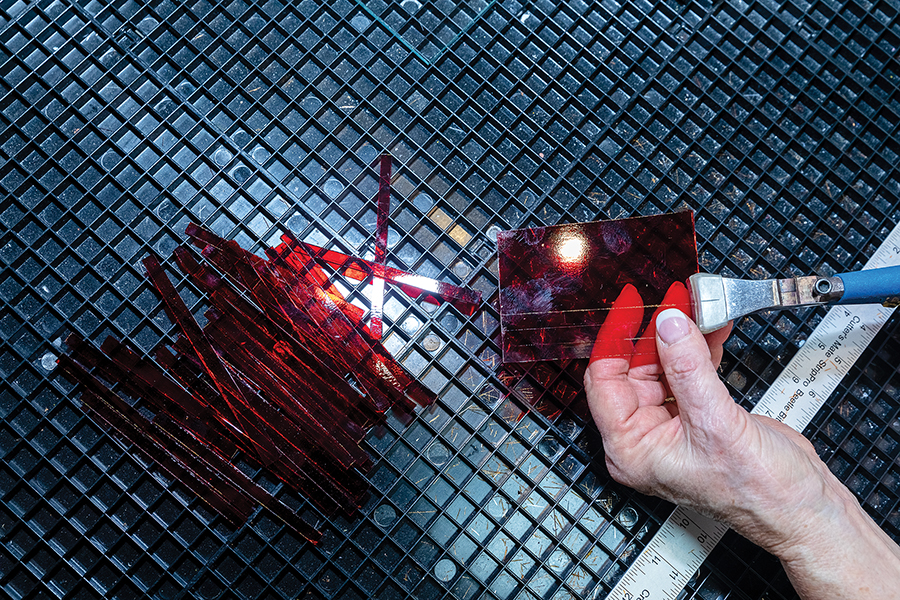
Cawn cuts apart the copied pattern so she can trace each piece of the design onto glass (black marker on light colors and silver marker on darks), then she cuts the glass itself. To demonstrate, she pretends to trace a shape onto a spare sheet of emerald glass, the color she used for the poppy stems.
       

Cawn looks up as a schnauzer tears around the corner into the studio, nails clacking against the hardwood floor, legs spinning out. “She’s not really cute because she’s shaved now,” says Cawn, apologizing for Schatzi’s shorn summer coat. She reaches down to pat the gray head. “She’s gotten really finicky, so I say, ‘Just shave her. It’s not a fashion show.’” The 13-year-old dog wiggles her stubby tail, then retreats to a plush bed in the corner.

“OK, they’re all cut out, and they all fit nicely,” Cawn says, back behind the worktable. She pulls out a spool of copper foil tape and demonstrates lining the edges of cut glass. “You do this all the way around the glass, and you overlap it by a 1/4 inch at the end.”
Cawn smooths the foil, so the entire edge is neatly covered, and a thin line of copper shows on the face and back sides of the glass. The dark patina of the copper will give the stained glass its signature edge. “You do this on all your pieces,” Cawn says. In this case, all 332.
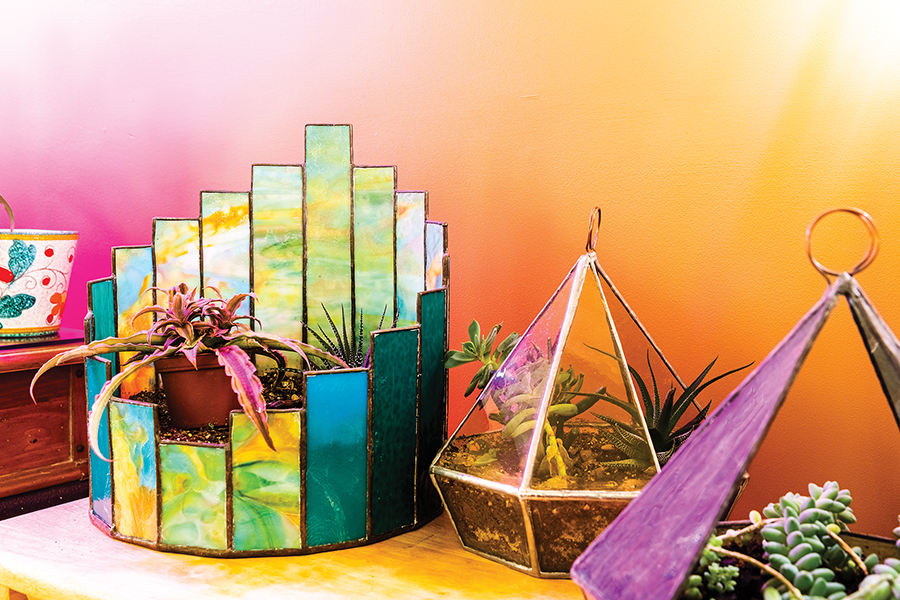
Soldering comes next, then the patina, then a wax and polish to shine the panel. “You take your wax, shake it, pour a little on, wipe it all over, let it dry, and then you buff it with a rag, and you’re done.” She tosses a rag on the table.

“I used to hate waxing and polishing, but it’s such an important part. It’s the finishing touch, and they go, ‘Ohhhhhhh.’” Cawn puts her hands to her cheeks and opens her mouth, mimicking happy customers and, in a way, herself. “To me, there’s just a magical quality about glass.”  PS

Shop for Sarah Cawn’s glass art at One of a Kind Gallery, in Pinehurst.


Jenna Biter is a writer and military wife in the Sandhills. She can be reached at jennabiter@protonmail.com.

The Forgotten Boyd

The story of an exceptional kid

By Stephen E. Smith

Photographs from the Weymouth Center Archives

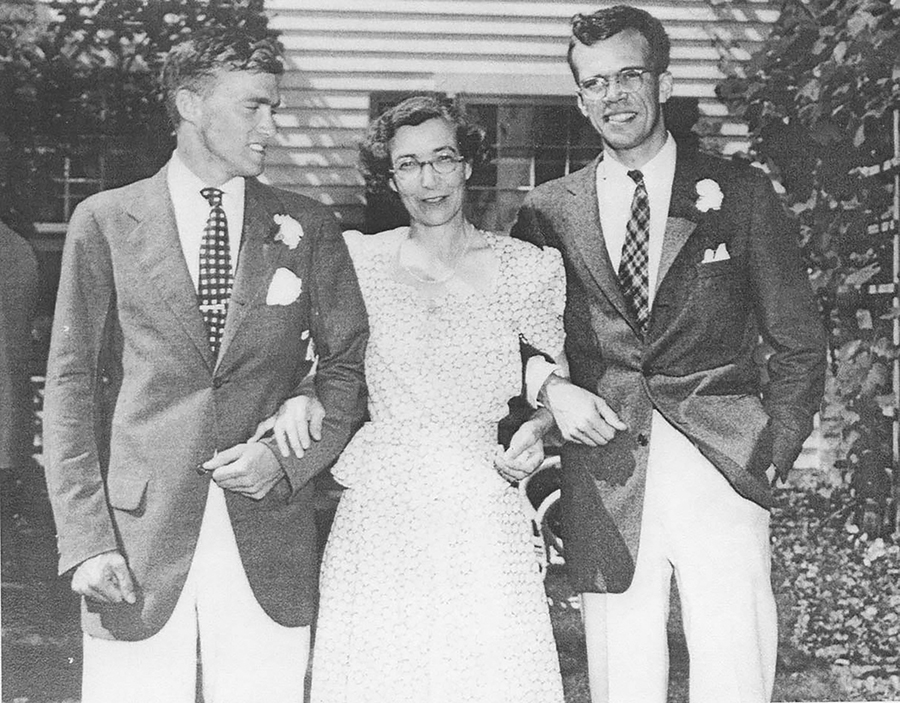
Dan, Katharine and Jim Boyd Jr.

The best of that whole Boyd bunch was Dan, the one who was killed in a motorcycle accident in San Francisco,” Glen Rounds said while lounging in his front yard on a sunny spring afternoon 30 years ago. He was parsing the James Boyd family, the “first family” of Southern Pines, the clan responsible for many of the aesthetic and cultural pleasures our quaint hometown offers.

“The older son, Jim, was something of an oddball,” Rounds continued, “but Dan . . . Dan was an exceptional kid.”

When Rounds spoke, I listened. Intently. In addition to authoring 100 children’s books and receiving a slew of state and national awards for his writing and illustrating, Rounds had his arthritic fingers on the pulse of Southern Pines. He knew what there was to know about everyone in town worth knowing about, and he served up his edgy opinions freely and with an occasional sprig of rancor and a dash of humor. Any praise, however slight, he might lavish on Daniel Boyd, the second son of historical novelist James Boyd and his wife, Katharine, was a high recommendation indeed and worthy of investigation.

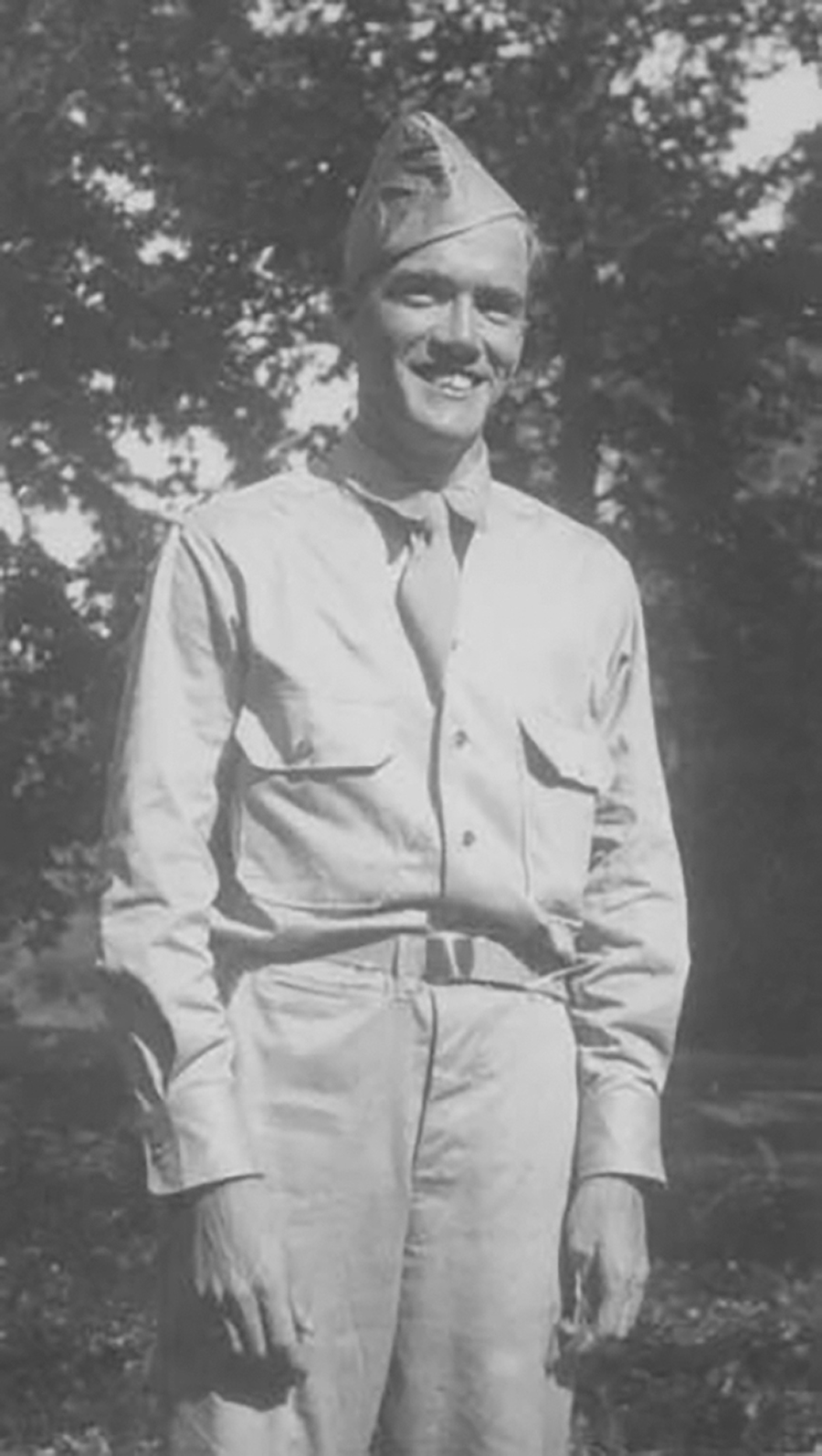
“Dan was awarded the Silver Star during the Battle of the Bulge,” Rounds went on, “and when he got back in town, he never once mentioned it.”

I knew nothing of Dan Boyd, so during my next visit to the Southern Pines Library, I plundered through fusty back issues of The Pilot bound in bulky, outsized volumes, and discovered the January 1, 1959, front page headline: “Daniel Boyd Killed in California Last Tuesday in Traffic Accident.”

The timeworn newsprint was crumbling and much of the story was missing, but the essential facts were there: “Daniel Lamont Boyd, 34, the son of Mrs. James Boyd of Southern Pines, was fatally injured Tuesday of last week (Dec. 23, 1958) in San Francisco, where he had made his home.” Boyd was homeward bound from the city center when a car crossed the yellow center line and struck his “motor bike” (a lightweight scooter of some variety, possibly a Vespa) head-on. Dan was transported to the hospital, where he died without regaining consciousness.

The article also noted that Katharine Boyd, publisher of The Pilot, flew to San Francisco as soon as she received word of her son’s death, and that “News of the tragic accident was received with great sorrow in the community.” Although Dan hadn’t lived in Southern Pines in several years, he had “maintained earlier friendships with many people.”

If Rounds wasn’t exactly correct about the motorcycle, he was spot on when it came to Boyd’s military record. Dan served with the 60th Engineering, 35th Infantry Unit, which fought from Normandy, through the battles for Saint-Lô and the Bulge — 78 years ago this month — to the end of the European campaign. It was during the Battle of the Bulge that Dan distinguished himself and was awarded a Purple Heart and the Silver Star for gallantry under fire.

Dan Boyd before going overseas

The Army doesn’t retain records detailing the courageous actions of individuals who have been awarded the Silver Star, but the Friday, Feb. 9, 1945 issue of The Pilot reprinted an official press release:

“Corporal Daniel L. Boyd, 34677486, Corps of Engineers, United States Army, for gallantry in action near ————- France on 13th December 1944.

“During the crossing of the ————– River near ————–, Corporal Boyd was in charge of an assault boat operating in a sector which was subjected to intense machine gun fire from enemy emplacements located only 150 yards from the river. When he saw a nearby boat capsize in mid-stream after receiving a burst of machine fire, he immediately paddled his boat to the scene and rescued five heavily clothed soldiers from drowning in the swift current. After he had brought the men to the friendly shore, he started to assist them to an aid station when one of the men collapsed as a result of a wound he had suffered. Corporal Boyd placed him in a sheltered position, administered first aid, and then continued to the aid station with the other men. Finding a shortage of medical personnel, he personally returned to the wounded man he had left behind, in the face of withering enemy fire, and with the aid of a litter bearer, succeeded in evacuating his comrade. Corporal Boyd’s intrepid deeds and resourceful performance in the face of heavy odds were responsible for saving the lives of five of his comrades and are in accord with the finest tradition of the United State Army.”

The January 1959 Pilot notes that “With fighting going on across the river where American units were isolated, Boyd went out, found one of the engineers’ boats and, under heavy fire, ferried across sufficient men to win the action.”

Valor in military service was nothing new to the Boyd family. Novelist James Boyd Sr. served as an ambulance driver in France during World War I, and Dan’s cousin, Seaman 1st Class John Boyd, who had grown up in what is now the Campbell House, died in the Battle for Guadalcanal when the USS Barton, the destroyer on which he was serving, was sunk in a night action in November 1942.

My curiosity concerning Dan Boyd’s life and death might have ended there, but Rounds’ recommendation resonated with me whenever I attended a cultural and social event held at the Weymouth Center for the Arts & Humanities. A few years later, I was researching James Boyd’s relationship with F. Scott Fitzgerald and Sherwood Anderson in the Firestone Library at Princeton and the Southern Historical Collection at UNC when I happened upon letters from Dan to his parents, chatty missives about life at boarding school, football games and, oddly enough, railroads. His letters were peppered with allusions to the trains and drawings of locomotives.

The mystery of Dan Boyd’s life unraveled further when Dotty Starling, Weymouth’s dedicated archivist, lent me a copy of An Oral History of Weymouth. Published in 2004, the history gathered the reminiscences of friends of the Boyd family and the recollections of longtime employees. Many of the details of Dan Boyd’s short life are revealed in those collected memories.

I learned that in the ’20s and ’30s, the James and Jackson Boyd children had grown up together, playing in the pasture behind Weymouth, riding horses, and sharing in the privileges afforded by their parents’ wealth. They all attended kindergarten and elementary school at the private Ark school, initially located on the corner of Ridge Street and Connecticut Avenue on the Weymouth property. (The foundation of the school is still clearly visible, a giant magnolia rising from what must have been the building’s basement.)

Longtime Pilot reporter and editor Mary Evelyn de Nissoff remembered her days attending the Ark in a 2001 interview: “Two English ladies ran it. In the morning they welcomed the children with a handshake and had a cup of tea with them before classes began. In the afternoons the children went down into the basement where there were iron cots . . . where the teachers read aloud to them.” All three of James and Katharine’s children, Jim Jr., Dan and Nancy, the youngest, attended classes with Mary Evelyn. “They (the Boyd children) rode, of course. They were into horses and they smelled of horses. Nancy didn’t, but Dan did.”

A life of privilege notwithstanding, the Boyd household was not always a peaceable kingdom. Jim Jr. and Dan, brothers of very different temperaments, often argued, and their mother had difficulty maintaining domestic harmony. In a scrapbook preserved in the Weymouth Archives, an unidentified family poet recorded the domestic discord in rhymed iambic pentameter:

Thus while Dan offers up his soul

To knowledge and each day grows thinner,

James lies in bed and eats his dinner;

And while Dan toils o’er Latin grammar

James turns out mediocre verses

Of fulsome amatory tone

And sends them round to all the nurses.”

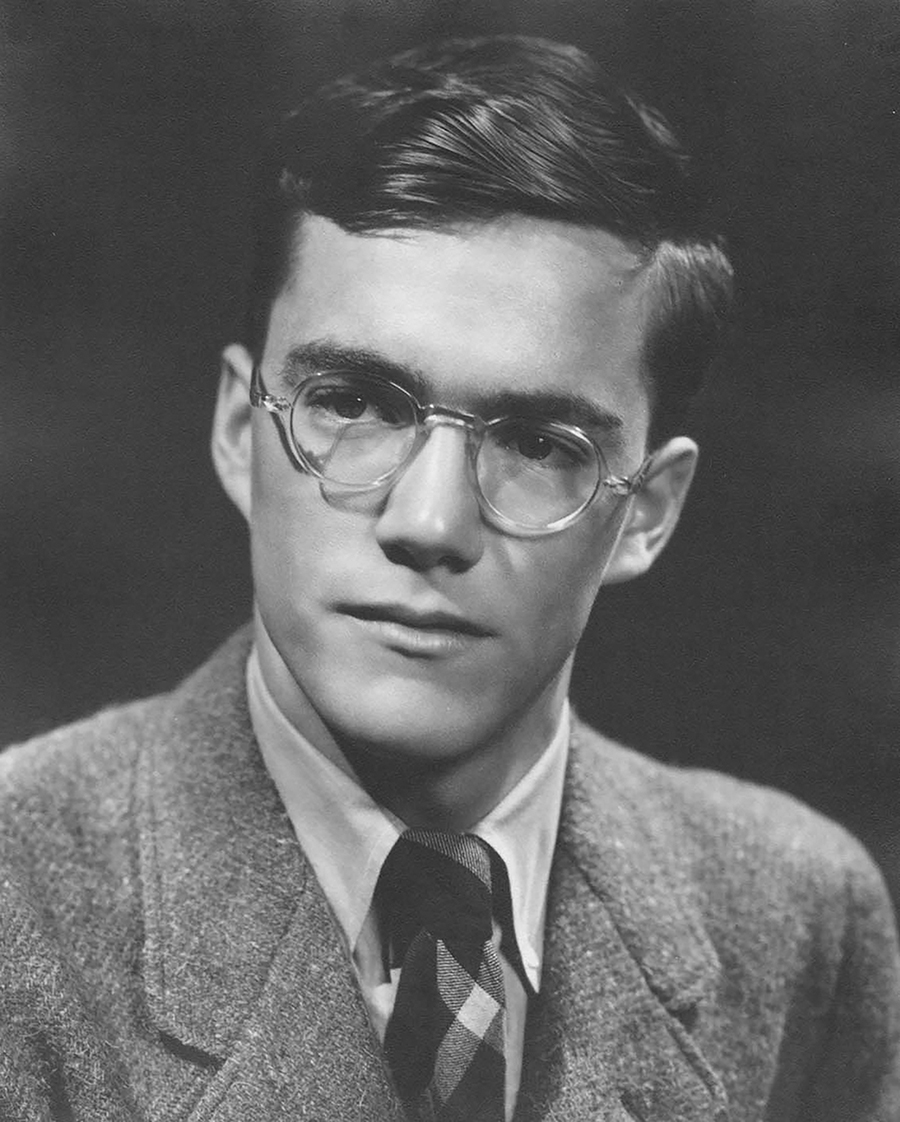
Dan Boyd

If Jim Jr. lacked motivation, Dan was obsessed — with trains. He decorated his room with railroad posters, collected electric trains, and snapped hundreds of photos of art deco diesel and steam locomotives — massive pufferbellies with all the machinery bolted to their boilers — which are now preserved and cataloged in the Weymouth Archives with other Boyd family papers.

The anonymous family poet also offers a prediction:

That some day, trudging down the track

In broken hat and hobo’s breeches,

He’ll [Jim Jr.] hear a train behind his back

Come rattling over frogs and switches

And, looking up as it goes past,

See seated in his private car

The road’s vice-president, D. Boyd,

Smoking a fifty-cent cigar!”

Dan and Jim Jr. were eventually shuffled off to Millbrook School, an academy for students in grades 9-12 located in Millbrook, New York. During those years, they wrote letters to their parents that conveyed a strong sense of family and a guarded affection for one another. Dan wrote about trains and drew locomotives on Millbrook stationery letterhead.

After completing their studies at Millbrook, Dan matriculated at Princeton, his father’s alma mater, while Jim Jr. attended UNC. When the war interrupted their studies, Jim joined the Coast Guard and Dan enlisted in the Army and fought in decisive battles in Europe. After the war, the brothers completed their degrees and Dan married Rhoda Whitridge in 1948 and went west to work with the Southern Pacific Railroad in Eugene, Oregon, eventually settling in San Francisco.

In 2002, Weymouth board member Bea O’Rand interviewed longtime Southern Pines luminary Voit Gilmore, who knew the Dan Boyd family well in the 1950s: “We knew of his connection with his very generous work with the arts council and arts groups in San Francisco. We knew the exact street where he was on his motorbike and got hit. Every time I go by that intersection now, it just breaks my heart that that happened. It was a steep hill on Polk where you come up and go over. The problem always is that if  the traffic light goes against you and you’re going up the hill you have a terrible time, you need to get over to the middle of the intersection which is what he did and got hit because of a car.”

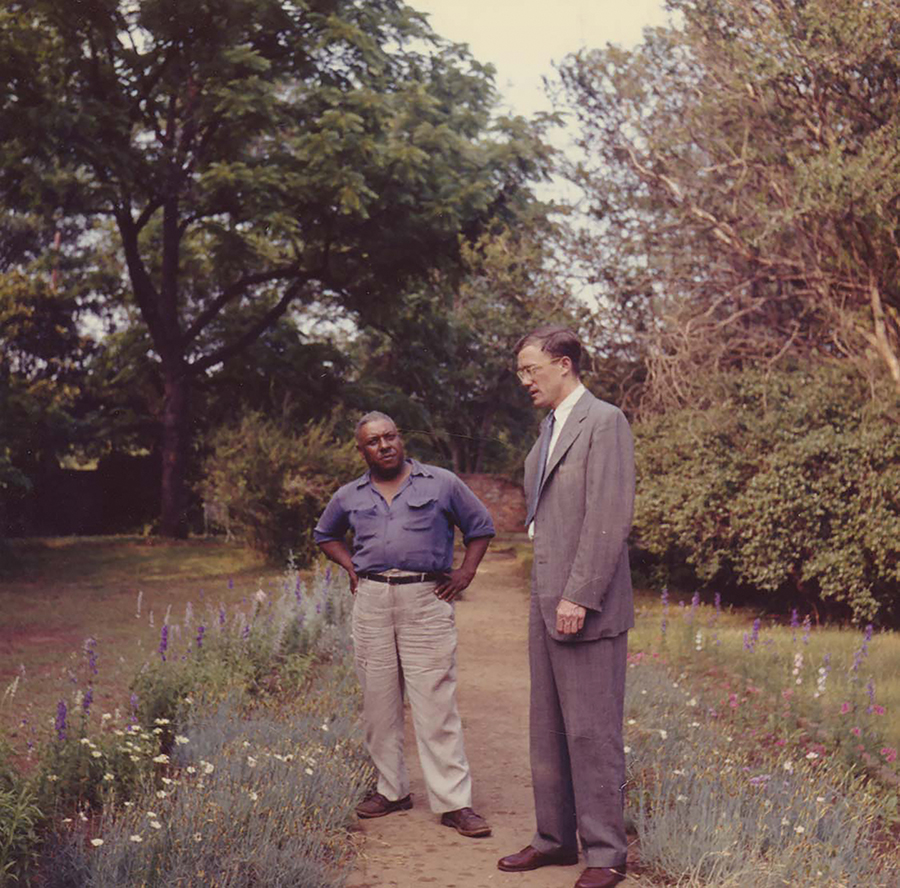
Dan Boyd with gardener Hilton Walker at Weymouth

Flossie Carpenter, a longtime employee of Katharine Boyd’s, recalled the effect Dan’s death had on his mother: “Now that’s when Mrs. Boyd went off, the morning that she got the message that he had been killed. Her mind was no more good. She tried to do but she couldn’t. . . . She stayed that way for about three years.”

Mary Evelyn de Nissoff, who suffered tragedy in her own life, keenly comprehended Katharine’s suffering. “ . . . I can understand what she was going through. She never got over it, because it leaves this great hole in your stomach that is never filled up.”

As a family, the Boyds participated in bettering the community in which they lived. Katharine contributed anonymously to the education of many local children. The family gave us the Weymouth Woods Sandhills Nature Preserve with its 7 miles of hiking trails and visitor center and exhibits, contributed to the Southern Pines Library, maintained what is now the Weymouth Center for the Arts & Humanities, and provided funds for the Boyd Library at Sandhills Community College. They worked to beautify the town and protect the pines that line our streets and shade our homes. The oldest living longleaf pine — its seed germinated in 1548, a survivor now of what was once the largest ecosystem in North America — thrives still on the Weymouth property.

In 2002, Rhoda Boyd, Dan’s widow, was driving with her granddaughter outside San Francisco when a redwood fell on her car, killing her instantly. Her granddaughter survived without injury. Dan and Rhoda Boyd are interred in Cypress Lawn Memorial Park in San Mateo County, California, far from Dan’s childhood home.

On that spring afternoon 30 years ago, Rounds, who knew something about humor and its understated uses, continued lauding Dan Boyd, offering up examples of his keen wit and artistic nature. As the afternoon wore on, the Southern Pines Middle School dismissed, and crowds of children began wandering up Ridge Street.

“Let’s go inside and have a drink to Dan Boyd,” Rounds suggested. “I don’t like to sit out here when these kids go by. They make too much noise.” Then he smiled. “But I’ll tell you what: When they’re gone, I go out and pick up their pencils.” PS

Stephen E. Smith is a retired professor and the author of seven books of poetry and prose. He’s the recipient of the Poetry Northwest Young Poet’s Prize, the Zoe Kincaid Brockman Prize for poetry and four North Carolina Press Awards.

Bring Us Some Figgy Pudding

Simple and elegant holiday brunch ideas

Story and Photographs by Rose Shewey

Festive meals among family and friends are the most magical of holiday traditions. Give me a Christmas brunch and I’ll be as joyful as the Sugar Plum Fairy in the Land of Sweets.

If you are blessed with young children on Christmas morning, you know that an early pot of coffee or a cup of tea is the most you’ll have time for until the presents are unwrapped and ooohed and aaahed at. Or, if you’re celebrating among grown-ups, an unrushed, peaceful start to the day can be a grand idea. All of which makes Christmas brunch an excellent choice on one of the brightest, most colorful and cheerful days of the year.

To spend less time in the kitchen and more time in the moment, with the people you love, gather inspiration from these simple, eye-catching dishes that require few ingredients and even less time to prepare.

Gingerbread Doughnuts with Amaretto Chocolate Glaze

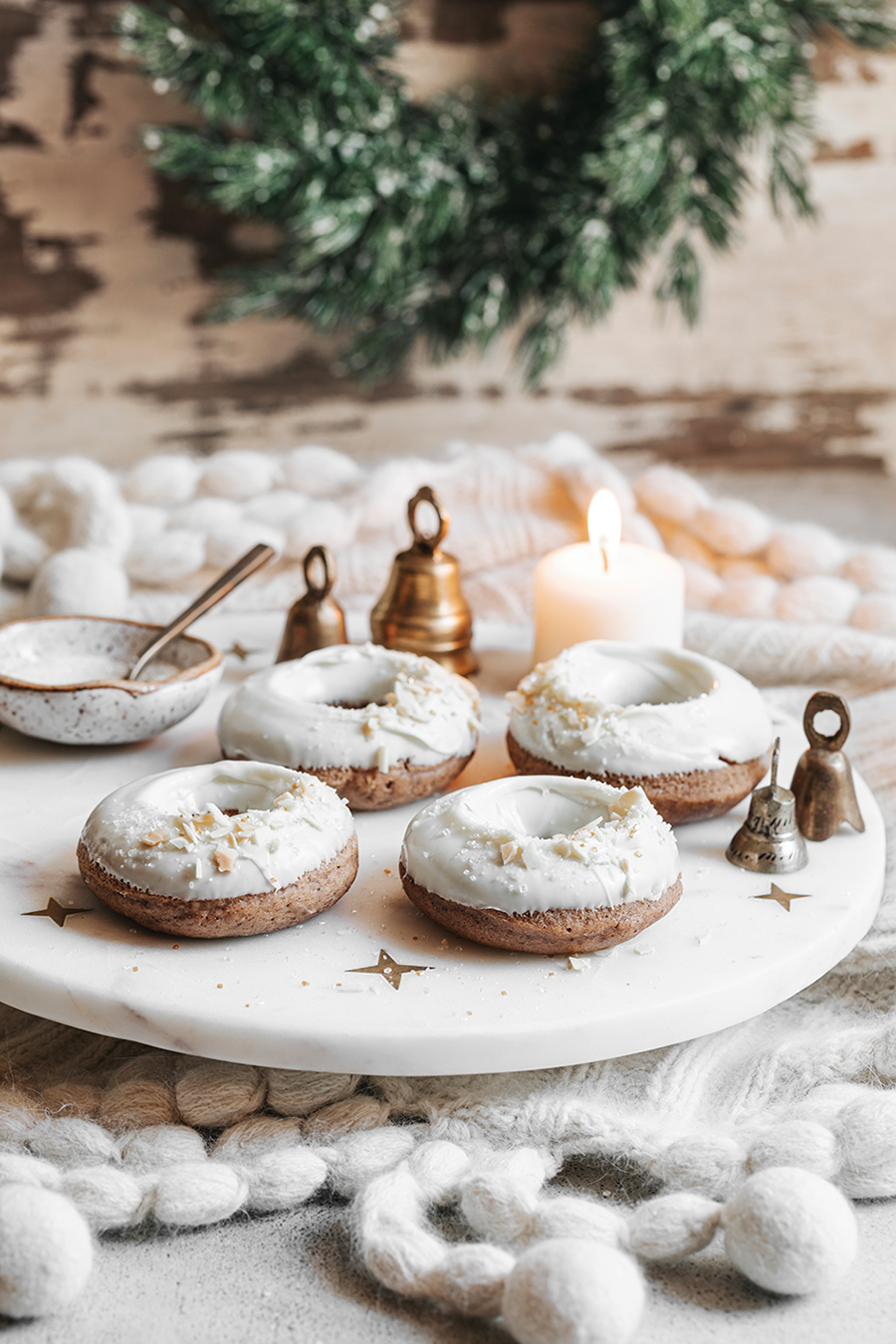
Doughnuts should be a staple in every brunch spread, no doubt about it. A basic doughnut recipe can be adjusted easily to feature the flavors of the  season. To transform ordinary doughnuts into a winter holiday treat, simply add gingerbread spice mix to the dough and, once baked and cooled off, dip in melted white chocolate infused with amaretto. Sprinkle with crushed almonds and sparkling sugar to add a touch of winter magic to your buffet.


Eggnog Chia Parfait

A spectacular make-ahead option for Christmas morning is eggnog chia parfait.
Nothing says Christmas more than eggnog for breakfast! To every one cup of liquid, add 1/4 cup of chia seeds; allow to rest for a few minutes, stir and refrigerate overnight. Layer with müesli, chopped nuts, seeds, chocolate mousse, compote, jam or fresh fruit of your choice and top with whipped cream.  The possibilities are endless, so let your creativity run wild.


Yorkshire Pudding Breakfast Bake

A take on the traditional Yorkshire pudding (which is similar to the American popover), this is a simple yet striking — not to mention scrumptious and satisfying — dish to serve your family and friends on Christmas morning. The base is made with just eggs, flour and milk, and takes minutes to whip up; add any breakfast ingredients of your choice, such as bacon, sausages or tomatoes and bake in the oven for 15-20 minutes or until the egg mixture is cooked through.


Green Shakshuka with Poached Eggs

Traditional shakshuka is not just a feast for the eye, it’s an incredibly aromatic dish for all those who have a penchant for Mediterranean spices. To mix it up, try a green version of shakshuka.  Instead of the tomato base, use layers of green vegetable, such as leafy greens, zucchini, broccoli and peas, then season with green harissa, paprika and cumin. Finish by cracking eggs right into the skillet and cook until the whites are set. Serve with toasted bread.


Potato Waffles with Smoked Salmon

Potato waffles are a fabulously sophisticated alternative to ordinary hash browns. To save time preparing a hash brown mixture, you can use previously frozen potato puffs or even a leftover mashed potato mix. Potato waffles will cook in minutes and make a hearty base for a variety of toppings. Smoked salmon with a dollop of crème fraîche garnished with capers and roe is a holiday-worthy combination. Or, you might find your own favorite mélange.


Winter Pavlova with Clementines

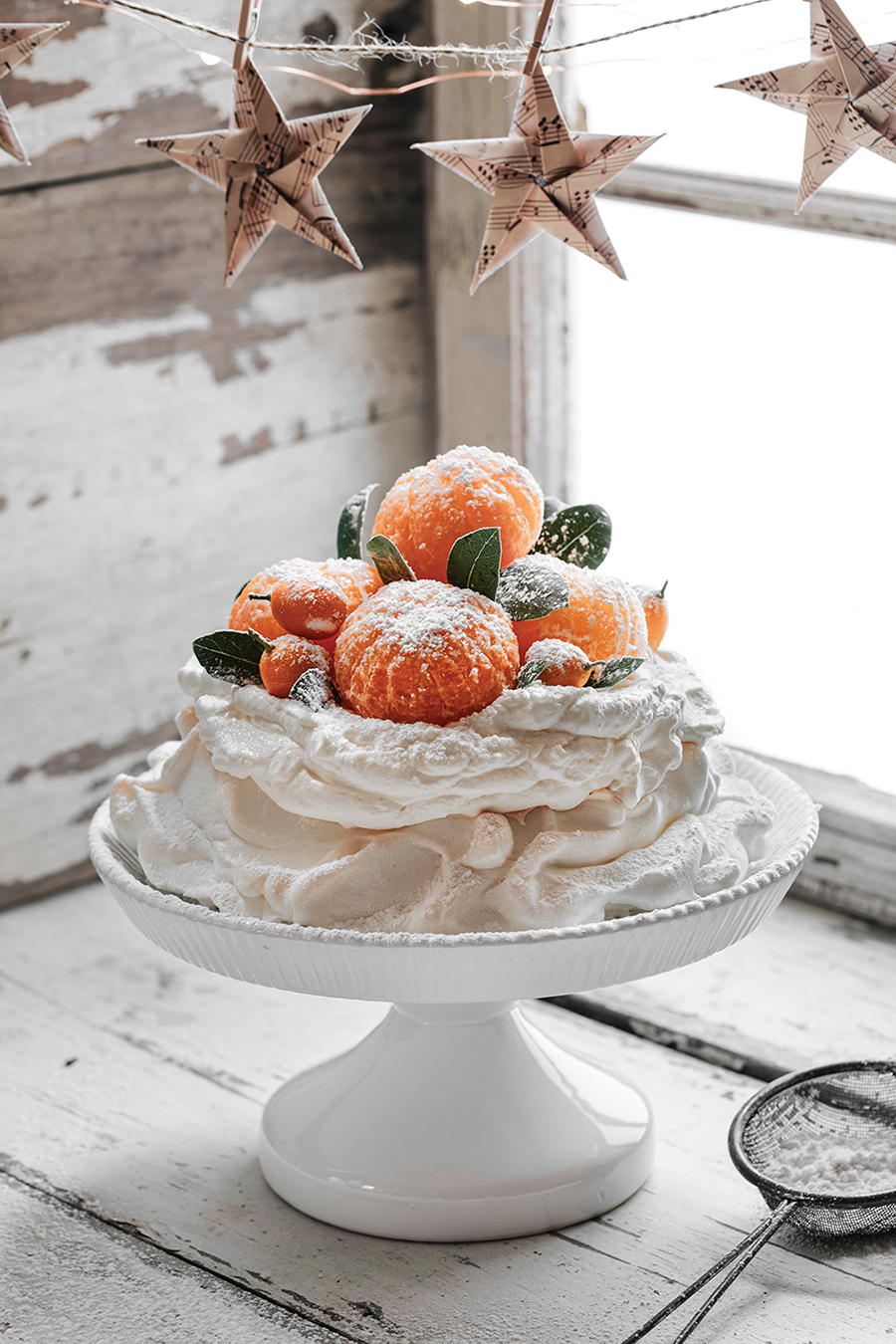
Pavlovas are quite the showstoppers and require few ingredients to make, mainly just egg-whites and sugar. While pavlovas can be a bit temperamental (you want to beat the eggs just right), they are exquisitely light and airy compositions that can be made a day in advance and dressed up with cream and fruit right before serving. Top your pavlova with whipped cream, curd and any seasonal fruit of your choice, such as clementines, oranges, figs, pomegranate or pear. PS


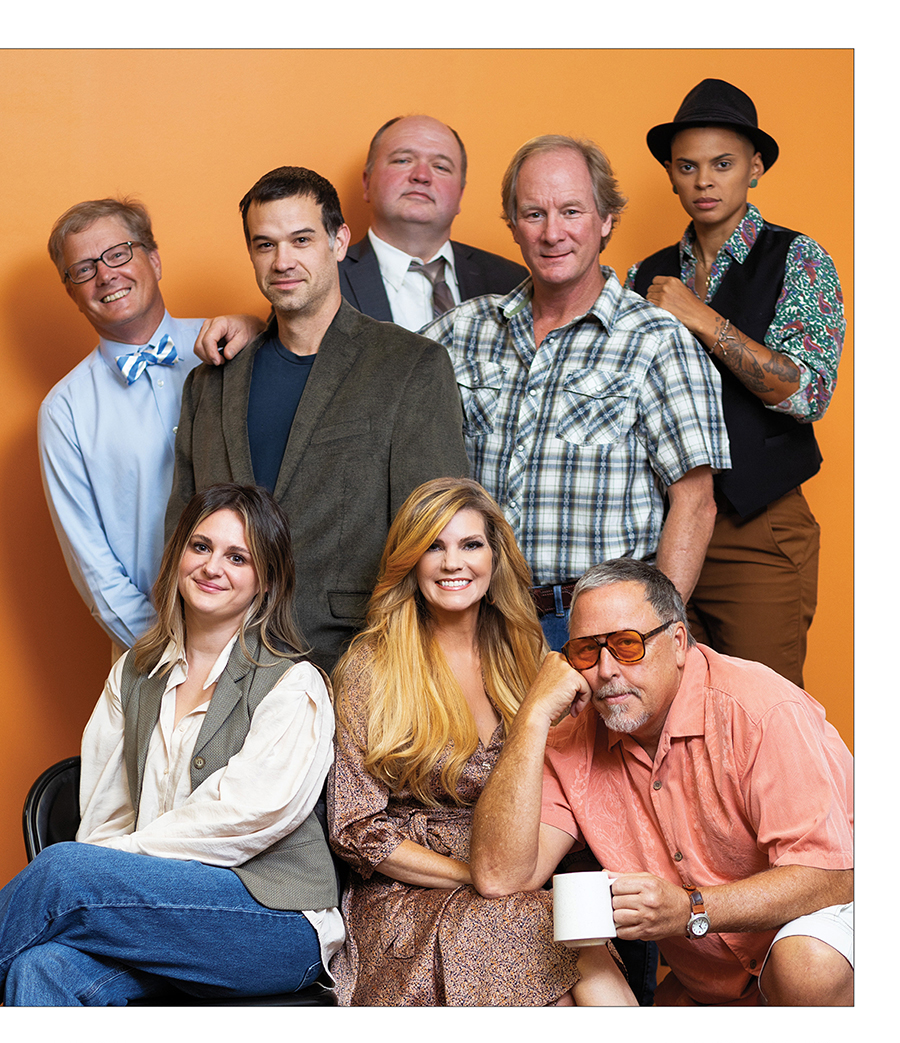
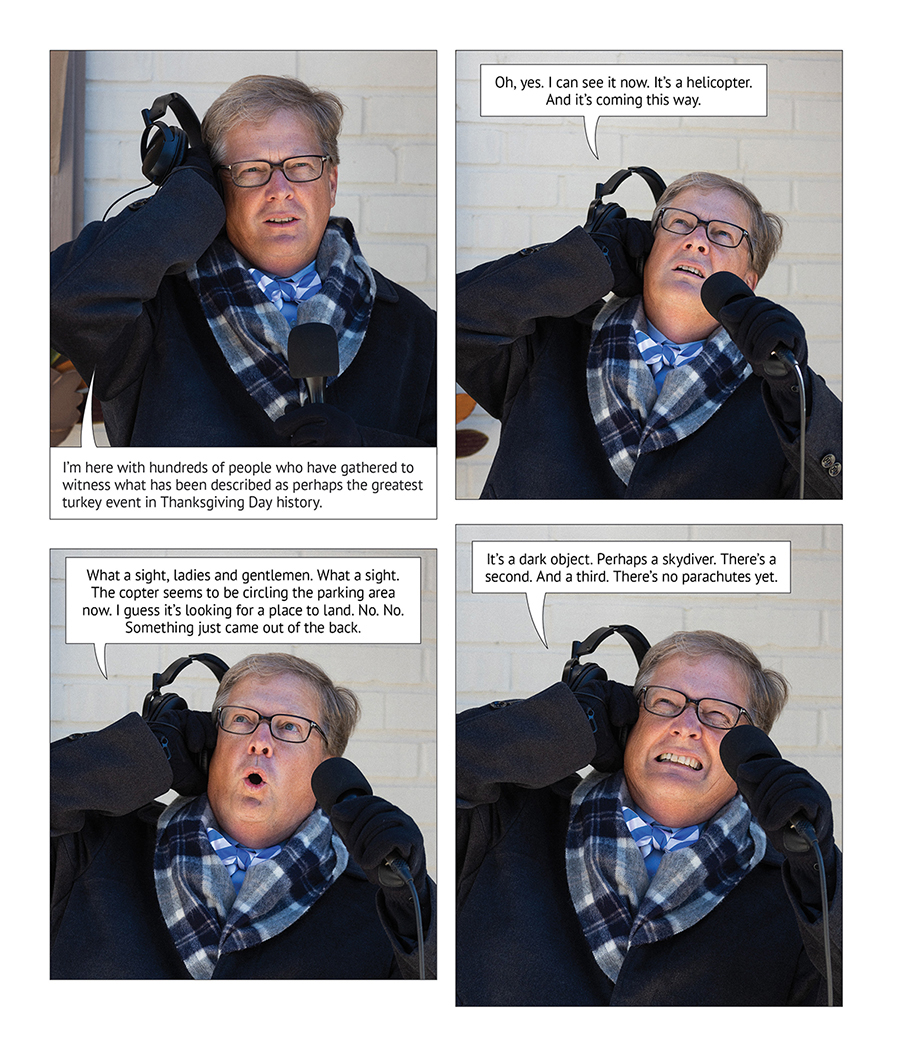
WKRP

IN MOORE COUNTY

Styled by Brady Gallagher

Photographs by Tim Sayer