Birdwatch

Songster in the Shrubs

The Eastern towhee hides to survive

By Susan Campbell

“Drink your tea, drink your tea,” the loud, emphatic call comes from dense shrubbery right outside our front door. It is the voice of a common, but frequently overlooked, Eastern towhee. It is hard to imagine that such a persistent songster could keep so well hidden, but towhees’ larger size makes them a target for predators, and keeping hidden is the survival strategy they employ. Belonging to the sparrow family, they are short-billed birds found in brushy or grassy habitat. The bird’s name originates from its typical “tow-hee” call.

Many backyard birdwatchers in central North Carolina are rather confused when they finally catch their first glimpse of a towhee. Is it some kind of oriole? Perhaps it is a young rose-breasted grosbeak? Males are quite colorful with rufous or chestnut flanks set against a white belly with a black hood, back and wings as well as a long black and white tail. The bill, too, is jet black. Females sport brown feathers instead of black but still have rufous sides. Their legs are long and powerful: good for kicking around debris in search of insects and seeds. Towhee eyes, which are usually dark red, may be orangey in the Sandhills population. Farther east, individuals have irises that are a striking pale yellow.

Eastern towhees are found, as their name implies, throughout the eastern United States. Here in the Southeast, they are year-round residents, although we do have some wintering individuals that breed further north. Their diet is variable, consisting of a variety of invertebrates (insects, spiders, millipedes) during the breeding season. However, in colder months, towhees can also be found scratching for seeds dropped by other birds from feeders. Their heavy bill allows them to take advantage of a variety of seeds. The powerful jaw muscles associated with such a strong bill make it a formidable weapon. If attacked, a towhee can inflict quite a bite. Males will viciously attack each other during territorial disputes and may inflict mortal wounds from grabbing the head or body of an opponent. Conflict is not infrequent where food is abundant, so the potential for fights exists throughout the year in our area.

It is not uncommon for Eastern towhees to raise three broods in a summer. Each brood involves three to five young. Nests are simple affairs, in short shrubbery or even directly on the ground. As a result, nestlings often do not remain in the nest long after their eyes open and downy feathers cover their bodies. They will move around noisily begging from the adults. Young towhees instinctively run for cover if their parents sound the alarm.

A little known fact about this species is that it was first described by some of the earliest Europeans to arrive in the New World. The artist-cartographer John White noticed towhees during his visit to the English colony on Roanoke Island in 1685-86. It was this trip that documented the colony’s disappearance — the Lost Colony. White’s unpublished drawings of both males and females predated the famous work of Mark Catesby in Natural History of Carolina, Florida and the Bahama Islands in the 1700s, since republished with a modern perspective as Catesby’s The Birds of Colonial America.  PS

Susan Campbell would love to receive your wildlife sightings and photographs at susan@ncaves.com.

The Creators of N.C.

The Feature Is Female

The future might be, too

By Wiley Cash

Photographs By Mallory Cash


Erika Arlee and Kristi Ray, co-founders of Wilmington’s Honey Head Films, grew up on sets. For Erika, one of her first on-set experiences was as a child growing up in Chapel Hill during the making of Attack of the Killer Dog, which she wrote, directed and co-starred in with her sister and one of their friends. Recalling the intensity of her childhood fascination with film, Erika says, “I wanted to make movies, and I wanted to hold the camera so badly.” Her early special effects included a plush stuffed animal dog that was tossed at the actors from offscreen so they could be, in fact, attacked by a killer dog.

For Kristi, who grew up in rural eastern North Carolina near New Bern, her first on-set experiences also took place at home, and included casting, producing and directing her older sister and cousin in back porch performances of Beauty and the Beast, Grease! and other movies that had left their mark. “I was always the director and the producer and the costumer,” she says. “And I would cast my cousin and my sister in the lead roles to get them to participate, and then I would play every other character that no one wanted to play.”

Regardless of whether they were handling stuffed animals while shouldering boxy VHS cameras or perusing thrift stores to outfit a cousin for a homemade play, both Erika and Kristi can trace their creative drive to those early days as girls who were desperate to see their dramatic visions come to life on the stage and screen.

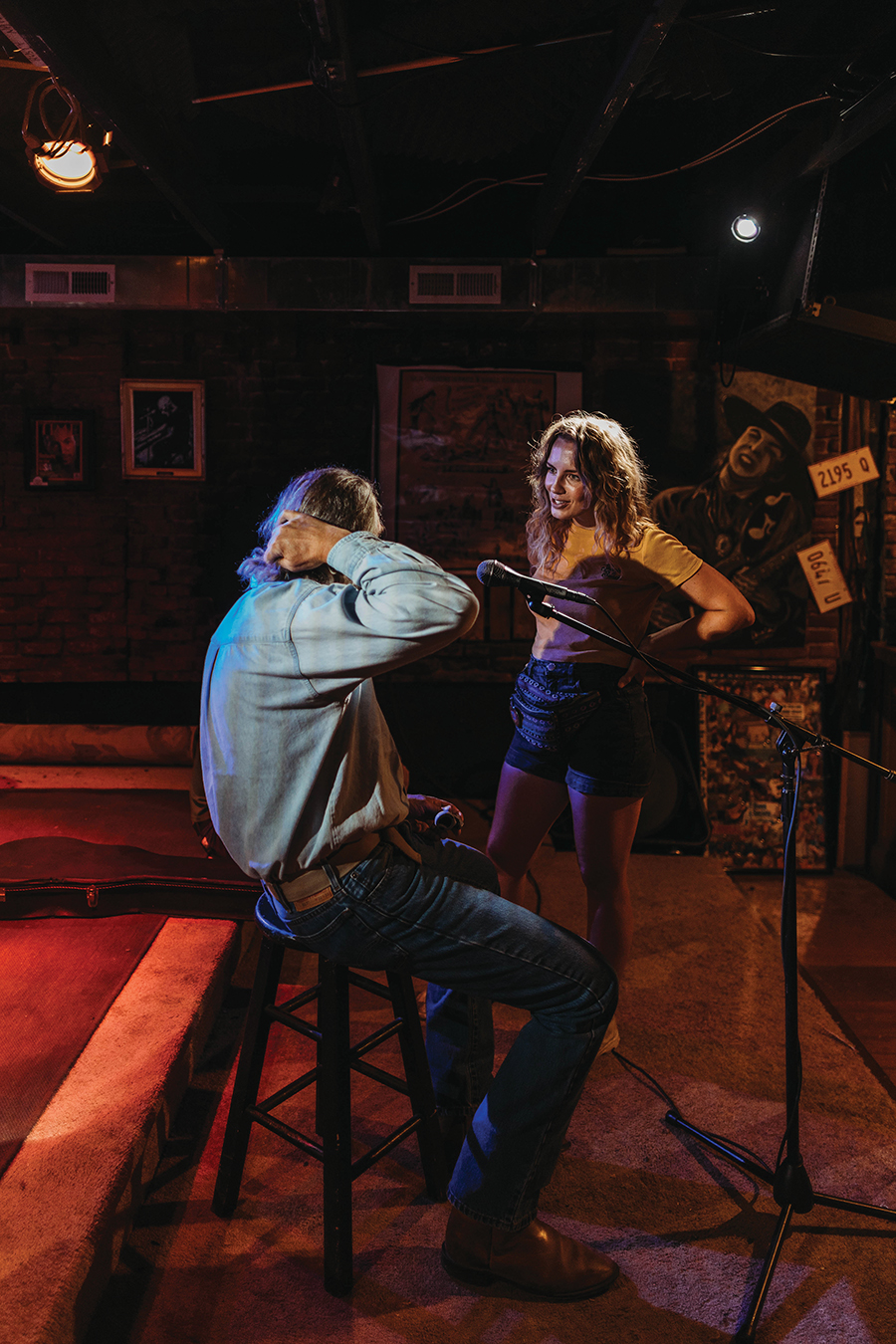
That energy, which is apparent to anyone who spends any amount of time with these two women, combined and gathered force to create A Song for Imogene, the first feature-length film by Honey Head. While Erika and Kristi’s paths to filmmaking seem preordained, their path to one another was a little less certain.

After growing up in Chapel Hill, Erika attended the University of North Carolina, double majoring in English and dramatic arts with a minor in creative writing. Although she’d always been drawn to film, it didn’t seem like something that was accessible on campus or in town, but Erika had seen Broadway productions, so she threw herself into acting and dance, thinking those outlets might be the only way for a Southern kid from a small town to find the stage. She never lost her interest in film or her desire to hold the camera, however, and by 2014 she was living in Wilmington, auditioning across the Southeast and working behind the camera with local writers and producers.

Unlike Erika, who headed east to Wilmington after college, as a 17-year-old Kristi went west to Los Angeles to pursue acting after high school. “I probably ran out of money like a year into my journey there,” she says. “I came back to North Carolina and auditioned for a feature film that was being produced in the Triangle, and I got cast in the lead role.” Kristi’s performance as Charlotte in Pieces of Talent was noticed, and she was soon offered a scholarship to the Lee Strasberg Theatre and Film Institute in New York. As much as she benefited from her education, Kristi found that the atmosphere in New York wasn’t as supportive as the film community in North Carolina, so she came home and settled in Wilmington.


I don’t know how many successful relationships, business or otherwise, begin on Craigslist, but this one did. Erika had joined with a local actor to write and shoot a horror film that featured a number of their friends, but they needed a female lead, so she posted a call on Craigslist, which Kristi happened to find and answer. Their bond was almost immediate. Soon, the two women were filming one another for audition reels, reading scripts together, and sorting through what seemed to be a shrinking market of opportunity for young women in the film world.

Aside from vapid roles that relied on little more than youth and appearance, “there just wasn’t anything interesting for young women that we were finding,” Erika says.

“This was the time when Winter’s Bone almost won an Oscar and there were a lot of really cool roles out there, they just weren’t around the Southeast, and they weren’t being offered to blonde girls who looked anything like us,” Kristi says. “We wanted to prove that we could play someone who wasn’t just a cute little girl at the mall.”

Erika wrote a short film about two sisters called Lorelei that was written specifically for her and Kristi so they could reach toward what they knew was the full range of their abilities. The story of two women settling their mother’s estate in rural North Carolina eventually served as the backstory for A Song for Imogene, which stars Kristi and was directed by Erika.

The two women who had come up through the ranks while shooting one another’s audition tapes are now at the helm of a feature film that’s in post-production and positioned to go out on the international film festival circuit. The relationship they’d built during their formative years, and through the experience of writing and shooting commercial work, had created a foundation that now guided them.

“Erika’s an incredible director. She was the first female director I’d ever worked with, so there’s this huge trust that I’ve always had,” Kristi says. “And her writing is really good, so it’s hard to do it poorly.”

The crew for A Song for Imogene was 70 percent female, including eight female interns from university film programs from around the East Coast. For many of these young women, it was their first time on a film set. Erika and Kristi allowed them to explore what interested them while also playing key roles in the production. While they watched the interns bond they couldn’t help but recall their own experiences of doing the same just a few years earlier. Now, they had become the teachers and mentors.

“When these young women go out into the professional world and work on sets, they won’t be afraid,” Kristi says. “They will have already gotten their anxiety out the door in a safe environment with us.” Erika and Kristi hope that the experience will leave these young women more mental space and emotional energy to collaborate and build community.


Pondering their own struggles in the industry while witnessing their interns thrive, Erika and Kristi had an idea about how to help the next crop of female filmmakers enter film programs or step onto sets with confidence. They partnered with educator Sam McCleod to create a summer camp, called Shoot Like a Girl, that focuses on female filmmakers from the ninth to 12th grades.

“We’re trying to get them at that stage where they’re a little bit more reserved,” Erika says.

The two-week camp, which kicked off its inaugural session in July, allowed the girls to learn cinematography, wardrobe, lighting and grip, screenwriting and directing. By the end of the camp they were casting and shooting their own short films. To ensure that the experience was accessible to girls regardless of their economic circumstances, Kristi and Erika were able to raise $18,000 from community partners to fund seven of the 12 girls at the camp. They’re excited to see what this first group will do next.

“To feel this empowerment and to be in a cohort of women is something that’s going to be invaluable,” Kristi says.

Erika and Kristi’s new film, A Song for Imogene, is certainly a female feature, and, with Honey Head and Shoot Like a Girl, the future of film might be, too.  PS

Wiley Cash is the Alumni Author-in-Residence at the University of North Carolina at Asheville. His new novel, When Ghosts Come Home, is available wherever books are sold.

Sporting Life

Field of Dreams

Rekindling an old love affair

By Tom Bryant

“The future ain’t what it used to be.” — Yogi Berra

The  baseball World Series had the New York Yankees battling their archrivals, the Brooklyn Dodgers. I remember it so well because the final game was played on my birthday, Oct. 7.

I was 11 years old and had just come out of a Little League baseball season where I had hit my first home run. Everyone knew I was gonna be a baseball player, because that’s what I told every solitary soul who would listen. My hero was Mickey Mantle.

My daddy played baseball in high school and won a scholarship to play at Clemson University. Along came World War II and canceled those plans. He came home in 1946, put his baseball plans on the back burner and proceeded to raise a family of four children. I was the first, and the story was that before Dad left for the Navy in ’41, he bought me a toy baseball bat, ball and glove with the hopes that I would be a chip off the old block. I was 3 months old and Mother often said that the baseball toys were my favorite, sort of like the way other kids had a security blanket.

Pinebluff, the little village where we lived, was the perfect place for a youngster who loved the grand old all-American sport. There were enough kids to start our own competing leagues. The boys on the west side of Highway 1, which bisected the town, comprised one league, and the players on the east side made up the other. Most times, when we played at our makeshift diamond behind Virgil Carpenter’s home, we didn’t have enough players for nine on each side, so we would choose up, and sometimes the opposing west team would have to lend players to the east or vice versa. This was our way of fielding teams, but later, along came our first formal structure of organized baseball — Little League.

I was hooked. Many game-day mornings, I would sit on the steps of our front porch, looking toward the clouds, hoping and praying that it wouldn’t rain and shut down the afternoon game.

I met kids from all over the county who loved the sport as much as I did, and later some of us would be on the same baseball team in high school. There was H.B. Ritter who played center field and could hit the ball a country mile. Sonny Smith caught and pitched and was an all-around talent. Jimmy Veasy played third; Marvin Lewis, shortstop; and Billy Marts, second base. They covered the infield like a blanket. Not much could get by that amazing trio. Oh, I played first base and helped where I could. Our coach was Bill Russell, one of the best. He knew the sport and had as much fun coaching as we did playing.

Our senior year we almost won the state championship, losing that game to Southern Pines. I can’t remember the score, but it was heartbreaking. The day after that evening game, Mother and I left for Brevard College to see if I made the cut and could become a student.

It was a melancholy time, my last year of high school and the last year I would ever play baseball for good old Aberdeen High. I was afraid my baseball career was ended but I lucked out, got into college, and was able to play baseball there.

So what got me on this memory road trip about the days of old when baseball was such a big part of my life? It was a character I met recently, at church actually, named Bill Berger. In the Air Force Bill flew those huge tankers that refuel jets in flight. After retiring, he did several years of contract work for the government, having great experiences along the way.

Bill and his lovely wife, Bonnie, live in Seven Lakes, and both are very active in our communities. As a matter of fact, Bill introduced me to our church’s men’s prayer breakfast that meets at Sizzlin’ Steak or Eggs restaurant two Tuesdays a month. It was at one of those gatherings when Bill told me that he and Bonnie were going out to Omaha to attend the NCAA Men’s College World Series. I was entranced.

Baseball was my favorite sport, but after I aged out and laid my glove down and watched a few pro games, I figured I was done. It wasn’t the same. Today’s pros get paid a gazillion dollars to play. They move from team to team, traded at the whim of the coaches or wherever the money is greatest. It was hard for me to develop a loyalty to a team when you have to keep a roster to identify the players. So I let it go and concentrated on other outdoor pursuits.

Flipping through TV channels a day or two after Bill told me about his impending trip to Omaha, I came upon the network featuring the college teams, and I was hooked. I watched most of the competitors and marveled at the young talent on the field. Not only was there plenty of ability, but the players actually looked as if they were having fun.

I remembered the letter to The Pilot that Bill penned after he and Bonnie got back from their road trip out west. “Omaha is a long drive, but the games are worth the effort: not expensive, great new stadium, clean city, good food, and most importantly, exciting games played by the same old rules we all employed years ago. It’s a treat and a trip back to our youth.”

So there you go. Next year, if I can persuade Linda, my bride, we’re gonna head out to Omaha to enjoy a couple of games played by youngsters the way it should be, for the fun of it.

I guess it really is like my favorite baseball coach of all time, Yogi Berra, said in his own special vernacular, “It ain’t over till it’s over.”  PS

Tom Bryant, a Southern Pines resident, is a lifelong outdoorsman and PineStraw’s Sporting Life columnist.

Bookshelf

September Books

FICTION

We Spread, by Iain Reid

Penny, an artist, has lived in the same apartment for decades, surrounded by the artifacts and keepsakes of her long life. She is resigned to the mundane rituals of old age, until things start to slip. Before her longtime partner passed away, provisions were made for a room in a unique long-term care residence, where Penny finds herself after one too many “incidents.” Initially, all is well. She even begins to paint again. But as the days start to blur together, Penny — with a growing sense of unrest and distrust — starts to lose her grip on the passage of time and on her place in the world. Is she succumbing to the subtly destructive effects of aging, or is she an unknowing participant in something more unsettling? Reid’s genre-defying third novel explores questions of conformity, art, productivity, relationships and what, ultimately, it means to grow old.

If I Survive You, by Jonathan Escoffery

In the 1970s, Topper and Sanya flee to Miami as political violence consumes their native Kingston, Jamaica. But America, as the couple and their two children learn, is far from the Promised Land. The family pushes on through Hurricane Andrew and later the 2008 recession, living in a house so cursed that the pet fish launches itself out of its own tank rather than stay. Even as things fall apart, the family remains motivated by what their younger son, Trelawny, calls “the exquisite, racking compulsion to survive.” Masterfully constructed with heart and humor, the linked stories in If I Survive You center on Trelawny as he struggles to carve out a place for himself.

Lark Ascending, by Silas House

As fires devastate most of the United States, Lark and his family secure a place on a refugee boat headed to Ireland, the last country not yet overrun by extremists and rumored to be accepting American refugees. But Lark is the only one to survive the trip, and once ashore, he doesn’t find the safe haven he’d hoped for. As he runs for his life, Lark finds an abandoned dog, who becomes his closest companion, and a woman in search of her lost son. Together they form a makeshift family and attempt to reach Glendalough, a place they believe will offer protection. But can any community provide the safety that they seek?

The Marsh Queen, by Virginia Hartman

Loni Murrow is an accomplished bird artist at the Smithsonian who loves her job. But when she receives a call from her younger brother summoning her back home to help their obstinate mother recover after an accident, Loni’s neat, contained life in Washington, D.C., is thrown into chaos. Going through her mother’s things, Loni uncovers scraps and snippets of a time in her life she would prefer to forget — a childhood marked by her father, Boyd’s, death by drowning. When Loni comes across a single, cryptic note from a stranger, she begins a dangerous quest to discover the truth about Boyd’s death. Pulled between worlds — her professional accomplishments in Washington, and the small town of her childhood — Loni must decide whether to delve beneath the surface into murky half-truths and either avenge the past or bury it, once and for all.

NONFICTION

One Hundred Saturdays, by Michael Frank

The remarkable story of 99-year-old Stella Levi, whose conversations with the writer Michael Frank over the course of six years bring to life the vibrant world of Jewish Rhodes, the deportation to Auschwitz that extinguished 90 percent of her community, and the resilience and wisdom of the woman who lived to tell the tale. With nearly a century of life behind her, Levi had never before spoken in detail about her past. Frank came to her Greenwich Village apartment one Saturday afternoon to ask her a question about the Juderia, the neighborhood in Rhodes where she’d grown up in a Jewish community that had thrived there for half a millennium. Neither of them could know this was the first of one hundred Saturdays that they would spend in each other’s company as Stella traveled back in time to conjure what it felt like to come of age on this legendary island in the eastern Aegean, which the Italians began governing as an official possession in 1923 and transformed over the next two decades until the Germans seized control and deported the entire Juderia to Auschwitz. Probing and courageous, candid and sly, Stella’s stories reveal what it was like to grow up in an extraordinary place in an extraordinary time. PS

Compiled by Kimberly Daniels Taws.

Poem

Cardinal

Like a spot of blood against the blue sky,

a Cardinal perches on the shepherd’s hook

where I hang suet and a cylinder of seed-feeders

I gave Sylvia for her last Mother’s Day.

The birds are a gift to me now. Her beautiful

ashes fill a marble blue urn and rest

near one of her crazy quilts in the foyer to welcome visitors.

Buddha is there on a table and guards her keepsakes,

a cleaned-out bookshelf holds her high school portrait,

a cross-stitch she made for me. Every little corner

has its memory of how short a sweet life can be.

— Marty Silverthorne

From Collected Poems of Marty Silverthorne

The Omnivorous Reader

Little Press Success

Big things can come in small packages

By Stephen E. Smith

Since its founding by professor Ronald Bayes in 1969, St. Andrews Press at St. Andrews University in Laurinburg has earned a reputation as one of the most consistent and persistent small presses in the country — which is no insignificant accomplishment considering that the average small press has a lifespan of five years. Within the last few months, under the editorship of Ted Wojtasik, the press has released two books that deserve a wide audience. The first is Ruth Moose’s The Goings on at Glen Arbor Acres, a collection of interrelated stories about life in an assisted living facility.

Moose has long been a creative force in the North Carolina writing community. She has published two novels as well as numerous collections of short stories and poetry. Her work has appeared in Atlantic Monthly, Redbook, Ladies Home Journal and Our State magazine, and she taught for 15 years on the Creative Writing faculty at the University of North Carolina in Chapel Hill.

Moose’s latest collection will not disappoint readers who are seeking to escape the everyday stress of politics and pandemic surges, neither of which is mentioned in these stories. There may be “goings on” aplenty at Glen Arbor Acres, but only of a benign nature. In “The Major’s Gun,” a character observes: “You have to be so careful around this place. One misheard word and the gossip goes rampant” — which is pretty much the source of the collection’s recurring conflicts.

Moreover, readers won’t be troubled by stories about characters who undergo overwhelming misfortunes that culminate in disasters of epic proportions. Glen Arbor is no Keseyesque Cuckoo’s Nest. There’s no Nurse Ratched in the medication room, no physical or verbal combat, no racial utterances to be heard, or even a mildly offensive exclamation that might raise a wary eyebrow. Moose’s slice-of-life stories simply offer readers a window into the everyday dilemmas of Glen Arbor’s elderly residents who eat, drink and sleep in the gossipy microcosm where fate has deposited them. If they are allowed enough freedom to cause a mild degree of mischief, they’re always on the lookout for a new source of intrigue. They’ve identified an antagonist, Miss Anne Blackmore Rae (Miss ABR aka Always Be Right), the director of  Glen Arbor, and a male protagonist, the Major, a resident who functions as an authority figure who might right trifling wrongs, a tired old god the ladies can turn to in times of emotional discomfort.

Moose focuses on her characters’ foibles and eccentricities — there is a nudist yoga teacher, a wig maker, a troll-like man who intrudes himself into the ladies’ daily walks, and the mystery of the director’s runaway dog who may or may not be dead. The most “teachable” story involves a resident who submits a poem to a national poetry contest and is notified by mail that she is a finalist who should attend a dinner meeting to receive her award. Of course, it’s a scam perpetrated on the unsuspecting — in this case, the elderly — but the aspiring poet buys a new dress and attends the ceremony. She doesn’t win (there’s a surprise), but she’s received by her peers at Glen Arbor as a literary luminary, proof that there is success to be had in the waning years, and that good friends value us for who we are, not for what we do.

There’s a good deal of irony and wit in Moose’s stories, even if her characters don’t see themselves as the object of humor, even when the situation and context are obviously comic, and readers will find themselves amused and charmed by her subtly crafted narratives.

Another recent St. Andrews Press publication, Collected Poems of Marty Silverthorne, is justification enough for supporting small presses. Silverthorne died in 2019, and it’s unlikely, regardless of his talents as a poet, that a mainstream or university press would publish a book by an author who isn’t around to promote it at readings and in bookstores.

As a poet, Silverthorne had talent and perseverance to spare. He devoted himself to writing verse while working for 30 years as a counselor for persons suffering from alcohol and drug addiction. Left a quadriplegic after a motorcycle accident in 1976, he faithfully dictated his poems to a caregiver and companion, and until the pandemic, he was a steadfast participant at regular meetings of the North Carolina Poetry Society.

Silverthorne is a “plain language” poet. His poems are straightforward retellings of the events that shaped his life, the loss and redemption, the small pleasures he experiences, the troubles and pain a person in his predicament suffers, as in “Inside of Me,” where the poet muses on what others expect of him after accepting his disability: Inside of me you expected to find/a motorcycle wrapped around a tree,/whiskey bottles beside the road./You did not expect to find daffodils/blooming in a pine thicket,/crape myrtles close enough/to threaten their beauty//Inside of me you expected to find/the soiled pages of Penthouse./You did not expect Yeats and Keats/on a linen table cloth,/one large candle with a wavering flame,/a bottle of chardonnay.

Much of Silverthorne’s later poetry was written while mourning the loss of his wife, as in “Delicate Ashes:” . . . Back at home our neighbor held you in his hands,/his fingers around the beautiful blue bowl/of your body, the delicate ashes of your life . . .

Silverthorne makes rich and various uses of rhetorical devices — humor, anger, wit, irony, and juxtapositions of conflicting and indecorous feelings. In doing so, he has left readers with a rich record of a life lived to the fullest despite almost overwhelming adversity.

We are fortunate that St. Andrews Press and other small presses continue to publish books that might otherwise, for reasons unrelated to literary quality, go unread. The pandemic has hit little presses hard. Readings at bookstores and arts organizations have dropped off, and live audiences are difficult to gather in dangerous times. If you’d like to encourage small press publishing, buy their books. Poets and Writers magazine lists over 370 such literary entities that desperately need our support.  PS

Stephen E. Smith is a retired professor and the author of seven books of poetry and prose. He’s the recipient of the Poetry Northwest Young Poet’s Prize, the Zoe Kincaid Brockman Prize for poetry and four North Carolina Press Awards.

Tea Leaf Astrologer

Virgo

(August 23 – September 22)

Before a Virgo bakes a pie, they have already sliced it a dozen times in a dozen different ways. They have considered everything: how the vegan butter might affect the flakiness of the crust; whether the pie should be chilled before sliced; which knives to use for scoring and cutting; et cetera, et cetera. We know you’re analytical. But birthdays are meant to be fun. No need to dissect the flavor out of every slice. You’ll kill your own buzz.

Tea leaf “fortunes” for the rest of you:

Libra (September 23 – October 22)

The knots will untangle themselves.

Scorpio (October 23 – November 21)

Don’t overthink it.

Sagittarius (November 22 – December 21)

Rinse and repeat.

Capricorn (December 22 – January 19)

Three words: Know your audience.

Aquarius (January 20 – February 18)

Cut the rope. You know what I’m talking about.

Pisces (February 19 – March 20)

The answer is chocolate.

Aries (March 21 – April 19) 

Take a breather.

Taurus (April 20 – May 20) 

You’re paddling upstream again.

Gemini (May 21 – June 20)

Do they know that it’s a game to you?

Cancer (June 21 – July 22)

Someone needs a hug.

Leo (July 23 – August 22)

Go for the upgrade.  PS

Zora Stellanova has been divining with tea leaves since Game of Thrones’ Starbucks cup mishap of 2019. While she’s not exactly a medium, she’s far from average. She lives in the N.C. foothills with her Sphynx cat, Lyla. 

Story of a House

Old Town, Rich History

And a couple embracing both

By Deborah Salomon     Photographs by Cara Mathis


Something old, something new, nothing borrowed, lots of blue add up to a Pinehurst showplace named Jefferson Cottage.

Cara, Gavin and 6-year-old Holden Mathis comprise a young family with traditional ideas; their home – a white-painted brick single-story with modified mansard roof and wings extending into an acre of Old Town Pinehurst.

Cara, a former Public Affairs Specialist, now an artist and photographer, explains the interior styling, which includes tennis rackets, oars, equestrian and golf memorabilia. “I love it that we live in an area rich in the history of these activities,” she says. “I like to think of my style as ‘resort heritage,’ which incorporates antique and vintage leisure activities in décor and styling.” She calls their efforts heritage stewardship and, to further the goal, has joined the village’s Historic Preservation Commission.

For decades wealthy urbanites seeking mild winters snapped up cottages built by the Tufts family in the first two decades of the 20th century — and the additional homes, in similar architectural style, that followed. They enlarged and renovated these “cottages” to the gills, but the supply was finite. When it gave out, seekers built Georgian mansions or Tudor castles interspersed with Arts and Crafts, Southern plantation, Cape Cod and a few modern and postmoderns.

Jefferson Cottage was built in 1960, a product of the postmodern era. That explains, perhaps, why chez Mathis has a faintly French country exterior, but inside, the large rooms, spa baths and dream kitchen are everything Americans expect. History doesn’t interfere with beauty or comfort.


     

Cara grew up in a gracious Philadelphia suburb. Gavin is from Montana. “My father managed an airport. I rode my bike on the tarmac,” he says. They met in Washington, D.C., where Cara was FBI and Gavin, a lobbyist. Cara fell in love with Pinehurst when her parents bought a vacation home here in 2008. She and Gavin were married in the Village Chapel in 2014. The young couple planned, long-range, to retire in Pinehurst.

Cara was posted in Utah when COVID struck, prompting a reboot in employment and residence. Driving down Linden Road, she decided someday she’d like to live under the tall pines. By coincidence their Old Town residence, at the time newly renovated by contractor Travis Wallace, was on the market. It positively glowed. Cara liked what she saw, with a few additions, like adding a foyer wall and creating a dramatic proscenium entrance to the living room, sunroom and gardens beyond.

They moved in August 2021.

        

Gavin is a venture capitalist who telecommutes while Cara pursues art and photography, both from home offices in their Carolina chateau, which has evolved as elegant and livable, kid-friendly and entertaining-ready. Its furnishings, most purchased for this house, illustrate the methods of the daughter of an antique dealer, who knows where to find what, online or otherwise. “My mother taught me to have an eye. I can walk into any store and just know,” she says. Cara points to a framed antique map of New Bern, North Carolina. “Twenty dollars,” she says. Gesturing toward a massive breakfront she says, “We drove to Myrtle Beach to pick it up ourselves.”

Cara mixes pieces from Wayfair and Ikea with classics from Facebook’s Marketplace, local estate and Habitat for Humanity sales. The workplace element greatly increases the amount of time spent at home — all the more reason to make it perfect which, for Cara, means refreshing, relaxing.

As though obeying the command “let there be blue and white” the color scheme dominates every room. On a palette where white offers 50 variations Cara’s choice is neither vanilla nor milk, eggshell nor moonbeam, but the purest, cleanest stark white. Blues run from a Carolina blue wallpaper with birds in the dining room to books bound in navy, stacked on living room shelves. She allows a few grains of sandy taupe, mainly in rug-over-rug arrangements on oak floors stained dark. Gray appears in the statuesque gunmetal kitchen appliances. Black accents are permitted, in the form of two rambunctious kittens, but the blues dominate on white fabrics, wallpaper, bedding and her vast assortment of china and transferware.


     

Cara believes in displaying her collections and, given the room proportions afforded by Jefferson Cottage, they don’t appear cluttered. Approximately 40 candlesticks holding candles of different heights march down the center of her white dining room table. Wall art includes old prints, lithographs and fine line drawings, many her own work, depicting golf and equestrian scenes. Some match family life events — sailing ships hang in Holden’s room because he was born in Annapolis, Maryland. Cara drew and framed the Jefferson Memorial in D.C., where Gavin proposed.

Perhaps Cara’s most fascinating collection is a set of FBI challenge coins, bestowed as rewards for professional services and/or sacrifices.


    

Travis Wallace’s initial renovation resulted in minimal structural changes. To avoid others, Cara repurposed spaces. Family meals are eaten at the sunroom table adjoining the living room or at one of two breakfast bars. Kitchen cupboards were moved and a coffee bar added. Gavin, who does most of the cooking, likes the results.

The dining room is reserved for holiday gatherings attended by Cara’s parents and sister, who live nearby. An oversized family room with French doors just off the foyer became the master suite with two of the five bathrooms. Down the hall two more bedrooms serve as home offices. The opposite wing is divided into Holden’s room (with play space and a queen-sized bed) and a guest suite with bedroom, kitchenette and separate entrance. The double garage, which opens on the side to preserve the symmetrical façade, contains a mini-gym and golf cart parking.

There’s no massive media presence, thank you very much. This family owns only one TV. Select programs are watched via iPad.


   

The longitudinal footprint of this handsome residence allows three terraces out back — one for cooking and eating, another with a daybed swing, the last for conversation. Holden’s play “fort” occupies a corner. They decided against a pool since the hotel is practically across the street. “Living here is like being on vacation every day, like a Hallmark movie,” says Gavin.

“With an outdoor space like this why go to Italy?” Cara says.

As renovators of Pinehurst landmarks confirm, the village’s earliest cottages can become money pits. Gavin appreciates the sturdiness of Jefferson Cottage. “This is solid construction, plaster over brick,” he says. Otherwise, for décor and furnishings, “I trust Cara completely.”




As well he should. “I think of heritage homeowners as stewards rather than owners,” she says. “I’ve been charged with protecting the integrity of this home and enhancing its beauty.”  PS

Out of the Blue

Lumpy, Frumpy, Beloved

It’s the little duffle that could

By Deborah Salomon

Carpet bags were actually made of carpet. Remember Mary Poppins’ arrival toting a magic one? Steamer trunks were once a necessity on long voyages, per Titanic. Suitcases accommodate everything but suits, which travel in hanging bags.

Collectively, call it luggage. Fancy-schmancy, call one smallish piece a valise.

For the past 15 years I have flown to Canada to see my grandsons five or six times a year. More when they were younger, less now that they are grown men. I don’t stay long — two or three nights. But I bring a lot, including food (cheese, frozen shrimp, deli roast beef, homemade cookies), gifts (car magazines, T-shirts), seasonal candy, dog toys and funny stuff they might like — as well as my own bulky cold weather clothes.

Checking baggage isn’t an option since missed connections and re-routing happen regularly, not to mention the cost. So I bought a roller carry-on, first with hard sides, then semi-soft. They slid easily into the overhead compartment but held a finite amount. Surely none of the passengers scooting from gate to gate pulling aluminum siding on ball bearings had hungry grandchildren.

So I added a small duffle to hold the overflow plus my purse, since only two carry-ons were allowed. Except the duffle didn’t attach to the roller bag and kept falling off, a real pain. 

I looked again, this time for something uber-expandible that could still be stuffed into the overhead compartment. Appearance didn’t matter. I’d pull one adorned with Betty Boop if it worked.

About five years ago I spotted the perfect bag at Stein Mart. Tacky, verging on ugly, its loose canvas body was as suitable for stuffing as a Butterball. The white canvas printed with black stars made it immediately recognizable in a row of sleek, monochromatic, ball-bearing, aluminum-sided roller bags —  an ugly duckling in a pond of svelte swans. Nobody ever grabbed my bag by mistake.

So what if people snickered. At least it had a zipper pocket on the outside to separate my lunch and my socks.

Because anybody who pays $12 for a tuna sandwich en route is just plain nuts.

Unlike airport tuna, my valise was cheap, maybe $20. I soon discovered why. The wheels rattled. The handle required a yank. Once stuffed, the valise wobbled, even toppled. Despite malfunctions I still loved its capacity, which amazed security personnel.

“I’ll remove the food,” according to regulations, I told the officer. He watched, wide-eyed. Out came the cookies, the candy, the cheese, the frozen shrimp, Reese’s Peanut Butter Halloween pumpkins, taco rice and salsa, leaving my sweaters, shoes, nightgown, hair dryer.

Remember the old circus gag where a dozen clowns emerge from a VW Beetle?

“What else ya got in there?” the officer grinned suspiciously.

I grinned back and offered him a chocolate chip cookie.

Once inside the aircraft, however, my bag-o-tricks faced another challenge. This valise was heavier than it looked. Much heavier. Could I lift it into the compartment? When no Lancelot appeared, darned if it didn’t squeeze underneath the seat in front.

On the return trip, grandkids’ goodies were replaced by three dozen of the world’s best bagels. This, the inspectors understood.

All these years and only one accident. My daughter loves Stouffer frozen spinach soufflé, not available in Canada. I always bring a single-serving box secured in a resealable plastic bag. On a recent trip it thawed, then seeped through the box and bag, tinting my jeans “Exorcist” vomit green.

Alas, this ugly saddlebag/rucksack/duffle/carry-on hybrid is showing her age. Canvas corners are threadbare. The zipper sticks. The main compartment is lined with cat hair, since Lucky stows away in it between trips. Perhaps he detected a faint tuna odor. My grandsons may have outgrown silly socks and peanut butter pumpkins. But, unless a wheel falls off or the zipper derails, this trusty travel companion will chug along behind me, clickety-clack, on every flight until the last.  PS

Deborah Salomon is a writer for PineStraw and The Pilot. She may be reached at debsalomon@nc.rr.com.