Owning the Past

For any writer — budding or in full bloom — a great story often begins someplace that’s intimately known

By Wiley Cash

When I teach creative writing, whether to undergraduates or master’s students or community workshop participants, I always tell my class three things. First, I say that the knowledge I will share with them has been accumulated over my years of sitting at the desk and working very hard to get what is in my mind onto the page. This is my way of going about the task of writing, but it is by no means the only way of going about it. Other writers and teachers may give different or altogether conflicting advice. It is the student’s job to wade through that advice to discover what works. Second, writing is difficult, and there are no guarantees that what you are working on will ever see print. I tell them that my first publication came when I was a 20-year-old college sophomore. My second publication came when I was a 30-year-old graduate student, which means that for 10 years I was writing and submitting stories for publication without any success. Third, I tell them that their own lives are worth writing about.

This semester I am teaching creative writing at the University of North Carolina-Asheville, which is my alma mater and the campus on which I was living when I wrote and published that first short story 20 years ago. On the first day of class, I told my students the above-mentioned three things that I always tell my classes. When I talked about their lives being worth literature, a student raised his hand and said that he was “just a hick from Mount Airy,” and that we could tell by his thick accent. I told him that he did not sound like a hick. He sounded like someone who was from somewhere and that he should rely on his knowledge of the place he is from when writing because you never know what you will come to understand about yourself when you scour your past and investigate the places you call home and the people you knew there.

With this in mind, our first assignment was to write a personal essay that portrays the places students called home and to consider the ways in which their views of these places and the people they knew there have changed over time. Part of the assignment required them to draw a map of their neighborhood and label the places that meant something to them: Where did their friends live? Where did they play? Where were the places that scared them? Where were the places where they were injured or did something brave or had their hearts broken?

Early in the semester I made a promise to my students that I would write with them, which means I would keep an up-to-date writing journal that responds to the same prompts I gave them. It also meant that I would do things like draw a map of the neighborhood from my childhood and write an essay in response to it. Because I have given this assignment before and spent time drawing maps of my old neighborhood in my hometown of Gastonia, North Carolina, I decided to draw a map of my paternal grandparents’ neighborhood in Shelby, North Carolina, where we spent just about every Sunday afternoon of my childhood.

When I began sketching my map I drew my grandparents’ house, and then I drew the houses around it. An elderly man named Roscoe lived on one side of my grandparents. In my memory he wore spectacles and a cowboy hat and looked a little like Grandpa Jones from Hee Haw. Surely I am filling in someone I cannot remember with someone I can, but if I were to write about Roscoe, then I would have to rely on the image in my mind to do it. On the other side of my grandparents’ house a couple named Narse and Linda lived with their daughter Suzie, who was about eight years older than me. I say that Narse’s name was Narse, but it was probably Norris and my grandparents and my father pronounced it with only one syllable. I cannot remember what Narse or Linda did for a living, but I remember that Narse had a garage behind his house where he worked on cars, and sometimes he would invite my father and me over to check out his work.

I drew the garage behind Narse’s house on my map, and seeing it reminded me of something that I had not thought of in years. Behind my grandparents’ house was a huge, dusty patch of garden where they would grow vegetables in long rows. Behind the garden was a stand of trees of some kind. I have a very foggy memory of my father taking my younger brother and me on a walk behind this stand of trees to a shaded area where goats munched on grass. In this memory I am about 4 years old, and my brother, who is in my father’s arms, is about 2. I can remember picking up some kind of fruit off the ground, perhaps apples, and feeding it to the goats. I can remember the feel of them eating the fruit from my hand, the roughness of their horns against my palms, the clangs of the bells around their necks as they moved around us.

Where had this memory been for so many years? Would I have recalled it had I not done this exercise, had the image of Narse’s garage not led to my grandparents’ patch of garden?

I talked about my memory of the goats during our next class. I asked the students to consider how they would use voice to tell their stories. For example, would they limit their perspectives to the moment of their experience when they were 4 or 10 or 15 years old, or would they move beyond it and tell their stories from the contemporary moment of being college freshmen and sophomores? I asked them to ponder this because a 4-year-old’s powers of observation are not as sharp as a 10-year-old’s, and as authors they have to think about what their characters perceive and how these perceptions will be shared with the reader.

I used an exercise to illustrate my point. On the chalkboard I wrote “memory of feeding the goats.” I drew a line on the left and wrote “four years old” above the line. I explained to the class that if I were going to recall this memory from the perspective of my 4-year-old self, then I would only be able to draw on the information I possessed at that time. On the other side of the memory I drew a longer line, and I marked it at several points. If I were to narrate this memory from the perspective of my 15-year-old self, then my voice would probably have an edge of boredom to it: What were we doing out in the backyard feeding goats when I could have been playing video games or shooting basketball or talking on the phone to girls? How would I narrate this memory at 19 after I had lost both my grandparents? Would my recollection of this place that had recently been sold contain an air of nostalgia? Continuing down the line headed away from the memory, I stopped and wrote “thirty-eight,” which is how old I was when I lost my father. If I were to narrate this memory from this vantage point, how would I portray the man I had lost as he held my brother in his arms and told me not to be afraid of the small black goats that milled around us?

The line continued a little farther, stopping at 40, the age I am now. There, my back turned to my class, chalk held to the board, I remembered something else that I had forgotten. My grandfather died just before I turned 5. I have memories of knowing he was dying in the bedroom at my grandparents’ house, and I have memories of adults — my parents and aunts and uncles — shushing my brother and me while we played. We were too young to play outside alone, so my father took a break from sitting by his own father’s bedside and carried my brother and me outside to the backyard. Wanting us away from the house, he decided to show us the goats on the other side of the trees, where our voices could not be heard inside my grandparents’ bedroom.

In that moment, standing in front of my students, I realized that my memory of feeding the goats was not the story I would write based on the map of my grandparents’ neighborhood and the memories it conjured. No, I would write about another memory, a memory much more recent, but a memory that involved my father just the same.

I am not 4, but 38. It is not my grandfather who is dying, but my father. We are not at my grandparents’ house in Shelby, but at my parents’ house in Oak Island, and it is not my brother and me whose voices are being shushed by the adults tending my grandfather, but the voices of my two daughters in the hallway outside my parents’ bedroom door. In this memory I pick up my youngest, who is barely 2 months old and having trouble settling down for a nap, and I take the hand of my oldest, who is almost 2. We walk out into my parents’ backyard so that my oldest can play and the baby can cry and settle without anyone worrying about her disturbing my father, who we all know is long past being able to hear us.

I look up at the windows of my parents’ bedroom, knowing that my father may be gone when I go back inside. Now, as I write this, I wonder if my own father thought the same thing on that day long ago as he held my brother and watched a small black goat eat an apple from my hand. What else could he have been thinking? How good it feels to have the warm spring sun on your face, to feel the heft of a baby in your arms, to hear the sounds of a child laughing outside in the light.

These memories have been locked inside me from anywhere from two to 36 years, and they are layered and resonant and difficult to describe. I would struggle to explain how to get them on the page, and doing so would not guarantee anything at all aside from the work it would take. But I do believe these memories are worth writing about, and I do believe that I will stay in that moment, a goat nibbling at an apple in my hand, my newborn daughter asleep in my arms, my father and my grandfather on the cusp of leaving this world, for as long as I can.

Wiley Cash lives in Wilmington with his wife and their two daughters. His new novel, The Last Ballad, is available wherever books are sold.

Long Journey Home

Life lessons of the “baby home” in Tanzania

By Samara Wright

When I arrived in the small village of Mwanza in the summer of 2017, I walked slowly through the tiny market, my eyes taking in each small shop made out of dirt and clay. I watched girls my own age baking “chapati” and “mandazi,” similar to our tortillas and doughnuts. Some sold fruits and vegetables, including the largest avocados and mangos I’d ever seen. The village, and the people who would become my friends, quickly felt like home to me.

For six of my eight weeks there, I worked in a baby home, an orphanage, called Forever Angels. Neshibu, one of the mamas, or care workers, invited me to her house for lunch, the first meal of her day. We walked the twisted path between dirt walls that she walked every day. Her home, one of the nicest in the village, was one room, with a tiny bed. It was beautifully cluttered with things she had collected, clippings from local magazines, pink tinsel saved from baby home parties, a large wooden cross. I was welcomed by her two young children, who immediately introduced me to their neighbor friends. After Neshibu cooked rice and beans on the tiny stove she shared with her neighbors, we sat around her bed and ate together, showed each other our favorite photos, laughed and sang songs.

On Tuesdays of every week as many as 150 families came to the baby home, some traveling as much as five hours to get there. We would teach them about nutrition and what to do if their child had a fever.  For most of them baby formula represented an entire week’s wages and was impossible to afford. We gave them formula and peanut butter and, usually, that was enough to keep them from abandoning their children, to keep their children from being the ones we cradled in the baby home each day. I played photographer and took family photos which we printed out and gave to each family as a gift. A picture they could hold in their hands meant more to them than I would have ever imagined.

But mostly I remember the babies. I held them each and every day, giving them baths and hearing their giggles. And I remember the music. The baby home had very few CDs but one of them was the soundtrack of the musical Mamma Mia. I laughed until I cried watching 30 or 40 African toddlers gyrating wildly to the song “Dancing Queen.” They sang “Happy Birthday” at the top of their lungs to every single insect we found because they loved singing one of the few songs they knew in English. I read stories to them, both in English and Swahili, and they begged for more. I walked down to Lake Victoria with a baby strapped to my back. And when it was time to eat, I watched them sit around the dinner table together, like real family.

Every night when I put them to bed, straight out of the bath, all cozy and clean in their pajamas, they lined up so I could kiss each one on the head and say “kulala” or “goodnight.”

I learned their stories. One had been left in a graveyard, one on the outskirts of the baby home, some in hospitals. Many had starved, some with both parents dead, some whose mothers died and whose fathers couldn’t take care of them. I cried nearly every day, of gratitude and heartbreak. I felt like I was walking exactly where I was supposed to be, a feeling like I had never felt before.

I left Mwanza wanting to know what was in the best interest, not just of the orphans I’d held each day, but also for the 8 million additional orphans in care institutions. I connected with professionals in the international adoption field, something that keeps me close to the place that feels like home, even when I’m not there. I’d seen the joy of international adoption but also became aware of the corruption that plagues it. Today 80 percent of children in care institutions around the world aren’t orphans, but have been either taken or bought from their families to meet the demand First World countries have for orphaned children. Not all orphanages and adoption processes look like the baby home in Mwanza.

Though much of what I have learned was shocking and scary, I am encouraged because I saw it done right at Forever Angels. I’m certain of one thing — the importance of being culturally diverse as individuals, families and communities. In all of my conversations with both advocates and opponents of international adoption, there has been one common denominator: We must respect and promote cultural awareness and sensitivity. We must champion it.

The babies I held in my arms every day are the voiceless. They have nothing, not even a mother or a father. Regardless of whether they grow up in Tanzania, East Africa, or Southern Pines, North Carolina, they need a community that is inclusive, that sees the beauty of diversity and the value of every life.

I am thankful for all those who made it possible for me to walk where I have always dreamed of walking, thankful to this community that taught me, the community that I am proud to call home. I’m thankful to Young Life Africa and Forever Angels. I hope we can continue to dream together and know that what is cultivated in our community does, in fact, have the power to change the world.

Samara Wright is a 2016 graduate of Pinecrest High School and a sophomore at Appalachian State University, majoring in communication studies. An intern for Young Life Africa, she plans on returning to Tanzania after graduation.

“Konk-a-ree!”

The call of the red-winged blackbird heralds spring

By Susan Campbell

The sound of spring, for some, is the song of the American robin, our melodious and most familiar songster. But for me it has always been the call of the red-winged blackbird. When I first started watching birds in New York State, migration began a lot later than here in North Carolina. And some of the first returnees riding the warmer winds back north are red-wingeds. The distant “chucking” coming from the ribbons of birds passing overhead was the very first sign that winter was losing its grip. Not long after, I would be greeted by the first males giving their loud “konk-a-ree!” songs from the tallest of the cattails in the nearby marsh.

Red-wingeds get their name, of course, from the bright red epaulets on the wings of the adult males. These patches are actually set off on the black wing by a patch of yellow feathers just below. Otherwise, the birds are completely dark. Females, not surprisingly, are quite drab.  Their brownish, streaky appearance is superb camouflage against the tall grasses in the wet habitat that they tend to inhabit.  Young birds are also entirely streaked, which makes them harder to spot as they learn their way around the world, well into their first winter.

These blackbirds can be found inland in our state year round. However, in the winter months, they gather in large flocks so they are not widespread.  Aggregations of thousands of birds can be found closer to the coast from late fall into early spring.  But by March, they are returning to localized bottomlands, lakes and ponds to breed. Red-wingeds are unusual in that they are polygymous. Males may have a harem of mates within the territory that they defend.  Experienced males will pair with two or more females as early as mid-March. Females will create substantial nests in low vegetation by weaving wet leaves and shoots together to form a dense cup. They will add mud to the inside and then finally line it with fine grasses before laying two to four pale eggs with dark streaks. 

Although blackbirds are generally known to feed on seeds, of both native and agricultural origins, in the summer they hunt mainly insects. They are known to probe at the base of aquatic plants with their slender bills and are very capable of prying insects from the stems. Young red-wingeds, like so many species, require lots of protein. It is the mother birds that forage for the family. Males spend most of their time defending their territories from high perches, singing throughout the day and fiercely chasing interlopers that venture too close.

As abundant as these birds may seem to be, their numbers have been declining for several decades. It is likely due to the continuing loss of wetland habitat throughout their range. Additionally, terrestrial predators are on the rise in areas where they breed — including cats. If you have red-wingeds in your neighborhood this spring, consider yourself lucky and be sure to get out and enjoy their antics as well as that unmistakable song!

Susan would love to receive your wildlife sightings and photos at susan@ncaves.com.

March Books

FICTION

Gods of Howl Mountain, by Taylor Brown

This is the third novel by the acclaimed author of The River of Kings and Fallen Land set in the high country of 1950s North Carolina. Gods of Howl Mountain is a dark and compelling story of family secrets, whiskey running, vengeance and love. Maybelline Docherty, “Granny May,” is a folk healer with a dark past. She concocts potions and cures for the people of the mountains — her powers rumored to rival those of a wood witch — while watching over her grandson, Rory Docherty, who has returned from the Korean War with a wooden leg and nightmares of the Battle of Chosin Reservoir. Rory runs bootleg whiskey in a high-powered car to roadhouses, brothels and private clients in the mill town at the foot of the mountains. With gritty and atmospheric prose, Brown brings to life a perilous mountain and the family who rules it, tying together past and present in one captivating narrative.

What You Don’t Know about Charlie Outlaw, by Leah Stewart

After a series of missteps in the face of his newfound fame, actor Charlie Outlaw flees to a remote island in search of anonymity and a chance to reevaluate his recent breakup with his girlfriend, actress Josie Lamar. Soon after his arrival on the peaceful island, his solitary hike into the jungle takes him into danger he never anticipated. As Charlie struggles with gaining fame, Josie struggles with its loss. The star of a cult TV show in her early 20s, Josie has spent the two decades since searching for a role to equal that one, and feeling less and less like her character, the heroic Bronwyn Kyle. As she gets ready for a reunion of the cast at a huge fan convention, she thinks all she needs to do is find a part and replace Charlie. But she can’t forget him, and to get him back she’ll need to be a hero in real life.

Tangerine, by Christine Mangan 

Lucy Mason was the last person Alice Shipley expected to see since arriving in Tangier with her new husband, John. After the accident at Bennington, the two friends — once inseparable roommates — haven’t spoken in over a year. But there Lucy was, trying to make things right and return to their old rhythms. Too afraid to venture out into the bustling medina and oppressive heat, Alice hadn’t adjusted to life in Morocco. Lucy, fearless and independent, helps her emerge from her flat and explore the country. Soon a familiar feeling starts to overtake Alice — she feels controlled and stifled by Lucy at every turn. When John goes missing, Alice starts to question everything around her: her relationship with her enigmatic friend, her decision to come to Tangier, and her own state of mind. Tangerine is a sharp dagger of a book, a tightly wound debut replete with exotic imagery and charm. Full of precise details and extraordinary craftsmanship, it will leave you absolutely breathless.

Caribbean Rim, by Randy Wayne White

Marine biologist Doc Ford has been known to help his friends out of jams, but he’s never faced a situation like this. Murder, sunken treasure and pirates both ancient and modern send Ford on a nightmare quest in this thrilling new novel. His old pal Carl Fitzpatrick has been chasing sunken wrecks most of his life, but now he’s run afoul of the Florida Division of Historical Resources. Its director, Leonard Nickelby, despises amateur archaeologists, which is bad enough, but now he and his young “assistant” have disappeared — along with Fitzpatrick’s impounded cache of rare Spanish coins and the list of uncharted wrecks Fitz spent decades compiling. Some of Fitz’s own explorations have been a little dicey, so he can’t go to the authorities. Doc is his only hope. But greed makes people do terrible things: rob, cheat, even kill. With stakes this high, there’s no way the thieves will go quietly — and Doc just put himself in their crosshairs.

Anatomy of a Miracle, by Jonathan Miles

The last place Private First Class Cameron Harris walked was in a field in the Darah Khujz District of Zabul Province, in Afghanistan. A paraplegic for the last four years, he lives with his older sister, Tanya, in their Biloxi, Mississippi, family home — a narrow, 50-year-old shotgun-style house that wasn’t designed for the turning radius of a wheelchair — in a neighborhood where only half the houses made it through the storm surge of Hurricane Katrina. One hot August afternoon on their daily trip to the Biz-E-Bee convenience store, as Cameron waits outside for Tanya, he suddenly and inexplicably stands up. In the aftermath of this “miracle,” Cameron finds himself a celebrity at the center of a contentious debate about what’s taken place. And when scientists, journalists and a representative from the Vatican start digging, Cameron’s deepest secrets are endangered. Written as a closely observed journalistic rendering, filtered through a wide lens that encompasses the vibrant characters, Anatomy of a Miracle is a remarkable story of the perils of grace.

The Flight Attendant, by Chris Bohjalian

From The New York Times best-selling author of The Guest Room, a powerful story of how an entire life can change in one night when a flight attendant wakes up in the wrong hotel, in the wrong bed, with a dead man — and no idea what happened. Cassandra Bowden is no stranger to morning hangovers. She’s a binge drinker with a taste for adventure who lives with occasional blackouts and the accompanying self-loathing. When she awakens in a Dubai hotel room, she tries to piece together the previous night, counting the minutes until she has to catch her crew shuttle to the airport. She quietly slides out of bed, careful not to aggravate her pounding head, and looks at the man she spent the night with. She sees his dark hair. His utter stillness. And a slick, wet pool of blood on the crisp white sheets. Afraid to call the police, Cassie lies to the other flight attendants and pilots; she lies on the way to Paris as she works the first class cabin; and she lies to the FBI agents in New York who meet her at the gate. Soon it’s too late to come clean. Could she have killed him? If not, who did? The Flight Attendant unveils a spellbinding story of the devastating consequences of addiction, and of murder far from home.

NONFICTION

Educated: A Memoir, by Tara Westover 

The first time Tara Westover set foot in a classroom she was 17 years old. Born to survivalists in the mountains of Idaho, she prepared for the end of the world by stockpiling home-canned peaches and sleeping with her “head-for-the-hills bag.” In the summer she stewed herbs for her mother, a midwife and healer, and in the winter she salvaged in her father’s junkyard. The family was so isolated from mainstream society that there was no one to ensure the children received an education, and no one to intervene when one of Tara’s older brothers became violent. As a way out, Tara began to educate herself, learning enough mathematics and grammar to be admitted to Brigham Young University. Her quest for knowledge would transform her, taking her to Harvard and, then, Cambridge University. With acute insight, Westover has crafted a universal coming-of-age story that gets to the heart of what an education offers: the perspective to see one’s life through new eyes, and the will to change it.

The Beekeeper: Saving the Stolen Women of Iraq, by Dunya Mikhail, translated by Max Weiss

Since 2014, Daesh (ISIS) has been brutalizing the Yazidi people of Northern Iraq: sowing destruction, killing those who won’t convert to Islam, and enslaving young girls and women. The Beekeeper, by the acclaimed poet and journalist Dunya Mikhail, tells the harrowing stories of several women who lost their families and loved ones, been sexually abused, psychologically tortured, and forced to manufacture chemical weapons. In extensive interviews an unlikely hero emerges: a beekeeper, who uses his knowledge of the local terrain, along with a wide network of transporters, helpers, and former cigarette smugglers, to bring these women, one by one, through the war-torn landscapes of Iraq, Syria, and Turkey, back to safety. In the face of inhuman suffering, this powerful work of nonfiction offers a counterpoint to Daesh’s genocidal extremism: hope, as ordinary people risk their own lives to save those of others.

CHILDREN’S BOOKS

Bears and Blossoms, by Shirley Parenteau

Readers who fell in love with Bears on Chairs will squeal with delight as Big Brown Bear and the four little bears welcome spring with a picnic under flowering trees.  But when a great wind threatens their yummy honey-on-bread lunch, the bears declare, “The Wind is just right!” and set off flying kites.  With rhyming text and delightful illustrations, Bears and Blossoms is the perfect read-together book to celebrate the coming of spring.  (Ages 2-5.)

The Horse’s Haiku, by Michael Rosen

From field to barn to field, the grace, playfulness and beauty of the horse is celebrated through haiku in this stunningly simple, quietly lovely picture book.  Horse lovers of all ages will smile with appreciation at author Michael Rosen’s clever insights into the cool quirkiness of horses and his genuine understanding of the connection between horse and rider told exclusively through haiku.  (Age 6-adult.)

Dory Fantasmagory: Head in the Clouds, 
by Abby Hanlon

You really just can’t help but love Dory Fantasmagory.  One of the newest kids on the chapter book scene, this series has it all:  a fun-loving character, an imaginary best friend, a goofy school buddy, an invisible arch nemesis evil witch and a good kid-problem or two.  In Head in the Clouds, Dory must rebel against the wearing of the horrible “bunchy coat,” contend with an overzealous neat freak playdate, and save the tooth fairy from an imaginary evil witch nemesis.  Chapter books really have never been full of so much fun and adventure. (Ages 7-10.)

Arlo Finch in the Valley of Fire, by John August

Arlo Finch moves to a new town where he joins the Rangers program and learns about the mysterious Long Woods and the magic seeping out from within them. Arlo must face down fierce enemies and help friends in need on his way to becoming a better Ranger.  Filled to the brink with plot twists, turns and surprises throughout. Readers who like fantasy or realistic fiction will adore Arlo — review by Henry Bauer, 12. (Ages 10-14.)

Compiled by Kimberly Daniels Taws and Angie Tally.

The Allure of March

On the cusp of good eating

By Jan Leitschuh

March can either frost us or tempt us with promises of spring. Dreams of fresh produce awaken the taste buds. It’s a good time to clean up the garden, even plant a few items.

Early March, we can put in the sugar snap peas, some beets, carrots, spinach, radishes and Swiss chard. Your odds are good. Tough transplants of broccoli, cauliflower, parsley, cabbage, chives and onions can go in now if a glance at the weather forecast looks promising. Set out your potatoes. Hold off till at least month’s end (if not longer) for corn, tomatoes, squash, peppers, eggplant, basil and cucumbers.

Have a cover ready for that inevitable night in the mid-20s. Cross your fingers, and hope the deer and the bunnies steer clear.

Yet we know that many here in the Sandhills will never plant so much as a seed — and that’s fine. Life is busy, your soil is poor, there’s little interest, the neighborhood or the sun exposure doesn’t support the growing of produce, the old knees aren’t what they used to be. But, if you still love a strawberry, those sweet early greens, juicy fresh peaches, spring asparagus and tender sweet corn, the next best way to experience the freshest tastes is to buy just-picked produce from a Sandhills someone who did.

With the advent of produce programs outside the area, including Amazon moving into the fresh food space, it’s good to distinguish items grown right here by our fellow citizens, enriching our local economy and preserving our local green spaces.

“For every dollar you spend on truly local produce, it circulates within our economy,” says Lorraine Berman, acting general manager of Sandhills Farm to Table Cooperative (SF2T). “If we buy local produce, and the farmer hires and spends locally, well, it really contributes a lot more than if you spent those food dollars outside the area.”

Besides, she adds, “Fresh, local produce just tastes amazing.”

I’ve said it before, but the in the early decade of this century, Moore County virtually led the nation for loss of farmland. This tide has stabilized, in part due to the support of the community in creating a market for local tastes. In fact, one essential aspect of the new 2018-2020 Moore County Economic Development Strategic Plan is simply “to keep Moore County farmers farming.”

“Because agriculture is 25 percent of our local economy,” says Pat Corso, executive director of Moore County Partners in Progress.

Your support does this. You provide the markets that keep Sandhills farmers farming.

There are a number of ways to enjoy the tastes of the Sandhills. Finest of all is to visit a local farm during fruit-picking season. Strawberries top the popular list in mid-April, and in the giddiness of early spring, what could be finer than taking the kids to a pick-your-own field? A month or two later, you can find pick-your-own blueberries, blackberries and maybe even grapes during the summer season. Don’t delay; the season for any juicy fruit crop is short. A farmer’s own stand will offer a cornucopia of summer bounty.

Another way is to visit local farmers markets for a variety of seasonal treats, meats and cheeses. At peak season, you can buy fresh almost every day of the week. You can speak to your producers directly, pick up preparation tips, learn something about how your produce was grown, run into your friends and neighbors. Local farmers markets also kick off in April, with the market on Morganton Road open Thursdays throughout the year with meats, greenhouse produce and more.

Another program with genuine impact on the local farm economy is the Sandhills Farm to Table box program, distributing the full bounty of the Sandhills season. Entering its ninth year, the community-owned program requires a certain number of subscriptions by April each year to remain viable, but the positive impact on local farmers is undeniable. “It makes a difference,” says John Blue of Highlander’s Farm. “It really does.”

Many Sandhills farmers enjoy picking a crop the afternoon before, or even that morning, and delivering wholesale quantities to the SF2T packing house, getting better than wholesale prices for their labor and the day free to do what they do best — grow food. They take their stewardship of the land and “their” subscribers very personally, going the extra mile to replace any item (packed by community volunteers) deemed sub-optimal after delivery.

This year, SF2T will kick off its subscription drive March 1, with a public community celebration at the Sunrise Theater, screening the film Sustainable, followed by local bites and spirits at 305 Trackside. Tickets for the movie-and-food event are available at the Sunrise website. Subscription to SF2T boxes of weekly or biweekly produce is available at the movie event or email info@sandhillsfarm2table.com.

“We are often overwhelmed by the news and problems of the world, convinced that we are helpless to effect change,” says Berman. “But all things large start out small; every marathon starts with that first step. Eating local food and subscribing to Sandhills Farm to Table is that first step toward better health, to protecting the environment, toward improving our local economy, and toward a kinder community and better quality of life.”

Jan Leitschuh is a local gardener, avid eater of fresh produce and co-founder of the Sandhills Farm to Table Cooperative.

Roll, Honey, Roll…

If you’ve been there, you feel my pain

By Clyde Edgerton

If you’ve been “down in the back,” raise your hand.

If you didn’t raise your hand, you might find the following about as interesting as a pharmaceutical commercial.

But if you’ve been there, then as you read on you may nod your head in agreement here and there.

During our early January Arctic cold spell, I ventured under our house to turn off water to some outside pipes. At about six steps in through the low door that leads under the house — bending way over — I looked up and, whoops, felt a sharp pain in the middle of my lower back. A quiet voice said: “That was not good.” I finished with the pipes, got out from under the house and thought, Maybe it’s not too bad. I hauled in a load of wood for the fireplace, built a fire, messed around in the backyard, thinking: Something is wrong with my lower back. But it’ll be better in the morning.

Next morning, when I started to get out of bed, a sledgehammer hammered a spike into my lower back. A pain so severe that had it continued over a few seconds I’d been yelling constantly to the high heavens. “Stabbing pain” sort of gets at it, but I feel like I need a new word — not spasm, but: Stabazm!

I yelled, and fell back into bed. The universe had attacked. Oh my goodness.

Kristina, my wife, who’s had back problems off and on for a decade, said, “If you want to get up, you need to roll. Roll out of bed. Don’t just pull up. You’ve got to roll. And breathe.” After a long struggle and several more stabazms, each bringing a yell and sweat, I got up and slowly made my way — holding onto furniture — to the bathroom and then to the living room couch. Kristina helped me get propped up on my back with pillows under my knees, ice on my back and a laptop in lap for work. While helping me onto the couch, she said, “Roll. You’ve got to roll.” When I was later trying to get back up she again said, “Roll, honey, roll,” and the word roll got funny for some reason . . . to both of us. I started to laugh — but the laughing brought on — yikes! Stabazm!

“Please don’t make me laugh,” I whispered through clenched teeth.

Next I found that I could not cough without initiating a stabazm.

I remained inside the house, hobbling back and forth from bed to couch for one week. I would figure out yet another way to not move, and then: BAM, another you-know-what. After a week, I visited my doctor. She gave me a muscle-relaxer drug, an inflammation drug and said if it wasn’t better in another week to get an X-ray. It got a little better, but not much. I decided to wait two weeks to see if I really needed that X-ray. Inside the house I was using a cane that I was too proud to use outside the house. I finally started driving. A car entrance looked a little like . . . I don’t know — a turtle climbing onto a motorcycle?

At the beginning of the third week — two days ago as of this writing — I got that X-ray and then went to UNCW for a faculty meeting. I was somewhat better, no stabazms in three days. I was happy to be up and about — careful about every move. But I was five minutes late to the meeting, hobbling along carefully.

I met a student who said, “Hi.”

“Hi,” I said. I wondered if I was supposed to know him. He was smiling.

“Hi,” he said again.

I was a bit confused. I had pencil and pad in hand, ready to go into
the meeting.

Then he pointed . . . and said what he’d been saying all along: “Fly!”

“Oh. Thanks,” I said, grabbed at my pants, dropped the pencil, zipped up and then bent down to pick up the pencil.

Stabazm! I was unable to muffle a yell.

If you’ve been there, you know how it feels.

If you haven’t been there, then when it happens, and you have to get out of bed: Roll.

Clyde Edgerton is the author of 10 novels, a memoir and most recently, Papadaddy’s Book for New Fathers. He is the Thomas S. Kenan III Distinguished Professor of Creative Writing at UNCW.

A Cut in Time

Carving out a piece of art

By Haley Ray     Photographs by John Gessner

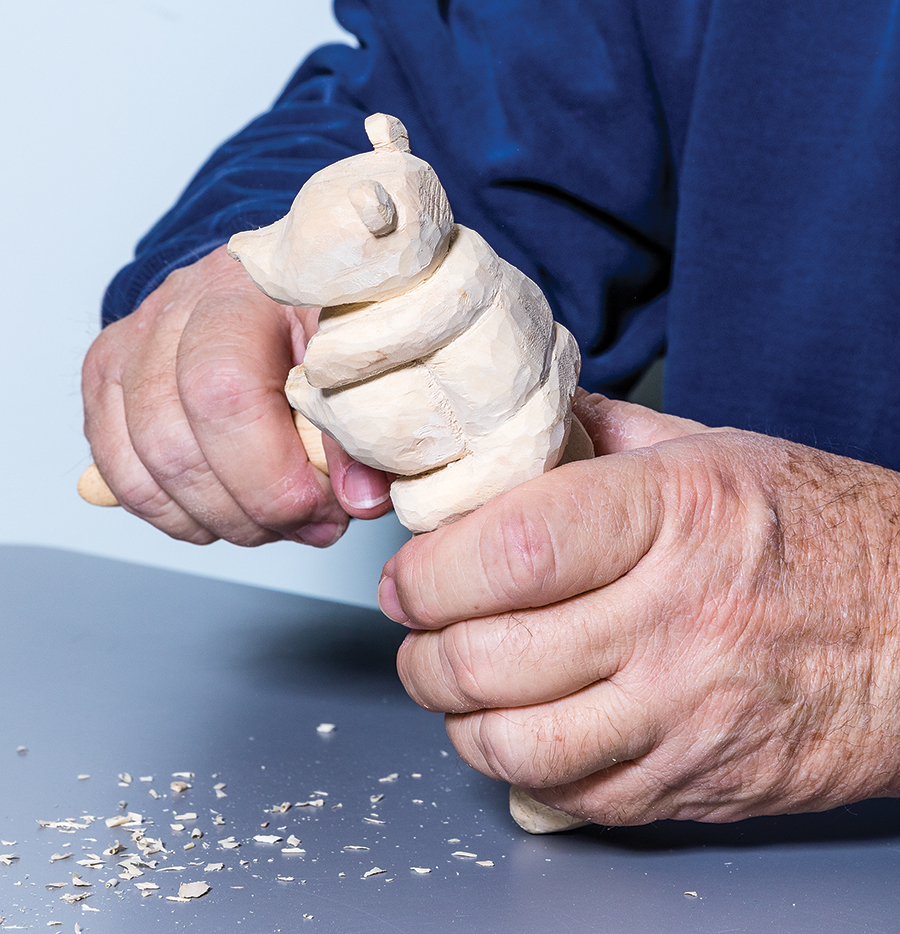
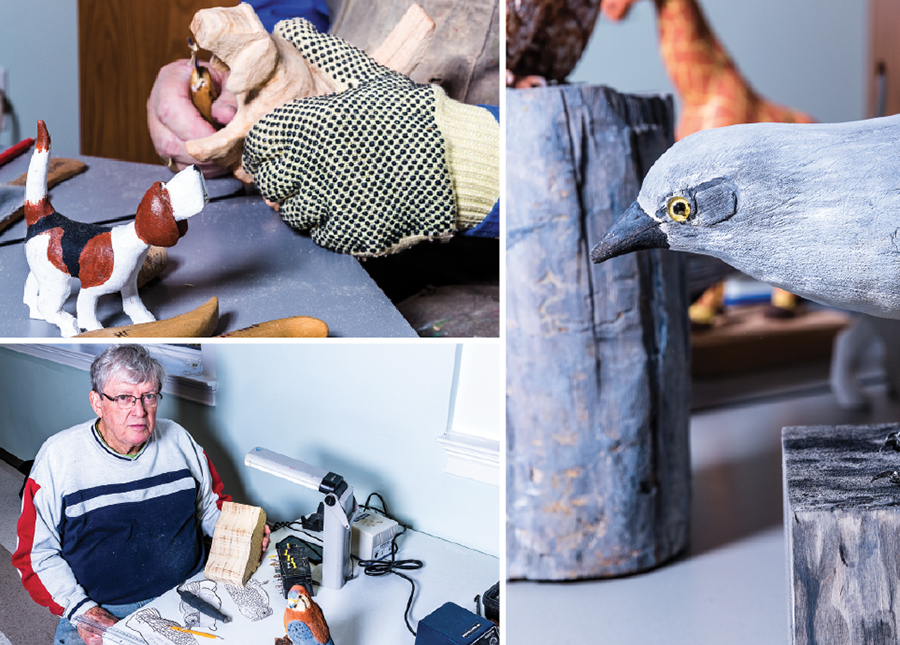
Scars have a tale to tell. Some are the hieroglyphics of awkward accidents or perhaps the traces of regrettable choices you’d rather let slip from memory. For the Sandhills Woodcarvers, however, each scar is a testament to persisting through the beginner stage of the woodcarving craft, a skill rife with small nicks to the hands. Most of the cuts aren’t deep and fade faster than the playful stories attached to them, the price tags of fellowship.

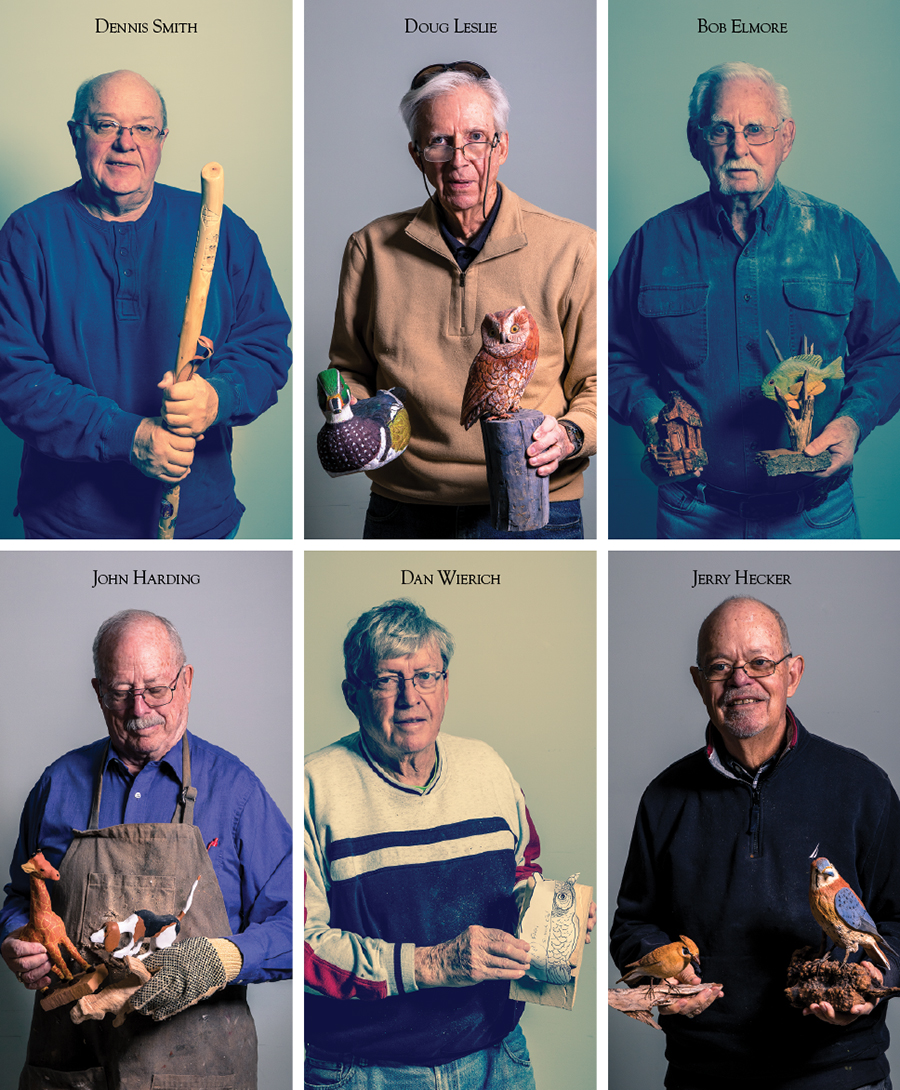
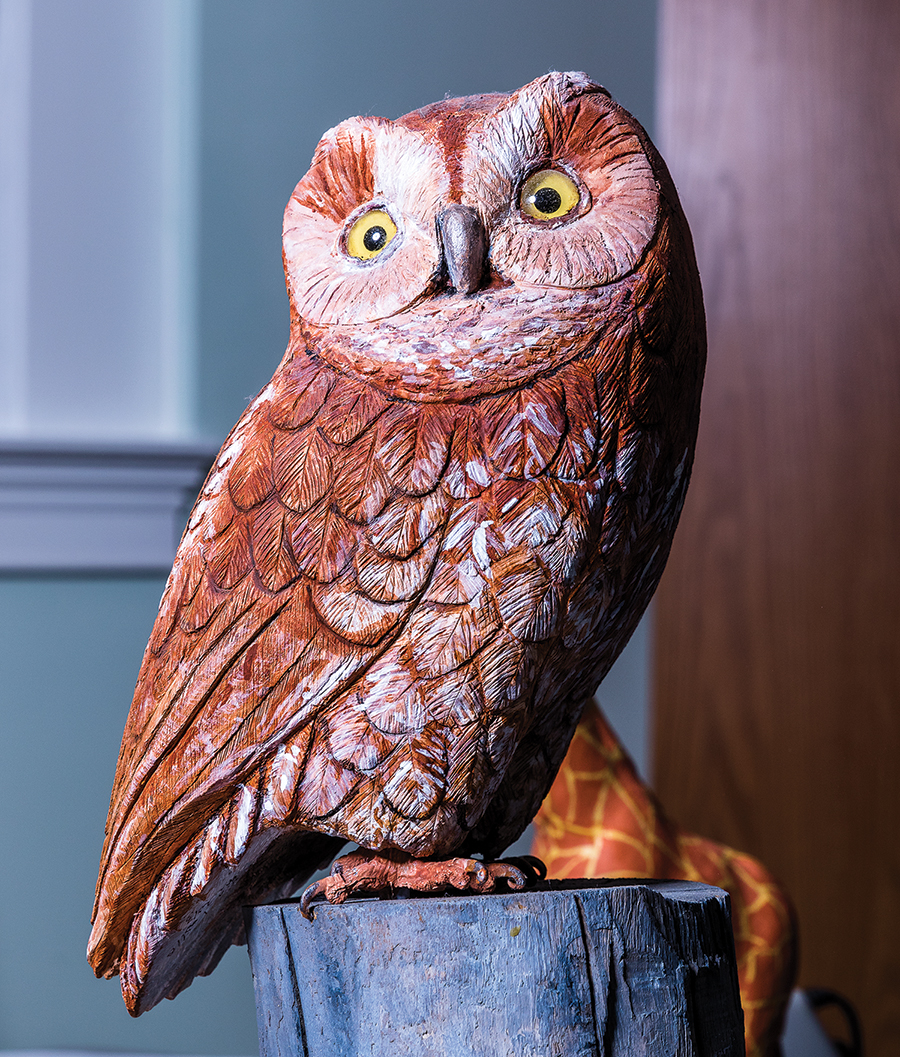
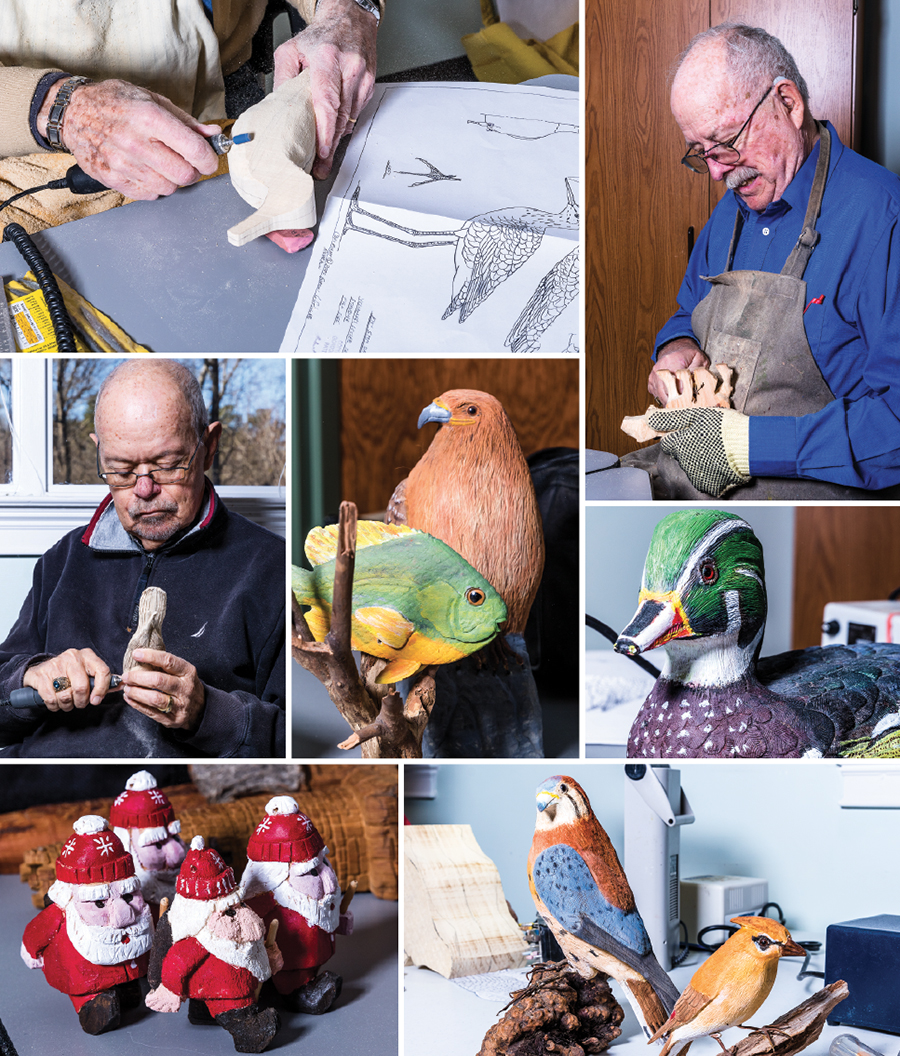
The group meets every Monday afternoon, from 1 p.m. to 3 p.m., in the Senior Enrichment Center off U.S. 15-501. The member list comprises both longtime carvers and newbies who took to the hobby as a form of relaxation and social stimulation. Around 12 to 15 people arrive each week, deftly sculpting trees, hiking sticks, life-size birds, tiny detailed houses, and a variety of other knick-knacks.

Abundant gift giving is a conspicuous commandment of the woodcarving craft, a product of having any number of finished tokens lying around the house with no other use. John Harding picked up the gouge and chisel after he lost his favorite game, tennis. “I hurt my shoulder, and I couldn’t play anymore,” Harding says. “So I found this woodcarving group about eight years ago.” Every spare Monday he carves highly personalized gifts for friends and family, completing over 300 comfort crosses with smoothed edges made to fit peacefully in an enclosed palm.

“It’s so satisfying, about my crosses. I get calls saying, ‘My wife passed away and she was holding your cross.’ It makes me feel that I did some good,” Harding says.

Another memorable carving Harding worked on was for his son-in-law, a second generation Russian-American. He crafted a typewriter spelling out ‘Merry Christmas’ in Russian. For the wedding anniversary of his son-in-law’s parents, he carved a dancing Russian bear. It was the hit of the event, celebrated in St. Petersburg. But the comfort crosses are what make his Mondays fulfilling.

Sixteen-year-old Lonnie Poynter also makes a habit of gifting his creations.

“When you’re finished you can’t wait to give it away,” he says. “You get tired of looking at it.”

Lonnie and his sister Gretchen are oddities in a room otherwise filled with retirees. About six years ago they were introduced to the group by their older brother, who had been encouraged to join by one of the original founders, Don McCluskey. They started at ages 8 and 9, and haven’t stopped since. Although no longer a beginner, Lonnie remembers the novice experience and has a nickel-sized scar decorating his thumb to commemorate the days of yore. The siblings laugh at the memory.

“He was using a dull carver, which will hurt you more than a sharp one,” explains Gretchen. “It slipped and took a chunk out of his hand. He said he had something to show me, and it was just his hand bleeding everywhere.”

Sibling moments, even the gory ones, aren’t the only chances for bonding in the carving club. The retired members of the Sandhills Woodcarvers discovered a sense of kinship when they picked up their carving tools.

“One of the best parts is the camaraderie and picking things up from other people,” says Hal Williams.

The skill set travels, extending well beyond a room in the Senior Enrichment Center. During summer travels to National Parks from Yosemite to Yellowstone, Dennis Smith would often find himself sitting at a picnic table, carving away on the hiking sticks he adorns with the park medallions. Without fail, curious people would start up conversations wondering what, exactly, he was working on.

“It generates a lot of interest. A lot of people know someone who carves,” he says.

The Woodcarvers are eager to teach new members the basics, no matter how long it may take or how many cuts are accrued in the process. They don’t want to hoard all that companionship. They prefer to give it away.

Haley Ray is a Pinehurst native and University of North Carolina-Chapel Hill graduate, who recently returned from the deserts of Southern California.

Dateline: Carmichael

When good things came in smaller packages

By Bill Fields

I’m not sure how my reading ability stacked up to that of my elementary school classmates, but I’m certain having the sports pages of the Greensboro Daily News at the breakfast table didn’t hurt. There were some big words in there.

The newspaper was very specific about where it was covering an out-of-town contest. After North Carolina moved into its new basketball facility in 1965, the dateline for Tar Heel home games spilled over into a second line of narrow-column type.

CARMICHAEL AUDITORIUM, Chapel Hill—

Occasionally, if the slot man was swamped and the typesetter was sloppy, it looked like this next to my bowl of grits:

CARMICHAEL AUDITORI-
UM, Chapel Hill—

Regardless of how it appeared in the paper, the building’s name stood out because it was where my team played. It was not CAMERON INDOOR STADIUM, Durham; or REYNOLDS COLISEUM, Raleigh; or other Atlantic Coast Conference basketball venues.

We had no family ties to Carolina, notwithstanding a summer school Spanish class my UNC Greensboro sister took there. My other sister went to Wake Forest, and while I proudly wore the black-and-gold sweatshirt she gave me, I was a Carolina kid. It was one of those decisions those of us in ACC country made early, before you were even able to write the name of your favorite basketball player in cursive.

I was in first grade when the Tar Heels played their first game in Carmichael, defeating William & Mary 87-68 on Dec. 4, 1965. Although I didn’t see the place in person until I got to campus as a freshman a dozen years later, I felt I knew it.

Aside from newspaper stories and box scores, there were the radio broadcasts. In the late-1960s — when Carolina won the ACC Tournament and advanced to the Final Four three straight years — play-by-play was handled by Bill Currie, a crazy-uncle type known as the “Mouth of the South” and starting with the 1971-72 season by Woody Durham, who was “The Voice of the Tar Heels” for four decades.

Televised games were rare when I first became a fan. We had to be content when a Carolina contest was on the Wednesday or Saturday C.D. Chesley network. And “The Dean Smith Show” was weekly Sunday morning viewing, with Smith always much more effusive about assists or hustle than how many points someone had scored.

One of my first memories of basketball on television is the NCAA title game on March 23, 1968, when the Tar Heels played UCLA. It was a 7 p.m. tipoff in Los Angeles, which made it a very late night for an 8-year-old in Southern Pines. I stayed awake until early in the second half, when the Bruins were well on their way to a 78-55 victory.

Nine years later Carolina played for another championship but had its heart broken by Marquette. I attended my first game in Carmichael in the second semester of my freshman year, a two-point victory over Wake Forest on Jan. 15, 1978. Working my way up the pecking order of The Daily Tar Heel sports department, I traded a seat in the student section for one on the press row-catwalk above it. When things went well for the team wearing light blue and white, it was deafening either place. After home games, reporters huddled around Smith in a corridor outside the locker room as he smoked a cigarette and looked forward to a Scotch.

My first time on a commercial flight, on Dec. 3, 1979, I sat beside then-assistant coach Roy Williams going from RDU to Tampa-St. Petersburg to cover Carolina vs. South Florida. Prior to the start of the 1980-81 season, I had a 90-minute interview with Smith in his office. I was DTH sports editor at that point, but, needing to mind my grades as a senior, left the job well before Carolina lost to Indiana in the 1981 NCAA championship game.  The following spring, I was back on Franklin Street as a fan — and graduate — enjoying the Tar Heels’ win over Georgetown.

Carolina men’s basketball relocated to the Smith Center in 1986. It has twice the seats of Carmichael, but if one grew up with the latter, not twice the charm. Carmichael Auditorium is no more, having been renamed Carmichael Arena in 2010 following an extensive modernization. They sold small commemorative pieces of the hallowed hardwood from the old building in 1998. I didn’t buy one then, but it might be time to check on eBay.

Southern Pines native Bill Fields, who writes about golf and other things, moved north in 1986 but hasn’t lost his accent.

A Generous Voice

The distinguished reign of a poet laureate

By Stephen E. Smith

I have seen the ones I love leave this world as shadows without wings.

The purple martins that come up every year from Somewhere

Leave as easily as they jetted into their gourds in March.

And I have held my father’s hand as he was dying

And my mother’s, lying in her lap like dried peas . . .

From Paul’s Hill

Shelby Stephenson

North Carolina Poet Laureate

With the death of Poet Laureate Sam Ragan in 1996, the office of state laureate ceased being a lifetime appointment, and sitting governors began selecting poets laureate (with recommendations from the state’s writing communities) who would promote an appreciation for an often misapprehended genre. Recent laureates have been chosen for the excellence of their work, their influence on other writers, and “an appreciation for literature in its diversity throughout the state.” The revised guidelines grant tenures ranging from a standard two-year term to five years, depending upon the governor’s readiness to select a new laureate and the willingness of the poet to serve. With the exception of a disquieting hiccup during the McCrory administration, governors have chosen poets laureate who exhibit exceptional talent and generosity — and the process has been, thank God, more or less devoid of politics.

But the job of poet laureate, the physical act of getting behind the wheel of a car and driving to every corner of the state to give readings and workshops, has turned out to be anything but cushy. In fact, it’s full-time work, offering little in the way of compensation and requiring immense dedication. Beginning with Greensboro’s Fred Chappell, who was the first of the new poets laureate and whose Midquest is the finest book (poem) written by a poet of his generation, and continuing with Kathryn Stripling Byer, Cathy Smith Bowers, Joseph Bathanti and Shelby Stephenson, our poets laureate have been barnstorming nonstop for more than 20 years.

From December 2014 to January 2018, Stephenson has given 315 readings, lectures and workshops, traveling from Hatteras to the Tennessee border, twice, and driving more than 25,000 miles within the state. Stephenson, who officially leaves office when a new laureate is appointed later this month, has gently touched the lives of thousands of North Carolinians, and he leaves us with an ambitious 52-part poem, Paul’s Hill: Homage to Whitman (Sir Walter Press), which is the logical and artistic culmination of his past work framed within the hard edges of the perplexing new world in which we find ourselves.

Raised in a large family that farmed in Johnston County, Stephenson is deeply rooted in a rural environment and possessed of a strong sense of longing for a particular time and place that’s never failed to offer the purest vision. His primary subjects, the foundation upon which he’s shaped most of his poems, are family, the natural world, the cycle of life, even the plank house where he was born, and despite a reliance on memory and the intensely personal nature of his poetry, there’s a restrained use of nostalgia in his work. When reading his leapfrogging lyrical lines, the reader is left with an overwhelming appreciation for the life the poet has lived and his eagerness to share his most personal moments.

The light plays shadows where once cordwood readied the woodbox.

My mother’s lost in the steam of her kettle.

I rub my face, as if parting curtains,

Wonder if I see myself in the rose-blue feathers smeared on the picture-window.

Bliss fades into pattern I’ll ride later, dross and all.

White moon, hold me in your arms.

Bathe my thoughts so wild onions may climb the cold

Sister Night to say to morning, “Hello, again.”

A mix of spoken language and the rhymes and rhythms, the literary tongue is interspersed with hymns, dogs, goldfinches, tulip poplars, cornstalks, collards and  country music resonating in song titles and country lyrics, even in the irony of a long-forgotten radio advertisement sung by Arthur Smith and the Crackerjacks:

If your snuff’s too strong it’s wrong

Get Tuberose get Tuberose

To make your life one happy song

Get Tuberose get Tuberose.

Stephenson’s early poems took their inspiration from the land, but in the last 25 years he’s dealt critically with the guilt posed by slavery, the destruction of the natural environment, the dangers of romanticism, the relationship of the past to the present, and the twitches and ticks of contemporary life all infused into Paul’s Hill, anchored steadfastly in the present by the inclusion of the mundane elements of daily life and a use of language that dissolves the distinction between precincts of poetry and prose. His is the voice of a man viewing the present with skepticism, occasional distaste and a trace of anxiety.

The flag of the Oklahoma-bombing holds one tiny baby, fire-scarred

And that September, towering out of words, humble beyond relief,

Some hint of lushness — and you among the moon’s heaving night —

listening to whispers . . .

Judged by productivity, Shelby Stephenson has, for 50 years, created poetry of high quality. Beginning with Middle Creek Poems and moving forward through his 10 books to Paul’s Hill, he’s demonstrated continued growth and has perfected a distinctly individual voice cultivated with a single-minded devotion to his vision of a North Carolina in transition. As he’s matured as a writer, he’s stepped out of the tobacco rows, assuming the role of critic, teacher, reviewer, social commentator — and, most importantly, a distinguished and generous poet laureate.

Stephen E. Smith is a retired professor and the author of seven books of poetry and prose. He’s the recipient of the Poetry Northwest Young Poet’s Prize, the Zoe Kincaid Brockman Prize for poetry and four North Carolina Press awards.

Long Live Loblolly

The halls are alive, with the sound of . . . a new generation

By Deborah Salomon   •   Photographs by John Gessner

Ah, the good old days, the Roaring ’20s, when Southern Pines throbbed with urban intelligentsia wintering in cottages and mansions — the most prestigious built by New York architect Aymar Embury II — while they partied with author James Boyd’s coterie. Picture life in the Gatsby era as described by F. Scott Fitzgerald, a Boyd house guest. Perhaps he strolled over to Loblolly. Embury had taken on this second project for James’ aunt, Helen Boyd Dull, in 1918. Auntie Helen, founder of the Southern Pines Civic Club, christened it Loblolly, honoring the indigenous pines which she had lobbied her father to save from the booming turpentine industry.

Nearly a hundred years after Helen Dull’s death in 1924, ghostly echoes of Jazz Age soirees, heated discussions and philosophical musings compete with the barking of five dogs and the laughter of three small children kicking a soccer ball or playing fort in the bamboo grove.

Loblolly, purchased by Erin and Mitch Lancaster in 2011, is once again alive and lively, like a fashionably dressed dowager whirling across the ballroom floor in the arms of John Travolta.

Possible, since Loblolly actually has a ballroom — or so it was called.

“We call it the Big Room,” Erin says. Indeed, at 7,000 square feet total, big is Loblolly’s operative word. The house, including two guest suites with kitchens, sleeps 14  comfortably. The Lancasters have hosted a wedding on the terrace, with reception complete with dance floor in the Big Room.

The stock market crash and ensuing Great Depression silenced the ’20s roar, but Loblolly stands witness to the history that shaped Weymouth Heights.

When James Boyd lured his Princeton classmate, already a “society architect,” to Southern Pines no architectural style prevailed in the nascent enclave.  While Embury developed the Boyd homestead as Classical Revival, he shook, not stirred, Loblolly. Instead of a rectangular footprint the house stretches longitudinally as far as the eye can see.  Sources provided by the Moore County Historical Association describe it as “recognizable but difficult to define, not quite English Norman cottage, or French, not Art Nouveau — with stuccoed clay tile, checkerboard brick, bell-cast and hipped and gabled slate roofs with tile ridges.” Which boils down to a divine mishmash that established prototypes influencing subsequent homes in growing Weymouth Heights.

After Mrs. Dull’s death, Loblolly was sold to the Vale family, who retained ownership until the 1970s. A fire in 1926 caused the Vales to hire Embury to rebuild and add the ballroom wing.

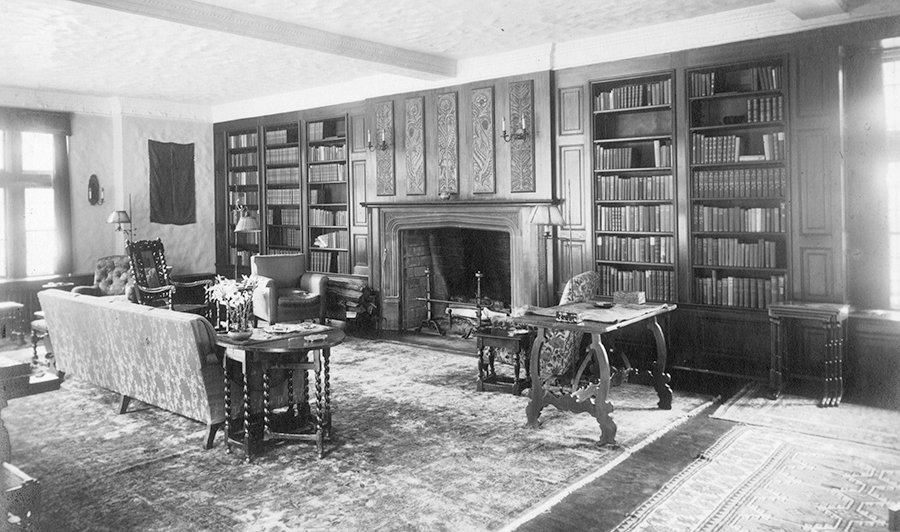
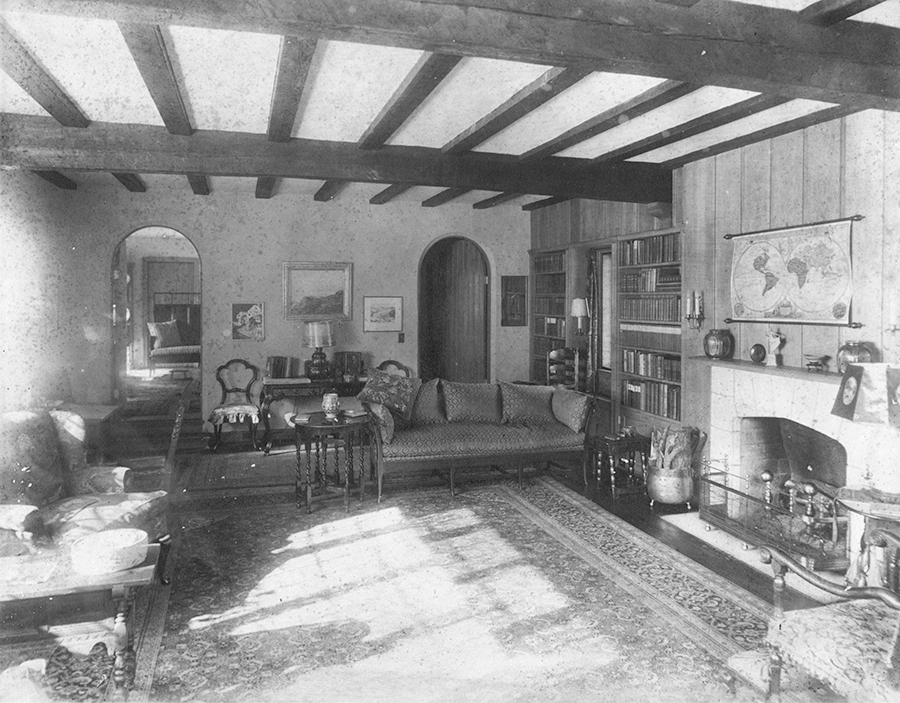
The tennis court is gone, the swimming pool filled in, the acreage divided.  Inside Loblolly seemed dark and imposing by today’s standards, with its hewn beams, teak and walnut floors and miles of built-in bookcases — hardly a tempting project for a young family.

“I didn’t even want to move (to Southern Pines),” Erin Lancaster says. She is from Richmond, Virginia, Mitch from historic Windsor, North Carolina. They met in Raleigh. His parents lived at Woodlake. The young couple, then with a baby and toddler, were looking to relocate — a possibility, since Mitch operates his businesses from home.

“We were visiting friends and loved the idea of walking downtown,” he says. For fun, they looked online. Loblolly popped up. That was on a Sunday. They viewed the property on Tuesday, made an offer on Friday, which was accepted the following Sunday.

“Not much had been done — it needed a few upgrades,” Erin remembers, charitably. “It had that ’80s look, with faux marble.” The Lancasters knew what might be involved from remodeling their Raleigh home. Full speed ahead — systems and big jobs first.

But making a historic property livable and practical goes beyond fresh paint and new carpet. “We wanted it to be comfortable, not stuffy,” Mitch says. In other words, Erin adds, no no-touch zones.

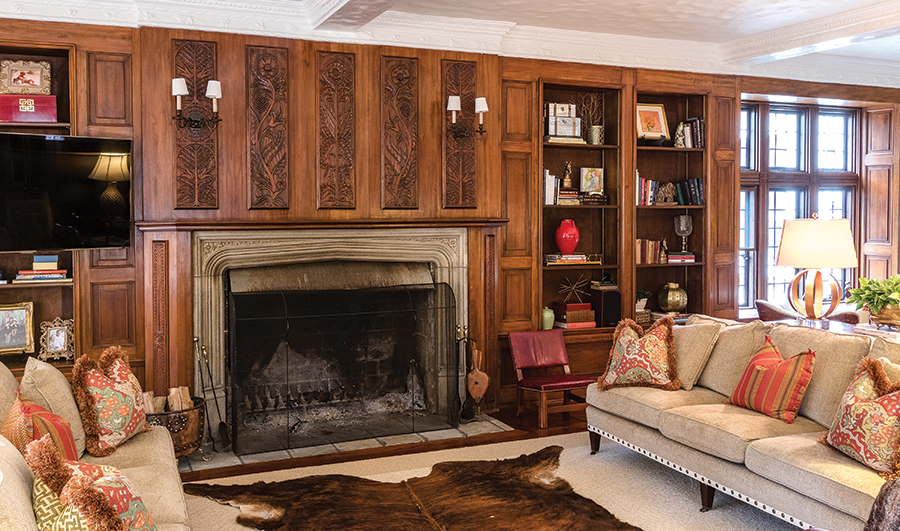
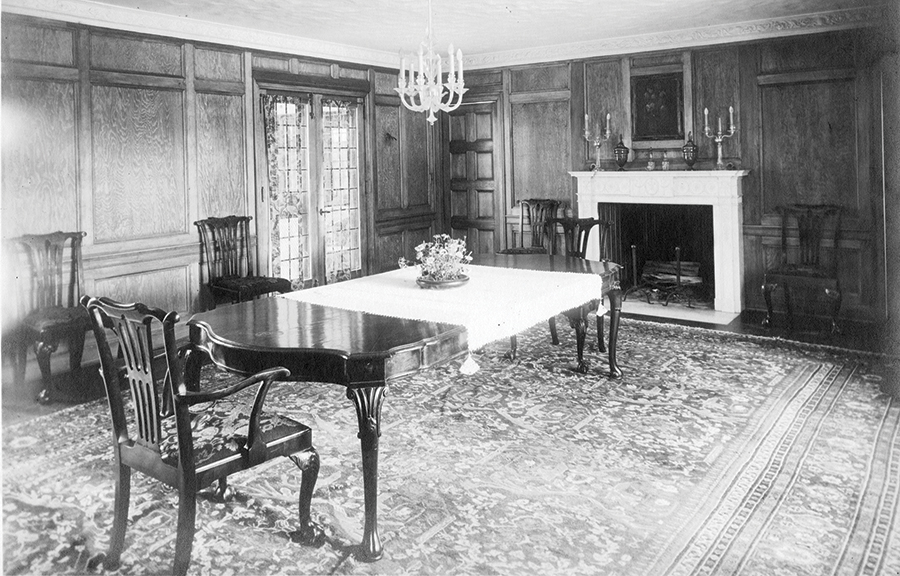
Here, architectural features dictate interior décor: Paned metal casement windows decorate walls like paintings. Sculpted moldings in the dining room channel French chateaux.  Plaster walls hand-rubbed into an undulating pattern throughout were likely the work of craftsmen imported from New York by the builder.  Built-ins dominate public rooms.

For participants in the Southern Pines Garden Club Home & Garden Tour on April 14, a walk through the Lancaster-era Loblolly will be a magical mystery tour, beginning with a dark, wide, slightly monastic foyer whose only decoration is Erin’s favorite Biblical verse, from Isaiah, stitched on fabric in the shape of a cross, framed, and hung on the wall — her talisman. To the left, through a paneled round-topped door is the formal living room with beamed ceiling and an entire wall of bookcases, also of dark woods, which convey a library effect.  The Lancasters call this the Christmas Room, perfect for their big tree.

“We wanted traditional (furnishings) to match the house,” Erin says. What they brought from their previous home fit beautifully. High-backed upholstered chairs, a circular upholstered coffee table/ottoman, her desk and side pieces — even a bread trough under a window shelf — are oversized to match the living room’s dimensions. Yet, she reports, the kids have enough space to run laps around the sofa.

Erin’s interior designer, Susan Brown of Raleigh, chose light solids and patterns (some classic Schumacher) for upholstery and drapes to relieve the dark paneling and floors, which are original, gorgeous and sparsely covered by Orientals.

“Susan worked with me on our house in Raleigh,” Erin says. “She knows me so well.”

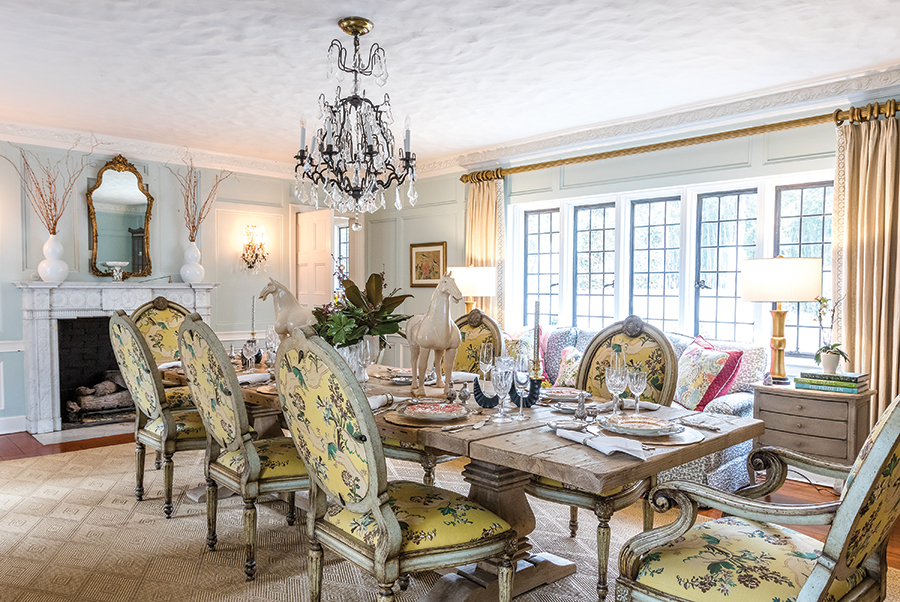
Nowhere is the scale of Loblolly’s original footprint more evident than in the dining room, which accommodates 12-foot table, a full-sized sofa under the window, an exquisite French china cabinet filled with Minton bunnies (Erin’s trademark) and other pieces without crowding.

Here, Susan and Erin created a wild juxtaposition that works: The tabletop is made from wide, roughly textured planks while the Papa Bear-proportioned chairs have ornate French Provincial frames upholstered in a floral fabric. Under the table, a sisal all-weather rug, in neutral sand because, Erin points out, “The kids run through here on the way to the kitchen.”

The kitchen, of course, required gutting. A small bedroom and pantry behind it were removed to open up space for a family sitting/dining area. The kitchen itself displays an unusual arrangement of two parallel islands, with sink on one and range, ovens, refrigerator against the walls. Carrara marble tops the massive bureau-style walnut cabinetry. A ceramic tile backsplash adds another texture. “Mitch has the good brains about how a kitchen functions,” Erin says, understandable since he’s the family chef.

When it comes to colors, Erin and Mitch part ways. She adores the pale aqua predominant in the dining room and on some fabrics. He likes red. Erin and Susan Brown have softened his bright primary into a rosy rust, which lives peaceably with Erin’s choice throughout the house, but especially in the family dining area.

The Big Room, sunken a half-dozen steps below the main floor, elicits disbelief. Approximately 40-by-25 feet with a high ceiling of the same undulating plaster, built in bookshelves lining two walls, paneling elsewhere, a wood-burning fireplace and two TVs, the space is arranged as the baby grand piano area, the conversation area and the bar added by the Lancasters, where a small kitchen with dated metal cabinets once stood. Beside the bar, a grouping of two pale yellow leather chairs, made in New Zealand, seem lifted from a modern art museum. “We were at a gallery in Las Vegas, looking for paintings,” Erin explains. “Mitch saw the chairs and sat down on one. He said, ‘Oh, these are comfortable.’” Others have noted that Elvis might share his opinion.

Pack ’em up, ship ’em east.

Loblolly has no grand staircase. The elevator has been removed. The second floor remains a maze of wings and narrow hallways, dormer niches with light streaming onto a heirloom slipper chair or table. But the bedrooms (eight, total, including the garage apartment) are enormous, with window seats and sitting areas. Son Milum’s room has two four-poster beds from Mitch’s childhood, while daughter Beverly uses Erin’s small  chests of drawers and plays with her mother’s stuffed bunny collection. The kids have a designated Lego room. One small bedroom has become Erin’s closet/dressing room. At the end of the hallway the master suite with soaring ceiling and windows on three sides looks out over terraces, gardens and two-plus fenced acres bordered by ancient trees — another world, another story

Loblolly represents not only an extinct lifestyle, but materials and workmanship impossible to duplicate. The trick is dressing old bones in new clothes. “We’ve been chipping away at it for seven years,” Erin says. “We’re about halfway done.” During that time, the Lancasters had a third child, adopted several rescue dogs, enticed Erin’s sister and her family to a house down the road. Mitch entered city politics. And a renewed Loblolly is once again the scene of dinner parties, meetings, play dates and social events.

“It’s a God thing that we ended up down here,” Erin concludes. “OK, here’s your path, God told us. So if this is where we’re supposed to be, let the house pass inspection.”

Loblolly is one of six homes featured on the 70th Annual Southern Pines Home & Garden Tour, from 10 a.m. to 4 p.m. Saturday, April 14. Also included, an exhibit at Campbell House recounting how club members shaped the landscape of the community through their projects and initiatives. Proceeds from the tour support local beautification and horticultural scholarships. Tickets: $20 in advance, $25 day of tour (at sites). Advance tickets are available at The Country Bookshop in Southern Pines and Pinehurst Woman’s Exchange, or through the club website: www.southernpinesgardenclub.com.