Almanac

By Ashley Wahl

November is the sculptor and the stone — ever chiseling away, ever clarifying what has always been, gently unveiling the mystery.

Near-bare branches reveal ash-gray skies, crisp silhouettes in all directions and a panorama so clear you wonder how you never noticed what you’ve never noticed.

The veil is thin. Like trees with lungs, deer stand silent, eyes wide, ears spread like radio antennae. There is nothing and nowhere to hide. Even the last of the leaves have let go — not yet of their branches but of their need for sunlight. No more churning out chlorophyll. No more illusion of green. Only dappled yellow and mottled orange, the brilliant scarlet truth.

November is the last of the apples, zucchini bread warm from the oven and the cold sting of autumn in your eyes and bones.

In a flash, an earful of waxwing ornament the tender branches of the dogwood, pass its red berries from bill to bill like children sharing candies. You heard them before you saw them. And like a dream, the birds have vanished as suddenly as they arrived, the berries gone with them.

November guides you inward.

You are standing in the kitchen now, cradling a hot beverage until your face and fingers thaw. It doesn’t happen all at once, this softening. But sure as the final leaves descend, the grace of the season will become clear: Things fall away to reveal what matters most. And with all this space — this bare-branched view of the brilliant scarlet truth — there is gratitude.

You give thanks for what is here now, the cold sting of aliveness and the warmth within the mystery.

The wild gander leads his flock through the cool night,
Ya-honk! he says, and sounds it down to me like an invitation,
The pert may suppose it meaningless, but I listening close,
Find its purpose and place up there toward the wintry sky.
— Walt Whitman, Leaves of Grass

Turnip Eater

It’s turnip season, and if that doesn’t thrill you from tongue to root, consider the words of Pliny the Elder, who maintained that the turnip “should be spoken of immediately after corn, or the bean, at all events; for next to these two productions, there is no plant that is of more extensive use.”

In Roman times, the globular roots were hurled at unpopular public figures much in the way disappointed groundlings chucked rotting fruit at Shakespeare’s duds.

There are more practical uses, of course.

During World War I, bread and potato shortages gave birth to the “Turnip Winter” of 1916–1917. German civilians subsisted on them. And in World War II, when biscuits and mutton were scarce, guess what? The turnip was there, best in savory Lord Woolton pie, named for the Minister of Food who popularized the dish in 1940.

Turnips are low in carbs and packed with nutrients.

Roast them in butter. Mash them with sage. Pan-fry their greens with sweet onions and garlic, balancing the bitter with brown sugar, salt and apple cider vinegar.

In 2018, Tasmanian farmer Roger Bignell accidentally grew a world record-breaking turnip that weighed a whopping 18.36 kilograms (that’s over 40 pounds). Imagine unearthing that sucker, a root the size of a border collie! Not so easy to hurl.

If Charles Dickens used the word “turnip” in a novel, he was likely referring to a country bumpkin. But it’s a gift to be simple, and when life gives you turnips, you might just get creative with them.

Quiet Time

The full Beaver Moon rises on Monday, November 30. It’s time now.

The beaver retreats to its lodge, the squirrel to its drey. The bumblebee burrows underground, alone, dreaming of honey and clover.

The creatures lead the way, but we, too, turn inward.

Warm wishes and good health to you and yours this holiday season. May your hearts and cupboards be full.  PS

Murder on Midland

The 1937 hunt for Juney Carraway’s killers

By Bill Case

It was not uncommon for 48-year-old tourist camp operator Juney Carraway to vanish for days without informing wife Leoma, or anyone else, of his whereabouts. On one occasion the wandering Juney had flown the coop for months before reappearing. Thus, it did not particularly alarm Leoma when her husband and two male lodgers did not make it back to Connecticut Camp by nightfall on Friday, Aug. 6, 1937. The men had left the camp at 6:30 that morning in Carraway’s Chevrolet coupe.

Carraway typically carried hundreds of dollars in his bulging billfold — a habit he did not hide. As Sunday dawned and there was still no trace of her husband, Leoma became fearful Juney had become a tempting target for desperate men harboring bad intentions.

The men who left Connecticut Camp with Carraway definitely checked the desperation box. Unkempt, with straggly hair and dirty overalls, they had hitchhiked into the camp the previous Wednesday, arriving from parts unknown. An odd couple, the older of the two was in his late 20s, short, stocky, dark-haired and of swarthy complexion. He spoke with a distinct accent. The younger man, around 20, was a lanky blond string bean.

Connecticut Camp, located on U.S. 1 between the rural hamlets of Pinebluff and Hoffman, was rather lax when it came to the niceties of registration. Though the drifters seemed friendly enough to Leoma, she didn’t even know their names.

Friday wasn’t the first time Carraway had given his two guests a lift. The day before he’d taken them in search of local employment — just the sort of thing that better-off folks did for the downtrodden during the hard times of the Great Depression.

By Sunday afternoon, a frantic Leoma called the Moore County Sheriff’s Office and reported her husband missing. The department promptly posted an all points bulletin urging area law enforcement personnel to be on the lookout for Carraway, his Chevy coupe, and the two drifters.

Like most August days in the Sandhills, temperatures on Sunday, Aug. 8, flared into the 90s. Swan Pond, a local swimming hole that exists to this day, is located approximately a quarter-mile north of Midland Road, and a mile west of downtown Southern Pines. A handful of boys seeking relief from the sweltering heat in its cool water noticed a Chevy coupe parked on the pond’s north shore, far from any road or driveway. At first, the swimmers paid no attention to it, but when the car still had not moved in succeeding days, one of the lads mentioned it to his father, who notified law enforcement.

Sheriff’s deputy Charles Dunlap made his way to the abandoned vehicle during the late afternoon of Tuesday, Aug. 10. His search of the auto found Carraway’s personal papers scattered on the car’s floor. Other evidence suggested something more sinister had taken place. There was a bullet hole in the left side window, another in the car’s hood, and a spent .22 caliber bullet rested on the frame of the motor. The whereabouts of Carraway and his two passengers remained unknown.

Dunlap asked Aberdeen mechanic Jim Riley to tow Carraway’s auto from the pond to his garage’s storage lot. On the morning of Wednesday, Aug. 11, Riley carefully maneuvered his tow truck through the dense pines to the abandoned Chevy. When he noticed the car’s right front tire and rim were missing, he went looking for them. He found the tire just off the edge of Midland Road. Venturing deeper into the woods, he saw the rim. Near the rim he saw Juney Carraway’s badly decomposed body with a 5-inch bone-handled knife and a sandbag alongside the dead man.

County coroner Carl Fry hurried to the scene. After examining the body, he concluded that Carraway had been beaten about his head and body, dragged through the woods and knifed through the heart. Fry found no evidence that gunplay had played a role in the attack. The coroner estimated the murder had occurred on Aug. 6, the day Carraway departed his Connecticut Camp for the final time.

Tire marks on Midland Road indicated that Carraway had been driving west toward Pinehurst when he lost control of the car. It veered over the median across the eastbound portion of Midland, careening through shrubbery on the double road’s south side. Still in motion, the Chevy swerved back across the median and the westbound roadway before sideswiping a tree, dislodging the tire from the rim.

One of Carraway’s passengers, it was suspected, had struck him over the head with the sand bag, causing the car to swerve wildly. When the car stopped, it appeared as though the dazed Carraway managed to open the driver-side door and tumble out in an effort to ward off, or flee from, his attackers. Whether they struck him again or not, Carraway must have lost consciousness because the two assailants were able to drag him away from the road into the woods, where he was stabbed to death. The killers managed to move the Chevy through the trees to the edge of Swan Pond. Then they disappeared.

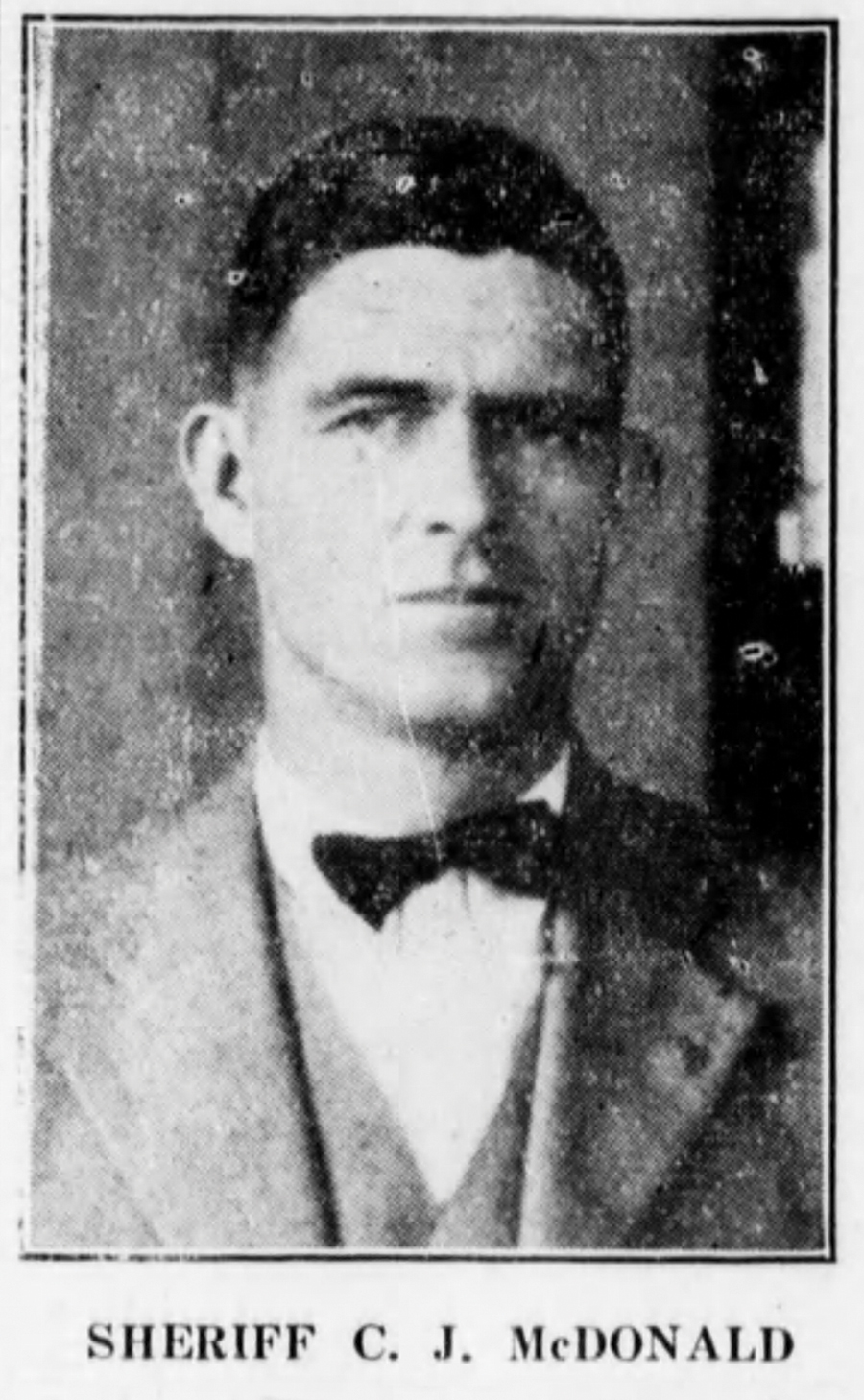
Given a five-day head start, Moore County Sheriff C.J. McDonald knew it would be no easy task to track the killers. The 45-year-old McDonald was a seasoned lawman. A former state highway supervisor, he had been elected sheriff in 1928 and earned a reputation as an indefatigable detective. The Pilot wrote, “Once he (McDonald) catches the scent of an evildoer, he follows it relentlessly no matter where it leads. No detail is too minor, no distance too far when the quarry is at the end of the line.”

And the sheriff was no stranger to sensational cases. In 1929, he had brought to justice Granville Deitz, the runaway killer of Southern Pines’ police chief, Joseph Kelly. But the finding of Juney Carraway’s murderers would take all the resolve McDonald could summon.

After receiving Fry’s inquest findings, McDonald launched what would eventually morph into an international manhunt. With the help of his most trusted deputies, A.W. Lambert, Herman Grimm and Dunlap, by late Wednesday afternoon (Aug. 11), the officers had inspected the murder scene, interviewed witnesses at Connecticut Camp, and transported evidentiary items to Raleigh for forensic analysis and fingerprinting. Because it had rained in the intervening time between the murder and the discovery of Carraway’s body, fingerprints on the knife and other key articles had been washed away.

News of the murder spread rapidly through the Sandhills. When Pinehurst taxicab driver Joe Hensley learned details of the crime on Thursday, Aug. 12, he contacted the sheriff. He said two men matching the suspects’ descriptions had shown up at his Pinehurst taxi stand around 10 a.m. on Friday, Aug. 6. They inquired whether Hensley could drive them to Raleigh in time to arrive there by noon. The men explained they were picking up two motorcycles that had been shipped to the city, and “they wanted to get there as quickly as possible to pick them up.” The two claimed they were starting new jobs and the cycles were going to serve as their transportation.

Hensley’s fares rarely ventured outside Moore County, so the long-haul request sparked his curiosity. He asked the men why they didn’t take the train. “We don’t like to ride on trains,” was the response. Hensley quoted a $15 fare for the trip. Eyeing the shabby appearance of the duo, the cabbie insisted on payment up front.

On the way to Raleigh, Hensley stopped for food at a filling station in Cameron. When the passengers got out of the cab to stretch their legs, Joe saw the outline of a gun in the hip pocket of one of them.

With alarm bells clanging in his mind, Hensley paid close attention to what the two men said and did. The older, darker complexioned man (Hensley suggested perhaps he was of Italian heritage) talked constantly and with a distinct accent. Joe observed the man was missing part of a forefinger. The younger 6-foot sidekick, with long blond hair combed straight back, said he hailed from Boston. Hensley noticed the tall man’s oversized footwear and wondered whether they were “convict shoes.” Both were defensive about their rough appearance, assuring Hensley they would get cleaned up as soon as they arrived in Raleigh. The lanky blond made mention of having spent time “in Reading.” This aside would become a key — though initially misunderstood — clue. Hensley dropped the men off in Raleigh (not at a motorcycle dealership), and thought nothing further of the matter until learning of Carraway’s murder.

Sheriff McDonald instructed his deputies to contact every motorcycle shop in Raleigh and neighboring counties. A Greensboro dealer reported that a young man answering the lanky blond’s description had entered his shop and bought a motorcycle on Aug. 9. The buyer was tracked down and apprehended on the 15th. After learning that the suspect’s brother-in-law in Albany, New York, matched the description of the darker, fast-talking suspect, it momentarily appeared that the case might be wrapped up. That possibility disappeared when the men provided ironclad alibis. Both had been in Albany on Aug. 6.

By the end of August, the investigation had stalled. McDonald sat for an interview with a reporter from The Pilot on Sept. 1 and was unable to offer much comforting information. He acknowledged that Boston’s police department, contacted thanks to Hensley’s information, had yet to report anything useful. Several other leads had proved to be dead ends. One was a rumor that a woman staying at Connecticut Camp had befriended the suspects. In fact, she’d never laid eyes on them. Another resulted in the arrest of an Italian man in Durham who, after questioning, was quickly released. A promising lead involving two Norfolk, Virginia, suspects also fizzled. Despite McDonald’s distribution of 500 wanted posters to police departments across the eastern United States, the identity and whereabouts of the suspects remained unknown.

In search of a new angle, the sheriff brainstormed with his deputies. They had all assumed the suspects entered the Sandhills on the day they arrived at Connecticut Camp. What if the men had been locked-up in the county jail, an ever-present occupational hazard for train-hopping hoboes? McDonald summoned the jailer to his office. He remembered two New York City guys, friends with one another, matching the suspects’ descriptions. Convicted of hoboing, James DeGruiccio, age 25, and Albert Whitworth, age 22, had served 60-day sentences in the Moore County jail prior to being released from custody on July 4th, a month prior to the Carraway murder.

If the men had indeed killed Carraway, it seemed logical to McDonald they would hightail it back to their hometown. On Sept. 17, he journeyed to New York City to confer with officers in the NYPD’s homicide unit. In the meeting, the police captain in charge agreed to assign undercover plainclothesmen to find DeGruiccio and Whitworth.

After returning to Carthage on Sept. 19, the sheriff complimented the NYPD. “They have a real police force,” he effused, “and if the men can be found I think they will find them.” Reflecting McDonald’s optimism, the Sept. 24 edition of The Pilot carried the headline “Sheriff Confident of Arrests in Murder Case.”

McDonald’s faith in New York City’s finest proved justified. DeGruiccio and Whitworth were identified and arrested. The Oct. 1 edition of The Pilot hailed the news: “Hats off to police authorities of Moore County and New York City in the apprehension of the probable murderers of J.E. Carraway.”

There was one last formality to address before the sheriff could declare the case solved: a positive identification by Joe Hensley that the men in custody were the same men he had transported to Raleigh. Hensley agreed to go to New York with deputies Lambert and Grimm to make the identification.

A lineup including the two suspects was arranged. Hensley did, indeed, pick DeGruiccio and Whitworth out of the grouping, but then the cabdriver added: “They look enough like the men I carried to be their twin brothers, but I’m positive they are not the same men.” When the two suspects later furnished evidence confirming their presence in New York on Aug. 6, they were released. Another dead end.

The news from New York was a bitter pill for McDonald. Remembering that the lanky blond suspect had mentioned “Reading” in the course of the cab ride to Raleigh, McDonald suggested that Lambert and Grimm stop in Reading, Pennsylvania, on their way home. Perhaps that city’s police department could provide a lead. The detour proved just as fruitless, and the deputies returned to Carthage disappointed and empty-handed.

The sheriff was back to square one. McDonald determined there was one more ground ball to run out before suspending his investigation. He wanted to conduct a final, exhaustive inspection of Connecticut Camp, even though two months had passed since the murder, and a search of the premises seemed an exercise in futility. The deputies reexamined every inch, focusing at last on a massive trash heap located behind the camp’s cabins. After hours rummaging through the foul refuse, one of the officers came across a small scrap of paper bearing a smudged and barely legible name and address that read:

Bill Sommers

249 Forest St.

Reading, Mass.

It wasn’t Pennsylvania at all, but Massachusetts, and Reading happened to be a suburb of Boston — the city where the lanky blond told Hensley he once lived. Deputy Grimm was dispatched to Reading, Massachusetts, where he found and interviewed Bill Sommers, who operated a motorcycle store there. Sommers recalled that two men matching the descriptions of the killers had visited his shop and discussed acquiring motorcycles for a trip south, but had left the store without making a purchase.

Grimm passed the new information on to Reading’s police department. An officer there thought the tall blond who had visited Sommer’s shop might be 19-year-old Robert Svendsen, who he believed resided in the neighboring town of Somerville with his mother, Lily Svendsen. The Reading police visited Lily, who said her son had recently moved to Hamilton, Ontario, where his father lived.

With Svendsen in Canada, Grimm confronted matters involving international law and extradition. It would require complicated paperwork to arrest Svendsen for a crime committed in the United States and, afraid the young man might flee, Grimm convinced Hamilton police to arrest him for vagrancy and hold him on that charge until the deputy was able to obtain authority for an arrest for the U.S. murder.

During the second week of January 1938, Grimm left Boston, crossed the border into Canada, and headed for Hamilton to interrogate Svendsen. The young man admitted involvement in the crime, and seemed relieved to do so, but maintained it was his confederate, “Griffith,” a Canadian of French and Native American descent (not Italian), who had smashed Carraway over the head and knifed him.

Svendsen said he had been totally stunned by the unexpected violence. He claimed to have had no inkling that Griffith intended to either hurt or rob Carraway. The killing made no sense to him, especially, he said, since Carraway had been doing the two a favor by giving them a lift to Pinehurst. Svendsen confessed he helped cover up the crime by dragging Carraway into the woods, but only did so because Griffith pointed his pistol at him. Svendsen did not turn down the $75 Griffith gave him, a small portion of the loot removed from Carraway’s billfold.

Svendsen said he and Griffith separated after the cab ride to Raleigh and, with his share of the money, bought new clothes, shoes and a motorcycle, then headed north. In Baltimore, the gangling youth collided with a streetcar and sustained a knee injury that laid him up in the hospital for several weeks. Following his recovery, he continued on to Somerville to visit his mother before heading for Canada, where he had been scheduled to start a new job in Hamilton on, as it turned out, the day after his arrest.

The young man also provided details regarding his association with Griffith. They had known each other for only a week before journeying together to Springfield, Massachusetts, where they spent a night at the house of Griffith’s family. Afterward, the two made their way south by various means: in an old jalopy (which they sold in Baltimore), riding a train and hitchhiking.
Svendsen waived extradition and Grimm transported him to Carthage to await trial. When Springfield police were unable to locate Griffith’s family residence — let alone Griffith himself — Svendsen was asked whether he would be able to find the house where they’d spent the night. He thought he could. In fact, he was eager to assist the police, since Griffith had brought him nothing but trouble. With Svendsen in tow, Grimm and Dunlap made yet another trip to New England.

It took an entire day of meandering through the streets of Springfield, but Svendsen finally pointed out the house. Griffith’s family no longer resided there, however, having moved to Canada. In checking with neighbors, the officers discovered that the family’s name wasn’t, in fact, Griffith at all — it was Caron. The neighbors were familiar with Svendsen’s swarthy accomplice. His real name was Jean Baptiste Caron, an erstwhile circus roustabout and tailor. Svendsen was flabbergasted that Caron had used an alias but there was a plausible reason for the deception — Jean Baptiste Caron had a lengthy criminal record.

Now that the police knew Caron’s actual identity, he became easier to track. Soon, an array of Canadian law enforcement entities, including the Northwest Mounted Police, were nipping at his heels. Caron presumably sensed law enforcement was catching up to him because he hopped a freight train in Halifax, Nova Scotia, and rode it 750 miles before getting off in Waterloo, Quebec. Word of Caron’s crime traveled faster than the train did, however, and provincial police were waiting to apprehend him.

After receiving a telegram from Montreal advising of Caron’s capture, McDonald and Grimm made ready for a trip to Canada to escort the prisoner, who had waived extradition, back to Moore County. They reached Montreal on Saturday, Feb. 26, and returned with a handcuffed Caron to Carthage, a little more than six months after Carraway’s murder.

Charged with first-degree murder, there was a distinct possibility Caron could receive the death penalty. His involvement in the brutal crime could not be seriously disputed, and his cohort had identified him as the actual killer. Caron could try avoiding the gas chamber by pointing the finger at Svendsen, but sweet-talking a jury into believing that the 19-year-old had masterminded the plot would have been a tall order for Clarence Darrow, let alone the local lawyer defending Caron. Besides, Svendsen simply did not look the part. The Moore County News described the gangly youth as having “anything but a killer’s face.”

Nonetheless, Caron accused Svendsen of having done the knifing that finished Carraway. But other statements he offered tended to tighten the noose around his own neck. By claiming that Svendsen was in on the plan to kill Carraway, Caron essentially acknowledged his own conspiratorial role. He said that the younger man had prepared the sandbag for the attack, but then admitted being the one who struck Carraway with it. During the period leading up to the trial, it became obvious that Caron had little confidence he could avoid a death sentence. The Pilot reported he was busy negotiating the sale of his body for medical research.

The trial began the last week of May. Caron did not take the stand, but Svendsen did. While the jury members acknowledged that the defendants had committed a dastardly homicide, they were unable to agree on the specific charges upon which to convict them. Accordingly, the judge declared a mistrial. The breakdown of the jury’s split votes indicated that Caron had narrowly escaped a first-degree murder conviction that would have exposed him to the death penalty. Several jurors viewed Svendsen’s role more leniently. Two had been willing to let him off with a charge of manslaughter.

The defendants were tried again in August. This time Judge E.C. Bivens empanelled a special “blue ribbon” jury to hear the case. The presentation of evidence mirrored the first trial and on Aug. 18 the jurors returned a verdict of second-degree murder for both men. Surely, Caron breathed a sigh of relief; Svendsen not so much. Judge Bivens issued the maximum sentence available to both men: 30 years imprisonment at hard labor.

Sheriff McDonald and his deputies received high praise for their perseverance and ingenuity in bringing Carraway’s killers to justice. Without benefit of closed-circuit cameras, social media tip-offs, DNA or 21st century forensics, they had painstakingly solved an intractable murder case. The investigation had weathered a multitude of disheartening false leads before the long-shot trash bin search produced a paper scrap that cracked the case. Daring Detective magazine carried a feature story detailing it all in its February 1939 issue.

Charlie McDonald’s illustrious career as Moore County sheriff would continue for another 20 years. Deputy Lambert served under the sheriff for that entire tenure. Herman Grimm did not stay long, moving on to a position with the state ABC. Ironically, Grimm would later run for sheriff against his old boss. Like all Charlie’s challengers for the office, Herman lost. When McDonald finally removed his shield in 1958, his 30-year tenure matched the longest of any sheriff in North Carolina’s history. Two months after retiring, he died.

Juney E. Carraway’s body lies in Northam Cemetery, a pastoral graveyard on the outer reaches of Richmond County, his good deed on a hot August day tragically punished.  PS

Pinehurst resident Bill Case is PineStraw’s history man. He can be reached at Bill.Case@thompsonhine.com.

City on a Hill

The legacy of Jimtown

By Bill Fields     Photographs provided by the Moore County Historical Association

Opening photo: Our Lady of Victory School in 1948

Nearly a century ago, a man wrote a letter to the editor of The Moore County News. He was proud of his community, proud of his home, plain proud. The newspaper had included in the previous week’s edition a positive story about “Jimtown,” the African American neighborhood on the sunset side of the tracks in Southern Pines.

“Of course Jimtown is a very peculiar name, and West Southern Pines sounds much better, but Jimtown is alright. We are delighted over your discussion of Jimtown and what we are doing here. We are building our homes and repairing the old ones. … I am building me a home here in Jimtown. When you pass through here look for my beautiful home on Connecticut Avenue, a space of 150×161 feet, overlooking Knollwood.

“It has always been said that a city sitting upon a hill cannot be hidden. So there is too much going on here in Jimtown to be hidden. Of course Jimtown is not a city but you bet your life it sits upon a hill. Jimtown is making wonderful progress this year. We can’t keep up with you white people with money, but our outlook is fine. We know that we can’t go over the top, but we are going to the top.”

A Jimtown Citizen

STEPHEN J. SANDERS

When Sanders wrote those words of pride and hope, it had been only 23 years since the Wilmington coup of 1898 just 135 miles to the east, a violent overthrow of a legitimately elected government, massacre of African Americans and the destruction of their community. The Ku Klux Klan was poised for a resurgence. Racial segregation in the Jim Crow South was decades from its reckoning.

“That event (Wilmington 1898) ripples out for a long time,” says Dr. Katherine Charron, associate professor of history at North Carolina State University. “In terms of the terror, in how Black people had to readjust to disenfranchisement. The Black community probably turns more inward because of disenfranchisement and violence. It is doing institution building and self-governance.”

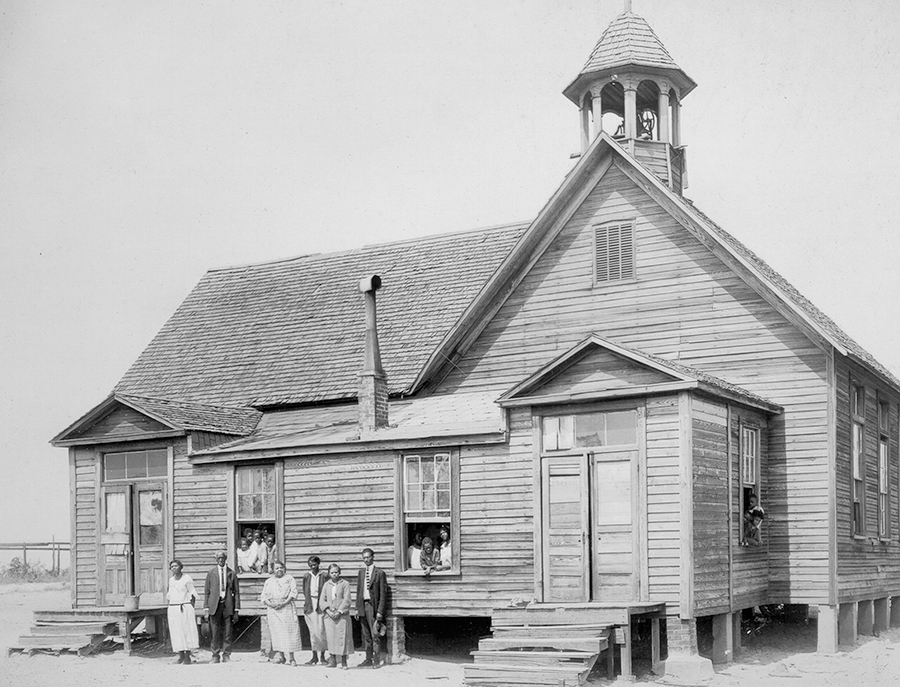
West Southern Pines School

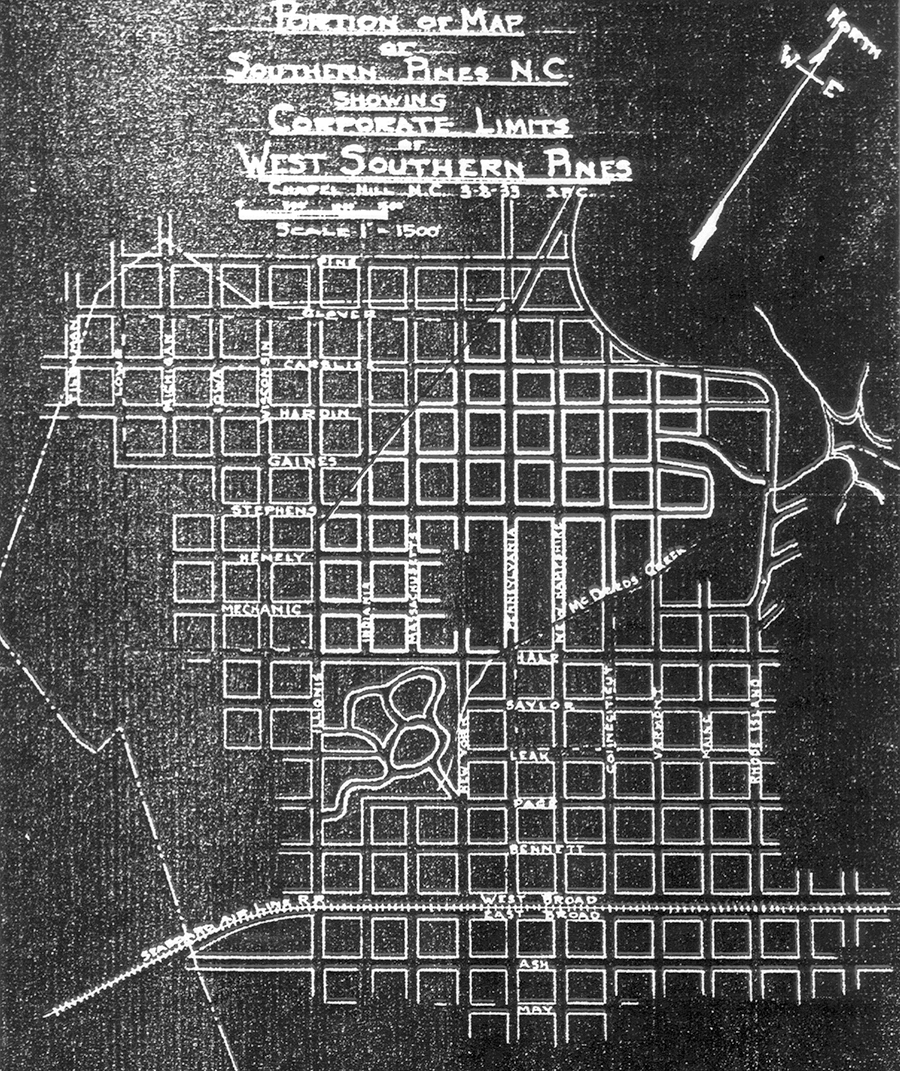
For African Americans in Southern Pines, community control took a formal turn in 1923 when Jimtown was incorporated as West Southern Pines, a rare development in the South at that time. The town remained a separate entity until 1931, when it was annexed by Southern Pines.

Before, during and after its eight-year period as a separate town in segregated times, West Southern Pines was a community populated with citizens who shared Stephen Sanders’ pride despite the injustice and hardship they faced.

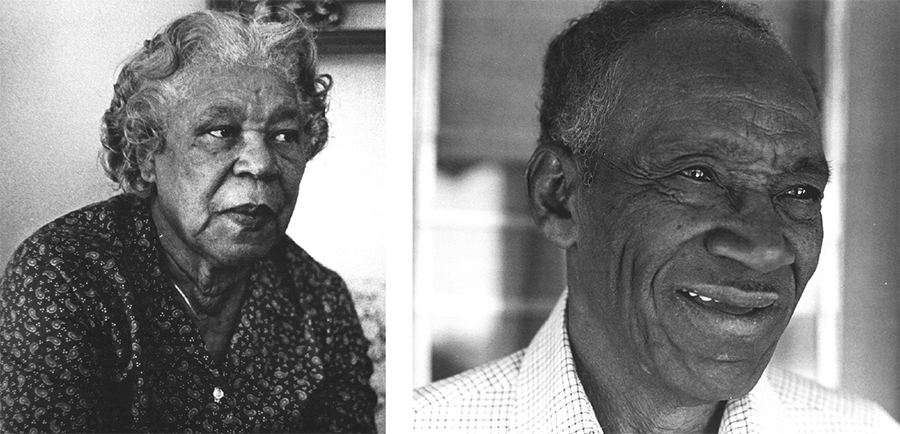
“All of our needs were met and most of our wants,” says Dorothy Brower, a 1969 graduate of West Southern Pines High School, the last class prior to the opening of integrated and consolidated Pinecrest High School that fall. “We grew up with the self-confidence that we can do, that we will do. Our parents never told us we were not as good as white folks. And we had the support of everybody in the community, everybody in the schools. We didn’t have to look outside our homes and communities for our heroes.”

Brower’s father, Hosea, was one such role model. He contracted polio as a baby, which paralyzed his left leg and forced him to use crutches the rest of his life. But he didn’t let his disability govern his ambition. As a young man, he wrote President Franklin Roosevelt a letter asking for assistance in vocational training. Brower went to North Carolina A&T, became a social worker at Morrison Training School, a reformatory for young Black males in Hoffman. In addition to his position at the training school, he prepared taxes and coached baseball. “If you told him he couldn’t do something,” says his daughter, “he surely would. He excelled.”

Brower became an educator after graduating from North Carolina Central, working at Durham Tech until she retired and moved back to West Southern Pines in 2010. Teaching was a popular career for African Americans in Southern Pines, in no small part because of how much education was stressed at home and in the West Southern Pines schools. Many teachers had advanced degrees and inspired their students to achieve.

“You have to acknowledge the daily humiliation of Jim Crow, the indignity of it, but at the same time, the response to it is dignified,” Charron says. “Upon the end of slavery and in Reconstruction, the first thing Black people understand is that if they want to be landowners — whatever they want to do in freedom — it demands an education. Everything they aspire to is tied to education. It’s crucial to their goals and surviving.”

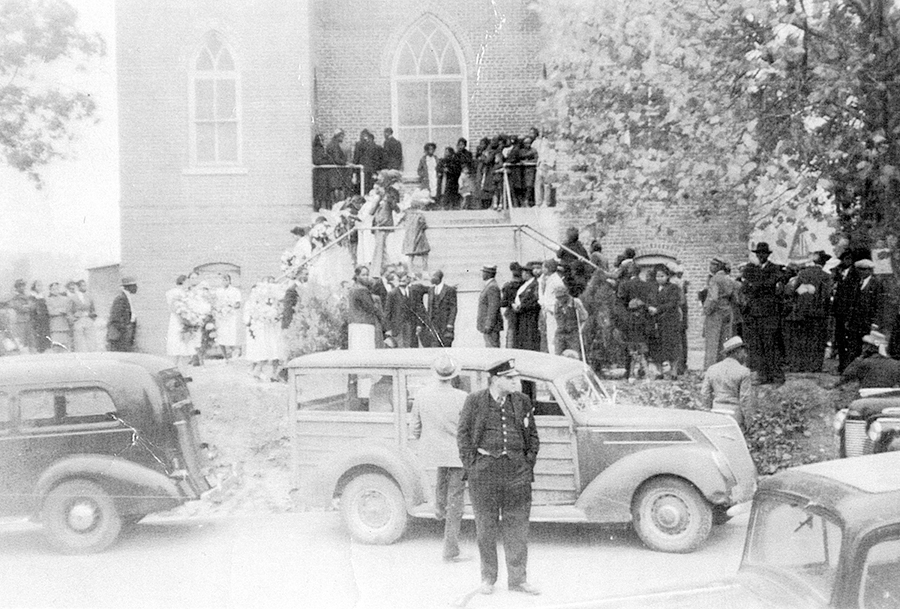
Amos Broadway funeral at Trinity A.M.E. Zion Church

The daughter of a merchant, Cynthia McDonald graduated from West Southern Pines High School in 1956. “We had exceptionally good educators,” says McDonald, a retired English professor at Sandhills Community College. “I had one lady, Terry Watkins, who taught French, history, civics and Spanish, and made time to take us on a bus to see plays. I wanted to be like her. I didn’t have time to think about what I was missing. Some books we probably didn’t have like the kids on the East side, but we were blessed with exceptional, dedicated teachers.”

Educators had the support of parents backing them up on the importance of academics. Charles Waddell, a multi-sport star athlete who graduated from Pinecrest in 1971 before going to the University of North Carolina at Chapel Hill — where he is the last person to earn varsity letters in three sports — succeeded in the classroom as well. “I always had the threat from my mom (Emma) if I brought home a ‘B,’ I was off the team,” Waddell says. “That’s what kept me straight.”

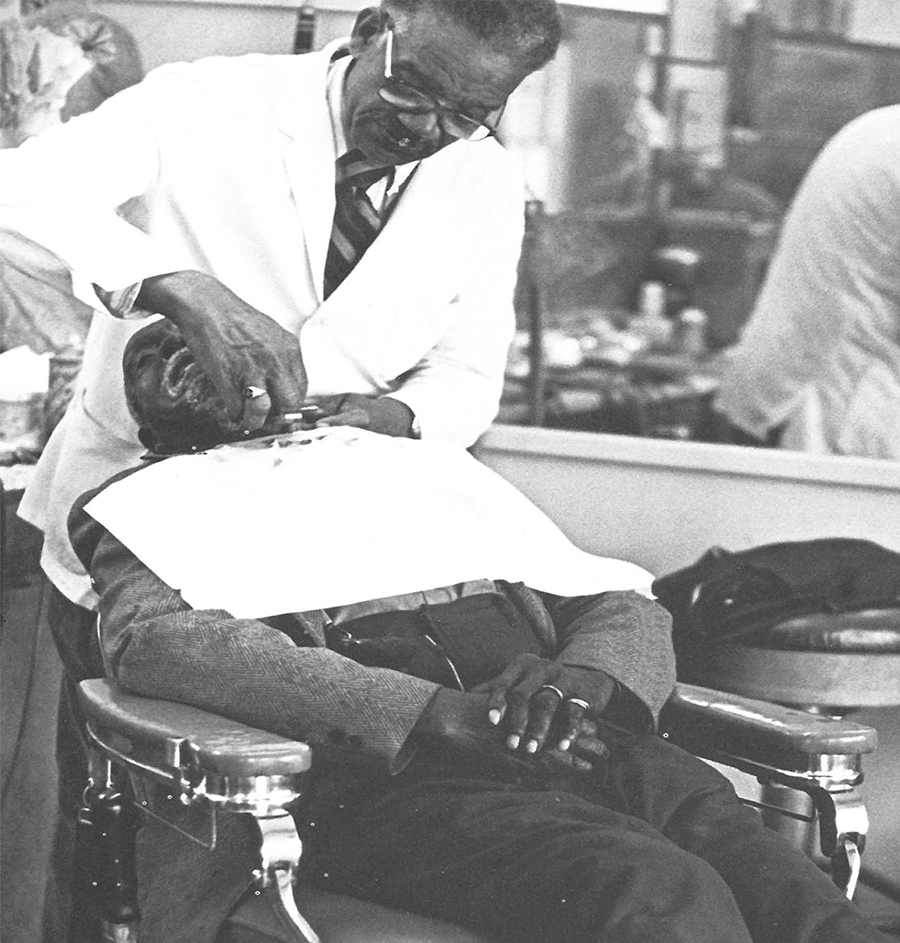
While he was achieving excellence in sports and in his studies, Waddell, like generations of African Americans in Southern Pines who came before him, saw people running businesses that served the community. One of his uncles, Joe, operated a barbershop in West Southern Pines, having learned to cut hair as a child.

“In a lot of ways, West Southern Pines was self-sufficient in those days,” Waddell says. “There were two or three barbershops, a dry cleaner, stores where you could get produce and meats. There were brickmasons and plumbers, carpenters and mechanics. West Southern Pines was kind of a hub for Black people living in surrounding areas — Raeford, Montgomery County, Vass. We kind of felt a little special in West Southern Pines.”

In earlier times for Blacks who weren’t business owners or tradesmen, work often was physically demanding in grape vineyards or peach orchards. For those who caddied at Pinehurst Country Club, such as another of Charles Waddell’s uncles, Press, the work meant a 12-mile round trip on foot. He got 50 cents for 18 holes in the 1930s before a caddie strike resulted in a pay bump to a dollar. Caddieing at Mid Pines and Pine Needles resulted in a shorter commute. Other people worked as hotel janitors, stable hands, or as maids and cooks for white families on the East side.

Map of West Southern Pines, 1923

Compared to the back-breaking toil in the cotton or tobacco fields that many Blacks left to relocate in the resort town — sometimes returning to farm work when Northerners went up the seaboard for the summer — domestic employment had an upside. Most workers walked to their jobs. Before Pennsylvania Avenue was completed, there was a path through wooded terrain the locals called “Moccasin Slide.”

“You can’t confuse the work people do with who they are in the Black community,” says Charron. “That is a separate identity. Your work is not who you are.”

Reality of Segregation

Churches and civic organizations buoyed spirits and offered a buffer against white supremacy, but the reality of segregation was present until laws finally changed in the 1960s. While Moore County was largely spared the type of racial violence that took place elsewhere in the South, North Carolina was no haven for moderation. In the early 1960s, more KKK members lived in North Carolina than any other state.

For residents of West Southern Pines, daily life brought daily reminders of discrimination.

“In terms of really bad incidents or situations, no, but it was obvious,” says Waddell, 67, who played professional football prior to a career in business and sports administration. “You knew you weren’t able to do certain things. We had to sit upstairs at the movie theater. Even when we went to the hospital we had to go in the back entrance and sit in a different waiting room, a space that was probably 10-feet by 10-feet. Little things like that just made you feel that you didn’t have everything.”

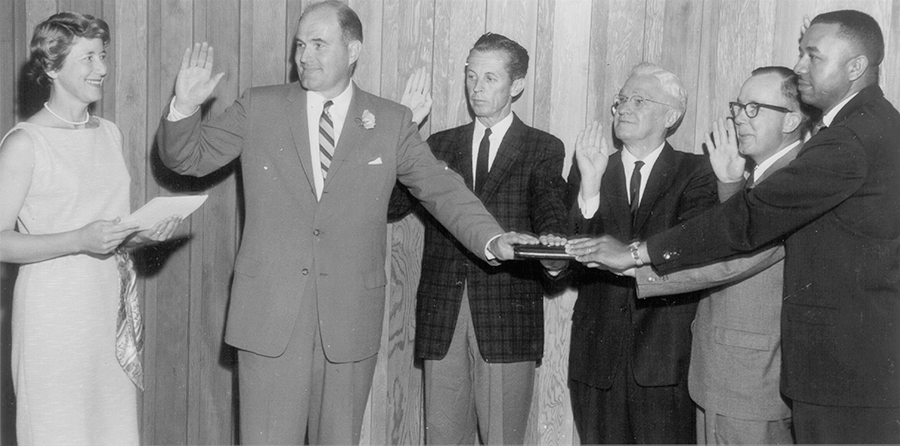
McDonald recalls how women’s clothing stores in Southern Pines would sell clothing and hats to African Americans but wouldn’t allow them to try on the garments. Around 1960, Mitch Capel, then a young child, was in a dress shop on Broad Street with his mother, Jean. Mitch’s father, Felton Capel, was active in town affairs and, with progressive white citizens, pivotal in integrating public accommodations in Southern Pines.

“I don’t know if it was because my mother was very fair-skinned or because of my father, but she was allowed to try on a dress,” Capel recalls. “An African American friend of my mother’s came in the shop and wanted to try on clothing and wasn’t allowed. That was the first time I saw my mother get upset. It was a long time ago, but I’ve never forgotten that day.”

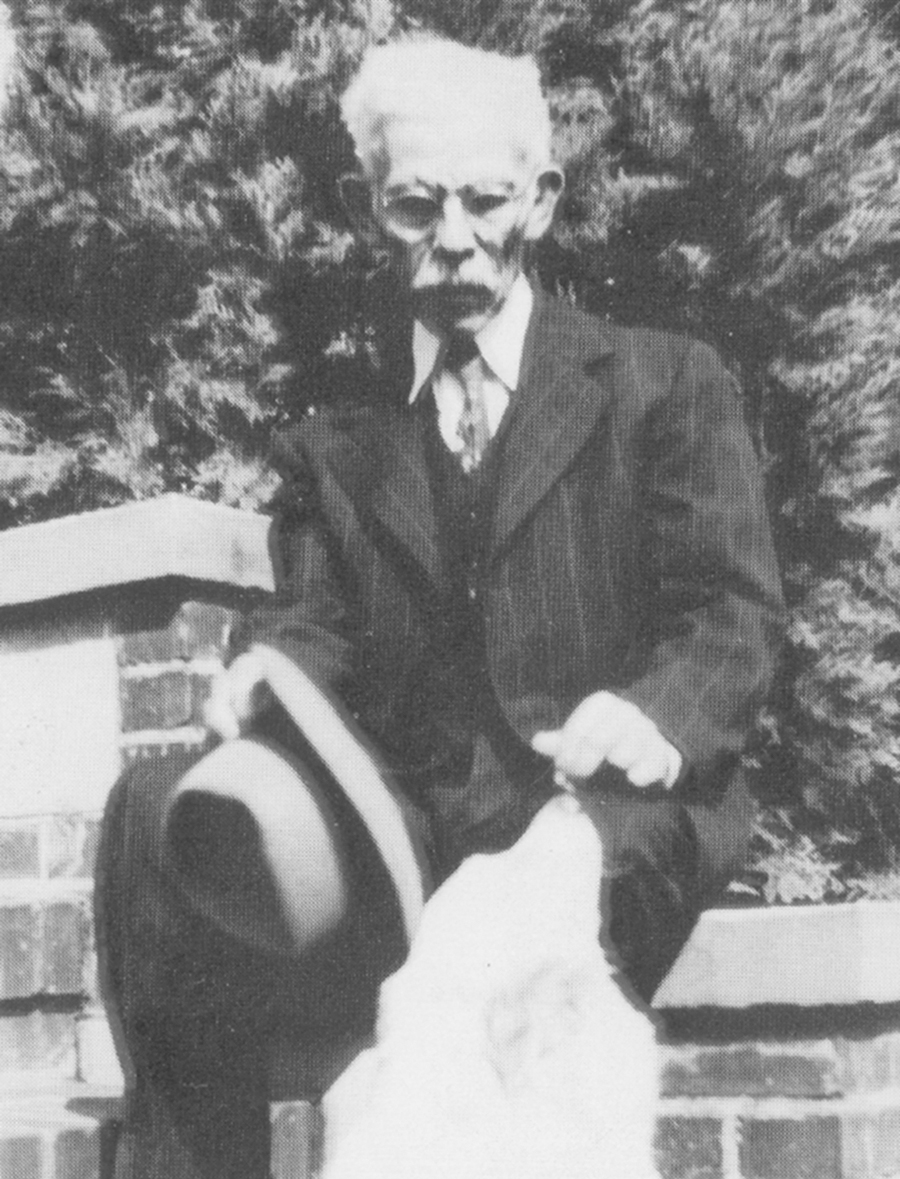
James Hasty, West Southern Pines’ second mayor, 1927

McDonald says of outings to the Sunrise Theater, where Blacks had to enter through a separate door and climb narrow, steep stairs to get to their balcony seats, that “we had a ball upstairs.” Escaping to a movie didn’t erase other slights and insults. “Somebody would call you nigger,” says McDonald, who graduated magna cum laude from N.C. Central in 1960. “Once when we were 9 or 10 years old, a group of us put on our Sunday clothes and decided we’d integrate one of the drugstores. We were tired of going to movies and not being able to get a soda afterward. I can remember the look of confusion on one of the clerks. She told us we could go to the back and she’d get us a Coke. We refused to do that. They wouldn’t serve us up front. But we didn’t let things like that make us bitter. Our teachers motivated us to be the best we can. Most of us did. And quite a few in my class of 23 attended college and finished.”

Growing up, Cicero Carpenter straddled the white and Black worlds of Southern Pines. His mother and father worked for the wealthy Boyd family — his dad was in charge of horses and dogs; his mom was a maid and cook — and resided on the Weymouth estate. Born on that property in 1941, Carpenter lived there until he was 9 years old, when his family moved to a house on Pennsylvania Avenue. Several years later, when the U.S. Highway 1 bypass was being constructed through neighborhoods in Pinedene and West Southern Pines, homes were lost to eminent domain. A handful of houses belonging to Black families near the Carpenter residence was torn down.

“Ours was the only one moved,” says Carpenter, who retired after a long Navy career. “My dad was a home builder in addition to working for the Boyds. They wanted to tear down our house and give him money. He knew it was worth more and protested. Mrs. Boyd got involved, and the state decided they would move it on a truck to New Hampshire Avenue. It’s still there.”

Carpenter followed his father and his uncle, Jesse, into construction, and as a teenager in the late 1950s started building another structure next to his parents’ relocated home.

“The old West Southern Pines jailhouse was behind a lady’s home,” Carpenter says. “I asked her if I could tear down the old jail if I could have the bricks. She told me I could. I used those bricks to build that house on New Hampshire. When I got out of the Navy and built my house in Highland Trails in 1983, I used some of those bricks in the foyer and around the fireplace. Some of the other bricks are around a dogwood in my yard.”

Joe Waddell

No-Man’s-Land

Those bricks are a link to West Southern Pines’ early days. Crime played a role in it becoming an incorporated town and in the annexation by Southern Pines eight years later.

Jimtown — believed to have been named for one of two African American merchants, James Henderson or Jim Bethea — was neglected by area law enforcement, allowing crime to fester.

Sisters Wilman and Bessie Hasty, whose father, James, became West Southern Pines’ second mayor, in 1927, and whose grandfather helped James Patrick survey Southern Pines when he founded it during the 1880s, described the atmosphere in oral history interviews conducted by the Town of Southern Pines in 1982.

“This was no-man’s-land,” Wilma told interviewer Nancy Mason. “The people did as they pleased.”

Bessie recalled, “We couldn’t get a policeman over here. We did all our chores before it got dark because we didn’t dare go out after dark.”

Nightclubs and bootleggers brought in outsiders. “We had a lot of gamblers and different people come through,” George Ross, who moved to West Southern Pines in 1926, told Mason. “After sundown, you stayed home.”

There were assaults and stabbings in the wee hours. Joe Waddell recalled decades later, “I heard some Yankee say that we had the most beautiful part of Southern Pines.” Yet one area of the Black community came to be called “Blood Field” because of a number of stabbings. There were murders, including the killings of a well-known West Southern Pines eatery/juke joint owner, Amos Broadway, and a Black police officer, John Allen. White authorities contended that Black fugitives sought — and found — sanctuary in the community. One published report from the 1920s, though, details how African American residents conducted a house-by-house search in an attempt to find an outlaw.

Willa Mae Harrington and Press Waddell

On March 3, 1931, the charter for West Southern Pines was revoked by the North Carolina state legislature. The news traveled to New York City, where The Dunbar News, a Black newspaper, lamented the development.

“So this town of, for, and by the Negroes is no more,” the periodical editorialized. “Will the actions of the legislature of North Carolina prove an encouragement to its Negro citizenry? Does it stand to the credit of the state? This is not Jim Town’s tragedy alone.”

In a subsequent edition, The Dunbar News published the opinion of a “leading white citizen of Southern Pines” whose name the publication didn’t disclose. According to this man, the process of revoking the charter hadn’t been furtive and had been necessary because of a high crime rate that he attributed mostly to “a large, floating population of Negroes from all over the South. They are to a considerable extent an undesirable and, in some cases, a dangerous element, and it is no small wonder that the Negro administration has not been able to handle them . . . It was felt, perhaps with some exaggeration, that West Southern Pines was a potential menace to the health and general decency of the general community.” In his rebuttal, he didn’t mention what had to have been a key reason for the annexation: Headlines of crime were potentially bad for the bottom line of white-owned businesses and resorts.

Instead of being bordered on three sides by Southern Pines, it was now formally part of the larger town, which still drew tourists and seasonal residents during the Great Depression.

“There were a lot of people still coming in,” Willa Mae Harrington said in the oral history project. “There were still plenty of jobs we could do. Sometimes there would be ads in the paper, ‘I want a chauffeur, a cook and a maid.’ A whole family could go to the same place and work. That’s how most of the people over here got their houses. By working as caddies, maids, cooks, housekeepers and saving their money. You could always get a day’s work. If you got with a good family you could save while you worked for them.”

Small Steps Forward

Three months after West Southern Pines was annexed, The Pilot reported on the paving of streets, and plans for a water main and fire hydrants for “the thickly settled” part of the Black community.

Those infrastructure improvements were small steps forward for Southern Pines’ African American residents living their lives in a still-segregated era. It would be three decades after Southern Pines annexed West Southern Pines until the town added a Black officer to the police force of the larger municipality, before the bowling alley and golf courses welcomed African Americans and they didn’t have to sit in the Sunrise Theater balcony, before Black women could try on a dress in a downtown shop. Into the 1950s, when the Capel family moved to West Southern Pines, the area’s infrastructure had not kept pace with other parts of town.

Felton Capel being sworn in to the Southern Pines Town Council, 1959

Despite the unequal treatment, African Americans persevered. Oliver Hines’ great-uncle, J. Pleasant Hines, was the mayor of West Southern Pines from 1923-27. Oliver, 68, is a community activist who, like fellow native and longtime Black residents, regrets the loss of businesses on the west side that has gone hand-in-hand with a decrease in the tight-knit spirit he knew growing up. “I wrote down 39 places that used to be here in West Southern Pines and all of them were Black-owned,” Hines says. “Now, there is only a handful. We were thriving at one point.”

Those who remember more vibrant times are eager for a revitalization in West Southern Pines — projects that could celebrate its history while offering an economic boost. The Southern Pines Land and Housing Trust is seeking to acquire the former Southern Pines Primary School (where West Southern Pines High School previously existed) and turn it into a cultural and economic hub.

“The creation of this campus will be a state and national model of how community, government, education and business can work to enhance the lives of citizens and stimulate the economy,” Brower says.

West Southern Pines still sits on a hill, still working to catch a favorable wind.  PS

Story of a House: Second Wind

Family house gone artsy

By Deborah Salomon     Photographs by John Gessner

Location, location, location. Fittingly, this real estate mantra defines the home of broker Kim Stout and her husband, Todd Stout. Almost close enough to smell Vito’s pizza, walk to the post office, bike to the library or skip to the park. Definitely close enough to vibrate as Amtrak coasts by.

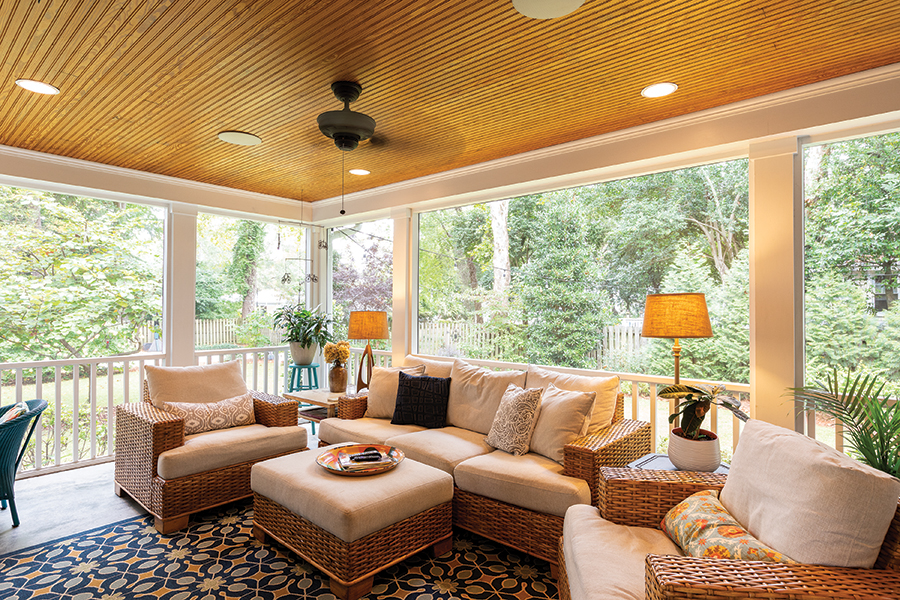
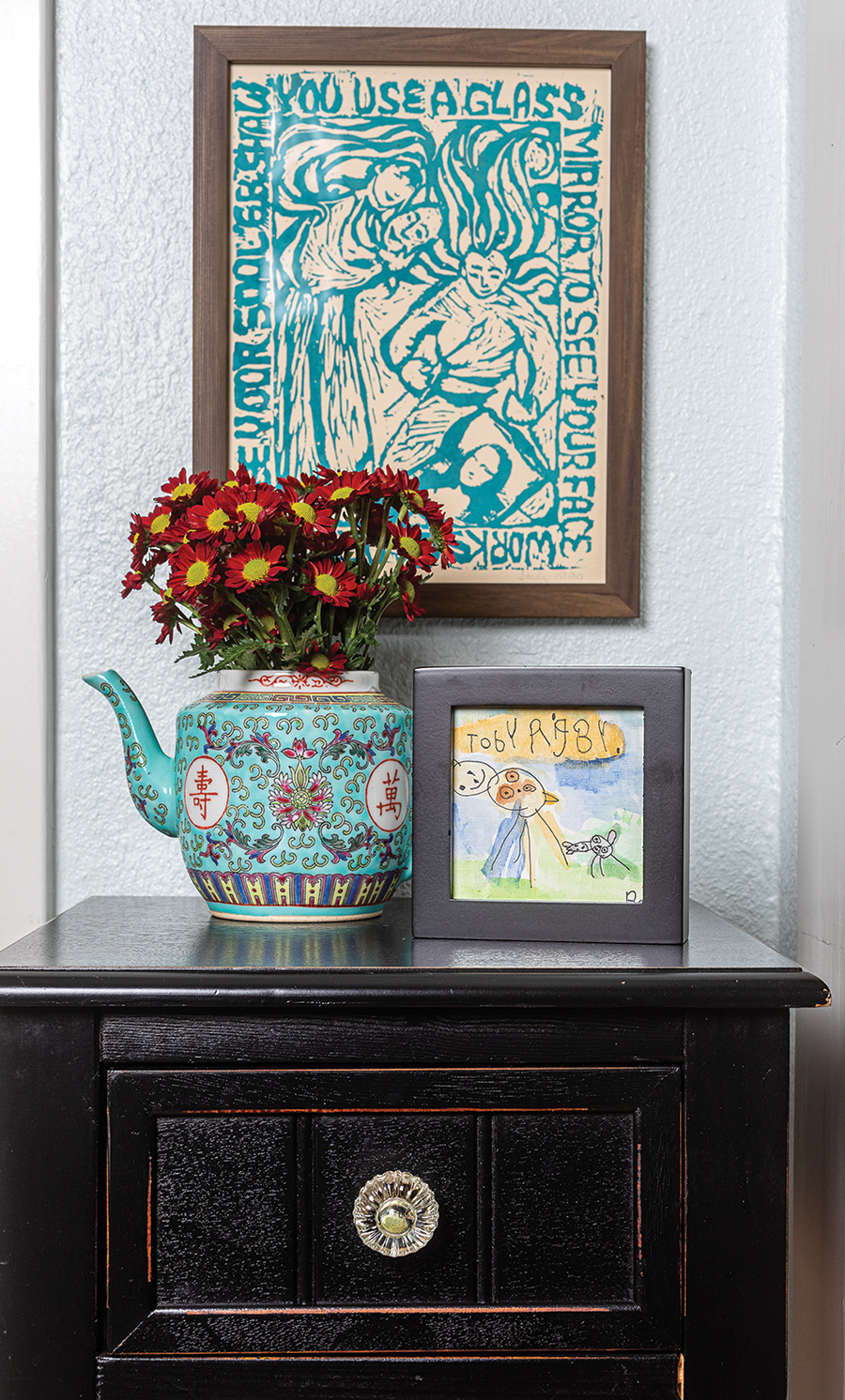
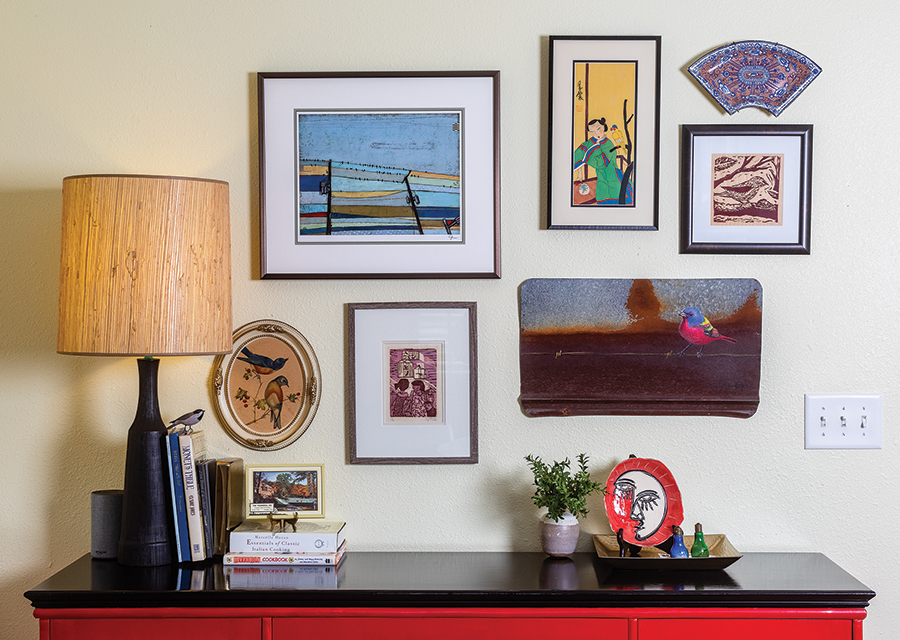
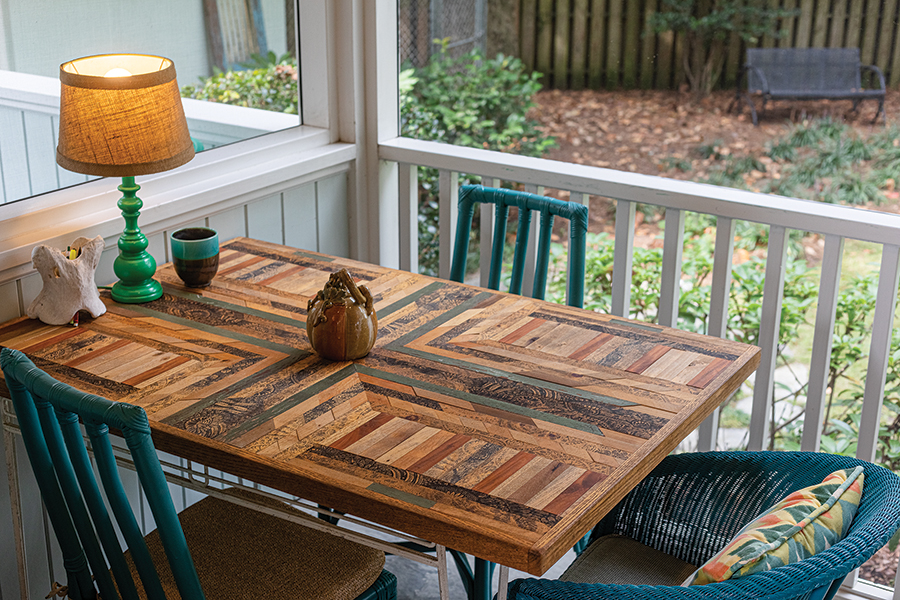
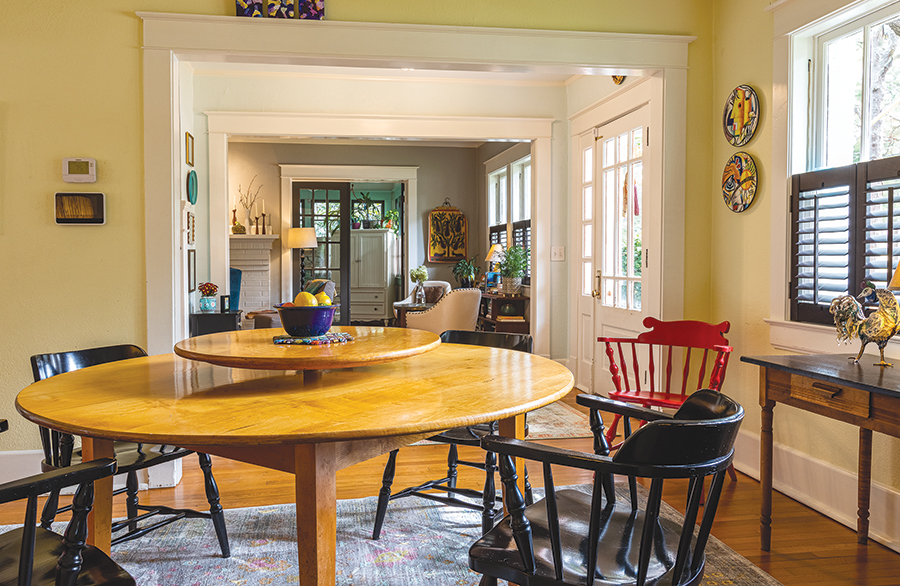
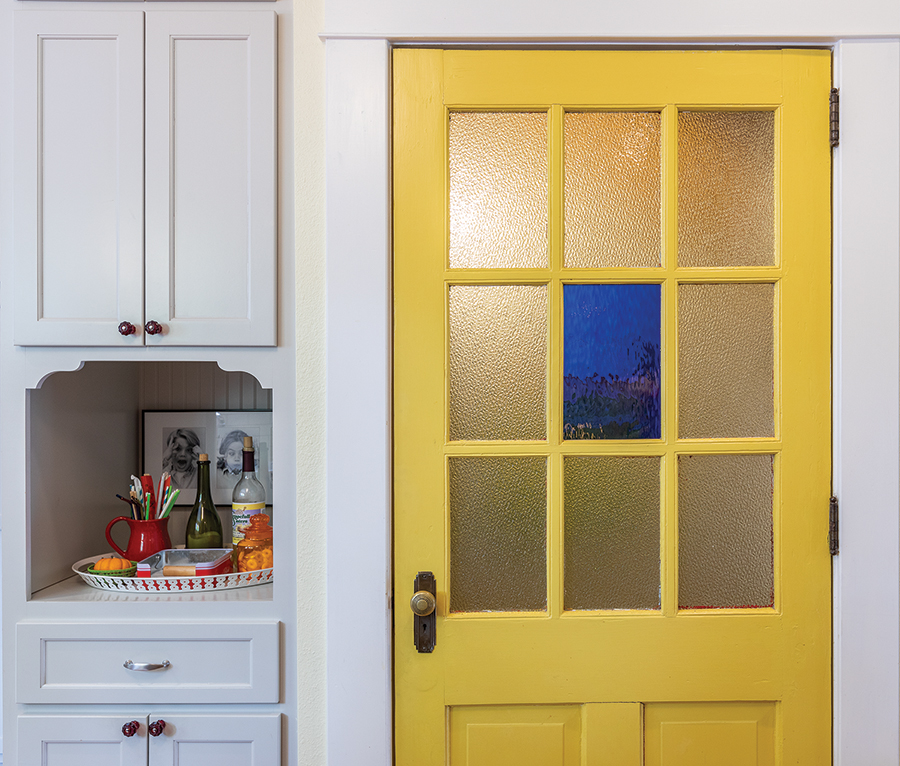
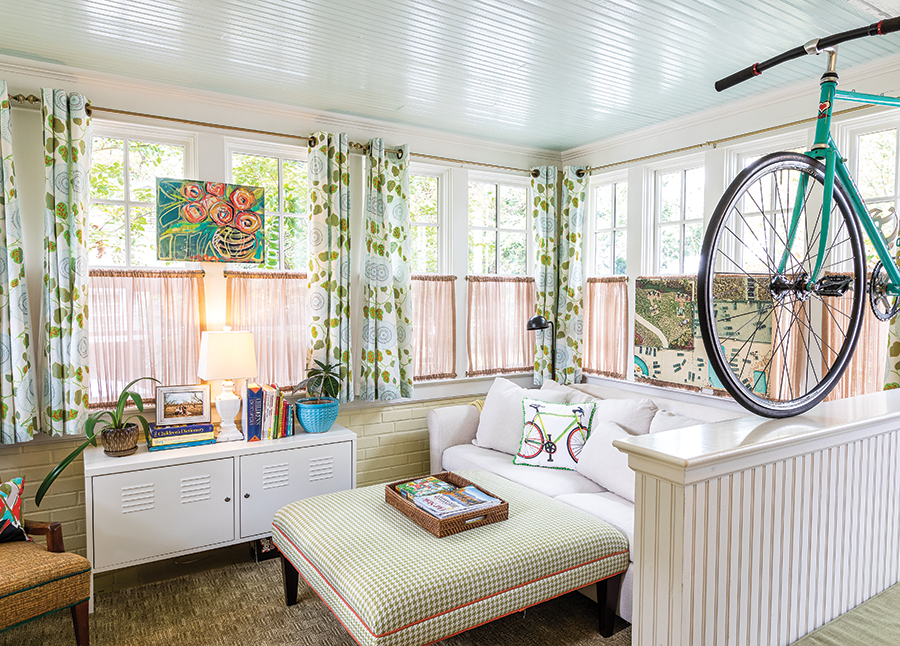
A roomy brick house winging out in both directions. A yard big enough for a concrete mini-court with hoop. And, starting at the Creamsicle-colored front door, an interior palette of bright colors: sunroom floor, lime green brick. Master bedroom floor stained deep turquoise. Dining room buffet, tomato red. Kitchen door, chrome yellow. Fabrics and rugs bleed fuchsia, hot pink and serious purple. Folk art à la Grandma Moses progresses to wildly abstract, everywhere: An elongated painting fills the 8-inch strip between kitchen window and cabinet.

Obviously, an artist lives here. A fearless décor maven.

However, the yard was what sold Kim. She and Todd raised three athletic children in the stately manse built during the mid-1920s Southern Pines building boom, occupied in the 1950s by Rev. Maynard Mangum from First Baptist Church across the street. In fact, when the Stouts purchased the house in 1988, urban renewal was still a concept, relegating L-L-L to the ’burbs, not historic district cottages uphill from Broad Street.

Kim, from Monroe, North Carolina, and Todd, from Idaho, were living in Laurinburg, where Todd’s father farmed turkeys. Todd discovered Southern Pines through cycling. “I came up to ride,” he said. “It’s the only place I could find cyclists.”

His discovery happened in spring, with azaleas in bloom. Broad Street was charming, the people, welcoming. “I never saw a place I liked better.”

Todd went home and announced: “We’re moving.”

Kim was pregnant with their second child. They looked at houses. Just inside the front door Kim decided this one was it. “We’ll take it,” she told the Realtor.

Never mind what Kim describes as “ . . . total chaos most people would run from.”

Not to worry. They participated in the initial renovation, with experience gained from working on a 1940s home. “We had also lived in a brand new house that was just . . . a house,” Kim says.

She set about filling their acquisition with a hodgepodge of furnishings and a third child.

Life rushed by. In 2012, with the children mostly grown and gone, Kim and Todd decided on a major upgrade. They pushed out the kitchen, added a screened living room with fireplace, created an open air morning coffee porch and an upstairs master suite.

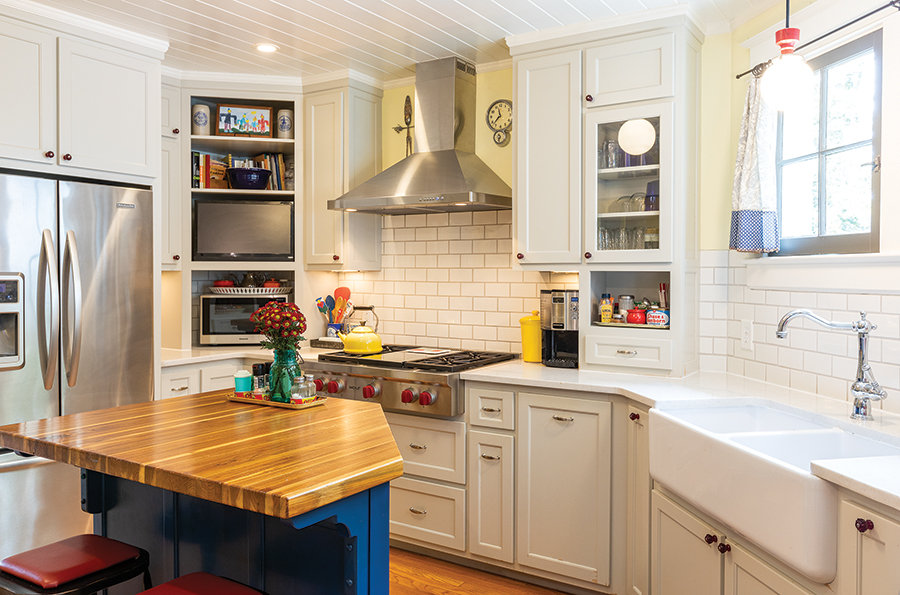
Or, as Todd puts it, “We went from five people and two bathrooms to two people and four bathrooms.” One of those bathrooms, Todd’s favorite, encores 1950s avocado and black tiles, now fabulous retro chic. The new kitchen — pale gray with mini-bursts of color — is efficiently sized, not cavernous, punctuated with angles and cubbies.

Unlike the current practice of imposing open spaces on a classic cross-hall floorplan, the Stouts left rooms intact, delineated by wide, graceful door and window moldings, a detail (along with textured plaster walls) that adds what real estate professionals call “character.” All the doors and windows are original, Kim notes, also the beveled glass panes in the front door.

Besides that tomato red buffet, the small dining room has a round table with a built-in lazy Susan, like Chinese restaurants of yesteryear, where dishes are placed in the center and families help themselves.

“Lots of stories (happened) around this table,” Kim says wistfully.

Even the tiny foyer coat closet yields a tale. Inside the door, height markers for Lindsey, Matthew and Sean survive in faint pencil.

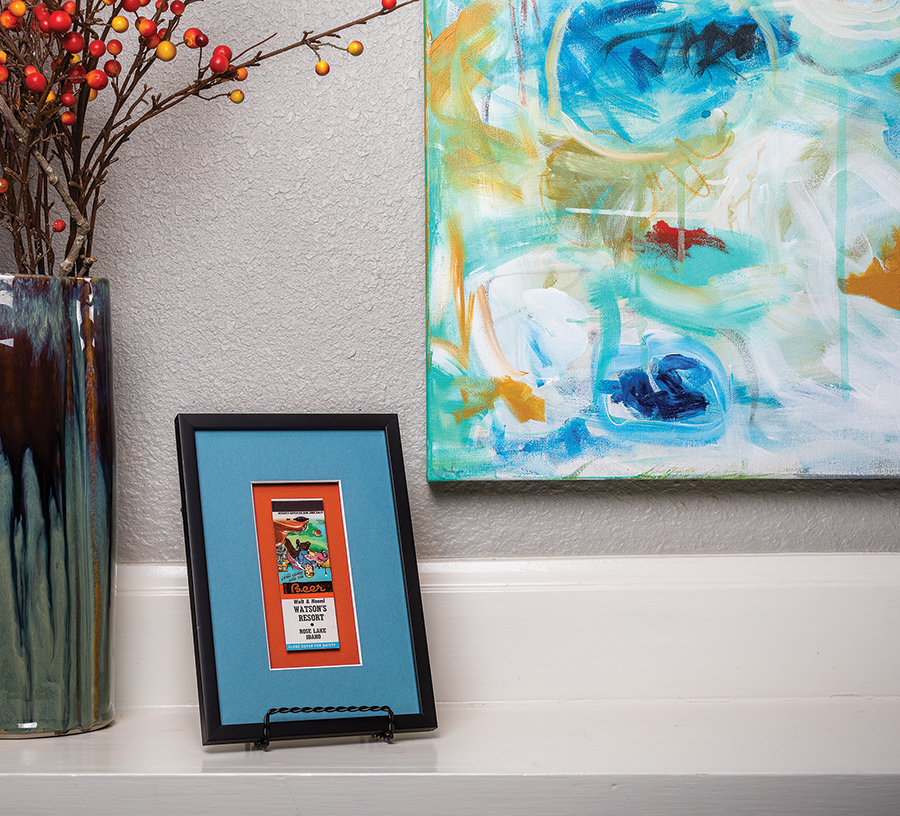
Todd’s input: “I’ve done one thing.” He holds up a framed matchbook (found on eBay) from Watson’s Resort in Idaho, an outdoorsmen’s paradise, where he spent happy times.

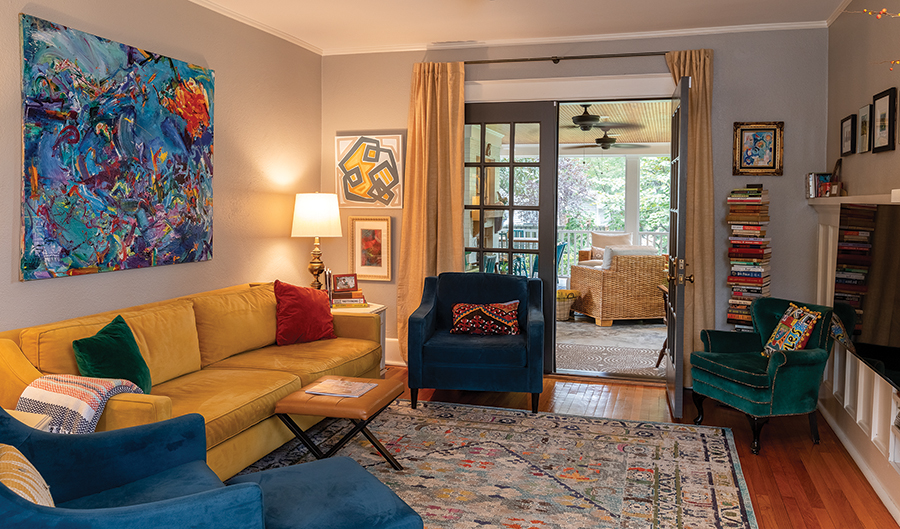
Except for the art — some paintings by Kim herself, others by daughter Lindsey — the living room, especially lamps and plushy upholstered pieces, could be lifted from a ’50s stage set, including the side table made from a cross-cut tree trunk mounted on wrought iron spindles.

Here and elsewhere, Kim’s preference for green fading into turquoise originates with a grandmother, nicknamed Granny Green, for her all-green house.

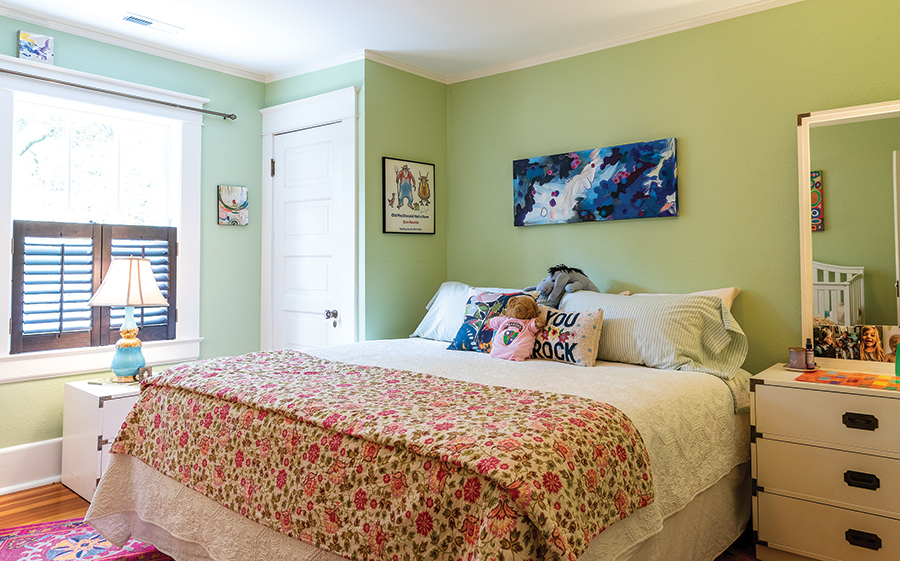
Upstairs, the children’s bedrooms, hung with sports memorabilia and comic strip art, have been left mostly intact. A baseball bat and an aerial view of the neighborhood painted by a 10-year-old are mounted in the boys’ room, which survived many brotherly rumbles, Kim recalls.

After the proliferation of colorful stuff, the Stouts’ new master suite is a turnaround. Square paned windows, left bare, are set ceiling height over the king-sized bed. The deep turquoise floor appears cottage-y, as do a wicker armchair and ottoman, while three bureaus and a long slatted bench illustrate the post-war Scandinavian-modern genre. “This was our first grown-up furniture,” Kim says.

Other bedroom décor is spare, calm. Ever-practical, she installed a second washer and dryer off the master bathroom.

Unlike similar homes of the period, this one has a full basement, dubbed the swamp. Murky and damp no more, the Stouts’ renovation included shoring up underpinnings, creating a workout room, main laundry room, storage space and the most adorable bathroom with step-down vanity cabinet painted the same tomato red as the dining room buffet.

“I am not a spec home/cookie cutter person. We didn’t want anything formal because we had kids and dogs.” Which explains why Kim’s crewel and splashy-patterned area rugs “are almost disposable.”

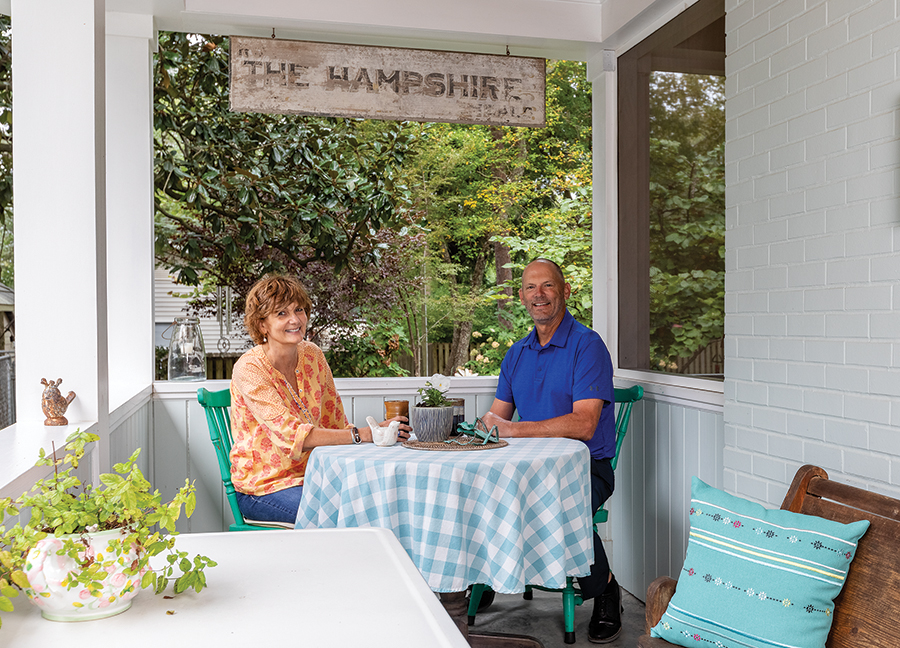
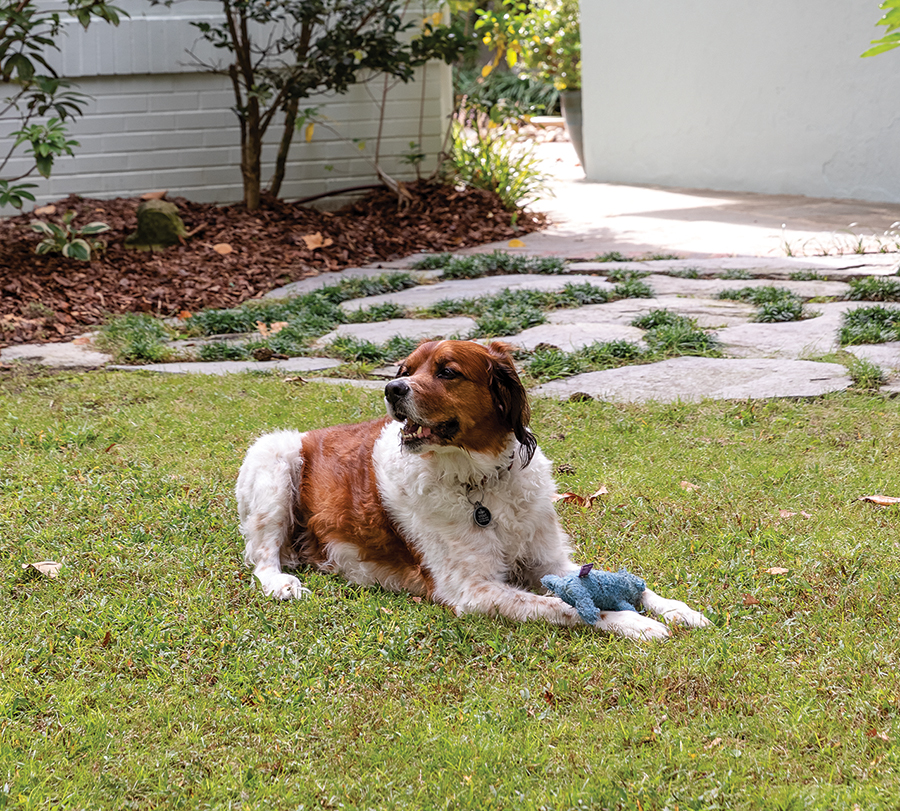
When the sun shines on South Ashe Street, the painted brick of this residential jewel appears pearly white. On a cloudy day, however, a bluish-green tint emerges. Weatherproof art decorates the small sitting patio; an ancient Hotel Hampshire sign hangs over the morning porch. The grassy backyard, rimmed with shrubs and flowers, fenced for Toby the dog, echoes shouts of boys shooting hoops. Beadboard ceilings and original floors uncoated with layers of lacquer add dimension.

Throughout, the old shadows the new like a friendly, welcoming ghost.

“We’ve gone through some growing pains with this house,” Kim admits.

Or, as longtime friend Cassie Willis concludes, “This house has a heartbeat.”  PS

Poem

Exulansis

The tendency to give up trying to talk about an experience because people are unable to relate to it. – The Dictionary of Obscure Sorrows 

To my Northern friends: I regret

I can no longer speak with authority

about winter. I’ve forgotten the feeling

of ears ringing with the silence

of fresh snowfall, air so cold it stabs

the lungs. Gone are those Norse names,

the rough wool, heavy boots,

bodies bent against wind so fierce

there must be a name for it in Lakota.

I can’t recall how despair closes in,

a cloud blanket for days, dense, ominous.

Remind me how, in a whiteout,

a person can get lost between car

and house. Tell me about

children in mufflers waiting

for the school bus in handmade huts,

the shush of skis down slushy streets.

Didn’t we find Easter eggs nested

on the icy crust? I do remember

that just when you vow to never

shovel another drive,

the bright flags of daffodils flare. 

— Debra Kaufman

Debra Kaufman’s most recent book is God Shattered

Thanksgiving on the Edge

When a can of cranberry sauce just won’t do

By Jenna Biter   •   Photographs by John Gessner

(L-R): Chef Mark Elliott, Chef Teresa Santiago, Chef Orlando Jinzo, Chef Warren Lewis

Sarah Josepha Hale, a magazine editor and the poet who made the nursery rhyme Mary Had a Little Lamb famous, also led the charge to make Thanksgiving a national holiday, earning her the nickname the “Mother of Thanksgiving.” She wrote about a Thanksgiving feast in her 1827 novel Northwood, and, after that, it was all-turkey-all-the-time for Hale. She even published editorials, recipes and poems dedicated to the holiday hopeful.

Her appeal didn’t get picked up until Lincoln proclaimed “a day of Thanksgiving and Praise” in 1863, but, ever since (or just about), it’s been stuffing, turkey, pie, repeat. Except for this year. It’s not that we don’t love the traditional lineup — we do — but you already know what that spread looks like. So instead we asked some of our most creative local chefs to whip up a six-course visual feast that will make you wish they were your relatives. It’s not your grandmother’s Thanksgiving, that much we know for certain.


First Course: Butternut Squash Potato Leek Soup

Chef Peter Hamm | Chapman’s Food & Spirits

First up, Chef Peter Hamm of Chapman’s Food & Spirits magic-upped soup for that friend who can never decide between sweet and savory. He combines butternut squash and the classic potato-and-leek duo in a pureed soup that’s topped with a dollop of Chantilly cream and garnished with crispy fried leeks, the sophisticated cousin of onion straws. They give you architectural height that you never knew you wanted in a soup, but now you do. And while it looks too pretty to eat, you’d regret not draining the bowl.


Second Course: Beef Wellington Tartare

Chef Orlando Jinzo | The Leadmine Whiskey Bar and Kitchen

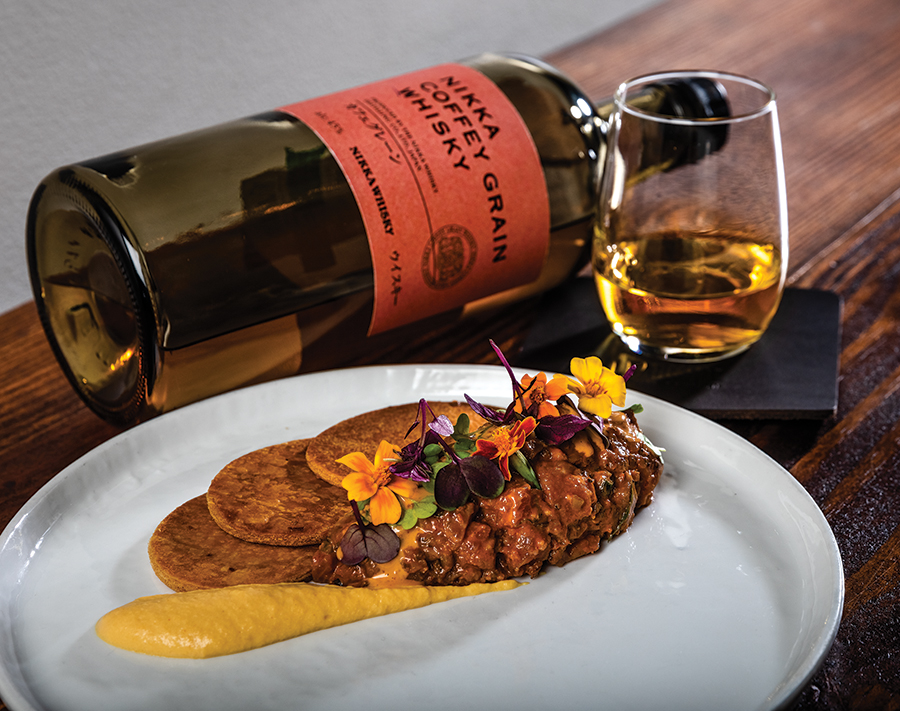
“I usually try to think of something that’s a classic that everyone can relate to and slightly tweak it,” says Chef Orlando Jinzo of The Leadmine Whiskey Bar and Kitchen. And this time, Jinzo deconstructs Beef Wellington and reimagines it as a tartare through a Southeast Asian lens. The result is an off-the-wall appetizer starring Wagyu beef, black garlic pâté and pickled mushroom duxelles. It’s served with a swipe of, and I quote, “verrrrry spicy mustard” and puff pastry crisps for dipping. Jinzo recommends pairing his course with Nikka Coffey Grain Whisky — or, as he prefers to call it, breakfast whiskey.


Third Course: Ripe Mozzarella

Chef Mark Elliott | Elliott’s on Linden

Chef Mark Elliott of Elliott’s on Linden has been reworking the classic tomato-and-mozzarella caprese for years. He’s done mushrooms and cheese in the past, but, for this visual feast, he pays homage to the fall with squash. “It’s roasted butternut squash with burrata, which is basically ripe mozzarella,” says Elliott, “and it’s got coriander olive oil over it, balsamic with an accent of rosemary in that and microgreens on top.” Plump tangerine slices complete the dish — Elliott says he loves the little citrus fruit during the holidays, and, thanks to him, so do we.


Fourth Course: Whole-Roasted Lobster and Butternut Squash Barley Risotto

Chef Warren Lewis | Chef Warren’s

Chef Warren Lewis of his eponymous restaurant redubs turkey day lobster day. He whole-roasts the crustacean and serves it up with a side of butternut squash barley risotto. “It’s a traditional and non-traditional Thanksgiving,” Lewis says. “They probably didn’t have turkey on the first Thanksgiving.” At least, the bird wasn’t the centerpiece of the 1621 feast. We know that the Wampanoag Indians brought venison, and the Pilgrims prepared fowl, but not necessarily turkey. Culinary historians actually believe that seafood made up a lot of the meal; they were in New England. In other words, lobster was just as likely to be eaten on the first Thanksgiving as turkey — so Lewis pays lobster its belated due. He pairs it with a can’t miss bottle of 13 Celsius, a New Zealand sauvignon blanc.


Fifth Course: Cheese Board

Angela Sanchez | Southern Whey

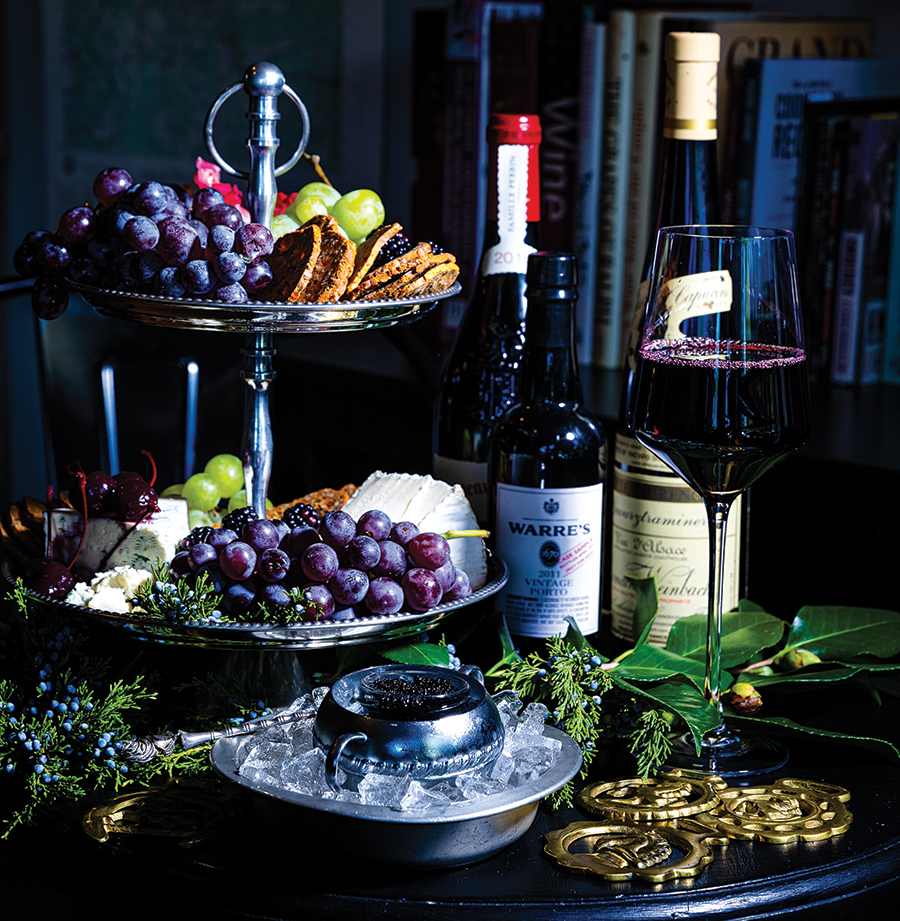
Angela Sanchez of Southern Whey overhauled the traditional cheese board. “I wanted to do something kind of outlandish,” she says, “that was the most decadent things that you could have that you wouldn’t necessarily think about having on Thanksgiving.” Sanchez features two cheeses: Délice de Bourgogne, a triple-cream Brie, and Rogue River Blue Oregon, a blue cheese that ages in grape leaves doused in pear spirits that was recently named best cheese in the world. She pairs the Brie with Caviar Star Hackleback Sturgeon from North Carolina and the blue with Woodford Reserve bourbon-soaked cherries. To top it off, she recommends a trio of wines that you wouldn’t crack open on your average Thursday: a 2009 Domaine Weinbach Gewurztraminer Cuvée Laurence, a 2010 Château de Beaucastel Hommage Jacques Perrin Châteauneuf-du-Pape or 2011 Warre’s Vintage Port — that’s a mouthful.


Sixth Course: Roasted Sweet Potato Mousse

Pastry Chefs Teresa Santiago, Jonathan Rankin and Andrew Huggins | The Bakehouse

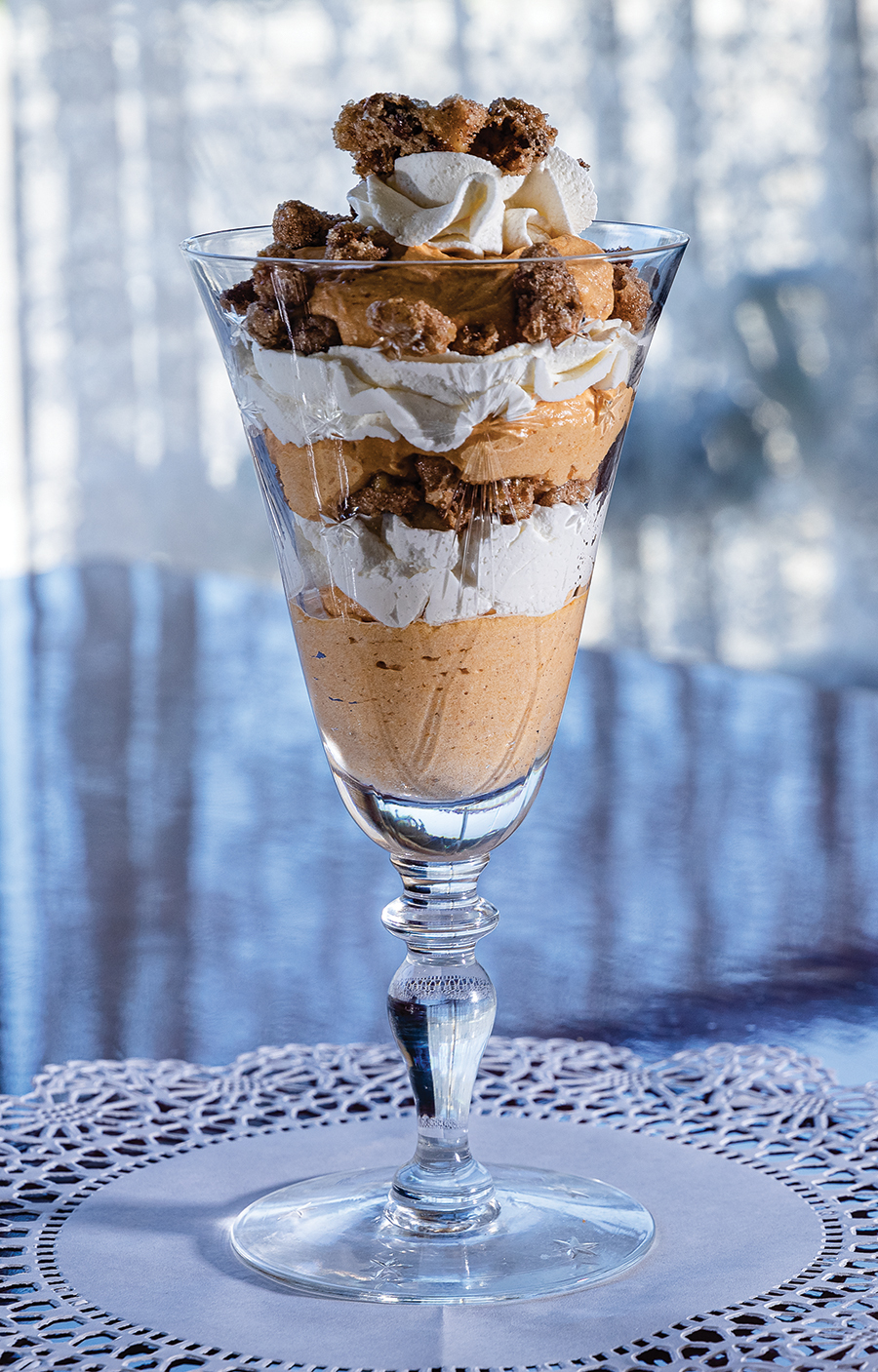
Sweet potato pie and Thanksgiving are made for each other, but Pastry Chef Teresa Santiago of The Bakehouse and her teammates Jonathan Rankin and Andrew Huggins dreamt up a drool-worthy update. “We took sweet potatoes, roasted them in the oven and then pureed and sweetened them,” Santiago explains. “Then, it’s layered with a rum-whipped cream and candied pecans and walnuts; it’s essentially a parfait.” The result is a dessert that’s not too sweet but just sweet enough . . . to hit the sweet spot.

Jenna Biter is a fashion designer, entrepreneur and military wife in the Sandhills. She can be reached at jenna.biter@gmail.com.

Poem

A Nimble Deer

A doe that was, only a minute

before, quietly munching, leaps over

a wooden fence, nimble

as a goat. She rears up, after reaching

the other side, like a trick dog —

her front hooves dangling from her

useless forelegs, her hind legs

absorbing all the weight. She cranes

her soft, brown neck just far

enough to reach the succulent leaves

of a dogwood tree. But the younger 

deer — smaller, less sure —

stick to low-hanging branches,

their tails flicking like little propellers

that fail to lift them from the earth.

– Terri Kirby Erickson

Almanac

By Ashley Wahl

October is a cauldron of enchantment. The cracking open of pecan husks. The whirl of sparrows casting cryptic messages across fiery canvases. Crisp air and burn piles. Black walnuts and black dahlias. Golden leaves and ever-fading light.

October awakens the mystic, beckons homemade tinctures, loose-leaf teas, sage leaves wrapped in tidy bundles.

October is pumpkins and gourds, pumpkins and gourds, spring-blooming bulbs in the cool autumn soil.

She’s the veil between worlds — thin as a web in the morning light. The black cat that slinks across your path, disappears, then watches from beyond a silky sea of milkweed pods.

Do not be afraid. October is ripe with blessings. You need only let her reveal them.

Try squatting down — fluid movements are best — and then gaze into her yellow moon-eyes until all you can see is yourself. This is her invitation. And in her own time — you cannot rush nature — she will saunter toward you, perhaps with a jingle, and all superstition will dissolve.

October is the black cat kissing your hand, arm and shin with her face and body, her circular movements like that of an ancient symbol, a sacred dance, a living incantation. She is purring. She is plopping belly-up in the dry leaves at your feet. She is all but crawling into your lap — a playful and hallowed month filled with auspicious surprises.

There is no season when such pleasant and sunny spots may be lighted on, and produce so pleasant
an effect on the feelings, as now in October.
— Nathaniel Hawthorne

Mums the Word

Chrysanthemums are blooming. Pink, purple, red, orange and yellow. Double-petaled and fringed. Heirloom cultivars as lovely as dahlias. 

In Chinese bird and flower paintings, chrysanthemums are depicted in ink wash paintings among the “Four Gentlemen” or “Four Noble Ones,” an assemblage of plants that represent the four seasons: plum blossom (winter), orchid (spring), bamboo (summer), and chrysanthemum (autumn).

Native to China, this medicinal flower was brought to Japan by Buddhist monks in the year 400. Here in the United States, a “Dark Purple” cultivar was imported from England in 1798 by Col. John Stevens, the American engineer who constructed the country’s first steam locomotive and steam-powered ferry. In the years since, mums have reigned as the “Queen of Fall Flowers,” singing alongside our kale, pansies and cabbage, and coloring our autumn gardens magnificent.

According to feng shui, chrysanthemums bring happiness and laughter into the home. They’re loaded with healing properties and have been used in traditional Chinese medicine for centuries. Chrysanthemum tea (made from flowers of the species morifolium or indicum) is considered a common health drink in China, often consumed for its cooling and calming effect. And as any flower-savvy gardener will tell you, mums repel most insects yet are non-toxic to animals.

Glory be to this noble flower! Long live the lovely Queen of Fall.

Autumn leaves don’t fall, they fly.

They take their time and wander on

this their only chance to soar. — Delia Owens, Where the Crawdads Sing

The Night Sky

This year, the full harvest moon rises on the first of October, and on the last day of the month, the first blue moon of 2020 (the full hunter’s moon) will create the quintessential vision of Halloween, illuminating the sky for a howl-worthy night.

And, look, there’s another celestial beauty shining bright this month: Mars. 

On Oct. 6, Mars will be just about as close to Earth as it can get — 38.57 million miles — a proximity the likes of which we won’t see again until September 2035.

On Tuesday, Oct. 13, Mars will arrive in the constellation Pisces, beaming from dusk until dawn at a magnitude three times brighter than our brightest nighttime star, Sirius. In fact, this month Mars supersedes Jupiter as the second-brightest planet, following the moon and Venus as the third brightest object in the night sky.  PS

Story of a House: Still a Castle

Dunross holding the fort in Knollwood

By Deborah Salomon     Photographs by John Gessner

On Feb. 15, 1929, The Pilot featured seven houses built by prominent families in the Knollwood residential enclave, a development that followed the opening of Mid Pines in 1921 and Pine Needles in 1927.

Why let Pinehurst have all the glory?

The write-up gushes over a brick residence commissioned by golf course architect Donald Ross:

When Donald Ross delivered to the builder the plans for his new house . . . he went far beyond the concepts of a $10,000-$12,000 house and ordered what would look like a castle. In after years the house will become a shrine . . . Ross is the Mohammed of the golf cult. His home in Knollwood Heights, overlooking two of his finest creations, will be sought out by devotees for years.

However, since Ross sold the house in 1931, one legend suggests that he built and occupied it briefly to call attention to Knollwood, thus increasing sales.

Ross should see it now . . . if not a castle, at least a manor house named Dunross by its current owners. In Scots “dun” means fort.

Cynthia — a seventh generation Texan — and Bruce Birdsall like things Texas-big. Seven thousand square feet of living space (plus carriage house/apartment, workshop and greenhouse) with six bedrooms and 10 bathrooms on nearly 3 acres suited the couple, as did the history.

“We were looking for a place to retire near my daughter and grandchildren,” Cynthia explains. The daughter lives in Charlotte, but they preferred a small town reasonably close to an airport offering nonstop flights to Paris, a favorite getaway. Neither their Carolina beach house, a condo in Washington, D.C., nor a Savannah residence with formal gardens met the requirements.

“Bruce was a big golfer. I bought an ornament in the Village when we came here,” Cynthia says.

Something clicked. She searched listings online. “I liked the area for its history, art, vibrant community, its bars and medical care.”

Oddly, the Ross house provided no “ah-hah” moment, at first sight. “But it had potential, and we had renovated other old homes.”

This one had been modernized, but Cynthia found plenty to do, beginning with removing and repairing the 37 paned casement windows, refinishing the original flooring, and adapting the screened porch to accommodate a lift down to the garden, where she had ramps installed, should either of them require a walker or wheelchair. The house was already equipped with an elevator.

Setting it apart from others of the period is the asymmetrical exterior with pink brick, three setbacks and a front door facing away from the street, quite avant-garde for the 1920s. This allows a floorplan that creates a circular flow during large gatherings.

The Birdsalls enjoy entertaining; when they moved in, in 2018, they put invitations for a get-acquainted party in mailboxes throughout the neighborhood. The house is scheduled to be on next spring’s (COVID permitting) Southern Pines Garden Club home and garden tour.

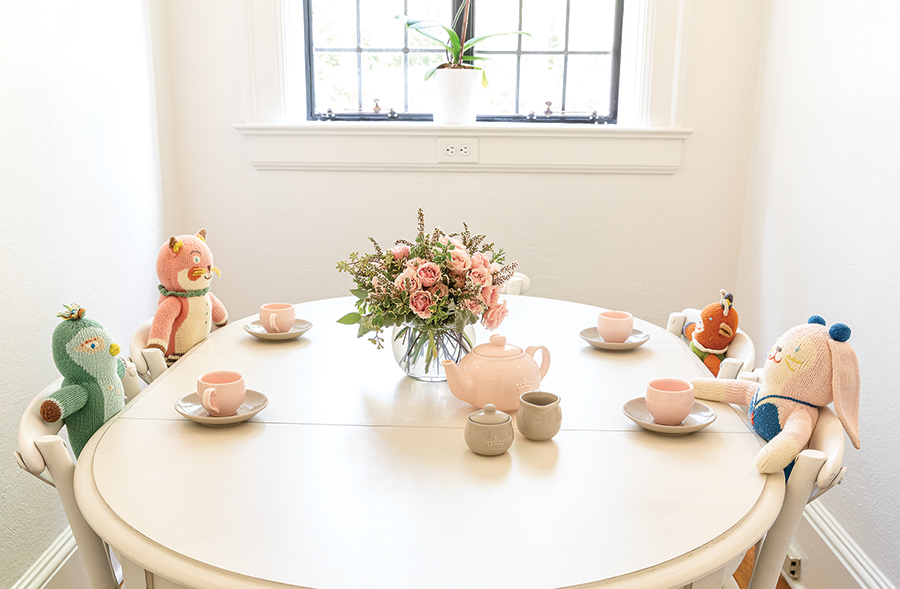
True, the main staircase stands, traditionally, opposite the front door, but the dining room lined with casement windows forms a wing jutting to the left. Enter the kitchen directly from the foyer area, continue to the screened porch, the bar room (where they have cocktails daily at 5:30 p.m.), the Carolina sunroom (big enough to comfortably accommodate a 10-foot leather couch) and back to the living room. Also off the foyer, an adorable nook (originally a butler’s pantry?) furnished with a scaled-down table, chairs and tea service, for the granddaughters.
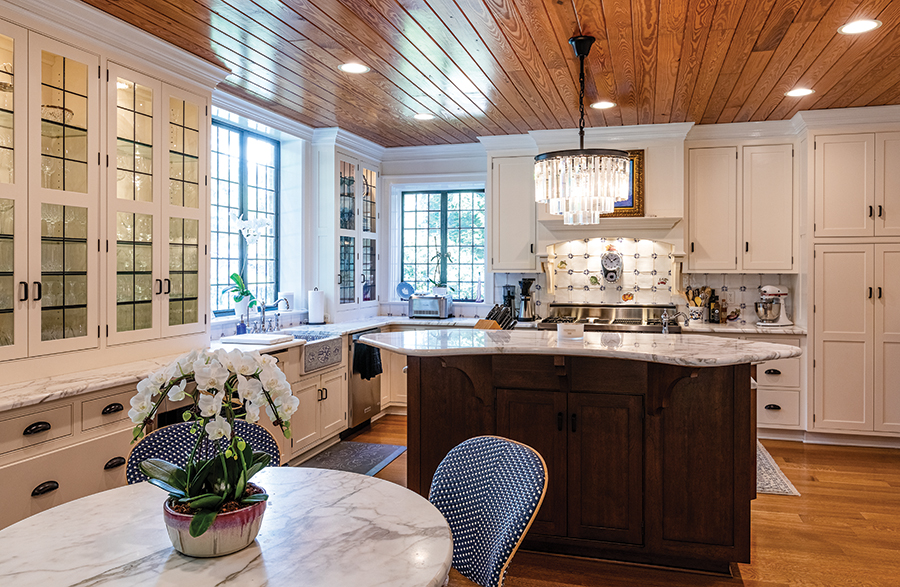
The kitchen contains a farm sink painted in blue Provençal motifs with matching backsplash tiles, white glass-front cupboards, a yellow Viking double-oven range and yellow prep sink. The two-tiered island has a stained (not painted) base, and the ceiling is covered in floorboards.

Upstairs, the master suite opens out onto a TV room, formerly a porch as indicated by the exposed brick wall. A five-part bath-dressing room laid out around a hallway appears to have been put together by a previous owner from a bedroom and small bath. Cynthia’s office and guest rooms complete the second floor, with Bruce’s office and more guest rooms, formerly servants’ quarters, accessed by a narrow staircase.

Almost every room has built-in bookshelves; a corner fireplace in the living room follows the Scottish placement tradition, Cynthia learned.

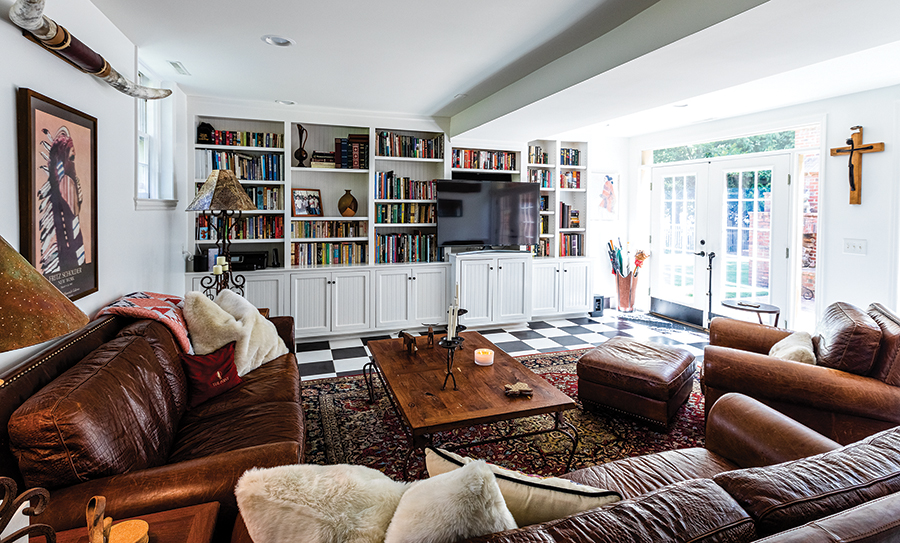
Then, the above-ground basement Texas room, with giant black and white floor tiles, weathered leather upholstery, a pair of wall-mounted longhorns, a lampshade made from hide, a photo of long-ago Texas rangers and other Lone Star memorabilia justifying its name. Also on this level, a combination wine cellar and fitness room.
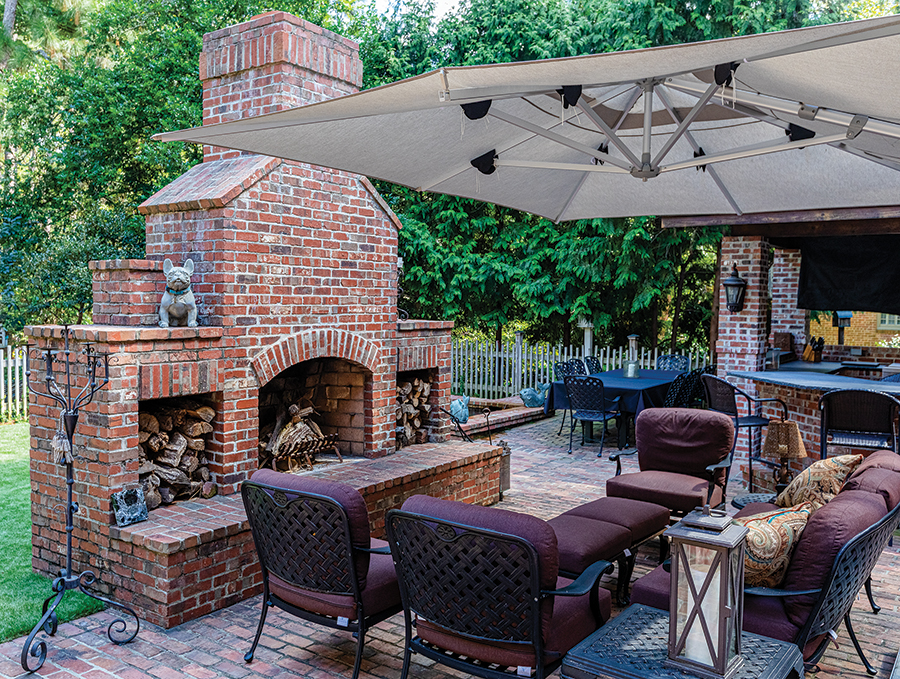
The Birdsalls purchased adjacent lots, enabling construction of a workshop for Bruce’s vintage motorcycles and cars, as well as a Victorian greenhouse imported from Belgium for Cynthia’s plants. Guarding her raised beds, the fountain statue of a woman is reminiscent of Midnight in the Garden of Good and Evil, set in Savannah. Already in place when the Birdsalls assumed ownership, an apartment with deck over the carriage house and a complete outdoor kitchen with dining area, stone fireplace and koi pond.

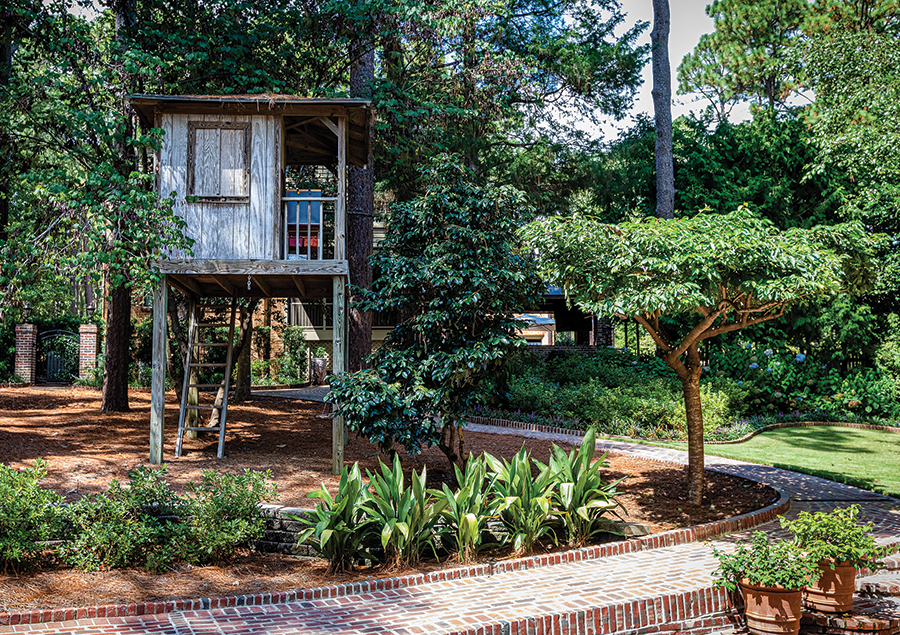
No pool. “We’re not pool people,” she says. But they are grandparents who provide a tree house, where the grandkids have art lessons.

The Birdsalls travel, collect and display, with restraint. No clutter in this fort. Cynthia identifies favorites:

In the living room, a 19th century inlaid French armoire, “The first piece of furniture I ever bought,” now filled with crystal flutes.

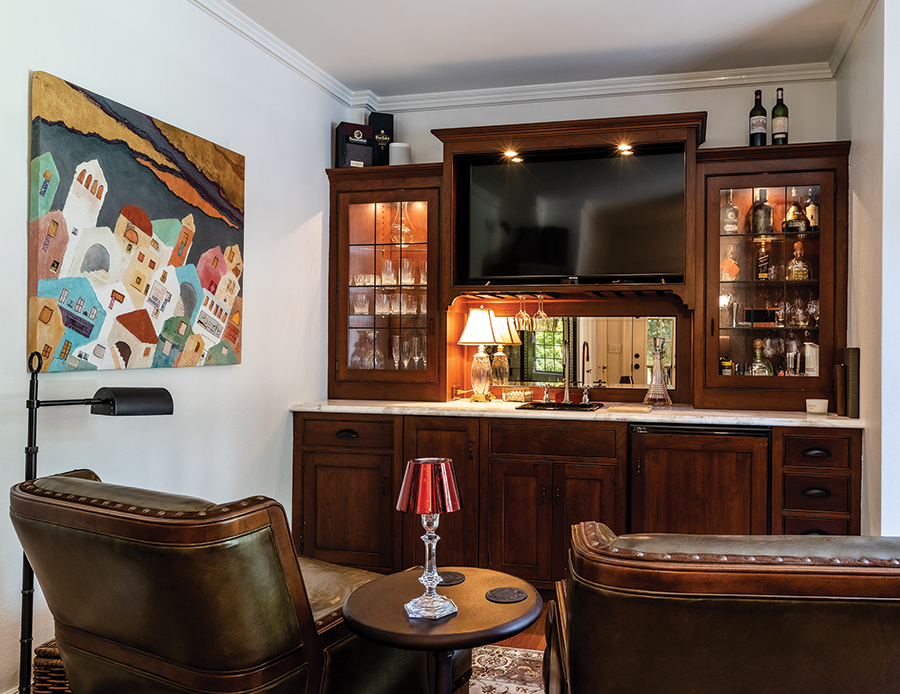
In the bar room, where they relax over afternoon cocktails, Cynthia displays Bruce’s collection of single-malt Scotch. Her favorite kitchen appliance is a gelato maker, which she uses to turn berries and mint from the garden into elegant European-style desserts.

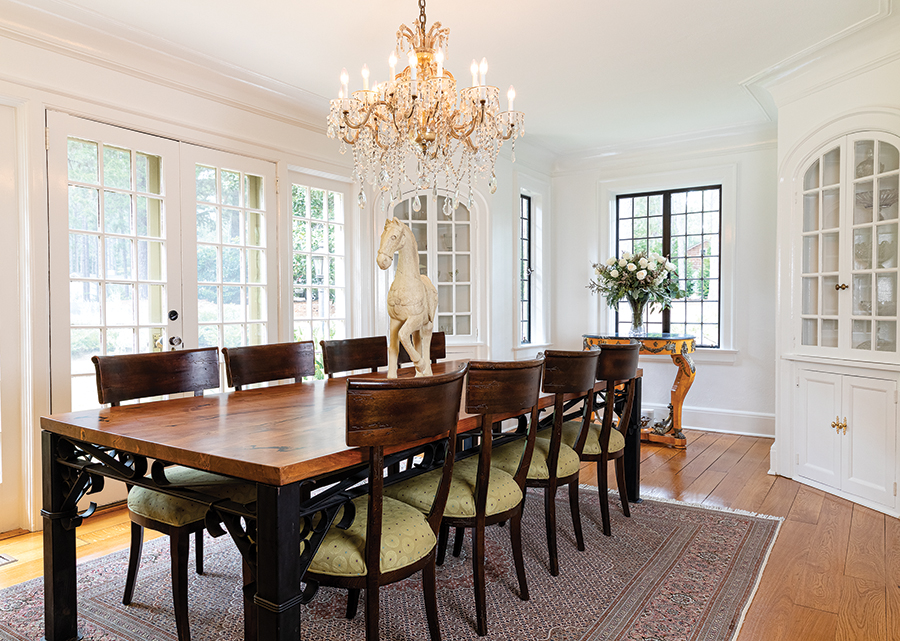
The dining room standout has to be the table that seats 12, custom-made from a single mesquite tree, with a heavy wrought iron base.

Paisley upholstery on porch furniture was chosen to complement a poster from Verona. Cynthia is definitely a poster person: Her favorite, drawn and signed by Tony Bennett, has a jazz theme. Cynthia and Bruce were regulars at the New Orleans Jazz Festival.

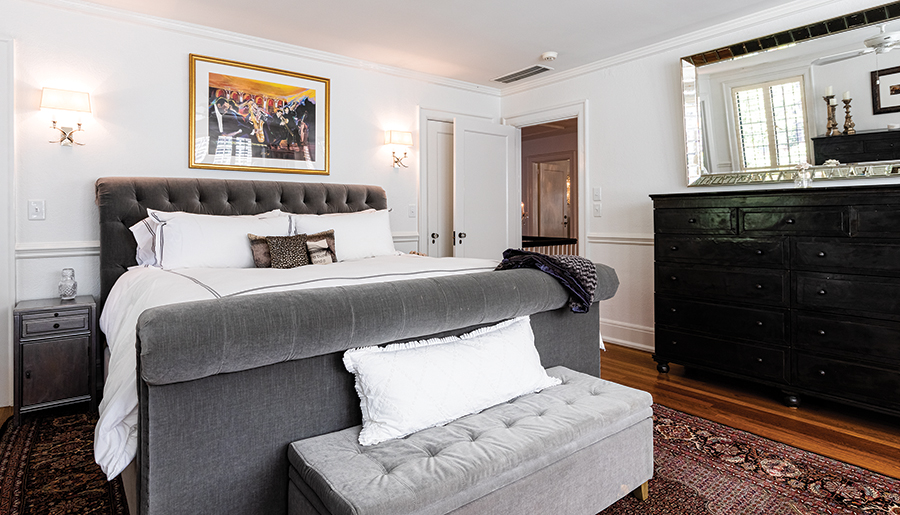
The star of the master bedroom, done in white and seafoam beige, is a tiny crystal Baccarat jewelry box found at an antique auction, while in the master bathroom Cynthia likes a round glass stand next to the claw-foot tub for her bathtime glass of Champagne. Also in the bath suite, a glass-front cabinet belonging to Bruce’s mother now displays Cynthia’s collection of perfume bottles.

Their only other family heirloom, a child’s rocking chair made by Cynthia’s great-grandfather, has a special place in a guest room, as does a purple velvet slipper chair.

Of the several chandeliers, Cynthia’s prize, from a mansion in New Orleans’ Garden District, is suspended over the main staircase, where also hangs a family portrait. A former maid’s quarters is home to a dress-up closet containing costumes worn by Cynthia’s granddaughters.

The unifying factor: Walls throughout glow a particular shade of white, like whole milk diluted with chardonnay. Moldings and woodwork have been painted high gloss to reflect light streaming through windows occasionally covered by shutters, never drapes. “Colors create energy, and I’m looking for calm,” Cynthia explains.

Bruce’s favorite things, aside from his workshop, set Dunross apart. A system of soft lights weaves through the tall pines surrounding the lawn. At dusk they come on, bathing the estate in faux moonlight.

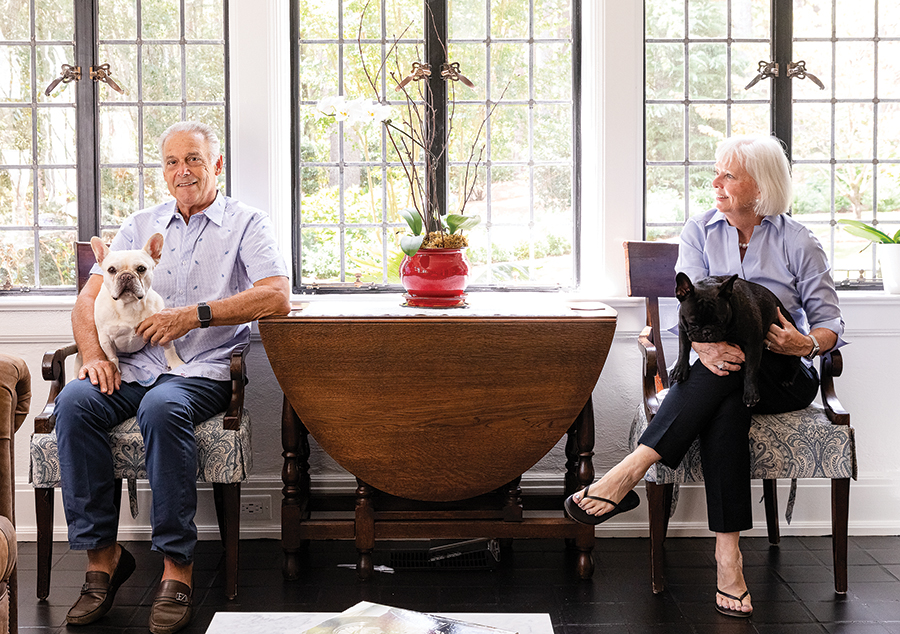
Donald Ross’ castle has evolved into an extraordinary retirement home occupied by far-from-ordinary people. Cynthia grew up on a ranch in East Texas; Bruce in a wood frame house in Connecticut. Dunross represents their achievements, as well as a well-planned gathering place for families, friends and two French bulldogs named, bien sur, for a pair of French institutions, Coco Chanel and Rémy Martin.

“This house has a sense of peace about it — a contented place,” says Cynthia, “a good place to spend our last years.”  PS

Magic Show

Seeing the world in greater depth

Photographs by John Gessner


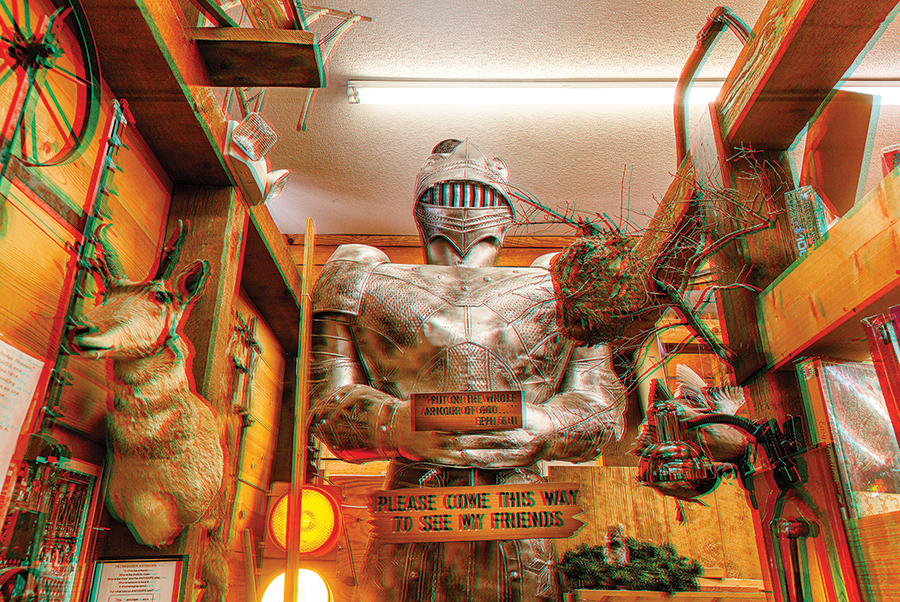
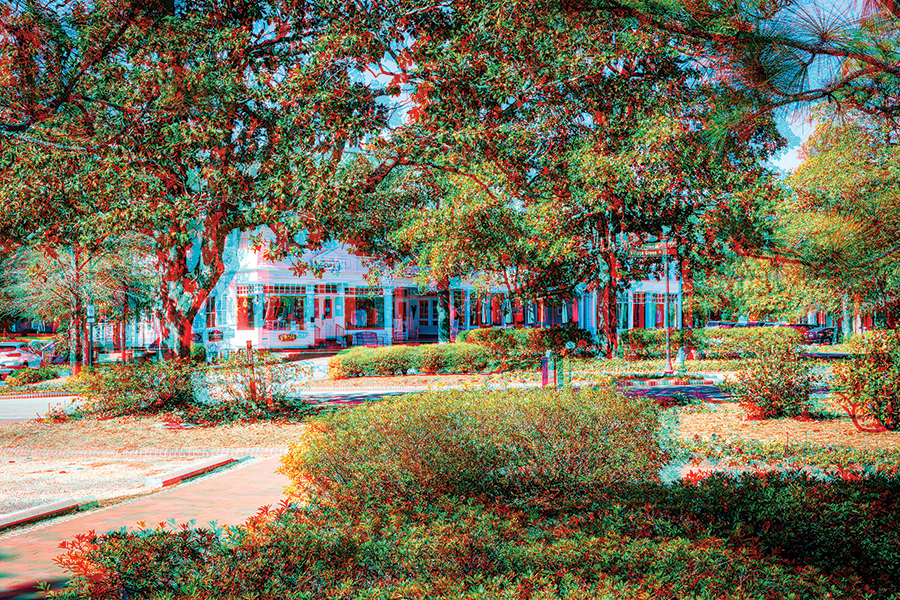
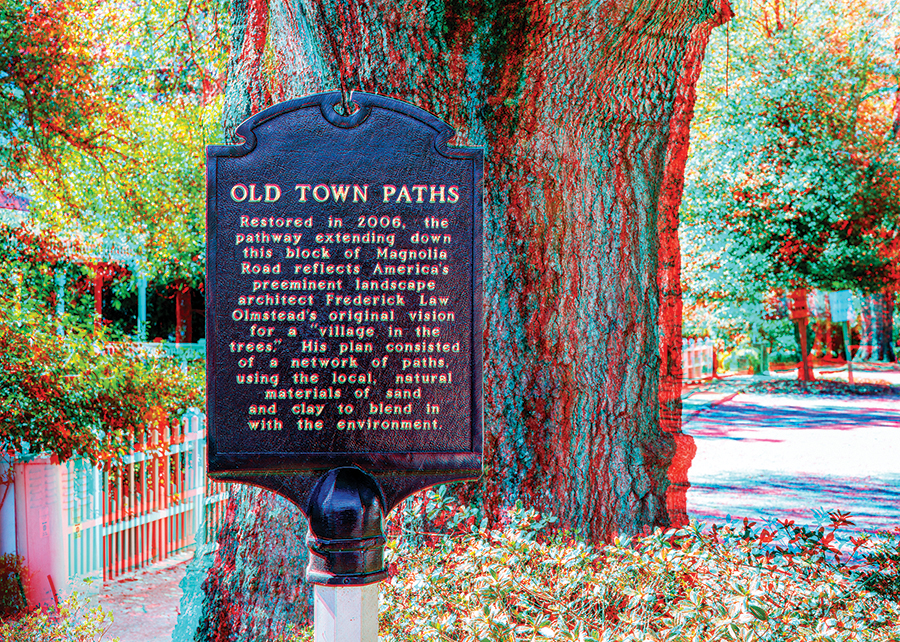
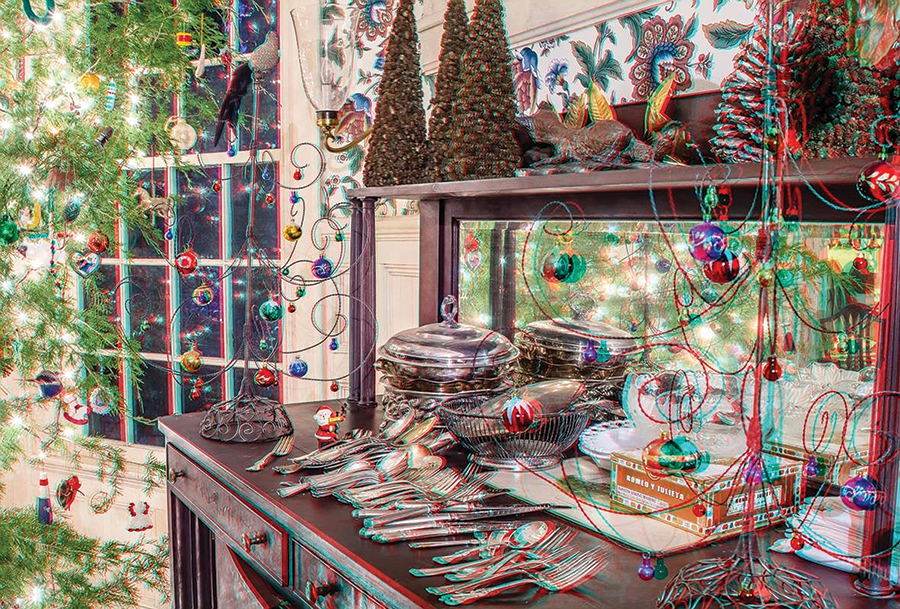
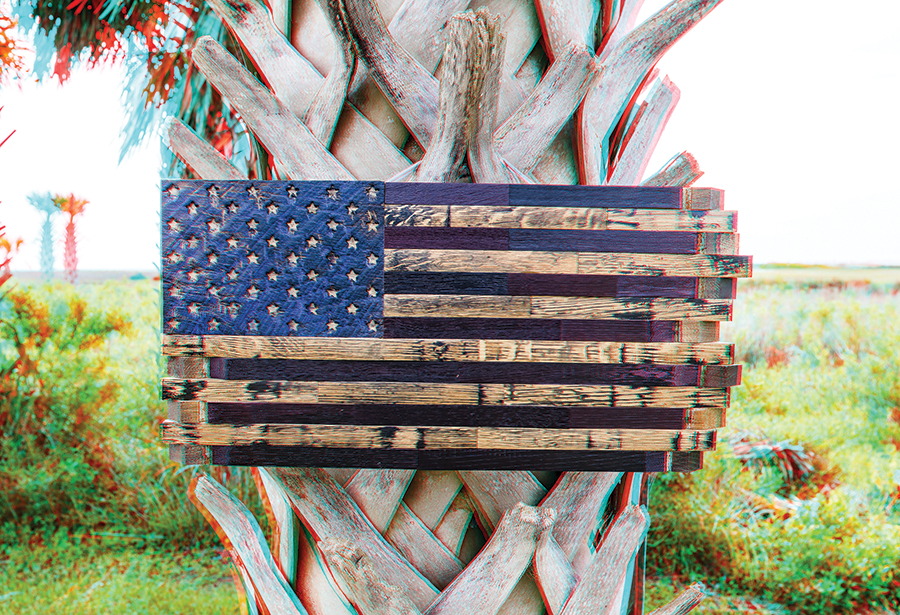
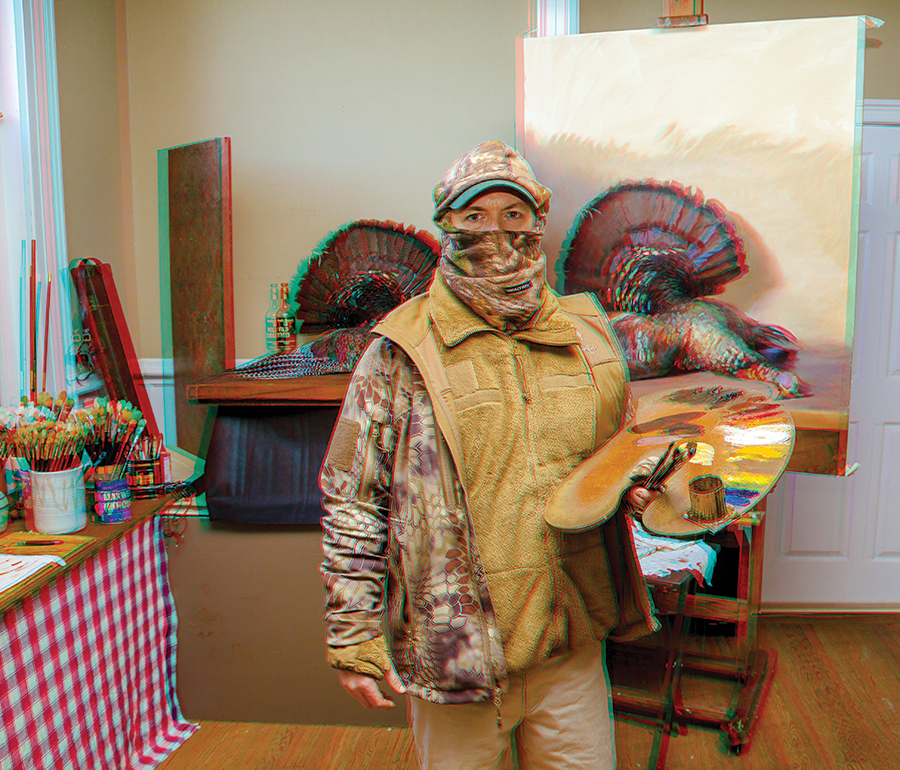
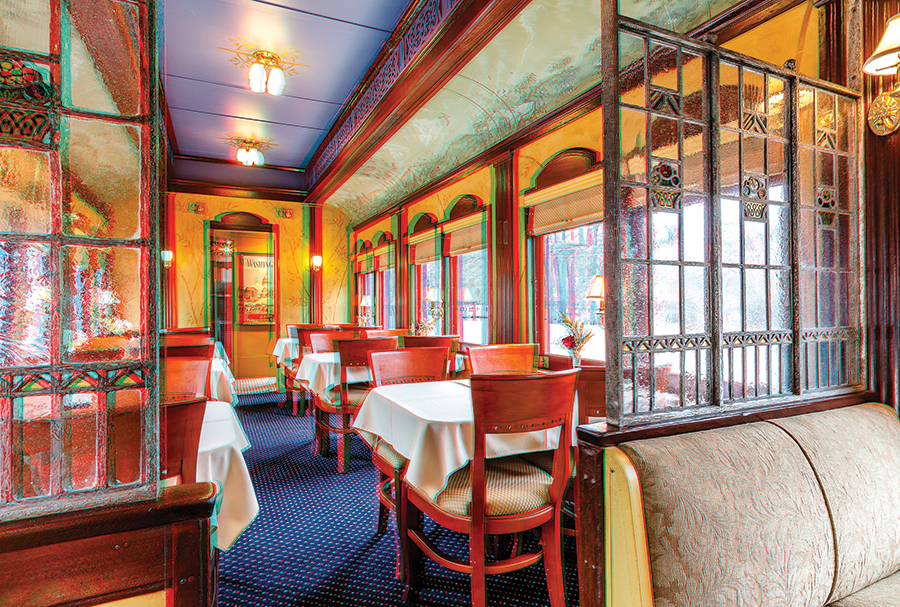
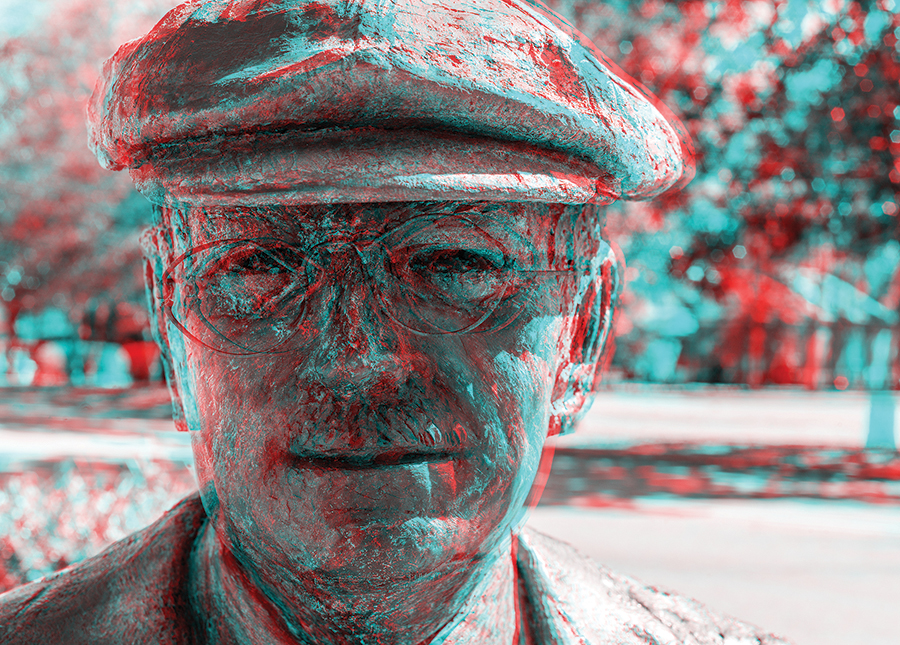
John Gessner has been seeing double most of his life. Not in the clinical sense, mind you, but in the artistic one. “They had this place, Museum Village, where I grew up, and one of the rooms was full of photo amusements,” says Gessner. Among the amusements were stereo cards — those stiff, antique cards with side-by-side images viewed through a handheld stereograph, yielding a three-dimensional image. “They’ve been doing those since the beginning of photography. I’ve been making them since I was little.”

For the last 10 years Gessner has been producing 3D images with a 35mm camera fixed to a mount of his own design. He levels the camera, frames the shot, makes the first exposure, slides the camera to the right approximately the distance between the centers of your eyes, makes the second exposure, then fuses the images using Photoshop.

What follows is a collection of his 3D photographs, seen with the help of glasses sponsored by Carolina Eye Associates. If you want to know why the pictures work, well, the shortest explanation I could come up with was that two images, when viewed through color-coded anaglyph glasses, produce an integrated stereoscopic image that the visual cortex of the brain fuses into the perception of a three-dimensional scene. Or something like that. As for me, I think it’s magic. — Jim Moriarty