Story of a House

Cabin Fever

Historic homes and life lessons

By Deborah Salomon     Photographs by Laura Gingerich

Walls can’t talk. Except for creaks, neither can rough-hewn floorboards or unscreened windows. Too bad, because their stories would describe a life primitive in comparison to ours. A life without air conditioning, indoor plumbing, electricity. A life where large families were the norm, as was burying a child or two.

A life where women stayed home. A life that fascinates for its simplicity and hardship, considering how complicated and automated ours have become.

These lives may, after all, speak best through their homes.

A Village Grew Around It

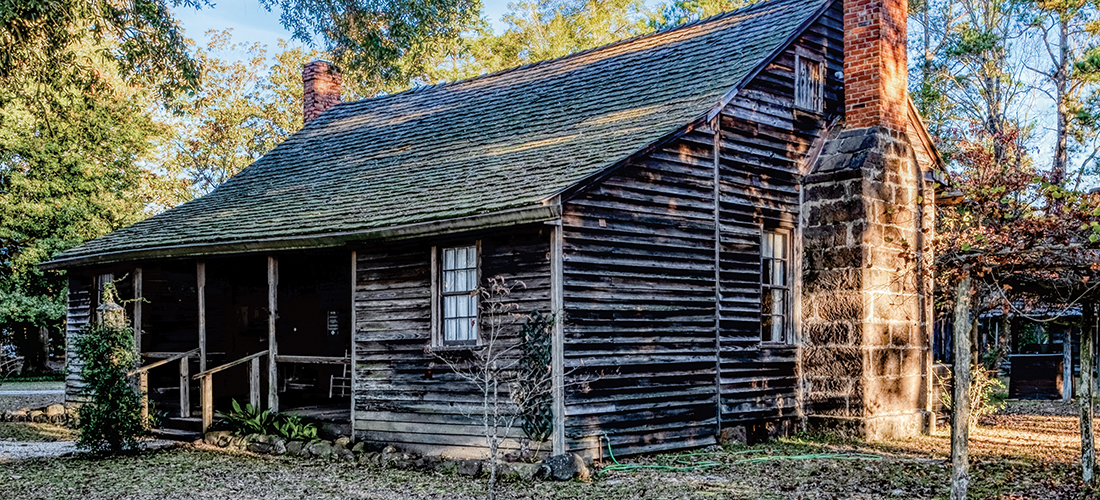
Shaw House sits, stoically, on a downtown Southern Pines corner within sight of a bank, a pub, a gas station, a gym and a Mexican restaurant — futuristic anachronisms, given its weathered boards and sloping porch. The date on one of two massive sandstone chimneys reads 1842, although the house itself was constructed in 1820 by Charles Shaw, a first-generation Scottish settler, on 2,500 acres of farmland. Perhaps the later date reflects addition of the porch and “travelers’ room,” usually with a separate entrance, occupied by itinerant preachers or craftsmen.

Water was drawn from a well. Houses of this era lacked kitchens; food preparation took place in an outbuilding distant enough so the inevitable fire would spare living quarters.

Step through the front door into a dim antithesis of 21st century bright-and-beautiful homes. Windows are small, unscreened and low-set — some shaded from blazing summer sunlight by the front porch. Walls, like floors, are random-width pine boards weathered gray, with the occasional decorative beadboard or faded green paint. Floors slant noticeably toward the doorsills. Low tables and chairs accommodated people of smaller stature, but no one seems to know why ceilings soar.

Obviously, utility was the architect here, yet few provisions were made for Shaw’s children. When not working the fields, they must have gathered in the “greeting” room just inside the front door. The dining area also seems cramped for that brood, as does the parlor. During winter months, perhaps they drew close to one of three fireplaces to finish their lessons. Since the house has but a single designated bedroom, the eight surviving siblings (two died in infancy, two encamped during the Civil War) must have slept in the narrow loft with angled ceilings, a tiny window and no insulation.
Imagine the heat, the insects.

Yet this dwelling housed a family of substance, ambition. In 1887, son Charles “Squire” Shaw became Southern Pines’ first mayor. The house remained in Shaw family ownership until acquired by the Moore County Historical Association in 1946. Period furnishings were hunted down, climate controls installed, a kitchen added. The house became a museum, a tea room and headquarters for the MCHA.

The Shaws peer down on the upgrades from photo portraits. The men appear quite nice-looking with thick silver hair, but the women . . . a bit frumpy. Obviously, smiles were frowned upon.

All well and good, though no re-enactment could replace the musty aroma, the passage of time, and the aura that cannot be synthesized.

Happy Birthday, Bryant House

Two hundred years and still standing, quite a feat considering how many dwellings have perished in the interim. Sad that COVID-19 canceled your party — but it had no effect on your historical clout.

Bryant House, on a knoll past McLendon’s Creek in Carthage, surrounded by ancient sycamores and enormous crape myrtles, has a wistful Andrew Wyeth quality in silhouette and hue. Yet on this milestone occasion it stands tall and well-preserved, like a silver-haired matriarch unbowed by the decades.

Joel McLendon built the adjacent one-room cabin, known as McLendon’s Place, in the mid-1700s, selling it to Robert Graham in 1787. Graham’s daughter married Michael Bryant. Their son James inherited the cabin, purchased surrounding land, married and constructed a homestead. This visionary’s project, completed in 1820, suggests the input of an experienced carpenter, with an eye to architecture. Everything is even, plumb, squares up. Floors pass the rolling marble test.

Careful — doorframes aren’t sized for 6-footers.
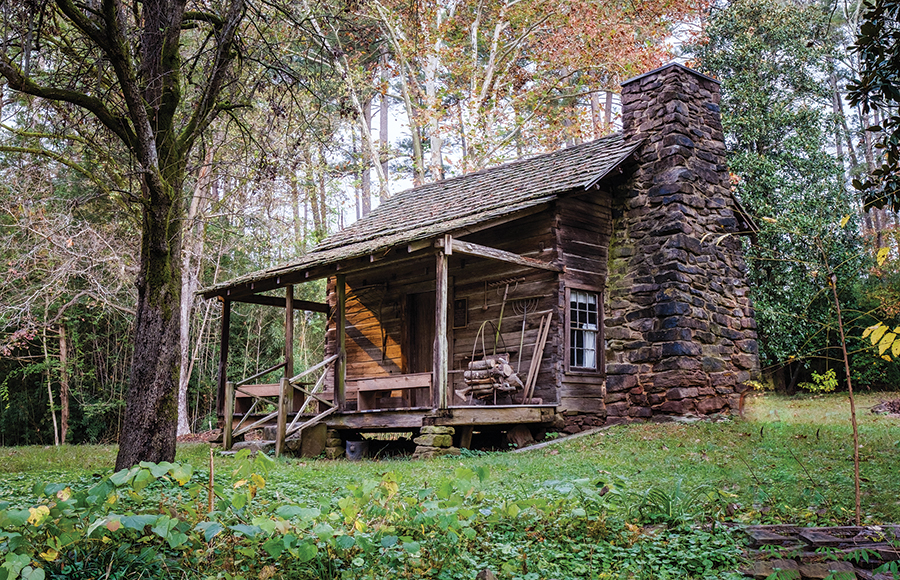
Wallboards are milled to match. The layout allows cross ventilation in the bedrooms (designated guest and granny) which, like the gathering area, are large — a good thing, since a successive generation of Bryants produced 13 children. They slept upstairs, divided into two rooms accessed by dangerously narrow, steep steps. Space under that staircase has been closed off as a bedroom closet, unusual in an era of “wardrobes,” armoires and pegs.

Even without running water, toilet facilities and a kitchen, the house was occupied well into the 20th century. It was gifted to MCHA and restored in 1970, including a fine collection of period furnishings, within guidelines set forth by the National Register of Historic Places.

Still, had home tours existed during Abraham Lincoln’s tenure, Bryant House would be a top pick.

Tracing genealogy can be like navigating a corn maze unless you’re a part of it, like Kaye Davis Brown, a sixth-generation daughter of the Bryant clan. Her father was one of Flossie Bryant Davis’ 13 children. Brown reels off a list of relatives — and rattles some skeletons, like Leandy Bryant’s love child, who bore her maiden name.

Brown describes how kids bathed in the creek in summertime, using smashed leaves as “soap.’’ During the winter a tub was placed near a fireplace, then surrounded by blankets draped over chairs for privacy. Half a dozen little ones later, the murky water got dumped outside.
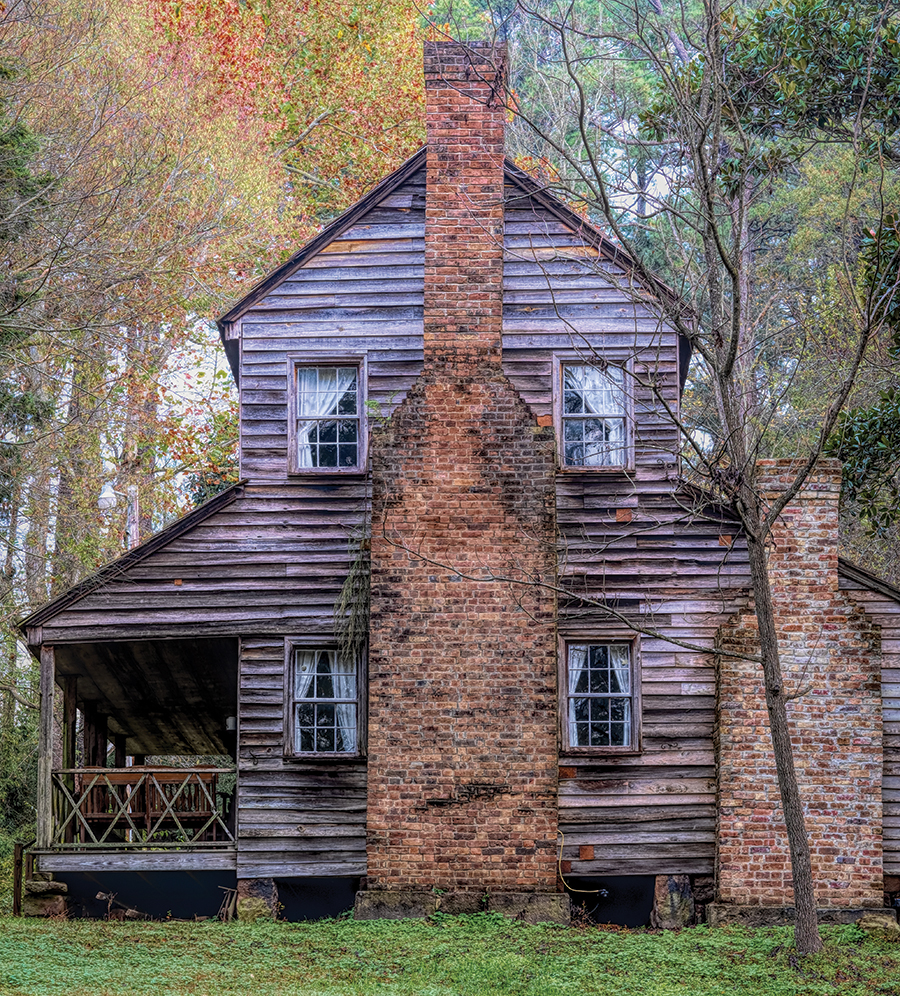
Brown points out a cross engraved over Mom and Pop’s bed, now blurred by white mold. She repeats the legend of how Flossie, an animal lover, coaxed her pet foal up that narrow staircase. Just don’t assume the bullet hole near the front door resulted from a military skirmish, as at the Alston House in the Horseshoe. Instead, blame neighborhood pranksters.

With minimal improvements, Bryant House was occupied until the 1940s. As a child, Brown remembers visiting cousins there. The grounds are beautifully kept; events draw crowds who enjoy the music, crafts and food — just not this year. A spring open house was postponed until December, then canceled, leaving only chilly ghosts to hear the tales, sing the songs and play simple games on the edge of this Wi-Fi world.

Have Cabin, Will Travel

The Shaw and Bryant homes have board walls constructed from heart pine. The Woman’s Exchange gift shop and café, a Pinehurst landmark, is a true whole-log cabin.

Naturally, it comes with a story — beginning with “Thanks, Mrs. Tufts” — from Exchange board President Barbara Summers.
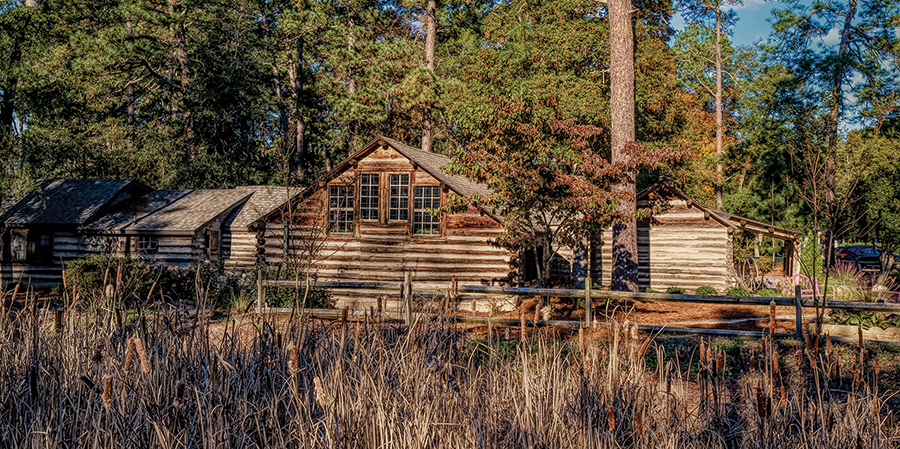
The cabin was crafted without nails in 1810, several miles from Pinehurst at Ray’s Grist Mill. After the Civil War it was purchased by the Archibald McKenzie family as a kitchen. James Tufts, while developing the resort, was so charmed by this relic that he purchased it in 1895, had it disassembled log by log and moved near the village, where he could show it off to friends from New England.  He compensated the McKenzies by building them a new cookhouse.

At first, the cabin served as a museum. Its opening was reported in the Pinehurst Outlook in an 1898 story that spoke of a foot-long, iron key originating in a Fayetteville jail, a spinning wheel, candlesticks and deer antlers. The one-room cabin was later home to freed slaves Tom Cotton (a caddie on the resort’s golf courses) and his brother.

But all the while, Summers relates, Mary Emma Tufts had other ideas. Mrs. Tufts supported the Woman’s Exchange movement, begun in Philadelphia, in 1832. Gentlewomen who had fallen on hard times consigned handiwork in the shops, affording them not only financial aid but marketing skills toward future employment. Some exchanges opened tea rooms where forward-thinking women could socialize and share ideas. At its height, in the late 19th century, 100 Exchange shops attracted 16,000 consignees.
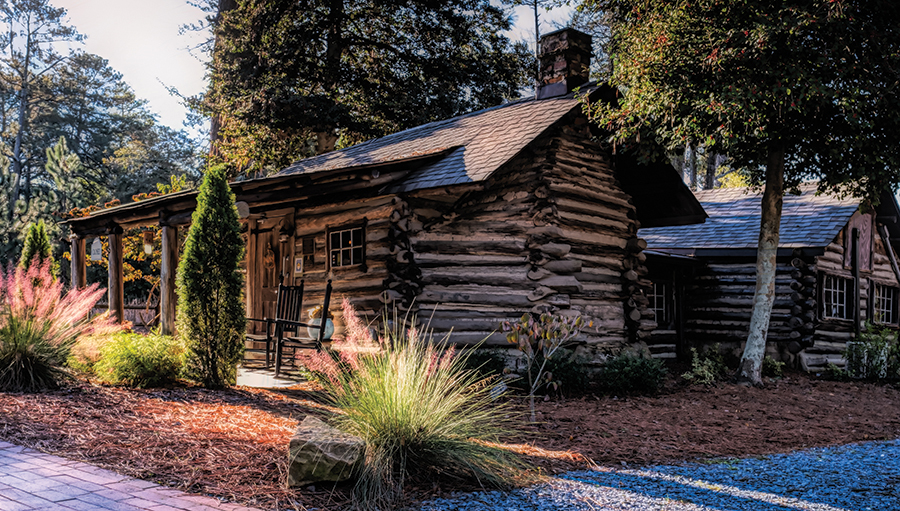
Mrs. Tufts died in 1922. In 1924, perhaps as a result of her influence, the cabin became an Exchange shop. Now, Summers continues, the pandemic has forced closing of four of the 20 remaining federation outlets but not the Azalea Road log cabin, which has spread in all directions from the original dark room with low door frames and a huge fireplace suitable for cooking. Sun streams in the showroom skylights; display cabinets have been painted white; and the café, usually full, specializes in soups, quiches and a turkey-avocado wrap. Artisan gifts and estate items are one-of-a-kind.

The garden surrounding the cabin has been replanted, heating and air conditioning improved, the computer system upgraded without changing the image of that solitary space and porch where, over the years, lives were led and business conducted.

Nothing succeeds like success. Leave it to the gals. And, pandemic notwithstanding, better show up early for a socially-distanced lunch.  PS

Return of a Classic

The Blind Colt celebrates its 80th anniversary with a new edition

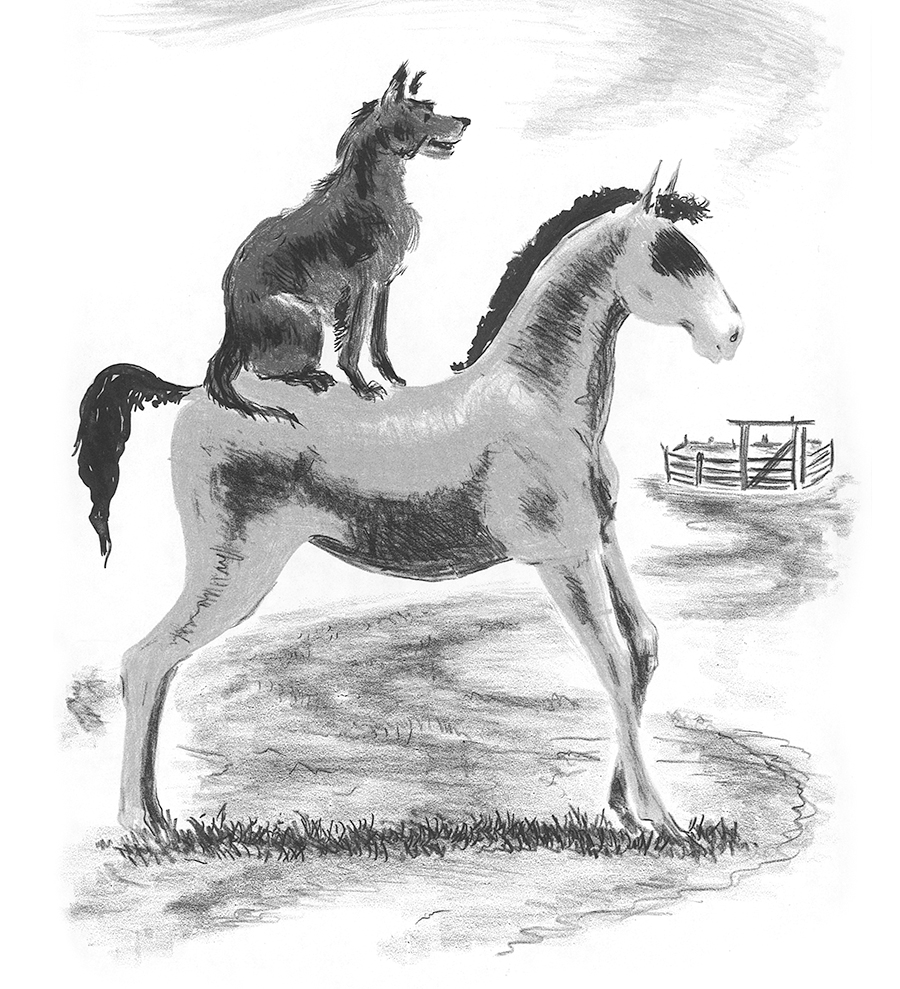
You can’t hurry a Glen Rounds book. You are asked to find a rock and sit for a spell. Listen to the tumbleweed rattle by. Smell the sagebrush. Let the wind chill your hide. If you’re patient, the critters will let you see them, going about the business of living. These are wild animals, so they won’t come when you call. They would not do well in a petting zoo, or in most children’s books. They don’t talk or wear cute outfits. Sometimes they are playful, but never sweet. The Blind Colt is not only hunted by wolves, but gets bitten and kicked in the ribs by other horses. Yet because Rounds shows us the harsher side of life, we are all the more tickled to watch the young colt buck and run for the “pure fun” of it. In the books of Glen Rounds, wild danger always comes with wild fun.

From “Glen Rounds: An Appreciation,” copyright © 2021 by Matt Myers. Reproduced by permission from Holiday House Publishing, Inc.

Glen Rounds Illustrations courtesy Holiday House publishing inc.

Illustration by Matt Myers

Poem

What It Was about that First Marriage

The floors were fine. Gorgeous,

in fact. Blond as sunshine, clean,

polished, alive with the kind of promise

we had dreamed. But oh those two

mismatched tables. Same height,

so we kept trying to line them up

as if they were a unit. One was maple,

right out of somebody’s 1950s Nebraska kitchen, with a scalloped leaf that folded down,

though it was years before we saw it

for what it was. The other, streamlined,

sleek. Once we tried pushing them together

and covering both with a patterned cloth, though dinner guests kept banging their knees. When I look back, I’m amazed

we didn’t toss it, haul it to the curb.

But, no, we struggled for years

to make it work, painting,

and painting again, turning it sideways.

— Dannye Romine Powell

Almanac

By Ashley Wahl

January cold guides us inward. You find yourself studying your hands, quietly tracing the lines of your palms when, suddenly, there is movement in the periphery. A flash — and then nothing.

The mouse is back. How he gets inside you’ll never know. And yet, the mystery keeps you smiling, keeps you guessing. You catch and release him into the yard again, and as he scurries off, heart pounding like a tiny hammer, you wait for him to turn around, maybe wink his beady eye as if to say see you ’round.

Here we are again, January. By some miracle we’ve made it. And just like the mouse, we carry with us new stories, new wisdom from our journey.

This is a time for planning and dreaming.

You order seeds.

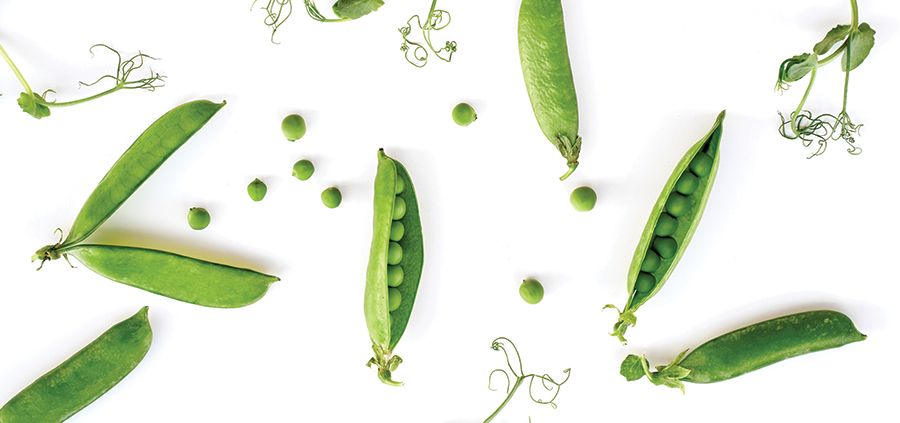
Next month, when the first of the daffodils burst through the soil in rapturous glory, you’ll sow sugar snaps and snow peas, carrots and parsnips, lettuce and spinach, maybe mustard seeds. But for now, you’re back to quiet contemplation, thoughtfully observing the lines on the back of your hands. The etchings and wrinkles begin to resemble the rings of a tree. There are stories here, you think. Lessons in each tiny groove.

And out of the blue, Aesop’s Fables pops into
your mind.

“The Ants & the Grasshopper”: There’s a time for work and a time for play.

“The Crow & the Pitcher”: In a pinch a good use of our wits may help us out.

“The Lion & the Mouse”: A kindness is never wasted.

You think of that crafty house mouse, smiling at his persistence and how you’re not so different from him. Your needs are the same: food, shelter and warmth. No doubt you both dream of the tender kiss of spring. And like the mouse, you, too, rely on a kindly universe to smile upon you, to gently guide you along your journey, granting you stories and wisdom for your future travels.

January is a year of lessons in the making. Notice the creatures, great and small, that remind us how to live. And remember: you are one of them.

Winter Blooms

Nature always gives us what we need. And in the dead of winter, when the bleakness of the landscape nearly becomes too much to bear, she gives us flowers.

Prunus mume, commonly known as flowering apricot, blooms in January. Its delicate, fragrant flowers — pink, red or white — ornament naked branches much like the cherry blossoms of official spring. Amazingly, this small, ornamental fruit tree was virtually unknown in the United States prior to the spirited efforts of the late Dr. J.C. Raulston, beloved horticulturist and founder of the nationally acclaimed arboretum at N.C.S.U. Raulston devoted his life to growing and sharing rare and spectacular plants, P. mume among them. This month, when its vibrant flowers offer their spicy aroma and the promise of spring, surely, whisper, thank you.

Hope smiles from the threshold of the year to come, whispering ‘it will be happier’ . . . — Alfred Lord Tennyson 

Looking Out, Looking Up

How will your garden grow? Per Aesop’s “Ants & the Grasshopper” fable, now’s a good time to plan ahead. This month, order quality seeds and map out a planting calendar for year-round harvest. Sure, it will take a bit of work. The ants know something about that. But educating yourself on what to plant and when is a game changer. And when you’re harvesting fresh veggies from your backyard spring through winter, no doubt you’ll be singing like a grasshopper in June. 

But while you’re planning, don’t forget to look up. Although a waning gibbous moon will try to outshine it, the Quadrantid meteor shower will peak on Sunday, January 3, from 2 a.m. until dawn. The first new moon of the New Year lands on Wednesday, January 13. Consider this cosmic reset a good time to set intentions and launch into a new project. Through darkness comes light.

A Spin Around the World

Christmas in Distant Lands

Photographs by Tim Sayer

Costuming by Mary and Marcie McKeithen, Showboat

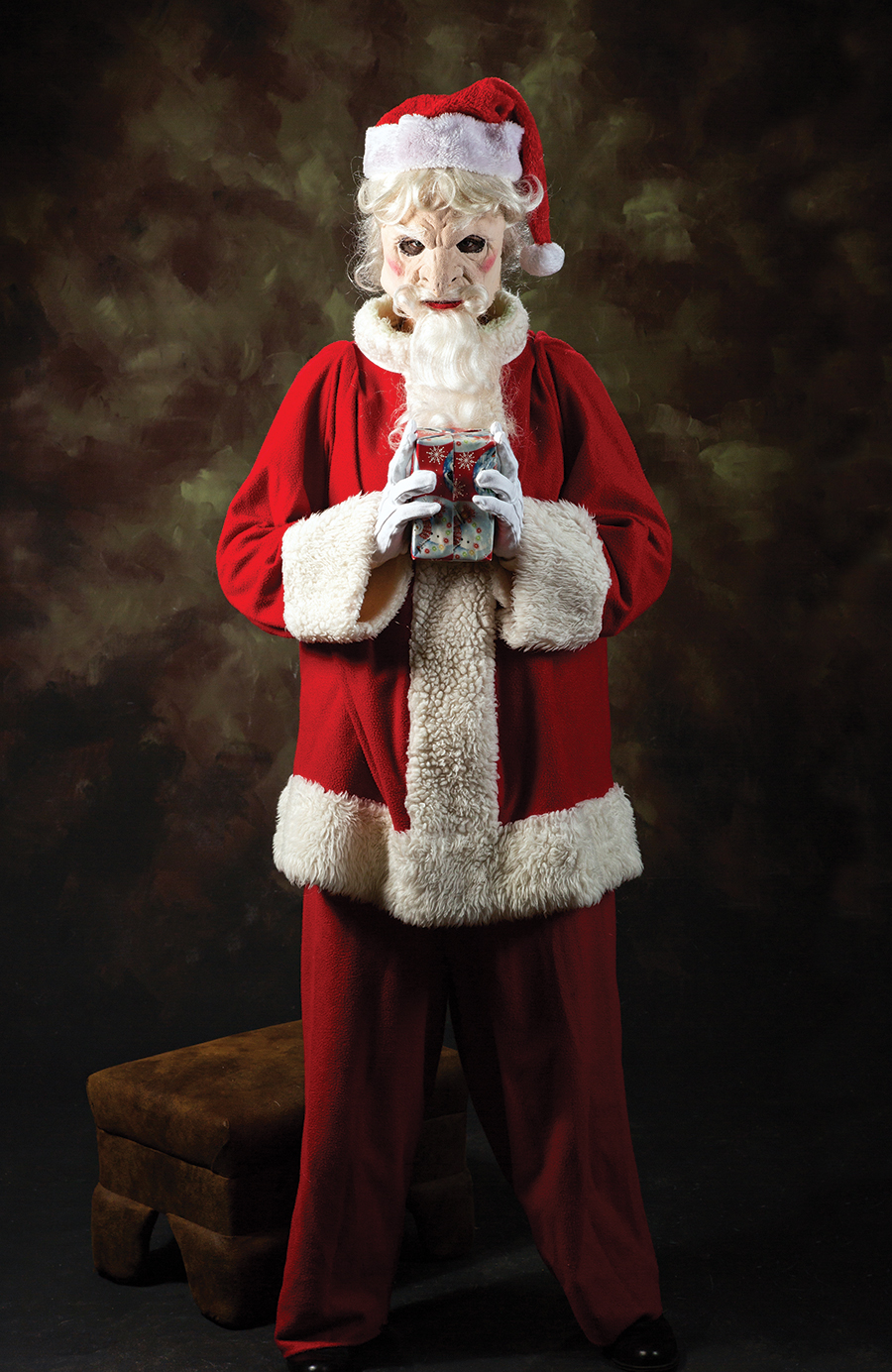
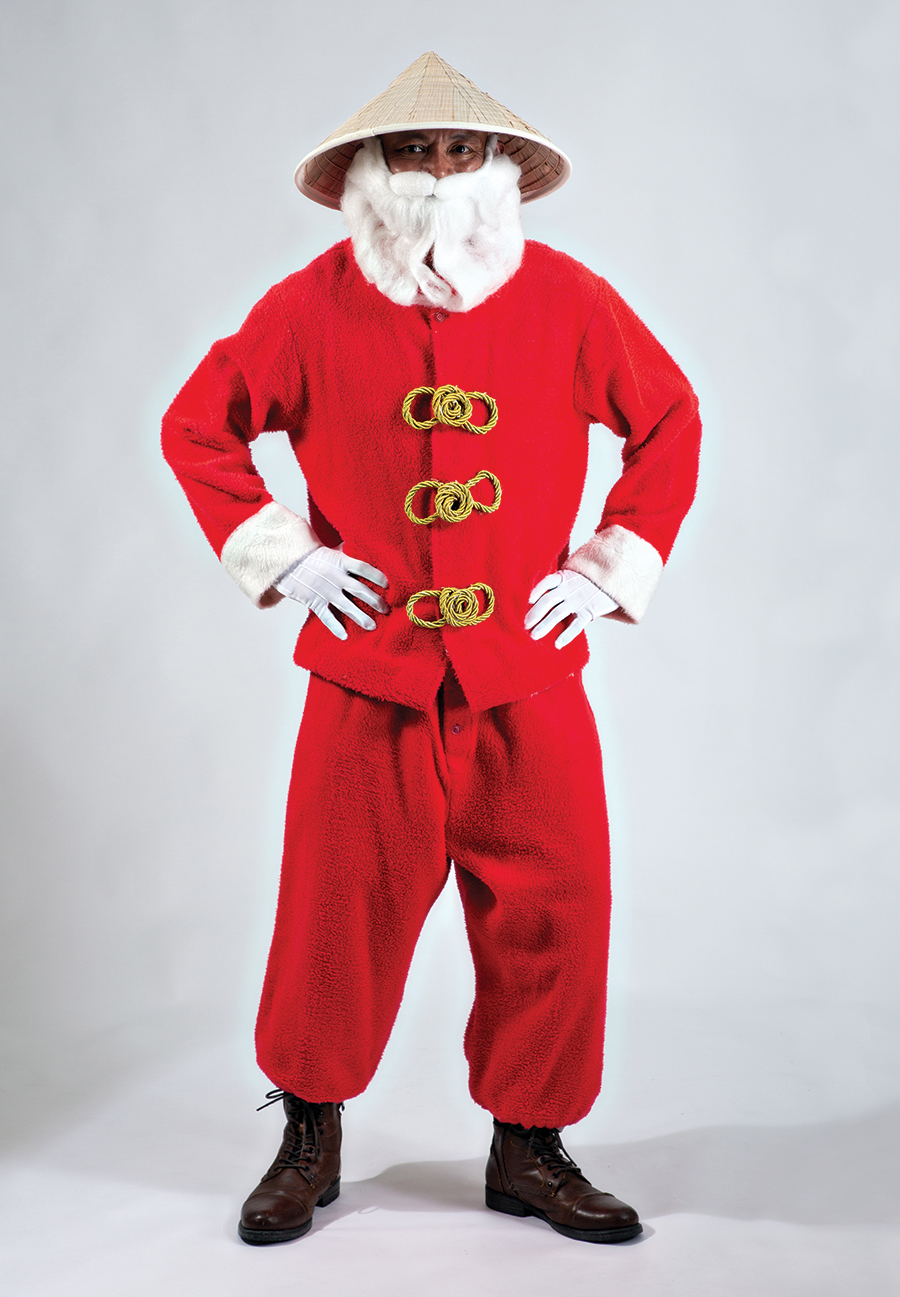
The symbols of holiday spirit can involve more than a jolly old elf with a belly that shakes like a bowl full of jelly. You can be naughty or nice in every corner of the globe.

Netherlands

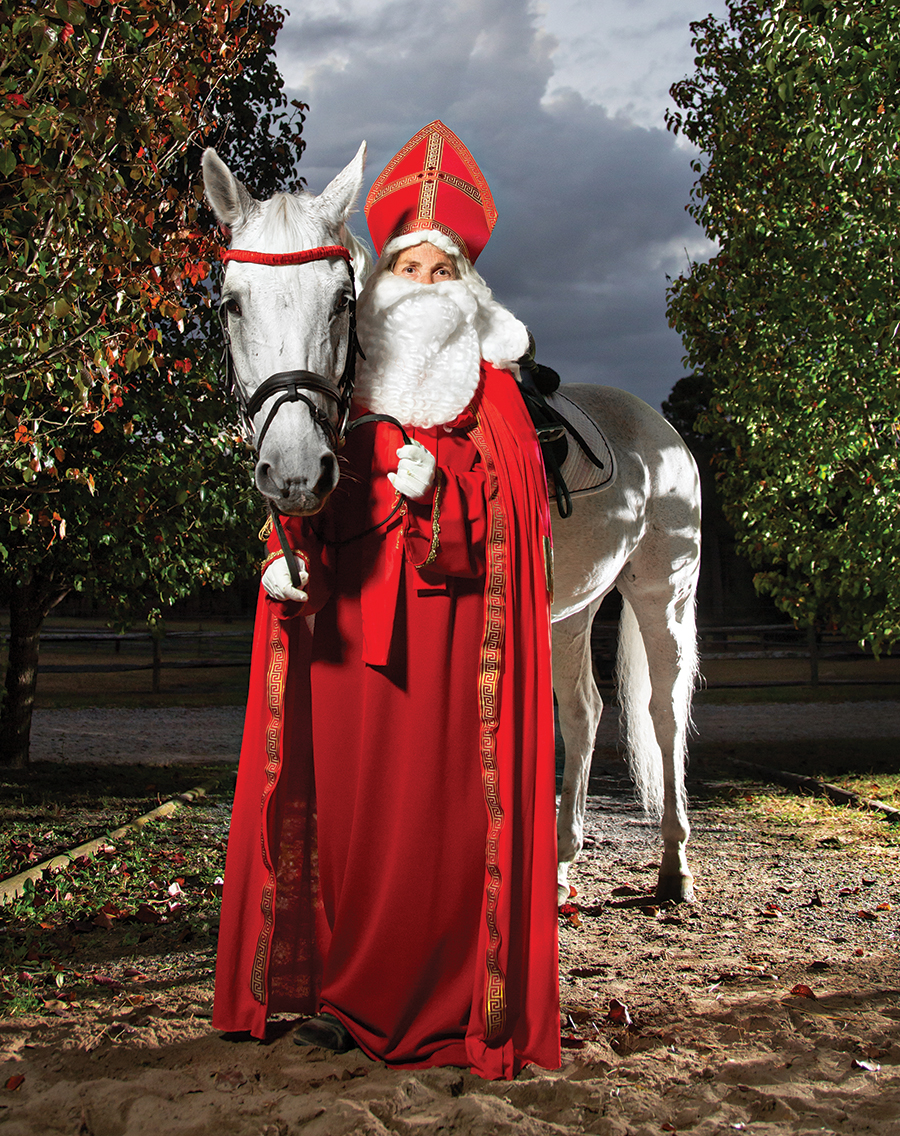
As Cosmo Kramer would say, “Giddyup!” In 1642 Dutch explorers named their first church in Manhattan after Sinterklaas, the patron saint of children and sailors who comes riding into town decked out with a bishop’s red hat and carrying a jeweled staff. He knocks on doors delivering bags of goodies. In the 21st century celebration Sinterklaas arrives in Amsterdam on a boat from Spain — where he spends the rest of the year — on Dec. 5. Olé, old fella.

USDF bronze and silver medalist, Charlotte Brent, poses with Anna, owned by Jennie Acklin


United Kingdom

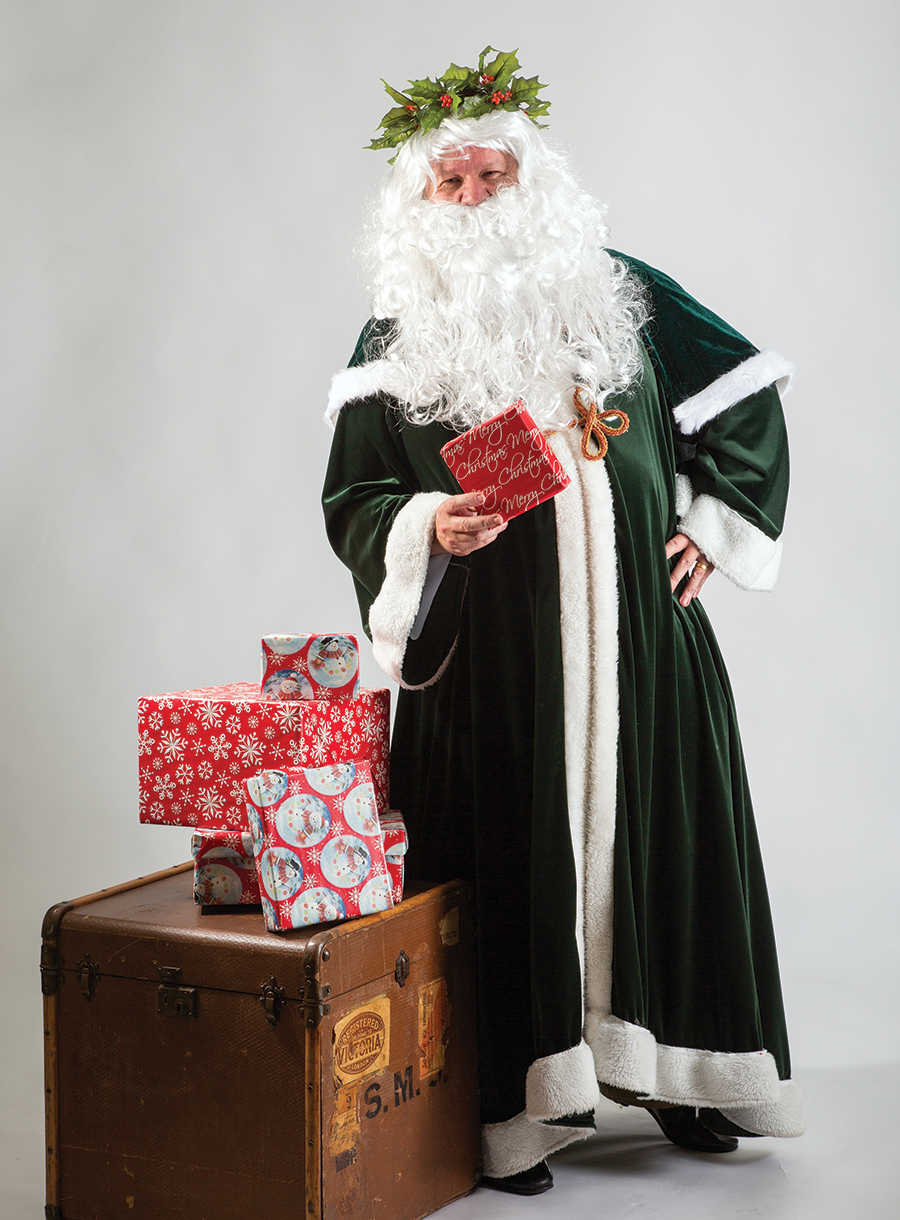
Throw the big, fat goose on the table, slather yourself in Yorkshire pudding and pull out that dusty old volume of Charles Dickens. You might see a Santa in a red suit on the streets of London, but the traditional British Father Christmas is decked out in a hooded green suit, his head crowned with a wreath of holly and a dash of mistletoe — the colorful touch of pagan mythology.

Ian Drake, manager of The Sly Fox Pub


Germany

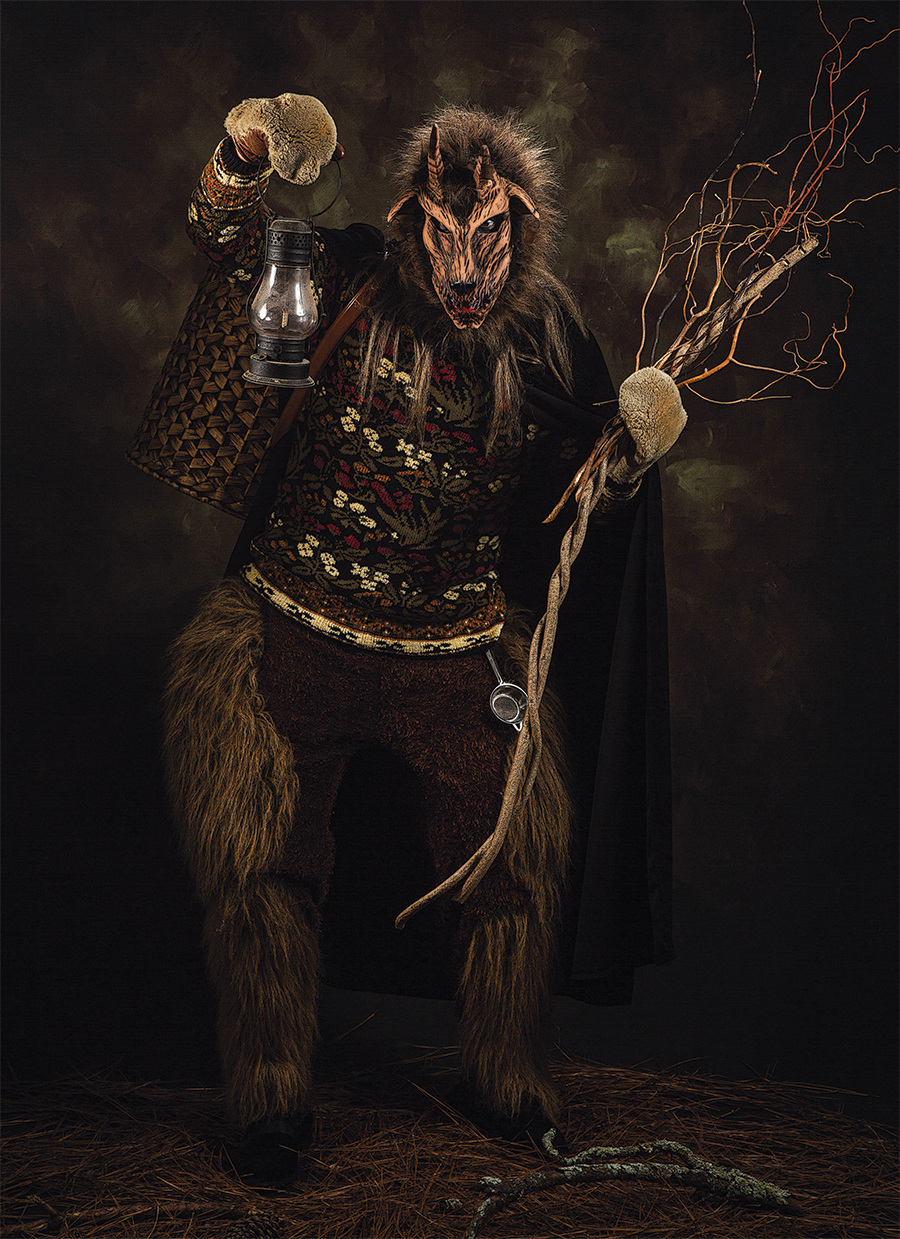
The legend of Krampus, spread across much of Central Europe, dates back to the 12th century. In early December, youngsters began hearing whispers about a dark creature with horns and fangs who carried a bundle of switches used to swat misbehaving children. On Krampusnacht — Dec. 5, the day before St. Nicholas Day — he’d come into town with chains and bells and steal away bad children in a basket. The next day St. Nick would reward all the good children with presents in their shoes. Fill ’er up.

Phillip Shumaker, Existing Industry Expansions manager, Economic Partnership of North Carolina


Norway

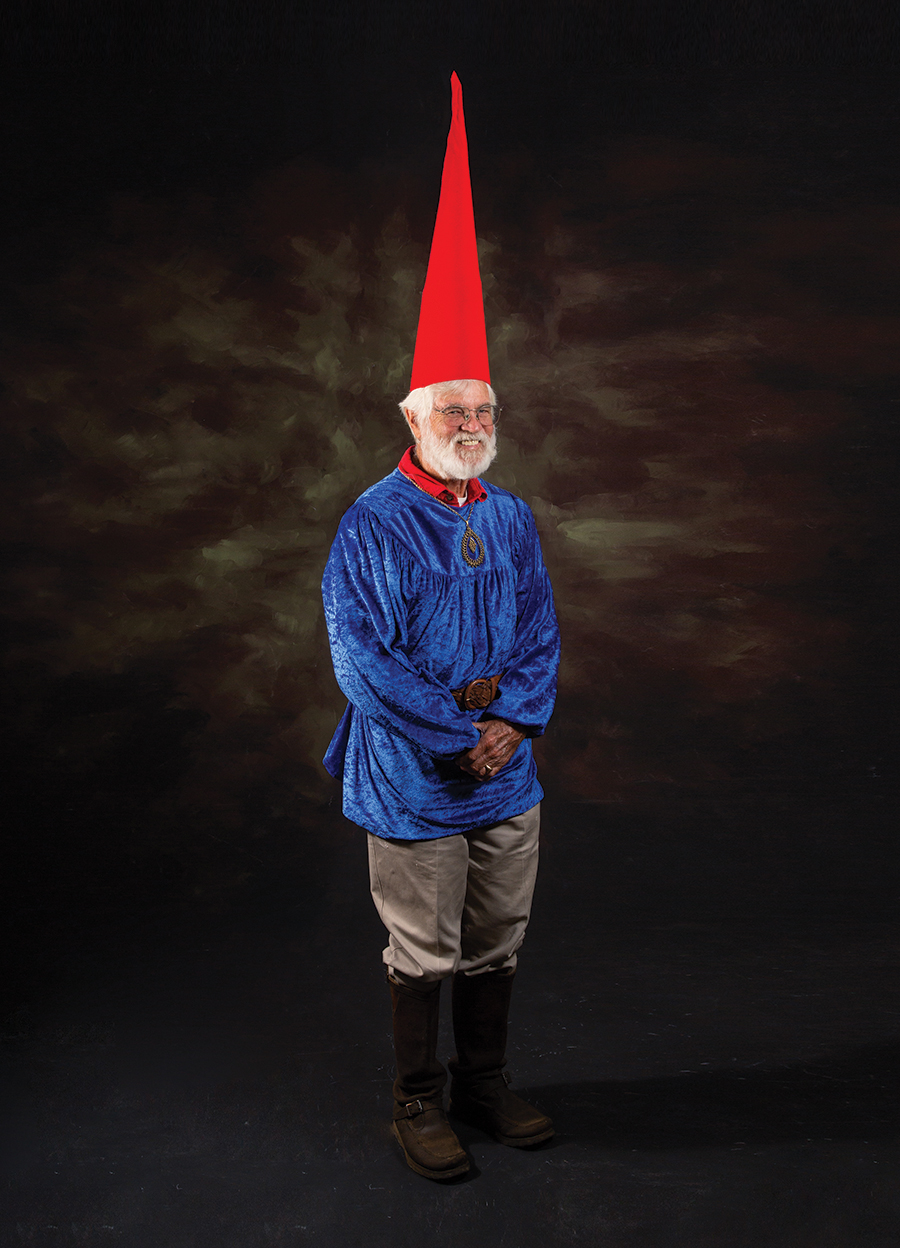
Dressed like a garden gnome, the gray-bearded julenissen was once a barn devil who protected the farm like a rabid Chihuahua. While these days it may live in a forest or a field nearby, the julenissen brings gifts from the North Pole on Christmas — not down the chimney but through the front door. And don’t forget the porridge with a little butter on top. This gnome can go sideways in a heartbeat.

Local fisherman Bennett Rose


Austria

Christkind, or Christkindl, is the giver of gifts. An angelic figure with long, often curly, blond hair and golden wings, she leaves them under the tree (or maybe on the doorstep) on the last day of Advent, Dec. 24. This second Santa grew out of the Reformation in the 16th and 17th centuries. Children never see the Christkind in person — on delivery day, that is. In some places, her departure is announced by the ringing of a tiny bell. Come and get it.

Veronica Lloyd, owner and manager of Monkees


France

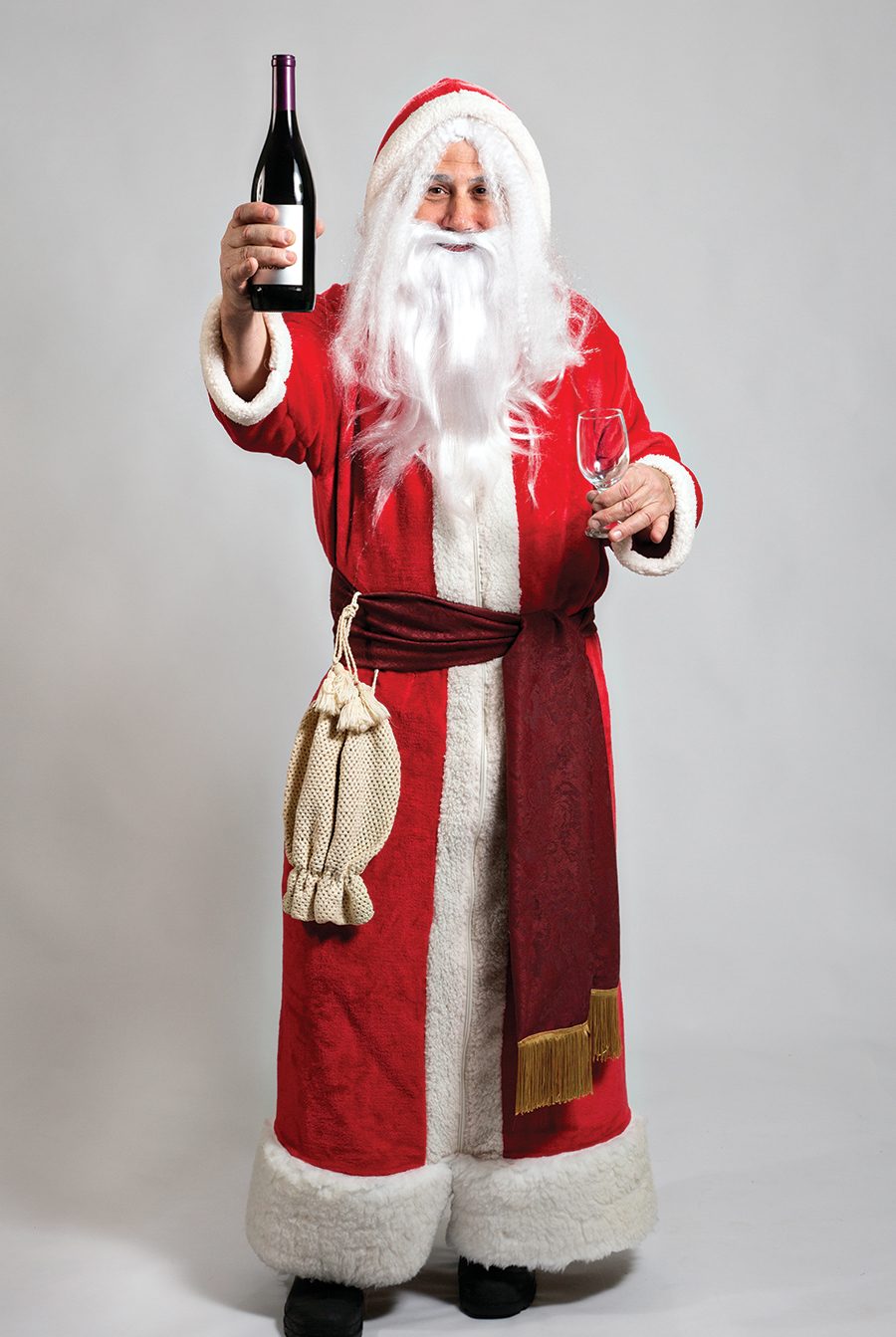
Anyone who remembers the Coneheads from Saturday Night Live knows that things are a little different in France. Père Noël wears a red cloak with a hood and brings toys to good children after evening Mass on Christmas Eve. Children don’t leave milk and cookies but might set out a glass of wine. Père Noël travels with Père Fouettard — the whipping father — who handles the misbehaving little tykes.

Local carpenter Laurent Rocherolle


Italy

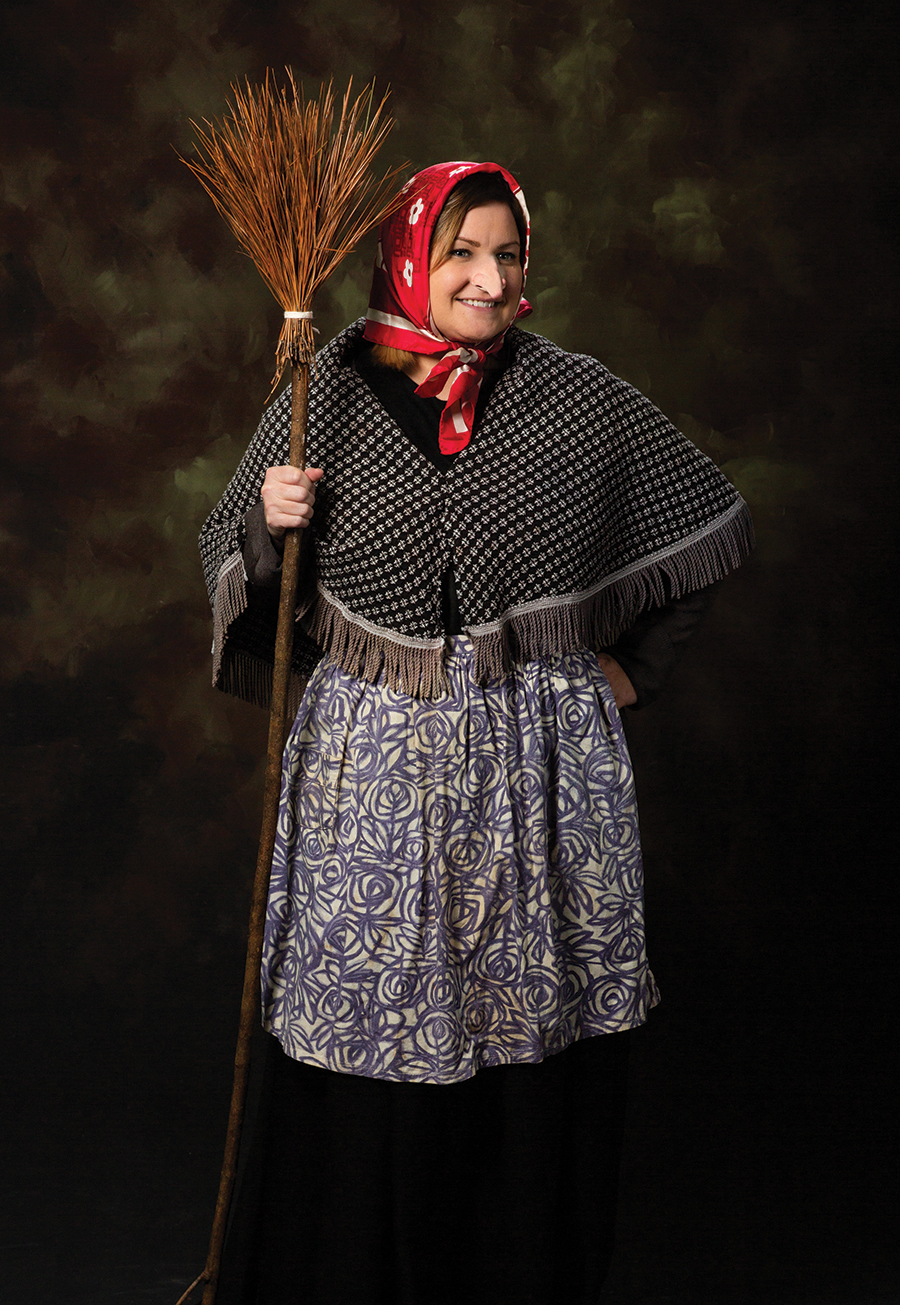
La Befana is the good-natured hag who flies around on her broomstick on the night of Jan. 5, the Eve of Epiphany. She’s covered in soot because she enters houses through the chimney carrying a bag filled with candy and gifts for good children and coal for the naughty ones. According to the legend, she gave the three wise men shelter but declined to join them on their trip to Bethlehem. She’s been trying to catch up ever since.

Kathryn Galloway


Sweden

The tomte is a powerful little guy who’s got your back. Traditionally the protector of the farmer and his family, your typical tomte is no taller than half the size of a grown adult. If you get him angry he has the power to drive you mad. The jultomten is a tomte who showed up sometime in the late 1800s bringing gifts at Christmas. Leave him a bowl of porridge on Christmas Eve with a small cut of butter on top.

Secret Santa


China

What do they say, a billion Chinese can’t be wrong? They can’t be entirely without Santa, either. Though the Christian population hovers around 2 percent, Dun Che Lao Ren, the Christmas Old Man, still makes an appearance. Gifts are pretty much confined to New Year celebrations, but Santa shows up in malls and markets and is a frequent photo op. In a few households, children hang muslin stockings to be filled with treats and gifts.

Manny Samson, former post commander VFW

Almanac

December Almanac

By Ashley Wahl

December is here and, with it, the sound of a single cricket. One distant, mechanical song. A message transmitted across space and time.

The stars are out. You cannot sleep. And so, you listen.

Months ago, when the crape myrtle scattered her crinkled petals like pink confetti upon the earth beneath her, an orchestra of crickets filled the night with a song thick as honey. And months from now, when the vines are heavy with ripening fruit, they will sing again, knitting an afghan of sound by moonlight — gently tucking you into bed.

On this cold December night, the cricket transmission grows clearer. You follow it like a single thread of yarn until you receive it:

There is no end, the cricket sings. Only change.

Somehow, this message brings you comfort.

December isn’t an abrupt or happy ending. There is no hourglass to turn. No starting over. Just a continuum. An endless stream of light and color ever-shifting like a dreamy kaleidoscope.

December is sharing what’s here: our warmth, our abundance, what we canned last summer.

This year and the cold have softened us. We feed our neighbors, feed the birds, open our hearts and doors.

The camellia blossoms. Holly bursts with scarlet berries. From the soil: gifts of iris, phlox and winter-flowering crocus.

The cricket offers his song — a tiny thread guiding us toward the warmth of spring — and we listen.

This listening, too, is a gift. Sometimes it’s all we’ve got. And, sometimes, that listening is itself a simple thread of hope.

December’s wintry breath is already clouding the pond, frosting the pane, obscuring summer’s memory . . . – John Geddes

You Gotta Eat Your Spinach, Baby

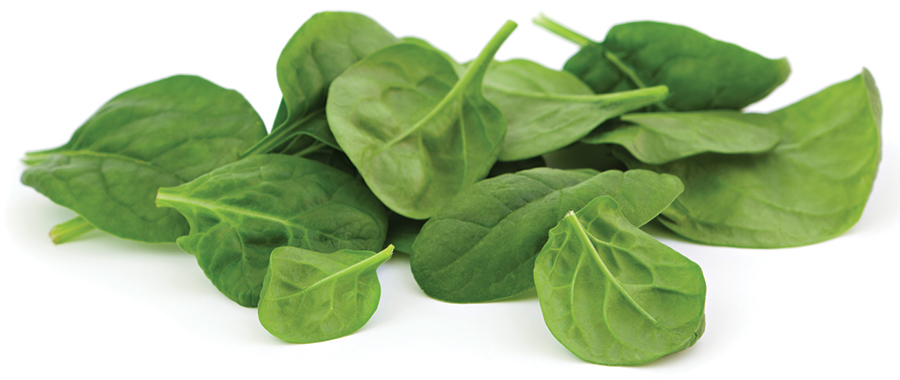
Fortunately, many nutrient rich greens thrive in our winter gardens. Especially spinach. And what’s not to love about it?

Enter pint-sized Shirley Temple, ringlets bouncing as she marches past a small ensemble to join Jack Haley and Alice Faye centerstage:

“Pardon me, did I hear you say spinach?” she asserts with furrowed brow and her punchy, sing-songy little voice. “I bring a message from the kids of the nation to tell you we can do without it.”

And then, song:

No spinach! Take away that awful greenery

No spinach! Give us lots of jelly beanery

We positively refuse to budge

We like lollipops and we like fudge

But no spinach, Hosanna!

And now for the opposing view: In the 1930s, the spinach industry credited cartoonist Elzie Crisler (E.C.) Segar and his muscly armed sailor man for boosting spinach consumption in the U.S. by 33 percent.

But why-oh-why did he eat it from a can?

Longer shelf life, no doubt. Also, cooked spinach contains some health benefits that raw spinach does not. Raw spinach is rich in folate, vitamin C, niacin, riboflavin and potassium, but it also contains oxalic acid, which can hinder the body’s absorption of essential nutrients like calcium and iron.

According to Vegetarian Times, eating cooked spinach allows you to “absorb higher levels of vitamins A and E, protein, fiber, zinc, thiamin, calcium and iron.”

In other words: You gotta eat your spinach, baby.

Starry, Starry Night

Well, this is perfect: The Geminid meteor shower will be peak from mid-evening December 13 until dawn December 14 — a new moon. That means the show will be unobstructed from moonlight, and if conditions are right, you might catch up to 120 meteors per hour.

Some believe this prolific shower ramps up every year. We’ll see. Regardless, may we allow this celestial pageant to remind us of the wonder and beauty that so often graces us.

And don’t forget to make a wish.  PS
Hope & Healing

Photographs by John Gessner

We’ve all had bad days. Occasionally it’s been a tough week. And some months are better than others — blistering heat in August and ice storms in February come to mind. But an entire year gone off the rails? Geez. There is little doubt that 2020 carved out a special spot in our psyches for wretchedness. Seemed as though if it could go wrong, it did. It’s been an alphabet soup of catastrophe and, as we all know, the letter C stands for COVID. But the end is in sight. The sun will come up tomorrow. And who better to remind us of the promise of that new day than the faith community that surrounds and embraces all of us?


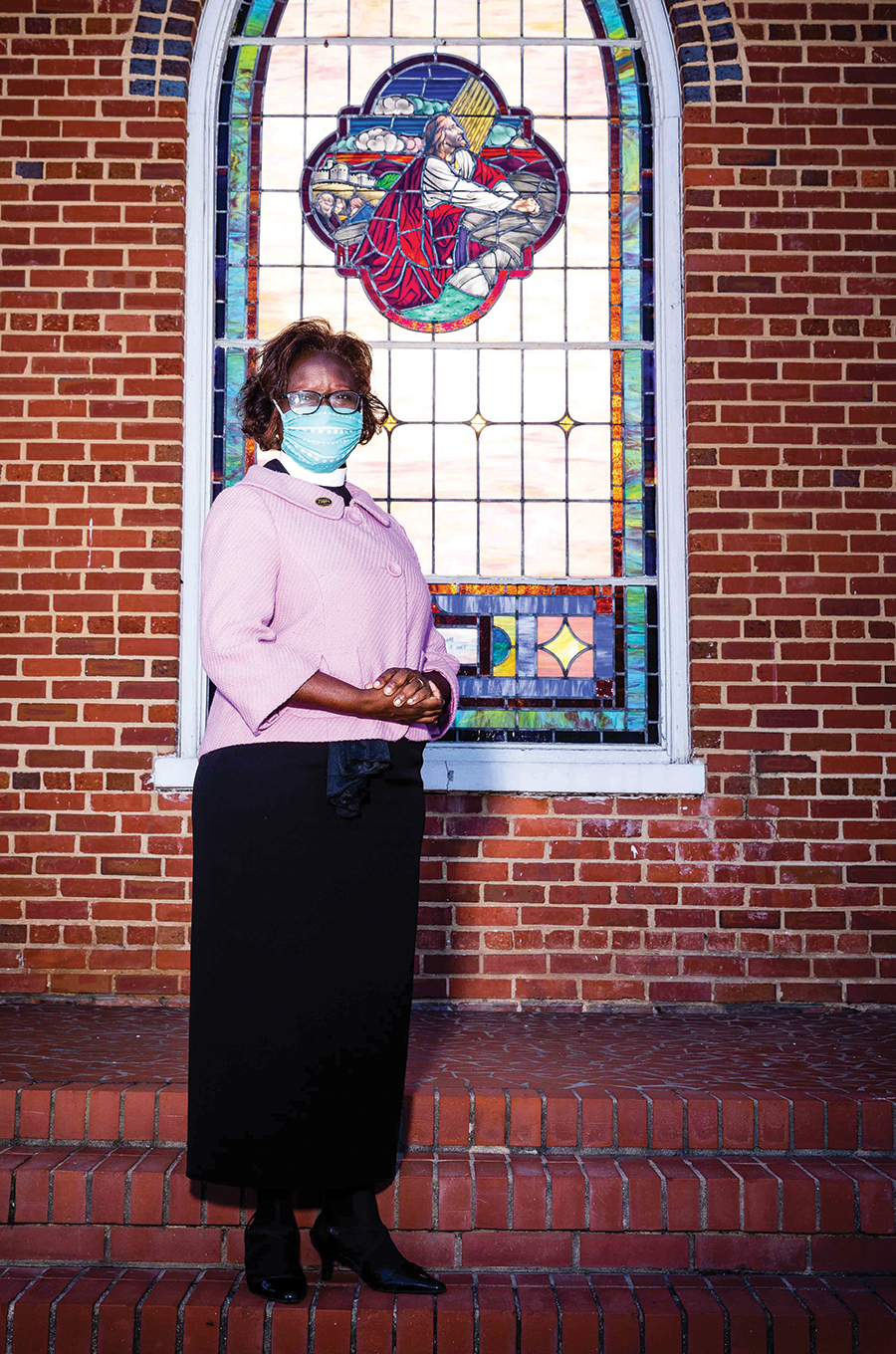
Rev. Debra L. Gray

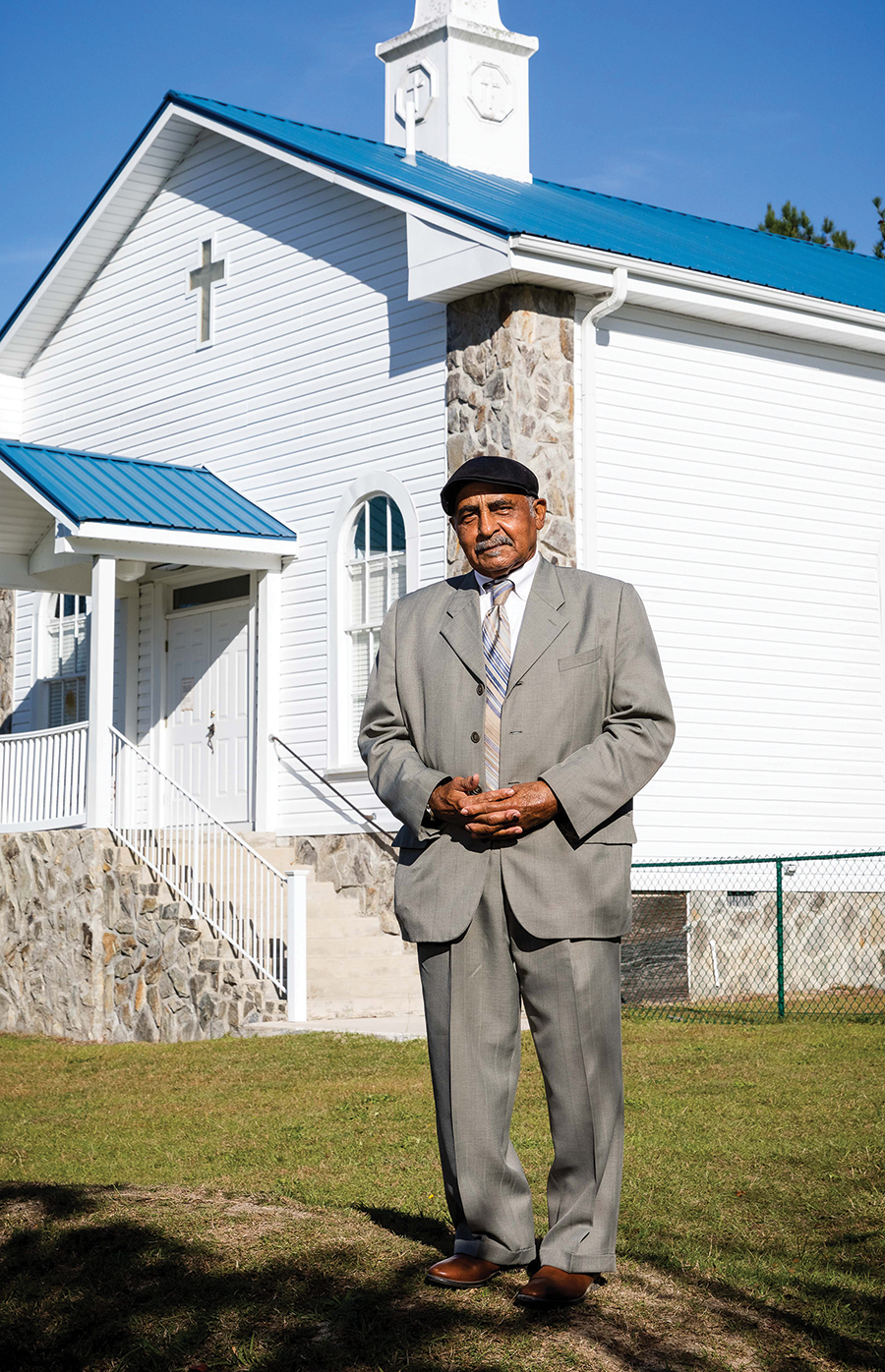
Pastor Blacknall Chapel
A.M.E. Zion Church

Attorney and author Bryan Stevenson, in his public appearance at Davidson College in 2019, declared proximity to be important in addressing the problem of inequity in our society. This is not natural, nor easy. Ethnic and socioeconomic divides disunify our nation. Yet the unforeseen challenges of this year have devastated the lives of all of us. It is in this place of pain and frustration that we have now begun to experience proximity. The images of the inexplicable deaths of Breonna Taylor and George Floyd and others are embedded in our minds, not to be forgotten. We have all been affected. We have all been hurt. We are all forced to accept the new norm of masks and social distancing. We understand others’ hurts because it is the same as ours.

I am reminded of the story of Moses. Scriptures tell us when Moses died, it was God who buried him. The Creator of all the Earth got close to the lifeless remains of this man to put him in the ground, where only God knows the place. Our God can still get close to our dead places. Welcome His proximity into your life as we walk this journey together.


Rev. John Jacobs

The Village Chapel

Yes, we’ve had a tough year, but that doesn’t have to define us. Circumstances beyond our control need not control us. Unsuccessful responses to crises need not defeat us. Abraham Lincoln called us the “almost chosen people,” in contrast to the Jews, as God’s chosen people. Well, are we? I believe we are.

Our hope in 2021, and the years to follow, must be in where it has been before: “In God We Trust.” Considering the fact there are many who will be grateful to see this past year retrospectively, hopeful that 2021 will bring welcome changes for the better; for many, reasons to cheer 2020 are nonexistent. Some might even find scant chance for redemption in the year to be remembered for racial unrest, lawless destruction in our cities, political polarization, and a pandemic virus leading to shutdowns affecting the economy, jobs, schools and churches. No one has been unaffected negatively by our responses to the pandemic.

And yet, the bleakest prospect would be to think that nothing can be learned and changed by these 2020 experiences. God help us if we ignore a redemption that can restore our faith in the Creator of this world — the God who has promised to make all things new; the God who can take our sins and mistakes and redeem them for good.  

In this country the rest of the world still calls “new” — and as God’s “almost” chosen people — therein lies our hope, in God’s redeeming grace, our only hope, that will take us from this crisis to the next, and from here to eternity.


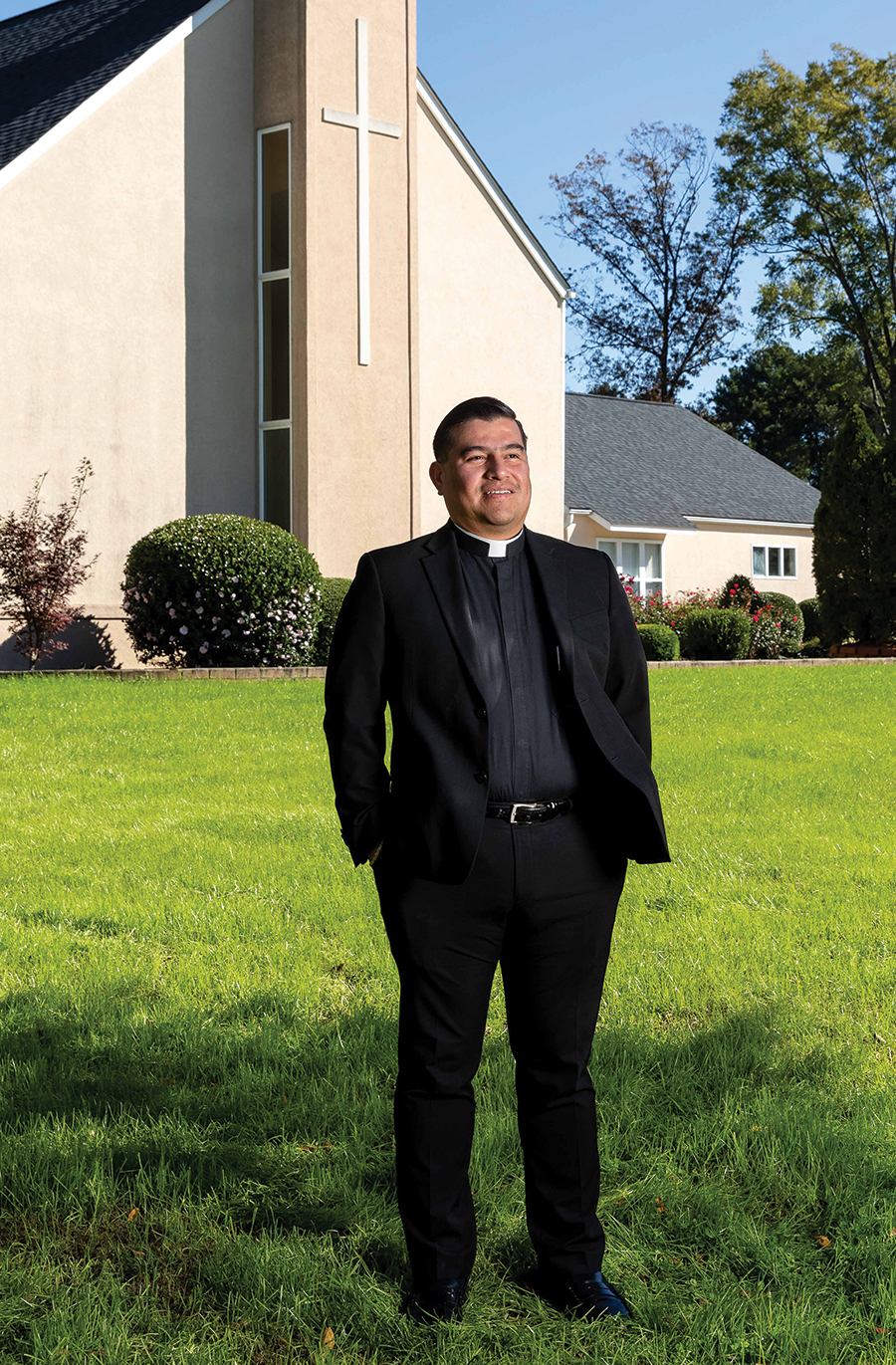
F. Javier Castrejón

San Juan Diego Catholic Mission, Robbins

Les saludo con mucha alegría. Este año 2020 ha sido un año diferente como todos los demás, sólo que este año nos ha dejado tristezas en algunas familias y nos ha presentado retos difíciles. Pero al mismo tiempo, este año nos deja una gran enseñanza, que sólo unidos todos como verdaderos hermanos, sin distinción de raza, pueblo o nación, podremos vencer las dificultades, el egoísmo, el racismo, la indiferencia y la irresponsabilidad deben desaparecer de nuestras vidas en este 2021. Todos nosotros debemos ver este nuevo año como una nueva oportunidad para corregir nuestros errores pasados y saber que todo lo que yo haga en beneficio de los demás ayudará a que todos vivamos mejor y así cuidar nuestra casa común, que es este mundo en el cual vivimos. Nada malo podrá vencernos si nos mantenemos unidos. No olvides volver tus pasos a Dios y vivir su mandamiento de amarnos unos a otros como Él nos ha enseñado.

Mis mejores deseos para este 2021. Dios te bendiga.

I greet you with great joy. This year 2020 has been a different year like all the others, only this year has left us sadness in some families and has presented us with difficult challenges. But at the same time, this year leaves us a great lesson, that only united as true brothers, without distinction of race, people or nation, can we overcome difficulties, selfishness, racism, indifference and irresponsibility must disappear from our lives in 2021. All of us must see this new year as a new opportunity to correct our past mistakes and to know that everything I do for the benefit of others will help us all live better and thus take care of our common home, which is this world in which we live.  Nothing bad can defeat us if we stick together. Do not forget to turn your steps to God and live his command to love one another as He has taught us.

Best wishes for 2021. God bless you.


Rabbi Ken Brickman

Sandhills Jewish Congregation — Beth Shalom

Each week the Jewish Sabbath begins at sundown with the lighting of two candles to remind us to bring light and hope into the world, just as day turns to night. In recent months, the restrictions caused by the pandemic, the illness itself and the grief of those who have lost loved ones to the virus have often made it seem as if the light of that hope has been diminished and a pall has been placed over the world. As we approach the holiday season, people of all faiths will celebrate by lighting lights, whether it is the candles on the Hanukkah menorah or the multicolored lights that adorn homes throughout our community.

As the year ends, we hope and pray that these lights will rekindle the sense of hope for a new year in which we can resume our lives as they were when we celebrated the holidays last year. Ring in the New Year not with the usual resolutions, but with the commitment to bring light into our world by working to realize our shared vision of a just and more humane world.


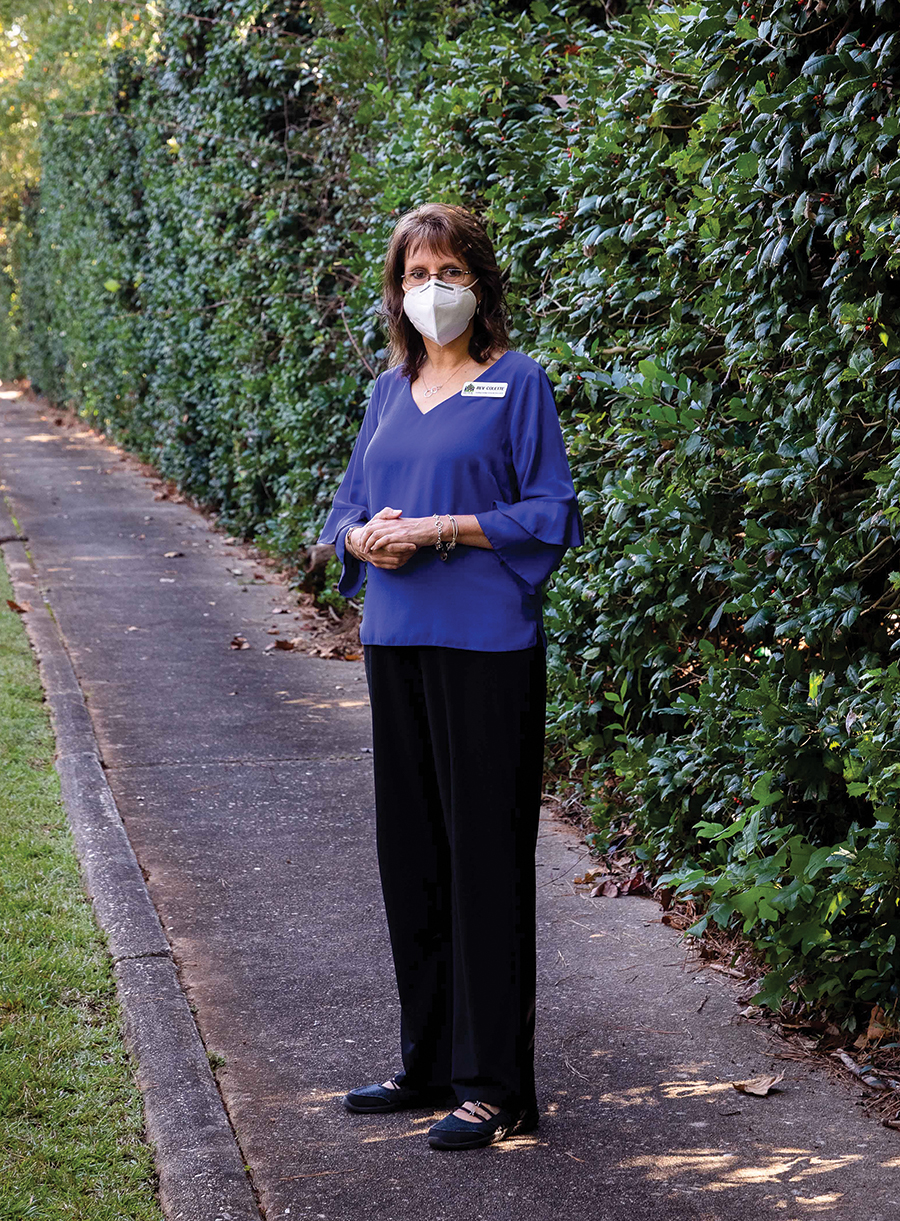
Rev. Colette Bachand

Penick Village

When my children grew old enough to know who Santa was, their father and I had to make an important decision. Would the gifts under the Christmas tree be wrapped by Santa or unwrapped?

When their dad was little, Santa brought unwrapped gifts, but in my house as a child, Santa’s gifts were wrapped. There was a special feeling that came with discovering wrapped gifts. There was mystery, anticipation and most of all trust. Trust that something amazing lay beneath the colorful wrapping and bows. There was a moment when everything in the world felt possible. Underneath the wrappings could be a new bike, a record player, roller skates, or even better, the outfit guaranteed to impress the boys at school.

This is a year we need to believe that underneath the Christmas tree, anything and everything is possible. We need to hold on to anticipation because we’ve waited too long for things to feel normal. We need the guarantee that the outfit we wear when COVID is over will be our victory garment because we made it through with God by our side.

In the end, my girls got gifts wrapped by Santa. This year, I need a reminder of those wrapped gifts because they held within them the promise of things to come, even when we didn’t know what that was. The mystery of wrapped gifts is the promise that under the Christmas tree is everything we need. Under the tree is God, the God who wishes to dwell among us and because of that, we will be OK. For now, the mystery must be enough. In due time, we can unwrap the gift.


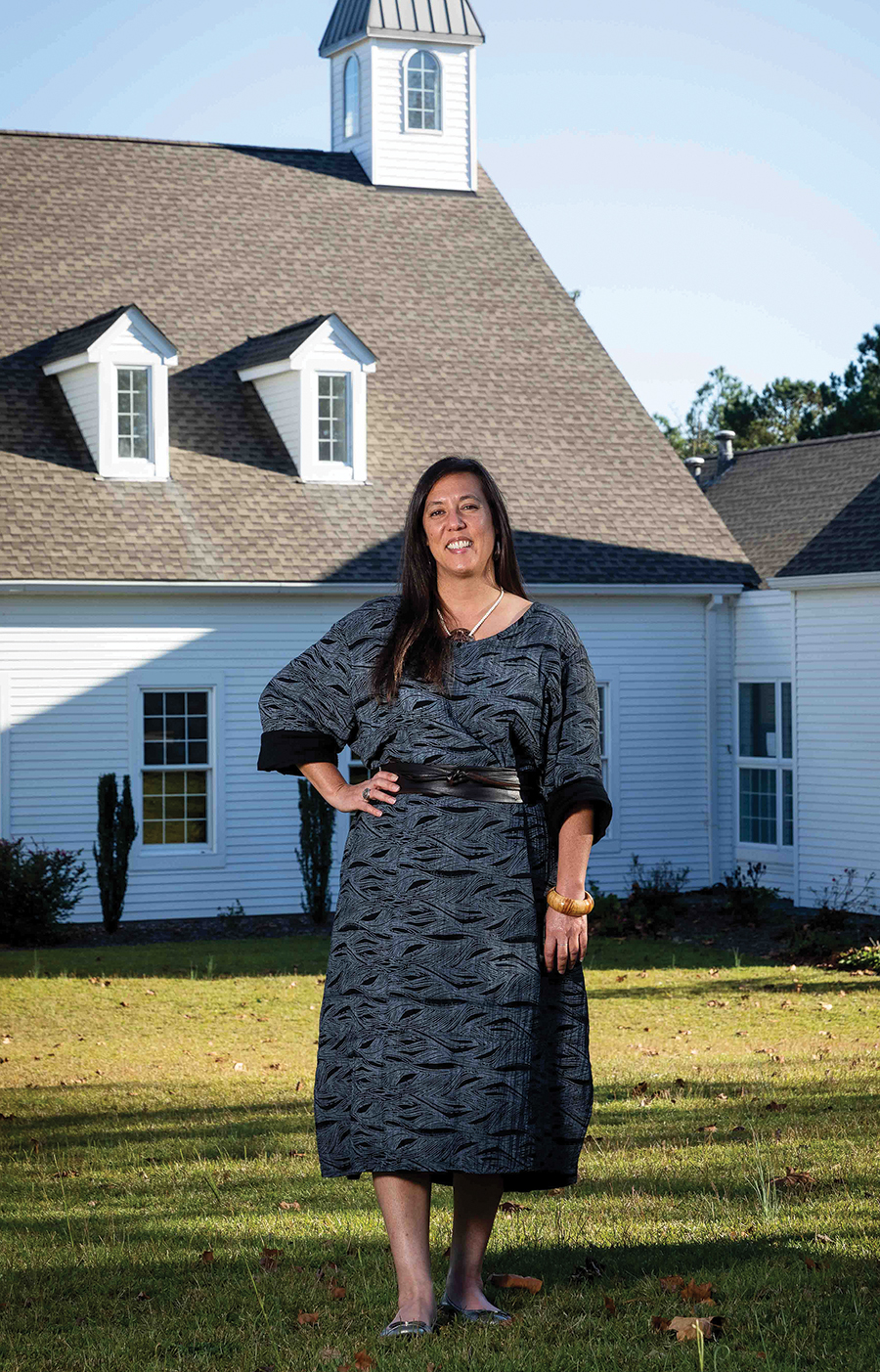
Rev. Terry Yasuko Ogawa

Congregational Church of Pinehurst

If we are Christian, we follow the God who is Love itself (I John:4).

After a year of physical distance, isolation and divisiveness, I think the path to unity requires that we each admit that we are not defective, but broken. There seems to be a desperation to deny our ongoing hurts, which prevents acknowledgement of our neighbors’ pains. The problem is, when we do that, the pain leaks out, and often gets taken out on others in resentment.

Recognizing others’ trauma does not diminish the significance of your own trauma, even if they are not equivalent. The God of Love has healing for us all. There is room at the table for each and every one. And we are called to make sure that our neighbors get to the proverbial feast as well.

We have work to do. The work of justice, the work of kin-dom building, is ongoing. Use the gifts God has given you to the best of your ability, and let your light shine. Recognize that others’ lights deserve to shine too. Hope lies in being the best disciples of Love we can be. And recognizing that if others are following their own paths of compassion, well, God loves them too.


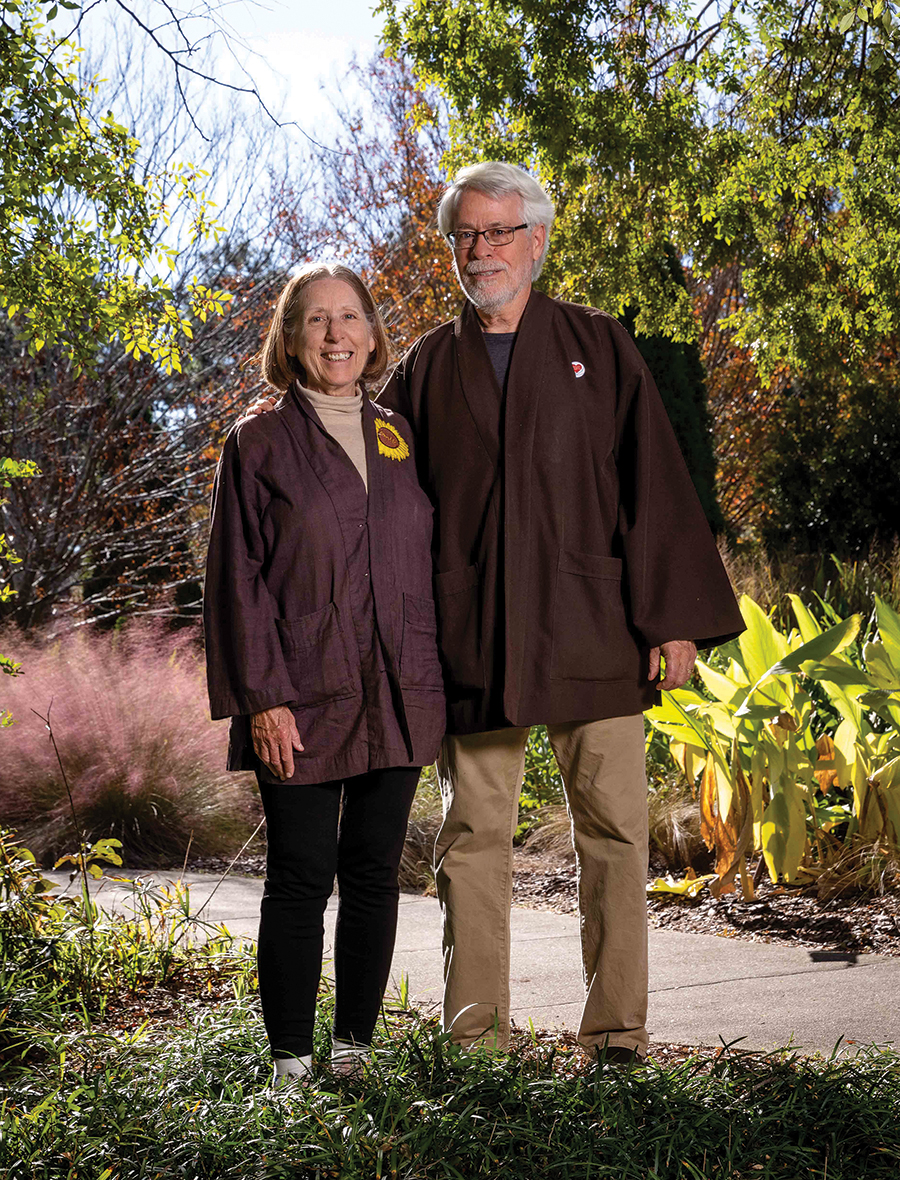
Emily Whittle and John Bowman

Community of Mindful Living in the Pines

During this year our human family has been confronted with monumental challenges and suffering. Together we continue to face an expanding pandemic; a societal crisis in terms of racial injustice, poverty and class inequality; severe economic challenges; and climate crisis. Today we all have a role to play in the rising tide of collective awakening to racial injustice, systemic inequalities and climate justice.

As we honor our emotional experience at this moment and care for what is arising in us, we are invited to examine our lives and our community and help move our world toward a more inclusive and compassionate society.

One of the greatest challenges we face now is how to be calm and peaceful in these crises. Mindfulness practice and mediation can be a source of peace, healing and transformation, and it must go hand-in-hand with deeply looking into all aspects of our daily lives and its social structures to examine their ethical and moral foundations. When we act from a place of being, of stillness and peace, we can be moved into compassionate action. At this moment it is essential that we stand up and speak out against racism and for racial justice, just as it is for gender, class and climate justice. We must have the courage, patience and openness of mind to look deeply into the root causes of these injustices, and listen deeply to those who are suffering, and learn how we are each contributing, individually and collectively. This can be a source of peace, healing and transformation for the world and us.

May we all be filled with loving kindness, may we all be well, may we be calm and at ease, may we all be safe and happy.


Muhammad A. Lodhi

Masjid Al Madina

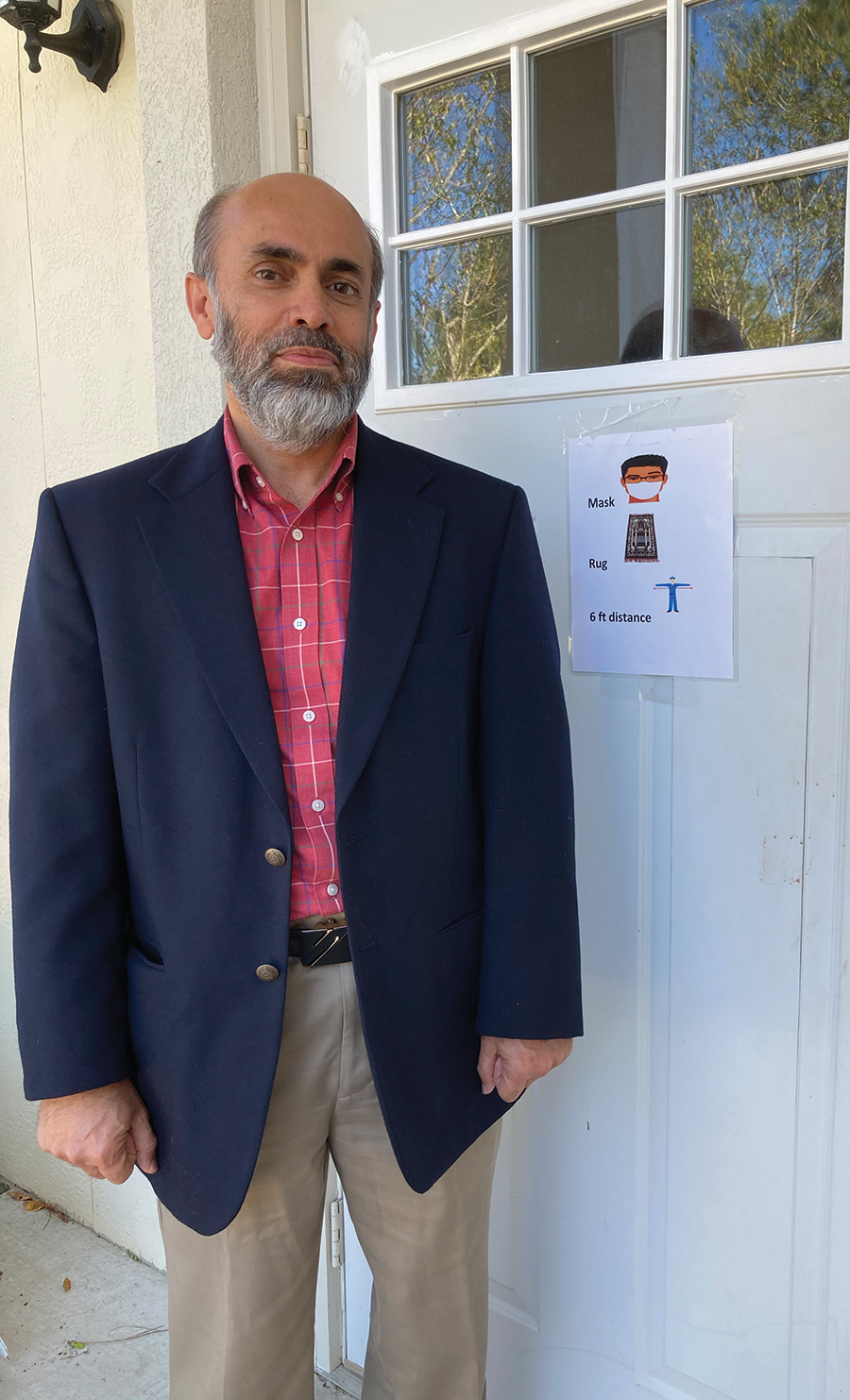
As believers, we trust that the prevailing pandemic and accompanying challenges faced by humanity cannot exist without the knowledge and permission of Almighty God. Every hardship is a test from our Lord as He says in the Holy Quran, “And We will surely test you with something of fear and hunger and a loss of wealth and lives and fruits but give good tidings to the patient. Who, when disaster strikes them, say, ‘Indeed we belong to God, and indeed to Him we will return.’” COVID-19 is a test from God. A test to see whether we reflect, show patience, and thank Him or continue with our usual ways. There is no one who can remove adversity from us except God, who is known as Al Rahman and Al Raheem, the most merciful to His creation. Prophet Muhammad, peace be upon him, taught us that God tests those people He loves. He further advised to recognize and acknowledge God in times of ease and prosperity, and He would remember us in times of adversity. We should turn to God and beg His forgiveness, show our allegiance, and spread goodness. May the Controller of affairs protect us all from any harm.


Pastor Nathaniel Jackson

Christ Way Deliverance Church

In these very different times

Dear God what can “I do” in these times

To make things better for someone

Although I am aging

Put me in places and mold me

To make someone’s day brighter and bring a smile

Although I am growing in years

Help me to help the young reach their goal

If not their lifetime goal

A goal that makes things better for the moment

Dear Lord

Help me cheer up someone’s day

That they are smiling as I walk away

Lord help me

Offer a hand up that will last

Not just a hand out

Bless this our country and our world

Keep us safe and free from all sickness

Help us find more love, peace and happiness

Not just at this Christmas season but all year long

Help us find salvation in Jesus Christ our savior

In Jesus’ holy name I pray

Poem

Worksock

If I could round up stockings

I’d take all the holey ones from Mama’s box of sewings,

My father’s, first, the heel ragged as a monkey’s face.

I’d hang that sock again for him

And pray Santa would put an orange

Or some nuts down in the thin

And frayed toe, then arrange

One real coconut with peeling skinned

Off to let him know

The love he held for me I hold for him.

We were not poor — just didn’t have much money.

Christmas meant longing:

That chance to fill me with sunny

Trances when I would skip the fields

And pray for days that Jesus would not appear.

I was never ready to see Him

Alive instead of in a sermon nailed to a dogwood tree.

Before sunup on Christmas day

The plankhouse hummed with joy.

In my stocking: raisins, a few English walnuts, toy

From a Cracker Jack box I’d run

A store with: I’d “sell” my brother a Mary Jane

From his sock that Mama darned in a ray of sun.

— Shelby Stephenson

Shelby Stephenson was North Carolina Poet Laureate from 2015–2018. His most recent book is More.

Christmas Stories, Somewhat but Mostly Not True

By Daniel Wallace   •   Illustration by Ippy Patterson

The oldest family Christmas story I know is about my great grandmother, Nona. This is the century before last. Nona was a widow. As far as anyone could tell, Nona had always been a widow — some said she was born one. The truth is that her husband, my great grandfather, perished much too young in the salt mines of northern Alabama, leaving her alone with a brand-new baby, my grandfather, Ewing.  As everyone who knows anything knows, Alabama was once home to the largest salt deposits in North America, something having to do with the shallow Cambrian seas that once covered the entirety of the state. But the mines were deep and dangerous and only the bravest of men ventured into them.

After the salt mine tragedy, Nona was penniless but proud, foraging for food in the forest to feed herself and her wee child. They moved into a straw hut abutting the tail end of the Appalachian mountain range. It was all they could afford.

All Nona had was an old milk cow, named Deuce, and Deuce was about a day away from becoming their last supper when Nona had an idea. Ever resourceful and with a will of pig iron, she became a milk lady. In the beginning she only had enough milk to service a few homes, delivering it in old tin cups. But after making her first few sales she upgraded, got a cart, some bottles, and before the sun was up she loaded the cart full of as many bottles as she could, pulled by the source of it all, Deuce. With her profits she purchased another cow, and another, and soon she became the most popular milk lady in town; but then again she was also the only one.

Even though she was making enough to feed herself and young Ewing, she was still too poor for a tree, and their hut — one tiny room, shoebox-small — was too teeny for even a shrub. But as she was reported to say right from the start, “We do what we can with what we might have.” She said it in the way that people who come from nothing say that sort of thing, all matter of fact, followed by a brief shrug of the shoulders.

So this is what happened on Christmas morning. Nona took Ewing off into the forest, pulled on a cart by the ever-loyal Deuce. And there they sat beneath the tallest, most majestic pine in the forest, an ancient giant of the Pinus clan, a tree so big it’s visible from space, they say. And there she would make a prayer, share some milk and give her son his present. As has been told to the subsequent generations of immeasurably spoiled and ungrateful children, Ewing was thrilled with his interesting pine cone or a rock in the shape of a shoe.

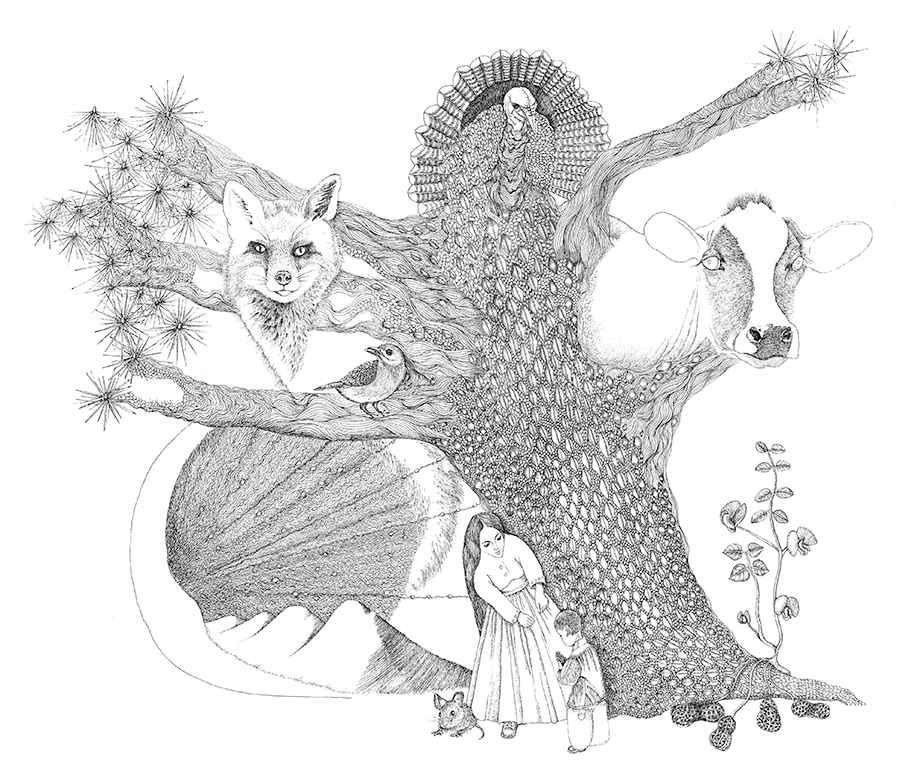
But here is what was remarkable about that Christmas, and every Christmas they shared.  They never spent it alone. One by one all the animals of the forest would creep up, join them there, slinking out of the forest-dark like shy friends. Deer, raccoons, wild hogs, bluebirds, hawks, turkeys, forest mice, coyotes, snakes, skunks, sometimes even a cougar or bobcat. Nona particularly loved a black bear she called Susie. They’d all keep their animal distance, but close enough for Ewing to see the warm steam of their collective breath. So the Christmas present really wasn’t a pine cone at all, nor a rock, it was the presentation and a celebration of the awesome myriad of life. She was actually giving Ewing the whole world.

I met Nona when I was three days old and she was 101. A week later she died in her sleep and Deuce followed soon thereafter. In honor of her passing no one in town drank milk for a month.

And now to her son, Ewing, my grandfather. Ewing was nicknamed “Dumbo” as a child, due to his larger-than-life ears. He was actually quite brilliant and used his ears to good effect: not only could he wear large hats; he could also hear everything. He could hear an owl sigh. He married my grandmother Lucille when he was but 18 years old, after he fell in love listening to her hum.

Like his mother, Ewing was an inventive and resourceful entrepreneur. Would it surprise you to know that Ewing was the man who invented the boiled peanut stand? This is almost a true fact and let no one tell you different: the very first ever. He built it out of pallets and tree branches, using rusty nails pulled from old barns, and set it up on the side of the busiest road out of Cullman, a meager dirt road that disappeared after a hard rain and had to be repaved with more dirt next time the sun came out. His peanut stand was the most modern thing around at the time and people went no matter if they liked peanuts or not.

Peanuts grew wild in Cullman. An underground forest of them in Ewing’s backyard became an underground goldmine. The first stand was a great success — boiled peanuts from a roadside stand! What a concept! — and that success led to a second, a few miles down the road. He hired his cousins and cousins of cousins, friends of his cousins and their sons and daughters and soon the stands were everywhere, from Alabama down through Mississippi, sweeping into Louisiana and Florida, up through Georgia and finally into the Carolinas. Very few people know that most boiled peanut stands back then were franchises, but that’s what they were in the beginning. A little part of every peanut sold found its way back to my grandfather’s pocket, and though he never became a rich man he was able to move his bride Lucille out of the thatched hut and into a proper house in town.

Christmas was a magical time in my grandparents’ home. My father got all kinds of presents: peanuts, tiny cars made of peanut shells, and best of all, peanuts painstakingly carved by Lucille, intricate portraits of Washington and Lincoln, or detailed landscapes of the French countryside, all from her imagining what it might be like. Find one today and it’s worth more than a Fabergé egg. Alas, most of them were eaten.

Lucille and Ewing saved and saved and eventually built an actual restaurant serving a great variety of foods. It was the only restaurant for 50 miles in any direction. Some people had never seen a restaurant before; many weren’t even familiar with the concept. Ewing and Lucille had to teach them to use a menu and then how to order their food from the lady in the pale blue frock. The good citizens of Cullman and beyond caught on quick.

People take restaurants for granted, but they shouldn’t. Restaurants are everywhere now, sure. But it wasn’t always like that. You may have my grandparents to thank for that. Maybe not.

With boiled peanut money my grandparents bought a house big enough for a tree and money at the end of the year to buy something for my dad, Eron, their only child. One Christmas morning my father got a pocket watch. On another he got a knife. The next, a bulky jacket, and then a pair of shoes — three sizes too big, for growing into. On his 16th Christmas they gave him a suitcase, on his 17th a compass. He saw where this was going. Year after year he had gotten one single thing until he got all the things he needed to make a life of his own and when he was 18 years old set off for the wider world.

On his first Christmas morning alone my father woke before the sun came up, fell into the Mississippi River and floated 200 miles down stream to the Gulf of Mexico on a raft hastily assembled from twigs and mud grass, and was finally rescued by one of the bravest and most intrepid sailors ever to roam the Gulf of Mexico in an old shrimp trawler: Joan Pedigo, the woman who would become my mother. They fell in love in about three-quarters of a second.

Family followed almost as quickly: me and three sisters, dogs and cats and a snake and a bird. Still: struggling. Lots of mouths to feed. It was my mother who had the idea for the salted peanut, which brought the two biggest industries in town — salt and peanuts — together for the first time. How no one had thought of it before her was a mystery. Thanks to the salted peanut for a period of years we were a family of not insignificant wealth. Later, a bigger company, the one that made complimentary peanuts — really nice people, for the most part — would put us out of business. But until then every Christmas we traveled to a different country in the world. We’d plan our trips out beginning on January 1, studying the language, the mode of dress, learning their customs and histories: Mongolia, Argentina, Gabon — you name it. One cold Christmas we spent with Eskimos in Greenland. Atelihai means hello, but that’s all the Inuit I remember. Because of my parents and Christmas our family has been almost everywhere there is to go. Name a place.

Yep. Been there.

Name another.

Been there too.

Christmas! Christmas seems made for tall tales: look at the big red one that persists to this day. These days our own Christmases aren’t quite as big as the ones that preceded it — no bears, I am sorry to say — but they are just as beautiful: North Carolina, where we have lived for the last 40 years or so, makes sure of that. Until this year for decades running my family has produced postcard-worthy Christmases: the tree, the lights, the boxes wrapped in shiny paper, all of us gathered together next to the hearth beneath what felt like a dome of warmth and love.

But Christmas is not the same this time around. The pandemic has put a chink in our plans. Our clan is distant and scattered, and we do so many things in the world: we’re lawyers, doctors, construction workers, stage designers, Navy men and women, judges, paralegals, writers, scientists, artists, animal trainers. Every one of us knows a little bit about something, and together — could you bring us all together — we’d know practically everything. My second cousin is training snow-white pigeons to fly back and forth between our many homes, carrying Christmas greetings; another is perfecting the hologram, so even if we’re not together we will look like we are.

But then I think back to Nona, and those misty mornings she spent beneath that towering pine, with mountain lions and turtles, et al; of my father, floating down the Mississippi clinging to a twig and a blade of grass. Which is just to say that yes, Christmas will be different this year, but it’s different almost every year, in one way or another. It’s what Nona said: We do what we can with what we might have: to hope and work for better times while making these times the best they can possibly be. That may be the story of our Christmas this year, but it may also be the story of all our lives.  PS
Daniel Wallace is author of six novels, including Big Fish (1998) and, most recently, Extraordinary Adventures (2017). His fourth novel, Mr. Sebastian and the Negro Magician, won the Sir Walter Raleigh Prize for best fiction published in North Carolina in 2009, and in 2019 he won the Harper Lee Award, an award given to a living, nationally recognized Alabama writer who has made a significant lifelong contribution to Alabama letters. He lives in Chapel Hill where he directs the Creative Writing Program at the University of North Carolina.

Grand Traditions

History, N.C. pride and personal touches in the mansion

Photographs by Keith Isaacs

One of the many inconveniences endured because our world has bent to the reality of the coronavirus is that North Carolina’s Executive Mansion will be closed to the public during the holiday season. While the interior decorations will be scaled back, this year’s focus will be on the mansion grounds, with colored illuminations on all four sides, garlands and wreaths on the fence and gates. The two front parlors will each have a large tree in the window, decorated with white lights. And festive trees will be displayed in the center second floor window and the center third floor widow.

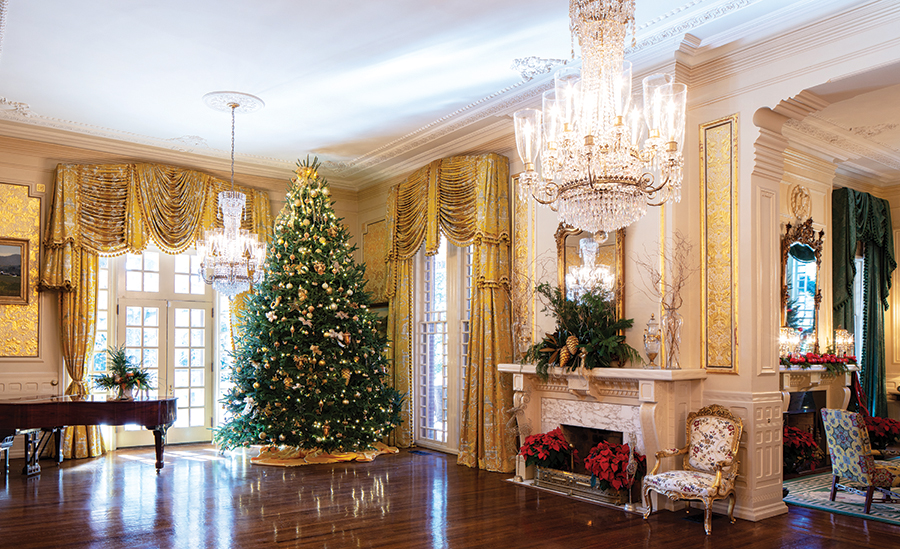
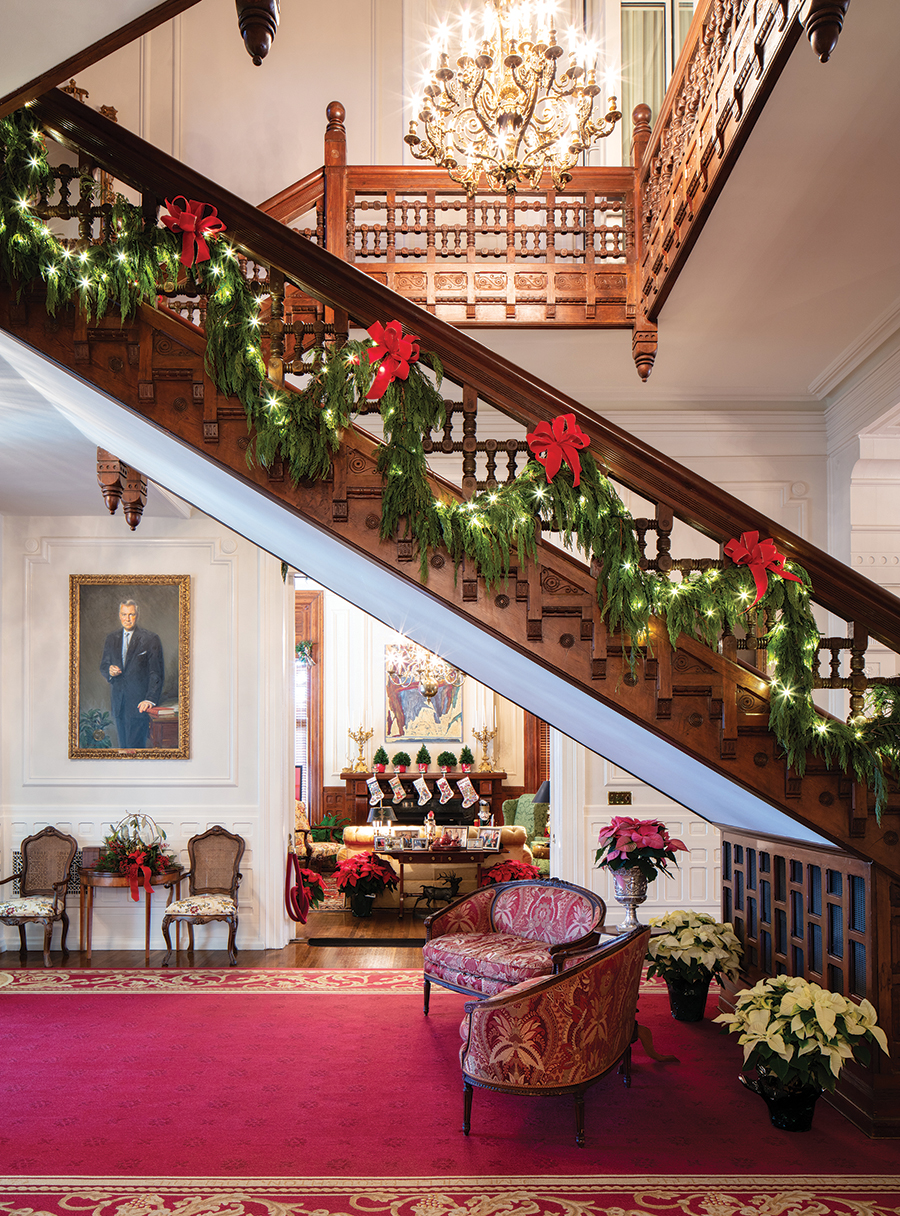
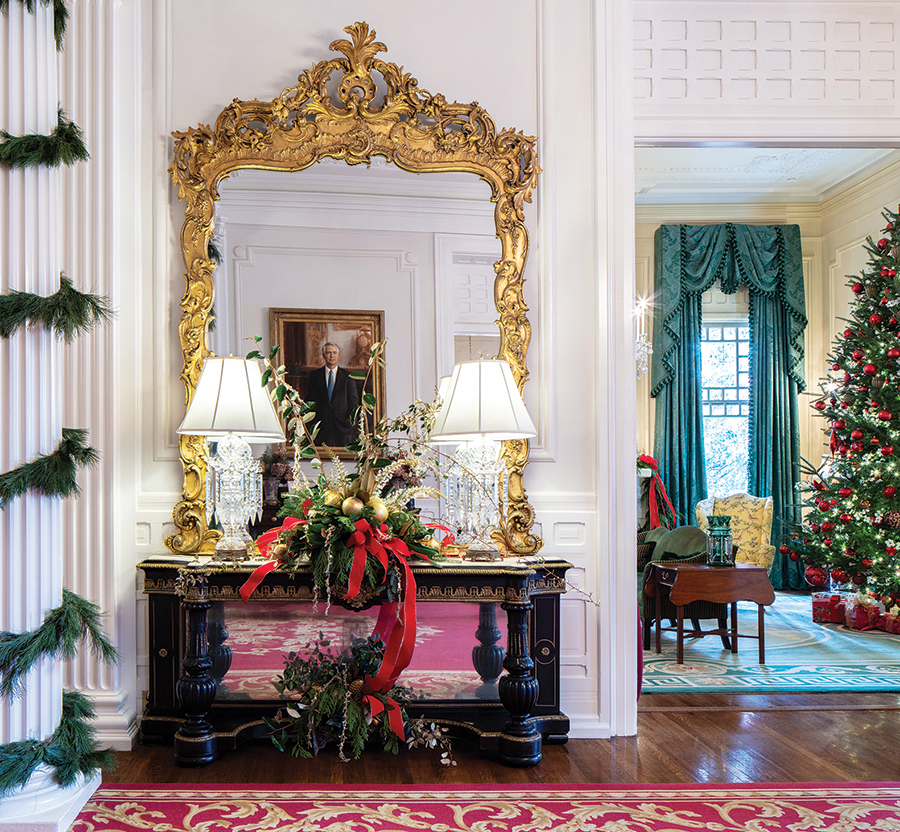
Just because we can’t tour the mansion in person in 2020, however, doesn’t mean we can’t imagine it in all its splendor. During a more typical year, the week after Thanksgiving, the mansion closes, and for five days staffers work tirelessly to transform the ornate Victorian home from its everyday splendor to a magnificent winter wonderland. These photographs show the governor’s home in more normal times.

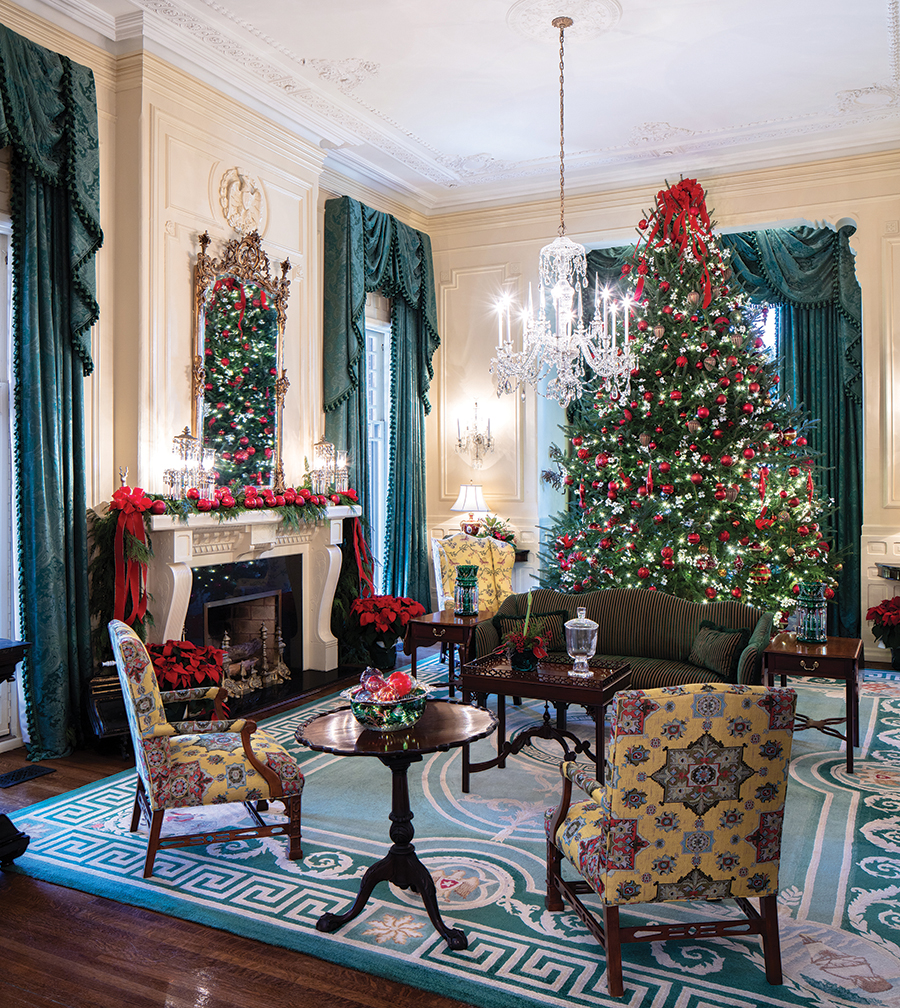
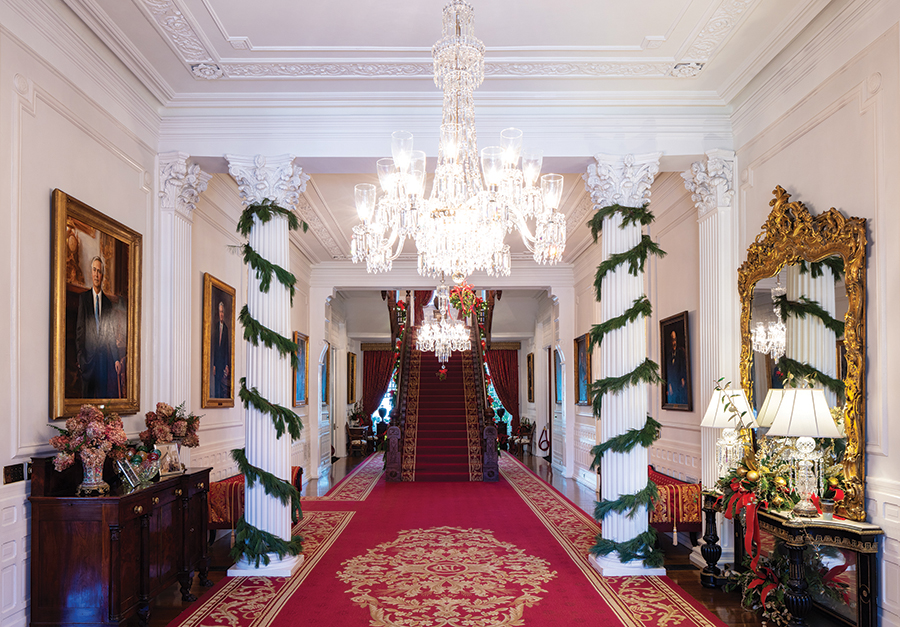
Giant, live trees — from N.C. farms, of course — are the focal points. They’re displayed in four rooms on the first floor, usually the men’s lounge, ladies’ parlor, ballroom and sunroom, as well as in second- and third-floor windows above the home’s main entrance. Evergreen garlands wrap columns and banisters, locally-grown poinsettias fill every nook, and oversized arrangements mixing greenery, baubles, ribbons and more are atop every available surface. Outside, millions of lights twinkle, and blinking orbs shine from the limbs of enormous trees. Traditionally, the first spouse takes charge of the holiday decor, aided by a team of volunteers and input from the N.C. Arts Council. The planning ordinarily starts in July, and while some elements may repeat from one year to the next, “We never want it to look the same within the governorship,” David Robinson, the director of the Executive Mansion, who has managed the home for eight years, has said.

Each first family puts their own touch on the decor. For the Coopers, it has meant hanging stockings that first lady Kristin Cooper made for her family, as well as displaying a Christmas village scene she’s collected over time, complete with a tiny replica of nearby Krispy Kreme. “Mrs. Cooper always puts it together herself,” says Robinson.

While the dazzling trees would normally get the biggest oohs and aahs, it’s the details that will be missed this year: sprigs of mistletoe hung from chandeliers (sometimes cut from the mansion’s grounds), decorations made by local artists and nods to North Carolina’s state symbols woven into the decor. Robinson loves the atmosphere the holiday decorations create: “It’s my favorite time of year.” Even if this is a year like no other.  PS

The tree in the ballroom often celebrates a community cause; past years have included a military tree and an education tree.
Cardinals and dogwood on the tree in the men’s lounge.
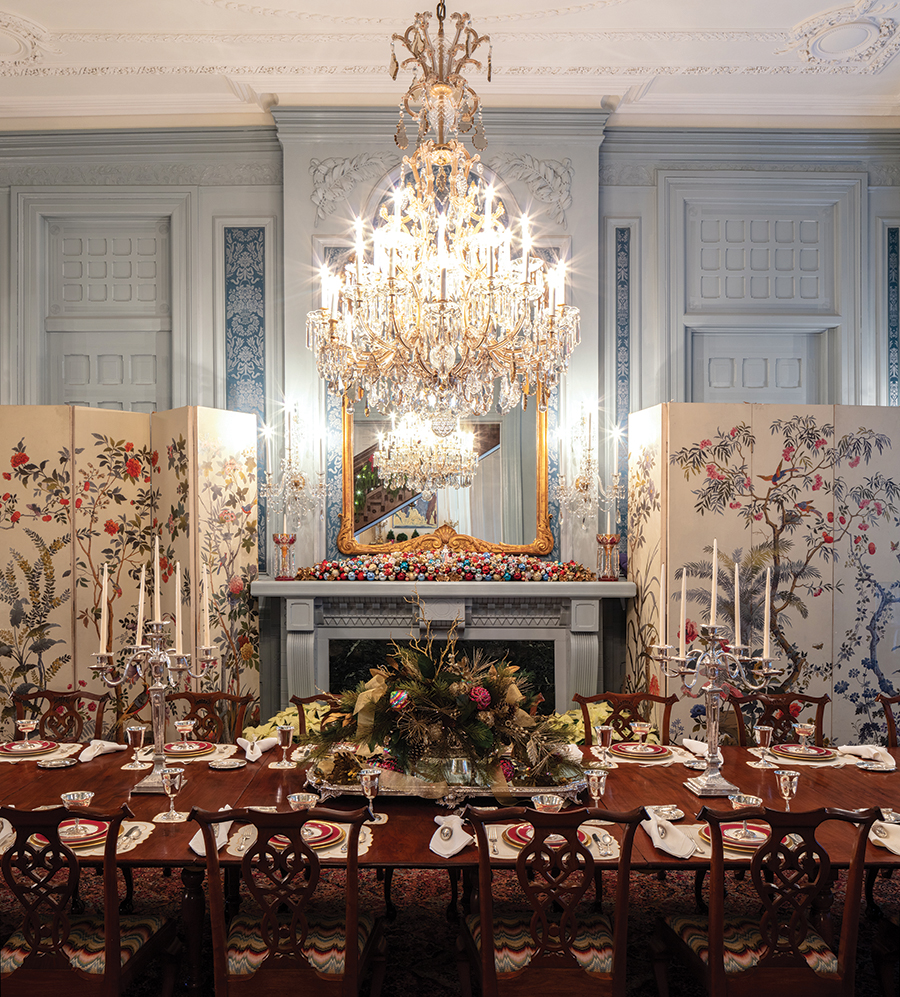
The powder-blue dining room is set with state china for special occasions.
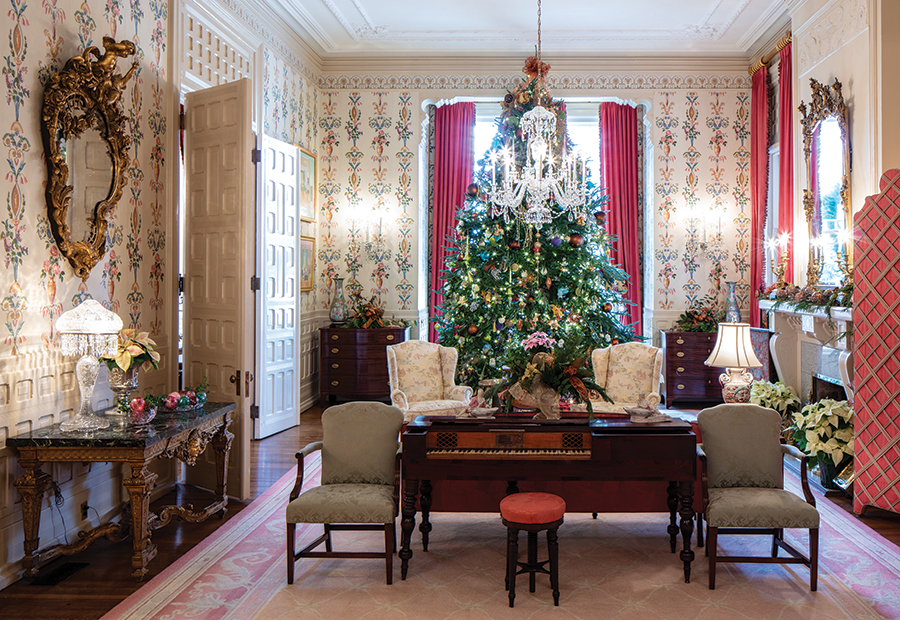
The tree in the ladies’ parlor is typically decorated in traditional Victorian style to match the home’s architecture.