Poem

Beige Wall Telephone, 1960s

Beige Wall Telephone, 1960s

To you who have never known what it is to be tethered

     to the family’s one phone by a corkscrew cord

          filthied by idle fingers twisting it as we talked

and stretched by our efforts to sneak with the handset

away from the dining room where that cheap plastic box

     clung to the wall, my sister and I desperate

          to hide behind curtains or in a nearby room

and mumble dumb endearments to whichever lucky soul

we had a crush on that week: I won’t say how wonderful

     it felt to hear a call’s unexpected tremolo

          and rush to answer that sudden summons,

lifting the receiver’s heavy curve out of its metal hook,

or to dial seven numbers on a whirring analog wheel

     and hear a distant ringing pulse in the ear,

          knowing that actual bells trilled as a body

moved through space to deliver its hopeful Hello? –

no, it was awful, that phone, intended for businesses,

     brisk standing exchanges of information,

          not a home where its too-public anchoring

left adolescent siblings open to each other’s mockery

and the cocked ears of nosy parents straining to decode

     one side of conversations as we curled closer

          to the wall and whispered words downward

into the darkness that our huddling made, not pacing

like a barking dog chained to a stake in the backyard

     but trying our best to vanish, descending

          slow as a diver sipping words like oxygen

from a humming line whose other end kept us breathing.

— Michael McFee, from We Were Once Here,
Carnegie Mellon University Press, 2017

Story of a House

Return of the Native

Speaking fluent mid-century modernism

By Deborah Salomon     Photographs by John Gessner

What’s in a name?

Grandfathered by the Arts and Crafts movement, championed by Frank Lloyd Wright, architectural styles that flourished post WWII answer to contemporary, Scandinavian, modern, post-modern and, finally, mid-century modernism, a style nurtured at the N.C. State University College of Design. Here, famed California architect George Matsumoto inspired disciples Edward Lowenstein and Thomas Hayes.

Go forth, they were challenged, and shock the Georgians, the Taras, Colonials, Tudors, saltboxes and ranches tricked out in cherry highboys, mahogany dining tables, cut glass lamps and brocade upholstery. Out with the drapes. In with the light. Disciple Lowenstein shook up Guilford County while, in 1958, Hayes settled in Southern Pines, built himself a house in the genre’s extreme, opened an office with Calvin Howell, and began designing residences in stark contrast to the brick mansions and summery cottages à la Aymar Embury II. Soon after, Cecil Beith, a founding member of the St. Andrew’s Society of N.C., commissioned a residence on a 2-acre corner lot in Knollwood, where it appeared less Martian than those Hayes built in Weymouth.

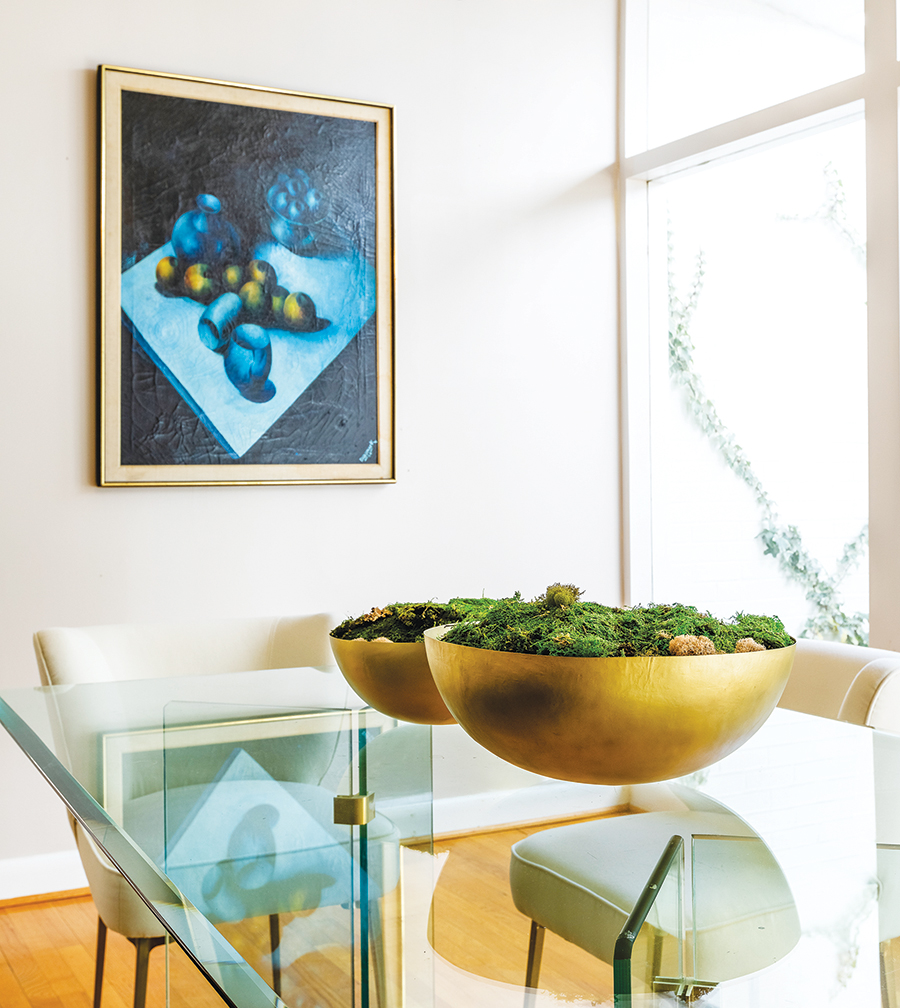
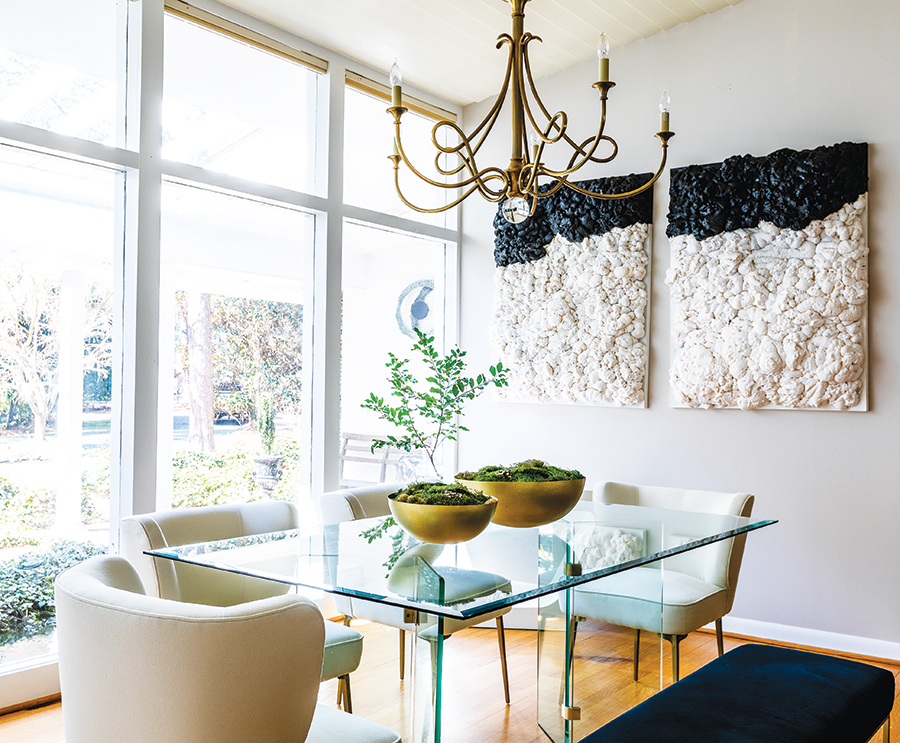
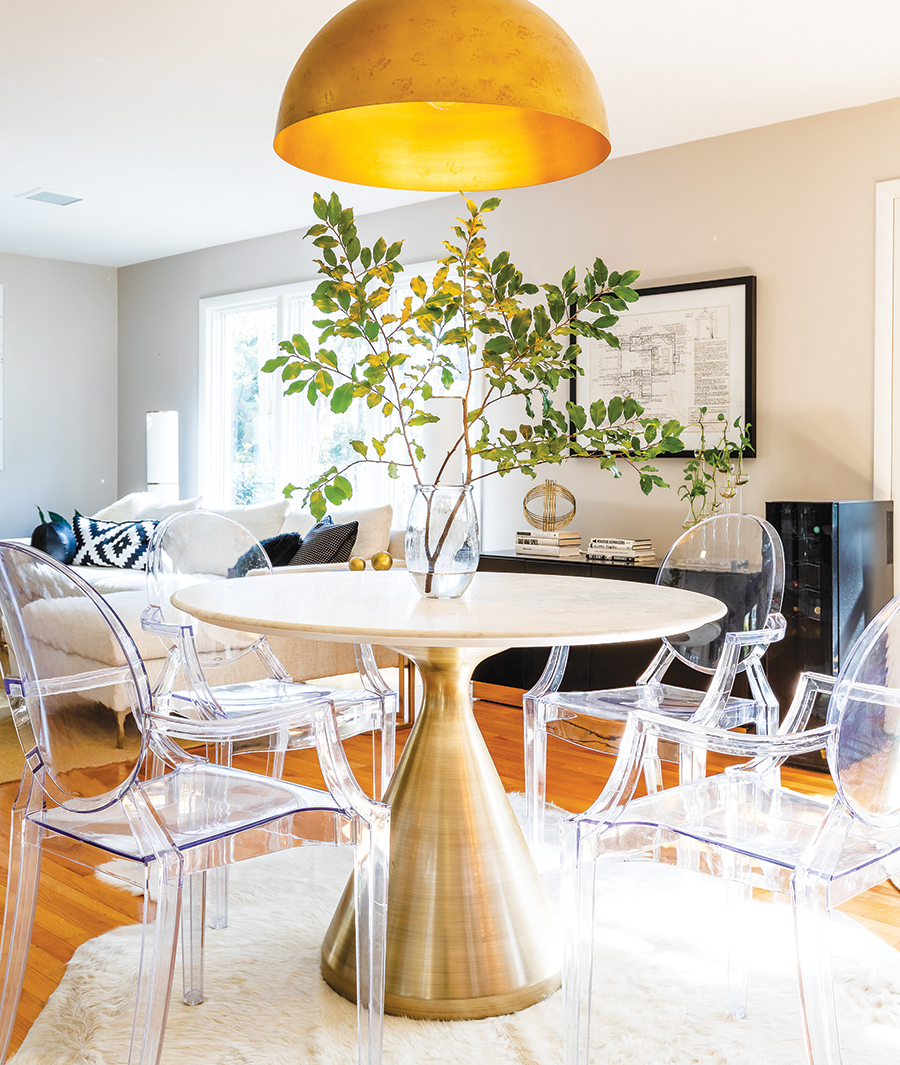
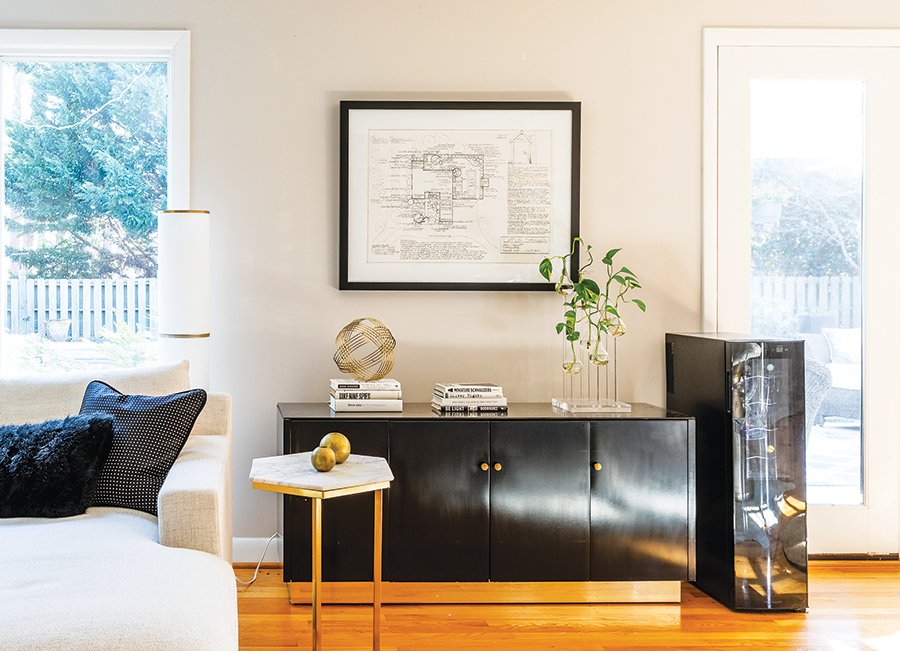
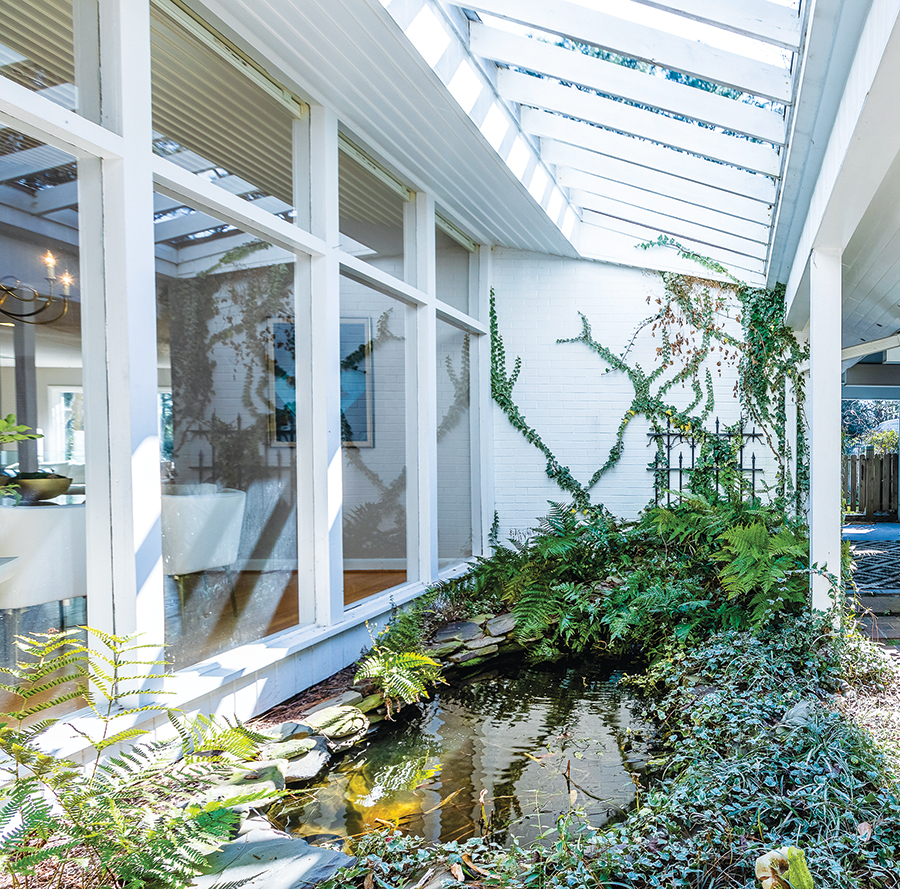
Now, after several ownerships but minimal renovations, this Hayes creation, home to bachelor Guy Bailey, speaks modernism starting at the front door. To the left, an exterior wall composed of slate plates laid horizontally and vertically form a decorative pattern. To the right, a goldfish pond with running water. The window wall rising above it reveals the dining room, furnished with a glass table and clear acrylic chairs which, in their transparency, almost levitate. Pale oak floors need only a few area rugs, also pale. In the vestibule, grasscloth wall coverings, a sleek black lacquer case piece and a watery blue painting in a floating frame set an immediate tone — followed by a surprise:

The formal (as opposed to family) living room ceiling is composed of redwood slats, painted the color of beach sand and installed on a slant.

Minimalism reigns here, where less is enough.

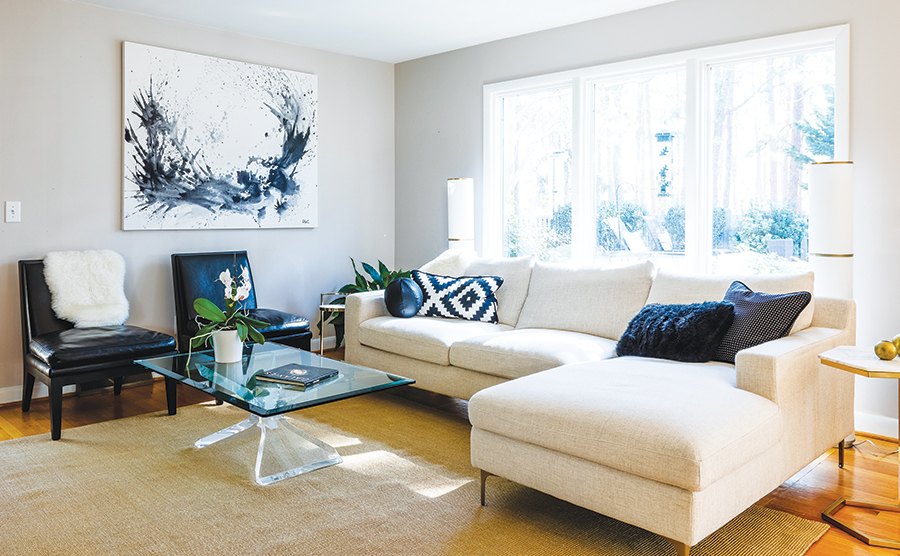
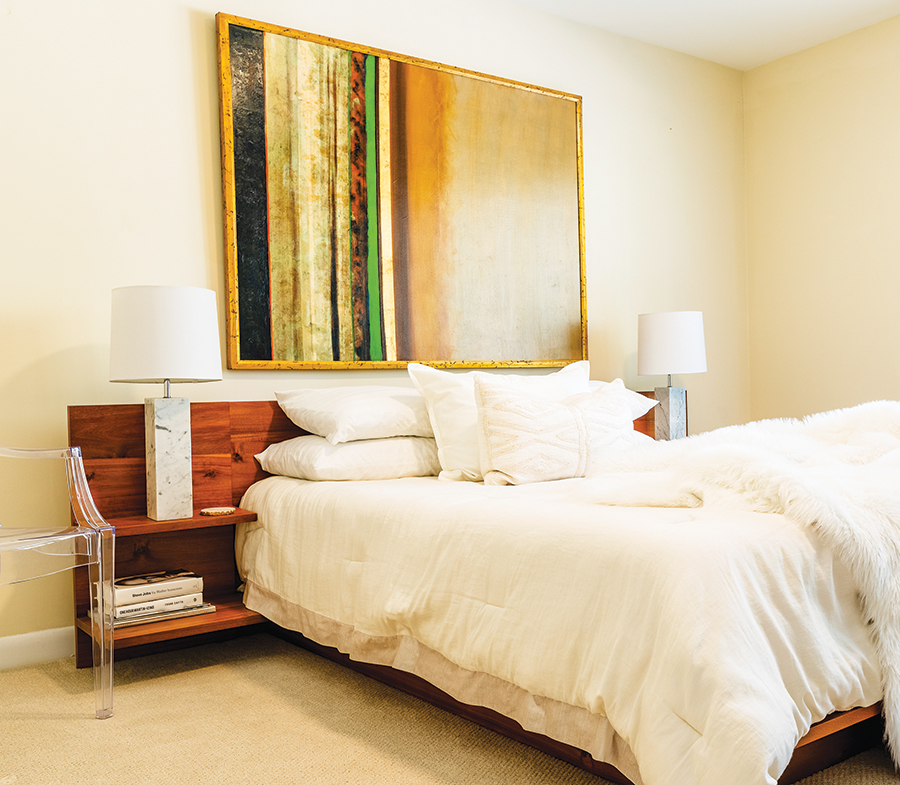
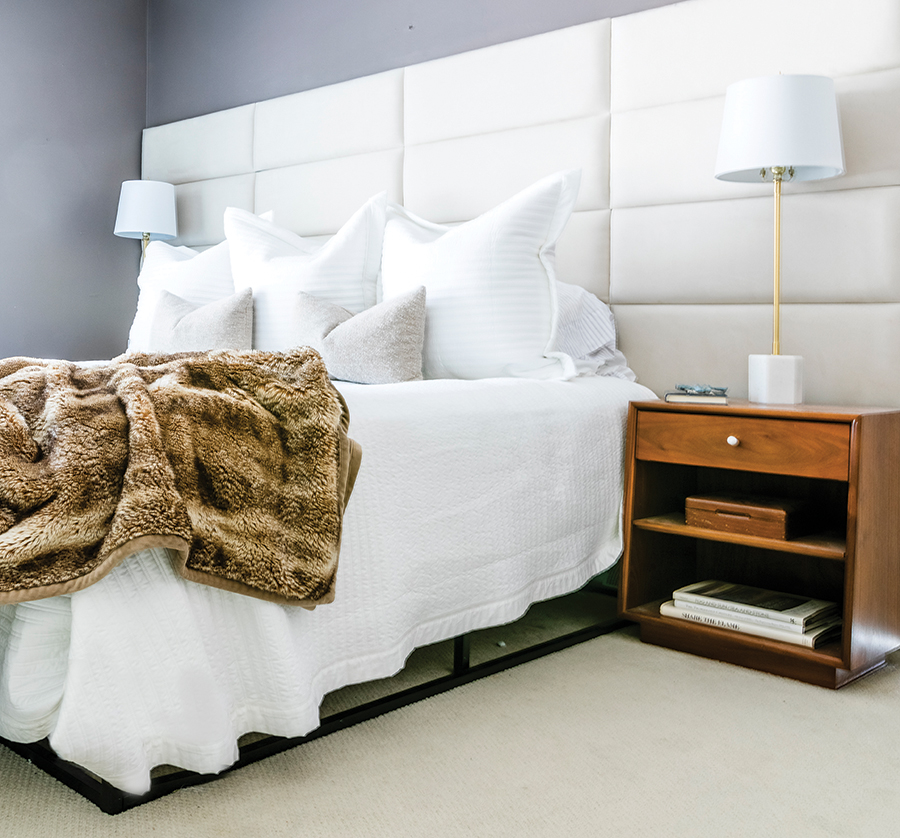
Clean lines. Simple forms. Light. Abstract art. White, black, shades of gray, cream, vanilla, occasionally navy. A few books and plants, no clutter. Windows throughout, except for over the kitchen sink, are floor-to-ceiling, most uncovered. Bailey watches deer go by from a picture window set into the master bathroom wall.

Bailey belongs to a select group of mid-life or retired native-borns who have returned to Moore County. “We lived on Country Club Circle, near the Elks Club, in Judge McConnell’s house,” he says wistfully. “I realize now how wonderful it was to grow up in a small community.” His parents owned clothing stores on Broad Street, The Men’s Room and Fancy This. Bailey graduated from Pinecrest in 1979, tried college, worked in fashion/fabrics, lived in Charlotte, where he married and raised two sons.

In 2017 a series of life events (and his elderly parents) drew him back to Southern Pines. But, realizing that people are defined by their digs, where should he live?

“I wasn’t interested in building . . . we’d done that,” Bailey says. He looked around, mainly lakefront properties in Whispering Pines and Pinehurst. A friend discovered the Knollwood house which, coincidentally, belonged to the parents of a high school classmate. Bailey was familiar with the area from playing golf at Mid Pines Inn and Golf Club and visiting Peggy Kirk Bell’s family.

“I’ve always loved Knollwood Heights . . . it’s the antithesis of a typical Moore County neighborhood. When I walked in the house I didn’t want the Realtor to see how excited I was.”

About what, specifically?

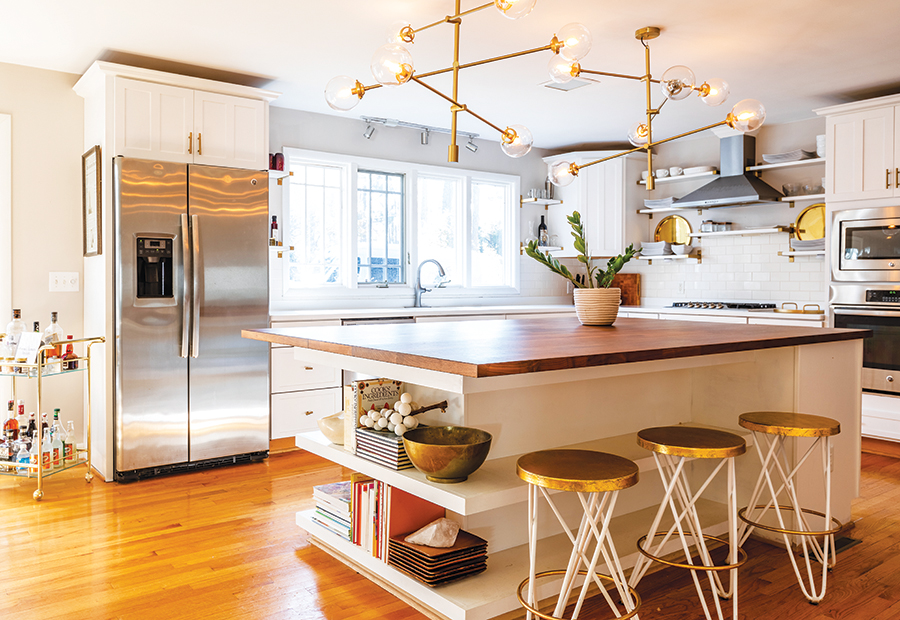
The house, listed at 3,587 square feet, seems larger because space is lavished on living areas, not bedrooms, which suits Bailey fine. “I get up, shower, get dressed and leave.” Beyond the “formal” living and dining rooms (with fireplace and built-ins) is an enormous undivided kitchen-eating-relaxing room, nearly 60 feet long, accommodating an 8-by-10-foot island, “where we gather.” Bailey likes to cook, necessitating a few adjustments in the kitchen, namely swapping a flat-top electric range for natural gas. To further increase the spaciousness, Bailey removed a wall surrounding a stairwell leading to the finished basement, allowing even more light to stream through.

The 40-foot shallow lap pool was a huge attraction, as was the landscaping planned strategically to screen off neighbors.

“I love the seclusion so close to a main road,” Bailey says. And, he loves poring over Hayes’ renderings, which he found rolled up in the crawl space.

The basement appealed to an alter ego, eons from modernism. “My man cave,” Bailey calls the underground room containing remnants of his city life and homes: a pool table, office equipment, sports stuff, easy chairs, plaids and a worn leather couch for napping.

Arriving with virtually no furnishings was advantageous, especially since Bailey’s sister, niece and friends volunteered to scour Habitat and Designer’s Showcase for modernist period pieces — many large and showy like the circular étagère, perfect for a wide-open wall in the formal living room.

“I’m not an antiques kind of guy,” Bailey admits, a good thing since family heirlooms “went to the girls.” Exceptions: One hallway is devoted to photos of his children. His grandmother’s set of amber glassware lines a shelf. Otherwise, he forges boldly into abstract art; niece Grace Crawford contributed several sculptural, dimensional hangings made from insulation sprayed on canvas, then painted. Other canvases, some encrusted with sparkly granules, add the only primary colors in an otherwise black and near-white environment where Bailey feels comfortable, after years in high fashion.

In a period piece designed by a notable architect, little things still count. Bailey loves that a door in the master bathroom opens out onto the lap pool deck. Kitsch gets a nod from the white fur bedspreads. And, since he believes Hayes planned this house for entertaining, Bailey enjoys taking advantage by letting the extended family spread out on holidays.

Architecture and décor styles go through a process, from avant garde/trendy to commonplace, then classic. Still pre-classic, mid-century modernism paired with minimalism appears fresh as the azaleas currently ablaze in Knollwood. After four years, Guy Bailey has settled into his stunning surroundings. He acknowledges the serenity simplicity encourages. Practicality, too; open spaces and uncluttered surfaces are easy to clean.

But, should nostalgia surface, Bailey can retreat to his clubby, sporty, leather-and-plaid man cave; the best of two worlds under one roof.    PS

Seeing Triple

Three options at one address

By Deborah Salomon     Photography by John Gessner

Houses can be 3-D textbooks chronicling history or sociology.

The first cottages built by the Tufts family were close to the hotel and without kitchens, since renters took their meals in the Casino building. Later on, people who stayed longer, perhaps for the winter “season,” brought children (who attended a schoolhouse built for this purpose), and needed cooking facilities and a maid’s room. Front porches, perhaps a screened one on the side, were obligatory for sitting and conversing with neighbors out for an evening stroll. Fireplaces got them through the winter. Before air conditioning, everybody left in May.

After nearly two decades of attracting wealthy urbanites, the cottages — now built on spec rather than commissioned — became smaller, plainer. Some were occupied by upper-level resort staff and village merchants, others by families drawn to Pinehurst’s rung on the social ladder. The best had enough land to expand.

Acadia Cottage, built in Old Town in 1917, conforms to some of these parameters but with a checkered history. Hugh McKenzie was the first owner, followed by another five by 1951. Only one — Mrs. W.H. Nearing — appears in the Pinehurst Outlook social listing of comings and goings. Records show that a fire burned off the wood-shingled roof, which was replaced by fireproof shingles for $300.

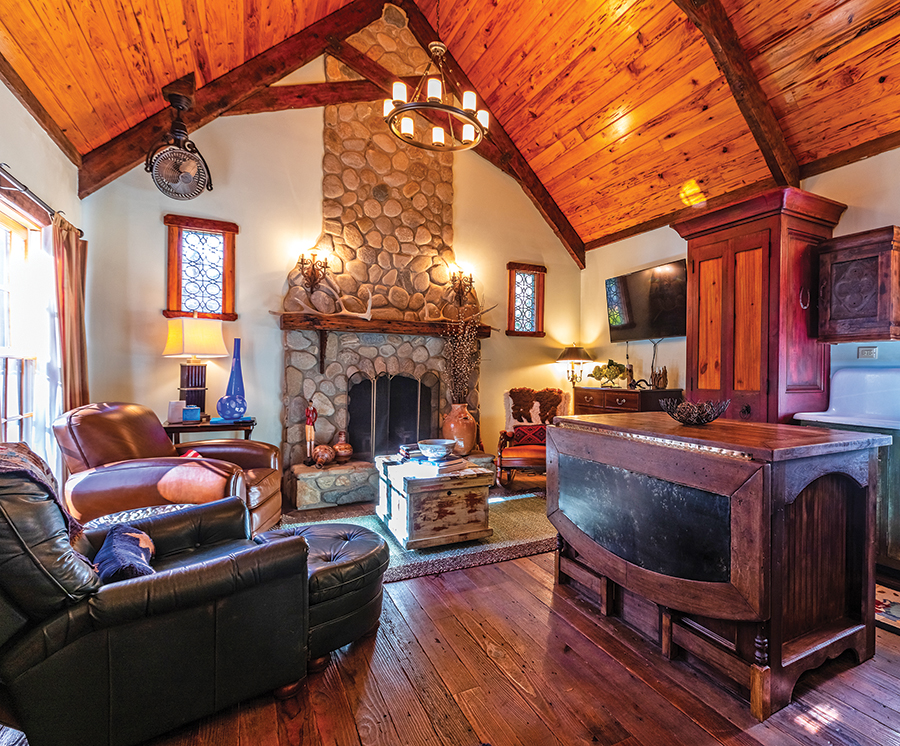
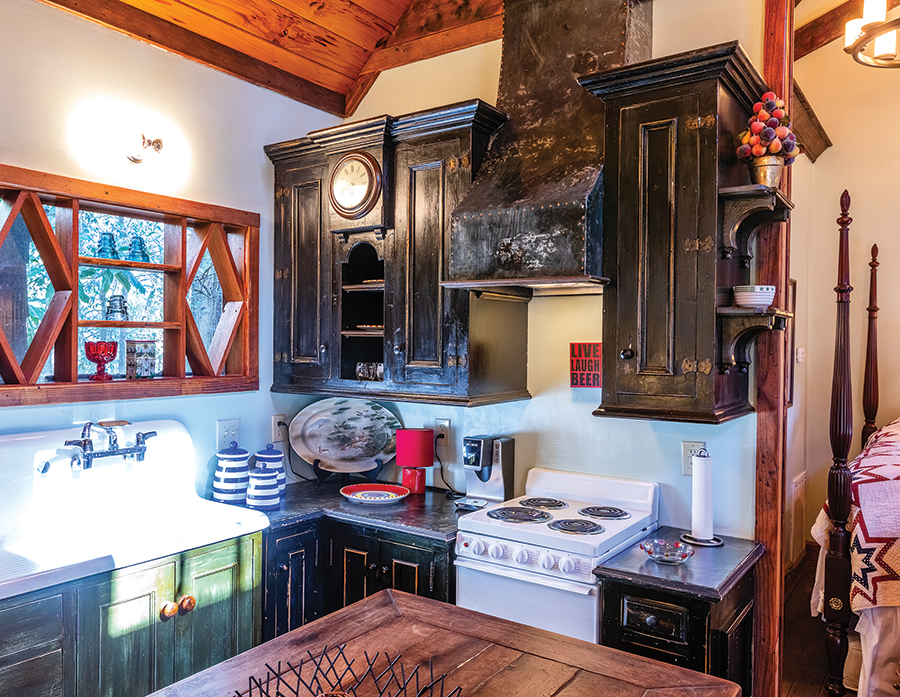
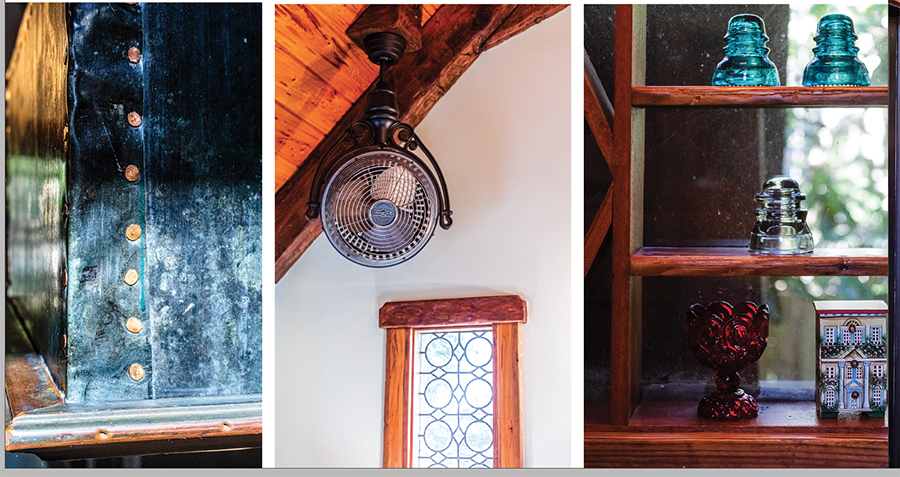
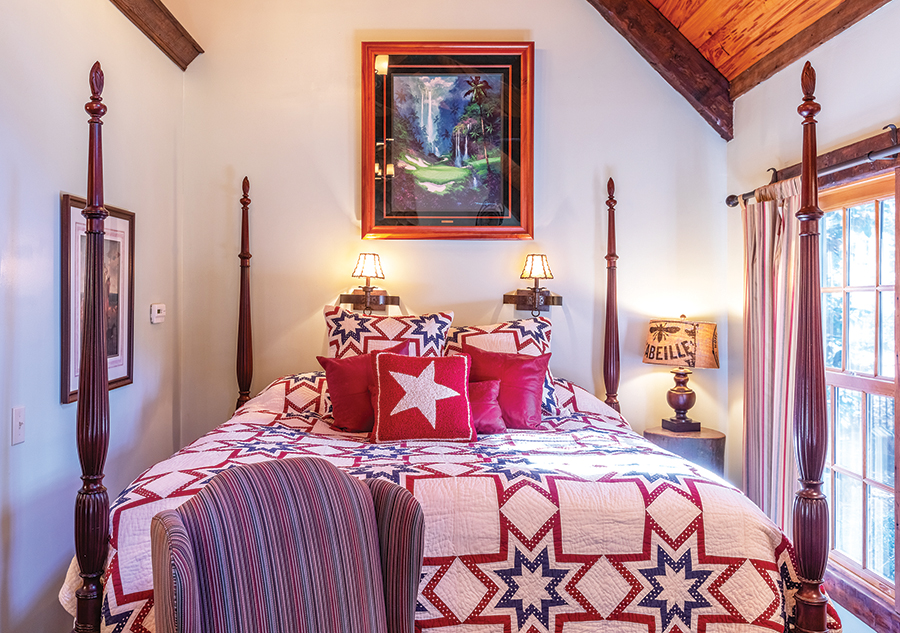
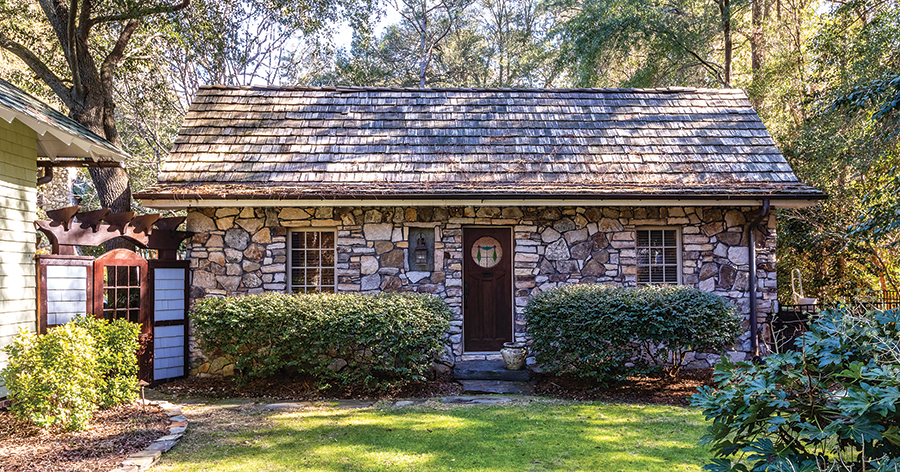
Now, beyond Acadia’s back door or through a side gate lies a magic kingdom — a mossy courtyard with a fire pit, a 50-foot-long and 11-foot-deep pool, massive stone benches for sitting and boulders for diving, a darling little pool house and a roomier guest house, both fully serviced with heat and AC, kitchenette, sitting room, a sleeping alcove and bathroom. No piece of this enclave appears strictly utilitarian. Each, whether it’s a cabinet or a conveyor-belt ceiling fan, offers an artistic, craft or historical component.

Antiques co-exist peacefully with reproductions and artifacts. Only living there affords enough time to notice, and appreciate, the array.

This enlargement and renovation was the brainchild of David Connelly, a Chicagoan with four athletic children, who wanted a vacation haven and found the overgrown back lot completely hidden from street view ideal. Connelly, a self-described wannabe architect, purchased the dull, dated but well-built “brownie house” on half an acre in 2000 and went to work. He and his contractor sourced stone for outbuilding walls from western North Carolina mountains, lumber from a demolished tobacco barn and the Reynolds estate in Southern Pines.

On a damp day, the boards still smell like tobacco.

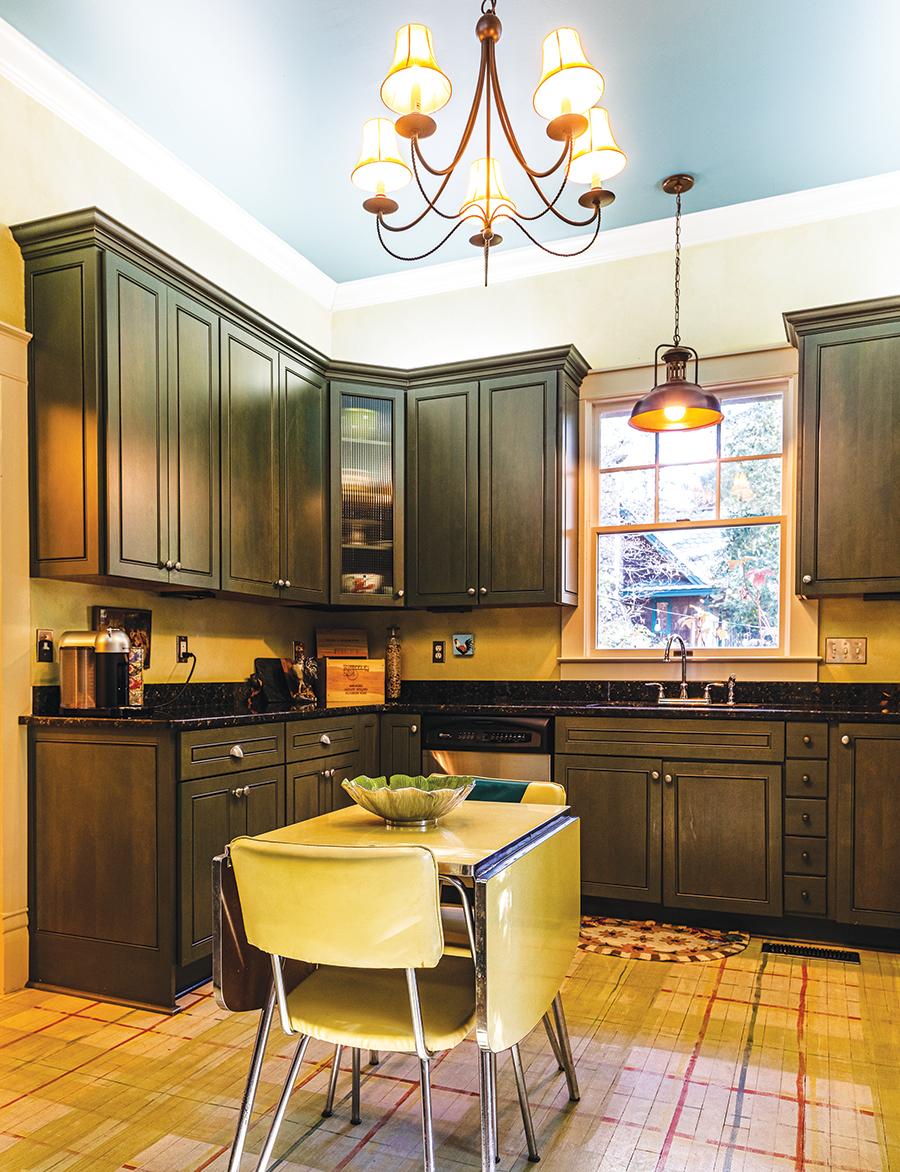
They removed walls in the two-bedroom cottage, creating an open living/dining/den space, and installed a modern kitchen that, somehow, looks like it’s been there forever. A bath/laundry room with a half wall tile shower was added, as well as a Carolina room off the dining area. Details mattered; moldings aplenty, sometimes painted a color different from the walls, delineate the 10-foot ceiling. Over the front door, a transom pane. An old-timey wood screen door fit the timeline. Then, to frost this cake of many layers, a faux specialist painted wide pastel stripes from Marshall Field’s shopping bags on a powder room’s walls. Even more striking is the colored grid applied to the kitchen floorboards creating the look of scuffed linoleum, circa 1940s. 

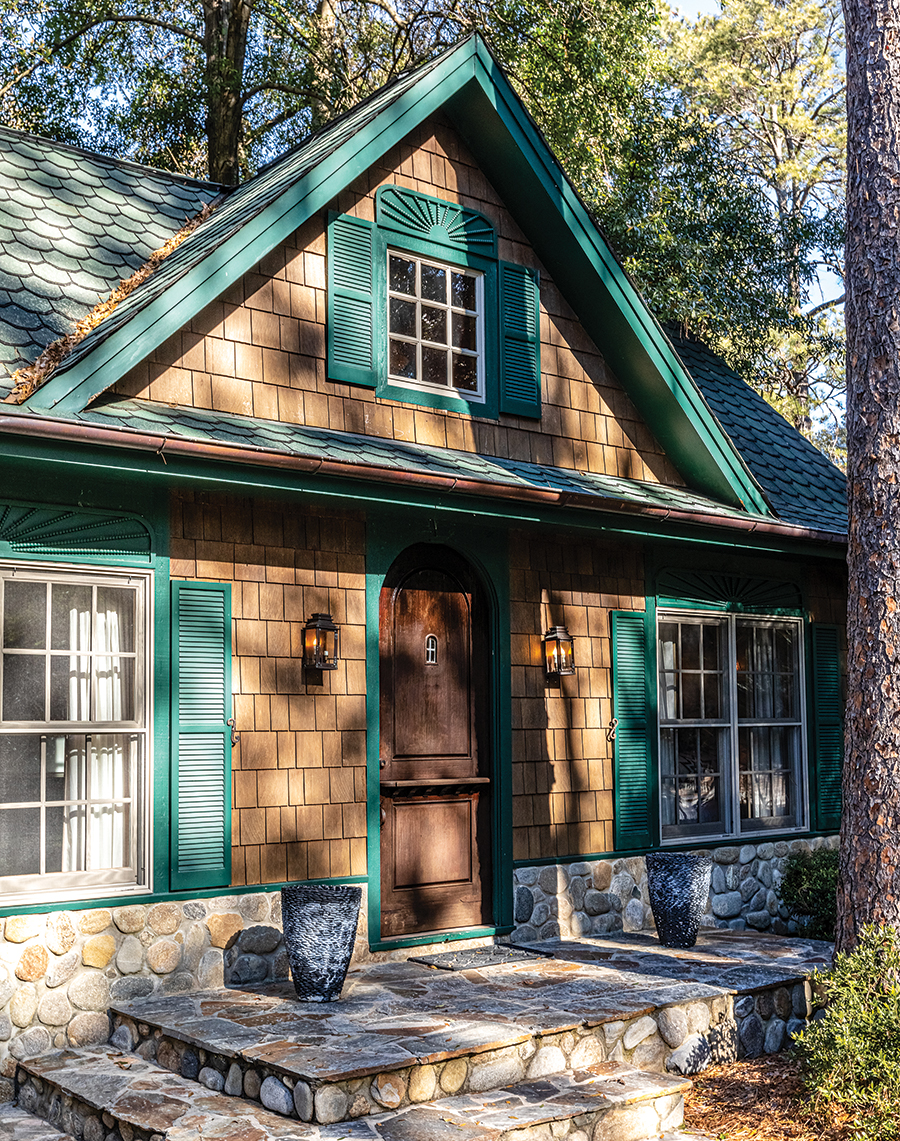
The dull brownie house, called Acadia now, inside and out, glowed a pale green, neither mint nor avocado, froggy nor kiwi, but so organic to the setting that Jay and Kim Butler, who purchased the property in 2010, didn’t paint over it.

The story of their acquisition rings familiar:

The Butlers, from Virginia, with a second home at Nags Head, spent a weekend in Pinehurst. Kim had never been here. “We rode by the house on a Saturday and saw it was for sale. It had great curb appeal,” Jay recalls.

After 10 years, Connelly was ready for another project.

“I had to have a pool, so I loved that feature,” adds Kim, retired from the retail pool business, with an avocation for collecting mid-century modern furniture and unusual décor accents.

“We just liked the quaintness,” says Jay, an executive in a family recycling business. Golf was a draw, confirmed by memorabilia decorating walls in the TV den opposite the living room. Most of all, “It was in move-in condition, exactly the way we liked it.”

About a month later, they did exactly that.

Soon, their friends were lining up for invitations to test private guest and pool house accommodations which set this address apart from Pinehurst estates with designated guest quarters under one roof. Their verdict, Jay says: “Kinda cool.”

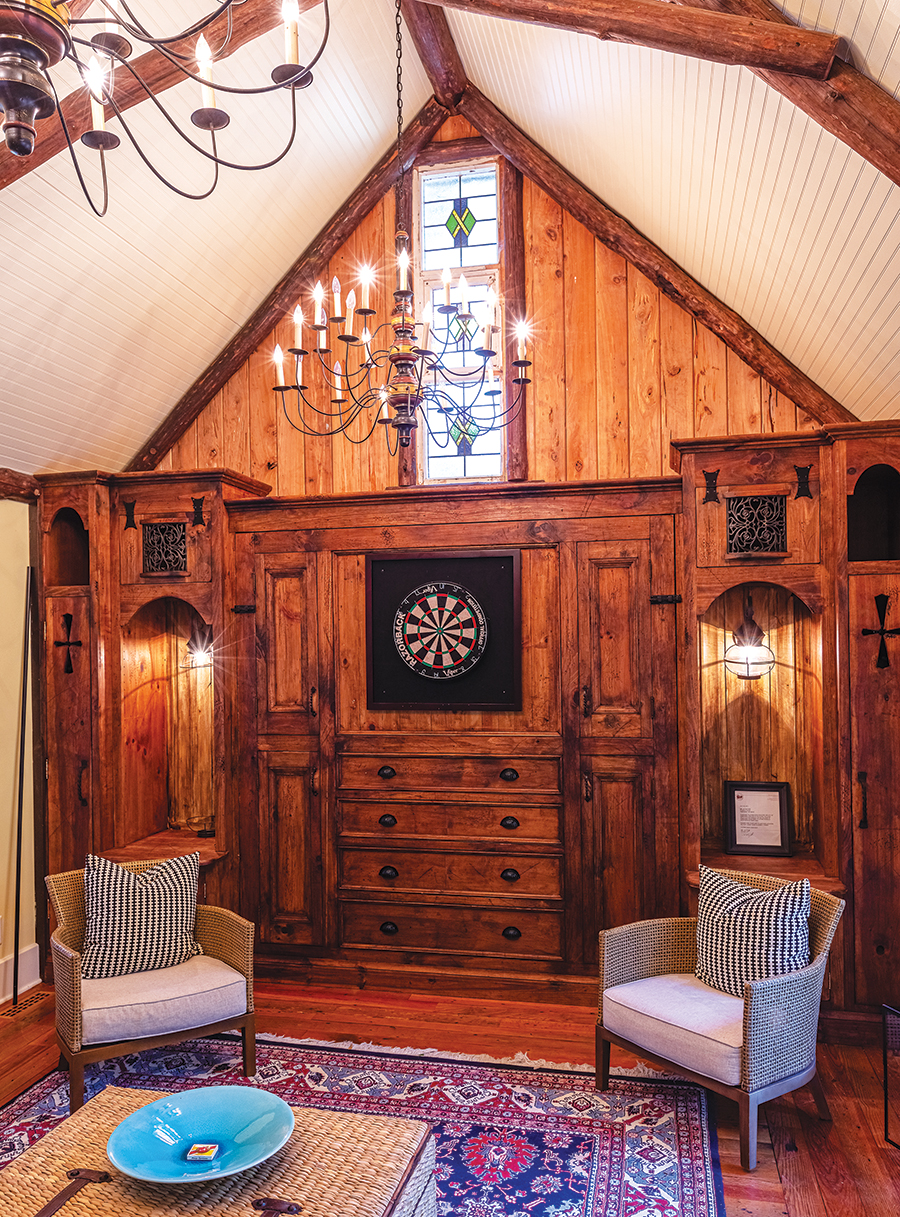
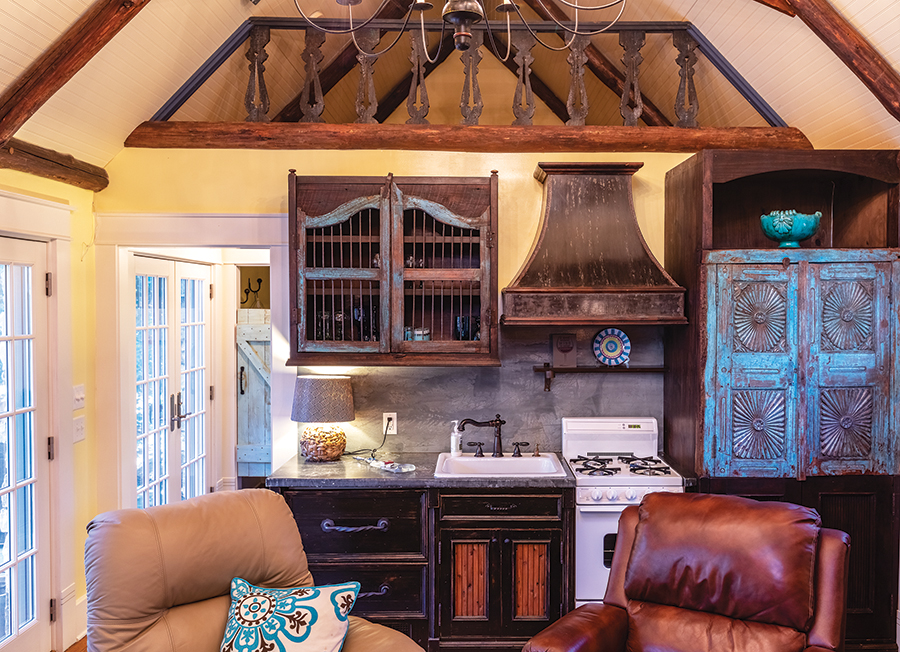
Each outbuilding has only one room — but enough features to fill a catalog, like a queen-sized Murphy bed hidden by wood paneling suggesting a library, or chapel. “Antiqued” cabinetry and metalwork, distressed painted pieces, leather chairs with half-moon ottomans, beadboard, an old porcelain sink, refrigerated drawers, vaulted wormy chestnut ceilings illuminated by stained glass inserts, a drop-leaf kitchen work surface that, with leaf raised, becomes a table. The guest house has a round-topped Dutch front door rescued from a wine cellar, and the pool house bathroom, with direct access to the yard, is split into shower, toilet and vanity sections along a narrow hallway.

Obviously, planning coupled with imagination were at work here.

However, fitting so much furniture into relatively small spaces can be challenging. Not for Kim Butler, who positions modern glass sculptures on a rustic table and adorns dressers with large, bare branches. Throughout, she uses traditional wide-slat wooden blinds.

Back in two-bedroom Acadia — compact but perfect with the living area opened up and furnished with Kim’s retro pieces — one standout is a small drop-leaf kitchen table made of aluminum tubing and Formica, with vinyl-upholstered chairs. “I thought about an island,” always convenient in a kitchen with limited counter space. Instead, Kim settled for what has become an emblem, a conversation piece.

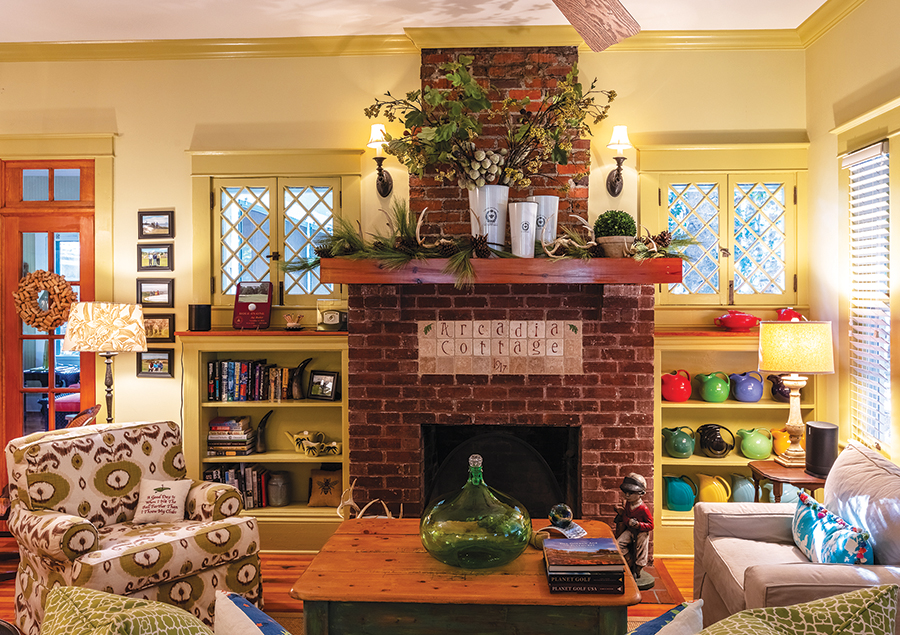
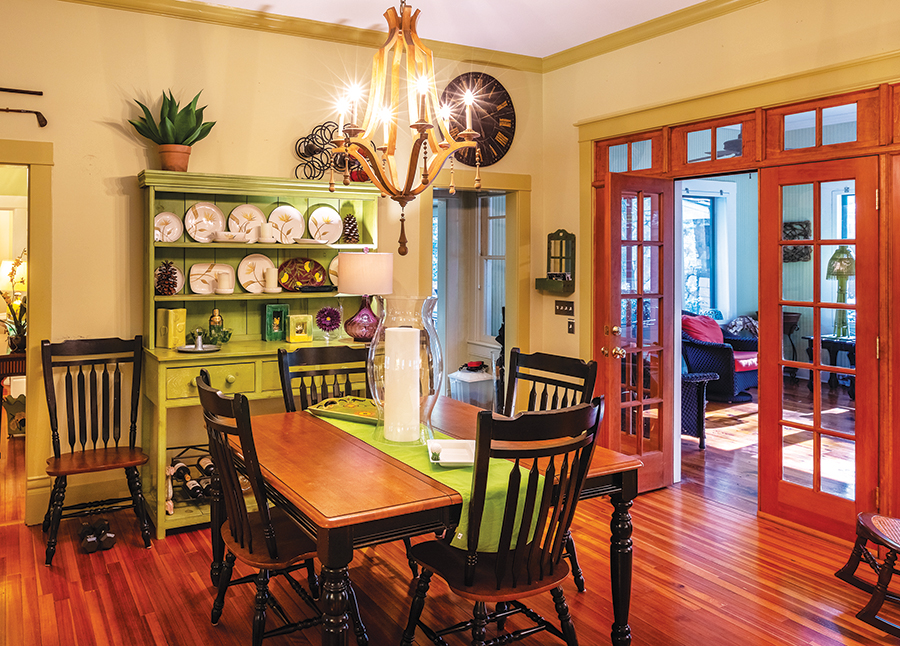
Kim’s collection of colored pottery pitchers brightens a bookcase flanking the shallow living room fireplace, converted to gas for safety; other pottery and glass pieces cover tabletops. Texture, texture everywhere. The chandelier over the dining table is made of wood, and the upholstered club chairs qualify as shabby-chic. No two lamps claim the same parentage.

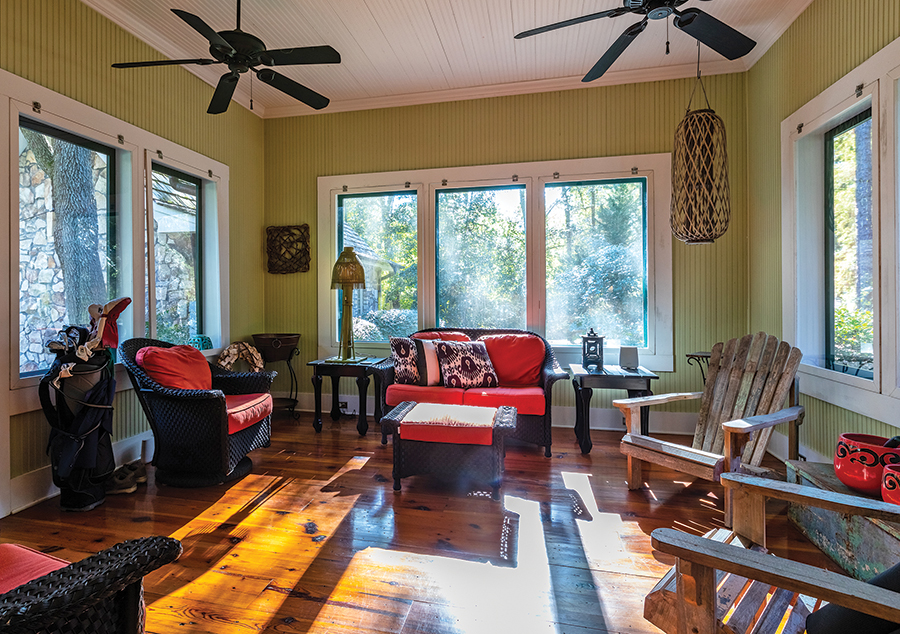
Kim furnished the screened porch in Chinese red lacquer and black wicker, strong colors that pair with the darkened knotty pine floors milled from trees cut out back.

Room to room, comfort prevails.

Who would guess what’s inside from strolling by, as Annie Oakley might have done when she lived in an apartment across the street? The well-tended walkway, flower beds and porch provide no hint.

Acadia may lack the pedigree of homes built before and during the Roaring ’20s — the Mellons and Rockefellers never stopped here. The Fownes and Marshalls opted for bigger and fancier rather than livable and convenient.

But, after 10 years walking to the village for dinner after a relaxing float in the pool, then chasing the dogs around the fenced yard, Jay Butler concludes, “It’s just a good place to have a home.”  PS

Photos by Joseph Hill

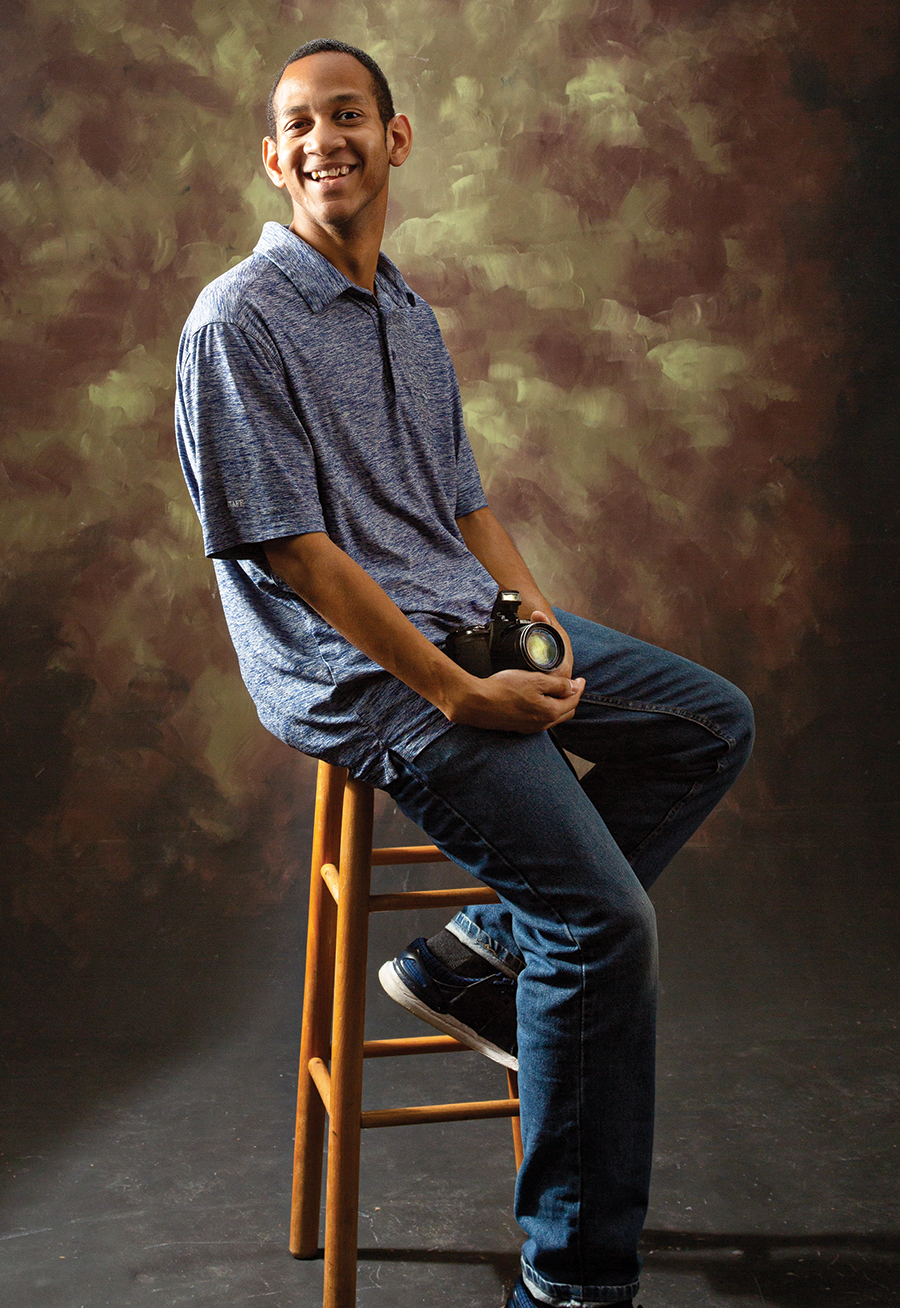
We arranged to meet inside the Welcome Center on the north side of the train station in Southern Pines. “I’ll be the guy with the red scarf,” I said.

“I’ll be the guy with the camera,” Joseph Hill replied.

Most locals are familiar with Hill and his story. He’s become as distinctive in Southern Pines as the Yield to the Left signs that confound visiting drivers at every intersection of the downtown business district. Hill is autistic and, in that long ago pre-COVID era, you would see him most Saturdays — and pretty much any day he had a reason to come to town — wandering around with his Nikon and Fujifilm cameras.

“In a way, it’s peaceful,” he says of his photography. “I can just be wandering around, minding my own business, and I come across something I haven’t seen before — maybe neither of us have seen before — and I take a picture of it. Every day, what you call mundane, that we pass by and see but don’t notice fully, if I happen to see it at just the right angle, looking up or looking down at the ground, hey, I take a picture.”

Hill will turn 27 the month that this magazine appears. “I’m blessed,” he says, “and I hope to make every birthday of each year count.”

Since we’re all still using best practices to avoid the spread of the virus, Hill wears his mask. It says Kindness Is Contagious. The town never had a more good-hearted face.   Jim Moriarty  PS

Portrait by Tim Sayer

For more information about Joseph Hill read Jaymie Baxley’s story in The Pilot at https://www.thepilot.com/3-a-different-angle/image_3c8e794e-281d-11ea-8949-db91e82ba31d.html or go to josephhillphoto.com.

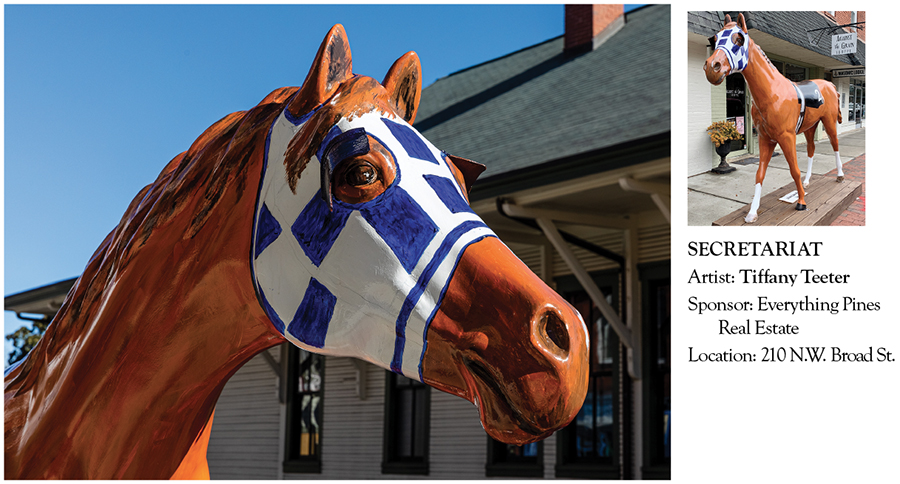
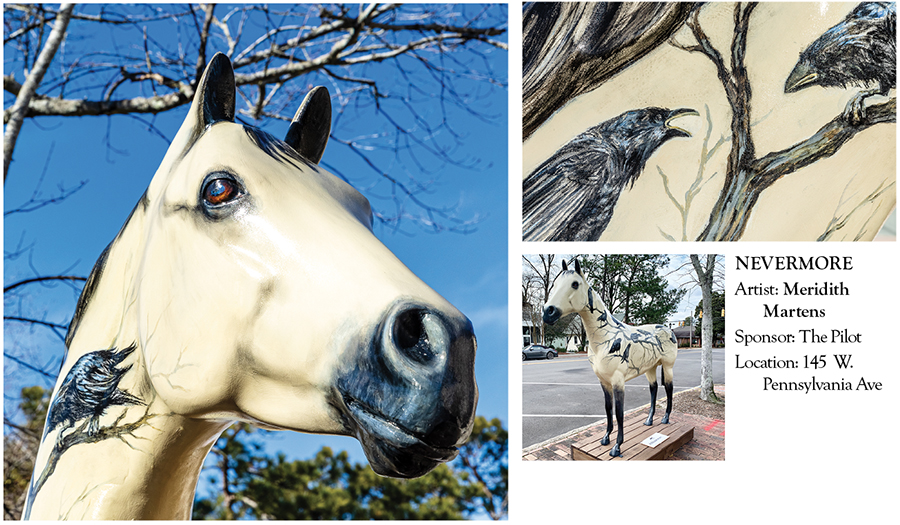
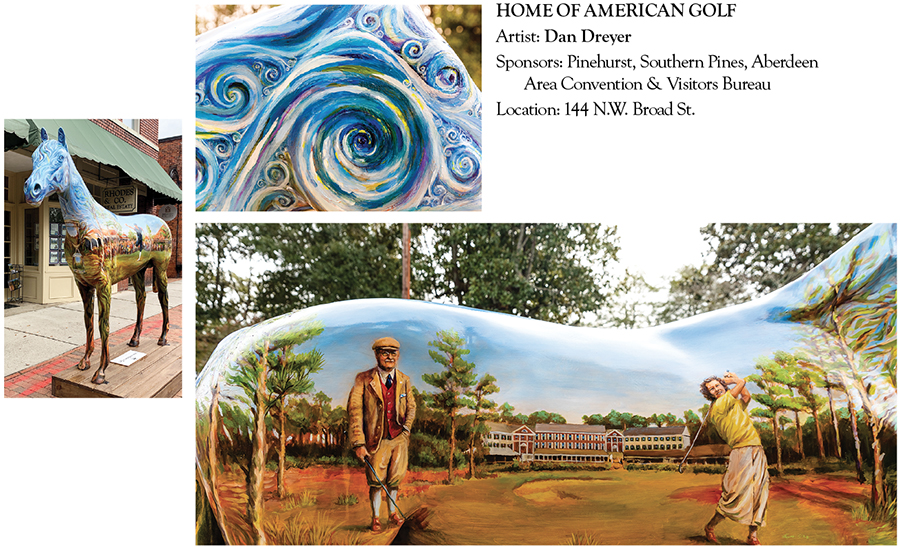
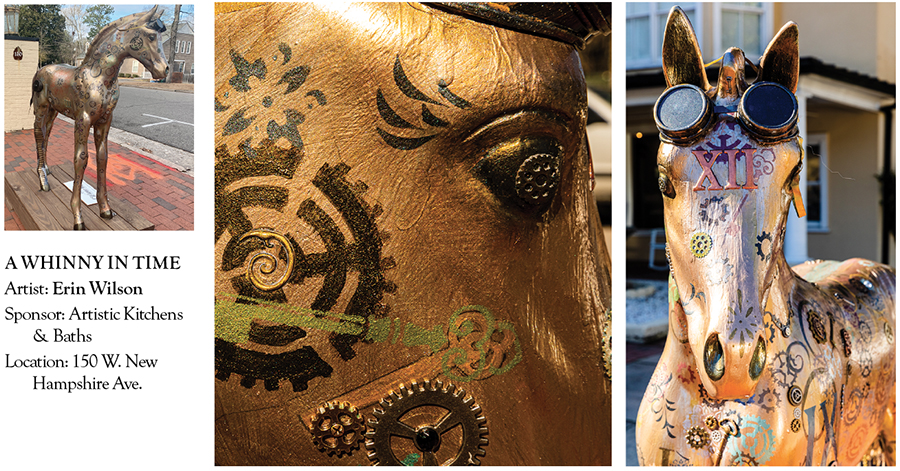
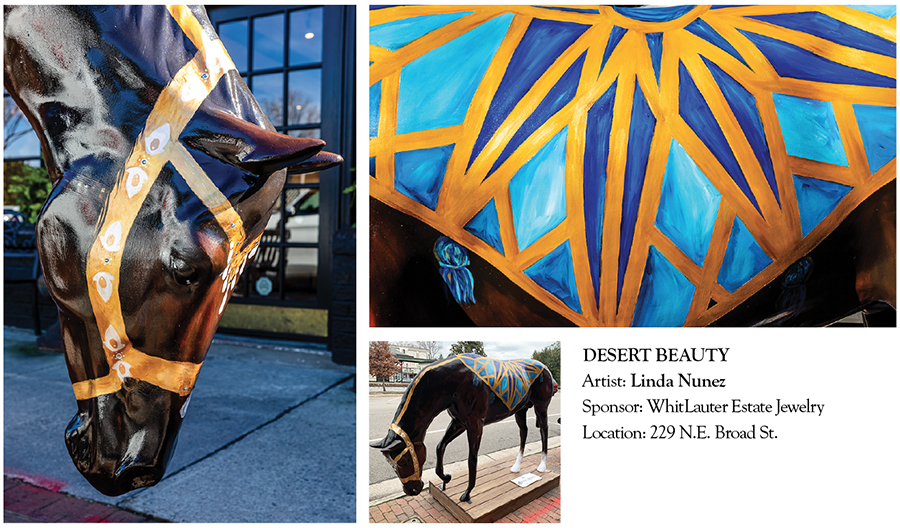
Painted Ponies

Photographs by John Gessner and Mackenzie Francisco

Back in the saddle again

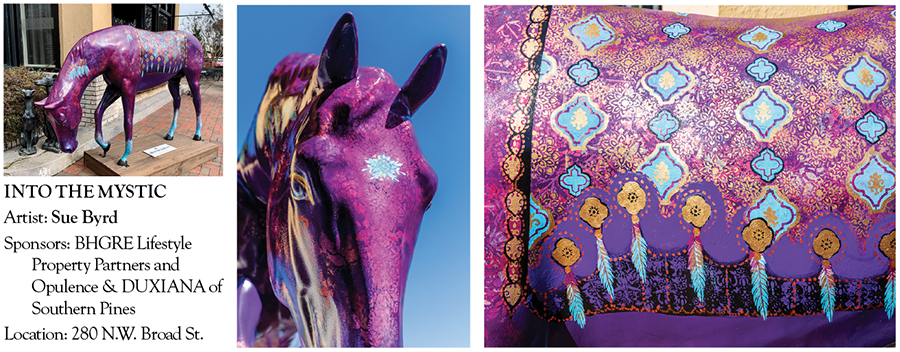
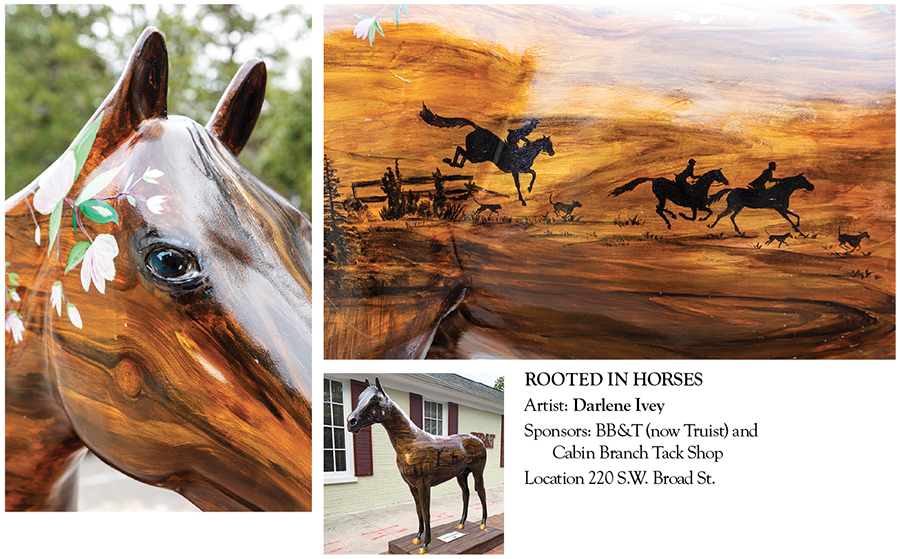
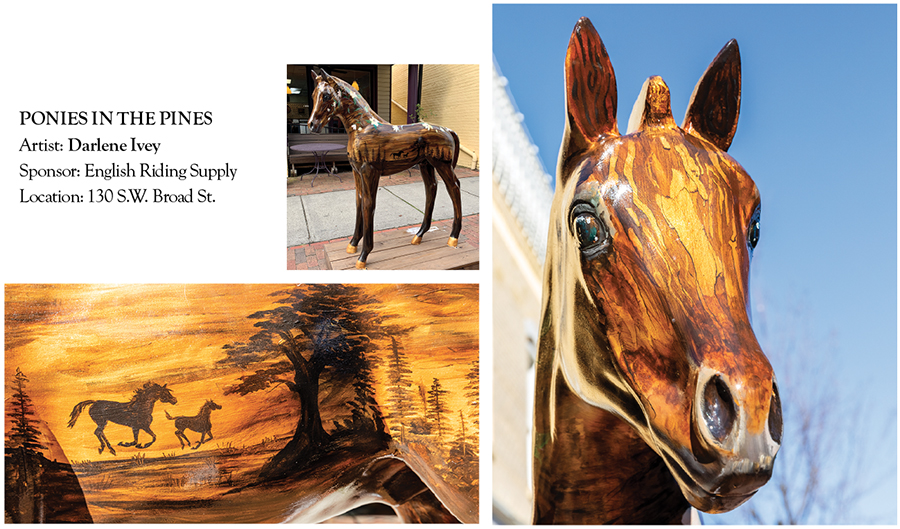
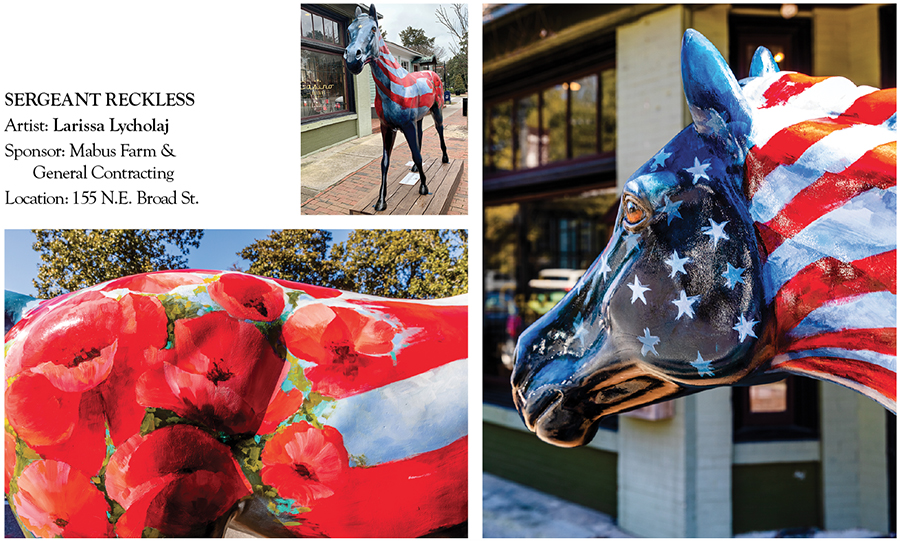
The wild mustangs of the Outer Banks have nothing on us now that the painted ponies have returned to the streets of Southern Pines. They’ll show their creative colors until March 30 or so when the imaginative dozen
will be rounded up and auctioned off on April 3 to benefit the Carolina Horse Park. 

Poem

Pairing Mantids

He has only one job to do. And she, with her hunger,

her need to feed the future without him by consuming him,

has a lot to get done before winter.

His head tilts slightly, like a sinner at communion,

like a teen expecting his first kiss to be like lightning.

Then his body starts to do the work it was built to do.

She turns toward him and wipes off his face.

He knows it’s all over, but his body keeps on, unknowing itself.

His is the kind of stupid happiness

you can only appreciate at a distance,

the kind you know cannot be as good as it looks.

Hers is the work of duty and a different devotion.

While he takes her from behind, she takes him

head first just like she took a yellow striped hornet

who would have taken her to his own hideaway,

just as she took the grasshopper who was tired of summer,

as she took the large green moth who had no mouth of its own.

She ignored those magnificent wings — just let them fall —

as she ignores the thrusting body that falls away from hers.

He dies two deaths at once, the deaths of love and of life.

But the moment between, the moment before it all ends,

is the moment of his glory and the beginning of her toil.

— Paul Jones

Paul Jones is the author of What the Welsh and Chinese Have in Common

Why I Love Pool Halls

By Bland Simpson   

Illustration by Harry Blair

On a green field of order, where I wait

for this game’s random shifts to bring you back,

high and low, striped and solid balls rotate.

I chalk my cue and call for one more rack . . .

— Henry Taylor, from An Afternoon of Pocket Billiards

From the open upstairs windows of a plain two-story commercial building overlooking a bricked side-street, Colonial Avenue in Elizabeth City, as a boy I used to hear the pouring out of loud jolly talk and laughter, but most of all the hard clicks of cue balls breaking the racks, and spoken and sometimes shouted encouragements and disappointments, and the lighter clicks of wooden scoring beads, as men I could not see slid them along strung wires above the green felt-covered slate pool tables in that magic room above.

A small sign hung by the street-side door, stating simply: City Billiards, Home of Luther “Wimpy” Lassiter, World Champion, 9-Ball.

In the nearby corner movie theater, the Center, my friends and I often sat, enthralled and forgetting we were only a hundred yards from a swamp river on its way from the Great Dismal Swamp to the sound and the sea, believing instead that we were riding along on horseback as we wove with the cowboys through some saguaro range, or that we were stomping or swinging along with Tarzan of the Jungle through mamba snake-ridden equatorial brakes. We even saw Zsa Zsa Gabor there, in Queen of Outer Space, and knew this short interlude of imaginary galactic travel had brought us to our worshipful knees before the most beautiful and powerful woman in the universe.

Yet when we emerged from these diversions, our riverport reality fell heavily upon us, and the sounds of smack and click kept spilling out from the pool hall on high, and we somehow knew that was where the real men, not boys, went to have their adventures, though all we could do, our ages still in single digits, was to stand on the sidewalk below and listen hard and try and make out what the hoots and hollers and howls, and the cussing were all about, and what they all really meant.

At my Uncle Joe’s home on Greenwood Road, a few hundred yards straight down the Raleigh Road hill below Gimghoul Castle in Chapel Hill, in a large square pine-paneled room stood two grand implements of joy and purpose that guided me through my teenage days: a 1917 player piano, and a Brunswick pool table of more recent vintage with a golden-brown felt top. After school, an inspired fellow could get in an hour of honky-tonk piano playing (Ray Charles’ “What I’d Say,” Floyd Kramer’s “Last Date,” Alan Toussaint’s “Mother-in-Law,” as interpreted by Ernie K-Doe) and another good hour of 8-ball. Even if I were only singing alone and then playing, as well, only against myself. I liked the feel of the ivories, and then I certainly liked the light heft of the cue stick and the faint smell of blue chalk as I squeaked it onto the tip and smacked the cue ball into the rack and heard all that increasingly familiar clack and clatter.

As I could be Ray Charles for a while, then I could be Wimpy Lassiter for a while too. And why not?

Some of my friends from the Greenwood neighborhood, Tom West and Dave Harrison among them, would also chalk a cue with me on occasion, so the progression of lonesome though active afternoons would be broken. After a while, about the time we all turned 16 and could drive (in my case, my uncle gave me the use of a ’48 Willys jeep, with no top and only a seagull feather to dip into the gas tank to discover how close to empty the vehicle was), we decided to take our skills to town and try out a real pool hall, there being one on West Franklin Street and another on West Rosemary Street — said to be somehow under the control of Doug Clark, the musician whose perennially popular band the Hot Nuts toured the East Coast on weekends and played fortunes of off-color R&B music for young college men to alligator to, trying to impress their dates.

So one sunny Saturday morning a quartet of us went into Doug’s pool hall and shot for a couple of hours and, as we knew we would, liked the loud clatter of rack after rack busting apart as ferocious underslung stick action slammed the cue balls forth into battle. That we were white boys in a black men’s redoubt made no difference, or seemed not to. We were no trouble, and we were spending money. We may not have played very well, but we were left alone and did all right there.

We got to going to the Brass Rail pool hall over in downtown Durham, with its clientele as white and laconic as Doug Clark’s was black and passionate. The men of the Brass Rail were low-energy, cynical, worn down from work in the tobacco factories, older men who drifted in and out, playing two or three rounds of 8-ball and drinking two or three longnecks, and some of them hacking and spitting the brown juice of their chaws into bright brass spittoons placed all around the joint.

Our play improved steadily, if slowly, as we visited these emporia, and we played only 8-ball, and my friends found their way to Uncle Joe’s piano and pool hall more frequently as well, so the long lone days had given way to days of what we had come to know as pool hall conviviality. Off to ourselves, we could feign in a way that we were up at Doug Clark’s or over at the Brass Rail and ape the ways grown men walked slowly around with squinted eyes and assayed the lay of a table as they set up their shots, and the ways they addressed the cue ball, maybe lying well over the table as they did, and slammed a long shot home or maybe just barely kissed a combination shot so the second ball in the combo might lightly curl around the cushion corner and fall smartly into the center pocket. We learned that it was not only the shot, but also the next shot, and so we learned about the leave.

And that this was all geometry worth knowing.

What really elevated the importance of pool and rooms in which it was played was a talk with my father one evening, which began with him saying: “We need to talk about where you stand with the draft.”

“The draft?” I had yet to turn 18, and only would during my first term at Carolina.

“What do you know about it? And I don’t mean what you’ve heard around the pool hall — what do you really know?”

Not a long call, but a keen one. I promised I would follow up, check on whatever I would have to do to register, and so forth. But what was truly meaningful was my father’s realistic assumption that I would have, even should have, found my way to the pool hall and heard there the inevitable levity and also serious talk about serious matters and that, also, I might not have known how in the midst of animated and, at times, fur-flying talk, to tell what of it was real and what was not. My father was letting me know, advising me of the truth in a slant way, that one needed, always, to take the temper of the room, to learn extra-well how to navigate the gathering places, the watering holes and oases of the world, to note which assertions had real grains of truth within them and which ones were as flimsy as those thin wires above the pool tables threading through the wooden scoring beads.

He was telling me that a pool hall was a truly important place, and he was right.

For that first one I ever recalled, City Billiards there in Elizabeth City just a couple of blocks from where my father was born and lived and practiced law, and only two miles from where he died, drew many men into its convivial space, many of them rank amateurs, some poseurs with light skills and a trick or two and perhaps a two-bit hustle, and a few truly talented when it came to chalking a cue.

Yet one of them — and only one — was the champion of the world.

In time, my old friend Jake Mills showed me his two favorite pool halls, Happy’s on Cotanche in Greenville, and Wilbur’s on Webb Avenue in Burlington. After school in the 1950s, he and his longtime friend Steve Coley used to play quarter games against the textile mill hands coming off first-shift and drifting into Wilbur’s straight from work. The cigarette haze hung low below the green shades, and the cry of “Rack!” was in the air and the balls clicked and clacked and, like many a youth before them, Jake and Steve picked up pin money in this Alamance County 8-ball haven. When, decades later, Jake and I looked in late one winter’s day, had a cold one, and shot a round, no haze hung, and we were just about the only ones in Wilbur’s as a gloaming crept over the closed mills at half past five.

Once, at the courthouse square pool hall in neighboring Graham, the bartender serving Jake after a spell commiserated with him, telling Jake about his best friend and how the best friend’s wife had recently stabbed him in the back with a Bic pen, not really hurting him, but . . . “Pretty pointed message,” Jake said, and the bartender grimaced. “I mean,” Jake went on, “she must’ve thought he wasn’t exactly seeing the writing on the wall.” At which point the bartender shook his head angrily and walked off.

Sometimes in New York City, fellow songwriter David Olney and I found ourselves in the big, 16-tabled, Upper West Side 79th Street Billiards at the northeast corner of Broadway. The hall had a fortune of windows wrapping around its corner, facing west and south, and so had a bright, airy disposition to it, even on a cloudy day. One slow afternoon, the owner, a stocky man about 60, ambled by as we racked the balls and asked us where we fellows were from. When I said North Carolina, he asked: “Anywhere near Elizabeth City?”

“That’s where I grew up — Luther Lassiter’s from there!” I went on about the Colonial Billiards, about how Lassiter started hanging around there as a boy, got the use of the tables for keeping the place swept up.

Wimpy — sure. He always comes by here anytime he’s in town, runs the table a few times, shows everybody how you do it. Nice guy. The best.”

“What about Minnesota Fats?” I asked.

Fats? Aw, he’s a loudmouth, a braggart — he’s nothing but a hustler.”

The pool hall man who had seen it all let that sit a few seconds, nodding at Dave and me both, and just before he walked on through a space that is no more, said with finality: “Wimpy Lassiter’s the best 9-ball player I’ve ever seen. Straight pool too. And on top of that, he’s a real gentleman.”

Semi-dim places like Crunkleton’s in Chapel Hill and the Orange County Social Club in Carrboro featured single tables back away from their front doors, always a nice sight for an 8-ball man or woman. Though a single table hardly a pool hall made, the OCSC, like Neville’s agreeable speakeasy just off Broad Street in Southern Pines with its lone table, seemed at least halfway there. My son Hunter and I were chalking post-Thanksgiving cues not long ago in the OCSC and challenging David and Heidi Perry, and in the ensuing contest across the red felt table (with chalk cubes to match), our energies went betimes vivid, betimes laconic, matching the energy in the small Paris-of-the-Piedmont barroom (“Nice to be channeling the Royal James,” David said a time or two).

In former days, women would not have found such welcome in the real pool halls. Dave Harrison and I brought our dates into the Brass Rail in Durham one evening after we had gone to an art film at the Rialto and for that integrative act earned just about the most brazen, hostile glares either of us had ever received. But that age went by the boards sometime as the 20th century aged and passed on, and pool tables started showing up, along with darts and foosball games, in many a spot that served wine as well as beer. Vic’s smoky tavern on Turner Street in Beaufort (where, my wife, Ann, has told me, a young woman’s reputation would be shot should she ever enter) kept its three big, beckoning, green-felt slate tables and became the Royal James, smoky no more yet still and all one of the best pool halls in the land and a renowned epicenter of eastern Carolina-ness, welcoming all comers and losing nothing in the bargain.

Channeling the Royal James indeed.

I have sat in the Royal James, the RJ, on a Thanksgiving-tide afternoon and heard the best of talk from Steve Desper, the late impressive science educator, about speculative ways to pull nitrogen out of the Neuse River; have heard from author Barbara Garrity-Blake of an African American menhaden fisherman engaging the captain of the pogeyboat upon which they both worked in there and telling him, movingly, “I know why you fish, Cap’n, ’cause it’s in your heart”; seen a laughing female in a sequined, formfitting camouflage dress pulling the taps behind the bar at a blistering pace one Friday night; seen another woman polish off male 8-ball opponents on the middle slate table just as fast as they could challenge her, she in all respects untouchable; and seen families of every imaginable age range taking a few moments off the baking summertime Beaufort streets and cooling out on the smaller, 75-cent tables in the back of the hall.

And over a stretch of 35 years I have found the Royal James to be as good a barometer of balance as any around, and far better than most. As much as I have enjoyed concertizing in theaters great and small around the world, or spending serious time in the corridors of power and the halls of academia, I have also learned that a man without time to enter the pool hall and find a pint of hops and chalk a cue and go two out of three or three out of five with a handful of friends is a man missing out on some of life’s best essences. For X marks the spot where geometry and conviviality cross and create the billiard parlor, the pool room, and praise be for such salubrious intersection.

At home in the hill country of Carolina, I once unwrapped a present from Ann and our daughter Cary, a lightweight something in a 2-by-3-foot box that turned out to be a miniature pool table replete with 3-foot cue-sticks and inch-and-a-half balls. And a full-sized cube of chalk.

Its name — with no shadow falling between contemplation and act — immediately became the Royal James Jr. And over many years since its unwrapping, upon its green felt in our red-clay country living room, many a family and friends contest of geometry and will has been launched, played with an exacting hilarity, and settled. The relish to rack is the same, the squeak of the chalk the same, and much is spoken and heard around the RJ Jr. pool hall.

And the smack and click of the white cue and the striped and solid balls are the same as they ever were, just as those clear sharp convincing sounds were when they leapt out the windows and echoed over Colonial Avenue and rained down on us boys there, emanating from Wimpy’s home court, City Billiards of long ago, where up the same lopsided stairs in the same second-story room near the banks of the Pasquotank River, there is a pool hall yet.   PS

Bland Simpson is Kenan Distinguished Professor of English and Creative Writing at the University of North Carolina-Chapel Hill, the author of nine books and a longtime pianist and composer/lyricist for the Tony Award-winning North Carolina string band The Red Clay Ramblers. In 2005 he received the North Carolina Award for Fine Arts.

Almanac

March is as harsh as it is hopeful. The earth is aflame with tender new grasses. Dead-nettle spills across the lawn like a sea of purple kisses. The birds are twittering on high and the dog is cradling something in its mouth, looking up as if to say you’ve got to see this.

You are equally relieved and horrified to discover that whatever she’s holding is pink and wriggling and very much alive.

“Drop it,” you say.

And so, she does. On a soft patch of earth dotted with dandelion. 

Blind and hairless, the newborn squirrel is utterly helpless. You look up to the fork of a nearby oak, hoping to see a wild, leafy tangle of nest. Back when the world was gold-and-rust, leaves rustling like starlings with each gust, you’d witnessed its construction. And by some miracle — because what held by sticks and faith is not — the nest is still intact. You scoop up the babe with a thin cloth, place it at the base of a tree like a sacred offering, back away and wait.

The dog is whimpering. She looks up at you with the worried expression of a mother, back to the squirrel, so pink and vulnerable, then back to you.

Patience, you tell the dog as a reminder to yourself. The earth beneath you softens, yet there’s a chill you cannot shake.

An hour passes. You have nearly given up hope that mother squirrel will arrive, but she does. And in an instant, she is gone, scurrying up the tree with the babe in her mouth.

March winds can be cruel. But dog was dog, not snake or hawk. And in spring, there is always hope.

Just listen to the birds.

I glanced out the window at the signs of spring. The sky was almost blue, the trees were almost budding, the sun was almost bright. — Millard Kaufman

Princess of the Pea

Although the robin has been announcing its return for weeks, official spring arrives on March 20 — and with it, the glorious, flowering redbud.

Blue sky or gray, redbud blossoms are utterly electric by contrast, seemingly more vibrant by the day. The Eastern redbud (Cercis canadensis), also known as the Judas tree, is a tree of the pea family. Christian folklore tells that this now small and somewhat dainty tree once stood tall and mighty as an oak and that, when Judas betrayed Christ, he hanged himself from one. But let’s talk instead of their delicate clusters of rosy pink flowers, shall we?

Yep, they’re edible. High in Vitamin C. And that they burst from bare-bone limbs before the tree’s first heart-shaped leaves never fails to dazzle. Pickle them or transform your spring salad into a work of art with a sprinkling or a sprig.

As for the seeds and pods? Edible, too. Eat the Weeds [eattheweeds.com], a blog for foraging newbies, suggests using the unopened buds as a caper substitute. 

Just add pasta, garlic and butter.

In the Garden

Mid-month, transplant broccoli, cauliflower and cabbage into the garden. Ditto lettuce and spinach. And get ready for April. After the last frost, it’s time again to sow your summer garden. The earth is softening. But the birds tell you everything you need to know: spring is here.  PS

Late Bloomer

Though he never swung a club until age 34, Walter J. Travis became America’s first great golfer

By Bill Case 

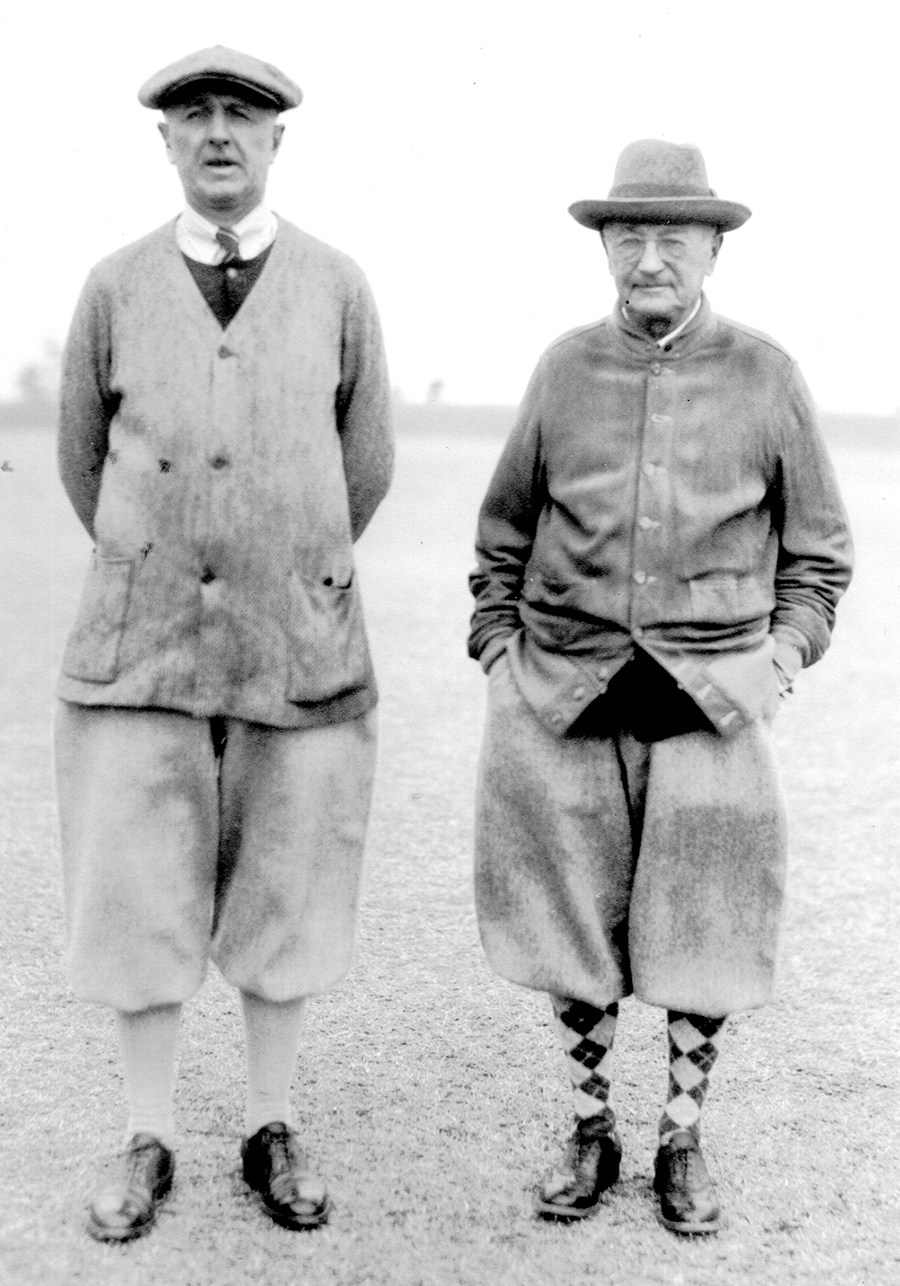
In late March 1904, Walter J. Travis checked into the Holly Inn for three weeks of golf, hoping it would culminate in winning the coveted United North and South Amateur Championship. His arrival was considered a big deal because the Australian immigrant was generally recognized to be the best golfer in the United States — amateur or pro. Called “the most conspicuous figure in the golfing world today” by the Pinehurst Outlook, the 42-year-old Travis, playing out of Garden City Golf Club on Long Island, had won three of the preceding four U.S. Amateur championships, capturing the Havemeyer trophy in 1900, ’01 and ’03.

It was a return trip for Travis, who had already won the resort’s special “Inauguration” tournament in January. “Mr. Travis was delighted with his first visit to Pinehurst,” proclaimed the Outlook, “and he returns, not only with the championship cup in his mind’s eye, but to renew pleasant associations.”

Pleasantness certainly marked his March golf. In a casual four-ball match, the homburg-hatted Travis, partnering with Charles B. Corey, carded a record score of 69 on Course No. 1, then measuring 5,408 yards. In the North and South, he posted the best medal score of all qualifiers and trounced each of his match play opponents en route to the 36-hole final against his four-ball partner, Corey. Emitting clouds of smoke from pungent black cigars, Travis played brilliantly from the outset, leaving his erstwhile partner six holes in arrears after the morning round. Following lunch, he coasted to an 8 and 7 championship victory.

While the North and South was a valued title, Travis had his eye on a greater prize: the British Amateur championship in May at Royal St. George’s Golf Club in Sandwich, England. No American had ever accomplished anything noteworthy in the event. It seemed a pipedream for Travis to think he could stand toe-to-toe with British stars like John Ball and Harold Hilton, considered far superior players to the best in America.

C.B. MacDonald, the renowned course architect and 1896 U.S. amateur champion, thought otherwise, pointing out that Travis was four strokes better over 36 holes than any other American. If Travis (already approaching the life expectancy of the average American male in the first decade of the 20th century) could withstand the rigors of the ocean voyage and change in climate, reasoned MacDonald, he would likely give a good account of himself.

Most golf aficionados “on the other side of the pond” scoffed at the idea. On his previous trip to Great Britain in 1901, Hilton had beaten him easily. Short of stature and weighing less than 140 pounds, Travis was admittedly not a long hitter, a problem because Royal St. George’s was tailor-made for powerful drivers. Could he carry the venue’s vast bunkers like the aptly named Sahara and Himalayas? Most of all, British golf cognoscenti doubted that anyone who hadn’t taken up the game until the age of 34 — and looked even older than his years — could hope to be a true championship player.

Nothing about Travis’ hardscrabble early life suggested that he would become a celebrated sportsman. Born in Maldon, Australia, in 1862, he was the fourth child of Charles and Susan Travis. A native Englishman, Charles had emigrated Down Under in 1852, seeking to capitalize on the country’s gold rush. Though he failed to amass riches, he did land a respected position as a mining engineer. Tragedy struck in 1880, when Charles was killed in a mining accident, leaving wife Susan and their seven children in dire circumstances. When Walter’s older brother perished the following year, the burden of supporting the family fell primarily on him. After it became apparent that work in a grocery store and sheepherding on the side wouldn’t support a family, he took a position with the hardware merchants McLean Brothers in Melbourne. He rose rapidly up the company ranks and, when McLean Brothers decided to open a New York City branch in 1885, 23-year-old Travis agreed to head up the satellite office.

Travis diligently attended to McLean Brothers’ affairs. Though a bit standoffish, he spent convivial evenings with his mates, drinking whiskey, shooting billiards and playing poker. His interests expanded to include bicycle racing, tennis and bird hunting. But his most intense outside interest was courting the comely and spirited Anne Bent.

“For a man seen as dour, abrupt and serious for much of his public life, Travis was effusive, romantic and smitten while courting Anne,” says Bob Labbance, author of The Old Man, a biography of Travis. “He could write six pages about nothing more than how much he loved her, missed her, and couldn’t possibly wait until they were together again.” Anne would play hard to get, but Walter’s persistence won her over, and the couple married on Jan. 9, 1890, settling in Flushing, New York, and parenting a son and daughter.

In 1895, McLean Brothers sent Travis to London on temporary assignment. While there, he learned that several friends back in Flushing intended to become members of a new golf club.

At first, Travis rejected any notion of joining them. He would write that “the game made no appeal to me. I am free to confess that I had mild contempt for it.” But, not wanting to be left out of the mix, Travis grudgingly purchased a set of clubs, “and with anything but pride, brought them over on my return.”

He joined the Oakland Golf Club in the fall of 1896 and embarked on his improbable golf journey. Just a month after hitting his first ball, he won a handicap competition. The next month he finished second in a scratch competition. He was hooked. The golf convert assiduously studied golf instructional books authored by British golf greats Willie Park and Horace Hutchinson. Together with “an enormous amount of experimentation,” it culminated in Travis gaining a well-grooved swing that invariably resulted in an exquisitely controlled hook.

The following summer, Travis, now down to a 7 handicap, entered numerous medal play events, acquitting himself with distinction. He won an event at the Meadow Brook Hunt Club after riding his bicycle to the first tee to submit his entry for the competition. That triumph was followed by a victory in Oakland’s club championship. He won his first foray into a match play event and lost in the finals of another. The press took notice of what was rapidly becoming a Cinderella story. One headline read, “Travis a Surprise — Almost an Unknown Man.”

More titles followed in the summer of 1898. Encouraged, he entered the U.S. Amateur that September. Incredibly, the player of less than two years’ experience made the semifinals. Dogged by poor putting, Travis was beaten decisively in the penultimate match by Findlay Douglas, a player who would become a perennial foe. The two met for a second time in the semis of the 1899 Amateur championship, and Douglas would prevail once again 2 and 1. It was clear, however, that Walter’s golfing skill was fast approaching that of his fiercest rival.

Prior to the 1899 Amateur, Travis was approached by a friend, James Taylor, to see if he would be interested in working with architect John Duncan Dunn in designing a new course, Ekwanok Golf Club, in Manchester, Vermont. America’s early courses often featured flat, square-shaped greens with bunkers, chocolate drop mounds, and hazards sprinkled across the entire width of fairways. Travis believed such hindrances should be placed at the sides of fairways so as not to penalize straight hitting, and that greens should have varying shapes and undulations. Sensing he could design a layout with more challenging features than most he had encountered, he accepted the invitation.

Travis spent much of September and October of 1899 in Vermont, immersed in Ekwanok’s construction. His detail-oriented mind and organizational skills proved well-suited for the multi-faceted task of designing and building a golf course, and he relished the work. The finished course, recognized as excellent in all regards, helped establish Travis as an architect of stature.

Early in 1900, the Travis family moved from Flushing to a house in Garden City, where he joined the Garden City Golf Club, a short walk from home. He was immediately appointed club captain and chairman of the green committee. As such, he made numerous design changes which toughened the course. His choice of Garden City proved especially timely because the club was hosting the 1900 U.S. Amateur. By the time the championship began, Travis knew every blade of grass on the course’s 6,070-yard layout. Medalist in the 36-hole qualifier, Travis blitzed through four opponents to the final where, once again, he confronted Findlay Douglas.

Despite having lost twice before to Douglas in the championship, Travis exhibited fearless confidence in this encounter. “Always be on the aggressive,” Travis would write in his autobiography. “(Be) quite sure of yourself and never give an opponent the psychological advantage of imagining you are the least afraid of him.”

Travis more than made up for his relative lack of length with stellar pitch shots and sand play. “Eight times Travis got into the sand hazards or in the long grass,” reported Golf magazine, “and each time with his iron he laid himself dead to the hole.” He led Douglas by three holes after the morning round. During the afternoon, Douglas made inroads on the lead, and was only 1 down coming down the 18th. By then a torrential downpour had flooded the course, and the home green was transformed into a virtual lake. Still, play continued.

After successfully splashing his approach onto the waterlogged green, Travis needed to get down in two strokes for the championship. He concluded, however, that rolling a putt with a mostly submerged ball was impossible. Instead, he executed a brilliant flop shot that left his ball inches from the hole, clinching the match. Just three years and nine months after his first strike of a golf ball, Travis had won the national amateur and vanquished his nemesis Douglas. He repeated as amateur champion in 1901 and won the title a third time in 1903. He also finished runner-up to Scotland’s Laurie Auchterlonie in the 1902 U.S. Open, also contested at Garden City.

Thus, while the Brits airily belittled his chances of winning the 1904 British Amateur, Travis was quietly optimistic, having just won the North and South in Pinehurst. Four Garden City club members accompanied him to Great Britain. The entourage referred to themselves as Walter’s “board of strategy.” The jocular Simeon Ford was among them. Ford would cheekily recall Travis’ debilitating seasickness during the ocean voyage. “He (Travis) spent the major portion of the time leaning over the rail, perfecting his follow through, and casting his bread upon the water.”

Once on shore, Travis’ queasy stomach became the least of his concerns. His good form vanished in wretched practice rounds at St. Andrews and Prestwick. He felt completely lost. Fortunately, his game markedly improved once he arrived at Royal St. George’s.

“From the first ball I struck, I knew I was on the road to recovery,” he wrote.

Travis’ putting had been particularly atrocious. On the eve of his opening match, an alarmed board of strategy cohort lent his personal putter to Travis. The “Schenectady” was a center-shafted mallet putter quite unlike the paper-thin blades then universally used. The loaner proved to be a godsend. In his final practice round, Travis suddenly began holing putts from outlandish lengths.

His golf was turning around, but Travis was growing increasingly resentful of how the Brits were treating him and his friends. Presumably due to oversight, no rooms had been reserved for them at the hotel where the other players were housed. The club failed to provide Travis a locker; he was relegated to changing clothes in a public hallway. The better players declined playing with him in practice rounds. The caddie assigned to Travis was beyond incompetent, “a natural-born idiot, and cross-eyed at that,” he groused. Officials refused Travis’ request for a replacement. Unlike the top British players, he was not afforded a first-round bye. British spectators cheered his misses. For the seething American, these incidents provided what would have been bulletin board material, had such a thing existed. The slights spurred Travis on, as he later acknowledged metaphorically. “A reasonable number of fleas is good for a dog,” he mused. “It keeps him from forgetting he is a dog.”

In The Story of American Golf, Herbert Warren Wind described the unusual methods the board of strategy employed each evening to prepare Travis for the following day’s matches. “They played cribbage with him and fed him large portions of stout,” while lauding the talents of prospective opponents. Goaded and fortified, a steely Travis stormed to the semifinal, leaving four opponents in his wake. His deadly accuracy with the Schenectady astounded everyone. Fears that his shortish drives would not surmount Royal St. George’s cavernous bunkers proved unfounded — but just barely. Time and again, he would carry the sand by about a yard, frustrating his opponents and those touting British superiority.

In his semifinal match, Travis confronted none other than Horace Hutchinson, the man whose instructional book he had devoured. With spectators openly rooting against the upstart American, Travis fought his way to the championship match, defeating his “teacher” 4 and 2. In the final, he faced Ted Blackwell, regarded as one of the game’s longest hitters. But Travis assumed control of the match from the outset.

“I had a comfortable feeling all through,’ he would recall, “and after the first few holes had been played, I felt certain of winning.” His black cigar smoke permeating the crisp air, Travis coasted to a 4 and 3 victory. The Scotsman described him as “coolness personified.”

The triumph marked the first glimpse of the coming American hegemony in golf. “No international sporting event for a long time has created the widespread interest that has been excited by Travis’ victory. Travis may now justly be called the amateur golf champion of the world,” claimed The New York Times.

Westchester Country Club, West Links

Feted as a conquering hero upon his return to New York, Travis’ celebrity status opened the door to lucrative opportunities including new course design assignments. Having authored his own instruction book, Practical Golf, in 1901, Travis was widely sought as a contributing writer by golf-related magazines and penned pieces on topics ranging from proper upkeep of greens to the art of putting. In 1908, he became the owner and editor of a new magazine, The American Golfer, a publication that he promised would promote “the best traditions of the Royal and Ancient game.” Among the backers of the venture was Pinehurst mogul Leonard Tufts.

Able to mostly support himself from golf-related activities, Travis resigned his post with McLean Brothers. There were occasional mutterings that his receipt of income from golf architecture and writing ought to disqualify him from amateur competitions, but USGA rules were not specific on the matter, and most concluded that Travis wasn’t doing anything wrong.

By the time Travis took the reins of The American Golfer, the 46-year-old had already been tagged with the moniker “the old man.” Due perhaps to advancing age or focus on the magazine, the single-minded competitive drive that had characterized his golf began to wane. His days of winning national titles were behind him as talented young stars like Chick Evans and Jerry Travers rose to prominence.

Still, Travis remained a threat to win any tournament he entered throughout his 40s. He relished playing, particularly in Pinehurst, which from 1904 until 1915 served as a second home for him from January to April. Travis would typically arrive after Christmas and stay at either the Holly or The Carolina through Valentine’s Day, then migrate to Palm Beach for a month before returning to Pinehurst in mid-March. It would be Travis’ headquarters until the conclusion of the United North and South Championship in mid-April. In all, he won that coveted event three times, following up his 1904 title with victories in 1910 and 1912 — at age 50.

Travis participated in a number of lesser Pinehurst tournaments, winning more than his share. His trophies included the Mid-Winter, St. Valentine’s Day, and Spring tournaments. The competition he faced was stiff, and he lost more than he won. He played numerous four-ball exhibition matches, many involving the Ross brothers, Donald and Alex. Hundreds of resort guests eager to see him in action attended. His conspicuous presence undeniably enhanced Pinehurst’s growing reputation and, as editor of The American Golfer, he arranged for extensive coverage of Pinehurst golf doings throughout its season.

Travis’ most important contribution to Pinehurst golf, however, may have been his role in transforming easy and bunker-free Course No. 2 into a venerated championship venue, maintaining that he was the person who persuaded the resort’s owner to redesign the course. “For several years, I had been at Mr. Tufts, the proprietor, to make this (No. 2) an exacting test,” wrote Travis in his 1920 piece for The American Golfer. “Finally, in 1906, I won him around to my way of thinking . . . ”

He further claimed that Tufts gave him the job of making the required changes to No. 2. “He gave me carte blanche to go ahead,” he wrote. Travis maintained that he was responsible for bringing Donald Ross onto the project. “I knew the changes I had in mind would result in a big uproar at the start, and I didn’t feel like shouldering the whole responsibility. So I suggested that Donald Ross and I should go over the course together and, without conferring, each propose a separate plan. I knew what the result would be.”

While stopping short of taking credit for No. 2’s redesign, Travis did say that Ross adopted virtually all of his suggestions, and that the Scottish transplant “was merely an echo of my own views regarding golf course architecture.”

While it’s fair to speculate whether Travis could have been exaggerating his role given his substantial ego — and the fact that he made these boasts 14 years after the events in question — it’s also reasonable to assume that in redesigning No. 2, Ross would have listened to anything the country’s leading golf figure (and fellow architect) had to say. And Ross never publicly contradicted Travis’ account. Whatever the extent of his involvement, it would seem Travis deserves, at minimum, some credit for contributing to the Ross masterpiece.

While normally restrained in his emotions, Travis effusively expressed his affinity for Pinehurst in remarks at a 1911 banquet at the Holly Inn. Travis said Pinehurst had come to have a “very warm place” in his heart and that “what St. Andrews is to golf on the other side, Pinehurst is to the game in America.”

The Old Man competed in Pinehurst events well into his sixth decade and, at age 53, won the resort’s March 1915 Spring Tournament. “Surely golfers may come and go,” reflected an admiring piece in the Outlook, “but Travis goes on forever! Straight down the alley, straight for the pin, straight for the cup.” But age was taking a toll on his already insubstantial drives, something that didn’t escape the notice of frequent playing companion Ross. “I watched him get crabbier and crabbier the older he got,” confided Pinehurst’s masterful architect. “He was always a great putter . . . but his long shots became shorter and shorter and he couldn’t reconcile himself to his loss of distance.”

Not long after that final Pinehurst victory, Travis decided to quit playing major events. While the decline in his play surely factored into the decision, the USGA was also on the threshold of adopting a rule that would result in golf course architects losing their amateur status. Travis was looking forward to expanding his course design business and, realizing it might be problematic, retreated from competitive efforts altogether. He elected to make the 1915 Metropolitan Amateur at The Apawamis Club in Rye, New York, his last important event. He shocked everybody with a series of impressive victories in the preliminary matches, even edging the formidable Travers, en route to the final where he faced John G. Anderson.

Travis’ supporters questioned whether he could still summon the necessary stamina and concentration for a 36-hole match, and he did flag down the stretch, blowing a 3-up lead over Anderson in the final nine holes. The match stood dead even as Travis staggered to the final green. He needed two putts from 40 feet to send the contest to extra holes. Instead, he electrified onlookers by holing the mammoth putt for the championship, his fourth Met title, and a spectacular farewell to big time golf for “The Old Man.”

Travis’ architectural services were increasingly in demand. Over his lifetime, Travis would design or remodel at least 50 courses, many now regarded as timeless classics. His notable projects include courses at Yahnudasis Country Club (Troy, N.Y.); Westchester Country Club (Rye, N.Y.); Equinox Golf Links (Vermont); Jekyll Island Golf Club (Georgia); Hollywood Golf Club (Deal, N.J.); Country Club of Scranton (Pa.); and modifications at Garden City. He designed courses until the end of his life in 1927, and today the Walter Travis Society continues to celebrate his accomplishments.

In 1979 he was inducted into the World Golf Hall of Fame. Given his late start, it is difficult to conceive how Travis managed to pack so much achievement into such a short period of time. Still, it was never quite enough. “Full as my cup has been,” Travis reflected, “I shall never cease to regret the many prior years which were wasted.”  PS

Pinehurst resident Bill Case is PineStraw’s history man. He can be reached at Bill.Case@thompsonhine.com.

Building Strong Roots

Reconstructing a Pinehurst landscape

By Claudia Watson    Photographs by Laura Gingerich

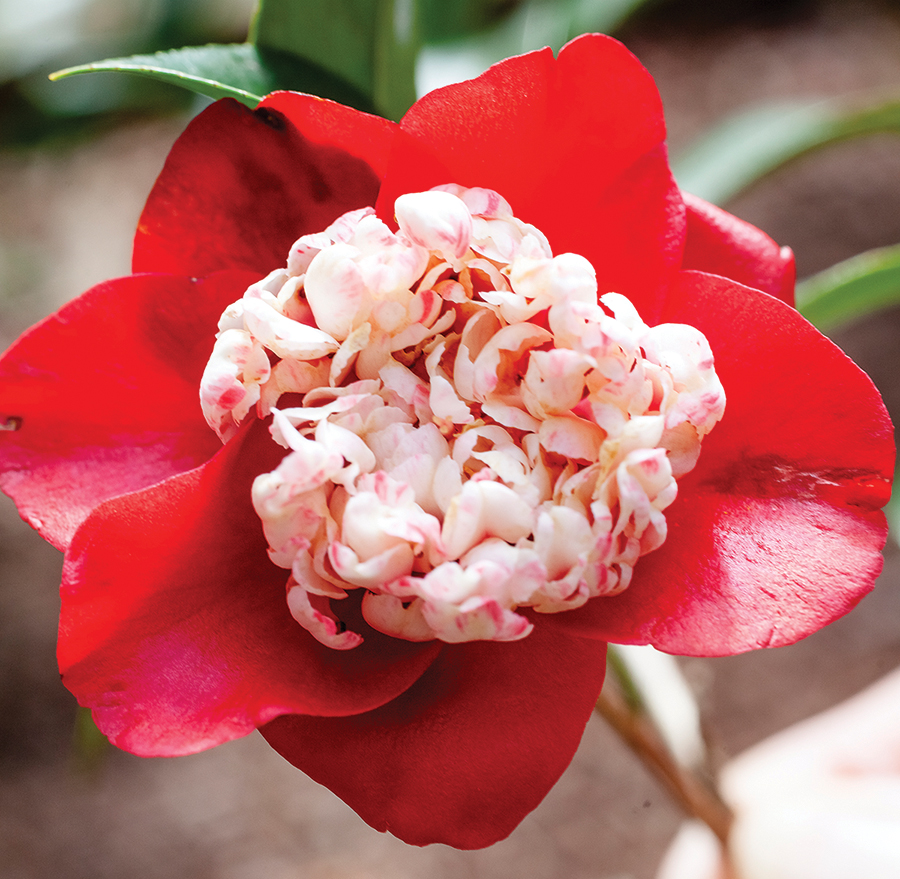
A little cottage on a well-kept street in old town Pinehurst sparked my curiosity for nearly two decades. The modest, single-story house hid behind a towering barricade of overgrown hollies. It looked melancholy except for a single camellia that hugged the tiny porch and bloomed during the dullest days of winter.

The house was built in 1957 of clapboard beveled heart pine siding and painted a then-trendy minty green. On occasion, an older woman cautiously peeked out a barely opened door, looking distraught by it all.

Nearly six years ago, after the owner died, there was an estate sale, mostly glassware, kitchen items and furnishings. A shed, almost fallen with age, was strewn with rusty yard tools and broken pots. All of it seemed so sad.

I was not the only one who was captivated by the old house. Sean Butler stopped by often to check on the owner and offered help with repairs.

“In its day, I knew it was a very nice home. It had good bones,” recalls Butler, owner of Butler Constructs. He and his business partner, Wes Smith, who lived in the neighborhood, walked through the house the day of the estate sale and made an offer on it that day. They purchased the half-acre property in 2015.

Butler’s redesign of the house maintains the original structure’s required exterior “cottagey” style. Inside, he let his imagination work as he drafted a new plan for the home, nearly doubling its size.

As work on the house continued, Angie Averitte and Patti Rainwater, both highly focused on buying a cottage in old town, noticed the renovation.

“We were in town with our real estate agent, stopped and saw that it was going on the market the next day. It was meant to be,” smiles Averitte after explaining they’d lost out on two other houses in the bidding wars of a hot real estate market.

Born down the road in Hamlet, North Carolina, Averitte started working for the predecessor of CSX Railroad in the small town. Her management career required relocating all over the East. “We called ourselves gypsies because we moved 12 times in 25 years,” she says.

When she closed her career with CSX after 38 years, she and Rainwater, a project manager for a home health company, lived in Nashville. Averitte’s desire to be with family coaxed them back to the Sandhills. “We moved back Christmas week of 2018. It was a good way to get out of Christmas,” she laughs.

Once settled, they recognized that living in a smaller house would take some adjustment. While they had many “what-if” dreams — they weren’t particularly conscious that the landscape might play a role in helping them put down strong roots.

During the late winter months, they’d walk the property assessing its potential. “We had a new patio, an old shed, some dead shrubs and a bit of a drainage issue, and didn’t know where to begin,” says Averitte. “We wanted livable outdoor space that was pretty, offered privacy and a place for entertaining. It was obvious that we needed help.”

At the suggestion of a friend, she called and then hired Dee Johnson, a highly recognized landscape designer who has always had a deep passion for gardens and horticulture. Growing up in rural West Virginia, Johnson often worked alongside her grandmother, an avid gardener. She and her parents enjoyed the outdoors, and getting their hands dirty was part of each day. She studied botany in college and relocated before receiving an undergraduate degree. When she and her husband moved to the Sandhills, she explored the Landscape Gardening program at Sandhills Community College.

“I thought it would be a nice hobby,” she laughs. She earned an associate degree in landscape gardening and began teaching in the Continuing Education program. After receiving an undergraduate degree in education and a master’s degree in agricultural extension education, she returned to teaching. Appointed coordinator of the landscape gardening program at SCC, she held the post 17 years. Her private design business remained in the background, but she geared it back up once she retired.
Johnson describes her design style as naturalistic — and she does not mean native plants, but plants in their natural form. Though she does design formal Williamsburg-type landscapes, these are not her preference. She disdains power shears used to make meatballs of shrubs.

“Plants will fight you tooth and nail. If it’s not supposed to be round, don’t make it. It’s going to try to go back to its natural state,” she insists.

One of Johnson’s formative influences is British landscape designer John Brookes, who introduced the notion that “gardens should be low-maintenance as well as beautiful by recognizing the proposed use of a garden before designing it.” He felt this ensured “that lifestyle, architecture and garden are a harmonious whole.”

Johnson uses the same approach with clients, and emphasizes they need to consider how they want the space to function. Those characteristics and the site orientation, house style, outbuildings and cultural history drive her gardens’ design and style.

These aspects are equally important as the practical considerations of budget and how much time the owner has to maintain the area. Being prepared with the information upfront keeps the plan and planting scheme on track and tailored toward the client’s taste.

Even if it’s a DIY landscape renovation, going in without a plan is not a good strategy. “It’s like going to the grocery store without your list. You’ll end up spending money on things you don’t need, then trying to find a place for it all, and then digging yourself out with a shovel for a long time,” Johnson says.

After a thorough site assessment, Johnson presented her proposal, including landscape and hardscape details, budget and timeframe. Though not a requirement of Johnson’s, Averitte and Rainwater elected to have her bid out the project and supervise the installation to ensure its successful completion.

Johnson promised a turnkey project. She used Joe Granato of Star Ridge Aquatics and Richie Cole of Knats Creek Nursery, two contractors who know her work and expectations. Start to finish, the project was completed in eight weeks, and just in time to take full advantage of the autumn rain and cooler temperatures that gave plants their roots.

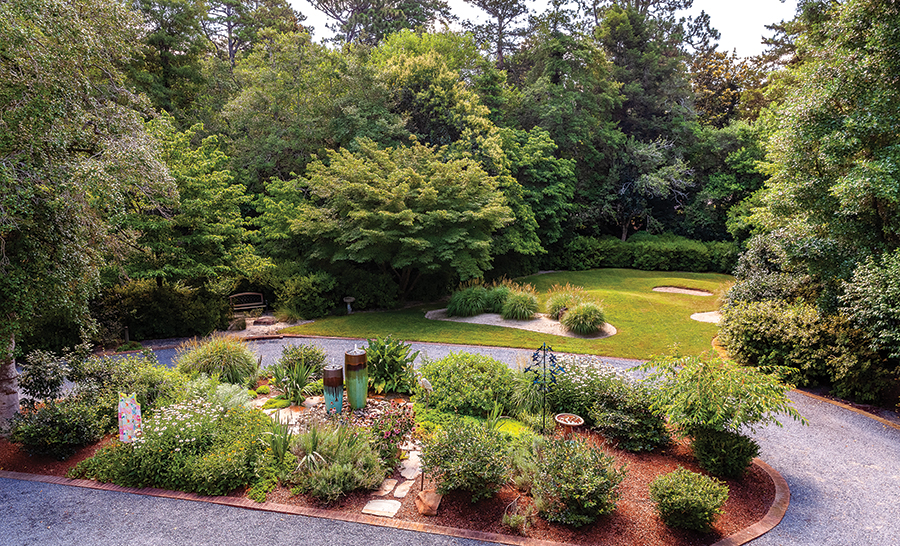
The design is balanced and merges beautifully with the surroundings. It sets the space for arrival, and an invitation to explore and participate in the landscape. There are distinct areas of the landscape, with some “rooms” open and spacious, and others cozy and intimate. All of it is colorful year-round.

At the front entry, a whimsical masked tin pig peeks out from under the giant leaves of a potted philodendron Philodendron selloum that Averitt has toted around for 30 years. Another keepsake, a toxic Jerusalem cherry evergreen shrub Solanum pseudocapsicum, steals the show with boldly red, yellow, and orange fruit.

The owners, not fans of crape myrtles, asked that the two crape myrtles next to the house be removed. Johnson creatively moved them forward to a new planting bed between the semi-circular driveway entrances.

“This is a basic design principle,” explains Johnson. “You want to soften the edges of the house and the roof ridgeline and move your eye toward the front door.” 

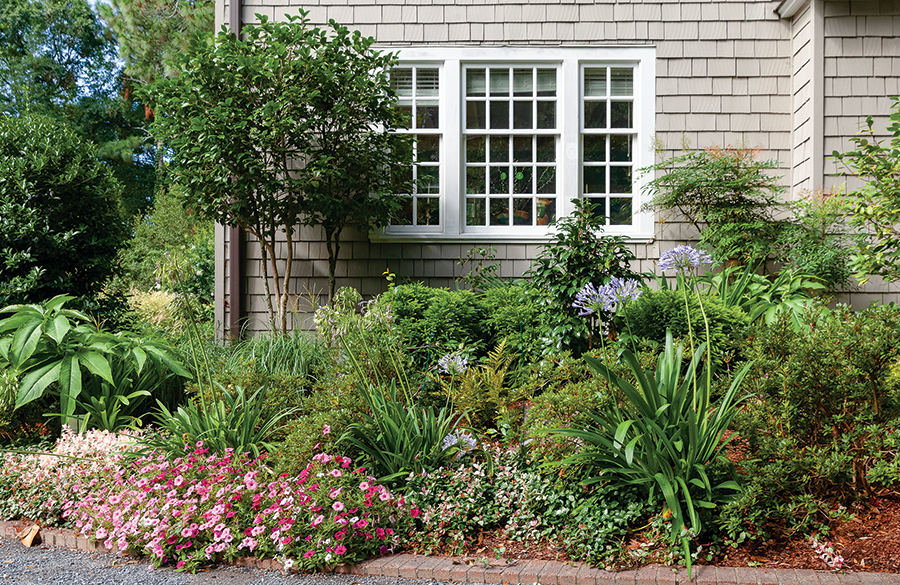
The crape myrtles give height to the area, as dwarf buddleia, fountain grass, rosemary, variegated liriope and yucca offer a tidy look and color throughout the year.

As with many old town cottages, the practical but pesky issue is the lack of a garage. For the owners, who have two cars, maneuvering to park in the semi-circular driveway was tricky.

“Every time I was there, someone had to move a car,” recalls Johnson. She widened the driveway to permit another car to move by a parked car and added a parking area to the side. Now, tumbled stone edging keeps driveway gravel out of the grass and provides a finished edge that blends in with the surrounding plantings.

Johnson carefully plants closer to the property’s edge, which helps define the barefoot-friendly Zeon zoysia lawn. The garden areas serve as visual boundaries to the property, creating a pleasing view from inside the house by giving the eye more to see than just grass.

The small, one-story house suggests the plantings’ scale and shape, and a linear planting design combined with curved beds keep the eye moving across the site. The use of plants with shorter growth habits allows the owners to enjoy the view from their windows without much maintenance.

From the street, a passerby catches a glimpse of the colorful perennial and herb garden. It’s tucked into the back corner of the property and bordered by a cedar privacy fence. The old shed was renovated to become the she shed, its lines softened by blueberry bushes at the entrance and the young hardy kiwi vines Actinidia arguta ambling skyward along a sturdy cedar arbor.

Anchored by a delicate ‘Forest pansy’ redbud Cercsis canadensis, several Camellia sasanqua ‘Survivor,’ and a trio of winter hardy Hydrangea paniculata ‘Limelight,’ the garden provides breathtaking summer and late autumn color.

In the spring, the Itea virginica ‘Little Henry’ blooms in a cascade of lightly fragrant white spikes. Its foliage deepens to orange and red colors into autumn. Existing loropetalum, boxwoods, and miscanthus grasses were relocated to the area to extend the allure during the winter months.

But it’s the perennials that provide the punch. The flower combinations complement each other rather than clash or compete.

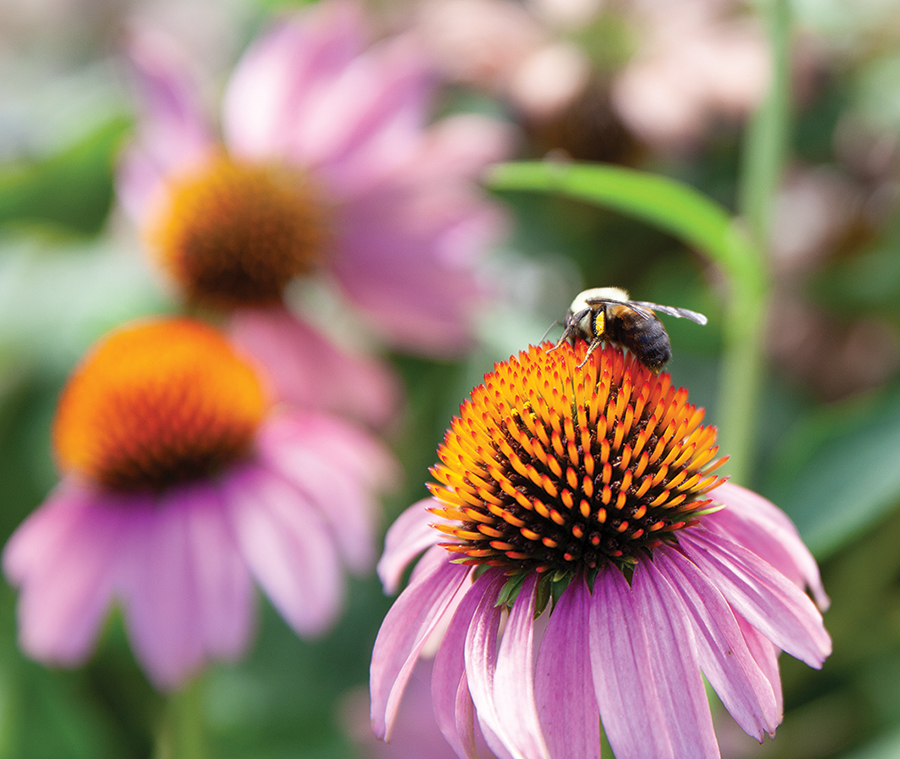
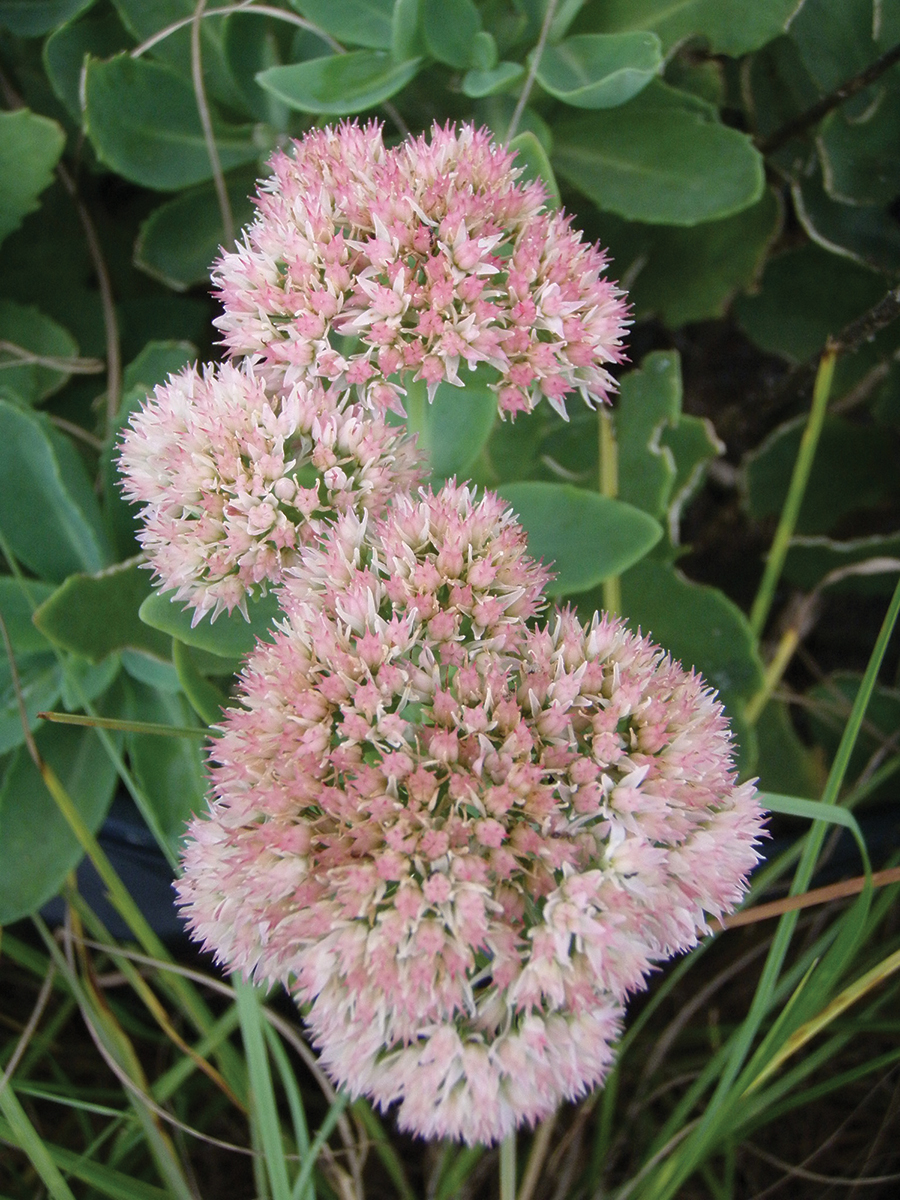
Pollinator favorites like Coreopsis Coreopsis lanceolate ‘Moonbeam,’ Walker’s Low catmint Nepeta x faassenii ‘Walker’s Low,’ Coneflower Echinacea purpurea, Goldstrum black-eyed Susan Rudbeckia fulgida, Black and Blue Salvia Salvia guaranitica, and the dependable Stonecrop, Sedum ‘Autumn Joy’ enliven the garden.

Johnson blends eucalyptus, lamb’s ear, rosemary, culinary sage and English lavender into the garden with an appreciation for the texture and fragrance offered by silvery foliage.

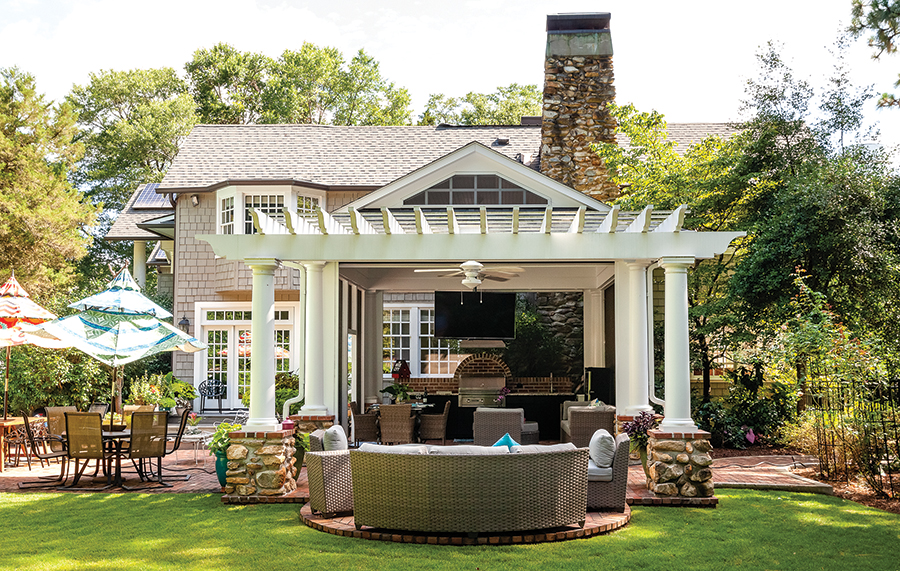
Just out the kitchen door is the often-used pergola-covered patio. It’s become a favorite spot for a glass of wine before dinner, especially when the nearby cluster of gardenia Gardenia jasminoides ‘Kleim’s Hardy’ releases its heavenly scent.

But of all the new spaces, it’s the striking fire pit that draws the accolades. A curved stone walkway leads to the area that seats six in rainbow-colored Adirondack chairs conveniently outfitted with cup and wineglass holders.

“It was insightful, though we didn’t know it at the time,” Averitte remembers. “When COVID started, we didn’t interact with anyone for two to three months. Once spring came, and the yard was full of blooms, we invited two friends over and a couple of neighbors. It morphed into a pretty cool and safe way to visit in the middle of this pandemic.”

A sitting ledge hugs the back curve with the surrounding garden filled with Verbena ‘Homestead purple’, English lavender and butterfly bush Buddleja davidii ‘White Provision.’ A laceleaf Japanese maple Acer palmatum ‘Seiryu’ is flanked by two lovely hydrangea Hydrangea quercifloia ‘Snowflake,’ providing visual height, privacy and spectacular seasonal color — at least until the deer discovered them — calling for new options.

As the moon rises in a velvety blue sky, the intimate water garden off the master suite is a tranquil setting with the sound of falling water accompanied by a chorus of frog calls. The backlit Japanese maple Acer palmatum ‘Waterfall’ and saucer magnolia Magnolia soulangeana ‘Jane’ offer a pretty backdrop. Dwarf gardenias Gardenia jasminoides ‘Radicans’ provide fragrance, and Sweet flag Acorus gramineus ‘Ogon’ adds spiky texture and bright color.

Averitte says she was impressed by Johnson’s attention to detail and dedication to the project. “Her work touched every part of our property and, in so many ways, and that’s enhanced our lives.”

Living in a smaller house has been a significant change. Still, she and Rainwater agree that they have a greater appreciation for nature’s calming power, especially during the pandemic.

“It’s become our sanctuary,” says Averitte quietly, who never considered herself a gardener. “I find myself in the garden and bringing the garden inside now — taking snippets, spending time deadheading plants, and thinking about how this beautiful place is all ours now. We’ve put down our roots and will be here for a long time.”

As for the little cottage, it’s renewed and happy again, too.  PS

Claudia Watson is a frequent contributor to PineStraw and The Pilot and finds the joy in each day, often in a garden.