A son’s moving remembrance of his struggle to win the love of a father whose emotions were as strange as the life he led
By Charles Price
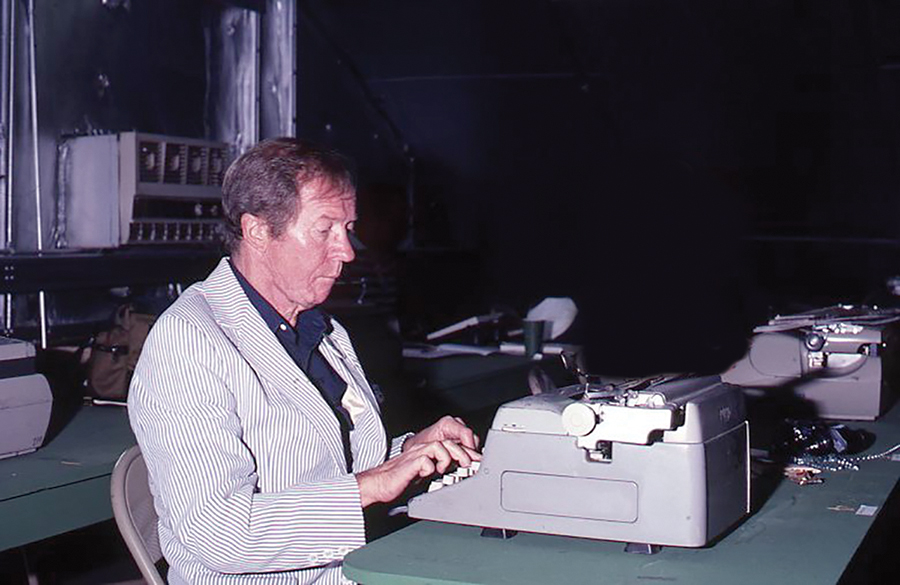
Photograph from the Tufts Archives
Charles Price was one of the greatest golf writers of the 20th century. I don’t know if he was at the very top of the mountain, but I do know he always worked above the tree line.
When he was in his late 20s, Charley spent a year driving Walter Hagen around Michigan’s back roads trying, unsuccessfully, to get a book out of him. Years later he became Bobby Jones’ legs during the Masters tournament, tracking down people who Jones, by then an invalid and confined to his Augusta National apartment behind drawn drapes, wanted to chat with.
Price got his start at Golf World when Bob Harlow, The Haig’s onetime agent, was still alive and Harlow’s fledgling magazine was located in the old warehouse building near the railway trestle in Pinehurst. He came back to the village to spend his last days, passing away in 1994.
Charley was a heavyweight writer but a bantamweight guy, thin as a hickory shaft and standing eyeball-to-eyeball with wee giants like Gary Player. My lasting image of him is striding up the neon green hill at the back of the Augusta National clubhouse as if the ghost of Jones had just summoned him, leaning into the climb, wearing soft shoes and a double-breasted blue blazer.
Price tried to play the professional tour as an amateur, in the days when such a thing was possible. One day on the putting green, Clayton Heafner — a very large man — said to him in his cozy North Carolina drawl, “Charley, have you noticed anything about the boys out here? Most of them are built like truck drivers with the touch of a hairdresser. You, on the other hand, are built like a hairdresser with the touch of a truck driver.”
Charley enjoyed telling that story, not so much because it was about him but because, I think, he admired the way Heafner put it together. He was kind to young writers, this young writer anyway, but didn’t suffer fools gladly. In that respect, he was very much like the man he writes about in this story, his father, published in the April 1959 edition of Coronet. — Jim Moriarty
My father was a gambler — a professional gambler. Among the people who came to his funeral were an ex-prizefighter, a strip-tease dancer, a millionaire, a cab driver, a farmer, a police captain, a nightclub comedian, our maid, a Sicilian with tattooed hands, and a bookmaker who couldn’t stop crying. There was also a man my father had once punched in the jaw.
I was surprised not at all that this man came to pay last respects to my father. I suspect he sincerely liked my father despite the fact he had once been humiliated by him. It was one of the oddities of my father’s life that everyone was always slightly terrified and mystified by him — even those he loved. I know I was. He was as inscrutable as the king of spades. I never really knew him until he was dead.
On the desk in front of me as I write is a photographic portrait of my father. I haven’t the remotest idea what he might have been smiling about. I was never very sure of anything about my father. We spent the better part of our lives together playing poker for our emotions, neither of us daring to tip his hand.
During the 1920s, when I was born, my father had operated backroom casinos in Philadelphia and Atlantic City. Before that, he had been a bookmaker. (When my mother first got to know him, she had been under the impression that he was in the publishing business.) And before that, a croupier, a bartender, and a number of other things he refused to discuss about his younger years in downtown Philadelphia.
During the last 15 of his 63 years, he had been majordomo of a gambling house in Maryland, only a few feet outside the District of Columbia. It was the largest, most colorful casino between Saratoga and Havana. Of course, it was also against the law, a discrepancy to which, however, few persons paid any attention. The integrity of my father’s casino was so beyond question, even congressmen patronized it.
Many professional gamblers have declared that my father was the best card player they have ever known. He also knew everything there is to know about craps, roulette, bird cage and other games that are outside the law of most states.
He was also acquainted with every notorious hood, cheat and racketeer on the East Coast, and he was afraid of none of them. He was accustomed to being entrusted with large amounts of other people’s money. He always kept his mouth shut about other people’s affairs. And he was scrupulously honest.
These were the qualities that set him apart from ordinary gamblers, and that enabled him to walk the underworld, if need be, with no more armor than his pinstriped suit and the incongruously flamboyant neckties he always wore.
From the time I was a little boy I was aware that my father was a man apart, not only because he was my father but because he was a creature of peculiar habits. No other father in our neighborhood, for example, arrived home from work at dawn. Sometimes, if he were particularly tired, I would be awakened by his heavy footsteps as he climbed his way to the third-floor attic, which had been converted into a sumptuous bedroom for his strange hours of sleep. To protect him from the daylight, the room had been decorated with thick drapes and blackish wallpaper. There my father slept until noon, filling the house with his resonant snoring, which I could hear even when playing in the cellar.
My father always came downstairs to breakfast dressed in his pajamas and a splendid silk bathrobe, his eyes still half-filled with sleep and his thin hair spectacularly awry on his head, like a Hottentot’s. He never said good morning to anybody, not even to my mother. Indeed, he would not speak a word until he had been fed. His breakfast was always the same — a pint of orange juice, black coffee and a thick slice of chocolate layer cake.
As a small boy, I would sometimes sit quietly across the breakfast table from my father and stare at him, fascinated by his magnificence. When he caught me looking at him, he would stop eating and lay down his morning newspaper. Peering over his reading glasses at me, he would say, not unkindly, “Is there something you want?”
I would shake my head and then scamper off, embarrassed. My father would shrug his shoulders and then go back to his breakfast.
When my father went to work, he would put on his overcoat and a large fedora, whose brim he kept rolled upward, like a Homburg. Then he would light a cigar, puffing vigorously to get it burning. Just before he reached for the door, he would blow out a cloud of smoke so thick that it would hang in the air long after he had left. As he grabbed the doorknob, he would turn to my mother and me. “Well … ” he would say, and mumble something, which we had to assume was a goodbye. Then he would close the door behind him without another word, climb into his black car and roar off to work, not to be seen again until the following noon.
My father’s favorite form of recreation was the legitimate theater. A well-performed tragedy could leave him transfixed. At a performance of Death of a Salesman, my mother once told me, my father actually burst into tears. I was astonished to learn of this, because I felt sure at the time that in real life my father would have considered Willy Loman a fool.
After an accident I had when I was 13, my father failed to visit me in the hospital. Despite the many logical excuses my mother made for him, I was bewildered and hurt. Today I know that he didn’t come because he couldn’t bring himself to see me hurt.
My father never wrote a letter to me in his life. If he had, it would today be framed and sitting on my shelf. Correspondence between us was handled by my mother, who wrote at length to explain the many fond thoughts my father had of me when we were separated, thoughts he somehow couldn’t bring himself to express when we were together.
My father lavished gifts on me, but to my knowledge he never personally bought me any of them. He considered the giving of presents unmanly. But he could periodically give $10 tips to a blind news dealer. (I doubt that he could have given them to a man who could see him do it.) He could send $100 — anonymously — to a lifeguard who had rescued somebody. And he could send a girl, who had been disfigured for life in an automobile accident, through college without ever letting her know he had paid the bills.
To this day I meet strangers who, on learning whose son I am, tell me stories of my father’s extraordinary generosity. It will always be a mystery to me, however, how a man could be seemingly so generous yet be so parsimonious when his emotions were involved. While during all my father’s life he remained to me — and still remains to me — as heroic as a father should be, we were in truth as uncommunicative as a father and son could be.
When I was 12, for example, my father sent me to a golf professional at a nearby country club. “Teach him everything there is to know about the game,” he said. His instructions to me were just as simple: “Call all the members ‘mister.’”
When I was 13, I played in my first tournament. I won it, but my father did not congratulate me. He bought me a new set of clubs, instead. I have since played in more than 100 tournaments, but my father watched me play in only one that I can recall.
I saw him standing behind a tree overlooking the fourth fairway. Because the match was a final, it had attracted a small gallery. While it is not uncommon for spectators to stand within a few feet of a contestant, my father wouldn’t come within 100 yards of me. At the end of nine holes, I was two-down. My father got into his black car and drove away. I don’t know whether he felt his presence was making me self-conscious or that he couldn’t bear to see me lose.
When I arrived home, I found him pacing back and forth on the driveway. “Well?” he said.
“I won,” I answered.
At that, my father reached into his pocket, pulled out a roll of bills, and then peeled off a $50 note. “Here,” he said. He handed the $50 to me and then he turned his back, so I wouldn’t see the pride on his face. He wanted dreadfully to congratulate me, but he just didn’t know how. While his manner may have seemed heartless, it wasn’t. My father was willing to be a father, but he refused to act like one.
When I was graduated from high school I was given a watch which I purchased myself with money my father gave me. Childishly perhaps, I was disappointed that he had not purchased the watch for me himself.
After high school, I attended two different colleges. My father visited neither one, not even on the day I was graduated. Since nothing had been said about his attending the exercises, I didn’t bother going myself. My diploma was mailed to me. When it arrived, I showed it to my father. He glanced at it, and then he told me to go downtown and buy a car for myself. For a moment, I thought I hadn’t heard him correctly. The tone of his voice was so matter-of-fact. You might have thought he was asking me to go down and buy him a cigar.
I am certain that my father was proud of me. I am positive he loved me. But it was our misfortune that we could not bring ourselves to exchange this information.
When my father was drawing close to death, we arranged a bed for him in a second-floor living room. One evening when I was alone with him, he sat up and said, bluntly, “I’m dying,” and he looked straight into my eyes. I couldn’t answer. My father swore softly under his breath, then lay back in bed.
All that night, I held my father’s hand. A croupier from my father’s casino gave him his medicine and wiped his brow. Near dawn, I climbed to my father’s attic and threw myself exhausted on his bed.
While lying there, I knew for the first time just why I loved this man to whom even the ordinary signs of love had always been embarrassing. I understood then how unselfish he had been in never trying to mold me in his own image, unlike so many fathers who act the paternal role to its fullest.
I saw, too, that despite the fact his life had been carried on outside the pale of ordinary society, he had always conducted himself with personal dignity. I decided that when I awoke I would somehow force myself to tell my father how much I loved him. Our lives together had been largely spent trying to divine each other’s feelings, and I had grown weary of the game.
I had been asleep about two hours when the croupier aroused me. “Wake up!” he said, shaking me. I sat up in bed and rubbed my eyes.
“You’d better come downstairs,” he said quietly. “Your father’s dead.”PS
According to Alfred, Lord Tennyson, “Old age hath yet his honor and his toil . . . ”
Maybe, but the inevitable task of dividing up possessions and moving from a beloved family home is usually more toil than honor. This process, now called downsizing, may cause trauma for elders and squabbles among children.
Not for Jane and Dan Clark. Heavens, no.
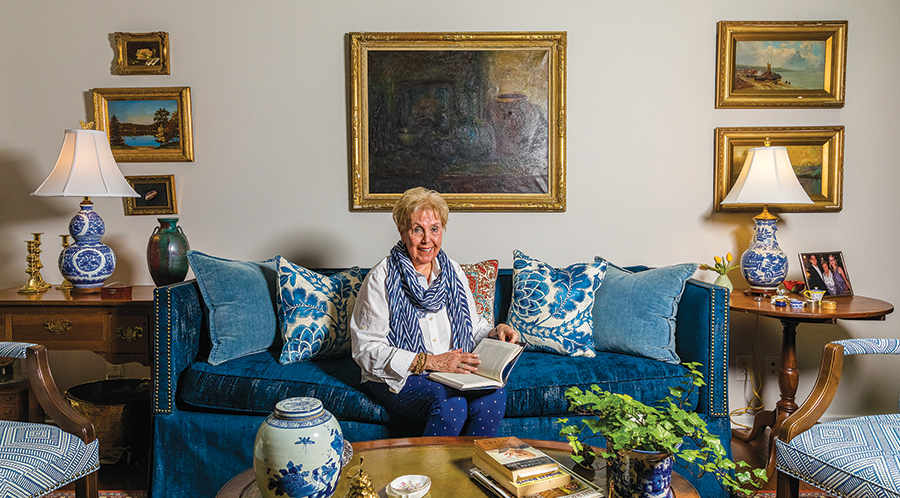
“I took all my pretty things,” Jane says, upbeat and with a touch of defiance.
This defiance created in a 1,500-square-foot Penick Village cottage a microcosm of the Clark’s 5,000-plus-square-foot manse on Massachusetts Avenue and, more recently, an Aberdeen home of equal size set on 12 wooded acres, suitable for the lifestyles of Dr. Dan Clark, a radiologist, and Jane, Southern Pines mayor in the 1980s. In addition, the Clarks retain a charming historic coastal home in Southport, which Jane calls her “happy place.”
Jane and Dan played marbles in kindergarten. Their friendship continued through school in the farming community of Everetts, current population 179. They married, were deployed by the Army to Texas and Japan, settled in Southern Pines in 1970. Dan established Pinehurst Radiology, and Jane took up politics. By the late 1980s she became Southern Pines’ Madame Mayor.
This power couple needed space to raise four daughters and entertain. Jane filled it with lovely things found in the shops of Charleston, Savannah, New Orleans and elsewhere.
No auctions. “I might go over budget.”
Her method: “I see it; I like it; I buy it.”
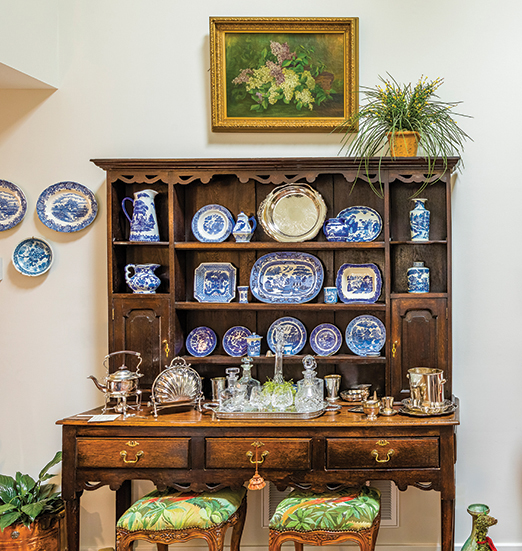
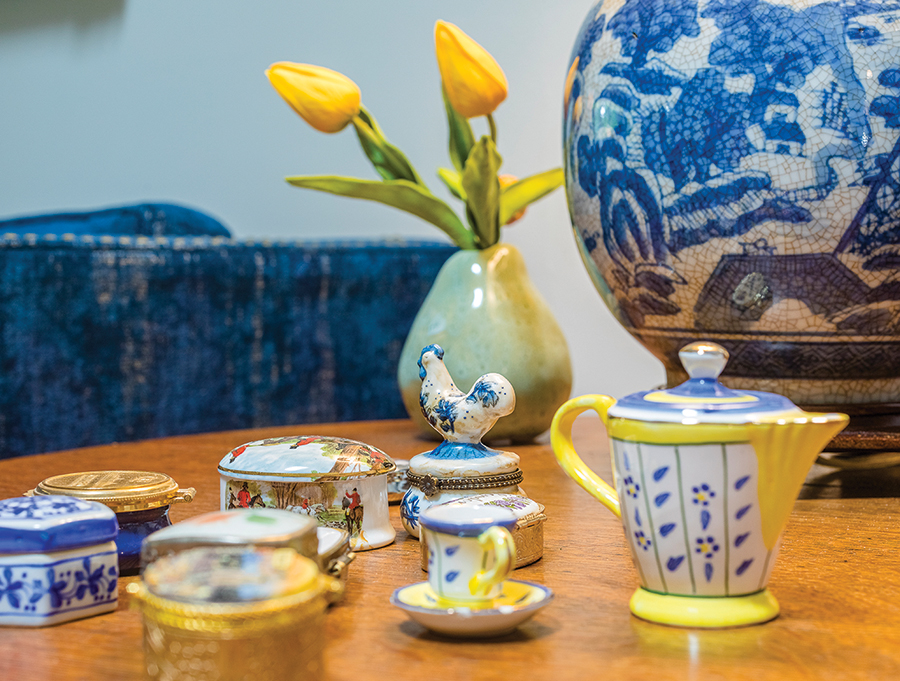
Decades of forays resulted in sizable collections of “pretty things” like blue and white china; lamps to canisters; plates to pillboxes; brass candlesticks from mini to massive; copper pots; kettles; jugs; and heavy silver serving pieces.
But, like with many couples reaching their mid-80s, spatial requirements had changed. Their daughters were long grown and gone with homes of their own and little need to raid the family nest.
“We needed to downsize for me,” Jane says. “I had to do everything.”
They looked at apartments, which Jane dismissed as “like a hotel.” Instead, they chose an attached two-bedroom brick-and-shingles unit in a quiet Penick corner backing on Weymouth, where they watch equestrians through a fence or from a deck that Jane had extended 3 feet and painted mossy green. Their private garden is even sweeter since maintenance is provided.
The Clarks moved in on March 1, accompanied by most of Jane’s “pretty things.” The trauma was lessened by friends and professionals who packed and unpacked more than 100 boxes, arranged furniture and hung paintings, sometimes with Jane’s input, sometimes on trust.
“I’m not bossy. I just have better ideas,” Jane says.
At first glance it appears that Jane must have brought everything. However, this panoply of beautiful objects is arranged so as not to overwhelm, aided by a soaring cathedral ceiling with skylight that bounces sunbeams off the gleaming silver serving pieces. Interspersed are family photos, each telling a story, including one of Jane and President Joe Biden.
The spacious unit with an efficient little gem of a kitchen redone in white and stainless steel is a retirees’ dream, though Jane rarely cooks anymore. But she longed to leave her mark: Narrow-strip wood flooring was replaced with wider boards, stained dark, like the home she left. Ceiling moldings were added. A wall dividing living room from sunroom was opened up and shelved for books. Throughout, corners were filled with adorable small tables and cabinets.
Jane was adamant about bringing three large chest/buffet/sideboard pieces, one found in Cherokee, which she stripped and refinished. When she deemed their dining room table seating 10 too large, she replaced it with an elongated sofa table with drop-leaf panels.
Sentimental value supercedes price: She could not leave behind a table spotted long ago in Rhinebeck, N.Y., while on a bus trip. “That was when you could fold things up and put them under the bus.”
Paintings lean toward dark classical land and seascapes except for a large unframed still life of pears, hanging beneath the skylight.
For pure charm, however, nothing comes close to the breakfast nook with a small round French wine-tasting table, also a sunroom overlooking the garden, furnished in matching armchairs upholstered blue and white, a primitive pine TV table, footstools and a crate with a blue and white pad for Martin, their Yorkie. This sunroom also displays Jane’s prized and well-worn 17th century pottery olive jug from France.
Dr. Dan’s collection of antique ship’s clocks is secured in the second bedroom.
“I’m a blue person,” Jane says, describing her go-to color, not her personality, which remains as vivacious as in the good old days.
Set off by the dark floors, Oriental and other rugs combine Prussian blue with an intense red, picked up by high-back chairs found secondhand for $25 apiece, and reupholstered. The same colors continue into the master bedroom, with Chinese motifs outlined in blue on bed pillows, and lamps made from blue-patterned vases or ginger jars. A window with wide, wood slat blinds runs the length of the room, framing the garden, alive with birds, rabbits and squirrels.
“It’s so wonderful to wake up to that view,” Jane says.
Another view, for her eyes only. In the master bathroom, one wall is covered in photos of the Clarks’ grandchildren. “I spend a lot of time in there, so I like to look at them,” Jane says, smiling wickedly.
This has to be relocation at its best. Who knows better than AARP?
“Downsizing tends to be more successful when the downsizers are making a conscious decision about how to live their lives,” an AARP publication states. “Considering it an adventure and being part of the process is key to a good outcome. When completed, the sensation of freedom can be quite powerful.”
Jane Clark, dressed in blue and white, flits from room to room pointing out details, recalling the provenance of each precious “thing” without bemoaning the few that were left behind. Long famous for one-liners, she sums up what could have been an angst-filled upheaval in two words,
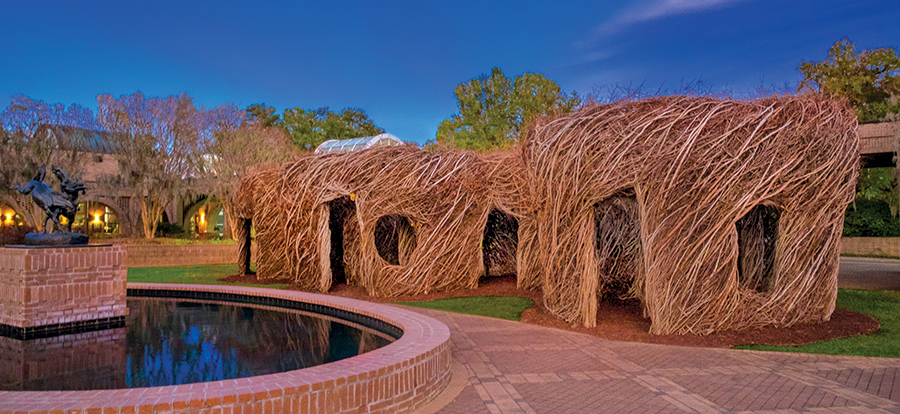
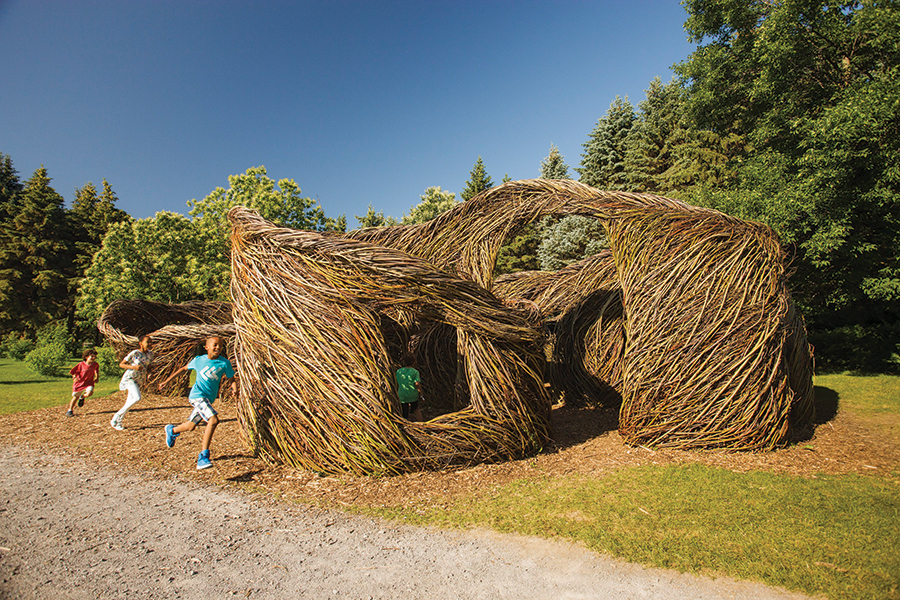
Feature photo: Fancy’s Bower, 2017.Montreal Botanical Garden, Canada.Photograph by Pierre Charbonneau
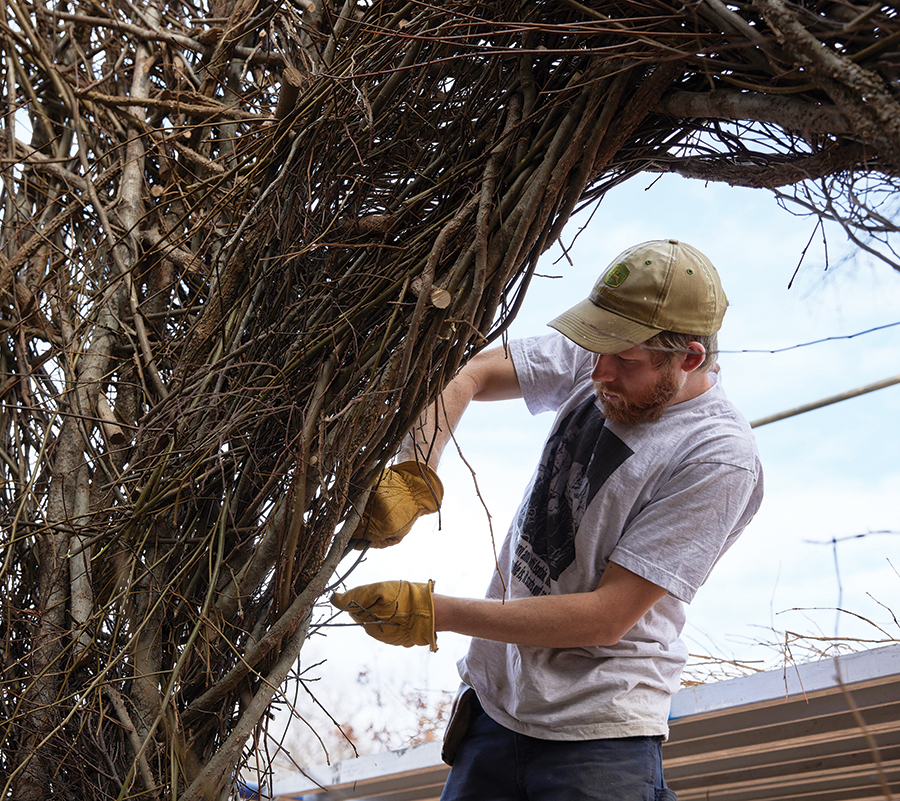
Nothing lasts forever, which is kind of the point. When Patrick Dougherty fashions one of his monumental structures, weaving sticks together as if he were knitting a medieval battlement from scratch, his internationally renowned art manages to make a permanent impact with a temporary footprint. It never strays very far from the notion that one day the wind will blow and this will all be gone — but not before we get a chance to revel in it.
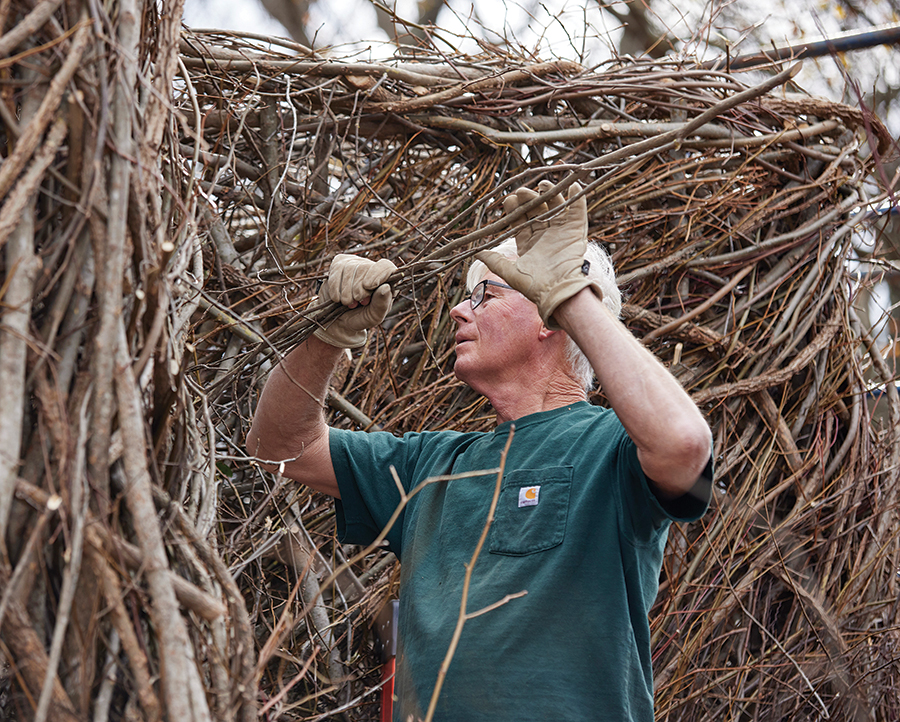
Dougherty, who spent a large part of his youth in Southern Pines, will travel down from his handcrafted Chapel Hill home for the first three weeks of June when he, his son, Sam, and a cadre of volunteers erect what will surely be one of the final sculptures of his career in a space near the Ball Visitors Center at Sandhills Community College. Dougherty is 75 now, and all the lifting, toting, gathering and climbing integral to creating these magnificent, magical piles of sticks is young man’s work.
“One thing you find, it’s kind of like a sport,” says Dougherty. “You’re going to have injuries throughout your career.”
In Dougherty’s case, that career has spanned more than 35 years, leaving a trail of well over 300 sculptures behind him, indoors and out, from Mexico City to Copenhagen, Ireland to Italy, L.A. to NYC, Sheboygan to Savannah. He averages 10 installations a year, and he’s booked through ’22. After that, he’ll likely be trading his work gloves for fireproof mittens.
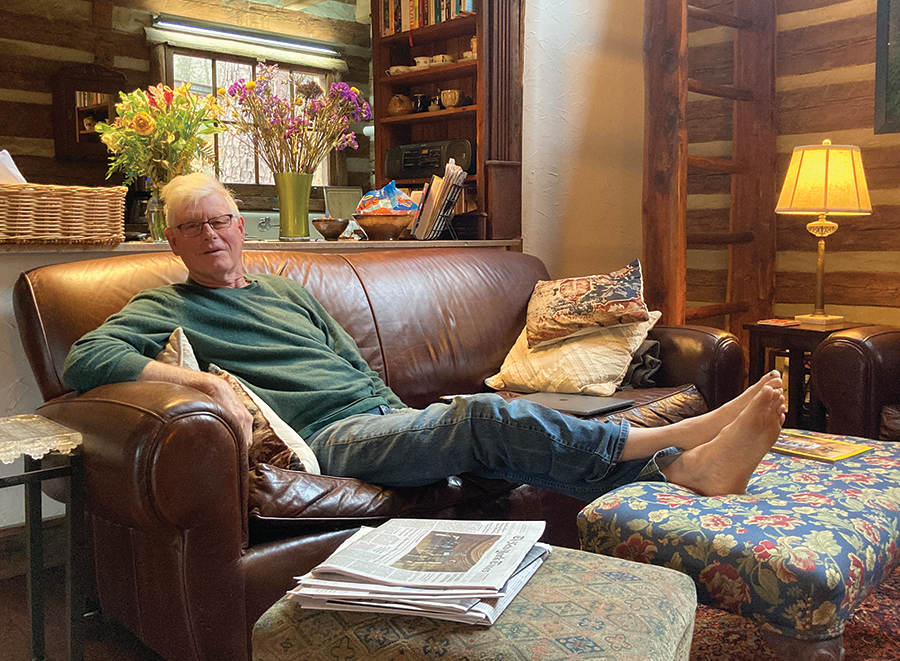
In the Mix, 2018. Brookgreen Gardens, Murrells Inlet, SC. Photograph by Anne MalarichPatrick Dougherty kicks back in the house he built in Chapel Hill. Photographs by Jim Moriarty.
“Sam is a potter,” says Dougherty. “My retirement is going to be helping him. I’m going to work the kiln.”
While artists generally avoid labels the way Roadrunner avoids Acme explosives, art historians would describe Dougherty as a card-carrying member of the Land Art Movement, a group that includes luminaries like Robert Smithson, who constructed sculptures from scattered materials, and Christo, best known for wrapping landmarks in fabric. One of Dougherty’s stick sculptures was on view at Brookgreen Gardens at Murrells Inlet in South Carolina until Hurricane Isaias delivered the coup de grâce in 2020.
“We had one of the larger installations,” says Robin Salmon, Brookgreen’s vice president of Art and Historical Collections and Curator of Sculpture. “It was like a house with rooms and windows intended to invoke Atalaya, the Huntington winter home that was built on the property. It’s interesting how carefully planned his designs are. They have to be or they wouldn’t stand for as long as they do. Ours was on view for almost four years. In Patrick’s words, they are designed to last as long as they will.”
Dougherty was born in Oklahoma, the grandson of farming families on both sides. His father, a physician, moved to Southern Pines into a house on Grove Road when Patrick was in second grade. He graduated from the old Southern Pines High School on May Street in 1963, then majored in English at the University of North Carolina-Chapel Hill. “My dad was a doctor and I thought, well, I’ve got to be a doctor. I went through all my pre-med courses, but when I came up to the moment I was like, ‘I can’t do it,’” he says. Instead, he got a degree in hospital and health administration from the University of Iowa in ’69, entered the Air Force and shipped off to Germany.
Photograph by Greg CampbellPhotograph by Greg Campbell
“When I was in the service, I was able to use their craft shop,” he says. A woman named Audrey Tuverson encouraged Dougherty’s natural inquisitiveness. “She had a graduate degree from Cranbook and knew how to do everything. Have you made a ring? Have you made a photograph? Have you repaired a piece of furniture? Have you made a clay sculpture? I got a real introduction to tools and to process.”
Once he was out of the military, it didn’t take long for Dougherty to realize hospital administration was no more for him than practicing medicine was. “Administration is kind of a dreary place if you want to be outside. I wanted to be outside and loved making things, so I decided I would go back to UNC,” he says. There he met one of the school’s sculpture professors, Mike Cindric. “You know, you just need somebody to give you permission. Particularly as an older person, if you go back to school — I was in my early 30s — you need somebody to say, ‘It’s all right. Go do what you want to do.’”
So he did. “It’s funny because if you’re a banker and you get out of school the bankers come and welcome you and say, ‘You’re a banker,’ and you know what you are. If you’re a sculptor you’re thrown out into the street and you don’t know what you are. But somewhere along the line you think, ‘I must be the real thing.’ It’s a bit more self-appointed awareness. Whether it’s popular or not depends on a whole lot of accidental things. My work turned out to be more relevant than some other work. The context changed from just being a found object to being connected to environmental issues.”
Like fashioning art from saplings gathered in woods, rain forests and swamps, nothing has gone to waste in Dougherty’s professional life. “All of your experiences are relevant to what you do. I started believing my sculpture life would be a lot better if I partnered with organizations. If you have kind of an administrative background, I wasn’t afraid to talk to the CEO. I also think having a degree in English literature turned out to be a stroke of luck. When you’re thinking about a novel, you love the way it is but the background noise is, how did they organize their words to produce an illusion that was compelling, that made you want to read it? For a sculptor, it’s great to look at people’s work, but what you really do is go further and say, ‘How does this work work?’ How does it become conscripted so you feel compelled about it?”
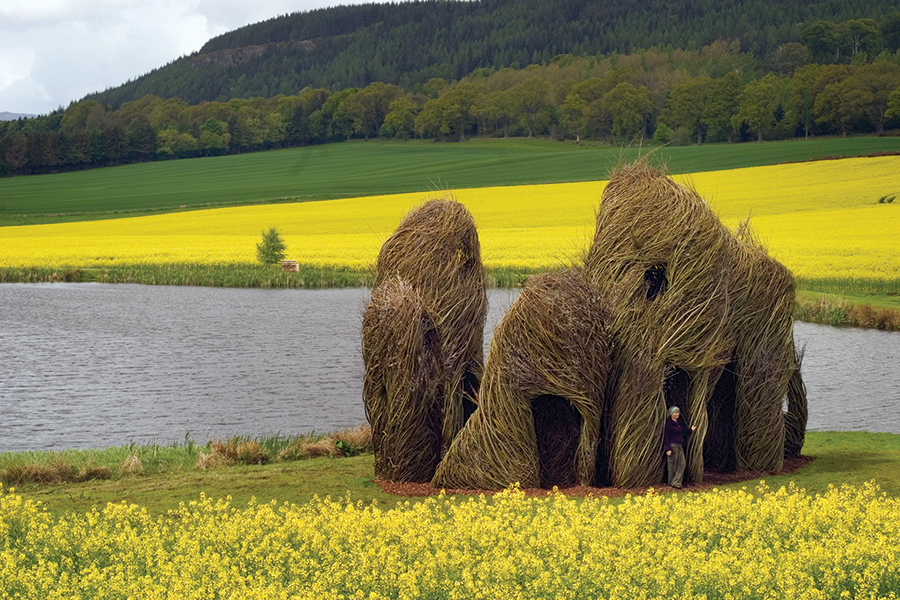
Close Ties (2006), Scottish Basketmakers Circle, Dingwall, Scotland, Photograph by Fin MacraeThrown for a Loop, 2017. Montreal Botanical Garden, Canada. Photograph by Pierre Chabonneau
The ideas can come from anywhere. “We were in Montreal at the botanic garden. I got this idea that I would take a doodle and I would make it into a big sculpture,” he says. “I found a doodle on the internet I really liked. Lots of looping. We laid that footprint on the ground and then we thought, ‘What would it be?’ So, it had, like, 16 rooms, a million doors and windows, and this top that kind of worked itself around. Then that led to thinking about tattoos. A lot of them are unity symbols from ancient ruins so you kind of trace the ideas back to ancient community symbols and you find out what those are like. What if I laid something out that looked kind of like that?”
In Dougherty’s monograph Stickwork it’s clear that every sculpture has been its own adventure. “We see snakes all the time,” he says of the stick-gathering forays. “We’ve had snakes, alligators, bees. In Japan, I was working with a person who was kind of sponsoring me, Ueno Masao. Families celebrate their ancestors in these Shinto shrines and he said, ‘I’m allowed to work in this temple and you can live there and work. The family won’t mind.’
“So, we go to this temple up on this mountain. There’s a tin roof on top of this rice straw. The first thing we see is a giant snake on the porch. I say, ‘Mr. Ueno, we have that snake in North Carolina. That’s a copperhead.’ He said, ‘Well, that’s not the most poisonous one but you can’t kill them. They belong to the temple. If one bites you, call my wife and she’ll take you to the doctor.’ I said, ‘Mr. Ueno, does your wife speak English?’ He said, ‘No, she doesn’t.’ The moral of this story is you can only stay awake for three days, then you say, ‘Go ahead and bite me.’ You can’t take it any longer.”
Because Dougherty enlists the help of volunteers in the harvesting of saplings and the construction of the installation itself — he generally relies on four volunteers in the morning and four in the afternoon throughout the three-week process — there is a decided community-building, almost a performance art, aspect to his work. “They’re the folks that call the newspaper or bring their friends or bring their grandchildren to look at it,” he says. “And it’s more advertising than you could ever hope for. If you’re working in a park in Savannah, the people who are calling the police the first day about the saplings getting dumped out are inviting you to dinner the last day. There’s a transition as people move from thinking you’re a nut to thinking it’s beautiful and glad that it’s in their neighborhood.”
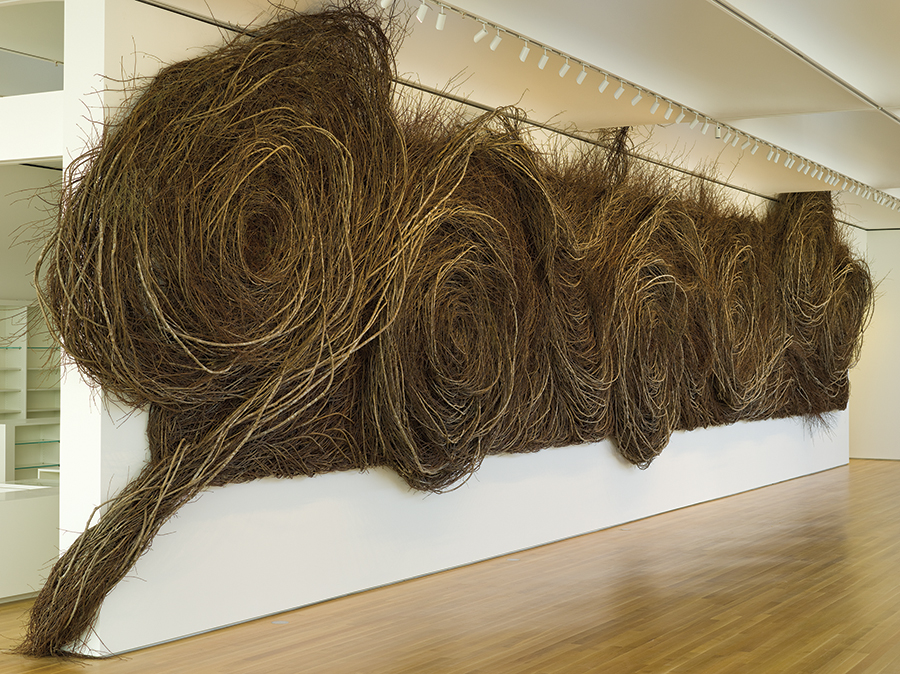
Uff-Da Palace at the Minnesota Landscape Arboretum, Photograph by Todd MulvihillOut of the Box (2009), North Carolina Museum of Art, Raleigh, NC, Photograph courtesey of the North Carolina Museum of Art
Though the temporal nature of the work is part of its DNA, Dougherty has a photographic record of all his sculptures which, in a way, makes his pieces no more transitory than an Ansel Adams print. “The concept of impermanence has become more acceptable than it used to be,” he says. “Your phone goes out, you get another one. I think a sculpture wears its site out. You can move it and it becomes relevant again, but in terms of just the placement and the excitement that goes around it, over a period of time, it just winnows the relevance out.
“I think objects are imbued with ideas that go with them, that are relevant to the site and to that moment, to the students or people on the street or whoever is seeing it. Once they have accommodated themselves to the idea, it just becomes less and less. Art history has to take care of itself. My problem is to make things that are provocative and relevant and informative and make people want to look at them.”
That’s the path that has brought Dougherty back home and close to the end. “Who knows what’s good in the future?” he says “A lot of things are remembered. My career has been great and it’s almost finished and I’ve done the best I can.”
The evidence will be on display in the town of his boyhood, to last as long as it will.PS
Dougherty will be holding a book signing in conjunction with The Country Bookshop at Weymouth 5 p.m. on Wednesday, June 9.
You may support the Patrick Dougherty sculpture installation by sending contributions to: The SCC Foundation/Dougherty Project, attn. Germaine Elkins, 3395 Airport Road, Pinehurst, NC 28374.
Jim Moriarty is the Editor of PineStraw and can be reached at jjmpinestraw@gmail.com.
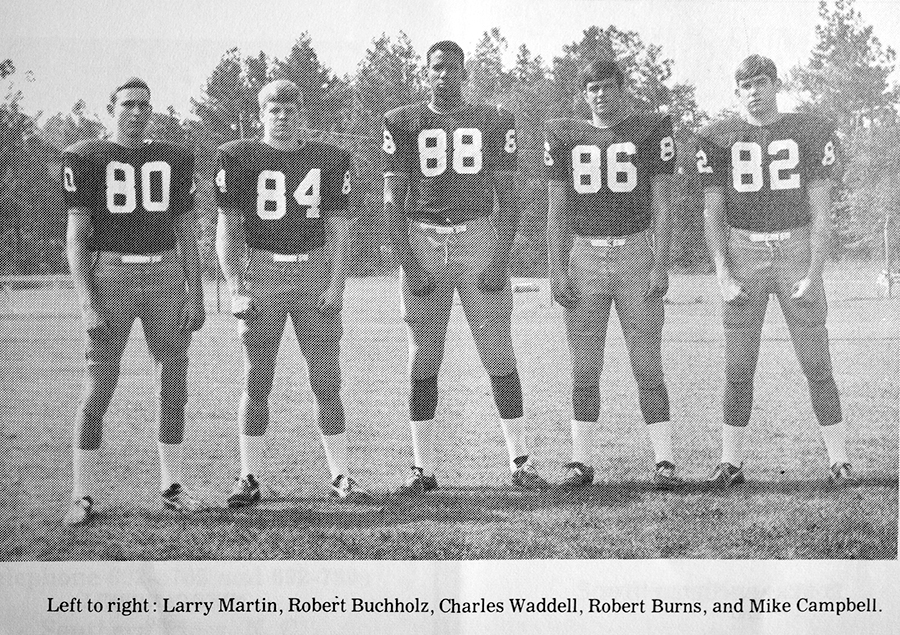
Charles Waddell was only in elementary school, but he wanted to do things the right way. He wanted to stand out.
He and his older brother, Frank, tagged along with their father, also named Frank, as he took care of his early morning janitorial duties at The Citizens Bank and Trust Company on Broad Street in Southern Pines, where he had a part-time job in addition to a full-time maintenance position at Carolina Power and Light.
After helping empty trash cans and other light chores, Charles would sit down to do his homework. “He would write it out in pencil,” Frank recalls, “and while my dad and I would continue cleaning, he would use one of the typewriters in the bank and try to type it out.”
Sometimes brother Frank, nearly eight years older, who had taken a year of typing, would take over and finish because the family had to go home and eat breakfast before the boys went to school. “He always had an interest in everything,” Frank says. “You knew he would be a good student, and he certainly developed into a fine athlete.”
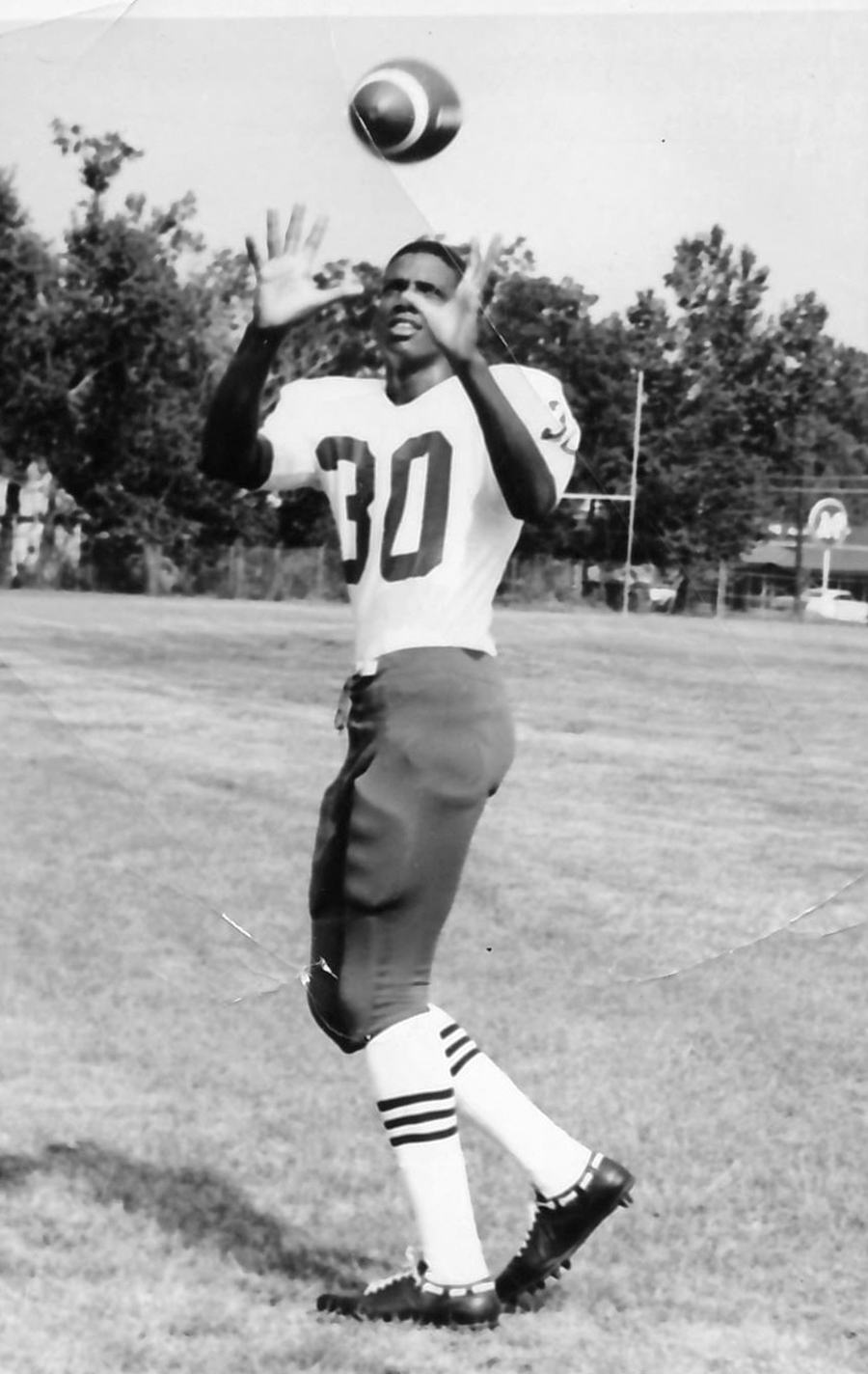
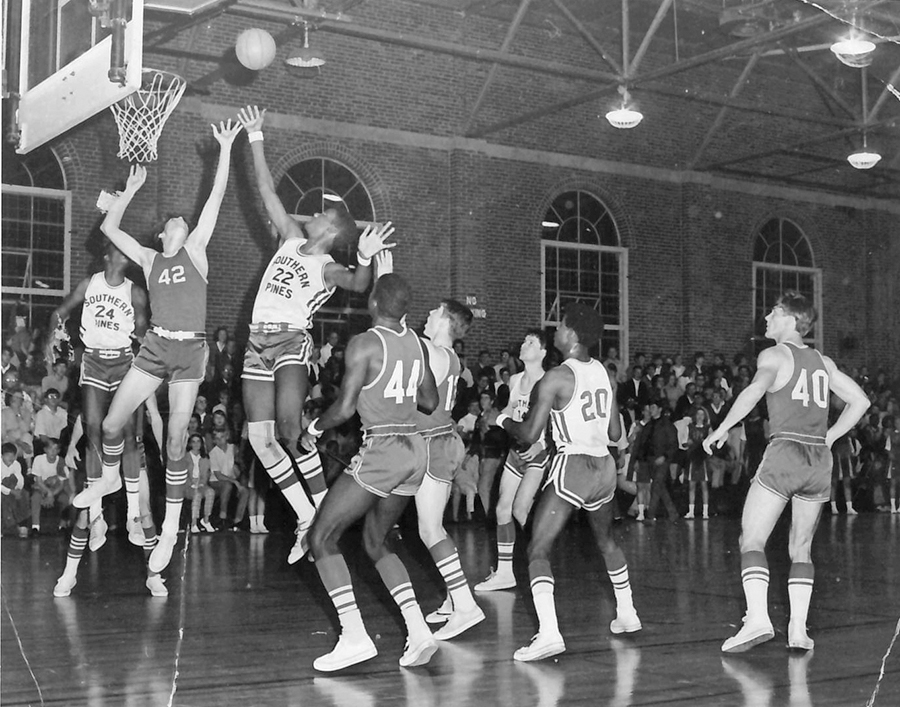
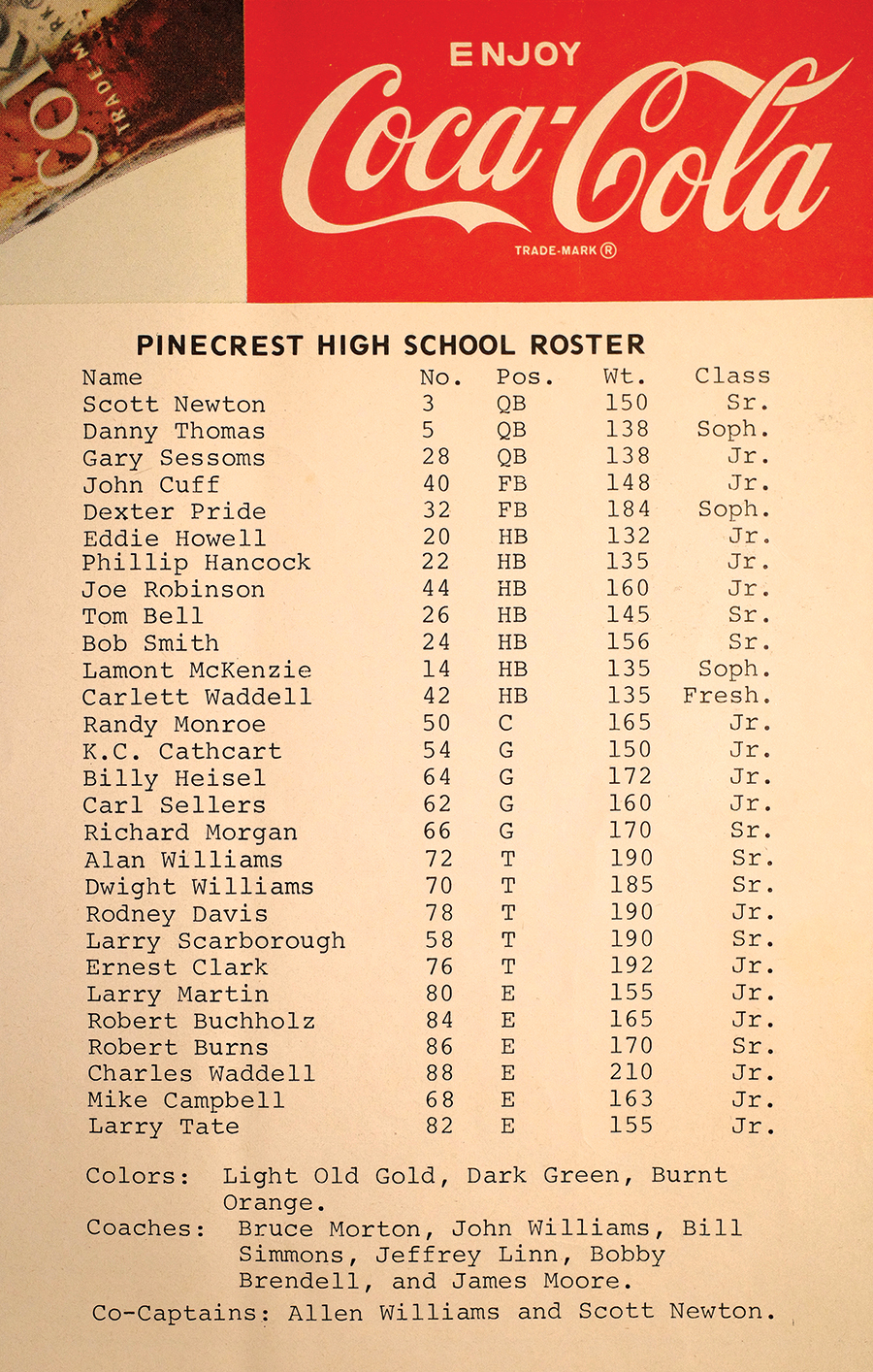
Fifty years ago, Charles Waddell graduated from Pinecrest High School, where he was all-state in football and basketball and excelled in the shot put, finishing second in the state in 1971. When, in 2013, the North Carolina High School Athletic Association named the top 100 male athletes in its century of existence, Waddell made the list. He led the Patriots to a state 3-A basketball title. Two of his fellow all-state hoops stars? Durham’s John Lucas and Shelby’s David Thompson, who would go on to star for Maryland and N.C. State, respectively.
“In the East-West All-Star basketball game, on one play I was bent down just a little bit and he came flying by and I was looking at the bottom of his shoe,” Waddell says. “Thompson was unreal.”
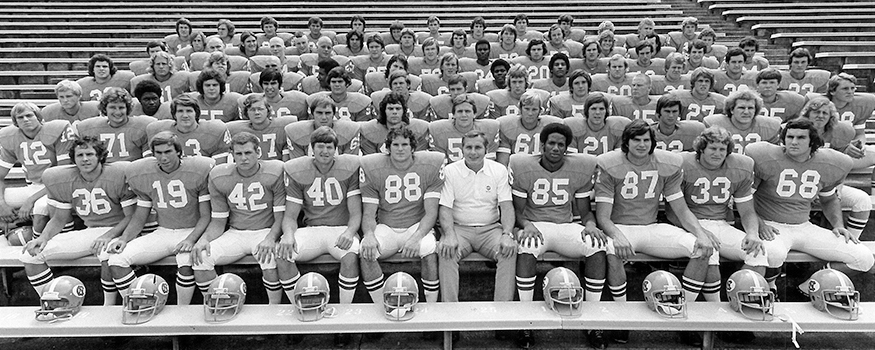
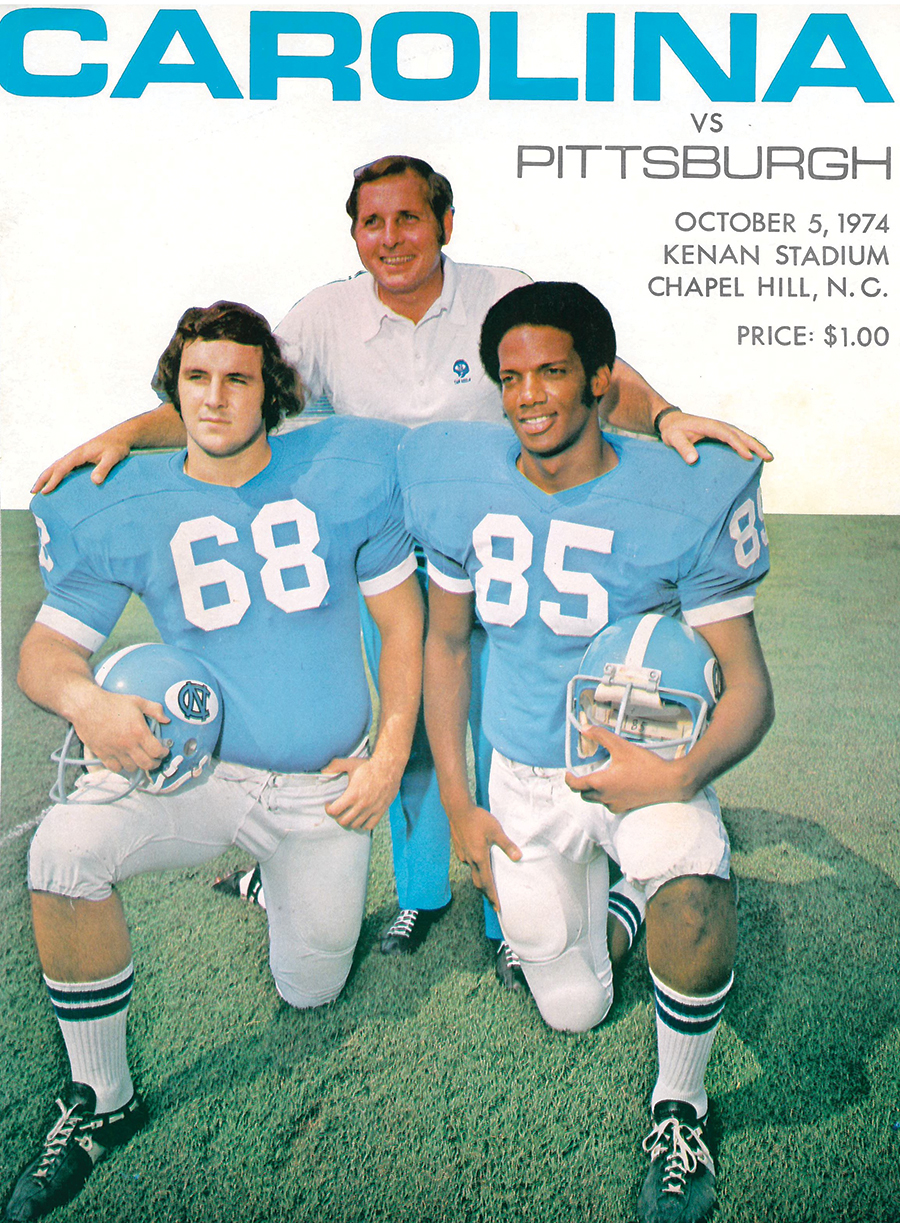
Waddell’s prep experiences were a prelude to further success in college. He earned a football scholarship to play for coach Bill Dooley at North Carolina. While in Chapel Hill, he also played two seasons for Dean Smith’s basketball Tar Heels and was a member of the UNC track and field team. He was the university’s first athlete to letter in more than two sports since Albert Long Jr. (track, football, basketball, baseball) in the 1950s. Although there have been about a dozen dual-sport Carolina lettermen since Waddell graduated, he is the last to letter in three sports (receiving three letters in football, two in basketball and one in track). The versatility led to him receiving the Patterson Medal, UNC’s highest athletic honor as a senior in 1975, joining a distinguished roster of recipients including Vic Seixas, Charlie Justice, Lennie Rosenbluth, Larry Miller, Charlie Scott, Don McCauley and Tony Waldrop.
“He was just always trying to succeed, and he had the skill set,” says Craig Gordon, Waddell’s best friend since they were 4 years old in West Southern Pines. “He could compete in just about anything. He didn’t run very fast, but he was quick for a big guy. We were tracking together until seventh or eighth grade, then he started stretching out. He went on and did some great things. But Charles tried to be the best he could be from a young age.”
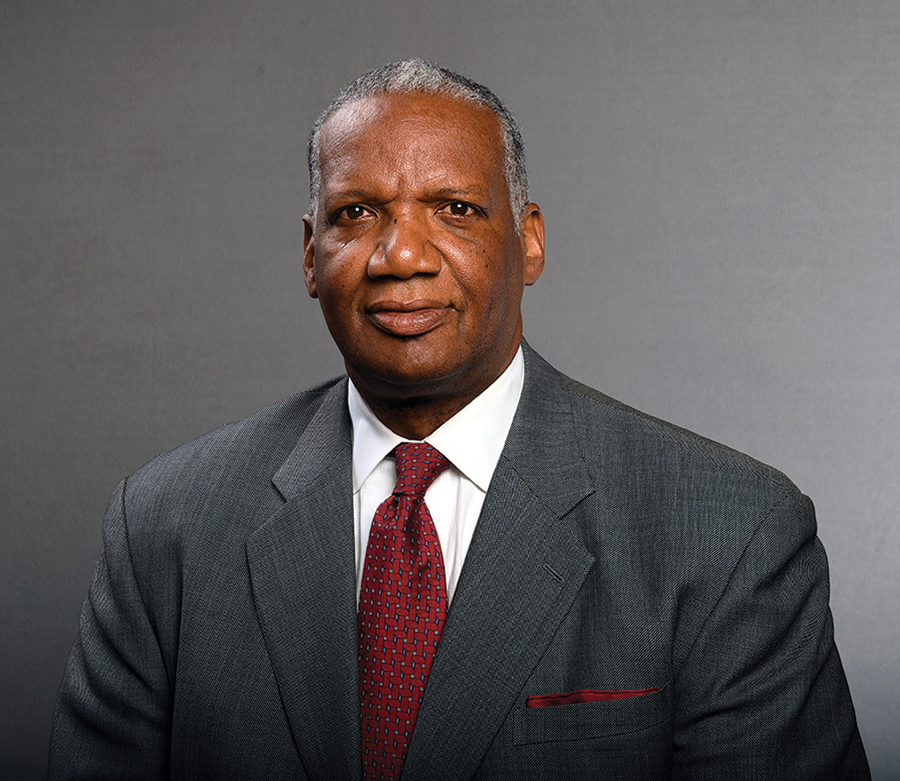
Waddell is 68 now, special assistant to the athletics director at the University of South Carolina, where he has held various posts in the athletic department since 2006. “I’ve been down here a long time, longer than I anticipated,” he says of being a Tar Heel in Gamecock country. “But I’ve gotten to develop some pretty good relationships with folks, the student-athletes and people I’ve worked with at the university.”
He ended up in Columbia with his wife, Sandra, and their three children (Christa, Cassandra and Cortez) after earlier positions in business and college athletics following a four-year, injury-hampered stint (neck, knee, shoulder) as an NFL tight end with the San Diego Chargers, Seattle Seahawks and Tampa Bay Buccaneers.
“It was really disappointing because I was on injured reserve three of the four years,” says Waddell. “You start getting hurt . . . I tell kids now that you really are a commodity in pro sports. If you have a car that breaks down on you three out of four years, you tend to get rid of it because there’s a new model coming out every season. I love the game, but it does take its toll. I’m reminded of those days just about every morning when I get out of bed.”
Frank was an early role model for Charles. He was on the West Southern Pines High School state championship basketball team as a freshman in 1959 and when the Yellow Jackets were runner-up in the state his senior season of 1962. “My brother was a really good athlete,” Waddell says. “I would say he was my first coach. He taught me just about everything. And he played on a state championship team and a state runner-up team in basketball just like I did.”
Both were kept on track by the guidance of their parents. Frank and Emma Waddell didn’t tolerate mediocrity in the classroom or any foolishness outside of it.
“Charles was always very studious, and his mom made sure every day the priority was school,” Gordon says. “His parents were very straight-shooting folks — everybody in the community pretty much was that way and looked after one another. If I did something, my mother would know about it before I got home.”
At a time when Blacks weren’t allowed to play organized youth baseball in town, Emma Waddell created uniforms and formed a team for Charles and his friends in their neighborhood. “Our mother was instrumental in forming the ‘Honey Bees,’” Frank says. “They didn’t really have anybody to play — I think they went to Raeford once — but she made sure they had a team.”
Waddell looked up to Charlie Scott, the first Black basketball player at North Carolina, and a certain Boston Celtics center. “Bill Russell has always been my idol,” Waddell told the News and Observer when he was a teenager. “I’ve always admired the way he wanted to win. He was never satisfied with being second.”
West Southern Pines High didn’t have the resources to field a football team, so Waddell made the tough decision as a sophomore to attend East Southern Pines in 1968-69 prior to the consolidated Pinecrest campus opening in the fall of ’69. He played football and basketball for the Blue Knights. For the first time the predominantly white school agreed to schedule a game with the Yellow Jackets, who for years had wanted the chance to square off against the East side team. With Waddell, already 6-foot-3 and 210 pounds and a force down low, the Blue Knights won the game. He would go on to average 25 points and 15 rebounds as a high school upperclassman.
“It was a little painful to go to the East side, and that basketball game was a tough one because West Southern Pines had a rich basketball history and had wanted a game with East Southern Pines for a long time,” Waddell says. “But I think it was the right thing for me to do. I was able to acclimate to the integrated situation a year before Pinecrest opened. And high school football helped with integration, because that was one of the first things that brought people together.”
As a senior, Waddell led the Patriots to a 7-2-1 record in the fall of 1970, which remained the school’s best football season until 2009. He went to Carolina on a football grant but with an understanding that he could try to play basketball too. His first year in Chapel Hill was the last year that freshmen could not play varsity football and basketball. The youngest Tar Heels, including Waddell, who stood 6-5 and weighed more than 220 pounds, still practiced with the main team.
“I got matched up with Charles quite a bit in practice,” says John Bunting, a senior All-Atlantic Coast Conference linebacker in ’71 who was the Tar Heel head coach in the 2000s. “He was a freshman going against a senior, but he was not intimidated, and he was very strong and athletic for a true freshman.”
Ted Elkins was a defensive end from Charlotte who arrived on campus with Waddell and, like Bunting, went up against him in practice. “It seemed I was always paired against Charles,” Elkins says. “He was a big guy and a great athlete. He wasn’t real demonstrative, but he didn’t need to be. He could be pretty dang quiet. On defense, I tried to fire up everybody, but Charles just lined up and would nail you.”
The ’71 season was marked by tragedy as lineman Bill Arnold from Staten Island, New York, died after collapsing during a hot afternoon practice in early September. It was an era when water and rest periods weren’t customary during football practices even when the weather was oppressive.
“I was usually OK in the heat, but there were some practices I lost anywhere from 12 to 16 pounds in water weight,” Waddell says. “When I would run, my shoes would be squishing because they were soaking wet.”
He caught 41 passes for 571 yards and seven touchdowns for the Tar Heels, including a school-record three TDs against Clemson, and earned All-America honors as a senior when he and Elkins served as co-captains. He joined the junior varsity basketball team as a sophomore but got moved up to Dean Smith’s varsity squad and played in 11 games in 1973. (He also participated on the track and field team in the shot put and discus that spring.)
Waddell played basketball as a junior, too, but broke his wrist in a game against Virginia and wasn’t in Carmichael Auditorium on March 2, 1974 when Carolina pulled off a magical comeback against Duke, rallying from eight points behind with 17 seconds left to tie the game on a long Walter Davis shot, then defeating the Blue Devils 96-92 in overtime. Charles was in Kenan Stadium, on the sidelines of a spring football practice.
“I was listening to the game with some of the trainers on the radio of an old station wagon they used to bring stuff out onto the field,” Waddell says.
A fifth-round selection by the San Diego Chargers in the 1975 NFL draft, Waddell returned to Chapel Hill in the late 1970s when his NFL career was over. He worked with Paul Hoolahan as one of UNC’s first strength and conditioning coaches. The duo also oversaw academics for Tar Heel athletes. In the early 1980s, Waddell decided to pursue an MBA while working part-time in game operations. He picked up additional income when Roy Williams, then an assistant basketball coach charged with delivering The Dean Smith Show to television stations each weekend during hoops season, shared the duty with Waddell who earned $100 every other week.
“They produced the show in Greensboro, so the weeks Roy didn’t do it I would pick up the tapes there at 3 or 4 o’clock on Sunday morning,” Waddell says. “I’d drive to the TV station in Asheville, drop one off there, then go on to Charlotte and leave one there, then come on home to Chapel Hill. Getting a hundred dollars was a big deal in those days.”
After securing his graduate degree, Waddell worked in investment banking at NCNB for seven years. When former Tar Heel basketball player Jim Delaney became commissioner of the Big 10, he hired Waddell to be an assistant commissioner. “I was enjoying investment banking but figured I would get back into college athletics at some point,” Waddell says. He worked at Big 10 headquarters in Chicago for four years before returning to North Carolina and a position with Richardson Sports and the Carolina Panthers in part to be closer to his mother after his dad passed away in 1990 (Emma Waddell died in 2017 at age 95.)
The Waddells especially loved watching the son they nurtured to succeed compete during his college days. “They really enjoyed my career at North Carolina,” Waddell says. “They got to be really good friends with some of my teammates and their parents. They went to all our home games and a lot of the road games. I know the first time either one of them got on an airplane was when they flew out to watch us in the Sun Bowl in Texas. I know they enjoyed that experience.”
Waddell’s business and athletic administration career also gave his parents satisfaction. When he surveys it all — from the boyhood games in the neighborhood and the town parks, to UNC, the NFL and beyond — he’s pleased. “I interviewed for some athletic director jobs over the years but never got one,” he says. “But I’ve had a good career and feel good about the things I’ve achieved.”
On and off the field, he has stood out like the typewritten homework he hunted and pecked at dawn all those years ago.PS
If you are a Showtime viewer, odds are you are familiar with the show Outlander, a time travel odyssey in which the 20th century female protagonist, Clare, after touching an ancient standing stone, is mystically transported to mid-18th century Scotland. Though married in her 20th century life, Clare weds Highland Scot Jamie Fraser, and given the circumstances, her bigamy seems excusable.
Clare and Jamie share adventures in a time of historic upheaval as the Jacobite Rebellion is in full swing. The charismatic Charles Edward Stuart, popularly known as “Bonnie Prince Charlie,” is engaged in an ultimately futile quest to restore the Stuarts as Britain’s monarchial rulers. Primarily due to the Stuarts’ adherence to the Catholic faith, Parliament had removed Charles’ grandfather, James II, from the throne a half-century earlier.
The Bonnie Prince courts support for his cause from French royalty and Scottish Highland clans in hopes they will back his effort to dethrone England’s current king, George II, and restore the Stuarts. Clare knows her history and is fully aware that the uprising is not only doomed to failure but will also result in devastation to the clans but, as is usually the case with transtemporal travel sagas, the Frasers’ various schemes to alter history backfire, making the foretold result inexorably more certain.
The Battle of Culloden on April 14, 1746, represents the denouement. The Highlanders are routed, and their catastrophic defeat effectively brings an end to the rebellion. But Outlander does not address the post-Culloden story of how a young Scottish woman cleverly aided Bonnie Prince Charlie’s desperate effort to escape British capture.
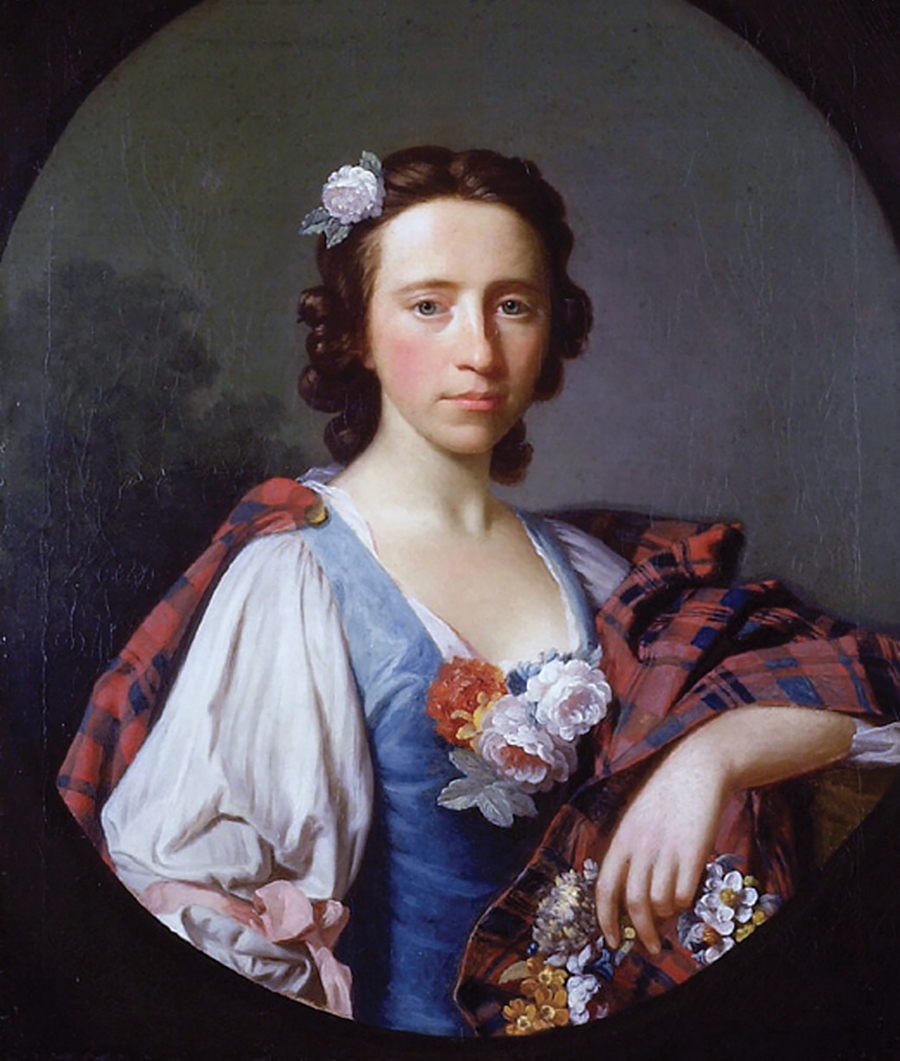
At the time of Culloden, Flora Macdonald was 24 years old. She was living off the northwest coast of Scotland on the Isle of Skye with her financially well-off mother and stepfather, Hugh Macdonald. One acquaintance described her as “a woman of soft features, gentle manners, kind soul, and elegant presence.” On June 20, 1746, Flora was visiting her brother at his “shieling” (huts where cattle farmers stay when tending to their livestock) on the neighboring island of South Uist.
It so happened that the on-the-lam prince was hiding nearby in the company of two aides, Capt. Conn O’Neill and Neil MacEachen. The king’s forces were hot on Charles’ trail, having organized search parties to apprehend the man they called the “Young Pretender.” Flora’s stepfather, Hugh Macdonald, secretly sympathetic to the Jacobites, informed the prince through a third party that Flora could be useful in affecting Charles’ potential escape by boat to Skye, where arrangements were in the works to transport the prince to France and freedom.
O’Neill, leaving behind Charles and MacEachen in the hills nearby, greeted Flora at the shieling late one night, and conspiratorially inquired whether he could “bring a friend to see her.”
Flora responded, “Is it the prince?”
Minutes later, Charles was before her. A plan had been concocted. Flora would sail home to Skye in an open boat accompanied by MacEachen and Charles, who would be disguised as a woman and use the alias “Betty Burke.” The “maid’s” purported purpose for traveling to Skye would be to spin wool for Flora’s mother. Flora’s stepfather, a double agent in the affair, as he also occupied a position in the British military, would arrange passports for the three travelers.
Numerous facts of Flora’s life have been subject to varying interpretations by historians, and her eagerness to participate in the plot is one of them. According to MacEachen, Flora agreed to the proposal immediately. O’Neill, however, reported that the young woman was far more ambivalent because of the obvious dangers of the enterprise. He claimed he overcame Flora’s hesitancy by declaring she “would be made immortal by such a noble and humane deed on her part in the Prince’s distressing circumstances.”
Flora proved to be no shrinking violet. She adamantly rejected the prince’s demand to include O’Neill on the voyage — she carried passports for just three passengers — and just as sternly refused Charles’ plea to carry a gun.
The crossing to Skye was launched from Benbecula on June 28. The voyage is recalled in the lyrics of the haunting ballad that opens each episode of Outlander — the “Skye Boat Song.” Strong westerly winds, high waves and fog plagued the rowers, and the boat was fired upon by hostile militia as the craft sought to make land at Skye. But Flora and her companions managed to avert disaster and put in elsewhere on Skye, where Alexander MacDonald of Kingsburgh took charge of Charles. When the grateful Bonnie Prince bade goodbye to Flora at Portree, he is supposed to have said, “I hope, Madam, we shall meet in St. James’s yet.” In short order, Charles jumped aboard another boat to Raasay from where he would eventually make his way to France. Notwithstanding his narrow escape, Charles Stuart was destined to live in exile the remainder of his increasingly sad and dissolute existence.
Flora, however, failed to elude the authorities. After word leaked regarding her role in Charles’ escape, she was detained and held as a prisoner, eventually taken to London in December 1746. Aside from a brief stint in the Tower of London, Flora, though technically under house arrest, enjoyed relative freedom in the city, visiting friends and entertaining visitors. O’Neill’s prediction that assisting the Bonnie Prince would lead to her lasting fame was coming true. She became a cult hero to Jacobite devotees. One woman asked Flora whether she could “have the honor of lying in the same bed with that person who had been so happy as to be guardian to her Prince.” Even royal partisans found themselves charmed by Flora. Frederick, Prince of Wales, paid her a personal visit.
Released from detention in July 1747, Flora returned to Scotland, resettling on Skye. In 1750, she married Allan MacDonald of Kingsburgh, the son of the man who had taken custody of Charles following the prince’s escape to Skye. Flora and Allan would parent seven children. Five years after their marriage, Allan succeeded his father as manager of their patron’s estate holdings. Unfortunately, he lacked business acumen and that, coupled with a cattle disease epidemic, led to Allan’s dismissal around 1766.
Facing increasingly difficult circumstances, the MacDonalds decided in 1774 to follow the example of fellow countrymen who had emigrated to North Carolina. Allan and Flora, along with sons Alexander and James, daughter Anne, her husband, Alexander MacLeod, and their children sailed to Wilmington, North Carolina, aboard the Baliol. Flora and Allan’s sons Charles and Ranald, engaged in military service for the crown, did not emigrate. Son John and daughter Fanny remained in Britain.
Flora and Allan first settled at Cross Creek, present-day Fayetteville. They subsequently moved farther west, acquiring a 475-acre plantation about 5 miles from Norman, North Carolina. Soon after Flora and Allan moved to their new estate, the Revolutionary War began. A majority of North Carolina’s Scottish Highlanders sided with the crown, as did Flora and Allan. Flora’s segue in allegiance from the Jacobites to the Hanoverian monarchy may appear puzzling, but most Highlanders had little stomach for taking on the powerful British Army following the debacle of Culloden. They figured allegiance to King George would be their best bet for avoiding a conflict that would disrupt their efforts to start over on the frontier.
Allan accepted a commission with the Royal Highland Emigrant Regiment, commanded by yet another “Mac,” Donald MacDonald. Allan’s sons Alexander and James, as well as son-in-law Alexander MacLeod, likewise joined the unit. The royal governor, Josiah Martin, ordered the regiment to gather at Cross Creek, then march to Brunswick, where it would link up with a brigade of British troops arriving from the North. The governor believed the combined forces would easily quash the Colonial rebellion in North Carolina.
Early Flora MacDonald historians maintained she was personally active in recruiting expat Highlanders for the regiment, delivering a rousing speech at Cross Creek exhorting the recruits to fight for victory over the rebels.
Colonial forces headed off the regiment on its march to Brunswick, confronting it at Moore’s Creek Bridge on Feb. 27, 1776. Shouting “For King George and Broadswords,” the Highlanders unwisely mounted a charge across the bridge. They were greeted with withering patriot gunfire. In the ensuing disaster, dozens of Scots were killed. Hundreds more were captured, including Allan MacDonald and son Alexander. The remaining members of the regiment, including James MacDonald, scattered. The crushed Loyalists would not re-emerge as a military presence in North Carolina until near the end of the war, in 1781.
The emboldened patriots (also called “Whigs”) began confiscating the land, livestock and other holdings of Scottish immigrants still loyal to the king. Flora did not escape the plundering. The plantation was ransacked and confiscated. She suffered the loss of most of her possessions. Desperate, she sought and received refuge in what is now Moore County under the protection of Loyalist Kenneth Black. In her new abode, located near the New River and present-day Pinehurst, Flora was close to daughter Anne, whose home, “Glendale,” stood nearby.
Summoned to appear before the local Whigs’ Committee of Safety to answer for her allegedly seditious conduct, Flora coolly displayed “spirited behavior” in responding to the inquiry. She was permitted to go free.
Allan managed to obtain freedom for himself and son Alexander by successfully negotiating a prisoner exchange with Congress in August 1777. He was released in New York, where he took command of a Loyalist company. In March 1778, Flora was permitted by Colonial authorities to join her husband there. Later that year, the couple made their way to Halifax, Nova Scotia, where Allan was placed in command of another regiment.
Persuaded by her husband that she would be better off living her remaining years in Scotland where her hero status remained undiminished, Flora, then 57, and daughter Anne returned to her native land in 1779. En route, a French privateer attacked Flora’s ship. Legend has it that she mounted the deck, exposed herself to gunfire, and bravely cheered the crew’s successful effort to repel the attack. She broke her arm in the resulting melee but reached Skye, where she was reunited with daughter Fanny, by then age 14.
Completing his service obligation in 1784, Allan crossed the Atlantic to Scotland and Flora. Because siding with the Loyalists resulted in the forfeiture of his American property, he submitted a claim seeking compensation for those losses and was granted a partial award by the crown. His financial circumstances further improved after obtaining a property management role as “Tack of Peinduin.” The position enabled Allan and Flora to live in relative, financial comfort until Flora’s death in 1790. Allan passed away two years later. Both are buried in Kilmuir Cemetery on Skye.
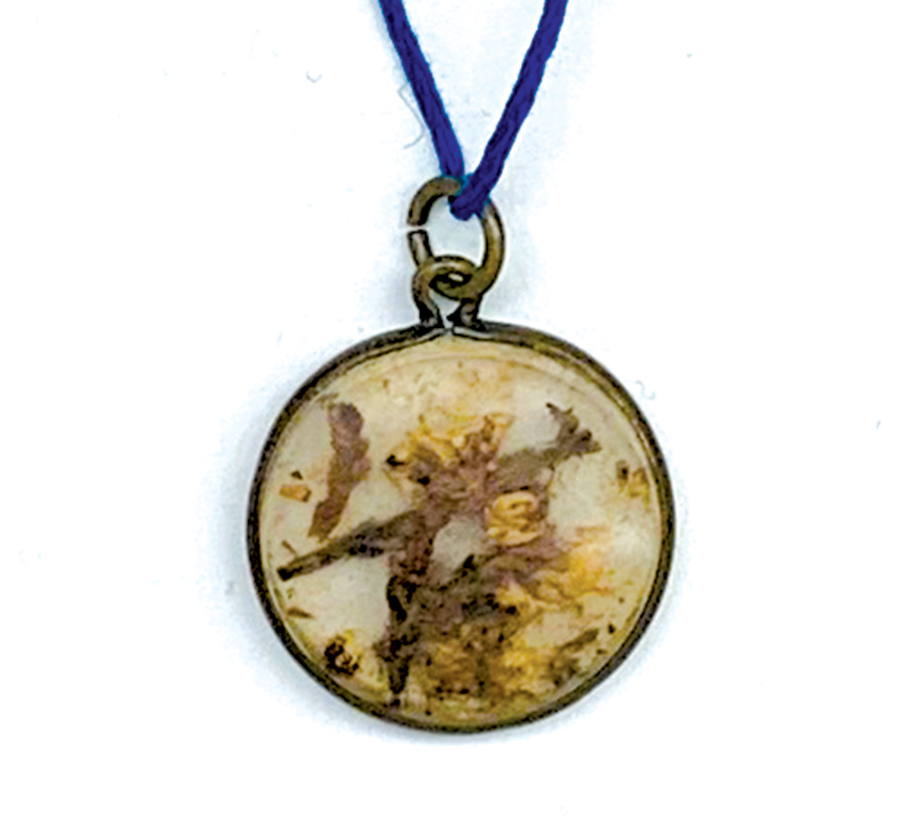
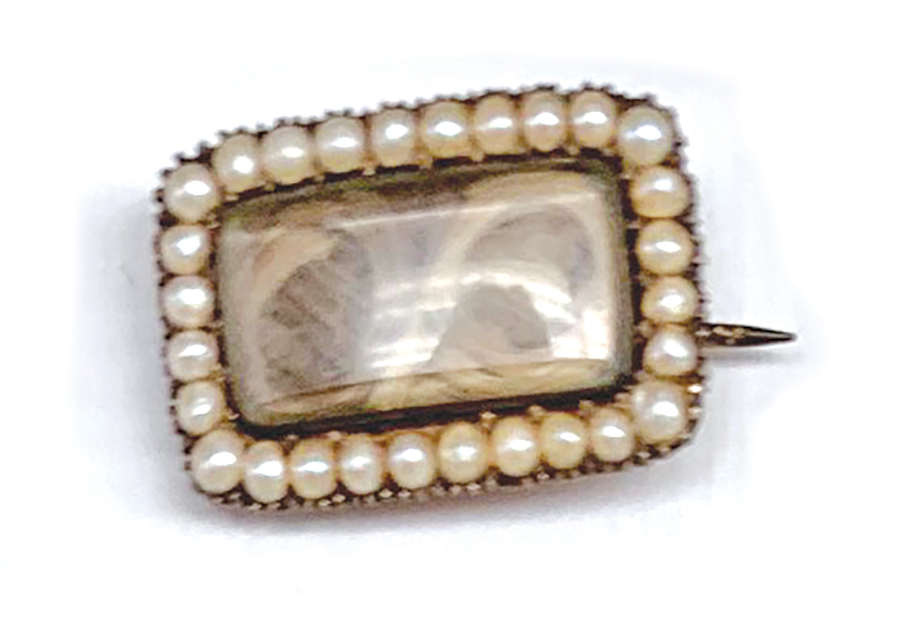
A small locket containing a piece of heather, reputedly worn by Flora MacDonald.Seed pearl brooch owned by Flora MacDonald, reputedly contains a lock of hair from Prince Charles Edward Stuart which was given to Flora upon departing from Skye in 1746.
Flora MacDonald’s life in North Carolina was replete with hardships, enduring lengthy separations from her husband, the harsh enmity of the Whigs, financial ruin, and virtual banishment from the state. A 1930s article in the Pinehurst Outlook disclosed another heartbreak allegedly suffered here. Citing a 1909 biography, the story claimed that after the fateful battle at Moore’s Creek Bridge, Flora “was called to grieve the loss of a son (age 11) and daughter (age 13) who died of typhus fever,” and that the two children were still buried at the MacDonald’s “Killiegray” plantation on Mountain Creek near Norman, North Carolina. A monument had been placed at the site marking the graves of her children.
While the text of the Outlook article acknowledged the graves, located in Richmond County just across the Montgomery County line, were “somewhat inaccessible,” it said they could be reached “without great difficulty,” and like an 87-year-old GPS, directions were provided. So, on a crisp mid-January afternoon, I drove to Norman. The directions said that “when almost through the village just beyond two brick churches, one on either side of the road, turn left on a dirt road.” I spotted the two churches and turned just beyond them, driving a couple of miles down a country road looking for the bridges and farm paths the Outlook said would lead to the graves. It was clear, however, that the passage of time had eradicated the helpful landmarks. I pulled over to contemplate my next move.
Just then, a young local couple drove alongside and asked if I was lost. When I explained I was looking for two Revolutionary War-era graves, the young man responded, “Oh, you mean the stones!” He suggested backtracking and veering down a crossing road that, as far as I could tell, didn’t exist. Where were these stones? Had the Outlander’s Clare Fraser experienced similar frustration when she sought to find the magical standing stone that would transport her from the 18th to the 20th century?
Reluctant to give up the hunt, I drove back into Norman and stopped at the local post office. (No dead letter jokes, please.) I told the longtime postmaster, Helen Simmons, about Flora’s children and “the stones,” and she smiled.
“I don’t know where Flora MacDonald’s children are buried, but I think I know what that fellow meant,” she said. “Tell you what, I’m getting off work. Follow me out of town to Mt. Carmel Presbyterian Church. It was founded by Scots who settled in this area during the Revolution. Several of my ancestors are buried there. There are some very old graves in the churchyard. Maybe you’ll find what you’re looking for there.”
Soon, Helen and I were walking about Mt. Carmel’s ancient graveyard. The black headstones from the late 1700s, worn down to the nub, some no more than 6 inches high, did not bear any decipherable script. If these were the “stones” my young acquaintance had had in mind, I doubted Flora’s children’s graves were among them. They were supposed to be located on private property — not in a church graveyard — though I did later learn that Flora attended the Mt. Carmel church during her abbreviated stay in the area.
I must be adept at appearing forlorn and in need of assistance, because after Helen left, another local resident came to offer help. Arriving in the church’s driveway was Bill McFadden, retired life-time Norman resident and a Mt. Carmel congregant. After hearing my tale of frustration, Bill placed a call to a historically-minded friend who suggested we look for the graves down another road that led into Richmond County. In short order, I was tailing Bill to another clearing in the countryside, but this foray didn’t pan out either, and the graves’ location remained a mystery.
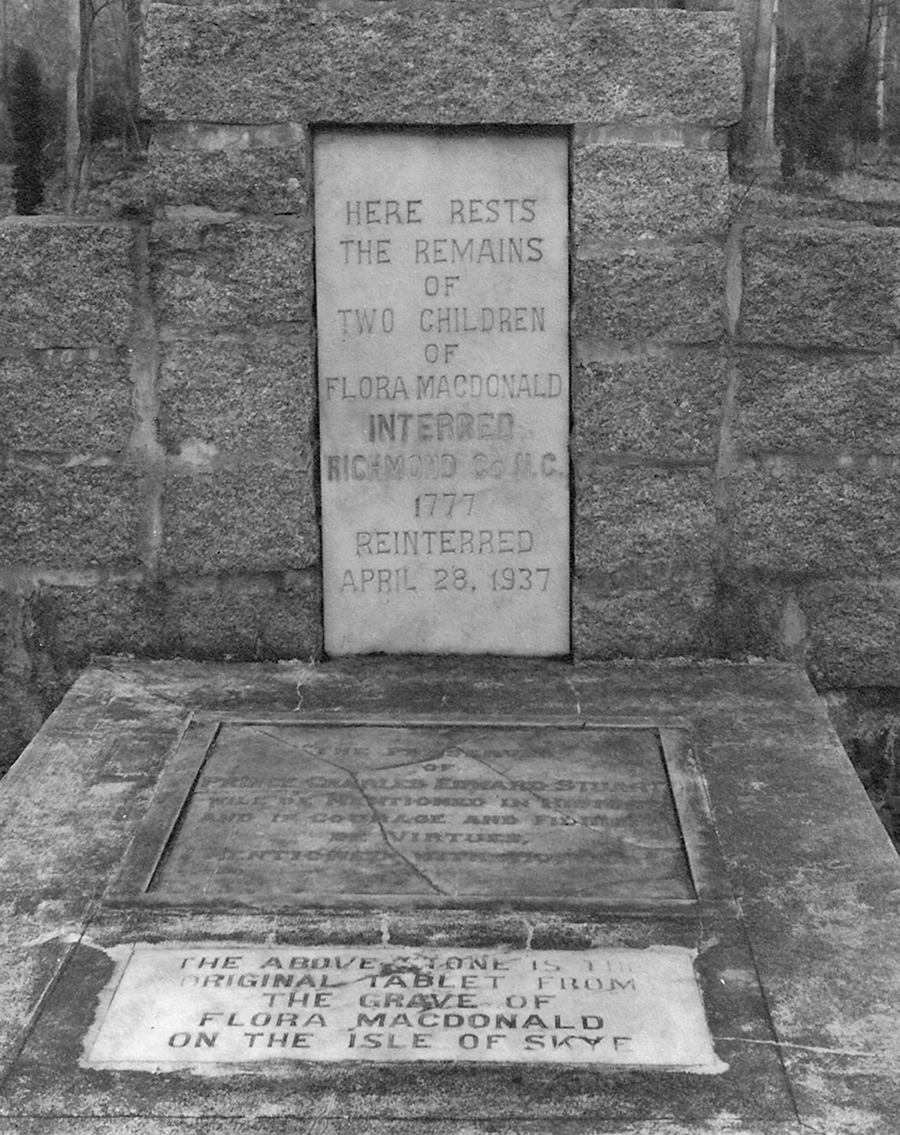
It turned out that in 1937, three years after the Outlook article, what was left of the children’s bodies had been disinterred and reinterred at the Red Springs campus of Flora MacDonald College, now Highlander Academy. But why?
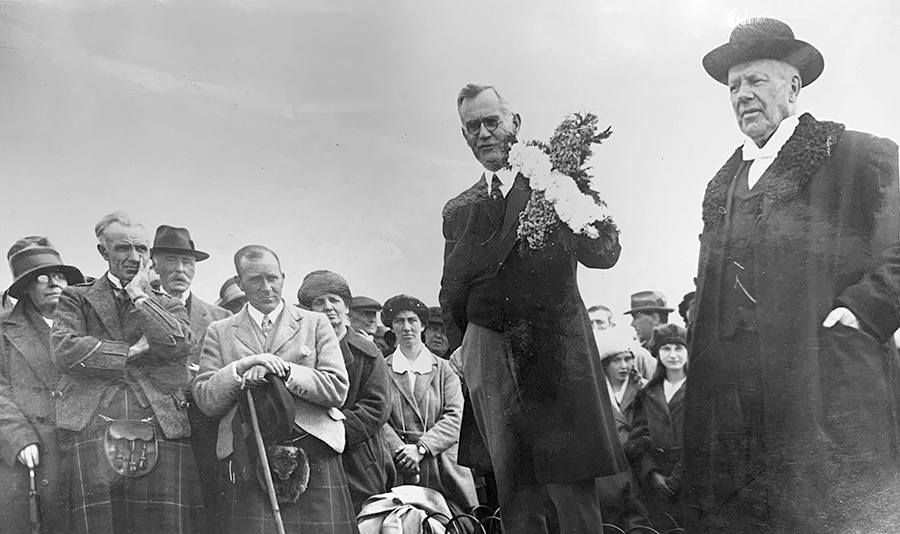
I toured the Red Springs campus with Alex Watson who explained that prior to 1915 it was a women’s college named Southern Presbyterian College and Conservancy of Music. Dr. Charles Vardell founded the institution in 1896 and served as its president for decades. Linda Rumple Vardell, Charles’ wife and an accomplished pianist, ran the college’s music program. Since the area had been settled by transplanted Scots, many Southern Presbyterian students were of Scottish ancestry.
When Canadian James A. Macdonald, editor of the Toronto Globe and an ordained Presbyterian minister, came to Fayetteville to attend a gathering of Scottish clans in 1914, he also toured the Southern Presbyterian College campus. Wowed by what he saw, the editor made a pledge to the endowment of the school and encouraged fellow Scots to do likewise. Macdonald felt that fundraising would be facilitated if the college’s scope was “broadened to bear the name of the Scottish heroine (Flora), herself a Presbyterian, a college graduate, and a noble example of Christian womanhood.” Thus in 1915, the Canadian persuaded Vardell to rename the school Flora MacDonald College, though the Presbyterian Synod of North Carolina still remained in ultimate charge.
The MacDonald tartanCharles Vardell (holding bouquet) at the 1922 dedication of Flora MacDonald Cross at Kilmuir Cemetery on Skye
The name change occurred not long after the publication of Flora MacDonald in America, by J.P. MacLean, in which the author claimed that Flora’s two children were buried at the aforementioned Killiegray plantation, approximately 50 miles from Red Springs. It occurred to Vardell that relocating the children’s graves on the Red Springs campus would provide the campus an additional element of Scottish heritage and testament to Flora’s memory.
But a legal obstacle stood in the way. Digging up a grave and relocating the remains was not a simple matter. The North Carolina legislature first needed to authorize any such disinterment. Before approaching the legislature, Vardell thought it prudent to undertake additional research to confirm that the graves were actually those of Flora’s children. To perform this task, Vardell turned to W.R. Coppedge, the highly respected former pastor of Mt. Carmel Presbyterian Church and superintendent of Richmond County Schools. Rev. Coppedge spoke with several longtime residents, all of whom believed the graves contained Flora’s children based on traditional accounts that were now a minimum of four generations old. Coppedge was persuaded that the residents knew what they were talking about and signed an affidavit indicating he was “convinced that these are the graves of Flora MacDonald’s children.”
Armed with Coppedge’s affidavit, Vardell obtained the legislature’s approval in 1917 to move the remains. For reasons unknown, the graves at Killiegray stayed undisturbed until the 1930s, when Vardell turned his attention back to bringing the graves’ remains to the campus. He was on the scene when they were finally dug up.
Vardell reported that natural elements and the passage of time had transformed the bodies into dust, which was collected in separate receptacles and brought to Red Springs. Corresponding with a project booster, an enthused Vardell wrote, “I think we can now say, so far as an intelligent person can judge, that the remains of Flora MacDonald’s children are now on the college campus.”
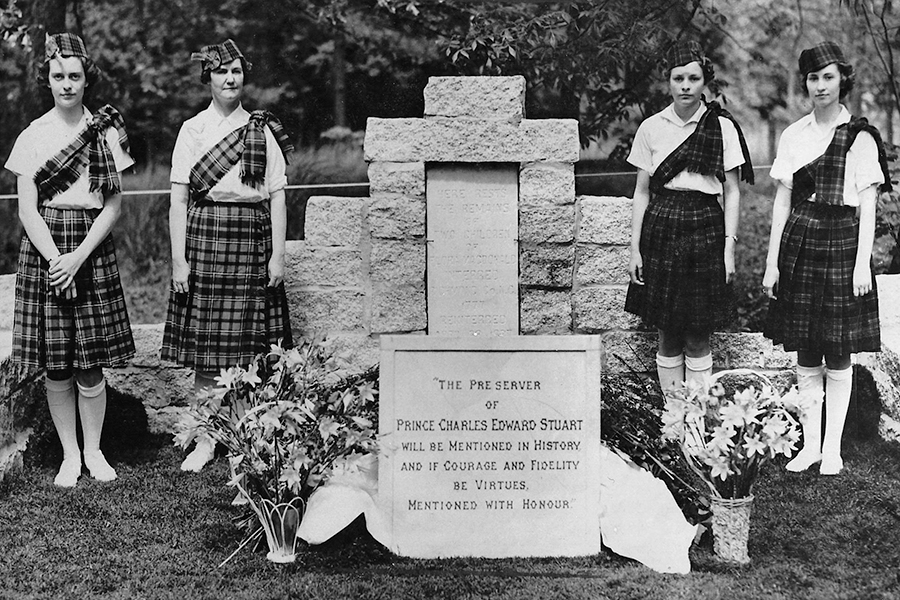
Having constructed a granite wall as a backdrop for the graves, the college made ready for an elaborate funeral ceremony at Red Springs on April 28, 1937. Prior to the ceremony, the double coffin was placed under the campus dome and laid “in state.” A 30-piece Fort Bragg military band and an honor guard of young women adorned in Stuart plaid lent a dignified atmosphere to the occasion. Four Flora MacDonald College students, all fittingly named Flora MacDonald, carried the remains from the dome to their permanent resting place.
Soon after the widely reported ceremony, questions were raised by skeptical historians whether the remains reinterred at the college were really Flora’s children. The naysayers advanced a simple argument that, in essence, involved the counting of noses: Flora had borne seven children, and they all could be accounted for. Sons Ranald and Alexander were lost at sea in 1783, and the earliest death of the remaining five took place in 1795 — 19 years after Flora fled the plantation.
Supporters of the view that the remains were of Flora’s offspring pointed to a letter she allegedly sent in February 1776, beseeching her friend Maggie to visit because Allan was with the regiment “and I shall be alone with my three bairns (Scottish word for children).” It was asserted that two of the “bairns” could only be the children who perished at the plantation. The 1872 edition of American Historical Review quoted this correspondence and stated it was being preserved in Fayetteville. But the letter’s existence is considered suspect since no one knows where it is today. Moreover, its slangy language is thought to be inconsistent with other writings of the well-educated Flora.
If two of Flora’s children did perish from typhus, it stands to reason she and Allan would have memorialized that fact somewhere in their writings. It would have particularly served Allan’s interest to report any such deaths in his 1784 petition to the British government in which he sought compensation for the confiscations and other losses he and Flora suffered in North Carolina. In his submission, Allan pulled out all the stops, pouring out the litany of hardships and heartbreaks inflicted upon the MacDonalds while in America, including the loss at sea of son Ranald. Tellingly missing from the petition is any mention of deaths of other children, young or otherwise.
Research of Colonial-era property records by Pinehurst’s Rassie Wicker further weakened the frayed case that the graves contained Flora’s children. Wicker found that Allan MacDonald never owned land at or very near Mountain Creek, the site of the unearthed graves. He did, however, own a 475-acre plantation in Montgomery County about 4 miles away on Cheek’s Creek. A 1775 letter authored by Royal Gov. Martin buttresses Wicker’s position. Martin wrote that he intended to spend the summer “with my friend Mr. MacDonald of Kingsborough … on Cheek’s Creek.” Wicker made the additional point that had Alan been inclined to name his plantation, he would surely have called it Kingsborough, not Killiegray — a name associated with a different Scottish clan.
The reinterred graves at Red SpringsTartan-clad pallbearers at the April, 1937 funeral: (l) to (r) Flora MacDonald, Flora MacDonald, Flora MacDonald and Flora MacDonald
This historical brouhaha failed to generate much impact at Flora MacDonald as the college refrained from involving itself in the controversy while continuing to project a spirited Scottish motif throughout the two decades following the aforementioned 1937 funeral. The college faced a far more significant challenge in 1955, when the Presbyterian Synod decided to consolidate the operations of various colleges they had been supporting. As a result, Flora MacDonald College and Presbyterian Junior College in Maxton were combined into a co-educational institution and moved to Laurinburg. The resulting school subsequently became St. Andrews University.
Flora MacDonald College was closed in 1961 and its personal property, including valuable paintings, a pearl brooch reportedly containing a locket of the Bonnie Prince’s hair, a snuff box given by Allan to Flora on their wedding day, and other artifacts, were packed up and shipped to Laurinburg. Nothing was left of the school in Red Springs except its vacant and rapidly deteriorating campus buildings.
The vacating of the campus devastated the community of Red Springs and the college’s female alumni. A combined preparatory school and junior college was reopened at the campus three years later. In 1974, the institution became a K-12 co-ed school. While undergoing multiple name changes since the 1961 reopening, the school has continued to venerate its Scottish heritage, Flora MacDonald, and her putative children.
But if, as seems most likely, the remains of Flora’s children are not housed in the campus graves, whose are they? It is doubtful anyone will ever know with certainty, but presumably they are children of either early Scottish immigrants or slaves. But there is no question about the authenticity of the damaged marble tablet that the college placed on the graves. It originally graced the monument on Flora’s gravesite on Skye. After a storm damaged that monument, Charles Vardell helped raise funds to replace it, journeying to Scotland for the installation of the new stone. He was permitted to return to Red Springs with the original tablet, which bore the following inscription:
FLORA MACDONALD
Preserver of Prince Charles Edward Stuart
Her name will be mentioned in history,
and if courage and fidelity be virtues,
mentioned with honour. PS
Pinehurst resident Bill Case is PineStraw’s history man. He can be reached at Bill.Case@thompsonhine.com.
May is a blushing bride, lips sweet as plump strawberries, humming an ancient rhyme for luck.
Something old (snakeskin), something new (four eggs), something borrowed (birdhouse), something blue (songbird).
The second stanza starts with honeyed warbles. Tu-a-wee sings the bluebird on the pitched roof of the birdhouse. Tu-a-wee trills the bluebird at the nest.
Verse three is the sound of movement through soft grass. In the black of night — a shadowy flash — four eggs swallowed one by one.
Lucky rat snake, with its new skin, its luscious fluidity, its bellyful of tender life.
Lucky rabbit, nibbling in the garden at dawn, bellyful of baby lettuce, salad greens, Swiss chard, snow peas.
May is a banquet, a ceremony, a celebration.
It is the vow from bee to flower, flower to bee. The sacred oath to give until there is nothing left.
And there is so much here.
An apple blossom for the maiden. Wild berries for the groom. An ancient rhyme. Sweet nectar and the tender, green promise of a full and luscious life — pleasant and bitter, in darkness and in light.
It was such a spring day as breathes into a man an ineffable yearning, a painful sweetness, a longing that makes him stand motionless, looking at the leaves or grass, and fling out his arms to embrace he knows not what. ― John Galsworthy, The Forsyte Saga
Strawberry Fields
Behold the earliest strawberries, fat and sweet. Like love notes from summer, ripe for the picking.
And if ever you picked them straight from the bush, perhaps you’ve noticed that they smell as scrumptious as they taste. Members of the rose family, strawberry plants are perennial. Fruit can be picked green (pickle them) or ripe (you’ll know what to do), but don’t fret if they’ve gone a bit soft. Instead, make wine —or jam.
You won’t need much: Two pounds of fresh strawberries (mash them), four cups of white sugar and one-fourth cup of fresh lemon juice. One heavy bottomed saucepan, too.
Stir mixture over low heat until sugar dissolves, then bring to a full rolling boil, stirring often, for about 15 minutes.
Sure, you can transfer to hot sterile jars, seal and process — or save yourself the trouble. Let cool and eat right away.
The May Wreath
May takes its name from the Roman goddess Maia, midwife of plants, flowers and the riotous beauty of spring.
Speaking of flowers, it’s time to gather them.
On the first of the month, May Day, celebrate this fertile, fruitful season by fashioning a wreath of twigs and greenery. Weave in wildflowers: crab apple, dogwood, painted trillium. Add pomegranate, garlic, herbs and nettle. Hang it on your door until midsummer night.
Wreath-making is an ancient Greek custom believed to ward off evil and invite prosperity. The act itself is a sacred dance between the weaver and the natural world. PS
Photographed at Weymouth Center for the Arts & Humanities
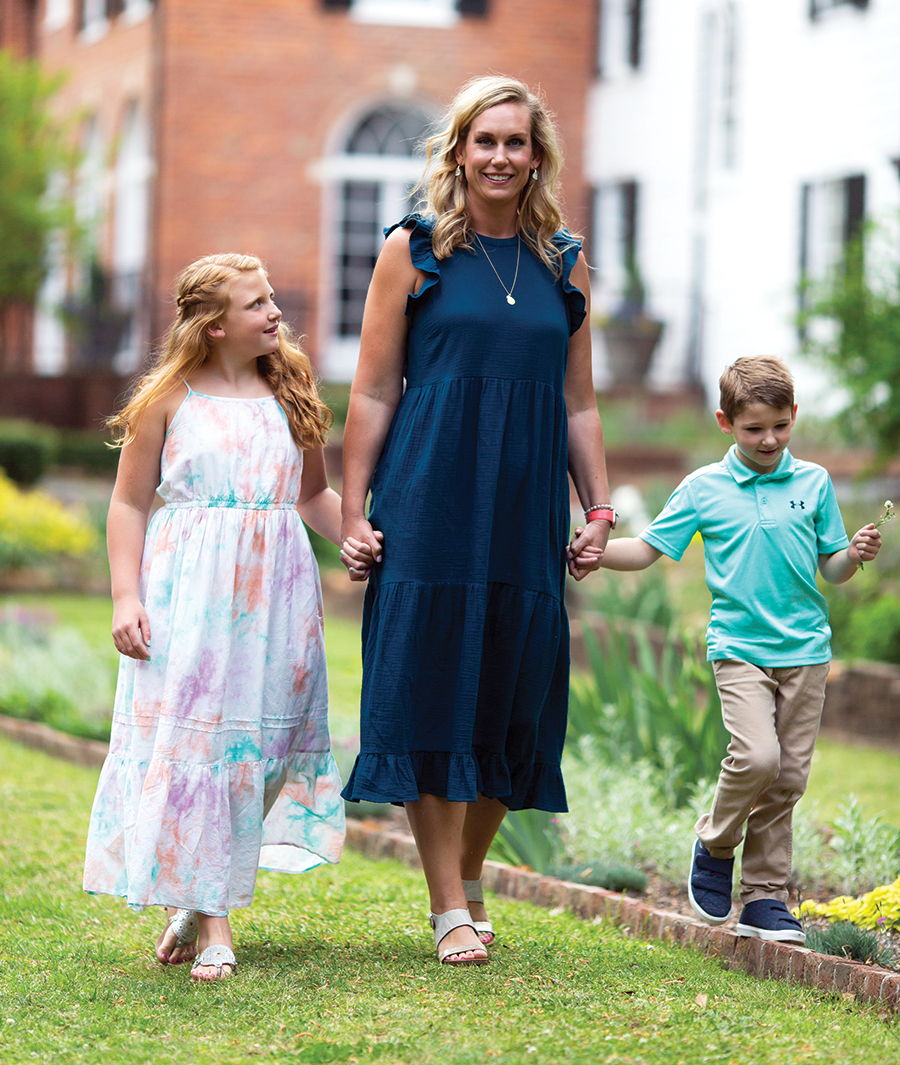
If Dad wasn’t married to Mom, he would live in a one-room house with beige carpeting, beige walls, a chair, three remotes he can’t find and cable TV he can’t surf. He has a sense for décor now, but that’s only because Mom has been training him for three decades plus. Last time I asked, Dad didn’t even know what bank they use or how much money they make. Mom could yank their well-decorated house right out from under him but, instead, she makes it his home — our home. Dad isn’t the only one who hopelessly leans on Mom, Captain Kath, as we affectionately call her, much to her faux chagrin. My brothers and I are in our late-20s, early-30s and we still phone the Captain when crises arise, from a lost set of car keys to a lovers’ quarrel. Without fail, she rejiggers her jam-packed schedule to solve our problems long distance. Thank you, Mom — we certainly don’t say that enough. What follows here is the tip of a very large iceberg — six Sandhills mothers who, just like Mom, keep all the balls in the air and make it look easy, even when it’s not.
Katie Wyatt
President and CEO of El Sistema USA
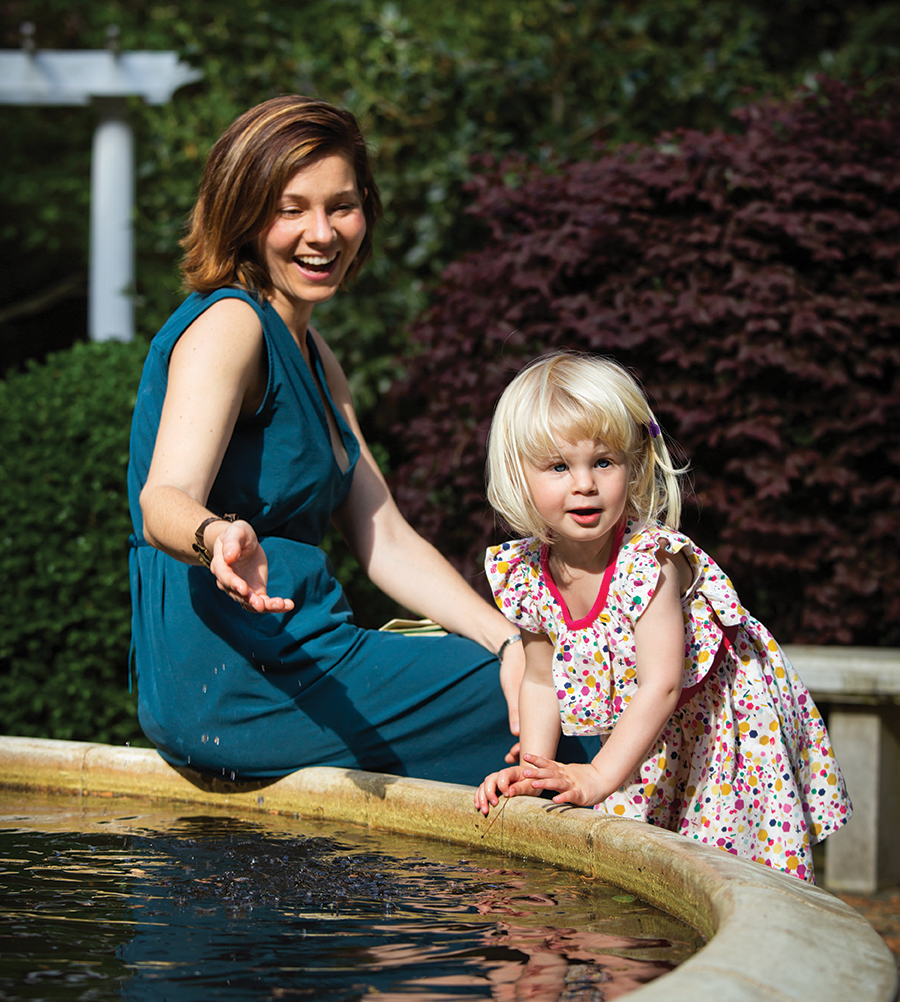
El Sistema is the colloquial name for a Venezuelan program that was founded in the 1970s to bring world class music instruction to underprivileged kids, and the movement has since spread worldwide. “The whole model of El Sistema is like an Olympic development program for music,” says Katie Wyatt, the founding president and CEO of El Sistema USA, a nonprofit organization that supports all El Sistema-inspired programs nationwide. “It’s way beyond your general music class, and the idea is to offer that kind of access and opportunity to all kids.” But El Sistema USA isn’t all that Wyatt does. She is the Carolina Philharmonic’s principal violist, supports the Weymouth Center in an interim capacity, teaches at Duke University, and is mom to 2 1/2-year-old Petra. “We’re buddies; we do a lot together,” Wyatt says of her daughter with a smile. “A lot of modeling for her is — this is who I am, this is something to aspire to be. It’s just the idea that you can do a million things. You can have this entrepreneurial mindset, which I think is this mindset of curiosity and challenge and discipline. The motto of El Sistema is ‘tocar y luchar,’ to play and to strive — and I am big on the luchar.” Petra is, too. “She is just rough and tumble. From the minute she could walk, she ran.”
Micaela Murphy
Lead Guide at Moore Montessori
Until last fall, Micaela Murphy and her family lived in Austin, Texas. But after student teaching observation at Moore Montessori, she was offered a job and the trio came to live in the Sandhills. “By study, I was in biology. I just loved the sciences and that was my path,” says Murphy, who’s now a lead guide at Moore Montessori. She pivoted away from the sciences after her daughter, Maliha, came home from school one day. “She was like, ‘Mom, where are all the teachers that look like me?’ She was like, you know, the brown skin and the curly hair that look like me.” Murphy had a conversation with one of Maliha’s teachers, who said there just aren’t a lot of Black teachers in Montessori. “Well, surely that’s not the answer,” Murphy reflects. And, if that was, it didn’t seem like a good one. “So, I was like, ‘OK, well, there’s not a lot?’ I’ll go ahead and become one.” And she did. “Long story short, I became a Montessori teacher, and my daughter encouraged the path that I’m on now.” Murphy describes her daughter, who’s now 9: “She’s everything that I’m not, all the best parts of a person, untouched by adult interference. And I say that because she still has this beautiful take on the world. She still has this humanitarian spirit. She still has this ‘But what if we can?’”
Ashley Tramontin
Owner of Against the Grain Shoppe
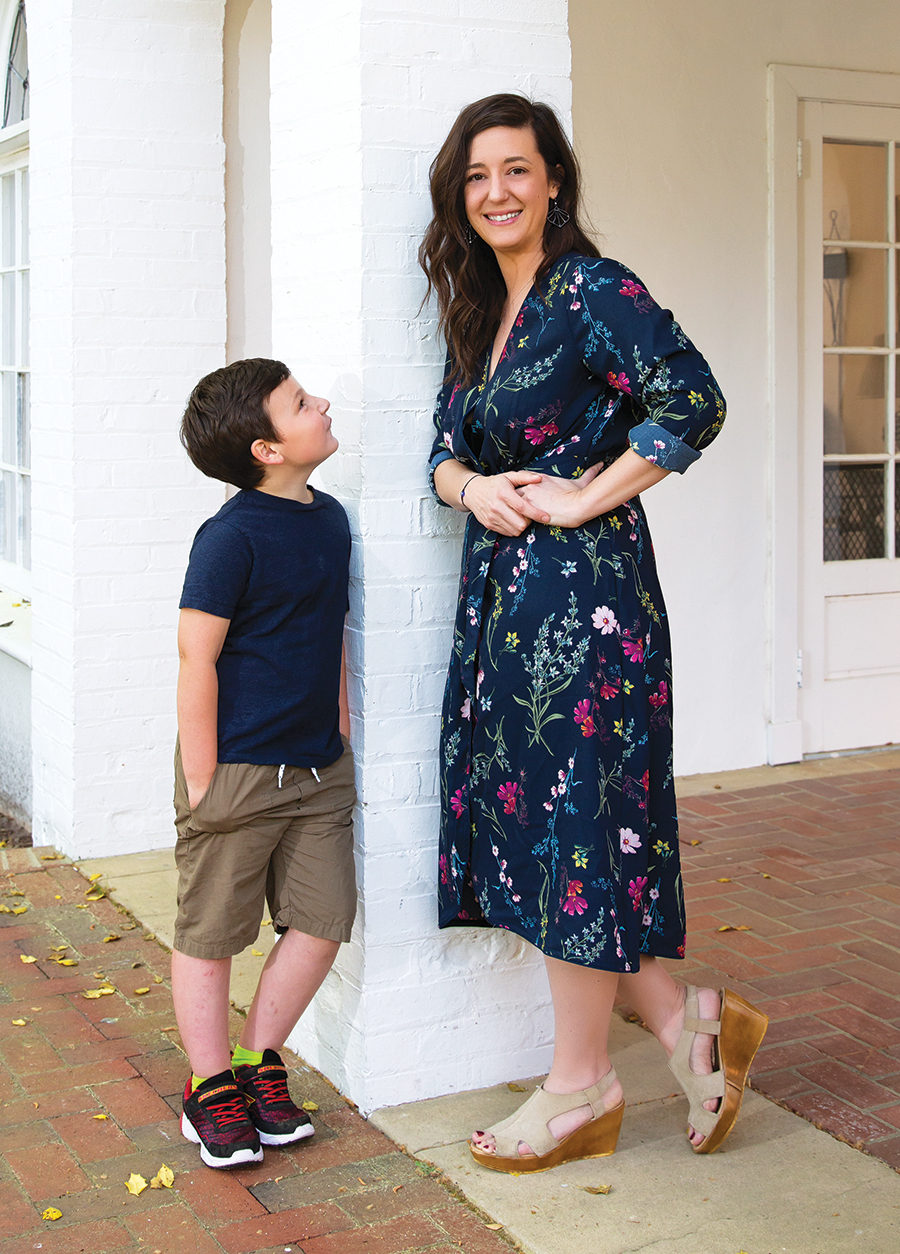
“I remember one time Reid told someone that I didn’t know — he was like, ‘Yeah, my mom owns a store,’ and, it was right after we opened, and it didn’t really feel real until he said that,” says Ashley Tramontin about her 7-year-old son. “I mean, I know he’s aware and paying attention, but it was so special to hear him be proud about it.” Tramontin started making and revamping furniture after hers was damaged in a move to the middle-of-nowhere Kansas. She recalls, “I started doing furniture for myself and then friends and built it into an Etsy store.” When she relocated to the Sandhills, she started selling her furniture in the area and eventually opened Against the Grain Shoppe to sell her wares and those of other local makers. Reid might be among them someday soon — he recently made and sold his first bench. But what he really enjoys is the back end of the business. “He loves to count the drawer for me,” says Tramontin, laughing. “He knows there’s supposed to be X-amount of money in here, and then he can figure it out, and then he can yell at me for not having it correct, and he loves it.”
Jane Claire Dawkins
Registered Nurse, Quality Department at Moore Regional Hospital
Jane Claire Dawkins is going on her 16th year of nursing — she’s now the quality coordinator for sepsis at FirstHealth Moore Regional Hospital. “There are certain core measures that we have to meet as a hospital, and my job is making sure that we’re compliant,” says Dawkins. She’s no longer providing bedside care in her day-to-day, but she has been administering COVID vaccines a couple of times per week at the community clinic. “It’s my way of giving back,” she says. Dawkins started her career in pediatric intensive care units. After she and her husband were married, they decided to make their way back to his hometown in the Sandhills. “We just felt called, really, for the sense of community,” she says. They liked the idea of raising their kids, Mary Britt, age 8, and Will, who’s just turning 5, in the area. “Mary Britt is super mature, and she’s super outgoing,” Dawkins says. “Will, he’s kind of like, he’s just my sweet little guy.” She smiles. As Dawkins’ family grew, her nursing career evolved, and she’s proud of the work/life balance she’s struck. “It’s definitely a dynamic field,” she says of nursing. “So many opportunities to work more or less, at the bedside or behind a desk, just depending on where you are . . . the season of life.”
Tiffany Fleeman
Owner of Workhorse Fitness & Yoga
“Regardless of what you try to shield them from, I think she was pretty aware that it was a tough year,” Tiffany Fleeman says about her new business, the pandemic and her 9-year-old, Olivia, or Liv, as she and her husband, Joel, call her. After a 2 1/2-year upfit, Fleeman opened Workhorse Fitness & Yoga in November 2019, just in time for the COVID pandemic. “This year was just such a hard time, teaching her not to give up. I mean, there were so many times this year — it’s hard to admit this — but giving up, it crossed my mind,” she says. “The business was new, and it was tough, but looking back, that’s never the example I want to set.” Liv is already resilient and blazing entrepreneurial trails just like her mom. “She has, through all of this, started her own little business.” Fleeman smiles. “She has this little plant business, and so we do that together. I help her make her little Marimo moss balls and these air plants that she sells in our store.” Workhorse has an in-house retail shop, fittingly called LIVWell. Fleeman continues, “She’s like, ‘Mom, you owe me this amount.’” She laughs and shakes her head. “She’s going to be a great businesswoman someday.”
LeAnn Bailey
Occupational Therapist
About 13 years ago, LeAnn Bailey closed her eyes, jabbed her finger at a map and happened to hit North Carolina. “I was finishing up my master’s degree in occupational therapy and had never lived outside of the state of Florida,” Bailey says. But because of that fateful jab, she met her husband while interning here in the Tar Heel State. Now years later, she works as an occupational therapist, driving daily to her patients in Moore’s surrounding counties, and goes home to a camper that she and her family are living in while their new house is being built in the Seven Lakes area. “I always thought I was a tiny living person like, ‘Oh, I can do that.’ I’ve learned very quickly now my life is not meant for tiny living. The 43-foot camper with three humans and two dogs gets a little . . . ” She laughs. Their 9-year-old daughter, Addie, has adjusted well to their interim housing. She seems to adjust well to anything; she just made friends with two kids while her mom was talking. “She doesn’t meet a stranger,” Bailey says. “She’s energetic. She is fun-loving, intelligent yet challenging at the same time, very intuitive.” She also likes to cheerlead and horseback ride. Addie runs over. “How would you describe your mom?” I ask her. “She’s really hardworking. She helps a lot of people, and I like it.”PS
Used to determine whether a user is included in an A / B or Multivariate test.
18 months
_ga
ID used to identify users
2 years
_gali
Used by Google Analytics to determine which links on a page are being clicked
30 seconds
_ga_
ID used to identify users
2 years
_gid
ID used to identify users for 24 hours after last activity
24 hours
_gat
Used to monitor number of Google Analytics server requests when using Google Tag Manager
1 minute
_gac_
Contains information related to marketing campaigns of the user. These are shared with Google AdWords / Google Ads when the Google Ads and Google Analytics accounts are linked together.
90 days
__utma
ID used to identify users and sessions
2 years after last activity
__utmt
Used to monitor number of Google Analytics server requests
10 minutes
__utmb
Used to distinguish new sessions and visits. This cookie is set when the GA.js javascript library is loaded and there is no existing __utmb cookie. The cookie is updated every time data is sent to the Google Analytics server.
30 minutes after last activity
__utmc
Used only with old Urchin versions of Google Analytics and not with GA.js. Was used to distinguish between new sessions and visits at the end of a session.
End of session (browser)
__utmz
Contains information about the traffic source or campaign that directed user to the website. The cookie is set when the GA.js javascript is loaded and updated when data is sent to the Google Anaytics server
6 months after last activity
__utmv
Contains custom information set by the web developer via the _setCustomVar method in Google Analytics. This cookie is updated every time new data is sent to the Google Analytics server.
2 years after last activity
SourceBuster is used by WooCommerce for order attribution based on user source.
Name
Description
Duration
sbjs_current_add
Timestamp, referring URL, and entry page for your visitor’s current visit to your store
session
sbjs_migrations
Technical data to help with migrations between different versions of the tracking feature
session
sbjs_first
Traffic origin information for the visitor’s first visit to your store (only applicable if the visitor returns before the session expires)
session
sbjs_current
Traffic origin information for the visitor’s current visit to your store
session
sbjs_first_add
Timestamp, referring URL, and entry page for your visitor’s first visit to your store (only applicable if the visitor returns before the session expires)
session
sbjs_session
The number of page views in this session and the current page path
30 minutes
sbjs_udata
Information about the visitor’s user agent, such as IP, the browser, and the device type