Out of the Blue

Out of the Blue

Batting Cleanup

Spotless . . . in the eye of the beholder

By Deborah Salomon

By June, “spring cleaning” should be done and dusted . . . right? The windows gleam, the carpet wafts shampoo. Begone dust bunnies that overwintered under the bureau. Same to soap scum ringing the tub and spilled jam glued to the refrigerator. The sofa has been moved, revealing kitty’s favorite toy and some petrified Halloween candy. All the shelves Swiffered, even the highest, uprooting a mosquito graveyard.

These tasks were accomplished on a sunny Saturday by family members, conscripted, cajoled or bribed.

Pizza for lunch, maybe?

Ah, spring cleaning, that archaic rite which, it seems, survives in name only. Because “clean” is a touchy subject — everybody wants clean surroundings, but nobody wants to do it.

I wanted to do it. Having three children in three-and-a-half years — then adding a rambunctious Airedale puppy — interfered. Nevertheless, every morning I gave the bathrooms a once-over, and late every afternoon, with most of the toys put away, I managed to vacuum, which gave the illusion of clean when Daddy came home to a hot supper. Then baths, stories, bedtime and collapse.

That’s just the way we did things in the ’60s.

Finally, I hired a “cleaning lady” who came every second Friday, from 9 to 3. Anna had emigrated from Eastern Europe to Canada after World War II. I assumed she flew in from heaven on huge white wings, to ease my travail. Anna, well into her 50s, was big, strong, energetic. She tuned her transistor radio to a Polish language station and attacked my house with a vengeance, I think in gratitude for the lunches: a big bowl of hearty homemade soup, rye bread for dunking, a meat sandwich, and garlicky coleslaw from a European deli. She finished off with a bearclaw (Danish filled with almond paste) and strong tea.

Food talks, even inspires.

After lunch I went out grocery shopping. When I returned, Anna was gone and the house smelled like Ajax and Pledge — more glorious than Chanel.

Anna demonstrated that cleaning isn’t just a profession or a necessity. It can be an art.

After she retired I hired helpers, since I was working full time, then gave up. They weren’t any more energetic than I was. Their clean didn’t squeak. They weren’t Anna.

Now, cleaning services are the mode. A crew of young men and women spill out of a truck with a snazzy logo. They bring supplies and implements, breeze through a big house in an hour or so, collect the cash and fly away, like Mary Poppins on her aeronautical umbrella.

They definitely don’t want lunch.

Some folks take clean to an obsession. I envy them, sort of. They are a ready market for Roomba (self-propelling vacuum) as well as Swiffer diversifications for wet and dry floors, blinds, hard to reach tchotchkes, et al. They remove stains with Mr. Clean Magic Erasers and suck up spills with Bounty paper towels. The aromas wafting through their hallways come from plug-ins, not meatloaf.

Others are neat freaks, where everything has its place and the kitchen harbors no junk drawer spilling over with twist ties, rubber bands, birthday candles and packets of soy sauce.

How do you live without a junk drawer? I have two.

Age has sapped my energy. The kitty and I don’t make much mess in our small apartment. I’m still fussy about the (one) bathroom and (tiny) kitchen. I push the carpet sweeper more often than the vacuum. The oven cleans itself, and I don’t keep jam in the refrigerator. Maybe books and magazines pile up, but so what? Makes me look literary. True, sometimes the late afternoon sun reveals a film of dust on the coffee table where I keep stylized animal figurines, collected over many years, many miles. So I close the blinds and the dust disappears.

Spring cleaning? Never got around to it. I’ll wait till fall.  PS

Deborah Salomon is a contributing writer for PineStraw and The Pilot. She can be reached at debsalomon@nc.rr.com.

Hometown

Hometown

The Boys of Summer

In a league of their own

By Bill Fields

There aren’t too many highlights sprinkled in my sporting life. The enjoyment, perhaps by necessity, has come from playing not winning.

I’ve had a few moments when I flipped the script, most occurring in a small ballpark on Morganton Road in Southern Pines across from the National Guard Armory, where kids still play baseball today. Win or lose, though, on that compact field of dreams the crack of bat on ball and pop of ball in glove was a soundtrack of fun.

The site was home to the Southern Pines Little League field more than a half century ago when the Pirates, Cardinals, Dodgers and Braves duked it out on Monday and Friday evenings from spring into summer, games at 6:00 and 7:45. The lights really kicked in for the second match-up, especially early in the season, making it seem a bigger stage.

We were boys chewing Bazooka bubble gum, savoring the stirrup socks that made us look like major leaguers, hoping some pixie dust would fly out with each pat of the rosin bag, and quenching our thirst with some not-so-cool water from the dugout fountain.

Each season started the same way. There would be a trip to Tate’s Hardware on N.E. Broad Street to purchase a pair of rubber-cleated baseball shoes. We’d put on our flannel team uniforms and parade through downtown on a Saturday in May, then scatter to sell candy door-to-door to raise money for the Little League.

It was a long time before travel teams or meddlesome parents who want to make the games about them. Our moms and dads didn’t argue with umpires or second-guess coaches. They sat in the bleachers or in their cars beyond the field. They volunteered in the concession stand or as the public address announcer. They cut the grass and chalked the foul lines.

The outfield fence — 180 feet from home plate when I started Little League and lengthened to 200 feet before I was done — was covered with advertisements for local businesses not protective padding. I one-hopped a couple of hard hits off the metal barrier in left center but never hit a dinger in my three years with the Braves. I am a man without a home run or a hole-in-one but still hold out hope for the latter.

My most meaningful at-bat probably came in my first Little League season when I was 10, after moving up from the Minor League Tigers. We were playing the always formidable Pirates coached by Willis Calcutt. Their ace pitcher, a strapping boy who could have passed for a second-year Pony Leaguer, had a no-hitter going deep into the six-inning game. I somehow managed to make contact with one of his fastballs, hitting a blooper just over the second baseman into shallow right field.

I was better with glove than bat, a confident infielder who played second and a little shortstop before settling at third base when I wasn’t pitching. (I threw a knuckleball that, on my good outings, fluttered just enough to keep batters guessing.)

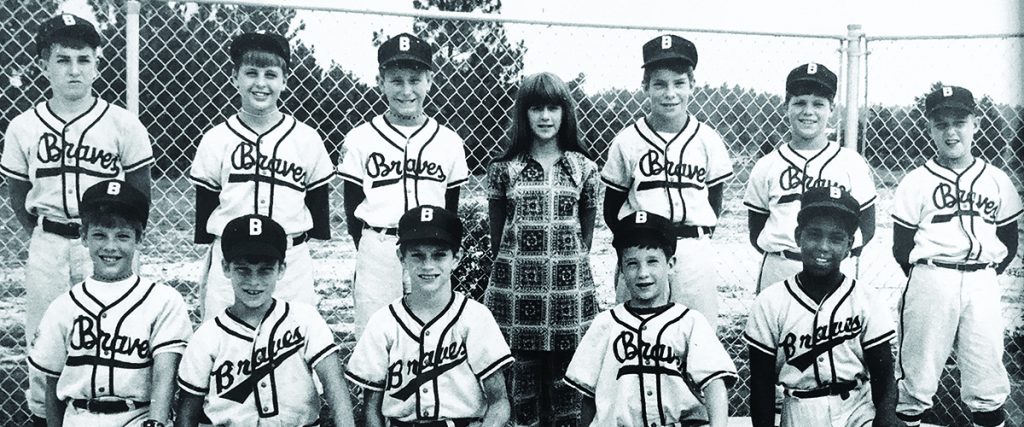
The Braves won the 1970 Southern Pines championship thanks to fellows who could really play like David Smith, Jay Samuels and Ian McPherson. (I’m far right, top row.) It didn’t hurt our chances that two of Coach John Williams’s sons, John Wiley and Mike, were part of the Braves. Coach was a de facto assistant to David Page and always willing to spend extra time working with us.

I made the All-Star team as a 12-year-old third baseman in 1971 when I had the privilege of playing for Jack Barron, whose many years of devoted community service in the Sandhills included being coach of the Dodgers for a long time. Mr. Barron did everything he could to prepare the All-Stars in our practices.

I’m not sure I knew there was a Warsaw, N.C., until we suited up in our blue and white Southern Pines uniforms and packed into a couple of station wagons for the two-hour drive east and our first game. But I’m certain I’d never seen a curveball on Morganton Road like the opposing pitcher threw that afternoon. I struck out in my one hapless at-bat, and my teammates didn’t fare much better. Our post-season didn’t last long.

But our disappointment, I recall, didn’t linger either. There was a stop for supper, at a restaurant that sold Andes Mints for two cents apiece at the cash register. We stocked up. Someone in the backseat figured out if a mint was released just so on top of the car, it would travel such that it would be sucked back into the wagon’s open rear window. The trick amused us for miles. If only we had solved the curve ball problem as proficiently. PS

Southern Pines native Bill Fields, who writes about golf and other things, moved north in 1986 but hasn’t lost his accent.

Focus on Food

Focus on Food

I Dream of Falafel

Iconic street food from the Levant

Story and Photograph by Rose Shewey

Do you know what North Carolina and North Africa have in common? We’re on the same latitude. Consider that for a moment! If you’re looking out onto the Atlantic Ocean in North Carolina you’re on par with Morocco. When inquisitive friends and family from overseas ask about the climate in our part of the world, I typically tell them that we may as well be in Casablanca. You know, if Casablanca was muggy.

I was so fortunate to visit North Africa and parts of the Levant in my younger years. I had just turned 18 and set up shop at the Costa del Sol in Spain for the summer. I vividly remember the day I was lounging at the beach in sunny Marbella; it was a particularly clear day, not a cloud in sight and the morning haze had just dissipated. As I gazed across the azure tinted Mediterranean sea, I saw her. I saw Africa and she was calling my name. Within less than 24 hours, I was on a ferry crossing over from Gibraltar, Spain to Tangier, Morocco. I was unaccompanied with little more than a small backpack, clutching on to my passport, ready to set foot on African soil.

North Africa is hands-down one of the most exotic and colorful places I have visited. While I have many rich memories of this trip, traversing the northern tip of Africa all the way from Morocco to transcontinental Egypt, what stands out the most is the allure of the Arab and Mediterranean cuisine, particularly the many different renditions of falafel I tried. No, I didn’t make it to Israel, the alleged home of the falafel where, rumor has it, you cannot turn around without ending up in the queue of a falafel shop. However, despite its popularity in Israel, most agree that falafel probably originated in Egypt. In fact, if you happen to go to a McDonald’s in Cairo, you’ll find McFalafel on the menu, bizarre as it may seem.

There are many reasons to love falafel. The most obvious is that these golden-baked, crispy balls drizzled with tahini sauce and stuffed into a fluffy pita or served as part of a meze are bursting with flavor. Falafel are also a fabulous gateway to a more plant-based life-style; with their meatball-esque texture, they leave little to be desired. June 12 marks the annual international falafel day, but why wait; there is no wrong time to enjoy the world’s oldest (and perhaps healthiest) fast food. 

Falafel

(Makes about 20 balls)

Ingredients:

1 1/4 cups dried chickpeas, soaked overnight

1/2 cup onion, finely chopped

4 garlic cloves, crushed

1/2 cup flat-leaf parsley, finely chopped

1/2 cup cilantro, finely chopped

1/4 teaspoon cayenne pepper

1 teaspoon ground cumin

1 teaspoon salt

1/2 teaspoon cardamom

1/4 teaspoon black pepper

2 tablespoons chickpea flour

1/2 teaspoon baking soda

Avocado oil for frying (optional)

Drain the chickpeas and add them to a food processor along with the onions, garlic, parsley and cilantro. If you have a small food processor, mix in batches; pulse each batch for about 30 seconds until the ingredients are finely chopped and hold together well. Once processed, add the spices, chickpea flour and baking soda and mix by hand; if the mixture feels too dry, add 1-2 tablespoons of water. Cover and refrigerate the mixture for at least 1 hour before processing.

Using your hands or an ice cream scoop, form balls or patties (about 1 tablespoon of mixture per ball).

You can now deep-fry or bake your falafels. To deep-fry, add about 4 inches of oil to a heavy-bottomed pot and heat the oil to 350°F. Cook falafels in batches, for about 3-4 minutes until they are golden brown. Transfer to a paper-towel lined plate and serve immediately.

To bake the falafel, pre-heat the oven to 425°F. Place the falafel on a baking sheet lined with parchment paper, brush the top of your falafel with oil and bake for 25 minutes. Flip falafel halfway through baking. Serve right away.  PS

German native Rose Shewey is a food stylist and food photographer. To see more of her work visit her website, suessholz.com.

It Takes A Village

It Takes A Village

Geneva McRae, Demus Taylor and Taylortown

By Bill Case

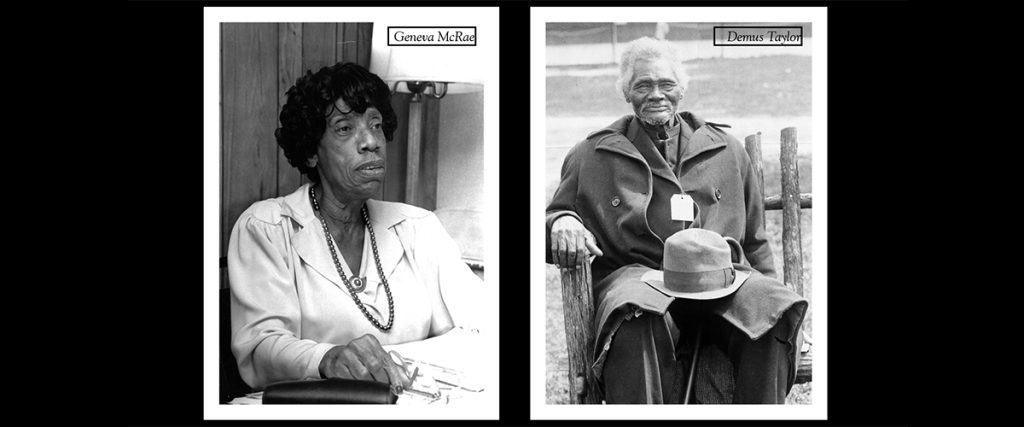
Having been gone so long she couldn’t remember when she left, Geneva McRae decided it was time to come home to Taylortown — the African American community of 650 souls where she had spent her formative years. Decades before, the untimely death of Geneva’s father, Charlie, caused her mother, Lowverta McRae, to relocate from Taylortown to New York City along with her six children. Lowverta sensed her kids stood a better chance of advancing their fortunes up north rather than in the Sandhills, where employment opportunities for Blacks were mostly limited to low-paying service jobs with the Pinehurst resort.

For the energetic and adventurous Geneva, New York proved a godsend. She would thrive there during a remarkable career in public service. First, she served a three-year hitch in the U.S. Army that featured culturally broadening deployments in England, France, and Germany. Following her discharge, McRae attended night school at City College of New York where she received a degree in education. While taking graduate studies in public administration at NYU, she taught at a city elementary school.

After passing a civil service examination she was hired by the New York State Employment Service where she steadily rose through the ranks holding management positions of ever-increasing responsibility, including the supervision of the agency’s first Job Corps unit. Her success caused a sister public entity to come calling. She took a two-year leave of absence to run South Bronx’s “Hunt’s Point” program for job training and health needs.

Shortly thereafter, McRae was recruited to serve as deputy director of New York City’s Model Cities Program. In that role, she helped underprivileged women receive the training necessary to become nurses. She also administered programs providing medical internships for minority candidates. “That’s where I got my education — my baptismal if you will — in community work,” McRae told The Pilot staff writer Huntley Womick in a 1990s interview.

Given her well-developed social network, McRae’s friends assumed she would remain in New York after retiring in 1978 at age 63. But the Sandhills called her home. She owned a tract of land in Taylortown — left to her by Lowverta — who instructed her daughter to never sell it. McRae built a house on the property and, when it was completed in 1982, she moved in. Her roots in Taylortown, however, stretched well beyond her ownership of land.

“Our forefathers, mine included, founded this community in the early 1900s, and built homes and churches,” she told The Pilot. The founders left “a pioneering spirit that continues to live in the hearts of the people.”
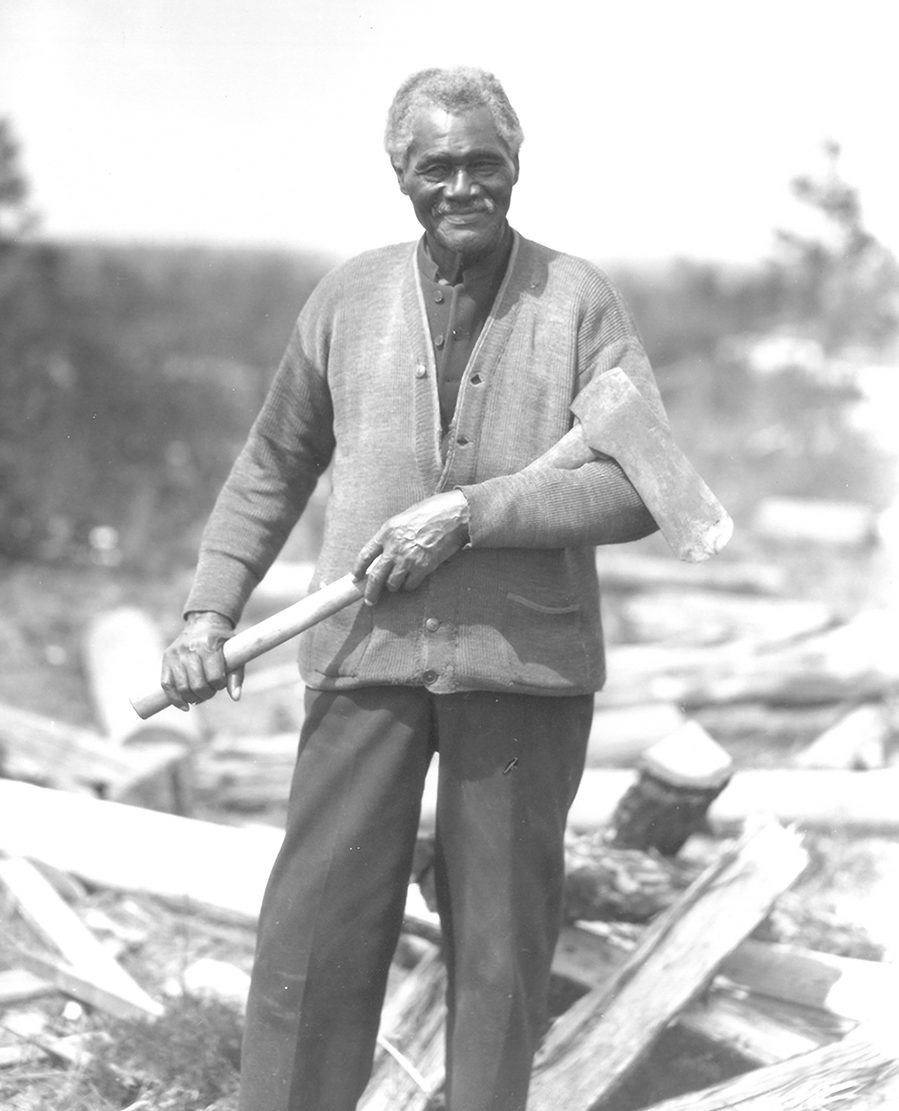
Demus Taylor

Taylortown’s strong religious ethos also attracted McRae. She expressed pride that the town’s people are “taught to love God and love the community.” Throughout its history, Taylortown has been home to an array of vibrant, well-attended churches including House of Prayer, Galilee Baptist, Spruill Temple Church of God, and Spaulding Chapel AME Zion. Geneva became a devout member of the latter, serving on its board of trustees.

Spaulding Chapel AME Zion had also been the chosen church of the town’s founder Demus Taylor — at 6 feet 5 inches, a larger than life figure. He was born into slavery, perhaps as early as 1821, though the exact date is unknown. His ancestors were from the West African Ebu tribe. Among Demus’ “owners” was James Taylor, brother of the 12th U.S. President, Zachary Taylor. According to one account, Demus’ ownership changed hands five times before his emancipation. After gaining his freedom — and the ability to trade his labor for wages — he worked in the turpentine trade, notching trees at a nickel apiece. Like Paul Bunyan, the lean, powerful Taylor could do the work of three men, notching hundreds of trees daily with his trademark axe. Apparently Demus was too productive for his own good. His employer determined the per tree stipend was too generous and trimmed Taylor’s compensation to a flat rate of $2 per day plus all the rations the man with the axe could eat.

When James Tufts came to Moore County in 1895 and founded Pinehurst, the aging Demus saw an opportunity for a new gig. With golf emerging as the resort’s primary attraction, Taylor (by then presumably in his mid-70s) decided to try caddying. He became a good one, often looping for Donald Ross. According to Golfdom magazine, Taylor ingratiated himself with the legendary golf professional and budding architect, becoming Ross’ “top Sergeant” at the resort’s caddie shack.

At first, Taylor and numerous Black workers resided at the “Old Settlement” — an area adjacent to what is now the 15th hole of the No. 3 golf course. Around 1905, Taylor bought property from Tufts located across current Route 211. Like a latter-day Moses, he led a migration of Black workers to this land, initially referred to as the “New Settlement.” Eventually, the transplanted residents began calling the area Taylortown, a fitting tribute to Demus.

Taylor died in 1934 and the stories reporting his demise gave a range of his age from 106 to 113. Numerous Taylortown men would follow Demus’ example by caddying at the resort including Hall of Fame loopers Robert “Hardrock” Robinson, Willie McRae (unrelated to Geneva), and Sam Snead’s man, Jimmy Steed. Over the years, the community would become home to scores of other resort employees: maids, laundry workers, masons, and laborers. Robert Taylor, Demus’ son, founded a school for Taylortown children. And, before moving to New York City, Geneva McRae graduated from that institution — the Academy Heights High School.

When McRae returned to Taylortown in 1982, she discovered her New York-honed community service skills were in high demand. In 1984, she joined the five-member board of the Taylortown Sanitary District, an entity founded in 1963 for the purpose of providing the first water service and streetlights for the town. She was elected chairperson of the board in 1985.
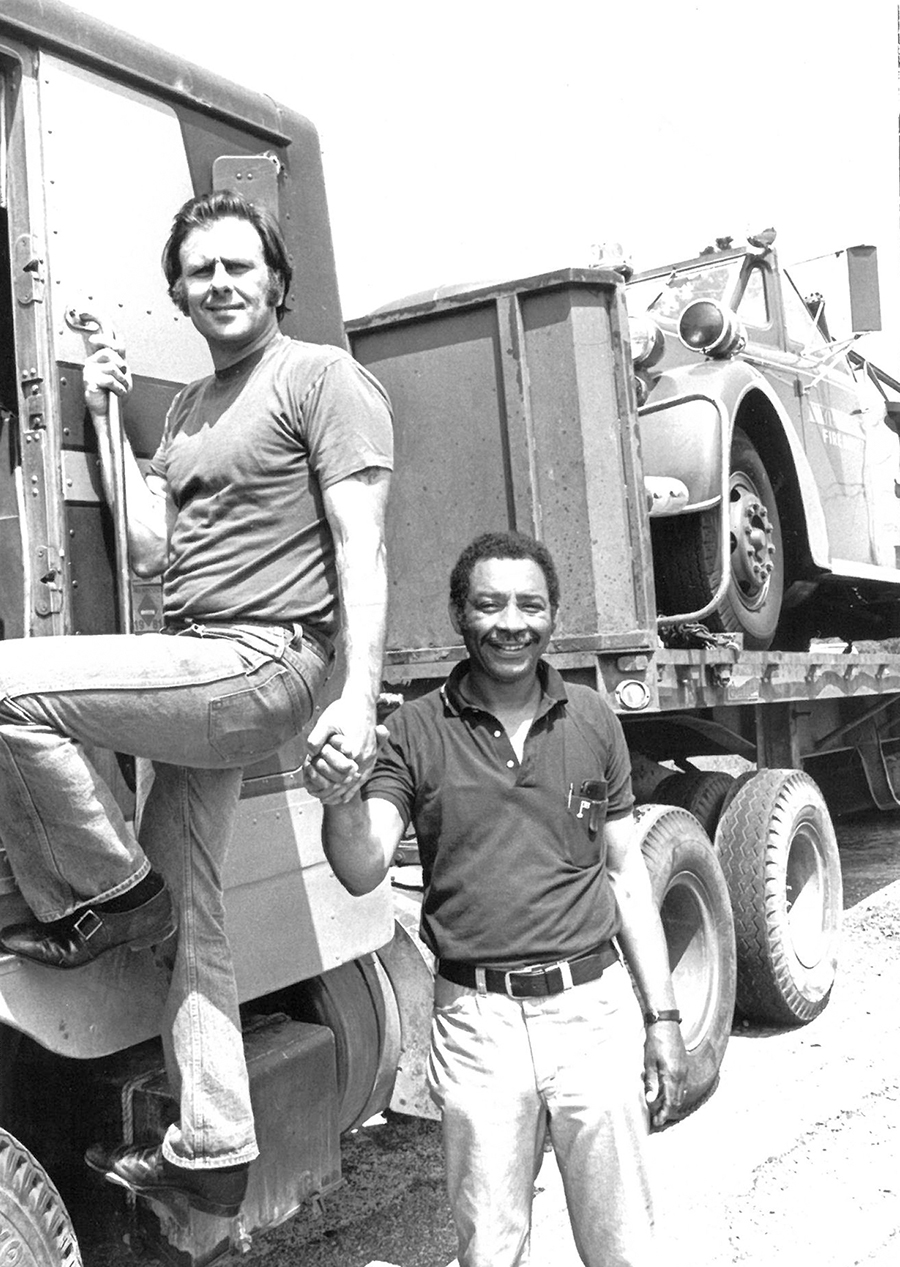
In 1981 J.O. Quin and Perry Barrett haul a ladder truck to Taylortown.

The advent of the Sanitary District marked an early step toward self-government for Taylortown’s inhabitants. Its establishment provided the necessary governmental entity to borrow money to construct the water lines and repay the loan. The Pinehurst Community Foundation pitched in to assist its Taylortown neighbors by paying for a legally required engineering study. Prior to the time the district came into being, “only six or eight houses had indoor plumbing,” according to early district board member Floyd Ray. Many residents had been forced to carry water from a pump or neighboring well to their homes for cooking, drinking, and bathing.

The Sanitary District represented real progress but residents of Taylortown hoped the time would come when the community could independently provide other governmental services. The county sheriff was primarily responsible for policing, but deputies patrolled the community sporadically at best. Far flung Moore County Emergency Services provided fire protection with additional assistance from Pinehurst. Periodic attempts to provide such services locally had failed to get off the ground.

In the 1960s, for example, community leaders urged Moore County officials to appoint a part-time deputy sheriff to patrol Taylortown. The sheriff and county commissioners were amenable to the concept but indicated the officers’ compensation would need to be borne by Taylortown residents. Had the community then possessed the status of a municipality with taxing authority, funding for the officer probably could have been arranged. But it was not, and the initiative went no further. 

In 1980, former Taylortown resident Perry Barrett launched a heroic, though ultimately futile, effort to establish a local fire department in his hometown. Barrett, then a head carpenter for the Nassau County (New York) maintenance department, got wind of the fact that New York-based fire departments were jettisoning and junking a couple of their fire trucks. Perry saw an opportunity to create a fire department in Taylortown and persuaded the authorities to give him the trucks. After making repairs, he got behind the wheel of one of the pumpers and began the long journey south. The truck’s engine blew en route and an exasperated Perry was marooned alongside the highway. He eventually managed to get the trucks to North Carolina, an achievement that garnered national publicity. North Carolina governor Jim Hunt awarded Barrett the Order of the Longleaf Pine, but his exploits would go for naught. Absent municipal status, Taylortown was in no position to operate, house, or staff safety forces of any type.

Such disappointments led civic leaders to consider the possibility of incorporating Taylortown as a municipality and momentum in that direction increased after Pinehurst proposed a new planning and zoning ordinance in 1981. As a municipality, Pinehurst under state law could zone unincorporated areas located less than one mile from its boundaries, thus including much of Taylortown.

This situation annoyed town resident Ruth Jackson who expressed the frustration shared by many in her community. “Who is representing Taylortown?” she inquired at the public hearing on the zoning ordinance. “We’ve requested water, sewer, and police services from Pinehurst several times. And every time, we’re told to go to Carthage. Now you come looking for us when it’s something we don’t even want.” Jackson further noted that hearings were being scheduled on weekday afternoons when Taylortown laborers couldn’t leave work to attend.

Given her successful role as Sanitary District chair, Geneva McRae realized she would be expected to take the point in any incorporation campaign at the North Carolina legislature. So she, together with Sanitary District commissioner Micajah Wyatt, took charge. Geneva’s background in community organizing came in handy. “I’ve never worked as hard on any job and put in so many hours,” she told an interviewer. “But it [was] a labor of love.”

She and Wyatt formed the Taylortown Executive Committee which sponsored fundraising activities to pay for a survey of Taylortown’s boundaries. Next, Geneva turned her attention to the churches — familiar ground for her. She asked for and received assistance from the Ministerial Alliance, a group established in the ’70s consisting of Black ministers from Taylortown and other Moore County churches. The alliance members would prove vital to the effort. McRae also met with Raeford mayor J.K. McNeil to prepare a feasibility study to support incorporation.

In June 1986, a petition to incorporate Taylortown was submitted to the North Carolina General Assembly. State Representative James Craven of Pinebluff adopted Taylortown’s incorporation as his personal cause by introducing proposed legislation to make it a reality.

In one meeting on the bill, Pinehurst mayor Charles Grant sought to derail it, claiming that state law did not permit incorporation by a small community located within one mile of a larger one. Craven countered that the cited law only applied when the larger community had a population of at least 5,000, which Pinehurst (at the time) did not. Mayor Grant argued that incorporation would cause problems with overlapping police jurisdictions. The resourceful McRae was prepared to respond. “If police will be a problem, why does Pinehurst tell us this is not in their jurisdiction for police services?” she asked.

Rev. H.C. Johnson, a Ministerial Alliance member, also spoke in support of Taylortown’s bid for municipal status, and did so emphatically. “I don’t want Pinehurst telling us what to do. We poor folks made Pinehurst what it is. We worked for nothing, $40 a week. We made it what it is and want to leave it there.”
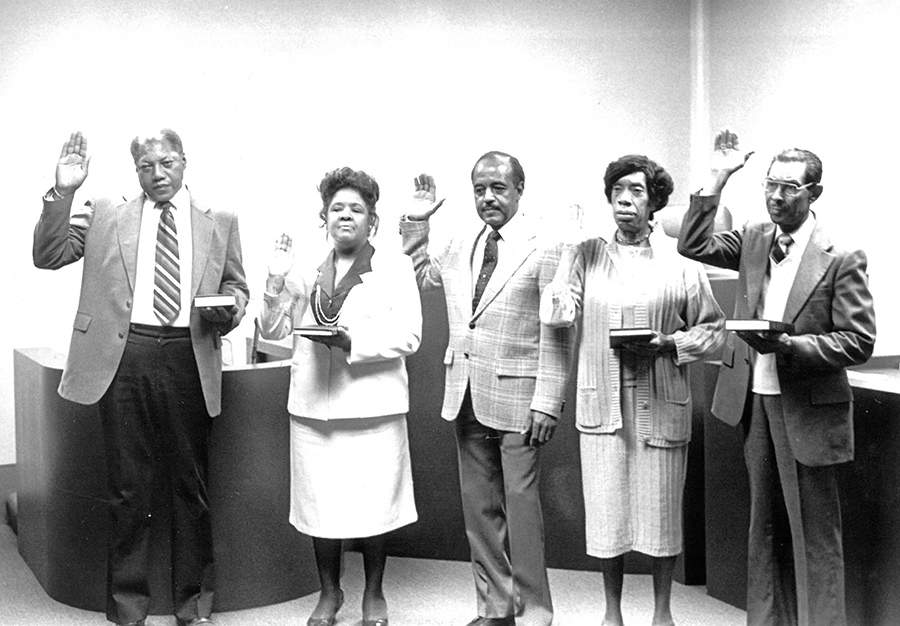
First village council members: Jesse Fuller, Frances Johnson, Floyd Ray, Geneva McRae and Daniel Morrison

However, the opposition of Pinehurst, coupled with the fact that the General Assembly was in short session resulted in the bill going nowhere. While frustrated, McRae and other incorporation proponents were not discouraged. “We were so determined to make Taylortown a municipality that we did everything required of us and more,” she told a writer for the Citizen News-Record.

Craven’s bill was finally taken up for consideration by the General Assembly the following year. A series of legislative committee meetings on it necessitated attendance by McRae and members of the Ministerial Alliance. Bishop Larry Brown, minister at Taylortown’s House of Prayer, was among the faithful attendees. Brown estimates he made at least 25 trips to Raleigh. In a recent interview with Pilot reporter Laura Douglass, the bishop indicated that more than one opponent of Craven’s bill questioned whether a town of Black people would be able to govern themselves. But the presence and advocacy of Brown and his fellow men of the cloth gave a spiritual dignity to Taylortown’s presentation, impressing the legislators.

Eventually, Pinehurst dropped its objection to the concept of Taylortown’s incorporation, but the village remained opposed to Craven’s bill when it was amended to include within the proposed municipality three vacant parcels comprising 31 acres located on the north side of Route 211. Pinehurst was itself attempting to annex the parcels, now the Pinecroft Shopping Center that includes the Harris Teeter grocery store.

The question of which town should wind up with the 31 acres constituted the last roadblock for McRae and the other proponents of incorporation. A key Moore County state senator, Wanda Hunt, also the chairwoman of the Senate’s local government committee, was feeling pressure from both sides. She wanted to vote for Taylortown’s incorporation, but because a property owner in the disputed area (who happened to be a Hunt supporter) preferred that his property remain in Pinehurst, her vote was up in the air. Moreover, the North Carolina League of Municipalities was siding with Pinehurst. After what Craven would describe as “a lot of lobbying,” he convinced both the League and Hunt to support his bill. With them on board, the state senate unanimously approved Craven’s bill 40-0. The inclusion of the three valuable parcels within Taylortown’s corporate limits would furnish a welcome boon to the new municipality’s tax base.

On July 13, 1987, Taylortown became a municipality. As was her style, McRae gave credit to everyone but herself for the achievement but, absent her organizational skills and tenacity, incorporation likely would have remained a pipedream.

As a result of incorporation, the Sanitary District was disbanded. To run the municipality’s affairs, a five member village council was established, initially consisting of McRae, Floyd Ray, Jesse Fuller, Frances Johnson, and Daniel Morrison. The new council selected McRae to be the town’s first mayor. Described by one writer as “a willowish wisp of a woman who, nevertheless, packs a wallop,” McRae would serve two terms in the post.

Her tenure was an active one. Under her leadership, Taylortown entered into a formal fire protection agreement with Pinehurst. That arrangement continues to this day. A police department was established after the council figured it could pay an officer of its own less than it would pay in a contract for law enforcement with the county. McRae would persuade county officials to establish a voting precinct inside Taylortown. Olmsted Village was annexed into the village. The council authorized new recreational facilities and, with financial assistance from the Sandhills Garden Club (arranged by McRae), beautification of the community became a priority.

Over the years following McRae’s departure from municipal government, many other improvements have taken place within the community. A new village hall was completed in 2000. Pinecroft and Harris Teeter occupied the once heavily contested 31 acres. Government funding was obtained to update the water system and additional streetlights were installed. Today, Taylortown Museum honors Demus Taylor and other community founders like the remarkable McRae who passed away in 2008 at the age of 93. And another gain to the community occurred when Perry Barrett, once the young man who brought fire engines to Taylortown and is now in his 90s, moved — like Geneva — from New York back home, an echo of McRae’s own words: “I love Taylortown and I love its people. I wouldn’t live anywhere else. This is home.”  PS

Pinehurst resident Bill Case is PineStraw’s history man. He can be reached at Bill.Case@thompsonhine.com.

Omnivorous Reader

Omnivorous Reader

Flying Toward Catastrophe

The real canaries in the coal mine

By Anne Blythe

Many of us turned a more enthusiastic ear toward the chorus of birds in our midst during the early days of the pandemic. With the routine rumble of traffic muted to a minimum, their chirps, trills and full-throated songs offered a sense of solace in an unfamiliar world.

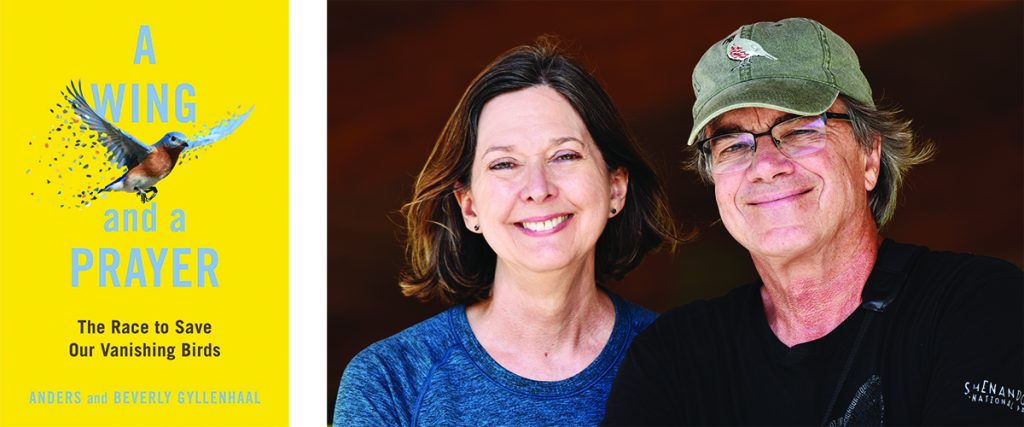
In their new book, A Wing and a Prayer: The Race to Save Our Vanishing Birds, Anders and Beverly Gyllenhaal tell us we should lean in and pay close attention. Their calls, or lack of them, their habits and changing habitats herald the health of our environment, write the avid birders and veteran journalists.

The husband and wife team, based in Raleigh, got the bad news out of the way at the start. In the last 50 years, a third of the North American bird population vanished.

“That translates to three billion birds of all sizes and shapes, in losses stretching from coast to coast, from the Arctic to Antarctica, through forests and grasslands, ranches and farms,” the couple writes in the introduction, noting that some birds are transcontinental travelers. “As one veteran biologist, John Doresky, with the U.S. Fish and Wildlife Service in Georgia, told us, ‘We’re in the emergency room now.’”

The Gyllenhaals might start their story in the ER, but their book does not dwell heavily on a doomsday scenario. Instead, they offer an optimistic outlook as they chronicle the research, new technology and conservation laboratories they explore during two years of cross-country and intercontinental travels.

The grasshopper sparrow and spotted owl serve as their bookends for a wide-ranging story reported with exacting detail about the work of “the ranks of biologists, ranchers, ecologists, birders, hunters, wildlife officers and philanthropists trying to protect the continent’s birds from a growing list of lethal threats and pressures.”

Anders and Beverly got involved with birding more than a decade ago while living in Washington, D.C. They were transitioning from long careers in journalism to “a lifestyle geared toward three Bs: birds, books and banjos, which Anders had played since high school.” Disclosure: One leg of their journalism path brought Anders to the News & Observer in Raleigh, where I worked for him and admired his dedication to solid reporting and storytelling. That commitment is evident throughout A Wing and a Prayer.

They take us along with them on a journey in their Airstream from North Carolina to Florida, through the heartlands to Kansas, and then further west to California, where they store their home office on wheels while they continue their trek through Hawaii.

They introduce us to colorful conservationists in muddy bogs, grassy fields and craggy bluffs while also giving readers a peek inside the offices of pivotal conservation organizations and ornithology labs.

Many of these scientists and conservationists could be the backbone for books of their own about trying to stop birds from being added to the list of extinct species. They introduce us to Ben Novak, a scientist in his mid-30s who grew up in North Dakota and now lives in Brevard, North Carolina. After falling in love with the passenger pigeon as a teen, he has developed intricate plans to build a lab in western North Carolina, hoping to use genomics to bring the bird back from extinction.

Not all of the conservation projects are as futuristic as Novak’s. In Hawaii they are about to release clouds of mosquitoes bred in laboratories to combat avian malaria. The goal is for the lab-created male mosquitos carrying an incompatible bacteria to mate with females that, in turn, will lay eggs that won’t hatch. In the process the conservationists hope to save some of the island state’s most threatened native birds. Hawaii, the Gyllenhaals point out, is the extinction capital of the world with 100 of the 140 native bird species having already disappeared. And, in the Southeast, the U.S. military has been heavily involved in efforts to save the red-cockaded woodpecker through controlled burns and managed forests on bases like Fort Bragg and Camp Lejeune.

While the Gyllenhaals stress that it is often the bigger birds — the bald eagle, the illusive ivory- billed woodpecker or the California condor — that get much of the attention, the smaller birds that hide easily in their habitats need more vocal advocates to save their species.

Their two-year journey, covering more than 25,000 miles, gives glimpses of many different birds including the Cerulean warbler, a tiny songbird that breeds in Appalachia and the eastern U.S. hardwood forests before making a long journey to winter in South America. The Gyllenhaals traveled to Ecuador to see firsthand the conservation efforts to protect the brilliantly colored birds that winter in the mountain forests there.

“We returned home inspired by the work under way to save birds,” the Gyllenhaals write. “We met folks who ruin their knees scrambling along dangerous cliffs, agonize over algorithms, confront adversaries at gunpoint and sometimes get their eyebrows singed off. They welcomed us into their lives for days at a time and shared their hopes, frustrations, and determinations.

Taken together, their experiences help make the case for birds — not only as nature’s workhorses and cultural icons, but as living bellwethers of the environment at a pivotal time.”

If you care about the birds in your midst — those in plain sight as well as those not so easy to see — A Wing and a Prayer is a must read.

“The Three Billion Bird Study stripped all mystery from the troubled state of the hemisphere’s birdscape,” the Gyllenhaals conclude. “There’s still time to respond, but that time is now. It’s clear what steps are making a difference and what will help avoid another half-century like the last one. Halting the collapse of our birds will not be easy. But as the scores of researchers, birders, wildlife experts, hunters and philanthropists are proving every day, a turnaround is within reach if we’ll listen to what the birds are telling us.”   OH

Anne Blythe has been a reporter in North Carolina for more than three decades. She has covered city halls, higher education, the courts, crime, hurricanes, ice storms, droughts, floods, college sports, health care and many wonderful characters who make this state such an interesting place.

Tea Leaf Astrologer

Tea Leaf Astrologer

Gemini

(May 21 – June 20)

A random fact (because it’s clear you collect them): Butterflies taste with their feet. As the social butterfly of the zodiac — and one plagued by an ever-wagging tongue — suffice it to say that Geminis know the taste of their feet. But for every foot-in-mouth moment you suffer, your wit and charm never fail to bail you out. When Mercury (your ruling planet) enters Gemini on June 11, your blundering will subside. In other words: They’ll be eating from the palm of your hand.

Tea leaf “fortunes” for the rest of you:

Cancer (June 21 – July 22)

Delete the app.

Leo (July 23 – August 22)

Please remain seated while the ride is in motion.

Virgo (August 23 – September 22)

Let it be a surprise.

Libra (September 23 – October 22)

Just add water. 

Scorpio (October 23 – November 21)

Scrolling isn’t a hobby.

Sagittarius (November 22 – December 21)

Take a long, deep breath.

Capricorn (December 22 – January 19)

It was already broken.

Aquarius (January 20 – February 18)

Don’t spoil your supper.

Pisces (February 19 – March 20)

Exit the hamster wheel.

Aries (March 21 – April 19) 

Butter your own biscuit.

Taurus (April 20 – May 20)

Two words: car karaoke.   PS

Zora Stellanova has been divining with tea leaves since Game of Thrones’ Starbucks cup mishap of 2019. While she’s not exactly a medium, she’s far from average. She lives in the N.C. foothills with her Sphynx cat, Lyla. 

PinePitch

PinePitch

Book It

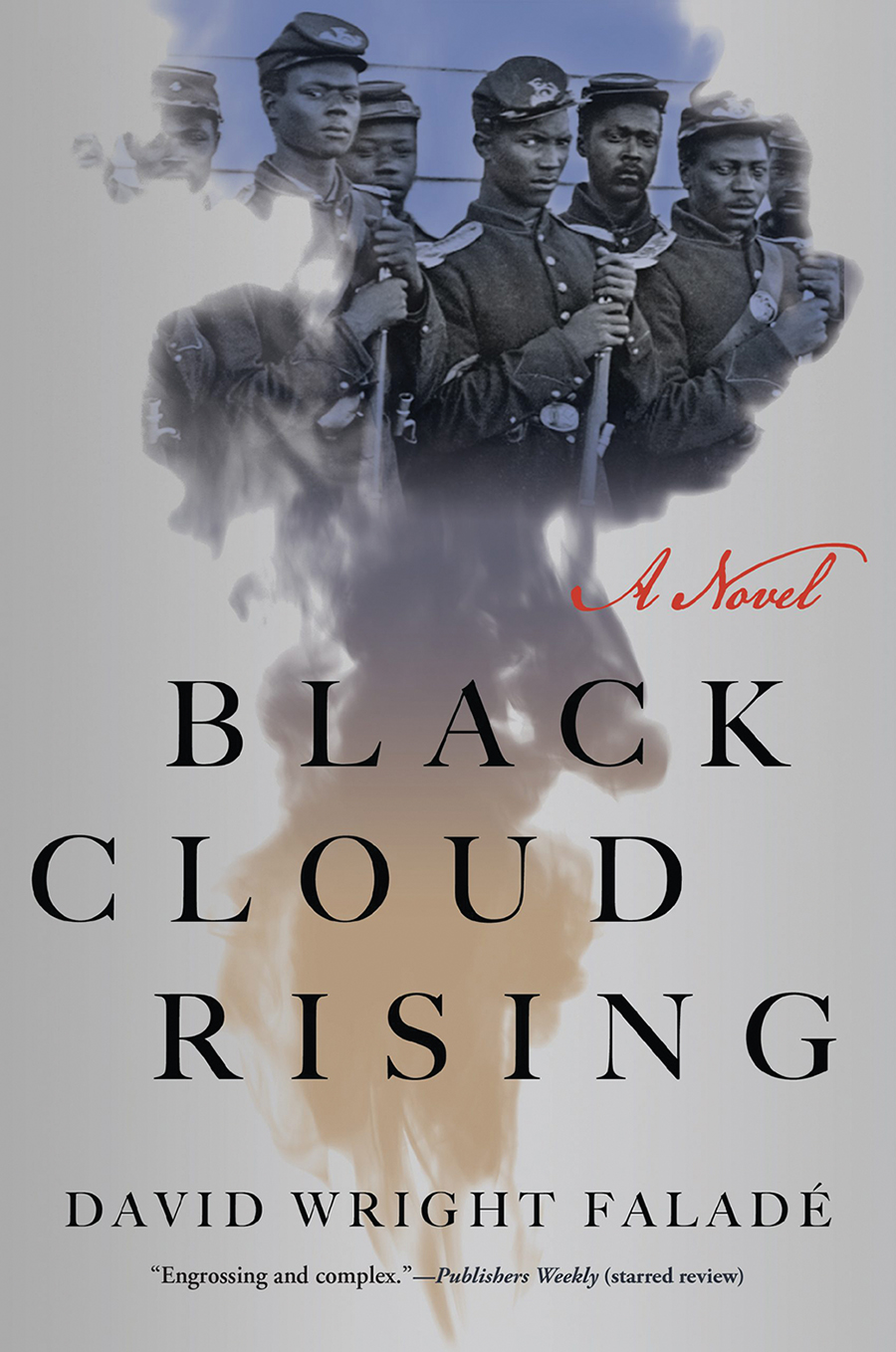
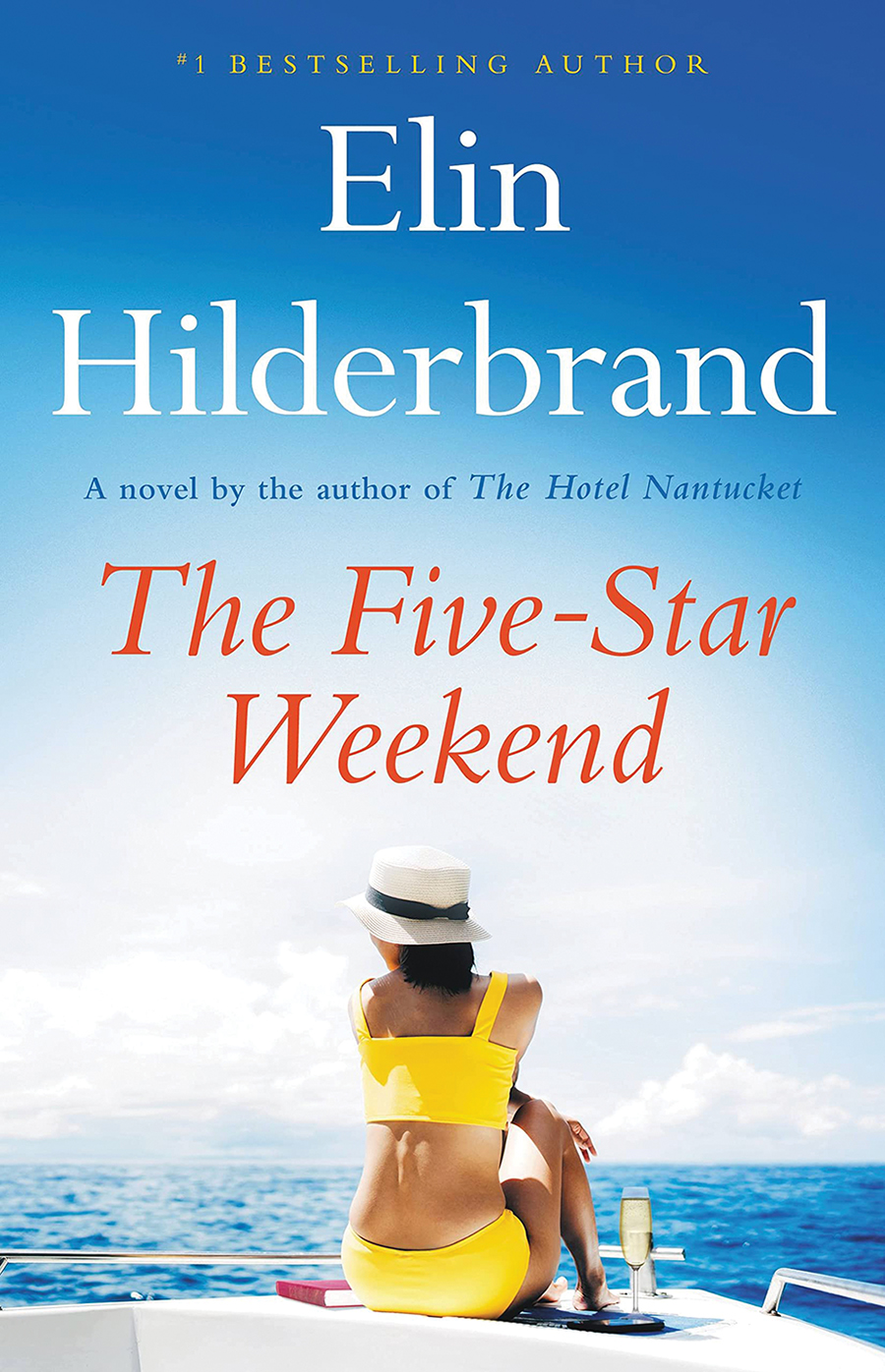
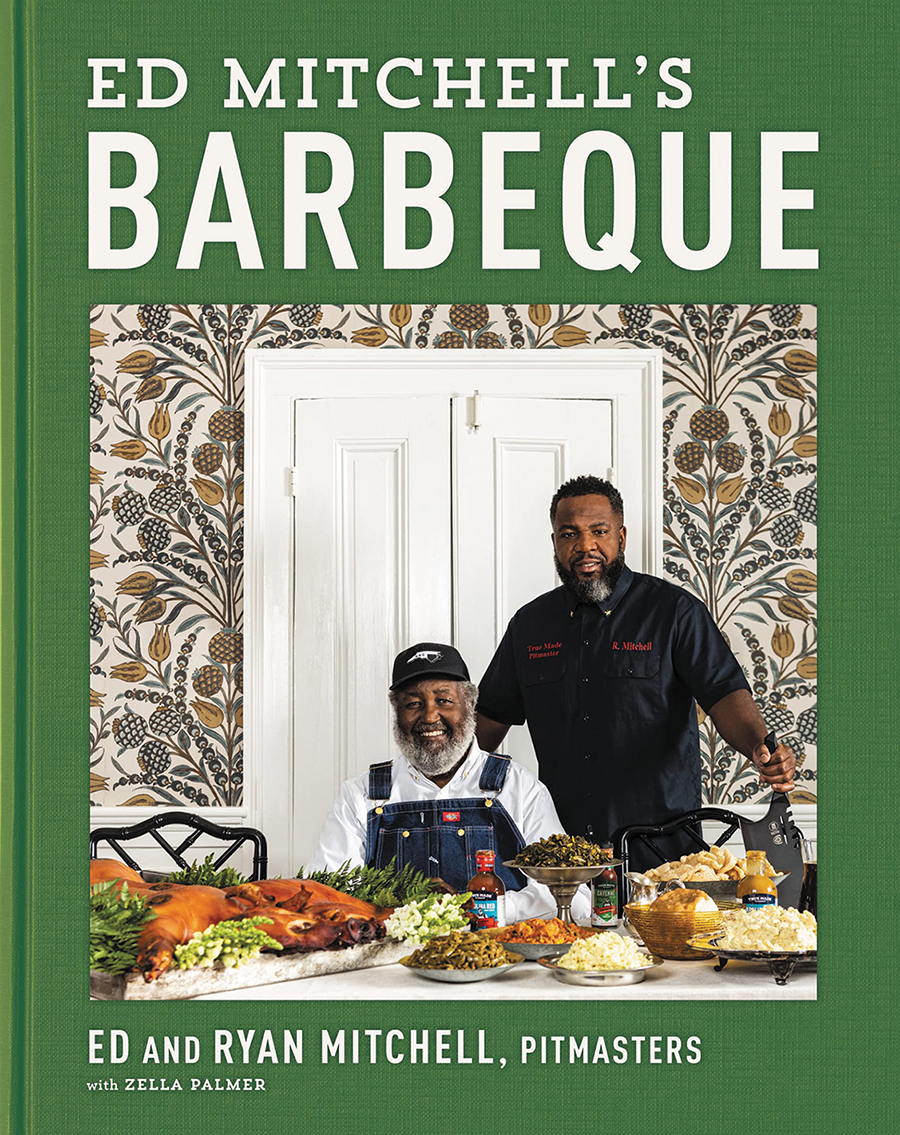
The Country Bookshop will be hosting several authors during the month of June. You can listen to Ed and Ryan Mitchell talk about their new cookbook Ed Mitchell’s Barbeque on Sunday, June 11 from 3 p.m. to 4 p.m.; David Wright Falade discussing his book Black Cloud Rising on Wednesday June 14 from 5 p.m. to 6 p.m.; Elin Hilderbrand signing copies of her book The Five-Star Weekend from 6 p.m. to 7:30 p.m. on Monday, June 19; and Annabel Monaghan talking about her book Same Time Next Summer on Wednesday, June 21 from 6 p.m. to 7 p.m. The Country Bookshop is at 140 N.W. Broad Street, Southern Pines.  

Hail Fellow Well Met

Don’t despair if you didn’t get one of the tickets to hear David Sedaris discuss his book Happy-Go-Lucky at 2 p.m. at The Country Bookshop, 140 N.W. Broad Street, Southern Pines, on Saturday, June 3. Sedaris will have a signing line and promises to stay until the last fan has come and gone or his hand cramps into something resembling a gardening claw. For further information visit www.ticketmesandhills.com.  
Tripping the Light Fantastic

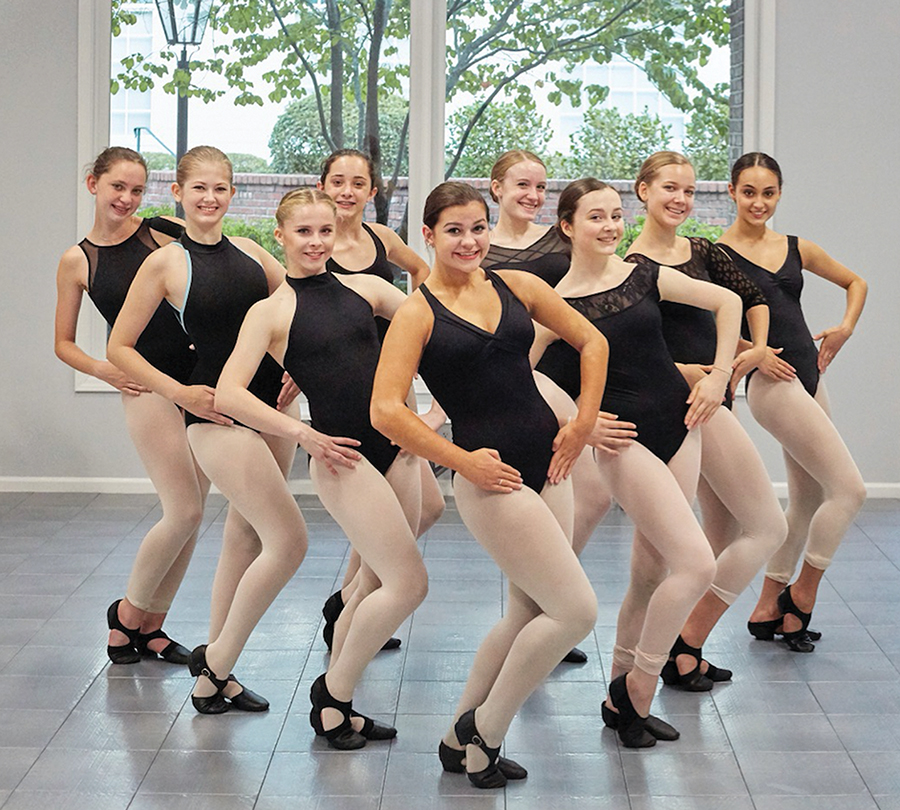
It’s the end of the academic year and what better way to celebrate than swaying cheek-to-cheek? Gary Taylor Dance’s students will perform Romancing the Dance, Junior at BPAC’s Owens Auditorium, 3395 Airport Road, Pinehurst on Saturday, June 3 from 10:30 a.m. to 11:30 a.m. But that’s just the beginning. Enjoy the blend of blues, funk and jazz in Gary Taylor’s Romancing the Dance performed by his company Saturday evening from 7:30 p.m. to 9:30 p.m. and again on Sunday, June 4 from 2 p.m. to 4 p.m. All seats are reserved. For more information go to www.ticketmesandhills.com.  

The Art of Perseverance

On Thursday, June 15 at 5:30 p.m. at the Weymouth Center for the Arts & Humanities, 555 E. Connecticut Ave., Southern Pines, artist in residence John Lee will discuss how he taught himself to paint with his non-dominant hand following a stroke. He’ll be joined by Dr. Miller Johnstone III, Dr. Karen Sullivan and Dr. Henry Tellez for a panel discussion about how the central nervous system may recover and adapt. Attendance is free and open to the public though registration is required. For additional information go to www.weymouthcenter.org.   

What Light Through Yonder Window Breaks

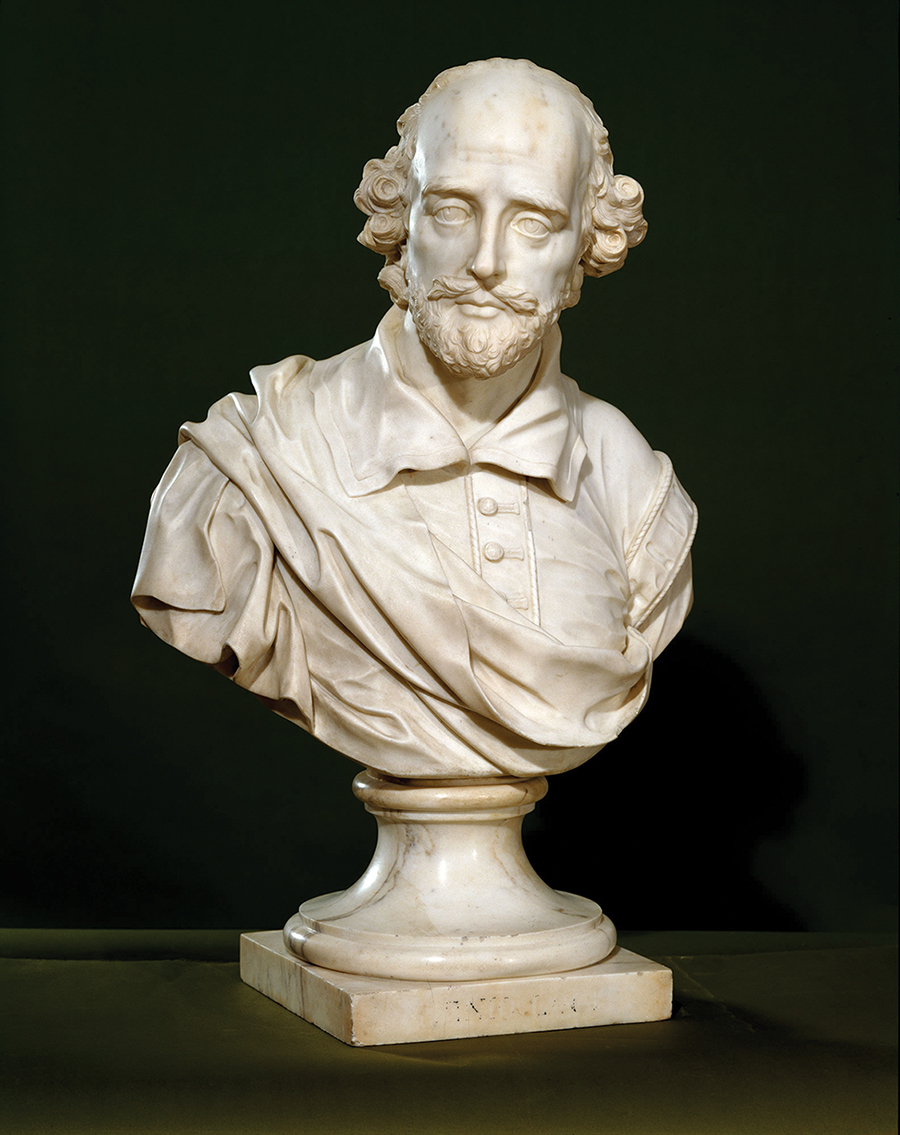
The Uprising Theatre Company puts Romeo and Juliet by you-know-who in a fresh perspective when Shakespeare in the Pines returns to the stage on Friday, June 9 from 7:30 p.m. to 10 p.m. at Tufts Memorial Park, 1 Village Green Road, Pinehurst. There will be additional performances on June 10-11 and again on June 16-18. So, wherefore art thou? For more information go to www.vopnc.org or www.ticketmesandhills.com.  
Who’s Afraid of Carnies?

Austin Powers. But kids 12 and under can gather to enjoy games, food and fun with a carnival vibe at the Downtown Park, Southern Pines, beginning at 6:30 p.m. on Friday, June 9. After the carnival there will be an outdoor showing of Luca. It’s free, people. For more information call (910) 692-7376.  

Festival in Vass

The town of Vass will host its annual summer festival on Saturday, June 10 from noon to 6 p.m. at Sandy Keith Park, 3600 U.S. Highway 1. There will be a car show, vendors, food trucks and a kid’s zone. For additional information visit www.townofvassnc.gov.  

Hitting the High Notes

The recital and finalist round of The Young Musician’s Festival Concert will feature between 30 and 40 area musicians performing for credentialed adjudicators at 2 p.m. on Sunday, June 4 at the Weymouth Center for the Arts & Humanities, 555 E. Connecticut Ave., Southern Pines. There will be cash prizes awarded in four divisions from the third through the 12th grades. Admission is free but registration is required. For info go to www.weymouthcenter.org.  

Juneteenth Celebration

The 3rd Annual Juneteenth Celebration begins at 2 p.m. Monday, June 19 (of course) at The Cardinal Park, 657 S. Walnut St., Pinebluff. Free for the whole family, there will be music, food vendors and storytelling. Festivities last until all the dancing is done. For more information go to www.thecardinalpark.com.  

Pretty as a Picture

Pretty as a Picture

Hospitality in gracious surroundings

By Deborah Salomon

Photographs by John Gessner

The Country Club of North Carolina residential enclave reads like an architectural history of North Carolina, from elongated ranches to mid-century modern, a 1950s genre developed at N.C. State. Showplace homes speak A-frame chalet to antebellum frilly, New England saltbox to French chateaux, log cabins to painted brick with interiors ranging from formal to fun.

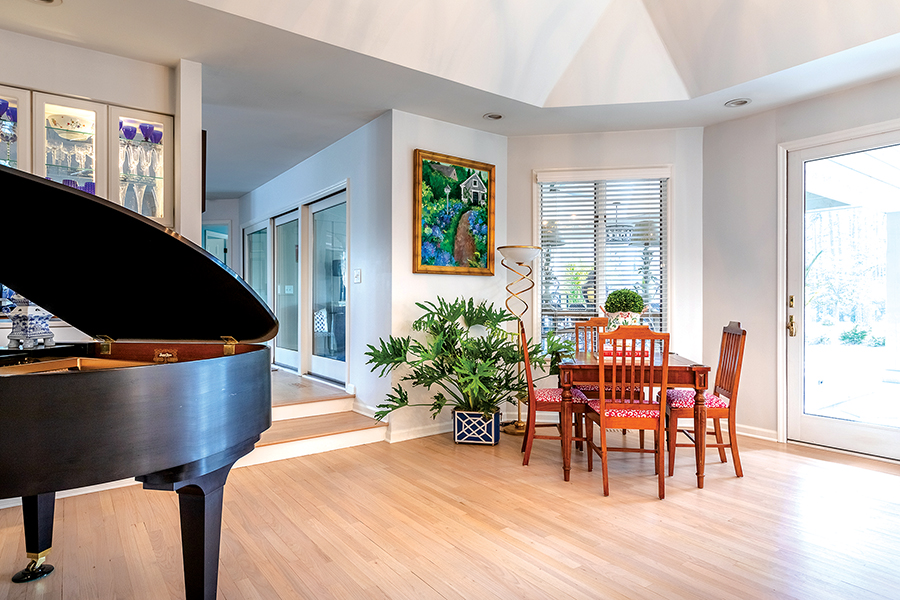
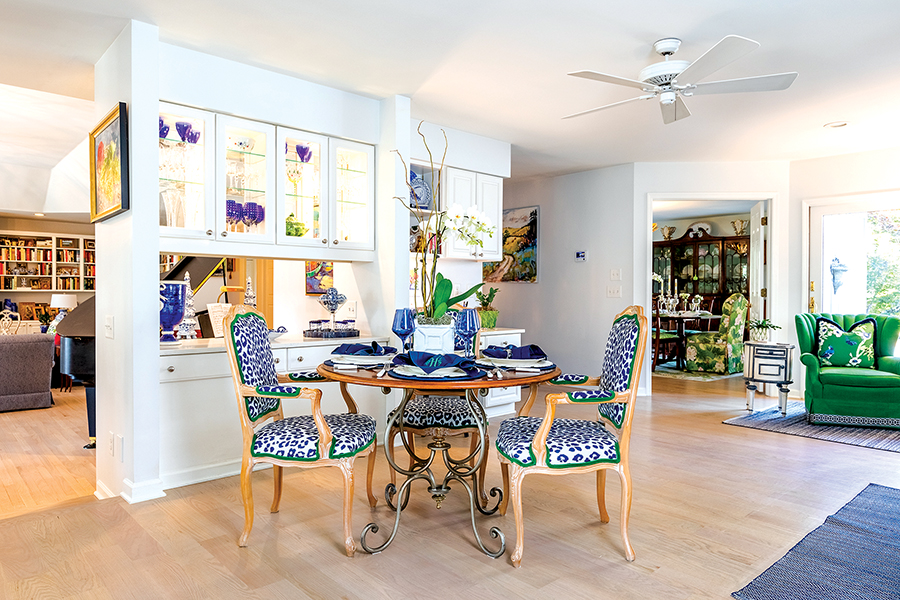
Not surprisingly, some homes display multiple styles, defying or at least resisting classification. Jane and Paul Whit Howard boast just such a home, built in 1991 on 1.7 acres. It’s refreshing, spacious, light, practical, retro, inventive, livable and, most of all, beautiful. Its kitchen may be modest in size and its bathrooms not quite spa but colors and fabric designs vibrate with the intensity of the jungle paintings of Henri Rousseau. The living room is sunken and hardwood floors have a whitewash. Deep tray ceilings speak to quality and detail. 


The grey exterior offers few clues but a portrait of well-worn golf bags between foyer and living room does. The Howards are both from eastern North Carolina, now retired. For decades their primary residence was Raleigh, with regular treks from beach to mountains. They brought their penchant for Southern hospitality with them to Pinehurst.

“I love to entertain,” Jane says. “I’m more of a Southern cook than a Julia Child. This kitchen is very adequate. It has everything I need.” Everything included shifting space to create a butler’s pantry for storage and another for food.

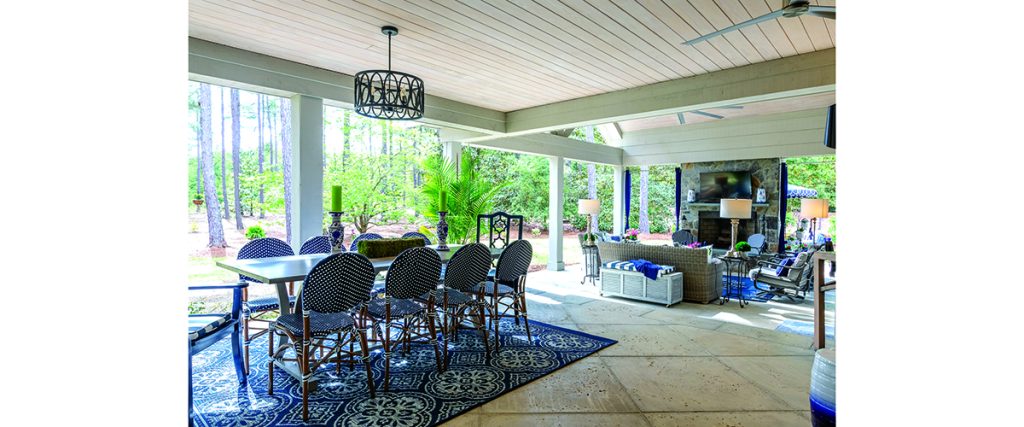
Instead of glamorizing the kitchen, the Howards poured resources into a defining feature, a covered veranda comprising living room, dining/cooking area, wood-burning fireplace and an uncovered conversation pit with fountain. Its square footage approaches a two-bedroom apartment. This addition earned its keep during the pandemic, when friends gathered once a week en plein air for casual dinners and COVID-talk.

A third outdoor space resembling an English tea garden, in place before the Howards’ acquisition, is ideal for morning coffee.

    With retirement looming and a son, Witt, who was an avid junior golfer at the time, the Howards were ready to leave their red brick ranch in Raleigh behind. They ruled out the beach. “Too much sun, heat, crowds,” Jane says. They knew Pinehurst from renting a weekend retreat. After visiting friends at Eastlake — “It felt so good to be here,” Jane recalls — she began looking at properties “on the QT.”

In 2017 they found the one at CCNC with a modified, elongated ranch layout. “I knew this was a party house from the beginning,” Jane says. It had been on the market for three years. She recognized its “good bones” required only bathroom upgrades and cosmetic work.

No problem. “We love to do that, the designing and creating,” Jane says. “My husband is a mechanical engineer — and a frustrated architect.” Her flair for interior design, fueled by a career as a worldwide travel consultant/tour leader, is evident, beginning at the front door where a wide pane of beveled glass with no covering allows maximum light to flood the entranceway.

Since they are only the second owners, the house hadn’t been put through interim, perhaps unwise, remodels.


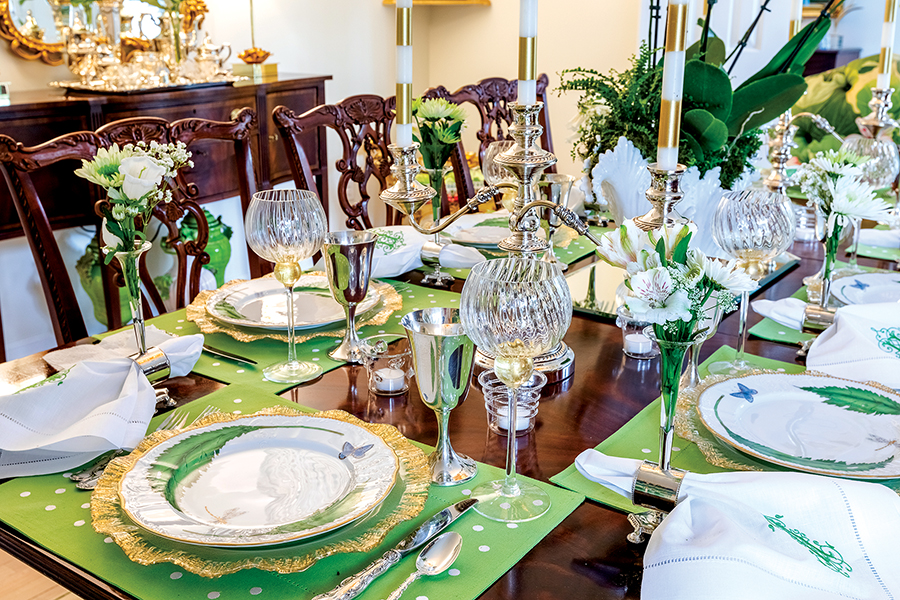
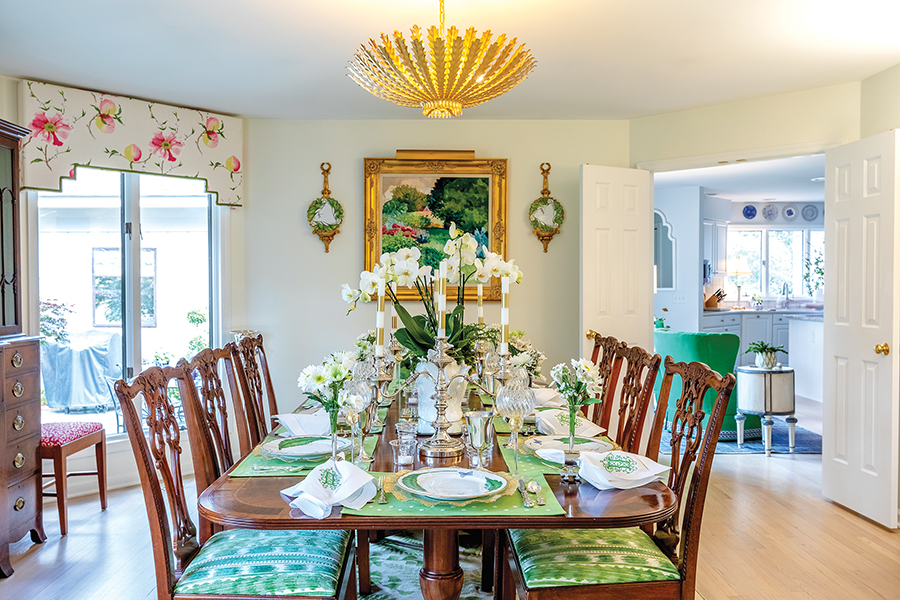
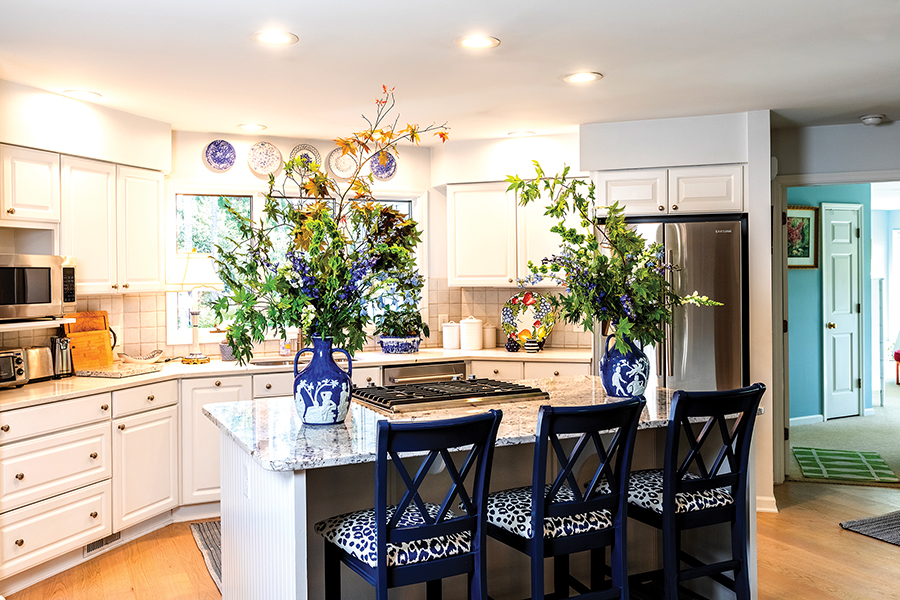
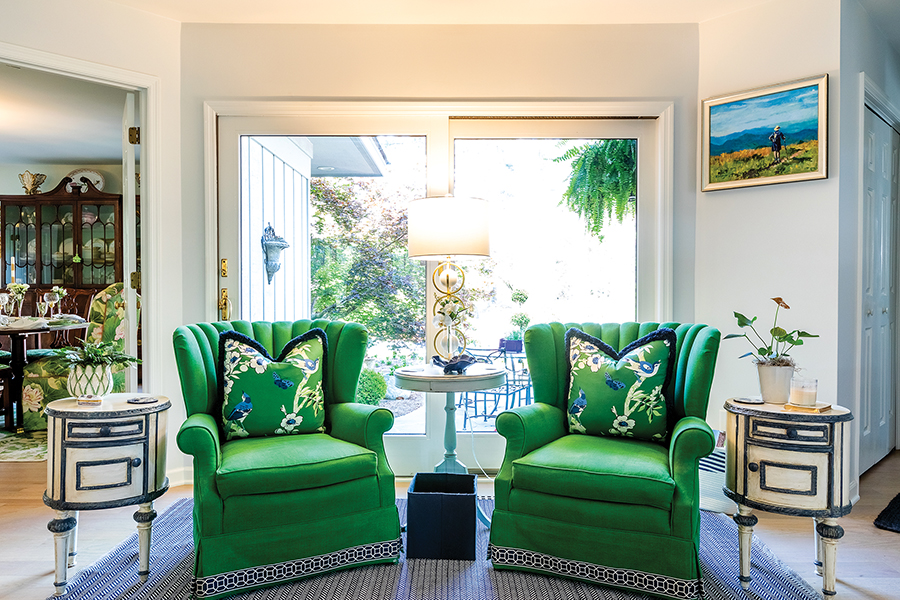
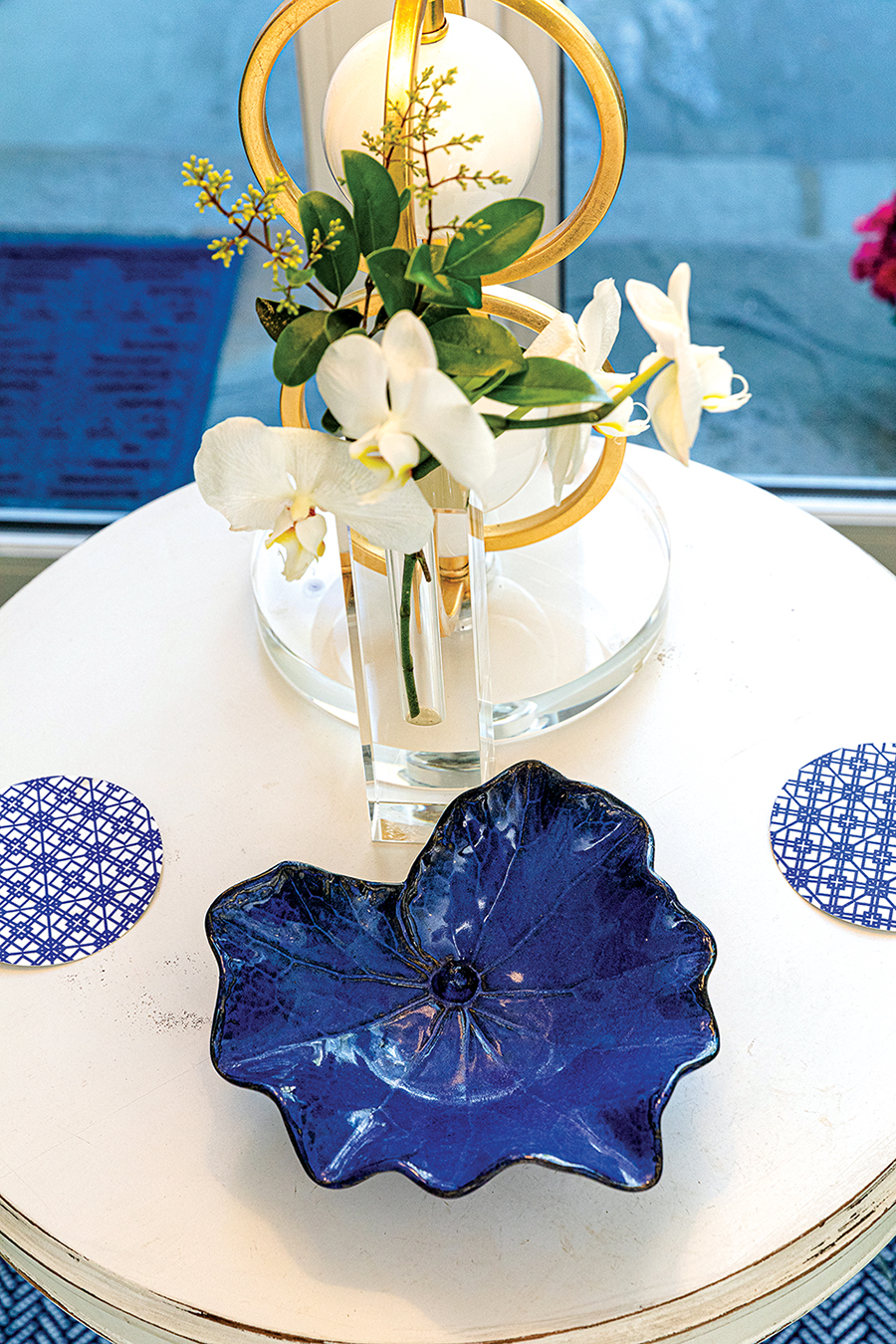
The “designing and creating” part involved a trade-off: Jane craves green and pink, long a favorite in gracious Southern homes of the mid-to-late 1900s. Paul Whit was ready for change. Jane retained her favorite color combination in the dining room, as background for a magnificent breakfront and other family antiques in dark woods, with a table set in silver napkin holders and gleaming crystal. In contrast, instead of sedate florals, for the dining room and elsewhere Jane chose bold fabrics featuring a green that trended more avocado-olive than lettuce. A pair of small, upholstered chairs brings her trademark green into the kitchen-family room, brightened by blue and white pottery.

In return for color concessions, “I got my rose garden,” Jane beams — 16 bushes in a raised bed on its own patio, with space to sit and admire.


Paul Whit had another request: A comfortable/casual atmosphere where men could put their feet up. That relaxed, hospitable vibe explains the informal living room with simple navy blue sofas, built-ins filled with books and family photos, a games table for bridge and Jane’s baby grand piano. On the veranda maintenance is simplified by chairs and sofas with cushions enclosed in wicker lattice.

No amount of outdoor dining or green accents are preparation for the guest bedroom used most often by the Howards’ son and his wife, Hadley. “Mom, I want dark walls and blackout shades,” he said. Mom’s response — breathtaking: navy blue walls and white carpet complemented by a geometric modern painting. Walls in the master suite glow a Caribbean aquamarine, also surprising. In a few months Jane and Paul Whit will repurpose an office adjoining the master suite as a nursery for their first grandchild and trade sleep space with the new parents.


Now, if only Jane knew for sure why one bathroom had a door opening onto the yard. Probably in preparation for a pool, which never materialized. Nor do the Howards plan to add one. “We’re over that,” Jane says.

At a time in life when most couples think condo or cottage the Howards — active and outgoing — still require more than elbow room. Jane plays pickleball, Paul Whit loves golf. They both enjoy yard work. The entire property is fenced for two lucky Lab-retrievers. Their house welcomes a crowd. And as the day winds down, fans whir on the veranda, ice tinkles in the glass, the dogs stretch out on the cool floor . . . and life looks good.  PS

June Bookshelf

June Bookshelf

June Books

FICTION

Lady Tan’s Circle of Women, by Lisa See

From a young age, Yunxian learns about women’s illnesses alongside a young midwife-in-training, Meiling. The two girls find fast friendship and a mutual purpose and they vow to be forever friends. No mud, no lotus, they tell themselves: from adversity beauty can bloom. But when Yunxian is sent into an arranged marriage, her mother-in-law forbids her from seeing Meiling and from helping the women and girls in the household. Yunxian is to act like a proper wife — embroider bound-foot slippers, pluck instruments, recite poetry, give birth to sons, and stay forever within the walls of the family compound, the Garden of Fragrant Delights. How might a woman break free of these traditions and lead a life of such importance that many of her remedies are still used five centuries later? Lady Tan’s Circle of Women is a captivating story of women helping other women.

Love, Theoretically, by Ali Hazelwood

The many lives of theoretical physicist Elsie Hannaway have finally caught up with her. By day, she’s an adjunct professor, toiling away teaching thermodynamics in the hopes of landing tenure. In another life, Elsie offers her services as a fake girlfriend, tapping into her expertly honed people-pleasing skills to embody whichever version of herself the client needs. It’s a pretty sweet gig — until her carefully constructed Elsie-verse comes crashing down. Jack Smith, the annoyingly attractive and arrogant older brother of her favorite client, turns out to be the cold-hearted experimental physicist who rules over the physics department at MIT, standing right between Elsie and her dream job. She’s prepared for an all-out war of scholarly sabotage but . . . those long, penetrating looks? Will falling into an experimentalist’s orbit finally tempt her to put her most guarded theories on love into practice?

The Quiet Tenant, by Clémence Michallon

Aidan Thomas is a hard-working family man in the small upstate New York town where he lives. He’s the kind of man who always lends a hand and has a good word for everyone. But Aidan has a dark secret. He’s a kidnapper and serial killer. Aidan has murdered eight women and there’s a ninth he has earmarked for death: Rachel, imprisoned in a backyard shed, fearing for her life. When Aidan’s wife dies, he and his 13-year-old daughter Cecilia are forced to move. Aidan has no choice but to bring Rachel along, introducing her to Cecilia as a “family friend” who needs a place to stay. Rachel recognizes Cecilia might just be the lifeline she has waited for all these years. As Rachel tests the boundaries of her new living situation, she begins to form a tenuous connection with Cecilia. And when Emily, a local restaurant owner, develops a crush on the handsome widower, she finds herself drawn into Rachel and Cecilia’s orbit, coming dangerously close to discovering Aidan’s secret.

Liberty Biscuit, by Melanie Sue Bowles

Katherine Pearl Baker — Kip for short — is the only child on her family’s rural peach farm. She longs for a pet to ease the loneliness. Hiding in the woods on the Fourth of July, Kip encounters a bedraggled donkey with one eye and a floppy ear. Immediately smitten and compelled to protect him, she feeds him biscuits and takes him home. When it is discovered that the donkey fled an abusive owner, Kip’s father reluctantly allows him to stay. Kip is elated when her grandfather agrees to help her foster the donkey, who she names “Liberty Biscuit,” along with two emaciated horses removed by the local sheriff from the same home, as the cruelty case goes to court. A court order to return the horses, and even worse, Kip’s beloved Liberty Biscuit, to the owner who had starved and beaten them throws Kip’s world into turmoil. Proceeds from his book support Bowles’ charity, Proud Spirit Horse Sanctuary.


CHILDREN’S BOOKS

What Were You Expecting? First Words for New Parents, by Cameron Spires

This little gem will have sleep-deprived new parents laughing until they cry (or crying until they laugh). The absolute perfect first read-aloud bedtime book, the striking art is for baby while the simple text is all grown up. (Ages infant-adult.)

Daddy & Me, Side by Side, by Pierce Freelon

Camping, fishing, trekking over rocks and through the woods is fun, but even more fun when Daddy is there. Daddy & Me celebrates family traditions and shared experiences and is perfect for Father’s Day or any day. (Ages 2-6.)

Pluto! Not a Planet? Not a Problem!, by Stacy McAnulty

Outer space comes alive in McAnulty’s “Our Universe” series. Fun facts and out of this world trivia will make any reader an expert on Pluto, a unique celestial orb. (Ages 4-8.)

Monster Camp, by Sarah Henning

Ghost stories around the fire are requisite activities at most summer camps, but what if you realize the monsters at your camp are actually your fellow campers? That’s what happens in this hilarious, slightly spooky summer sleepaway tale that is the perfect read for a long summer night. (Ages 9-12.)

The Storyteller, by Brandon Hobson

Ziggy is just a regular kid, well, a regular kid who encounters talking coyotes, singing frogs, prophesying snakes, truth-telling horses, a very interesting grandma, and Cherokee spirit people, the Nunnehi. Funny, sad, wise, and jam-packed with adventure, The Storyteller may be the very best book you’ll read in 2023. (Ages 10-14.)   PS

Compiled by Kimberly Daniels Taws and Angie Tally.

Birdwatch

Birdwatch

Playing a Cheerful Tune

The Carolina wren sings from dawn to dusk

By Susan Campbell

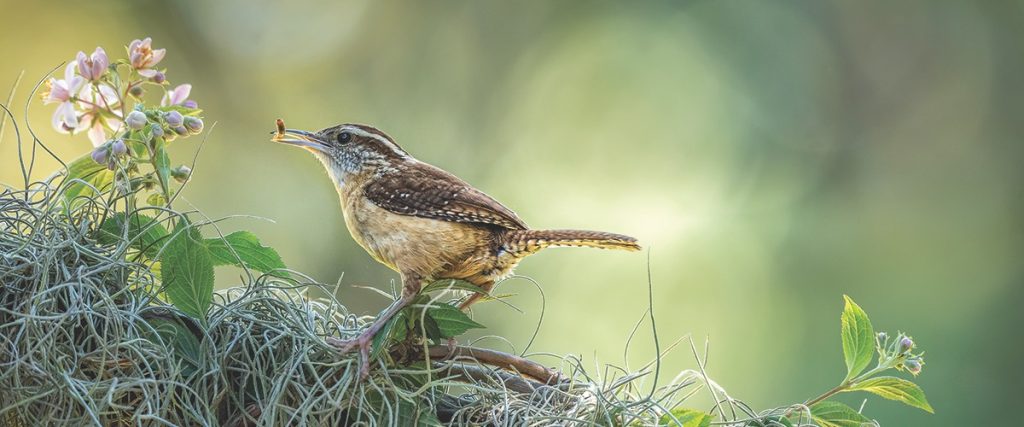
“Chirpity, chirpity, chirpity, chirp.”  Or is it “teakettle, teakettle, teakettle, tea?”  Or maybe “cheeseburger, cheeseburger, cheeseburger, cheese?”  Regardless of exactly how it sounds, this bright, cheery song belies a small and drab bird — the Carolina wren. This diminutive critter is rufousy-brown with banded wings and tail. The thin, decurved bill is well-equipped to probe nooks and crannies for its favorite food: insects. Not only do they flit around in trees and vines looking for caterpillars, but they will clamber around on windows, doors and porch furniture for spiders and flies.

Common throughout the Piedmont year-round, Carolina wrens, the state bird of South Carolina, are frequently overlooked — until spring, when their songs can be heard echoing from forests and fields to neighborhoods here in central North Carolina. And a rarity among songbirds, both males and females sing, providing double pleasure. In fact, sometimes they can be heard in duets, advertising their territory, vocalizing repeatedly, any time from dawn to dusk.

At this time of the year, Carolina wrens are a common sight as they seek a protected spot to construct their nests. They frequently prefer houses, sheds or something else manmade over vegetated habitat. Though it may seem foolhardy to us, barbeque grills, bags of potting soil, an old coat or hat may actually provide a perfectly suitable nesting spot. The female will carry in small leaves, pine needles, grasses, moss or even feathers of other birds to create a large, bulky cup nest. She’ll finish it off with a partial roof to hide the eggs and young more effectively. Wrens don’t seem to mind people coming and going, a seemingly welcome trade-off for the protection humans provide from predators. Peek into one of their nests and more likely than not the female or brooding young will just stare back at you.

Sometimes nesting adults demonstrate great resiliency, or even cunning, in adapting to manmade structures. More than once, a Carolina wren female has chosen a nook on one of the trams that circle the North Carolina Zoo in Asheboro as a nesting site. The nesting adults sit tight as the vehicle bumps around the property during incubation. Once the young hatch, adults who leave the nest to find food simply wait for the tram (and nest) to return to the parking area to feed their young.

It should not be surprising, then, that these resourceful birds will find their way indoors during spring. If they can, they will squeeze under a door or through a cracked window in order to use the corner of a shelf in a shed or mudroom of a house. When fledging day arrives, the parents simply call the young from the nest and show them how to slip outside. Be prepared for the whole brood to find its way back in and crowd into the nest to roost for days, or even weeks, thereafter.

Each winter I get calls about mysterious critters sleeping on high ledges or porches and carports.  Described as small brown balls, these unidentified sleeping objects almost inevitably turn out to be roosting Carolina wrens. After a yawn or two, wrens tuck their heads under their wings to roost, puffing themselves up and looking decidedly unbirdlike. They may also spend the night hunkered down in a potted plant or basket, frightening the daylights out of anyone who, next morning, comes upon them unaware.

Every year around the holidays, I’ll get a call or two about an unexpected Christmas guest. Seeking the warmest spot they can find, Carolina wrens often decide to huddle up in someone’s Christmas wreath. When subsequent visitors open the front door, the wren instinctively flies toward the brightest light — inside the house, occasioning merry and sometimes frantic holiday antics as everyone shares their favorite scheme for getting the bird back outside where it belongs.

So, if you have ever noticed these birds before, you should not have to go too far to find one — unless it finds you first.  PS

Susan Campbell would love to receive your wildlife sightings and photographs at susan@ncaves.com.