On Point

The beauty of champion bird dogs

By Tom Bryant

My cellphone rang just as I was crossing the bridge over the Pungo River, leaving Hyde County. I had spent the last four days at Lake Mattamuskeet in pursuit of waterfowl, and I could feel every one of my
advanced years. As my good friend and hunting buddy John Vernon says, “Tom, how many more times do you think we’ll be able to do this?”

I saw that the caller was Rich Warters, another friend and outdoor enthusiast.

“Tom, you ready to shoot some birds?” Rich trains bird dogs, and a time or two I’ve shot pen-raised quail over his trainees.

“Rich, old buddy, that’s what I’ve been doing for the last week. I’m on the way home from Mattamuskeet.”

“That’s right, I remember now. How was the hunt?”

“We had a grand time. The ducks were kind of sporadic, but we did get enough for a meal or two. I’ll get you and Penny over for a duck dinner after a while.”

“Great,” Rich said. “But right now, I need you to shoot some birds for me. Robert Ecker is here training dogs before a trial coming up in February and we need a shooter.” Ecker is a professional bird dog trainer and is well-known in the sport as one of the best. He has two of Rich’s pointers in his training regimen, and he and Rich work closely honing the dogs’ natural ability. Rich had asked me a few weeks before if I could help out, and I enthusiastically agreed. Hunting pen-raised quail is not like hunting wild birds; but with the serious shortage of the wild variety, bird hunters shoot on preserves where quail are raised for this purpose. It’s not the same, but it’s the next best thing.

“Rich, I’d love to help you, but I injured a back muscle hunting this week, and I’m probably going to have to see the doc when I get home. This thing’s giving me a fit. I have to stop the vehicle every hour or so to stretch.” Many years ago, I had torn a muscle in my back while white-water canoeing. Every now and then, the injury will reappear just to let me know who’s boss.

“OK, Tom. Drive safely and call me after you see the doctor. If nothing else, we want you out here just to see the dogs. Bo and Bud are here, and I want you to watch ’em work.” Bo and Bud are Rich’s pointer bird dogs. I’d heard a lot about them but had not watched them in action. We rang off and I continued driving west toward Southern Pines.

A few days after I got home from the Mattamuskeet hunt, my back was making a slow recovery. Rich called again. “Bryant, how’s the back?”

“A little better, but I’m not going to be able to shoot for you. I don’t believe I’d be able to swing a shotgun.”

“That’s all right. We’re just going to make some photos, and I’ll bring a 20- gauge Remington for you to just shoot one bird. That way we’ll be able to get some pictures. How about Friday around one o’clock out at the kennel?” The kennel is located in west central Moore County on about 800 acres. Mills Hodge, another bird dog aficionado, actually owns the kennel, and he and Rich work closely training the dogs. The big difference in the two is that Rich owns and works English pointers, and his good friend Mills owns and works English setters. There is a lot of friendly competition going on all the time.

When I arrived that Friday, Rich and Robert were already there getting things ready for the afternoon training session. I hadn’t seen Robert since Rich and I ventured up to Michigan to hunt grouse. At that time, we again used Robert’s expertise and his dogs to locate wild birds.

Robert hadn’t changed a bit. A young ball of fire, he still has the enthusiasm and skill required to turn young dogs into champions. There are 42 dogs in his training camp; but on this outing, he would only take four: Rich’s two pointers, an Irish setter, and an English setter. Robert is from Quakake, a small town in Pennsylvania where he has his kennel. He has been a professional bird dog trainer since 1994; and in that time, he has won about 80 field trials. When I expressed my amazement, he modestly replied, “Tom, those are in the past; it’s the trials and the dogs in the future that count.”

When I drove up, Rich walked over to the car. I hadn’t seen him in a while, but Rich never changes. An amazing individual at 82, he seems half his age and can outdo many people much younger. Rich and his lovely bride, Penny, retired to Pinehurst in 1995 after he served as assistant school superintendent in Horseheads, New York. An avid golfer, Rich plays three or four times a week and is a member of the renowned Tin Whistles, founded in1904 and the oldest golfing fraternity in the country. He has won several tournaments with that esteemed organization. When he’s not playing golf, he’s out working his dogs. I met Rich shortly after he retired, and I consider myself a better man for it.

“Bryant, limp on over here. In a minute we’re gonna put you in this four-wheeler and show you some pretty dog work.” Robert loaded the dogs in their crates in the back of the vehicle and left to put out birds for the dogs to find during the work session.

“Here’s the shotgun.” Rich handed me a 20-gauge Remington 1100 and a handful of shells. “Now don’t get upset,” he said as I started to protest. “You only have to shoot one time. We just want to take some pictures. You don’t even have to hit the bird.”

It didn’t take Robert long to finish his chores, and we crammed into the vehicle and headed out through the pines. A little way into the longleaf pine forest, Robert pulled over and got Bud, Rich’s champion pointer, out of the carrier. Bud was runner-up national champion last year, and this year has a real opportunity to take first place. We drove a bit farther down the sand path with Bud hunting in front. All of a sudden, he locked up on point like a statue. If there is anything prettier than a bird dog on point, I don’t know what it is. We piled out of the vehicle and Rich said, “Tom, here’s your chance. Don’t miss.” Chuckling all the time.

Robert eased up to me and quietly said, “I’ll jump the bird. Be ready.”

I loaded the 20-gauge and watched as Robert slowly edged into the undergrowth. Then it happened; a bird the size of a chicken burst from the cover, cackling like a demented pterodactyl. It was a great big cock pheasant. I almost dropped the gun. I was expecting a little quail, and this monster flew out of the brush right over my head. I did have the wherewithal to swing the shotgun and get the bird as he was going away.

Rich and Robert almost doubled over, they were laughing so hard. I was set up. Rich said, “Tom, I remembered that you had never shot a pheasant, and I had the good luck to acquire this one for you. He’s going to be great on the dinner table with your ducks.”

The rest of the afternoon went by quickly, and I got to watch some superior dogs at work. On the drive home, I thought back to John’s question of how much longer we’d be able to do this. If Rich Warters is an example, it’s gonna be a long time.  PS

Tom Bryant, a Southern Pines resident, is a lifelong outdoorsman and PineStraw’s Sporting Life columnist.

The Rise of Roussillon

Where red wine is roi

By Robyn James

Roussillon has been the redheaded stepchild of the French wine country for many years, a fact that is slowly changing due to the efforts of several ambitious and talented importers and winemakers.

This region connects Spain and France with the Mediterranean to the east and the Pyrenees Mountains to north, west and south.

The most important red grape grown in this region is carignan, accompanied by grenache noir, cinsault, syrah, mourvedre and some obscure local grapes. Red wine is king here, although they do produce about 25 percent rosé wines but only 2 percent white wines. Grenache blanc, roussanne and marsanne are the most popular white grapes grown.

The wines of Roussillon have been considered unremarkable for centuries, but 10 years ago, rock star importer Eric Solomon of European Cellars began to focus on the area. He previously imported wines mostly from Spain and other pricier areas of France such as the Loire Valley and the Rhône region. Ten years ago, Solomon met Jean-Marc and Eliane Lafage in Spain, where Jean-Marc consults with some Spanish wineries. Lafage suggested Solomon visit his vineyards in Roussillon, and a beautiful partnership was formed.

The Lafage family owns almost 400 acres of vineyards in various sections of Roussillon benefiting from the diversity of soil compositions. The knowledge and dedication of Lafage combined with the incredible palate and direction of Solomon have created wines that, in my opinion, raised the bar on quality/price ratio. An added bonus is that everything is farmed organically. Robert Parker, famous critic and owner of The Wine Advocate, says of Solomon, “I first tasted with Eric in 1991 and I have watched him grow as an importer to the point where he may be the finest in the United States.”

One of their projects in Roussillon is Saint Roch, a property in Agly Valley. The white they produce is Saint Roch Vieilles Vignes Blanc, a blend of grenache blanc and marsanne. It’s very rich and full-bodied with pronounced notes of tangerine and pineapple. As big as it is, it still pairs beautifully with food and usually sells for under $15. One of the reds from Saint Roch that I tasted is the 2014 Saint-Roch Chimères Côtes du Roussillon Villages. This wine is under $17 yet was awarded 92 points from Parker, who described it as mostly grenache, but including 30 percent syrah and 10 percent mourvedre. “Aged in a combination of concrete tank demi-muid (large oak barrels), it makes the most of this difficult vintage and has terrific purity in its raspberry, violet, licorice and olive-laced aromas and flavors. Ripe, nicely textured and with bright acidity,” wrote Parker.

The Lafage estate produces a Miraflors Dry Rosé that is an organic blend of mourvedre and grenache gris. It is a must-have for summertime quaffing. It has gorgeous notes of strawberries, framboise and rose petals. At under $18 it rivals the great rosés of Bandol that sell for $40-$60.

Two more reds they produce are the 2014 Tessellae Grenache-Syrah-Mourvedre Old Vines, under $15 and 2014 Domaine Lafage Bastide Miraflors, a blend of syrah and grenache that is under $17. These two wines are the same blends that you would find in Châteauneuf-du-Pape selling for three to five times the price. Parker gave Tessellae 90 points and described it as a remarkable bargain from Lafage. Aged in concrete, this blend of 50 percent grenache, 40 percent syrah and 10 percent mourvedre “. . . comes from 70-year-old vines planted in limestone and clay soils. A delicious, dense ruby wine with notes of red and black cherries, earth, spice, pepper and a touch of Provençal garrigue. Fresh vibrant acidity is also present, and the wine is uncomplicated, but rich, fleshy and very well balanced,” writes Parker.

On Bastide Miraflors, Parker identifies the 2014 Bastide Miraflors, which is a Côtes du Roussillon that blends 70 percent syrah and 30 percent grenache — with the grenache aged in concrete tanks and the syrah in 500-liter demi-muids — as a particularly notable bargain. “Lafage makes more expensive wines than this, but certainly excels with his value lineup. He has really hit a home run with this 10,000-case cuvée,” writes Parker. “It is deep, ruby/plum/purple, with fresh notes of blackcurrants, plums, Provençal herbs as well as licorice. Deep, medium to full-bodied, with amazing fruit, the purity, authenticity and Mediterranean upbringing of this wine are obvious. Quite deep, round and succulent, this wine should drink well for another several years. This is one to buy by the case.”

Clearly, there is a bromance going on among Lafage, Solomon and Parker, but the proof is in the bottles. They are amazing blends. PS

Robyn James is a certified sommelier and proprietor of The Wine Cellar and Tasting Room in Southern Pines. Contact her at robynajames@gmail.com.

Yelp!

Something to sink your teeth into

By Clyde Edgerton

I went to a new dentist last week. The old one recently retired. I sat in the waiting room reading a magazine until called into the room with the chair and drills. That room had new equipment and I noticed that the seat-chair-bed-thing that you sit on and that they lean you back in, felt very comfortable.

I needed a crown. The new dentist came in. The reason I was using a new dentist is that he took over the patients of my old one. 

Isn’t it funny what all we don’t check up on. You may be different but I ask friends about where to eat. I go online and check prices and comments about shoes I might buy. And in the store, I try on several pairs before buying. I go into Dick’s for a basketball and look at a whole rack with prices under each basketball and I pick up several and dribble them there in the store. Then I decide.

But I go to somebody who is going to operate on my head, inside my mouth with drills and needles and cement, and I don’t do research. Maybe you do. But somehow I’ve never shopped for a dentist. My mama took me to the first one and then that dentist retired and turned over his office to a distant cousin of mine — and I went to him because he was kin — and then he turned his office over to another dentist. I continued going to that one for years . . . 

Then I moved to Wilmington and I have no idea how I ended up with my first Wilmington dentist (15 years ago), since I didn’t inherit him. (I had no complaints.) And now, when that one retired, the office people didn’t change and I kind of knew them, and all of the sudden I was in the long, reclining seat when the new guy came in. I had no idea of whether or not he could tell a bicuspid from a bicycle. He looked to be about 12, 13 years old.

Things went fine. I liked him. He wore gloves with a grape smell. On purpose. Honest.

Another thing I’ve noticed is that people in our culture tend to be silent about the price of a dentist’s or doctor’s bill — when you pay, that is. If it’s your car and your oil has been changed and you’ve gotten a new battery, you say to the cashier, “How much?” and the cashier tells you and you pay. If it’s a doctor, the cashier says, “That’s a $30 or $70, or (now) $90 co-pay, please.” And you pay it. The end.

What I don’t say is, “How much was the total charge for today’s visit?” Maybe you do.

Actually, for a short while about three years ago, I did ask the receptionist/cashier about total bill numbers, and something like the following is what usually happened:

“That’s a $40 co-pay,” says the receptionist/cashier.

I reach for my billfold and say, “Can you tell me how much the bill is?”

“Forty dollars.”

“No, I mean for the entire visit. You know — the whole bill. I’m just curious.”

“For the entire visit?” she asks, looking up at me for the first time. She’s looking me in the eye.

“Yes, Please. Thank you.”

“Well, let’s see,” she says, and she looks down at the piece of white paper she’s about to file, having given me the yellow copy. I look at my copy. It has 200 tiny squares with something medical written in beside each, something like “Quadra florientine xerox procedure.”  Or “Hymiscus of the vertebrae test.” Of the 200, nine are checked off.

She goes to a closet and gets an adding machine, one like my father used to have in his grocery store in the ’50s. She brings it back out, places it on her desk, and puts the white piece of paper down beside it. “Hang on,” she says. “This might take a minute or two.” She turns to the computer while holding her finger on that first check in the top little block on the white piece of paper. With a mouse under the other hand, she finds what she’s looking for on the computer from a website and puts a number into the adding machine, and pulls the handle. She sound is sort of: Cha-chank.

“OK,” she says. “Let me see here.” She places a finger on the second check, finds a different website, and finds what she’s looking for. She puts a number into the adding machine. Cha-chank.

She makes a phone call and says, “Yes, I can wait.” In about two minutes she says, “Yes, can you give me the price of a crankshem rebotolin frisk? . . . . OK, thanks.” Cha-chank.

She’s back on the computer. This goes on for a while. Shadows, from sunlight coming through windows, lengthen across the room.

“Okey-doke,” she says. She tears off the strip of paper from the adding machine, pulls a curtain around her that hangs from a curved rod, looks over my shoulder, leans forward, looks left and right, circles the bottom number and places it up on the counter in front of me. $489.23.

I say, “Thank you very much.”

Now, I’m waiting for the day there is a co-pay on the co-pay. And that time is not far off, probably about the time my dentist turns 16 or 18.  PS

Clyde Edgerton is the author of 10 novels, a memoir and most recently, Papadaddy’s Book for New Fathers. He is the Thomas S. Kenan III Distinguished Professor of Creative Writing at UNCW.

PinePitch

Saint Patrick’s Day Parade

On Saturday, March 18, The Village of Pinehurst will show off its Irish spirit during the 16th Annual Saint Patrick’s Day Parade. Colorful parade entries, great music, dancing and good Irish cheer are in store for all who attend. The parade begins at 11 a.m. sharp at Tufts Memorial Park, 1 Village Green Road, West, Pinehurst. Following the parade, families can stick around for entertainment, children’s activities, and food and beverages. (Rain date: March 25.)

Parade entries from non-profits, businesses, civic groups, churches and families are welcome, so don your Irish green and join us for the celebration. Here’s to the Emerald Isle. For more information, contact Dugan’s Pub at (910) 295-3400.

Meet the Author

On Thursday, March 9, at 5 p.m., Michael Knight will present his new work, Eveningland, a collection of interlinked stories and a novella that are set in or near Mobile, Alabama. These stories, which range in focus from the historical catastrophe of the Deepwater Horizon oil spill to the personal intricacies of a marriage, will take you through the whole gamut of human emotion. Knight, who is from Mobile, has received numerous awards, including the New Writing Award from the Fellowship of Southern Writers and the Hemingway Foundation/PEN Award Special Citation. He is the director of the creative writing program of the University of Tennessee, Knoxville. This event will take place at The Country Bookshop, 140 NW Broad St., Southern Pines. Info: (910) 692-3211.

The Rooster’s Wife

The Rooster’s Wife March lineup bursts into spring:

Sunday, March 5: Kerrville Song Circle. Winners of the 2015 Kerrville New Folk songwriting competition, Wes Collins, Amy Kucharik, Tom Meny and Becky Warren tour together as a four-person in-the-round show. $15.

Friday, March 10: Major and the Monbacks. This high energy, Virginia-based band is an ensemble of bass guitar, keyboard, organ, vocals, percussion and a couple of horns that blends ’60s and ’70s rock with psychedelic and a little soul. $15.

Sunday, March 12: Al Strong Quartet. As a trumpeter, arranger and composer, Al Strong incorporates progressive jazz, soul, gospel and Afro-beat grooves. $20.

Sunday, March 19: Lindsey Lou and the Flatbellys. Based in bluegrass, this stringband features mandolin, guitar, resonator guitar and sultry vocals. It’s Americana and beyond. $20.

Sunday, March 26: The Kennedys, a folk/rock/pop duo, and Jack Broadbent, a modern bluesman on a slide guitar, share the stage. $20.

Doors open at 6 p.m. and music begins at 6:46 at the Poplar Knight Spot, 114 Knight St., Aberdeen. Call (910) 944-7502 or visit www.theroosterswife.org for info and tickets.

Young People’s Fine Arts Festival

The Arts Council of Moore County presents the 21st Annual Young People’s Fine Arts Festival showcasing the artistic talents of students in grades K–12 from Moore County public, private, charter and home schools. You are invited to attend the Opening Reception and Awards Ceremony on Friday, March 3, from 5 to 7 p.m. at the Campbell House Galleries, where all entries will be on display from March 3 to 31. The reception and exhibit, sponsored by George Little & Associates Inc., Whistle Stop Press Inc. and the Town of Southern Pines, are free and open to the public. The Gallery is located at 482 E. Connecticut Ave., Southern Pines. Gallery hours are 9 a.m.–5 p.m. weekdays and 1–4 p.m. on Saturday, March 18. Call (910) 692-2787 or visit mooreart.org for more information.

Horses, Hearts and Heroes

On March 30, enjoy an evening of dinner, dancing and the music of DJ King Curtiss in celebration and support of horses and heroes at the Prancing Horse Annual Spring Barn Dance, from 6 to 10 p.m. Tickets for the dance are $50 per person and can be purchased at Cabin Branch Tack Shop, Southern Pines; A Bit Used, Vass; Sandhills Winery, West End; Lady Bedford’s Tea Parlour, Pinehurst; or online at www. prancing-horse.org. The $100 raffle tickets can be purchased at www.prancing-horse.org or at the event. The festivities take place at The Fair Barn, 200 Beulah Road S, Pinehurst. For more information, call (910) 281-3223.

Photography Stroll

On Saturday, March 11, at 9:30 a.m., take a one-mile hike through the Weymouth Woods-Sandhills Nature Preserve with wildlife and nature photographer Brady Beck. The towering long-leaf pines of Weymouth Woods provide a home for many rare and intriguing creatures, such as the red-cockaded woodpecker, pine barrens tree frog and fox squirrel, as well as a habitat for the highly photogenic wiregrass and wildflowers. While strolling one of the easy trails through the forest, Beck will share tips for capturing the natural beauty of the longleaf pine ecosystem.

Brady Beck is a biologist studying the red-cockaded woodpecker in the Sandhills. His interests in photography include capturing natural history details, observing wildlife behaviors and creating wildlife portraits in both still and HD video formats. 

This program celebrates the conservation legacy of Ansel Adams and the exhibition of his photographs at the NC Museum of Art through May 7, 2017. Weymouth Woods is located at 1024 Fort Bragg Road, Southern Pines. (910) 692-2167.

Sandhills Farm to Table Now Open for 2017! 

Become a member of the Farm to Table Co-op and get boxes of the freshest local fruits and vegetables delivered to your Gathering Site from mid-April to November. Being a member of the Co-op has many additional benefits — You will receive newsletters with recipes and tips and have access to the online artisanal market, which delivers grass-fed beef, local honey, homemade ice cream, goat cheese, salsas and jams, baked goods, sustainably-raised pork and poultry and more, fresh to the Gathering Site nearest you. You will be able to order extra and bulk seasonal produce each week, like peaches for canning or strawberries for jam. And members are eligible to take part in classes, demonstrations and community events such as You Pick Days! Sign up today and help create a healthier, resilient community that ensures a long-term, secure market for Sandhills farmers. Info and signup: www.sandhillsfarm2table.com or call (910) 722-1623.

And Then There Were None

Beginning Thursday, March 23, and running through the 26th, The Judson Theatre Company (Moore County’s only professional theatre) presents Agatha Christie’s bestselling mystery of all time. Ten guilty strangers are trapped in a mansion on Soldier Island, stranded by a torrential storm and haunted by an ancient nursery rhyme. One by one, they begin to die. Alison Arngrim, who played Nellie Oleson on TV’s Little House on the Prairie, stars as the ruthless, remorseless Emily Brent. Tickets: $38. (Save $8 per ticket when you buy 10 or more.) The performance is at 7 p.m. Thursday, 8 p.m. Friday and Saturday, with a matinee at 2 p.m. Saturday and 3 p.m. Sunday, at Owens Auditorium at Sandhills Community College, 3395 Airport Road, Pinehurst. For more information, call (910) 585-6989 or visit www.judsontheatre.com.

Saturday in the Gardens

The 69th annual Southern Pines Garden Club Home and Garden Tour is being held on a Saturday for first time, April 8 from 10 a.m. to 4 p.m. The tour features six elegant homes and gardens from horse country to historic Pinehurst and includes stops at Weymouth and Sandhills Gardens for springtime plant sales. Proceeds are used for community beautification and horticultural education projects that benefit all Moore County residents. Tickets ($20 in advance) are available at the Campbell House, the Women’s Exchange, the Country Bookshop, and online at www.southernpinesgardenclub.com.

Cliff Aikens Sings Our Songs

Gather at Given for an evening of “American History and Americana Told in Song,” as folk singer Cliff Aikens recalls the decades from 1920 to 1970 in dialogue and songs  by Woody Guthrie; Bob Dylan; The Weavers; Peter, Paul and Mary; Pete Seeger; The Grand Ole Opry; Simon and Garfunkel; and the Kingston Trio. Come, listen, sing along, remember and reconnect to the special times in your own lives.

Performances are free and open to the public on Tuesday, March 7, 3:30 p.m. at Given Memorial Library, 150 Cherokee Road, Pinehurst; and on Wednesday, March 8, 7 p.m. at Given Outpost, 95 Cherokee Road, Pinehurst.

Tools of the Trade

Some gone but none forgotten

By Deborah Salomon

In my eight years at PineStraw I’ve observed how writers like to reminisce over objects representing a time or place. To be kinda corny, these are mileposts on life’s highway, more Route 66 than I-95. Most of mine belong in the kitchen — relics exhibiting a patina, a glow, when viewed beside microwaves, food processors, Keurigs, blenders and non-stick Bundt pans.

Some have gone to pots-and-pans heaven; others I cling to for dear life since they outperform successors. Let’s look beyond the here and now to way back when:

The eldest is my Greensboro granny’s “stew pot,” a wobbly aluminum WearEver vessel with a clip-on lid and two small grab handles rather than one long. Nanny was born in 1875, married in 1899. In this pot, easily a centenarian with another 100 years possible, she boiled beef with a cut-up onion and a jar of home-canned tomatoes. This simmered on the back gas burner or the woodstove all afternoon until the chuck roast fell apart and the liquid almost evaporated. If I close my eyes and take a deep breath, I can smell it now. I also have her biscuit cutter and wood bread tray, its bottom worn to splinters, worth hundreds to Southern antique collectors.

The jewels in a Jewish cook’s crown are matzo ball soup and chopped liver. My mother-in-law made divine chopped chicken liver (with hard-boiled eggs and caramelized onions) in a Hamilton Beach electric meat grinder that weighed a ton. It must have been 20 years old when she relinquished the chore to me in the 1960s. Chopped liver perfected, I discovered superb hamburgers made from home-ground meat. The upper part is made of a metal which, on assembly, sounds a strange clunk. When our basset hound heard this he came running, anticipating scraps. Presently, my countertop behemoth stands, statuesque, rather like a headstone, on a storeroom shelf.

The only item from my mother’s kitchen is an odd-sized brownie pan made from dark embossed metal. She talked a good game, but made her “famous brownies” about once a year, for bridge club.

My wedding gifts included an enamel-on-cast-iron oval Dutch oven from Royal Dru in, where else, Holland. Oh, the briskets this friend has simmered, the coq au vin. Its green exterior is chipped, the white interior stained. Yet 57 years later the stalwart outperforms any replacement.

You wouldn’t want to see my two warped aluminum cookie sheets. With blackened bottoms and curled edges, they are beyond disreputable. No matter; after more than 50,000 cookies, I cannot remember one burned batch. Humbug to the dark non-stick kind. I keep the top side bright with Brillo and will use them as long as I can find cookie lovers. Which is never a problem.

Two percolators have followed me from apartment to duplex, four houses, a condo and back to an apartment. One is stovetop — a tall, stainless steel number memorable because my toddlers used to take it apart and put it together like a puzzle, causing a happy clatter. The other (both Farberware) is electric. Drip coffee cannot compare in flavor, aroma or temperature. I see that both are again available in retro catalogs.

As for ordinary pots, I’ve always preferred copper-bottomed. They never wear out but do become aesthetically challenged. Time to replace. I bought just one, same brand, except it weighed so much less that I returned it. After all, only the contents matter.

One cherished icon that got away was Nanny’s iron skillet with an iron lid that doubled as a shallow frying pan. She fried chicken (raised “free-range” in the yard, terminated and cleaned on the back porch, soaked in salt water overnight) and cooked it the pre-deep fryer way: dredged in seasoned flour, browned in Crisco, covered with the lid and into the oven for 45 minutes. When tender she removed the lid and crisped the skin over a burner. Other times, the lid-skillet turned out perfect free-range sunny-side ups.

Another gone-but-not-forgotten relic: an aluminum cauldron with tall lid and basket for sterilizing baby bottles. I tried it on soup but the metal was too thin, resulting in burned split peas.

No, I don’t have a kitchen clock with a cord; the electric skillet and wok (always red, never hot enough) have gone with the wind, as have the wood-handled knives with blades worn down by sharpening against a stone, something my father insisted on doing.

What will become of this trove? My grandsons are more interested in eating than cooking. I have no granddaughter.

Sounds rather maudlin, but not really. My kitchen tools were friends — dependable, capable and, unlike their newer counterparts, long-lasting. I salute them, with thanks.  PS

Deborah Salomon is a staff writer for PineStraw and The Pilot. She may be reached at debsalomon@nc.rr.com.

Man on the Move

A brain tumor ended one career but gave birth to an even more extraordinary life of service

By Jim Moriarty     Photographs by John Gessner

Sometimes great events are measured in centimeters. A couple of them turned up 13 years ago.

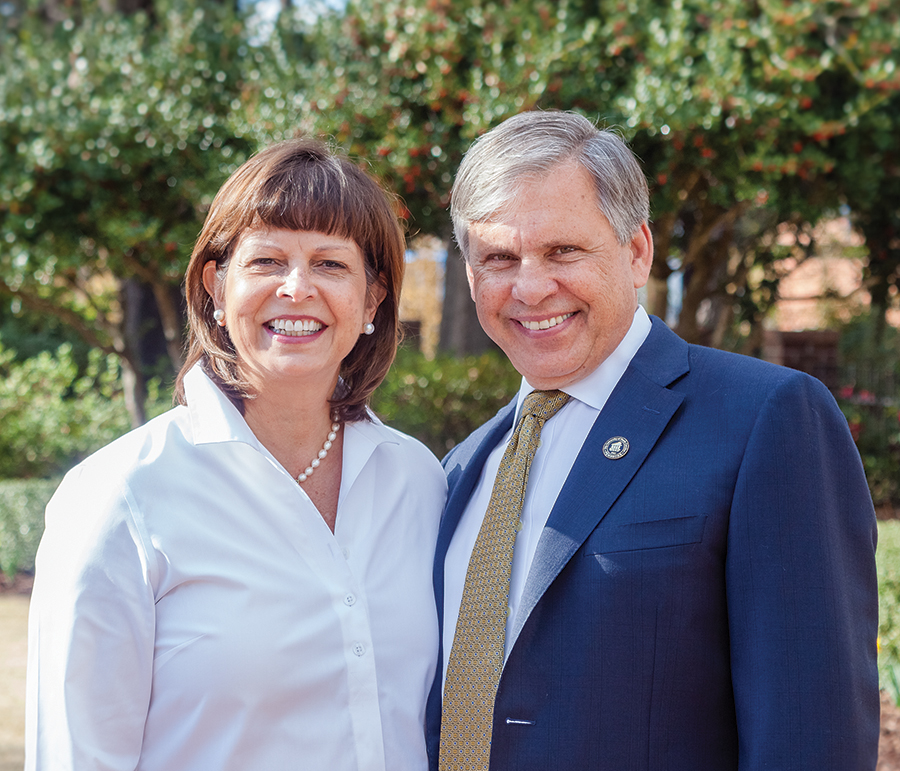
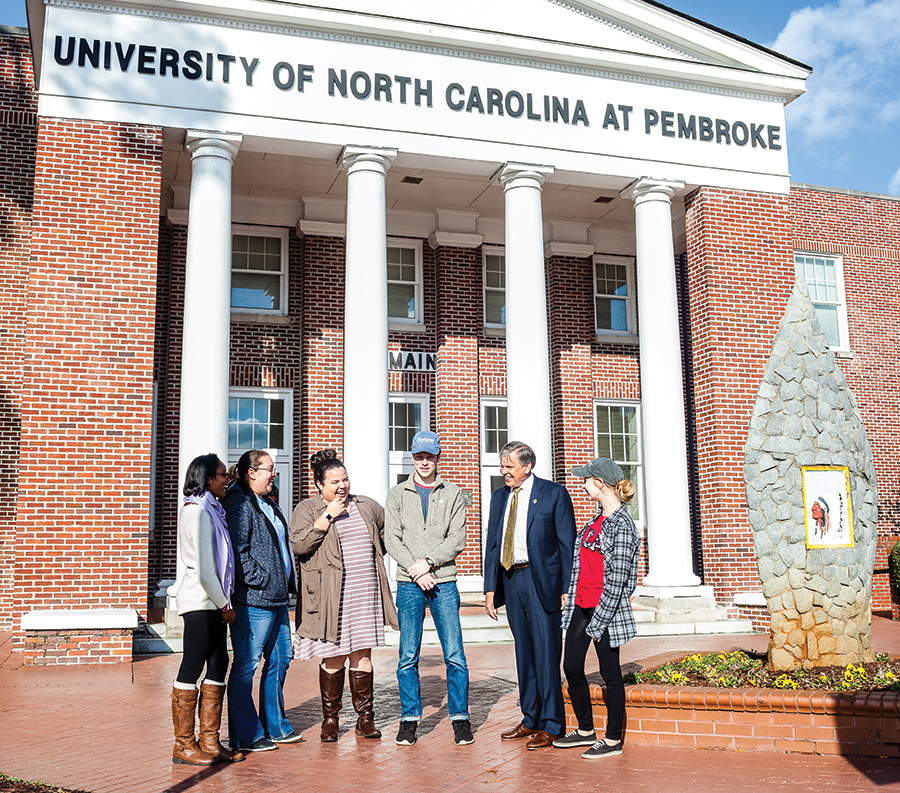
Dr. Robin Cummings, who is now the chancellor at the University of North Carolina at Pembroke, was on his rounds, looking in on patients at FirstHealth Moore Regional Hospital. It was an early winter evening, full darkness by 7 o’clock. He had performed two heart bypass surgeries that day. Walking alongside his colleague and friend Dr. Carl Berk, an ear-nose-and-throat surgeon, he mentioned he was having trouble hearing in one of his ears. Dr. Berk asked him a couple of questions. They diverted to radiology, where Cummings had an MRI. It revealed a two-centimeter acoustic neuroma located roughly where the brain stem meets the brain.

“It was a benign tumor, which is good,” says Cummings. “Most brain tumors are not.” Surgery was performed successfully a few weeks later. His hearing was preserved to a large degree, though even that has waned in the intervening years. But the surgery also affected his fine motor skills. Cummings knew that would happen before the doctors in Raleigh made the first incision. “Where it was located, you could not have put it  in a more key place in my body to affect my livelihood,” says Cummings. After the surgery he tried to hold an instrument and focus. “My hand would shake. So, I said, ‘I’m not going back.’ I quit. I retired early.”

Sort of.

It wasn’t just a livelihood Cummings lost that day. That’s the dispassionate, the clinical word for it. What he’d lost was a life. An all-consuming occupation, his mission, something he’d trained for from the moment he saw a beating heart in a chest, something he practiced with consummate skill. Something that defined who he was had been taken from him by the very capriciousness of life he dealt with every day he put on surgeon’s scrubs.

“It was like going through a divorce, going through a death,” says Cummings. After he retired, he and his wife, Rebecca, would join friends for an evening and he discovered he had nothing to talk about. “I really couldn’t carry on a conversation,” says Cummings. “No exaggeration.” Normal things, the gritty stuff of day-to-day, had eluded him. Turned out, the skill set of the highly skilled was also highly limited.

“It really was about six months of going through some depression,” he says. “I remember sitting in our kitchen one day and Rebecca wasn’t there and I was just, I was screaming and shaking my hands. I don’t understand this. Why can’t I operate? Why did this happen? God-why-did-you-do-this kind of thing.”

His self-prescribed therapy was to move. Just move. Do something. And he hasn’t stopped since. It led him to the hospital’s board of trustees; to being the director of Community Care of the Sandhills; to manage North Carolina’s Office of Rural Health and Community Care; to oversee the state’s Medicaid program, delivering health care to 1.8 million people with a budget of $14 billion; and, ultimately, back home, back to Pembroke, back to Robeson County, back to the place where it all began.

Dr. John Dempsey, the president of Sandhills Community College, is a longtime acquaintance of both the Cummings. “I wrote my master’s thesis on the subject of power in the works of Ernest Hemingway,” says Dempsey. “Most of Hemingway’s characters are people who have lost one power, had it replaced by another and were far the better for the experience. And, I think in truth, that’s Robin’s situation as well. As he lost one ability, he gained others.”

Cummings grew up on a 25-acre farm in Robeson County’s Union Chapel Community, roughly three miles from the chancellor’s house on the campus of UNC Pembroke, where he now lives. His father, Simeon, was a Methodist minister. His mother, Maude, and the couple’s nine children — Robin is the second youngest — worked the farm to keep the electricity on.

“Tobacco. Corn. Cotton. Soybeans. And cucumbers. Later on, we got into cucumbers,” says Cummings. “I’ve picked cucumbers, man, I’ll tell you. If you want to work hard, pick cucumbers.”

Or tobacco.

“Sunday Dad would preach — Sunday morning, Sunday night. Then Monday was our day to put in tobacco,” says Cummings. Snapping leaves off the stalks by hand, working from the sand lugs, the dirty, heavy bottom leaves, up on each successive Monday. Beginning as soon as it was light enough to see, getting wet from the feet up with the morning dew, then from the head down with the sweat of the afternoon sun. Their allotment was 1.5 acres. “Usually you had about six croppings,” he says. “We would get up at 4:30 on Monday morning, go to the barn, unload the barn — it’s been curing for the past week — put it in the pack house and then by 6:00, 6:30 we go to the field crop and do our acre and a half.”

Cummings’ mother graded the tobacco in the pack house, A for the golden leaves, then B and C. “She would put those in different piles and we would wrap each pile in a big sheet,” says Cummings. “One of the worst whippings I ever got was when I was jumping on the Grade A tobacco.”

When Cummings was in the 8th grade at Pembroke Middle School, he met a little 7th grader, Rebecca, who lived in the Harpers Ferry community. Both are members of the Lumbee Tribe. Rebecca’s mother worked in Converse’s Chuck Taylor plant; her father drove long haul trucks from one end of the country to the other. “She grabbed on and wouldn’t let go,” Cummings says, laughing. Now they have have four grown children of their own.

Simeon Cummings, the minister at what would become the largest American Indian church east of the Mississippi, Prospect United Methodist, was also a member of the first four-year graduating class at Pembroke, getting his degree after returning from World War II where he served — of all things — as a medic. Education was a family value. Robin Cummings went to UNC-Chapel Hill and graduated with a degree in zoology but knew he wanted to go to medical school. He took a year off when he and Rebecca were married. They also bought a car. He still has the bill of sale.

“It was a Chrysler LeBaron,” Cummings says. “My dad gave me a Toyota Celica to get through school, which broke down all the time. I took that Toyota Celica, and went down to the Lumberton Chrysler place. I didn’t know what I was doing. The salesman played me like a yo-yo. He pointed out this brown LeBaron. ‘I bet you want that car right there. Here’s the sticker price, son. That’s what it costs.’ I remember laying in bed that night and Rebecca says, ‘What are you thinking about?’ I said, ‘I can’t believe we just borrowed $4,000.’ To me, that was the beginning of our life.”

Cummings spent that year working in a dye factory, second shift, at something nudging minimum wage. “It was my first exposure to factory kind of work. What I saw that really upset me was the way the upper level people treated the folks down on the floor. I’m not talking about a racial thing. We’re up here, you’re down there. It really was caste kind of thinking. That second shift, it helped me fill out those applications and get into medical school, boy. Don’t waste time.”

The Cummings farm, most of those 25 acres, is still in the family, but the only part Robin owns is a memory. Financing for medical school came from multiple sources — loans, scholarships, what have you — but one of the pieces came from his father, the minister with the four-year degree. In the original movie The Magnificent Seven, the Mexican villagers tell Yul Brynner they’ve collected everything of value in their town in order to hire him and he replies, “I’ve been offered a lot for my work, but never everything.” One weekend back from school, in the home place on Union Chapel Road, his father handed him a check, small in the grand scheme of things but everything in other ways. “My dad took my part (of the farm) that he was going to give me and sold it to one of my other brothers to give me money to go to medical school,” says Cummings. “He was so proud.”

From Robeson County to Chapel Hill to Duke to operating rooms in Moore County to another one in Raleigh, where instead of giving the care he was receiving it, Cummings found himself back in Raleigh again, only this time finding a way to help 1.8 million people.

“My two years in Raleigh prepared me so well for this job,” Cummings says of his position leading UNC Pembroke. “When I went into work as Medicaid director it wasn’t what fire do I need to take care of today, it was what fire is burning hottest that will burn me up if I don’t take care of it today. Anyway, it prepared me. I dealt with bureaucracy. I dealt with politicians. I dealt with a big organization. I tell people it was a Harvard grad school education for two years, hands-on, trial-by-fire kind of stuff.”

Lacking a background as an academic administrator, Cummings was an unconventional pick to be Pembroke’s chancellor. Turns out convention isn’t as vital as leadership. It isn’t a matter of where UNC Pembroke was as much as where he wanted to take it.

“UNC Pembroke was a teachers’ college when it started. We added a school of business. We have a fairly strong arts and sciences school now. Nursing has come on. How do we retool ourselves for the future? What are the degrees that UNC Pembroke should be focusing on? How does this university serve this region? Here’s this great, wonderful university, yet we’re located in the poorest county in the poorest part of the state and we’ve been here 129 years. That doesn’t make sense, folks. This is this region’s university. Look at Buies Creek. Take Campbell University out of there and what would it be? Imagine if we could put that kind of machine here in southeast North Carolina. We would change the dynamics of this region in an incredibly good way.”

The university has developed a dual degree program with the North Carolina State University College of Engineering. The recently passed educational bond has earmarked $23 million for a state-of-the-art school of business. The building will actually cost $36 million, but Cummings views the fundraising challenge as another opportunity. They hope to break ground next year. They’ve created a program in collaboration with the NC State School of Veterinary Medicine, one of the hardest post-graduate programs to access in the nation.

“The honest truth is, of all the things we are for our institutions,” says Dempsey, “probably foremost among them is cheerleader. I think Robin is a great cheerleader for UNCP. He understands the political process because he worked in Raleigh. He does understand, I think, what it means to deal with very strong personalities. He is nominally in charge but just as the real work at the hospital is done by the doctors and nurses, the real work at the university is done by the professors and counselors. He is learning that you lead these institutions by cajoling rather than by declaring. Not ever to underestimate the importance of a cardiac surgeon, but the hearts and minds that Robin is touching now at UNC Pembroke are certainly equal to those that he touched in his career as a surgeon. I couldn’t be more impressed. He’s always upbeat. He’s always looking to the future.”

And still on the move.  PS

Jim Moriarty is senior editor of PineStraw and can be reached at
jjmpinestraw@gmail.com.

March Books

By Romey Petite

Eveningland: Stories, by Michael Knight

An American treasure, Michael Knight’s Eveningland is not so much a compilation of short fiction as it is a multi-part portrait of Mobile Bay and the lives of its people. It chronicles the days, from mundane to mythic, leading up to the arrival of a hurricane — a storm that will tear their private worlds asunder. With place as the framing device, the Alabama Gulf Coast inlet hosts a total of seven interlocking stories (like the Vietnam War in Tim O’Brien’s The Things They Carried). Throughout Knight’s prose one hears the voice of a raconteur’s playful spirit — alternatively honest and abashed. His characters are memorable, familiar and genuine. Still, in crafting their private fancies, Knight never fails to incorporate another essential element in Southern fiction — what Flannery O’Connor (to whom the author gives thanks in the acknowledgments) called the grotesque. While the individual stories certainly invite themselves to be anthologized and the format invites each delicacy to be digested a tale at a time, think of it as celebrated storyteller Daniel Wallace of Big Fish meets the format of Quentin Tarantino’s Pulp Fiction (1994). The author will be signing copies of his upcoming collection at The Country Bookshop on Thursday, March 9, at 5 p.m. — an event you’ll want to make sure to mark on your calendar

The One Eyed Man, by Ron Currie

The author of Everything Matters! and Flimsy Little Plastic Miracles returns with this lampoon of literalism. K. is a widower who has awoken one day to find himself unable to accept metaphorical language — preferring only simple, blunt, even crude explanations. In seeking someone who will be honest with him, he finds a confidant in Claire, a grocery clerk (at a thinly veiled Whole Foods parody), when he argues with her over incorrect fruit labels. Slogan by slogan he rejects the comfortable padding of the world that surrounds him, even quibbling over the semantics of a bumper sticker. K. becomes an unlikely hero when he’s thrust into a delicate situation, choosing between being a bystander or foiling a robbery in progress, and is turned into the object of society’s fascination — the star of a reality show — and eventually a target of the brutality that asking the wrong questions may beget.

Spaceman of Bohemia, by Jaroslav Kalfar

When a mysterious comet passes within the vicinity of Earth it turns the night sky strange swatches of purple. Jakub Prochazka, the orphaned son of a Communist Party informer, becomes the country’s first astronaut when he undertakes a dangerous mission offering a chance at both heroism and atonement. What he doesn’t anticipate is that while encased on the eight-month journey into deep space, he will long greatly for his wife, Lenka. There, pining for his beloved, and floating in the unknown, he encounters an eloquent spiderlike entity. Kalfar’s debut novel, evoking a Homeric epic, is an exceedingly pensive odyssey.

Exit West, by Mohsin Hamid

Mohsin Hamid, international best-selling author of The Reluctant Fundamentalist and a PEN/Hemingway finalist for Moth Smoke, returns with a love story verging on magical realism. Against the backdrop of a fractious unnamed country on the fault line of an impending civil war, Exit West tells the tale of the romance between Saeed and Nadia. In a land of escalating violence, they hear rumors of doors that will allow them to escape, making a dangerous and costly journey into an uncertain future. They leave their old world behind and struggle to hold on to each other and their sense of who they are.

One of the Boys, by Daniel Magariel

Though a short read, One of the Boys is no small feat, nor a novel for the faint of heart. A confessional, deep-cutting debut novel told from the perspective of the younger of two sons, it grapples with the grim subject of abuse. Two boys leave their mother behind, siding with their father, the parent they consider the lesser of two evils. The youngest boy even conspires to fabricate evidence against his mother to permanently ensure she will never receive custody. In being manipulated into crafting such a scheme, he finds himself culpable in his father’s crimes. As both boys begin to see a different side to their dad — his negligence, addictions and violent temper — they realize they are obeying him not only because they love him but fearing for their lives. Once you’ve glimpsed past the shuttered windows of this broken family, it will be impossible to look away.

Born Both, by Hida Viloria

The upcoming Born Both is a memoir detailing Hida Viloria’s experience of gradually coming to the realization she is intersex — and subsequent endeavors to spread awareness of it as an individual identity. It’s also about trust, consent and what happens when it is betrayed. Growing up, Viloria struggled with a hyper-masculine father and this book is very much an exorcism of that toxic figure. Being an activist in LGBTQIA rights, Viloria has appeared and been interviewed on The Oprah Winfrey Show, The Tyra Banks Show, ABC News, and has also penned articles for The New York Times, CNN.com and The American Journal of BioEthics. Her book’s publication is timely, considering that Hanne Gaby Odiele, a runway model, recently revealed that she was intersex in hopes of spreading awareness and doing away with taboos regarding non-binary bodies. Fans of Jeffrey Eugenides’s novel Middlesex may find that this intimate and jolting account speaks to them in ways fiction, perhaps, cannot.

Sonora, by Hannah Lillith Assadi

Hannah Lillith Assadi’s coming-of-age story, Sonora, is a noteworthy, dreamlike debut. Ahlam, a late bloomer, is the daughter of one world in the Middle East, but two separate visions. Her parents come from both sides of a fault line — Ahlam’s mother is from Israel and her father is a refugee from Palestine. Raised on the barren outskirts of Phoenix, Arizona, Ahlam has known little of the conflict, save for the news her father blasts during dinnertime and the stories he tells to remind her of how lucky she is. Unpopular in school, Ahlam finds a friend and kindred spirit in Laura, a maverick whose mother is from a local reservation. Laura awakens the dormant and shy Ahlam to her womanhood — encouraging her to experiment with drugs, boys and witchcraft. Together, they form a pact, eventually fleeing to New York, where they find there are certain troubles you cannot run from — those you take with you.

CHILDREN’S BOOKS By Angie Tally

Birds, by Kevin Henkes

Just in time for spring comes this lovely new edition of Birds, called the “Perfect book for young readers” by the New York Times Book Review. A little girl watches birds from her window and observes their sizes, colors, shapes, and the way they appear and disappear. She wishes she could fly as they do, but celebrates the one big thing they have in common: singing. Ages 2-4.

This House, Once, by Deborah Freedman

A picture book artist/author and one-time architect, Deborah Freedman presents this absolutely stunning portrait of a house from the ground up. A door that was once a tree; a foundation built of rocks once underground; windows once blowing sand — this a perfect coffee-table-type gift for families moving into a new home or budding architects everywhere. Ages 3-6.

Magic Tree House: World at War, by Mary Pope Osborne

The Magic Tree House books, long staples on beginning readers’ shelves, have gotten a new look and are now presented in three divisions: Magic Tree House titles for beginning chapter book readers; Merlin Missions for more advanced readers; and Fact Trackers for nonfiction fans. Additionally, this newest title in the series World at War is the first Super Edition and is Jack and Annie’s most dangerous mission in the scariest time the world has ever known, World War II. No reader will want to miss this longer story with additional facts and photographs. Ages 7-10.

Grandpa’s Great Escape, by David Walliams
and Tony Ross

Grandpa is Jack’s favorite person in the world, but has become confused and believes he is back in World War II where he was an ace fighter pilot. Jack is the only one who understands him anymore, so when Grandpa is sent to an old folks home, it’s up to Jack to help Grandpa plot a daring escape. As their adventure spins out of control, they will need Grandpa’s fighter pilot know-how and Jack’s real world common sense to get home. Ages 8-12.

Genius, by Leopoldo Gout

Three international teenage coding and hacking geniuses who have created an online presence called the “Lodge” find themselves involved in a high stakes competition arranged by a computer genius who may have more than a game in mind. With detailed illustrations and STEM connections, this book is unlike any other for science-minded fiction readers. Ages 12-16.  PS

Surprise! Surprise!

Forget the turnips, Pisces, because life’s about to turn around

By Astrid Stellanova

Time for March Madness and Gladness, Star Children! St. Paddy’s Day on the 17th, and then we give Ole Man Winter the boot on the 20th. Get green. Thaw out. Get on down. Shake the winter funk off and get your good time groove on, Wild Things. Ad Astra — Astrid

Pisces (February 19–March 20)

Honey, times ain’t so bad. Don’t go all Scarlet O’Hara, scrounging in the dirt for turnips and cutting up the living room drapes. For your birthday, you have a consolation prize you are going to like. Oh, it’s a gen-u-ine humdinger, and faster than you can say twiddle-dee-dee, you get the biggest surprise in the tee-nine-siest package.

Aries (March 21–April 19)

You’ve outdone yourself recently, getting yourself prime placement in the Pissing-People-Off Hall of Fame. Have you lost your ever-loving marbles? Don’t try and blame all your woes on Jesus, carbohydrates and the mean girls on the cheerleading squad! This is a great year to come clean about the fact that you pitched a fast-ball that was just damn lucky and stop pretending it wasn’t a fluke. Go work on your game, Child.

Taurus (April 20–May 20)

Remember, class is subjective. Even paper towel can be called common white trash. But not only is that white trash useful, it absorbs a whole lot of other people’s spills. Don’t try and keep up with the Joneses, because, honestly, they are not all that and a pack of Nabs anyway. Your past does not define you.

Gemini (May 21–June 20)

Your self-mastery has taken a back seat to your need to know what all your closest friends are doing, where, and whoever they are doing it with. Throw it in reverse my Twin, and resist the urge to track your nearest and dearest like a bloodhound. You may feel insecure, but in the coming months you will get a boost that will make you wonder why that was ever true.

Cancer (June 21–July 22)

You have been laid up nursing a bad case of the poor pitifuls. Unsure how to get some perspective and back up on your feet? Here’s what you need to know. Honey, life hits us all hard. But you think you fall from some kind of a greater height than the rest of us, right? Not. At. All. The sun is about to break through the clouds, Sunshine.

Leo (July 23–August 22)

Sugar, everybody’s dee-lighted you are feeling in fine fettle. But, honestly, spell “overconfident.” A pack of dogs can chase a car and a fast one will dang nearly catch it, but not many of them can change gears and drive the thing. You have got a learning curve before you slide behind the wheel. Hit the books.

Virgo (August 23–September 22)

It’s been a dry spell for you in the social department. Don’t worry, dishes, no one did me either. But actually, you are about to have a good times breakthrough and you will be irresistible to somebody that used to give you the coldest of cold shoulders. Meantime, Poor Thing, you finally get credit long overdue.

Libra (September 23–October 22)

You’ve been working hard on an image that you privately consider to be artsy. There ain’t much distance between eccentric and crazy. And I don’t think anybody believes that wearing a beret makes you an artiste. In the meantime, be careful about leaning too much on a confidant that happens to have a very big mouth and a weak backbone.

Scorpio (October 23–November 21)

You share everything lately, dontcha? Especially the check. The road to frugality started out as a good thing and then you took a turn toward Crazy Town. Relax, Sugar. You have savings in the bank and more sense than most when it comes to turning a dollar. This month, splurge a little and live a lot.

Sagittarius (November 22–December 21)

You have the wattage of a very big star, but your lights went on low dim due to some mean-spirited body who always makes you feel a little foolish and a lot outclassed. Snap out of it, Sugar. They are envious of your God-given talents, and they wouldn’t bother to throw shade at you if they weren’t.

Capricorn (December 22–January 19)

Put that Sapphire-Chase-Supreme-Big-Spenders-Club plastic in the safe, put it under the floorboard, or just get the scissors out and cut it up. You know you didn’t need that new credit card, and nobody cares if it’s the same one that the Spending Hall of Famers pack in their wallets. You know it is a royal temptation, so skip the coronation.

Aquarius (January 20–February 18)

When Twain quipped that cauliflower is cabbage with a college education, Darling, he was thinking of your chief critic. Maybe this uppity someone is an alum of Cabbage College and now they think this makes them better than you. They can think again, Honey. You’ve got big talent and all they have got is a big head — of cabbage. So skip the Tom Dooley act and don’t go hanging down your (much nicer) head. PS

For years, Astrid Stellanova owned and operated Curl Up and Dye Beauty Salon in the boondocks of North Carolina until arthritic fingers and her popular astrological readings provoked a new career path.

World on a Shelf

An encyclopedia of adventure

By Bill Fields

I pulled a volume off a shelf in a spare room and placed it on a table in front of my mother. Red with blue, gold and gray accents and fraying corners, it is seven years older than I am.

The World Book Encyclopedia, 1952 edition. I didn’t go to kindergarten, but I had our World Books, 18 volumes of information and entertainment, early childhood education without realizing it.   

“They were a good investment,” said Mom, who couldn’t remember how much they cost on an installment plan those many years ago.

Whatever my parents paid for them, it was a fair price, and I think my mother has long forgiven me for the stray crayon marks and torn pages in the “Farm” and “Fire” entries.

For my older sisters and me, the World Books were a window to the world far beyond our neighborhood, our school, our community, our state — although once I could read and not just look at the pictures, I did get a charge out of the “North Carolina” entry and seeing Southern Pines, population 4,772, among the rundown of the Old North State’s cities and towns.

But the real joy was in discovering things I didn’t know — that would have been almost everything in elementary school and earlier — and there was something on nearly every page. Thanks to the World Books, a housefly wasn’t just a pest to swat but a creature whose body parts were diagrammed. “Thorax” remains one of my favorite words. Before I saw a live tadpole, I’d seen “Life Story Of The Frog” in the encyclopedia.

Much of the set was in black and white, which made the bright four-color maps of American states and foreign countries stand out and seem special. When I flew to Great Britain for the first time, in 1988, it was to a country I initially had seen in Volume 7 of our World Books, when the longest trip was in a car for a couple of hours to the beach. The encyclopedia’s maps triggered an early interest in geography. At filling stations in the days when they gave away highway maps, if one was on a shelf I could reach, I took it for my collection.

Some of the World Book maps look silly more than six decades later, freeze-dried coffee in a Keurig Cup era. There is no Soviet Union, and many countries in Africa have different names. To see the “French Indochina” entry that was published years before the Vietnam War is a jarring reminder of history.

Being fascinated by balls and games from the time I was a toddler, I pored over the sporting entries. The football helmets shown were leather and without facemasks in 1952, which had drastically changed by the early 1960s when I first started poking through the World Books. A football field, however, was 100 yards long then and now.

The same can’t be said for the “Golf” entry. The diagram showing “distances a very good player should get with various iron clubs” indicates a 5-iron going 150 yards, something that hasn’t been so for decades, thanks mostly to the construction of balls and clubs.

That golf chart was only one example of how the World Books presented information. A country would be superimposed on a map of the United States to show its relative size. A pie chart displayed the food elements in a grape. The leading tobacco states were denoted by illustrated rankings, North Carolina at the top of the heap! There was a two-page spread highlighting “French Literature” from the 1400s to the 1900s, something I bet my sisters looked at more than I did.

Along with school texts and library books, The Pilot and The Greensboro Daily News, the 1952 World Books were what I read until I was in the fourth grade and it was decided our encyclopedias needed to be updated. There was debate over whether we would stick with World Books or switch to Encyclopedia Britannica, sort of a Ford or Chevy thing.

I remember a saleslady coming to the house one night extolling the virtues of the 1968 World Books, handsomely covered in white and green. She was a good closer, and before long the original set had been retired. But never forgotten.  PS

Southern Pines native Bill Fields, who writes about golf and other things, moved North in 1986 but hasn’t lost his accent.

Almanac

It was one of those March days when the sun shines hot and the wind blows cold: when it is summer in the light, and winter in the shade. –Charles Dickens, Great Expectations

Worms on the March

March is here and the world begins to soften. Some six feet underground, the earthworms are thawing, and when their first castings reappear in the dormant garden, so, too, will the robin. You’ll hear his mirthful, rhythmic song on an otherwise ordinary morning, pastel light filtering through the kitchen window where the sleeping cat stretches out his toes and, slowly, unfurls.

Cheerily, cheer-up, cheer-up, cheerily, cheer-up.

In other words: Spring has arrived.

All at once you notice flowering crocus, catkins dangling from delicate branches, colorful weeds dotting sepia toned landscapes. You watch the robin trot across the lawn, chest puffed like a popinjay as he pinballs from worm to fat, delicious worm. Soon he will gather twigs, feathers and grasses to build his nest.

Cheerily, cheer-up, cheer-up, cheerily, cheer-up.

As the kettle whistles from the stovetop, the aroma of freshly ground coffee warming the sunny room, a smile animates your face with soft lines.

Spring has arrived, you think.

And the world stirs back to life.

The Goddess Returns

The Full Worm Moon and Daylight Saving Time both happen on Sunday, March 12.  Because maple sap begins to flow in March, Native Americans deemed this month’s full moon the Sap Moon. You won’t want to miss it. And while you may miss that hour of sleep after turning the clocks forward, the longer days will make up for it in no time — especially when the field crickets start sweet-talking you into porch-sitting past supper.

Although the lusty robin may have announced the arrival of spring weeks ago, Monday, March 20, officially marks the vernal equinox. Greek myth tells that Demeter, goddess of harvest and fertility, celebrates the six-month return of her beautiful daughter, Persephone (goddess of the Underworld), by making the earth lush and fruitful once again. 

International Day of Forests and World Poetry Day fall on Tuesday, March 21 — a day after the start of spring. Celebrate with a poem by your favorite naturalist, and if you’re feeling inspired, try reading a few lines to a favorite stand of oak, maple or pine. 

In the spirit of Saint Patrick’s Day (Friday, March 17), why not spread white or red clover seed across bare patches of the lawn? One benefit of this flowering, drought-resistant legume is that it attracts pollinators and other insects that prey on garden pests. Plus, if you find a four-leaf clover — supposedly there’s one for every 10 thousand with three leaves — it’s said to bring you good luck. Give the shamrock to a friend and your fortune will double.

According to National Geographic, one of the “Top 7 Must-See Sky Events for 2017” will occur on March 29. On this Wednesday evening, Mercury, Mars, and a thin crescent moon will form a stunning celestial triangle in the western sky, with Mercury shining at its brightest to the right of the moon and Mars glowing above them.

Each leaf,

each blade of grass

vies for attention.

Even weeds

carry tiny blossoms

to astonish us. –Marianne Poloskey, “Sunday in Spring”

 Bald Facts about Daffodils

The daffodil — also known as jonquil, Narcissus and “Lent Lily” — is the birth flower of March. Synonymous with spring, this cheerful yellow flower is a symbol of rebirth and good fortune. And a little-known fact: Medieval Arabs used daffodil juice as a cure for baldness.  PS