All Bottled Up

Poor man’s stained glass comes of age

By Susan McCrimmon  •  Photographs by Laura Gingerich

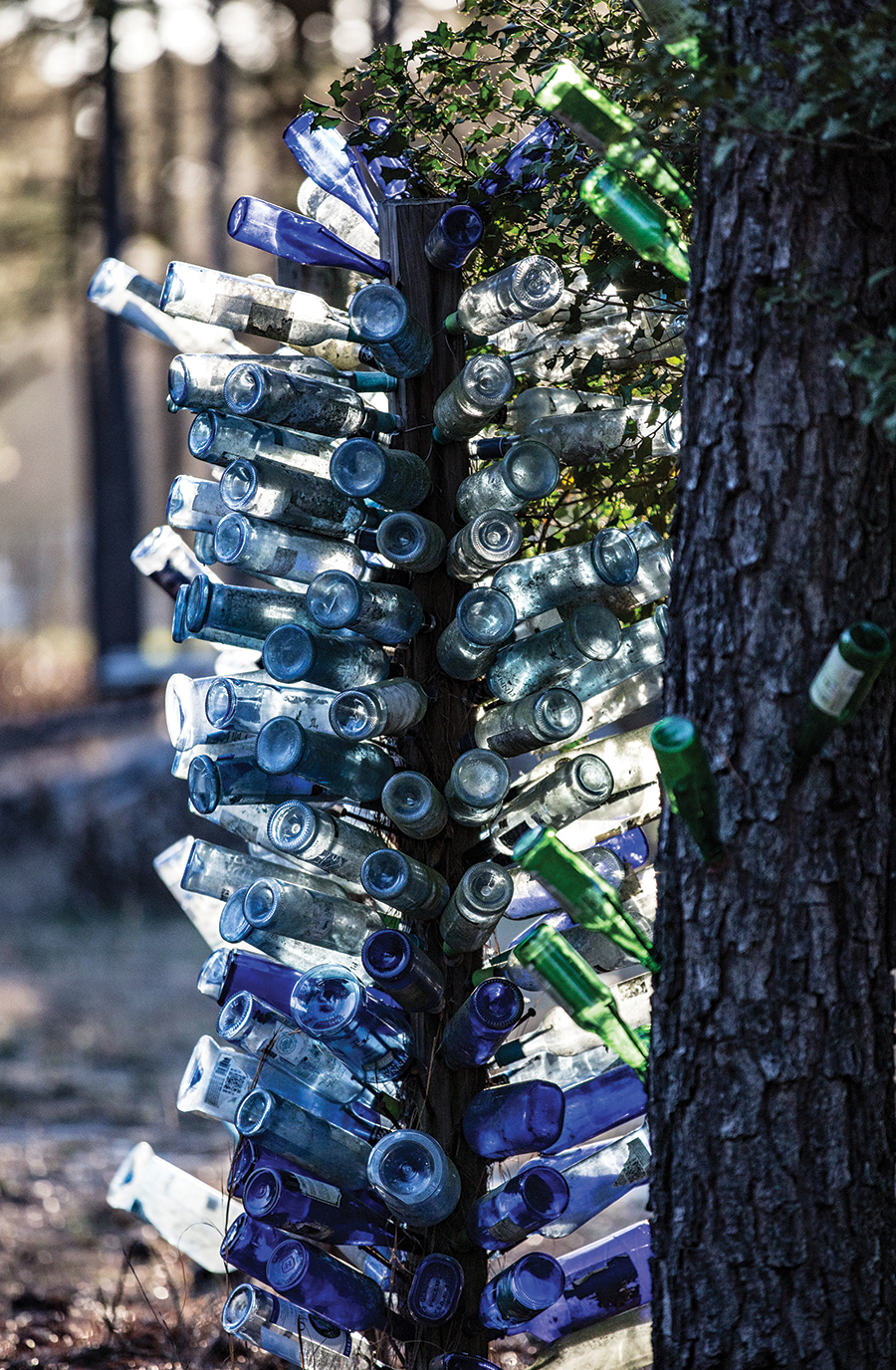
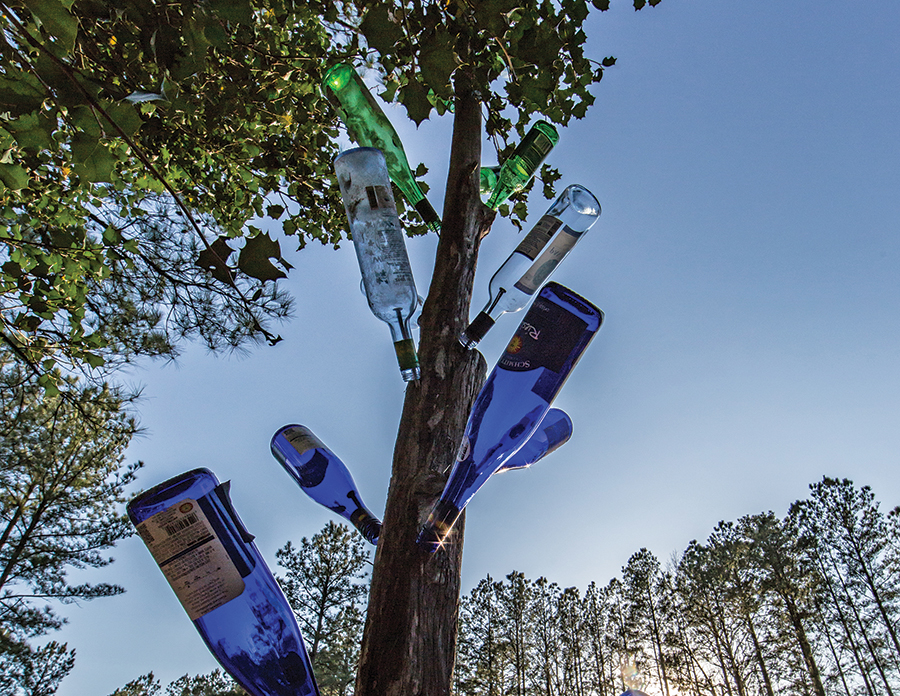
Are they trash recycled as art? Does your heart soar when one is spotted tucked back into some shrubbery? Does your nose wrinkle with distaste at the gaudy display? Love ’em or hate ’em, glass containers emptied of their various and sundry contents — liquid medicines, soft drinks, vinegar, beer, syrups, hard liquor — all have been transformed into an art form, the Pietà of salvage, the bottle tree.

A splash of color in the corner of the garden or a note of whimsy as the garden’s focal point, there is no denying a bottle tree’s impact. There are no formulas, no blueprints, no set rules governing construction or design. Bottle trees are limited only by one’s imagination, creativity or pocketbook. The “poor man’s stained glass” can be constructed from a variety of materials. The most current manifestation can be purchased and installed in short order. Metal “trees” made from rebar or similar material are placed in the desired location and the chosen bottles are inverted onto the tree “limbs” to complete the look. Easy peasy. The more traditional bottle trees take a little more effort. If one is lucky, a  dead cedar tree or crape myrtle, in the right location, works great. Cedars and crape myrtles are traditionally associated with bottle trees, although anything with good limb structure will work. Just trim the limbs as needed and place saved bottles as your artistic muse dictates.

Otherwise, a strategically positioned post or tree trunk may be your best option. Some people drill holes and pound wooden dowels at an angle into the post or tree trunk to support the bottles. I prefer to hammer in 20-penny nails. Relatively inexpensive, they can be easily moved for creative effect. To finish, simply add the collected bottles. They can be a wide variety of shapes and colors or just one specific type or one specific color. The possibilities are endless.

Bottle trees have spiritual, cultural and aesthetic significance in history and garden design. Glass was first discovered in northern Africa about 3500 B.C. Glass bottles appeared in Egypt and Mesopotamia around 1600 B.C. It’s possible that the Arabic folk tale of the genie in Aladdin’s lamp is the first instance of bottles being used to capture spirits, pre-dating the common conception of bottle trees originating in the Congo during the ninth century where empty glass bottles were placed around entryways in order to ensnare evil spirits which then would be destroyed by sunshine. Wind blowing across the bottles was the sound of spirits trapped inside moaning to be released. At the same time in the Congo, tree altars were erected to honor dead relatives. Plates attached to trees or sticks would be placed around the gravesite as a memorial. The plates were thought to resemble mushrooms. The  Congolese word for mushroom was similar to their word for love. See a mushroom . . . think of love. Earth from the gravesite would be placed in bottles and they would be hung by the neck from low limbs of a tree. These bottles would emit a tinkling sound in a breeze, possibly the beginning of wind chimes. The two concepts began  to merge into the bottle tree.

The color of choice for bottle trees has predominantly been cobalt blue. Cobalt blue is universally accepted for relaxing and calming the spirit and has historically been associated with spirits, ghosts and haints. Blue bottles have been found on shipwrecks from the Minoans dating as far back as 2700 B.C. The most widespread means of adding blue color to glass was using the element cobalt, thus the name. The term cobalt is Greek in origin by way of medieval Germany. When smelting silver, the cobalt metal embedded in the silver ore could interfere with the process and cause respiratory issues. As early as 1335, “Kobald” referred to gnomes or spirits afflicting the silver miners. The association stuck. The word for troublesome spirits became associated with the main way of getting blue color into glass that was then used in bottle trees to capture evil spirits. Cobalt blue was the preferred color of Voodoo tradition. This color of the sky and water was a crossroads of heaven and Earth, the living and the dead, and creative and destructive spirits. 

The esteemed Southern writer Eudora Welty believed that place is what makes a story appear real, because with place come associations, customs and feelings. In the short story “Livvie” she writes:

“Out front was a clean dirt yard with every vestige of grass patiently uprooted and the ground scarred in deep whorls from the strike of Livvie’s broom. Rose bushes with tiny blood-red roses blooming every month grew in threes on either side of the steps. On one side was a peach tree, on the other a pomegranate. 

“Then coming around up the path from the deep cut of the Natchez Trace below was a line of bare crape-myrtle trees with every branch of them ending in a colored bottle, green or blue. 

“There was no word that fell from Solomon’s lips to say what they were for, but Livvie knew that there could be a spell put in trees, and she was familiar from the time she was born with the way bottle trees kept evil spirits from coming into the house — by luring them inside the colored bottles, where they cannot get out again. 

“Solomon had made the bottle trees with his own hands over the nine years, in labor amounting to about a tree a year, and without a sign that he had any uneasiness in his heart, for he took as much pride in his precautions against spirits coming in the house as he took in the house, and sometimes in the sun the bottle trees looked prettier than the house did . . . ”

My first two bottle trees came about due to my mother’s illness. She was a died-in-the-wool Southern iced tea drinker. Every day. If there wasn’t a pitcher of tea already in the fridge, it was being brewed on the stove. One of the manifestations of her illness was that it altered my mother’s drinking habits. She no longer wanted tea but began to drink Coke. Not any Coke, mind you, but it had to be the ones in the 6-ounce bottles. We bought them by the case. I began to store the small greenish bottles with the distinctive red labels. When I thought enough had been gathered, I dug a hole near a large camellia bush, beat in the nails, and erected this rather odd memorial to my mother. During the many months of her illness, almost every evening was passed with friends and family murmuring words of support while sitting on Mom’s screened-in porch. At times, alcohol was the crutch used to help numb the pain. My second bottle tree was born as a memorial to those evenings. The current count is six . . . and growing. 

Regardless of your color choice, be it blue, green, brown, clear, red or any array of color choices for your garden addition, remember its long tradition of keeping bad things away. No one can feel bad from something that brings one such joy.  PS

Susan McCrimmon is a noted science geek, Suduko and crossword addict and is rumored to be besotted by words…and bottle trees.

PinePitch

100 Years of Jugtown

For 100 years, the Owens family has owned and operated Jugtown Pottery, a working pottery and American craft shop. The story of its founding and evolution have been told by Stephen C. Compton in his new book, Jugtown Pottery: 1917 — 2017 A Century of Art and Craft in Clay, released by John F. Blair, publisher. On Saturday, April 22, the Owens family will host a day-long celebration of Jugtown’s history and the book that tells it.

The shop opens at 8:30 a.m. with new pottery pieces from the wood and gas kilns, as well as fine crafts from many artisans. Activities are planned for the whole day and will include demonstrations, a book reading and signing, a Q & A session with author Stephen Compton and the Owens family, live music by local performer Momma Molasses, and food vendors. Buggytown Coffee will be on site with a wonderful variety of coffees, teas and goodies. Jugtown Pottery is located at 330 Jugtown Road, Seagrove. For more information, call (910) 464-3266 or visit jugtown@mindspring.com.

Earthly Delights

For your gardening pleasure, local plant sales are offering an abundance of horticultural treasures, rain or shine:

Saturday, April 8, from 9 a.m.–1 p.m.

The Weymouth Center Spring Plant Sale offers perennials, shrubs, trees, groundcovers, vines and herbs, from the Weymouth Estate and members’ gardens. The Garden White Elephant Sale will feature containers, books, baskets, tools and treasures of all sorts. Proceeds go to the Weymouth Center Gardens, 555 E. Connecticut Ave., Southern Pines. For information call (910) 692-6261 or visit weymouthcenter.org.

Saturday, April 8, from 8 a.m.–12 p.m.

The Sandhills Horticultural Society Plant Sale includes perennials, woody plants and bulbs and will take place at the Steed Hall (new horticultural building) area of Sandhills Community College, 3395 Airport Road, Pinehurst. For information or to pre-order call (910) 695-3882.

Friday, April 21, 1–5 p.m. and Saturday, April 22, from 9 a.m.–12 p.m.

The Sandhills Community College Annual Bedding Plant Sale is selling annuals, herbs, tomatoes and pepper plants to benefit the student’s educational field trip. Order forms are available at the Ball Visitors Center or you can order by phone, (910) 695-3883/3882. Mail SCC-Landscape Gardening Dept., 3395 Airport Road, Pinehurst, NC 28374. Email johnsond@sandhills.edu or fax (910) 695-3894. Pre-order to get the best selection. The sale will take place at the Steed Hall (new horticultural building) area of Sandhills Community College, 3395 Airport Road, Pinehurst.

Saturday, April 22, from 10 a.m.–3 p.m.

The Pinehurst Garden Club Plant Sale features local favorites. Profits provide a scholarship for a Sandhills Community College horticulture student and contribute to area beautification projects. To place an order, please visit www.pinehurstgardenclub.com or contact Janis McCullough at (910) 420-2208. Pick up your plants or shop at the sale at Pinehurst Fire Dept. Station 91, 405 Magnolia Road, Pinehurst. Info: (910) 420-1777.

Marshmallow Madness

The ninth annual Peeps Diorama Contest is on, and the Southern Pines Public Library invites you to let your imagination and sweet tooth run wild in creating a diorama that stars the Peeps marshmallow chicks and rabbits in a scene from your favorite book. Or for the digitally inclined, create a “Peep Show” video.   

The contest, sponsored by the Friends of the Library, is open to all ages, and prizes will be awarded by age group for best in show. Entries are limited to one per contestant for both the diorama and video contests and must be received by 5 p.m., Sunday, April 30. Find rules and entry forms online at www.sppl.net or at the library, 170 W. Connecticut Ave., Southern Pines, open Monday — Thursday 10 a.m. to 7 p.m., Friday and Saturday 10 a.m. to 5 p.m., and Sunday 2 to 5 p.m. Call (910) 692-8235 for more information or visit the website.

A Walk Through History

From the ancient cave paintings of Lascaux to the street murals of today, people around the world throughout time have used murals to express themselves. Denise Drum Baker, an artist and recently retired professor of visual arts at Sandhills Community College, will talk about murals as a means of freedom of expression, social activism and propaganda. Baker’s lecture, “If These Walls Could Talk,” is part of the Fine Arts Lecture Series presented by the Arts Council of Moore County and Weymouth Center for the Arts & Humanities. The lecture will take place on Thursday, April 6, at 5:30 p.m. A wine-and-cheese reception with Baker will follow. Both events are at 555 E. Connecticut Ave., Southern Pines. Cost to members is $11, $16 to nonmembers. Info: (910) 692-6261 or weymouthcenter.org.

The Joy of Broadway

On Saturday, April 8, The Carolina Philharmonic presents a Broadway cabaret, in which Maestro David Michael Wolff will introduce you to two of Broadway’s exciting entertainers in an intimate musical event replete with all the character, color and drama of the legendary Great White Way. There will be an afternoon performance at 3 p.m. and an evening performance at 7:30. Both performances will be at Sandhills Community College’s Owens Auditorium, 3395 Airport Road, Pinehurst. Tickets range from $11 to $60 and are available at www.carolinaphil.org. For more information, call (910) 687-0287.

Spring Scavenger Hunt

The Southern Pines Public Library and the Arts Council of Moore County invite children between the ages 3 and 12 to take part in a fitness-themed scavenger hunt on Monday, April 17, at the Campbell House playground. The scavenger hunt clues will lead the youngsters through some fun obstacles that will get participants of all ages up and moving as they hula-hoop, skip rope and crab walk to find eggs, prizes and fun. Top off the afternoon with a make-your-own-ice cream sundae. It all starts at 3 p.m., rain or shine, and is free and open to the public. The Campbell House is located at 482 E. Connecticut Ave., Southern Pines. For more information, call (910) 692-2787 or (910) 910-692-2463.

Meet the Beatles … Again

On Saturday, April 22, Vision 4 Moore presents the amazing Beatles tribute band “The Return,” performing songs that cover two eras of Beatles music. The first set will highlight the Ed Sullivan era, with “I Want To Hold Your Hand,” “A Hard Day’s Night,” and other early hits. For the second set, the band will dress in uniforms from the Sgt. Pepper’s Lonely Hearts Club Band album to perform songs like “Hello, Goodbye,” “Revolution,” and “Hey Jude.” Tickets are $15–$35, and profits from this event will benefit MIRA Foundation USA, Caring Hearts for Kids of Moore, and Meals on Wheels of the Sandhills. The performance starts at 7:30 p.m. at Lee Auditorium, Pinecrest High School, 250 Voit Gilmore Lane, Southern Pines. For more information, call (910) 365-9890.

Live after 5

On Friday, April 14, The Legacy Motown Revue will take you back to the days of The Drifters, The Coasters, The Jackson 5, Earth Wind & Fire, The Temptations, and many more legendary icons. The concert is free for the entire family, and you can bring your own picnic basket, but no outside alcoholic beverages are permitted. Food trucks will be on-site with sandwiches, pizzas and desserts. Wine, beer, water and soft drinks will be available for purchase with the proceeds supporting local nonprofits. Don’t forget to bring your lawn chairs, blankets and dancing shoes! The music starts at 5:30 p.m. at Tufts Memorial Park, 1 Village Green Road W., Pinehurst. For more information, call (910) 295-2817 or visit vopnc.org.

A Russian Virtuoso in Concert

Classical guitarist Irina Kulikova was born in Chelyabinsk, Russia, where under the guidance of her mother, cellist Vinera Kulikova, she started developing her musicianship at an early age. At the age of 12, Kulikova began performing throughout Russia and abroad and graduated with distinction from the Mozarteum University in Salzburg (Austria), the Gnessins Academy in Moscow and the Conservatoire of Maastricht (The Netherlands). Treat yourself to this free concert on Tuesday, April 11, at 7 p.m. at Owens Auditorium, Sandhills Community College, 3395 Airport Road, Pinehurst. For more information, call Ryan Book at (910) 695-3828.

April Books

By Romey Petite

Royce Rolls, by Margaret Stohl

The author of the best-selling Beautiful Creatures and Black Widow series turns her pen toward satire in this thinly veiled caricature of the Kardashian family. Bentley Royce, a girl of 16 years, is sick of playing second fiddle to her older sister Porsche (Kim), suffering at the schemes of her manipulative mother, Mercedes (Kris), and her brother, Maybach (Rob), who is of little help to her. Reality intercedes when both Bentley and T. Wilson White — her brother-in-law to be — careen off a cliff on Mulholland Drive. Peppered throughout with memo-like footnotes and press releases, Royce Rolls is a rollicking send-up of the culture of reality TV and our desire to live vicariously through the stars.

What It Means When a Man Falls from the Sky: Stories,
by Lesley Nneka Arimah

In What It Means When a Man Falls from the Sky, Arimah uses speculative fiction to illustrate truths that are otherwise intangible. Each story is a skillfully concocted, strange, yet plausible, world that a novelist might have wasted an entire sea of words on. In one, a girl crafts a baby out of fallen hair she sweeps up at a salon, but her woven-child’s hunger proves far more ferocious than any child born of flesh and blood. In another, an equation is discovered with the potential to solve all the unhappiness in the world, but mathematicians repeatedly fail to fully integrate it into daily life. Fans of Karen Russell’s St. Lucy’s Home for Girls Raised by Wolves or Aimee Bender’s Willful Creatures will adore and admire the seamlessness with which Arimah takes only the time she needs to tell a story — before weaving another its equal in depth. 

Blitzed: Drugs in the Third Reich, by Norman Ohler

Five years of scintillating research went into Ohler’s Blitzed, an account of the rise of drug culture in Weimar Germany and the immediate fallout — the weaponized manufacture of opiates. It includes the dark history behind corporations such as Merck & Co, Bayer AG and Temmler, and how these companies became producers of narcotics on an unprecedented scale in Nazi-Occupied Germany. Unique to his book is the deconstruction of Adolf Hitler as the teetotaling, abstinent figure the Fuhrer purported himself to be. Blitzed spent five weeks on the best-seller list in Germany, where its publication received considerable acclaim regarding its findings. Its debut on this side of the pond is not to be missed. 

The Boy in the Earth, by Fuminori Nakamura

While being a meditative yet relatively slim weekend read, Nakamura’s The Boy in the Earth has the makings of psychological thriller, a nightmarish noir setting. Part Taxi Driver (1976), part Dostoevsky’s Notes from Underground, for the author it is a personal voyage into the human soul. The narrator, an orphan and survivor of a traumatic, abusive childhood, finds himself co-habiting with a strange girl who has also fallen between the cracks in the world. Further disillusioned at discovering his father is still alive, he remains desperate for answers. Nakamura’s first novel to be translated into English, The Thief, was a finalist for the Los Angeles Times Book Prize. He is also the winner of the Oe Prize, Japan’s highest literary award.

Foxlowe, by Eleanor Wasserberg 

Set against the backdrop of the East Anglian moorlands, the Foxlowe folk are an in-group holding fast to their strange maypole customs. Superstitious and reclusive, they live in fear of the Bad, cursing the memory of Leavers, and otherwise shun the Outside. In their society power comes from naming and marking boundaries. All new arrivals are rechristened. Green, being born in Foxlowe, has no past outside of their tiny world, but she isn’t the only one for long. A baby arrives and Green finds herself forever bound to this newcomer, having mistakenly named her Blue. While Wasserberg’s invented language in this foreboding coming-of-age novel might put one in mind of Anthony Burgess’ A Clockwork Orange, her approach toward depicting this rural society has earned her comparisons with the haunted works of Shirley Jackson and reveals her to be a promising new talent — a voice in fiction to watch out for.

My Cat Yugoslavia, by Pajtim Statovci

An arranged marriage becomes the impetus for Statovci’s first novel, a tale bridging two moments in time. In 1980, Emine — a Muslim girl from Kosovo — receives a marriage proposal from a man she’s had little chance to get to know. While the pairing is blessed by the girl’s father, it’s clear her own feelings regarding the match aren’t mutual. Shortly thereafter, war breaks out and the couple flees to Finland, where they try to raise a family despite their splintering union. It is their youngest son, Bekim, who features prominently in the adjacent narrative — intertwined with the first and taking place in the present day. He lives a libertine life of eccentricity, allowing his pet boa constrictor free rein of his apartment. His life takes a turn from the simply odd toward the fabulist when he meets an allegorical cat. It is the subsequent conversations with this outspoken anthropomorphic feline that lead Bekim to return to his mother’s homeland and retrace the steps of his family’s fragmented history.

The Road to Jonestown: Jim Jones and Peoples Temple, by Jeff Guinn

The New York Times best-selling author of Manson returns with a chilling new foray into the subject of mass-hysteria and cults of personality with his investigation into the mind behind the Jonestown massacre — Jim Jones. The Road to Jonestown delves deeply into the jungle settlement in Guyana and provides revelations into the bizarre figure of Jones himself, painting a portrait of the enigmatic figure of the Peoples Temple’s leader. Thoroughly researched and compiled from interviews with survivors of the congregation’s cyanide-induced mass suicide, Guinn’s book is a harrowing read into this quintessential, yet uniquely American, tragedy — one that must never be forgotten.

CHILDREN’S BOOKS By Angie Talley

Bunny’s Book Club, by Annie Silvestro

On a sunny afternoon, on the front steps of the library, Bunny discovered the power, the delight of stories and knew he would do anything to have more books in his world.  Book lovers everywhere understand the power of being absolutely drawn in by a good story and will enjoy sharing this tale of book love. Ages 3-6.

65 Story Treehouse, by Andy Griffiths

Andy and Terry live and write books in their 65-story treehouse that was once 13, then 26, then 38, then 52 stories tall. It has a pet-grooming salon, a birthday room where it’s always your birthday, a room full of exploding eyeballs, a shark tank, a lollipop shop, a quicksand pit, an ant farm and a time machine. Andy Griffiths, author of the wildly popular 13 Story Treehouse graphic novel series will bring his own version of wackiness to The Country Bookshop Thursday, April 6, at 4 p.m.  This event is free and appropriate for children ages 6-12 and their families.

Panda-monium,
by Stuart Gibbs

In this fourth fast-paced endangered species mystery series set in FunJungle, panda fanatics are frenzied, awaiting the arrival of the park’s most thrilling animal yet, Li Ping, a rare and incredibly expensive giant panda. However, when the truck transporting Li Ping finally arrives, its precious cargo has vanished.  Author Stuart Gibbs will visit The Country Bookshop Monday, April 3, at 4 p.m., to introduce Panda-monium as well as his New York Times bestselling Spy School and Space Case series. This event is free and appropriate for children ages 8-12 and their families.

Daughter of a Pirate King,
by Tricia Levenseller

Alosa is the daughter of the infamous Pirate King, the overlord of the seas. When he hears word of a map to an island filled with treasure, he sends the only person he has trained himself — his daughter. She expects her task to be easy but soon encounters a problem, the first mate, Riden. Alosa is just as determined to find the map for her father, but will Riden prove too much to resist? Ages 13 and up.  PS

Mystery in Pieces

Here’s a clue — Walmart is not guilty

By Renee Phile

A few weeks ago, my bestie from high school, Caren, flew up from Orlando to spend the week with me. I have only seen her maybe four times since we graduated from high school nearly 16 years ago, so, as you can imagine, we wanted to fill our time with plenty of meaningful, friendship-building activities.

After she arrived at the airport, we grabbed a bite to eat and then headed to the store to pick up groceries for the week. We decided, as we were throwing salad, quinoa and other organic items (I mean ice cream and four types of cookies) into the cart, that we needed some type of bonding activity. A puzzle was just the answer. We spent around 45 minutes in the puzzle aisle examining every single one while the ice cream in our cart melted. Right before we walked out of the store puzzleless, because I didn’t want to tackle an under the sea scene and she didn’t care to work on a Star Wars one, the answer, once again, became very, very clear: a 750-piece with a pink and purple sky, with mountains, a river and trees in their autumn peak, all surrounding a white castle flashed right before our eyes.

Our eyes met and we knew.

This was the one.

That night we started construction on the border. Our border. She took the sky, and I took the foreground, which were those blasted, confusing swirls of autumn trees.

Caren’s job allows her to work from her computer, so she stayed home with our puzzle while I went to work the next day. Around 2 p.m., a nagging feeling appeared in my mind. I sent her a text:

Me: 2:14 You better not be working on the puzzle

Caren: 2:16 I’m not

Me: 2:17 Yes you are

Caren: 2:18 Only two pieces

Me: 2:18 Stop!

Caren: 2:19 OK, no more. I will wait for you

An hour later. . .

Me: 3:15 Stop working on the puzzle!

Caren: 3:17 Only two more pieces

Me: 3:20 Ugh! I’m leaving work. Be there soon. Leave the puzzle alone.

We worked on our puzzle on and off through afternoons and evenings. Occasionally, my boys would help, but they typically lost interest within a few minutes. As the days crept by, we realized something was off. We had yet to connect the sides with the border, and we just kept thinking we had not found the right piece or there were missing pieces. The bottom border was almost a wavy line. I had put the bottom together and, while it was just a nagging feeling, I truly thought maybe Walmart had sold us a defective puzzle.

“I think this piece goes here, but I just need some scissors to trim the edge, and then it will fit,” I said, halfway kidding. Caren exploded with laughter, and we continued to work on our project.

One night after a very exciting SCC basketball game, we plopped down at the kitchen table to work on our puzzle. Caren peered at the bottom border pieces and burst into hysterical laughter, like to the point where I thought something might be wrong with her.

“Are you kidding me?” she said. “These don’t fit! This one doesn’t fit! This one doesn’t fit! Renee! You have been forcing pieces together that don’t fit!” I was a bit embarrassed, but mostly relieved, even if the problem was me.  Laughing, she pulled apart the border. She connected some, reconnected others, the wavy border straightened, and the mystery was solved. Shew. No more blaming Walmart.

Caren left for home before the puzzle was finished. A bunch of trees were left, and they literally looked as if autumn had thrown up. The oranges, reds and yellows all swirled together near the bottom of the puzzle. I didn’t go back to it right away. One Friday night, though, I decided I wanted to finish the puzzle, glue it together, and frame it.  I spent an hour or so connecting piece by piece until it was finished. Every piece fit. I snapped a picture of the masterpiece and texted it to Caren.

The next morning, I woke up, and with coffee in hand, I admired my work. Suddenly, I noticed something very peculiar. There was a piece missing from the sky. Just one. Gone.

I figured one of my boys snagged it to be funny. I asked each of them, “Have you seen this piece?”

“Nope.” David said, “Maybe you should ask Kevin.”

“Kevin, have you seen this piece?”

“No! I promise! David probably knows!”

With each passing hour, my technique changed:

“I really want to frame this picture and hang it up. Could you please give me back the missing piece?”

“Look, I don’t care who took it or why. Just put it back. Have it back by the morning at 6 a.m. I don’t even need to know who stole it.”

“No one is leaving the house until the piece is back.”

“We aren’t eating again until the piece is back.”

“Stealing puzzle pieces from your mom’s puzzle and lying are sins.”

“GIVE IT BACK!”

No admissions. None.

I even questioned Bailey, my 2-year-old Rottweiler, and she claimed that she had no idea where the piece had gone.

Days later, the piece is still gone. No one will admit to it, and if it doesn’t appear by Friday, I’m just going to glue the puzzle and frame it with a hole in the sky. I’m done questioning the suspects. I don’t know what else to do.

I’m completely puzzled.   PS

Renee Phile teaches English composition at Sandhills Community College.

Longleaf Majesty

The roots of a massive ecosystem

By Bill Fields     Photographs by Brady Beck

For those who understand the longleaf pine, lose sleep over its well-being and know of its former ubiquity in the southeastern United States, there is a yearning to have witnessed the old landscape vastly different from today.

“Guys fantasize about a lot of things,” says Jesse Wimberley, outreach coordinator for the nonprofit Sandhills Area Land Trust, “but you’re talking to a guy who literally fantasizes about wanting to have seen that forest. I think we missed out on one of the greatest things that this country ever had — that endless longleaf forest that went on for miles and miles and miles.”

An Aberdeen native, 1976 Pinecrest High School graduate and fourth-generation longleaf farmer, Wimberley calls the 92 million acres of longleaf that once existed from Virginia south to Florida and west to Texas “the greatest ecosystem that ever existed in the United States.” It is hard to argue with him, especially in the Sandhills, where the species is the area’s long-needled fingerprint, the remnant that offers an inkling of what stood centuries earlier.

“They talked about being able to ride for days and days and never getting out of the piney woods,” says Robert Abernathy, president of the Longleaf Alliance, an education and advocacy organization started in 1995. “You can get a taste of that in Weymouth Woods and on the Walthour-Moss property. You can get out in the middle of it, and if you don’t listen to the traffic, you can get an idea of what the forest looked like 200 years ago.”

There are accounts of what that experience would have been like, from William Bartram’s writings near the end of the 18th century to Basil Hall’s book Travels in North America, in the Years 1827 and 28.

“For five hundred miles, at the least, we travelled, in different parts of the South, over a country of this description, almost every where consisting of sand, feebly held together by a short wiry grass, shaded by the endless forest,” Hall, a native of Edinburgh, Scotland, wrote. “I don’t know exactly what was the cause, but it was a long time before I got quite tired of the scenery of these pine barrens. There was something, I thought, very graceful in the millions upon millions of tall and slender columns, growing up in solitude, not crowded upon one another, but gradually appearing to come closer and closer, till they formed a compact mass, beyond which nothing was to be seen.”
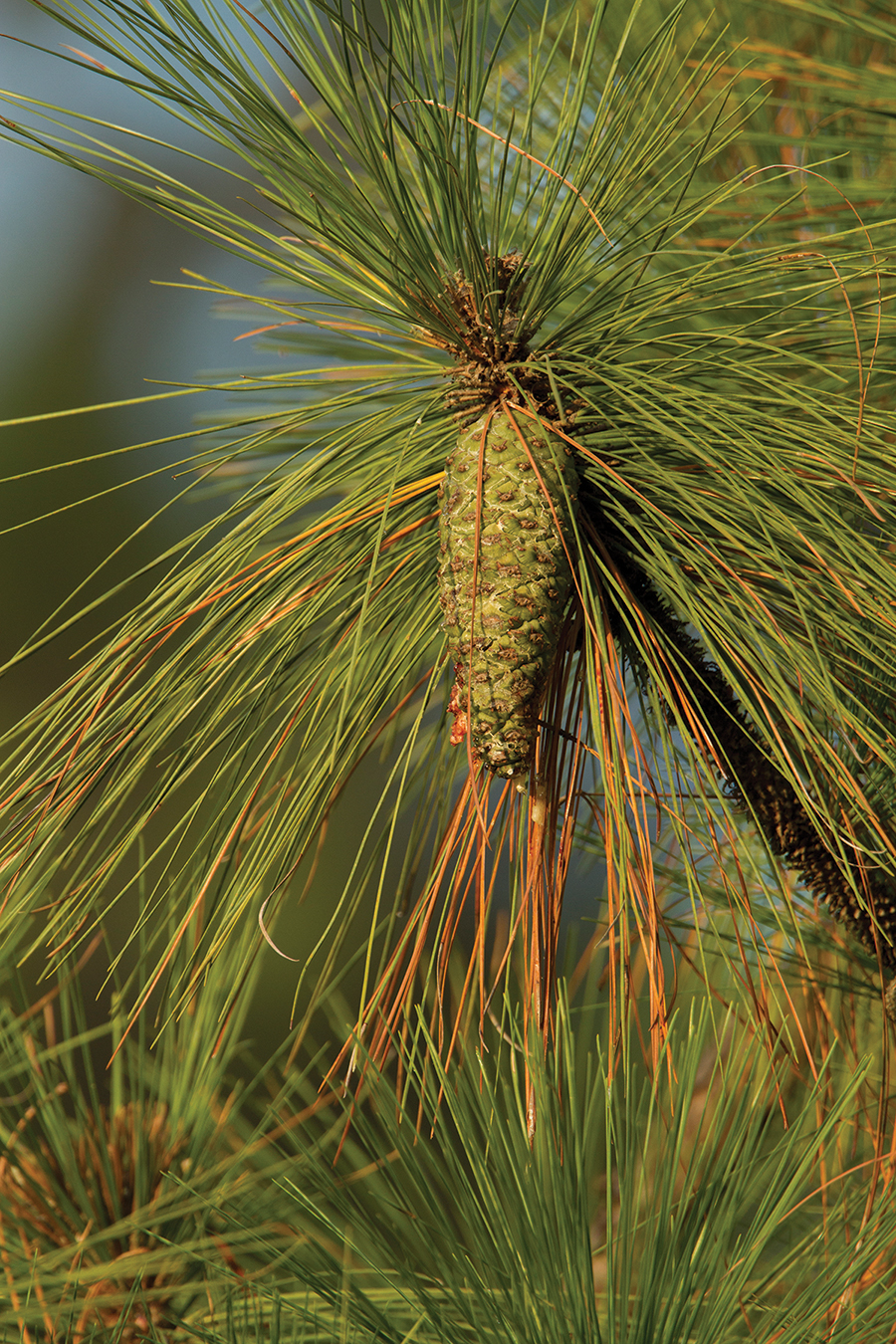
Traveling out through longleaf from Raleigh in 1853, a correspondent for The New York Times described “a soft winter’s day, when the evergreens filled the air with a balsamic odor, and the green light came quivering through them, and the foot fell silently upon the elastic carpet that had spread, deluding one with all the feelings of Spring.”

As John Patrick and James Walker Tufts arrived at the tail end of the 19th century in what became Southern Pines and Pinehurst, amid the detritus of a landscape savaged for timber and turpentine, it was the lung-clearing, life-affirming air among the remaining longleaf that gave the founders a reason to settle. On the early laps of the 21st century, as hastening development intrudes even on second-growth Sandhills longleaf, claiming them for shopping centers and tract homes, their scent and sight become something to savor ever more. Even what you hear, standing among longleaf “through which the wind roves with a sound no poet can capture,” as Hamlet native Tom Wicker wrote in 1975.

Given that only 4.7 million acres of longleaf pine forests stand today, 5 percent of its original geographic range — which was roughly the size of California — it would at first glance seem there isn’t much to cheer about. But things have gotten better since 1995 when a Journal of Forestry article titled “Requiem or Renaissance?” noted losses had reduced remaining longleaf forests to fewer than 3 million acres, a far more dramatic shrinkage than that suffered by the Amazon rainforest.

“It is progress, especially since we stopped the decline of the system itself,” says Dan Ryan of The Nature Conservancy, a longleaf specialist based in North Carolina. “It was on a horrific trajectory for a couple of hundred years. The fact that it’s actually increasing is phenomenal. But the ability to increase acreage is extremely resource-intensive because essentially there has to be protection over the land, and the habitat of the land needs to be managed for the longleaf pine. A lot of money is involved in turning that number around.”

When conservationists talk about restoring Pinus palustris, they are referring to much more than saving a small stand of the Sandhills’ signature tree, say, in the median of Midland Road — not that they wouldn’t want to do that, too. Naturalist John Muir wrote of his 1868 journey through the Southern piney woods that he “sauntered in delightful freedom.”

Muir’s experience was possible because of the essential character of a longleaf ecosystem, in which mature trees 70 to 120 feet tall (height primarily depends on the quality of the soil) tend to be void of low-hanging branches. The open canopy allows sunlight to reach the sandy forest floor, which in its natural state, thanks to periodic fire, is alive with grasses, wildflowers and wildlife.

“I like to tell people it’s the opposite of the rainforest,” says Nancy Williamson, park ranger at Weymouth Woods Sandhills Nature Preserve. “In the rainforest, it’s so dark on the forest floor there isn’t a lot of diversity on the floor. It’s the different kinds of trees and the things that are going on in them. With longleaf, the diversity is in the open understory.” Abernathy adds, “If you have the right plants, you have the animals, a whole suite of species.”

With the red-cockaded woodpecker — an endangered species that uses the trunk of a living longleaf for a nesting habitat — at home high above, the unique understory can be a haven for a host of other birds and mammals (approximately 30 species of each, including quail and fox squirrels) characteristic to a longleaf ecosystem. Beyond the birds and mammals is a diverse population, particularly in the Sandhills, of reptiles and amphibians. Abernathy cites as one of his favorites the legless glass lizard, which evades predators by dropping off part of its tail. “All these really cool animals most people don’t know about live in the longleaf ecosystem,” Abernathy says.
The many plants include wire grass, morning glory, blackberry, pawpaw, low-bush blueberry, orange-fringed orchids, dwarf iris, golden aster and bird’s foot violet. Writing in 1791, Bartram described “a forest of the great long-leaved pine, the earth covered with grass, interspersed with an infinite variety of herbaceous plants . . . ”

Generations of Americans grew up hearing from Smokey Bear about the dangers of forest fires. But well before the popular mascot was created in 1944, longleaf environments — and the living creatures and vegetation within that depend on fire to survive — were victims of this philosophy as surely as they were of the ax and the turpentine box.

“A lot of the fear of burning came out of the Northeast, where there were primarily hardwoods, which have a thinner bark than pines do,” Abernathy says. “They came and saw Southerners burning their trees and said, ‘Are you crazy?’”

As Helen G. Huttenhauer details in the history of her hometown, Young Southern Pines, James Boyd’s longleaf-rich property suffered a terrible fire after being misguided by federal forest officials to clear thin strips on his land for fire defense rather than regularly singeing the forest with prescribed burns that locals knew to be the correct approach. “Woods are going to burn,” Wimberley says. “Either we burn them or they are going to burn on their own.”

In the spring of 1909 a spark from a passing locomotive started a small brush fire that moved up Vermont Avenue to Weymouth. “The wind rose and carried sparks and the sparks fell on wire grass and started new fires,” Huttenhauer writes. “The firefighters stood transfixed. Suddenly, a vast wave of flame surged high over the tree tops and, borne by the wind, in seconds outdistanced the ground fire . . . A goodly portion of Boyd timberland lay in smoking ruins.”

Another scary fire started in Pinebluff in the spring of 1963, destroying homes and 3,000 acres as it moved toward Pinehurst, its flames traveling through the forest canopy and spreading 10 miles in less than four hours, according to an Associated Press report.

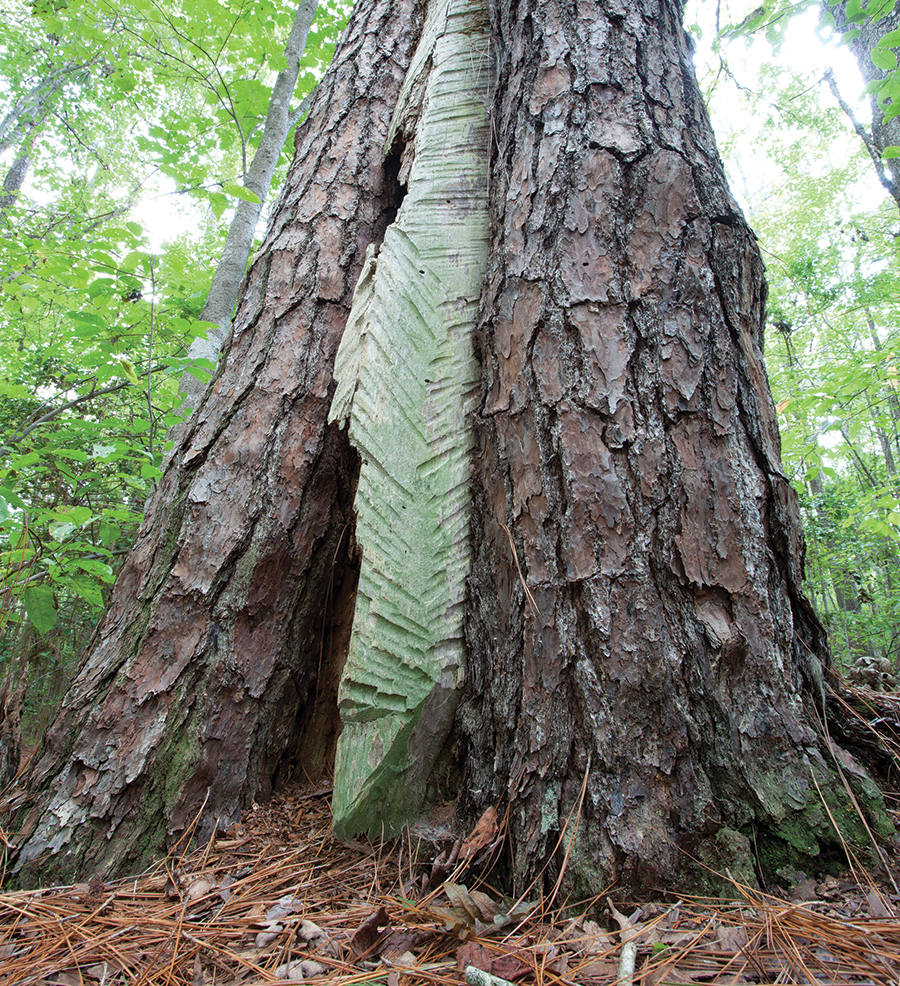
Longleaf withstands routine fires well, one of the reasons it came to dominate the Southeastern landscape, primarily because of its thick and tough bark described by author Bill Finch in Longleaf, Far as the Eye Can See “as layered as a Greek pastry.” Lawrence S. Earley, whose 2004 book Looking for Longleaf: The Fall and Rise of an American Forest provides a definitive look at the tree’s past and present, noted its formidable barrier.

“As a fire licks the bark of a tree, the temperature on the surface can rise to 1,600 degrees Fahrenheit,” Earley writes. “At a temperature of 140 degrees Fahrenheit, the cambium of a tree is killed. Thus bark can be considered the Maginot Line of a tree’s fire defenses.”

Combined with an unusually strong taproot, longleaf’s fire resistance contributes to its longevity. Although far from being the longest-living tree — a Great Basin bristlecone pine in the White Mountains of California is 5,066 years old, and giant sequoia have been verified at a few thousand years old — a longleaf’s lifespan can exceed more than 500 years. That’s about twice as long, for example, as live oak, pecan or American elm.

The oldest recorded living longleaf, situated off Den Road on the Boyd tract in Weymouth Woods, dates to 1548, its age determined a decade ago by a UNC Greensboro graduate student, Jason Ortegren, and his geography professor, Paul Knapp, who cored it for a historical climate study. That makes it 469 years old, having come to life 59 years before the founding of Jamestown, 228 years before the Declaration of Independence, 317 years before the end of the Civil War and 431 years before the state park acquired the 105-acre Boyd tract populated by old-growth longleaf James Boyd saved from the jaws of commerce when he bought his estate. The ancient pine is approximately 75 feet tall and 2 feet in diameter, its bark bulging in places like the arthritic knuckles of a senior citizen.

“The Boyd tract was never timbered and is mostly old-growth,” Williamson says. “A lot of the trees there are probably 400 years old. There could be older trees — we definitely have ones that are larger than the one that was measured. It may be even be a little bit older than 469 because when longleaf start out they’re in a grass stage for a couple of years. Whatever its exact age, every time we get a storm, we get nervous. Hurricane Matthew last fall made us hold our breath a little bit.”

Most of the longleaf that emerged in the 16th century were harvested long ago. The species was used for naval stores, goods for building and maintaining ships, from wood to various products made from the sap. Turpentine distillation accelerated prior to 1840, and later in the 19th century the advent of railroad lines and steam-powered sawmills led to the decimation of much of the virgin longleaf forest over a 50-year period following the Civil War. By 1955 only about one-eighth of the original longleaf forest was left. With longleaf being abandoned for faster-growing loblolly pine by many logging concerns — loblolly yields saw timber in 40 to 50 years versus 50 to 70 for longleaf — the longleaf acreage had decreased to about 4 million in 1985.

There was no secret why mature longleaf — dense, strong and pest-resistant because of its high resin content and slow growth — was so desirable. “It’s impervious to just about anything,” says Bennett Rose, a retired forester in Southern Pines. “A termite would break his beak trying to get through that stuff.”

Before techniques were invented to propel the modern steel industry in the second half of the 19th century, longleaf was the most valuable construction material. “Everybody in the wood business says the longleaf pine was the best wood the Lord ever made,” antique pine dealer Pat Fontenot told The New York Times in 2015. “If it wouldn’t have been for the longleaf pine tree, we wouldn’t have been able to do the Industrial Revolution.”

Much of the old-growth longleaf, centuries old, went north, for buildings and bridges (including underwater support for the base of the Brooklyn Bridge, built in 1883). Reclaimed longleaf has become a hot business in recent years as architects seek to use it for a vintage look. Bill Gingerich, owner of Timber Services, Inc., in Carthage, specializes in longleaf lumber and flooring. He buys old buildings and salvages the wood and also cuts down trees on private land that have to come out for construction.

Not long ago Gingerich bought big longleaf timbers that came from a building in rural North Carolina and was amazed when he studied the wood, suspecting it could 600 years old. “The growth rings on some of the beams are like pieces of paper,” he says. “It’s crazy old.”

But the longleaf that he cuts down doesn’t have to be quite that old. “We’ve learned that in order for longleaf to have good heart, which is what we make our flooring out of, it needs to be at least 80 years old,” Gingerich says. “We’re still finding those type trees and even older ones. We’ve seen some that were 150, 160 years old. Heart pine that old makes a beautiful floor. But an 80-year-old tree can be just as beautiful as an old-growth one.”

Longleaf advocates, who have an ambitious goal of increasing the longleaf environment to 8 million acres by 2025, spend their time educating and arm-twisting as they try to increase longleaf’s presence on private property. “We’ve done a good job restoring it on public lands,” Wimberley says. “Now the effort is on restoring it on private lands. Sixty percent of the potential longleaf restoration is on private land.” That potential could have economic as well as environmental effects.

“Rural eastern North Carolina has been devastated by the loss of tobacco and manufacturing,” Wimberley says. “It’s heartbreaking to see how hollowed out some of these towns are. We believe longleaf could be a game-changer that helps a landowner retain his land and see a profit from growing longleaf.”

It can be a tough sell, given the slower growth of longleaf compared to loblolly and the longer time frame before timber can be harvested. The distinctive, long needles and their landscaping popularity has turned pine straw into a financial winner, with property owners getting $100 to $200 an acre annually once trees start yielding straw at about a dozen years old. Yet that proposition is not without environmental trade-offs.

“Straw can be a lucrative thing in a place like the Sandhills,” says Ryan Bollinger, who works in Southern Pines for the Longleaf Alliance. “But if you rake really hard, you’re essentially doing commercial timber with longleaf pines, you’re basically creating an ecological desert under your longleaf when there is no understory. When you rake too hard for a number of years, then there is no food for the critters, and the rare plants and things get pushed out.”

Bollinger likes to preach “rake, rest, burn” to landowners, urging them not to rake every year. Or, if someone has a large property, a portion of it can be used for pine straw and the rest left undisturbed other than for prescribed burns.

“Landowners who are growing longleaf aren’t trying to make the most money possible on their property,” Abernathy says. “They want an income. But they want to ride their horses through that property. They want to hunt quail and deer. They want the look.”

They want a version of what a “magnificent grove of stately pines” brought to William Bartram more than two centuries ago, “a pleasing effect, rousing the faculties of the mind, awakening the imagination by its sublimity, and arresting every active inquisitive idea, by the variety of the scenery and the solemn symphony of the steady Western breezes, playing incessantly, rising and falling through the thick and wavy foliage.”  PS

Longleaf Pine Celebrations

The Party for the Pine, an annual celebration for the oldest longleaf pine, will take place on Earth Day, April 22, from 10 a.m. to 3 p.m. Festivities begin in the meadow behind the Weymouth Center, 555 E. Connecticut Avenue, Southern Pines. It’s sponsored by Weymouth Woods-Sandhills Nature Preserve, Sandhills Area Land Trust, the Arts Council of Moore County, the Sunrise Theater and is funded in part by the Renewable Resources Extension Act. Haw River-based singer-songwriter and guitarist Bill West will kick off the music, followed by Cousin Amy Deluxe Old Time String Band taking the stage at 11 a.m. Band members Amy McDonald, David McDonald, Steven Hedgpeth, Rob Shanana and Allen Ashdown transport the audience back in time with their Appalachian fiddle dance music. Abigail Dowd will be joined by Michael Gaffney and Jason Duff at 1:30 p.m. Gaffney, who grew up in the Sandhills, was a fixture in the Asheville music scene for over 35 years. There will also be a guided hike to the oldest tree, a falconry presentation by Hawk Manor Falconry, a birthday celebration and a live prescribed burn.

The movie Siren of the Round Timber Tract, by Brady Beck and Ray Owen, will debut at 5:30 p.m. at the Sunrise Theater, 250 NW Broad Street, Southern Pines. Admission is free and doors open at 5 p.m. The film is a dramatic work telling the story of the Round Timber tract, the most ancient part of Weymouth Woods Preserve. The saving of this section of forest effectively launched longleaf pine conservation throughout the Southeast. The film will be preceded by guest speaker Janisse Ray, writer, activist and naturalist who has authored six books, including her memoir, Ecology of a Cracker Childhood. She was a 2015 inductee into the Georgia Writers Hall of Fame. 

A Star Party, the fifth annual event and part of the N.C. Science Festival, takes place the evening of April 22. Bring blankets and lawn chairs and meet at the parking lot of the Weymouth Center at 555 E. Connecticut Ave. Activities, prepared by the statewide organizer, typically include stargazing, locating common constellations, a small telescope for viewing planets or the moon and kid-friendly crafts.  PS

A Natural Petition

When cats go to Heaven

they rearrange the order.

First, who made God, God?

Who decided angels didn’t

need fur, tails and whiskers?

Consider tail as a talking point.

Consider tail as a tour guide.

Consider tail conversational mapping.

But whiskers — ah, they let you

nuzzle a nuzzle. Soft, sexy.

Whiskers are out there

antennae catching vibes.

Whiskers are words

translated into touch.

Fur. . . the grandest of all.

One is always dressed for any

occasion.  Every occasion.

Tuxedo, calico, Bengal, leopard,

Persian. Fur is what the world

would wear if it could.

— Ruth Moose

Harbinger of Spring

The blue-gray gnatcatcher heralds the seasonal migration in Central N.C.

By Susan Campbell

It won’t be much longer . . . the wheezy calls from blue-gray gnatcatchers will soon be echoing from the treetops, signaling the beginning of spring migration here in central North Carolina. But these tiny gray-and-white birds are not going to find you. You are going to have to find them. As they flit around searching for small insects, they tend not to stay in one spot long enough for a good look. But with patience and a sharp eye, a determined birder will spot the bird’s characteristic dainty bill, white eye ring and long black tail with white edges.

Some of these passing gnatcatchers will stay put and raise a family, or two, here in the coming months. The species is known to breed across most of the Eastern United States at lower elevations. Within the gnatcatcher family this is the only species that is truly migratory, although individuals that we encounter have not likely traveled northward very far. Wintering grounds may be as close as Florida though some gnatcatchers may wing their way back from as far away as Cuba or the Bahamas.

Despite their name, gnats do not form a more significant part of the bird’s diet. Foraging for any invertebrates they can find, a gnatcatcher will sometime capture insects and spiders that are too large to swallow. But this ingenious bird divvies its prey into smaller portions by banging the insects on a branch to dispatch them and then pulling their appendages off until they are small enough to swallow. Its secret weapon to uncover insects? A long tail that it will flick from side to side to disturb the vegetation and cause potential prey to fly into visual range.

The species is sometimes referred to as “Little Mockingbirds,” not so much for their plumage but for their tendency to incorporate elements and snippets of other birds’ songs into their own.  Short songs involve wheezy “spee” notes. But longer songs, meant to better advertise territory in the spring, involve a variety of sounds: chips, whistles and mewing notes that are typically very high-pitched. When they cannot get their point across, males will chase one another, sometime ranging abroad as far as 70 feet or more. If things get particularly fierce, the competitors may even rise up, chest to chest, high in the air, with snapping bills in what looks like an odd game of “chicken.”

Here in the Piedmont and Sandhills, blue-gray gnatcatchers can be found in any forested area where there is a significant understory. This is a species that thrives on woody vegetation and an insect-rich environment. Nests tend to be high up in hardwoods and are constructed with fine grasses and a variety of soft materials. Furthermore, they always include an exterior layer of mosses or lichens that camouflage the small cup-like nests from predators. As with the only slightly smaller ruby-throated hummingbird, nests need to be almost invisible. Adult blue-gray gnatcatchers have no other effective means of defending the next generation than the ingenious use of camouflage. As it is, eggs and young are often located by small mammals, as well as climbing snakes and other birds. But the parents will readily build a new nest, even incorporating old nesting material to speed up the process, several times in a season, if need be.

So if you keep an eye as well as an ear out towards the end of the month, you may spot one of these spirited and industrious little birds. Tiny blue-gray gnatcatchers are certainly one of the most overlooked members of our summer bird fauna. However, I guarantee they will be out and about if you take the time to notice in the weeks ahead.  PS

Susan would love to receive your wildlife sightings and photos at susan@ncaves.com.

Martins Redux

Catching up with a brother act

By Lee Pace

The sports world is chock-full of successful sibling stories. From coaching you have Jim and John Harbaugh, and Rob and Rex Ryan. From quarterbacking, exhibit A is certainly Peyton and Eli Manning. The tennis world features sisters Venus and Serena Williams, and brothers Bob and Mike Bryan. The Busch boys (Kyle and Kurt) have won often on NASCAR tracks, and you cannot get close to center ice without stumbling on a Stahl (Eric, Marc, Jordan, Jared).

Golf from way back had Lloyd and Ray Mangrum combining for 41 PGA Tour wins, from a generation ago Lanny and Bobby Wadkins emerging out of Richmond, and today Francesco and Edoardo Molinari are forces on the European Tour.

So what to make of Zachary and Joshua Martin, the dynamic brotherly golf duo from Pinehurst now plying their trade at the University of North Carolina?

“It’s an interesting sibling dynamic,” says Pinehurst teaching pro Kelly Mitchum, who gave both brothers lessons during their high school days. “They’ve competed against each other, but I’ve never sensed anything but them truly rooting for each other. They always wanted each other to do well.”

“It’s like they’re each other’s biggest cheerleader,” adds UNC coach Andrew Sapp, who brought Zach into the Tar Heel program in 2013 and Josh in 2015. “I really haven’t seen a sibling rivalry between the two. I was out of town with Josh once at a tournament and we heard that Zach had lit it up in a qualifying round back home. Josh was genuinely excited to hear his brother shot a good score.”

The Martin brothers have acquired over their dozen years in Pinehurst quite the golfing pedigree. The family was profiled in the Wall Street Journal in 2008 for its adventuresome move from Wilson in Eastern North Carolina to Pinehurst so that the boys could have access to the village’s largesse — courses, instructors and a 24-7 golf ambience. Bowie and Julie Martin gave their boys opportunities in all manner of sports as youngsters, but in time they gravitated toward golf. Bowie’s job as owner and president of a family business involved in manufacturing and distributing premium table tennis equipment worldwide gave him the freedom to relocate. At the time, Zach was 10 and Josh 8.

“I was too young to know how crazy it was with our parents having a business in Wilson,” Josh says. “But it worked out well for everyone.”

“I can better appreciate the history of Pinehurst as I’ve gotten older,” Zach says. “When we first moved, all I saw was a bunch of golf courses. Then you understand more about the North and South Open, the PGA Championship back in the 1930s, you definitely get a better appreciation. I think being in Pinehurst has definitely helped both of us develop as golfers.”

Zach first caught the attention of Sapp while shooting a 66 at Mid Pines in a junior tournament in 2012. “He made everything he looked at,” Sapp remembers. “He’d bang it, go find it and drain another birdie.” Zach’s birdie putt in a playoff on the 17th hole at Pinehurst No. 8 secured the state championship for Pinecrest High in 2013.

Josh won a pair of Donald Ross Memorial titles and four U.S. Kids World Championships, held each August in the Sandhills, and in 2014 at the age of 17 became the youngest winner ever of the North Carolina Amateur Championship.

And they evolved with a single-minded focus that’s an oddity today with so many social media and youth league sports distractions.

“They never canceled a lesson, never were late for a lesson,” Mitchum remembers. “No matter the weather, they were on time and ready to work.”

Josh’s ability in particular earned him somewhat legendary status around the resort and community — originally the family rented a house on Pinehurst No. 3 and several years later moved to Pinewild Country Club. Enter a Google search for Josh Martin and you’ll find one subjective yet interesting blog listing him among the top 10 child golf prodigies of all time (along with Tiger Woods and Michelle Wie), and included is one unsourced account of a golfer at Pinehurst allowing this 7-year-old kid with ketchup on his shirt to join him on No. 4 and Josh shooting a 78. The grown-up asked the kid for an autograph after the round was over.

“We joined up with older people all the time,” Zach says. “At first, they were a little hesitant because we were so young. No one wants to be held up by little kids who are just learning. But once they saw we could play, they enjoyed it. We had a good time playing with other people and made some friends over the years.”

Sapp says he often runs into golfers and families from around the country and as far removed as China who knew of Josh’s dominance in the U.S. Kids World Championship and Rich Wainwright, an executive at Pinehurst and assistant golf coach at Pinecrest High, whistles looking at Josh’s prep era that included him, Eric Bae (now on the golf team at Wake Forest), Doc Redman (Clemson) and Henry Shimp (Stanford) and says, “That’s U.S. Open material there.”

Zach has caddied for Josh twice in the U.S. Amateur, and this spring both are competing for regular playing spots on a Tar Heel lineup that is likely the deepest and most experienced it’s been in many years. Zach is 22 and a senior, Josh 20 and a sophomore.

Bowie Martin says one of the elements of golf that he and Julie as parents favored in their children’s evolution was the emotional control and manners one had to learn to succeed in the sport. More than a decade into it, that’s proven prophetic.

“Etiquette, patience, self-policing are parts of golf,” Bowie says. “You don’t have officials on top of you. In golf, you monitor yourself. That’s the neat thing about it. If you hit a bad shot, you might have five minutes before you can get it back. Patience is huge, staying even-keeled over a longer period of time.”

To put the Martins’ games in nutshells, Zach plays a power game, Josh a precision game. Zach hits the ball “forever,” as Sapp says, and can overpower a course. He shot the course record at UNC Finley, a 1999 Tom Fazio design that can stretch to 7,220 yards, with a 63 last fall, then broke it two weeks later with a 62.

“Off the tee, he’s probably the longest guy on the team,” Josh says. “When he gets it going, he can go really low. He makes a bunch of birdies and can beat anybody.”

Zach might bomb his drive over bunkers on a par-5, while Josh, by no means short, is playing a more tactical game with carefully aimed hybrids off certain tees. Josh has a legendary short game.

“He knows how to get the ball in the hole,” Zach says, slowing down and enunciating in the hole with extra bite. “I can’t emphasize that enough. He knows damage control.”

“Josh doesn’t miss fairways, doesn’t miss greens, and makes a few birdies along the way,” Sapp adds. “When both are on, they have tremendous potential in college golf.”

I first met the Martins in the spring of 2009 when I wrote their story for the May 2009 PineStraw. Their swings were being videotaped by Eric Alpenfels, also a Pinehurst instructor and colleague of Mitchum’s, at the base of the Maniac Hill practice facility. The building blocks were apparent then — skill level, love of the game, focus, parental support.

“The boys would like to play college golf,” their dad said at the time. “After that, who knows? Golf offers a lot of opportunities to play as part of your business. You can be a teaching pro. You can try the pro tour, but that’s a tough life. That’s not the goal. The goal is the challenge of trying to accomplish something, to master a skill and get better.”

Nearly a decade later, so far, so good. Both are good students at Carolina, Zach studying economics and Josh sports administration, but both want to play pro golf. If that doesn’t work, something in the golf industry would be fine — teaching, perhaps. And the boys have grown as siblings and friends and with no apparent rivalry gumming up the works. The elder Zach even says his younger sibling’s glitzy record flips the traditional big brother/little brother dynamic.

“His accomplishments so far outweigh mine, so I look up to him and feel like he’s mentoring me every time I play with him,” Zach says.

“We’re competitive, but at the end of the day, we put down the clubs and are great friends,” Josh says.

Stay tuned for the spring of 2017 in Chapel Hill and then beyond for Zach and Josh Martin. There’s plenty of room in the winner’s circle that houses the Mannings and Mangrums — basically everybody and their brother.  PS

Chapel Hill-based writer Lee Pace has written “Golftown Journal” since the summer of 2008.

Bar Wash

The art of infusing a cocktail lineup

By Tony Cross

Working in the restaurant business can be brutal, demanding and taxing on the body. However, it’s also fun, crazy and rewarding. One aspect that I always embraced is when someone new joined the kitchen staff. It was interesting to learn new methods that he or she would bring to the table. Sharing was a big part of my job, and it never got old being on the receiving end of the exchange. Five years ago, I began a working relationship, which immediately turned into a friendship, with a new chef who had moved down from Chapel Hill named Randy. This is around the time that I started to get my hands dirty with bartending. One afternoon, Randy asked me if I heard about infusing bacon into bourbon. “Um, what?” I replied. I had no clue what he was talking about.

Randy quickly broke it down for me: Just take the fat from cooked bacon, add it to a bottle of bourbon, seal up the container, and put it in the freezer. When the fat separates, strain the bourbon out, and voilà! He recommended me putting a spin on an old-fashioned cocktail with maple syrup. So, I did. I had the drink ready as a special by the weekend, and it was a hit. For my Bourbon Kush, I used Maker’s Mark bourbon, Grade B maple syrup for the sugar (that’s the first one I could get my hands on at Nature’s Own), Angostura Bitters, and an orange peel for the oils and garnish. It was delicious!

What I didn’t realize until a few months later was that I had totally ripped off the bartender who created the “Benton’s Old-Fashioned,” Don Lee, from prized New York City bar PDT (Please Don’t Tell). Looking back, I think Randy had the drink at a local restaurant in Chapel Hill and thought it was something I could run with. Another thing I didn’t grasp was the science that goes behind what is now known as washing. It’s another way to infuse flavors into your booze. You can fat-wash (bacon fat, olive oil, sesame oil and butter), milk-wash and egg-wash, to name a few styles.

I didn’t mess around with any kind of “washing” until a few years later when I received the book Liquid Intelligence from famed bartender/wizard extraordinaire Dave Arnold. In Intelligence (which reads like a science textbook, by the way) Arnold covers these different washing methods. The first style that caught my eye was milk-washing. Milk-washing is an ideal infusion when you’re trying to cut out the astringency from an infusion used in a shaken cocktail. For me, this chapter couldn’t have come at a better time — I was looking to combine an Earl Grey tea infusion with a homemade marmalade that I was working on. Arnold’s directions for milk-washing were simple enough. I took eight of the best organic Earl Grey teabags that I had available, steeping them into a bottle of vodka for an hour, letting the infusion get very dark. Next, I took 250 ml of whole milk and poured it into a large mixing container, then adding the infused vodka to the milk (very slowly) while stirring. It curdled right away, just like the directions stated. After letting the milk and tea-infused vodka sit for a couple of hours, I slowly stirred a half-ounce of fresh lemon juice into the mix. The acidity of the juice allowed the milk to break away from the vodka. The remaining steps told me to gently scoop out the large curds and let the vodka sit another few hours before fine-straining the cloudy infusion. Simple enough. The result was a silky and tasty infusion. The vodka had all the flavor of the tea, without the bitterness from the bergamot. The Jean Grey soon found its way to my spring cocktail lineup.

An easier way to wash is with olive oil. I was recently invited to a pop-up dinner where the theme would be early 1900s France. I decided I wanted to do a spin on a martini, and since I’m not full-time behind a bar these days, I love trying out new things whenever I get a chance. I took a bottle of Plymouth gin and added that to a container with 4 ounces of organic, cold extracted olive oil. Just a quick, hard shake (10 seconds will do), leaving it to sit for a couple of hours. Place upside down in the freezer, allowing the oil to harden (it won’t completely freeze) before filtering out the infused gin. You want to place the container upside down, so the oil will be almost frozen on the bottom of the container when you strain the gin out. Doing this gave my gin an oily texture without the briny flavor that is associated with olive juice. It also added depth to my cocktail. Check out the recipe below.

Though I am no pro when it comes to washing spirits, like most everything else involving bartending, use quality ingredients. Don’t wash your spirit with anything that you wouldn’t eat or cook with. If it doesn’t taste good to you, it probably won’t taste good in your final product.

Lave et Humide

1 1/2 ounces olive oil-washed Plymouth Gin

1 1/2 ounces Dolin de Chambéry Vermouth

4 dashes Crude “Sycophant” Bitters

Combine ingredients in a mixing vessel, add plenty of ice and stir until liquid is ice cold. Strain into a chilled coupe glass. Add a lemon peel to the drink after expressing its oils over the martini.  PS

Tony Cross is a bartender who runs cocktail catering company Reverie Cocktails in Southern pines. He can also recommend a vitamin supplement for the morning after at Nature’s Own.

Mimi’s Dress

A wedding to remember, a grandmother no one will ever forget

By Anna Kraus

Through it all there was Mimi.

I got married a year ago this month. It was a destination wedding of sorts, held in Seaside, a quaint beach town located along the panhandle of Florida. Our small home there has been the site of family gatherings and vacations for as long as I can remember. As an Army brat it is the closest thing to a hometown that my family and I have. It is a special place.

Friends and family gathered for the weekend to celebrate my husband-to-be and me, and the weekend was kicked off with a rehearsal dinner that everyone was invited to. Everyone was invited because everyone, including friends, was family. A local restaurant paid homage to my husband’s family with paella cooked on an open flame, wine glasses filled with Spanish wine and Champagne bottles popping. Love was shared, toasts were made, and new acquaintances became old friends.

I got ready for the ceremony at my parents’ beach house, a bubble gum pink house that barely holds five people that was overrun with bridesmaids’ dresses, makeup, our two golden retrievers, Max and Molly, and camera equipment. It was frantic and cramped and hectic and it was perfect, made more so by being able to wear my Mimi’s wedding gown. My mother helped me dress, buttoning a thousand buttons and then (not so gently) throwing her veil on my head. Photographers whirled around us and puppies stepped on hemlines.

The dress itself is not really my style; I would not have picked it. It is a ball gown with yards of tulle and lace and stitching. I would have chosen something more modern with fewer frills. But wearing a gown that multiple generations of my family — my Mimi, my aunt and my mom — had worn made the moment I walked down the aisle that much more special.   

The wedding was held in a beautiful, small chapel in town. It holds 100 people, the exterior is white wash, and the interior is stained cedar with enormous windows that take up all the wall space, filling the one-room chapel with sun. Almost every pew was full. After the ceremony pictures were taken and I was whisked back to the house to change into something easier to wear. At the reception I showed off a dress more my style, a short white dress better suited for dancing until all hours of the night.

And there was dancing and singing, eating and drinking and festivity. Lights were strung across an outdoor square. Farm tables were decorated with blush garden roses and greenery. Candles twinkled and provided light as the sun set and everyone at the wedding celebrated my husband and me.

Through it all there was Mimi. At the rehearsal dinner she charmed and captivated. She adopted an old friend as “an honorary Barnes girl” and embraced new family as if they had been part of every family gathering for as long as she could remember. She conversed and cajoled as only Mimi could. She posed for pictures, encircled by her family, new and old. Mimi loved it.

At the wedding Mimi sat in the front row, delighting over being with all her family and honored by the fact that her eldest granddaughter was wearing her wedding dress. As I danced with family and friends at the reception, Mimi was right where she loved being, surrounded by family, in the center of things, holding court under a gas lamp for warmth. Mimi loved it.

Mimi passed away in October. It was a blow to our family, driving home the point that the extended family had lost the heart that kept us all truly connected. But it was also a chance to gather, and to gather is good. To gather together is a means to support and love and embrace each other. She brought us all together as only Mimi could. But Mimi’s absence was felt. She should have been holding court, staying up just as late as the rest of us as we all swirled around her. Sipping a glass of wine and staying right in the thick of things as we told stories and made memories. And Mimi would have loved it.  PS

Anna Kraus is Cos Barnes’ granddaughter. She lives in Alexandria, Virginia, with her husband, Andrew.