Sporting Life

Beach Music

Grand memories buried in the sand

By Tom Bryant

When the July sun is almost directly overhead and the dogs are digging in the shrubbery looking for some cool and the humidity is thick enough to cut with a kitchen knife and the air conditioner is working overtime, relief is two words away . . . THE BEACH!

We always called it that, simply the beach. Other people from around the country refer to it in different ways. Some folks call it the shore or the coast; but down South, it is always known as the beach. And in South Carolina, the beach means Ocean Drive or Cherry Grove or Windy Hill or Crescent or Myrtle or Pawleys or Litchfield, but always it’s the beach.

The tradition of going to the beach began early in our family. My grandfather, a tobacco farmer in the low country, would load my grandmother and all eight kids, along with Shep, a farm hand and cook when needed, in one of his 2 1/2-ton farm trucks and tote them to the beach. The old farm vehicle would be loaded with a crate of live chickens, dozens of eggs, country ham, watermelons, cantaloupes and bushel baskets of Grandma’s garden vegetables. Enough food to feed an army, and with eight hungry kids, it almost was.

There they would remain for a month, glowing brown from the summer sun and almost growing gills, they were in the water so much. Mom often said that the good Lord looked after them because they survived swimming out so far in the ocean that the beach house back on land looked like a miniature reproduction, and in those days lifeguards were nonexistent.

My grandfather disliked the beach and thought it was a serious waste of energy. He often said the family could spend their time more wisely working in the crops that were in full summer bloom. Jokingly, he would threaten to cancel the coastal expedition; but secretly, he really did enjoy the fishing and laid-back times spent in the porch swing. He would carry the family and the cook to the beach and drop them off, and then he would return on weekends or when the farm crops would let him.

There is an old family story about him and the beach, and if it’s true, what a story. It seems that a land salesman from Myrtle Beach made an appointment to see Granddad on the farm right before the family’s summer outing. Grandma always rented the same beach house, a big rambling two-story affair right on the oceanfront. The old house, made of heart pine, had been there for years and had survived storms and hurricanes and seemed to grow stronger every summer. Mom remembers that the ancient beach house had two screened porches, one on each floor, and was the only house for several miles.

The beach salesman showed up at the farm early one evening just as Granddad was coming in from the fields. Granddad, who was a big landowner, didn’t suffer fools lightly; and unfortunately, sales people, according to him, fit that category. However, he begrudgingly agreed to listen to the gentleman’s spiel.

The story goes that Granddad sat in the big front porch swing and the real-estate expert sat opposite in a rocker. The salesman opened his briefcase, drew out maps and charts of the beach and the house where the family always spent summer vacations. Now Granddad was a gentleman. He was tired from his day in the fields, but he let the salesman go through his material, pointing out the maps and extolling the potential of the beach house and surrounding area. He said that the whole plot was for sale at a depressed price because the banks were going to foreclose. The original owner had passed away, and the heirs didn’t want to keep the place and would let it go at the tax value, which in those days was next to nothing.

Granddad listened politely, and Grandma went inside to the kitchen to get some iced tea. When she came back, Granddad stood up, walked over to the wide steps of the porch and said, “Come here, mister, I want to show you something.” He pointed to the cotton field across the road.

“See that? That’s 200 acres of the finest cotton I’ve ever grown. And look over there.”

He pointed to the field across the fence adjacent to the ancient plantation house. “That’s about a hundred acres, give or take an acre or two, of good corn, excellent corn if we get rain at the right time. Behind the house and over toward Black Creek is some of the prettiest tobacco I’ve ever raised. And last week, I closed the deal on land down toward the creek that has some outstanding second-growth timber. So, mister, you can see I’m pretty well occupied, and like everybody else in this country, I’m waiting out this blame Depression with my fingers crossed.”

They both sat back down and my grandfather continued, “I appreciate your effort and sorry you drove here from the beach, but I’ve looked at your maps and prices, and the family dearly loves visiting the old house and our summers there, but my major problem with what you’re offering,” and here he paused for effect, “I don’t know of a thing I can grow in all that sand.”

The story continued that the salesman was invited for supper and did stay and enjoyed my grandmother’s good cooking and the restful time on the porch afterward. He later left for home and the beach, and I don’t think he made any more overtures to Granddad to buy beach property. The beach outings went on for a few more years until the children got older and times changed.

Years later, my dad and mother continued the tradition, and our family spent time every summer at the beach. After Linda and I were married, we joined them, and my sisters and brother and their children did the same. We would all gather at Ocean Drive, Garden City, Pawleys Island or Litchfield, and we did this until the families got so large that one house couldn’t handle us and we had to rent two. Finally, the logistics and other distractions interfered, and our summer family gathering fell by the wayside.

Linda and I and sometimes our son, Tommy, still make summer excursions to the beach with our little Airstream trailer. We camp at Huntington Beach State Park, famous for its 3 miles of pristine oceanfront. The park and surrounding area remind me a lot of the descriptions my mother remembers of the early outings with Granddad and the family. We love it there and try to go as often as we can.

The other evening I was looking at some old photos of the family when everyone gathered and had fun at the beach. They were grand times, and if I have one regret, it’s this — I sure wish Granddad could have figured out something he could have grown in all that sand.  PS

Tom Bryant, a Southern Pines resident, is a lifelong outdoorsman and PineStraw’s Sporting Life columnist.

In The Spirit

The Perfect Martini

How to create — or botch — a great one

By Tony Cross

After closing, I rent out the kitchen at Nature’s Own to work on prepping and batching kegged cocktails. I get ideas just walking around the store grabbing ingredients. One night as I passed the shelf of vermouths, I thought to myself, “Self, I probably need to re-up on some Dolin. Why have people been telling me about their terrible martinis lately?” Let’s talk about what you (or your bartender) are doing wrong.

The martini is the international symbol for cocktails. I just made that up. Or maybe not. What other shape — whether it’s a neon sign, printed on oven towels, or painted on a canvas at Bed, Bath & Beyond — represents an alcoholic drink that’s recognized everywhere? Everyone over 21 knows about the martini. This doesn’t mean that everyone has tried one, much less enjoyed this quintessential classic. I can certainly tell you that I did not fall in love my first go-round. Quite the opposite, actually. If memory serves, I believe all I was drinking was cold, lousy gin, in a martini glass. What a moment.

From talking to my bar guests in the past, to chatting with friends and clients, here are some tips:

Just because it’s in a martini glass doesn’t make it a martini.

I’m getting this one out of the way, because you’d think it should be self-explanatory, but . . .

What recipe?

OK, this one should be pretty obvious, but just like with other cocktails out there, a lot of bartenders (home or away) just throw it all in there and don’t look back. Unless you’re quite skilled, stick to measuring. You might think you look cool behind the bar free-pouring that loooonnnngg stream of gin (probably vodka), but you don’t. If it doesn’t taste good, your guests are ordering something else. Plus, you just poured 4 ounces of gin in an oversized martini glass, and made your server spill it all over his/her hand. Good job. Do this instead: Order some jiggers from a reputable online store (I love the Japanese style) and measure. Consistency is key, and you want your guests coming back every evening because they know that your martini is the best every single time.

What vermouth?

A majority of bars across this county (and country) have rancid vermouth on the shelf. I was recently at a local spot that I wouldn’t have guessed would do such a thing. I didn’t have the heart to say anything, but luckily my buddy did. Vermouth is fortified wine, so you have to treat it like a wine, and refrigerate it. It’ll last for months (if you’re doing it right, you’ll be running out before that’s even an issue). You can also opt for smaller bottles if you’re not making many on average. When it comes to which kind, Dolin Dry has my heart. This French vermouth has been in production since 1821 and been in my belly since I was 21. Just kidding, I was drinking Jägerbombs at 21.

Gin.

To the gin martini drinkers: Just any old gin won’t do. It’s true that we have lots of local distilleries popping up, and they’re making some fantastic stuff, but for a martini, for me, it’s got to be Plymouth Gin. It’s so soft, with slight earthy-like undertones. I’ve never been great at describing spirits on my own, so there you go. Soft and earthy. But really, some other gins have a ton of different botanicals going on, and it’s just too much for me. Plymouth really mingles well with the vermouth. It allows both products to let each other shine. If Plymouth is not available, a London Dry will do. May I suggest Tanqueray 10?

Execution.

In the 1971 copy of Playboy’s Host & Bar Book (I am a loud and proud owner — Mom, I only read the recipes) it says, “A martini must be piercingly cold; at its best, both gin and vermouth are pre-chilled in the refrigerator, well stirred with ice and poured into a pre-chilled glass. Energetic stirring with the ice is all-important; the dilution makes the drink both smooth and palatable.” (Mario, 1971) Yes! Especially that “energetic stirring” part. I’m stealing that. The martini needs to be silky smooth and ice-freaking-cold! Just cold is not going to cut it. If you are (as the same book calls its reader) a martini man, you should always keep your gin in the fridge. Having both your gin and vermouth cold from the start is going to help propel your martini to the next level.

We already know not to use bad ice, but let’s refresh our memory really quick. Rubbish in, rubbish out. If your house water is great on its own, you shouldn’t really worry. Chances are, that’s not the case. So, get your own molds, and fill them with distilled water. Make sure that all of your ingredients go into an ice-cold mixing vessel. I prefer a mixing glass. If you’ve never used one, give it a shot. You can also try (after adding your gin and vermouth; see proportions in “Recipe”, below) to completely fill up the vessel with crushed ice. You can’t get much colder than that. You will be stirring, not shaking. If you’re having a hard time stirring correctly, there are a couple of great videos on YouTube that can guide you. I’m not ashamed to tell you that’s how I taught myself.

Recipe.

These vary slightly, but this is what I make for myself:

2 1/2 ounces Plymouth Gin

3/4 ounce Dolin Dry Vermouth

Strain into a chilled martini or coupe glass. Garnish with olive(s) or lemon peel.

Scroll up and repeat. I should note that some folks like to use a dash of orange bitters. If I do, it’s with a blend that I’ve mixed from a few different companies. Not really a game changer.  PS

Tony Cross is a bartender who runs cocktail catering company Reverie Cocktails in Southern Pines.

Papadaddy’s Mindfield

Changing Customs, Fading Manners

Who is minding what?

By Clyde Edgerton

“Mind your manners” is a phrase that is probably less heard today than it was 60 years ago. Back then (I was a teenager), I would have no more worn a hat inside a house or building than I would have peed in the street. (I would have peed in the backyard, down toward the woods, and that would not have been considered bad manners where I’m from in rural North Carolina.)

Are we sometimes talking about changing customs, or changing norms, rather than changing manners? Shades of difference move between those three terms: customs, norms, manners. Your mama, or another trusted relative, probably never said to you, “Mind your customs,” or “Mind your norms.” Customs and norms describe habitual stuff out there in a society — descriptive. Manners are more about what happens in smaller group settings — prescriptive, connected to right and wrong.

And sometimes I think (like other older folks) that manners haven’t changed; they have simply disappeared. Well, almost. Perhaps disappeared in other parts of the country, and are hanging by a thin thread in my home section of the country, the South, where people do not have accents unless they are from elsewhere.

Let’s take family reunions — and “eating order.” Family reunions in my childhood were like Christmases. The family planned ahead for, and looked forward to, each family reunion. It was a big deal. We had five of them each year. (It’s down to two now.) When it was time to eat from the big long table with covered dishes (you were likely out of doors), the older folks served themselves first. Had I, as a child, started for the food right after the blessing, my mother would have said, “Mind your manners, Son,” and I would have remembered that children served themselves last, not first. It was a matter of right and wrong, good and bad. Simple good manners.

There were only good and bad manners, no debatable manners, or, for that matter, “politically incorrect” manners. “Politically correct” — for better and/or worse — hadn’t been invented.

My first brush (that I know about) with my own politically incorrect manners happened at a dinner party (among academics) in about 2000. Each of us stood behind our own chair before being seated. When it was time to sit, I reached for the chair beside mine because standing behind that chair was a woman. As I started to pull back her chair for her to sit, she quietly held the chair in its place.

I didn’t get it. I assumed she was looking the other way. I tried again, and then looked into her eyes. The message was clear. She did not like what I was doing. She remained silent. I turned loose of her chair and tended to my own. I was confused, but there was no doubt that she did not like me messing with her chair.

I have since figured out what was perhaps going on. (I have two daughters, and would like to consider myself an intersectional feminist who believes rational feminism can lead to men’s liberation.) I think back on that occasion, on the matter of customs, norms, manners; on the woman beside me at the dinner party; on my mother (not an academic by a long shot) and how she behaved in social situations. I’m pretty sure my mother, had she been a modern-day feminist, would have said, “I’d prefer to pull out my own  chair, but thank you.” She would have said that because she had good manners — innate good manners.  OH

Clyde Edgerton is the author of 10 novels, a memoir and most recently, Papadaddy’s Book for New Fathers. He is the Thomas S. Kenan III Distinguished Professor of Creative Writing at UNCW.

Simple Life

Lulu and The Mull

By Jim Dodson

This is a story about two beautiful dogs, one that I’ve known for a decade, the other for less than an hour.

One is my canine soul mate — my God Dog, as I think of her.

The other briefly touched my soul.

So here’s the tale: It was rush hour and I was running late for an afternoon speaking event. On the horizon, the sky was black,  the first fierce thunderstorm of the season was breaking.

The traffic was heavy. Everyone was hurrying home before the tumult broke.

That’s when I saw the dog.

Approaching one of the busiest intersections in the city, traffic zooming in all four directions, a dog bolted across the road two cars ahead of me. Both cars swerved and the driver directly in front slammed on brakes, allowing the dog to barely make the landscaped traffic island.  As I watched, the animal started to cross the oncoming lane, causing a blast of horns and automotive mayhem. One car just missed her, another swerved. the dog jumped back onto the island.

Some things are pretty simple. I stopped my car in traffic and got out, opening a back door, hoping the terrified dog would jump in. She didn’t. She merely stared at me, frightened, panting and exhausted.

Over the decades, traveling hundreds of roads large and small, including in at least two foreign countries, I’ve pulled off busy highways to try and help dogs in distress, not to mention at least one chicken and probably half a dozen snapping turtles.

In almost every case, a good outcome resulted. 

That was certainly the case 10 years ago when I pulled into a park to give a talk at a festival  and saw a skinny black dog  bolt across busy US Highway 1 in Aberdeen, narrowly avoiding the wheels of a FedEx truck. 

Moments later,  as I parked the car, the same skinny dog — a black pup with a white star on her chest — streaked past me, headed for some kids playing near the woods. An hour later, as I was leaving the park, the same black streak passed again, heading straight back to the busy highway.

I squatted and called out, “Hey, black dog! Stop! Come here.”

To this day, I don’t know why the dog stopped. But she did, whipped around and looked directly at me. We were maybe half a football field apart. 

Then she did something amazing. It may have even changed my life. It certainly improved it.

The dog ran straight to me and jumped into my arms, like she’d known me forever. She was filthy, a wiggly pup with liquid brown eyes, a runaway or a stray, the happiest dog I’d ever seen.

I asked some park maintenance men if they knew where she came from or who she might belong to. There was no collar.   

“That dog don’t belong to nobody. She’s been around here a week or more,” one of the workmen said. “I think she lives in the woods and eats from the garbage cans. We can’t catch her. How did you?”

“She just came to me when I called.”

He laughed. “Guess that means she’s your dog now.”

I asked the kids by the woods, too. “She lives in the woods,” one told me. “You should see her run. She catches squirrels and birds and stuff. Fast as lightning.”

So I took her to three different shelters in the county. Two were full occupancy. By the time we reached the no-kill shelter in a neighboring county, the dusty pup was sitting on the center console between the front leather seats of my new car, making herself at home. She was actually leaning against me.

The women who ran the shelter gave her a shot of worming medication, a small biscuit and said to me with a smile,  “That dog really seems to like you.”

So I took her home to my cottage and phoned my wife in Maine to let her know I’d found a pup running wild and might need to keep her until I could find her owner.

My wife laughed.  We already had two dogs, a pair of aging golden retrievers.

“Of course you will.”

“Just until I find her owner.”

“Sure. If you say so.”

I bathed the pup.  She hated it but came out shiny as a baby sea lion.

Next I fed her a can of Alpo. She ate the food in three gulps and threw it up with several small animal bones. The girl was obviously a hunter.  I thought of calling her Diana, Greek goddess of the hunt.

That night I heard snoring and rolled over to find the pup lying on her back next to me in bed, head on the pillow, snoring to beat the band. When I spoke to her, she looked at me with the most soulful brown eyes I’d ever seen and thumped her tail.

I ran an ad in the newspaper but never found an owner.

Looking back, I’m certain the universe never intended me to find an owner. The pup had found me.

I named her Mulligan, a second chance dog, or “The Mull” or “Mully” for short. Some people have a God Parent or God Child. I have a God Dog, an animal divinely sent to keep an eye on me.  Dog, after all, is simply God spelled backwards.

She and I have been together over a decade now, traveling pals through life, best friends who have gone down many roads in each other’s company. Wherever I go, she goes – to the garden, to the store, ever watchful, always waiting, ready to ride. The Mull sleeps beside my side of the bed. And when I leave bed well before dawn, my God Dog follows me and my cup of coffee outside to sit beneath the morning stars to reconnect with the universe.

When Ajax, our big retriever that I call “Junior,” finally lumbers out for our morning walk around the neighborhood, The Mull is ready to lead the pack.  Junior is young, spoiled, far too good looking for his own good. He knows four or five good words like “walk” and “Cookie.” But the The Mull hasn’t given up on him, thinks there’s hope for him yet. Mully has the vocabulary of a gifted middle-schooler – or at least telepathic powers. 

In any case, she roams ahead off the lead, scouting the world where she once ran wild, seeing everything that moves around us, smiling the entire time. Junior lumbers behind, basically oblivious save for the grazing rabbits in yards, carrying his own lead, impressed with himself, following the family alpha dog.

Ironically, I didn’t have the God Dog with me the afternoon I stopped rush-hour traffic in two directions for half a dozen blocks while trying to coax the terrified dog on the island into my car. Fortunately a woman driving the other way stopped traffic on her side of the island and got out to lend a hand. And a second driver appeared with a cup of water, hoping the dog would pause to drink so we could grab her.

For several minutes — a small eternity it seemed rather hopeless. She ran circles around my car, was visibly tempted to jump in, but eluded our efforts. Finally,  as she rounded the corner for the umpteenth time, I dove and grabbed her by the back leg.

People applauded and tooted their horns supportively.

I thanked the two guardian angels who stopped to help but only caught their first names – Laura and Sean

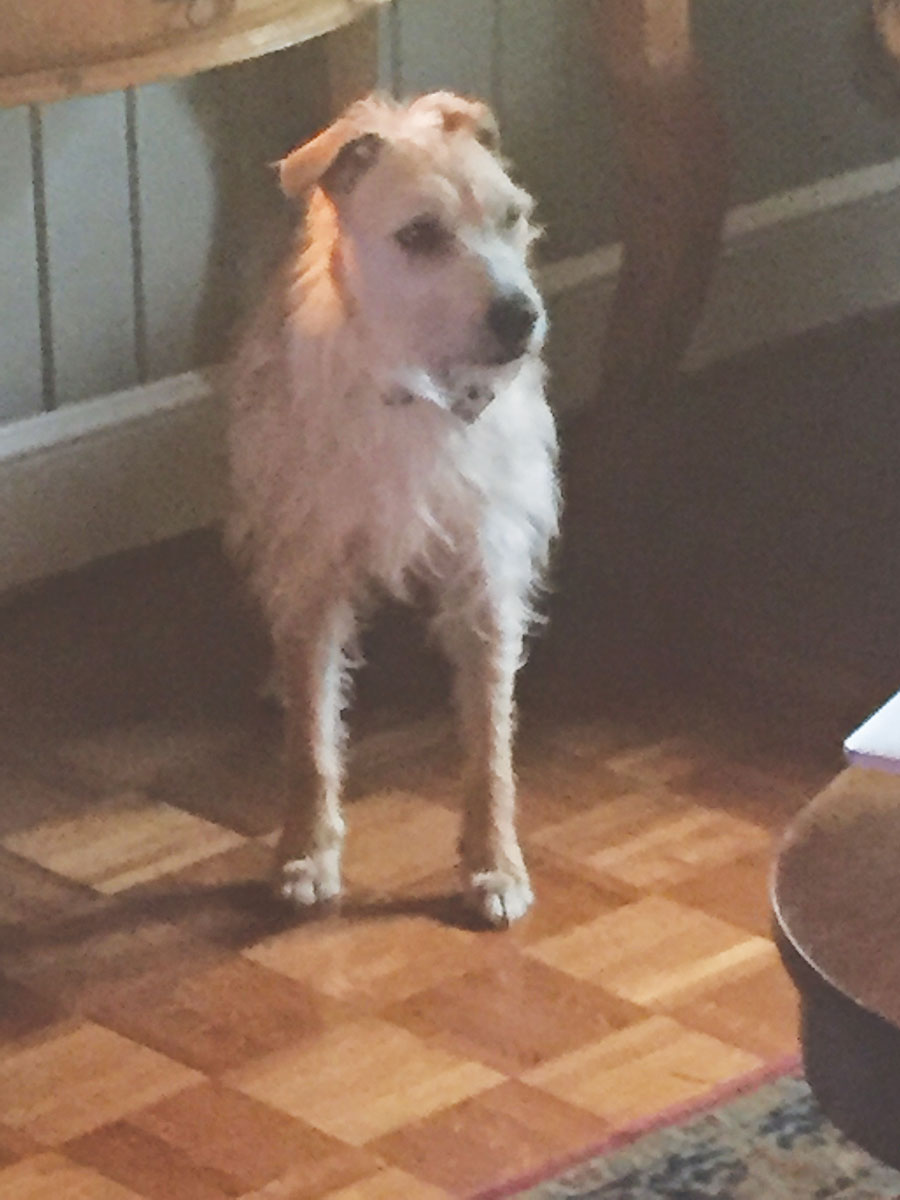
I took the dog straight home.  Mulligan and Ajax warmly welcomed her. But the newcomer was so skittish, she raced behind my den chair and refused to move until The Mull, my wise old foundling, went and sat with her for a spell. It was like watching a family counselor at work, the God Dog doing her thing.

The dog eventually calmed down enough to come out from behind the chair to drink some water and take a biscuit from my hand. I saw a faded tag with a phone number on her narrow collar. Her name was Lulu. The phone number was a Los Angeles number. I called it anyway.

After several rings a woman answered. “Do you have a dog named Lulu?” I asked.

“I sure do,” she said. “You found her? I’ve been so worried. She ran away a when the thunderstorm broke. Lightning struck and she was gone.”

Lulu lived more than 4 miles away. She’d had never stopped running until she’d reached the traffic island.

“Well, she’s safe now at our house.” I gave her our address.

She pulled up 20 minutes later, expressed deep gratitude and informed me that she and Lulu were about to relocate to France.

“I can’t believe she let you get near her. She’s terrified of lightning and people. It’s a miracle you could catch her.”

“I had some help.” I mentioned the two angels on the road and the help of Junior and The Mull.

She scratched Mulligan’s head.  The God Dog smiled, As always, her brown eyes shined, her tail wagged.

“What a sweet dog. How long have you had her?” she asked.

“Not long enough. Just 10 years.” I told her about saving Mully from a busy highway, joking how it was she who really saved me.  PS

Contact Editor Jim Dodson at jim@thepilot.com.

The Omnivorous Reader

To Boston and Back

A history of the psychedelic ’60s

By Stephen E. Smith

The stoner who said “If you remember the ’60s, you weren’t really there” got it wrong. Most of us who lived through those times recall what went down, even if we did inhale. But if your memory is less than eidetic, Ryan H. Walsh’s Astral Weeks: A Secret History of 1968 is an engrossing aide-mémoire, a jumbled catchall of social upheavals and artistic convergences that occurred in Boston half a century ago.

Walsh focuses on two narrative threads, one societal and the other musical, that evolved in parallel. The first is the founding of Mel Lyman’s Fort Hill Community, variously identified as a commune, cult or family; and the other is Van Morrison’s mystic stream-of-consciousness song cycle Astral Weeks recorded while the Irish blues rocker was hiding out in Beantown. Both events, although unrelated, had a transmutative effect on a flower-power generation searching for “peace and love” and alternative lifestyles.

Walsh begins with the not-so-secret culture-shifting decision by Bob Dylan to electrify his backup band and crank out a high-decibel version of “Like a Rolling Stone” at the 1965 Newport Folk Festival. Members of the audience still debate whether Dylan was greeted with widespread booing, but Walsh maintains the crowd was exiting in a funk when harmonica player Mel Lyman took the stage and intoned a 20-minute dirge-like rendition of “Rock of Ages.” Lyman was a member of Jim Kweskin’s Jug Band, a Boston group that had achieved modest national success. By 1966, he’d emerged as the charismatic leader of a community that squatted in abandoned houses in the Fort Hill section of Roxbury.

Lyman had drifted from California to North Carolina (he learned to play banjo from Asheville’s Obray Ramsey) and settled in Boston, attracting a coterie of subservient followers. His Fort Hill Community was no run-of-the-mill hippie commune. Daria Halprin and Mark Frechette, the stars of Michelangelo Antonioni’s film Zabriskie Point; Paul Williams, the publisher of Crawdaddy magazine; musician Jim Kweskin; Jessie Benton, the daughter of Thomas Hart Benton; two children of the novelist Kay Boyle; and Owen DeLong, a speechwriter for Robert Kennedy, were all active members of the Fort Hill family.

Lyman asserted complete control over community members and employed LSD trips, astrological readings and physical intimidation to maintain discipline. Members remodeled dilapidated dwellings and distributed the counterculture biweekly newspaper Avatar to support themselves. The cult’s sole purpose was to serve Mel Lyman and his creative enterprises, and in 1973, Frechette and two other members of the family attempted, ostensibly at Lyman’s bidding, to rob a Roxbury bank to fund a film project. One member was killed by police, and Frechette was sentenced to prison, where he died under suspicious circumstances. Walsh delves into the cult’s internal disputes, most of which concerned the content and publication of Avatar, and he details the less seemly workings of the Fort Hill Community, branches of which are still active in Boston, Los Angeles and Kansas. What became of Mel Lyman is a mystery. It was reported that he died in 1978, but no death certificate is known to exist.

The second thread of Walsh’s secret history traces singer-songwriter Van Morrison’s gradual rise to national prominence via his recording of Astral Weeks, a 1968 Warner Brothers release that went unnoticed at the time but has since achieved cult status. Morrison had first emerged on the music scene as the lead singer of the Belfast band Them, who charted with “Gloria” and “Here Comes the Night.” Morrison had a 1967 solo hit with “Brown-Eyed Girl,” but he’d made a bad business decision, signing with Bang Records, a company with mob connections. Warner Brothers had to buy out Morrison’s contract, and the singer moved from New York to Boston with his girlfriend Janet Rigsbee (aka Janet Planet), where he began composing the songs for Astral Weeks and playing rock clubs, high school gyms, roller rinks and amusement parks across New England with a group of local musicians known collectively as the Van Morrison Controversy. 

To record Astral Weeks, Morrison traveled from Boston to New York and laid down the tracks backed by jazz pros who’d never heard of the 22-year-old singer-songwriter wailing away in the vocal booth. Morrison never spoke to the studio musicians, but guitarist Jay Berliner, drummer Connie Kay, vibraphonist Warren Smith and bassist Richard Davis (the name of the flutist is lost to history) provided the backing that helped bring Morrison’s lyrics to life. The songs are about childhood, death and rebirth, and in “Madame George,” “Cyprus Avenue,” “Astral Weeks,” “Slim Slow Slider,” “Sweet Thing” and “Beside You,” Morrison’s craggy voice rings with a coarse authenticity. Astral Weeks has survived and sweetened over the years, and Walsh’s thorough investigation of the recording process reveals the inner workings of the musical experience without diminishing the album’s subtle ability to mesmerize listeners.

A slew of pop culture luminaries make brief appearances in Walsh’s history: Lou Reed of the Velvet Underground; Peter Wolf, future front man of the J. Geils Band; bluesman Howlin’ Wolf; singer-songwriter Jonathan Richman; Tufts University Shakespeare scholar David Silver; LSD guru Timothy Leary; and others. Since video and audio recordings of most of the principals exist, readers can access images of the characters and hear the crazy ideas they espoused. Dick Cavett’s painfully uncommunicative interview with Daria Halprin and Mark Frechette can be viewed on YouTube, and the album Astral Weeks is streamable on internet devices, as are numerous recordings of Mel Lyman, including his Newport Folk Festival “Rock of Ages” performance and eerie album cuts featuring Lyman and the Fort Hill Community. Jim Kweskin’s America Co-Starring Mel Lyman and the Lyman Family is available on CD. Fifty years out, a replay of these historic recordings in conjunction with a reading of Walsh’s detailed history will remind readers that the Grateful Dead had it right all along: “What a long strange trip it’s been.”  PS

Stephen E. Smith is a retired professor and the author of seven books of poetry and prose. He’s the recipient of the Poetry Northwest Young Poet’s Prize, the Zoe Kincaid Brockman Prize for poetry and four North Carolina Press awards.

Poem

Summer Boy

The summer we were seventeen

I watched you in the sun.

Blond and blue

Beside the pool

Teasing girls you hardly knew.

Jackknife off the high dive —

Daring other golden guys.

I watched. You didn’t see.

Dark and dusky me.

— Phillis Thompson

The Community of Food

It’s a business, an art and a science and it all eventually winds up on our tables.  These are just a few of the folks who make dining in the Sandhills a fresh, friendly, delicious experience.

Dale Thompson

Hilltop Angus Farm

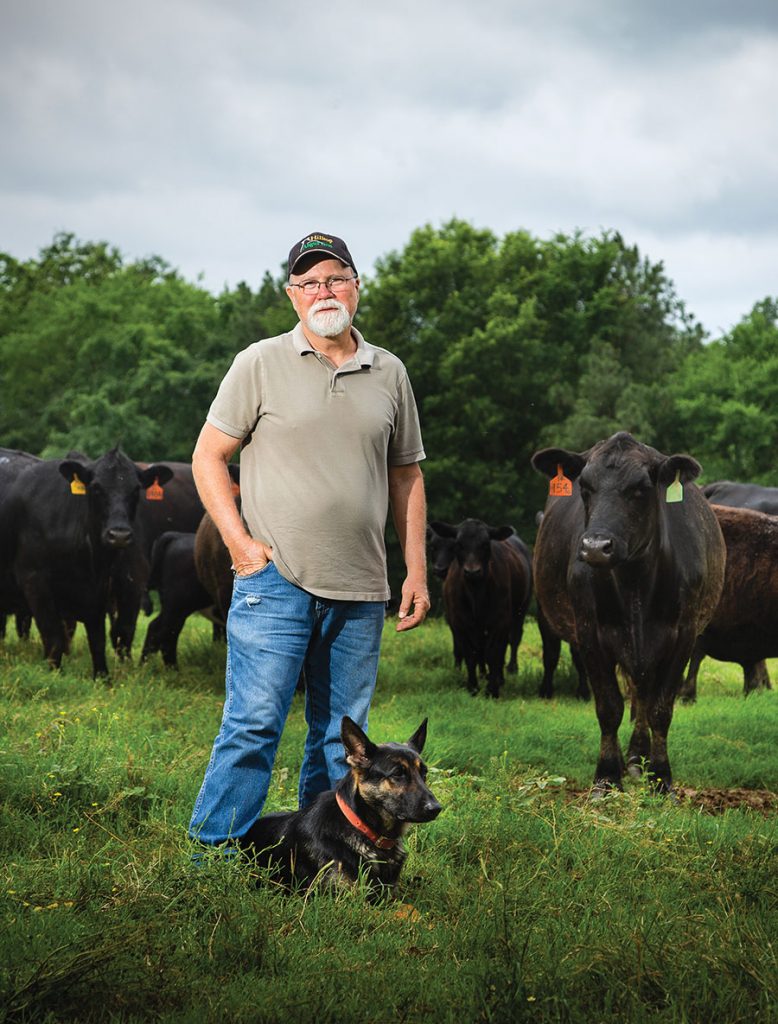
“I’ve been here all my life,” says Dale Thompson, looking out over the rolling hills near the Uwharrie National Forest from the second story of the green barn where he organizes the distribution of his grassfed beef. His parents were loggers, then dairy farmers. “Things change. We have a cattlemen’s meeting every month during the winter. We had a guy from N.C. State come and put on a program about direct marketing. My oldest son talked me into trying it.”  They started with Earth Fare in Asheville in 2011. “I figured that if it was good enough for Earth Fare we could try a market. It’s a big step to go to a market. You’re afraid your product will be rejected. We started in Southern Pines and Pinehurst. It just grew and grew and grew. Now we sell all of our production. People like to have a clean food, know what’s in it, know where it comes from.” Hilltop adheres to the protocols of the American Grassfed Association. The cattle are never given growth hormones or antibiotics. The beef is processed and packaged by Mays Meats in Taylorsville. In addition to Hilltop’s beef, artisan salami and sausages, they offer lamb on a limited basis and heritage pork. They sell directly to Ashten’s, who has been with them since the beginning, and Sly Fox. Their reach extends as far as Wilmington. Thompson has roughly 300 customers there who place orders online. “We meet them in a parking lot on Sunday morning, the first Sunday of each month,” he says. “Anywhere from 50-70 people come in an hour and a half.” Thompson’s wife, Sharon, grew up on a farm 3 miles south of Mt. Gilead. “She was raised on a farm. I was raised on a farm,” Dale says. “I’m born on the land. The only way I can leave it is to sell it.” And that’s not about to happen.

Ben, Jane and Gary Priest

Gary Priest Farm

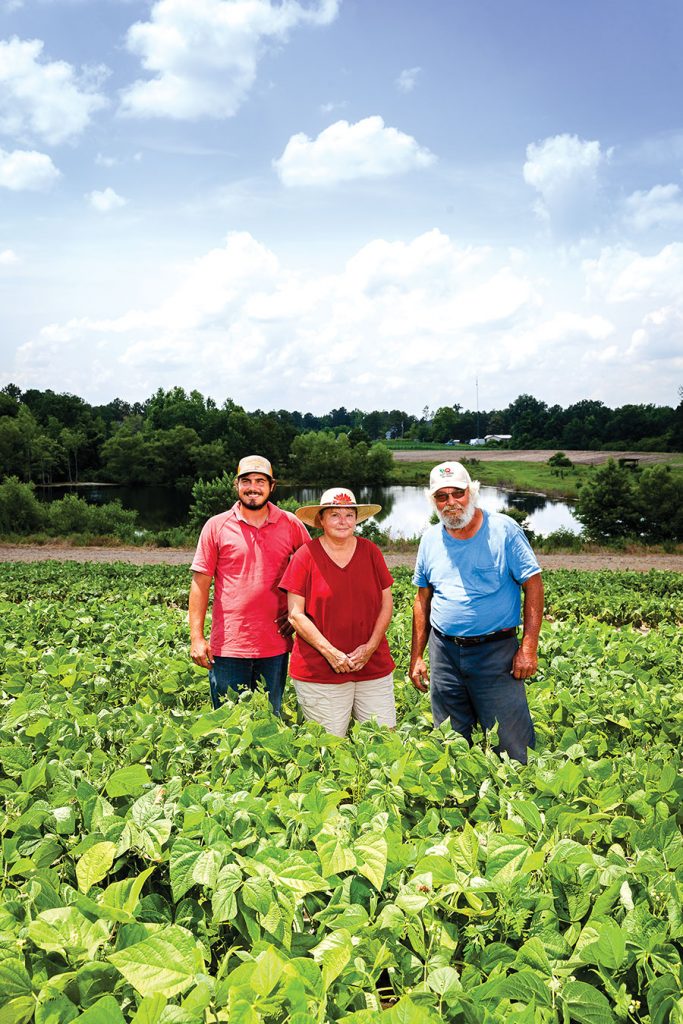
The transition started with asparagus. Where there once was a hillside full of tobacco, now the farm on Bibey Road in Carthage grows nothing but produce. “I started playing with asparagus,” says Gary Priest. “Somebody said I couldn’t grow it.” Besides, the farmhands needed something to keep them busy in the spring. “Now all the tobacco’s gone to a different farm,” says Gary’s son, Ben. “We should be growing more produce this year than we ever have. That field right there gets triple-cropped. Soon as those peas are done, I planted kale where the first pea patch was. Soon as the potatoes are gone, something else will be there. Collards or something. We have carrots, onions, garlic. Green beans on the hill where you drive up.” The Priest farm devotes somewhere between 1/4 and 1/2 acre to asparagus. “Then we had more than we could just sell to the restaurants and we started going to the farmers market and the Farm to Table got started,” says Ben. “We don’t plant on speculation. Half of it is sold when we plant it.” And they’re particular about what they deliver. Someone once approached Gary looking for advice on marketing a crop of strawberries. “You send them the very best you got because you’re not just selling strawberries,” he told them. “You’re selling your farm, your name, your reputation and they won’t forget it you dump something on them.” The Priests supply produce to nearly a dozen local restaurants, including Ashten’s, Chef Warren’s, Elliott’s on Linden, Restaurant 195, Sly Fox, Ironwood, Scott’s Table, Thyme and Place Café and The Bell Tree Tavern. “Stuff that’s grown under plastic is fine,” says Gary, “but it doesn’t taste like something grown in the bare ground.”


Ryan Olufs 

Misty Morning Ranch

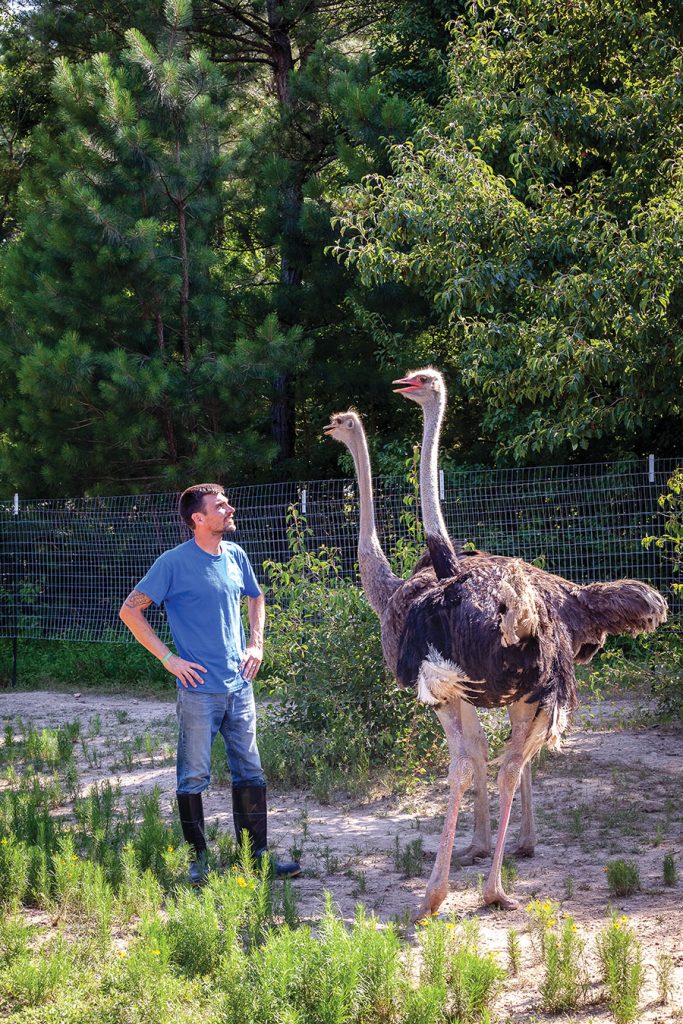
In September 2015, Ryan Olufs and his wife, Gabriela, crammed everything they didn’t sell or give away into their Dodge Challenger and moved from the San Fernando Valley in California, to Robbins, North Carolina, stopping along the way to see Yellowstone and Mount Rushmore.  “We wanted to move to a more rural region, get away from the big city lifestyle,” says Ryan. They did it in a big way. After purchasing a farm in Robbins, they decided they needed to put something on it. “I came across ostrich, really for the feathers. Then we found out that the meat is the No. 1 product,” says Ryan. “Wow, you can eat an ostrich? The more we researched it more it appealed to us. Being first-time farmers, they don’t require as much husbandry as other animals. Ostriches have one of the strongest immune systems of any animal. They’re completely immune to avian flu. They require no vaccines. They lay eggs. And it’s just about the healthiest meat you can eat, either red or white.” So, with the help of Ryan’s brother, Robert, who is in the military, the Olufs planted their urban roots. They revitalized the pastures and put in fencing. They started with two birds, Ed and Bella, in 2016. Now they have 19 birds, 15 breeding stock and four juveniles for processing, done by Chaudhry’s in Siler City. “There’s exploding demand outside the United States,” says Ryan. “Right now ostrich sells for more than Kobe beef in Japan.” With production in its infancy, the Olufs sell locally at farmers markets in Southern Pines and Pinehurst and a butcher’s market in Raleigh. “Chef Warren’s has it on the menu,” says Ryan. “Sly Fox has done it before. Ashten’s buys the eggs from us and they make crème brûlée and ice cream out of them. People will actually come to the farmers market to tell us how good the ice cream is at Ashten’s.”


Martin Brunner

The Bakehouse

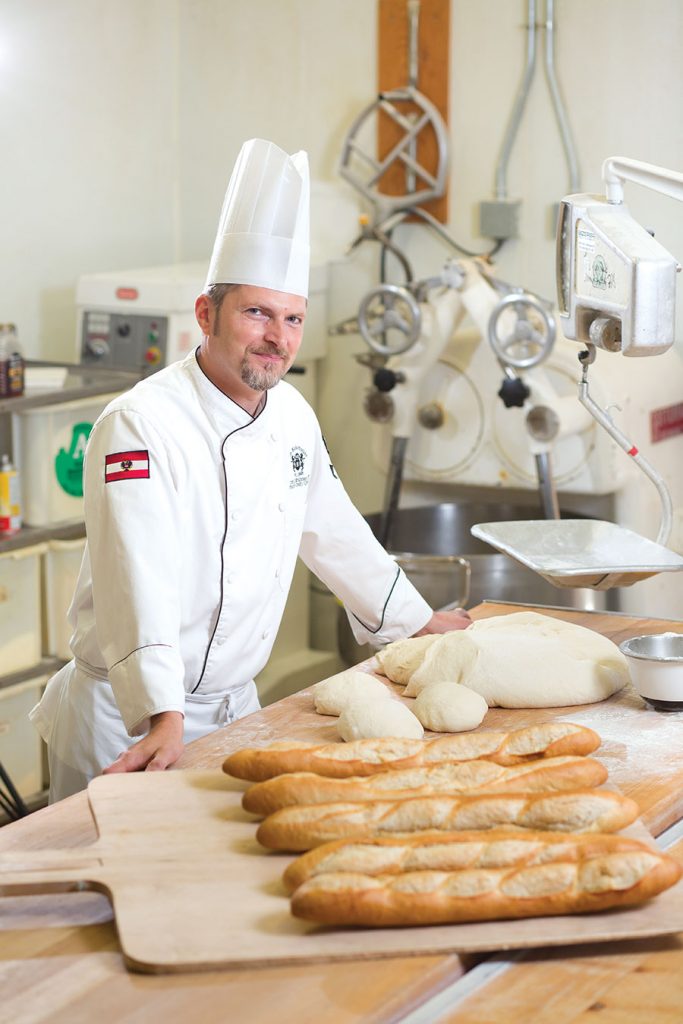
Martin Brunner’s father, Kurt, who started The Bakehouse, was a master baker. Martin’s grandfather was a master baker. His great-grandfather was one, too. And his great-great-grandfather before that. Five generations of experience floats out of the The Bakehouse kitchen on the scent of fresh bread. Martin, who emigrated from Austria in 1991, is also the baking and pastry coordinator at Sandhills Community College. The Bakehouse menu’s Spanish flair comes from Martin’s wife, Mireia, and her mother, Dolores. “A lot of the recipes here are my mom’s, my dad’s, my grandfather’s, my great-grandfather’s,” says Brunner. “Actually the recipe we use the most is my grandmother’s Black Forest cake. We’ve been in the United States 26 years and I was a little kid eating it, so for 34 years we’ve made the same cake.” In addition to the restaurant, they sell wholesale to the Pinehurst Resort, Pine Needles, Restaurant 195 and various retirement homes. “We do a lot of brioche and burger buns for food trucks. The biggest thing is that we — all the restaurants here in town — work really hard to be special,” says Brunner. “If I can add a burger bun that I only make for you and you’re going to put your signature burger on it, that’s what we’re all about. We don’t mass-produce.”


Ronnie and Denise Williams

Black Rock Vineyards

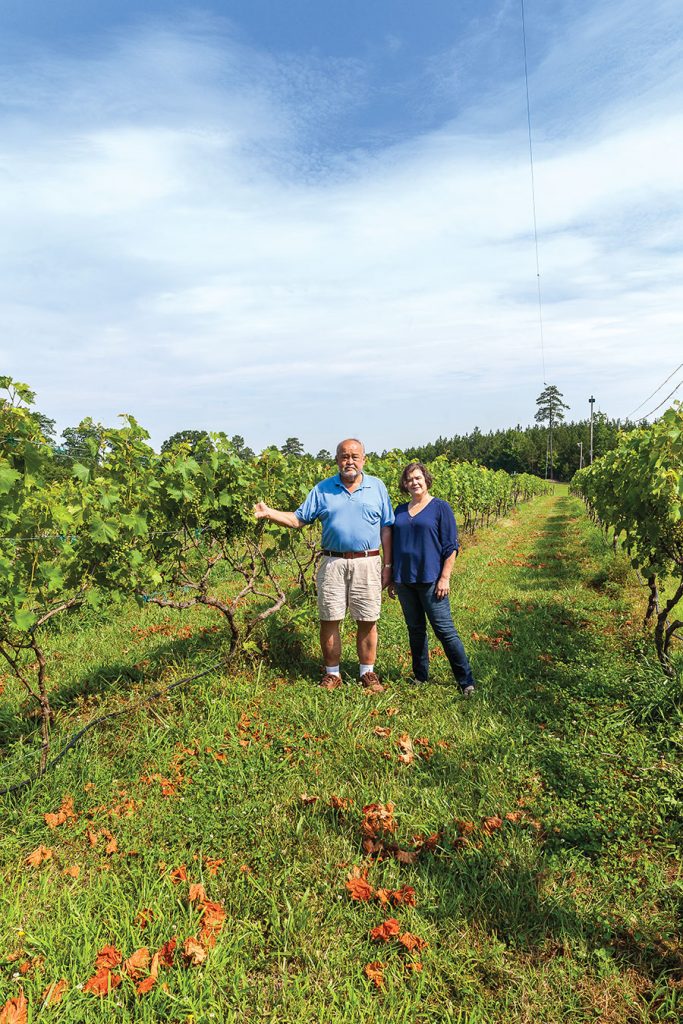
Full-time landscapers, Denise and Ronnie Williams branched out from dogwoods and maples to chambourcin and traminette. Grapes, that is. “We have a nursery farm with ball and burlap stock on it. Machine dug trees. We cleared a piece of our property to put in more of the same,” says Denise. “It was not suitable so we started researching what would grow. We kind of got into the grape-growing business. We were told it wouldn’t work here. We started ripping the soil and getting everything ready in 2004. We made our first wine in 2008. We weren’t even hobbyists. We took that first little crop and we sold 1,000 bottles. The next year we made about 3,600 bottles. In 2010 we had our best year, which was about 10,000 bottles.” Now they have 5 1/2 acres of viniferous grapes and sell wine at the Corner Store in Pinehurst and Nature’s Own, in addition to their winery on U.S. 15-501. “The last couple of years have been very challenging because of the weather conditions,” says Denise. “Twice now we’ve lost vines due to cold.” With Ronnie doing the planting and Denise the winemaking — she had a background in laboratory work from a 24-year career at the Pinehurst Surgical Clinic — they experienced some early hurdles and early successes. “We do have some wines that we pulled back,” says Denise. “But we’ve also got some wines that we’ve won medals with. We’ve won medals with our chambourcin. It’s probably our best-seller. It makes a really good medium-bodied wine. It goes really well with barbecue, with a steak. We try to use the minimalist approach to just about everything. We use the least amount of sulfites. We do it in a primitive way. We pick the grapes, bring them back to the warehouse. We have a ratchet press that’s manned by four people.” The winery doubles as an event venue. They’re in the livestock business, too. “We have lamb now,” says Denise. “In Australia they put sheep in the vineyards to mow. Filly and Colts has our racks of lamb on their menu.” The weather extremes of the last few years have cut precipitously into the harvest. “When you lose, it’s heartbreaking,” says Denise, “but it doesn’t keep us from wanting to go forward.”

Rich Angstreich

Java Bean Plantation & Roasting Companys

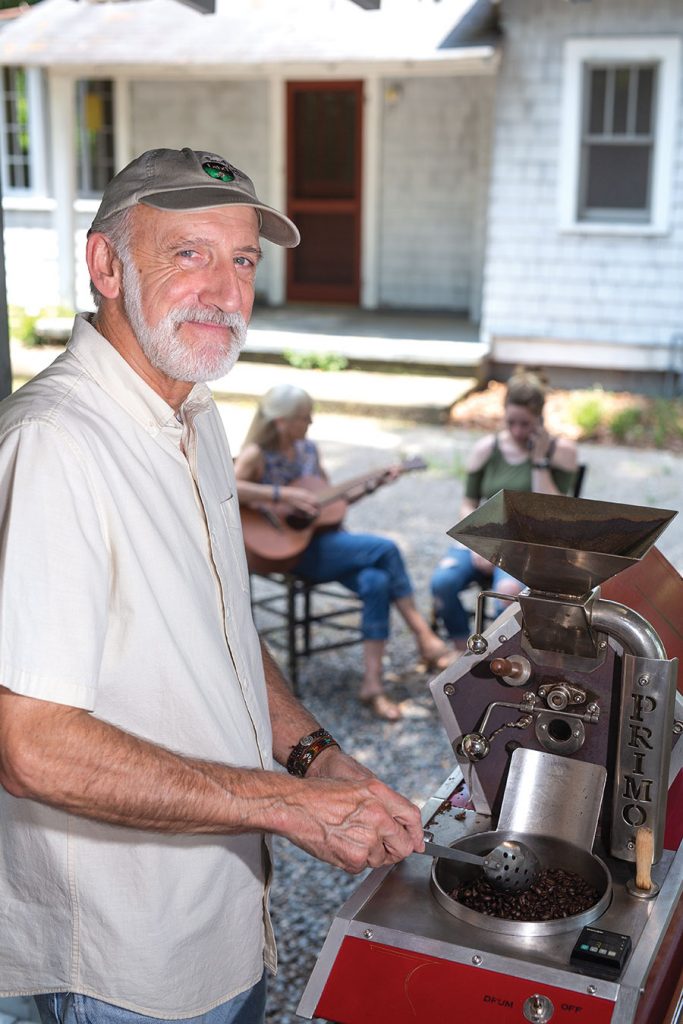
It’s kind of The Comedy Store of coffee shops. Rich Angstreich brings skill to coffee bean roasting and roasting to customer relations. “Friends of mine opened the shop and eventually I became a partner,” says Angstreich, who took over three years after it opened in 1996. At first blush, roasting the green beans was a craft in the making. “It was all trial and error in the beginning because it was just for fun. It took a while but we figured it out. A couple of visits from the fire department,” he says (comedic drum snare). Though the list of coffees fluctuates, beans currently on the docket include Colombian organic, Sumatra organic, Costa Rican, Mexican Chiapas, Honduran and a Sumatra decaf. “We’re definitely small batch, artisan roasting,” he says. Angstreich roasts for the Java Bean, The Bakehouse and Chef Warren’s. Most of his supply comes from a large importer, Royal Coffee, though he also purchases from a small company in Raleigh that deals directly with farmers. “It’s Honduran and they’re trying to expand and get a couple more coffees from Central America,” he says. “Each coffee roasts slightly differently. Some taste better when they’re dark roasted, some taste better when they’re a little lighter roast. We do everything by hand. There are no electronics to start or stop it. Everything is your eyes and your ears and your nose to figure out what to do.”

Golftown Journal

Four by Two

Hanse and Wagner reshape Pinehurst’s No. 4 course

By Lee Pace

The bar was set quite high indeed for this new No. 4 golf course at Pinehurst Country Club when it opened in 1919, commissioned by Pinehurst owner Leonard Tufts and designed by the Scottish architect Donald Ross.

“It is perhaps the best laid-out course of the whole bunch, and when more thoroughly trapped will tax the skill of the wariest golfer,” noted the Pinehurst Outlook in early December 1919.

Later in the month, the newspaper added: “Mr. Ross is warm in his praise of the No. 4 course which is now a complete eighteen hole affair, and he states that he considers it will be the best golfing proposition of all when it has been fully trapped and the fairgreens developed.”

Best golfing proposition? Lofty praise indeed, though admittedly coming well before the No. 2 course was expanded, revised, remodeled and amped up in the mid-1930s when the prideful Ross was irked of hearing about some upstart course in Augusta, Georgia.

The No. 4 course followed the opening of No. 1 in 1899, No. 2 in 1907 and No. 3 in 1911. From the main clubhouse, No. 3 was set essentially to the west, across Hwy. 5, No. 1 to the south, No. 2 to the east, and No. 4 was tucked to the southeast between No. 2 and 1, much as it is today. Maps indicate that in the very early days of No. 2, three holes peeled off from what is now the 10th green and ran into an area that would later comprise No. 4, then rejoined the current routing at the 11th hole. The large 5-acre lake that has been the primary visual feature was originally much smaller.

No. 2 evolved into its status as one golf’s grandest venues when Ross arrived at its current routing in 1935 and replaced the sand/clay greens with Bermuda grass, and it was deemed at nearly 7,000 yards to be one of the strongest, most severe tests for the elite golfer. It has remained so over nearly a century and in the last two-plus decades has hosted three U.S. Opens and a U.S. Women’s Open.

But being the last to arrive, No. 4 was the first to stumble when difficult economic times arrived in the 1930s, the first domino falling in what would become a checkered existence.

The Tufts family closed nine holes of the course in 1936 and shut down the remaining nine in 1939. Then, when better times arrived after World War II, Richard Tufts, Leonard’s son who had now ascended to the presidency of Pinehurst Inc., tweaked nine of the original holes and they were opened back in 1950. A complete 18-hole course followed three years later.

When the Diamondhead Corporation, Pinehurst’s new owners, enticed the PGA Tour to hold a 144-hole event at the club in 1973, a second course was needed as a venue along with No. 2, and Robert Trent Jones, who had become a Moore County landowner with a parcel bordering Pinehurst Country Club and the Country Club of North Carolina, was retained to lengthen and strengthen the course for the professionals. Then a decade later, son Rees Jones authored yet another renovation — the crux of the project the rebuilding of all the greens to be more receptive to the longer tee shots his dad had integrated years before.

“No. 4 had become a hybrid of designers and ideas with no thread to tie it all together,” Pat Corso, Pinehurst’s president and CEO from 1987-2004, said in 1998.

As he spoke, Tom Fazio and his team were busy at work rebuilding and shaping the course toward yet another iteration. The new No. 4 that opened in December 1999 was routed through essentially the same corridors as the earlier course, but holes were rearranged and Fazio integrated a British flavor of a myriad of pot bunkers as a nod of the cap to Ross, the Scottish designer.

The course also embraced the design flavor of the era: It was green, and it had smooth, soft edges, and there were flower beds in several nooks and crannies, most notably the slopes around the green of the par-3 fourth hole.

All of that was fine until 2011, when No. 2 next door was given a new set of bones and coat of paint courtesy of the design team of Bill Coore and Ben Crenshaw. The Deuce had also become sleek and glossy in the golf world’s creep toward the standards set by Augusta National. Don Padgett II, the Pinehurst president and COO at the time, slammed on the brakes and charged Coore and Crenshaw to return the club’s pride and joy to its sandy, linksy, disheveled self that Ross had molded with his native Scotland in mind.

The more No. 2 has succeeded over a half dozen years from contexts of visuals, playability, maintenance and fidelity toward Pinehurst’s past, the more No. 4 paled by comparison. Thus the decision in 2016 by Pinehurst owner Robert Dedman Jr. and Tom Pashley, who succeeded Padgett in 2014, to hire Gil Hanse and partner Jim Wagner to rebuild No. 4. The course closed in October 2017 and Hanse set about his face-lift, his sleeping quarters over the winter being the Ross Cottage by the third hole of No. 2. The new course was sodded and sprigged by early June, and this month is growing in toward a September reopening.

“It all started with Coore and Crenshaw,” Hanse says. “They were brought in to bring back the character and to restore the sandy waste areas and Ross’ vision for what Carolina Sandhills golf looks like. We’ve carried that a little further in this presentation. It’s not a tribute course to Ross or course No. 2. But we feel it will be a good companion golf course.”

The corridors from the old course were used but several shifts in holes were made. Two of the par-3s have been altered substantially. The green on the fourth hole has been moved from well below the tee and beside the lake to a higher elevation farther to the left, with a sharp slope now cascading to the right toward the water. The sixth green was elevated and substantial sandscaping integrated around it. The old 12th hole was abandoned in favor of a new par-3 built into the woods, sitting in a triangle between the previous seventh, 10th and 11th holes.

“The characteristic about No. 4 that is most special is the land. It has some of the most dramatic contours on the entire site,” Hanse says. “On No. 2, holes four and five and 13 and 14 are the most dramatic in terms of topography. I think we’ve eight or nine that have that element. That gives us the opportunity to create very dramatic landscaping and more picturesque landscaping. The new course has something of the look and feel of No. 2 and returns a more natural connection to the landscape.”

Another interesting twist is creating a massive waste area on the par-5 ninth hole similar to the “Hell’s Half Acre” at Pine Valley. Golfers will traverse a sandy area dotted with wiregrass, broom sedge and other wild growth for some 80 yards on their second shot.

The designers and their construction company transplanted thousands of wiregrass plants from the site of the abandoned Pit Golf Links on N.C. 5 near Aberdeen and also moved “chunks” of dirt, sand and vegetation from the site as well. They scooped out sections of ground roughly 2-feet wide by 4-feet long, moved them intact to the No. 4 course and placed them around bunkers. Then a shaper followed and tucked them into the surface, the result hopefully looking like ground that has aged and weathered for years.

Just like No. 2 looked after Coore and Crenshaw took aim in 2010-11.

Just like Mid Pines, another Ross relic from the 1920s, looked after Kyle Franz restored it in 2013.

“What Jim and I focused on was creating something that is going to look and feel and be sort of philosophically in line with the playable characteristics that Ross embraced at Pinehurst,” Hanse says. “The golf course will capture more of that look, that look that Kyle Franz did at Mid Pines. There is an excitement around Pinehurst about recapturing that ‘Pinehurst look.’”

Noting that at Pinehurst “our history is our road map to the future,” Pashley adds that a halfway house will be built alongside the fifth hole of No. 4 and will also serve golfers coming off the 10th green of No. 2 nearby. The architectural model will be the original Pinehurst clubhouse from 1900 — two stories with an observation deck. Coming full circle seems to be an enduring theme at Pinehurst.  PS

Author Lee Pace wrote extensively of the Coore and Crenshaw restoration of Pinehurst No. 2 in his 2012 book, The Golden Age of Pinehurst — The Rebirth of No. 2.

Southwords

Hit the Highway

An ode to the road

By Susan S. Kelly

It’s a universal truth of summer in North Carolina, when the beach and the mountains become our magnetic poles, that sooner or later you’re going to be traveling on Interstate 40. Or “Forty,” as its fans and its haters call it.

I’m a fan.

You can have your backroads. How can a pastoral scene compare with the racetrack of 423.6 miles that (somewhat) horizontally slices the state? Every mile is pure entertainment. Sure, the “Bridge Ices Before Road” signs get boring, but the stuff people are hauling more than compensates. Where else but on I-40 in North Carolina can you find Christmas trees and golf carts and watermelons and boats? Plus, skis, surfboards, bicycles, kayaks, coolers, tobacco, cotton, horses, coonhound cages, Airstreams, and the requisite pickup or two hauling a chest, a mattress, a La-Z-Boy, and a fake tree, tarp a’ flappin’. It must be admitted that when I pass one of those silver-slatted semis, I strain to see if there are hogs inside, just before I avert my eyes and try not to think about their ultimate destination. Same for the vanilla-colored school bus whose sides read “Department of Prisons.” Don’t tell me you haven’t tried to peer into those windows crisscrossed with wire. I grew up with a father who always pointed out the guy with the rifle on his shoulder while inmates worked on the roadsides. Don’t see that much anymore, or those silvery mud flaps sporting silhouettes of naked ladies. Now the rigs are hot pink, for breast cancer. Progress.

I’m not the slightest bit offended if a rig driver honks at me as I pass. If someone still finds my 63-year-old knees attractive, I ain’t complaining.

How does a town get a name like Icard?

I particularly like those lead drivers with flashing head and taillights that warn of “Wide Load.” What a cool job. Like Dorothy Parker, who famously said that she’d never been rich, but thought she’d “be darling at it,” so would I in one of those cars. Think of the books-on-tape you could finish.

The amazing variety of stuff dangling from rearview mirrors — sunglasses, leis, air fresheners, Mardi Gras beads — all give a glimpse into a driver’s personality, like bumper stickers. (Question: How did so many Steelers fans wind up in North Carolina?) And while Virginia holds an unofficial record for vanity tags, I-40 is no slouch in that department, either. PRAZGOD. KNEEDEEP. IAMAJEDI. JETANGEL. Hair seems to be an ongoing tag topic: HAIRLOOM. NOHAIR. And this: SPDGTKT. Seriously, why not just call the cops instead of advertising?

I do not understand convertibles on interstates.

Do not fret yourself over aliens and vampires: If I-40 traffic is any indication, white pickup trucks are far more likely to take over the world.

You can’t fail to notice, while the Athena cantaloupes you bought at the state farmers market are growing more and more fragrant in the backseat, that, let’s face it, the flowers and trees planted in medians around Raleigh are way more attractive than anywhere else in the state. Harrumph. Near Fayetteville, D.C. license tags get more numerous, just as around Asheville, the Tennessee tags multiply, and around Benson, the New Yorks and Floridas proliferate.

Granted, I’d swap a few Bojangles and Cracker Barrel signs for South of the Border and Pedro puns on I-95, but that Mobile Chapel — a permanent trailer in the parking lot of a truck stop near Burlington — never fails to intrigue. As does Tucker Lake, a Johnston County curiosity with a fake beach and so kitted out with rope swings, slides, ski jumps, cables and random docks that you can scarcely see the water. Moreover, a stretch of I-40 around Greensboro has its own ghoulish nickname — “Death Valley” — for its unfortunate statistic of wrecks. And how about those cell towers disguised as pine trees? Come on. The “trees” are so spindly that they look like they belong, well, somewhere near the actual Death Valley.

So much to see from mountains to coast. What you won’t see, though, is the sign where I-40 begins, in Wilmington, that reads “Barstow, California 2,554 miles.” It was stolen so often that the DOT got tired of replacing it. Meanwhile, if you happen to have a list of locations for the elusive Dairy Queens along I-40, please text me. Calories don’t count when you’re a friend of Forty.  PS

Susan Kelly is a blithe spirit, author of several novels, and proud grandmother.