Bookshelf

July Books

NONFICTION

Indianapolis: The True Story of the Worst Sea Disaster in U.S. Naval History and the Fifty-Year Fight to Exonerate an Innocent Man, by Lynn Vincent and Sara Vladic

Vincent, the co-author of Same Kind of Different as Me and Heaven is For Real, teams up with Vladic to re-examine the story of the Indianapolis. Thanks to a decade of original research and interviews with 107 survivors and eyewitnesses, Vincent and Vladic tell the complete story of the ship, her crew, and their final mission to save one of their own — the fight for justice on behalf of their skipper, Capt. Charles McVay III, who was put on trial as a scapegoat for the infamous and unforgettable moment in American naval history. 

Jell-O Girls: A Family History, by Allie Rowbottom

After her great-great-great-uncle bought the patent to Jell-O from its inventor for $450, Rowbottom reveals the dark family history that flowed from one of the most profitable business deals ever. Jell-O Girls is a family story, a feminist memoir, and a tale of motherhood, love and loss. In crystalline prose, Rowbottom considers the roots of trauma not only in her own family, but in the American psyche, ultimately weaving a story that is deeply personal, as well as deeply connected to the collective female experience.

Killing It: An Education, by Camas Davis

A longtime food writer, Davis delivers a funny, heartfelt memoir of her journey from a girl without a job, home or boyfriend in Portland, Oregon, to rural France, where she learned the artisanal craft of an enlightened butcher. When Davis returns to Portland, the city is in the midst of a food revolution, where it suddenly seems possible to translate much of the Old World skills she learned in Gascony to a New World setting. Camas faces hardships and heartaches along the way, but in the end, Killing It is about what it means to pursue the real thing and dedicate your life to it.

Northland: A 4,000-Mile Journey Along America’s Forgotten Border, by Porter Fox

Spending three years exploring the border between the United States and Canada, traveling from Maine to Washington by canoe, freighter, car and on foot, Fox blends a deeply reported and beautifully written story of the region’s history with a riveting account of his travels. Fox follows explorer Samuel de Champlain’s adventures across the Northeast; recounts the rise and fall of the timber, iron and rail industries; crosses the Great Lakes on a freighter; tracks America’s fur traders through the Boundary Waters; and traces the 49th parallel from Minnesota to the Pacific Ocean.

City of Devils: The Two Men Who Ruled The Underworld of Old Shanghai, by Paul French 

Set in a city of temptations, French tells an astonishing story of the two men whose lives intertwined in both crime and a twisted friendship. “Lucky” Jack Riley, with his acid-burnt fingertips, finds a future as The Slots King while “Dapper” Joe Farren, whose name was printed in neon across the Shanghai Badlands, rules the nightclubs. Eyewitness accounts from moles at the Shanghai Municipal Police, letters and contemporary newspaper articles inform this meticulously researched story, bringing to life the extravagant music halls, bars, theaters and political unrest of a city that appears both intensely glamorous and depressingly seedy. 

FICTION

The Family Tabor, by Cherise Wolas

The beloved author of The Resurrection of Joan Ashby returns with a second novel. A family patriarch’s forthcoming award as Man of the Decade causes his wife and adult children to re-examine their choices, and the parts of themselves they share with family members in an engaging and remarkable work of literary fiction. The author will be in Southern Pines on July 25th. 

Dear Mrs. Bird, by A.J. Pearce

British women’s magazines during World War II published articles about making do, keeping calm and carrying on as well as answers to queries about trivial events or how to cope when bad things happen. Dear Mrs. Bird tells the story of Emmy, who opens the mail addressed to the advice column at a magazine, and the events that unfold when she writes her own reply to one of the letters. If you loved Major Pettigrew’s Last Stand, The Guernsey Literary and Potato Peel Pie Society, or the Miss Read books, you will adore this book.

Clock Dance, by Anne Tyler

Willa Drake can count on one hand the defining moments of her life. In 1967, she is a schoolgirl coping with her mother’s sudden disappearance. In 1977, she is a college coed considering a marriage proposal. In 1997, she is a young widow trying to piece her life back together. And in 2017, she yearns to be a grandmother but isn’t sure she ever will be. Then, one day, Willa receives a startling phone call from a stranger. Without fully understanding why, she flies across the country to Baltimore to look after a young woman she’s never met, her 9-year-old daughter, and their dog, Airplane. Surrounded by eccentric neighbors who treat each other like family, she finds solace and fulfillment in an unexpected place.

Who Is Vera Kelly, by Rosalie Knecht

New York City, 1962. Vera Kelly is struggling to pay the rent and blend into the underground gay scene in Greenwich Village. She’s working night shifts at a radio station when her quick wit, sharp tongue and technical skills get her noticed by a recruiter for the CIA. Next thing she knows she’s in Argentina, tasked with wiretapping a congressman and infiltrating a group of student activists in Buenos Aires. As Vera becomes more and more enmeshed with the young radicals, the fragile local government begins to split at the seams. When a betrayal leaves her stranded in the wake of a coup, Vera learns the Cold War makes for strange and unexpected bedfellows, and she’s forced to take extreme measures to save herself.

CHILDRENS’ BOOKS

Doll-E 1.0, by Shanda McCloskey

Curious, inquisitive, confident Charlotte is always tinkering, coding, clicking and downloading. So when she gets a doll for a gift, what does she do? She tinkers, codes and clicks, and creates the new Doll-E 1.0. A celebration of science, creativity and play, Doll-E is the perfect book for budding young scientists who also love Rosie Revere. (Ages 3-7.)

Albert’s Tree, by Jenni Desmond

Who wouldn’t just adore sweet Albert! Concerned about why his tree is crying, Albert the bear sets out to solve the mystery and what he discovers surprises everyone. A great read-aloud, Albert’s Tree will become a favorite read-it-again story for young nature lovers. (Ages 3-6.)

Smack Dab in the Middle of Maybe,
by Jo Watson Hackl

Quirky charming Cricket Overland wanders out of Thelma’s Cash and Carry Grocery Store and into the hearts of readers who have loved Three Times Lucky, Savvy and The Penderwicks. Armed with only a few snacks, a hand shovel, duct tape and a live cricket named Charlene, Cricket sets out on her own to find some answers. A sweet, clever, stand-alone adventure story with an art history/mystery twist thrown in for good measure. (Ages 8-12.)

Furyborn, by Claire Legrand

Two young women, Rielle and Eliana, living centuries apart, tap into their extraordinary personal powers when someone close to them is threatened. As they fight in a cosmic war that spans millennia, their stories intersect, and the shocking connections between them ultimately determine the fate of their world — and of each other. Bloody, violent, fast-paced and impossible to put down, fantasy fans everywhere will consider Furyborn a must-read for the summer.
(Ages 14 and up.) 
PS

Compiled by Kimberly Daniels Taws and Angie Tally.

The Kitchen Garden

Bring on the Basil

The king of herbs spices up summertime

By Jan Leitschuh

Many of you are eaters of fresh produce, not growers. I get that.

However, if you grow nothing else, you can grow basil. Fresh basil is the classic fragrance of a foodie’s hot-weather feast, the symphonic notes in the Sandhills’ summer bounty. Food writers call basil “The King of Herbs” for the commanding accent it brings to seasonal food.

A cool plate of juicy heirloom tomatoes sliced simply with fresh mozzarella and topped with fresh basil, cracked pepper and balsamic is about as good as it gets in July. Unless, of course, it’s a fresh peach, goat chèvre and basil salad . . . or a pizza margherita with fresh basil leaves . . . or basil chicken with lemon . . . or a cucumber, basil and lime gimlet . . .

You see? No mention yet of pesto, which is delicious nonetheless.

Yes, you non-kitchen-gardener you, you can grow basil. Just buy a 4-inch pot and set it in a window box. Or in a planter. Tuck a plant outside your back door, right in the dirt. In fact, if you have a sunny window, you can even grow it indoors. The store-bought fresh packs are convenient but costly, and, if you are a basil lover, insufficient. Just grow some already.

For so much flavor, basil’s wants are simple: sunshine and lots of it. And warmth. Water when the soil gets dry which, in a full-on Sandhills summer, can be daily. 

With a little pinching — or rather, harvesting — of a few pungent, glossy leaves, sweet basil will grow into a vigorous bushy ball, about a foot or two high.

And while we savor the Mediterranean notes that basil brings to our summer tables, it turns out it’s also a very healthy addition to our diets. Basil is a brain enhancer. Certain antioxidants in basil are considered protective shields for the brain, preventing oxidative stress. Eating basil, which contains minerals like manganese, may be useful in preventing cognitive decline.

Anti-inflammatory elements of basil help quell the burning of arthritis, or soothe the acid indigestion you’ll surely get from scarfing that whole pizza pie. A great source of vitamin K, basil also helps build strong bones, and its phenolics and anthocyanins make it a useful addition to a cancer-fighting diet.

Beyond the sweet or Genovese basils, you can find the beautiful purple-leaved basils such as Red Rubin and Dark Opal. These dark lovelies are garden accents in and of themselves. Other cultivars are available with different tastes, including cultivars with cinnamon, clove, lemon and lime notes. Holy basil, or tulsi, is another flavor altogether. Start with the tried and true sweet basil, and branch out from there.

Potted plants are readily available in the spring, but basil is easy and inexpensive to start from seed. Press a few seeds into a pot and water. You can do this monthly to ensure a continuous supply.

As the daylight shortens, your basil will try to flower. Pinch these off immediately. You are trying to keep it in the fragrant vegetative (leafy) state, not allowing it to send its energy into reproduction (flowers and seeds).

To keep cut basil fresh in your kitchen, treat it like the lovely bouquet it is. Trim the stems and put them in a jar or glass of water on your counter.  Cover it with a loose plastic bag if you want. Never put fresh leaves in the fridge, where they will blacken.

At some point in the summer, you will have a lot of basil. This is a good thing, as Martha Stewart would say. Think ahead to those basil-less winter pizzas, fish dishes and pastas (sad trumpet sound). How do you think pesto got invented? It uses scads of basil. If your summers are busy and you don’t have time to combine with pine nuts or walnuts, and pecorino cheese, just rinse off a batch and whir it with simple olive oil. Freeze in ice cube trays and re-bag. Pull out a basil cube on a joyless, sunless winter day when you need to remember the sunshine.

Or, using the bounty of July, serve up something cool:

Tomato, Basil and Watermelon Skewers

Alternate squares of watermelon with feta squares, basil and halved cherry tomatoes.

Arrange on a platter, drizzle with EVOO and a good balsamic vinegar. Have a party and share the flavor.  PS

Jan Leitschuh is a local gardener, avid eater of fresh produce and co-founder of the Sandhills Farm to Table Cooperative.

Out of the Blue

Message in a Bottle

Especially on a hot summer afternoon

By Deborah Salomon

The heat of July, always a scorcher, means gallons of cold stuff to wash down the potato salad. And, because in these parts nothing goes down easier than Retro-Ade, let me dig around in the cooler for some thick glass bottles filled with . . .

I spent every hot, dusty summer of my childhood at my grandparents’ house, in Greensboro, which my mother thought was preferable to hot, muggy summers in Manhattan. No residential AC in the 1940s, but you could sit the afternoon in a frigid movie theater, since movies ran continuously and kiddie fare was a dime. The other good thing about Greensboro was soda. My mother forbad it at home, a punishment for not liking milk, unless mixed with Jell-O pudding or Campbell’s Tomato Soup. For a special treat, a few times a year I was allowed a fountain Coke over shaved ice at the drugstore, only because she loved them. But my sweet Nanny Teachey knew that little girls need a cold bottle of fizzy to make long, hot afternoons bearable. That bottle came from the mom-and-pop grocery on the corner which, like the gas station up the block, had a massive cooler with a bottle opener attached. I see them in antique shops now, and weep.

Nanny would grab her shopping bag, wink at me and say, “Come keep me company while I walk up to the store.” I never got why she needed an item or two every day.

Once there, she slipped me a nickel and let me choose from glorious Dr. Pepper, Coca-Cola, Grapette, Nesbitt’s Orange, Royal Crown. The bottles were much smaller and scratched from re-use. A plain white paper straw touched the bottom with plenty of sipping room up top. Grapette was my favorite, deep purple, in a clear glass bottle. Who knows if it contained even a drop of fruit juice? I was in heaven. To make it last I slipped the cold bottle under my shirt on the walk home, then hid it beside my bed.

Nesbitt’s Orange was my second favorite because the bottle was bigger, except even with a straw, the orange artificial color left me with a tell-tale neon tongue. Then, the ultimate: Nanny froze Pepsi in an aluminum ice tray. I’d chop the cubes into slush and eat with an iced tea spoon.

Calories and high fructose corn syrup weren’t factors, just blistering July heat and a cold soda.

About once a week Nanny and I returned bottles for the deposit, usually when my mother had gone uptown to the beauty parlor, or else she might wonder how so many had accumulated; during our visits the only soda allowed at the table was Canada Dry Ginger Ale, which Granddaddy put in his iced tea instead of lemon. Nanny carried the heavy bag but I inserted the empties in a metal rack beside the cooler, producing a clink I haven’t heard for 70 years.

Well, guess what? Grapette changed hands, went underground but survived and is now part of Walmart Sam’s Club beverage line, in a 2-liter plastic container. No thanks. I only want a little, sucked with a straw from a scratched bottle — so cold it made my head ache, so clandestine that the chill produced a wicked thrill.

I don’t drink soda anymore except for the occasional Fresca. Too many chemicals. Besides, my apartment is air conditioned and “purified” water’s all the rage. As for those sickly sweet caffeine-laced fondly remembered concoctions, they wouldn’t be much good at washing down brown rice and sautéed kale.

To everything, a season. You can’t go home again and other platitudes. I don’t want to, because memory glorifies and reality disappoints. But when thirst overtakes me on a July afternoon . . . PS

Deborah Salomon is a staff writer for PineStraw and The Pilot. She may be reached at debsalomon@nc.rr.com.

Birdwatch

Little Brown Bird How I Love Thee!

In search of the rare grasshopper sparrow

By Susan Campbell

One of the rarest breeding birds here in the Piedmont is the grasshopper sparrow. This diminutive, cryptically colored bird can only be found in very specific habitat: contiguous, large grassland. Such large fields are increasingly hard to find across our state these days. And even if you seek out the right habitat, seeing an individual, even a territorial male, is not very likely because they are so secretive and well camouflaged. But if you persist, you might hear one of them. Their voices are quite characteristic: a very high-pitched buzzy trill. It is the combination of their call and the typically grasshopper-rich areas in which they are found that gives them their name.

Nowadays these birds are only found in manmade grasslands. In the Sandhills, the only location where they breed is at the Moore County Airport. I have identified as many as 12 grasshopper sparrow territories between the runway and Airport Road. I suppose some birds may use what are called drop zones, areas targeted for paratrooper operations at Fort Bragg. However, these typically have a variety of plants — not ideal territory for these birds. Up around Greensboro, I hear that they can be found scattered among the agricultural fields along Baldwin Road. If you make the trip, also be on the lookout for a dickcissel, a fairly, large, yellowish sparrow-like individual that is even, an even rarer find.

Grasshopper sparrows return from their wintering grounds in Mexico and the southeastern coastal plain of the United States by mid-March.  Males spend much time singing from taller vegetation, often beginning their day well before dawn. They use short, low fluttering flight displays to impress potential females. Eggs are laid in cup-shaped nests in a slight depression, hidden by overhanging grasses, containing four or five creamy-colored eggs that are speckled reddish-brown.

Habitat loss has certainly affected the small local populations of these birds, plus routine mowing of these fields usually destroys nests. But the birds stay and attempt to nest again. In shorter grass, their nests are easily detected by predators, such as foxes and raccoons. Therefore, breeding success tends to vary greatly from year to year in these types of locations. If the habitat remains unaltered from May through August, grasshopper sparrow pairs can produce two (and sometimes three) families in a year.

But these birds are also vulnerable to the effects of pesticides. Although they do eat small seeds associated with the grasses that grow around them, they also rely upon significant numbers of insects, especially when they are feeding young.

Grasshopper sparrows are surely not easy to observe in summer but, in winter, they are even harder to find. They mix in with other sparrows that frequent open spaces and seldom sing. But for those experienced birdwatchers who enjoy the challenge that comes with sorting through “little brown birds,” (like me!), their flat foreheads, large bills and buffy underparts are a welcome sight.   PS

Susan would love to receive your wildlife sightings and photos. She can be contacted by email at susan@ncaves.com.

Jamie & Kent George

JAMIE & KENT GEORGE

Photographer: Heather Gunter Photography Wedding Coordinator: Bailey Grinde, Pinehurst Resort

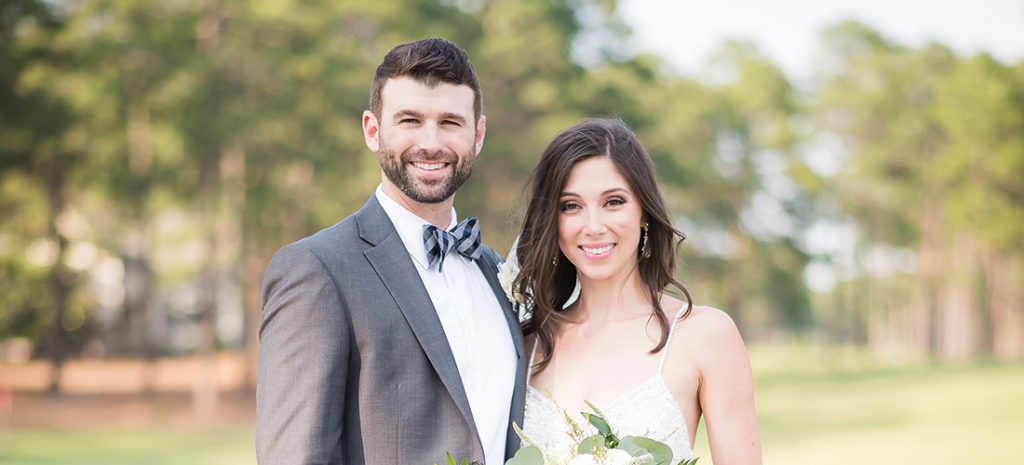
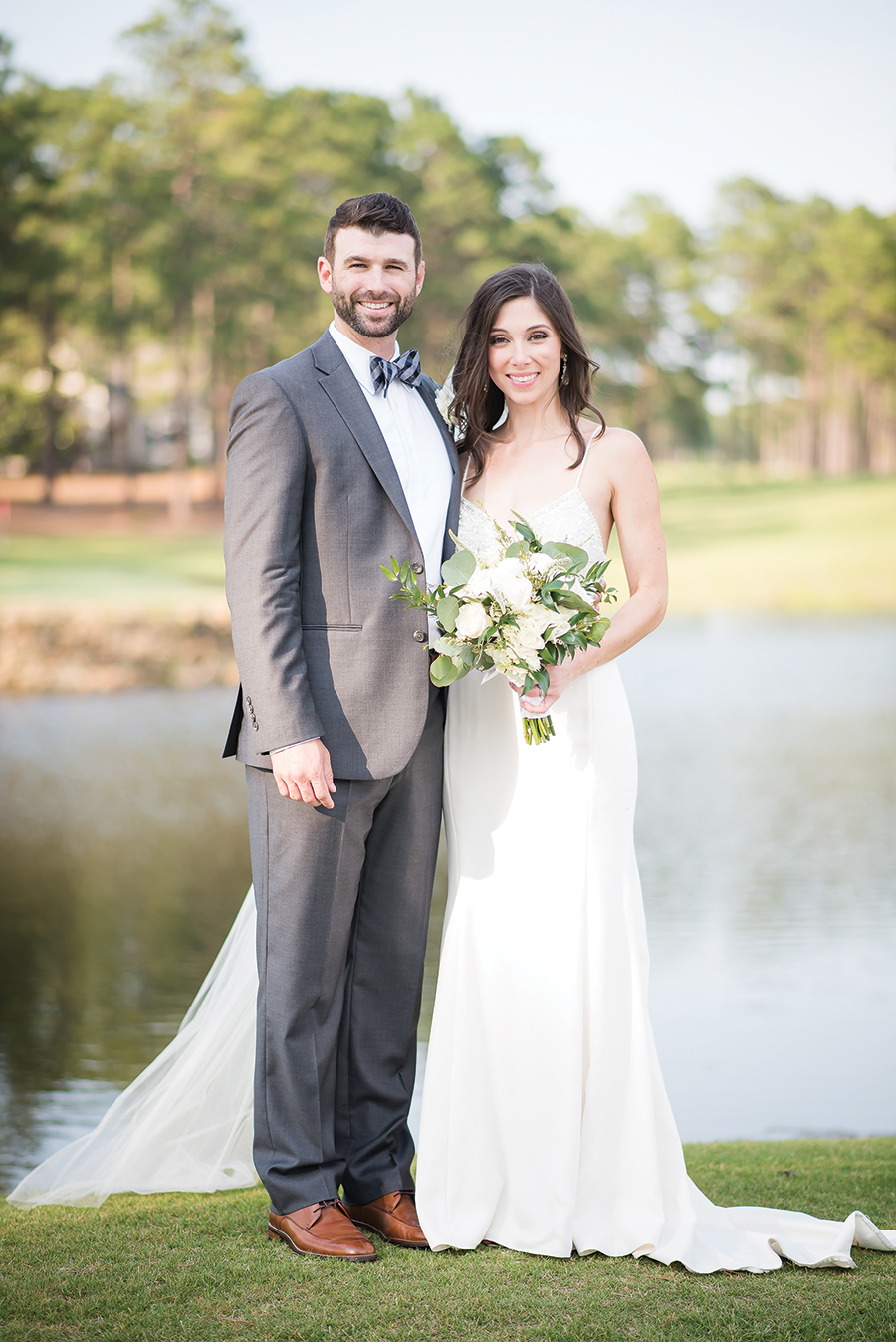
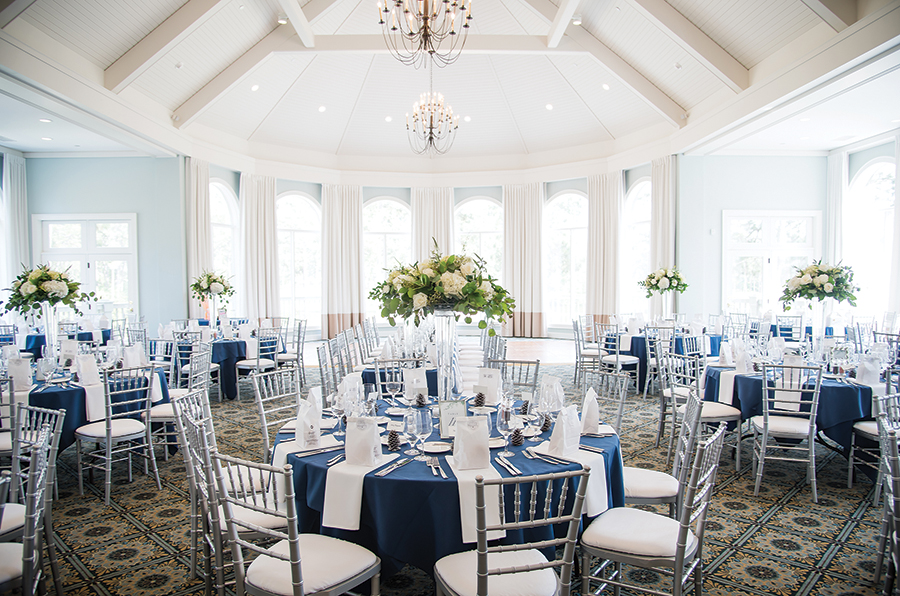
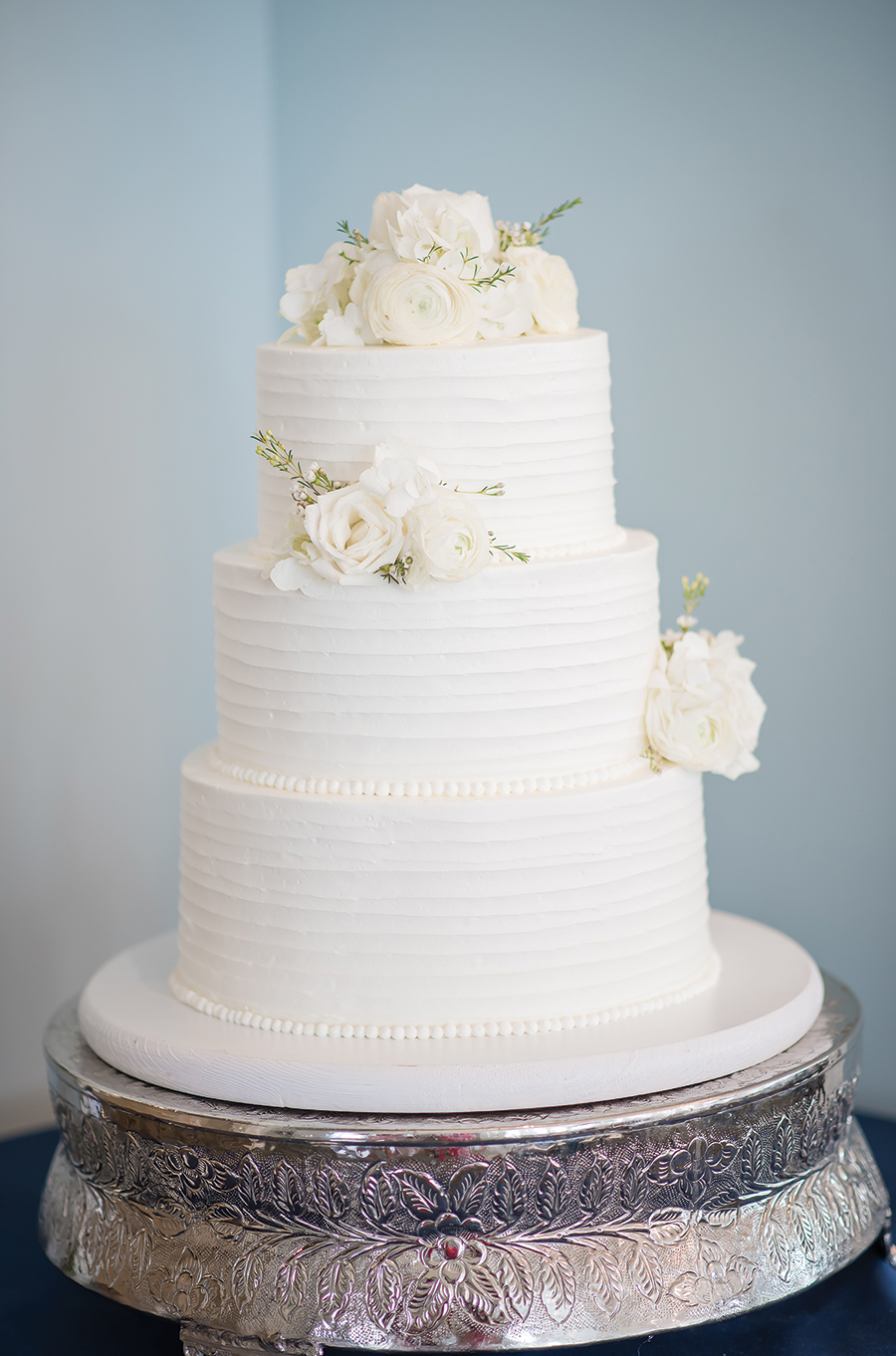
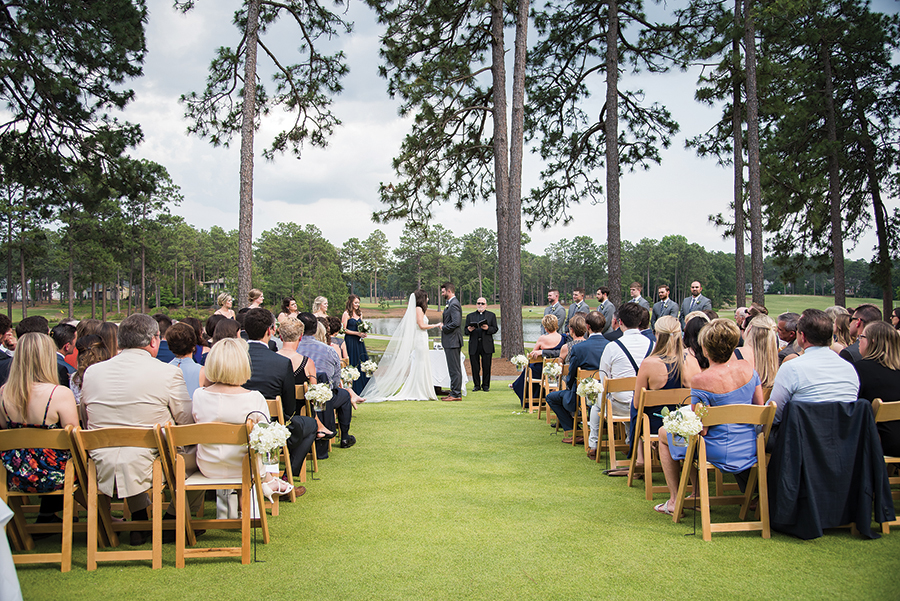
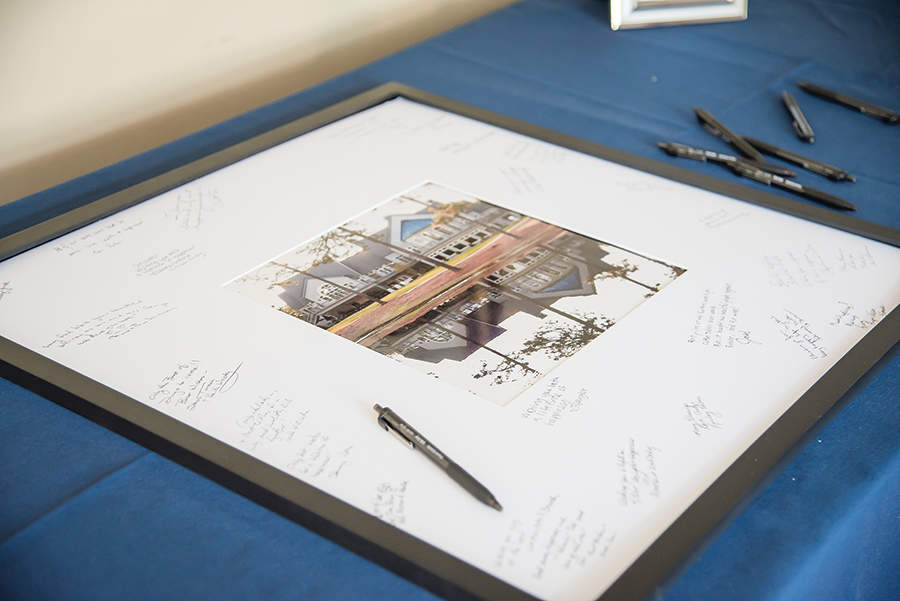
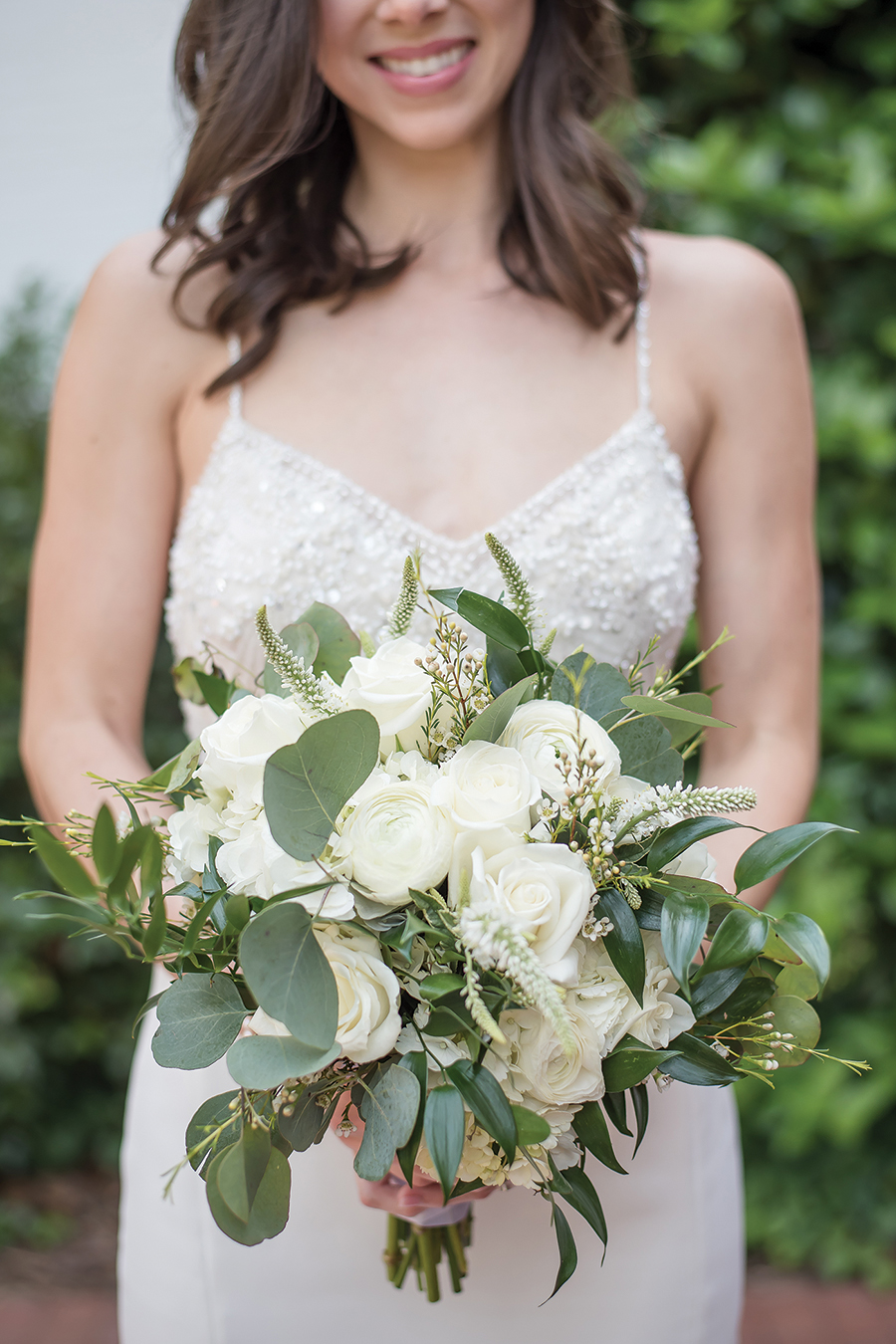
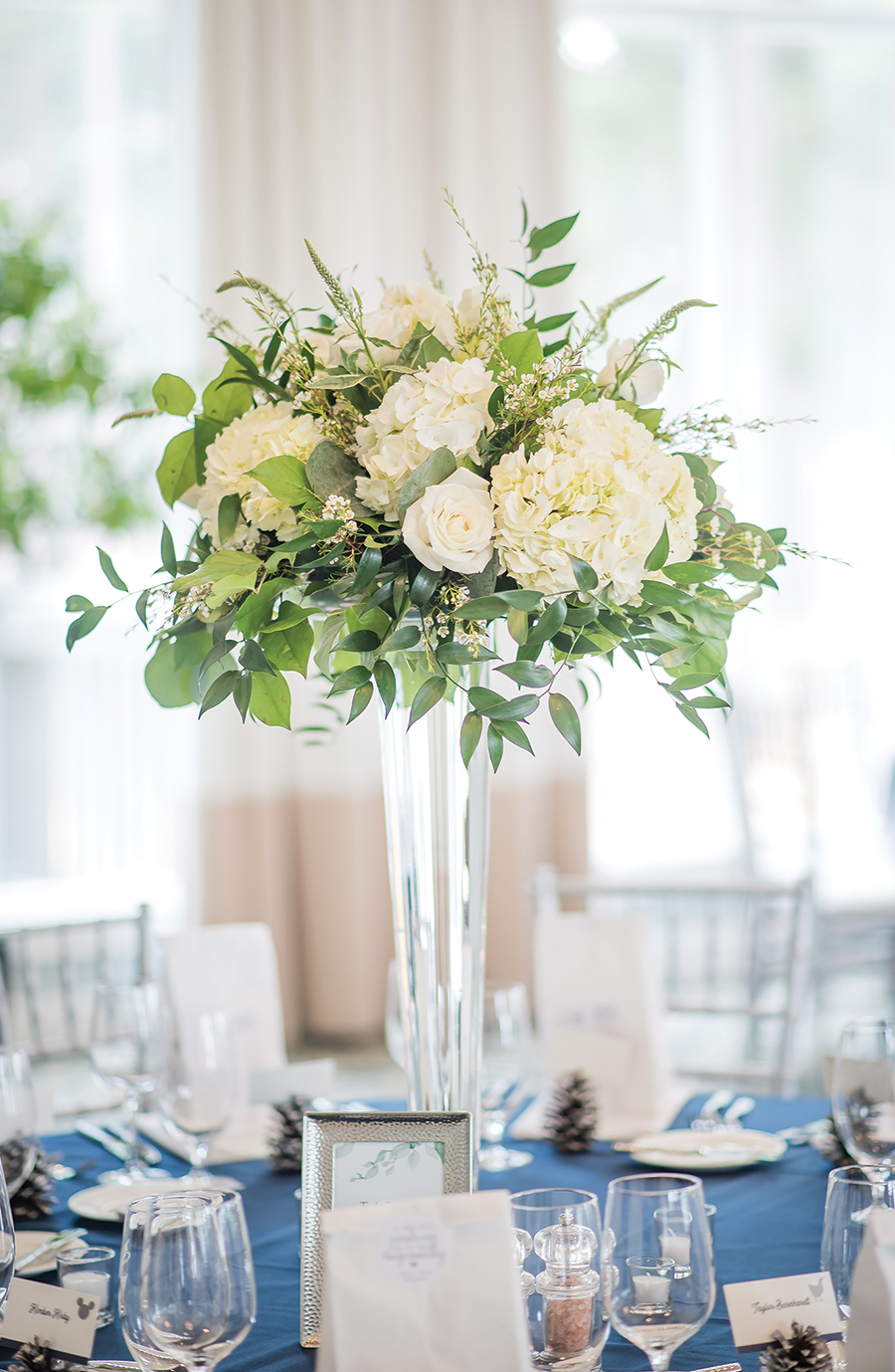
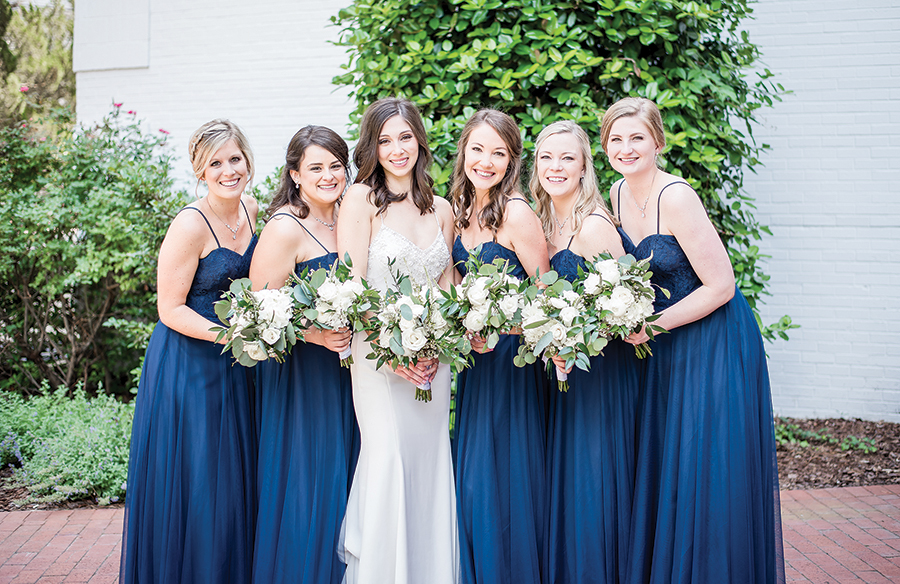
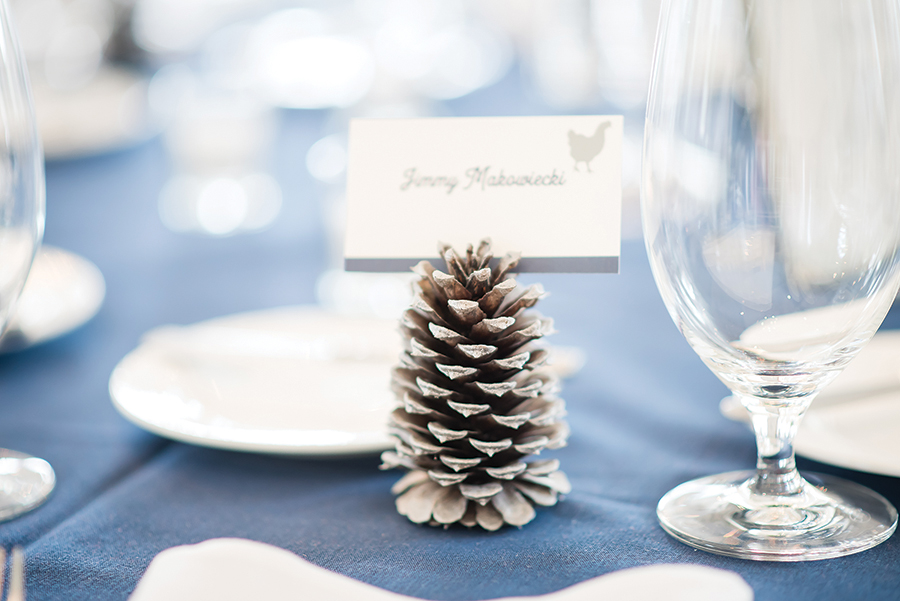
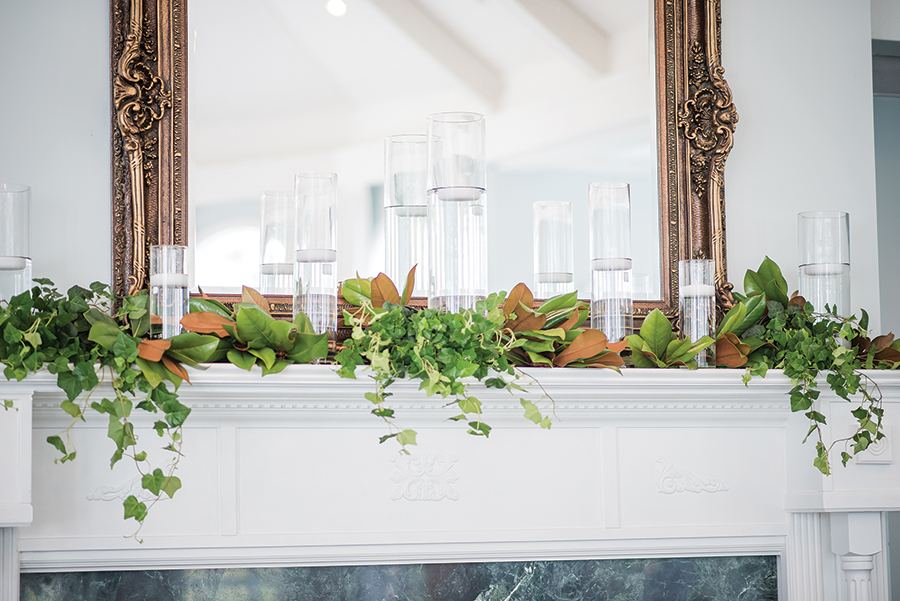
A vase, filled with stones hand-picked and prayed over by each wedding guest, reminds this Charlotte couple of the love they shared with friends and family at their sentimental Pinehurst wedding. This union was focused on making memories, beginning with a proposal that incorporated a three-hour scavenger hunt and family members of the bride and groom. Kent’s love of golf and Jamie’s family connections led the two to pick Pinehurst, where Jamie let the area’s natural beauty take front-and-center in the ceremony on No. 9. Guests from 18 states were on hand to watch the couple say their own vows, a flower girl blow bubbles down the aisle, and a ring-bearer, armed with a water gun, play security. Jamie and her dad performed a surprise choreographed dance, and guests partied while wearing glowing jewelry and glasses. As if all that wasn’t sweet enough, guests departed with custom heart-shaped glazed doughnuts.

Ceremony & Reception: Pinehurst No. 9 Videographer: Davis Video Productions Dress: Willowby by Watters Bridesmaids: Bridals by Lori Groomsmen: JoS. A. Bank | Flowers: Jack Hadden Floral & Event Design Hair: Chelsea Regan Makeup: Julie Robbins Makeup Cake & Catering: Pinehurst Resort | Doughnuts: Southern Angel Donut Co. | Entertainment: Eric Hodgden, All Around Raleigh DJ

Patriot Games

Building on a tradition of success

By Lee Pace

Pinehurst is where the golf architectural genius of Donald Ross sprouted. It’s where thousands of visitors in the 1910s and ’20s were first exposed to golf, were smitten and spread the idea for new courses in their hometowns across the Northeast and Midwest. The No. 2 course at the resort has been host to the U.S. Open (men and women), the U.S. Amateur (men and women), the Ryder Cup and PGA Championship.

There are 40 golf courses within Moore County and a sand wedge of its border.

So why shouldn’t the area be home to one of North Carolina’s juggernaut high school golf teams?

Pinecrest High School has won the boys 4-A state title four of the last six years and collected three in a row from 2015-17. The Patriots finished fifth in the most recent state competition, with Raleigh Broughton taking the championship while Pinecrest’s A.J. Beechler won his second consecutive individual title.

“We broke open the floodgates my senior year, and it seemed to really set the tone for what was to come with future teams,” says Zach Martin, a member of the 2013 state championship team who went on to play at the University of North Carolina. “The success builds on itself. This run of state championships is pretty strong.”

The Patriots’ remarkable stretch of success in both the boys’ and girls’ programs began two decades ago when one of the staff golf professionals at Pinehurst Resort and Country Club was frustrated that there was no golf team at West Pine Middle School. Rich Wainwright wanted a team that his son John, a sixth-grader, could play on and begin to develop his game. So Wainwright volunteered to start a team, hoping John and his friends would be motivated to continue the game into high school at Pinecrest.

“I remember having a lot of fun with it,” says John, who is now 32, and is a golf instructor and tournament director for U.S. Kids Golf in Southern Pines. “A lot of guys got the bug then. Once our team started, we bonded and became lifelong friends. We had golf to talk about during the school day, and it was fun getting out of school for golf matches. That bond and that structure helped when we went to high school.”

When John moved to high school, Wainwright began volunteering as a coach for the Pinecrest team in 2000 and has been the Patriots’ “co-coach” ever since, working with high school staffers Sandy Sackmann, Jennifer Kearney and Lynne Beechler through the years. Wainwright enjoyed his experiences teaching juniors at the club dating back to the 1980s and was further motivated by his boss at Pinehurst, the late Don Padgett Sr., who was a longtime proponent of junior golf and was the resort’s director of golf from 1987-2002.

“Rich always loved to work with youth; he had a drive and enthusiasm to work with young people,” says Ken Crow, who was also on the Pinehurst staff at the time and now has a son, Benjamin, on the Pinecrest team. “Back in the ’80s, Rich was the guy having the most fun in junior clinics, encouraging them to get better.”

Wainwright remembers commiserating with Padgett in the early 2000s over a patch of high scores posted in recent competitions. Padgett, as he was wont to do, leaned back in his office chair overlooking the putting green to the south side of the Pinehurst clubhouse and addressed Wainwright by his nickname, Red.

“Red, just have ’em putt,” Padgett advised. “Teach those kids the short game. Have ’em pitch the ball over that row of bushes and see who can get it closest.”

The light popped on in Wainwright’s head. For going on two decades now, it’s been all about the short game — sage advice not only for high school golf teams but rank-and-file golfers of every shape, size and era.

“If these kids have good short games, we can win most tournaments,” Wainwright says. “I do very little to nothing in the full swing. We do a lot of situational short game practice.”

Golfers coming through the program remember all the 5-foot putts at sundown, their stomachs growling for dinner and the pressure of having to make x-number in succession so everyone could go home.

“We learned a lot about playing under pressure,” Martin says. “Everyone on the team would have to make, like, 10 putts in a row before anyone could go home. You don’t want to be the guy who misses and keeps everyone there to putt another round.”

Sometimes Wainwright will have his golfers hole out a chip before they can leave or even jar two from a bunker before calling it a day. He’ll set up recovery shots from the woods and encourage his golfers to envision a shot with a 7-iron and another with a pitching wedge.

“He’s a numbers guy,” Martin says. “Golf comes down to the short game when you want to score well. He definitely puts a lot of importance on it. It’s paid off the last few years.”

“Dad’s gotten pretty good teaching guys how to play the game of golf better,” John says. “He doesn’t spend too much range time. It’s all about how to get the ball in the hole. How do you still score when you’re not having your best day at ball-striking? It’s been neat to watch him evolve.”

It’s obviously worked well. Pinecrest won the girls’ state title in 2001 and 2016 and the boys’ in 2006, 2013, 2015, 2016 and 2017, and more than a dozen golfers have advanced to play collegiately.

Joshua Martin followed older brother Zach to Chapel Hill. Jack Fields and Robert Riesen also played at Carolina, Eric Bae at Wake Forest and Josh Stockwell at UNC Greensboro. This year’s boys’ team has four players going to Division I schools in Benjamin Crow and Symon Balbin to UNC Greensboro and A.J. Beechler and Attie Giles to East Carolina.

Among the top girls’ players have been Josie Shinn at UNC, Gabrielle Weiss at James Madison, Elizabeth Nguyen at Georgetown and Mackenzie Battle at The Citadel. Wainwright is particularly high on sophomore Jaclyn Kenzel and senior Lorin Wagler on this year’s team.

The environment has helped attract golfers who otherwise might not have been in Pinehurst. Bae, who was born in South Korea, was living in Raleigh when he made the decision to fully commit to becoming an elite golfer, and moved to Pinehurst to live with his adopted uncle.

“If you want to get good at golf, where better place to be than Pinehurst?” asks Bae, who earned a starting position as a freshman last spring at Wake Forest and is a sophomore now. “Playing for Pinecrest was an awesome experience. I enjoyed every minute of it. Guys like Joshua Martin and A.J. were really competitive; it helped me improve as a player. Coach Wainwright created a really good environment for me to improve.”

In mid-April, the Patriots were playing a match at Pinehurst No. 8, the scene of their 2015 state title, when Bae eagled the par-5 17th and then birdied 18 to secure the championship. Giles had a 50-yard wedge shot and knocked it in the hole for an eagle.

“Coach, I channeled my ‘inner Eric Bae,’” Giles told Wainwright.

Wainwright texted Bae and told him, “You’re still helping us win golf tournaments.”

That’s the way it goes in championship athletic programs — success begets success. A culture is created and grows on itself.

“I’ve had a lot of fun,” Wainwright says. “I like to win. My goal is 10 state championships. We’re closing in on it.”  PS

Chapel Hill-based writer Lee Pace has been chronicling the Sandhills golf scene in PineStraw since 2008.

Feathered Phantom

The secretive, beautiful green heron finds a summer home in these parts

By Susan Campbell

Think of a heron and a tall, lanky wader comes to mind. However, the green heron is quite a different animal! This stocky bird is about the size of a crow with relatively short yellow legs. But it does have a dark, dagger-like bill and a handsome, velvety-green back, dark cap and chestnut-colored body. And in true heron form, it moves slowly and deliberately, hunting in and around the water’s edge. Because of this slow-motion lifestyle, this bird is often overlooked. When it flushes from thick vegetation or croaks to advertise its territory might be the rare occasions that this bird gets noticed.

Green herons can be found through most of our state. Here in the Sandhills and Piedmont they spend the spring and summer months in all types of wet habitat. Not surprisingly, they feed on fish, amphibians and large invertebrates. They have even been known to grab hummingbirds from time to time! Very versatile hunters, green herons can dive and swim after prey if motivated. Moving through deep water is likely made possible by their natural buoyancy and partial webbing between their toes. Most remarkably, this is one of a very few bird species that actually uses tools. Individuals have been known to use worms, twigs, feathers, bread crusts and other enticements to lure small fish within easy reach.

Green herons are adaptable when it comes to breeding as well. A pair bond is formed between males and females from spring through late summer. The male will choose a spot and begin nest building early on. The female will take over and construct a platform of sticks that may be solid or quite flimsy. But the nest will always be protected, whether it is in a tree or large shrub. The clutch of three to five eggs is assiduously tended by both parents. Likewise, the young will be fed and brooded not only by the female but by the male as well. And for several weeks the heron family will stick together while the juveniles learn what it takes to survive.

You can expect to see green herons from late March into September. Most members of the population in the Eastern United States then head to the Caribbean and Central America in the fall. Even before this southward movement, individuals may wander in almost any direction, especially if food levels drop or water sources dry up. Individuals have covered very long distances. Surprisingly, a few have been observed as far away as Great Britain and France.

So over the next few months, if you scan the edges of wet habitat, you may be lucky enough to spot a green heron, hunched over with a long, sharp bill, staring intently into the water. Better yet, listen for a loud, catlike “skeow” or odd screaming that may give these somewhat secretive birds away. Should a bird fly, it may seem somewhat crow-like with slow wing beats, but its partially unfolded neck will certainly give it away.  PS

Susan would love to hear from you. Feel free to send wildlife observations to susan@ncaves.com

AI, Phone Home

Is anyone really there?

By Deborah Salomon

I like knowing how things work. Knowledge is power . . . right? This comes from watching my father — a hobbyist handyman/fixer — repair stuff: a toaster, a lamp cord, a toy. Assembling that dreaded “knocked down” furniture filled him with glee. So I experienced no trepidation when, during college summer vacations, my job as an NBC Studios tour guide at the network’s Rockefeller Center headquarters required operating  a wall-sized display that explained how TV works: images are broken down into dots, transmitted from tower to tower and reassembled on home screens. In a flash. That was the late 1950s. Heaven knows how transmission — satellite, cable, digital and otherwise — works these days.

Then, the time I listened attentively, dreamy-eyed, while a boyfriend explained car motors. I even sort-of understand what keeps a 650,000-pound Airbus aloft.

Much knowledge has been gained on the job. I’ve written stories about how a toilet functions (simple and logical, really) and, mid-1980s, the first CAD/CAM computer designing heating/AC systems. That one was dicey: I told the engineer to pretend I’m a fourth-grader. He did. I understood enough — and wrote the story in a fourth-grade vocabulary, for a business magazine, no less. Readers loved it.

That’s the thing: Learning how a motor propels a car isn’t rocket science; computer technology is, and I’m frightened, partly by dependence on machines so few ordinary folks understand. Our human footprint is distilled onto an envelope-sized appliance thinner than an Oreo called a cellphone — a misnomer, since calls are its least-used function. With it, you can close a garage door or order a pizza; navigate Boston or check movie times; watch the ball game or watch your grandchildren — who live in Bangkok. Horrifying news from Dell: “We’re teaching your car how to read your mind.”

How? Can anyone explain that in fourth-grade lingo?

Speaking of fourth-graders, when they ask, “Where’s the cloud?” what’s your answer?

I’m with Michelangelo: “Look up.”

Enter the most fearsome creatures of all named, enigmatically, virtual personal assistants: Siri, Alexa, M, Cortana, Watson et al. The names sound vaguely familiar. Siri? Isn’t she the daughter of Tom Cruise and Katie Holmes? I’m sure Judi Dench played “M” in James Bond flicks. Cortana must be that ski resort in the Italian Alps. As for how they work, don’t ask anyone over 18 unless they have kids over 12. The answer I got: “Siri just asks the computer,” which is 10 feet away, saving me the trip.

Siri, her siblings and similar devices are dubbed artificial intelligence, AI, first explored in the eponymous 2001 film directed by Steven Spielberg, E.T.’s daddy. Because Siri is “artificial,” no need for a please or thank you when shouting orders. But now, the apes have breeched their cages and are rounding up the zookeepers. Watson beat all comers on Jeopardy!  Deep Blue, an IBM prodigy, won at chess against a world champion. Soon, scientists fear, these creatures with a single name (preferably not Meatloaf, Madonna or Omarosa) will start bypassing human input and interacting with each other — maybe take over the world, which might not be so bad considering the job humans are doing.

As a remedy I think schools should adopt a syllabus on How Things Work. Start with filling toothpaste tubes, move on to wrapping Hershey Kisses, inserting cheese slices into cellophane envelopes, then helicopter physics before touching on how the Mars Rover responds to signals sent from Earth, a mere 101.51 million miles away. End, in grade 12, with computer mechanics.

My rabbit-ears antennae pick up grumbling: There goes another sassy old technophobe. Not true. I’m simply scolding the tail that wags the dog. If I need a new kidney, by all means press a button on the 3-D printer and suit me up. But I’m not flagging any self-driven taxi, and if I want a weather report my old-fashioned PC (talk about an oxymoron) does just fine.

But Siri, do text me when you locate my car keys.  PS

Deborah Salomon is a staff writer for PineStraw and The Pilot. She may be reached at debsalomon@nc.rr.com.

June Books

POETRY

Proof, by Murray Dunlap

With the release of Proof, local author Murray Dunlap celebrates the 10-year anniversary of the car accident that left him immobile and with a severe brain injury. The poems chronicle his marriage, relationship with God, and the struggles and confusion he has encountered during his journey. Dunlap worked on the collection during his stay as a writer-in-residence at the Weymouth Center for the Arts and Humanities. 

FICTION

How Hard Can It Be?, by Allison Pearson

Kate Reddy is approaching 50 and facing the ultimate female body betrayal: perimenopause, which she has nicknamed “Perry.” After leaving a highly successful career to raise her family, she finds herself entering the job market once again — no small feat at her age. All the while her husband is in the throes of a midlife crisis and her two children pose typical and not-so-typical challenges. The author of the best-selling I Don’t Know How She Does It leaves the reader gasping with laughter.

Florida, by Lauren Groff 

In 11 short stories, each masterfully crafted by a writer with a keen eye for humanity, Groff lifts the curtain on the side of Florida the sunburned droves of tourists trekking to man-made meccas miss. Dark, lush and dreamy, the stories depict the dangerous natural elements lurking in the Sunshine State along with its dissatisfied, insecure and flawed characters.

Bring Me Back, by B.A. Paris

The author of Behind Closed Doors returns with a psychological thriller that will keep you guessing until the very end. For the past decade Finn has wondered what happened to his girlfriend, Layla, after she disappeared from a rest stop. When he announces his engagement to Layla’s sister, Ellen, he starts getting signs that can only come from someone who knows her whereabouts
. . . or are they coming from Layla, herself?

Remind Me Again What Happened, by Joanna Luloff

A traveling journalist, Claire goes on an assignment to India, contracts Japanese encephalitis and wakes up alone in a hospital in the Florida Keys. Her husband and best friend come to be with her, and eventually take her home, but her memory loss wears on them all. Remind Me Again What Happened is a fascinating look at friendship and how events in our lives change those relationships.

Left: A Love Story, by Mary Hogan

Fay and Paul are vacationing in Spain when the first signs that something is wrong with Paul begin. Everything comes to a standstill when he falls and requires surgery. His mind is never the same, and Fay must learn to live with her new life. A touching account of loving someone in sickness and in health.

NONFICTION

Lincoln’s Last Trial, by Dan Abrams and David Fisher

At the end of the summer of 1859, 22-year-old “Peachy” Quinn Harrison went on trial for murder in Springfield, Illinois. Abraham Lincoln, who had been involved in more than 3,000 cases — including more than 25 murder trials — during his two-decade legal career, was hired to defend him.  Lincoln’s Last Trial captures a moment that shines a light on our legal system in a battle that remains incredibly relevant today.

The Price of Greatness: Alexander Hamilton, James Madison, and the Creation of American Oligarchy, by Jay Cost

Hamilton emphasized economic growth and Madison the importance of republican principles. Cost argues that both men were right and that their quarrel reveals a fundamental paradox at the heart of the American experiment. He shows that each man, in his own way, came to accept corruption as a cost of growth. The Price of Greatness reveals the trade-off that made the United States the richest nation in human history, and that continues to fracture our politics to this day.

Race to Save the Romanovs: The Truth Behind the Secret Plans to Rescue the Russian Imperial Family, by Helen Rappaport

Investigating the murder of the Russian imperial family, Helen Rappaport embarks on a quest to uncover the various international plots and plans to save them, why they failed, and who was responsible. She draws on never-before-seen sources from archives in the United States, Russia, Spain and the United Kingdom, creating a powerful account of near misses and close calls with a heartbreaking conclusion.

CHILDREN’S BOOKS

Brave Enough for Two, by Jonathan D. Voss

Hoot and Olive are best friends and adventure lovers. As often happens, opposites attract. Olive likes her adventure in books while Hoot prefers the great outdoors. But, when good friends get together, things always seem to work out. With classic-feeling illustrations and a gentle back-and-forth story, Hoot and Olive are reminiscent of the friendships found in the A.A. Milne Winnie the Pooh stories. (Ages 3-6.)

Crunch the Shy Dinosaur, by Cirocco Dunlap, with illustrations by Greg Pizzoli

Shhhhh. Crunch the Dinosaur wants to come out and play, but is just too shy. Whisper his name and maybe he will venture out to join you. Engaging and interactive, this cute new dinosaur tale will delight young readers over and over again. (Ages 3-6.)

The Inventors at No. 8, by A.M. Morgen

On the eve of his 10th birthday, George, the third Lord of Devonshire, has suffered the death of almost all of the adults closest to him. His only guardian is his manservant, Frobisher. The pair survive by selling the furnishings from George’s house. When a thief tries to steal George’s legacy, his grandfather’s map to the Star of Victory, an ingenious mechanical bird intervenes. Jam-packed with thieves, clues and intrigue, The Inventors at No. 8 is a great summer read. (Ages 8-13.)

Neverworld Wake, by Marisha Pessl

Beatrice, Martha, Cannon, Whitley and Kipling find themselves in the Neverworld Wake, the hours the friends relive over and over, a hundred, a thousand, possibly a million times as they search for answers about their friend, Jim’s, death, and the accident that threw them into the wake. “The first thing you must do is stay calm,” says the mysterious Keeper. This psychological thriller of the most fascinating sort, where one’s worst nightmare is relived again and again, is an absolute beach-bag must for fans of Gone Girl, We Were Liars and We Are the Goldens. (Ages 14 to adult.)  PS

Compiled by Kimberly Daniels Taws and Angie Tally.

Old Forty

Even the best of rides can throw a rod once in a while

By Tom Bryant

In 1959, the summer before my first year of college, my dad bought me a 1940 four-door deluxe Chevrolet. It was the finest car ever made, at least to me. There is something about a youngster’s first automobile. The occasion creates an aura of independence, open roads, traveling, seeing the country. Adventures are only limited by the imagination.

Dad bought the almost 20-year-old car at an estate sale in Pinehurst and called me at the ice plant where I was working a summer job before going off to Brevard College. He was the superintendent at the plant and gave me the job to supplement my spending money for school. The chief engineer on duty that day called me to the phone that was hanging on a post in the engine room. Dad said, “Tom, I need you to help me move some stuff at home. I’ll pick you up in a few minutes.”

“What stuff? I’m in the middle of pulling ice right now.”

“Never mind, let Walter take over. You’ll only be gone an hour or two.”

Walter was another summer employee, and we alternated the chore of pulling ice from the huge brine tanks. We used an immense crane that could lift 10 blocks weighing 400 pound each all at once. It was not my favorite job around the plant, so I was glad to let him take over.

When Dad arrived, he went to his office to check messages, and I waited in the car. In a few minutes he was back. “I need to go by Pinehurst, and then we’ll run home to move that swing set for the girls.” My sisters were into gymnastics and had an exercise bar and swing set in the backyard. We needed to move it to a shadier spot.

“I hope I’m still on the clock,” I joked. “I need the money. School is only six weeks away.” In those days I made the minimum wage, which was a dollar an hour. A 40-hour week provided, before taxes, $40, a lot of money in the ’50s.

I assumed we were going by the old chicken plant in Pinehurst where Dad was the consultant for the refrigeration system, so I didn’t pay a lot of attention when we pulled in to the driveway of an old house that had seen better days. He stopped in front of a ramshackle single garage. A dusty car squatted forlornly in the dark opening. “There it is, buddy roe,” he said.

“There what is?”

“Your new ride.” I piled out of the car and, somewhat dazed, walked to the garage and the dust-covered vehicle. It was so dirty, with years of accumulated grime, that I could hardly tell its color.

“What do you think?” Dad asked.

I was flabbergasted. I didn’t know what to say. “Will it run?”

“Sure it’ll run. I checked it out before I bought it. It’s gonna need a lot of cleaning and some small repairs, but she’s solid and, with a little work, will carry you many miles.”

I opened the driver’s side door and crawled in. It was magnificent, dirty but magnificent. I looked out at Dad and asked, “Can I crank it?”

“Sure, the switch for the starter is on the floor. I’ve already put in a new battery, so she should fire without any problem.”

I pushed down on the switch and the old vehicle roared into action.

“OK, son, back her out and I’ll follow you home.”

That was easier said than done. When I was just on the outskirts of Pinebluff, cruising at about 40 miles an hour, the right back tire blew like a firecracker. As I was pulling to a slow stop on the side of the road, the left front tire also blew out with a bang. Dad was right behind me and pulled over, got out of his car and walked up laughing. “I thought we’d make it home anyway,” he said, chuckling. “Those old tires are the originals and are dry rotted. They’ll have to be replaced. You wait here and I’ll get a wrecker to pull your car back to the plant, and we’ll put on a new set of tires.”

The rest of the day was a blur. Dad went to town and bought a set of tires from the automotive store, and the guys working at the plant helped me install them. I remember changing the oil and using some of the plant’s equipment to grease the old vehicle. It had been years since she had been serviced.

That day began a love affair with the ancient ride that we nicknamed plainly “The Old Forty.” I used her for all sorts of things: camping, hunting, fishing. She carried friends and me many, many miles safely and only left us, or me, rather, stranded once. It was my sophomore year and I was on the way to school, clipping through Hendersonville, about 20 miles from Brevard, at a pretty good pace. I topped a rise right outside of town and heard something give way in the engine. I pulled into the gravel parking lot of a two-pump service station, got out of the car, raised the hood and heard rattling. It sounded like something in the motor was using a hammer trying to get out.

An old guy, dressed in bib overalls, walked over, looked under the hood and motioned for me to shut down the engine. “I’m sorry, old sport,” he said as he leaned in the passenger-side window, “but I do believe you have, as they say in the vernacular, thrown a rod.” He spit a dollop of chewing tobacco out the corner of his mouth. “It looks like you’re heading to school,” he said, noticing the load of camping gear, clothes and boxes in the back seat.

“Yes sir, Brevard. The semester starts tomorrow.”

“Well, I’ll tell you, we might be able to solve this little quandary. Brevard is right down the road. I’ve got some business there this afternoon and if you don’t mind being towed by an old pickup, as a matter of fact about as old as this beauty you’re sporting, I can tow you to school and then you can make arrangements to get her fixed at your convenience.”

We hooked a chain from the front of Old Forty to the hitch on the back of his pickup, and that’s how I arrived at college. The old gentleman and his ancient truck deposited me at the rear of my dorm, right across from the cafeteria where a line was forming for evening chow. A cheer went up as we unhooked from his pickup and pushed my car into a parking spot. The old guy grinned and said, “It looks like some of those folks are glad to see you.”

That was an understatement. “The Old Forty” became famous as the conveyance that, even though it wouldn’t run, brought me back to an institution of higher learning, or so said many of my friends.

I had the car repaired the next spring and we went on to many more adventures.

A few years later, I was sitting in the front seat of the old vehicle in the parking lot of Ritchie’s Drive-in Bar and Grill, on the outskirts of Elon College, another bastion of higher learning I was attending at the time. I had Old Forty idling, heater going full blast, attempting to warm Linda and me. It was right frosty outside and the windows were fogged. I had been planning for weeks to propose marriage to the cute little girl sitting there in the passenger’s seat, and I made the decision, for better or worse, to pop the question.

The stars and moon must have been perfectly aligned that night because Linda said “yes,” and I swear I could hear the old car happily applauding, or maybe it was just the valves rattling as I shut her down and kissed my soon-to-be bride.  PS

Tom Bryant, a Southern Pines resident, is a lifelong outdoorsman and PineStraw’s Sporting Life columnist.