Ashley & Steve Labarre

ASHLEY & STEVE LABARRE

Photographer: Pinehurst Photography Wedding Planner: Vision Events Wedding & Event Planning

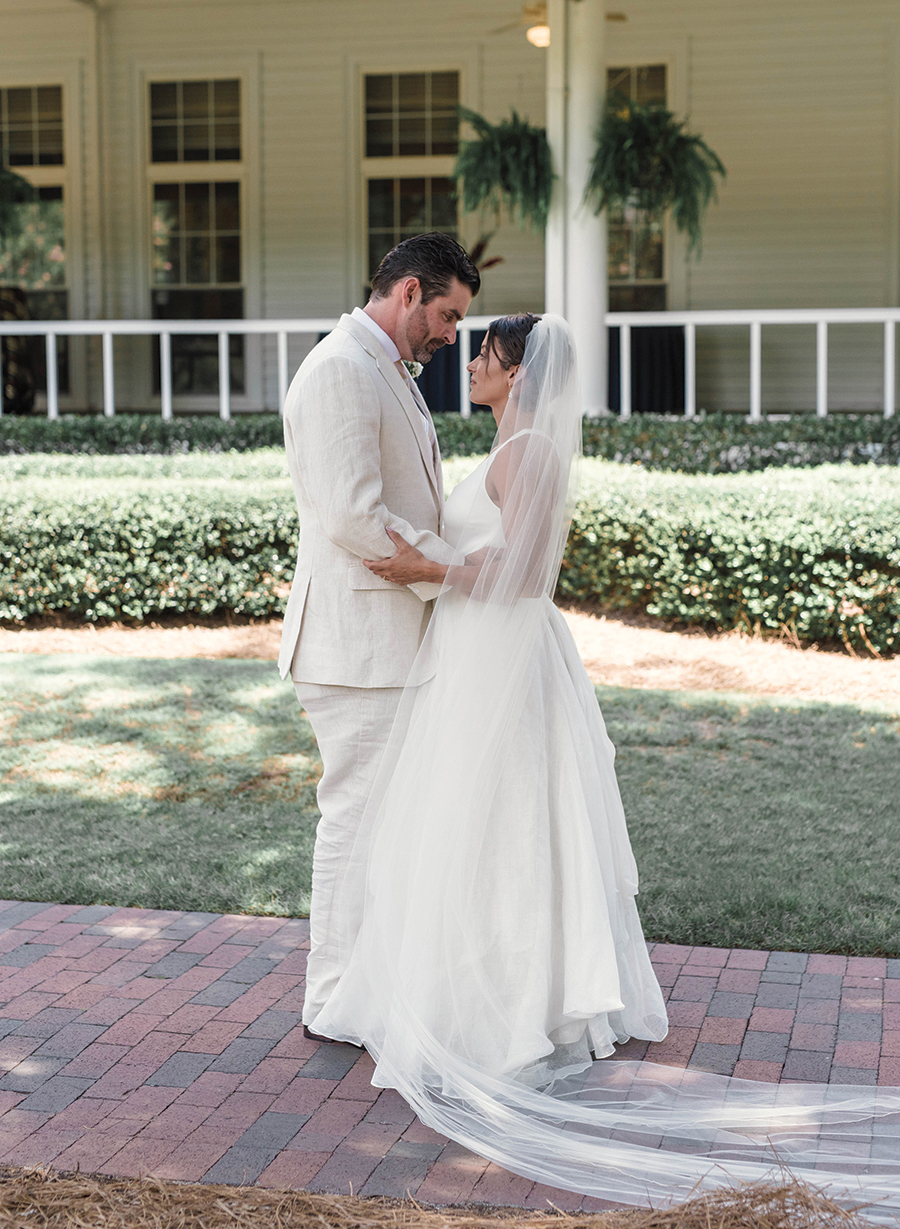
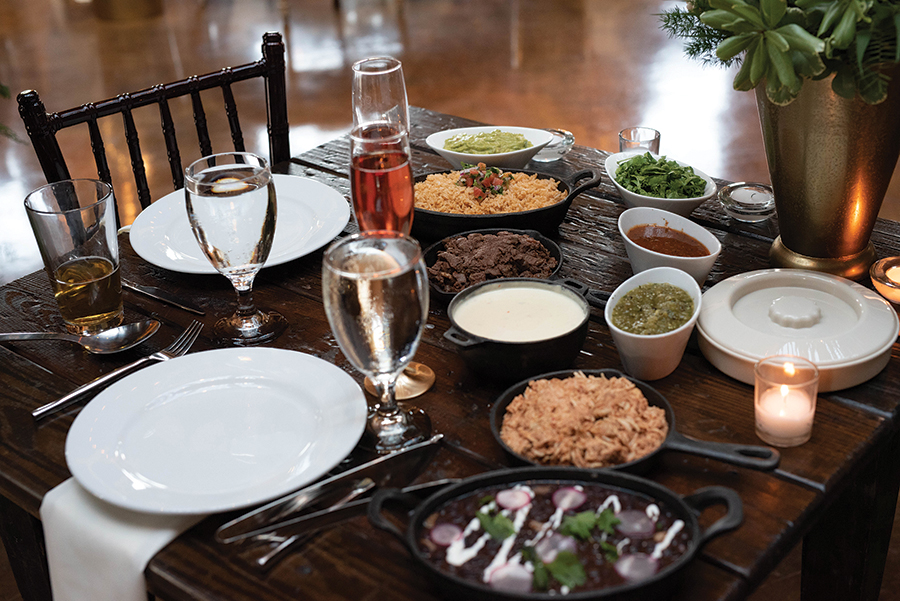
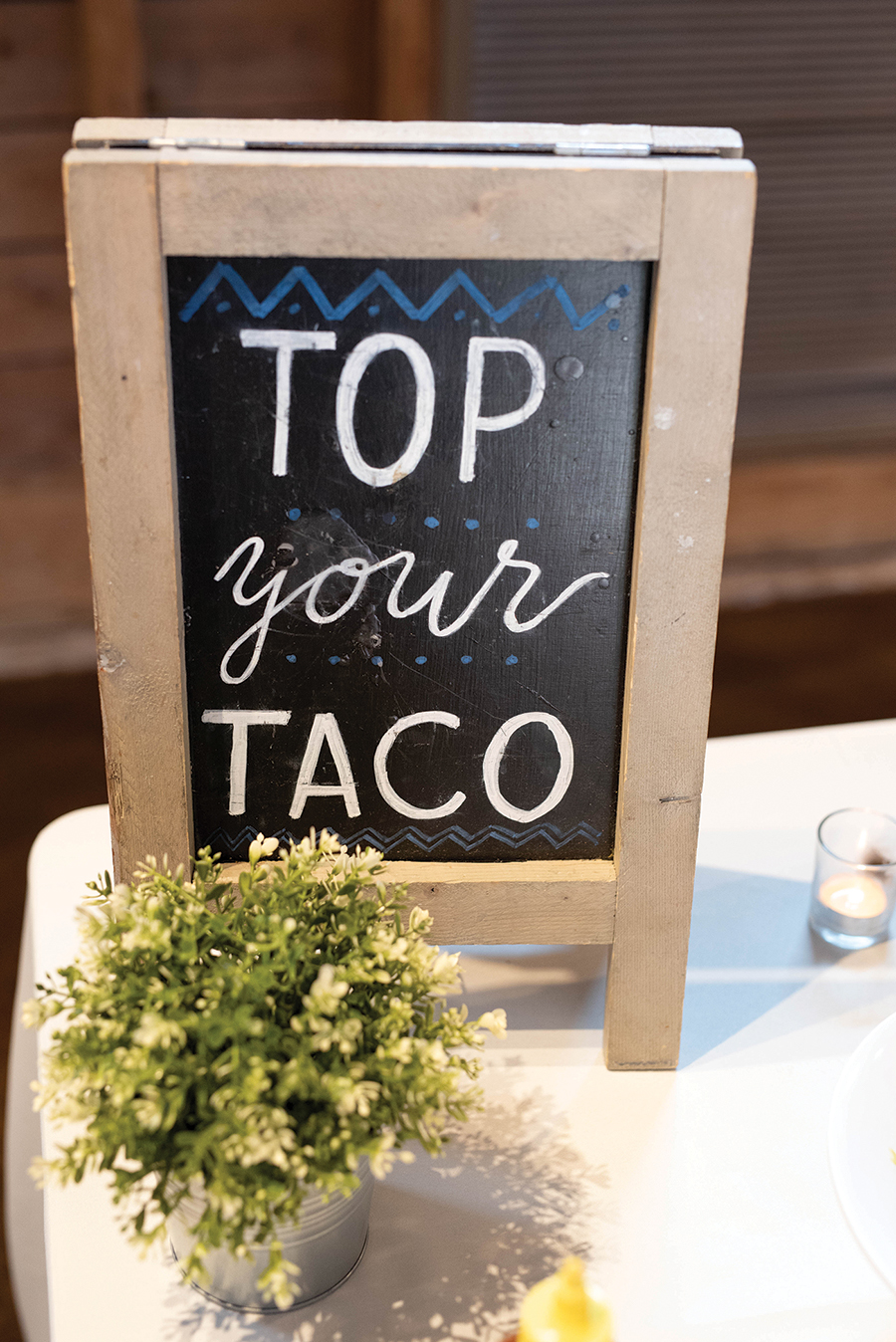
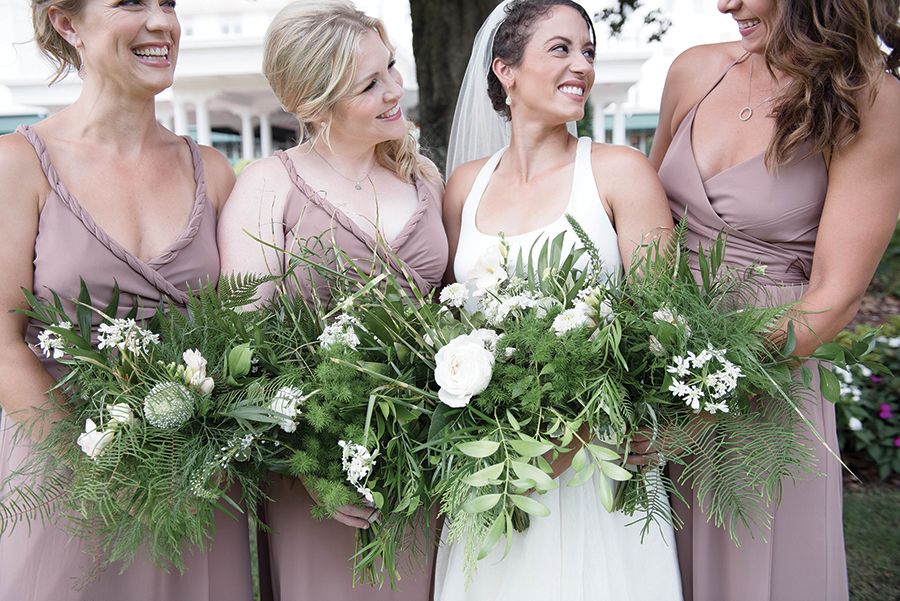
If there’s one way to test the mental fortitude of a new lover, it’s plummeting to the Earth from 14,000 feet up — but Ashley’s work commitments forced this adventurous Army couple to settle on a first date option that was a little more grounded. Three years later, Steve revisited the idea of a skydiving date by planning to propose right after parachutes returned them to terra firma — but Ashley found the ring. So while the couple have yet to jump from a perfectly good airplane, they took the plunge in a summer wedding at the Fair Barn. A fun, casual ceremony that incorporated their own children (Kyla, 9, Lucan, 8, and Addyson, 7) was high on their wish list; and a taco dinner, photo booth, bubbles, and a toast of sparkling grape made it memorable for the more than 40 kids in attendance.

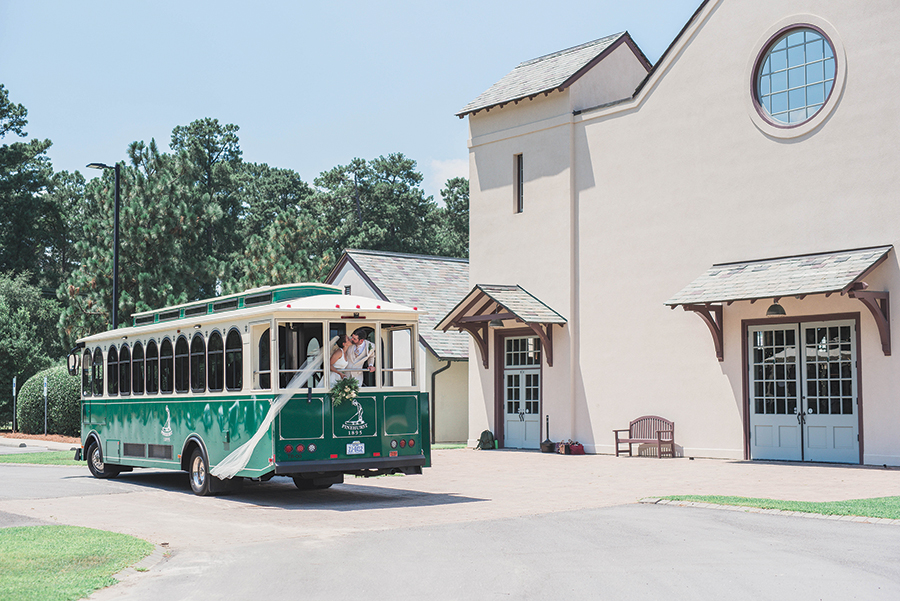
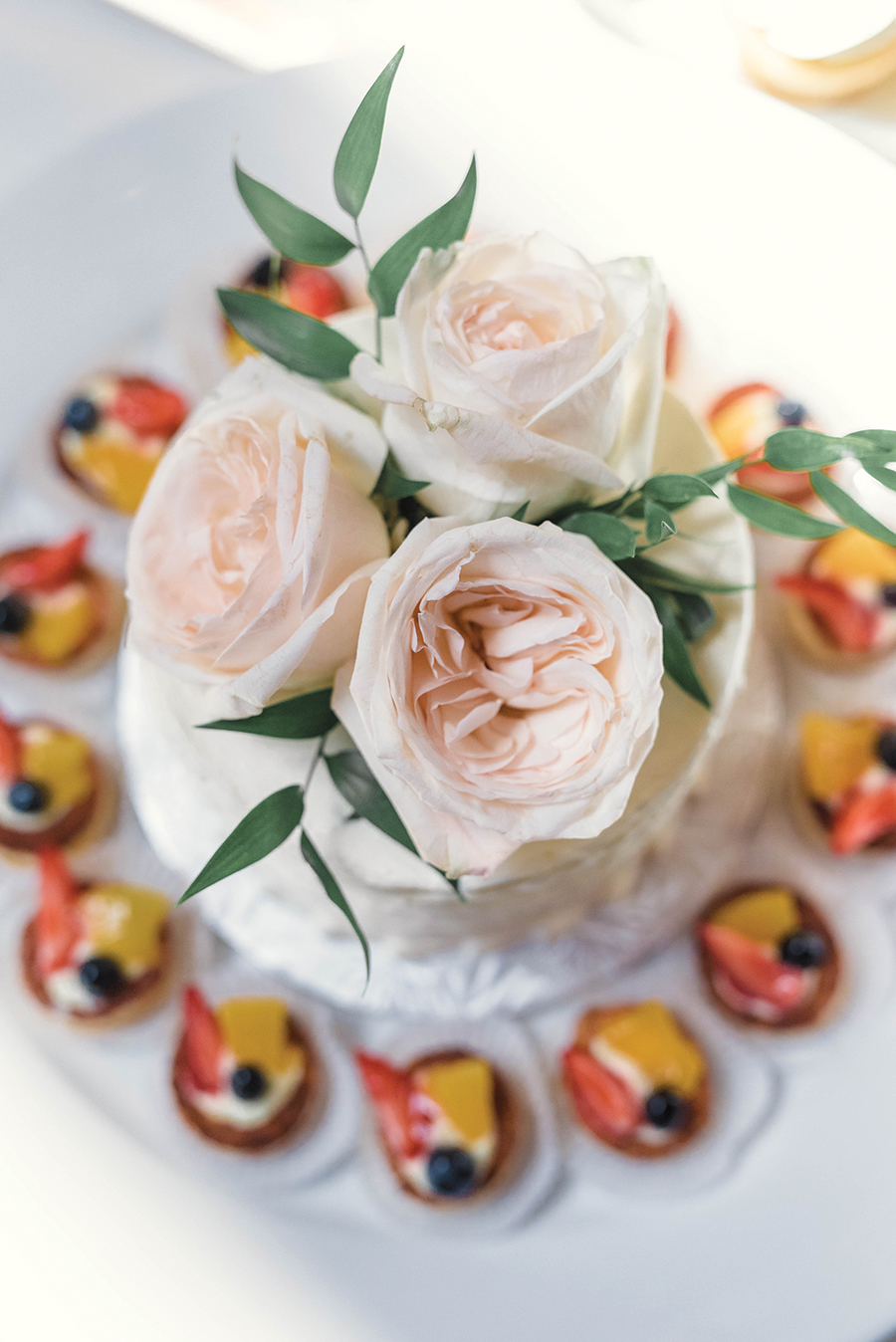
Ceremony & Reception: The Fair Barn | Dress: Carol Hannah | Bridesmaids: Joanna August | Flowers: Specialties Floral and Events Hair & Makeup: Retro Salon | Wedding Rings: Honeycutt Jewelers  Cake: The Bakehouse | Catering: Rocky Top Catering | Entertainment & Photobooth: All Events DJs | Transportation: Pinehurst Hotel Trolly | Specialty Rentals: Greenhouse Picker Sisters | Lighting/Rentals: Ward Productions

Good Natured

Be Optimistic

It’s good for your health

By Karen Frye

Some things are worth working for. Being optimistic may turn out to be one of them. Thinking of your life in the future, always imagine that you have the best of all possible outcomes. Maintaining an upbeat, positive frame of mind may even extend your life. Optimism’s benefits include better mental, emotional and physical health.

Many of us have a friend or loved one suffering from age-related dementia or Alzheimer’s disease. The number of people with this health issue seems to keep increasing even with medications to slow it down. The gene APOEe4 is the risk gene with the greatest known impact, though its presence does not mean that a person will develop Alzheimer’s.

Yale University researchers have discovered that people who carry the gene but hold positive beliefs about aging appear less likely to develop dementia than those with negative aging beliefs. Just by having an optimistic outlook, you can reduce your risk. Feeling good overall about your aging experience can help you deal better with stress. We all recognize the negative effect stress has on our health. Having a positive outlook can help with reductions in stroke, heart disease and pain. It also strengthens the immune system. In a study of more than 2,500 men and women over the age of 65, those who were most optimistic had the lowest blood pressure. The simple fact may be that negativity contributes to deteriorating health and disease. Just by keeping an upbeat attitude you can reduce inflammation, lower cortisol, and lower cholesterol, underlying causes of chronic disease.

Here are a few ideas to get you started on becoming the optimist you want to be.

— Notice how you perceive the world around you; the more you recognize the positive things in your life, the easier it becomes to see them in the future.

— Even in difficulty and uncertainty, there is always a lot to feel positive about.

— Take a few index cards and write helpful reminders, positive messages and put them in places where you see them throughout the day to keep your thoughts on the right track.

As this practice becomes a normal way of life, your health conditions may start to improve and your quality of life will be better. You might find that people want to be around you because you boost their optimism.

See more goodness in life, and your life will be rewarded with a warm heart and a long healthy life.

All the best on your journey.  PS

Karen Frye is the owner and founder of Natures Own and teaches yoga at the Bikram Yoga Studio.

Pleasures of Life

Hail the Tomato

The indispensible veggie/fruit/berry

By Michael Smith

Garden-fresh tomatoes will soon play center stage at Sandhills farmers markets. The things purporting to be tomatoes that we’ve endured all winter look like a picture. But then they also taste like a picture.

You say “tumahtoe,” I say “toomaydo,” the French and Spanish say “tomate,” Dutch say “tomaat,” and Italians say “pomodoro.” Whatever, those luscious little veggies soon will find their way onto our plates and delight our palates. Tomatoes are not just good, nay, they’re good for you. They’re chock-full of vitamins and stuff like lycopene, an antioxidant that is good for the heart and effective against certain cancers.

Americans love tomatoes. According to the USDA, the average American eats 23 pounds of tomatoes each year. And a Google search reveals that 93 percent of American gardeners grow tomatoes in their yards.

Did I say luscious “little veggies?” Should I have said luscious little fruits? Doesn’t matter to me and probably not to you. But back in the day, it did matter to the United States Supreme Court.

On May 10, 1893, the Supreme Court decided that tomatoes are vegetables. Case closed. That, despite the fact that, botanically, fruits — say, tomatoes, for example — surround their seed(s) with fleshy material. Vegetables don’t. (Bet you’re already wondering about seedless grapes, seedless watermelons, and seedless oranges.) The Supremes found that dictionaries did not sufficiently settle the question so, as it’s wont to do, the court decided the issue using the “common language of the people.” Most folks say tomatoes are vegetables.

Phytologists might have a word or two to contribute to that. They study plants and to them, tomatoes are more nearly a berry. New Jersey sides with the Supremes. There, the tomato is the state vegetable. In Ohio it’s the state fruit. Arkansas covers all bases. There the tomato is both the state fruit and state vegetable.

Moving right along, Americans grow tomatoes as annual plants, but they are actually perennials. They still grow wild in the Andes mountains. Actually, you can nurse the plants through the winter and plant them again next spring.

Tomatoes have an interesting history. One source traces them to the early Aztecs, circa 700 A.D. But by the time Spanish explorers began ripping off South America, tomatoes were pervasive and enjoyed by natives there as a food staple. They grew wild and they were also cultivated for food. In addition, they were regarded as an aphrodisiac, which probably had most to do with why tomatoes were sent back to Europe, along with everything else of value.

Once there, the French apparently took the aphrodisiac business to heart. They called the tomato pomme d’ amore or “apple of love.” Tomatoes were also embraced as part of the Spanish diet. Upper-class Brits took a pass on the things while lower-class Brits ate tomatoes with gusto. One theory about that is that the rich folks ate off pewter flatware with a high lead content. Tomato acid caused the lead to mix into the food and lead poisoning led to bad results. Poor people used wooden plates.

A more probable explanation for literate rich Brits eschewing tomatoes is that the tomato plant closely resembles the nightshade plant which is, in fact, poison and can even be fatal. Fast-forward to America’s Colonies. Tomatoes got off to a very slow start. Apparently, the nightshade/poison fiction came over with the Pilgrims. And the apple of love business was definitely not a hit with the Puritans. None of that “hot tomato” stuff.

High-profile dudes like Thomas Jefferson, Col. Robert Gibbon Johnson, and Joseph Campbell popularized tomatoes and ensured their place in our culture. Jefferson grew them in his garden and promoted their use in cooking. Johnson, as late as 1830, had the temerity to eat the things on the steps of a local courthouse, where folks lined up to watch him die. And in 1897, Campbell began marketing condensed tomato soup. Now, would Campbell Soup do you wrong?

Given the popularity of the tomato, a body might think America would be the largest tomato producer. Not so, it’s China. America’s second. In America, Florida grows the most fresh tomatoes, while California processes the most tomatoes used in soups, sauces, salsas, salads, ketchup and multitudes of similar commodities.

Tomatoes are not just garden-variety, either. In fact, there are a whopping 10,000 varieties of the vegetables, uh, fruits, uh, berries. And they come in red, pink, purple, black, yellow and even white. So there’s something for everybody.

Tomatoes are spacey. That’s right,  according to NASA.gov, 600,000 tomato seeds traveled to the International Space Station and back. As part of the “Tomatosphere Project,” students in Canadian classrooms are using the seeds to grow plants and compare them with plants from seeds that didn’t get to go to space.

Here’s one for the books: The Guinness Book of World Records says between May 2005 and April 2006, a tomato “tree” grown in the Walt Disney World Resort greenhouse produced over 32,000 tomatoes in the first 16 months after it was planted. That scored the record for the most tomatoes in a single year. And here’s another: The heaviest tomato on record was produced in 2013 in Oklahoma. Weight — 7 pounds and 12 ounces. Put that in perspective by considering that the average tomato weighs a mere 4 ounces. Finally, Guinness says the world’s tallest tomato plant was 65 feet, grown in 2000 in Lancashire, United Kingdom.

All right, I promise this is the last one. There’s this little place called Buñol, which is a province of Valencia, Spain. Each year on the last Wednesday of August between 11 a.m. and 1 p.m., as many as 50,000 visitors from everywhere on Earth gather in Buñol for the “La Tomatina” food fight festival. On average, those nuts unleash 243,000 pounds of tomatoes at everything that moves and everything that doesn’t move. Hey, whatever rings your bell.  PS

Michael Smith lives in Talamore, Southern Pines, with his wife, Judee. They moved here in 2017 and wish they had moved here years earlier.

Hometown

Road Game

Putt-Putt: a miniature obsession

By Bill Fields

I’ve gotten to interview some of the greats of golf, stars whose names will resonate as long as the game is played — golfers like Gene Sarazen, Sam Snead and Arnold Palmer. Once, I even got to fly into the Moore County Airport on a jet Palmer was piloting. There might not be any cheering in the press box, but that was cool.

A few years ago, it was a thrill to talk with Rick Baird, John Napoli and Rick Smith.

You probably don’t recognize the latter trio or know why I would have been interested in learning their stories. But for someone who loved Putt-Putt the way I did as a kid — despite not getting to play very often — speaking with those putting legends was as good as it gets, the opposite of the feeling when your colored ball disappeared down the chute on the last hole.

Baird and Napoli are two of only three people to shoot an 18 in a Putt-Putt competition, making a 1 on each of the approximately 30-foot putts. (By comparison, there have been 23 perfect games pitched in Major League Baseball.) Smith was one of the best putters in the heyday of the Professional Putters Association. A teen phenom, he won world titles in 1969 and 1972 and was so skilled with his center-shafted blade that Don Clayton, who opened the first Putt-Putt course in Fayetteville in 1954, nicknamed him “The Ace Machine.”

I’m pretty sure my family believed I got a bit too excited about miniature golf, particularly when I wouldn’t budge from the couch when the Putt-Putt televised series, Parade of Champions, was on Sunday mornings. Smith, Vance Randall, John Connor and the other pros showed that Sam Jones had nothing on them when it came to bank shots. They just made theirs wearing dress loafers.

I was usually in flip-flops while trying to imitate the putting pros — open stance like Smith or closed stance like Randall? — on vacation in Ocean Drive, South Carolina, where I looked forward to the beachside Putt-Putt course more than Hoskins’ flounder or Sno-Cones. One of the other kids going round and round those same 18 holes was none other than Rick Baird. About 40 years later, he shot his “Perfect 18” at a tournament in Richmond, Virginia.

My marathon Putt-Putt days occurred while spending a summer week with my sister in High Point, where there was a 36-hole facility on North Main Street. It was three bucks for as much as you wanted to play on a weekday. Practice didn’t make perfect by any means, but I occasionally broke 30, convinced I would have scored better if I had splurged on an official “steel center” PPA ball. Truer roll, and all that.

Young nerves went a long way on those surfaces. Putt-Putt carpets aren’t as fast now because the specific material isn’t manufactured, but back then they were closer to linoleum than Bermuda overseeded with rye. On a real course, I never played on anything approaching Putt-Putt speed until the mid-1970s on the well-manicured bentgrass surfaces at Quail Ridge in Sanford.

I was not a miniature golf snob, happily going to Jungle Golf or Wacky Golf or whatever other names the places with dinosaurs, rhinos and windmills on Highway 17 in Myrtle Beach were called. My parents and sisters indulged me and played too, although I think they tried to pretend they didn’t know me on the occasions I insisted on using my own putter rather than one of the loaners.

My mother relished her holes-in-one, all the more if I had recently critiqued her grip as better suited for a broom handle than a golf club. She was not a great putter but a very good sport, joining Dad and me at the South of the Border miniature golf course, the round a consolation prize on a desultory ride home from a thwarted trip to the beach. All the motel rooms on the Grand Strand were filled by bikers, which sabotaged our spur-of-the-moment attempt at a long weekend.

On Mom’s 80th birthday trip, a long time since we had done so, we had a game at the beach. I asked a stranger to take a snapshot. We are standing next to a giant plastic flamingo, colored balls in our hands and smiles on our faces.  PS

Southern Pines native Bill Fields, who writes about golf and other things, moved north in 1986 but hasn’t lost his accent.

Mom, Inc.

Sunnybird

And everything she left behind

By Renee Phile

I woke up thinking about her, and I’m not sure why. Facebook told me today is her birthday, so maybe that’s why. Or maybe it’s because my son had his best friend over last night, and as I watched all the non-verbal communication — their inside jokes, looks, smirks, eye rolls — I couldn’t help but think about Serenity. She was my best friend in fourth grade and the grades after that, and although her name is Serenity, she preferred to be called Sunny for short, so I called her Sunnybird. We met in fourth grade on Mercer Christian Academy’s basketball team. Neither of us was really into it, but we kind of tried. Serenity was home-schooled and there was a chance she was going to join me at MCA the next year, and every day I would call her house to get the status.

“Hello?” her mom answered.

“Is Serenity there?”

“Just a minute. (Pause.) Serenity?”

(Phone going through hands, some stumbling around.)

“Hi, Renee!”

“Are you coming to MCA next year?”

“I don’t know yet.”

“OK. Talk to you later!” I would immediately hang up.

During one of the many sleepovers we had, she told me that she wished I had talked longer on the phone — that it hurt her feelings when I ended our conversations so abruptly. “I’m sorry,” I said, and I tried to explain. “I just had a question and needed an answer.”

She did end up going to MCA for fifth grade. Our teacher was Mr. Smith, an older, soft-spoken gentleman who always wore a different belt buckle and played basketball with us during recess. That year I stayed up one night reading and writing a report about Florence Nightingale. It was the first documented all-nighter of my school career.

Serenity sat in the desk behind me. She ate saltine crackers and cheese during class and passed me notes, folded into unique designs. The designs were way fancier than the words, and it was fun to spend five minutes opening a note to see her splashy cursive: “Hi! Want to swing instead of playing ball today?”

I spent lots of nights and days at her three-story house right off the main street in downtown Princeton, West Virginia. On Saturdays we had to clean her bathroom and vacuum before we could do anything fun. Fun meant walking the mile or so to Jason’s Market to buy Carmelo bars, cotton candy gum, Cow Tails, and peach Nehis. We left the market and walked to the cemetery down the road and made up stories about the names on the gravestones while we chomped on our gum and blew big bubbles. Once we saw a black-haired man sitting cross-legged on one of those above-ground graves. (I didn’t know they were called mausoleums.) We watched him for a few minutes, turning him into a serial killer in our imaginations, and then trudged back to her house. When we turned around, we saw him walking after us. We began running, turning down random streets, but he was still there. He was behind us, running just as hard as we were. We flew into her front door and slammed it hard behind us, sure we were seconds from being kidnapped and killed by the guy with black hair who sat on a grave in the cemetery. We told and retold the story for years, each time adding a new, dramatic detail. He had a knife. He snarled. We nearly died that day.

Once Sunnybird was snowed in at my house for a week. Or maybe her parents had gone out of town and it just happened to be snowing. I can’t remember. She decided to leave her folded notes for my parents all over the house, to thank them for letting her stay. Some in cabinets, some in bookshelves, some behind the TV. Each one was specific: “Thank you for letting me use your toilet.” Or, “Thank you for letting me eat your peanut butter.” We saved the ones we could find. There may be some still hidden in that house in the mountains of West Virginia.

We were pretty innocent creatures, trying to figure out life and love and other stuff, and I felt safe when I was with her. She moved to Oklahoma when we were in high school and I felt like I had lost a body part. We sent letters back and forth and she still folded them into fancy designs before she plopped them in the envelope. There were no cell phones, so if we wanted to call each other, we could only talk a few minutes because it was long distance and long distance costs money.

We lost touch over the years, but I see her sometimes on Facebook, and I’m back at the cemetery in fifth grade with a Carmelo bar and a peach Nehi, being chased by someone with black hair until I am safe again.  PS

Renee Phile loves being a mom, even if it doesn’t show at certain moments.

Food for Thought

Pamlico Perfection

There is no need for fancy cooking at the beach, especially when local shrimp are running

By Jane Lear

There is something freewheeling about beach house cookery. All the familiar props, from tools to staple foods, are gone, and most folks happily make do with whatever they can find in a stranger’s kitchen cabinets and at the grocery store, seafood market and farm stand. Everything will taste delicious, after all, because most people who love the beach spend the entire day outdoors. Even if you do nothing more strenuous than laze under an umbrella with the latest page-turner, you somehow manage to work up an appetite.

That’s why I am only fussy about a couple of things. The first is tomatoes. More often than not, I’ve been disappointed by the selection at coastal Carolina farm stands; typically, the tomatoes are commercial hybrids and not very interesting or flavorful. I always hedge my bets, then, by bringing plenty of good ’uns with me — both backyard beefsteaks and heirlooms in varying shapes, sizes and degrees of ripeness. I bring lots of them, enough for a week’s worth of salads and the best sandwiches in the world. I pack them in low cardboard boxes and nestled in beach towels, stem-side up so their rounded shoulders won’t get bruised.

I’m also uncompromising about finding local wild-caught shrimp, one of my favorite beach eats. The brown shrimp (Farfantepenaeus aztecus) that are running now are sweet and fat. And whether you buy them from a seafood purveyor or roadside cooler, don’t be afraid to ask questions about their source. “Anyone selling shrimp should know who they purchased it from (if they didn’t catch it themselves) and should be able to provide some details (e.g., the name of the boat, the fish house, area of the coast, etc.) if it’s from North Carolina,” writes Scott Baker, fisheries specialist for the NC Sea Grant Extension Program. “The NC Catch organization has a directory for seafood retailers that provide local products.” NC Catch can be found online at nccatch.org.

The last North Carolina shrimp I had were real beauts — just hours out of the hold of a boat working Pamlico Sound. This shallow lagoon separating much of the Outer Banks from the mainland is a remarkable body of water; it’s so broad and long that when explorer Giovanni da Verrazzano reached the coast in 1523, he thought he had reached the Pacific Ocean.

My extended family that gathers at the beach expands or contracts depending on circumstances. What never changes, though, is a love of the surf and a great reluctance to leave the beach in order to go make dinner. That means we all share kitchen duty — and no one ever complains about the fact that peel-your-own boiled shrimp is the default meal. Add corn on the cob and a platter of those tomatoes, and you have easily attainable perfection in no time flat.

When it comes to cooking shrimp, I’m a big believer in protecting the physical integrity — thus the flavor and tender texture — of seafood. Unless I’m stuck with very large shrimp, I never fool with deveining. Why open up that thin, resilient armor and risk coarsening such delicate meat? To my mind, there’s no beating the succulence of heads-on shrimp, but lots of people prefer the convenience that comes with buying them heads-off.

I also cook shrimp in the smallest amount of water I can get away with, covering them by just 2 inches or so. As far as the seasoning is concerned, I add a quartered lemon and enough sea salt to make cold tap water taste like the ocean. If you are a fan of a seafood boil blend such as Old Bay or Zatarain’s, toss some in as well, but use a light hand — you don’t want to overwhelm the clean, briny-sweet flavor of the shellfish.

James Beard famously declared that “the unpardonable fault in preparing shrimp is overcooking,” therefore attention must be paid. After bringing the seasoned water to a boil, add the unpeeled shrimp and start timing from that moment. Depending on the size of the shrimp and how many pounds of them are in the pot, begin checking for doneness at about two minutes. Once the shrimp are a beautiful rosy-pink on the outside, opaque inside, and firm yet tender in texture (cut one open to check), immediately drain them in a colander.

Spread newspapers over the table and eat the shrimp hot out of the shell, with melted butter (add garlic or a spritz of lemon if the spirit moves), or cooled, with a horseradishy cocktail sauce. A New Orleans-style rémoulade would be wonderful too, but I don’t know — all that mincing and measuring sounds like too much work at the beach.

The adults in my crowd can easily put away at least three-quarters of a pound of shrimp per person. Any leftovers are tucked into the fridge for lunchtime shrimp rolls the next day. Peel the shrimp and cut them into chunks. Add some Duke’s mayo, a little Dijon mustard, shredded carrot, chopped scallion, and perhaps some chopped red bell pepper or celery for crunch. Serve in lightly toasted hot dog buns. Then slather on more sunscreen and go outside. The surf is waiting.  PS

Jane Lear was the senior articles editor at Gourmet and features director at Martha Stewart Living.

The Accidental Astrologer

Heavens Above

Action-packed planets rule the July Sky

By Astrid Stellanova

Mother Nature provides far more reasons than fireworks on the Fourth to look skyward, Star Children! Come July 15, a crescent moon meets Venus in a swoon-worthy event. That will be followed by a total lunar eclipse on July 27. And then, on the same date, Mars will be ready for its close-up when Earth passes between the Sun and Mars. This will be our biggest, closest and best encounter with Mars — an event that won’t happen again for 17 years.

Should you miss this, optimists and health nuts can mark their Daytimers for July 2035. Ad Astra — Astrid

Cancer (June 21–July 22)

Birthday Child, you’ll be sopping up praise like King’s Syrup on a biscuit this month. There will be plenty of cake, candles, razzle, dazzle and enough sizzle to make this one of your best celebrations ever. In the fullness of time, another side of your life came to life, and it was a beautiful secret modestly kept from many. Your selfless acts have been revealed, and people are wowed by your big ole generous heart.

Leo (July 23–August 22)

Maybe the best thing you can do is to launch a charm offensive, because being defensive just ain’t working for you, Honey. One thing you keep forgetting is how your long trust in an old acquaintance just isn’t working for you as well as it is for them. Speak your truth and let the cards fall slap on the table.

Virgo (August 23–September 22)

Sugar, as irresistible as you are, nobody’s liable to want to steal your blood and sell it. It’s true your sweat tastes like nectar but the skeeters are the only ones that know it. Mix and mingle. Stop being afraid of stranger danger, because you are safe and loved, and attractive to the single and solvent.

Libra (September 23–October 22)

You might as well live in the moment ’cause you might not get into the next one given how badly you’ve been navigating. Your emotional GPS has gone kerflooey and needs resetting. And despite your photographic memory, you seem a tee-ninesy off in your ability to remember where you put your keys or glasses.

Scorpio (October 23–November 21)

A friend will help you move; but a real friend will help move and hide the body. Was there ever a friend who was there no matter what? You know who’s been there for you, and they need you now in their worst hour. Call them, thank them, and show up. If you’re lucky, there won’t be any corpses involved.

Sagittarius (November 22–December 21)

You might be surprised just how far you can stretch one good yarn. The ability to turn everything into a great story is one of your super powers. Work it, Baby! It turns out that everything is useful in this big ole schoolhouse of life, even in the darkest hours. Reuse, recycle, reframe the past and share it.

Capricorn (December 22–January 19)

In the past, you didn’t exactly reach for the stars, Sugar. Some of your extra special powers included Jolly Rancher Jell-O shots, quick quips and sarcasm. It’s your fallback under pressure, and you have sure felt the pressure. Use new muscles. Sarcasm can be inverted into a form of sharp insight — not a bite.

Aquarius (January 20–February 18)

You really tried to fit in, but left others wondering if you are a Southern belle or a dumbbell. The truth is you’re neither. Your good mind and instincts are going to be needed in the latter part of the month when someone near and dear is challenged. Don’t be demure, and don’t play dumb. Step up!

Pisces (February 19–March 20)

If you only knew how long I looked for Mr. Wrong, you might not expect I ever found Beau. For ages I wanted a bad boy, becoming an expert bad girl to match, specializing in seeking rebels without a cause. Being bad never felt as good as the day I woke up and recognized my true love was hiding in plain sight.

Aries (March 21–April 19)

You may have to declare your wild self a disaster area. You are close to qualifying for federal assistance given the way you cut a path of destruction last month. Sugar, your idea of escape since that fiasco has involved a gravy bowl and comfort food. Don’t fall prey to one more ramen noodle or wild whim.

Taurus (April 20–May 20)

Sugar, you got good ammo but bad aim. Your intended target didn’t take a hit, but an innocent did. They are the forgiving type, so if you own and iron things out you won’t feel like such a dip wad. Meanwhile, a dream you pushed aside could happen for you and deserves to be re-examined.

Gemini (May 21–June 20)

That hurt, Sugar. You swallowed your pride and tried to reconnect with an old pal. You felt about as welcome as a yellow jacket in an outhouse or a skeeter in a pup tent. They know they behaved badly; just step back and resolution will come. Meanwhile, a very welcome surprise is on its way. PS

For years, Astrid Stellanova owned and operated Curl Up and Dye Beauty Salon in the boondocks of North Carolina until arthritic fingers and her popular astrological readings provoked a new career path.

Wine Country

Wine Uncorked

It can be simple, easy and eco-friendly

By Angela Sanchez

Why not drink wine out of a can? Why not drink wine from a bottle with a screw cap or Stelvin closure? Maybe, even a keg? Before all of you confirmed cork devotees get too upset, I’m not talking about grand cru Burgundy or first growth Bordeaux or single vineyard California cabernet from Screaming Eagle. I’m talking about wine that is made to be consumed young — what some people refer to as table wine — without oak or bottle aging. It’s the stuff we everyday folk consume on a regular basis. It’s what we take on boats and road trips and keep chilled for the backyard barbecue and camping in the summer. It’s the wine we have in the fridge and on the rack in the kitchen for when a friend drops by and needs a friendly ear. Nothing serious, just a good bottle we enjoy.

Like a lot of people these days, I want convenience that’s also eco-friendly, but my primary reason for exploring alternative closures and vessels for wine is the cork itself. Harvested from cork trees grown in Portugal and then crafted into fitted closures for wine bottles, the cork contains living organisms that can go bad and “taint” the wine. It can happen as often as one in every 12 bottles. According to thekitchn.com, fungi which naturally reside in cork can come into contact with bleaches and other sterilization products found in wine cellars, tainting the wine and rendering it “corked.” Have you ever opened a bottle of wine that smelled and/or tasted like wet cardboard or gym socks? At home you might suffer through it and never purchase that wine again. At a restaurant you paid double, sometimes triple, the actual cost of the bottle and probably just decided you didn’t like the wine or simply chose the wrong bottle. But, no cork, no taint.

This, of course, doesn’t apply to high-end premium wines, single-sourced or from small, highly acclaimed biodynamic vineyards. I’m talking about that bottle you pick up for under $15. If you’re headed to the beach, boat or backyard this month, you want something that tastes good, fits in a cooler, chills quickly, stays that way, and is easily disposed of and recycled. And since you can’t ask the waiter to bring you another bottle, it helps if it’s not tainted. Convenience, taste and an eco-friendly container can all be achieved from wine with a screw cap, in a can, keg or even a box. Studies show, and I have confirmed through years as a wine professional, that screw caps and Stelvin closures keep wine fresher longer, creating less waste. You might even want to avoid the bottle altogether. No glass on the beach or by the pool, and who wants to dig around for a wine tool? One can of wine is equivalent to a half bottle. Coolers are made for cans and, at the end of the day, cans are recycled at an 80 percent rate compared to 20 percent for glass.

Let’s face it, wine can be snobby. A lot of people don’t even like to drink beer out of a can. To each his own. If nothing but a bottle with a cork will do, fine. But it is summer, so don’t be afraid to try something for fun that’s also convenient and friendly to the environment.

Keep your snacks simple too. Easy wine and summer outdoor activities require cheese with great flavor but not too serious aging or washing. Snacking cheese, not thinking cheese. Try a great aged cheddar like Tickler from England with a bit of crunch from whey protein or a Southern classic like pimento cheese. All Southern cooks have their own recipe, usually a blend of cheddars, pimentos, Duke’s mayonnaise and maybe pickled jalapeños or olives. Easily shared and great with simple crackers or used as a dip with celery, pimento cheese is the perfect summer snack. Whatever you choose, it’s July, summer is here, keep it simple and easy.  PS

Angela Sanchez owns Southern Whey, a cheese-centric specialty food store in Southern Pines, with her husband, Chris Abbey. She was in the wine industry for 20 years and was lucky enough to travel the world drinking wine and eating cheese.

Story Of A House

Our House, Our Town

Finding serendipity on Massachusetts Avenue

By Deborah Salomon 
Photographs by John Gessner

When the Roaring ’20s crashed in 1929, so did construction of luxurious winter residences in Southern Pines. One exception was a Dutch Colonial- style home designed by Alfred Yeomans in 1930 on prime Massachusetts Avenue acreage. Yeomans, a landscape designer and James Boyd’s cousin, had built the Highland Inn a few blocks away with Aymar Embury II. The new home on Massachusetts was owned by two daughters of Julia Anna “Annie” DePeyster of Ridgefield, Connecticut — Estelle Hosmer and Mary Justine Martin.

The DePeysters, mother and daughters,  were typical of urban high society flocking to Southern Pines and Pinehurst for the mild winters. The family tree included two Colonial mayors of New York City. Another descendant, Frederick DePeyster, was a loyalist who fought on the side of the British in the Revolutionary War, was exiled to Canada, returned as a wealthy merchant, and rejoined New York’s social and economic elite. Annie DePeyster’s husband, Johnston Livingston de Peyster (a variant of DePeyster)  enlisted in the Union Army at 18 and was credited with raising the first Union flag over the Capitol Building in Richmond, Virginia, after the city fell in 1865. He passed away in 1903. Why the sisters sold the fully furnished house in 1936  to the Catholic Diocese of Raleigh for half price remains a mystery, though Annie passed away a year later at the age of 90. William Hafey, the first Catholic bishop of Raleigh, kept his elderly father there; and Elizabeth Sutherland, a founding member of the Southern Pines Garden Club was a subsequent owner.

How very proud Yeomans, Embury (who built himself a cottage nearby) and the DePeysters would be of their accomplishment, now curated by Mary and Mike Saulnier. The flower, vegetable and herb gardens flourish, laid out and tended by novices who learned as they dug, moving and preserving decades-old plants. The house itself gains personality from irregularities and novelties — off-center dormer placement, angled walls, an exposed brick chimney rising two stories, a back stairway leading to the maid’s room (now a guest suite), a pair of interior windows, massive original bathroom fixtures and black-and-white tiled floors, a call bell system for the servants, and an under-the-stairway closet where hangs a clever fire extinguisher. Iron radiators, some covered with perforated screens, have been left in place as icons of the pre-forced air heating/AC era.
By way of introduction, in the foyer hang Yeomans’ architectural drawings, an homage to history beautifully framed by the Saulniers.

“I found them in the basement,” Mary says.  That find inspired her to compile a scrapbook containing newspaper clippings about the house and its wealthy occupants, as well as other schematics.  Because for Mary and retired Army Col. Mike Saulnier, this home represents another type of find.

“We were looking for a hometown,” Mike says.

Mary spent part of her childhood in Alaskan whaling villages, where her father taught in a one-room schoolhouse, later relocating his wife and eight children to Pennsylvania. Mike, from a military family, moved around.  They met at Shippensburg University.  Beginning in 1999, the military and NATO posted Mike, Mary and their children to The Netherlands, Belgium and Korea, sometimes for several years, with plenty of time to absorb the culture and acquire household goods.

The homesteading desire appeared in 2009, when they were stationed at Fort Bragg.
“We were sitting at the beach, trying to figure out where to live, since we didn’t have any connections,” Mary recalls. While browsing online she found a Weymouth listing that sounded attractive. They drove over and instantly fell in love with the area and, subsequently, the Dutch Colonial, which had been renovated and needed only painting (Mary and Mike did the interior themselves), window treatments, landscaping and minor adjustments.

“It felt right. We never looked anywhere else,” Mary says. Neither golf nor horses influenced their decision.

They moved in 2011 and began making the house their own. An unusual rectangular pool, for example. This came about when Mike discovered nothing would grow on that patch, also that a pool would cost less than a flagstone terrace. But nothing motel-style. He laid out the shape with ropes and hoses. “We wanted it to look like a water feature that had always been here.” The result, a safe 5-foot depth with a grayish pebble lining that makes the pool fade into the surroundings. An ozone purification system replaces chlorine. Add a few lilies and he’d have a pond.

Crumbling bricks on garden walls were made on premises by Yeomans, and a Dutch wooden gate replicates the one hung by the architect.

The main floor has a circular plan; turn right inside the front door, go through the dining room, kitchen and family room, windowless office and into the living room, which opens onto a screened porch. The only addition, by a previous owner, was the family room, which begs the question: Why are the walls angled in several directions?

Mary explains that the room was built not to disturb an ancient tree, perhaps a sugar maple like the huge one with dense canopy that shades and cools a portion of the yard.

That tree, a grassy lawn and boxwoods bring New England to the piney Sandhills.
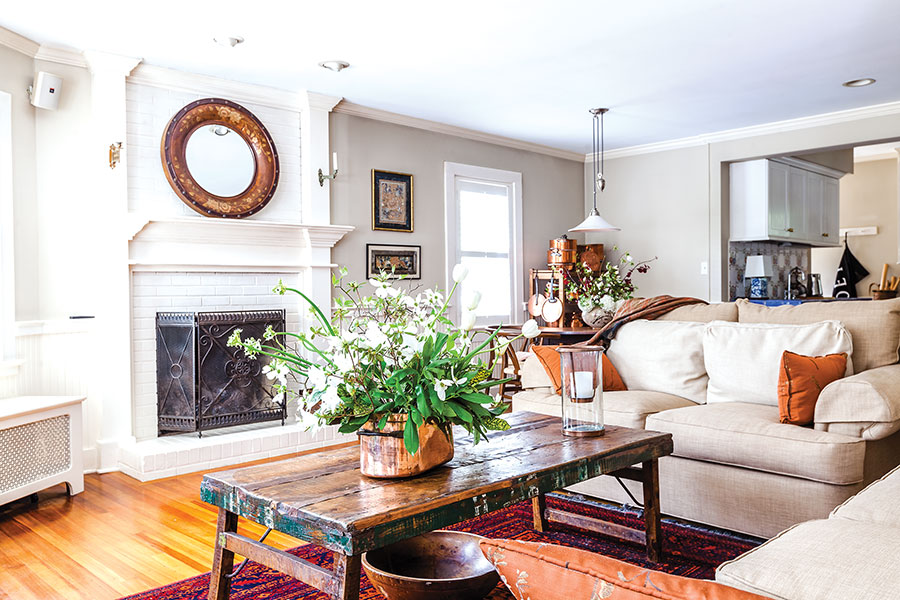
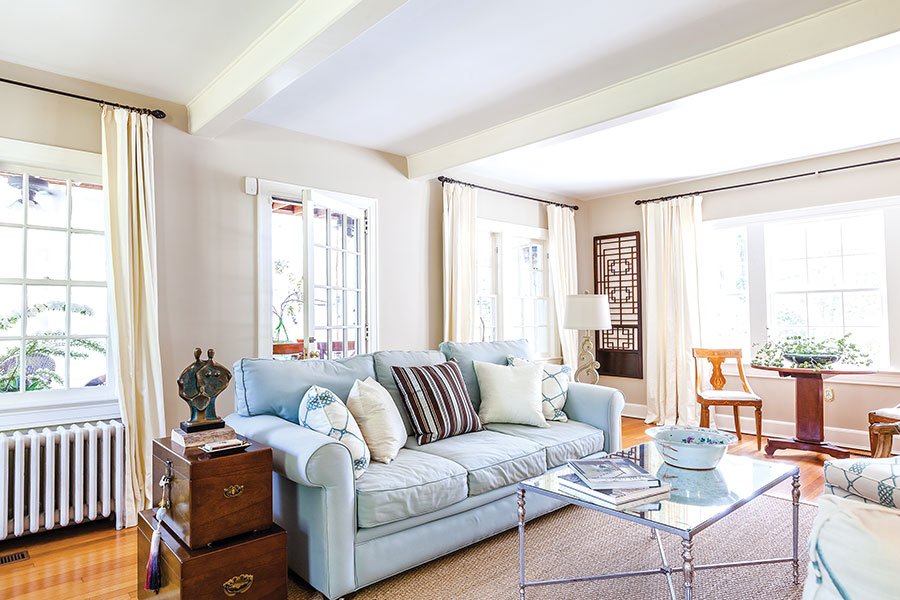
If only nations could live as harmoniously as the furnishings the Saulniers collected in Europe and Korea. An Asian aura prevails, serenely, without resorting to red lacquer. A set of calligraphy brushes on a runner printed with the Korean alphabet adorn the foyer table, hinting at what lies within. Folding screens serve as headboards. Bells line shelves. A step-down bedroom chest, Mary explains, is finished and operational on both sides making it suitable as a room divider. But for every Korean artifact there is a table, a dresser, a desk or bookshelf — some carved antiques, others plain and functional —  acquired at auctions in Belgium and Holland.

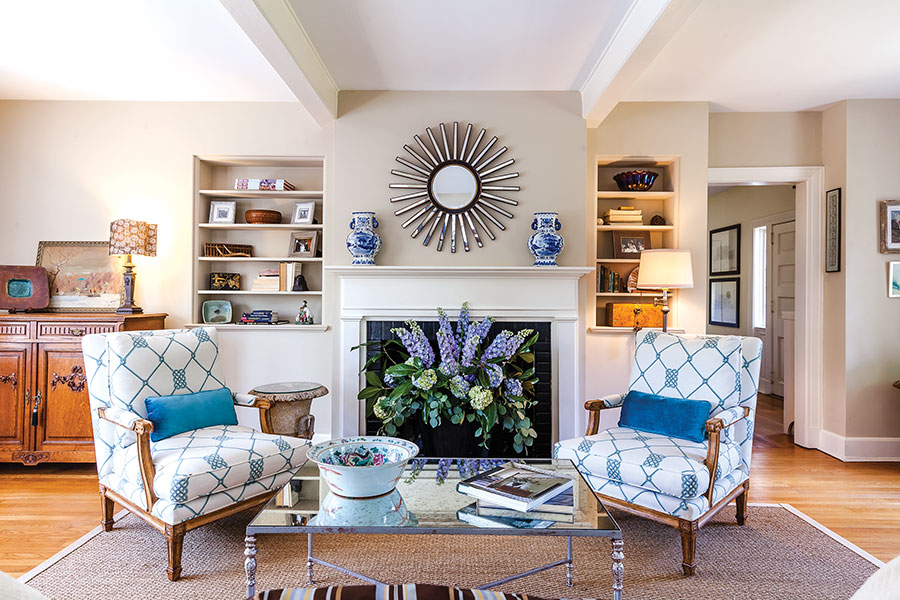
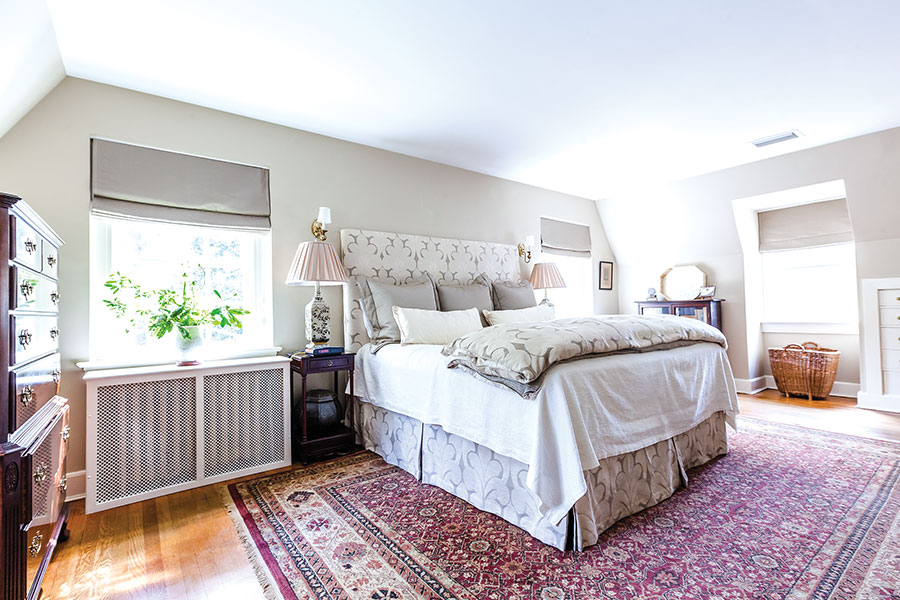
I am naturally attracted to rustic and classic in muted tones,” Mary says. Her palette flows from moss greens and woodsy browns to oatmeal, linen beige, deep maroon and putty. Dusty turquoise appears briefly in the living room alongside an 18th century Flemish tapestry, with a few brightly colored Vietnamese bed coverings upstairs. Mary chose other fabrics with contemporary motifs. She and Mike upholstered bedroom headboards themselves using only plywood, padding, damask and a staple gun. In fact, “Everything we did is the first time we did it,” Mary says.  Original oak and pine floorboards host carpets Mike brought back from Afghanistan. Beams cross the living room ceiling but this is not a house weighed down with crown moldings. Instead, objects like a colorful child’s kimono hung from a curtain rod practically jump off the slightly textured plastered walls.
In the DePeyster’s era a small galley kitchen was sufficient for the hired cook. Now, when houses sink or swim in the kitchen, the Saulniers’ bypasses glitz and gadgets for warmth and European country charm while providing every amenity. An L-shaped layout, beadboard cabinetry (except for a few original carpenter-mades), thick natural wood and Provençal blue ceramic countertops, a French Quimper tile backsplash, a small vegetable sink in addition to the oversize farmer model, make it a comfortable and convenient place to prepare meals. In a corner stands an antique baker’s rack holding Mary’s pride: a collection of polished copper pots and skillets without which a French chef wouldn’t attempt even a scrambled egg.

More than 3,000 square feet on 1 1/2 acres seems generous for two people and a cat. Yet no room (except for the family room adjoining the kitchen) is oversize. Mary thought ahead. “The kids are gone but we want them and the grandchildren (two, already) to come home and stay in the house for holidays and make noise.” Besides, she continues, the way the house is configured, when one area gets noisy other spaces, indoors and out, offer alternatives for quiet conversation.

Back to finding a hometown. As with the house, Mary and Mike Saulnier lucked out. “This area has a real blend of cultures and people and viewpoints,” Mary says. “You go to an art exhibit and every person you meet is from somewhere else — but it’s still a small town.” A small town graced with historic homes, preserved and furnished with fascinating memorabilia of lives well-lived, including theirs.  PS