Good Natured

Buckwheat

More than Alfalfa’s Little Rascals friend

By Karen Frye

Many folks think of buckwheat as a grain — especially because it has “wheat” in the word — but it’s actually a seed. Buckwheat groats (often called kasha) are seeds from a plant related to rhubarb and have been used throughout the world as a regular part of the diet. It can be ground into flour (the pancakes are delicious), eaten as a pasta (soba noodles), a porridge or as buckwheat sprouts.

The nutrients in buckwheat are amazing, making it clearly one of nature’s superfoods. It is gluten-free with few calories and a unique amino acid profile, containing substantial amounts of easily digestible protein. The antioxidant content is impressive with a good amount of rutin, quercetin, magnesium and other important minerals. It is also high in insoluble fiber — almost 5 grams per cup.

You may find you want to ditch your morning bowl of oatmeal or cereal for a bowl of buckwheat groats. You can prepare them easily, and add a little maple syrup or fresh berries to create a superfood breakfast. There is a delicious, easy-to-prepare creamy hot cereal made of buckwheat available at Nature’s Own.

Maybe you or someone you know could use the nutritional perks of buckwheat.  It helps:

— Lower inflammation and increases good cholesterol;

— Balance the blood sugar, reducing the risk of diabetes;

— Lower high blood pressure;

— Prevent gallstones;

— Slow the progression of hardening of the arteries;

— Protect against breast cancer; and

— Relieve constipation.

How about that? A little seed with a powerful punch. Here’s a delicious recipe, great for a summer lunch, and easy to prepare.

Buckwheat Wraps

Makes 6 servings

1/2 cup diced onion

3 1/4 cups water

1 tablespoon miso paste

1 bay leaf

1 1/4 cups buckwheat groats

1 stalk celery, chopped

1/2 cup shredded carrot

Pinch of paprika

Salt and pepper to taste

6 large collard (tender) leaves, chard or cabbage, washed, patted dry and large vein removed

Sauté the onions with 1/4 cup of water for about 3 minutes. Add miso, bay leaf and the remaining 3 cups of water, and bring to a boil. Add the buckwheat and cook over medium heat for 10-12 minutes, or until the buckwheat is soft (but not mushy). Remove from heat and fluff with a fork. Transfer to a mixing bowl and add the celery, carrot, paprika, salt and pepper. Stir and mix well.

Stuff the leaves by adding the mixture (the amount depends on the size of the leaves) toward the wide end of the leaf. Fold the sides of the leaf over the filling and stem, and roll the leaf up, compressing the mixture a bit (like when wrapping a burrito). Use a toothpick or skewer if necessary to keep it together.

Serve with avocado, hummus, tomatoes, spinach leaves, sprouts or whatever you might enjoy! 

Karen Frye is the owner and founder of Nature’s Own and teaches yoga at the Bikram Yoga Studio.

Sporting Life

The Wings of an Idea

A quiet time when the cosmos comes calling

By Tom Bryant

“I don’t know if we each have a destiny, or if we’re all just floatin’ around accidental-like on a breeze. But I, I think maybe it’s both.”       — Forrest Gump

Over the bay there was a bright moon coming up that seemed so close I could reach out and touch it. A few light cotton strips of clouds drifted across the brightness and fostered a feeling of loneliness, although I was right next to a full campground.

Linda, my bride, and I were in Florida, camping in the little Airstream, on a late season trip. We were at our favorite spot, Chokoloskee Island, to hang out, fish (I would do most of the fishing) and, in general, break away from all the rigmarole that seemed to infest our lives of late. Also, it was a trip ostensibly to help me pull together what has become known around our house as “The Book.” I’ve been working on this particular manuscript forever, it seems, and I hoped the different scenery would add a little incentive for getting the bloomin’ thing finished.

Tonight, though, I thought I’d do a little evening fishing to catch some trout for tomorrow’s supper. There was a group of folks out on the end of the boat dock enjoying the moonrise, and they wished me luck as I shoved off in my little canoe.

The bay was as calm as a lake, and the tide was in, which meant I had a couple of hours before the tide shifted and I’d need to get back. Thinking about the tidal flow, I paddled inland toward the Everglades so I’d not have to buck the outflow when it changed.

There is a peacefulness on a gulf bay backlit by a full moon. In no time, I had put out a line baited with shrimp and was enjoying the solitude. I kicked back in the canoe to await a little action and also enjoy the scenery.

During my lifetime in the great outdoors, I’ve had some amazing experiences, a lot of them defying normal explanations; and tonight, drifting along, fishing the bay, I had another. I had just settled down and opened a drink from the cooler when a dolphin surfaced right off the bow of the boat. He played around like he thought the canoe was a friend, and after a short visit, he did a final leap and was gone.

I’ve had other surreal encounters with amazing wild creatures, and as I floated in my canoe on that early spring night, I thought about a couple that had no explanation other than what each was, a gift.

Rich Warters, a good friend, and I were coming out of the woods one spring morning after an early jaunt to try for a turkey. This was our third attempt of the early turkey season, and we had been unsuccessful thus far. Dogwoods were in full bloom, and the air still had a little winter nip in it, so we were glad to get back to the truck, where we had a thermos of coffee waiting. We had poured ourselves a cup of steaming coffee and were standing at the back tailgate of my vehicle commiserating over our lack of success in the turkey-hunting department. We were planning the next day’s adventure when, all of a sudden and seemingly from nowhere, a ruby-throated hummingbird flew right between us, hovered a few seconds, looked at both of us, and was gone. Rich and I stood there opened-mouthed, and Rich exclaimed, “That made my day!”

I replied, “Rich, that made my year!”

There was another time when I was duck hunting and a pair of otters surfaced right beside my boat, looked me over slowly, then disappeared beneath the surface of the water.

The appearances of these wild creatures were amazing, but there was one other wonderful encounter that I’ll always remember.

In the late ’70s, a good friend and I decided to fulfill a long-time career desire to start our own newspaper. Now, we were good in our newspaper endeavors, if not exceptional. Jim was the features editor of a major daily paper in another county, and I was the ad director of our city’s daily newspaper. We were both doing well in our separate divisions of the business, and we felt the timing was right for a new community voice in our market. So, after a year of planning and three months of pulling everything together, we launched our first edition. It was October 1976.

Jimmy Carter, bless his heart, a good old boy from Georgia, was elected president a month after our first edition. Right away, it seemed, the economy tanked. Now I can’t blame Jimmy; I even voted for him. After all, he is Southern, and I loved his brother Billy; but I believe the quagmire that was Washington then and still is today sucked him down as surely as the economy was doing to our fledging newspaper.

For three years we waged an uphill battle. Our circulation continued to climb; but small advertisers, our bread and butter who paid the bills, were on a downhill slide. My partner decided to hang it up, and I was left, a captain on a sinking ship.

I did everything I could, cut everywhere I could, and thought of every solution to save the floundering business, but I had hit a brick wall. One Saturday after a morning at the office, I went home to take a break. Linda was grocery shopping, so I grabbed a beer from the fridge, went out on the deck and sat in one of our rockers. I glanced up at the big white oak trees in our backyard, leafing out in early spring green.

As I looked up, I noticed a piece of leaf, or I thought it was a piece of leaf, fluttering in the top branches. In a moment, I saw it was a butterfly. I watched it for several minutes as it flitted from one tree to another, and then just as if it were on a string, it fluttered down to the deck and lit on my knee. I watched open-mouthed as the big monarch sat there for a few seconds, wings opening and closing, then flew away.

That night I awoke from a deep sleep, sat upright in bed and mentally grabbed the remnants of a fleeting dream. The dream was about a new publication, published for the retail outlet craze, which was in full bloom.

Thus was born The Outlet Outlook, a shopper paper designed for transient outlet shoppers. In no time, we had papers in outlet centers in Burlington, North Carolina; Myrtle Beach and Spartanburg, South Carolina; and Pigeon Forge, Tennessee. As Forrest Gump so eloquently put it, “We had more money than Davy Crockett.”

The tide was beginning to change, and I had three trout in the bucket, enough for tomorrow’s supper, so I decided to head back to camp. It was an easy paddle, and I let the boat drift along, remembering those days when I was much younger. I don’t know if that butterfly was a messenger helping me with my destiny or just a beautiful piece of nature floating along, but I tend to agree with Forrest; maybe it was a little of both.  PS

Tom Bryant, a Southern Pines resident, is a lifelong outdoorsman and PineStraw’s Sporting Life columnist.

Simple Life

Stormy Weather

After withstanding decades of hurricanes, Wilmington’s Blockade Runner is ready to defy the odds once more

By Jim Dodson

On October 10 of last year, Hurricane Michael made landfall on the panhandle of Florida packing sustained winds of 160 mph, a storm verging on Category 5 that entered the record books as the third strongest hurricane on record. After fully devastating Mexico Beach, Michael churned toward the Carolinas as a tropical storm over the next two days, claiming 54 lives from Florida to Virginia, causing $25 billion in property damage.

On the afternoon Michael arrived in North Carolina, I watched on my iPhone weather app as the storm spread its mayhem over Charlotte and took some comfort that the winds and rain were expected to diminish to 30 mph tropical gusts by the time the storm reached the Triad.

The winds and rain arrived on schedule around 3 p.m. Since we live in a neighborhood filled with century-old hardwoods, I stepped outside to see how our elderly trees were handling the winds after one of the wettest autumns on record.

The winds suddenly increased and something blew off my roof with a clatter. It turned out to be a chimney cap, airlifted halfway across our front yard. As I walked over to pick it up, keeping an eye on the churning treetops, things got even crazier. I heard what sounded remarkably like an oncoming freight train and turned around just in time to see the peak of our neighbor’s roof vanish beneath what appeared to be a madly swirling cloud.  Having once been dangerously close to a large tornado, I wasn’t anxious to repeat the experience.

I headed straight inside to chase wife and dogs to the basement but suddenly remembered that I’d left the door to my home office over the garage standing ajar. Like one of those Russian babushkas who insisted on sweeping her stoop before evacuating the Chernobyl nuclear site, I foolishly bolted out the back door even as my phone began shrieking a weather alarm to take shelter immediately.

Taking two steps at once, I reached the top of the garage steps just as the large wooden electrical pole at the rear of our property, bearing a major transformer and various cable lines, snapped like a twig and flew past me like the witch from The Wizard of Oz, crashing into our backyard with a vivid explosion of sparks. For several seconds, I stood there stunned by what I’d seen . . . until I had the good sense to turn around bolt for the basement.

What turned out to be a microburst or tornado, spawned by the fury of Michael’s tropical remnants, knocked over half a dozen ancient trees along our street and plunged the neighborhood into darkness for more than a week. We were among the fortunate ones, though. Our generator came on, and chainsaws came out and neighbors began appearing outside to help assess the damage and begin the cleanup process. Several folks on the street suffered major damage from trees that toppled directly onto their houses, but fortunately there we no serious injuries on our side of town.

My thoughtful neighbor Ken, who lives across the street and had a massive oak take out his center chimney and new second-floor bathroom renovation, shook his head and said it best. “Incredible, isn’t it? Nature’s power always seems to have the final word.”

A few weeks ago, I mentioned this frightening scenario and Ken’s comment to Bill Baggett as we sat together in a newly renovated room on the top floor of the historic Blockade Runner Hotel at Wrightsville Beach. Baggett, 72, simply smiled.

“Nature’s fury has the only word,” he added.

With the first of June looming — the official start of the Atlantic hurricane season that lasts until November 30 —  Baggett and his sister Mary, who jointly own and operate arguably the most beloved and well-known hotel on the North Carolina coast, are something akin to experts on the fickle fury of hurricanes and the unpredictable damage they leave in their aftermath.

Since their family purchased the Blockade Runner from its original owner, Lawrence Lewis of Richmond, Virginia, in 1971, the Baggetts — who assumed operational management of the property in 1984 — have ridden out half a dozen major Atlantic hurricanes and several near misses while hunkered down inside their cozy seaside hotel. Their legacy began with Hurricane Diana in 1984 and continued through last September’s Hurricane Florence, the sea monster that preceded Michael and turned Wilmington and much of Eastern North Carolina into a vast world of water, marooning the Port City for weeks.

In 1984, Diana blew out the hotel’s old-style windows and flooded the ground floor of the hotel with wind-driven rain. “Structurally the hotel was fine. It’s made of reinforced industrial concrete.” Baggett recalled that the worst thing that happened was that the covering for the air vents blew off, allowing rain to flood rooms and public spaces, while destroying plaster walls and ceilings “The hotel was soaked, a real mess, physically and legally,” he said.

When the Baggetts declined to accept their insurance company’s insufficient payout of just $12,000 to cover the extensive damages, they took their case to court, enlisting an expert witness in the person of a retired meteorologist from the Miami Hurricane Center named Robert Simpson, for whom the Saffir-Simpson Hurricane scale is named. His testimony resulted in a more satisfactory settlement  — and a new insurance company going forward.

Three hurricanes in quick succession followed within a decade. Hurricanes Fran (September 1996; 27 fatalities, $5 billion total damage), Bonnie (August 1998, no fatalities but 950,000 people evacuated from the Carolinas, total damage: $1 billion) and Floyd (September 1999, extensive flooding, 76 fatalities, $6.5 billion in total damage) tested the moxie of the Baggetts and their stout lodging. In 1989, even Hurricane Hugo took a passing swipe that blew out Blockade Runner’s windows but otherwise left the property unscathed. 

“Fran was pretty bad,” Baggett recalled. “It took a typical path up the Cape Fear and right over the top, sucking up water from both sides of the hotel — the ocean on one side, the sound on the other. For a while, it was like being in an aquarium,” he allowed with a laugh. “There were six of us in the hotel that night — Mary and myself, one of our cooks and several maintenance folks. Around 11 p.m., the window wall blew out and the water came rushing in, ruining carpets and floors. It was a long night but really the damage in that instance was fortunately fairly minimal. The hotel itself was fine.”

In Fran’s aftermath, in fact, emergency crews from the Red Cross, power companies and relief agencies billeted at the Blockade Runner, which was up and running in a matter of days. “The real issue,” Baggett explained, “was that Fran did serious damage to docks along the sound — prompting fears that the annual Flotilla might be cancelled. Fortunately, everyone worked hard to get the island back in shape and the event came off.”

For her part, Hurricane Bonnie looked fearsome but passed over relatively quickly, moving so swiftly she only took a portion of the Blockade Runner’s roof.

Floyd, however, brought rain on a Biblical scale that flooded numerous towns across the Eastern portions of the state, killing livestock and damaging crops. But once again, with its new roof, the Blockade Runner was updated and “hurricane ready,” as Bill Baggett put it. When Hurricane Matthew banged along the entire east coast in early October of 2016, the hotel barely noticed its passing.

And then, last September, came Florence — a Cat-4 monster that brought new levels of devastation to Wilmington and surrounding region.

“We were a little concerned that she was predicted to come ashore as a Cat-4 hurricane, but we planned to stay in the hotel and ride it out regardless,” said Hurricane Bill Baggett. “I mean, where would we evacuate to — some stick-built motel on the mainland? This hotel is made from industrial reinforced concrete. Besides, by the time the hurricane was on top of us, the only real concern we had — besides water — was the wind.”

By the time Florence rolled over Wrightsville Beach early on Friday morning, September 14, wind shear had weakened the storm to Category 1, wind gusting to 105 mph, which was still sufficient to take out the roof of the Blockade Runner’s balcony and soak some of the hotel’s premium seaside suites.

The major problem with Florence was a record high storm surge of 10 to 13 feet at high tide and the volume of rain. Over two days the storm stalled and lingered over the region, dumping more than 45 inches of rain in places — including on top of the hotel — downing thousands of power lines and trees, making Florence the wettest tropical cyclone to ever hit the Carolinas.

“We lost vents again and had water in some of our tunnels,” Baggett told me, “but for the most part we were in better shape than most people around us.” Because of their working partnership with BELFOR, the property damage specialists who work across the country, response teams were on the site within a day, bringing emergency fuel that allowed the hotel to operate its three large cooling generators and drying machines.

In the aftermath of Florence, much of Wilmington was underwater for the next two weeks, as were numerous towns and cities across Eastern North Carolina.

Fifty-seven deaths were attributed to the storm, and $24 billion in damages to property in North Carolina alone, more than the cost of Matthew and Floyd combined.

As many have done in the wake of Florence, in the process of repairing the damage to their hotel balcony suites, the Baggetts decided to undertake a comprehensive renovation of their landmark hotel, enlisting designer Terry Allred to give the property a fresh new tropical look from top to bottom. The extensive $11 million redo, which includes makeovers of every guest room, dining room and public spaces, is ready to welcome longtime customers and perhaps a new generation of beachcombers to the hotel just as a new summer vacation season dawns.

“Hurricanes are amazingly unpredictable things,” Bill Baggett mused as he showed me through the bright new suites on the balcony floor. “It’s a new roll of the dice every time one of those storms comes out of the Caribbean. But with a jewel like this, Mary and I feel like we are stewards of the hotel. It’s been a pleasure to try and improve it over the years, regardless of whatever comes at us from the sea.” He paused and smiled. “One thing for sure. When the next one comes, we’ll still be here in the hotel.”   PS

Contact Editor Jim Dodson at jim@thepilot.com.

Drinking with Writers

One Man’s Good Advice

Clyde Edgerton and the art of negotiation

By Wiley Cash     Photographs by Mallory Cash

In 2011, my wife and I were living in West Virginia when I learned that my first novel was going to be published. My editor asked me to reach out to any well-known authors I knew to see if they would offer a blurb for the book jacket. The problem? I didn’t know many well-known authors, so I began sleuthing for email addresses. Clyde Edgerton’s was one of the first I found. I wrote to him and told him that I, like him, was a North Carolina native who had written a North Carolina novel, and I wondered if he would be willing to give it a read and consider offering some kind words. He not only read my novel and offered some kind words that ended up on the front of the hardcover, he offered some criticism as well. There was one particular scene in the novel that he felt went on a little too long, and he suggested some edits. I made the edits; they were the last I made before the novel went to print, and they improved the novel in ways I never could have imagined. I had never met Clyde Edgerton. I had never been one of his students. He was just being kind, giving more of his time and talent than I ever expected.

Clyde’s kindness and giving of time continued in the spring of 2012 when he appeared at Pomegranate Books in Wilmington, North Carolina, to attend one of the first events of my book tour. I had not expected him to be there, and it was a little like shooting free throws while Michael Jordan watched from the stands, but I will never forget how deeply honored I felt. At the conclusion of that event, I spoke a little about a new novel that I was working on, and I expressed the difficulty I was having with the ending. A few days later, I received an email from Clyde, sharing his ideas about how to end novels in ways that satisfied both writers and readers.

Clyde and I struck up a friendship after my wife and I moved back to North Carolina and settled in Wilmington in 2013. He christened our second child. Our kids go to the same school. We have shared the stage with other authors at literary events and fundraisers around the South, and over the past few months we have fallen into a routine of eating omelets and biscuits and gravy and sharing sliced tomatoes in a booth at White Front Breakfast House at the corner of Market and 16th Street.

That was where we were sitting recently when I sought Clyde’s advice about a particularly difficult ethical situation I was facing in my professional life. Aside from the respect I have for Clyde as a writer, it is exceeded only by my respect for him as a citizen and altruist. After asking for his advice, Clyde shared some wisdom he had gleaned from a local reverend, friend and ally named Dante Murphy.

“Don’t get angry at people in these situations,” he said. “When it becomes personal that anger can poison you. Get angry at institutions. You can change an institution. It’s harder to change a person.”

Clyde knows what he is talking about. For the past few years he has been one of a handful of citizens leading the charge to uncover racial inequities in the New Hanover County School System, something he first encountered while tutoring students at Forest Hills Elementary. The school had a Spanish language immersion program, and while the student body was 46 percent African-American, every single one of the 40 slots in the language program had been taken by white students before open enrollment even began. Since then, the former principal and school system have given a number of excuses — some laughable, some offensive — about the racial disparity in the program. None of it has deterred Clyde and a group of citizens from following leads, learning of other instances of discrimination or wrongdoing, and meeting with parents, school board members and city and county employees.

None of the students on whose behalf Clyde is working have ever met him. They are not his children, but he is working for them regardless. It is similar to the compassion and care he showed me all those years ago, but the kindness he showed me never got him banned from county school property.

How does Clyde address these issues with school leaders? The same way he approaches finding a satisfying conclusion to a piece of fiction he is writing.

“Some writers think that story comes from conflict,” he says. “I don’t think that’s always true. Conflict can be impassable, and there’s no story with an impasse. I think good stories come from negotiation. Good stories happen when everyone can see they have a stake in a good outcome.”

For a good outcome, whether in a community or a novel or a literary friendship, negotiation is key. Clyde, please pass the sliced tomatoes.  PS

Wiley Cash lives in Wilmington with his wife and their two daughters. His latest novel, The Last Ballad, is available wherever books are sold.

Papadaddy’s Mindfield

Why We Teach

Because love trumps money

By Clyde Edgerton

After a recent day of teacher protest in Raleigh, a Buzz from the StarNews went something like this: “If they want more money, why do they teach?”

One answer: “To educate young people in such a way that America doesn’t end up with about 40 percent of its adults who think like you do.”

For some reason, I’m guessing the question-asker is an adult male — kind of irreverent in an annoying way, annoyingly pushy, laughing in an annoying way about being pushy. This guy, let’s call him Norman, probably has a boring, well-paying job, and loves to watch TV and collect, say, bicycle spokes. He made Cs in high school, finished two months of college, then dropped out because it was boring.

Today, his boring job pays a pretty good salary — for a person with the creativity of mud. He has health insurance and is going to retire as soon as possible so he can spend the rest of his life watching TV and collecting bicycle spokes. He likes quiz shows and action films — the ones that aren’t too complicated. He likes to bet on sports. He dreams of being a millionaire. He knows that greed makes the world go around. Greed makes people work hard. Teachers aren’t greedy, so they don’t work hard.

I had Norman pictured as about 40 years old, making maybe 48 to 54 grand a year, but I just now had a switch-glitch.

I had him wrong.

Norman is actually a multimillionaire who lives carefully, counting his money. He got some lucky breaks. He thinks of himself as cool — though he doesn’t collect bicycle spokes — he has no hobbies; he’s a little less creative than the first Norman. He does have two Thomas Kinkade paintings except one of them doesn’t have the little original spot of real paint. He has a cool Mercedes. He’s 62, and has had some face-work. Maybe a little too much — since he looks kind of like a 38-year-old who’s constipated.

He’d volunteer in a public school if he could find one that paid $1,200 per hour. But why should he spend even a second thinking about public schools? He has a portfolio. And a nice $920,000 yacht. He has a membership in a high-end country club. (Don’t get me wrong — there are people in country clubs without face-lifts.) His thought is: What is public education anyway but a place for poor kids? Like the children of teachers. He, like the first Norman, asks, “If they want more money, why do they teach?”

They teach because most of them love teaching. Love it in spite of a collapse of respect for what they do — in spite of a surprisingly large percentage of their country’s budget going for “leadership.” Whoa. In spite of bosses with a Bluetoothed ear who sometimes visit in schools that might well expel a student who refused to un-Bluetooth her ear. In spite of insane testing mandates from the government. In spite of people working around them for $11 an hour — with their state government and local school board rubber-stamping those poverty-making wages.

They love teaching. They are rewarded by the look in the eyes of a child who is excited about learning something — like, say, a new language, how to play clarinet, or how to solve a calculus problem. They believe that look in the eyes of a curious child might, with some luck, be morphed into a dream that does not depend on money for happiness, a dream that finds purpose in serving others, that creates a permanent curiosity about the world, a permanent respect, even love, for their neighbors — even neighbors who have far less than they do. The deep excitement in teaching and learning is water for a thirsty nation.

While it’s appropriate to say, “Thank you for your service” to a vet, it’s just as appropriate to say, “Thank you for your service” to a teacher. Both make our nation safe. Both have tremendous power — one to destroy, one to build.

If they want more money, why do they teach? To build student insight and character through knowledge, and thus make our nation better able to handle something as risky as democracy.  PS

Clyde Edgerton is the author of 10 novels, a memoir and most recently, Papadaddy’s Book for New Fathers. He is the Thomas S. Keenan III Distinguished Professor of Creative Writing at UNCW.

King of the Road

Leonard Tufts’ love affair with adventure motoring

By Bill Case     Photographs from the Tufts Archives

By 1911, Pinehurst, only 16 years in existence, had become one of the pre-eminent resort destinations in America. Northerners arriving by rail flocked to the Sandhills to experience the golf, equestrian activities, hunting and fine dining, offered by the resort. Bostonian and soda fountain magnate James W. Tufts founded the town and resort in 1895. But after his death in 1902, it was his son, Leonard, who masterminded changes in business practices that bolstered Pinehurst’s financial viability during the first decade of the 20th century.

James Tufts had never turned a profit in the seven years he served at the resort’s helm. Leonard flipped the bottom line when he started selling lots and existing cottages in Pinehurst to prominent Northerners. These “cottage colony” residents needed products and services of all kinds and, as the sole proprietor of a company town, the savvy Tufts was in a position to provide these various commodities at a fair profit to himself.

Leonard was never one to rest on his laurels, and was always on the lookout for potential storm clouds that, left unaddressed, could impact the resort’s future success. He viewed the emergence of the automobile as presenting just such a challenge. Though Tufts’ guests from the North were still content to visit the town by rail (the first guest to motor from New England to Pinehurst did so in 1909), he foresaw a not-too-distant time when they would be traveling to vacation destinations in their own autos. If Southern roads (and those around Pinehurst) remained in their poor condition, these patrons would likely choose to spend their holidays in more auto-friendly locations.

That very thing occurred at a hotel near Leonard Tufts’ summer home in Meredith, New Hampshire. An excellent roadway had been constructed straight from New York City to the doorstep of the Waukegan House — a distance of 400 miles. Auto enthusiasts from the city began making the drive to the Waukegan in droves, transforming a struggling hostelry into a blockbuster.

“Automobiles are going across the road continuously,” Leonard observed, “oftentimes one hundred or more arrive in a day.” This was precisely the kind of road accessibility Tufts craved for Pinehurst.

Many who shared Leonard’s concerns about roads chose to address the issue by berating state and local officials to fix things. That was not Leonard Tufts’ style. Instead, he immersed himself in local, regional and national road improvement activities and associations. In June 1909, he helped organize a conference of good road proponents in Columbia, South Carolina, attended by over 100 representatives from Virginia, North Carolina, South Carolina and Georgia. The purpose of the gathering was to discuss the establishment of a continuous highway from Washington, D.C., to Atlanta that would pass through Richmond, Raleigh and Columbia — all capitals of their respective states. The road was to be dubbed the “Capital Highway.” The representatives on hand in Columbia selected Leonard to head up the project.
Tufts explored ways of promoting the new highway. One possibility involved an automobile reliability contest tour between New York and Atlanta sponsored by the New York Herald and Atlanta Journal newspapers. The papers announced they would be awarding a $1,000 prize to the county found to have the best roadway on the tour. Leonard concluded that competition for this prize would provide a powerful incentive for counties along the Capital Highway to improve their respective sections of the road. He urged the two newspapers to hold the southern portion of the tour on the Capital Highway instead of a more westerly path through the mountains proposed by a rival group. Leonard pointed out that the mostly sandy surfaces of the Capital Highway were superior to those of the red clay mountain roads, which often became impassable when wet. Unfortunately, the newspapers ignored his plea, opting to conduct the contest over the western route.

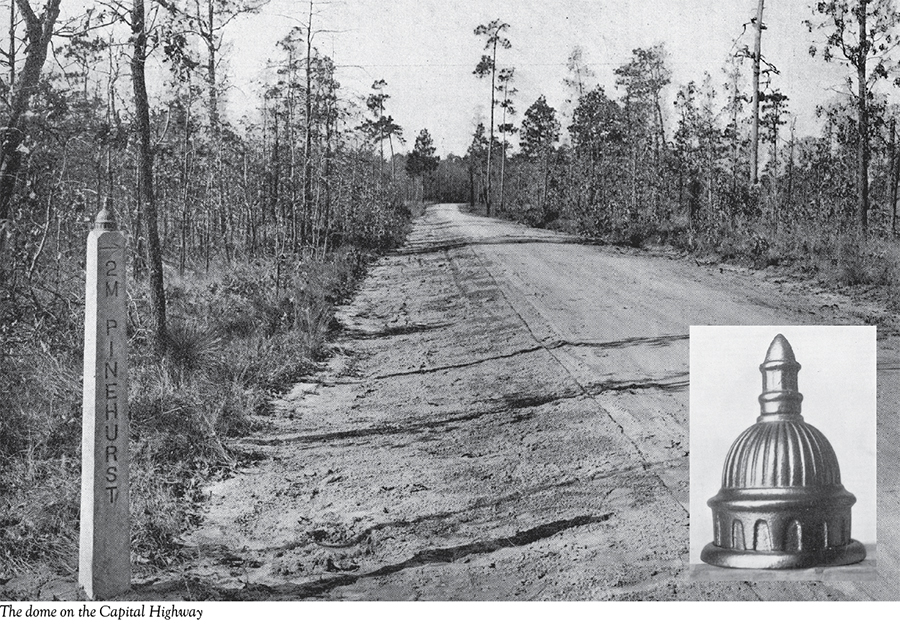
This setback did not deter Tufts’ relentless championing of the Capital Highway. He beseeched local officials along the route to provide funding for improvements, and Leonard subsidized many of them himself. Though the highway’s path through North Carolina largely followed what is now Route 1, Tufts made sure that the road veered through the middle of Pinehurst. To promote the highway’s branding and identification with state capitals, he caused Capitol dome likenesses to be placed atop highway mile markers. Guidebooks were made available to motorists that described every zig and zag of the highway in an easy-to-follow manner. Other materials provided info on the various resorts near the highway where weary travelers could bivouac.

Leonard also paid attention to the accessibility of roads near Pinehurst. Surmising that resort guests would eventually be taking day trips in their flivvers touring Moore County’s countryside, he laid out and improved a number of roads in the vicinity. He also involved himself in an ambitious mapping project of the county for the benefit of both guests and future development.

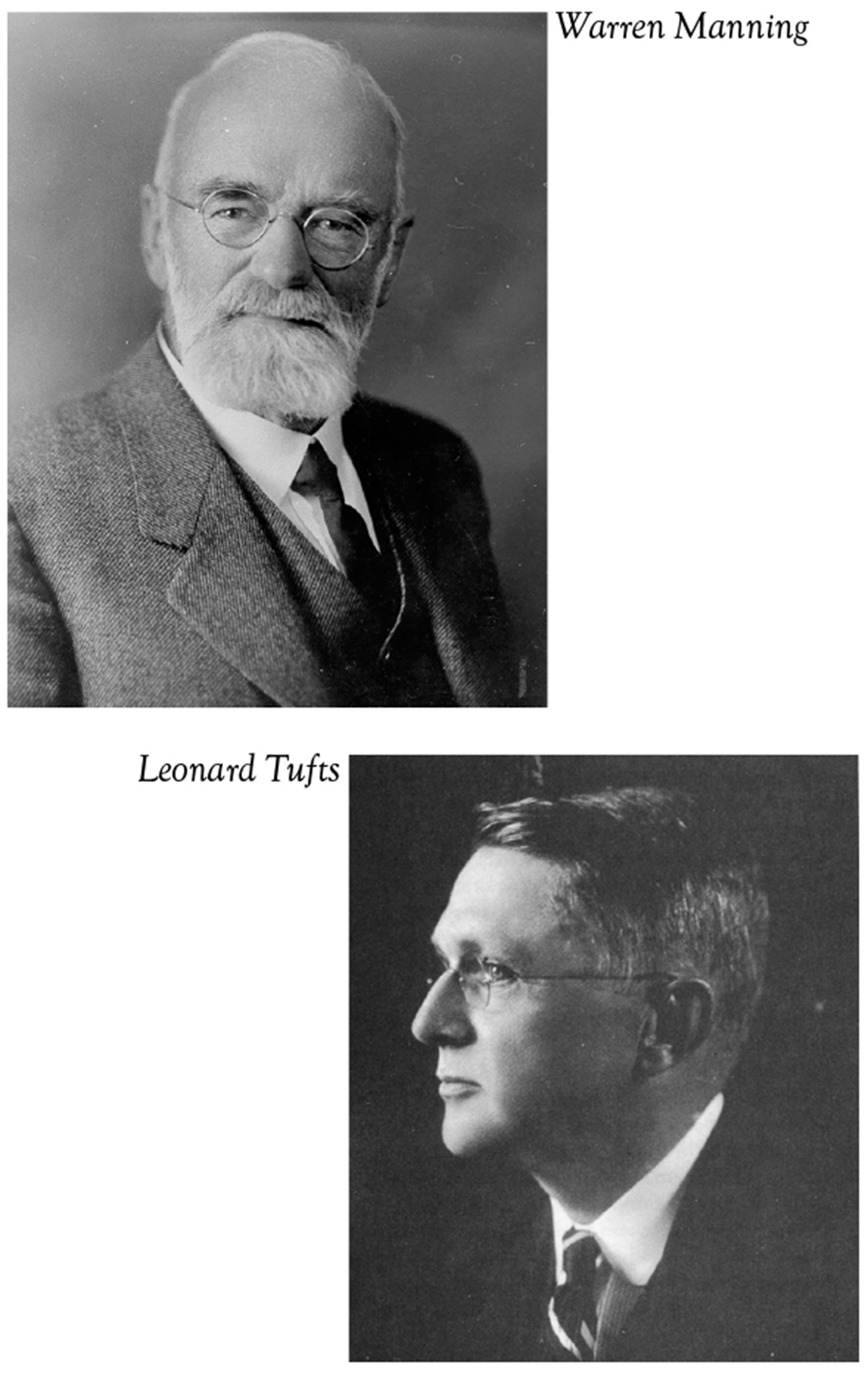
Accompanying him on these forays into the hinterlands was 49-year-old Warren H. Manning, the man whose creative tree and plant selections had transformed Pinehurst from a denuded pine barrens into a veritable “Garden of Eden.” While employed with the firm of Frederick Law Olmsted (the designer of New York’s Central Park), Manning arranged the plantings for the Chicago Columbian Exposition of 1893 and the Biltmore House in Asheville. He also assisted Olmsted in laying out Pinehurst’s unique serpentine roads. Manning ultimately left Olmsted’s firm to start his own landscape architecture business, taking the Pinehurst account with him. Soon, he established his own national reputation for designing naturalistic “wild gardens.”

Though his services were in increasingly high demand, Manning always found time to work on Pinehurst projects. He and Tufts had formed such a close bond that the architect frequently lodged at Leonard’s Mystic Cottage home when on assignment in the Sandhills.

The two friends made something of an odd couple, motoring through Moore County’s hills. The scholarly, 40-year-old Leonard, usually toting a book under his arm, calmly and deliberately eyed every feature when they disembarked to inspect the surrounding terrain. By contrast, the peripatetic, square-bearded Manning often appeared oblivious to anything except the task at hand. He speed-walked from point to point, recording notes and measurements, and generally leaving his younger cohort in the dust. According to Tufts, the architect was “the ‘walkingest’ man” he had ever encountered.

Tufts’ work on Moore County roads did not distract him from overseeing his pet project — the Capital Highway. Though it was now open to motorists, Leonard was concerned that parts of the highway were still not up to snuff. He also suspected local counties and other governmental entities along the route were not pulling their weight in maintaining their respective portions of the road. When the Pinehurst resort closed for the season in May 1911, Tufts decided to make his annual migration to Meredith, New Hampshire, by automobile so he could examine firsthand the northerly half of the highway running from Pinehurst to Richmond.
Three men joined Leonard on the 800-mile expedition: his frequent sidekick Manning, Dr. Myron Marr, and Charley Cotton. The 31-year-old Marr, a native of Dorchester, Massachusetts, had become quite a fixture in Pinehurst Country Club circles. Whether golfing with the Tin Whistles organization, competing in equestrian events, playing doubles tennis with his wife, or shooting trap, the doctor was very much in the club’s mix. He also enjoyed a pleasant gig as the “resident physician for Pinehurst,” with morning visiting hours (or by appointment) at his conveniently located office inside the Carolina Hotel. Like most denizens of Pinehurst’s Cottage Colony, the coming of May signaled the time for Dr. Marr to be heading to New England, so he was presumably pleased to be hitching a ride with Tufts.

According to later reminiscences of Leonard’s son, Richard, Charley Cotton, the fourth member of the group, went along “to assist in making camp and with the preparation of meals.” Originally born into slavery, the 60ish, white-bearded Cotton had long worked for Pinehurst and the Tufts family. “Uncle Charley’s” whimsical observations and homespun horse sense charmed his fellow travelers, contributing much more to the journey than his labor.

Manning kept a journal, housed at the Tufts Archives, of their road trip and snapped a number of photographs as well. His first entry says, “I arrived at Pinehurst, 9 a.m., May 6, 1911, attended to plans and telegram, lunched with Mr. Tufts and Dr. Marr under Minnie’s ministrations, got into khaki and flannel shirt, helped pack auto (Leonard’s 4-cylinder Reo with steering wheel on the right side), then we started at 3 p.m.” After a brief stop in Southern Pines for additional supplies, the Reo headed north in “perfect” weather — at an excellent clip of 22 mph.

As might be expected, many of Manning’s journal entries pertained to plants, trees and gardens he observed along the way. As the quartet steamed up the Capital Highway, the landscape architect noted “the young oak leaves are a vivid yellow green, quite distinct from the gray and reddish greens of the northern oaks in the spring. At Manley was a brilliant blue and scarlet field of the common toadflax and the common sheep sorrel.”

It became something of a working holiday for Leonard Tufts, who diligently recorded his observations regarding the Capital Highway’s condition, and then submitted them for publication to local newspapers serving towns along the route. As the Reo neared Cameron that first afternoon, Leonard did not like what he saw. “From Pinehurst, the first seventeen miles of the road is good, the next four miles to Cameron the road is deteriorated as it has had little attention,” he wrote. “From Cameron to Lemon Springs, N.C., a distance of six miles, the sand is as deep as ever.” The excessive sand caused the Reo to be slowed to 5 mph. But when the road was in satisfactory repair, Leonard noted that too. “(F)rom Lemon Springs to Jonesboro, six miles, there has been some improvement. Jonesboro Township is to sell its road bonds this month, and then will put its part of this in first-class shape.”

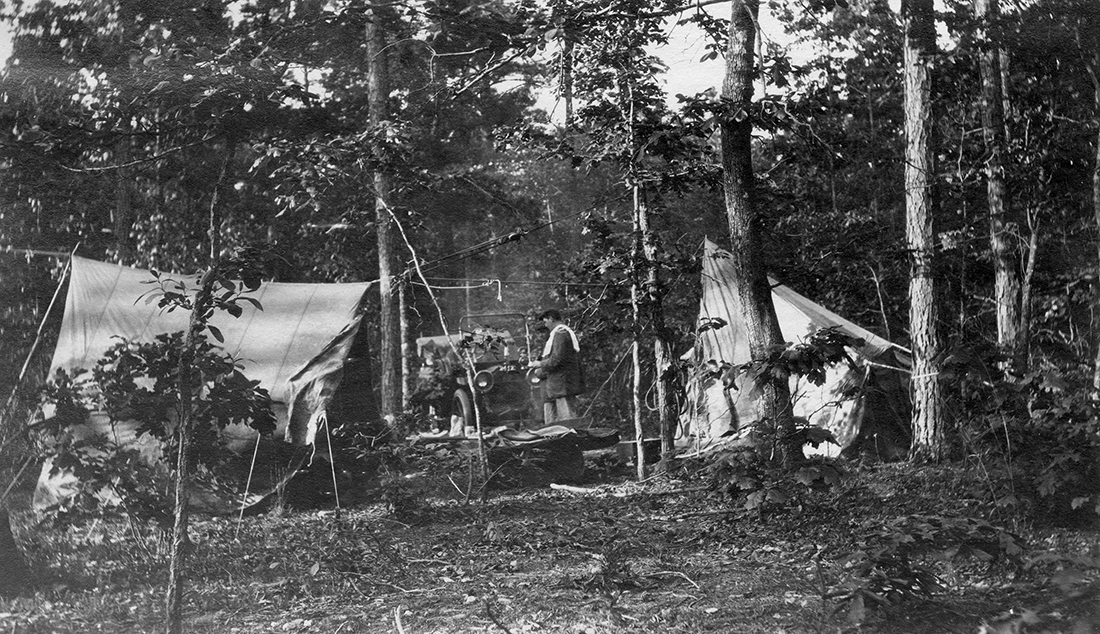
At 7 p.m., shortly after passing through Sanford, the four men pitched tents in an oak woods. Manning’s journal indicates that after setting up “4 cots, 4 sleeping bags, (and) the commissary boxes,” the four sat by the fire, ate supper, and went to bed. Toting along camping gear was pretty much a necessity for any long-haul motoring in 1911. With unforeseeable road conditions and the frequent breakdowns of the early vehicles, it was guesswork where one might wind up after a day’s driving. And because service stations and auto mechanics were few and far between, motorists like Tufts generally needed to be self-reliant in dealing with flat tires, engine troubles, and a wide array of other road mishaps. For early auto enthusiasts, the unpredictability of what might be encountered made for a challenging adventure.
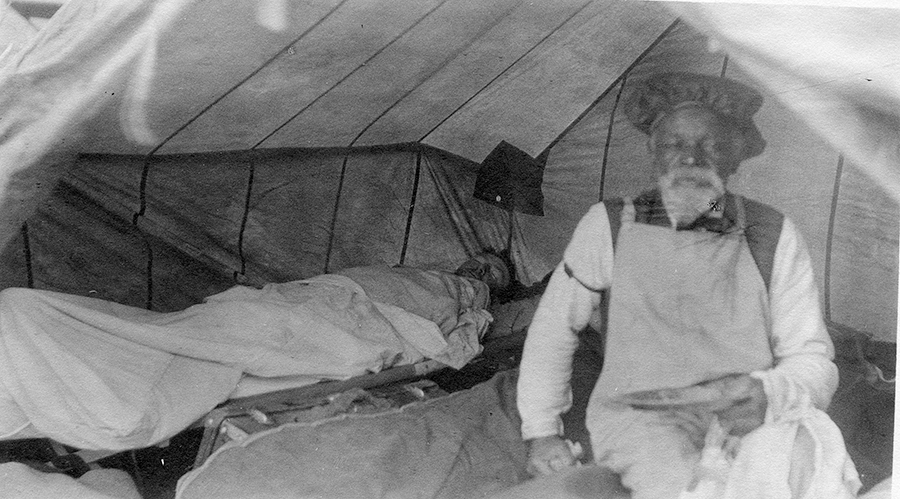
The Reo certainly challenged Leonard. On the morning of May 7, he fiddled with the engine until 11 a.m. before it fired up. Once on the road, Manning noticed that Tufts was being especially considerate of carriage drivers and their teams of horses. The horses would sometimes rear when Leonard’s horseless carriage whizzed by. “Sorry to have given you all that trouble, sir,” Leonard would invariably say. According to Manning, his friend’s unfailing courtesy tended to “chase away frowns, and bring smiles and ‘thank-yous.’”

On that first full day of driving, Warren became aware of Charley Cotton’s unique brand of wisdom. Some of his maxims, though farcically illogical, made perfect sense. When a drowsy mule trudging by suddenly acted up, Cotton cautioned Manning that, “a mule . . . (may not) wake up until you get by him, but then, he wakes up powerful smart.” Tire troubles continued to dog the travelers that day, but they managed to reach Raleigh by late afternoon, where they gave the Reo “a feed and a drink in a garage.” The men set up camp outside the city on an abandoned road.

A “drizzly day and mud, mud, mud,” greeted the travelers the following morning (May 8), and progress was slow. Weary from the slog, they ended the day in Warrenton, North Carolina, only 55 miles from Raleigh. But spirits were high after Charley served up dinner of steak, strawberry preserves, bread, and a corn batter and flapjack combination.

The worst road conditions of the trip confronted the men on May 9, and Leonard informed newspaper readers all about it. “For the next eleven miles . . . through Macon and Vaughn to Littleton, the roads are bad and seem to me to be getting worse,” reported Tufts. “There was a man with a light car ahead of us, whose tracks we watched with a great deal of interest. We counted where he had gone into the ditch sixteen times, and then we quit. We were fortunate in going in only four times.”

The intrepid band negotiated the quagmire, and finally entered Virginia at 4:30 in the afternoon. Once having crossed the state line, Leonard found the highway much more to his liking. “When you come to Barley (Virginia) you strike the kind of roads you dream about, and your motor picks up its head, arches its neck and goes down the road like a two-year-old,” wrote the admiring Tufts. “It is sixteen miles of gliding. Three cheers for Greensville County, and their board, Messrs. Cato, Rainey, and Murfee.”

The men camped that evening between Emporia and Jarratt, Virginia, “near a railroad crossing in a tall pine grove,” close to “several Negro cabins.” According to Manning, a number of the African-Americans, “soon trooped over, headed by Mr. ‘Bologna Sausage’ (a moniker provided by Charley), who appeared again after supper, with his accordion to sing, play, and tell stories around the fire that lighted three white faces on one side, and five black faces on the other.” Leonard passed out cigars to all in attendance while Cotton “weaved in and out through the ranks and to the fire washing dishes.”

Manning reported that sleep came rapidly that night “in spite of the occasional trains . . . pig squeals, donkey brays, clank of a wall chain, and in the morning (May 10) a multitude of bird calls, Whip o’ will, chuck-will’s widow, chickadee, creepers, crowing roosters, and cackling hens.” Cotton’s tasty breakfast of steak and corn cake awaited Tufts, Manning and Marr. Once on the highway, Tufts piloted the Reo to Loco, Virginia, where he indulged in some road politicking with J.M. Tyus, whom Leonard praised as having “done more in the last two years with the limited money at hand than any man has done on the Capital Highway, in my opinion between Richmond and Augusta, Ga.” From there the foursome made good headway through Petersburg and Bensley, finally reaching Richmond, where “the auto went to garage for clean up, repairs, and food, and we to the Jefferson Hotel for the same.”

Having already decided not to follow the Capital Highway to its northern terminus at Washington, D.C., they took a westerly route up the Shenandoah Valley in the direction of Charlottesville. Of the 273 miles of the highway the men traveled from Pinehurst to Richmond, Leonard estimated that the road was poor for 73 of them. His newspaper article suggested the bad sections could “readily be put in good shape at an expense of not over $20,000,” provided “we all work together.”

The group was eager to move on from Richmond on the morning of May 11, but repairs to the Reo delayed their departure until 6 p.m. They were led out of town by “a pilot auto filled with Mr. Tufts’ auto club (AAA) friends, who went out a number of miles — miles of dust, too, for there were many machines on this part of the road.” Though it was the normal routine to set up camp before dark, this particular evening with its soft balmy air and full moon struck them as so “exquisitely delightful” that they continued motoring long into the night. Finally stopping at midnight, the men pitched their tents in oak woods “at the first railroad crossing beyond Louisa.”
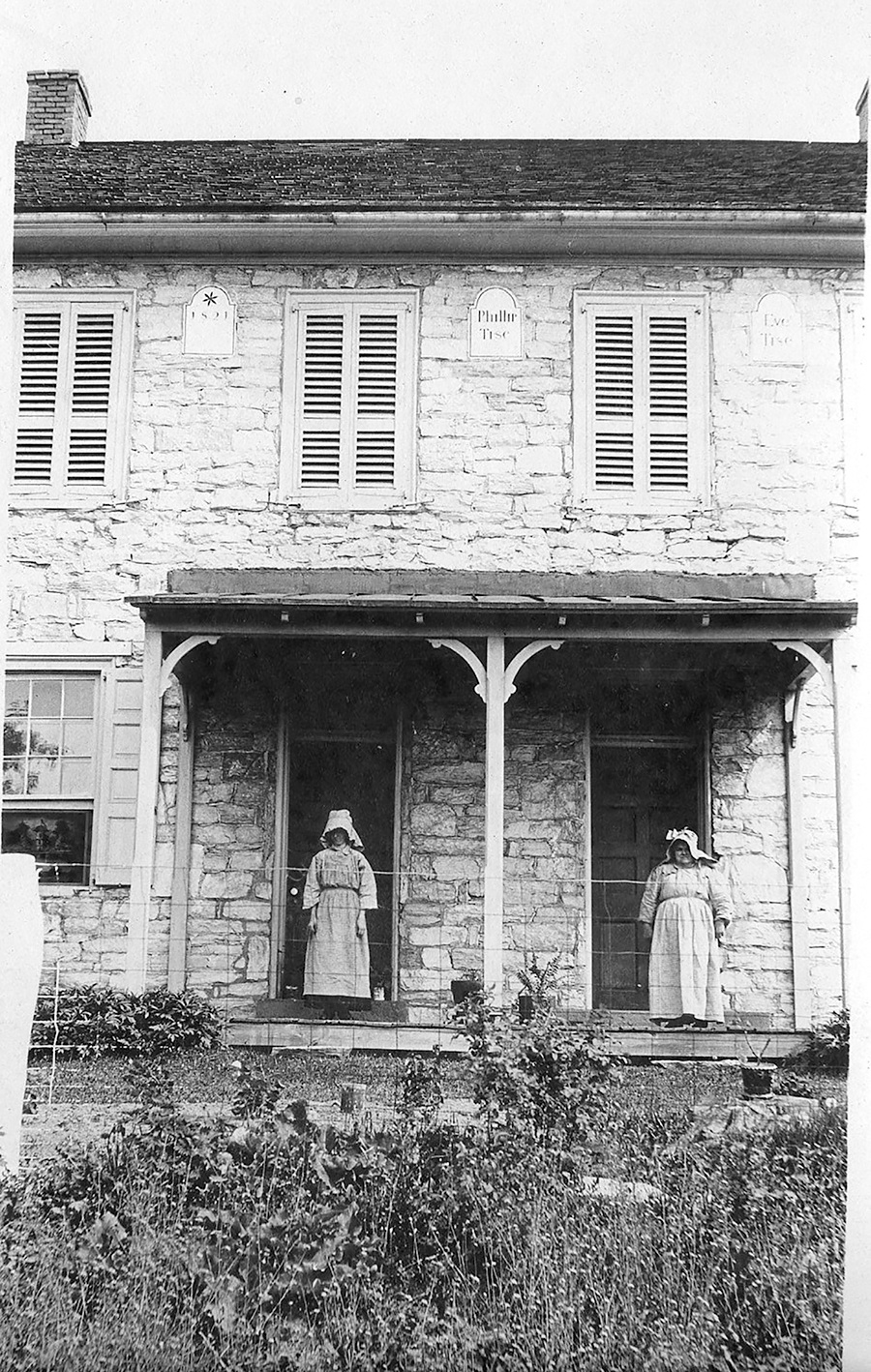
The following morning (May 12), they drove to Charlottesville, where they toured Monticello and the University of Virginia. Relishing the Jeffersonian history and architecture, they whiled away most of the day before cranking up the Reo, ultimately setting up camp just 23 miles farther up the road in Afton, Virginia.

On May 13, Leonard had the Reo cover more than 100 miles as it steamed through Staunton and then Winchester (“a busy little city, not yet much modernized”). Manning did not much care for the frequent turnpike gates along the way, “to each of which fifteen cents is handed out in an envelope as we slow up a little.”

May 14 found the men in Gettysburg, Pennsylvania, where they viewed the battlefield monuments. The quartet camped at a grove located in Pennsylvania Dutch country near Myerstown. A Dutch farmer “with fire in his eye” approached the Tufts party, irate that the men were on his land. But when the farmer saw the Reo (still a rare sight in that area), there was an immediate about-face in his attitude. “My that’s a big automobile,” he marveled. Tufts and his contingent were permitted to stay.

On May 15, the men entered New Jersey. Notwithstanding the fact that the Reo was registered in North Carolina, Tufts was nonetheless required to obtain a separate New Jersey registration. Manning observed that the roads in New Jersey were uniformly good, however, when the travelers approached the Hudson River, there was no bridge available, and the four men and the Reo were ferried across to Tarrytown, New York.

Having spent 10 days in his company, Manning had become greatly impressed with Cotton’s ever-positive attitude. He considered Charley’s unfailing smile, displayed even during hard going through the mud, as the foursome’s “most valuable asset.”

The travelers finally reached New England on May 16, and with good roads and weather, made good time. After two days of driving, the group set up their last campsite in Hillsboro, New Hampshire. Then, on the afternoon of May 18, 12 days after departing Pinehurst, Tufts chugged the Reo up the driveway of his Meredith home, overlooking the breathtaking Lake Winnipesaukee.

Manning was stunned by the vista, writing that, “at no point have we seen a view that will conjure up the extent, variety, and beauty of lake, valley, and mountains . . . that Mr. Tufts secures from his summer home.” After enjoying a sumptuous feast, their great excursion was at an end.

While the men undoubtedly savored their shared adventure, the motor trip had a practical benefit. Tufts successfully used it as a means to rally county officials to step up support for the Capital Highway. Within a few years, visitors from the North, regardless of their city of origin, were traveling over a well-maintained highway to Pinehurst.

What became of the four wanderers?
There’s precious little information regarding Charley Cotton, though we know from Richard Tufts’ writings that Charley enjoyed the high regard of the entire Tufts family. Dr. Marr’s medical career lasted another 47 years before he retired from the staff of the Moore County Hospital in 1958. He also came to public attention when he testified in 1935 at an inquest regarding the mysterious and controversial death of hotel heiress Elva Statler, who had been his patient. He died in 1972 at age 91.

Manning achieved something akin to legendary status in landscape architecture, both in Pinehurst and nationally. He was integral to the formation of the American Society of Landscape Architects, and was a vigorous advocate for the National Parks System. He collaborated with Leonard Tufts for another two decades on projects, including the Knollwood development and the state fairgrounds. The two men also continued to work together on roads, though they were not always of the same mind as to how far into the future a road designer should plan.

Manning thought it best to engineer roads of sufficient width to accommodate many future generations of motorists. Tufts viewed the issue more conservatively. “I have been thinking about your wide road business,” Leonard wrote Manning in 1923. “We have 100,000,000 (population in the United States) now and an automobile to about every two families. While the present road system in Moore County is adequate for at least twenty times the traffic as far as the width of the road is concerned, I cannot conceive of a condition where there is more than one car to every family . . . and neither can I conceive of the population . . . doubling in less than twenty years. If my figures are right, this is planning for the next 80 years, and by that time we may have given up the automobile and gone to the air.”

Around 1929, Leonard, suffering from frequent bouts of ill health, began ceding control of Pinehurst’s affairs to son Richard. Leonard Tufts died in 1945. Though 36 years younger, Richard came to like and respect Warren Manning, and the two men partnered together on numerous projects. And, like his forebears James and Leonard, Richard had trouble keeping up with the still-spry Manning, who kept on speed-walking until shortly before his death in 1938. On one occasion when Richard was lagging behind, Manning turned to him and remarked, “Years ago I used to walk your grandfather off his feet, then I walked your father off his feet, and now I am walking too fast for you!”  PS

Pinehurst resident Bill Case is PineStraw’s history man. He can be reached at Bill.Case@thompsonhine.com. 

Birdwatch

Shy and Dry

This time of year, the fields are teeming with Killdeer that call their own name day or night

By Susan Campbell

The killdeer is a small, brown-and-white shorebird that breeds in the Sandhills and Piedmont of North Carolina but is widespread throughout North America. It can be found here year round in the right habitat, but that doesn’t mean you should go looking for it in wetlands. Despite its classification as a shorebird, most of the population lives away from the water’s edge. In fact, for egg-laying, the drier the spot, the better! And in truth, sandy soil like that in the Sandhills, is not that much different from the beaches, where one would expect a shorebird to nest.

This robin-sized bird, not surprisingly, gets its name from its call: a loud “kill-deer, kill-deer” which can be heard day or night. During migration, individuals frequently vocalize on the wing, high in the air. Adults will also circle above their territory calling incessantly in early spring.

On the ground, killdeer are a challenge to spot. They blend in well with the dark ground and practically disappear against the mottled background of a tilled field or a gravel surface. Killdeer employ a “run-and-stop” foraging strategy as they search for insect prey on the ground. As they run, they may sir up insects, which will be easily gobbled up as the birds come to a quick halt. Although they live in close proximity to humans, they are quite shy. Killdeer are more likely to run than fly if approached. When alarmed, they frequently use a quick head bob or two. This may be a strategy to make the birds seem larger than they appear.

During the winter months, flocks of killdeer concentrate in open, insect-rich habitat such as ball fields, golf courses, or harvested croplands. Come spring, pairs will search out drier substrates, preferring sandy or rocky areas for nesting. They may even use flat, gravel rooftops. The female merely scrapes a slight depression where she lays four to six speckled eggs that blend in with the surroundings. She will sit perfectly still on her nest and incubate the eggs for three to four weeks. If disturbed by a potential predator, the female killdeer will employ distractive displays to draw the intruder away from the eggs. This may go so far as to involve feigning a broken wing. Calling loudly and spreading out her tail, the mother bird makes herself as noticeable as possible, limping along and dragging a wing on the ground. This “broken wing act” can be very convincing, giving the predator the idea that following the female will result in an easy meal. Once far enough from the nest, the killdeer will fly off, not returning to the eggs until she is convinced the coast is clear. Should distractions by the adults not be effective, the pair will find a new nesting location and begin again. The species is a very determined nester. Killdeer are capable of producing up to three broods in a summer.

Normally, the eggs hatch almost all at the same time. As soon as they have dried off, the downy, long-legged young will immediately follow their mother away from the nest to a safer, more protected area nearby. They will follow her around for several weeks, being fed and brooded along the way. Once they are fully feathered, the young will have learned not only how to escape danger but how and where to find food for themselves.

So, if you hear a “kill-deer” over the next couple months, stop and look closely: you may be rewarded with a peek into the summer life of this fascinating little bird.  OH

Susan would love to receive your wildlife sightings and photos. She can be contacted by email at susan@ncaves.com.

As Good As It Gets

A mystical, magical U.S. Open turns 20

By Bill Fields

The 1999 U.S. Open has stuck with me, the way it has anyone who ever daydreams about golf instead of more important things, because it was quite a week. The event was a long time coming to Pinehurst, so long that it felt as if it would never occur, that the roster of North and Souths, World Opens, Tour Championships and a lone PGA when FDR was in the White House would never get this kind of fancy company. 

“You just assumed it was something that would never happen,” says Curtis Strange, who before winning back-to-back U.S. Opens in the late ’80s won consecutive North and South Amateurs on No. 2 in the mid-’70s.

Then it did, concluding on an oddly cool and drizzly June afternoon as packed with drama as a longleaf pine with needles. Twenty years down the road, Pinehurst’s first Open remains one of the best.

Before it became Payne Stewart’s, the ’99 Open belonged, at least a little bit, to me, to all with close ties to America’s golf capital. As someone born and raised in the area, I’d like to think it still does.

I remember coming to town a month or so before the championship to report a story for Golf World magazine — whose home used to be in the Sandhills and was my professional home for many years — and feeling both anticipation and anxiety about the exposure my hometown was about to receive. Given that the community already was in a growth spurt, the attention from the U.S. Open was going to be an accelerant for that change.

When the USGA announced in 1993 that the Open would be played on No. 2 six years later, the late Brent Hackney wrote in The Pilot: “For Pinehurst, being chosen to host the Open is golf’s equivalent of being the site of football’s Super Bowl, baseball’s World Series or college basketball’s Final Four.”

My preview article reflected the reality of the village’s transition before a shot was struck in the 99th U.S. Open. Pat Corso, then president and COO of Pinehurst, Inc., who had been a key force in the resort’s return to glory under ClubCorp’s ownership, noted the construction of several dozen homes on Pinehurst No. 6.

“You can’t play a hole without hearing a hammer,” Corso told me. “But from where I sit, it’s not so bad. If it’s so bad, why are they all still coming? It’s a matter of perspective. But it’s not the way it was for the resort and it’s not the way it was for those who lived here (before). It’s different.”

As I grew up in Southern Pines during a time when everyone’s world was much smaller, Pinehurst could seem much farther away than 5 miles. In the 1960s and ’70s both places were more afternoon nap than loud party, a sophisticated “Mayberry” of natives and transplants, the latter decades away from moving here in droves.

Charles Price, one of best to ever write about golf, lived in Pinehurst in the middle of the 20th century, as a reporter for The Pinehurst Outlook and Golf World, and visited the village three decades hence before settling here later on. “There was and is something venerable about the place,” Price wrote in Golf magazine in the 1970s, “something almost holy about its atmosphere you can’t find in the newness of Palm Springs and the clutter of Palm Beach. While Pinehurst is nowhere near as graybeard as St. Andrews, it still has a church quiet you won’t find even there.”

When I was a small boy, Pinehurst was mostly a turn we didn’t take driving over to Jackson Springs on Sundays to visit my grandmother. My parents had gone to movies in the theater when they were courting. The Pinehurst golf courses might as well have been in outer space until I got I my first set of clubs in 1969, then they became an aspiration.

I saw them before I played them, walking No. 2 for the first time as a 14-year-old spectator during the two-week-long, 144-hole World Open in 1973, the first professional golf at Pinehurst since the final North and South Open in 1951. I would carry a scoring standard in subsequent tour events — the late Bruce Edwards wouldn’t give me a golf ball one year following 18 holes with Tom Watson, which I kidded Bruce about after becoming a golf writer — and a couple of times took up gallery stakes and rope with some fellow Pinecrest students on the Monday after for $20 and lunch. It was a wonder we didn’t get gored with the sharp end of one of those metal rods, but somehow we avoided injury.

Our high school golf team got to play the No. 1 course a lot, along with occasional rounds on No. 4 and No. 5, with our matches and a local junior tournament held on No. 1. I shot a 72 in one Monday match to lead the team to what was then a school-record total, but compared with the local kids who came along a generation and two later, who could really play, ours was weak sauce. 

Getting to play No. 2 was a very special occasion, which meant that my several appearances in the Donald Ross Memorial Junior, a Christmastime staple, were fraught with nervousness. I’ve blocked out what I shot, and hope there is no surviving archive of scores, but I am sure I never broke 90. Once, when I was 22 and well past the point of knowing I would not ever earn a living with a scorecard in my back pocket, I thought I was about to get some revenge on No. 2 for those desultory December days. I was 1 over through 16 holes in a round with three good players but finished with back-to-back double bogeys, the CliffsNotes of a career that never really was.

That was my Pinehurst golf background heading into the ’99 Open but far from all my history there. I was in the crowd when the World Golf Hall of Fame, adjacent to the eastern edge of No. 2, was dedicated in September 1974, with newly promoted President Gerald Ford part of the ceremony for the original 13 inductees.

Seven years later, immediately after graduating from Carolina, I worked at the WGHOF in a brief stint as a greenhorn public relations director. My duties included writing press releases, making appearances with television hosts Lee Kinard of WFMY and Jim Burns of WECT to promote the Hall of Fame Tournament, and putting out buckets under a perpetually leaky shrine-building roof.

We were doing the tournament, which almost didn’t happen because of a lack of funds, on the cheap, and if you watched a commercial for the event that had a close-up of driver meeting golf ball, that was me making contact with my persimmon MacGregor on the fifth hole. It was a good strike, but rest assured not like the prodigious pokes Davis Love III made going around No. 2 in winning the 1984 North and South Amateur, an awesome driving display of accurate power that stands out many years later.

In 1988, our rehearsal dinner was at the Pine Crest Inn, wedding ceremony at Community Presbyterian Church, reception at the Manor Inn. We spent our honeymoon night in the Carolina Hotel, the start of a decade-long marriage that ended in divorce about six months before the ’99 U.S. Open.

While some homeowners in the Sandhills were getting many thousands to rent their houses to visitors for the week of the Open, my mother got enough from Golf World to buy two new mattresses so photographers Steve Szurlej and Gary Newkirk could bunk upstairs with me in our house not far from downtown Southern Pines. (Most of the magazine staff stayed in a rental house in Pinehurst.) It really felt like old home week when I pulled my rented Chevy into the media lot, a.k.a. Pinecrest High School, where for junior and senior years I had parked my aging Ford.

Having covered the Tour Championship and U.S. Senior Open at No. 2, as well at the U.S. Women’s Open at Pine Needles, within the previous decade, I was no stranger to returning to my hometown on assignment. This time, though, given the gravitas of the event and my place in life — just turned 40 and newly divorced, writing for a publication I’d grown up reading and wanting to work for — it felt a bit like swinging a club with a weighted doughnut around its neck.

Photograph from the Tufts archives

Payne Stewart was just slightly older than me, 42, married and the father of two. He certainly had been a constant presence on the PGA Tour in my golf photography and writing career, known for his old-fashioned swing, the plus fours he wore on the course, liking a good time and, more than occasionally, not treating everyone with kindness. One contemporary of Payne’s told me he was the only fellow pro he ever wanted to punch — not once but twice — and for every memory of a fun-loving competitor is a recollection of when Stewart, a good harmonica player, was off-key, arrogant, churlish.

Stewart’s ability to get over the hump with his manners seems, by most accounts, to have lagged behind his transformation into a tournament winner, which came after lots of close calls that earned him an “Avis” nickname. Once that moniker was mostly history, Stewart still had more than twice as many career runner-up finishes as victories (11), a reality that might have been related to his attention deficit disorder, which was undiagnosed until 1995.

Dr. Richard Coop, a UNC-Chapel Hill education professor and a pioneering golf psychologist, worked with Stewart starting in 1988 and became a dear friend and confidante of his. I got to know Stewart a bit through Dr. Coop, with whom I collaborated on magazine columns and Mind Over Golf, his primer on how to become a better golfer through a sound mental approach. Stewart wrote the foreword for the book, published in 1993. The year after he began seeing Dr. Coop, Payne won his first major, the 1989 PGA Championship. He got some help that day at Kemper Lakes from a poor finish by Mike Reid, and Stewart’s behavior as Reid struggled home was indicative of his immaturity.

Stewart won the 1991 U.S. Open before winning the 1999 edition in Pinehurst, John Garrity in Sports Illustrated writing that while he was among more than a dozen golfers to win two U.S. Opens in a decade, he was the first to do it with two personalities. That was certainly a popular theme around the time that Stewart won in Pinehurst, his demeanor change credited to a newfound Christianity, old-school maturity and a talking-to from his mother, Bee. “I gave him an attitude adjustment,” she told Sports Illustrated. “He’s learned you can’t go around being rude to everyone.”

There was no doubt the fellow who put on a costume every time he teed it up was a real human being, complex to the core.

That made him no different, really, than the golfers with whom he would spar that fateful Sunday in Pinehurst: Phil Mickelson, Vijay Singh, Tiger Woods, David Duval.

Any doubts that No. 2 would stand up as host to its first professional major in 63 years were quelled that Thursday when, after an inch of rain Wednesday night, no one torched the place — a quartet of 3-under 67s including Mickelson and Duval leading with Stewart and Woods among those at 68. The ground got firmer and the flagsticks were tucked as the week went on, the ingredients mixing for a fantastic finish on a misty Sunday that could have been ordered by course designer Donald Ross, a native Scot.

Arguably the closely cut grass around the turtleback greens could have been slightly taller to encourage more chips and fewer putts from the fringes, but it still was the most distinctive U.S. Open setup in years, with everything from fairway woods to lob wedges utilized around the putting surfaces, the heart and soul of No. 2.

“It’s not the hardest course I’ve ever played,” said Tom Watson, who won the tour event at Pinehurst in 1978 and ’79, “but it may be the hardest to get the ball close to the hole on the green.”

Through 54 holes Stewart was the only player under par, at 209. In search of his first major and with his wife, Amy, expecting their first child that had him a beeper away from departing, Mickelson was one back with Tiger and Tim Herron at 211. Duval, Singh and Steve Stricker were three behind. The only logjam was on the leaderboard, as pre-Open fears of the village and surrounding towns being overwhelmed by traffic never materialized. Shop and restaurant owners, in fact, were disappointed that customers seemed to be scared away by the imagined congestion.

The golf did not disappoint, though, particularly as the fourth round simmered into a stew of stars. The often-seen attrition of leaders in an Open was replaced with clutch play. Stewart and Mickelson each closed with 70s, as did Woods, with Singh shooting 69. Only Duval sputtered to the clubhouse, with a 75. The final two hours were the very definition of golf drama, the protagonists and plot ranking up there with other great finales in the championship’s history, roars reverberating through the pines, Augusta-like, as if a dormant stage had reopened for the finest actors of the day to perform.

Mickelson and Stewart swapped the lead half a dozen times over the final nine. Woods was never far away either, and when he birdied the par-4 16th to pull even with Stewart one behind Mickelson, the game was truly on, the outcome in doubt. Stewart’s personality, while making it difficult to maintain his focus week in and week out for a whole season, also allowed him to exhibit keen concentration for short periods, particularly under difficult circumstances. (It is not unlike an average golfer being able to execute a fine recovery shot through a gap in the trees because a small, defined target narrows his focus.)

Stewart, wearing a waterproof jacket from which he had scissored off the sleeves himself so his classic swing wouldn’t be constrained, was never more focused than on the last three holes at Pinehurst on Sunday. He faced a double-breaking 25-footer for par that went uphill and then downhill on the 16th, and sank it as if it were for kicks on the putting clock on Tuesday morning. He converted a 3-footer for birdie on the par-3 17th after a gorgeous 6-iron, a birdie Mickelson hadn’t been able to match from inside 10 feet after a wonderful tee shot of his own.

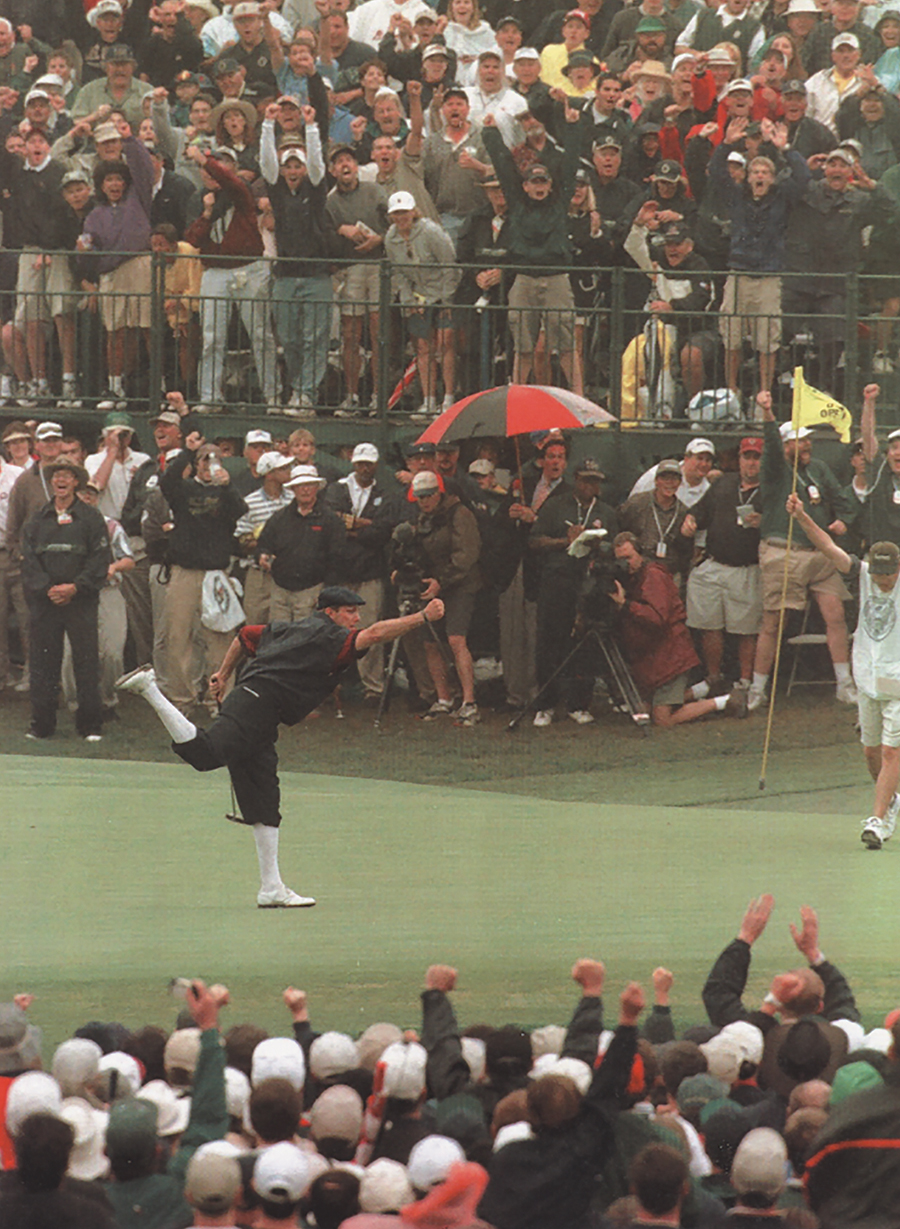
On No. 18, Stewart’s drive finished in a gnarly lie in the wet, right rough. In the distance the chimes from The Village Chapel made the air tingle. Forced to lay up, Stewart would have to pitch and putt for a winning par unless Mickelson was able to sink a sidewinding 30-footer for birdie. Phil couldn’t do it, leaving Payne 18 uphill feet to his second national championship. The stroke was pure and the roar was deafening after the ball dropped into the cup, Stewart’s fifth one-putt on the last six holes, dreamy putting on a magical day.

Arm up, leg out — a pose that became a memory and, too soon for the wrong reason, a statue.

Payne hugged his caddie, Mike Hicks, and consoled Phil Mickelson. When his press conference was over and all the pin flags were signed, Stewart got in a car, trophy at his feet, to ride to Hicks’ home in Mebane, where the hardware was their flute, champagne and white lightning flowing to toast an unforgettable day.

I retreated to my childhood house, to the desk where I used to do my homework to try to type the story. I could hear my mother and my sister downstairs, reliving their Sunday — they had attended, watching for a couple of hours in a grandstand, prior to watching the giddy finish on TV. Ten o’clock became 11 and 11 became midnight, and my laptop screen was still empty, the occasion seeming to put a tourniquet on the flow of my words. Over more than 20 years working for Golf World, I would pull dozens of all-nighters at a computer, the stories solid, sometimes even lyrical. I wrote clean copy and met deadlines. This Sunday night, though, when I most wanted to come through, while Payne Stewart was swilling bubbly in celebration, I fizzled at the keyboard.

Eventually, around a groggy sunrise, I filed my 2,000 words but they weren’t very good words. Someone at our Connecticut office had their way with them after flying back from North Carolina. I didn’t blame them for that, because the article needed more than a little TLC, but didn’t appreciate not getting a crack at making some improvements myself. My byline is on the story, but many of the sentences aren’t mine.

Monday evening, as I ate dinner with my former wife at The Squire’s Pub, homecoming week nearly over, I felt like a loser.

Time, and well-written stories, of course, changed my perception. I got to go to lots of U.S. Opens after that one, unlike Stewart, who died in an aviation tragedy about four months later. I was in baggage claim at LaGuardia Airport late on that October Monday afternoon returning from the Nike Tour Championship when the man who was driving me home said, “Awful about the golfer on the plane.” As my mind scanned for possible victims, someone nearby said, “It was the guy who wore the knickers.”

Twenty years later, I don’t think much about the bad story I filed but the good day the guy in the knickers had in the rain on No. 2. There have been other U.S. Opens at Pinehurst, with more to come, but the first will always stand out. Folks attempt Stewart’s putt and pose with a cast figure that commemorates the defining day of a life cut short. My childhood desk isn’t there for me anymore, but I can go home, where you still hear hammers, bells and, if you use your imagination, the cheers of a misty Sunday, long, loud and happy.  PS

Bill Fields has covered more than 100 major championships, including U.S. Opens at Pinehurst in 1999, 2005 and 2014.

Giving Voice

The art of speaking about the unspeakable

By Jim Moriarty  •  Photograph by Tim Sayer

Up a rutted, sandy road in a shaded horse country bungalow, Susan Southard, slight and silver-haired, is researching her next book. Her first, Nagasaki: Life After Nuclear War, is being released in Japan this summer, four years after its American publication. Comprised of stark, intimate portraits of five hibakusha — atomic bomb survivors — it took her 12 1/2 years to tell the stories of a world that changed in a second.

Southard’s first trip to Nagasaki was as a 16-year-old exchange student on a field trip from the girls’ school she was attending in Kamakura, locking arms with her classmates in front of photos and artifacts too terrible for anyone of any age to contemplate. Later, working in Washington, D.C., as an assistant to the executive director of a political and economic consulting firm, she locked emotional arms with Taniguchi Sumiteru, one of the survivors whose life she would later document. She pinch hit as his interpreter for two days and in their private moments, he allowed her to ask any question she wanted — and he answered.

“He was 16 at the time of the bombing,” she says, the same age Southard was when she first saw the effects of it. “By ’44 everyone 14 and older had to leave school and work for the war effort because they had no men left in the country. His job was to deliver mail.”

It was 1945, August 9, two minutes past 11 a.m. “He was delivering mail in the hills, and he was riding his bicycle, as everyone did. He was facing away from the bomb, and the blast came and the heat came, throwing him off his bicycle and onto the ground. His whole back was burned off. It’s unbelievable he stayed alive. He had no skin and seemingly no flesh. He didn’t get medical treatment until December. People were rubbing mechanical oil and newspaper ash on his back. That’s the only thing they had.”

Southard and Taniguchi met in 1986. “I didn’t start the book until 2003, but that was the real seed,” she says.

The book, which received the Dayton Literary Peace Prize in Nonfiction and the J. Anthony Lukas Book Prize co-sponsored by the Columbia School of Journalism and Harvard University’s Nieman Foundation for Journalism, led to a speaking engagement at the United Nations, addressing the delegates from the balcony at the request of the International Campaign to Abolish Nuclear Weapons (ICAN), the organization that was awarded the 2017 Nobel Peace Prize.

Last year, she spoke at a U.N. disarmament conference in Hiroshima and returned to Nagasaki, where she gave talks at two high schools. One of the teachers at the second school was the son of Yoshida Katsuji, another of the hibakusha in Southard’s book, whose face had been wretchedly disfigured by the blast. “Mr. Yoshida was such a dear, sweet, hilarious man. He was charming beyond measure,” says Southard. The school where his son taught English was built on the site of the school his father once attended. “It wasn’t until a week before I went there that I realized it was the exact same location. So, there I was, standing in a school that was built on the premises of the school that was destroyed during the bombing, where Mr. Yoshida had gone to school, telling Mr. Yoshida’s story.”

In the summer of 1990, four years after meeting Taniguchi, Southard and her ex-husband, Eric Black, moved from the humid heat of Washington to the dry heat of Phoenix. (Their grown daughter, Eva, lives in Las Vegas and works for Nevada Sen. Jacky Rosen.) Having discovered a social outreach theater company in D.C. suggested to her by the actor Stanley Anderson, Southard quickly founded Essential Theatre, an improvisational acting company working with marginalized communities. It has lasted 29 seasons.

“We use the foundational techniques of Playback Theatre, which was created some 40 or 45 years ago,” says Southard. “It’s an art form where people in the audience tell stories from their lives and we, the ensemble of actors and musicians, create works of art to honor their stories. It’s interactive; it’s improvised performance. When it’s done well, it’s so beautiful and so moving and so theatrical because everybody in the audience has just heard the story and they’re, like, ‘What are they going to do?’”

Lorenzo Aragon has been with the company almost from its inception. “We created a theater that was more about our audiences, and we loved that,” he says. “Our company has always had many colors, many genders, many orientations. Susan wanted the company to reflect what was in the audience.”

Southard doesn’t act anymore. Living 2,100 miles away makes it nearly impossible to nurture the familiarity necessary to be as skillful with the improvisational work as she was with Aragon. “Lorenzo and I have done thousands and thousands of performances together,” says Southard. “If you were telling a story and it’s just the two of us, we can read each other’s mind.”

As an actor, Aragon says Southard, “calls on her experience in life. She’s a stickler for clarity. And versatile. I’ve seen her be Dr. Martin Luther King and I’ve seen her be a baby that’s being born. In fact, I gave her birth one time.”

The theater has branched off into two parts with Southard maintaining her work with Phoenix’s Youth Development Institute, a treatment program for juveniles who have sexually abused somebody. “We have to create a community of trust first,” she says. “Many of them have experienced various levels of abuse and neglect themselves. They’ve been in jail already, and they’ve been adjudicated to this treatment program. So, they’re quite closed down.”

Aragon puts it another way. “When you deal with kids in the joint, you’ve got to be pretty real,” he says.

Progress can be slow. “We teach them basic theater techniques, how to step into a character, how to use imaginary objects as props, how to change your voice,” says Southard. “They have to learn to listen. We see these incremental changes, not in every boy, but most. And the therapists see it. We teach the older boys about metaphor. They think of one of their victims and one of the episodes of an offense, then they write the victim’s story from the victim’s point of view, in first person.” Using the professional actors and other boys from the theraputic group, they perform. “It’s very powerful for everyone in the room. When you’re listening to someone’s story and you’re stepping into their shoes, that is an act of empathy.”

It should come as no surprise that Southard has brought her community involvement skills with her. She will be holding a “Civic Saturday,” her second such event since moving to the Sandhills in 2016, on Saturday, June 15, from 10 a.m. to 11:30 a.m., at the Pinehurst Village Hall, at 395 Magnolia Road in Pinehurst. The theme is “Facing the Climate Crisis: Urgency, Action and Hope.”

The Civic Saturdays concept was gleaned from a Seattle program called Citizen University. “Their goal is to promote civic engagement around core values of liberty and ethical responsibility as citizens,” says Southard. The gathering is non-partisan. The stated goal is to “nurture and energize a spirit of shared purpose and effective citizenship around our nation’s creeds of liberty, equality and self-government.” The program will consist of a brief talk by Southard, some music, and readings from American civic literature that could range from excerpts of famous speeches to parts of the Constitution.

And that next book? It remains a secret. “I learned from Nagasaki you have to really choose topics that you’re willing to stay with for years and years and years,” she says.

It’s worth the wait to be the memory of a generation.  PS

Jim Moriarty is the senior editor of PineStraw and can be reached at jjmpinestraw@gmail.com.

Golftown Journal

Fathers, Sons and Golf

A tradition like no other at CCNC

By Lee Pace

The world of golf is chock-full of great father-son stories. Fourteen of the first 30 Open Championships beginning in 1860 were won by fathers and sons from two families — the Willie Parkses (Sr. and Jr.) and the Tom Morrises (Old and Young). Arnold Palmer learned to play from his father, Deacon, the greenkeeper and pro at Latrobe Country Club, and they played golf together on junkets to Pinehurst. Jack Nicklaus nervously ambled around Pinehurst No. 2 in 1985, watching his son Jack II win the same North and South Amateur title the elder Nicklaus had won 26 years earlier.

This summer will mark the 50th rendition of the Sandhills’ oldest tradition invoking dads and their boys. The Country Club of North Carolina’s National Father-Son Invitational was conceived by noted amateur golfer Dale Morey, and the first one was held on the Dogwood Course at CCNC in 1970.

“We think with the quality of golf courses and the tradition we have, the Father-Son is one of the special tournaments in all of amateur golf,” says CCNC Director of Golf Jeff Dotson. “We’ve had teams come from across the country, and it truly is a national event.”

CCNC opened in 1963 on land just to the southeast of Pinehurst Resort and Country Club, and was conceived as Moore County’s first true private golf club and one viewed as a weekend and leisure escape for businessmen and avid golfers from across the state and beyond. Willard Byrd and Ellis Maples designed what would be known as the Dogwood Course. The first nine holes of the Cardinal Course followed in 1970, with nine more added in 1981.

Donald and Jeffery Hall won the inaugural event and were followed in 1971 by Tom and Tom Kite Jr. — the latter at the time a 21-year-old University of Texas golfer. Another future PGA Tour standout, Scott Hoch, won the Father-Son as well, teaming with dad Arthur in 1977 and ’79 when Scott was still playing at Wake Forest.

The tournament is generally held in July — the 25th through the 28th this year — and utilizes both the Dogwood and Cardinal Courses. Both courses have been updated in recent years with modern turf and drainage, with the Dogwood Course getting a complete overhaul in 2015-16 from architect Kris Spence.

The format is to play the Dogwood Course for the first round, the Cardinal for round two, and then Dogwood again for the final round. The first two rounds are better ball and the final 18 is aggregate — both scores counting. So each team posts four scores over three days. If one player is the dominant player, he can carry the team for the first two rounds. But there’s nowhere to hide on the final day.

Ronnie and Hunter Grove have the most titles with five — collecting them in 1990-92, ’98 and 2000. A Senior Division was started in 2000 and a Super Senior Division in 2014, and Tim and Chris Miller have the distinction of being the only team to win in two divisions; they were overall champions in 2007-08 and then graduated to the Senior Division, where they won three straight from 2012-14.

Dick Schwob has been a CCNC member since 1999 and has cherished the times he and son Leighton have teed it up in the Father-Son.

“There is nothing like having three days one-on-one with your son playing the game you love on courses you love,” says Schwob. “We both played sports as kids growing up and have that competitive drive, and this is an outlet for competition and having fun with your son.”

Leighton works for the USGA as director of operations for the U.S. Open, so his summers are busy with travel, but he makes every effort to clear out that weekend for the Father-Son.

“The Father-Son at CCNC is as fun an event as you can have,” the younger Schwob says. “The field consists of a bunch of like-minded fathers and sons from all over the country who love the game of golf. We have met many great people over the years and look forward to seeing them each year.

“But the most important part of this event and what separates it from so many others is the time I get alone with my father out on the golf course. Life can be hectic these days between the Open and the growing family, but getting to spend quality time with my dad playing a sport we both love and are passionate about is as good as it gets.”

Rick Jones Jr. of Youngtown, Ohio, is the only golfer who has won as a son and a father. He was the son playing with Rick Sr. to win in 1980, ’85 and ’86. He was the father playing with son Connor two years ago, in 2017. That 1986 win was notable because in the final round on the Dogwood Course, Rick Jr. aced the par-3 16th, Rick Sr. birdied 17 and both Joneses birdied 18 — that’s 5-under in three holes to come from behind and win.

“It’s the best week of the year,” Rick Jones Jr. says. “It always has been, always will be. CCNC is my favorite place to play golf. I’ve never been anywhere so quiet.”

Bob Dyer and his son Kenny started playing in 1985 and were regulars for more than a decade. Bob is 87 now and says they aged out several years ago, but his affection for the annual trip sparked him and his wife to buy a house in Pinehurst and join the club.

“I finally got here in 2005,” Dyer says. “As soon as I walked into the property in 1985, I said, ‘Wow, this would be a good place to live.’ We had such a good time over the years. It was a wonderful experience.”

One of the interesting dynamics of fathers and sons teaming is melding the experience and strategic thinking of the more mature father with the “what, me worry?” attitude of the younger golfer. And then there is the evolution of age — as the fathers lose their athleticism and distance and their sons become the team leaders.

“You don’t realize how much pressure the dads are playing under,” Jones says. “I had no idea when I was young. When you’re young, you’re just playing and having fun. But the dads are grinding. They tend to choke a bit. You’re grinding so hard for your son. I learned that when Connor and I started playing.”

Kelly Miller, whose family owns the Pine Needles and Mid Pines resorts in nearby Southern Pines, has long been a competitor at the top level of national amateur golf. He’s a member at CCNC and has competed with son Blair often in the Father-Son, the Millers collecting the championship in 2002.

“I guess you’ll always be a father to some degree, but there’s a stage where you want to become a friend as well,” he says. “The Father-Son is a place to do that. You enjoy the time you spend with your son. That part is great. It’s an interesting dynamic as you grow older and your games change. You go from your son depending on you (when he’s younger) and all of a sudden you’re depending on him. It goes full circle.”

The Father-Son Invitational participation history for the Keim family of Erie, Pennsylvania, dates to the late 1970s and includes five golfers over three generations. Jim Keim, a top-ranked amateur golfer in Ohio and later on national levels as a senior golfer, brought his son Michael to the tournament in 1978 when Michael was 16. Another son, Chris, was four years younger, and over the years Keim played with both sons in the event. Michael has two sons, Aaron (now 34) and Alex (32), and both of them have competed either with their father or grandfather.

It would be difficult to top the experience of playing at CCNC with your dad, your brother and your sons,” Michael says. “The golf courses are spectacular and challenging in every way, and the fact that the staff and the board managed to keep this thing going all these years I think is no small miracle in itself. My dad was very single-minded in his passion for golf over his entire life, and this tournament was perfect to enjoy the game with his sons and grandsons.”  PS

For information on the CCNC National Father-Son Invitational, contact Director of Golf Jeff Dotson at (910) 692-1502.

Lee Pace has written about the Pinehurst area golf scene for more than 30 years. Write him at leepace7@gmail.com.