Birdwatch

BIRDWATCH

Harbingers of Spring

Return of the swooping swallows

By Susan Campbell

As the days lengthen and the air begins to warm, many of us look forward to the return of migrant songbirds. Dozens of species that breed here spend their winters far to the south, and dozens more spend time feeding here as they migrate to summer haunts in New England and points farther north. Of these, the first to return in central North Carolina are the swallows. In early April, it’s possible to see six different species: barn, rough-winged, tree, bank and cliff, as well as the more familiar purple martin. And since swallows move in mixed flocks at this time of year, encountering three or four kinds in close proximity is not unusual.

Swallows are almost exclusively insectivorous and are built to catch their prey on the wing. They have strong pointed wings and forked tails, which allow for excellent aerial maneuverability. Except for adult male martins, they are all dark on top and light colored below. But each species has a characteristic flight pattern that can be used to identify it even if field marks cannot be discerned. Modern field guides include descriptions of the patterns — where a species flies and how it flies (the combination of flapping and soaring) are unique. This is very helpful, since swallows spend most of their time on the wing and tend to be quite high in the air, so plumage is difficult, if not impossible, to see.

Without a doubt, the best place to find swallows is around water, where insects are most abundant during the warmer months. If one is lucky and there is a snag or wire adjacent to a wet area, the birds may be perched at close range, which should make for ideal viewing conditions. Except for purple martins, sexes are identical. To the human eye, male and female size, coloration and behavior are the same. However, you may be able to pick out the drabber plumage of a juvenile in late summer if you have a pair of binoculars — and a good bit of patience.

Purple martins are the largest of the group and have the darkest feathering. Adult males are a distinctive bluish-black. Females and second-year males have some blue feathering on the back and head but are mainly a dingy gray. Juveniles will be a paler gray with little or no blue feathers in late summer.

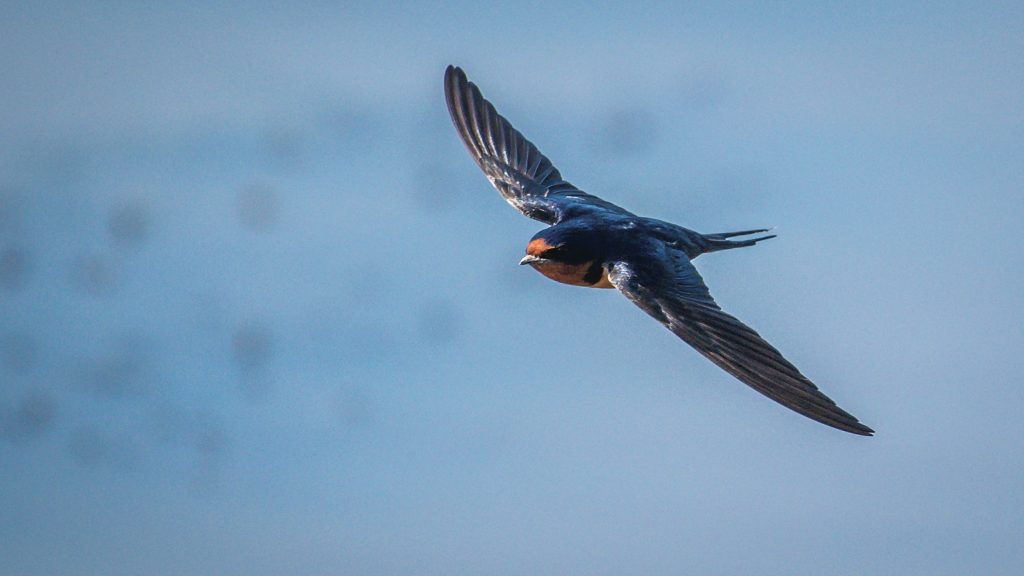
Barn swallows have a dark-bluish back, orange face and yellowish underparts. They also have a deeply forked tail. Given this superior rudder, they are capable of low and erratic flight, scooping up insects close to water level or over large grassy expanses such as horse pastures or golf course fairways.

By comparison, rough-winged swallows are stocky and brown above, whitish below with a drab, buffy throat. They spend a lot of time soaring high in the air and, therefore, have a more squared-off tail.

Bank, tree and cliff swallows are less likely to be encountered in central North Carolina. All three have less distinct plumage and short, forked tails. Bank swallows, which may be found in the western part of the state, have light brown backs, thinner wings and quick wing beats. Tree swallows have dark-green backs, broad, long wings and more direct flight behavior with less wheeling involved. Increasingly, they can be found using tree cavities or nest boxes near large bodies of water in the northern Piedmont. And they are quite common in the coastal plain. Cliff swallows, which resemble barn swallows with a short tail and a pale rump patch, fly more deliberately, with slightly slower, more powerful strokes. They favor the protection of overhangs associated with man-made structures such as bridges and overpasses to affix their unique mud nests. Interestingly, for reasons we are not sure of, cliffs are being found in more locations across the state each season.

Although these little birds are well-engineered for flight, they are not known for their song. In fact, their vocalizations consist of short raspy or mechanical calls. Nevertheless, swallows can be quite noisy, whether they are migrating as a flock or in pairs defending a breeding territory. Try to remember to listen and look up this spring; you might just spot some fancy fliers.


Dissecting a Cocktail

DISSECTING A COCKTAIL

Jack and Coke

Story and Photograph by Tony Cross

The Jack and Coke is, and has been, widely ordered at bars for almost a century. It was the go-to drink of my late brother and my father, who recently passed away, so this is an homage to them.

The first recorded mention of a “Coca-Cola highball” stretches all the way back to 1907. Highballs — cocktails in tall glasses that contain ice, spirit and some variation of soda — were popular but the quality of other sodas was inconsistent. Every location formulated its own drinks; syrups would be improperly stored (lack of refrigeration or ice), leading to a loss of flavor; CO2 variations would leave drinks flat or too acidic from over-carbonation. This gave Coca-Cola an advantage: It tasted the same every time.

Fast forward to the Prohibition years and you’ll read how cola was masking bad-tasting spirits, especially whiskey. This is where Jack Daniel’s came in. The way it charcoal-filtered its whiskey made it softer around the edges, also giving it notes of vanilla and caramel. Pairing that with the sweetness of Coke made the drink an instant classic.

A decade later, the United States was in the middle of a world war. Coca-Cola President Robert Woodruff declared his intention “to see that every man in uniform gets a bottle of Coca-Cola for 5 cents, wherever he is and whatever it costs the company.” In turn, soldiers started ordering Jack and Cokes when they were at bars until the whiskey became hard to find. Down the line, the drink became a favorite of everyone from musicians like Frank Sinatra and Lemmy Kilmister to my father and little brother, who all raised a glass of Jack and Coke during some of the best times of their lives.

Jack Daniel’s and Coca-Cola didn’t create whiskey and soda, but they made it iconic.

Specifications

1 1/2 ounces Jack Daniel’s
No. 7 Whiskey

4-6 ounces Coca-Cola

Execution

Add ice and whiskey in a short or tall glass. Top with ice cold
Coca-Cola. A quick stir is optional.

Golftown Journal

GOLFTOWN JOURNAL

A Family Legacy

Right at home in the Hall of Fame

By Lee Pace

It began with a press release in April 1981 that a new Carolinas Golf Hall of Fame had been created, and the venture continued with an inaugural inductee banquet on June 1 at the Southern Pines Elks Club. All five of those first inductees as designated by a committee headed by Jack Horner of the Durham Herald-Sun and composed of members of the now-defunct Carolinas Golf Reporters Association had some connection to Pinehurst and the Sandhills.

Richard Tufts was the grandson of Pinehurst founder James W. Tufts, a former president of the USGA and a noted authority on the Rules of Golf.

Donald Ross lived in Pinehurst after moving from Dornoch on the northeast coast of Scotland in 1900 through his death in 1948, and designed seven Sandhills area courses and just under 400 nationwide in a prolific career.

Harvie Ward and Billy Joe Patton were North Carolina natives and golfing bon vivants, playing with style and spirit and winking to the gallery while making birdies. Between them, they won four North & South Amateurs from 1948 to 1963.

And Estelle Lawson Page ruled the Women’s North & South Amateur from 1937 to 1945, winning six of nine over that period.

Seventy-five more golfers have entered the Carolinas Golf Hall of Fame (now under the auspices of the Carolinas Golf Association) since then. In the early days, plaques commemorating their inclusion were housed at Seven Lakes Country Club at the behest of Peter Tufts, the Seven Lakes course designer and son of Richard. Later the display moved to Pine Needles Lodge, where it was housed in 2007, when it moved to its current home.

Pinehurst Resort management in the 1990s expanded the 1900 Carolina Hotel eastward with two major projects — the Grand Ballroom as the centerpiece to an expansive new meeting center, and then the spa and fitness center. One elongated hallway leading from the hotel’s East Wing to the ballroom afforded an important opportunity. The resort offered use of one wall for the Carolinas Golf Hall of Fame. Over the next quarter century, the exhibition has grown to 82 members and was recently reorganized to provide additional wall space for the Hall of Fame to grow.

This year the owners of the resort for the last 42 years took their place along that hallway.

Inducted in mid-February were Robert Dedman Sr., whose Club Corporation of America bought the resort in 1984, and Robert Dedman Jr., who took the baton upon his father’s death in 2002 and has guided Pinehurst to unparalleled heights in the last dozen years.

“The Dedmans’ impact cannot be measured simply by courses renovated, courses built or championships hosted but something far more lasting — stewardship,” said longtime family friend and former USGA President Jim Hyler in introducing Dedman Jr. during the induction ceremony held, appropriately enough, in the Grand Ballroom. “They have not only owned the Pinehurst Resort but cared for it. They understood Pinehurst is not just a destination but a trust, passed from one generation to the next, carrying with it the soul of the game itself.”

Also inducted was Jack Nance, the recently retired executive director of the Carolinas Golf Association, which has been headquartered since the 1980s in the Sandhills area. Nance in his remarks paid tribute to what the Dedmans had meant not only to Pinehurst but the region and the state of North Carolina having hosted four U.S. Opens, one U.S. Women’s Open and offering land between the Carolina Hotel and its golf clubhouses for the USGA’s new Golf House Pinehurst and World Golf Hall of Fame.

“What your family has done for golf here in the Carolinas is extraordinary and permanent,” Nance said. “From bringing the U.S. Open to Pinehurst to what we see today across Moore County — the USGA Hall of Fame and satellite headquarters, the massive road renovations, and the never-ending projects, the economic boom — it all traces back to your family’s vision. Your award tonight is well earned, and your legacy will be long-lived.”

Dedman Jr. said his family’s long involvement at Pinehurst had “been a labor of love for two generations” and told of his father’s humble upbringing in Arkansas, his G.I. Bill financed law degree after World War II and his entrepreneurial instincts that hit in the early 1950s. Dedman was playing golf in Palm Springs, California, at a golf community that featured three courses and one central clubhouse operation and it occurred to him that the model could work in a metropolitan area like his own home in Dallas. That launched the idea for Brookhaven Country Club, which opened in 1957 and was the first domino to fall in what would become ClubCorp — a massive global operation with country clubs and city clubs around the world.

“Over the next 50 years, ClubCorp became a world leader,” Dedman said. “My father raised and elevated the standards of excellence in the club industry. He democratized the industry, making clubs more affordable and accessible, clubs that were exclusive but not exclusionary. That has been a guiding principle since the beginning.”

The initiative of Dedman Sr. was restoration — rebuild the facilities that included having a chef fall through a kitchen floor, cultivate quality playing surfaces on the golf courses, bring championship golf back to Pinehurst, add new courses in Nos. 7 and 8 and expand the room inventory with the acquisition of village of Pinehurst properties such as the Holly Inn and Manor Inn.

The initiative of Dedman Jr. has been transformation — green light the restoration of the No. 2 course back to its early 1900s character of bouncy fairways and perimeters of natural hardpan sand and wire grass, redesign and re-engineer No. 4 in a similar fashion, add The Cradle short course and launch a major expansion south toward Aberdeen that will include courses No. 10 and 11. Dedman noted the company has invested some $250 million over the last five years in the facility.

“And there’s more to come,” he said. “These are exciting times in Pinehurst.”

That Pinehurst has had just three owners over 131 years (the Tufts, Maxton native Malcolm McLean and the Dedmans) is remarkable — even more so that one family has been constant for the last four-decades plus.

“In recent years, Bob talks about wanting to be the soul of American golf,” Hyler said. “The Dedmans have been caretakers of an unbelievable asset. I am glad they’re being properly recognized for many years of stability and leadership.”

Out of the Blue

OUT OF THE BLUE

Drama! Stat!

Blood on demand

By Deborah Salomon

A man clutches his throat and falls to the floor of the church/theater/stadium. “Is there a doctor in the house?”

You bet. He/she, almost life-sized, hangs on the family room wall, surrounded by hospital personnel and patients in various stages of maladies du jour.

Long live the medical drama!

Google, er, cough up Marcus Welby, Ben Casey, Doc Martin, Doogie Howser, Dr. Quinn operating on Chicago Med, Chicago Hope, Brilliant Minds, Nip/Tuck, St. Elsewhere, New Amsterdam and dozens more. Some mildly entertaining, slightly informative. Others silly and manipulative. Now, the genre has come full circle led by — yes! — Noah Wyle, who earned his TV-MD as Dr. John Carter on ER.

Now, Wyle’s back as Dr. Michael Robinavitch, the bearded, graying chief resident at a busy Pittsburgh hospital known only as The Pitt, hence the name of the show. Meek ’n’ mild Carter, now irascible, overplays every emotion. He hugs, he storms, he whines, he cries and comforts for which he cleaned up at the Emmys, both as an actor and as a producer/director.

Never mind that the jargon is spit out faster than viewers can absorb, let alone comprehend.

Each episode covers a shift, 8 a.m. till whenever. The cases, mostly emergencies, vary: a snatched-from-the-headlines mass shooting, to an autistic young man’s ankle broken while playing Ping-Pong, to a fistfight (two women) in the waiting room, to a cringe-worthy birth and several deaths. Lots of profanity, of course (cable On Demand), but how about this foray during opening credits — “nudity in a medical setting.”

Fear not, there’s nothing erotic about watching a corpulent lady soak in an ice bath.

The only familiar face is Wyle’s. None of his fellow actors suffered carryover from lawyer shows. But they did display diversity: Latino, Indian, Asian, Black, Caucasian, young, ripped, paunchy, bald, beards and assorted ethnic head coverings.

The hour raced by. I loved it.

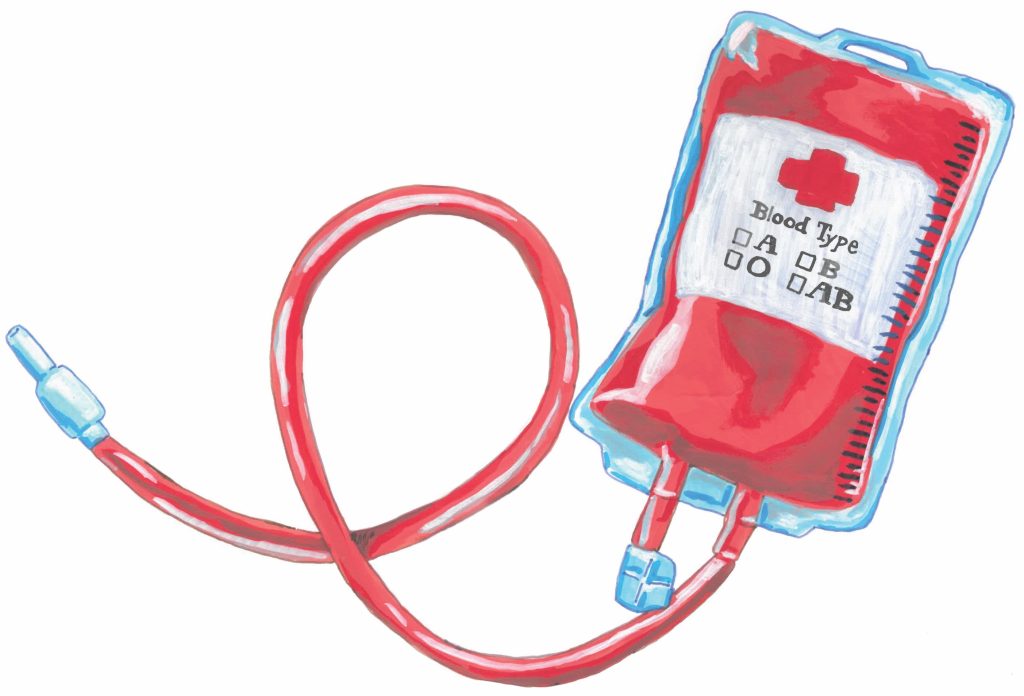
My primary bone to pick, so to speak: blood everywhere. On the injured, of course, but spilling off the gurneys onto the floor, running down white fabric and clear plastic gowns, soaking through bed linens? The janitor mopping it up reminded me of the gravedigger scene from Hamlet.

Then, the soundtrack is loud and mostly jargon. I missed many words but, oh, the rolling eyes, the knowing looks. The scary part, assuming situations are realistic and thoroughly vetted, is outcome uncertainty in a busy teaching hospital.

By now you’ve guessed that I’m still a cable subscriber so I endure the ads for prescription drugs. The list of contraindications, it seems, is longer than the benefits, and sometimes ends in death. Yet the medication itself is described in glowing terms by happy, healthy actors. Recently 150-year-old Eli Lilly spent a bundle reimaging itself as “a medicine company” with the m-word replacing scarier “drug.’’ Their TV spokespeople are more likely dairy farmers than stockbrokers. Their profits, just imagine.

I asked a local physician about the dire tech stuff. He said it’s for protection in court proceedings.

“You were warned!”

Another warning: I’m not sure The Pitt will survive many seasons . . . too much medical, not enough drama. Although to its credit, the hour left me with a splitting headache.

A Southern Pines Fairytale

A SOUTHERN PINES FAIRYTALE

A Southern Pines Fairytale

Whimsical blooms with an intoxicating scent

By Jason Harpster
Photographs by Paige Ramsey Moody

Fairies and fairytales hold a special allure in the hearts and minds of children and adults alike. We grow up enchanted by the possibilities of magic and often wonder if such possibilities are real. In Southern Pines, this question seems a bit less far-fetched. We are home to the world’s oldest longleaf pine tree and are known for our old-growth forest. What other towns have an annual festival celebrating a tree’s birthday? It seems only fitting that it should have a fairy named after it, too.

If fairies do exist, then their form surely would be fleeting and ethereal. Whether you call them woodland nymphs, pixies or sprites, one thing is certain: They are rare and special. Only the most fortunate may catch a glimpse. To capture one in a photograph, timing must be perfect. One such sprite has been seen, documented and officially confirmed by the Species Identification Task Force. No kidding.

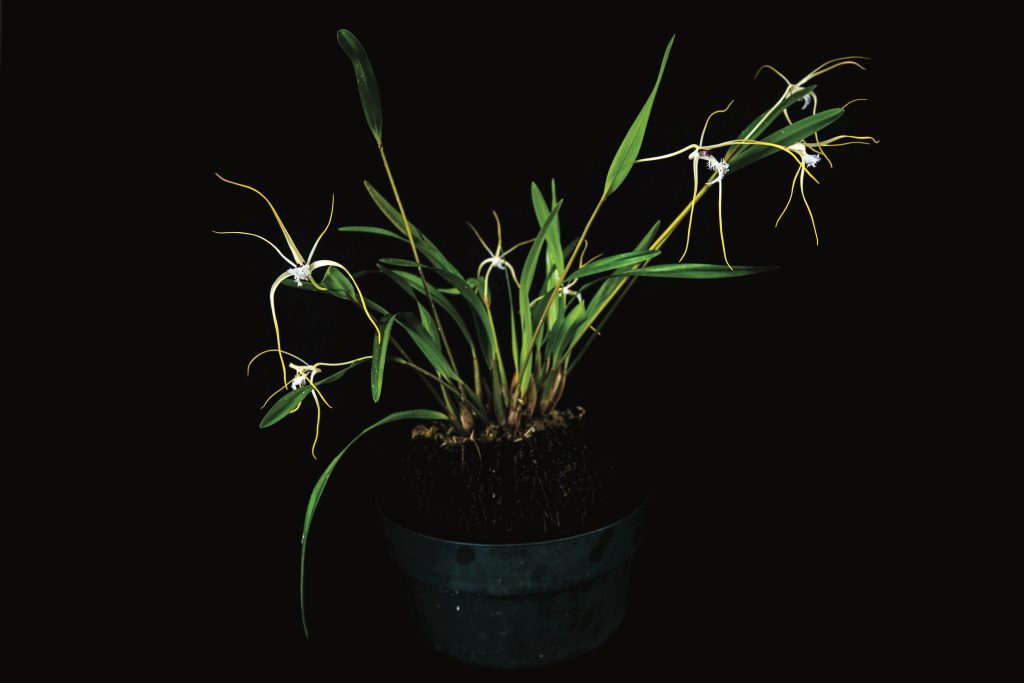
When Dendrobium tipuliferum ‘Southern Pines Sprite’ was presented to American Orchid Society judging on Aug. 13, 2023, conditions were just right. Native to Fiji, this diminutive orchid is capable of blooming multiple times a year, producing flowers that are so delicate and ephemeral that they often go unnoticed. The whimsical blooms have an intoxicating watermelon fragrance. Like many other orchids, the more fragrant the bloom, the shorter its life. The flowers of Dendrobium tipuliferum last less than 24 hours, so it’s not entirely surprising that this was the first time this species had been exhibited for judging.

The plant received a Certificate of Horticultural Merit with a score of 86 points for its form, color, floriferousness and overall aesthetic appeal. The judges commented that the filamentous petals, serrated lip and brilliant yellow color were especially striking. The photos speak for themselves.

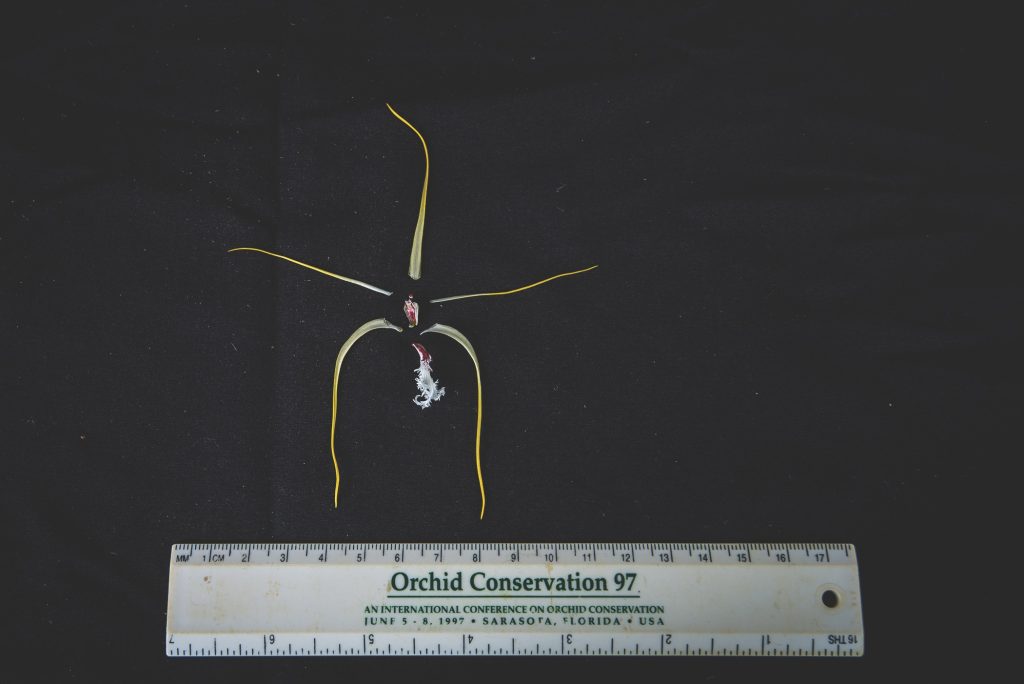
The clonal name ‘Southern Pines Sprite’ was chosen as the stellate flowers seem to wave and beckon you closer, just before hitting you with the magical watermelon fragrance. Since this was the first award ever granted to the species, one of the blooms had to be carefully dissected, measured and described for official verification by the Species Identification Task Force.

Some plants and flowers have anthropomorphic features that give them seemingly human qualities. Dracula flowers, or monkey-faced orchids, are one such example. Dendrobium tipuliferum is truly a special species as its flowers look like fairies gracefully dancing in the breeze. The flower chosen for the award photograph is especially cheerful as it looks like it is waving hello.

It seems the fairies in Southern Pines are rather friendly and have a propensity for making people smile.

Focus on Food

FOCUS ON FOOD

Potluck Go-To

Piece of cake for a buffet

Story and Photograph by Rose Shewey

Gatherings at our house are a well-practiced routine: We provide all food and drink, you just show up in your party hat. In fact, don’t bring anything at all. From first course to last, wine included, we have it covered. I have always been inclined to encourage our guests to come empty-handed, but one fateful Easter brunch solidified my stance on the matter.

A few years ago, we spent Easter Sunday at a friend’s house — a classic potluck affair. One by one, we arranged our dishes on the dining table, complimenting each other’s handiwork. Then one of the guests slid a half-eaten, shriveled quiche onto the table. As we awkwardly eyeballed his contribution, quiche-guy paused, then retrieved his tray. “I should probably taste this first to make sure it’s still good,” he said cheerfully, then added with a shrug, “Leftovers from last weekend!” Off he went to the kitchen, clattering around for a fork to sample his contribution.

And yes, he decided in favor of the quiche and boldly brought it back to the table to share. That was enough to set my house rules in stone: I cook, you eat, the end.

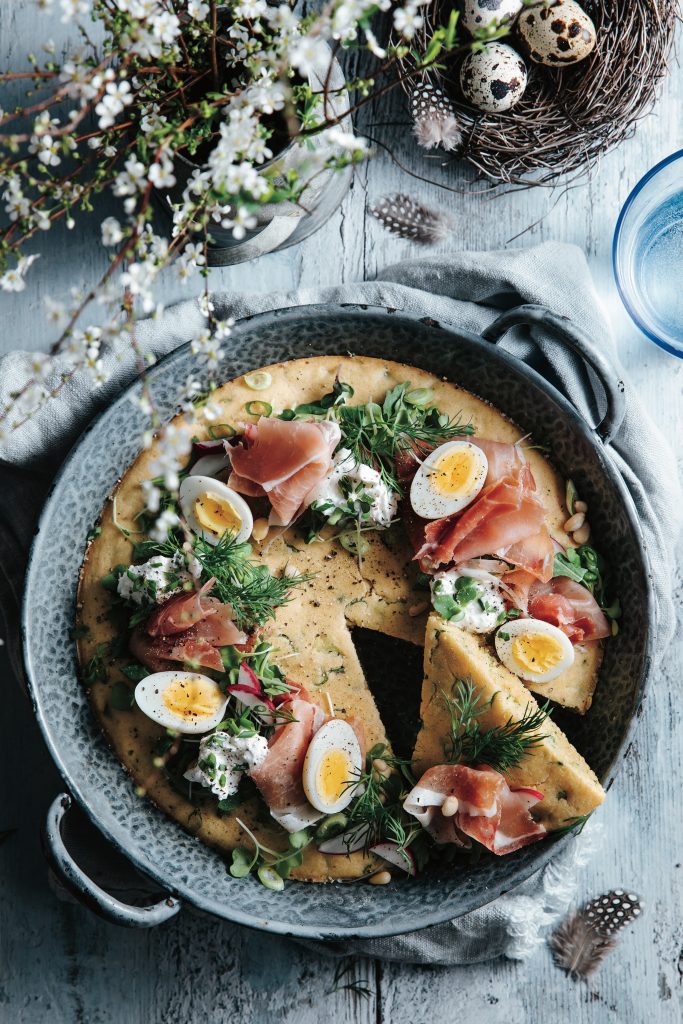
Although potlucks are a bit of a gamble, if called upon, I will faithfully bring a dish to a friend’s house. I have a number of stand-by offerings I typically prepare, but recently I have truly been enjoying sheet pancakes, or skillet pancakes, which are an excellent addition to buffets when kids are included. Instead of flipping cakes for half an hour, you just pour the batter right into a skillet, bake it for 25 minutes or so, and you’re done.

And don’t stop there! Who says pancakes have to be sweet? Try this savory version with herbs and whipped goat cheese — or create your own medley of spring flavors.

Savory Skillet Pancakes with
Garden Herbs and Whipped Goat Cheese

(Serves 4)

For the whipped goat cheese:

8 ounces fresh goat cheese (chèvre)

1/4 cup Greek yogurt

1/2 teaspoon honey

1/4 teaspoon garlic powder

1/4 teaspoon onion powder

1/4 teaspoon salt

2 tablespoons chopped chives

For the pancakes:

1 cup all-purpose Einkorn flour

1 1/4 teaspoons baking powder

1/4 teaspoon baking soda

1/2 teaspoon salt

1 egg

1/2 cup milk (dairy-free, if desired)

1/2 cup Greek yogurt

1 1/2 tablespoons melted butter or melted coconut oil

1/4 cup scallions, finely chopped

1/4 cup fresh herbs, such as parsley, chives, dill, basil

Optional toppings:

Boiled eggs, prosciutto, sprouts, diced cucumber and radishes, pine nuts, more fresh herbs and scallions for serving.

Method

To make the whipped goat cheese, add all ingredients except for the chives to the bowl of your stand mixer or, if using a handheld mixer, to a medium size bowl. Whip until the cheese is smooth and creamy, then fold in chives and transfer to a serving bowl. Refrigerate until ready to use.

To make the skillet pancakes, preheat oven to 375F. If using a cast iron skillet (10-inch), set it in the oven while it heats. In a medium-size bowl, sift together the flour, baking powder, baking soda and salt. In a large bowl, whisk egg with milk, yogurt and butter. Add the flour mixture to the bowl with the wet mixture and whisk briefly to smooth out the batter. Fold in scallions and herbs. Pour the batter into the skillet and bake for 20-25 minutes, or until the center is cooked through. Serve with whipped goat cheese and toppings of your choice.

Sandhills Photo Club

SANDHILLS PHOTO CLUB

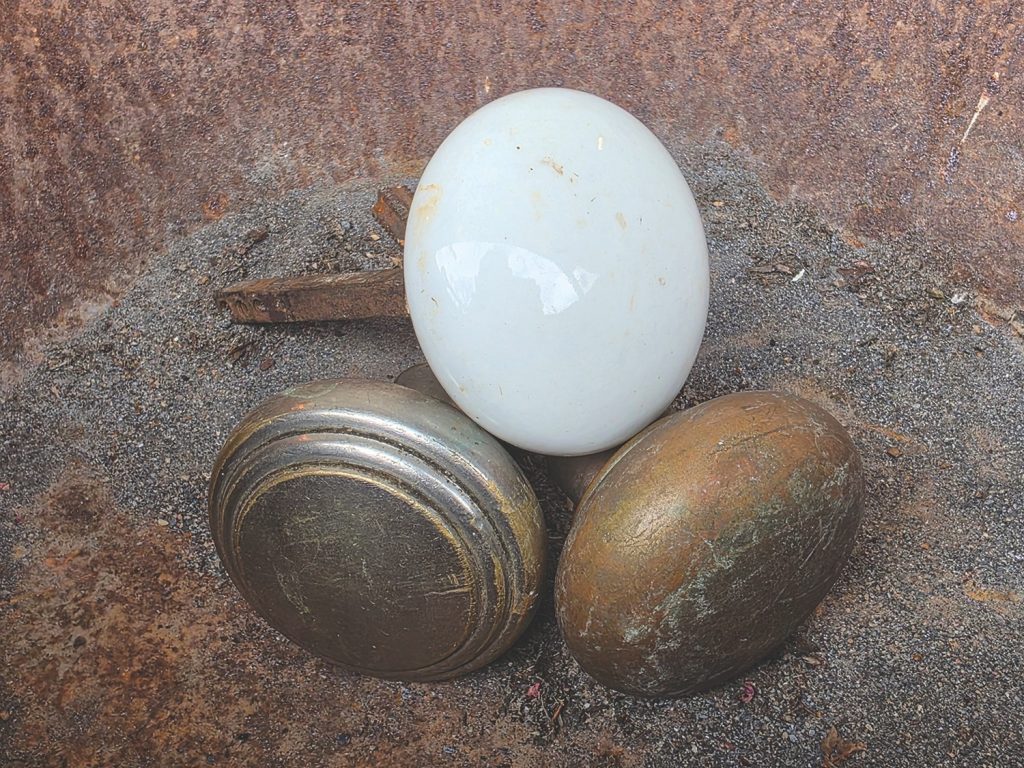
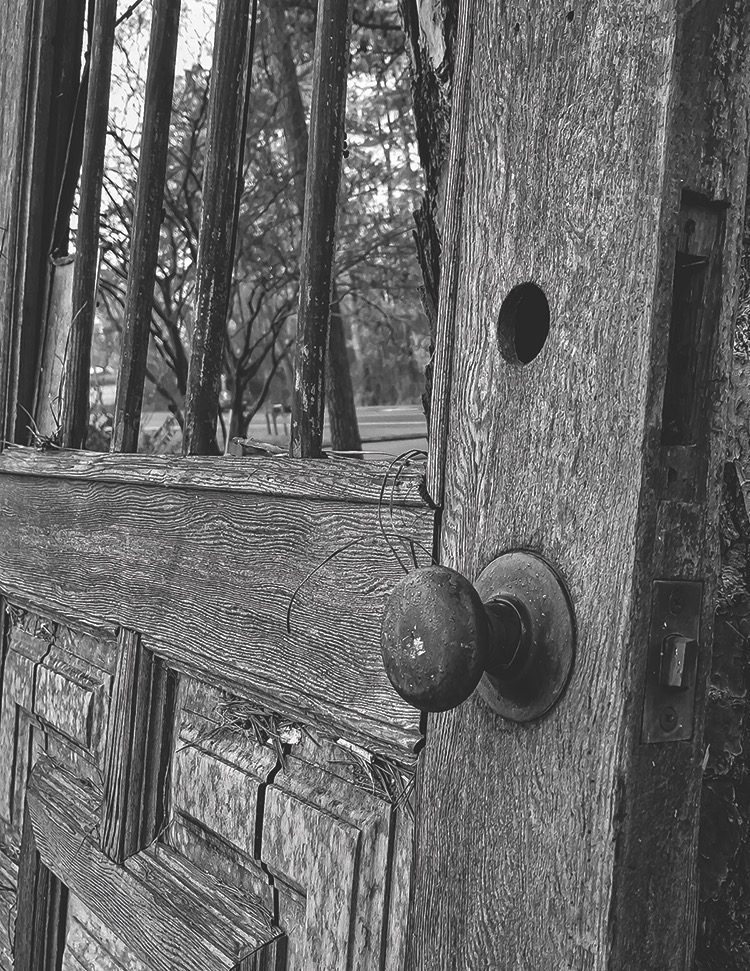
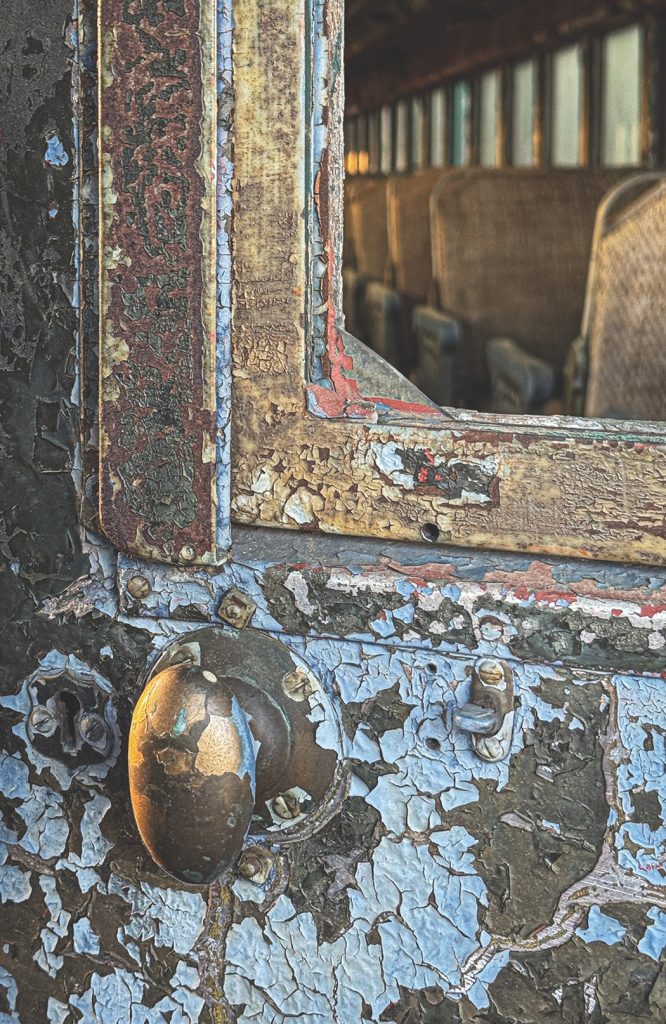
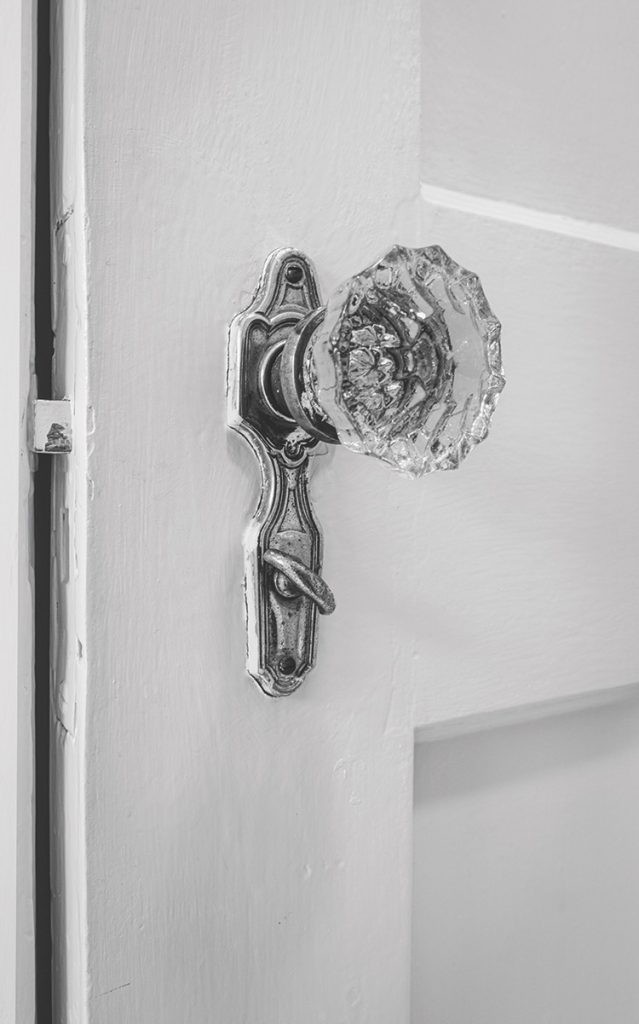
Doorknobs

Tier 1 Winners

Tier 1, 1st Place: Weathered by Faith by Mary Bonsall
Tier 1, 2nd Place: Door Wanted by Jean Antholzner
Tier 1, 3rd Place: Portal to a Tormented Soul by Steve Bonsall

Tier 2 Winners

Tier 2, 1st Place: Enchanted Threshold by Michael Sassano
Tier 2, 2nd Place: Artistic Entryway by Donna Sassano
Tier 2, 3rd Place: Unhinged by Susan Batts

Tier 3 Winners

Tier 3, 1st Place: Final Destination by Dale Jennings
Tier 3, 2nd Place: Anno Domini 1928 by Gisela Danielson
Tier 3, 3rd Place: No Entry to the Caboose by Neva Scheve

Southwords

SOUTHWORDS

A Magic Moment

By Jim Moriarty

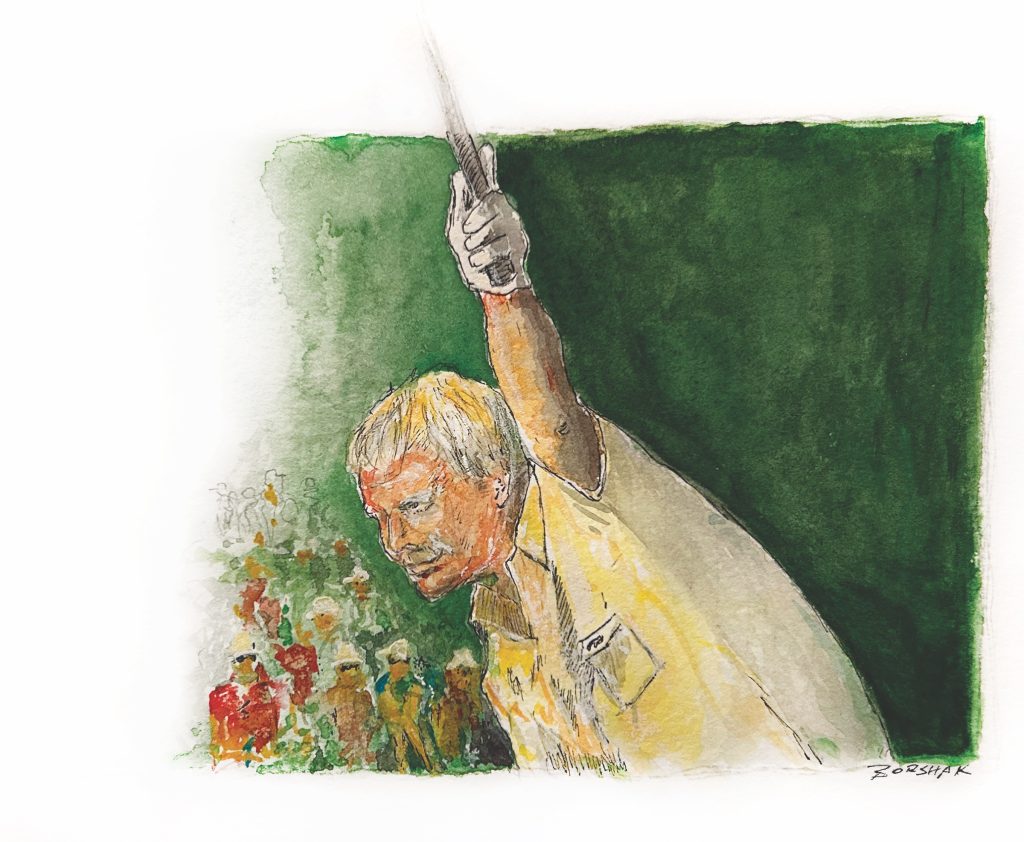
I find it hard to believe that it’s been 40 years since Jack and I won the Masters. God bless him, he’s gotten old. Jack has shrunk over the decades. He blames, at least in part, his cascading vertebra on the cortisone shots he received in his back to relieve pain when he was a teenage golfer. At the Father and Son Challenge in 2020, Gary Player joked that he never thought he’d out-drive Jack, “and I never thought I’d be taller than him either.”

Jack and I didn’t get off to the best of starts. It was the 1979 Colgate Hall of Fame Classic on Pinehurst’s No. 2 course. I was a relative newcomer to golf. Jack had already made a favorable impression on the game. (If you think 15 majors is good.) I met him on Maniac Hill, where he was warming up. I was there to take as many swing sequences as players would allow for Golf World magazine, where I was the associate editor — a title that conveyed with it cameras and lenses, something I was beyond ill-prepared for. I introduced myself and asked Jack if he would mind if I took a swing sequence of him. He rather politely agreed, being a good friend of my editor in chief, Dick Taylor. Whenever Dick traveled to Palm Beach, he bunked in with the Nicklauses.

The sequence camera was — and I suppose still is if, God forbid, you can find one — called a Hulcher. It was a rattletrap box of whirling, grinding widgets, invented by an otherwise perfectly harmless little man of the same name to photograph rockets taking off for the Department of Defense. While it may have been useful for Wernher von Braun, it was a curse to any golf photographer who ever touched one, with the exception of World Golf Hall of Fame photographer Leonard Kamsler, who had mysteriously managed to tame his personal Hulcher the way Siegfried and Roy tamed white tigers.

Jack never pulled a club back until he was absolutely, positively, unconditionally ready to hit the ball. He could stand motionless over a putt longer than any human being who ever lived. His full shots weren’t much different. When I got ready to take Jack’s swing sequence, he was addressing the ball. I began running the camera, sending 35mm film screaming through the beast at 40 or 60 frames per second, I can’t remember which, making a noise not dissimilar to a Navy destroyer raising anchor. The film came in 100 foot rolls and I’d run about 80 of it through the camera when I stopped.

The motionless Nicklaus turned his head and stared at me. “I thought you were going to take a sequence,” he said.

“I thought you were going to swing,” I replied.

Not quite a year later, I had the chance to take Jack’s picture again, this time on the 18th green of Baltusrol Golf Club as he won his fourth U.S. Open. They hung the message “Jack Is Back” on the big leaderboard. As thousands rushed the green, Jack threw up his hands like a London traffic cop, stopping the hordes in their tracks. Isao Aoki had yet to putt out. Lost in the crowd, I climbed the tree at the back of the green, a vantage point that — given my limited photojournalistic capabilities — didn’t yield much better pictures than the ones I’d gotten that day on Maniac Hill.

By 1986, through sheer repetition, I’d improved. Most of my photos were functionally usable. Jack, on the other hand, had gone in the opposite direction. His return in 1980 lasted through the PGA Championship at Oak Hill Country Club, which gave every appearance of being the final major he would win, leaving his total at 17. Then came that Sunday in Augusta.

As Jack was charging on the back nine and Seve Ballesteros was collapsing, I found myself funneled to the right of the 16th green, trapped behind half the population of Georgia. Unable to squeeze in to take a photo, I became a spectator, too. For comparison purposes only, I once attended one of Bo Schembechler’s postgame interviews conducted in a tiny room with a single bare lightbulb hanging from the ceiling, off the same concrete tunnel the University of Michigan marching band used to exit the stadium, jammed shoulder to shoulder, playing “Hail to the Victors” at incalculable decibel levels. I promise you, the noise the crowd made in the valley at Augusta National that day as Jack walked from the 16th green to the 17th tee was far, far louder — so loud his eyes welled with tears as he walked up 17. Mine, too.

The echo of those cheers still rattles my bones, even if they are 40 years older.

State of Mind

STATE OF MIND

Sweet Spot

A place to watch the world

By Tommy Tomlinson

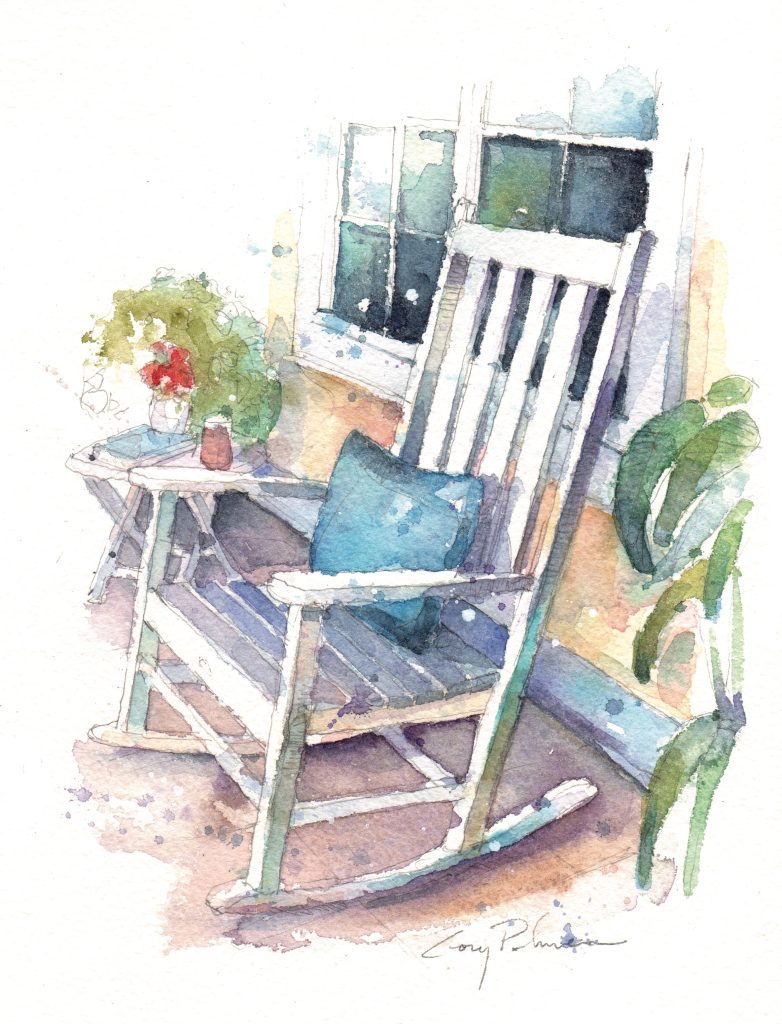
Every year I mark it on the calendar when it arrives: porch season.

This year we got a dose in the middle of February. We always get a brief false spring right around then. You know winter is coming back for another round so you get outside while you can.

It was 74 degrees one day, 83 the next, and my wife and I took to the porch in the afternoons. The porch was one of the main reasons we bought this old house. It was built in 1929, ancient in a modern city of teardowns. When we got the place the porch was half caved in — it had a big crack in the concrete, running down the middle. We got it resurfaced, and over the last 22 years, and two sets of porch furniture, we’ve spent untold thousands of hours out here.

There are some neighbors we see only when we’re on the porch. They stop by and chat on their way to get a beer down the street, or just on their evening walk. Sometimes they come to browse the books in our Little Free Library. Not long after we put the library in, a young couple with a little girl would stop by a few times a week. An older neighbor noticed, found out the girl’s name, and started leaving books in there with notes for her. Then the couple discovered that the older woman had a dog and started leaving treats for the dog. I’m not sure that couple and that woman ever met. But those little gifts meant the world to them. And to us.

A year or two ago, a waterlogged branch fell off our oak tree in a storm and knocked out the library. We had it rebuilt. You can’t let go of a thing that gives you a story like that.

The porch is our party line, our message board, the place we catch up on news and gossip. It’s where we learn who moved out and who moved in, who got sick and who’s doing better. We have watched children grow from here, and watched other neighbors age.

This winter was a hard one. We had an ice storm one weekend and 11 inches of snow the next. Other parts of the state got it even worse. We got lucky at our house — the power never went out and the pipes didn’t freeze. But man, a winter storm in the South can be lonely. We went entire days without seeing another soul. My wife is from Wisconsin and cheerfully tells stories about having to shovel the driveway every hour when they had one of their regular blizzards. Some people down here — mostly transplants — take to the snow like golden retrievers. The rest of us just hunker.

A week or so after the last snow melted, I saw the shoots of one of our daffodils poking through the dirt. And I knew porch weather was coming.

I have spent some time over the years developing a theory about why the South is believed to be, let’s say, more eccentric than other parts of the country. I call it the Crazy Aunt Theory. In colder places, if you have a crazy aunt, you can just stick her in the attic. But our summers are too hot for that. So we put our crazy aunts on the porch where they can talk to God and everybody.

The porch takes us back to those looser, closer times. You don’t have to text anybody from the porch. You don’t need to look up their socials to see what they’ve been doing. They are voice and flesh, standing right in front of you, having real conversations. Sometimes, if somebody has a few minutes, they’ll come up on the porch and actually sit with us. Crazy, right? Spending time together, in person? And we will sit there with glasses of sweet tea, or possibly bourbon, and talk about — well, maybe, nothing. Some days nothing is the best thing to talk about.

And sometimes we are silent because there is so much to see.

There’s a movie from the ’90s called Smoke that features a character named Augie who runs a little tobacco shop in Brooklyn. Every morning at 8, he takes a single photo of the street corner outside. One of the other characters thinks this is the dumbest thing he’s ever heard . . . until he looks through an album of Augie’s photos. Slowly he notices the little differences, the way the light changes, the weather, the people walking through the frame. He is deeply moved.

That’s the way I think about our porch.

In my mind, I can flip through the album and watch the magnolia on the corner bloom and fade. I can see the wrens who show up every year to build a nest under one of the eaves, making a warm space for their babies: first eggs, then hatchlings, then gone. I can see the lizards who slink out from under the house to sun themselves on the warm concrete. I can turn around the camera and see Alix sitting next to me. We who moved here in our 40s and are now in our 60s and hope to still be around in our 80s.

That second warm day in February, two bluebirds floated into the branches of the ornamental cherry tree in our front yard. Our neighborhood is full of cardinals and robins and swallows. Hawks watch over us from the tops of the trees, and owls call to one another at night. But we don’t get many bluebirds. They felt like a promise. The hard winter was coming to an end. Soon it would be porch season for real. We could live out here again — not virtually, not digitally, but through the rich and beautiful panorama of real life.