Bookshelf

June Books

FICTION

The One Hundred Years of Lenni and Margot, by Marianne Cronin

Lenni, 17, meets Margot, 83, while they are both in a hospital in Glasgow. They develop a friendship in an art class, where they decide to paint 100 pictures between them, one for each year of their lives, in this beautiful story of friendship at any age and how it changes us.

The Nature of Witches, by Rachel Griffin

For centuries, witches have maintained the climate, their power peaking in the season of their birth. But now their control is faltering as the atmosphere becomes more erratic. All hope lies with Clara, an Everwitch, whose rare magic is tied to every season. The Nature of Witches is a fierce, romantic YA story about a world on the brink of destruction, the one witch who holds the power to save it, and the choice that could cost her everything she loves.

Malibu Rising, by Taylor Jenkins Reid

It’s the day of Nina Riva’s end-of-summer party, and anticipation is at a fever pitch. Everyone wants to be around the famous Rivas: Nina, the talented surfer and supermodel; brothers Jay and Hud, one a championship surfer, the other a renowned photographer; and their adored baby sister, Kit. Together the siblings — the offspring of the legendary singer Mick Riva — are a source of fascination in Malibu and the world over. By midnight the party will be completely out of control. By morning, the Riva mansion will have gone up in flames. But before that first spark is lit, the loves and secrets that shaped this family’s generations will all come rising to the surface.

Double Blind, by Edward St. Aubyn

Moving from London to Provence to California and back to a beautiful woodland entirely off the grid, Double Blind is a breathtaking, kaleidoscopic novel exploring friendship, love, consciousness and the natural world. Timely and expansive ecological concerns animate the novel as it follows three friends and their circle through a year of transformation, moving between London, Oxford, Cap d’Antibes, Sussex and Big Sur. It’s about the headlong pursuit of knowledge and the consequences of fleeing what we already know about others and ourselves.

Morningside Heights, by Joshua Henkin

An Ohio woman attends Yale, falls in love with her professor, and marries him. As she struggles to face her aging, a chance at new romance arrives. Morningside Heights is a compassionate novel about surviving a marriage wrecked with hardship, the love between men and women, parents and children, and living a life different from what we expected.

The Personal Librarian, by Marie Benedict and Victoria Christopher Murray

Belle da Costa Greene was born a light-skinned Black woman whose family moved to New York to live as white. She is hired by J.P. Morgan to be his personal librarian, changing not only her world, but her family’s, too. Belle was an exceptional woman with a love for rare books that matched Morgan’s. Authors Benedict and Murray, one white and one Black, have written a fabulous book that puts you in Belle’s shoes as you feel her daily fear of exposure.

NONFICTION

The Power of Awareness: And Other Secrets from the World’s Foremost Spies, Detectives, and Special Operators on How to Stay Safe and Save Your Life, by Dan Schilling

In this compelling guide, Schilling uses stories from his Special Operations career, and from other experts, to outline six rules you can apply anywhere to improve your personal safety and situational awareness as Americans emerge from the lockdown of the pandemic.

The Ride of Her Life: The True Story of a Woman,
Her Horse and Their Last-Chance Journey Across America,
by Elizabeth Letts

It’s the winter of 1954 in rural Maine and Annie Wilkins is a 62-year-old woman living a hardscrabble existence on a failing farm. When she becomes ill and learns that she has just a few years to live, Annie buys a rundown horse, packs a few necessities, and she and her dog set out on a ride to see California — her mother’s dream. The story of this woman’s journey provides a lens to view the cultural shift in America as one era ends and another begins.

CHILDREN’S BOOKS

Last Gate of the Emperor, by Kwame Mbalia and Prince Joel Makonnen

Yared Heywat, a flawed hero with a gift for gab, teams up with the mysterious Ibis to dominate the boards in the augmented reality game “The Hunt for Kaleb’s Obelisk” and, as play progresses, they realize they are involved in something way more serious than a mere game. Rooted in the real-life history of Makonnen’s family, the last emperors of Ethiopia, Last Gate of the Emperor is a must read for all young adventure lovers.  (Ages 9-13.)

Freaky Funky Fish, by Debra Kempf Shumaker

A fish book with freakiness ratings really should be on the shelf of every young outdoor adventurer. From those that fly to those that climb, from those with invisible heads to those that can dance, there’s a fish for every weird attribute possible, and they’re all rated on a freakiness scale from 1-5. (Ages 5 and up.)

What Will You Be?, by Yamile Saied Méndez

“What will you be when you grow up?” A builder, a teacher, a leader, a student? Children are asked this all the time, and this stunning picture book answers in some surprising ways. This little gem is the perfect gift for graduates of all ages.

Darling Baby, by Maira Kalman

No day is ordinary when it’s shared between a grandparent and their new grandchild. This sweet story of just one of those days is illustrated by the brilliant Kalman and is the perfect read-together for grandparents and grandchildren. (Ages birth to 5.)

The Trillium Sisters 1: The Triplets Get Charmed, by Laura Brown and Elly Kramer

Nature themes, girl power and cute baby animals with amazing secret powers combine to make this new series perfect for readers who are looking for a new, fun and adventurous chapter book series. (Ages 6-9.)

A Father’s Love, by Hannah Holt

A father’s love, whether in the animal kingdom or the human one, is powerful and true and long-lasting. A fun look at the roles of fathers in the animal kingdom, this little gem is perfect for Father’s Day or every day. (Ages birth to 3.)  PS

Compiled by Kimberly Daniels Taws and Angie Tally.

Out of the Blue

From Cover to Cover

When time was marked by magazines

By Deborah Salomon

Life’s steep and winding highway begs mile markers. On mine, look for magazines.

Because you are what you read, from childhood on. I remember more about Mary Poppins than Earnest Hemingway. But those are books, to curl up with on a rainy Saturday, or dissect in a college lit class.

Magazines, in contrast, provide quick reads: facts, opinions, critiques, humor, all au courant.

I grew up in a magazine-rich household. Highlight of the week was arrival of Life. What or who would rate a cover story? Eisenhower? Marilyn? Castro? Ali?

My mother rated Look a notch below Life, therefore unworthy of a subscription. Thank goodness she approved of Reader’s Digest. I beelined to the “Laughter, the Best Medicine” feature.

This affection began with Jack and Jill, first published the year before I was born. I aced the page where animals or objects were “hidden” in an illustration. Soon, much to the chagrin of parents, pre-teen girls developed “crushes” on movie stars. We passed around Photoplay and Modern Screen until pages, stained from Coke, went raggedy. A year or so later, we moved on to racy, fabricated confessions in True Story, purchased by older sisters and sequestered under the mattress. Pure trash . . . but a deliciously grown-up transition.

I was interested in food even then, probably because my mother wasn’t. I recall begging her to subscribe to Ladies’ Home Journal and Good Housekeeping in the early ’50s, when anything cooked in cream of mushroom soup rated “gourmet.” Meatloaf was a hot topic. Garlic, not. Cakes had three layers; salads were “tossed” and fresh herbs, absent.

Never caught the Seventeen bug. Just too 17-ish.

As a Manhattan kid transplanted kicking and screaming to Asheville, I craved the edgy. With babysitting money, I subscribed to The New Yorker in high school, mostly for the cartoons and covers which, unlike now, were timely but gentle. From these pages printed in a recognizable font I learned about profiling, which helped later on when, coming full circle, I profiled my favorite New Yorker cartoonist, Ed Koren, for a news syndicate.

I continued that subscription for more than 50 years until the articles became too long and the covers, too mean-spirited. I tried skimming my husband’s Sports Illustrated after hearing that the writing was top drawer. Maybe, once you plowed through the jargon.

Then, the Newsweek mandate.

My mother was a high school math teacher and politics maven. She had strong opinions better expressed in Newsweek than Time. I had disappointed her once, by an indifference to math and disinterest in the teaching profession. She certainly wasn’t going to cede her only child to even a smidgen of pop journalism. So, after I married and moved far away, she gifted me with a perpetual Newsweek subscription. Our phone calls usually included a “Did you read about . . . ”

Still checking up.

The subscription ran out after she died.

Magazines in their original form also declined, victims to the internet, podcasts and 24-hour cable news. TV Guide, where my father checked off the week’s best ball games, became superfluous and The Saturday Evening Post a collector’s item. Playboy endured, as if anybody really looks like that naked.

This highway has a happy ending. When my older grandson was about 9, he displayed a keen interest in history, geography, outer space and other exotic destinations. So, for his birthday, I subscribed to National Geographic but had the copies sent to my address. That way I could skim the stories and discuss them with him. He already knew most of the stuff, but loved to argue facts and opinions, whether tribal cultures or marine life in the South China Sea. What a joy, to be out-litigated by a fourth-grader. I subscribed until he was 15.

“Nanny, you should see the pile of National Geographics I have stacked up,” he said, when moving into his first apartment. By then, he had traveled and/or studied in two dozen countries including China, Japan, Australia, Thailand, Vietnam, Eastern Europe, Central America. He speaks three languages, graduated from law school and passed the bar, all by 23. I take no credit, except for sharing something beyond comic books and chocolate chip cookies.

I can’t remember a time when a few magazines weren’t stacked on my coffee table — always PineStraw, occasionally something else. Occasionally, I read The New Yorker online. My dentist gets an impressive array, including Our State and Southern Living. I arrive early, on purpose, to copy recipes that I never make. At the supermarket checkout I notice that magazines have become terribly specialized, more like grown-up picture books. And horribly expensive.

I don’t subscribe to anything anymore. The house where I wallpapered a bathroom with New Yorker covers is long sold. I haven’t the heart to ask my grandson if he discarded the National Geographics.

But the thrill endures because look where I ended up: writing about magazines for a magazine.  PS

Deborah Salomon is a writer for PineStraw and The Pilot. She may be reached at debsalomon@nc.rr.com.

Southwords

A Day at the Open

Memories of a father’s gift

By Tom Allen

My father, decades ago, played one round of golf. Never again.

For Dad — a fisherman and dove hunter — golf was too tedious. He was, however, captivated by televised tournaments, especially the Masters and the U.S. Open. He was an armchair quarterback for college football and a recliner referee for ACC hoops, and a wannabe umpire for Braves baseball. He followed celebrity golfers from his generation — Trevino, Palmer, Nicklaus — and watched enough golf to know the names Mickelson and Els. And Tiger, like Michael Jordan, was a household name.

In 2005, I snagged two tickets for Friday’s U.S. Open Championship on Pinehurst No. 2. I asked Dad if he wanted to go, a Father’s Day gift from a son who broke a hundred once. He smiled at the chance. I smiled too. The day might be a bust — a 46-year-old and an 83-year-old, whose conversations over our adult years covered reminders from Dad to change the oil in my car every 3,000 miles to his chiding me for setting my tomato plants before the soil warmed while I, in turn, reminded him to keep his cellphone turned on and to get a flu shot. These conversations inevitably ended with my changing the oil every 5,000 miles and planting my tomatoes in cool, sometimes frosty, late March. He, likewise, continued to keep his phone off and never rolled up his sleeve.

We met that Friday morning at my home in Whispering Pines. I drove us to Pinehurst, remarkably without any comments from Dad about my tendency to drive faster and brake later than he did. We parked and took a shuttle to the main entrance, arriving as the gates were opening. I suggested a walk through the merchandise tent, not for want of anything but just to see Dad’s reaction to the prices.

A finance major in college, Dad was drafted in 1942, one of two in his graduating class at Oak Ridge Military Academy who wasn’t assigned to a combat unit. Dad ended up in the 109th Finance Disbursing Section, stationed for a few years in England. He received a Certificate of Merit from his commanding officer. The U.S. Army had no idea what a good decision they made by placing an adding machine in his hands instead of a rifle.

At 83, Dad was robust and thriving, but I knew he’d tire trying to trail certain players, so we positioned ourselves in a shady section of a grandstand, an ideal spot to watch approach shots and putts and to see Tiger birdie and tip his cap. Dad loved every minute though, like father, like son, he had to be shushed a few times by a grandstand marshal when players were putting out. Thankfully, she was a member of the church I serve and tempered her shushing with a smile.

By noon he was done. Walking out, we got a glimpse of a Mickelson fairway shot, long and straight. Dad showed no interest in paying U.S. Open food prices. Bojangles was the choice for lunch, his treat. At home, his garden needed tending and his bird dog feeding. It was a short but good day. Actually, one of the best.

Ten years later, at 93, weakened by an illness that caused a rapid decline, Dad and I watched the U.S. Open from his hospice room. A few weeks later, father and son were alone. I whispered I loved him, thanked him for being the best dad ever, told him Mom would be cared for, and gave him my blessing to go home. A few seconds later, as gently as he had lived his life, he left.

In April, Sophie, Countess of Wessex, reflecting on Prince Philip’s final moments said, “It was so gentle. It was like somebody took him by the hand and off he went. Very, very peaceful . . . ” Her words resonated.

Not a U.S. Open passes that I don’t think of that day in ’05 — sunny, warm, just enough breeze. At 63, I’ve moderated my speed and widened my brake time. Dad would be pleased. He would probably shake his head at automotive technology that allows for twice the mileage before an oil change. I imagine he would stick with 3,000. This year, unlike others, I waited to plant my tomatoes until the soil warmed and any chance of frost had passed. Those tomatoes, like Dad on that warm June day, have thrived. In the end, I guess Father really does know best.  PS

Tom Allen is minister of education at First Baptist Church, Southern Pines.

Good Natured

An Herb for the Ages

Everything’s better with red ginseng

By Karen Frye

Ginseng has been used in Eastern cultures for thousands of years. It grows in the wild in China and Korea. There is an American ginseng, as well, and it grows wild in the mountains of North Carolina near Boone. It takes about 20 years for the ginseng root to mature. You can find it in tea, extracts and capsules.

There are about a dozen varieties of ginseng, and each variety has its own unique properties. One, however, has a reputation like no other — Korean red ginseng.

Among the reasons to seek out red ginseng root are extreme fatigue, exhaustion, brain fog, low libido and the inability to handle stress in a healthy way. Studies involving red ginseng root have found it useful in treating cancer, diabetes and hormonal imbalances, and in boosting energy levels.

While it does increase your energy, it’s not a stimulant, it is an adaptogen. Adaptogens help bring balance to the body’s systems. So, while ginseng is energizing, it’s also calming. A good substitute for that cup of coffee or pick-me-up, ginseng offers a boost while curbing stress, as well as preventing some of the common ailments that jeopardize our quality of life.

While ginseng frequently takes a couple of weeks to kick in, the results with red ginseng are usually immediate. Typically, you find men looking for ginseng (think Father’s Day), but there are benefits for women, too. Red ginseng is safe if taken as recommended. One possible side effect, however, is a reduction in blood glucose levels. Therefore, if you are diabetic, it’s important to talk to your doctor before taking it.

Red ginseng is a wonderful energy tonic. It can help relieve fatigue and reduce the effects of long-term chronic stress by reducing levels of cortisol. It can give you relief from anxiety and depression while improving memory and brain functions. Ginseng has been relied upon for a very long time and remains one of the best herbs for better overall health and well-being.  PS

Karen Frye is the owner and founder of Nature’s Own and teaches yoga at the Bikram Yoga Studio.

The Naturalist

Like Son, Like Father

A manatee, a rattlesnake, and a change of perspective

By Todd Pusser

Putting on a wetsuit is an ordeal, especially if you have never done it before. The process of pulling a thick piece of neoprene up over your legs and torso is exhausting. So it was as I strained with all my might, trying in vain to pull the crushed rubber material up over the last few inches of my father’s shoulders.

Finally, with a few extra twists and turns, I was able get to Dad fully suited up. Pulling the zipper up his back, I turned him around to inspect how well the rented contraption fit him. Standing there on the bow of our aluminum jon boat, Dad looked like an aging superhero with his white hair, all aglow under a bright January sun, contrasting sharply with his skintight black wetsuit.

I handed him a mask and snorkel and he promptly belly flopped over the side of the boat. Dad had never snorkeled before, not even in our backyard swimming pool. I figured this was as safe a place as any for his first try. Our boat was anchored near a large, freshwater spring, many miles away from the ocean, and the calm water was only 8 feet deep.

I had asked Dad to join me for a trip to Crystal River, Florida, to dive with mermaids, something he agreed to without hesitation. Errr . . . I meant manatees. I wasn’t trying to mislead my father — after all, lovesick, old-timey sailors frequently mistook the sea cows for voluptuous sirens. No, I had asked Dad to come along with hopes that he could gain a better understanding of the career path I had chosen for myself.

I have always had a strong love for nature, especially creatures of the ocean. Despite growing up in landlocked Eagle Springs, over a hundred miles from the nearest beach, my passion for the sea was innate, though a chunk of it was certainly inspired by Sunday afternoon viewings of the Undersea World of Jacques Cousteau at Granny’s house.

Dad never fully understood my obsession with nature, but he tolerated it. More importantly, he and Mom always encouraged and supported me, especially when they asked what I wanted to be when I grew up. The answer was always the same — a marine biologist.

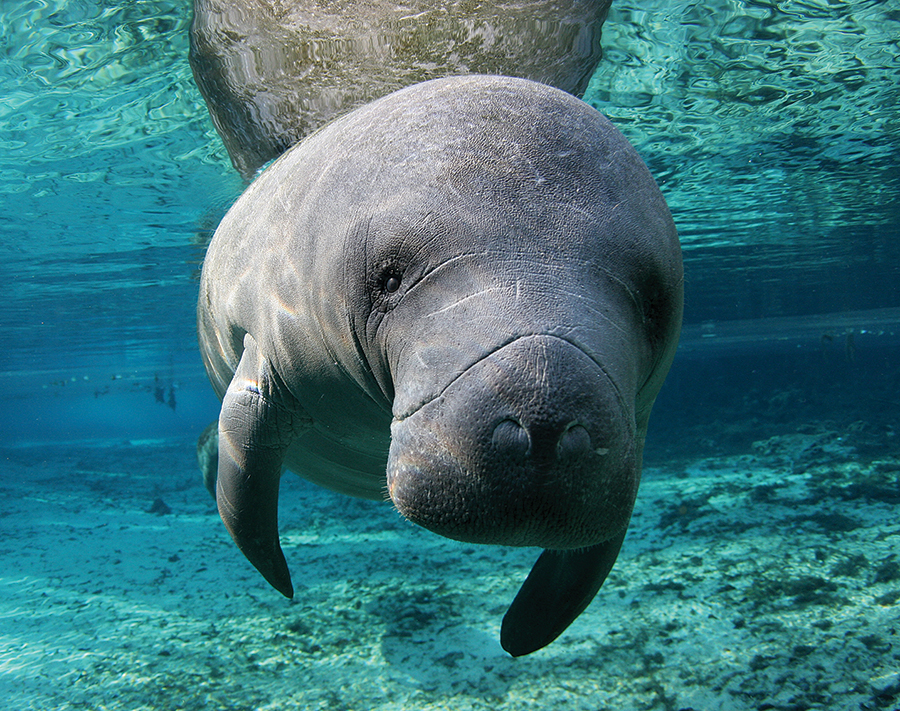
As soon as Dad hit the water, a manatee appeared from out of nowhere. Dad gave an audible “grunt” in his snorkel, obviously surprised by the sofa-sized mammal that had snuggled up next to him. Despite their size, manatees can be quite curious, even playful, and this particular one nuzzled its head up under Dad’s hand, wanting a scratch like some overgrown puppy. (Disclaimer: This interaction took place over decade ago. Touching manatees is no longer permitted.)

As quietly as I could, I slipped into the water, fumbling with the controls of my underwater camera. The manatee, ever curious, kept swimming circles around me and my father. Occasionally it would pause to scratch its back on the anchor line that ran from the bow of the boat to the river bottom. After 10 minutes or so, it swam off. Dad climbed back into the boat, shivering from the cold water but clearly exhilarated by the whole experience. The sparkle in his eye told me everything I needed to know. No longer would he wonder about what motivates his son in life.

The following summer, I asked Dad to join me once again in the field, this time in the Albemarle Peninsula of coastal North Carolina. A wild, sparsely settled region of the state, with immense tracts of farmland surrounded by thick, pocosin swamps full of bears, bobcats and red wolves, the peninsula is one of my favorite places.

As a kid, Dad and I did not spend much time together outside. The family carpet business in West End took up most of his time. He and Mom worked hard, busting their butts Monday to Saturday, through all hours of the day, providing for our family.

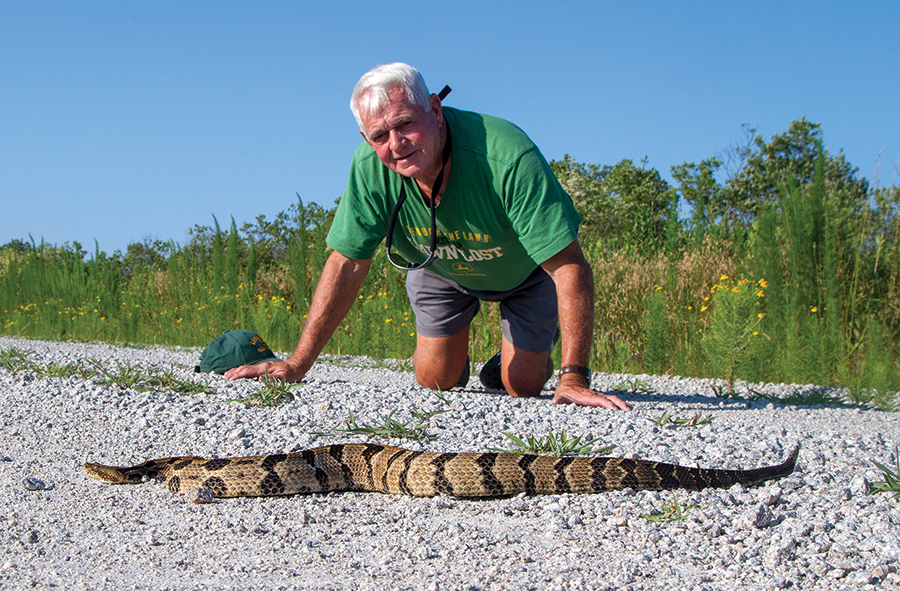
It was the first afternoon of a planned four-day trip, when Dad and I encountered the rattlesnake. We came upon the venomous serpent stretched out in the middle of a long dirt road that cut through a dense patch of forest. Its yellow and black scales glistened in the late afternoon light.

I stopped the car about 20 feet in front of the snake and slowly opened the door with camera in hand. Dad, reluctantly, did the same.

I find snakes, all snakes, to be beautiful creatures. Always have. Dad, on the other hand, emphatically does not. An insufferable ophidiophobe, his mantra in life (perhaps many of you can relate) is, “The only good snake is a dead snake.” As a kid, whenever a snake appeared in our rural Eagle Springs yard, Dad always assumed it was venomous and promptly dispatched it with a deft stroke of a shovel. As I matured, I realized that not all snakes seen in the yard were venomous, so I would plead with Dad not to kill them. Sometimes, if I whined long enough, he would relent and allow me to catch and move them unharmed to a nearby patch of forest.

Back at the dirt road, I asked Dad to go and kneel down behind the rattlesnake so I could take a photo that would give a sense of scale (no pun intended) to the 4-foot-long serpent. He cocked his head, raised an eyebrow, and calmly replied, “Hell no.”

I tried to explain that rattlesnakes are not aggressive and that they do not attack people. I explained that most venomous bites occur when people try to kill a snake. I even described how snakes are beneficial to have around and that they eat a variety of pests, many of which carry ticks that harbor disease. This failed to impress and Dad remained steadfast. I figured as much.

Wanting to get a few shots of the snake in habitat, I took out my wide-angle lens and lay down on the dirt road, just out of strike range of the venomous serpent. The rattlesnake remained perfectly still, neither flicking its tongue nor vibrating that famous tail. It was simply biding its time, waiting for us to leave it in peace.

After a few minutes of watching me, Dad, realizing there was nothing to fear, agreed to take a knee behind the snake. As I framed him in the camera, he even managed to crack a nervous smile. I wondered to myself if perhaps Dad was changing his point of view about snakes.

A few months later, I got my answer. Mom called to tell me a most unusual story. While driving down a rural Jackson Springs road, she and Dad encountered a rattlesnake in the center lane. Instead of running it over, Dad pulled the car over to the shoulder of the road, got out, and fetched a tree limb. Stopping oncoming traffic, he coaxed the venomous reptile off the road into the safety of the woods, all the while explaining how beneficial snakes are to the environment to Mom and the other exasperated drivers.

I have never been more proud.  PS

Naturalist and photographer Todd Pusser works to document the extraordinary diversity of life both near and far. His images can be found at www.ToddPusser.com.

Golftown Journal

Full Circle

Pinehurst goes from empty to overflowing

By Lee Pace

It was a moment straight from The Shining, Danny Torrance pedaling his tricycle through the abandoned hallways of the Overlook Hotel. Only this was Matt Chriscoe riding a bicycle down the hallways of the 120-year-old Carolina Hotel in Pinehurst. It was late March 2020, and the hotel operation had shut down in the wake of the worldwide COVID-19 pandemic. Chriscoe, the resort’s director of lodging, and another staff member were endeavoring to move the bicycles kept out front for guest use into storage for an unknown period of time.

“It was eerie,” Chriscoe reflects a year later. “We were riding bikes down that long hallway. The lights were turned off, the phones were re-routed. We had no idea how long it was going to last.”

When Pinehurst officials made the decision on March 22 to shut down the operation of its three hotel facilities — the Carolina, the Holly and the Manor — they realized the front doors under the porte-cochère of the Carolina had no locking mechanism.

The hotel had never been closed.

“We literally used chain link and a padlock,” says Tom Pashley, president of Pinehurst Resort. “That was the only way we could secure the doors.”

Pashley shakes his head thinking back one year to the trauma of the spring of 2020. He’s sitting on the veranda on the south side of the original Pinehurst golf clubhouse, looking over The Cradle short course. On this morning in late April 2021, the club and resort have come full circle, from the hotel operation shutting down to 12 months later being a beehive of activity. Tee sheets are full. The Maniac Hill practice range is lined with golfers. Parking spaces are at a premium. Within Pashley’s field of vision are two construction projects — a bulldozer at the far end of the short-game practice area is shaping a foundation for a new permanent beverage facility to service golfers on The Cradle, and construction workers are hammering and nailing on a golf shop expansion.

“We’re building a new home for the Pine Cone,” Pashley says of the vintage beverage cart located behind the third green of The Cradle. “It’s served us well, but we need a permanent beverage facility, there’s so much traffic out here. And we need more space in the golf shop. We’ll start selling 2024 U.S. Open merchandise before long.”

The resort booked a record amount of business in 2019 and was primed to eclipse that in 2020 before COVID-19 ground business and travel to a halt. The hotels and the resort’s 10 restaurants were closed for two months, then began welcoming guests again on May 22 when North Carolina Gov. Roy Cooper allowed restaurants to reopen under certain procedural guidelines.

“There was still activity here on the golf side,” Pashley says. “But at the hotel it was sad. When restaurants had to close, we made the decision to close our lodging. We had to feed people and couldn’t do that. I remember the weather was perfect, it was a great spring. I was thinking, what a shame that guests can’t be here. The members were here, but no guests.

“Pinehurst was in the golf business, but not the hospitality business.”

The resort had to lay off more than 1,000 employees during the thick of the pandemic. Pashley nods to the front entrance of the clubhouse, where Larry Goins and Frolin Hatcher have a century of combined experience welcoming golfers to the clubhouse, unloading their golf bags from the hotel shuttle and getting them acclimated to the hubbub of the resort.

“We had to say goodbye to guys like Frolin and Larry,” Pashley says. “All of a sudden, it became personal.”

Pashley remembers fighting off the “woe-is-me” syndrome at the outset and brainstorming ideas to help employees during his regular 8-mile morning walks.

“My brain was churning,” he says. “I thought, ‘We have all these amazing experiences we can auction off and raise money.’”

In quick order the resort raised more than $300,000 for an employee relief fund — much of it earmarked to continue health benefits through June — by selling a low-ticket item like a golf ball for $25 to a high-dollar offering of a three-day golf experience with lodging in the Dornoch Cottage for $25,000. The fund got one contribution from a former executive retired in Florida for $1,895 — hearkening to the year of the resort’s founding.

“It was heartwarming seeing people overpay for things just knowing the money was going to a good cause,” Pashley says.

Now in the summer of 2021, those employees have returned — and so have the travelers. Pinehurst is back in the hospitality business.

You see it in the caddie area in the basement of the clubhouse.

“I’ve got 150 caddies, and I need 20 or 30 more,” says Jimmy Smith, the caddiemaster. “It’s insane. We just hired caddies from places like Wisconsin and Pennsylvania. They know we have work for them. My biggest problem is, ‘Where do they park?’”

You see it a half mile away in the village, where shop owners like Tom Stewart at Old Sport & Gallery have transitioned from running online auctions of his paintings, books and collectibles during the thick of the pandemic to welcoming a brisk flow of foot traffic a year later.

“It blows my mind,” says Stewart. “Real estate is unbelievable here. My business, knock on wood, has been better this spring than in 10 years. People who have bought these houses come in and say, ‘I need something, I need artwork and books.’ I’ve sold a couple of big-ticket paintings, and that hasn’t happened in a while.”

Pashley and his staff are faced with the unprecedented challenge of having so much interest from leisure travelers — that group of eight guys coming down from Cleveland — that there isn’t enough golf inventory in the near term for a business group that wants to come for meetings in the morning and golf in the afternoon. Certainly, that will change when golfers are more comfortable traveling to Scotland and Ireland and take some of the demand off domestic travel that ratcheted up during the pandemic, and business travel will return more to its pre-pandemic level.

And, of course, the 2024 U.S. Open on Pinehurst No. 2 is on the horizon, not to mention the new USGA facility to be built next door, and the approval and permitting process for a potential new hotel facility next door to the Pinehurst clubhouse.

It goes to show that what goes around, comes around at Pinehurst. One century before, the founding Tufts family had the happy problem of what to do with all the golfers visiting its four golf courses.

“It has been necessary to turn away from Pinehurst some 15,000 people who wanted to come in February and March,” noted a 1923 publication. The Tuftses were getting more business at their resort than they could handle during the winter “high season” — more than 100,000 rounds a year were being played in the mid-1920s — which led to new ventures to the east in Southern Pines with what would become the Mid Pines and Pine Needles clubs.

Which leads Pashley to nod again toward the south, toward Aberdeen, where the resort owns hundreds of acres it bought nearly a decade ago. The architects Bill Coore and Ben Crenshaw routed a course on land once occupied by The Pit Golf Links, and Pinehurst Resort owner Bob Dedman gave serious thought in 2011 to green-lighting the project. He decided against it, but now, amid a healthy golf economy at Pinehurst, that idea is back on the table.

“Down the road, we’ll have to have a more serious conversation,” Pashley says. “It’s nice to not have to go out and buy land. We’re sitting on 900-plus acres and can dream about what’s next.”

At Pinehurst, what’s next has always been part of the equation.  PS

Lee Pace’s first book about Pinehurst and its history, Pinehurst Stories — A Celebration of Great Golf and Good Times, was published 30 years ago.

Birdwatch

Hidden in Plain Sight

The secretive and elusive Eastern meadowlark

By Susan Campbell

Larks? Here in central North Carolina? Yes, indeed! But few folks are likely to notice them. Even during the summer, when their melodious songs can be heard on the warmest days and their yellow plumage is at its brightest, these birds tend to blend in with the large fields they inhabit.

Meadowlarks are not small birds, but they do have secretive habits that allow for survival in open areas. They are only found breeding in agricultural areas with plenty of large insects such as grasshoppers and beetles, as well as warm season grasses that produce a good crop of seeds by midsummer. The Eastern meadowlark is a jay-sized bird with long legs that spends the majority of the time on the ground searching for prey. The head, back and tail are streaked and blend in perfectly with the vegetation. Its chest, however, is yellow with a black “V-shaped” collar. Males actually display a somewhat brighter breast at prospective females and will even jump into the air as they puff out their chests in their attempts to impress potential mates.

Where the habitat is good, males will defend territories containing more than one female. Polygyny is not uncommon for meadowlarks. This is more frequently the case for Western meadowlarks, found in the Great Plains and beyond. Actually, Eastern and Western meadowlarks are almost indistinguishable where they overlap in the Midwest and southern Plains. Their voice is really the only clue. Westerns are far more musical, having a song that is a rich warble. Not surprisingly, in the western part of the range, Easterns do sometimes learn the wrong song or even hybridize with their Western cousins.

Here you can find meadowlarks anywhere from larger hay fields to horse farms or airports. Males will be singing from elevated perches, such as fence posts, from dawn until sunset. They typically throw their heads back and emit a series of loud, clear whistles. In winter, you will more commonly hear their rattling call as a dozen or more individuals make their way through plowed fields in search of leftover corn, soybeans or slow-moving insects. Unfortunately, because they require very large openings, they are reluctant to come to bird feeders even in the coldest weather.

Females build a cup-shaped nest in a thick clump of grass in order to hide and protect their young from both aerial and ground predators. And, in our area, the season is long enough for two broods to be produced. However, the fact that they typically use large hay fields makes them very vulnerable to losing eggs and nestlings to mowing. The increase in ground predators such as raccoons, foxes and stray cats also has caused significant population declines here in the eastern United States. There are other grassland species that have been affected as well. Grasshopper sparrows, horned larks and bobolinks have become even more scarce — but their stories will have to wait.  PS

Susan would love to receive your wildlife sightings and photos.  She can be contacted at susan@ncaves.com.

The Kitchen Garden

Tomato Tips

Prepare for your homegrown bounty

By Jan Leitschuh

You, or your friendly local farm stand or market, will have ripe, field-grown tomatoes by the end of this month. Even non-kitchen gardeners have been known to plant a tomato or two. It’s the juicy lure of summer meals with that fabulous homegrown tomato taste. With that in mind, here are a few random, but useful, tricks and tips:

— Stake or cage. If you haven’t already, do it now. By the end of the month, your vines will be so heavy with ripening fruits that the plant will sprawl along the ground, tomatoes will rot, and the plant will be exposed to pests and diseases. At this point, tall stakes may be your best bet. If you cage, get one tall enough that the vines don’t spill over the top, then snap under the growing weight of your hard-won harvest. Set cages or stakes deep in the ground so they don’t blow over, and tie vines loosely with soft cloth or twine, supporting the fruiting arms. The thin wire cones sold at supermarkets and some garden stores are really too short for tomatoes and are better suited to peppers and eggplant.

— Hunt for hornworms. Likely, you have a few on your plants right now, so put your glasses on and have a look. Search for chewed leaves. You’re looking for a fat, green, caterpillar-looking creature, especially on the undersides of your branches. Remove and squish (or feed to your neighbor’s chickens). Just a few hornworms can decimate a plant. Luckily, you’ll probably have just a few. Hornworms are tricky because of their exceptional green camouflage. They can hide in plain sight, but once you’ve spotted them, you can’t unsee them. Daily checks for a few weeks — with your cheaters on — will end this problem.

— Improve taste via soil. Generally, the better the soil, the better the flavor. Compost and a mineral-balanced tomato fertilizer are your friends. Unfortunately, by June, isn’t this like shutting the barn door after the mule has fled? Au contraire! It’s not too late to put in another round of tomato plants for late summer and fall harvests. In the early stages of growth, tomato plants need plenty of nitrogen to grow strong stems and plenty of leaves. Once the plant has matured, the major minerals of phosphorus and potassium are needed in greater amounts to allow the plant to switch to successful fruit production. Trace minerals are important as well. Potassium levels in the soil have a significant impact on the taste of the fruits, as do sulfur, boron, sodium and chlorine. Next year, ensure your soil contains the right balance of these nutrients, and you’ll be flooded with flavorful tomatoes come harvest time. I like a mineral product called SulPoMag that’s well-suited for our Sandhills soils.

— Improve taste via variety. Tomato taste is complex, and your original variety choice is important. With thousands of tomato varieties to choose from, each with its own unique flavor profile, the tender heirlooms often top the flavor tests. Store-bought tomatoes are bred with shipping and shelf life, not flavor, in mind. Heirlooms, however, do not have the disease resistance of some of the decent, more modern tomatoes like the popular Better Boy. So, plant some of both.

— Add Epsom salts. Here is a post-planting tweak you can do right now. The timing is “ripe.” Do your tomatoes lack that delicious homegrown taste? Are your plants slow to fruit or ripen, leaves curling or turning yellow between the leaf’s green veining? It may be a magnesium deficiency. This region of the country tends to have low magnesium in the soil. Epsom salts, or hydrated magnesium sulfate, can help boost your tomato yield and keep plants bushy and healthy. The fruits will grow larger and taste better, and the plants will better resist disease and bear longer. Use it as a soil drench or foliar spray. Epsom salts are highly soluble and provide two essential micronutrients: magnesium and sulfur.

Once a month, dissolve two tablespoons Epsom salts in a gallon of water and “drench” the soil around your plant. Thereafter, use plain water regularly until the following month, then repeat the Epsom drench every 30 days. This same mixture — two tablespoons in a gallon of water — can also be sprayed on the leaves as a foliar spray and the magnesium (and sulphur) will be taken up by the plant quickly. Be sparing, again on a monthly schedule.

— Don’t forget pruning. In May, did you prune your tomatoes? Yes, prune. Removing the lower leaves up from the first fruit, or flower cluster, helps fight off common foliar diseases that result from splashing dirt. If you didn’t do it then, do it now. Did you also manage to pinch off the suckers, those feral shoots that arise from the V between the main stem and tomato branches? Cut them off as soon as you see them forming. Pruning them does cut down on the amount of fruit you’ll get, but it also improves the health of the plant, and in the long run, leads to stronger plants that will produce through the whole season. If these suckers are allowed to grow, they will set fruit, but also crowd out the other branches in search of sunlight. That can lead to poor air circulation and fungal diseases. It can also cause fruit to ripen slowly, or not at all. If you don’t prune your plants, you’ll have a smaller and less tasty yield because the extra energy that goes to growing foliage won’t make its way into the fruit. Also, remove any dead or dying leaves to allow the plant to put its energy into fruit production. Wash hands between plants to avoid spreading disease inadvertently.

— Water properly. Keep water off leaves. Tomato leaves are born trying to grab onto a foliar disease, it seems. Proper watering — and mulch — helps prevent splashing dirt onto the leaves. Slight water stress at the time of picking improves flavor, too, since it avoids dilution. Perhaps water in the morning and pick in the afternoon — for that delicious suppertime BLT or Caprese salad. There’s no need to guess when to water your tomato plants. Simply stick your index finger into the soil; if it feels dry, it’s time to water. If it’s moist, you’re good to go. If plants are drooping or wilting, water them deeply immediately and add mulch to protect roots and conserve soil moisture.

— Use the right pots fo container plantings. “Water and feed” is your mantra. Your potted tomato, a heavy feeder, is completely dependent on you. Use determinate (shorter and bushier varieties) or special “bush” tomatoes. Most determinate tomatoes (those that grow to a designated height then stop) are perfect for large, 5-10-gallon pots. Also, roots tend to migrate to the outside of their container. On a blazing day, this can lead to root burn on the sunny side. I’ll set a cheap, large nursery pot within my nicer pot to avoid this, with a little air gap of mulch or sand on the sides. At least use a light colored, reflective pot for your tomatoes if not using the pot-in-a-pot method.

— Companions are helpful. Basil. You’ll pair it with ‘maters in the cook pot, so why not in the garden? Besides culinary considerations, some say basil plants help deter certain pests like whiteflies or thrips. I know for a fact a crushed basil leaf, rubbed on the arms, deters evening mosquitoes. Others swear that tomatoes are tastier with basil planted nearby — you can be the judge of that. Garlic is also said to help repel pests, and that may include deer. Marigolds, cheerful little things, discourage root-knot nematodes. Some gardeners believe marigolds deter tomato hornworms and thrips too.

— Beware non-companions. Avoid planting sworn enemies nearby, such as cabbage or corn. These are such heavy feeders, they will pull nutrients from your tomatoes. Plus, corn earworm, Heliothus zea, known by another name, tomato fruitworm, will attack your tomatoes. Fennel is another unpleasant companion, exuding an unpleasant substance that discourages its neighbors. Also avoid planting other members of the tomato family — eggplant, Irish potatoes and bell peppers. They share diseases.

— Treat black spots. Tomatoes on the vine sometimes get black spots on the bottom, called blossom end rot. This is usually caused by a calcium deficiency. Lime or a good tomato fertilizer will help the issue, or next year you can put crushed egg shells in the soil around the plant. Commercial growers will use a calcium spray at the first sign of it.

— Plan for sbundance. Because it’s almost here. Start Googling recipes, and ways to put up and use your harvest. From canning to salsa to freezing to sun-dried tomatoes, from pizza sauce to tomato chutney to ratatouille, get your tomato game on. By July, you’ll be swimming in delicious, homegrown fruits. Lucky you! Don’t forget to share with friends.  PS

Jan Leitschuh is a local gardener, avid eater of fresh produce and co-founder of Sandhills Farm to Table.

The Omnivorous Reader

Bigger Than a Saltbox

How a second story walk-up became an institution

By D.G. Martin

Ricky Moore’s Saltbox Seafood Joint Cookbook is full of good directions and advice about how to select, prepare and serve seasonal seafood from the North Carolina coast. It is also, and primarily, a memoir that explains the raging success of a seafood joint located in a shack in downtown Durham.

It was the delicious food at the Saltbox Seafood Joint that led the University of North Carolina Press to encourage Moore to write a book about the tricky business of getting the best tasting seafood to the table.

North Carolina’s cultural icon, David Cecelski, author of A Historian’s Coast: Adventures into the Tidewater Past, praises the new book as highly as he does the restaurant: “I think he’s written the finest seafood cookbook you’ve ever seen.”

Moore shares 60 favorite recipes and his techniques for selecting, preparing, cooking and serving North Carolina seafood. But the heart of this book is the story of how Moore rose from a hard-working family in coastal North Carolina and used the experiences of his youth, his military service, an education at the country’s leading college for chefs, and work in the kitchens of some of the best restaurants in the world to make a tiny seafood restaurant into one of the country’s most admired eateries.

The story begins near New Bern, where the families of Moore’s mother and father lived.

“I grew up along the Neuse and Trent rivers and spent plenty of my childhood fishing those waters, but I don’t want this to sound as though we were eating fish all the time. We ate it whenever we could get it, whenever it was available, or whenever somebody went out fishing,” Moore writes.

Moore was a self-described “Army brat.” He spent time in Germany and remembered his German babysitter feeding him local raspberries picked that day and freshly baked bread slathered with butter. “There I was, a little kid with an Afro and an orange Fat Albert shirt, soaking up all the German food culture,” he says.

After high school he considered studying art at East Carolina, but he craved the kind of experiences he’d found in Germany. When he turned 18 in 1987, he enlisted. After basic training and jump school, it was time for advanced training. “I picked the first option that would get me out of New Bern: military cook school in Fort Jackson, South Carolina!”

He learned that meals “had to sustain, had to be wholesome, and had to feed a lot of people.” There were regulations and recipes for everything, “even for Kool-Aid.” He learned “how to scale a recipe for a crowd, how to measure, and how to cook in huge vessels and vats.”

As he transferred from one post to the next — from Fort Polk, Louisiana, to Schofield Barracks in Hawaii — he learned new styles of food peculiar to that region. In Hawaii, he met his future wife, Norma.

Just before leaving the Army, an officer told Moore about the Culinary Institute of America, known in the cooking world as the Harvard University of culinary education. In 1993, he enrolled in a two-year program at the Institute and quickly found that, while there was much to learn, his background helped tie the pieces together.

“My basic training as a soldier wasn’t so different from learning kitchen fundamentals, but in culinary school you get the bonus of learning about wine pairings and the practical economics of running a restaurant kitchen,” he says. He interned at the finest nearby restaurants such as Daniel in Manhattan and the Westchester Country Club in Rye, New York. “I went where I needed to in order to learn as much as I could. My goal was to be a great chef, period.”

After the Culinary Institute, he “hopped from one exciting kitchen to another, working with all kinds of cuisines.” He worked for free in the best restaurants in France.

“Through this work abroad, I found a shared sense of tradition, culture, behavior, and, most important, discipline when it came to food and dining. I was the only person of color in these European kitchens, which made me even more intense about learning as much as possible. Being Black automatically pigeonholed you.”

He writes that “the rustic roots of these culinary mainstays weren’t that different from the food of my childhood. I began to see that Southern food is not a lesser cuisine, and I shed many of the insecurities I had held about my own food culture. It was time to head back to the States.”

After returning to the U.S. and working in executive chef positions in Chicago and Washington, he and Norma moved back to North Carolina and settled in Chapel Hill. One day Norma asked him where she could get a fish sandwich. But not just any fish sandwich. A real fish sandwich. A sandwich, Moore writes, “with local fish, lightly breaded and seasoned, fried in fresh oil until golden brown and delicious, then served on fresh slices of yeasty sweet bread and garnished with traditional cooked green pepper and spicy onion relish plus tartar sauce chock full of capers, cornichons, eggs, and herbs.”

Moore knew he could make it — if he could find a good place to work.

He began to look for the right location in Durham. “I wanted a little shop, to do one thing really well, and to control every aspect of it. This was ultimately the base of my business model.”

He wanted Saltbox to be something like the old Rathskeller had been in Chapel Hill, a place folks would consider part of their hometown, a piece woven into the fabric of the community — a place that would make folks say, “You ain’t been to Durham if you haven’t been to Saltbox.”

He found that place on North Mangum Street in the middle of downtown Durham. It was “a little walk-up with the right bones.” By October 2012 he had it ready to open, “just in time for the first fish running of the fall.”

Today, that little walk-up is firmly established as a must-visit. Recently, Moore found a larger place on Durham-Chapel Hill Boulevard, which has turned into a seamless second version of Saltbox, giving folks visiting Durham — and readers of his book — another option to join David Cecelski in swooning about Ricky Moore’s seafood.  PS

D.G. Martin hosts North Carolina Bookwatch Sunday at 3:30 p.m. and Tuesday at 5 p.m. on UNC-TV. 


Simple Life

Kid of Wonder

Just as my father did, I’ll try to keep my child’s heart

By Jim Dodson

For years, I’ve joked that my late father was an adman with a poet’s heart. He never failed to quote some ancient sage or dead philosopher when you least expected it.

As a know-it-all teenager, alternately amused and mortified by his endlessly upbeat personality, I gave him the nickname “Opti the Mystic.”

It took me growing up to finally realize what an extraordinary gift he was to me and anyone lucky enough to know him.

When I was still pretty small, he hung two framed items on my bedroom wall.

One was the poem “If” by Rudyard Kipling, maybe the best life and career advice a father ever gave his son or daughter on how to walk with kings but keep the common touch.

The other was a quote by the ancient Chinese philosopher Mencius, a student of Confucius: “The great man is he who does not lose his child’s heart,” which confused me until my dad explained:

“Philosophy is designed to make you think. Some might think it simply means you should guard your child’s heart from growing cynical about life. I think it means that it’s wise to keep your own child-like sense of wonder — whatever age you are.”

My parents also gave me a set of the How and Why Wonder Books, a popular illustrated series designed to teach history and science to young people in the 1960s. The volumes made me take the idea of wonder quite seriously.

My mother said she always “wondered” what I was going to ask her next. In truth, I was something of a wondrous pest.

I wondered typical kid things, like why the sky was so blue and why I had to wear shoes to church in summer — why I even had to go to church in summer when the outdoor world was so green and inviting.

Naturally, I wondered about what made the seasons change and the stars move and where hurricanes come from. When a mountainous press foreman at my dad’s newspaper informed me that we lived smack in the middle of something called “Hurricane Alley” in Mississippi, I ordered a hurricane emergency kit from National Geographic in case one struck our coast.

To my regret — though probably good fortune — no hurricane came.

Thanks to the How and Why Wonder books, I became an avid reader at age 5.

But I often wondered about things the wonder books couldn’t explain.

Like why Mr. Sullivan, who lived alone two houses down, was suddenly building a bomb shelter in his backyard — and why he believed “Russian spies were everywhere.” Or what the vacation Bible school teacher was talking about when she said, “Jesus sees everything you do and writes it down for later.”

It made Jesus sound like a Russian spy, not a prince of peace. When I asked her what “for later” meant, she explained that the list Jesus keeps would determine who would — or wouldn’t — be “saved from eternal hellfire.”  I wondered why Jesus would keep such an awful list.

About that same time, during the presidential election of 1960, I wondered why my mother voted for Senator Kennedy and my father for Mr. Nixon. “Someone had to cancel out your father, honey,” my mom explained with a laugh. “Every now and then, even he makes silly decisions.”

On a beautiful Friday afternoon three years later, Mrs. Brown, my favorite teacher, suddenly left the room and returned with red and swollen eyes, dismissing us an hour early. Someone had shot and killed the President. I spent the next week glued to the TV set, wondering.

Looking back, I sometimes wonder if that’s the moment modern America began to lose her innocence, as some historians like to say, and if that’s when I decided I would become a journalist like my old man — if only to find out how and why.

No wonder I spent the first decade of my career writing about the terrible things human beings do to each other, reporting on everything from unrepentant Klansmen to corrupt politicians, Atlanta’s status as America’s murder capital to the South’s growing racial tensions.

As I approached 30, I feared I might be prematurely burning out — i.e. losing my sense of wonder.

But something saved me in the nick of time. One spring afternoon I went out to write a simple story about an inner-city baseball league and got recruited to coach a team called the Orioles for the next two seasons. More than half the kids on my team were African-American and came from one of the city’s bleakest housing projects. I made a deal with their parents and grandparents to drive them home after every practice and game. I also bribed them with milkshakes from a local joint called Woody’s CheeseSteaks if they learned to behave like gentlemen on and off the field.

They did just that. I bought a lot of milkshakes over those two years. We never lost a game.

Those kids — the “Mob that Became a Team,” as Reader’s Digest would call them — restored my lost sense of wonder.

After that second season, I turned down a dream job in Washington for a much simpler life on the bank of a winding green river in Vermont, where I got a pup, taught myself to flyfish, read every book of philosophy and poetry I could lay my hands on and lived in a small cottage heated by a woodstove for a year.

It was my private Walden Pond. My heartbeat slowed. I fell in love with the winter stars again. And that next spring, I recovered my passion for golf by playing the same course Rudyard Kipling played when he lived in the town, not long after he wrote “If.”

I realized that life truly is a wondrously circular affair — that everything you’ve loved is always with you, waiting to be born again, and that nobody — not even Jesus — is keeping a list like a Russian spy.

Here’s proof of the universe’s wondrous circularity. Not long ago, one of the players from the team that saved me, called out of the blue. “I’ve been trying to find you for years,” Pete said. “I finally found you and your books on the Internet.”

Pete and his teammates are in their early 50s now, grown men with their own careers and families. We’re planning a reunion. A few weeks ago, Pete sent me a photograph of himself standing in front of Woody’s CheeseSteaks. His hair is gray but he looks the same.

I may look a little older, I told him, but I’m still a kid of wonder, too.  PS

Jim Dodson can be reached at jim@thepilot.com.