Weekend Away

Mountain Men

The Madcap gents head for the hills

By Jason Oliver Nixon

There’s a handful of rarefied American resorts that are spoken about in hushed terms. Among those are The Point in upstate New York, Vermont’s Twin Farms, and San Ysidro Ranch on the California coast south of Santa Barbara. Blackberry Farm, tucked into the rolling hills and mountains of eastern Tennessee, also appears on that coveted, in-the-know list with breathy nods to the estate’s culinary prowess, superlative spa treatments, impressive wine list, and themed escapes built around literary and fashion “activations.”

I have been lucky enough to visit “the Farm” and was impressed by the estate’s gastronomic glories and bucolic landscape, so I was excited to hear that the Blackberry team would be opening a new outpost up the road from the Farm and atop a nearby mountain named, predictably, Blackberry Mountain.

In a word, Blackberry Mountain is camp. High-end camp. Rooms start at about $1,500 per night. Just for the room. Envision a certain luxe rusticity paired with stunning vistas of the Great Smoky Mountains, interesting menus, endless activities, charismatic sommeliers, and private fire pits complete with dial-up s’mores. And lots of construction still taking place.

But let’s dive deep: As you follow the directions from the main highway through Walland, Tennessee — about a 4 1/2-hour drive from the Triad — you might ask, as I did, “Er, did we miss something?”

“Deliverance,” my partner, John, said. But then you turn onto a newly asphalted road, and that seems encouraging. We drove past the vaguely Druidic gatepost emblazoned with an artistic “M” twice before realizing that we had gone too far. Back on track, we rounded a corner to the property’s actual gates, where we announced ourselves via intercom and were buzzed in.

And then we got lost again at a junction as we traveled up and up the mountain. “Just like camp,” John observed. “We need a map.” A few turns past the many homes being constructed (the Mountain is mixed use in its focus — resort meets second, third and fourth residences), and we arrived at the 5,200-acre property’s lobby-cum-bar/dining room, aka The Lodge. The views out toward the endless pine-shaded Great Smoky Mountains and the heated pool and spa lawn were breathtaking, and we lapped up the very calm interiors of the public spaces with the fire crackling merrily away in the bar.

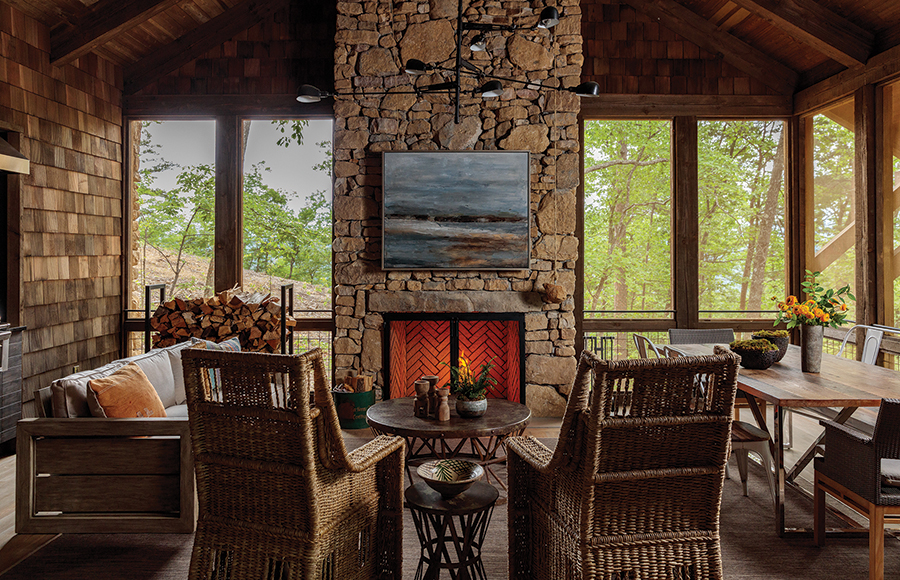
We were ferried by Lexus up from The Lodge to our stone-clad cottage complete with sprawling bedroom, spa-like bathroom, and private terrace with fireplace. A golf cart sat charging beside the villa’s entrance that would allow us to travel up the mountain to locations such as the fitness center, aka The Hub, and Firetower — and, yes, it’s a hike uphill, so the golf cart certainly came in handy.

Settled into our neutral-hued (aka, beige) pitched-roof guest room, John and I set out to explore. A stay at the Mountain — unlike the Farm, which gears itself more to relaxation — revolves around things to do. Or as the resort refers to the post-reveille run sheet, “active adventure.”

“We want the Mountain to inspire curiosity in our guests,” notes Blackberry Mountain proprietor Mary Celeste Beall.

“Have fun with that, I plan on sleeping,” commented John. “If I have to be curious, is there room service and a sauna and Turner Classics on the TV?”

And so I was left on my own to channel an inner “curiosity.” I skipped the Japanese pottery class — something called “raku” — but did try the Sound Bathing treatment, and that left me a bit perplexed. There were lots of musical instruments and singing, I think. Maybe a gong and a zither. I felt like I had attended a Sarah McLachlan concert, albeit supine. But then I didn’t like the bizarre “equine therapy” I tried at another retreat either, so maybe it’s me.

Would I care to do a spin class? Or any of the myriad exercise classes, yoga, spa treatments, workshops, painting classes, and hiking trails and so much more?

Er, no.

I do too much of too much in my daily life. Well, maybe not the gong playing. Or the raku.
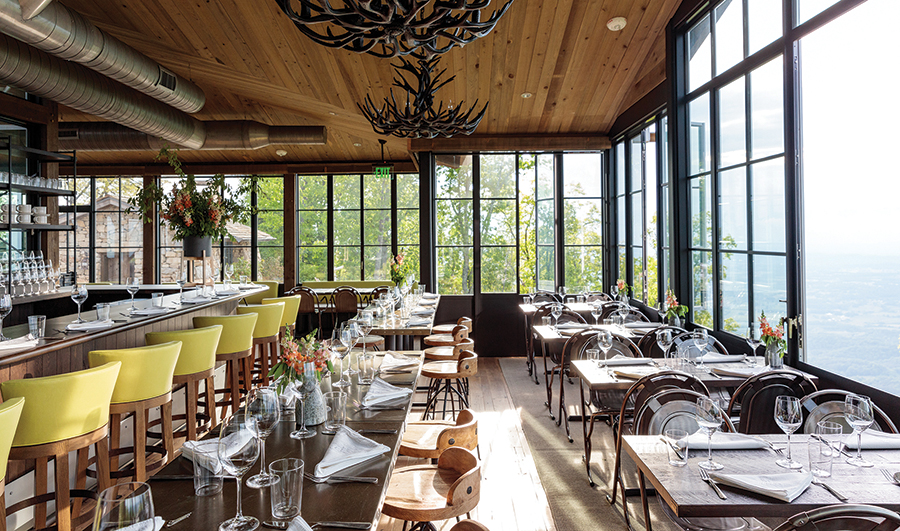
Instead, I created my own version of “active adventure.” I luxuriated with a perfect martini in The Lodge surrounded by a heap of magazines beside the fire before enjoying the hot tub in a natty Orlebar Brown bathing costume depicting James Bond.

But maybe I wasn’t being a good sport.

I recalibrated and tried to fit in. I donned head-to-ankle organic Lululemon and generic Allbirds.

“You look like a trustafarian from Venice Beach,” John commented, whilst dialing up for bubble bath and ice. “Very Abbot Kinney.”

Still, I tried. In my own way.

“Where’s the spa?” I trilled. “A farm-to-table pedicure, perhaps?”

“And is there a mixology class at the bar? With complimentary nibbles . . . ”

“Is there archery?”

We lapped up two inspired dinners at the Three Sisters restaurant and hiked a bit and took the golf cart to lunch at the Firetower, where John and I savored the eye-popping views. I took part in a cooking demonstration and felt like Ina Garten for about an hour.

John slept in, and we ran amok with the golf cart and Instagram TV-ed the whole thing. Frankly, the golf cart was our favorite active adventure. Brilliant.
I considered a yoga class.

And thought about Pilates.

And I have no idea what happens in a “movement studio” and don’t want to know.

Happily, there were s’mores that evening by our fire.

What I realized was that my interest in camp-like activities ended at about age 14 in tandem with the demise of The Go-Go’s and my plaid Swatch. If I have to be active, I want to bike through Provence or hike Sicily. And if I am curious, it’s about art-house films, museums, and famous gardens. Although I do like a good lanyard.

Sigh. I guess I am the wrong demographic.

Get me to the Farm.

So this bad camper ordered another martini and sat back to enjoy the postcard-perfect vista and wait for the internal dinner bell.  PS

In their debut travel column, the Madcap Cottage gents, John Loecke and Jason Oliver Nixon, embrace the new reality of COVID-friendly travel — heaps of road trips. To kick off the festivities, the gents pile into their Subaru and set off for the recently opened Blackberry Mountain (see blackberrymountain.com), the adventure-geared sister to Tennessee’s fabled Blackberry Farm.

The Kitchen Garden

Fall Gourds

Harvest of many colors

By Jan Leitschuh

Come fall, when the leaves turn and the pumpkin spice lattes star on the coffee shop menus, we all breathe a collective sigh of relief that the big heat is behind us. The morning crispness makes some of us giddy, and we succumb to that fine urge to mark the change of seasons.

Pumpkins, of course, are the first decoration to spring to mind; orange is the new seasonal black. But fall harvests come in many colors, sizes, patterns and shapes, and gourds are some of the most interesting.

But first: How is a gourd different from a squash? (Short answer: fun.)

For this and more, I turned to my North Carolina friend and gourd expert, Linda Fisher, owner of Fisher Pumpkin Farm in Red Oak. Linda has been growing gourds (and pumpkins) for the last 50 years on the family farm, hosting a popular fall harvest sale of many types of gourds and pumpkins right on the farm. 

Basically, for our purposes, you eat squash and look at gourds. Winter squashes are not gourds but can be decorative, and eventually you bake them. Gourds are purely for fun. (You won’t die if you eat them, but you won’t be raving about the taste on your Facebook page.)

Gourds, she says, had a heyday.

“Gourds were useful household tools provided by nature before manufacturing,” says Fisher, a former history teacher. “Dipper gourds were used as cups. The bottoms of martin gourds for bowls. Spoon gourds. Bushel basket gourds were containers for oats, corn and meal. Bottle gourds were tied to fishnets so they could float; today, they are primarily used for birdhouses and crafts.”

Some gourds can become useful toiletry, such as exfoliating sponges (luffa). Some can become birdhouses (martin gourds). Some can become craft projects (long-handled dipper gourds, bottle gourds). Musical instruments have been fashioned from gourds.

Some are stripy, spotted or solid, like speckled swan gourds or apple gourds. Fisher specializes in dipper and martin gourds, but has grown basketball, canteen, egg, and snake gourds, Crown of Thorns, spoon gourds, Turk’s Turban and more. And most are decorative and evocative of the ancestral abundance time, autumn farm harvest. 

There are whole craft communities dedicated to carving, burning and painting gourds. Besides traditional gourd crafts, some contemporary crafters dry the larger gourds, drill interesting patterns of holes and fill them with lights for an autumnal porch decoration to chase the darkness.

As you yield to the spirit of the season, pick up some fall decorations to brighten your autumn. Greens, gold, tans, scarlets, whites and oranges. Ridges, long necks, short necks, spiky shapes, bulbar, warty. The red/green and white Turk’s Turban squashes are spectacular. And next year, remember, gourds are easy to grow, and beloved by children.

You want a rich soil for gourds. “The best site for gourds is a highly organic soil,” says Fisher. “Even just an old sawdust pile. They have tendrils that will anchor the vines to trellises, bushes and fences.”

If you choose to plant gourds, give them room to run. Some vines can stretch 15 feet. They could be wound on a porch rail or fence as a decorative screen. They like what we have in the Sandhills, a well-draining soil that receives full daytime sun — just add compost and water. Some gourds need a long growing season to ripen on the vine, up to six months.

Harvest your gourds when the gourd stems dry out and turn brown on the vine. Leave a few inches of stem on the gourd. If an early freeze is coming, cut off any remaining gourds and discard any with bruises or soft spots, as these will decay in storage. Cold will damage the gourds’ ability to cure. 

Most of us will simply buy some gourds at a farm stand or store because they make us smile. But others may want to fashion a birdhouse, or use them for art and craft purposes. Google “gourd art” for beauty and inspiration.

If you’ve harvested your own, wash any gourds you plan to keep in soapy water and pat dry. Some collectors wipe down with rubbing alcohol afterward to further prevent rot. Store on a screen, in a shed or an airy spot out of bright light. Check and discard any that are getting soft instead of curing. Fisher has a hard time keeping the squirrels out of her farm-sized harvest, as they gnaw in after the seeds.

When the gourd feels light and the seeds rattle inside, it’s ready for crafting. Polish with steel wool or sandpaper. Now you can paint, wax, shellac, carve or burn designs into the hard-skinned gourd. If you’ve harvested correctly, “Gourds last indefinitely, if they dry out,” says Fisher.

For tabletop and decorative purposes, you could toss a few edible winter squash into the decorative autumn mix and enjoy their beauty before consuming. Some good shapes and tastes are the green, ridged acorn squash (wonderful baked with cider or maple syrup), the delicious tan butternut squash (cube it and use it like meat in casseroles and ethnic dishes), and the nutty striped delicata (eat these first, simply roast with butter and salt).

All jumbled together, it looks like fall. Harvest time.  PS

Jan Leitschuh is a local gardener, avid eater of fresh produce and co-founder of Sandhills Farm to Table. Find Fisher Pumpkin Farm on Facebook for hours and directions.

Good Natured

Boost Your Immunity

The list of supplements is long

By Karen Frye

It seems the virus of 2020 is not done with us yet. While a vaccine will likely be the most effective solution to slow the spread of COVID-19, what about the upcoming typical cold and flu season?

Some of the supplements known for building a strong immune system, like vitamins C and D, zinc and elderberry, were sought after by so many in the early months of the pandemic that they are now in short supply in some areas. However, there are a few other effective immune-boosting supplements to help you make it through this pandemic — and other cold or flu germs you may come in contact with. Your immune system is your best defense. Take care of it and it will take care of you.

Glutathione tops the list. A recent study in the Journal of Infectious Diseases links a deficiency of glutathione — resulting in an impaired immune response  — to serious manifestations in COVID-19 patients. Glutathione is a small protein composed of three amino acids: glutamate, cysteine and glycine. It is a powerful antioxidant, protecting your cells from damage, and maintaining a super-strong immune response. And the list is long on other benefits of glutathione, such as anti-aging and detoxifying abilities.

Another supplement is quercetin, a plant flavonoid found in green tea. It has long been used for seasonal allergies and works well with vitamin C as an immune boost along with some anti-viral effects.

Probiotics are crucial to keeping the gut and intestines healthy. Feed yourself good bacteria with fermented foods to get a daily dose of a good probiotic, so your immune system can thrive.

One more to keep in mind is olive leaf. The extract has many benefits when it comes to lung and respiratory health, and is great for the cold, flu and virus season.  PS

Karen Frye is the owner and founder of Nature’s Own and teaches yoga at the Bikram Yoga Studio.

Out of the Blue

Tubular

Plugged in and plugged up

By Deborah Salomon

Note: The following stands in memoriam for bygone Octobers, when three of the four TV networks debuted new seasons which, except for Christmas specials, ran until May.

Roku. Hulu. Sling. Philo. Fubu. Xumo.

Are these dialects spoken by aboriginal tribes living on remote Pacific islands?

Is Netflix a percussion instrument made from bamboo?

Did you know an Apple app is coming to your Mac?

Dare you cringe at sly ads that link Sling-ing to swinging?

Here’s what I resent: Most “quality” TV entertainment has been commandeered by services that require abandoning cable and signing up for something that may or, as you discover too late, may not carry clandestine favorites. Mine is Ancient Aliens, where a science guy with long, greasy curls professes that Martians with elongated heads engineered the pyramids.

What a relief from non-stop COVID-19 stats.

In addition, my 12-year-old Panasonic flat screen of modest but adequate proportions requires an appendage in order to Sling — as well as a technician to attach it. And a very patient teacher to explain the workings.

That’s OK. I’ve still got The Sopranos and Homeland on demand — superb. Also, some cheesy channel that runs The Golden Girls and Everybody Loves Raymond continuously.

Go ahead . . . laugh. Those are two of the best-written sitcoms ever, after All in the Family and Sex and the City. As for streaming award-winning The Handmaid’s Tale, no thanks. I read the book. I saw the movie (filmed in part on the Duke campus). No offense, but this English major (taught in toto on the Duke campus) judges anything Atwood an assignment, not entertainment.

The new quality TV, alas, has gone the way of Oreos: permutations galore, subjected to hard sell. Resisters feel out of the loop, lowbrow, left awash in New Amsterdam and CSI: Los Angeles. Ahoy, Anderson Cooper, Ari Melber, Joe Scarborough, Alex Trebek. I will not abandon you to Sling with anybody. Because that’s how the ante-up works. First came cable upgrades like HBO and Showtime, whose offerings reveled in F and S words. Then On Demand. Now, the arbiters insist we abandon our current service which provides 200 channels, 165 of which broadcast junk, and sign onto HullaBallo, or whatever, when all I want is ACC basketball.

Lest you think me a hopeless old fuddy-duddy, I learned, early on, exactly how TV operates.

Summers during college I worked as a uniformed and well-trained tour guide at NBC Studios, Rockefeller Center. In the 1950s this and the United Nations tour were musts for out-of-towners. One of the stops on the hour-long “studio” tour was a wall-sized display, with moving parts (controlled by a hand-held clicker), of how TV works: The picture is broken into dots (electrons), which are transmitted tower-to-tower and reassembled on home screens. This involved cathode ray tubes, therefore the early nickname for a TV set: tube.

It was almost rocket science. I was so proud.

Now, all is digital, which sounds related to fingers, but isn’t. Now, screens are so big and picture quality so hi-def that popcorn seems outdated. Sushi, anyone?

Now, made-for-streaming movies and series gobble up all the Emmys. Viewers have become spoiled to commercial-free entertainment with a pause option, for when the cell rings or nature calls.

The problem with streaming the good stuff is that you want to watch it all. And all, available 24-7, is just too much — although binge marathons got a lot of folks through the virus lockdown.

Back in the day I enjoyed waiting a week for the next Mad Men or 24, especially after a cliffhanger. “Who shot J.R?” joined the American lexicon for a reason. The interval gave people time to discuss episodes, predict outcomes. You know . . . morning after stuff, last enjoyed when Sybil, then Matthew, were snuffed out on Downton Abbey.

Oh, the agony.

Eventually, when my Panasonic repairs to the flat screen graveyard, I will replace it with something “smart,” that comes ready-to-Sling, even if I’m not. Maybe I’ll even live to see this handmaid’s idea come true: an electric-style outlet in each room. Plug in the TV and access everything out there with one remote, from this single source.

Impossible? That’s what they shouted at Ben Franklin, Alexander Graham Bell, Guglielmo Marconi, Charles Babbage, Philo Farnsworth and Bill Gates. Somebody can do it. Or, as a last resort, we can always task those little extraterrestrials with elongated noggins.  PS

Deborah Salomon is a contributing writer for PineStraw and The Pilot. She may be reached at debsalomon@nc.rr.com.

“What It Was Was…”

It kinda looks like ice hockey

By Jenna Biter

The University of North Carolina women’s field hockey team tied the University of Maryland’s team for the second-most NCAA Division I championship wins last year. On Nov. 24, 2019, the UNC Tar Heels beat the Princeton Tigers 6-1 at Kentner Stadium, a Wake Forest University facility, to clinch their eighth title. The win meant back-to-back championship victories for the Tar Heels and two consecutive undefeated seasons compiling 46 wins. On top of that, the Wake Forest field hockey team has three championship titles of its own, and Duke has been the runner-up four times, the last in 2013. In total, there are five Division I and three Division II field hockey colleges in North Carolina; yet, most Southerners probably don’t know what field hockey is.

“Is that lacrosse?” some ask. Or, “It kinda looks like ice hockey,” they say, pitching the word ‘hockey’ slightly higher, transforming their statement into a question. On one occasion last year, my husband took my car to work at Fort Bragg, and the security guard at the I.D. checkpoint stopped him for a random search. He popped the trunk, and the guard picked up one of my field hockey sticks, saying, “What is this?”

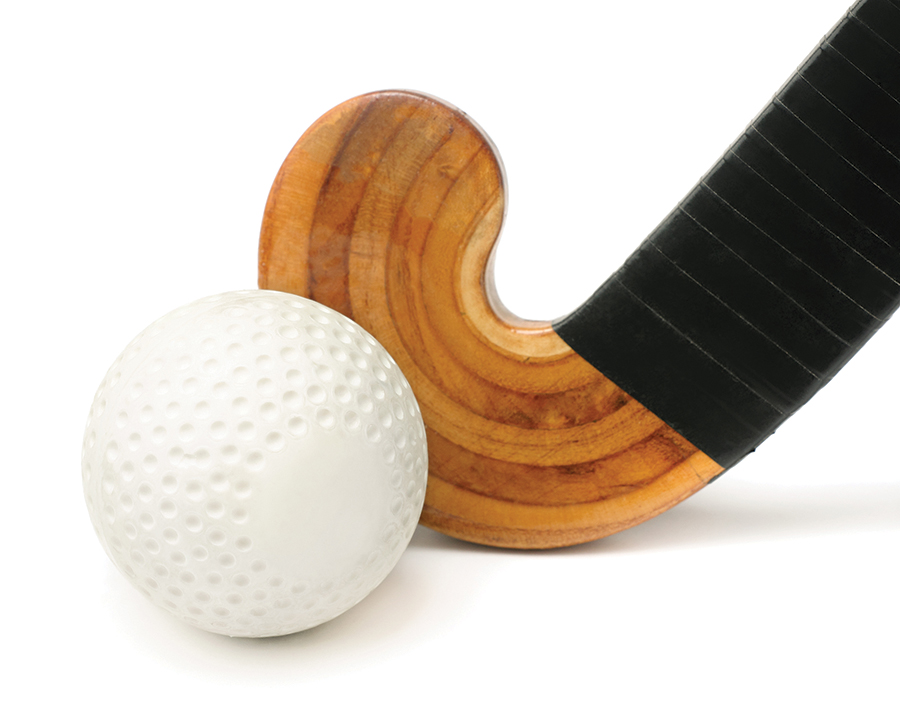
Picture an ice hockey stick but shorter, with a stubby, turned-up end. But unlike in ice hockey, and probably most shocking to outsiders, only one face of the stick is playable. Field hockey sticks have a flat face known as the “right” or playable side, and a rounded face, the “wrong” side.

“The difference is you have to turn the stick over to bring the ball back,” says Grant Fulton, the associate head coach of the UNC field hockey team and the coaching director of Carolina All Stars, a Chapel Hill-based field hockey club. “You can’t use the round side of the stick.”

He continues, “It’s difficult. There are really no other sports that correlate to the technical side; it’s kind of its own animal.”

Rather than a puck, field hockey is played with a baseball-sized ball made out of hard plastic with a cork and rubber core. Ball speeds can exceed 100 miles per hour, depending on the level of play and the surface; and, for that reason, goalkeepers are padded up like their ice hockey equivalents. At beginner levels, the sport is often played on grass or synthetic turf, usually the kind with rubber beads. But at higher levels, it’s played on water-based field hockey turf, a carpet-like surface that skips the rubber beads and gets wetted down with high-powered water cannons. Watering artificial turf — bizarre, perhaps — allows for better ball control and the ability to slide with less injury.

In a regulation field hockey game, two 11-player teams face off. “I always gave the ‘similar to soccer in numbers, positions and some strategies’ explanation,” says Denise Zelenak, the head coach of the Division I Drexel Dragons in Philadelphia, and my former coach. “But our skill sets are more challenging, as is the type of running.”

Field hockey has rolling substitutions and no offsides, and because the ball is played primarily on the ground and sticks can only be up to 41 inches in length (no matter the height of the player), running happens in a perpetual squat. As the field hockey adage goes, bend at the knees and not at the back.

The Northeast, specifically my home state of Pennsylvania, is a hotbed for youth field hockey. To put its popularity in perspective, well over 200 Pennsylvania high schools have field hockey teams, while less than 30 in North Carolina have the sport. And of the 28-player UNC roster, only three players are North Carolina natives, while 16 are from the Northeast — 12 of them hailing from Pennsylvania.

Zelenak, coaching in the hotbed, speculates about field hockey’s reach. “I think it’s as simple as where it landed. Constance Applebee came from England and moved to the Philadelphia area, where she created opportunities to learn and play, which led to a league, which then spread to schools and colleges building it into their curriculum.” Applebee is the Englishwoman who introduced field hockey to the United States, specifically to northeastern women’s colleges, when she came over to study in 1901.

“Once these teams started spreading into conferences, it grew throughout the Northeast, the Southeast, as well as California,” Zelenak says.

Even though the sport spread at the collegiate level and, to some extent, younger levels, youth field hockey is still concentrated in the northeastern United States. My older brother often joked, “How does it feel to have a skill that 99 percent of people don’t know exists?” At least in this country. Field hockey is enormously popular elsewhere. According to most web statistics, field hockey is the third most played sport worldwide, and that includes women and men. Stateside, field hockey is typically played by women, although America has women’s and men’s national teams, and boys’ field hockey is gaining some steam.

“I think it goes to the schooling systems,” UNC’s Fulton speculates about field hockey’s reach. “Soccer has always been here and massive in the women’s game, so I think that a lot of potential field hockey players are actually playing soccer.”

Field hockey, like soccer, is traditionally a fall sport, and the two would compete for athletes, but getting a foothold in schools is the key to spreading the game. “The way to get into those schools is to go and meet with the athletic directors and introduce free clinics where you pop into the school and do a physical education training section, where you introduce the equipment and start it grass roots,” explains Fulton.

And the younger the girls know about field hockey, the better. “My daughter, she’s 4, and they come to her day care, and they’ll run these soccer clinics. They’re just half an hour every Tuesday. They bring balls, cones and a bunch of pop-up goals, and they just teach the fundamentals,” Fulton says. “If you do that at day cares all around, and you pop into middle and high schools, that’s how we have to introduce it, right when kids are 3, 4, 5, 6 years old, especially for girls in this country. There are other options, but field hockey is a big one that’s underutilized.”

Lauren Williams neé Love, the head coach and owner of Pinecones Field Hockey Club here in the Sandhills, is working to right that. Williams is a Pennsylvania native, and she played for Wake Forest when they won the NCAA Division I championship in 2004. She explains what field hockey can offer to young women. “I think it is important for people to recognize the opportunity and potential for the athletes to play at the collegiate and Olympic levels,” she says. “This includes athletic scholarships, as well.” (And it’s also fun; to this day, my best friends were my Drexel teammates.)

Williams says, at Pinecones, “Our mission is to bring field hockey to young female athletes in our community. Our program focuses on fundamental instruction, teamwork, sportsmanship and discipline, while building character and instilling confidence that will last a lifetime.”

Building on Williams’ sentiment, Fulton says, “It’s a game that is lifelong, right? You can play all around the world. It’s like riding a bicycle. You can pick it up where you left off. You’re not going to lose the game. You might be a little rusty, but you can jump on your bike, and you can go.”

He continues, “You can find a job in the big city and, on the weekend, you can go play pickup with a bunch of field hockey, like-minded people. You can build friendships; it’s transferable; it travels.”  PS

Jenna Biter is a fashion designer, entrepreneur and military wife in the Sandhills. She can be reached at jenna.biter@gmail.com.

Art in the Woods

Sculpture grows in a Seagrove garden

By Jim Moriarty   •   Photographs by Tim Sayer

If you happen to be an artist trying to shop around a work that is roughly the size and weight of a walk-in freezer, your choices might be, let’s say, limited. Hauling it from one autumn craft show to another would present absurdly daunting logistical challenges, and this hypothetical Bacchus in a Box may well not fit through the front door of that cute little gallery in the theater district that represents you. So, what’s a sculptor to do?

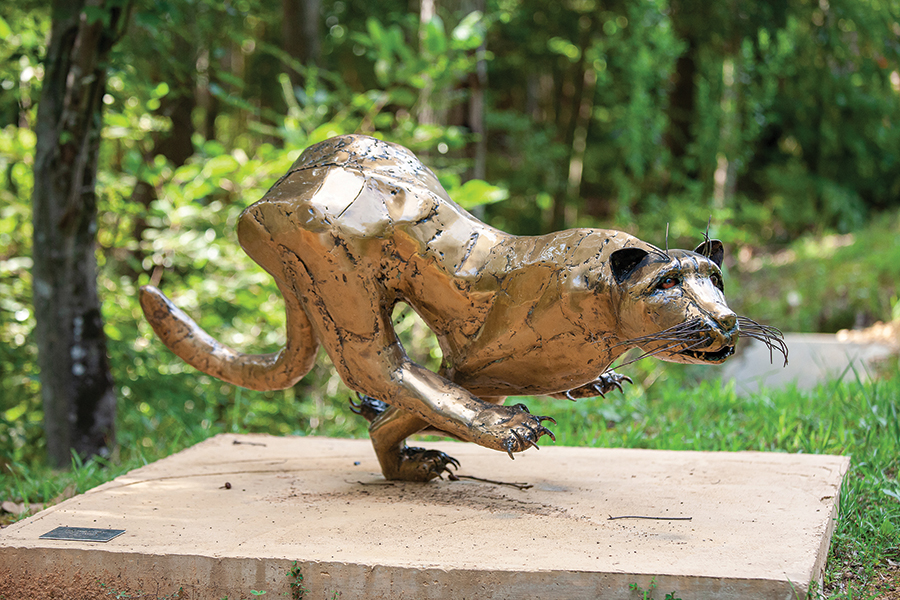
One option is the sculpture garden at Carolina Bronze, the artists’ foundry in the backwoods of Randolph County, down a gravel drive off Maple Springs Road on the opposite side of Hwy. 220/Interstate 74 from Seagrove, the ground zero of North Carolina pottery. Just because Carolina Bronze is off the beaten path doesn’t mean artists don’t beat a path there. Internationally renowned sculptors like Charlotte’s Chas Fagan have the castings of their work poured there. The sculpture garden is a natural offshoot of the business founded in 1995 by Ed Walker, a sculptor himself, and his wife, Melissa, both products of East Carolina University’s art program.

“It’s all a work in progress,” says Melissa of this weekend project, years in the making. “We keep doing a little bit here and there.”

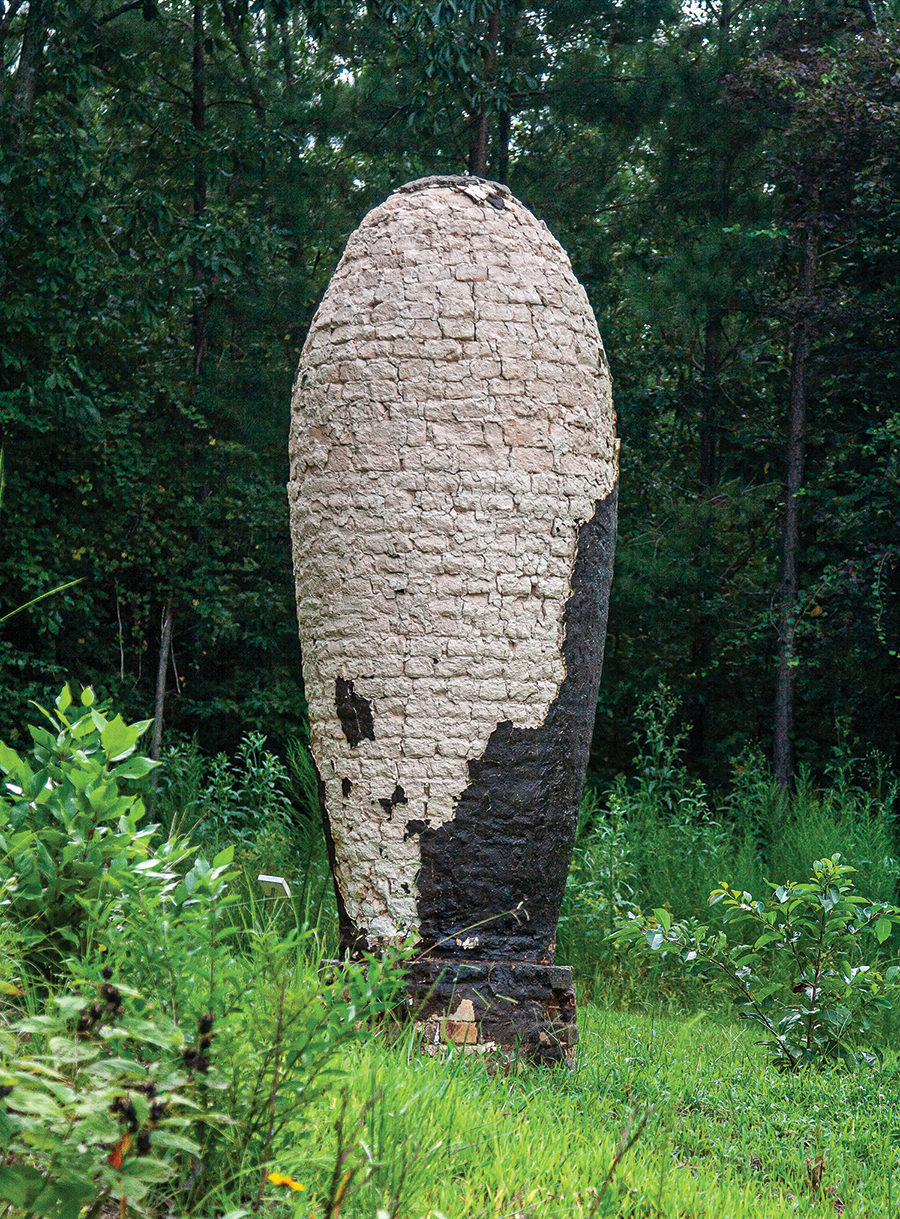
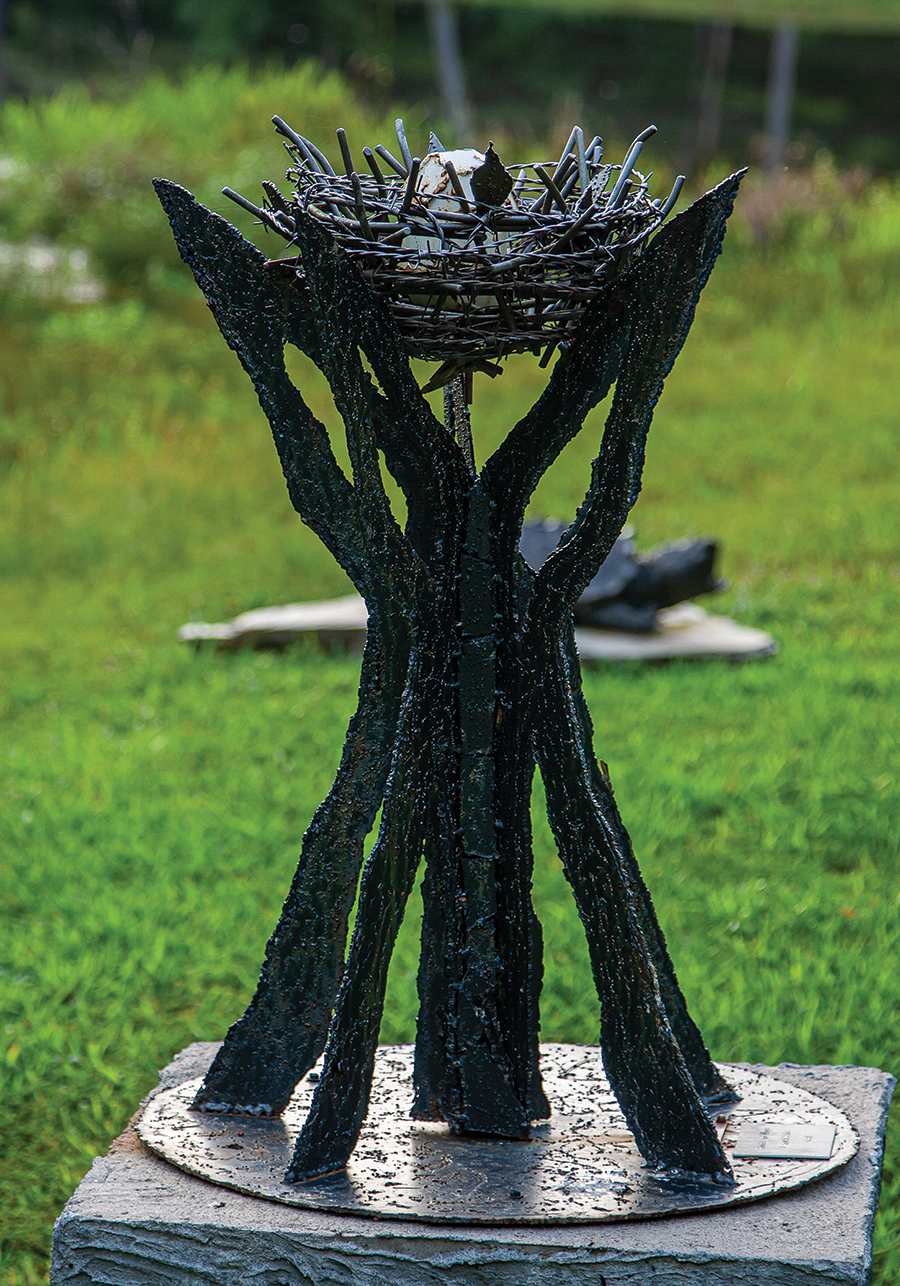
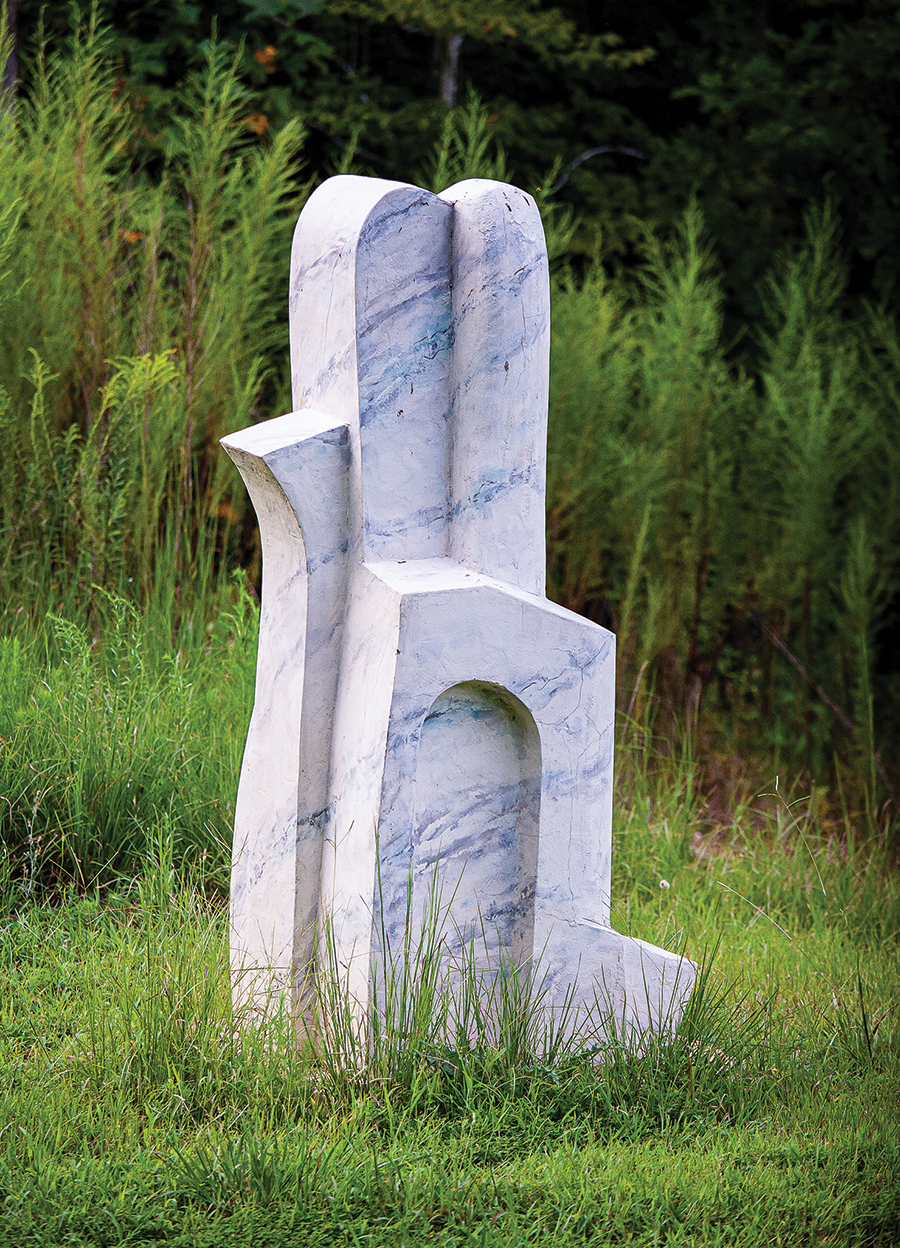
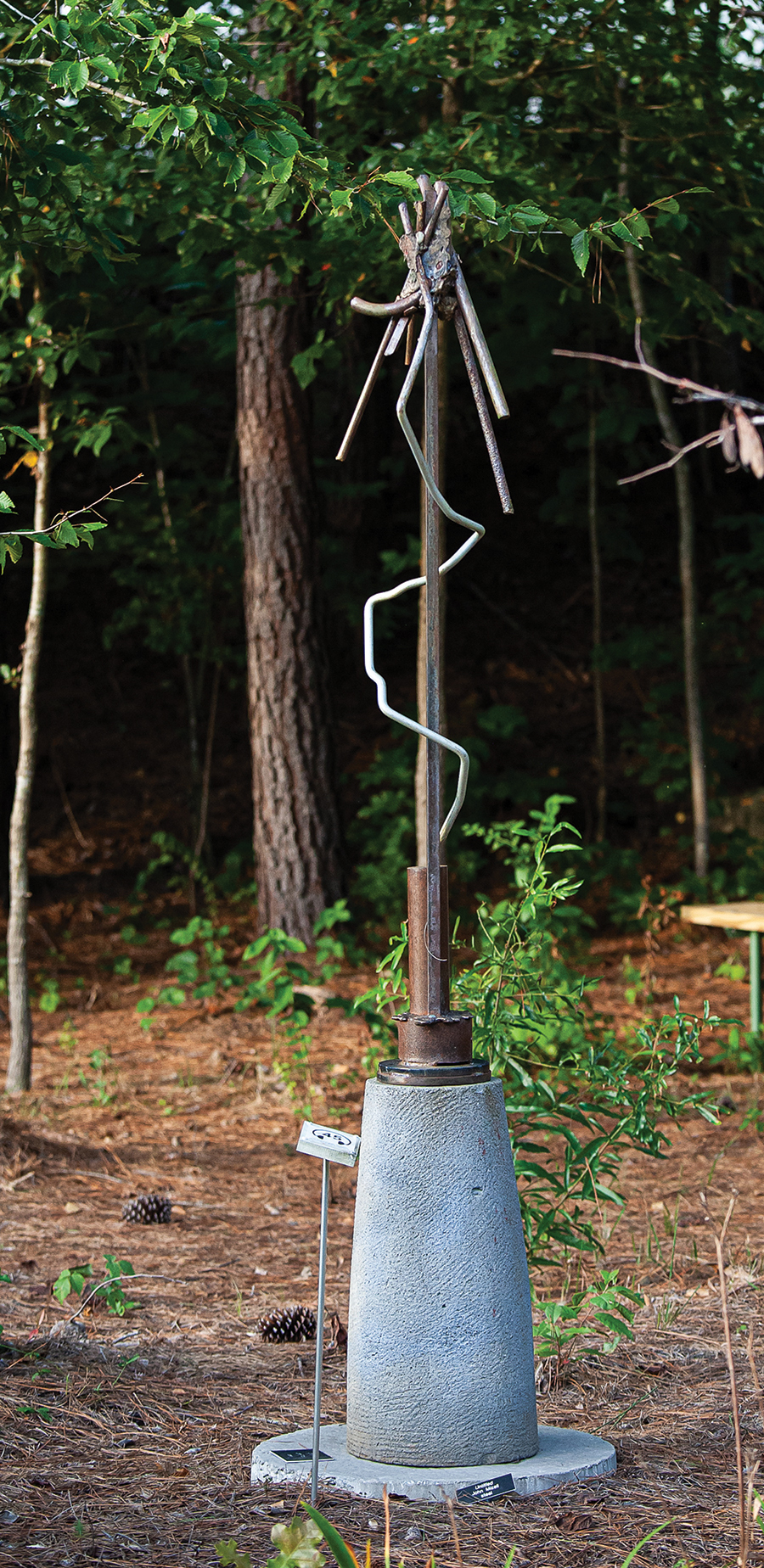
While the simple, rough-hewn path around a pond will never be mistaken for the manicured gardens of the palace at Versailles, it features the art of 25, plus or minus, artists. Melissa is populating the landscape with native North Carolina plants like cardinal flower and Jack-in-the-pulpit. Just like a museum tour, using your cellphone, it’s possible to download an app from the Carolina Bronze website that identifies and discusses the art and the various species of plants when you click on the corresponding number.

Ed’s dream also includes a heliport for prospective clients. If that seems wildly far-fetched, it wasn’t that long ago that they were trying to figure out a way for Nancy Reagan to fly in to preview one of Fagan’s sculptures of her husband, the 40th president of the United States — a trip that was eclipsed by Ronald Reagan’s illness.

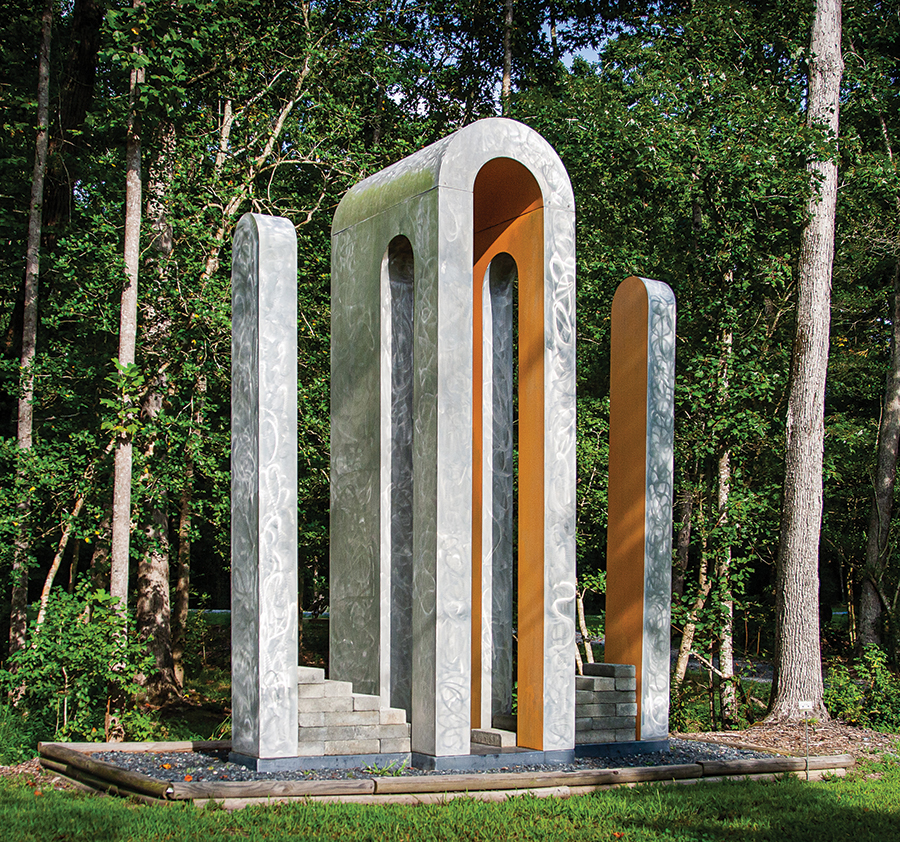
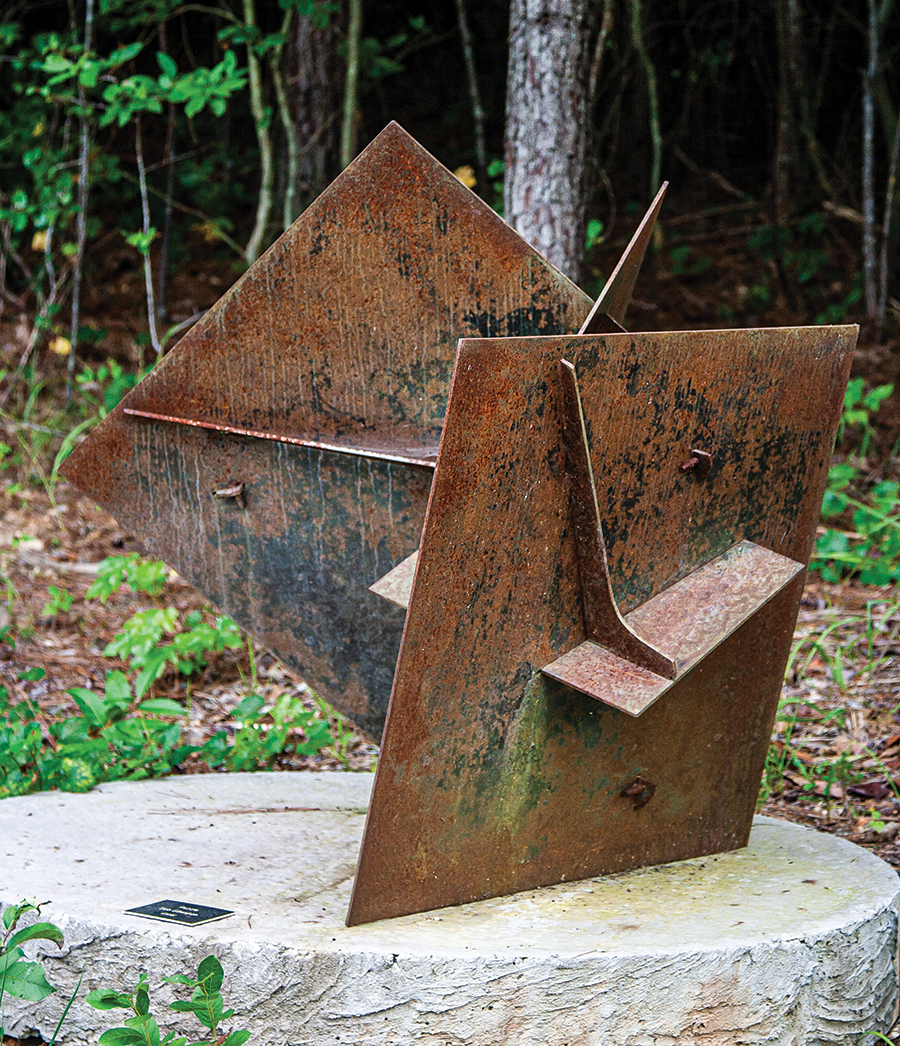
Jim Galluci, well known in Greensboro and beyond for his “gates” sculptures, is one of the artists represented in the garden with his piece Temple. “Well, I guess you can say when you show sculpture in the darnedest places, the darnedest people enjoy it,” says Galluci, who recently began fabrication work on an entryway project for the South County Regional Library in Charlotte. The work will include 18 sheets of aluminum fitted to look like the pages of a book, complete with titles and authors’ names.

“I really have a philosophy that the beauty of public art is you can go places where it’s never been before, open doors that have never been opened before, and get people interested that never, ever saw art before — and that’s a good purpose for public art,” says Galluci, who became intrigued with gates as an artistic leitmotif during a 1986 project. “I was shortlisted for a Holocaust memorial, and I designed a set of gates that would have survivors of the Holocaust press their hands in the foundry sand and molten bronze be spread on top of that and that would create the panels of the gates and the doorway. It was called Witness Gates.”

He didn’t get the commission, but he kept the concept. “If you have a good idea, it’s still a good idea,” he says. “Gates really hold kind of universal truths, like right now. Is the door open or closed? COVID closed; COVID open.”

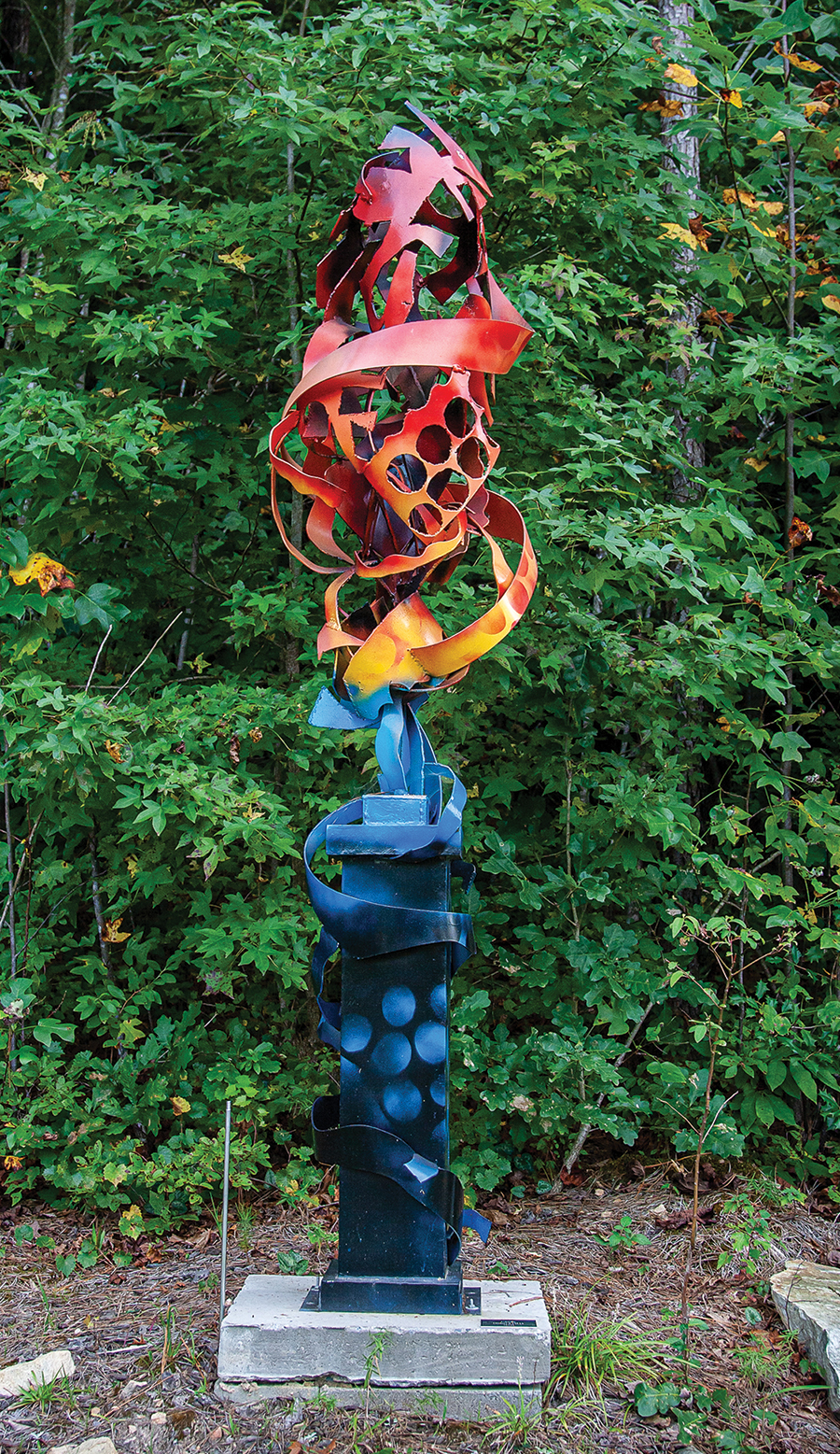
Richard Pitts, who has a studio in New York and another in Pennsylvania’s Endless Mountains an hour or so south of New York’s Finger Lakes, is another of the artists on exhibit on the little path around the pond. He has two pieces, Holy Smoke and Candle. “That bronze foundry is in the middle of nowhere, but I think a sculpture can make a place important, until the place makes the sculpture important. I think that’s the kind of dialogue that happens sort of naturally,” says Pitts. “To show sculpture outside is very important. It creates the landscape as much as the landscape creates it.”

The piece titled Candle was hand-painted, distinct from a commercial process he frequently uses now. “It was sort of a natural evolution of some of the hand-painted three-dimensional objects I was making indoors,” says Pitts. “My pieces are all hand-fabricated, and there’s a kind of spontaneity that I enjoy about making decisions and revisions as I go along. To me that’s an important part of the creative process.”

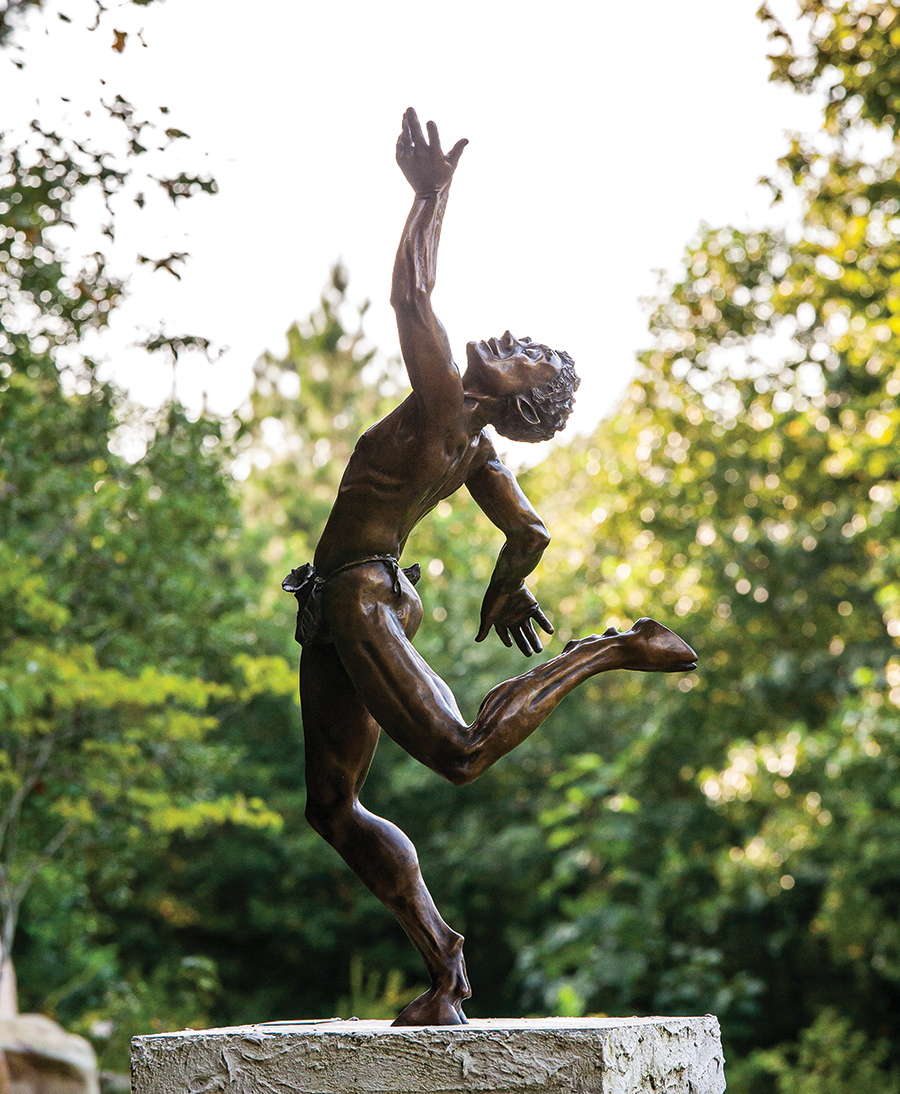
While most of the sculptures in the garden tend toward the abstract, Larry Bechtel’s more representational bronze Rapture occupies a singular space. “I did the original piece, on a small scale — about 12 inches — for a private collector in Charlottesville,” says Bechtel. “He had a beautiful garden and a pond, and he was looking for something to go there. He asked me to come up with an idea, which I did, a total blissed-out rapture. In some respects I’ve tried to do that in other works but that one really hit it just right.”

Bechtel, who taught English at Virginia Tech for seven years, is completing the third volume of “The Tinsmith’s Apprentice,” a trilogy of books centering on Isaac Granger, one of Thomas Jefferson’s slaves. It was a story he came across when he was researching Jefferson for a sculpture project for the Darden School of Business at the University of Virginia.

“I ran across a little book about Isaac Granger that included a very riveting picture of him. I did up this portrait bust of Isaac and eventually had it cast for a fellow in Virginia Beach. But the story stuck with me. In a sort of memoir dictated in the 1840s, Isaac talks about a time when he was a young man and he was taken to Philadelphia by Jefferson to be apprenticed to a tinsmith. I just began thinking about what it must have been like for a young man, enslaved on a Southern plantation, to be taken up to the largest city in the country, the capital, founded by Quakers, living in a household with other apprentices and a Quaker family. This had to be a mind-blowing experience. That was what I started with. It’s gone on from there.”

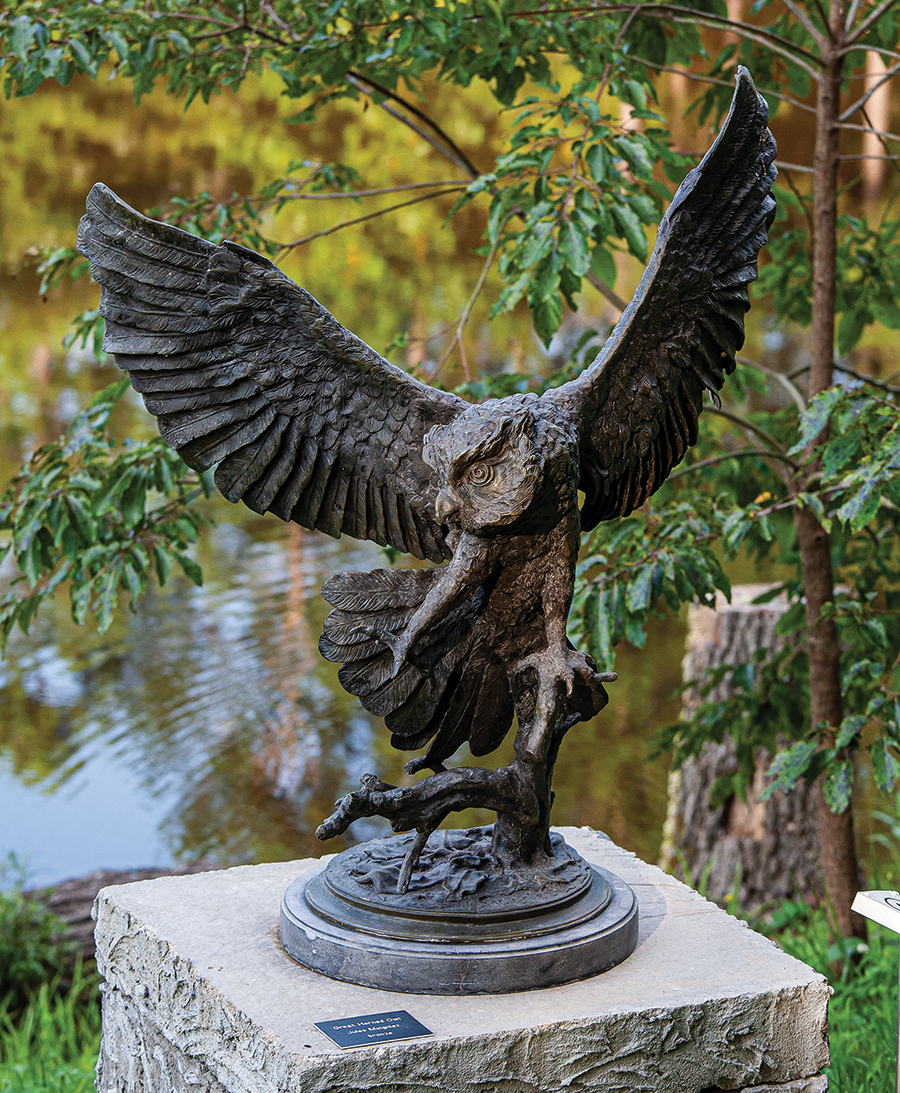
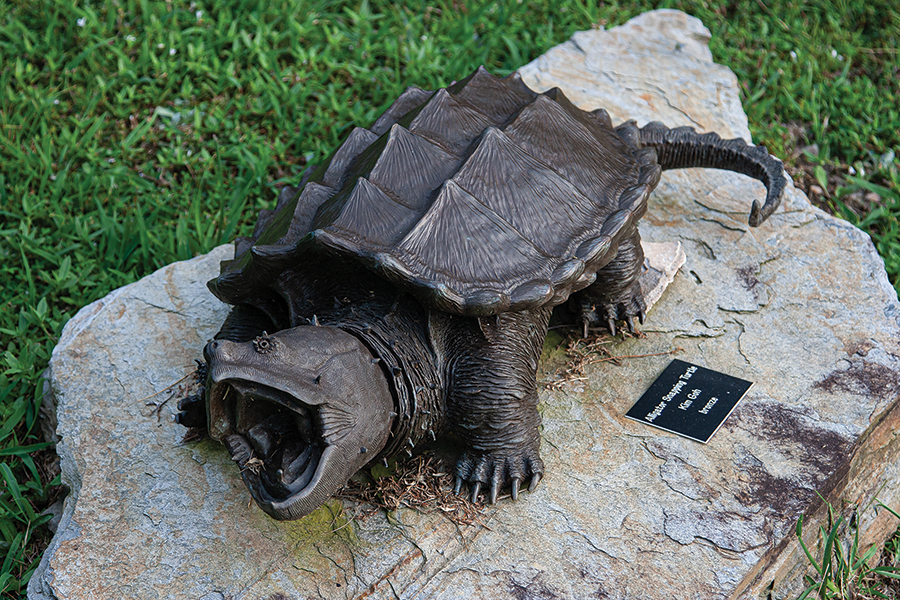
Ed Walker has several of his own sculptures gracing the grounds of Carolina Bronze. Some of the other artists represented include Norman Keller (a former professor at ECU); Kim Goh; Bill Donnan (also an ECU grad); the late Bob Edmiston; the Seagrove potter Daniel Johnston; former neurosurgeon Ed Byrd; a French artist whose 19th century work the Walkers personally acquired, Jules Moigniez; and more.

The peace of the pond and the path can be disturbed from time to time by groups of school kids touring the foundry (pre-coronavirus) or perhaps the pop-pop of neighbors hunting in the distant woods — or maybe the occasional curious stranger just hunting for art.  PS

Jim Moriarty is the Senior Editor of PineStraw and can be reached at jjmpinestraw@gmail.com.

In the Spirit

The Hangover

Making sure the sequel is a dud

By Tony Cross

I run my cocktail delivery business out of a health food store. Shocking, I know. I love working out and eating healthy — during the week, that is. On the weekends I’ll let loose. There are some who might say I have a supplement problem. And by “problem” I mean taking myriad vitamins to ensure I stay tip-top. When customers learn I run a cocktail business, too, the look of confusion is priceless. One of the first questions I’m asked when people find out about my double life is: What do you take for hangovers?

The Mayo Clinic defines a hangover as “a group of unpleasant signs and symptoms that can develop after drinking too much alcohol.” If you enjoy reading a spirits column, this is not exactly CNN breaking news. And if you’ve never experienced one, you’re a better person than me. Maybe. Long story short: They’re awful, and they get worse with age. Although there is no magical cure for a hangover, I’ve learned a few things along the way. But first, the basics.

Consuming a glass of water per alcoholic beverage is going to help you from becoming dehydrated, which is a huge hangover symptom. Also, avoid excess sugar in your cocktails if you’re going to be making a night of it. When I was 21 and bartending at a private party, the host told me that there was a bottle of Crown Royal hidden for a lady who would be arriving later in the evening. The whisky was only for her. I took that responsibility with pride, since Crown was the only liquor I drank at the time.

When the woman arrived, I shared my affinity for the spirit, prompting her to ask, “How do you take it?” I replied confidently, “With Coke.”

“Oh, no, honey, no!” she exclaimed. “That’s only making your hangover worse. Take it over ice or with water.” Important lessons from decorated professionals should be taken seriously. I never drank Crown and Coke again.

First and foremost, I strongly believe that having a healthy lifestyle is key; it’s all about balance.  I know from experience that treating your body with respect throughout the week will help those weekend hangover blues. Having a clean diet is the number one priority. That doesn’t mean being on a diet, it simply means eating as cleanly as possible, and limiting the processed foods and sugars you put into your body.

Next, exercise. Alcohol is a depressant, and for some folks it’s easy to slip into a routine of having a few drinks every night after work, and then more on the weekends. I’m speaking from experience on both fronts. I am happier, more confident, and have wayyy more energy when I’m in my workout routine. I’m not saying that exercise is going to prevent your hangover, but if you’re in good shape, and work out often, the hangovers are easier for the body to process.

Now, let’s talk supplements.

As a rule of thumb, I always recommend a good multi-vitamin. No matter how clean your diet is, you’re still probably not getting all of the vitamins/minerals you need on a daily basis. When you’re consuming alcohol, your vitamins get depleted, and it adds to why you don’t feel so great the next day.

B-Complex:  A lot of mental and emotional wellbeing that takes a beating after a night of over-indulgence comes from B vitamin deficiency. Most people will just take a B12 tablet, but that’s not good enough. When your Bs — 1, 2 and 3 — are depleted, depression, irritability and anxiety can be triggered.

Magnesium: This mineral is great for so many things, but being deficient can cause confusion, loss of appetite and weakness. For me, I take the glycinate form of magnesium. It was recommended to me by an amazing fitness trainer who, sadly, no longer lives in North Carolina. After a month of supplementing, I noticed that my panic attacks (especially if I was even slightly hung over) vanished. Seriously. I was this close to getting a prescription from a doctor, which would’ve been a Band-Aid. Instead I’ve been taking this supplement for six years now.

Milk thistle (Silybum marianum): This is a flowering plant grown around the world. Silymarin is one of the substances in milk thistle believed to protect the liver against toxins. Its anti-inflammatory and antioxidant effects help the liver after being damaged. Is it going to cure your hangover? No. Will it help your liver after a night of drinking? Probably. I take a liver supplement during the week at night before I go to bed. I look at it as a multi-vitamin for my liver. When I run out of my bottle of milk thistle, I’ll switch to another company that uses herbs like dandelion and burdock, or another one that uses the resihi, chaga and turkey tail mushrooms. All good for liver protection.

And the winner for “Best One-Two Punch for a Hangover” goes to: ibuprofen. Created by Stewart Adams and his associate John Nicholson in the late 1960s, the drug went to clinical trials in 1969, and was probably first tested on an alcohol-induced headache by Adams in 1971 while he was in Moscow, hours away from giving a big speech. Many shots of vodka the night before led Stewart to give it a go. “He took a handful of ibuprofen and felt fine, no hangover!” recalls his son, David Adams (Smithsonianmag.com 2020). Personally, I prefer Ranger Candy. If you know, you know. PS

Tony Cross is a bartender (well, ex-bartender) who runs cocktail catering company Reverie Cocktails in Southern Pines.

Southwords

The Inconsequential Comic

All alone with a microphone

By Traci Loper

“Shine bright like a diamond,” I began in the dullest way imaginable.

“Shine bright like a diamond.” I looked around at the audience flatly. I hear a few chuckles.

“Shine bright like a diamond,” I sing blandly, followed by a long, deep sigh.

The crowd lost it. More or less. I committed to the most cynical version of Rhianna’s then-popular song to kick off my first ever stand-up comedy show at an off-off-off Sunset comedy club in Los Angeles. It was so “off” kids colored with Crayons there during the day. That may have been the only big laugh I got during my five minutes of rocking the mic that night, but honestly I can’t remember. It’s a pretty big blur, and not because it was five minutes of bliss. It was five minutes of dread, regret, embarrassment, effort, and carefully planned talking points with jokes mixed in that crashed and burned.

OK, fine . . . looking back, the topics I chose for my first night of stand-up weren’t that great, but they were mine.

I’ve been entertaining for as long as I can remember. From the moment I could string sentences together, my mom would usher me into the center of a room and I’d just ramble. People would laugh and laugh, I’m guessing mostly because I was a child, I wasn’t shy, and nothing I said made much sense. (So, what’s changed, you ask.)

It was mostly at family gatherings, but she would occasionally take me to work with her at the Hammond Nursing Home. It was there where I found my most captive audiences. Surprising, I know.

I’d chat with the elderly through my mom’s entire shift. I’d go room to room doling out hugs and humor. Maybe that was the first sign of my desire to entertain. I think it’s fair to say, I didn’t really know what I was doing or what they were laughing at — but I haven’t stopped since.

When I finally made the move to L.A. in my mid-20s to pursue an acting career, I naturally gravitated toward comedy. Perhaps that was a mistake. My friends didn’t help. They were constantly on me to do some funny voice, or character I had come up with.

And every time they asked, I delivered. “OMG, Trace, you should be on SNL.” I, of course, thought this was ridiculous. Making your friends laugh was easy, bringing laughter to the world, not so much.

As a kid, I loved SNL and was in awe of Steve Martin, Gilda Radner, Jane Curtin and so many more. If I could follow in their footsteps, sign me up.

And sign up I did . . . at the Groundlings — that famous improv school that has churned out many comedic celebrities, like Will Ferrell and Kristen Wiig. I enrolled in regular acting classes for TV and film. I even joined a local sketch group that some of my theater friends started. I had a sharp wit, but now I had finally — and I suppose mistakenly — accepted that I was seriously funny. Look, if everyone around you is telling you the same thing, you eventually start to believe it. And confidence is never bad. Especially for an entertainer. Especially in Los Angeles.

The first rule of improv is to “Yes, and . . . ” everything. You have to agree to what your scene partner says, no matter what. If they say, “I see your pants are on fire,” then your pants are on fire and you better start jumping around like crazy. The moment you say “No,” the scene is over. The most important person in the scene is the person playing opposite you, not yourself.

But with stand-up, it’s just you. And your solitary goal is to make the audience laugh. That’s pressure of a different magnitude. Even though diamonds are formed under pressure, it takes a ton of polishing to make them shine. I’ve learned I sparkle best with spontaneity. I’ll leave stand-up to the pros.  PS

Traci Loper is an actor, writer and dreamer. After 20 years she ditched the Hollwood Hills for the Sandhill in search of less traffic, off-street parking and a slower pace of life.

Mom Inc.

You Gotta Move

Working out in the Age of Corona

By Renee Whitmore

I had to do something. Working from home meant a lot of sitting. The heat outside made jogging miserable. The endless recipes of chocolate chip cookies and banana nut muffins — perfected during QT (quarantine time) from an old cookbook — were turning me into a sloth diva.

YouTube to the rescue. I combed through home workouts, pulled on my too-tight leggings and classic running shoes and, armed to my triceps with 5-pound dumbbells, I planted myself in front of a laptop in the middle of the living room. Let’s do this.

As soon as her disturbingly enthusiastic voice — so high-pitched only Bailey, my 100-pound Rottweiler, could understand the vowels — blared through my speakers, I wondered what I had gotten myself into. I started the squats, the lunges, the running in place, the jumping this way and that, all in an effort to keep up with the 20-something brunette who just walked out of an Olympic fitness competition and into my house.

Gasping for air, I took a water break and told my YouTube mistress to go on without me — I would catch up in a minute. Bailey, excited from all the jumping, looked at me as if I had personally let him down in the most profound way. That’s when I saw my teenager, David, sticking his head out of his room. If he was trying not to laugh, he wasn’t trying very hard.

“Seriously? You think this is funny?”

“No, not at all,” his voice said, but his eyes were howling.

Sweat dripping down my forehead, I checked the AC to make sure it was still working, gulped some more water, and rejoined my YouTube fitness führer, who was now trying to make me do a minute-long plank that lasted a month and a half.

I took a few more “breaks,” popped some ibuprofen, slathered Icy Hot all over my shoulders, and didn’t move for the rest of the day.

The next morning, I reached out on Facebook. “Does anyone know of any workouts from home that won’t embarrass me in front of my kids and my dog?” I posted.

People mean well, they really do — I suppose. Some suggested fitness apps. That was a maybe. A few more mentioned YouTube videos. No thank you. Then I got a private message from one of my colleagues who teaches fitness classes. She was offering daily Zoom workouts — cardio mix, Pilates, yoga, and so on. Fitness in real-time with someone I knew. Yes, please.

I joined the workout at 4:30 p.m., but this time I set up in my bedroom and put a note on the door that said:

Workout in Session

Do Not Enter

(Dogs only)

Eight of us lined the screen in our little Zoom boxes. Bailey and I began the squats, the lunges, and all that other stuff. It wasn’t so bad because my colleague told us what we were doing and what was coming next, so there weren’t any surprise three-day planks. Our little Zoom squares all moved in unison.

As the weeks went by, I looked forward to my workouts and even moved myself back out to the living room. I’ve completed three months worth now, 4-5 days a week, balancing out my newest baking recipe: Reese’s Peanut Butter Cup, chocolate chip brownies. The exercise sessions have been largely uninterrupted — except for that one day. It went like this:

Two minutes till Zoom.

Me: “I’m gonna do my Zoom workout. All of y’all leave me alone for 45 minutes. That’s all I ask.”

Five minutes in.

Kevin, the 11-year-old: “Mom, I have a question.”

Me (doing jumping jacks, breathing hard): “It can wait.”

Five minutes later.

Kevin: “So, am I or am I not starting back to school in the fall? And, I need a phone. All my friends have phones.”

Me (doing squats): “I’ll talk in 34 minutes.”

Less than four minutes pass.

Kevin: “There’s someone at the door. I think they may have the coronavirus.”

It was our beloved UPS delivery woman. Amazon trumps Zoom. And so does an open gym. PS

When Renee isn’t teaching English or being a professional taxi driver for her two boys, she’s working on her first book.

Hometown

All’s Fair

A ride on the wild side

By Bill Fields

Anticipation is  — or at least, was, in simpler times — a big part of childhood. And there wasn’t much of anything to look forward to more than the Moore County Agricultural Fair.

It was an annual tradition to ride up Highway 15-501 toward Carthage, hang a right and pull into the field that served as the fair’s parking lot.

When I heard that the county fair was being canceled this year because of the COVID-19 pandemic, it struck me that, even in these much different times when entertainment is on demand instead of on-site, kids would be disappointed their families weren’t making the same trip mine did a long time ago.

This would have been the 74th Moore County Fair, it having been held each year since World War II ended.

I must have attended more than a dozen growing up. We weren’t a “state fair” family. We went to the amusement park at the beach, and took a special trip to Six Flags Over Georgia in the early 1970s — log flume! — but the county event was a staple.

For a small-town boy, the Tilt-A-Whirl was a big deal. For that matter, so was cotton candy, corn dogs, Sno-Cones and candy apples, which, to my memory, were the four main food groups in the years before any vendor had sold his first giant smoked turkey leg or microwaved some nachos.

With a warning from Mom to keep the vast sum of money in my pocket safe, I would be off for an adventure — choosing a rubber duck, riding the carousel and Ferris wheel, shooting at balloons, pitching nickels. I ate applesauce and drank juice from the “china” my nickels settled in.

Even though it wasn’t too far from home, the fair seemed exotic and full of things that didn’t populate our daily lives. These many years later, I still don’t know if it was a “Hoochie Coochie Show” or “Hootchy Kootchy Show” that lurked in the shadows away from the rides and games. Whatever belly dancing or other entertainment happened in the forbidden tent I never knew. But regardless of the spelling, they were five syllables to speak and ponder each fall.

A year ago, when I happened to be in town during the fair, I went for the first time in decades. Many things from childhood seem physically smaller than they used to. Things seemed more spread out, too, as if socially distanced before we knew what that term meant. The rides and games conjured memories, and so did the carnival workers who sold chances or clicked the safety bar down on your waist before the Ferris wheel spun into action. In the exhibition building, blue ribbons spoke of things cooked or sewn well.

I investigated all corners of the grounds for evidence of risqué entertainment, but saw no tent or heard any crowds. The fair seemed to have survived nicely into the 21st century, but the same couldn’t be said for the Hootchy Kootchy Show.

Riders shrieked while spinning through the air on the “Yo Yo.” A little girl carried a large stuffed bunny toward the exit. I did not observe anyone heading for their car with dishes or glasses.

I stayed away from the fried dough but capped the night with a cherry Sno-Cone. There were three places in my world where you could get such a treat: the fair, the beach and the concession stand at the Little League field.

The fair looked and felt a bit different than it had but tasted pretty much the same. A year from now, folks will be eager to return.  PS

Southern Pines native Bill Fields, who writes about golf and other things, moved north in 1986 but hasn’t lost his accent. Bill can be reached at williamhfields@gmail.com.