Sporting Life

Tent Adventures

The Airstream isn’t such a bad idea after all

By Tom Bryant

There was to be a full moon — not just a full moon, but an October harvest full moon. Linda, my bride, and I were at what has become known in our family as our beach house, and it’s often located at Huntington Beach State Park, right below Murrells Inlet in South Carolina.

Beach house is a misnomer in a way, because we pull our little house, actually an Airstream trailer, behind our Toyota FJ Cruiser. The beauty of not having a real location at the coast is that we can take our vacation home with us and then put it up until it’s needed again.

We love the coast in the early fall. There’s just enough edge to the ocean breeze, the bugs are diminished, most of the kids are back in school, and it’s too early for the invasion of the snowbirds, the nickname given to the folks that leave their winter-frosty states up North for warmer climes. The surf has cooled enough to bring in big reds, flounder and other sport fish that will keep me on the beach, happily fishing for hours.

We usually try to get to Huntington several times a year, but October has become a must month for a trip. Sadly, this area has been discovered. In the past, we were able to reserve a site just about anytime we would call; but the spillover from Myrtle Beach, plus our friends from the North, and now-retiring baby boomers who have discovered RV camping fill up the place every week. During the summer season, reserving a site is practically impossible; and even in the off-season, it can be hard to get one.

This week, though, was to be a restful time, kinda laid back, maybe with some bike riding, of course fishing, and naturally we would work in some time to visit our favorite seafood restaurants down in Georgetown. We would absolutely have to budget a day trip to Charleston to check out old familiar places and see if they were still familiar. It was to be a busy but happy 10 days.

Linda and I walked out on the beach right before moonrise to watch the amazing, almost surreal moon ascend from the ocean like an ancient god. A golden magnificent orb to begin with, the moon drifted to a grey-white with the valleys and craters clearly visible. I had carried a couple of low-slung beach chairs with us, and we sat right at the surf line and listened and watched as Mother Nature put on her best show.

There were a few walkers, and a solitary fisherman was trying his luck down the beach; but for the most part, we had the strand to ourselves as we watched the moon get higher, lose its orange glow, and diminish in size. As the tide began to change we headed back to the Airstream and the dessert that we had postponed, being too full after our delicious shrimp dinner.

After dessert, Linda worked on an art project she had brought, and I decided to sit under the awning for a bit and have a cup of coffee. The full moon lit the campground with a soft glow, and I watched as a few walkers took a late stroll before bed. There were several tent campers at the site across from us, and they were sitting around a campfire softly talking as one of them strummed a guitar. It was a peaceful, restful evening.

I watched the young folks having a good time and remembered the days when we used to tent camp. I use the word “we” rather loosely because Linda was never a big advocate of spending a night in a tent. She did it one time. Thinking about those early days reminded me how my camping experiences have changed over my many years sleeping in the great outdoors.

To say they have changed is an understatement. Here we’re camped in the little Airstream with most of the conveniences of home. Our experience today can hardly compare to the years I used an Army surplus pup tent as a kid. The little tent worked fine, though, unless a driving rain drenched the campsite, then the tent leaked like a sieve. I always carried a waterproof duffle bag to stuff everything in that had to stay absolutely dry.

After the pup tent came a waterproof sleeping bag that I won by selling Christmas cards. I completed the requirement of moving the first batch of cards, primarily to family and friends, and received my sleeping bag. That wasn’t the end of it, though. The greeting card company I was dealing with sent another batch of cards, unannounced and unrequested. I was also responsible for selling this bunch. With the second batch came all kinds of threats on the chance that I didn’t complete the sales task. After a call from my father to a company representative, the problem was rapidly solved. I got to keep the sleeping bag and could have kept the cards, but my dad convinced me that the best thing was to pack them up and send them back to the company, collect.

The so-called waterproof bag worked OK if there was only a heavy dew, but any kind of rain would seep through the outer lining, and I would wake up as wet as if I had just gotten out of the bath. There were other problems, too. I was not the only one sleeping under the stars. Outdoor creatures, you know, have a tendency to do the same thing.

One early spring night, I was stretched out in my bag and dozed off after a strenuous day afield. As a precaution against snakes, I had placed a rope around the bag. I had read somewhere, or probably more like it, had seen it on a Roy Rogers western movie at the old Aberdeen theater, that a rope around your sleeping pad would keep out snakes. I can attest to the fact that it worked, no snakes that night. Early that morning, though, as I was really sawing logs, I was awakened with a start: An animal was licking my face. After a few seconds of terror, I discovered that it really isn’t impossible to climb an oak tree in a zipped-up sleeping bag. When I realized that the culprit that tried to eat my face was my trusty companion and watchdog Smut, I climbed down the tree and gave the dog a serious scolding. I believe though that Smut had heard me snoring and was just checking to see if I was all right. Linda will sometimes do exactly like Smut, no licking, just a firm elbow to my arm. Works fine, only difference, I don’t climb trees.

My next camping experiment was with a jungle hammock. It worked great, got me off the ground. Only problem was it was designed strictly for summer. After a winter night hanging between a couple of pines rapidly turning into a Popsicle, I decided to relegate the hammock to summertime use only.

My last piece of camp housing gear was a Eureka four-man tent. It worked great, and I still have it stored in one of my camping closets. Maybe I’ll break the old tent out one of these days and see if I can still rough it.

Naw, not gonna do that. I’ve gotten too used to the good camping life. Plus Linda would stay home.  PS

Tom Bryant, a Southern Pines resident, is a lifelong outdoorsman and PineStraw’s Sporting Life columnist.

Story of a House

Minding Their Manors

Retirees resurrect Walter Hines Page residence

By Deborah Salomon   •   Photographs By John Koob Gessner

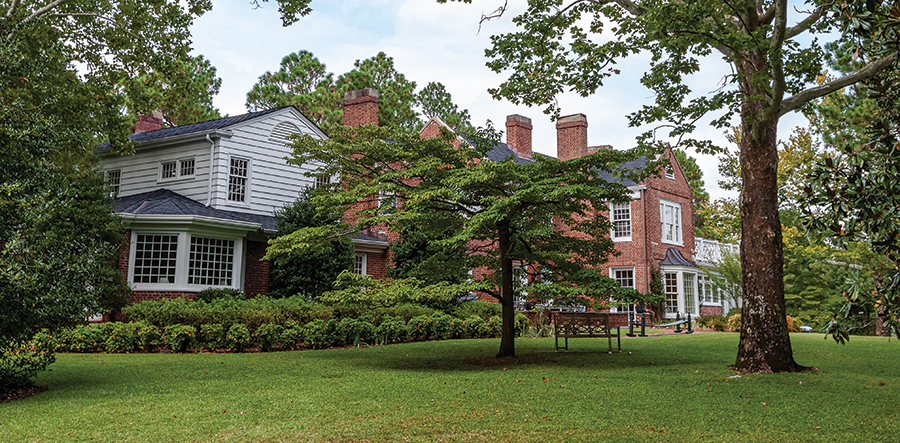
Twenty years ago, Dr. Russell and Ann McAllister decided to downsize from a 4,000- square-foot home in Durham. Their children were grown. Russell, a cardiologist, anticipated retirement. Golf wasn’t a factor. So what did they do? Purchase an empty and neglected 6,000-square-foot manor house on 5 acres with two tennis courts and a 20-by-40-foot pool, built in Pinehurst, circa 1916, for U.S. Ambassador to the United Kingdom, Walter Hines Page.

Page, appointed by Woodrow Wilson, served during World War I. His father, Francis Page, had made a fortune in logging and construction. The elder Page is credited with founding Cary and Aberdeen. Son Walter, who followed more intellectual pursuits (journalism, teaching, publishing), shifted his attention and residence to England, planning to return, eventually, as a gentleman farmer. Illness brought him back to Pinehurst, where died in 1918, at 63, without fully occupying the stately residence called Garran Hall.

The McAllisters’ acquisition of the Georgian manor, renamed Hollycrest, spins an unlikely tale.

Ann: “A friend asked me to come down from Chapel Hill with her to help find a house in the Sandhills. We looked through some brochures.” One caught Ann’s eye. The agent offered a showing. “It had been vacant for 16 years. As we came up the drive it looked like a haunted nursing home.”

By chance, the house was open. They tiptoed in.

(Roll the spooky music.)

“I had a moment,” Ann recalls. She saw beyond the cobwebs to the grounds, the scope and isolation. “I adore magnolias,” which were plentiful. She faces challenges without fear.

Russell: “I was at choir practice when Ann called to say she had found what she always wanted. And all those years I thought (that something) was me.” Instead, a brick masterpiece, simple and dignified, built longitudinally one room deep, with a wing at each end.

This faded beauty oozed potential. Ann possessed expertise; she had renovated a historic home in Kentucky, also trained as a docent at The Hermitage, President Andrew Jackson’s residence in Nashville, Tennessee.

Nevertheless, Russell — also a history buff — came down, took one look and uttered, tapping his forehead, “She needs help.”

She got the practical kind from the architect who designed their Durham home. But interiors executed in a genteel Southern mode are Ann’s alone.

Once termite damage had been rectified and the skeleton exposed, the crew got to work on making the house 21st century livable: Enlarge the main floor master suite and bathrooms, create a kitchen (original in the basement, which now houses a wine cellar), install new systems (five-zone AC), add two staircases and enough paneling, coffers and moldings that, if laid end to end, would reach W.H. Page’s grave in Aberdeen.

They were able to save all seven carved mantels, most doors and some oak flooring, which was lifted, repaired and relaid. Workmen ran into trouble when replacing the front portico, deemed wrong for the era. During its removal, bricks fell off the house front. The hunt for matching ones took three months.

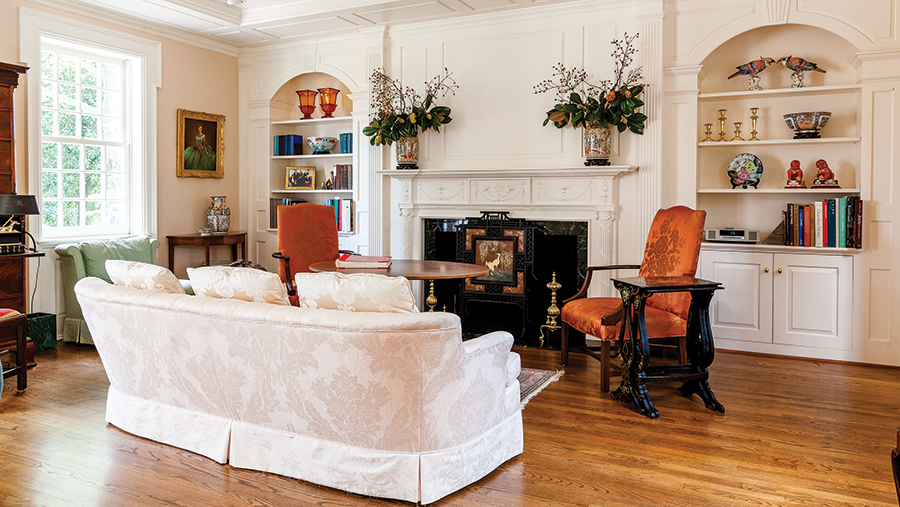
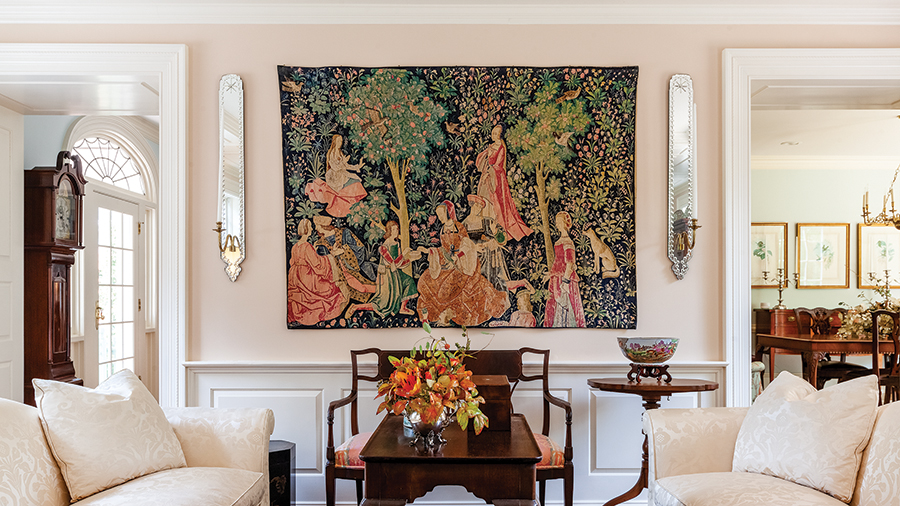
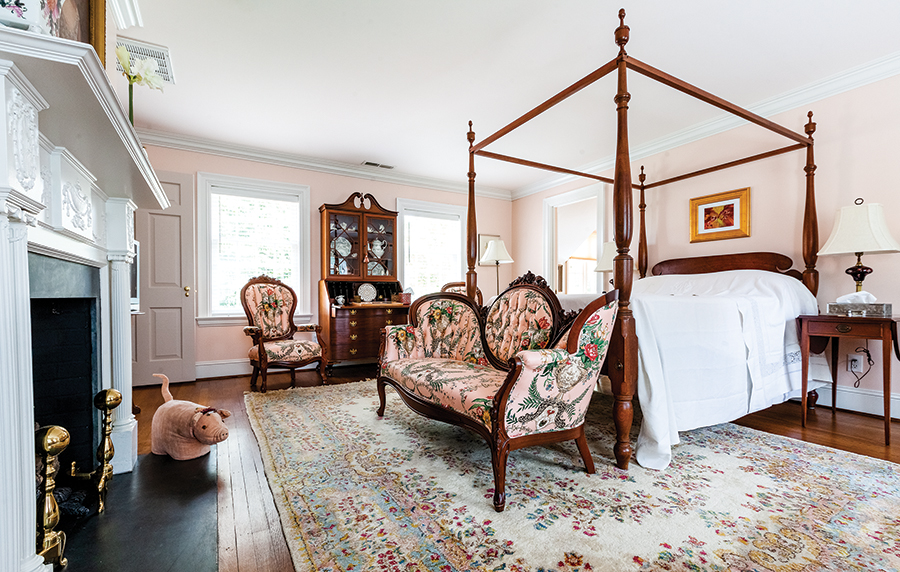
The blush pink salon — nearly 40 feet long, with tall bare windows parading down both sides — remained intact, divided into conversation areas by white sofas, chairs, rugs and tables. One end is anchored by a fireplace, the other by a 15th century millefleurs tapestry reproduction, where the background is composed of tiny flowers.

Given the dimensions, Russell envisioned it a ballroom.

“We love to dance.”

Less imposing on a quiet evening are several sitting rooms, including one adjacent to the kitchen, also Ann’s Blue Room displaying her Delft collections, notably tiles framing the fireplace. Part of Russell’s second-floor office doubles as the TV room. Her favorite is the library just off the kitchen, where a round ottoman upholstered in a fabric featuring life-sized cats dominates floorspace.

“Playfulness,” Ann calls it. “Every room needs a laugh.”

Laughing from the top of a highboy is her collection of nutcrackers brought back from a year in Switzerland. Russell identifies the odd painted wooden benches on the veranda and by the front door as joggling boards, a low country craft.

“This is where you sit with your girlfriend and ‘joggle’ closer and closer.”

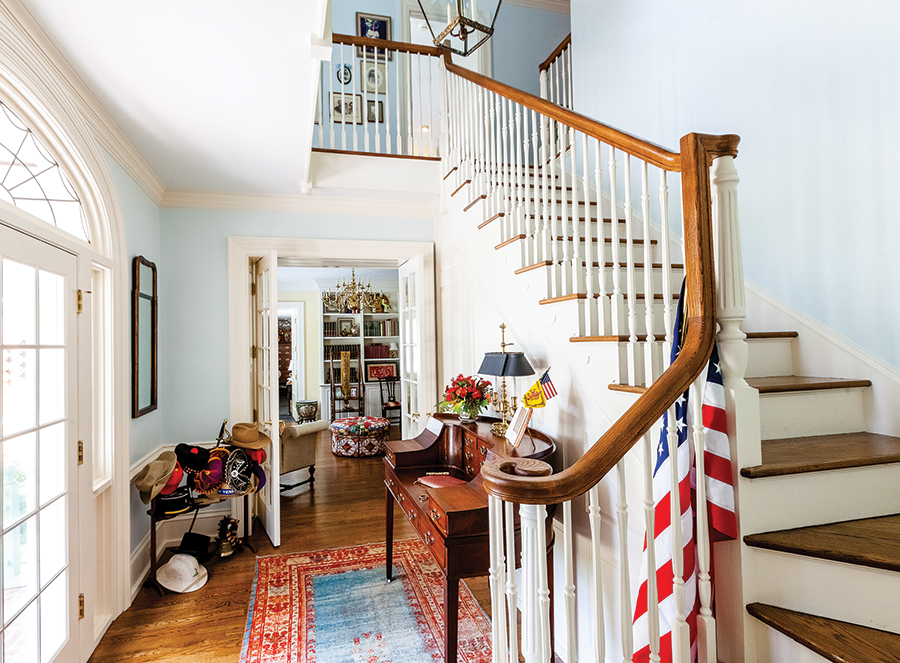
How refreshing to see serious antiques placed beside a cat fabric and pig-shaped leather footstool. In the foyer Ann again accomplished this with her mother-in-law’s Governor Winthrop-style desk a few feet from a low rack draped with a velvet jester’s cap, a French gendarme’s hat and assorted headgear collected on their travels.

Ann’s fabric/wallpaper preferences lean toward chinoiserie patterns with flowers and birds of paradise, popular in Europe when Asian trade routes opened during the 17th century. Some have a silky sheen. Her method: Haunt fine fabric shops in Charleston, Atlanta and Durham, purveyors of brands like Scalamandre and Brunschwig & Fils, for finds and bargains. When something catches her eye, “I buy it, a lot, and build the room around it.”

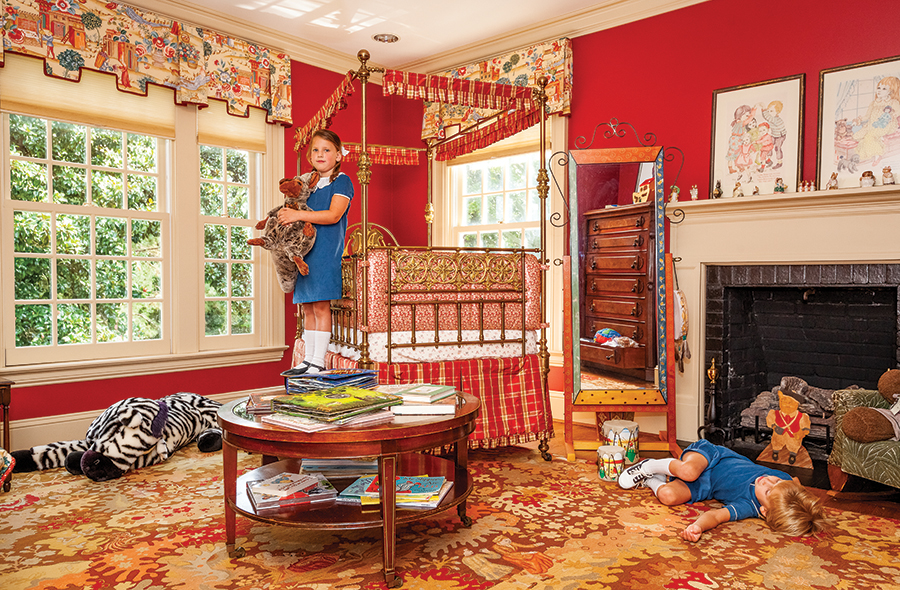
The gap between purchase and use can be years. Other times, the fabric completes a theme, as in the upstairs nursery. Here, a medieval tone is set by a brass canopied crib, fit for a prince, first used by the McAllister children, now by the grandchildren.

Ann attributes recurring Asian themes, notably lamps, to time their son spent at the University of Beijing.

Furniture wasn’t a problem. Russell descends from an old Virginia family, Ann from a Tennessee counterpart. Heirlooms aplenty trickled down, including a Biedermeier chest, many desks, side tables, campaign and other chairs, a bachelor’s chest, armoires, classic dining room pieces and, of course, ancestral portraits: Russell’s kin, a handsome assistant surgeon general of the Confederate Army, shares a wall with his stern-looking wife. “When you have enough relatives who die on both sides you can pull it together,” Ann learned.

Her kitchen, created from scratch, pushes the envelope in another direction. The toile wallpaper in giant black-on-white figures suggests a formality not reflected in matte black granite countertops, preferred for their well-worn look. The low storage island doubles as a dinette table, and two farm sinks (one in an open butler’s pantry) help when the McAllisters entertain. The wall of windows over the main sink faces an expanse of grass bordered by elder magnolias and American plane trees, with pool and tennis courts beyond.

“Every morning at 6:30 I look out and see a deer herd go by,” Ann says.

Indeed, Hollycrest qualifies as lodging for royalty. Elizabeth Demaine, who purchased the property in the 1940s, hosted the Queen of Thailand, a college friend, and her entourage there. Demaine, a foxhunter, changed the name to Hollycrest, adding stables and kennels — even an enclosure for peacocks, known to be guard birds.

Demaine’s favorite horse is buried on the property.

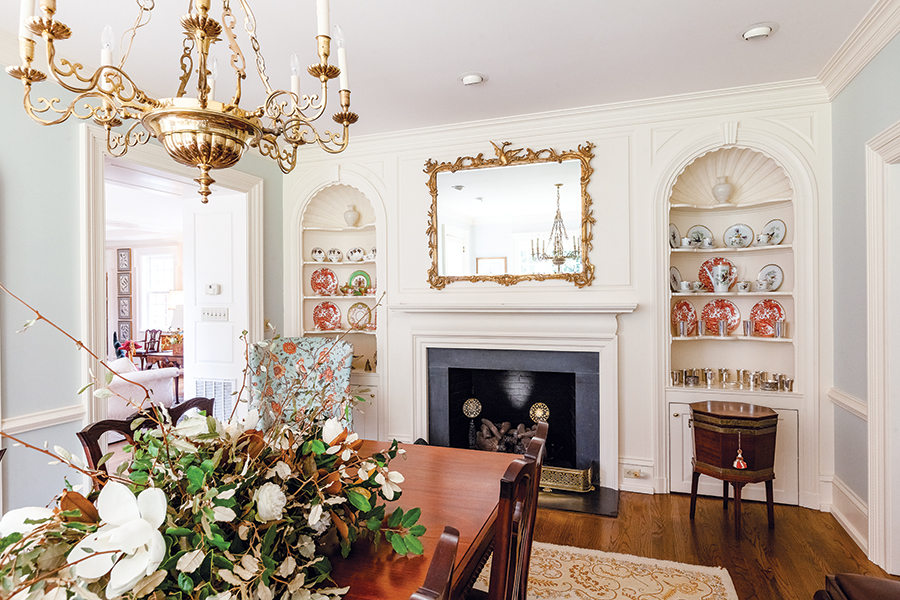
All things considered, the beauty of Hollycrest lies in the sum of its details: the old-fashioned robin’s egg blue and barely pink downstairs walls contrasting to dark, vivid teal and red upstairs, accomplished by first painting the surface black, then overlaying color. The Tennessee marble used for a powder room vanity. The original polished brass hinges and doorknobs. A narrow spiral staircase. Brick gateposts and a circular drive to match house proportions. Art purchased worldwide just because the collectors liked it. A secret coat closet, under the main staircase. A collection of tiny Hummel figurines. The handpainted folding screen in the dining room. Shelves of Southern literature and gardening books in Ann’s sitting room. A tiny refrigerator built into Russell’s office bookcase, containing his favorite beverages and the grandchildren’s.

Lucky grandchildren. Ann and Russell located a furnished “wee cottage” just tall enough to accommodate grade-schoolers. They arranged for its transportation, in toto, by sky crane, then secured it with a foundation.

Alice found no match in Wonderland.

Next up, lighting the tennis courts so the McAllister’s daughter, who played for Princeton University, can teach her children.

What Ambassador Walter Hines Page started others have continued in a style both innovative and respectful of times when people paid calls, wrote thank-you notes and took Sunday drives. As its current chatelaine Ann McAllister realizes, even greater potential as a family homestead.

“This house needs three or four kids running around. I have tried to preserve it for someone down the path, a continuing challenge.” PS

Good Natured

Know the Source

Where do your supplements come from?

By Karen Frye

Many years ago, when I first opened my natural food store, there were a handful of companies that produced vitamins, minerals and other nutritional supplements. It is amazing how many are in the industry today. There’s so much on the shelves to choose from that it can be confusing if you aren’t up on the background and standards of the manufacturers.

With the exploding popularity of supplements, some companies jumped into the business with dollar signs in mind — but that’s not true of everyone. A wonderful example is Gaia Herbs, located in the western part of North Carolina just outside Brevard.

Gaia Herbs is a Certified B Corporation. The B Corporation certification is a private certification issued to for-profit companies by B Lab, a global nonprofit. The “B” stands for benefit. To become a B Corp the company must be totally transparent. The standard represents a company’s dedication to sustainability and social impact, with transparency in every aspect of production, accountability, and social and environmental performance. B Corps have elevated the standards in the supplement industry by redefining success with a focus beyond profit.

Every year Gaia Herbs hosts a farm tour, and this past August I had the chance to attend the event. It was a real learning experience to see the great lengths they go to in the production of their herbal supplements. The business started about 32 years ago. The farm is over 300 acres in the mountain hills. I was able to walk through the fields of herbs they use to produce a lot of extracts and formulas. There were acres of gingko and hawthorne trees; they handpick the leaves at peak harvest to ensure the most potent product. There were fields of nettles, echinacea flowers, astragalus and over 22 other species. They had over 200 beehives and monarch butterfly stations ensuring pollination. The farm team consists of dedicated folks committed to lessening the environmental impact and reducing the carbon footprint. They don’t allow any plastics on the farm.

After the farm tour and a delicious lunch of vegetables grown organically on the farm, we were invited to tour the laboratory and manufacturing facility. Gaia’s commitment to stringent manufacturing procedures is another reason they are respected by consumers who look for all the right things in their herbal support.

We talked with the scientists and engineers who rigorously test the raw materials grown (organically, of course) on-site, and also informed us which materials are sourced elsewhere. They screen for trace amounts of heavy metals, pesticides, mycotoxins, microbes and residual solvents, using only the cleanest materials in the formulations.

The manufacturing of the extracts and capsules uses clean extraction methods: water ethanol or CO2 supercritical extraction — never any hexane or solvents. Also, the herbs go through batch tests to ensure that the potency and quality meet Gaia’s high standards. In fact, you can trace the origin of the plants used in the purchased product by scanning a code on the label, giving you the background of the herb.

All supplements are not created equal. It may be in your best interest to get to know more about the company that’s producing them for you. It might make all the difference in your health.  PS

Karen Frye is the owner and founder of Nature’s Own and teaches yoga at the Bikram Yoga Studio.

PinePitch

Trick or Treat

Ages 10 and under are invited to trick-or-treat in the downtown Southern Pines business district, then head to the Downtown Park for a Hauntingly Good Time Festival with games, crafts and more, beginning at 5 p.m. on Friday, Oct. 25. The movie Hotel Transylvania 2 will start at 7 p.m. Bring a blanket or chair. Concessions will be available. For information call (910) 692-7376.

Autumnfest in the Pines

The 41st annual fall festival features live entertainment, arts and crafts, food, a 5K run, a 1-mile Fun Run and Health Walk, youth sprints and children’s activities. Admission is free at the Downtown Park, 145 S.E. Broad St., Southern Pines. For information call (910) 692-7376 or go to www.mooreart.org.

Heritage Fair

Join the celebration supporting the Moore Country Historical Association at the Shaw House Heritage Fair from 9 a.m. to 4 p.m. on Saturday, Oct. 4, at 10 W. Morganton Road, Southern Pines. There will be live music, re-enactors, tours, live demonstrations, kids’ activities and food vendors. For additional information call (910) 692-2015 or see www.moorehistory.com.

Cameron Antiques Fair

Over 300 antique dealers, including the 12 who call Cameron home, will set up shop during the annual festival that runs from 9 a.m. to 5 p.m., on the weekend of Oct. 4 and 5. The festival takes place rain or shine in Cameron’s Historic District, 485 Carthage St., Cameron. For information call (910) 245-1231 or go to www.antiquesofcameron.com.

Low Country Boil & Halloween Party

Grab your dancing shoes, dress in your favorite Halloween costume and party at the Low Country Boil & Halloween Party featuring DJ King Curtiss and catered by White Rabbit at 6:30 p.m. on October 31 at the Fair Barn. All proceeds benefit the Given Memorial Library and Tufts Archives. Tickets are $75 and can be purchased at ticketmesandhills.com or at the Tufts Archives.

First Friday

The Empire Strikes Brass, a high energy brass-funk-rock band from Asheville, will take the First Bank Stage at the Sunrise Theater, 250 N.W. Broad St., Southern Pines, on Friday, Oct. 4, from 5 to 8 p.m. There will be food trucks aplenty and alcohol for purchase. No outside alcohol allowed. For information visit www.sunrisetheater.com or call (910) 692-8501.

Holly Arts & Crafts

The annual Holly Arts & Crafts Festival is Saturday, Oct. 19, from 10 a.m. to 4 p.m., on the village streets of Pinehurst, 395 Magnolia Road. Over 200 craft vendors in myriad genres from woodworking to glass, jewelry to sculpture will join the downtown shops. There will be a food court and a Kids Zone with games and crafts on the Village Green sponsored by Given Tufts. For more information visit www.pinehurstbusinesspartners.com.

Elephant on the Water

Enjoy Dumbo on the big screen at the Aberdeen Lake Park Recreation Station, 301 Lake Park Crossing, Aberdeen, on Friday, Oct. 18, at 7:15 p.m. Admission is free, and concessions will be available. Additional information can be found at www.townofaberdeen.net or by calling (910) 944-7275.

“Unleashing the Pawsibilities”

The Moore Humane Society’s annual gala will be Friday, Oct. 25, at the Country Club of North Carolina, from 6 p.m. to 9 p.m. Hosted by Patrick Kelly of Star 102.5FM with live music from The Sand Band, a full buffet and a prize-packed auction, the goal is to raise $50,000 to cover veterinary costs for life-saving operations and spay-neuter procedures. Tickets are $75 and a table of eight is $500. To make reservations visit www.moorehumane.org.

Birds, Bees and Butterflies, Oh, My!

Help celebrate the opening of the new pollinator garden at the Village Arboretum in Pinehurst on Saturday, Oct. 5, from 11 a.m. to 2 p.m. The “Flutterby Festival” will feature guided tours of the new garden and a tent where you’ll be surrounded by monarch butterflies. At the end of the event you can tag and release monarchs for their great migration to Mexico. Live music will be provided by the Carolina Philharmonic. There will be food vendors and kids’ activities. For further information go to villageheritagefoundation.org.

Thundercluk!

Half mortal. Half God. All natural chicken. The Arts Council of Moore County and Sandhills Community College present “Thundercluk,” the Viking chicken, featuring the animation and storytelling of Paul Tillery and Meg Wittmer. The exhibit will be in the Katharine L. Boyd Library, SCC, 3395 Airport Road, Pinehurst, Oct. 2–30. There will be a reception and artist’s talk on Oct. 2 from 3–5 p.m. It’s free and open to the public. The exhibit will include illustrations, animation and storytelling. The character was created by Tillery while he was at the Savannah College of Art and Design, where he earned his Master of Fine Arts degree in 2014. For further information visit www.mooreart.org.

The Rooster’s Wife

Sunday, Oct. 6: Julian Loida is a Boston-based percussionist, composer and producer. His musical curiosity and open-mindedness have propelled him toward a wide range of sounds, genres, and artistic endeavors. Loida will open the evening with selections from his amazing new solo vibraphone album. Folk rocker James Maddock brings prodigious guitar skills to match his evocative lyrics. Cost: $20.

Thursday, Oct. 10: In 2018, Beth and Ara Lee James formed the duo project Stand and Sway, pushing the boundaries of soul and folk music and attempting to break down the walls that have separated the worlds of music and poetry. Cost: $15.

Sunday, Oct. 13: Introduced by the legendary Li’l Queenie and Leigh Harris, Josh Paxton and Debbie Davis have spent the better part of two decades exploring their shared musical interests, ranging from Ellington and Jelly Roll Morton to Stevie Wonder and Randy Newman. They have performed in Switzerland, Italy, and France in addition to performances across the U.S. Piano and all that jazz. Cost: $15

Thursday, Oct. 17: Open mic with the The Parsons. Free to members.

Sunday, Oct. 20: Journey to the Andalusia region of Spain for an authentic Spanish Tablao at The Rooster’s Wife. Experience the intense, emotional power of Flamenco. Eduardo’s Noche Flamenca combines Spanish music, dance, cuisine and wines with renowned performers from Cuba, Spain, Venezuela, Canada and the United States. Cost: $18.

Thursday, Oct. 24: Jeremy Pinnell, Kentucky’s son from across the river, is a soft-spoken man, born to an area that is equal parts Southern hospitality, Northern attitude and Midwestern charm. Raised from humble beginnings singing in church, he learned guitar from his father and soon his craft made heads turn and rooms fall silent. When he left home at 18 to venture into the unknown, Pinnell found himself surrounded by the demons of the world he tried to sing away. The stories told are true, not embellished folklore. Jeremy will not speak of them; only sing. While he has returned to his roots and is living an honest life, his experiences must be heard to be believed. They are real, and most importantly, never forgotten. Cost: $15.

Sunday, Oct. 27: Rosier. Lanaudière is known round the world as Québec’s most musical region. There, traditional music is in the air and water, handed down through generations. Such is the story of the members of Rosier, four young gals and a guy named Colin who grew up in active musician families in Lanaudière, and carry the traditions forward while adding some new songs and sounds of their own. They perform a sparkling, diversified, bilingual repertoire of intimate waltzes, reels and beautifully sung call-and-response songs. Cost: $15.

Unless otherwise noted, doors open at 6 p.m. and music begins at 6:46 at the Poplar Knight Spot, 114 Knight St., Aberdeen. Prices above are for members. Annual memberships are $5 and available online or at the door. For more information call (910) 944-7502 or visit www.theroosterswife.org or ticketmesandhills.com.

In the Spirit

Bar Balance

Rely on the classics

By Tony Cross

A friend of mine recently made the transition from lifetime server to behind the bar. As a server, he’s probably one of the best that I’ve ever had the pleasure to work with. He’s fast, knowledgeable and friendly, but most importantly, he can work a room. Whether a server has been given multiple tables at once, or it’s an extremely busy night, if he/she can get everyone on their side, the rest of the night is butter.

And that’s what he did. Night in and night out. I’m talking upselling appetizers, better wine, and that extra dessert. This always results in great tips and constant requests from big spenders.

But now that he’s a bartender, the night feels a bit foreign. He wants to do the best job that he can do, and knowing his work ethic, he’ll do just fine. However, when he first made the transition, he started asking me how to do infusions, and other drinks that, for novices, are a bit over the top. My friend — we’ll call him “Danny” — is not a big drinker; what he does drink is quite simple, e.g., domestic beer, wine and the occasional cocktail.

My response to Danny’s questions might have come off a bit unsympathetic, but sincere, and I hope he takes it to heart. “Learn the classics first,” I told him. For someone that’s never experimented with cocktails in the workplace or at home, this is pretty standard advice. There’s no point in making a fat-washed bourbon for a Manhattan if you don’t understand the Manhattan to begin with. I don’t care how good your infusion is, if your specs are off, your cocktail will be, too. Not to mention the other things to be mindful about while bartending: engaging customers while making copious drinks; being able to juggle making different cocktails at once while making eye contact with your guests; greeting newly seated bar guests, taking orders, and creating an atmosphere. Did I mention engaging? If you’re new to making drinks, you most definitely do not need six-plus ingredient drinks on your menu. You will set yourself up for failure one way or another. Either your drinks or your guests will suffer. Maybe both.

I have another friend who is a retired bartender. And by “retired,” I mean he was behind the stick for a decade or so before he decided to move on to another profession outside of the hospitality business. We’ll call him “Adam.” Even though Adam was a bartender by trade for many years, he couldn’t make many drinks that I would deem drink-worthy. God, that sounds pretentious. But if you knew Adam, you’d know what I mean.

I worked with Adam for a few years while I was a server. It pained me waiting for my drinks. It wasn’t that Adam was physically slow making drinks; it was just that he was more interested in chatting it up with his bar guests. Many a night, while I was standing there waiting for my three or four cocktails, Adam would be in the middle of mixing them while talking to one of our regulars. Uh-oh. His face read, “Did I or did I not already add that ounce-and-a-half of vodka?” Just to be sure, Adam would go ahead and pour more into the shaker. Like clockwork, I would return in five minutes because my table couldn’t stomach the unbalanced drink. One Wednesday night I came as a customer, sat at the bar with Adam, ordered a beer, and stayed for dinner. That was when I realized why Adam had so many regulars. Even though I ate alone, Adam kept me entertained the whole evening. I had a good time and left with a smile on my face.

I’m mentioning my two friends for a reason. Yes, there’s a moral to the stories. A great bartender is able to cover multiple tasks while looking cool under pressure. I’m certain that Danny is going to learn the ropes quickly — multitasking is his first language — and once he gets his drinks down, he’s going to be amazing. And Adam. Though I’d never say he was a great bartender, he was spot-on in his hospitality. If you’re new to bartending, especially in a restaurant bar, you’ll need balance.

Start with the classics. Have a handful of drinks that you know like the back of your hand, and study up why they work. Lots of great bartenders have used these recipes as backbones for new drinks when they are inspired. Keep your cocktail list simple, but delicious. And if you’re just the imbiber and it’s your first time at this bar or restaurant: order a daiquiri. If it’s no bueno, chances are the rest of the drinks on the list aren’t either.

Or do what I’d do when visiting Adam — just order a beer.  PS

Tony Cross is a bartender who runs cocktail catering company Reverie Cocktails in Southern Pines.

The Omnivorous Reader

Making of a Marsh Girl

Praise for a North Carolina tale

By D.G. Martin

For almost a year now, Delia Owens’ Where the Crawdads Sing has been at the top of The New York Times best-seller list, usually at No. 1.

North Carolina likes to be first at everything. Freedom. Flight. Basketball. Books. So, some of us have been bragging because Crawdads is set in North Carolina. Most of the action takes place in the fictional coastal town of Barkley Cove and the surrounding marshes, coves and ocean waters. There are side trips to real places such as Greenville and Asheville.

Others complain that the book’s geography is confusing, that the main character is unbelievable, that the framing of the African-American characters and their dialect is faulty, and that the storyline is broken and contrived.

However, the book’s many fans argue that Crawdads is genuine literary fiction in light of its strong and lovely descriptions of nature’s plants and creatures. They continue with praise about the book’s compelling murder mystery that has an unexpected ending and gives readers a superior entertainment experience. They applaud the coming-of-age story of the book’s central character, Catherine Clark, or “Kya.”

Kya was abandoned by her family as a child and lived alone in a shack in the marshes miles away from town. People in Barkley Cove think she is weird, keep their distance, and call her “the Marsh Girl.” She spent only one day in school and cannot read or write. However, because she is smart and diligent, she learns about the nature of the marshes.

When Kya meets Tate Walker, a young man from Barkley Cove, he senses her strengths and shares her love of plants and animals. He teaches her to read and write. They fall in love.

When Tate leaves Kya behind to study science at UNC Chapel Hill, she is devastated. Later, she rebounds to the seductive charms of Chase Andrews, a town football hero and big shot. Their secret affair is interrupted by Chase’s marriage to another woman, and Kya is again distraught.

Overcoming these disappointments, Kya leverages her reading, writing and self-taught artistic talents to record the natural world that surrounds her. When Tate, now a scientist, returns to her life, he persuades her to submit her work for publication. The book is a great success, and she writes and illustrates several more.

All this is background for the story that begins when Kya is grown and her former lover, Chase Andrews, is found dead at the bottom of an old fire tower. Kya is a suspect and is ultimately charged, arrested, put in prison and tried for Chase’s murder.

The evidence against her seems flimsy at first. But incriminating facts pile up, including her angry response to the married Chase’s attempts to seduce her. But she has a strong alibi. The author’s deftness in setting up this situation, and resolving it smoothly, has helped make it a best-seller.

A remaining mystery is how and why Owens, the author of two successful non-fiction books about the African natural world, came to write Crawdads.

After studying and writing about animal behavior, as she explained on UNC-TV’s North Carolina Bookwatch in September, “I wanted to write a novel about how much we know about how animal behavior is like ours. It can help us learn about ourselves. So I came up with this idea of writing this novel about a young girl who is forced to live outside of a social group. She’s abandoned. She’s never totally alone, but she has to spend a lot of time alone, and how does that affect her behavior? That is the question of my novel. Because Kya doesn’t have any girlfriends, she is missing something. She’s lonely, she’s isolated, and when people are forced to live in that sort of situation they behave differently.

“Kya was raised in the wild coastal marsh of North Carolina. She was born in the 1940s and lived through the 1950s and on, and so I chose the marsh because she is mostly abandoned by her family. She has to live most of the time by herself. I wanted the story to be believable, and the marsh is a temperate climate so she could live, she didn’t have to worry about snow or freezing, and she had a shack. She could survive because you can truly walk around and pick up mussels and oysters. I know it’s not easy, but you can learn to do it. It was possible for her to survive in that environment. That’s the reason I chose it.”

Owens, who spent much of her life in the wilds of Africa, far from any other human, explained, “There’s a lot of me in Kya: girl, love of nature, live in the wilderness for years, feeling like I don’t belong anywhere. There’s a lot of me in Kya, but there’s a lot of Kya in all of us.”

She says that being totally alone changes a person. “When I was isolated in Africa all those years, I wanted to have social groups. I wanted to have more contact with people. But when I came back, I found out it’s not so easy just to do it. And that’s what happens to someone who’s isolated like Kya. She longed to be with people, but every time she had an opportunity she was shy and didn’t feel socially confident.

“One of the points of the book is that you do not have to live in a marsh to be lonely. A lot of people in cities are lonely. A lot of people in small towns, even though they have friends, are lonely because we don’t have the strong, long-lived groups that we used to have. And when we get away from that, not only do we feel less confident and lonely, but we also behave differently toward others.”

How does Owens make a story out of an isolated young woman who lives in a shack in the marsh?

“I came with the theme first. I wanted to write a story of a young girl growing up alone and how isolation would affect her, but I knew I couldn’t just write that story. It had to have a love story, and it’s a very intense love story. It’s a very compelling, I hope, murder mystery. Of course when Kya reached adolescence, she reached the time that she wanted to be with other people, she wanted to be loved. So she started in her way reaching out, at least watching, and there is sort of a love triangle that follows that is very intense.”

Will there be a movie? Crawdads gained the attention of actress Reese Witherspoon. Fox 2000 has acquired film rights and plans for Witherspoon to be the producer.

We can hope that the movie will be shot in North Carolina. But here the book’s problem jumps up. The geography described in the book, with palmettos and deep marshes adjoining ocean coves, seems to fit South Carolina or Georgia coastal landscapes better than North Carolina’s coastlands.

Nevertheless, whatever the moviemakers decide, North Carolinians can bask in the reflected glory of a No. 1 best-seller that claims our state for its setting.  PS

D.G. Martin hosts North Carolina Bookwatch Sunday at 11 a.m. and Tuesday at 5 p.m. on UNC-TV. The program also airs on the North Carolina Channel Tuesday at 8 p.m. To View prior programs go to http://video.unctv.org/show/nc-bookwatch/episodes/


Hometown

Unhooked

Avoiding a real drag at dawn

By Bill Fields

Walking through the Atlanta airport to my departure gate for an early morning flight late this summer, I trailed a couple of passengers who took a hard right into a glass-doored room with rows of seats. I didn’t understand their detour until I glimpsed someone settled in with a cigarette, the smoke headed upward toward a powerful vent in an attempt to mitigate the odor.

I checked later, and there are more places at Hartsfield-Jackson International for animals to go to the bathroom than for their owners to have a cigarette.

Smoking is an increasingly lonely and expensive — at my local convenience store, a pack ranges from $7.99 to $11.10 — proposition in the United States. Less than 15 percent of the population is lighting up compared with about four out of 10 Americans half a century ago, not long after the surgeon general first warned of the health risks. Chick-peas grow and solar panels collect the sun’s energy in many places where tobacco once grew.

I’ve smoked cigarettes — probably not a carton in total, right after I graduated from college — but thankfully never got hooked and, growing up in North Carolina when I did, that probably put me in the minority. Going to tour the R.J. Reynolds plant in Winston-Salem was as natural an outing as a trip to a museum in Raleigh or the battleship in Wilmington. We were very proud the Christmas we gave Dad, a Salem man, a kit to roll his own cigarettes. He was less enthusiastic, and Dad never missed a week of purchasing his carton of Salems from the Big Star (for about half the cost of what a single pack runs today).

It is hard for me to picture Dad without a cigarette. He smoked at least two packs a day most of his adult life. He didn’t want a shirt unless it had a pocket to store his smokes — even his T-shirts were so designed. He smoked inside, outside and when he was driving, fishing or playing golf. He had lighters inscribed with his initials.

I don’t know if he agreed with the Salem advertising that the brand had “a taste as soft and fresh as springtime,” but he was thoroughly hooked until he was diagnosed with a smoking-related cancer and had surgery. Dad only lived a little more than a year after that operation. He never smoked again, though, and after he quit came to realize how offensive the habit was.

Given that even doctors endorsed smoking when Dad started as a teenager in the late 1930s, and that cigarettes were part of a soldier’s standard kit during World War II, it’s not hard to see how so many people in his generation got hooked.

As I tried to discourage a young friend of mine from smoking recently, I thought about my father’s life and death, and of those smokers in the airport, who ought to know better, taking a drag at dawn and counting the minutes until they could have another cigarette.

I’m lucky that I quit before I ever really started, unhappy with how smoking made me feel and my clothes smell, beyond what had become indisputable health hazards. The stale scent was so different from what I remembered from a decade earlier when Dad took me to a tobacco warehouse in Fairmont, where the sweetly powerful and appealing aroma of the cured product was more distinct than the auctioneer’s rapid delivery.

I bought my last pack of Salems almost 40 years ago. It was a short smoking experiment, not quite as abbreviated as when I tried chewing tobacco for one inning during a college intramural softball game. As I attempted to manage the chaw, I felt as if I were getting greener than the sparse, end-of-semester grass on which we were playing. I was in left field and out of my league. My first purchase of Red Man was my last.  PS

Southern Pines native Bill Fields, who writes about golf and other things, moved north in 1986 but hasn’t lost his accent.

Birdwatch

Flying High and Fast

Listen for the “killy, killy, killy” of the American Kestrel this fall

By Susan Campbell

If you happen to see, high up on an electric wire, a brightly colored, sleek raptor surveying its territory, it just might be an American kestrel.

It’s not uncommon to spot kestrels in either the Piedmont or Sandhills year round. Southern populations are not migratory, so pairs remain in the same area throughout their lifetime. In fall, numbers swell as northern individuals arrive for the winter months. The smallest members of the falcon family, these handsome predators have an affinity for open habitat. Also known as “sparrow hawks,” they are fast, maneuverable fliers, quick to dive after prey. But you’ll  also see them hovering. Although kestrels are easiest to spot in large, grassy fields, they can also be found in wooded areas. They feed on a variety of prey: from grasshoppers to small snakes and songbirds. These fast-flying falcons are easy to recognize given their distinctive head pattern and bright plumage. Also listen for their distinctive call, a repeated sharp “killy, killy, killy.”

American kestrels are unique among the hawks found here in that the male and female are quite different in appearance. Both sexes have a dark, helmeted head and a handsome mustache. Males have slate-gray wings that contrast with the rufous upper parts. Females, on the other hand, which are larger than males, are more of a solid red-brown with black wingtips. The sexes also have distinct habits when it comes to defending territory. Males are typically excluded by females from more open areas, which means you can find them in brushier habitat featuring smaller but more abundant prey. Like most hawks, kestrels are monogamous.

The American kestrel can be found across most of the United States in the right habitat.  Birds that breed in Canada and the Upper Midwest are migratory. Northern individuals may move as far south as southern Central America for the winter. Declines in kestrels in the middle of the last century are blamed on the use of DDT. However, as pesticide use changed and nest boxes were added to the landscape in many areas, the species rebounded well and now is a common sight along roadways and the borders of agricultural areas across its range.

American kestrels use open woodlands for breeding.  In the Sandhills the open pine savannahs found on Ft. Bragg and the area’s game lands are ideal habitat to look for kestrels from March through July.  These birds are also unique among area hawks in using cavities for nesting. They take over holes created by other animals, usually pileated woodpeckers, in early spring.  Although they will switch locations from year to year, they may re-use the same cavity within the season. Often kestrels will raise two broods in years when rodents are plentiful. The nest hole needs to be large and deep enough to protect as many as four or five young for about a month until fledging.

Given their handsome appearance and small size, kestrels are popular among falconers. With proper permits, juveniles can be tamed and trained to hunt. Believe it or not, the ancient sport of falconry is alive and well across the United States — even here in North Carolina. But that will have to be a story for another time.  PS

Susan would love to receive your wildlife sightings and photos.She can be contacted by email at susan@ncaves.com

Food for Thought

The Tomato’s Last Hurrah

Summer’s carefree days have drawn to a close, but much of the bounty is still with us. Now’s the time to use up every bit of the tomato’s goodness

By Jane Lear

When I was a child, no one I knew cooked pasta (what we called noodles) with tomato sauce at home. In our part of the South, that sort of food was considered not just ethnic, but positively exotic, enjoyed as a special treat at the lone Italian restaurant in town. So although a college roommate introduced me to Ragú — we both thought it was pretty good — I didn’t have what you might call a relationship with tomato sauce until I moved to New York City in the late 1970s.

By sheer good fortune, I landed a job at Alfred A. Knopf, the legendary publishing house, and among the luminaries who graced the halls was Marcella Hazan, author of the instant classics The Classic Italian Cook Book and More Classic Italian Cooking. (Both books are combined in Essentials of Classic Italian Cooking, published by Knopf almost 20 years later.)

Mrs. Hazan’s recipe for Tomato Sauce with Onion and Butter, from the first book, is at once devastatingly simple and life-changing. Aside from pasta and cheese, it lists just four ingredients: tomatoes (fresh or canned), one onion, five tablespoons of butter, and salt. That recipe, which is easily available online, has long been famous for being a gift to home cooks everywhere; periodically, it is rediscovered and wins a whole new fan base.

I made tomato sauce the Marcella way for years. Eventually, though, I branched out, impelled by curiosity and the fact that during the end of tomato season, God will strike me dead if I let a single soft-ripe heirloom go to waste. That’s how I found out that a sauce gets complexity and a good balance of acidity and fruity sweetness from a mixture of varieties, and those juicy heirlooms were more interesting to play with than the pulpier plum (Roma) types.

The basic sauce below is extremely versatile — it’s what my husband and I reach for when making pasta and pizza. It’s wonderful drizzled over flat fresh romano beans, a slab of meatloaf, or polenta. And it seems to taste even better when made with the last of the year’s tomatoes. I freeze as much of it as I can because the jar in the fridge will be gone in no time flat.

By the way, the key to a great tomato sauce is the right pot. You want something heavy-bottomed, to discourage scorching, and with a wide surface area, to aid evaporation. The less time the tomatoes spend reducing, the fresher and more immediate the flavor will be.

A few personal asides on tomato prep: Some people like to peel and seed tomatoes before making sauce; others feel it’s more efficient to toss everything into the pot, then pass the cooked sauce through a food mill to get rid of the gnarly bits.

I generally prefer doing the work on the front end, but unlike many folks, I don’t blanch the tomatoes in boiling water first. Instead, I plunk them in a bowl, pour a kettle of boiling water over them and make myself a cup of tea while I’m at it. By the time I’ve gotten a sieve organized over another bowl, the tomatoes can be eased out of the hot water one by one; with a little help from a paring knife, the skins slip right off.

When seeding tomatoes, first cut them in half crosswise — around the equator — exposing the seed pockets. Use a finger to loosen the seeds in each pocket, then empty the tomato halves over the sieve.

To save every drop of the juices, I don’t chop the tomatoes on a cutting board, but instead in my hand, over the sieve. My tool of choice is a Dexter Russell oyster knife; the straight-edged blade is dull yet can still get the job done, the rubber handle is grippy in a wet hand, and the curved, rounded tip is ideal for flicking errant seeds out of the way. The chopped tomatoes go in the bowl underneath, and once you’ve pressed hard on the solids in the sieve, you can toss them into the compost pail knowing they’ve given their all.

Late-Season Tomato Sauce

Makes about 1 1/2 quarts

I’ve never found my finished sauce to be overly acidic, so it never occurs to me to add any sugar, but I’m no purist: It all depends on the tomatoes. If your sauce tastes harsh, add a little brown sugar to taste. Lastly, inspiration here comes from Marcella Hazan, but also the late Giuliano Bugialli, who taught me that basil isn’t used in a tomato sauce for its own flavor, but to bring out the flavor of the tomatoes themselves.

1/4 cup extra virgin olive oil

1 large yellow onion, chopped

3 fat cloves of garlic, minced

Several sprigs of fresh thyme, marjoram
or winter savory, tied together with kitchen string

5 to 6 pounds soft-ripe tomatoes, peeled, seeded and roughly chopped, plus
their juices

Coarse salt

1 or 2 fresh basil sprigs

A little unsalted butter, if desired

1. Heat the oil in a large, wide, heavy-bottomed pot over moderately high heat until it’s hot. Add the onion and cook until it begins to soften, then add the garlic. Cook, stirring occasionally, until the onion and garlic are thoroughly softened (don’t let them brown).

2. Add the tied herb sprigs, the tomatoes and their juices, and a generous pinch or two of salt. Simmer the sauce, uncovered, stirring occasionally, until it thickens nicely, about 1 hour. Taste the sauce and adjust the seasoning. Remove the herb sprigs.

3. After the sauce is done, add the basil sprigs, simmer the sauce an additional 2 minutes, then remove the basil.

4. Stirring in a little butter at this point will round out the flavors in the sauce and give it finesse, but it’s by no means necessary. I like a fairly chunky sauce, but if you prefer something smoother, purée it in a blender. Let the sauce cool completely, uncovered, before refrigerating or freezing.  PS

Jane Lear, formerly of Gourmet magazine and Martha Stewart Living, is the editor of Feed Me, a quarterly magazine for Long Island food lovers.

Mom Inc.

Running Buddies

No telling what evil lurks

By Renee Whitmore

A few days ago, I galloped back into the house after a run — well, it was more like a trot. I am calling it a trot because after a year’s hiatus from running, I downloaded the “Couch-to-5K” app on my phone, and have come to the realization that what I do is not really running, but can best be described as an uneven trot.

If you are unfamiliar with the Couch-to-5K app, it’s a virtual running partner. The voice tells you through your earbuds, “Start running now,” and “Start walking now,” and my personal favorite, “One minute left.”

On Day One, you start with small bursts of 60-second runs between several minute-long walks. Each week, the running time increases and the walking time decreases. Ideally, you run at least three days a week, and according to my software tyrant, in nine weeks, you’re ready to run a 5K (3.1 miles). Sounds great, right? Not so fast, as they say.

I am currently on Week Three, but I have to be honest: Week Three has been on repeat for four weeks because I wasn’t ready to move onto Week Four because, well, that’s a lot of running, er, trotting, and Week Three (otherwise known as September) was still too hot to trot.

Anyway, I want to tell you about that day’s run/walk. Let me preface this by saying that I live in the country, so I have a great running road with lots of room and rarely do I encounter anything out of the ordinary. By ordinary, I mean the usual roadkill, a snake or two, empty beer bottles and crumpled McDonalds cheeseburger wrappers pitched out on the side of the road. Maybe, if I’m lucky, some dog who either thinks I’m in his territory or just wants to meet me feels like a romp and tags along for a bit.

On that particular day, I was running back to my house, about three-fourths of the way through my trot. Sweat was dripping off my forehead, stinging my eyes, and my chest felt like it was on fire. (I mentioned the heat, didn’t I?) Suddenly, I started to feel like I was being watched.

I rarely see other humans on my runs, unless someone stops to ask me for directions (which is a bad idea, by the way, because half the time, runners don’t really know where they are and couldn’t find their way home without using the GPS on their phone). Anyway, something was off. Someone or something was watching me.

I frantically glanced around, into the fields on both sides of me, up at the sky, behind me, in front of me. Just the usual. The puffy white clouds. The pine trees. The growing corn stalks. A dead squirrel.

The feeling lingered, though. A car lazily passed me. I waved. They waved back. I kept trucking. But, still. What was watching me? It’s probably just in my head.

Then, there it was. On my left. Fenced in a neighbor’s yard. Its black, beady eyes glared right through me. I couldn’t take my eyes off it. As I ran by, its head moved, keeping its eyes on me. A chill ran through me, even though I was sweating, and I thought of the last Stephen King novel I read, which I’m pretty sure involved an animal very much like this one.

It was a goat. But not like any goat I had ever seen. A big, jet-black goat with huge pointy horns. He was sitting in his yard, behind the wire fence, staring at me.

So, I ran. I ignored the high-pitched voice in my earbuds that commanded, “Start walking now.” I just ran. All the way home and into my front door with Mr. Stephen King Black Goat still burned in my mind.

I tried to tell my husband and sons about the big black goat, but they just laughed it off like I was being melodramatic. No one seemed to take the goat seriously, and for the next several days, when we passed the house with the fence, I said, “Look for the goat!” Except he was gone.

Did I imagine him? No. No way. He was there. He was big. He had pointy horns. He was jet-black. Who knows what evil lurks in the heart of a goat gone bad?

Well, I just got in from another trot/run this evening (I graduated to Week Four). When I passed the house with the fence, there he was! Sitting in the same spot, those eyes boring into me just like before. We exchanged stares. He stood up and charged at the fence near me. I stopped running and just stood there, contemplating whether I should snap a picture. Goat proof.

In the distance, behind the fierce, almost-certainly-possessed goat, the front door of the house opened, and an elderly lady with a cane peeked out. When she saw the goat and me standing practically eye-to-eye, she yelled, in the strongest voice the poor old woman could muster, “Fluffy! Leave that lady alone and get back in here! It’s time for dinner!”

And, wouldn’t you know, Fluffy turned right around and galloped right through the front door. Virtual goat no more.

I trotted on down the road.  PS

When Renee is not teaching English or being a professional taxi driver for her two boys, she is working on her first book.