Almanac

December is a frosted window, a singing kettle, the busying of hands.

Beyond the glass, the breath of winter settles upon the still earth like a blanket of glittering lace. The garden withers. The air grows bitter. The cold sucks the life from the glistening landscape.

Yet, for a few precious hours, the wild ones stir.

As the sun thaws the silvery earth, critters emerge from their hideaways.

Birds flit from feeder to swinging feeder.

Deer feast on turkey tail mushrooms; paw for acorns; chomp on chicory and sunchoke roots.

Mice sniff out seeds. Rabbits munch on winter buds. Hawks watch from the naked trees above.

Inside, time is measured by cups of tea — earthy, dark and sweet. The fire crackles. The kettle sings. Quiet hands ache to make things:

Sourdough loaves studded with walnuts and dried figs.

Gingersnap cookies thick with blackstrap molasses.

Stovetop potpourri swirling with pine, orange and warming spices.

Winter wreaths woven with wild grape and honeysuckle vines.

Beyond the window, night comes early. The air grows frosty. Critters disappear with the dwindling light.

You stoke the fire, tend the kettle, nurture an ancient knowing growing wilder in your winter bones.

Long Nights Moon

The Cold Moon rises on Thursday, Dec. 8. Also called the Long Nights Moon and the Moon Before Yule, this month’s full and luminous wonder will share the limelight with a bright and strikingly visible Mars. With the Red Planet at opposition (meaning the Earth is positioned between it and the sun), Mars will appear brighter than all the stars.

Speaking of lustrous marvels, the Geminids meteor shower will peak on Dec. 13 and 14, illuminating the night sky with up to 120 meteors per hour. As its name suggests, this celestial pageant will emanate from the constellation Gemini, but here’s a hint: Just look up.

The final meteor shower of 2022 happens in tandem with the winter solstice on Dec. 21 — the longest night of the year. Although it’s hardly as eventful as the aforementioned Geminids, a dark sky makes conditions favorable for the Ursids, a minor shower that peaks with up to 10 meteors per hour.

May your nights be merry and bright. And your New Year, full of light.


Someone I loved once gave me a box full of darkness. It took me years to understand that this too, was a gift.      — Mary Oliver


Where the Sunchokes Shine

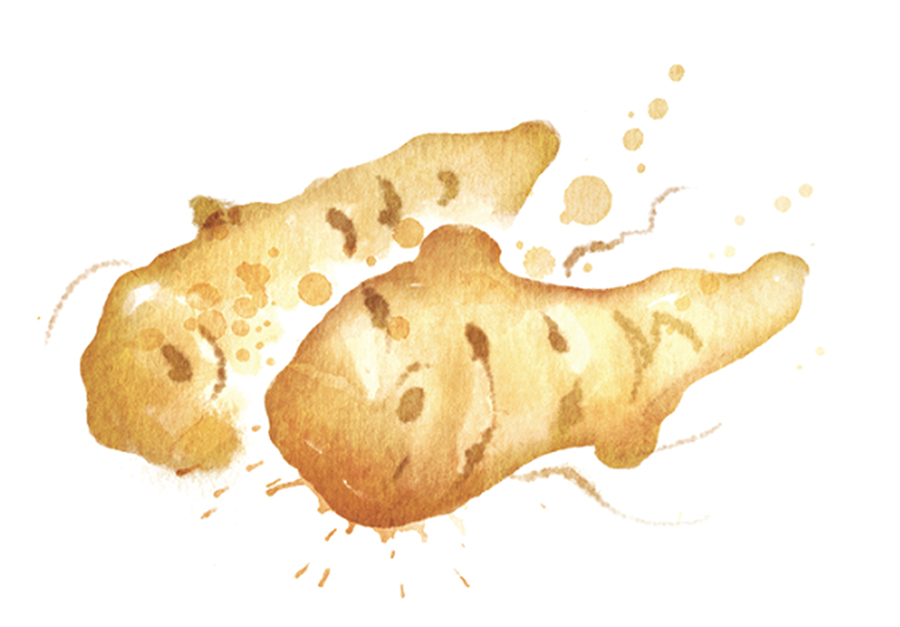
’Tis the season for Jerusalem artichokes, which are not, in fact, from The Holy City. Nor are they artichokes. These tasty tubers, also known as sunroots, sunchokes, wild sunflowers and earth apples, were first cultivated by indigenous peoples. When Italian settlers discovered this yellow-flowering plant, they dubbed it girasole, the Italian word for sunflower. The blossoms do look a bit like sunflowers, but they are actually more like daisies. Anyway, “girasole” became “Jerusalem” over time. You know how it goes.

Assuming the ground isn’t frozen, the tubers can be harvested all winter. Then what?

Scrub them, slice them and toss them with oil and spices.

Roast them until tender. Sauté them with garlic. Pan-fry them with butter and sage. You’ll figure it out.

A root by any other name would taste as savory and sweet.   PS

Simple Life

Miss Jan for Christmas

By Jim Dodson

As she eats her Sunday morning breakfast, Miss Jan looks across the table at me and cheerfully remarks, “You look very nice. Why are you so dressed up?”

As usual, I have a silly answer ready. 

“Actually, Jan, I’m planning to address Congress today. I’m proposing a constitutional amendment promoting universal kindness and the importance of using proper turn signals in traffic. Thought I should look my best.”

She laughs. “Good for you! I hope they listen!”

In fact, Wendy and I are just heading off to church. But this is a kind of game I play when Miss Jan comes to our house on weekends.

During the week, a lovely caregiver named Waletta looks after her needs at the independent senior living facility where Miss Jan lives, while her daughter, my busy wife, brings her groceries and takes her mom out to lunch at least once a week. She’s incredibly chatty with the waiters and a bit of an old flirt. Miss Jan is, too.

Every day is like Christmas when Miss Jan — as her art students called her — comes to our house. She eats her favorite foods, drinks a little wine, plays with Gracie, the dog, clips beautiful things out of magazines for her scrapbooks, and watches Love It or List It. As her world narrows down, she takes genuine pleasure in the smallest of things.

“I love bacon,” she declares that same Sunday morning. “And eggs, too. They are my favorite foods.”

I knew what was coming next. She tells me how, when she was a little girl growing up on a farm in rural Connecticut, her mother would make bacon and eggs gathered from the farm’s henhouse every Sunday morning. How Jack, the hired man, would sit at one end of the table, her father, the architect, at the other, and Mike, the dog, between, waiting for scraps to fall. She even slips into the stern Irish voice of her mother, admonishing her daughters not to feed Mike. For it is a sin in the eyes of the Almighty to waste food.

I’ve heard this sweet story probably a hundred times over the past five or six years.

“I like that tie you’re wearing,” she declares next, buttering her biscuit. “Where did you get that?”

It came from a clothing shop in Edinburgh, Scotland, I explain, a Sinclair hunting tartan necktie I purchased for my daughter Maggie’s recent wedding.

Miss Jan beams, speaking in exclamation points. “That’s wonderful news! When did she get married?”

“Two weeks ago yesterday. Up in Maine.”

“Oh,” she sighs, “I love Maine. It’s my favorite place. We lived on the water.”

“I know. You and Bill had a very nice life there.”

This prompts her to tell me about their cottage on the water in Harpswell, where they watched boats come and go all day, and the harbor lights at night; about the little kids she taught about the importance of art; about the clear starry nights come winter. This opens the door to other memories. She tells me about the trips to Europe she took with Bill — to England, Germany and Switzerland; her favorite sights; the colorful characters they met.

“Switzerland was my favorite place.”

“How about Swiss chocolate?”

“Oh, I love Swiss chocolate. It’s my favorite!” She says this with an impish grin, like a little girl sneaking a piece from the cupboard.

She tells me more about Bill, who I knew for more than two decades. “He was quite a dancer, you know. He played the accordion beautifully. The girls loved hearing him play.”

Memories are like summer’s fireflies. They carry us through the darkness, but vanish too soon. She chuckles like Chaucer’s Wife of Bath. “I like you. You’re a really good guy. You make me laugh.”

“Just doing my job, ma’am.”

Not long ago, Miss Jan asked her daughter, “So who’s that funny man who stays in your house?” Perhaps she thought I was Jack, the hired man.

“That’s Jim, mom. We’ve been married 21 years.”

“Oh, right,” she said with a good Irish laugh. “I forgot. I really like him. He makes me laugh.”

According to the CDC, about 5.8 million people in the United States have Alzheimer’s disease or some form of related dementia, including 5.6 million aged 65 and older, and about 200,000 under age 65.

Miss Jan is 84. Save for when she grumbles about having to take a shower and wash her hair — my wife’s weekly ordeal — she seems remarkably happy, even a bit of a cheerful con artist. At dinner parties she will listen intently before nimbly joining the table’s flow of conversation, for the moment sounding like the wise, compassionate, opinionated and highly intelligent mother and social activist she was most of her life.

True, every year her boat seems to drift a little farther from the shore. But for now, at least, she seems to be holding her own, defying the outgoing tide, happy as a kid on Christmas morning on days when she’s with us.

Perhaps I cherish such days because they remind me how fleeting this life is, how short the time we are given. Miss Jan also reminds me of my own sweet Southern mother and her cheerful dance with this silent, insidious disease. She, too, was what I call a “happy forgetter.”

After my dad’s passing in 1996, I brought her and her half-blind yellow lab, Molly, to live with us in Maine. She delighted in the fiery leaves of autumn and the deep snows of winter. She loved our big, crackling fire and the sight of the herd of white-tail deer I faithfully fed at the edge of the forest on frigid nights.

When her memory began to fail, we moved her to a fine independent living facility where she became the belle of the ball, squired around by a celebrated Episcopal bishop who’d marched across the bridge in Selma with M.L. King Jr.

One summer afternoon I drove her out to the seaside restaurant where she and my father always ate when they came to Maine to see their grandbabies.

As we sat drinking wine, she told me about the day she met my father, remembered their first date and commented that I laughed just like him.

“I sure miss him,” I admitted. “I bet you do, too.” He’d been gone for five years.

She sipped her wine and smiled. “You have no idea, sugar. But don’t worry. I’ll see him very soon.”

She sounded so sure. Two days later, she suffered a stroke and peacefully slipped away.

I have no idea how long Miss Jan will be with us. With our four kids grown up and scattered to the winds, it will probably just be the three of us again this Christmas. Five, counting the dog and cat whose names she can’t remember.

But having Miss Jan for Christmas will be perfect. She says it’s her favorite holiday ever. We have that in common.

Plus, I can always make her laugh.  PS

Jim Dodson can be reached at jwdauthor@gmail.com.

Story of a House

Touch of the Orient

Aberdeen’s John W. Graham House
is a colorful work of art

By Ashley Walshe     Photographs by John Gessner

Christmas Styling by Hollyfield Design


In the late 1990s, Bart Boudreaux was living in Beijing, China, with his wife, Lynel, when a friend invited him to visit Pinehurst.

“It was a lot different back then,” says Boudreaux, a Louisiana native whose work in the oil business had taken him all over the globe. “Very quiet, calm. Not much traffic. That’s what we were looking for . . . especially coming from China.”

Of course, the world-class golf was part of the draw. “Unmatched,” says Boudreaux.

Life in Pinehurst became the pin on the narrowing horizon. In 2012, the couple bought and restored one of the 1895 James Walker Tufts cottages (The Woodbine) in Old Town Pinehurst, where the couple have lived since Bart’s retirement in 2015.

But this isn’t a story about that house, nor is it a story about Pinehurst. Ultimately, this is a marriage story. It begins with one man’s love of old houses.

“I can’t explain it,” says Boudreaux, trying to put his passion for restoration into words. “I needed to find something to do outside of golf.”

Perhaps his time in New Orleans influenced his taste for old houses. “Not everyone’s cup of tea,” he admits.

Regardless, buying and restoring them became his accidental pastime. In addition to the Pinehurst home, Boudreaux revamped the house next door (another one of Tufts’ original 38 cottages), renovated a 1930s Sears Roebuck on Dundee Road, then flipped one, two, three more fixer-uppers, all in Pinehurst.

Which brings us to his seventh and most recent project: a 1909 Victorian in downtown Aberdeen.

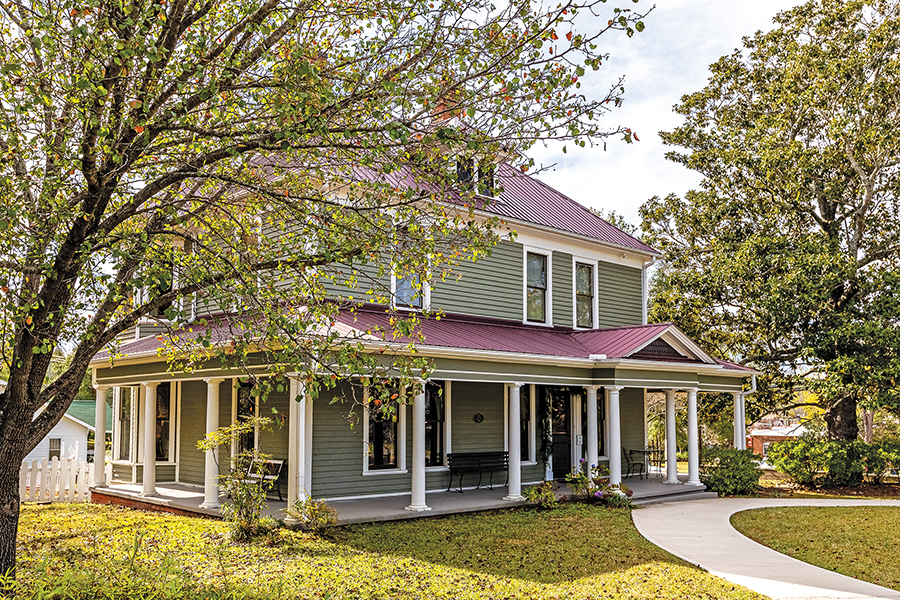
Situated on a spacious corner lot on High Street, the sage green double-pile with the classical Tuscan columns and wraparound porch once belonged to John W. Graham, son-in-law of Aberdeen and Rockfish Railroad founder John Blue. The exterior is grand yet understated, with an air of timelessness and restraint typical of Colonial Revival architecture. Boudreaux bought the National Register property in February of 2021 and devoted one year to its transformation.

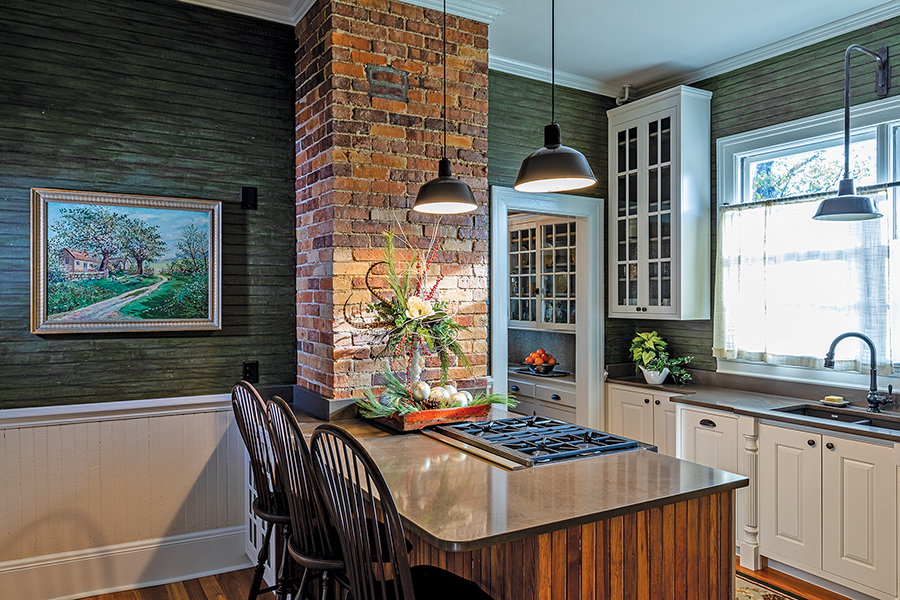
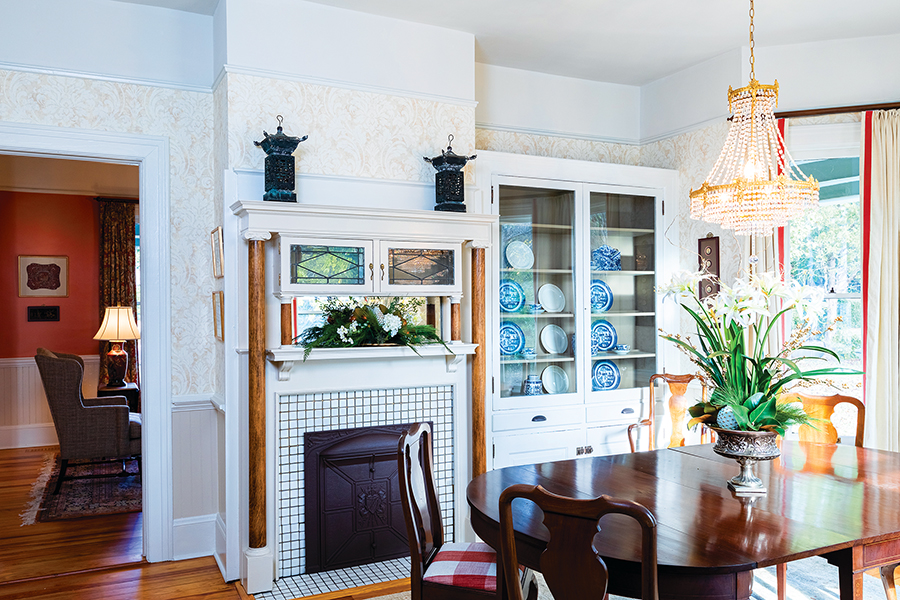
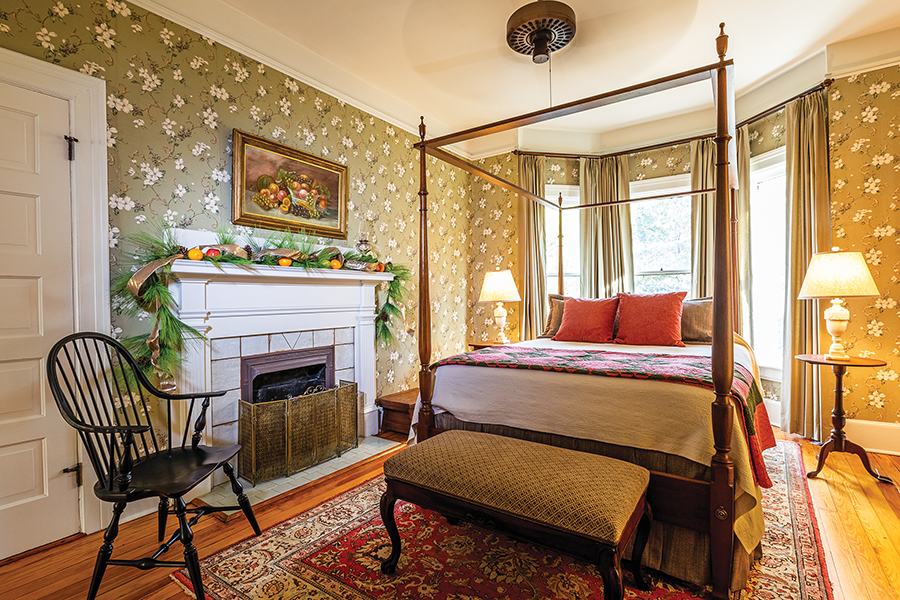
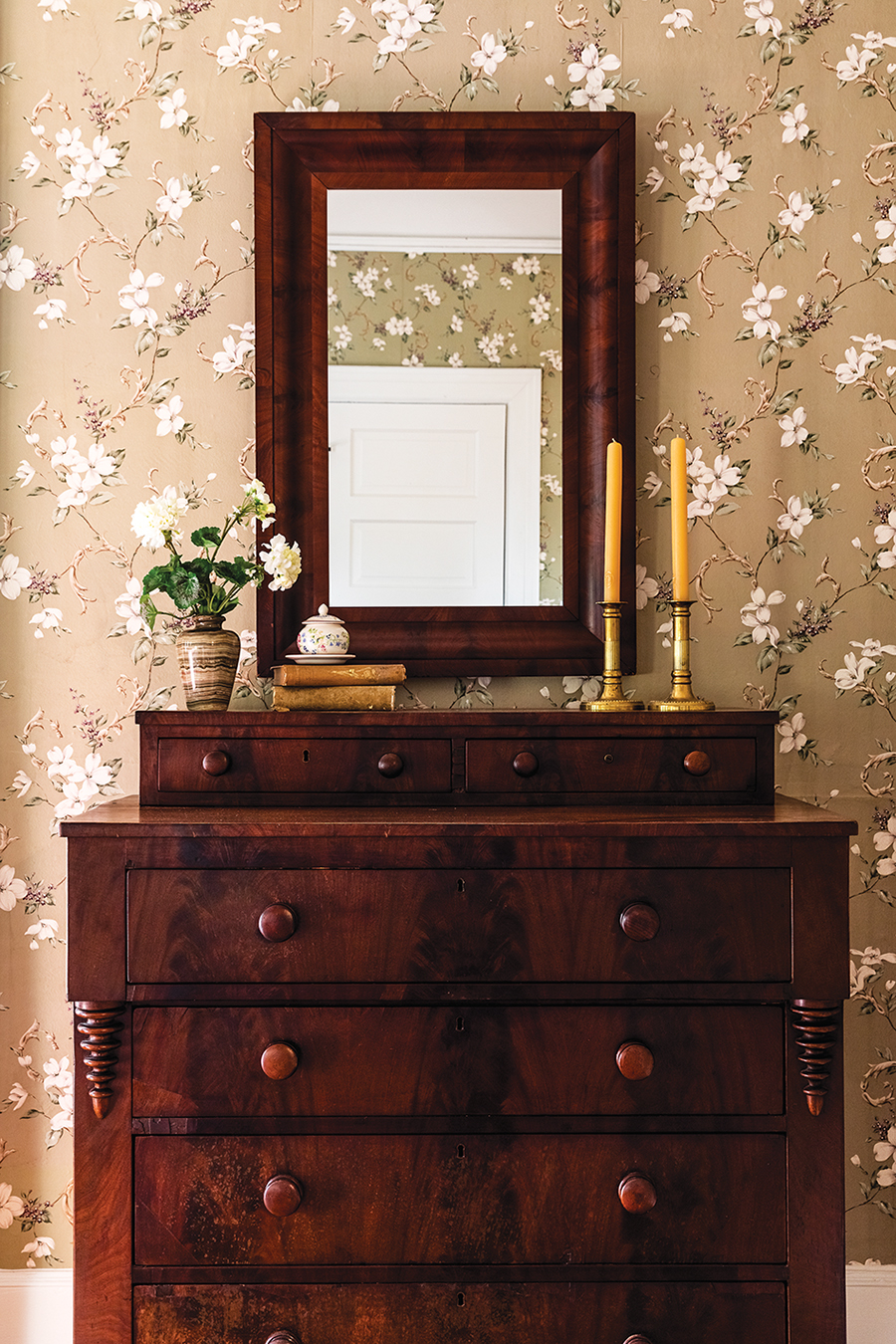
“It’s got tremendous character,” he says, noting the 10-foot ceilings and crown molding, the butler’s pantry, the two-story semi-octagonal bay, original dogwood wallpaper in one of the upstairs bedrooms, and five charming fireplaces throughout.

An original stained-glass window defines the nook beneath the half-turn staircase. Natural light floods every inch of the 2,500-square-foot space. Upstairs, transom windows above bedroom doors offer charm and function.

“I fell in love,” he says.

Heart pine flooring was repaired and restored. Old doors and tiger oak mantels, once hidden beneath layers of paint, are now among the home’s most striking features. Ditto the banister, stairs and newel caps.

“Almost killed me,” says Boudreaux of all the stripping. He did what he could himself and hired help to do the rest.


Boudreaux upgraded and reconfigured the kitchen, reintroducing an old entrance and constructing a small island with salvaged beadboard. He retiled and revamped existing baths (one full and one half); added a full bath upstairs; installed new cabinetry and quartz countertops; tinted original windows; exposed a bit of brick; updated plumbing, electrical wiring and appliances; replaced ductwork; and insulated the crawl space.

But he didn’t stop there.

Throughout the house, period-appropriate light fixtures (complete with ceiling medallions), fabric and furniture complement the architecture. 

“I just love the search for antiques,” he says, which is how he crossed paths with interior designer Jane Fairbanks of The Old Hardware Antiques in Cameron. “I know what I like. Jane’s got it.” 

Fairbanks helped Boudreaux outfit two of his Pinehurst homes in American country décor. “What he truly loves,” says the designer.

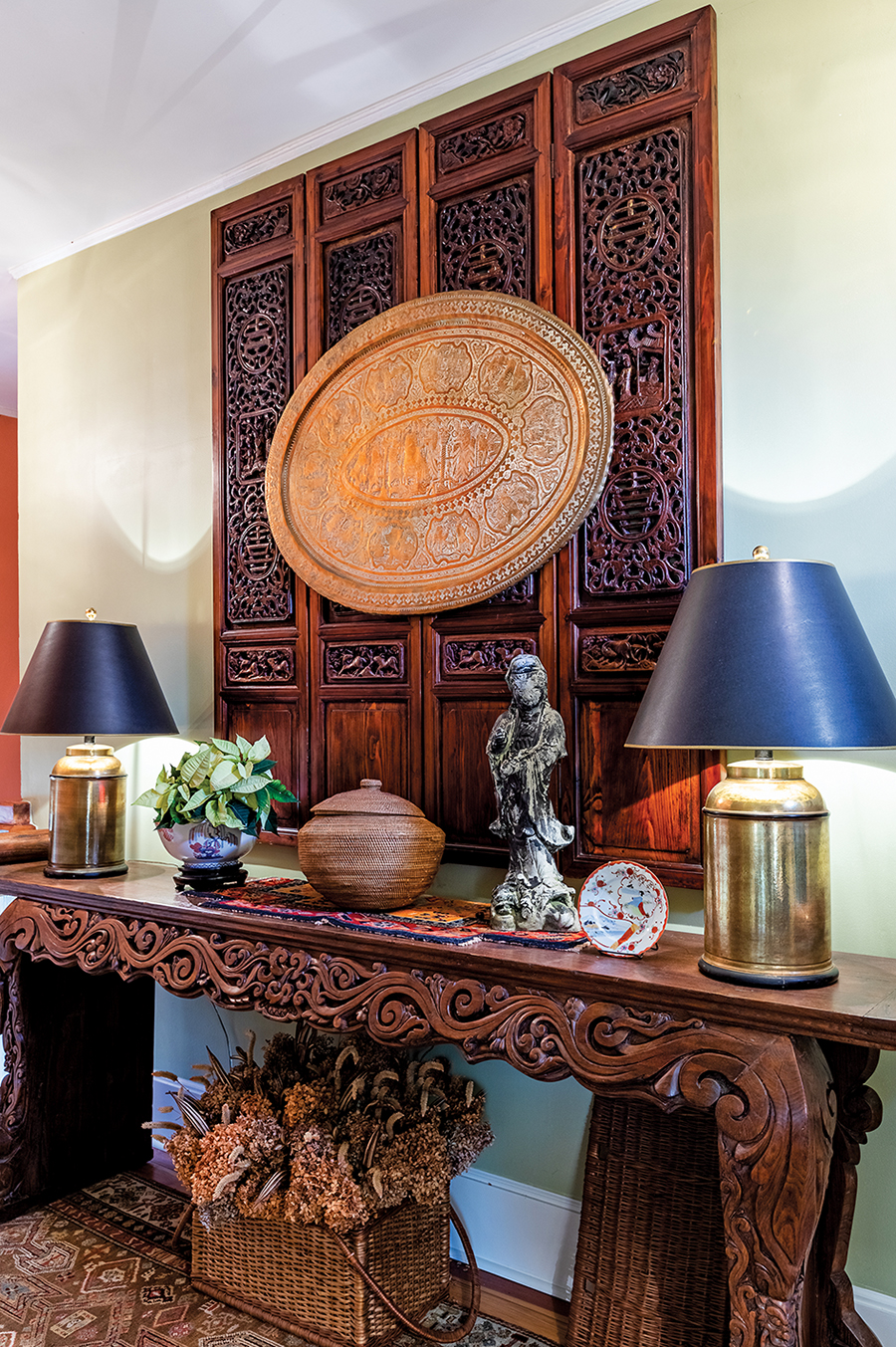
The interior of the Graham house is distinctly different. It’s an amalgam of color, texture and Victorian-era furnishings with a heavy emphasis on Oriental antiques —a marriage of tastes, his and hers. Flash back to China in the late 1990s.

“The oil company I worked for allowed us to transport one shipping container full of Chinese furniture back to the States on their nickel,” says Boudreaux.

Lynel, who worked as the assistant general manager at the Hilton Beijing, loaded up on ornate altar tables, hand-painted cabinets and intricate Chinese artwork — textiles in particular. Bart took Fairbanks to sift through the haul, in storage for over 20 years. Forgotten treasures were promptly dusted.

“They sort of became the inspiration for everything,” says Fairbanks.

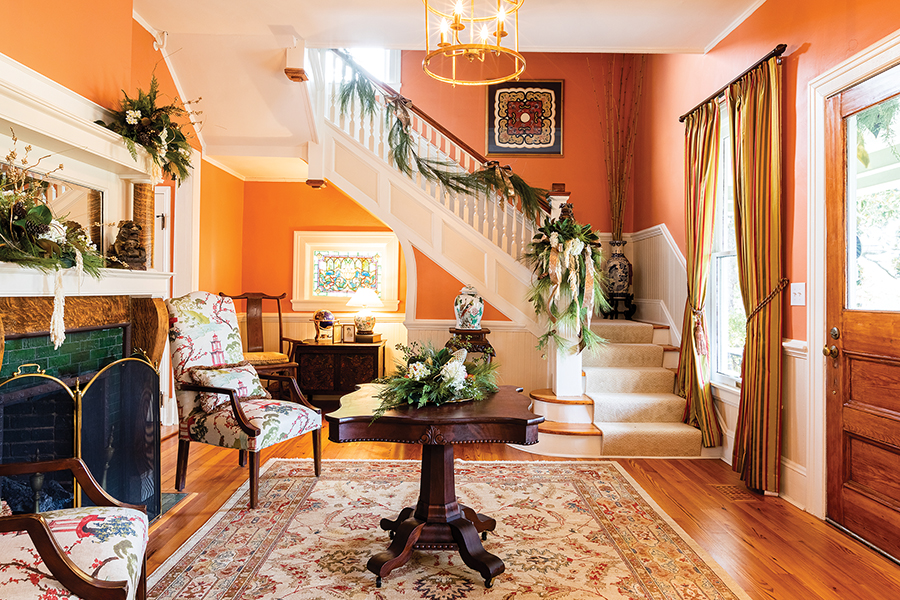
Especially the colors. In the front parlor, coral walls pop against crisp white molding and cream-colored beadboard wainscoting. A hand-embroidered silk opera collar is framed and displayed on the wall above the staircase. Asian accent chairs covered in pagoda-themed fabric flank the fireplace, and a pair of wooden foo dogs (Chinese guardian lions) draw the eye to the quarter-sawn tiger oak mantel.

Beneath the stained-glass, a hinged easel frame displays photos of original homeowners John W. Graham, a cashier and officer of the Bank of Aberdeen, and his bride, Kate Blue Graham.

One wonders what Kate might think of the vibrant paint and forbidden stitch embroidery.


Beyond yellow pine pocket doors — “massive and heavy as led,” adds Fairbanks — coral walls spill into the living room, where a silk rug and custom curtains soften the space with delicate pink hues. This is where worlds begin to collide in a surprising way: an American country cherry corner cupboard (1840s), for instance, opposite a Chinese wedding cabinet featuring traditional brass hardware and a hand-painted imperial dragon.

For Lynel, each piece has a story, like the statuette of Guan Yin (female Buddha), positioned between the living and dining rooms.

“I bought her in a Beijing dirt market from a little blind man,” Lynel recalls. The vendor assured her that the wooden figure was quite old.

“Lǎo de, lǎo de,” he repeated.

It wasn’t. The Buddha split in half a few weeks later. 

“Sounded like a gunshot,” Lynel says between bouts of laughter. “She was new, made to look old . . . but I love her anyway.”

In the upstairs hallway, a teak altar table paired with a carved wooden screen make a bold and elaborate statement. The walls? Georgian Green by Benjamin Moore.

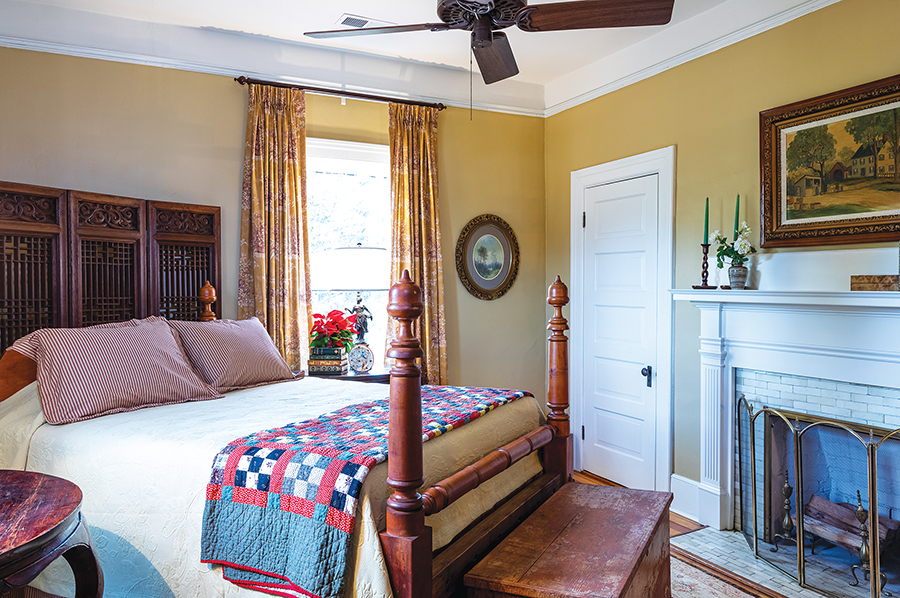
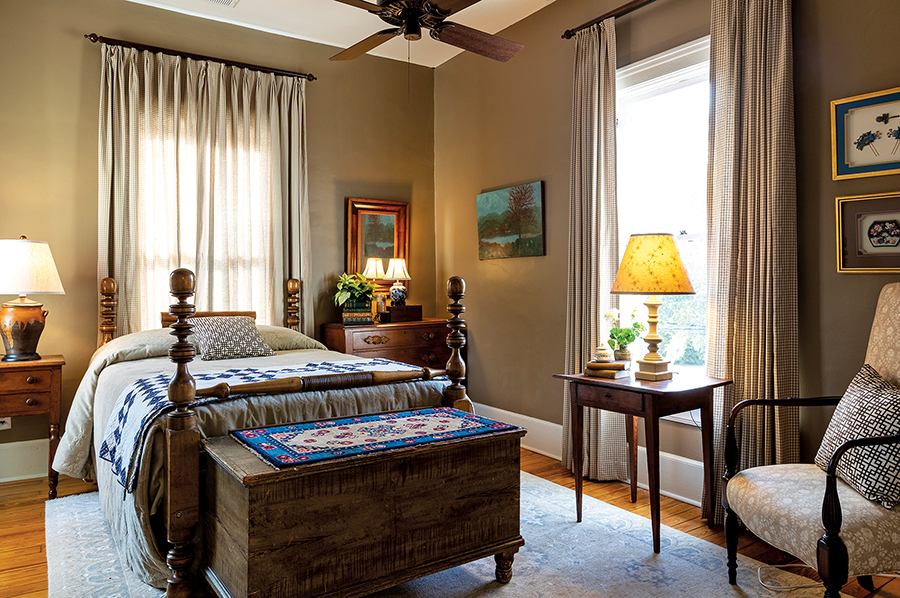
Bedrooms are handsomely outfitted. For one, an 1840s maple rope bed with curly maple headboard. A four-poster bed in another. The third features a faux curly maple queen anchored by an early 1840s blanket chest. Mounted oriental hair pins and an embroidered baby bib (and matching shoes) add color and whimsy.

“It’s just amazing how things can come from so many places and end up working so well together,” Fairbanks says.

The designer played a major role in bringing Bart’s vision for the house to life. “Big time,” he emphasizes.


All parties seem equally delighted by how it turned out. In the past, Boudreaux’s modus operandi has been to revamp and resell. But the John W. Graham house is a keeper. 

“Our Pinehurst house is on the market,” he explains.

Towns and dreams change. Bart and Lynel are moving back to Louisiana to be closer to family. The house on High Street will be their vacation home.

“Aberdeen is having a bit of a Renaissance, don’t you think?” says Lynel.

Bart’s golf clubs are there waiting. The house itself — a harmonious blend of tastes — is a labor of love ready to be enjoyed.  PS

Ashley Walshe, the former editor of O.Henry, lives up country and is dreaming up her next grand adventure. 

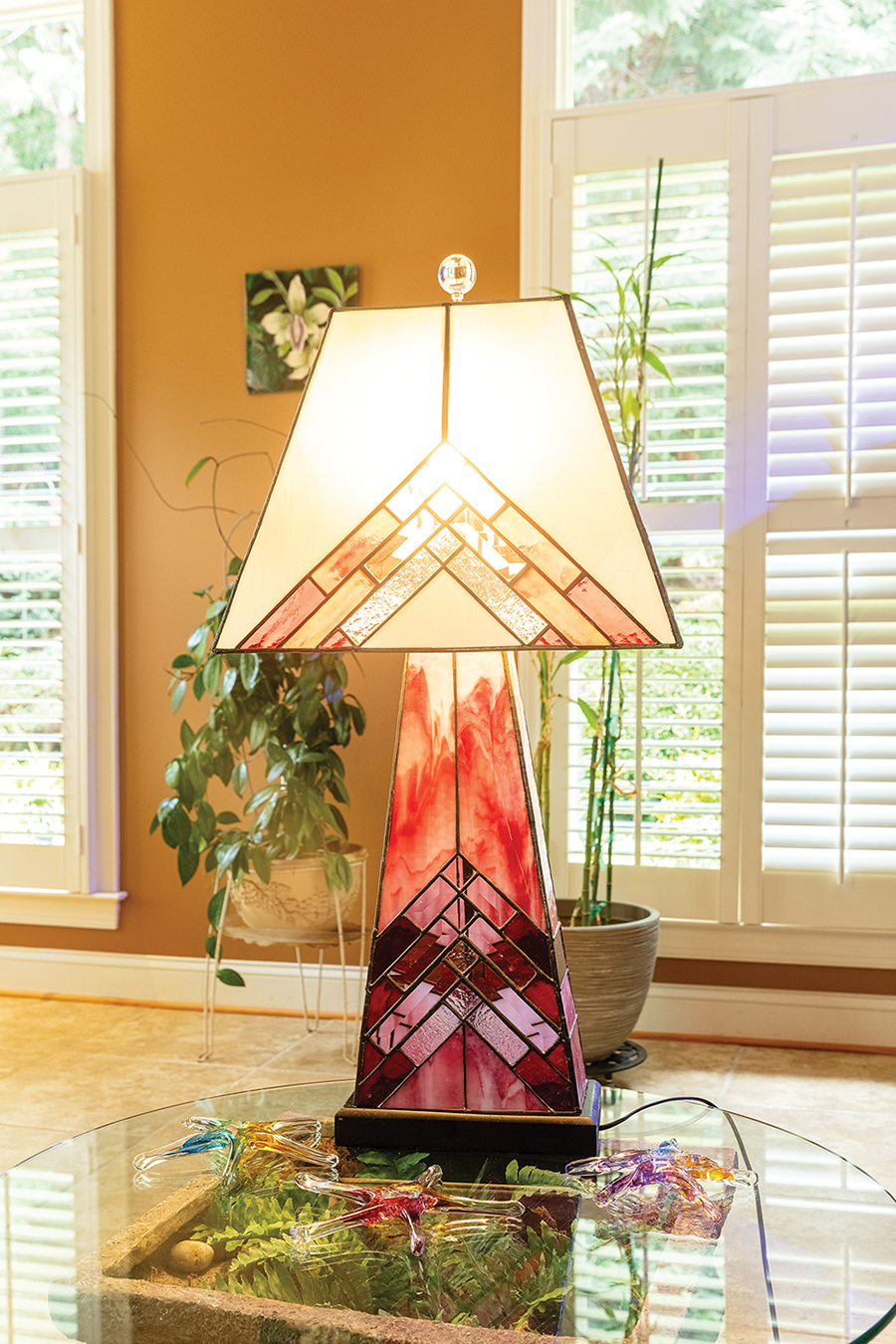
Through Rose-Colored Glass

The art of working with stained glass

By Jenna Biter

Photographs by John Gessner


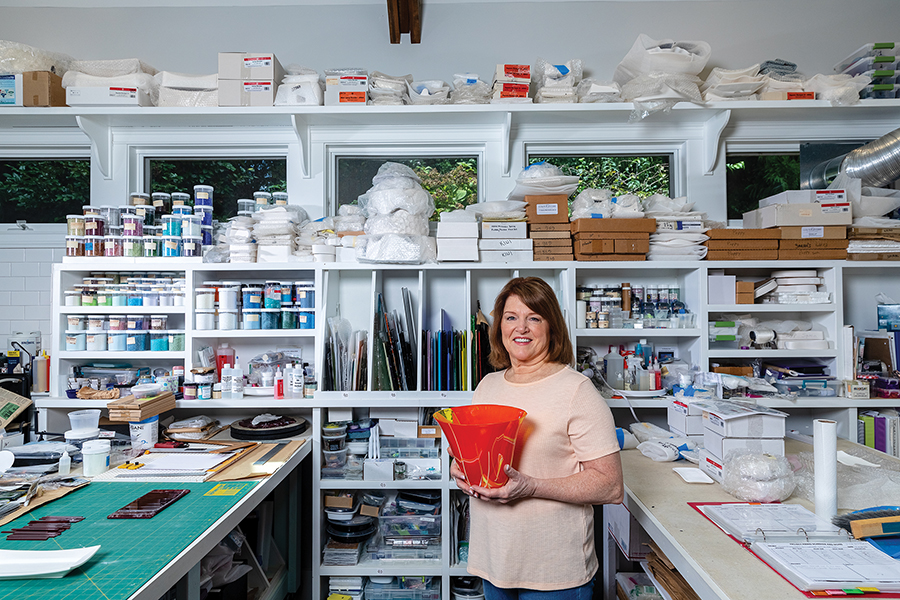
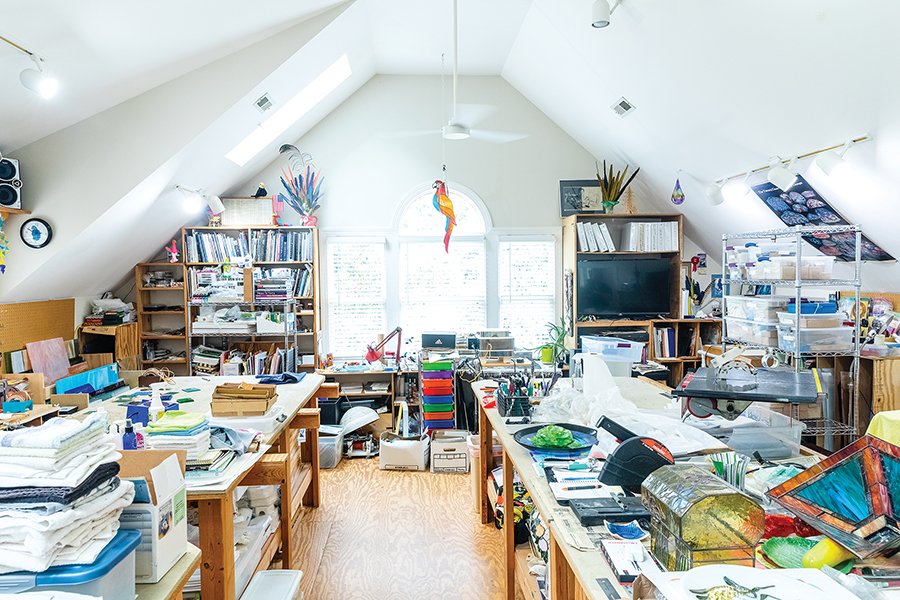
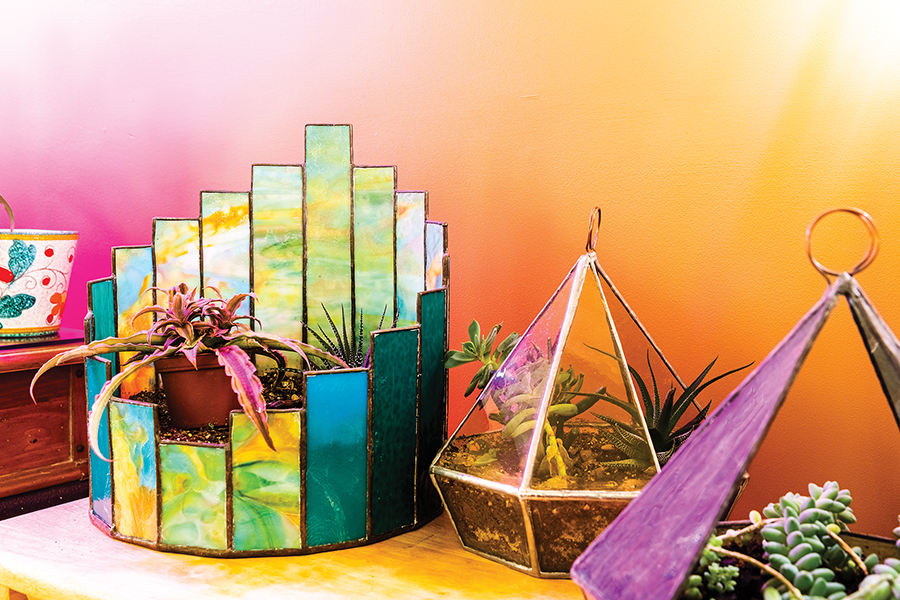
An oversized sheet of white craft paper unrolls across the worktable. “So, what I do,” Sarah Cawn says, her voice trailing off, distracted by a half-open box. “This is a big lamp I’m supposed to repair.” She lifts a cardboard flap and fingers the dome of a Tiffany-style glass shade.

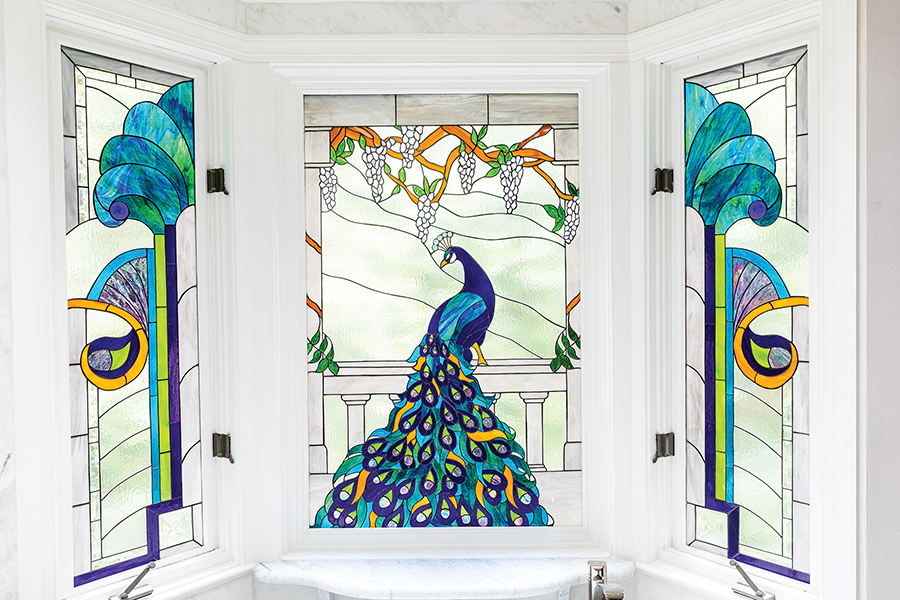
“OK,” she says, gathering herself to explain the process of making beautiful things with stained glass. “This one I just finished.” She points to a drawing on unfurled paper. The contours of wavy-edged poppies and their swan-like stems arc through rectangles configured like the eight windowpanes they represent.

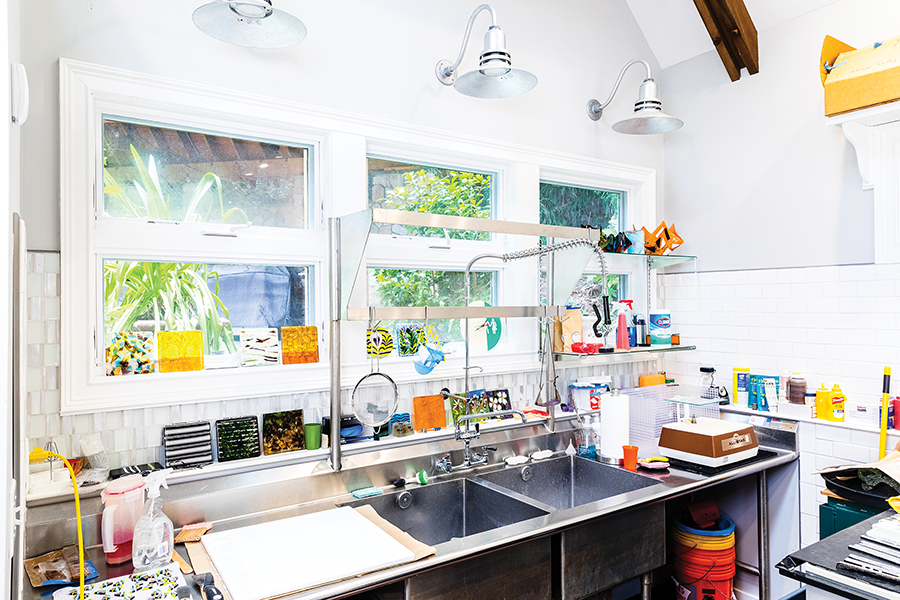
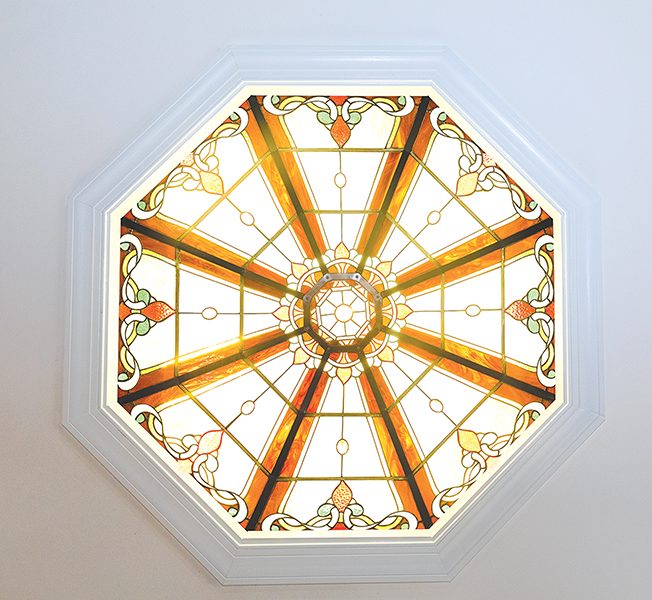
A gilded light casts itself across the drawing. Cawn points at the studio ceiling. “When we built the house, I had the builder box up the skylight so I could put that in there,” she says, her head tipped back. Above her a glass cupola of yellows and browns, trimmed in a filigree of rose and sea foam, warms the drawing below, willing it from the second dimension into the third.

Each section of the drawing, from the size of a button to the palm of a hand, whether it represents a petal, stem or sliver of background, wears a number as its name tag, all the way through 332, like a grown-up’s paint-by-number.

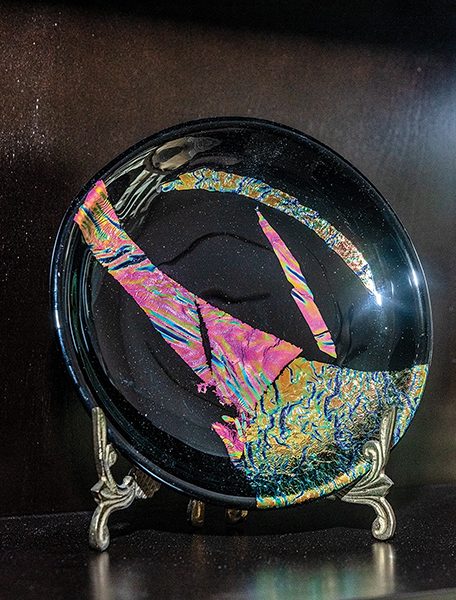
Cawn starts with the obvious. “I roll paper out and cut off as long a piece as I need.” She traces an index finger around each rectangle. “I had already drawn out the perimeters of each window, then put it up over there.” She points to a blank wall on the far side of the studio, half hidden by a table crowded with a collection of glass baubles: iridescent charms reminiscent of abalone, an amber chest overgrown with irises, a heart-shaped box, stacks of colored glass sheets, and a retro lampshade turned on its head.


She plucks the heart-shaped box from the menagerie like a client perusing the wares at a fine arts bazaar. “This is something that I inherited from somebody that got out of the business,” she says, holding the red vessel up to the light. “I thought if I fixed it, maybe I could — I don’t know.” Cawn turns the box over in her hand and inspects the soldering. She wrinkles her nose.

“It looks kinds of crummy, though. I don’t really want to sell it, so I probably should just junk it.” She sets the box down. “I just don’t feel right about selling something that isn’t mine.”

Cawn thumbs through colored glass sheets as if they’re playing cards, and she’s searching for the right one to start building a hand. Clack, clack. Each glass sheet is a different color, striated like the hard insides of a geode. Clack. There are emeralds and milky jades, electric blues and smoky blacks. One sheet is a galaxy of amethyst and mulberry; another swirls angrily like the eye of Jupiter, but in the soft nudes of a conch shell’s aperture.

“I thought it would be fun if I put them together like a patchwork and make cool wall hangings,” she rearranges the pieces like they’re quilt squares, thinking out loud,  “if I do the colors right.”


A scarlet macaw perched at the opposite end of the studio stares past Cawn at the half-hidden wall. The bird isn’t real — Cawn made it of glass — but it occupies the space of a live macaw, giving the impression, from the periphery, that it might squawk in its own colorful language.

She points back to the wall where she has tacked up the paper and penciled in the poppy design. “I’m going to be honest now, for the poppies — I do have an overhead.” She describes adjusting the projector until the blooms cast onto the paper create a convincing field of flowers, then she traces the pencil lines with black marker to finalize the design.

Cawn began making stained glass 40 years ago, give or take, at a Maryland shop (whose name she can’t remember and which has since closed) and has, ever since, been polishing her process as if it was, itself, a panel of stained glass.

“For me, it was like a drug,” she says with a shrug. “My husband made me a little workbench down in the basement and, at 10 o’clock at night, he’d go, ‘Are you coming to bed?’”

Through their moves to California, then throughout the Research Triangle in North Carolina, Cawn packed up her glass and tools — marked with a band of cheetah-print tape — and taken her craft with her.

In San Ramon, California, her studio was half the garage. “In the wintertime, I’d have to keep the big glass pieces in the house, so they’d be warm,” she says, explaining that glass can shatter when its temperature rapidly rises or falls.

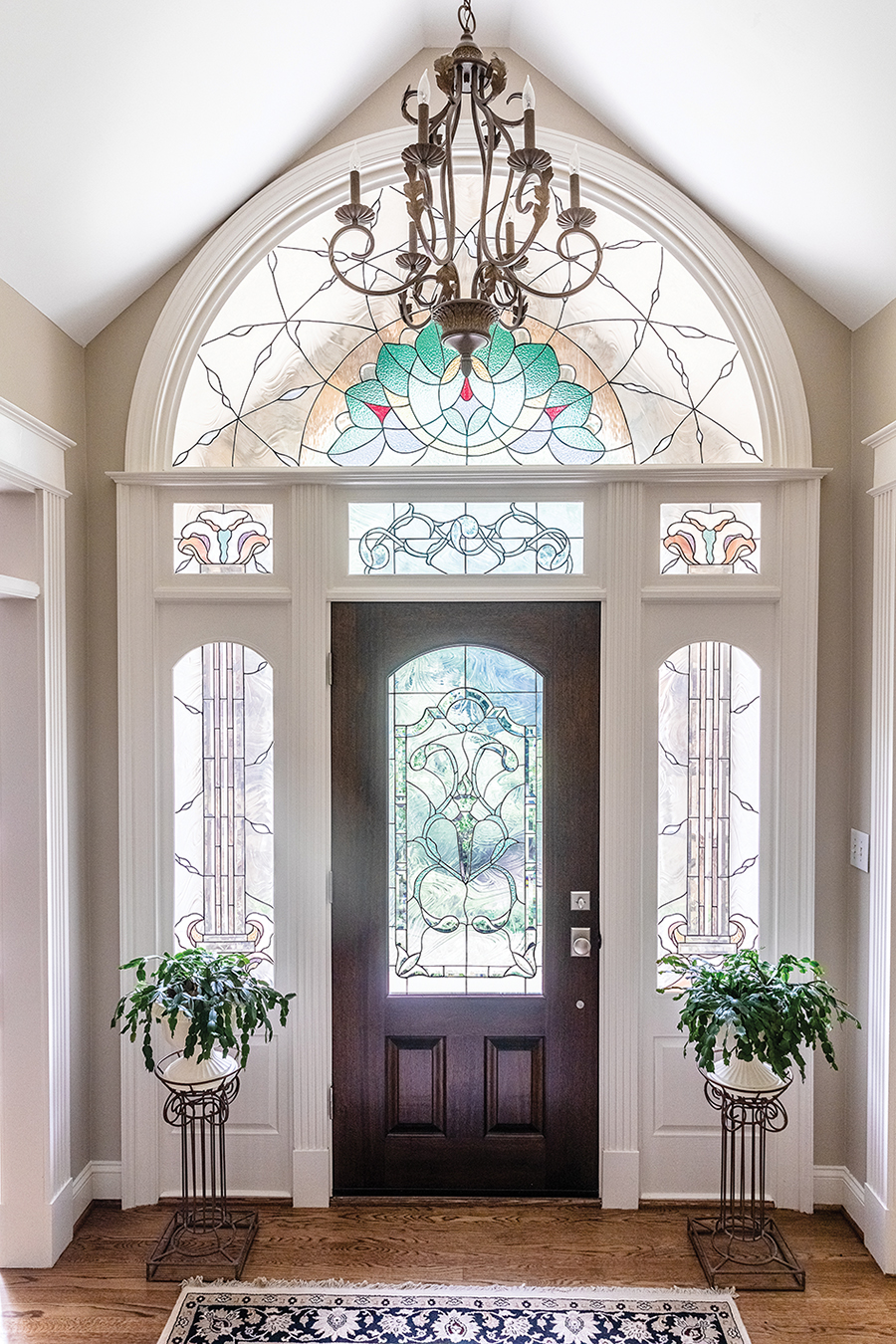
When the Cawns moved to Cary in the early ’90s, Sarah got her first real studio, but it was on the third floor. She crosses her eyes and groans, “Ughhhhhh,” imagining herself carrying sheets of heavy glass up three flights of stairs. They built their current house, a stone hideaway tucked into the woods just outside of downtown Raleigh, in 1996, and Cawn’s studio is a bonus room above, not in, the garage. An arched windowpane of wispy lines and pastel orbs over the front door welcomes guests into their home and silently announces the workshop upstairs.

“It started here,” Cawn says of her business, Sarah’s Glass Art, taking off. “In the ’90s everybody wanted stained-glass windows above their bathtub or around their door.” She grins sheepishly. “If I was lucky, they did both.”

Stained glass, and the inspiration for it, infuses the property like a visual perfume. Outside, in the backyard, tangerine, fiery red and pale pink koi glint like glass shards in the afternoon sun as they circle an ornamental pond. One fish resembling a golden dragon, with his trailing whiskers and billowing fins, swims near the surface, as if it were a water-bound Icarus waiting to be immortalized in glass like the scarlet macaw.

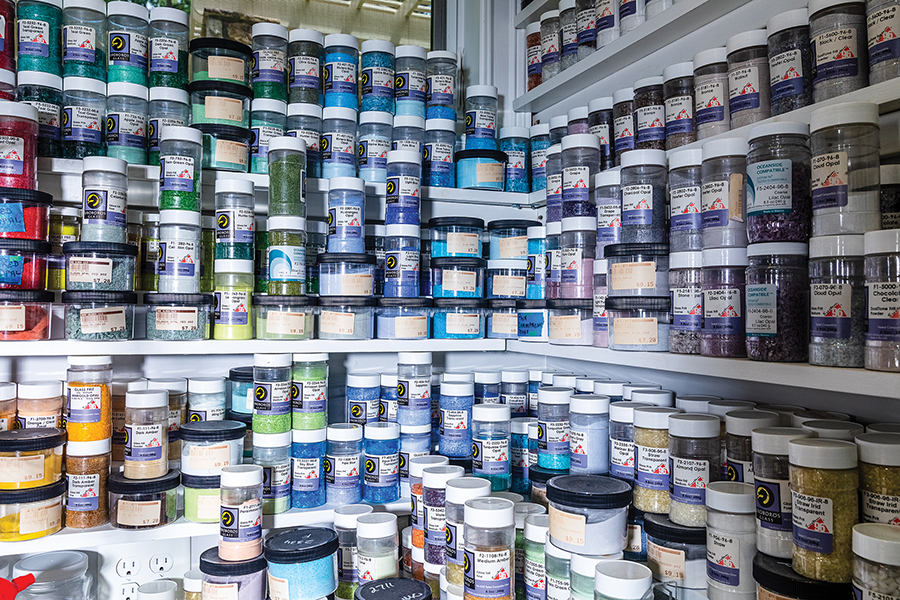
Later, the Cawns built a second studio, this one detached from the house, where Sarah makes fused glass, a craft she picked up two decades ago. It’s also where she teaches students to work with stained glass, something she started last year.

With the poppy pattern complete, Cawn traces a copy. “Some people take it to Kinkos, or some place that will copy it, but I don’t know how accurate that will be, so I’ve just never done that,” she says. “And I know, I’ve been told, ‘You’d save yourself a lot of time.’” She waggles an index finger. But why fix what’s not broken?

Keeping the original pattern as a template, she fits a jig — a device reminiscent of a picture frame — around the drawn windowpanes and fixes the jig to the worktable. It is the stage where all the pieces will come together. “Nothing’s going to turn out square if you don’t put a border around it,” she says. “If it’s not square, it will look like crap.”

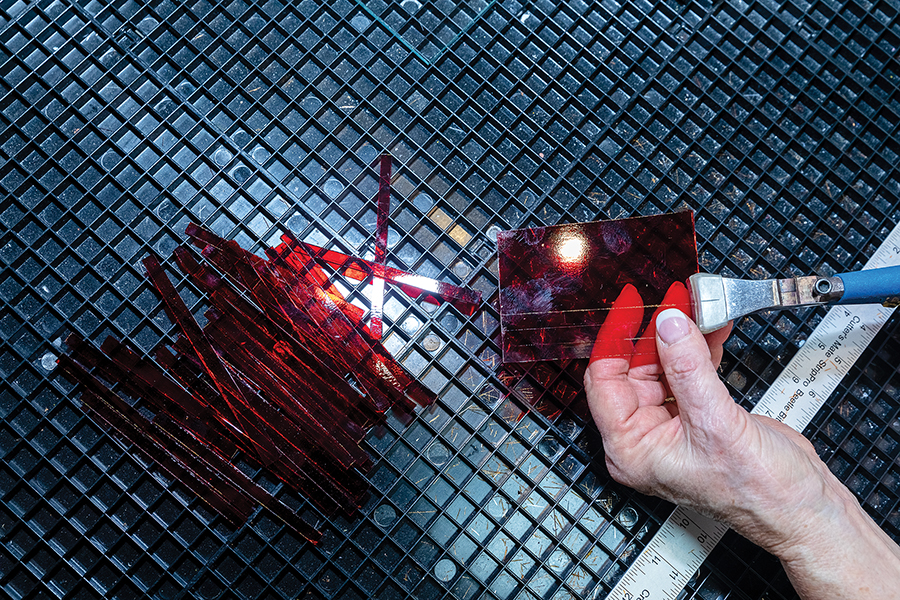
Cawn cuts apart the copied pattern so she can trace each piece of the design onto glass (black marker on light colors and silver marker on darks), then she cuts the glass itself. To demonstrate, she pretends to trace a shape onto a spare sheet of emerald glass, the color she used for the poppy stems.


Cawn looks up as a schnauzer tears around the corner into the studio, nails clacking against the hardwood floor, legs spinning out. “She’s not really cute because she’s shaved now,” says Cawn, apologizing for Schatzi’s shorn summer coat. She reaches down to pat the gray head. “She’s gotten really finicky, so I say, ‘Just shave her. It’s not a fashion show.’” The 13-year-old dog wiggles her stubby tail, then retreats to a plush bed in the corner.

“OK, they’re all cut out, and they all fit nicely,” Cawn says, back behind the worktable. She pulls out a spool of copper foil tape and demonstrates lining the edges of cut glass. “You do this all the way around the glass, and you overlap it by a 1/4 inch at the end.”

Cawn smooths the foil, so the entire edge is neatly covered, and a thin line of copper shows on the face and back sides of the glass. The dark patina of the copper will give the stained glass its signature edge. “You do this on all your pieces,” Cawn says. In this case, all 332.

Soldering comes next, then the patina, then a wax and polish to shine the panel. “You take your wax, shake it, pour a little on, wipe it all over, let it dry, and then you buff it with a rag, and you’re done.” She tosses a rag on the table.

“I used to hate waxing and polishing, but it’s such an important part. It’s the finishing touch, and they go, ‘Ohhhhhhh.’” Cawn puts her hands to her cheeks and opens her mouth, mimicking happy customers and, in a way, herself. “To me, there’s just a magical quality about glass.”  PS

Shop for Sarah Cawn’s glass art at One of a Kind Gallery, in Pinehurst.


Jenna Biter is a writer and military wife in the Sandhills. She can be reached at jennabiter@protonmail.com.

The Omnivorous Reader

Cozy Up

A mellow mystery on the Outer Banks

By Anne Blythe

Smile Beach may be a fictional spot on the imaginary Cattail Island, but in Smile Beach Murder, cozy mystery writer Alicia Bessette captures the real spirit of the Outer Banks, where the residents have a strong and often quirky sense of self-reliance and, at the same time, a profound need for community.

That connection is built around such places as the MotherVine Bookshop, Meek’s hardware store, the Cattail Crier office, the old lighthouse and inside the island natives’ homes, where the “inlanders” are referred to as dingbatters.

“Cattail Island is known for its beaches,” Bessette writes in the voice of her narrator. “The eastside ones evoke the covers of summer escape novels — windswept dunes sloping in fine sands, and beyond, the vast Atlantic. The westside beaches, including Smile Beach, feature the shallow, gentle waves of the Pamlico Sound. Unless of course there’s a storm.”

Callie Padgett, the protagonist, is a 38-year-old reporter freshly laid off from the Charlotte Times caught up in a storm of her own who has returned home to live with her uncle while she searches for another journalism job. She quickly gets swept up in a mystery when Eva Meeks, a beguiling eccentric whose family owns the local hardware store, is found lifeless at the base of the Cattail Lighthouse. Local police and others quickly label the death a suicide.

Callie is not convinced and begins her own sleuthing as a reporter hungry for a good story. We soon learn that Callie’s mother was found dead at the bottom of the same lighthouse 26 years earlier, an incident that prompted her to flee the island as soon as she was old enough.

Now she is back.

The feelings she has tried to bury for so many years resurface in a mystery about coming home, finding roots and finally getting to a place where they bring pride and allow for reinvention of oneself.

Cozy mysteries are a sub-genre of crime fiction that leave out the violence, darkness and sex that often accompany more hard-boiled whodunits. Always fast-paced, and sometimes lighthearted, they put readers in working detective mode trying to solve the pending conundrum alongside the protagonist.

In Smile Beach Murder, the launch of the Outer Banks Bookshop Mystery series, Callie vows to Summer, the 12-year-old daughter of Eva Meeks, that she will leave no clue unturned as she explores old haunts and new twists in this summertime narrative.

Bessette, a former newspaper reporter, poet and pianist who moved to the Outer Banks with her husband and fellow author Matthew Quick, gives a nod to mystery writers such as Mary Higgins Clark by having her protagonist work at the MotherVine Bookshop. The poetry and music come out in Bessette’s writing.

When Callie bangs on the door of a papered-up old storefront not far from the MotherVine, and encounters Toby Dodge, a former physical education teacher who moved to the island to open the Cattail Family Martial Arts School, Bessette writes: “His voice was musical, like if an upright bass could speak.” Elsewhere she writes, “Outside dusk leaked from the sky, pewter dripping into apricot . . . “

Bessette captures the sense of the Outer Banks from the very beginning of the book. “This barrier island, nine miles long, is shaped like a cattail, whip thin except for the wide part, three miles across,” she writes. “The wide part’s where most of the dwellings are, bungalow-style rental cottages and modest cedar-shake stilt homes. The southern end of Cattail Island curves slightly westward, allowing a glimpse of the lighthouse even from where I sit in the Elder Tree.”

Whether we’re with Callie on the thick and all-knowing Spanish-moss-draped branches of the Elder Tree or on madcap adventures and treasure hunts, we smell the maritime forests, peer into the waters below the rickety fishing pier and get to know Cattail Island’s cast of flawed but lovable characters.

It’s easy to embrace Uncle Hudson, Ronnie and Antoinette, the bookstore owner — all members of a group that had adventures together in the Old Farts Van, a vehicle Hudson fixed up himself when he was a young surfer. Tin Man, the bookstore cat, is Insta-famous with a delightful Instagram account the whole town seems to follow.

We cheer Callie on as she climbs over the sharp, iron-speared gate to dig into the story that Pearleen, the wealthy woman in the mansion beyond the gate, and her dutiful nephew Whitman have kept to themselves for years. Indeed, she leads us to a big breakthrough — a reveal that truly is a surprise ending.

There are times when Callie breaks into buildings and ignores boundaries that typically would not be crossed by journalists. Then again, without her making quick assumptions, pushing boundaries and beating the police to the answer of whether the Cattail Lighthouse is cursed, we would lose access to an alluring mystery that keeps us hunting for answers to the very end.   PS

Anne Blythe has been a reporter in North Carolina for more than three decades. She has covered city halls, higher education, the courts, crime, hurricanes, ice storms, droughts, floods, college sports, health care and many wonderful characters who make this state such an interesting place.

Art of the State

Building Community

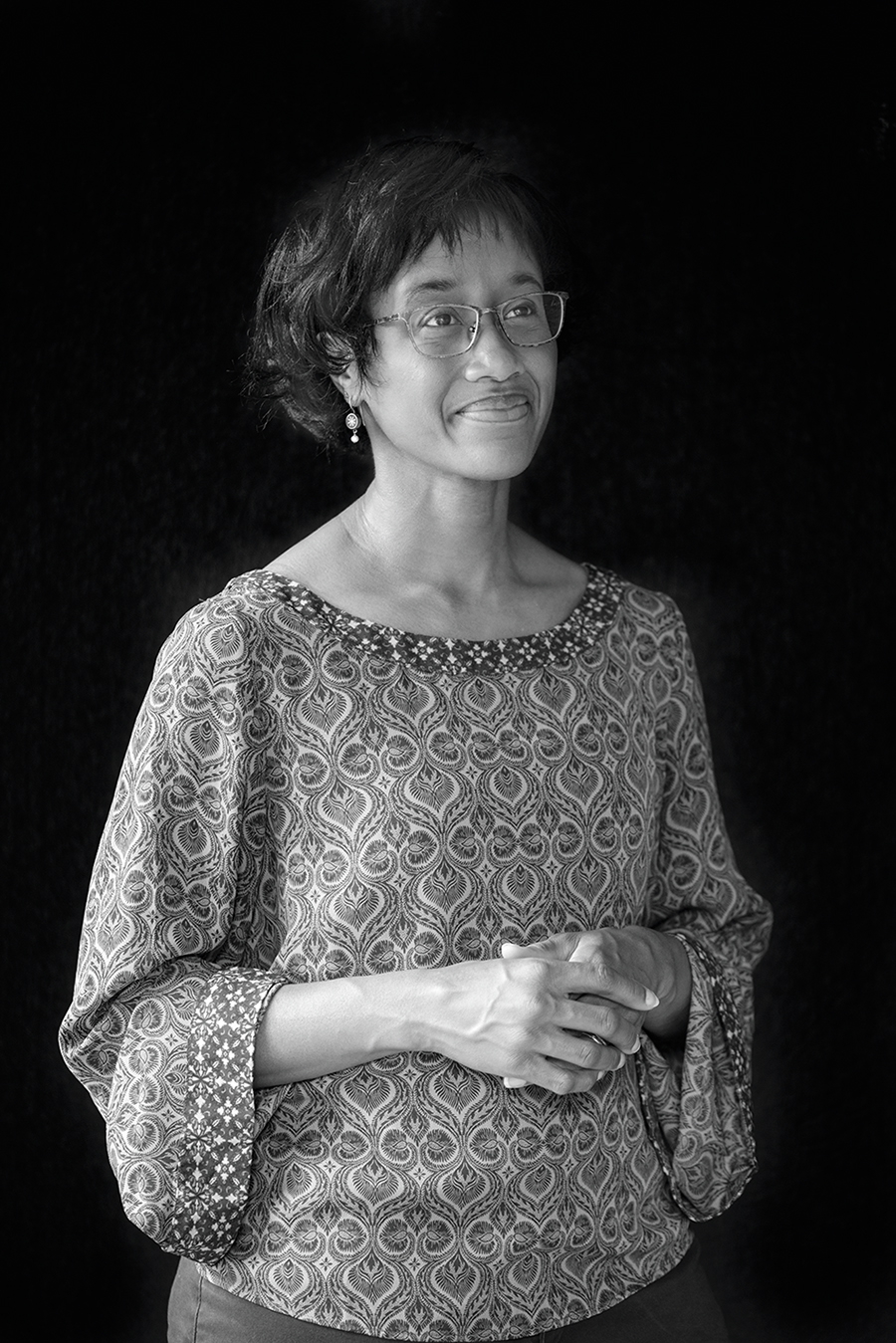
An artist and teacher, September Krueger finds connections through her practice

By Liza Roberts

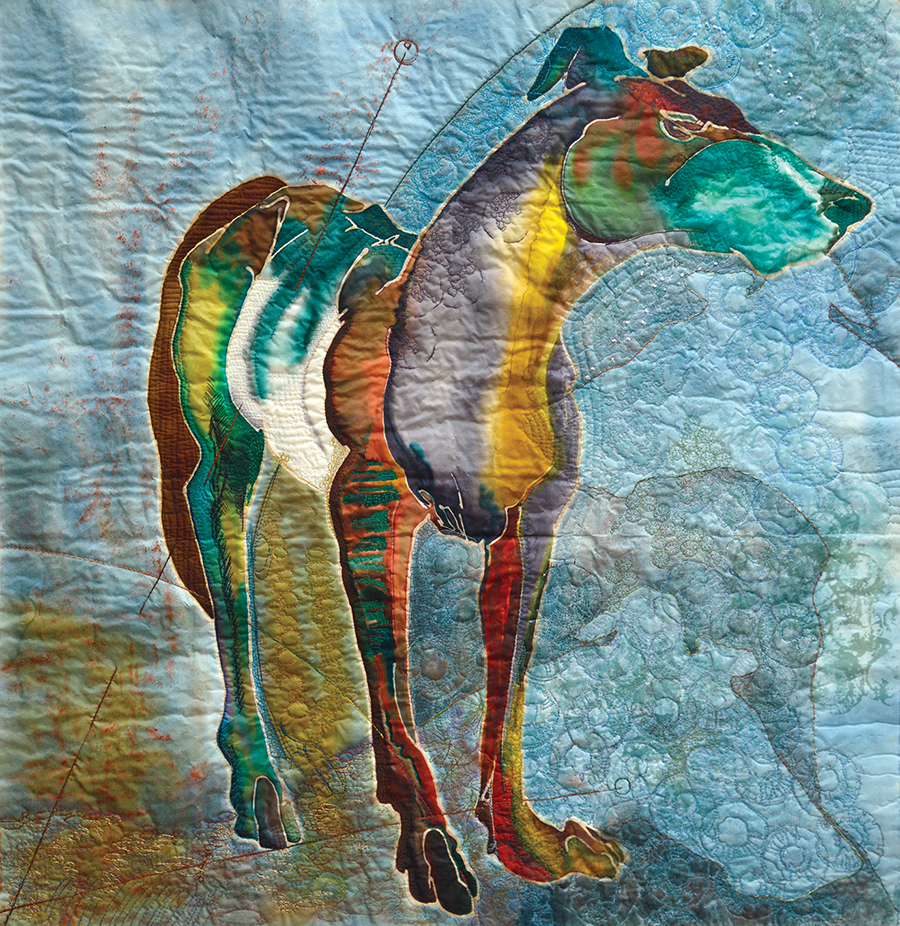
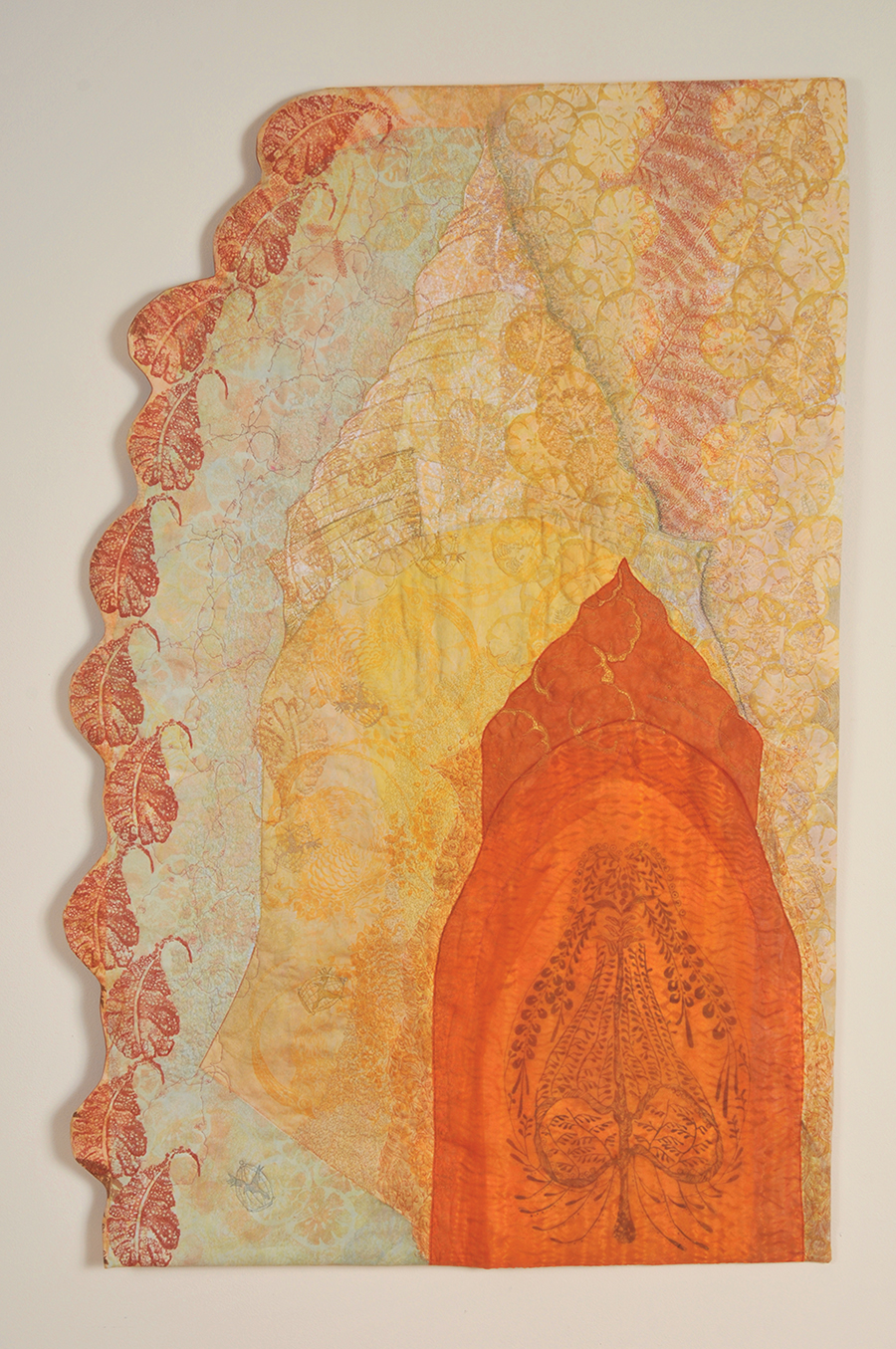
September Krueger’s intricate quilts and silk paintings use subtle, watery colors, delicate stitching, layered images and the unexpected juxtaposition of organic and designed shapes and lines. They honor the natural world: birds and plants, and the environments they share. And they are the work of an artist with a deep appreciation for her subject and her medium.

From an early age, Krueger loved to draw. She studied textiles as an undergraduate in Philadelphia with the idea of becoming a fashion designer, but her graduate work at East Carolina University between 2007 and 2010 opened her eyes to the potential of textiles as an artistic medium, inspiring her to “develop layers of information on woven cloth.”

Her 77th Year, painted silk with machine and hand embroidery, 42 x 42

A kimono she made at ECU was the turning point. She was on familiar ground when it came to the sewing and structure of the garment, but found herself pulled in a new direction with the fabric itself and the stories it told. “All of the motifs were of cloth that had been batiked,” says Krueger, referring to the artistic process of using wax-resistant dye to create patterns, “and all of the batiked imagery related to religion, which comes up a lot in thinking about myself and my family.” From that point forward, function took a back seat, she says: “‘Wearable’ became less and less important.”

Krueger uses silk and other fluid fabrics in her work today, enabling her to “build up the surface in so many ways, almost like a collage artist,” often using repeated motifs like a small bird or a leaf. These also show up in her finely wrought woodblock prints.


Left: Goatsucker, painted silk with embroidery, 24 x 24 Right: Reward: Reveal, silkscreened on cotton sateen with machine embroidery and organza

Central to Krueger’s artistic calling, she says, is an instinct to share it and use it to build community. As director of lifelong learning at Wilmington’s Cameron Art Museum since 2020, one of her central goals is to open the museum’s offerings to new populations. Paradoxically, she says, the pandemic might have helped with that effort, because people who might not have taken themselves to the museum in ordinary times were compelled to visit virtually. Krueger’s community focus goes beyond Wilmington. In Kinston, for example, she and Anne Brennan, a fellow artist and the executive director of the Cameron Art Museum, designed tile mosaics for installation in Kinston Music Park. They were inspired by the work of iconic North Carolina artist Romare Bearden, known for his work in collage, and created it together with the young women of a community development organization called The Gate.

In addition, Krueger’s work as head of the art department at Southeastern Community College, where she has been a teacher since 2011, takes her to nearby Whiteville regularly. “I found a community immediately here in Wilmington, between the university and the community college. I found that there are outstanding artists in our community college system,” Krueger says. “And I also met people who were at different stages of life and were going back to study and figure out what they might want to do . . . Art connects them all.”  PS

This is an excerpt from Art of the State: Celebrating the Art of North Carolina, published by UNC Press.

The Forgotten Boyd

The story of an exceptional kid

By Stephen E. Smith

Photographs from the Weymouth Center Archives
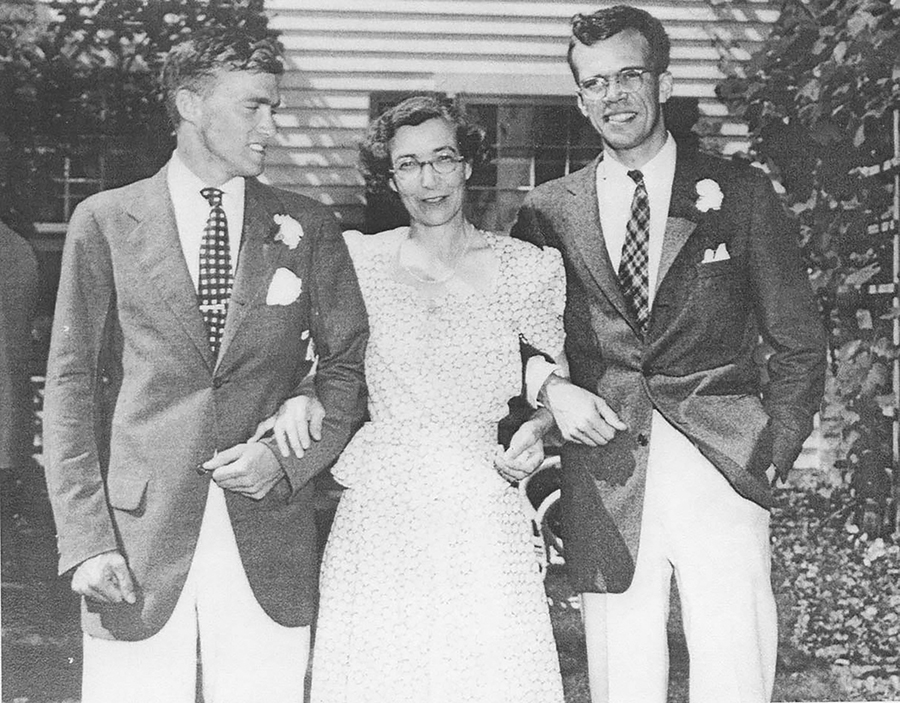
Dan, Katharine and Jim Boyd Jr.

The best of that whole Boyd bunch was Dan, the one who was killed in a motorcycle accident in San Francisco,” Glen Rounds said while lounging in his front yard on a sunny spring afternoon 30 years ago. He was parsing the James Boyd family, the “first family” of Southern Pines, the clan responsible for many of the aesthetic and cultural pleasures our quaint hometown offers.

“The older son, Jim, was something of an oddball,” Rounds continued, “but Dan . . . Dan was an exceptional kid.”

When Rounds spoke, I listened. Intently. In addition to authoring 100 children’s books and receiving a slew of state and national awards for his writing and illustrating, Rounds had his arthritic fingers on the pulse of Southern Pines. He knew what there was to know about everyone in town worth knowing about, and he served up his edgy opinions freely and with an occasional sprig of rancor and a dash of humor. Any praise, however slight, he might lavish on Daniel Boyd, the second son of historical novelist James Boyd and his wife, Katharine, was a high recommendation indeed and worthy of investigation.

“Dan was awarded the Silver Star during the Battle of the Bulge,” Rounds went on, “and when he got back in town, he never once mentioned it.”

I knew nothing of Dan Boyd, so during my next visit to the Southern Pines Library, I plundered through fusty back issues of The Pilot bound in bulky, outsized volumes, and discovered the January 1, 1959, front page headline: “Daniel Boyd Killed in California Last Tuesday in Traffic Accident.”

The timeworn newsprint was crumbling and much of the story was missing, but the essential facts were there: “Daniel Lamont Boyd, 34, the son of Mrs. James Boyd of Southern Pines, was fatally injured Tuesday of last week (Dec. 23, 1958) in San Francisco, where he had made his home.” Boyd was homeward bound from the city center when a car crossed the yellow center line and struck his “motor bike” (a lightweight scooter of some variety, possibly a Vespa) head-on. Dan was transported to the hospital, where he died without regaining consciousness.

The article also noted that Katharine Boyd, publisher of The Pilot, flew to San Francisco as soon as she received word of her son’s death, and that “News of the tragic accident was received with great sorrow in the community.” Although Dan hadn’t lived in Southern Pines in several years, he had “maintained earlier friendships with many people.”

If Rounds wasn’t exactly correct about the motorcycle, he was spot on when it came to Boyd’s military record. Dan served with the 60th Engineering, 35th Infantry Unit, which fought from Normandy, through the battles for Saint-Lô and the Bulge — 78 years ago this month — to the end of the European campaign. It was during the Battle of the Bulge that Dan distinguished himself and was awarded a Purple Heart and the Silver Star for gallantry under fire.
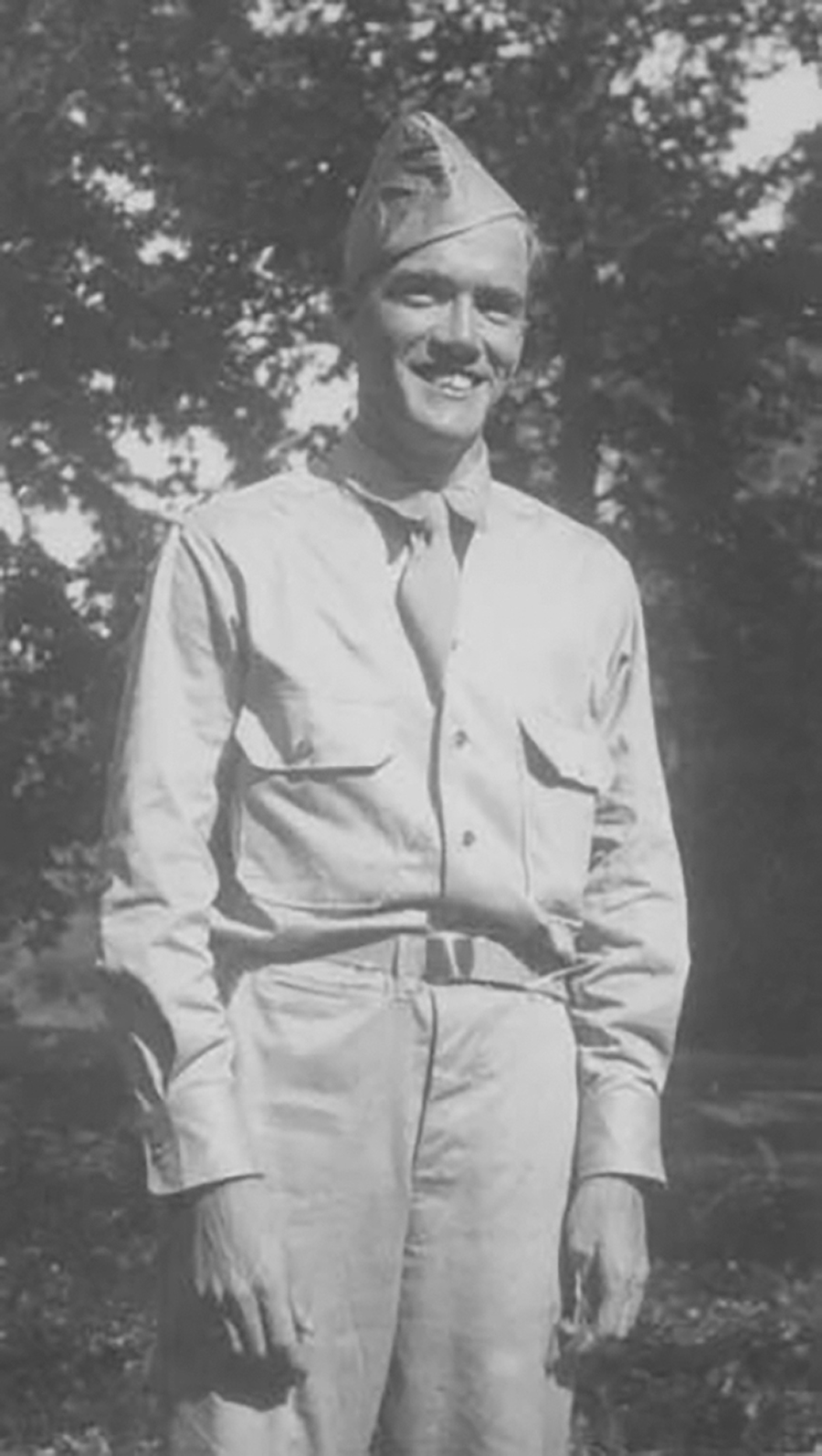
Dan Boyd before going overseas

The Army doesn’t retain records detailing the courageous actions of individuals who have been awarded the Silver Star, but the Friday, Feb. 9, 1945 issue of The Pilot reprinted an official press release:

“Corporal Daniel L. Boyd, 34677486, Corps of Engineers, United States Army, for gallantry in action near ————- France on 13th December 1944.

“During the crossing of the ————– River near ————–, Corporal Boyd was in charge of an assault boat operating in a sector which was subjected to intense machine gun fire from enemy emplacements located only 150 yards from the river. When he saw a nearby boat capsize in mid-stream after receiving a burst of machine fire, he immediately paddled his boat to the scene and rescued five heavily clothed soldiers from drowning in the swift current. After he had brought the men to the friendly shore, he started to assist them to an aid station when one of the men collapsed as a result of a wound he had suffered. Corporal Boyd placed him in a sheltered position, administered first aid, and then continued to the aid station with the other men. Finding a shortage of medical personnel, he personally returned to the wounded man he had left behind, in the face of withering enemy fire, and with the aid of a litter bearer, succeeded in evacuating his comrade. Corporal Boyd’s intrepid deeds and resourceful performance in the face of heavy odds were responsible for saving the lives of five of his comrades and are in accord with the finest tradition of the United State Army.”

The January 1959 Pilot notes that “With fighting going on across the river where American units were isolated, Boyd went out, found one of the engineers’ boats and, under heavy fire, ferried across sufficient men to win the action.”

Valor in military service was nothing new to the Boyd family. Novelist James Boyd Sr. served as an ambulance driver in France during World War I, and Dan’s cousin, Seaman 1st Class John Boyd, who had grown up in what is now the Campbell House, died in the Battle for Guadalcanal when the USS Barton, the destroyer on which he was serving, was sunk in a night action in November 1942.

My curiosity concerning Dan Boyd’s life and death might have ended there, but Rounds’ recommendation resonated with me whenever I attended a cultural and social event held at the Weymouth Center for the Arts & Humanities. A few years later, I was researching James Boyd’s relationship with F. Scott Fitzgerald and Sherwood Anderson in the Firestone Library at Princeton and the Southern Historical Collection at UNC when I happened upon letters from Dan to his parents, chatty missives about life at boarding school, football games and, oddly enough, railroads. His letters were peppered with allusions to the trains and drawings of locomotives.

The mystery of Dan Boyd’s life unraveled further when Dotty Starling, Weymouth’s dedicated archivist, lent me a copy of An Oral History of Weymouth. Published in 2004, the history gathered the reminiscences of friends of the Boyd family and the recollections of longtime employees. Many of the details of Dan Boyd’s short life are revealed in those collected memories.

I learned that in the ’20s and ’30s, the James and Jackson Boyd children had grown up together, playing in the pasture behind Weymouth, riding horses, and sharing in the privileges afforded by their parents’ wealth. They all attended kindergarten and elementary school at the private Ark school, initially located on the corner of Ridge Street and Connecticut Avenue on the Weymouth property. (The foundation of the school is still clearly visible, a giant magnolia rising from what must have been the building’s basement.)

Longtime Pilot reporter and editor Mary Evelyn de Nissoff remembered her days attending the Ark in a 2001 interview: “Two English ladies ran it. In the morning they welcomed the children with a handshake and had a cup of tea with them before classes began. In the afternoons the children went down into the basement where there were iron cots . . . where the teachers read aloud to them.” All three of James and Katharine’s children, Jim Jr., Dan and Nancy, the youngest, attended classes with Mary Evelyn. “They (the Boyd children) rode, of course. They were into horses and they smelled of horses. Nancy didn’t, but Dan did.”

A life of privilege notwithstanding, the Boyd household was not always a peaceable kingdom. Jim Jr. and Dan, brothers of very different temperaments, often argued, and their mother had difficulty maintaining domestic harmony. In a scrapbook preserved in the Weymouth Archives, an unidentified family poet recorded the domestic discord in rhymed iambic pentameter:

Thus while Dan offers up his soul

To knowledge and each day grows thinner,

James lies in bed and eats his dinner;

And while Dan toils o’er Latin grammar

James turns out mediocre verses

Of fulsome amatory tone

And sends them round to all the nurses.”
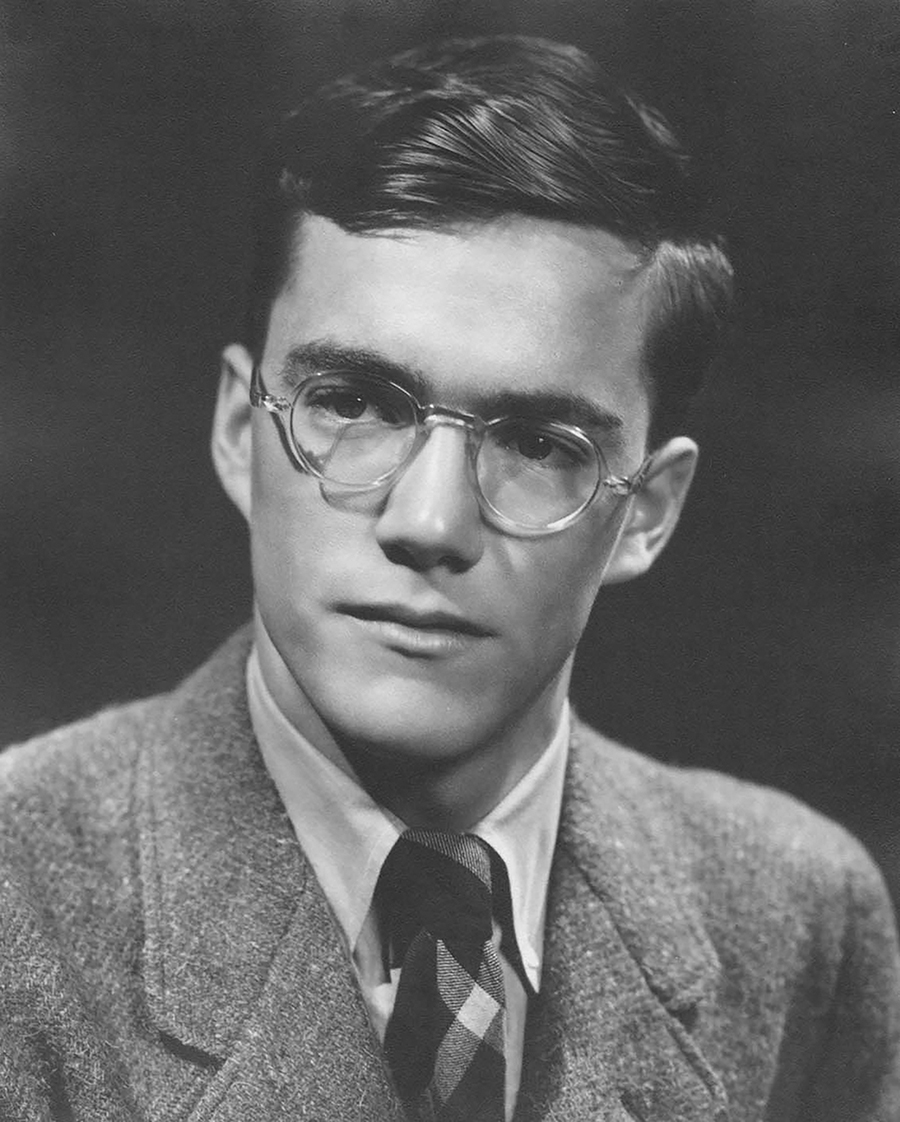
Dan Boyd

If Jim Jr. lacked motivation, Dan was obsessed — with trains. He decorated his room with railroad posters, collected electric trains, and snapped hundreds of photos of art deco diesel and steam locomotives — massive pufferbellies with all the machinery bolted to their boilers — which are now preserved and cataloged in the Weymouth Archives with other Boyd family papers.

The anonymous family poet also offers a prediction:

That some day, trudging down the track

In broken hat and hobo’s breeches,

He’ll [Jim Jr.] hear a train behind his back

Come rattling over frogs and switches

And, looking up as it goes past,

See seated in his private car

The road’s vice-president, D. Boyd,

Smoking a fifty-cent cigar!”

Dan and Jim Jr. were eventually shuffled off to Millbrook School, an academy for students in grades 9-12 located in Millbrook, New York. During those years, they wrote letters to their parents that conveyed a strong sense of family and a guarded affection for one another. Dan wrote about trains and drew locomotives on Millbrook stationery letterhead.

After completing their studies at Millbrook, Dan matriculated at Princeton, his father’s alma mater, while Jim Jr. attended UNC. When the war interrupted their studies, Jim joined the Coast Guard and Dan enlisted in the Army and fought in decisive battles in Europe. After the war, the brothers completed their degrees and Dan married Rhoda Whitridge in 1948 and went west to work with the Southern Pacific Railroad in Eugene, Oregon, eventually settling in San Francisco.

In 2002, Weymouth board member Bea O’Rand interviewed longtime Southern Pines luminary Voit Gilmore, who knew the Dan Boyd family well in the 1950s: “We knew of his connection with his very generous work with the arts council and arts groups in San Francisco. We knew the exact street where he was on his motorbike and got hit. Every time I go by that intersection now, it just breaks my heart that that happened. It was a steep hill on Polk where you come up and go over. The problem always is that if  the traffic light goes against you and you’re going up the hill you have a terrible time, you need to get over to the middle of the intersection which is what he did and got hit because of a car.”
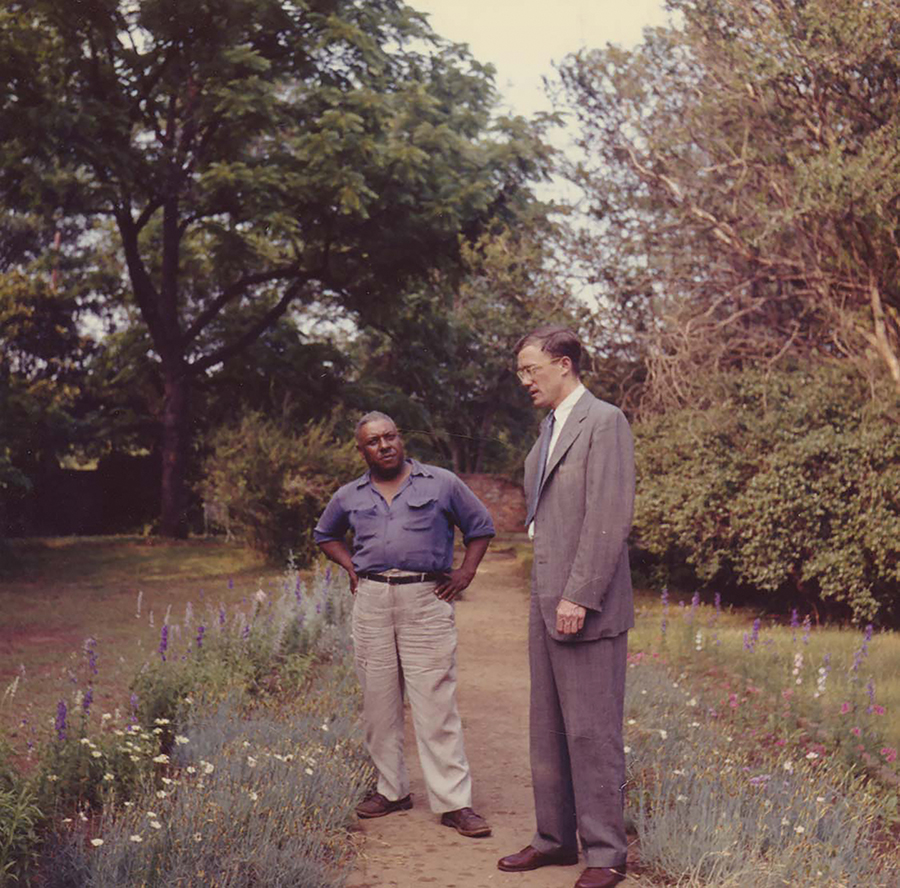
Dan Boyd with gardener Hilton Walker at Weymouth

Flossie Carpenter, a longtime employee of Katharine Boyd’s, recalled the effect Dan’s death had on his mother: “Now that’s when Mrs. Boyd went off, the morning that she got the message that he had been killed. Her mind was no more good. She tried to do but she couldn’t. . . . She stayed that way for about three years.”

Mary Evelyn de Nissoff, who suffered tragedy in her own life, keenly comprehended Katharine’s suffering. “ . . . I can understand what she was going through. She never got over it, because it leaves this great hole in your stomach that is never filled up.”

As a family, the Boyds participated in bettering the community in which they lived. Katharine contributed anonymously to the education of many local children. The family gave us the Weymouth Woods Sandhills Nature Preserve with its 7 miles of hiking trails and visitor center and exhibits, contributed to the Southern Pines Library, maintained what is now the Weymouth Center for the Arts & Humanities, and provided funds for the Boyd Library at Sandhills Community College. They worked to beautify the town and protect the pines that line our streets and shade our homes. The oldest living longleaf pine — its seed germinated in 1548, a survivor now of what was once the largest ecosystem in North America — thrives still on the Weymouth property.

In 2002, Rhoda Boyd, Dan’s widow, was driving with her granddaughter outside San Francisco when a redwood fell on her car, killing her instantly. Her granddaughter survived without injury. Dan and Rhoda Boyd are interred in Cypress Lawn Memorial Park in San Mateo County, California, far from Dan’s childhood home.

On that spring afternoon 30 years ago, Rounds, who knew something about humor and its understated uses, continued lauding Dan Boyd, offering up examples of his keen wit and artistic nature. As the afternoon wore on, the Southern Pines Middle School dismissed, and crowds of children began wandering up Ridge Street.

“Let’s go inside and have a drink to Dan Boyd,” Rounds suggested. “I don’t like to sit out here when these kids go by. They make too much noise.” Then he smiled. “But I’ll tell you what: When they’re gone, I go out and pick up their pencils.” PS

Stephen E. Smith is a retired professor and the author of seven books of poetry and prose. He’s the recipient of the Poetry Northwest Young Poet’s Prize, the Zoe Kincaid Brockman Prize for poetry and four North Carolina Press Awards.

Bring Us Some Figgy Pudding

Simple and elegant holiday brunch ideas

Story and Photographs by Rose Shewey

Festive meals among family and friends are the most magical of holiday traditions. Give me a Christmas brunch and I’ll be as joyful as the Sugar Plum Fairy in the Land of Sweets.

If you are blessed with young children on Christmas morning, you know that an early pot of coffee or a cup of tea is the most you’ll have time for until the presents are unwrapped and ooohed and aaahed at. Or, if you’re celebrating among grown-ups, an unrushed, peaceful start to the day can be a grand idea. All of which makes Christmas brunch an excellent choice on one of the brightest, most colorful and cheerful days of the year.

To spend less time in the kitchen and more time in the moment, with the people you love, gather inspiration from these simple, eye-catching dishes that require few ingredients and even less time to prepare.

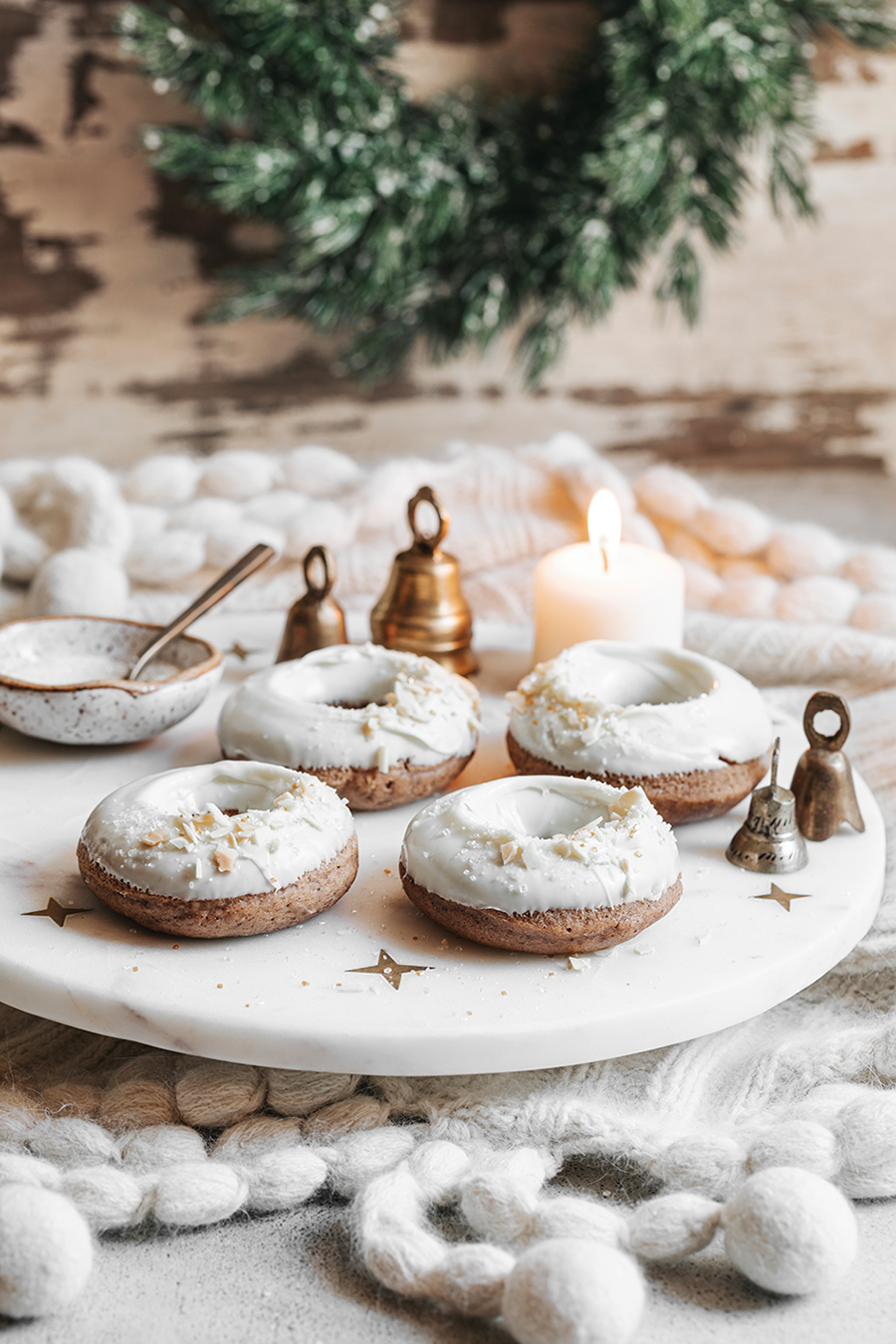
Gingerbread Doughnuts with Amaretto Chocolate Glaze

Doughnuts should be a staple in every brunch spread, no doubt about it. A basic doughnut recipe can be adjusted easily to feature the flavors of the  season. To transform ordinary doughnuts into a winter holiday treat, simply add gingerbread spice mix to the dough and, once baked and cooled off, dip in melted white chocolate infused with amaretto. Sprinkle with crushed almonds and sparkling sugar to add a touch of winter magic to your buffet.


Eggnog Chia Parfait

A spectacular make-ahead option for Christmas morning is eggnog chia parfait.
Nothing says Christmas more than eggnog for breakfast! To every one cup of liquid, add 1/4 cup of chia seeds; allow to rest for a few minutes, stir and refrigerate overnight. Layer with müesli, chopped nuts, seeds, chocolate mousse, compote, jam or fresh fruit of your choice and top with whipped cream.  The possibilities are endless, so let your creativity run wild.


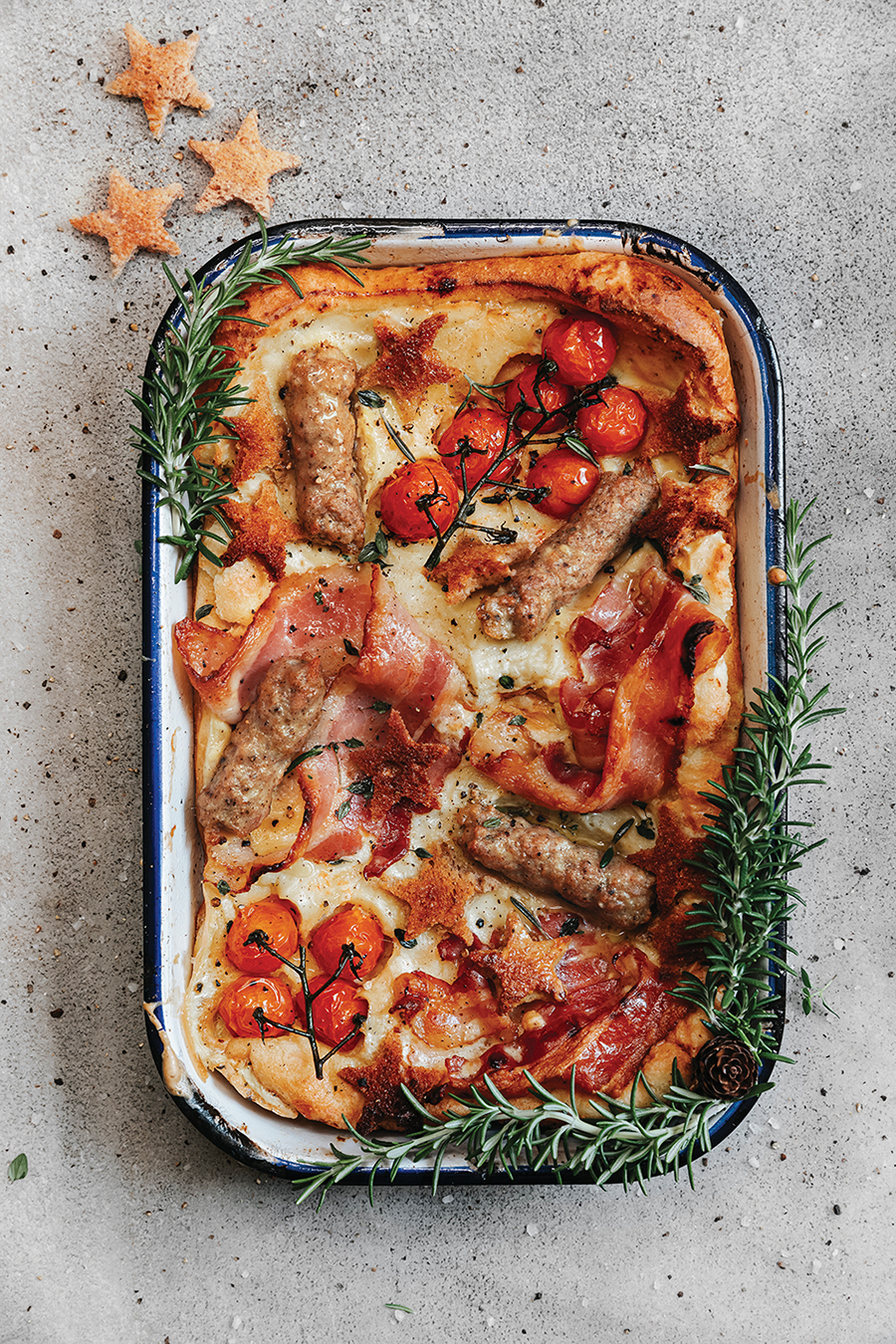
Yorkshire Pudding Breakfast Bake

A take on the traditional Yorkshire pudding (which is similar to the American popover), this is a simple yet striking — not to mention scrumptious and satisfying — dish to serve your family and friends on Christmas morning. The base is made with just eggs, flour and milk, and takes minutes to whip up; add any breakfast ingredients of your choice, such as bacon, sausages or tomatoes and bake in the oven for 15-20 minutes or until the egg mixture is cooked through.


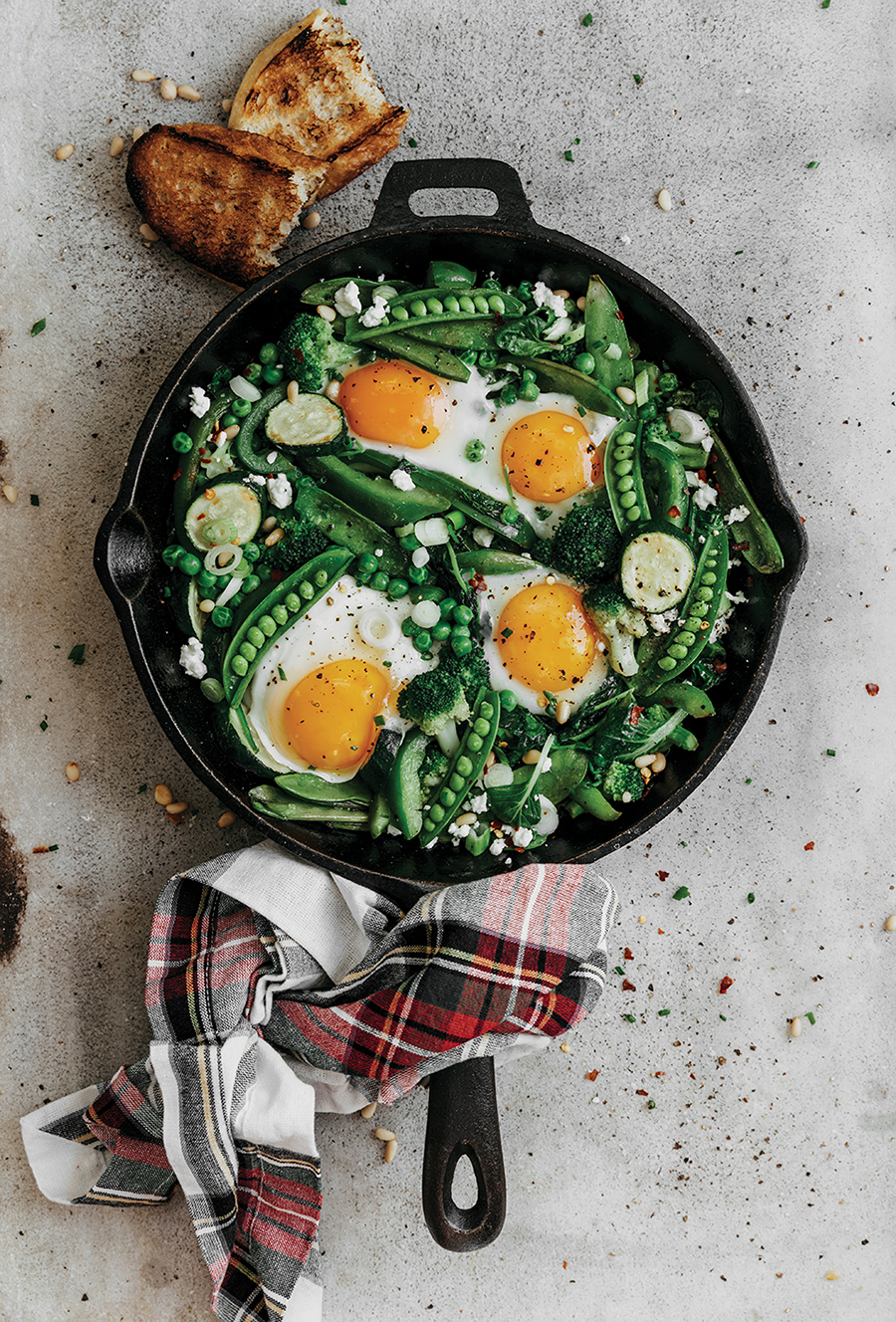
Green Shakshuka with Poached Eggs

Traditional shakshuka is not just a feast for the eye, it’s an incredibly aromatic dish for all those who have a penchant for Mediterranean spices. To mix it up, try a green version of shakshuka.  Instead of the tomato base, use layers of green vegetable, such as leafy greens, zucchini, broccoli and peas, then season with green harissa, paprika and cumin. Finish by cracking eggs right into the skillet and cook until the whites are set. Serve with toasted bread.


Potato Waffles with Smoked Salmon

Potato waffles are a fabulously sophisticated alternative to ordinary hash browns. To save time preparing a hash brown mixture, you can use previously frozen potato puffs or even a leftover mashed potato mix. Potato waffles will cook in minutes and make a hearty base for a variety of toppings. Smoked salmon with a dollop of crème fraîche garnished with capers and roe is a holiday-worthy combination. Or, you might find your own favorite mélange.


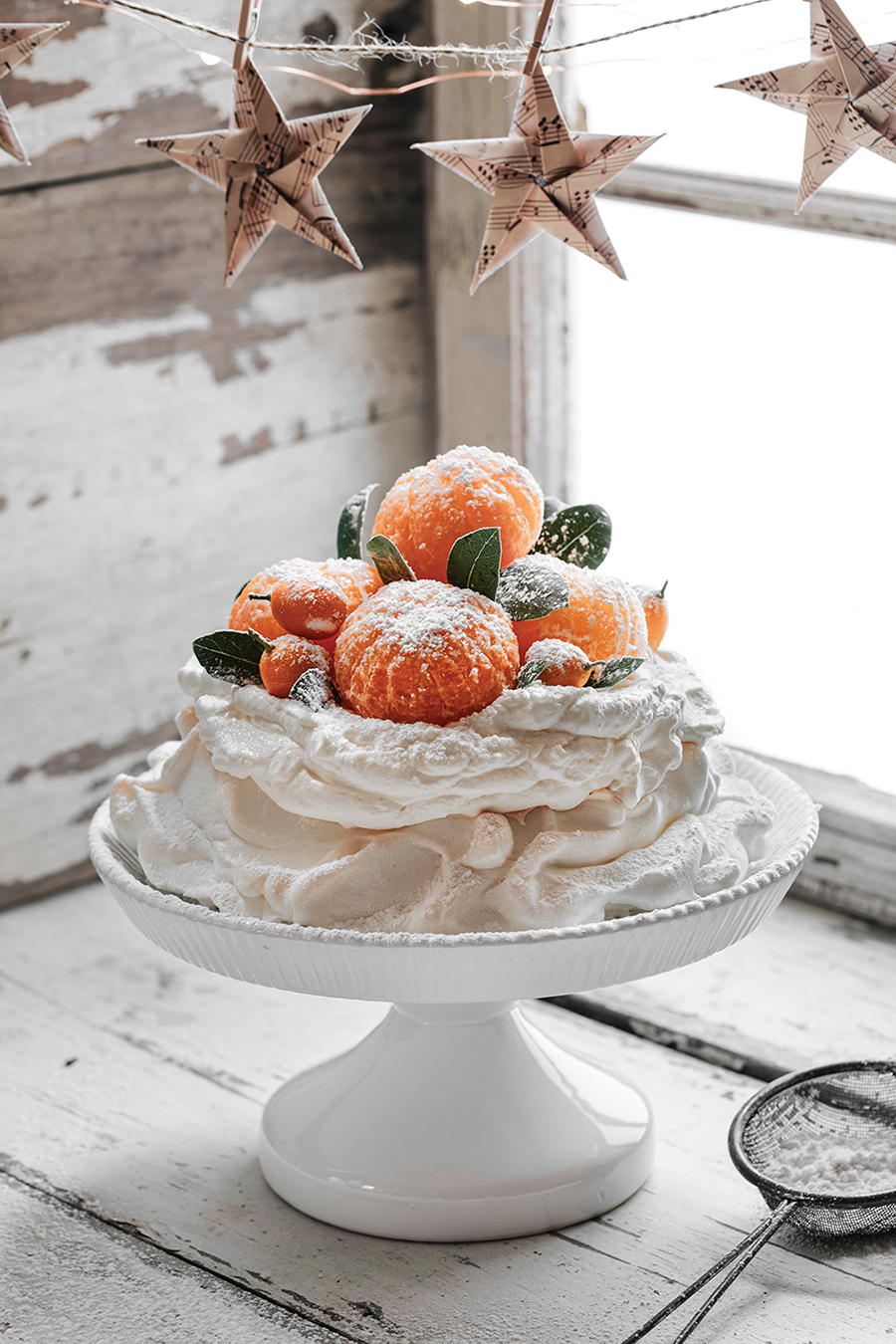
Winter Pavlova with Clementines

Pavlovas are quite the showstoppers and require few ingredients to make, mainly just egg-whites and sugar. While pavlovas can be a bit temperamental (you want to beat the eggs just right), they are exquisitely light and airy compositions that can be made a day in advance and dressed up with cream and fruit right before serving. Top your pavlova with whipped cream, curd and any seasonal fruit of your choice, such as clementines, oranges, figs, pomegranate or pear. PS


Pleasures of Life

The Littlest Stocking

By Audrey Moriarty

When I was a child and my parents were in that special hell reserved for people who are “in-between houses,” I had the great fortune of living with my Grandma and Grandpa for several months. I can tell you they weren’t too happy about it, but my older sister and I thought it had all worked out quite nicely. It was only a mile or so away but it might as well have been another universe.

I won’t say I was Grandma’s favorite, but at the time I was the baby of a whole slew of cousins. Together Grandma and I conspired to keep my mother uninformed of all my transgressions, most involving disputes with my sister that always ended badly, the occasional lapses in my toilet training, and my forays into the forbidden — Grandpa’s office, the delicious pantry, and the totally mystifying medicine cabinet. She handled me in the best possible way. She bribed me with M&Ms.

Half of the perimeter of Grandma’s kitchen was lined with a countertop and a metal Dwyer unit. She would put me on the counter and I could walk from the refrigerator, step down into the sinks, and hike the rest of the way to the end of the peninsula. From my perch on the counter I watched her peel potatoes, tissue thin, with a paring knife, while she called out the names of the birds that came to her feeders and birdbaths.

Anytime I got caught by Mom with wet trainers or a handful of hair I had been forced to yank out of my sister’s head, I would run to my co-conspirator and she would set me on the counter and dry my tears. Then she would whisper to me, “If you look very hard, you will find what I have hidden in the cabinet for you.” I’d search behind the teacups, under the bag of rolled oats, around the Postum, or behind the bacon grease can until, they there were! M&Ms.

This process was repeated many times during my stay with Grandma and Grandpa. I got faster, and she became more and more cunning. She enjoyed hiding them, but never as much as I enjoyed finding them. I savored them, first crunching a few furiously, then holding some in my mouth until the candy shell melted. I even invented a beverage that I continued to prepare for years, putting a handful of M&Ms in the bottom of a glass and filling it with the mysteriously warm and bubbly water at Grandma’s house.

After our new house was finished and we left Grandma’s, we still spent the night on the rare occasions when Mom and Dad went out. One of those times was the night of the annual Christmas party where Dad worked. My sister and I packed our jammies and toothbrushes and couldn’t wait to snuggle in Grandma’s bed, piled in thick quilts and flannel sheets, so foreign from our own. I dressed for the season, sporting my brand new bright red Buster Brown twin set. Mom agreed to the sweaters, but when I put the pressure on for my pair of matching red socks, she balked.

Mom was no pushover, but I know an ensemble when I see it, and I had to have them. I begged, whined and pleaded and finally, she relented. So off we went to Grandma’s, me stylish in all red. The next day, at home, I discovered that I only had one of my socks. I was not about to tell Mom, so I hid the survivor in the back of my drawer and didn’t mention it.

Every Christmas Eve, my sister and I participated in our Sunday School program and afterward went to Grandma and Grandpa’s for dinner and the chaotic joy of gifts. This year my aunt and uncle and their kids, who didn’t have to go to any old Christmas program, were already there, along with my childless and fearsome aunt who lived at Grandma’s. We rushed into the house, stamping snow from our church shoes and smelling the feast of ham and pies. Our heathen cousins had gotten right to the business of shaking boxes and locating the packages with their names on them. But, when we arrived, we were ordered directly to the table. No side trips to the tree for us.

You see, my fearsome aunt’s specialty was torture. She deliberately and perversely slowed the process, ordering people to their spots according to her intricate seating pattern. When she ate, she took tiny bites and chewed them 2,000 times. She made us tell about the Christmas program. She asked us how school was going — what kind of person cares about school on Christmas Eve? We were grilled on what we wanted for Christmas and on and on while we kids stared at each other, our eyes glazed over with anticipation. Then, she offered coffee and dessert, painstakingly cutting geometrically precise slices. When the adults finally finished we ran to the front parlor only to hear a loud voice behind us say, “We can’t leave the kitchen like this!” and we turned to face piles of dirty plates, cups, saucers and pans filling the sinks. My fearsome aunt leered with pleasure.

Hours later, it seemed, pushed nearly to the breaking point, we were ushered into the parlor, where beneath the tree were hundreds of presents. It was so exciting when one of the cousins got something cool and you just knew you were next. Finally, when all the boxes were opened and wrapping papers and ribbons were strewn everywhere and all that waiting was over, Grandma stood up and said, “Oh, I forgot. There is one more thing. Audrey, there is something for you on the tree that you have to find.”

Now you know I had never even looked at the tree, just at everything underneath it. Hanging in the front, pushed back in the dark center, was my red sock, dangling from a ribbon, heavy and full. Grandpa handed it down to me, and I untied the ribbon and out spilled the most perfect candy in the whole world, a special stocking full of wonderful memories.  PS

Audrey Moriarty is the Library Services and Archives Director for the village of Pinehurst.