Hometown

Cards of Christmas Past

Ode to a lonely address book

By Bill Fields

Amid so many uncertainties in the current world, there is an absolute truth: December is the loneliest month for one of my possessions.

Residing in a drawer where it seldom is disturbed, near some old keys and dull pencils, I’m sure my address book feels left out most of the time. But around the holidays — when the contents on its dog-eared pages used to be as essential as eggnog — it must be forlorn beyond consolation.

The state of my address book this time of year is, of course, related to both habit and technology. I still mail holiday greetings to some friends and relatives, but the list is much smaller than it once was. I know a few addresses from memory; others are in the contacts on my cell phone.

I felt quite mature not long ago when I visited a college communications department and, with time to kill before I spoke to a class, looked around the lobby before going upstairs. A display on the history of journalism included a Rolodex, an artifact of an earlier age.

Right out of college, I purchased a Rolodex at Austin Business Supply, a fancy one with a metal cover that went over the rotating spindle and a lock with one of those tiny keys that would go missing in a month. By the time I abandoned my Rolodex years later, it still had plenty of blank cards and wasn’t even in the same league with the bulging desktop index of a former boss in New York. He called in from the road once and asked me to find a number for someone. In flipping through his cards, I couldn’t help noticing how he handled those no longer with us: * DEAD * written in felt tip by their names. 

My address book is nearly 25 years old, purchased not long after the Moleskine notebooks came on the scene. The pages have come free from the binding; the elastic closure has been stretched to where it is like a belt four sizes too long. Inside the black paperboard cover fraying at both ends of its spine are names in and out of my life, relationships that ended and those that endure. If I were so inclined, there could be plenty of asterisks. The book even contains information foreshadowing its obsolescence — a password here, an email there, lines drawn through an old home number in the “H” section that no longer works.

Even though I’ll only send and receive a handful of cards this year, the tradition evokes lots of memories. Growing up, we often taped the cards above the double door to the dining room, where the scotch tape was certain to fail at least a few times. Sometimes they stood on top of a china closet or sideboard. Occasionally, they rested in a basket.

People tended to be predictable in the Christmas cards they sent. Some families chose one with a religious theme each year. You could count on birds from some and snowy scenes from others. I used to be fascinated by the envelopes that contained more than a card: the typed letters of what had gone on in a life in the preceding 12 months. We used to get missives from a divorced distant cousin that mentioned the activities of “Parents Without Partners.” To a kid, all the PWP updates seemed like TMI, even before there was such an acronym.

Mostly, though, it was a joy when the post office box was filled with cards from friends or family who thought enough to take the time to write them. It was a delight to receive a card from my mother even when she was north of 90, her handwriting nearly as neat as when she was a schoolgirl.

Retrieving my address book from its resting place not long ago, I was reminded that it had an accordion pocket. There were a couple of old business cards and return addresses torn off envelopes. In a pleasant surprise, there also were two partial books of attractive “Holiday Evergreens” Forever stamps. The longleaf pine version looks particularly like home and deserves to ensure passage of something better than a bill.  PS

Southern Pines native Bill Fields, who writes about golf and other things, moved north in 1986 but hasn’t lost his accent.

Naturalist

Spy in the Woods

With camera traps, every day is like Christmas

Story and photographs by Todd Pusser

Dappled sunlight, filtered by a canopy of oak and pine, illuminates the trail that snakes along the edge of Eagle Branch Creek. The raucous calls of a red-shouldered hawk pierce the crisp fall air as I walk quietly toward a camera that I had mounted to the side of a tree next to the small creek. Every two months for the past three years, I have made the same woodland trek to check this camera, simply to satisfy my curiosity as to what animals are found in the woods so close to my childhood home in Eagle Springs.

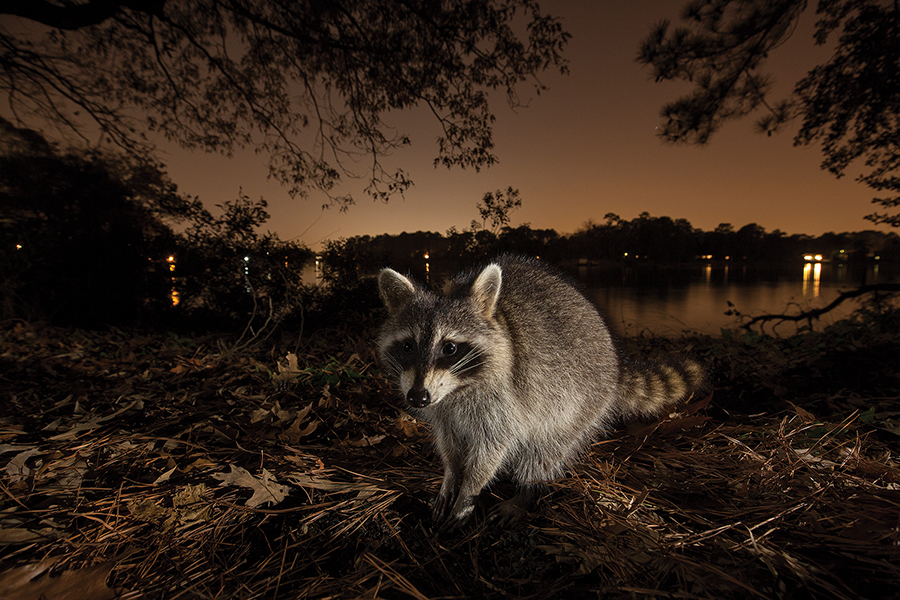
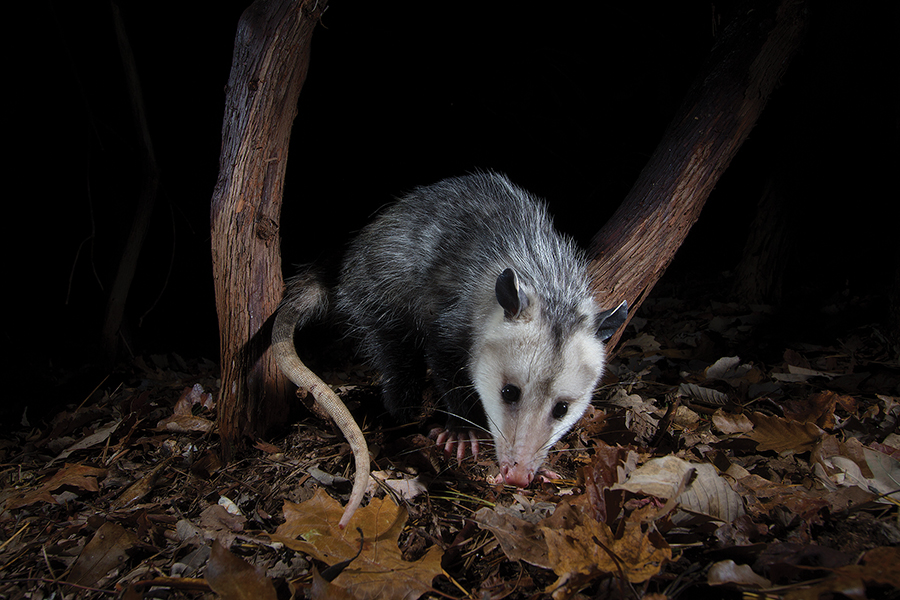
Most wild animals, especially mammals, are extremely wary of humans. They see, hear or smell us long before we are aware of their presence. Many species are nocturnal and are only active when the cover of darkness masks their movements. As such, it can be nearly impossible to observe wild animals in their natural habitat. To remedy this, I use a weatherproof camera trap that can be left in the woods for long periods of time, and is capable of recording images day and night. A motion-activated sensor attached to the camera records photos or video of any animal that passes by.

The concept of camera trap photography has been around for over 100 years, when pioneering nature photographer George Shiras used a crude, but complex, remote system of trip wires and flashes fired by exploding magnesium powder, to record images of animals along the shores of Lake Superior in Michigan. The resulting photographs, published in National Geographic Magazine in 1913, became instant sensations. Since that time, the use of camera traps (also known as trail cameras, game cameras, remote cameras, etc.) has increased exponentially, with hundreds of models now commercially available in a wide range of budgets. I use inexpensive Browning trail cameras to record high-definition video as well as custom-built camera traps that house my Canon DSLR cameras for professional quality images.

Camera traps are used for a variety of applications and have become essential tools for many nature enthusiasts, from zoologists who want to monitor rare species in remote tropical jungles, to hunters hoping to bag a trophy buck on local game lands, to naturalists wanting to learn what animals visit their backyards.

Finally arriving at the camera, I sit down next to the tree and remove a small laptop from my backpack. Pulling the memory card from the camera trap, I insert it inside the portable computer. Like a kid on Christmas morning, I wait with eager anticipation for what surprises the camera might hold.


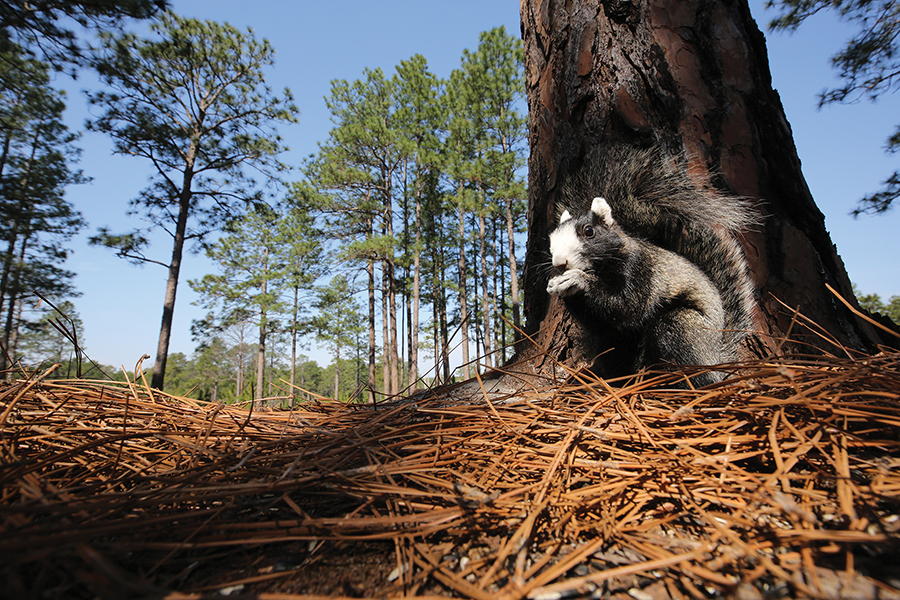
Over the three years that the camera has remained at this spot, it has recorded a remarkable diversity of wildlife. Opossums, raccoons, grey squirrels, cottontail rabbits and white-tailed deer are seen nearly every day and night throughout the year. More surprising was a nearly-black, striped skunk seen nosing through the leaf litter one cold December night. In a lifetime of exploring the woods of Moore County, I have only observed the pungent mammals on two other occasions.

Another surprise was the large, heavily spotted bobcat that made a near daily appearance in front of the camera one April. Once, the camera recorded a video clip of a pair of river otters playfully sliding down the muddy creek bank and splashing into the water. More recently, for a period of several afternoons in July, when temperatures hovered well north of 90 degrees, a barred owl would land next to the creek, lay down on the ground and stretch its wings far out to the side, arch its head back and close its eyes, seemingly soaking in the sun.

By far, the rarest and most unusual animal recorded here over the last three years was a long-tailed weasel. From conversations I have had with local elderly farmers, weasels were apparently much more common 60 or 70 years ago, when their raids of chicken coops drew much consternation. They are rarely encountered now in the Sandhills. The short video clip of a weasel bounding right to left across the frame on a late summer evening provides tantalizing proof that the miniature carnivores still exist here. I have yet to see a live one with my own eyes.

Finally, the memory card finishes downloading. Leaning back against the tree, I thumb through the 80 videos that the camera has captured over the past two months. Once again, raccoons, opossums and deer make up most of the video captures. The highlight is a pair of gray foxes that wandered by the camera in the middle of the afternoon, with noses to the ground.

Copying the videos to my hard drive, I clear the memory card and reinsert it into the camera along with a fresh supply of batteries. It will be another two months before I check the camera again, but I am already counting the days until I can discover what new marvels it may hold.  PS

Naturalist and photographer Todd Pusser grew up in Eagle Springs. He works to document the extraordinary diversity of life both near and far. His images can be found at www.ToddPusser.com.

Southwords

Modern Conveniences

And the wisdom of the ages

By Ashley Memory

Newly married, the pressure to be everything — wife, fashionista, hostess extraordinaire — had never been greater. J.P. and I were just hours away from our first dinner party, and already I hated the way my trendy beaded bracelets kept lassoing me to the kitchen cabinet handles. There was a reason my grandmother Wilma never wore fancy jewelry while entertaining, but I couldn’t worry about it now. The turkey was roasting in the oven, and I had rolls to make.

“Can I do anything?” J.P. called from the living room.

The last thing I needed was interference. Better to keep him occupied with details. “Set the table!” I yelled.

As I entered the pantry for flour, a box of Wilma’s cookware caught my eye. After her death, the box had been passed to me. But, as much as I’d adored her, Wilma had always done things the hard way. Tonight I didn’t have the time to fool with old-fashioned gadgets. In fact, this box was already taking up way too much space in my pantry. Sadly, many of Wilma’s things would probably have to go.

“Forgive me, Grandma,” I whispered, “but this occasion calls for modern convenience.”

The voice I suddenly heard was loving but wary: Better be careful.

My new planetary action mixer boasted beaters that rotated on their axis just like the Earth, and a mixer head that turned the opposite way. All this with a 1.3-horsepower motor. I wasn’t sure what any of that meant, but it sounded absolutely essential.

What it meant, I learned after I innocently stuck a spatula into the bowl as the mixer ran, was that it could fling objects, e.g., that same spatula, back at my face with a force strong enough to send Elon Musk’s Starship to the planet Mars and back again. Now I was the one seeing stars.

Didn’t I warn you?

“Everything OK in there?” J.P. shouted from the living room. “Hey, there’s a new space documentary on Nova tonight. Want to watch it?”

This was the last thing I needed to hear. “Are you kidding me?” I yelled back. “We’ve got people coming over, remember?”

Head throbbing, I retreated to the pantry and grabbed Wilma’s stout wooden spoon so I could mix the ingredients by hand. Then I looked down at my previously sparkly pink sweater. It was white with flour.

I heard that little voice again. Wilma. Might I recommend an apron?

I rifled back through the box and pulled out her red-checkered apron. Hardly haute couture, but I didn’t care. Once I put away the dough to rise, it was time to grate some cheese for the potato casserole. By now I was long overdue for some magic from my new food processor.

Do you really have time for that?

Sure enough, when I saw the shredding disk, I realized I had no idea how to attach it to the motor shaft. I gave up. “So much for modern conveniences.”

It’s OK, dear. Try my handheld grater.

“How’s it going?” J.P. called out. “Anything else I can do?

“Remember that box in the pantry? Bring it in here.”

“I thought you were donating that stuff,” he said, carrying Wilma’s cookware.

Now, now. Not so fast, dear.

I jerked off my bracelets and tossed them aside. “Are you kidding? The only thing I’m giving away are these stupid bracelets.”  PS

Ashley Memory lives in southwestern Randolph County, and when she’s not blowing up the kitchen, she’s outside hollering for the dogs.

PinePitch

Love and Joy Come to You

And to your holiday concert too! Join the Moore County Choral Society from 7 p.m. to 9 p.m. on Sunday, Dec. 11, for its 48th season and the holiday concert, “Love and Joy” at Owens Auditorium in the Bradshaw Performing Arts Center, 3395 Airport Road, Pinehurst. Wassail not included. Information and tickets: www.ticketmesandhills.com.


Auld Lang Syne for All

Pencil in downtown Southern Pines’ First Eve celebration and Pine Cone Drop on Saturday, Dec. 31, from 6 p.m. to 8 p.m., to ring in the New Year with live music, carnival games, face painting, and much more. The cone drops at 8 p.m. at the railway station in downtown Southern Pines.


Ride the Rails

With popcorn as a serendipitous side, recapture your holiday spirit with a free viewing of The Polar Express at 6:30 p.m. Thursday, Dec. 22, at the Sunrise Theater, 250 N.W. Broad St., Southern Pines. For more info, go to www.sunrisetheater.com.


Weymouth Wonderland

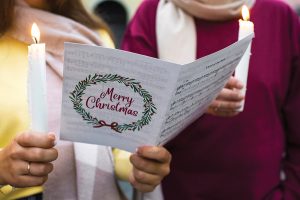
Walking in a winter wonderland has never been more magical — or more convenient. From Dec. 2 – 4 enjoy candlelight caroling, teddy bear teas, Santa Claus and more at the Weymouth Center for the Arts & Humanities, 555 E. Connecticut Ave., Southern Pines. For additional info on each day’s festivities, go to www.weymouthcenter.org.


While Away The Hours

If the holiday cheer is overwhelming, settle down for an opera inspired by Virginia Woolf’s Mrs. Dalloway. Follow three women as they grapple with their inner demons in this compelling drama adapted from the 1925 novel written by Woolf and performed by the Metropolitan Opera live in HD on Saturday, Dec.10, at 1 p.m., at the Sunrise Theater, 250 N.W. Broad St., Southern Pines. For information, go to www.sunrisetheater.com.


Wintry Writings

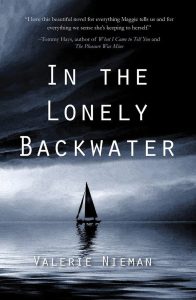
In all the holiday hubbub, be sure to reserve some reading time for those bookworms on the nice list. At 5:30 p.m. on Wednesday, Dec. 7, current Weymouth writer-in-residence Valerie Nieman will read from her novel In the Lonely Backwater, a mystery in the Southern gothic tradition. Free admission. Weymouth Center for the Arts and Humanities, 555 E. Connecticut Ave., Southern Pines. For info go to: www.weymouthcenter.org.


Do You Hear What I Hear?

It’s the sound of a nearly decade-old tradition that gets sweeter with time. On Sunday, Dec. 18, join a Moore County institution when Rev. Paul Murphy and his family perform their annual Christmas Concert at 2 p.m. and again at 7 p.m. at the Sunrise Theater, 250 N.W. Broad St., Southern Pines. For information, go to www.sunrisetheater.com.


Giddyup

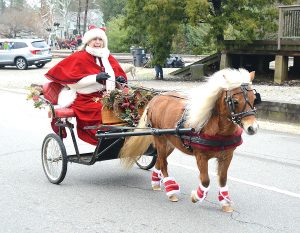
The colorful annual Christmas Carriage Parade staged by the Moore Country Driving club will be Saturday, Dec. 10 at 1 p.m., give or take, in downtown Southern Pines. Come on, it’s a bunch of horses so if they’re a minute or two late, cut ‘em a break. It’s worth the wait.


O Tannenbaum

Break out your holiday spirit for the Pinehurst tree lighting at Tufts Memorial Park on Friday, Dec. 2, from 5 p.m. to 7:30 p.m. They officially flip the switch at 6:30 p.m., but with vendors spreading holiday cheer and Santa on-site, there’s some Christmas cheer for the whole family. For more information, visit www.vopnc.org.


Party in the Pines

Calling all night owls. Break out your dancing shoes and shuffle off to The Carolina Hotel, 80 Carolina Vista Drive, Pinehurst, at 8 p.m. on New Year’s Eve for a gourmet dinner buffet, dancing to The Band of Oz, a Champagne toast and a midnight breakfast buffet. Bring your best Shama Lama Ding Dong sashay to start 2023 on the right foot. For info: www.eventbrite.com/e/party-in-the-pines-tickets-464647592457.

Birdwatch

An Uncommon Visitor

The feisty purple finch is in the hood

By Susan Campbell

If you happen to be maintaining a bird feeding station over the next few months, you will want to be on the lookout for an uncommon winter visitor: the purple finch. These feisty little birds are common to our north but some years, when their numbers surge as a result of above average reproductive success, they head further to the south following the breeding season.

It seems that spruce budworms were abundant in boreal forests in June and July, and this resulted in a bumper crop of baby finches. Like most of our songbirds, nestling purple finches require lots of caterpillars to grow into strong fledglings. The family groups merged into wintering flocks sometime in the last couple of months and are working their way southward, as they always do. Given their numbers, purple finches will spread much farther throughout the eastern half of the United States than they normally would. They’ve already been spotted in forests and at feeders in North Carolina.

Purple finches are robust birds that are larger than the chickadees and titmice, which they often associate with during the cooler months. They appear most similar to our ever-present house finches. Male purple finches are not really “purple” as their name would imply. They are more of a raspberry color. In addition to their coloring, they have a distinct whitish eye stripe and heavier bills than their cousins. Females and immature males that lack color can be overlooked as just another little brown bird at your feeder. But note that they are more aggressive and have that distinctive eyebrow. As so many of our winter feeder visitors do, purple finches love black oil sunflower. But they also will come to nyjer, or “thistle seed.” They, like goldfinches, find this tiny but highly fatty seed irresistible.

Away from feeders, purple finches feed on the seeds from conifers to tulip poplar, maple seeds to ragweed, and even dandelions. They may mix in with local house finches at feeding stations or simply with wintering sparrows in brushy habitat. These birds crush seeds and fruits using their powerful bills and strong tongues. The nut inside is consumed completely; therefore, purple finches are considered to be predatory and not dispersal agents, as many birds are.

You may notice a flock as a result of the males chorusing at the tops of trees. Purple finch song is distinguished by a fast rising and falling series of up to two dozen notes. Interestingly, males may incorporate bits of songs sung by other species where they breed. It is not that rare to hear American goldfinch or rufous-sided towhee notes mixed in.

If purple finches learn to efficiently find food as well as avoid predators, they can live a relatively long time for a small bird. The oldest known individual was documented as living over eight and a half years. It was a banded bird — recaptured right here in North Carolina.  PS

Susan Campbell would love to receive your wildlife sightings and photographs at susan@ncaves.com.

Serendipity

By Tom Allen

Already have an Elvis necktie, but know someone who’d love one? Perhaps a ceramic giraffe doesn’t fit your décor, but your cousin collects them. Do you really need another cinnamon-apple candle? Put it in that snowman gift bag from three Christmases ago and it’s a wrap.

Regifting is the art (and tact) of giving something away that was given to you, something you couldn’t use, didn’t need, or wasn’t your cup of tea — neither cup nor tea.

December, the season when we haul out the holly, brings back the memory of my first regifting experience, before the word was part of the urban lexicon. My wife, Beverly, and I had become engaged. A cousin gave us a lovely silver-plated nut dish as a wedding gift. There was a note card — “Edgar and Carol, congratulations on 50 years of marriage.” The card was signed, “Norman and Sue.” 

How sweet of Norm and Sue to remember that momentous occasion with such a thoughtful gift. How sorry I was that Cousin Carol and husband, Edgar, never had the opportunity to fill that silver-plated dish with the butter mints we put in it.

Let’s be honest. You, too, have a box or a bin or a drawer with socks and scarves, gadgets and gizmos, knick-knacks that, well, you know it’s the thought that counts, but you said to yourself, “Maybe they could have thought of something else.”

Surely there’s nothing amiss with regifting. Shouldn’t it make us feel at least as virtuous as recycling? We have all received items, whether carefully thought out or purchased at the last minute, that were duplicates or something we didn’t need. Long after our wedding gift from Cousin Carol and Edgar, I suspect we’ve been the recipients of a few other gifts, especially at Christmas, pulled from a drawer stocked with candles, foaming soap and lotion, tea towels and potholders. But, hey, lots of folks enjoy candles and potholders. And who doesn’t like to wash their hands with lemon verbena-scented soap?

There is a certain etiquette involved in proper regifting. First — and this very important — be careful not to regift to the person who gave you the gift in the first place. That breaks all the rules and you end up with a crate full of eggs on your face. And you might not get invited to their Christmas party again.

Second, never hand someone a gift and tell them it’s a regift. “A friend gave me this for my birthday but I already have two onion keepers and I thought you might enjoy one.” There are things in life that are better left unsaid. Another egg-worthy faux pas.

Third, regifting expired food is a major no-no. Suppose you find a box of Harry and David’s Moose Munch in your pantry. Check the expiration date before you toss it in a basket with other regifts.

Like all human endeavors, there are regifting boundaries that should not be crossed. No heirlooms, like that afghan your great-grandmother crocheted. No puzzles with a missing piece, that’s just wrong. And, on general principles, no CDs of Perry Como’s Christmas hits.

In a pinch, a nice candle or an unopened canister of tea is fine, but don’t become the neighborhood regifting king or queen. Put some time and thought into the regift, even if it’s been sitting in that drawer forever. Rewrap or rebag, even if you reuse a regifted bag and tissue — but don’t forget to take those name tags off.

And mind your manners. Be grateful, for whatever you receive. At some point a friend thought enough to give you something, and at some point, you thought enough of someone else to pass it on. It’s another way of reminding you that someone considers you a friend, and you them. In the end, boxes and bags aside, that’s the gift that keeps on giving.  PS

Tom Allen is a retired minister who lives in Whispering Pines.

Out of the Blue

Holiday Healing

A season in need of warm and fuzzy

By Deborah Salomon

No surprise that “the holiday season” descended on stores before the first Halloween pumpkin went under the knife. Merchants know that inflation will quickly gobble up dollars earmarked for gifts, parties, travel. Charities may suffer. Good causes will falter. Santa’s bag may be lighter, and New Year’s Eve won’t feature prime rib and Champagne.

Still, people crave this annual reprieve, especially after two holiday seasons dampened by COVID and its spin-offs.

We deserve some warm and fuzzy.

To be fair, holidays that comprise the “season” are unrelated, save for proximity. Christmas, of course, has deep and abiding religious significance, which no slapstick flick can trivialize. Yet it has been commercialized beyond belief — not all bad, many non-believers believe, since events bring people together, create memories.

Secular Christmas, it’s called — a perfect oxymoron.

Hanukkah, also falling in December, joined the trio big-time during the ’70s, swept in by diversity awareness, gobbled up by Jewish families like mine, with children who felt left out. Its symbols — candles, coins, food fried in oil — appeared for eight days, often culminating in a sizable gift on the last night.

Hanukkah commemorates a military victory, freedom of religion and a miracle whereby oil sufficient to illuminate the altar lamp for one day lasted eight.

Inspiring, significant, hardly warm and fuzzy.

Kwanzaa, which falls after Christmas, celebrates African American history and culture. The observance, initiated in 1966 after the Watts rebellion, is based on African harvest festivals. Candles are lit, special foods served, small gifts exchanged but, according to website definitions, Kwanzaa is non-religious and non-political.

My gut says this year we really, really need a holiday season. The world is in terrible shape. Cruel winter descends on a Ukraine with uncertain power, heat, water, food. A drought in Somalia forces mothers to trek hundreds of miles, often burying their infants by the dusty road. In Nigeria, catastrophic floods sweep away crops and farm animals. This year, we can’t dismiss these unthinkables as “over there.” Over here antisemitism has come roaring back, along with gun massacres in churches, supermarkets and, most horrific, schools. Run-up to midterm elections brought out the worst in politicians and their often rabid followers. Truth has been mocked. The nuclear threat changes everything, everywhere.

Of course other holiday seasons have weathered hard times. The Battle of the Bulge was fought at Christmas time. Bob Hope entertained U.S. troops in Vietnam. On Thanksgiving good souls feed and warm the ever-increasing homeless population. But I feel something ominous looming, a shift affecting lives and customs heretofore immune. I feel almost like Ebenezer Scrooge upon viewing a Christmas without Tiny Tim.

Or, maybe this downer will awaken gratitude for whatever remains.

So light the candles, trim the tree, fry the latkes, sip the eggnog, wrap the gifts, hug the kids, hum the carols and bring on the warm-and-fuzzy because this holiday season, however defined, we desperately need it.  PS

Deborah Salomon is a contributing writer for PineStraw and The Pilot. She may be reached at debsalomon@nc.rr.com.

Tea Leaf Astrologer

Scorpio

(October 23 – November 21)

They say one rotten apple spoils the barrel. Let’s put it this way: Your thoughts are the apples. While you aren’t prone to having more wormy ones, per se, you’re certainly more inclined to hold onto them. Grudges, in particular. Those closest to you can sense when you’re stewing, but no one knows how dismal it can feel to be dancing to the same noxious tune ad nauseum. Remember that you’re the DJ. Forgiveness is a gift to yourself. 

Tea leaf “fortunes” for the rest of you:

Sagittarius (November 22 – December 21)

Best not to think twice.

Capricorn (December 22 – January 19)

Let them talk. You know the truth.

Aquarius (January 20 – February 18)

Set an extra plate at the table.

Pisces (February 19 – March 20)

Chew before you swallow.

Aries (March 21 – April 19) 

Bring a poncho.

Taurus (April 20 – May 20) 

This might sting: There’s nothing between the lines.

Gemini (May 21 – June 20)

Try rotating your mattress.

Cancer (June 21 – July 22)

Wear the dang sweater.

Leo (July 23 – August 22)

You’re asking the wrong question.

Virgo (August 23 – September 22) 

Go for the store-bought.

Libra (September 23 – October 22)

Something’s overheating. (Hint: It’s not dinner.)  PS

Zora Stellanova has been divining with tea leaves since Game of Thrones’ Starbucks cup mishap of 2019. While she’s not exactly a medium, she’s far from average. She lives in the N.C. foothills with her Sphynx cat, Lyla. 

Out of the Blue

Picture This

A voyage into the past

By Deborah Salomon

What follows is about pictures.

As a reporter for 40 years I learned to call them photos. Sounds more professional, like “film” instead of “movie.” But lately, watching families sift through the contents of burned out or flooded homes, I’ve reverted to pictures, which better describes amateur snapshots memorializing . . . everything — the first baby’s first bath, toddler birthday parties, a basset puppy named Duffy, skiing, football, school plays, beach vacations, graduations. I have a picture of my mother, born in 1902, with her parents and baby brother, taken in 1906. My father brought back reams of sepia-toned pictures from World War I, in France, including one of the ambulance he drove. I went wild with my own grandchildren; every week the drugstore got a roll or two. Doubles, please, so I could mail some off.

Must be thousands, crammed into plastic under-the-bed boxes. Sometimes I pull one out, like slipping through a door overgrown with ivy into a secret garden. Remember Bert who drew a better world in sidewalk chalk, for Mary Poppins to jump in?

If only we could jump back into our pictures.

Often a picture will prompt a memory not altogether pleasant. That’s me, in Rome, feeding the famous Forum cats, who live on handouts. Sad.

Recently I wrote two features about couples in their 90s who had lived noteworthy lives. In preparation for the interview, each had spread scrapbooks and photo albums on a table. True, the pictures only depicted good times although, inevitably, happy turns sad as the generations pass.

At least nobody handed me a cellphone to flip through.

A picture/photo is tangible, printed on sturdy paper. It can be framed, tucked into a wallet, affixed to a refrigerator or, as non-agenarians do, mounted with caption in an album. I’m amazed the black and white photos I took with the first Polaroid camera (early ’60s) have not faded. Otherwise, I endured the wait, whittled down to an hour, until the film had been developed. Then I would re-live the event, perhaps from a different perspective. Like the hilarious pictures of my grandson on his first birthday. He dug into a piece of chocolate cake with both chubby hands, smearing it all over himself, the high chair and whoever came near. Now, I can smile. Then, I had to clean it — and him — up.

Digital cameras, and cellphones, have changed everything. I know, I know. Phones are omnipresent, meaning you never miss a shot. Photos can be sent by text, emailed. Cellphones and cameras can be plugged into other devices that print, albeit on flimsy copy paper. I’m sure there’s a way to back them up into some cloud or facility located in Never Never Land, but do you actually do it? Furthermore, cellphones are slippery little things that slide out of pockets and purses. But I don’t know anyone who routinely prints out the day’s catch to store under the bed in a long plastic box.

Not that plastic would protect against fire and floods. If climate change continues to destroy homes and lives somebody will hawk a secure metal container on late-night TV. As for albums/scrapbooks, I’m not that organized. Instead, to select pictures for this page I pulled out two dusty boxes, sat on the floor and went through hundreds of pictures, helter-skelter, taken over a 120-year span, from a grandmother I never knew to high school friends I had forgotten. I saw my first prom dress (scratchy net), all the apartments and houses I’ve lived in, cats and dogs I’ve loved, a ferryboat-sized Buick station wagon and a spiffy Olds convertible. I relived college graduation — mine and my daughters’ — and my son’s wedding. Yes, that’s me interviewing (Princess) Grace Kelly, during the filming of her last movie, in Asheville, in 1955.

Two boxes down, one to go, maybe another day when a storm has paused all electronic activities. Because getting lost in the past cuts both ways. I found pictures of gravestones, of healthy classmates who have withered with age. Of styles that now look silly: Mondrian-inspired mini-dresses, go-go boots and extreme bell-bottoms.

Kinship with homeowners poking through the ashes for a wedding picture, a son in Army uniform or a 50th anniversary cake runs strong, as does recalling the anticipation of picking up developed film. Digital isn’t the same, at least for me. Because, after all these years, one picture is still worth a thousand pixels.  PS 

Deborah Salomon is a contributing writer for PineStraw and The Pilot. She may be reached at debsalomon@nc.rr.com.

Almanac

November is a great sweeping wind, a clearing of what must go, a dance with a howling reaper.

The crickets have disappeared. Their nightly serenades, which crackled like warm vinyl from spring through harvest season, faded with the first hard frost. In their wake, the wind shrieks through naked trees. A great horned owl bellows from his perch.

The garden folds into itself. The porch toads that lurked by the watering can on warm autumn evenings now burrow beneath the frost line. Field mice shimmy down chimneys, squeeze through eaves, craft their nests inside cozy walls.

Songbirds come and go. Hermit thrushes strip the hollies of their crimson fruit. White-throated sparrows shuffle through crumpled leaves, scratching up what’s buried underneath.

The wind sings of a quickening darkness. The squirrels, scrambling to cache pecans as they fall, retort with squawks and chatter. A skein of geese sails across a golden sunset.

At dusk, when the wind nips at the heels of those still roaming, a pair of coyotes yips and howls beyond the fringe. Back and forth they shriek, wailing like banshees, piercing the air with their shrill and haunting staccato.

“I’m here,” cries one to the other.

A single voice sounds like dozens.

A biting wind howls back.

When Pies Fly

For our neighbors in Albany, Georgia (pecan capital of the world), it’s raining you-know-what right now. But we have our share of toothsome treasures plummeting upon our leaf-littered neck of the woods, too. Especially in the southeastern part of the state. Whatever you call them — PEE-cans or pee-KAHNS — ’tis harvest season. Pick them as they drop or else the crows and squirrels will beat you to it. You’ll want to let them cure (essential if they’re not yet ripe) before shelling and freezing them. Store them in a mesh bag — and in a cool, dry place — for about two weeks. While you’re waiting? Dream of pie.

On that nut-studded note, have you ever cracked pecans? If so, then you can more deeply appreciate that the average pecan pie packs between 70 and 80 of those sweet and buttery little candies. No need to mention the calories.


O wild West Wind, thou breath of Autumn’s being.

Thou, from whose unseen presence the leaves dead

Are driven, like ghosts from an enchanter fleeing

— Percy Bysshe Shelley


Prepare to be Dazzled

On Tuesday, Nov. 8, a total lunar eclipse begins around 3 a.m. According to Smithsonian magazine, which named this celestial event one of 10 “dazzling” must-sees of 2022, the moon will appear reddish, as if “all the world’s sunrises and sunsets” are being cast upon it.

Speaking of dazzling events, here’s to hoping your Thanksgiving will be described as such. At the very least, don’t let the parsnips eclipse that homemade pie.  PS