The Omnivorous Reader

A Masterpiece that Matters

To Kill a Mockingbird continues to resonate

By D.G. Martin

Last October, on the final episode of PBS’s The Great American Read, Harper Lee’s 1960 Southern classic To Kill a Mockingbird was named “America’s Best Loved Novel.”

From a list of 100 candidates and a total of 4 million votes cast over several months, Mockingbird was a clear winner, receiving 242,275 votes.

What explains the popularity of Mockingbird and its staying power more than a half century after its publication?

The host and leader of the The Great American Read, Meredith Vieira, said she was not surprised with the result. “Mockingbird,” she said, “is a personal favorite of mine — one that truly opened my eyes to a world outside of my own. Harper Lee’s iconic work of literature is cherished for its resonance, its life lessons and its impact on one’s own moral compass.”

Vieira told USA Today that she would have picked Mockingbird if it had been solely up to her. “I read it when I was 12. Of course it holds up; it’s a brilliant novel, and all of the lessons I learned then resonate deeply now. I think the reason I picked it is because I read it at a pivotal time in my life. I was a young kid growing up in Rhode Island and I didn’t know anything, really, about bigotry or racism, and that book pointed it out in the voice of a little girl, which appealed to me. And her dad (Atticus Finch), his ability to fight the good fight and step into other people’s skin. When you’re trying to determine your moral code moving forward, in that time in your life, your parents are influential, teachers are as well, but books are, too. And that book said to me, ‘You can do the right thing, or you can do the wrong thing.’”

For me, the book’s lasting success comes from its poignant story of Jean Louise, or Scout, whose love and respect for her father, Atticus, and his example gave her the courage to face the dangers and unfairness of a flawed world. It is also Atticus himself, the small town lawyer in the Jim Crow South of the 1930s, with his example of dignity, kindness and courage.

But it is much more complicated according to a new book, Why To Kill a Mockingbird Matters: What Harper Lee’s Book and the Iconic American Film Mean to Us Today, by Tom Santopietro.

That staying power is remarkable, according to Santopietro, because in “the nearly sixty years since Mockingbird was originally published, the world has changed much more than the previous three hundred years combined.”

Santopietro gives us a biography of the Mockingbird phenomenon. He takes us to Harper Lee’s hometown, Monroeville, Alabama, and introduces us to the friends, family and neighbors who were models for the characters of her book, to her gentle home life, and the town’s oppressive segregated social system.

In Mockingbird, Monroeville becomes the fictional town of Maycomb. Harper Lee as a child is the basis for the central character, the tomboy nicknamed Scout. Lee’s father, A.C. Lee, is the model for Atticus Fitch. Her childhood friend, Truman Capote, becomes Scout’s good friend, the irrepressible Dill. Her family’s troubled neighbor, Sonny Boulware, is the inspiration for the mysterious, frightening and, ultimately, heroic Boo Radley.

Santopietro explains how Mockingbird was first written and then rewritten. Lee’s early drafts focused on Jean Louise as a grown-up. The revisions eliminated the adult woman from the book and only told Scout’s childhood story.

When the revised work was sold to a publisher, it took the country by storm and won the Pulitzer Prize.

Then came the movie staring Gregory Peck as Atticus. Santopietro devotes twice as many chapters to his account of the production of the movie as he does for the making of the book.

On UNC-TV’s North Carolina Bookwatch recently, Santopietro explained how Peck’s star power enhanced the role of Atticus. “Peck was also a smart Hollywood star, and he thought, ‘I’m producing the film, I’m starring in the film, there’s gonna be a big courtroom scene in there.’ He was protecting his territory.”

In that powerful courtroom scene, Atticus defends the black defendant, Tom Robinson, who is accused of the rape of a white woman. Atticus demonstrates Robinson’s innocence, but the all-white, all-male jury convicts him nevertheless.

Mockingbird’s powerful message of racial injustice and oppression was clear, in the book and the film. Certainly, race is an important factor in the book’s continuing importance.

But Santopietro believes that something else explains why the book “still speaks to such a wide range of people.”

On Bookwatch, he explained, “What the book to me is about that’s so extraordinary — and I tried to write about this — it’s about what I call the ‘other,’ the concept of anybody who does not feel like they fit in. Every one of us in this room, every human being at some point, feels like the ‘other.’ You talk differently, you walk differently, you act differently, and that’s the journey through adolescence, which is universal. We all have felt that way sometimes. And, what Harper Lee is saying is that when we’re children, we think of the world as black and white, all good, all bad, but it’s so many different shades of gray. That’s our journey through adolescence, and she makes us realize that the people we fear, the monsters in our life, in fact can be our saviors. So, there are two people who fit the construct of the ‘other’ in Mockingbird. One is Tom Robinson, the African-American man unjustly accused of raping a white woman, and the other is Boo Radley. So, Scout and Jem think of Boo Radley as this monster in that dark house and, in fact, he’s their savior at the end, and I think that universal journey through adolescence — as we all learn those lessons — that to me is why the book still matters.”

In 2015, shortly before her death, the publication of Harper Lee’s Go Set a Watchman gave us a different and disturbing look at Atticus in the 1950s, set 20 years after the events in Mockingbird.

On a visit home, Jean Louise sees Atticus leading a meeting of the local White Citizens’ Council, one of many established throughout the South in the wake of the Brown v. Board of Education decision to resist the Supreme Court’s and the NAACP’s efforts to destroy “the Southern Way of Life.”

Confronting Atticus, she says the Citizens’ Council contradicts everything he had taught her. Do we now, like Jean Louise, have to push Atticus Finch out of our pantheon of heroic images?

Even though he is on the wrong side of history, Atticus’ core human values win out as they lead Jean Louise to confront him and to make him proud of her for doing so.

Many of our parents and grandparents who lived in Atticus’ times, like him, would never fully accept the changes the civil rights revolution brought to our region. But the core values of human kindness and respect for all people that they taught prepared their children to welcome and even work for those changes.

And for that, they and Atticus are for me, although imperfect, still heroes. PS

D.G. Martin hosts North Carolina Bookwatch, which premiers Tuesdays at 8 p.m. on the North Carolina Channel and airs on UNC-TV Sundays at 11 a.m. and Thursdays at 5 p.m.


Drinking with Writers

Poetry and Protest

The gravity of the written and spoken word

By Wiley Cash     Photographs by Mallory Cash

Khalisa Rae is a star, and like a star her presence bends the fabric of the universe in a way that draws creative people into her orbit: writers, activists, choreographers and artists. But it is not simply people who are drawn to Khalisa. Justice projects, writers’ workshops and femme empowerment movements have all found their way to her. Or maybe I have it wrong. Perhaps she is not the star but the explorer drawn to burning centers of mass where historical infernos rage hot and bright, where smoke burns the eyes, and where the good work of community building can begin once the fire is sated.

Khalisa Rae is a poet, feminist speaker, performance artist and educator who holds an MFA from Queens University in Charlotte, North Carolina. Her first collection of poems, Real Girls Have Real Problems, was published in 2012, and she has been a finalist for the Furious Flower Gwendolyn Brooks poetry prize. Her collection Outside the Canon: Poetry as Protest is forthcoming.

I first entered Khalisa’s orbit when my friend Lori Fisher told me the two of them had joined forces to start Athenian Press and Workshop in Wilmington. Along with a few others, the two women envisioned Athenian as an “anti-racist, feminist, creative organization” that would offer space for writers, artists and activists to work alone, together, and with their communities to effect change. According to their mission statement, the organization is based on core values that include social justice, feminism, accessibility, community building, sustainability and independence. Before long they had found a home they called Athenian House, where they regularly hosted open mics, readings, meetings and other community events.

When I met Khalisa at Drift Coffee in Wilmington’s Autumn Hall neighborhood in early November, I quickly learned that Athenian was only one of the many projects she had initiated, joined or planned to start, all of them centered on the writer’s role in social justice and community organizing.

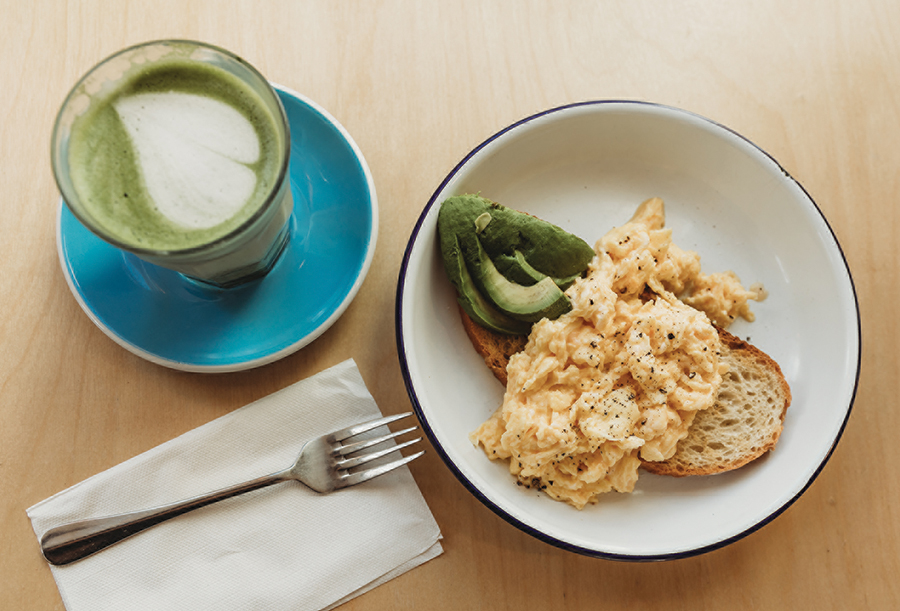
Drift Coffee has done an exquisite job marrying the laid-back feel of Wilmington’s beach community with the city’s upscale tastes in fine coffee and food. The menu is focused and healthy, combining standard breakfast fare with surprises like the Acai Bowl that features house-made granola and the Za’atar Spiced Chicken Sandwich with apple and tomato chutney and a tahini spread on sourdough bread. Drift’s light-filled interior is bright and welcoming with white walls, slate-colored cement floors, and comfortable tables and chairs where people are just as likely to be holding business meetings as catching up with friends.

Khalisa and I ordered some coffee and found seats in a sun-drenched corner. I asked her what had brought her to Wilmington from her native Chicago.

“I wanted to write films,” she says. “And this was the place to do it, so I came to UNCW.”

But it was not long until Khalisa’s passion for writing turned toward poetry, and she found an opportunity to work with activist poets in Greensboro. She left the Port City for an undergraduate degree at North Carolina A&T. A few years after graduating, she found herself in Wilmington again, working in community outreach and programming for the YWCA, leading workshops in writing and diversity training around the city, and eventually discovering the literary and cultural home she had not found as an undergraduate.

The more time Khalisa spent in Wilmington, the more she uncovered painful remnants of the city’s racial strife, strife that is grounded in events like the wrongful convictions of the Wilmington 10 and the 1898 coup d’état, which is the only successful coup in American history and an event that would greatly affect Khalisa’s work as a poet and activist.

While working at the Cameron Art Museum as part of their Kids at Cam initiative, Khalisa met Brittany Patterson, an artist and social worker who had just seen the 1898 documentary Wilmington on Fire. Patterson and Khalisa began a discussion about how to use art to repair the racial rifts that had run through Wilmington for more than a century.

“We wanted to curate something that was a medley of poetry and dance to focus on how 1898 affects people today,” says Rae. But the goal was not simply a performance. “The first thing we did was to have the cast sit in a circle and talk about what it means to be a person of color, what it means to be a white person moving around in spaces with people of color who were all affected by 1898.”

The outcome was the Invisibility Project, a performance that reaches across racial lines and combines dance choreographed by Patterson and spoken word poetry written and performed by Khalisa. The group’s first performance was in 2017, and their work has continued since with a special production to commemorate the 120th anniversary of the 1898 coup.

“It’s been interesting,” she says. “I’ve learned so much about this community, about what certain public spaces mean to certain groups of people, about how the past can push down on you without you understanding why.”

Khalisa and I finished our coffee. Nearly two hours had passed, and our conversation had run from our early fascinations with the written word to our hopes for our city’s racial reconciliation. As we got up to leave I could not help but feel pulled toward her energy and passion. I could say it was gravitational, but perhaps my feelings were anchored by the gravity of this generation’s struggle to reach through Wilmington’s painful past in the hope that, once the fire is out, there will be a hand to grasp.  PS

Wiley Cash lives in Wilmington with his wife and their two daughters. His latest novel, The Last Ballad, is available wherever books are sold.

The Accidental Astrologer

Brilliant and Batty

A cold moon rising ramps things up for the ramped-up December born

By Astrid Stellanova

My Grandpa talked about the Cold Moon, which is what the old-timers used to call the Yule Moon. The Cold Moon falls on December 22, just as Old Man Winter tightens his grip over the Old North State.

So, baby, it’s going to be a cool Yule. Winter Solstice is just 19 hours earlier, with the full moon sitting just above the horizon in a show we won’t forget. What people do forget is how tough it is being a December child and competing with the biggest holiday season of the year.

Brilliant or batty, December babies bring it: Ozzy Osbourne is a December baby. Ditto for Samuel L. Jackson and Taylor Swift. Stalin, Sinatra, Spielberg, Walt Disney, Jane Fonda and Pope Francis, too. That’s the short list. — Ad Astra, Astrid

Sagittarius (November 22–December 21)

Here you are, Birthday Child, with a bucket list that is slap full of ink. Stop making lists and start making memories. After the holidays, go to what calls you: Graceland or Dollywood. Get a gee-tar. Back talk somebody who scares you. Pick a bone with the smartest one in the room. Be too big for your britches. Don’t hold your taters.  Have a hissy fit with a tail on it, or get as nekkid as the day you came into this world and take the Polar Bear Challenge. Just don’t fiddle fart around, ’cause a birthday reminds us to make the time count before we kick that bucket slap over.

Capricorn (December 22–January 19)

You owe a debt to Saint Nick Nack for your love of the holidays. Sugar, nobody can outdo you at the high altar of tackiness. If there is a corner in the house you haven’t put a bow or geegaw on, it wasn’t for lack of trying. Sprinkle all the fairy dust you can; in this big old world, more than a few are grateful to you for the smiles.

Aquarius (January 20–February 18)

Sugar, as much as you want to come clean, this ain’t the time to air your dirty laundry. Things could get nastier, faster. So make nice, bake something yummy for the neighbors and get into the spirit without taking the cap off the spirits.

Pisces (February 19–March 20)

Yes, you have a taste for the good things in life. But Darling, life in a gated community — like, say, a jail — wouldn’t be your cuppa tea. You have got to stop allowing some wild-child impuls es to get the better of you. Take a shine to normal.

Aries (March 21–April 19)

Honey, sometimes you just have to slam the gol dang door! This is that time. You want to believe the best. Someone walked back into your life with sass and attitude. Also, a sense of entitlement. You are being far too kind and generous. 

Taurus (April 20–May 20)

You are on the highway to the danger zone, Baby. Yeah, you want to buy the world a Coke and shower it with love, but try reining in your impulse to pull out the wallet. Splash out on kindness, not dollars and you will be more than loved.

Gemini (May 21–June 20)

True, life can suck.  True, you seem to have managed to jam a straw right down in it and pulled from the very bottom.  Act like you have got some raising, child.  What happened has happened.  As for the sucky part, what you do with it is up to you. 

Cancer (June 21–July 22)

Have fun, but try to be home before zero-dark-thirty. This is no time to be taking chances. Grandpa used to say when you finally get your ducks in a row, first be sure that all of them are yours once you start counting them little tail feathers.

Leo (July 23-August22)

If the saying is true, that there is an ass for every seat, then you are in luck.  You have something important in the wings and need everybody that ever waved or winked at you for support. They will be there, Sugar, both gems and asses, too. 

Virgo (August 23 – September 22)

A dog may bark, but it is definitely not the same as a hyena. And bluebirds know better than to take up with a buzzard and build a nest.  Somebody has already warned you — don’t get into the Jell-O punch at the office party and forget that.

Libra (September 23–October 22)

Cuss and fuss if you want to, but you are going to enjoy the holidays a lot more than you expected.  Keep your superstitions tamped down and your wet shoes out of the oven. Don’t matter what temperature you set them on, shoe leather won’t turn into biscuits.

Scorpio (October 23–November 21)

If you drank act-right juice with the same determination you gulped down the Jack Daniels Root Canal Remedy, you might not have to face the long list of people you have ticked off. Make amends.  Send some fruit baskets. Like Mama said, try to act right.  PS

For years, Astrid Stellanova owned and operated Curl Up and Dye Beauty Salon in the boondocks of North Carolina until arthritic fingers and her popular astrological readings provoked a new career path.

Story of a House December 2018

Same Time, Last Year

A Tudor manor steeped in Yule for a special occasion

By Deborah Salomon     Photographs by John Gessner

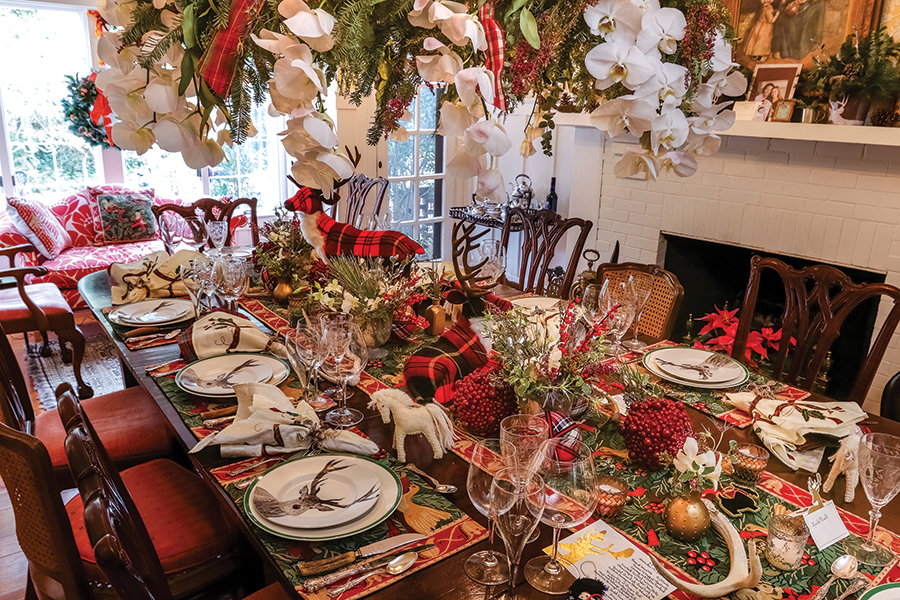
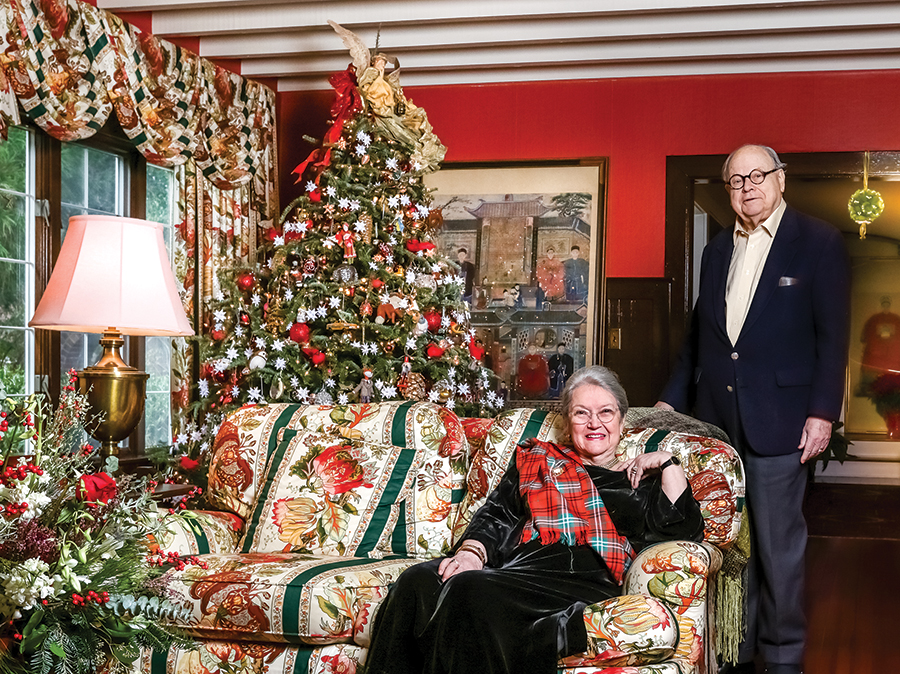
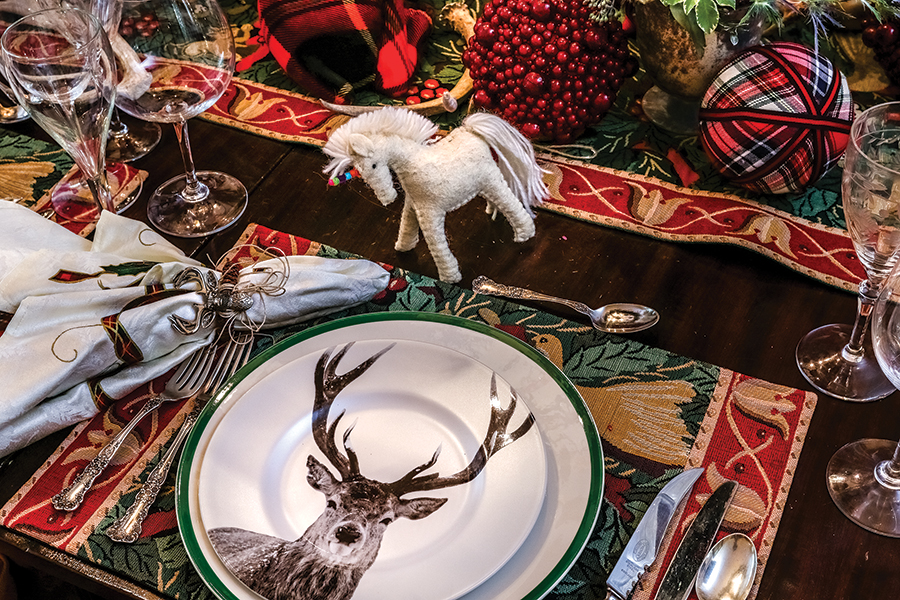
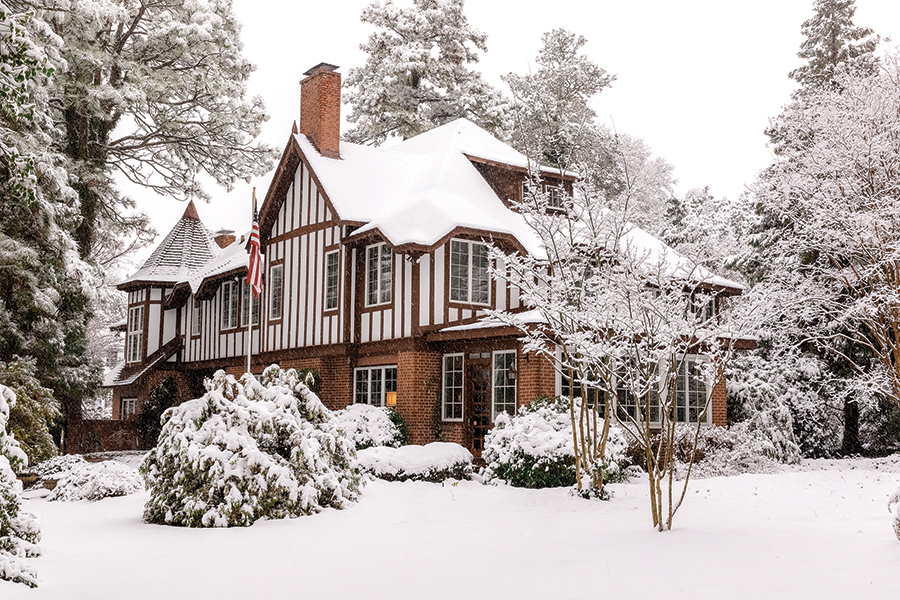
Never again will Le Berceau be as lavishly adorned for Christmas as in 2017: dozens of poinsettias, two fresh Carolina-grown trees, nutcracker guardsman, heirloom ornaments and the piece de resistance, a wreath of white orchids cascading from the dining room chandelier. Thus embellished, Lucille and Jim Buck’s home bearing the French name for cradle — arguably Pinehurst’s most elegant residence — provided the setting for an event Neil Simon could have scripted for Broadway: 10 couples, married to each other for at least 50 years, celebrate with a dinner party near the host’s anniversary date.

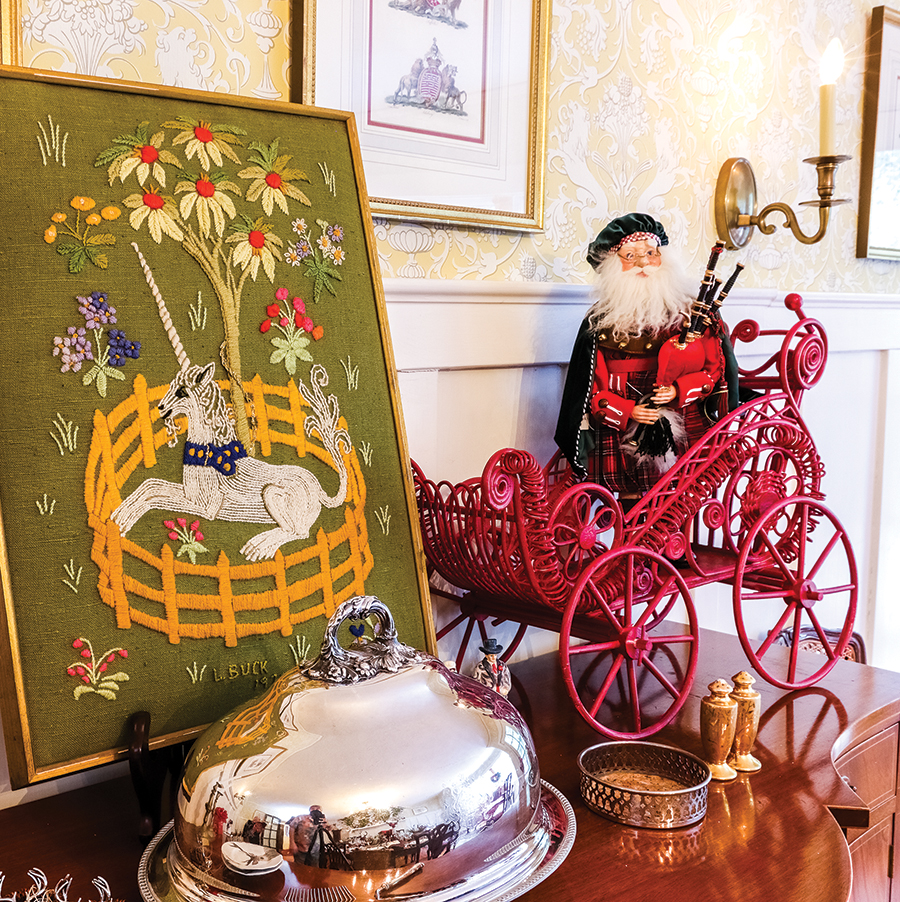
Jim and Lucille were married on Dec. 26, 1960, surrounded by poinsettias. Logical, then, they should go lavish, albeit with a Scottish theme arising from Lucille’s heritage not discovered until moving to North Carolina. She wore her Clan Morrison tartan sash to the black tie dinner. Thistles, the Scottish national flower, appeared in floral arrangements. A bagpiper played during cocktails. Unicorns, the official Scottish beastie, decorated the dining table. The menu, served on Spode Christmas china, debunked the notion that UK food is mostly forgettable: smoked Scottish salmon, roasted quail with Scotch eggs, tenderloin of beef with whiskey sauce, neeps (a root vegetable) and rumbledethumps (cabbage and mashed potatoes), frisée with Scotch vinaigrette and, for dessert, a wedding cake topped with bride and groom, he in kilt, she with an arm reaching around to lift it.

Single malt flowed like beer at Oktoberfest

As Lucille put it: “This was a big deal.”

Guest and “club” member Mary Gozzi elaborated: “OMG awesome, spectacular, so festive I was speechless. I’ve never seen so many orchids in one place. Lucille is a party giver who’s got it down to the jelly beans!”

But a dress is only a dress until draped on a stunning model. Even bare-naked Le Berceau seems Christmas-y, with multiple nooks, seating and dining areas, sun porches, mantels, paned windows, staircases, a tiny telephone cubby begging decoration. The tone is classic with red dominating since, Lucille says, “For Jim it’s either red or ugly.” The elevator bears a touch of Yule, as does the carousel horse prancing on the landing.  Jim’s office, arranged around a desk belonging to movie star Loretta Young, doesn’t escape the red wave. Here resides memorabilia from his career as an attorney, senior vice-president of the New York Stock Exchange and author of its definitive history. Lucille has her “pouting” room hung with accolades from a career in education at fine New York schools.

“I had an absolutely unqualified dream that I would live in a house like this,” Jim decided, as a boy growing up in Ohio.

In 2000, while living in a soigné Manhattan apartment with a house in the Hamptons, they contemplated retirement. But where? Let’s drive over to Pinehurst, they decided, while visiting a daughter who lived in Charlotte.

Lucille fell in love. “I felt at home,” among the longleaf pines, azaleas and gardenias that grew in East Texas, her childhood home. The Tudor-style manse with swimming pool and a servants’ wing suited for guests satisfied Jim’s goal. Imagine that, within sight of the Carolina Hotel.

This central location mattered to its first occupant. James Tufts lured Bostonian Dr. Myron Marr to Pinehurst, as resort physician. The house, designed by a Boston architect and built in 1921, probably sweetened the deal for the Marr family, who remained there until the 1950s. The Bucks are only the fourth owners.

Their imprint on the house, however, is indelible, starting with the walls, wallpapered throughout. Not just commonplace florals and geometrics. In the kitchen, giant Delft-blue platters against a red background reflect the blue Viking range. Fashion drawings for a granddaughter’s bedroom, English teacups for Lucille’s dressing room, birds in the laundry room, a rubber ducky bathroom, toile and Asian motifs in the master and other bedrooms. In the salon, especially for Jim, a solid red textured paper provides a backdrop for sofas covered in a red, cream and green Brunschwig et Fils fabric chosen by Jackie Kennedy’s White House interior designer for Brooke Astor’s library.

“I’ve had my eye on that fabric for years,” Lucille says, but only now found a suitable setting.

The Bucks’ Christmas ornaments and decorations form a family scrapbook of places and events. Into the hand of a tall nutcracker (a window decoration purchased from a store going out of business) Lucille would tuck tickets to the ballet at Lincoln Center for their daughters, who eventually danced in the Christmas production. A grandson later danced the part of Fritz, garnering a glowing review in The New York Times, which Lucille proudly reads aloud.

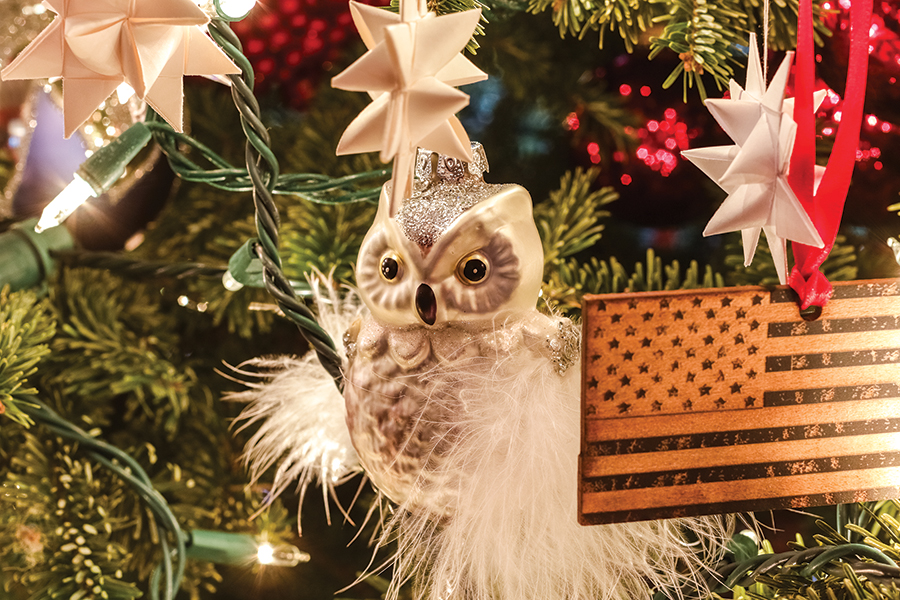
Then, the prank concerning green balls on the tree — Lucille’s choice — which the Bucks’ son said didn’t show up well enough. Through a complicated long-distance adventure that included snitching a giant green ball from the trunk of his parents’ car and hanging it from the top of the house on the Fourth of July, Lucille was proven wrong. Now, Moravian stars, pine cones and cardinals represent their relocation to North Carolina.

“In every house we’ve lived in, I always wanted a bigger Christmas tree — to touch the ceiling,” Jim says. Lucille decorates the tall living room tree and a smaller one in the bedroom, needing help only with attaching the angel on top. She commemorates Jim’s Swedish background with a Santa Lucia doll wearing a crown of candles — but marinated herring isn’t for Christmas dinner.

Christmas holds one poignant memory for Lucille:
“My mother and father took me into the woods to cut a tree . . . it was a great outing. One time we even chose a holly (bush).” Lucille’s father died when she was 12. “The year after that our minister went with us, so I wouldn’t miss it.”

Their decorations remain in place until Feast of the Epiphany, Jan. 6.

But last year, overriding all memorabilia and decor, was that wreath of anniversary orchids — a veritable canopy over the dining room table — designed and implemented by Carol Dowd of Botanicals. “We started planning in July,” Dowd says, inspired by a hanging orchid arrangement Lucille remembered from a dinner party in New York. Surprisingly, the two dozen white orchids, FedExed from Miami, proved long-lasting with only water tubes. The wreath hung for more than two weeks. More important, rather than obstructing guests’ sightline, the wreath, suspended over a low centerpiece, created a bower effect.

What a Christmas. What memories. “My Scottish heritage found me,” Lucille says. Sharing it with close friends was a blessing. “We’re the same generation. We’ve lived this long and have been successful, career-wise and in marriage. The party was a big job but I didn’t mind. In fact, it invigorated me.” PS

PinePitch

Open House Tours

Enjoy the beautiful decorations and holiday music in the Great Room at Weymouth Center for the Arts & Humanities, 555 E. Connecticut Ave., Southern Pines, from Thursday, Dec. 6 though Saturday, Dec. 8 from 10 a.m. to 3 p.m. and on Sunday, Dec. 9 from 11 a.m. to 2 p.m. The cost is $20 in advance, $25 at the door. Tickets are available at www.ticketmesandhills. Also decked out for the season, the Shaw House, Garner House and Sanders Cabin will be open to visitors from Friday, Dec. 7 to Sunday, Dec. 9 from 1-4 p.m. at the corner of Broad St. and Morganton Road in Southern Pines. For more information call (910) 692-2051 or visit www.moorehistory.com.

Carriage Parade

The members of the Moore County Driving Club decorate their horses and carriages for a spectacular holiday season drive through downtown Southern Pines. The parade begins at 1 p.m. on Saturday, Dec. 8.  For further information go to www.moorecountydrivingclub.net.

Winter Wonderland

Celebrate the New Year early and often with live music, carnival games, face painting and the countdown to the Pinecone Drop on Dec. 31 in downtown Southern Pines from 6-8 p.m. For more information call (910) 692-7376 or go to www.southernpines.net/136/Recreation-Parks.

Handel’s Messiah

The Carolina Philharmonic will celebrate the season with Handel’s Messiah, a moving musical portrait of the birth of Christ, from 7:30-8:45 p.m. at Lee Auditorium, Pinecrest High School, 250 Voit Gilmore Lane in Southern Pines on Monday, Dec. 17. For additional information call (910) 687-0287 or visit www.carolinaphil.org.

Tour of Homes

Visit six homes decorated in holiday splendor during the Episcopal Day School Candlelight Tour of Homes from 1-5 p.m. on Sunday, Dec. 9. Tickets are $20 in advance; $25 the day of. For information call (910) 692-3492 or visit www.epicopalday.org.

It’s a Party

The Country Bookshop is turning 65 and wants to turn back the clock, too. Help celebrate the occasion with a 1950s theme on Thursday, Dec. 6 from 6-8:30 p.m. The event kicks off at the The Country Bookshop, 140 N.W. Broad Street in Southern Pines and continues just down the road at 305 Trackside. The cost is $25. For tickets and more information go to www.ticketmesandhills.com.

Everyone Loves a Parade

The Aberdeen Christmas parade takes place on Saturday, Dec. 8 from 11 a.m. to noon in downtown Aberdeen, 115 North Poplar Street. If Santa needs directions he can call (910) 944-7275 or go online at www.townofaberdeen.net.

It’s a Very Murphy Christmas

Come and enjoy the Murphy Family Christmas Concert, a Sandhills tradition, on Sunday, Dec. 9 at 3 p.m. at the Sunrise Theater, 244 N.W. Broad St., Southern Pines. For more information call (910) 692-3611 or go to www.sunrisetheater.com.

The Rooster’s Wife

Sunday, Dec. 2: The Grandsons, an eclectic whirlpool of New Orleans rhythm and blues, rockabilly, swing and country two-steps. Cost: $20.

Friday, Dec. 7: Matt Munisteri and Sam Lewis. Munisteri is a sparkling guitarist, critically lauded songwriter and nimble lyricist while Lewis’ songs work to celebrate and elevate with the tones of rock and roll, rhythm and blues and country folk. Cost: $20.

Sunday, Dec. 9: The Gravy Boys, a band that makes acoustic Americana music by adding a cup of country, a pinch of roots rock, a handful of honky-tonk, a splash of bluegrass, a dash of hobo folk and stirring vigorously. Cost: $10

Sunday, Dec. 16: Martha Bassett Holiday Special. Classically trained, Bassett is blessed with a crystalline tone, a remarkable range and sultry delivery. Her performances are known for their emotional honesty and visceral impact. Cost: $20.

Doors open at 6 p.m. and music begins at 6:46 at the Poplar Knight Spot, 114 Knight St., Aberdeen. Prices above are for members. Annual memberships are $5 and available online or at the door. For more information call (910) 944-7502 or visit www.theroosterswife.org.

Simple Life

Silent Nights

Holding infinity in the palms of our hands

By Jim Dodson

When I was a kid, Christmas Eve couldn’t get here fast enough, the night I eagerly awaited all year. Mine was a visceral excitement fueled in part by the happy torture of unopened gifts beneath a heavily tinseled fir tree, and the crazy notion that if and when I somehow dropped off to sleep, a jolly bearded housebreaker would enter our premises and leave behind fantastic things I’d coveted from the pages of America’s holiest book — the Sears Catalog.

My excitement was also fueled by the other mythic theme of that singular night — the enchantment of a candlelight church service that always ended with congregants passing a small flame hand-to-hand as everyone sang “Silent Night” before filing out into a cold and silent night.

The flickering candles, the mingling scents of burning wax and well-worn hymnals, the ancient readings from Isaiah and St. Luke of a savior babe born in a barnyard stable, the sight of whole families bundled into creaking pews with squirming kids and yawning grandpas, O Magnum Mysterium — somehow it blended together into a delicious stew of magic and wonder that I felt — nay, believed — in my very bones. To this day, it’s the only time I intentionally stay up past midnight, stepping outside with a wee nightcap of bourbon or aged port to savor what may be the truest of silent nights.

Biblical scholars have long debated (and most disputed) the commonly assigned date of the historical Jesus’ birth (neither Luke nor Matthew makes mention of it happening in winter), leaving believers to accept the early Roman Church’s artful grafting of the birth of Jesus Christ onto pagan Rome’s popular feast of Saturnalia, a major holiday that coincided with the winter solstice that was known for its feasting and gift-giving in celebration of the returning of the sun god, Sol Invictus. For what it’s worth, ancient Persians assigned that same day, December 25, to be the birthday of their own returning sun god, Mithra. While in the Hebrew Calendar, the celebration of Hanukkah — the “Festival of Lights” that memorializes the restoration of the Second Temple of Jerusalem following a revolt by the Maccabeans and the miracle of a menorah that burned for eight days — begins on the 25th day of Kislev, which happens to fall anywhere from late November to late December in the Gregorian calendar. Just to make things more interesting, the Eastern Orthodox Christian Church accepts January 7 as the true birth date of Jesus Christ, the proper date of “Old Christmas.” Some leading Biblical scholars even maintain that the birthdate of Christ was in March, the start of spring.

Whatever else might be true, the Christmas-loving kid in me has never required a proof-of-authenticity label or even an official “start” date in order to believe in the transformative magic of the holiday season — whether it’s the lights of Hanukkah or lovely myth of Father Christmas or even lovelier myth of a virgin birth in a barn.

I embrace the true meaning of the word “myth,” by the way, an ancient word that has been stripped of its spiritual power by modern misuse, originally denoting a traditional story meant to convey an important message, often based on historical events, revealing an important belief, practice or phenomenon — all of which perfectly explains why we human seek the light in whatever form on the longest nights of the year.

Here’s my own favorite Christmas story.

During the years we lived on a wooded hill in Maine — deep in a forest of birch and hemlock that almost always had a dusting of snow by Christmas Eve — the Episcopal church we attended put special emphasis on its annual Christmas Eve pageant, an ambitious staging of the Nativity complete with angels, wise men and watchful shepherds guarding their flocks by night.

One year our prodigies, Maggie and Jack, snagged important roles as attending sheep, while my good friend and regular lunch pal, Colonel Robert Day, debuted as the archangel Gabriel. Colonel Bob was an ideal Gabriel, a lovely giant of a gent who’d lost two sons through tragedy and disease but somehow turned his unspeakable grief into counseling families grappling with their own personal tragedies.

In his former life, Bob had been one of the first to lead his unit of army engineers across the Rhine into Nazi Germany during the closing days of the Second World War and was on his way to lead a similar invasion into Japan when the Japanese capitulated. The rest of his military career was spent at the U.S. Military Academy at West Point, where he served as admissions director for many years, laying the foundation for the admission of women to the Academy.

Someone kitted out Colonel Bob with a massive pair of papier mâché wings for the pageant, which he sported with the dignity of Laurence Olivier until one wing detached and conked one of the baby cows on the head, bowling over the poor little creature. For a moment, the glory of Jesus’ birth was upstaged by anxious gasps as the little cow was righted and Bossie’s head removed. Beneath was a laughing kid. The audience broke into spontaneous applause. The kid-cow beamed. “Now that’s a small miracle,” one of the sheep-moms whispered to me with relief. And onward we went to the big finale of gifts from the Magi.

That particular year, the Christmas Eve family service that followed was held at the Settlemeyer family’s barn in the hills west of town. The Settlemeyers had real sheep and cows and a horse or two that were undoubtedly amused by the dozens of shivering families that crowded into their freezing barn to light candles and hear about a savior being born on a Midnight Clear. It was my job, as it happened, to provide the musical accompaniment on my guitar, fingers stiff with cold. Fortunately Colonel Bob showed up with a flask of good Irish whiskey. As a live chorus of sheep bleated, I plucked out a respectable “First Noel” followed by “Hark, the Herald Angels Sing!” and “Silent Night” as candlelight passed from hand to hand, illuminating one face at a time.

Up to that moment, worth noting, it had been a snowless winter in Maine — always an anxious thing for the locals (and yours truly) who counted on decent snows to insulate their foundations and garden beds and provide a pristine landscape for their favorite wintertime activities.

But as we blew out candles and stepped out of the Settlemeyers’ barn, a second small miracle took place — or maybe just good theatrical timing by the universe.

“Look, everybody,” someone cried, “it’s snowing!”

Indeed it was — a curtain of beautiful silent snow falling like an answered prayer over the darkened landscape. During the short drive home, my ever-wise lamb of a daughter wondered if the sudden appearance of snow might really be a miracle.

“Absolutely,” I assured her with the faith of a mustard seed, recalling Albert Einstein’s quote that there are two ways to live your life — as if there’s no such thing as miracles, or that everything is a miracle.

For the record, a third miracle occurred that silent night, one involving her proud papa and brilliant Scottish grandmother, Kate, a professed agnostic who cried once when I took her to Evensong at King’s College in Cambridge. I nicknamed her our “Queen Mum.” Together, we managed to put together a German dollhouse that looked more like a Rhine river castle and came in 4,000 pieces with a dozen pages of instructions in medieval German. In truth, I abandoned the quest around 2 a.m. leaving Mum to her third pot of tea, the rest of the Drambuie and a dying fire. I was certain the task was beyond us both.

In the morning, however, Maggie’s dollhouse looked worthy of a Fifth Avenue toy shop window.

“How’d you do that?” I discreetly quizzed the Queen Mum.

“The power of faith, James,” she came back with a prim smile. “And good Scottish tea.”

Sadly, I think the town fire marshal may have put the kibosh on any more Christmas candlelight services in a livestock barn, that old spoilsport. But I carry the sweetest memories of many such Silent Nights in my heart, that one above the rest.

Like Einstein, you see, I’ve come to believe everything is a small miracle — the oil that lighted lamps for eight days, a prince of peace born in a freezing stable, an angel with a broken wing who mended broken hearts, an agnostic’s tears and people of every race and creed who gather on the darkest night to celebrate the return of the light.

Besides, as Mother Theresa reportedly pointed out, nothing is small to God — only infinite. PS

Contact Editor Jim Dodson at jim@thepilot.com.

A Holiday Season of Suggestions

The New Yorker Encyclopedia of Cartoons: A Semi-Serious A-To-Z Archive, by Bob Mankoff

This is a huge, literally, two volume, 1,600-page hardcover set with a beautiful red slipcover box — the ultimate collection for the witty irreverent person in your life. Mankoff, the cartoon editor of The New Yorker for two decades, organizes nearly 3,000 cartoons from 1924 to the present into more than 250 categories of recurring themes and visual tropes, including banana peels, meeting St. Peter, being stranded on a desert island, snowmen, lion tamers, Adam and Eve, the Grim Reaper and, of course, dogs. The result is hilarious and Mankoff’s commentary throughout adds both depth and whimsy. The collection includes a foreword by New Yorker editor David Remnick.

Smithsonian: History of the World Map by Map

More than 140 detailed maps tell the story of pivotal episodes in world history, from the first human migrations out of Africa to the space race. Broad, sweeping introductions provide a chance to step back and look at entire periods, like World War II, or to explore overarching themes, like the Industrial Revolution. Custom regional and global maps chart how events traced patterns on land and ocean — patterns of exploration, discovery or conquest that created empires, colonies, or theaters of war.

Hip Hops: Poems about Beer, edited by Christoph Keller

From the ancient “Hymn to Ninkasi” (the Sumerian goddess of beer) to eighth century Chinese poet Li Bai’s “Bring in the Ale” to Robert Graves’ “Strong Beer,” the poems attest to humankind’s long attraction to the foamy and intoxicating product of malted grains. A surprising variety of poets have penned tributes to the brew; their tantalizing offerings include Robert Burns’ “John Barleycorn,” Edgar Allan Poe’s “Lines on Ale,” Frank O’Hara’s “Beer for Breakfast,” Sylvia Plath’s “The Beer Tastes Good,” Muriel Rukeyser’s “Beer and Bacon,” and Tom Waits’ “Warm Beer and Cold Women.” Whether pulling up to the celestial bar in Keats’ “Mermaid Tavern” or to the grittier, jazzier one in Carl Sandburg’s “Honky Tonk in Cleveland, Ohio” (where “the cartoonists weep in their beer”), lovers of beer and poetry are sure to find something to celebrate in these tantalizing pages.

Money Diaries: Everything You’ve Ever Wanted to Know about your Finances . . . and Everyone Else’s,
by Lindsey Stanberry

The most popular and beloved Refinery29 franchise, Money Diaries combines the very best of the work and money content their readers know and love — the fun voyeurism of all-new diaries combined with 52 weekly challenges and high-quality advice from some of the best female financial advisers around. Complete with worksheets, this is the go-to financial guide for millennial women.

The Hidden Life of Trees: The Illustrated Edition, by Peter Wohlleben

With compelling selections from the original book and stunning, large-format photographs of trees from around the world, this gorgeous volume distills the essence of Wohlleben’s message, showing trees in all their glory and diversity. Through rich language highlighting the interconnectedness of forest ecosystems, the book offers fascinating insights about the “wood wide web,” the difficult life lessons learned in tree school, the hard-working natural cleanup crews that recycle dying trees, and much more. Beautiful images provide the perfect complement to Wohlleben’s words, with striking close-ups of bark and seeds, panoramas of vast expanses of green, and a unique look at what is believed to be the oldest tree on the planet.

The Spy and The Traitor: The Greatest Espionage Story of the Cold War, by Ben Macintyre

If anyone could be considered a Russian counterpart to the infamous British double agent Kim Philby, it was Oleg Gordievsky. The son of two KGB agents and the product of the best Soviet institutions, the savvy, sophisticated Gordievsky grew to see his nation’s communism as both criminal and philistine. He took his first posting for Russian intelligence in 1968 and eventually became the Soviet Union’s top man in London, but from 1973 on he was secretly working for MI6. For nearly a decade, as the Cold War reached its twilight, Gordievsky helped the West turn the tables on the KGB, exposing Russian spies and helping to foil countless intelligence plots. Desperate to keep the circle of trust close, MI6 never revealed Gordievsky’s name to its counterparts in the CIA, which in turn grew obsessed with figuring out the identity of Britain’s obviously top-level source. Their obsession ultimately doomed Gordievsky — the CIA officer assigned to identify him was none other than Aldrich Ames, the man who would become infamous for secretly spying for the Soviets. “The best true spy story I ever read,” says John Le Carré.

The Tango War: The Struggle for the Hearts, Minds and Riches of Latin America During World War II, by Mary Jo McConahay

A flow of raw materials in the Southern Hemisphere — at a high cost in lives — was key to ensuring Allied victory, as were military bases supporting the North African campaign, the Battle of the Atlantic, the invasion of Sicily, and fending off attacks on the Panama Canal. As rival spy networks shadowed each other across the continent, the Allies secured loyalty through espionage and diplomacy ― including help from Hollywood and Mickey Mouse. Mexican pilots flew in the Philippines and 25,000 Brazilians breached the Gothic Line in Italy. The Tango War also describes the machinations behind the greatest mass flight of criminals of the 20th century, fascists with blood on their hands who escaped to the Americas. A true, shocking account that reads like a thriller.

Becoming Mrs. Lewis, by Patti Callahan

When poet and writer Joy Davidman began writing letters to C. S. Lewis, she was looking for spiritual answers, not love. Everything about Joy seemed ill-matched for an Oxford don and the beloved writer of Narnia, yet their minds bonded over their letters. Embarking on the adventure of her life, Joy, the woman Lewis called “my whole world,” traveled from New York to England and back, facing heartbreak and poverty, discovering friendship and faith and, against all odds, finding a love that even the threat of death couldn’t destroy.

CHILDREN’S BOOKS

The Broken Ornament, by Tony Di Terilizzi

Every family has a favorite holiday decorating story — the time the cat climbed the tree or Dad fell in the bushes hanging lights. The Broken Ornament stemmed from a DiTerlizzi family Christmas when his daughter broke a holiday ornament and learned the truth: When a beloved ornament is broken, a Christmas fairy is born. Sure to be a holiday classic, The Broken Ornament should be the first request on every Christmas list this year. Children and their families are invited to join New York Times best-selling and Caldecott Honor-winning author/illustrator Tony DiTerlizzi on Thursday, Dec. 6, at 4 p.m. for an ornament making workshop and Ugly Sweater Contest at The Country Bookshop. (Ages 3-10.)

Harold Loves His Woolly Hat, by Vern Klosky

Harold loves his woolly hat so much because he knows having it makes him special among all the bears. So when his hat is stolen, Harold pulls out all the stops to retrieve it . . . until he discovers someone else needs hit more than him. A sweet story of sharing, giving and letting go, Harold Loves his Woolly Hat is perfect for holiday giving. (Ages 3-6.)

The Atlas Obscura Explorer’s Guide for the World’s Most Adventurous Kid, by Dylan Thuras, Rosemary Mosco and Joy Ang.

With its cataloging of the weirdest and wildest places on Earth, the original Atlas Obscura absolutely changed the way people travel. Now adventurous kids have a chance to get in on the fun. Arranged in categories to allow kids to dig deeply into the strange and wonderful, Atlas Obscura Explorers Guide will be the hottest thing for young readers this fall. (Ages 6-12.)

Dry, by Neil Schusterman

If the human body is 60 percent water, just what exactly is the rest? The remainder is determination and steadfastness and loyalty and the will to live. The remainder is hope. When the “tap out,” the complete drying up of all water sources, happens one California afternoon, the lives of five kids — a brother and sister, a survivalist, a genius loner and a rogue — are forever changed. Mesmerizing, fast-paced and terrifying in its realistic possibility Dry will awaken appreciation for functioning kitchen water spigots and awareness of global climate change for a long, long time. (Ages 14 and up.)  PS

Compiled by Kimberly Daniels Taws and Angie Tally.

Good Natured

Frankincense and Myrrh

Gifts of the Magi that keep on giving

By Karen Frye

Whatever your religion, you most likely know the story of the three Wise Men who followed the star to the manger in Bethlehem the night Jesus was born. Two of the precious gifts they brought with them were frankincense and myrrh. Thousands of years ago, these herbs were worth as much as silver and gold, and they’ve retained their value, medicinally and spiritually.

The popularity of aromatherapy and the great success stories using the oils and extracts are well known. Myrrh is extracted from the Mukul myrrh tree, which grows in dry climates in the Middle East. The myrrh gum is used in preparations for teeth, gums and skin conditions. In Ayurvedic medicine (native to India) the extract from the myrrh, “gugul,” is especially effective for lowering bad cholesterol and improving the function of the thyroid gland.

Frankincense oil is prepared using hardened gum resins from the Boswellia sacra, a tree native to India, Africa and the Middle East. One of the main components of frankincense oil is boswellia, an herb with major anti-inflammatory properties. Boswellia (as a supplement) has been around a very long time and, while it isn’t as well known for its anti-inflammatory power as turmeric, it’s certainly on the way.

Inflammation doesn’t just cause joint pain; it contributes to disease throughout the body, including cancer and heart disease. In the case of asthma, allergies, bronchitis and chronic obstructive pulmonary disease, boswellia helps reduce inflammation in the lungs. Inflammation damages our brain cells, and may increase the risk of developing Alzheimer’s disease. Taking boswellia may boost brain function, as well as reduce inflammation. In addition to quelling joint pain, there are benefits to the digestive tract, assisting in relief from irritable bowel syndrome, colitis, even rheumatoid arthritis.

Frankincense oil is a lovely fragrance that has been used throughout the ages in perfumes. Its warm, pungent, sweet notes bring about feelings of peace and balance, helping to ease anxiety. Cleopatra is thought to have used frankincense oil in her beauty regimen. The pure oil used topically has been found to improve skin conditions. Frankincense is one of the most effective oils for skin care with remarkable rejuvenating and healing properties.

These gifts given many, many years ago are now gifts for those who seek better health through the wonders of nature. May you have a wonderful holiday season filled with peace, love and laughter.  PS

Karen Frye is the owner and founder of Nature’s Own and teaches yoga at the Bikram Yoga Studio.

Pleasures of Life

The Look

With a little help from my friends

By Beth MacDonald

You know those characters on the TV show Alien Nation? You know how, at first, you can’t quite put your finger on what’s missing, but then you realize they have no eyebrows? I, too, have several rather invisible features that throw off the aesthetics of a face. Since I have a fair complexion and very blonde hair, my eyebrows and eyelashes are imperceptible without a little AA, artificial assistance. When I apply even a light layer of makeup I often find myself narrating the process like a National Geographic documentary. “Here we see the one-eyed morning sloth searching for light hairs to shade in for others to see. The furrowed brow means the female of the species is frustrated, unable to locate any indigenous hairs.” If I don’t go through the process of trying to make these features evident to other humans, I am frequently mistaken for a 19th century influenza patient that won’t make it through the winter.

That’s just the beginning. My hair is unruly in its natural state, with so many irregular curls that it serves as a near-perfect hair hygrometer. Scientific tools aren’t required anywhere within my ZIP code since my head produces uncannily accurate relative humidity readings. I often try to soften the look by essentially destroying it with a straightening iron set on “nuclear power” mode. 

A friend invited me to one of those parties most of us have reluctantly supported where you are gathered for a demonstration of the best cookware, makeup, leggings, and home/car organization kits that will all simplify and improve your life and looks. This particular party was an amalgam of all of those salespeople selling their cutting-edge wares, turning my friend’s home into a virtual department store. I didn’t want to go because I already have four of most these items. I just wanted to sit at home in my buttery leggings, eating 5-minute fondue from my state of the art, personalized pot, while wearing the only vegan-organic-coconut-volcano-cherry-seaweed face mask on the market that would get rid of my wrinkles-lift my eyelids-plump my lips-strengthen my marriage, while I binge watch Netflix.

I tried to stick to the snack table, where I’m most comfortable, for long periods of time, but the makeup lady found me.  She must have taken one look at my sickly face and thought she should rescue me from “the ugly.” I relented and followed her to the other side of the living room/department store. I observed a moment of insanity, when I considered the necessity of a 137th finely woven pair of leggings.

I sat down in her chair as she read off an extensive list of makeover options ending with “natural bronze goddess.” I chose that one. Who doesn’t want that look? I’m pretty sure no one walks up for a makeover and says, “I’ll have the ‘pale haunted house clown face’ please.”

After an eternity (measured by increasing back pain in the uncomfortable chair, not actual real time) she was finished. She handed me a mirror to see my new, improved look. I tried to keep a straight face. I politely thanked her, hoping she couldn’t hear the horrified squeak in my voice. Blue eye shadow, bright pink cheeks, and red lipstick were not what I imagined a “natural bronzed goddess” looked like unless she was named Chuckie.

I made a mistake by going with a friend who drove, leaving me no easy escape option. I was waiting outside, hiding behind her car when she came out eons later, measured in beauty chair-time. On the way home she decided it would be a good idea to chain smoke with her windows shut. I opened my window to catch some fresh air approximately 15 seconds before a torrential downpour hit. I couldn’t close the window fast enough. I was in a lose-lose situation. Failure was not an option; it was a certainty.

At home, I realized I had forgotten my keys, and had to ring the doorbell. As I waited for my husband, Mason, to answer the door, I felt around my now sticky, wet face and knotted hair. Eau d’Ashtray was overpowering the Chanel No. 5 I had put on earlier. I looked like Dee Snider from Twisted Sister getting off his party bus. My husband opened the door and stared at me, wide-eyed.

“Sir, do you have a moment to hear my testimony of the greatest poet of our time, Alice Cooper?” I asked.  PS

Beth MacDonald is a Southern Pines suburban misadventurer that likes to make words up. She loves to travel with her family and read everything she can.

Birdwatch

O, Tannen-Bird!

The feisty red-breasted nuthatch flocks to North Carolina’s evergreens in winter

By Susan Campbell

Every few years, certain species of birds show up in the South when their food supply to the north becomes scant. This winter seems to be one of those years for the red-breasted nuthatch. Weighing in at only a few ounces, these feisty songbirds travel in small groups, typically moving during the cooler months from Canada’s 1.5-billion-acre boreal forests into the northern coniferous forests of the United States. As long as they can find enough seeds to sustain them through the season, they may not travel very far. But this fall, the red-breasteds’ favorites, found in spruce and fir cones, are already hard to come by. Therefore, they have begun to move well southward in search of suitable alternatives and can now be found in forested areas across North Carolina.

Red-breasted nuthatches are easy to recognize with their white eyebrows and rusty colored undersides. Like all nuthatches, they have gray backs and short legs and tails, along with a distinctive pointed, upturned bill. It’s great fun watching these birds crawling forward, sideways or upside down in search of food. And they are experts at clinging on the tippy-tops of branches as they hunt for their next meal. Strong legs and sharp claws enable red-breasteds to navigate the challenging terrain of evergreens, and their specialized bills work well to pry out seeds that other birds cannot reach. They adeptly are able to ferret out seeds from the smaller cones of cedars, hemlocks and larches. Here in our area, the sizable cones of loblolly and longleaf are easy pickings for these ravenous little birds.

This species has a very distinct vocalization, like its cousins, the white-breasted and brown-headed nuthatches, which are common here in the Sandhills and Piedmont. Red-breasted nuthatches do not sing but rather call frequently. Listen for a horn-like “yank, yank” coming from the treetops. You are much more likely to hear this bird before you see it. But individuals may be mixed in with chickadees and titmice traveling through the area. Any location with abundant pines, such as Weymouth Woods Sandhills Nature Preserve or the edge of Fort Bragg or the Sandhills Game Lands, is prime territory for these little birds from now through February. I am hoping that our winter banding activities will include capture of at least a few individuals in the next couple of months. We have only been fortunate enough to study a couple close-up one winter in 2012, which was the last big invasion of the species this far south.

Red-breasted nuthatches readily do come to bird feeders. They are attracted to oil-rich sunflower seed above all else. They will, however, also take advantage of suet especially if it contains peanut butter (as mine always does). You may find them attempting to monopolize your feeding station and bullying other birds — even larger birds such as cardinals. Defending food sources is a big part of daily life for these small guys and gals who year round live much of their lives on the edge. Regardless, I am looking forward to a few of these winter visitors finding my offerings this winter.  Their colorful appearance and feisty behavior always make me smile.  PS

Susan would love to receive your wildlife sightings and photos. She can be contacted by email at susan@ncaves.com.