Our Christmas Sing

Our Christmas Sing

A tradition that measures the years

By Margaret Maron     Illustrations by Laurel Holden

John thought it was probably the Christmas of 1978.

Scott said, “No, I think it was earlier.”

“Maybe 1976?” asked Celeste.

Carlette thought that sounded about right.

After hearing them puzzle over when it all began, I finally went through some of my old journals and found this entry: “First time all five Honeycutts here for dinner since the summer. By candlelight, firelight, and tree lights, we sang carols till midnight.”

It was December 23, 1977.

As farm girls growing up amid the tobacco fields of Johnston County, Sue Honeycutt and I had sung in our church choir. I can carry a tune as long as it is pitched no higher than B♭, but Sue’s voice soared like an angel’s. 

After school and marriage, we were separated first by an ocean and then hundreds of land miles, yet we kept in touch; and once my husband and I moved down to the family farm where I grew up, the friendship became even stronger.

There were eight of us that first Christmas: Sue and her husband, Carl, had two nearly-grown daughters and a teenage son; my husband and I had a 13-year-old boy. That evening together had been so much fun that we did it again the following December.

Do something twice in the South and it immediately becomes a tradition. The first three or four years, our ritual was to sing every seasonal song we could remember, from “Silent Night” to “Silver Bells” to “I Saw Mommy Kissing Santa Claus,” followed by a sit-down dinner, and ending in an exchange of gifts. We eventually scrapped the gift exchange — boring and too time-consuming. Instead, everyone is now encouraged to perform a party piece.

This might be a dramatic scene from a school play, an original comic skit with hand puppets, an operatic aria by a granddaughter who has inherited Sue’s voice, or a Christmas poem. (I have to be restrained from reading A.A. Milne’s “King John’s Christmas” every year.) Early on, our sons made us laugh with their take on the classic “Who’s On First?” routine. This past year, Sue’s 6-year-old great-granddaughter donned a blue shawl and shyly mimed “Mary, Did You Know?” When her father was that age, he came with a stash of Christmas riddles: “What do snowmen eat for breakfast? Frosted Flakes, of course.”

Getting measured soon became another part of the tradition. One end of our kitchen wall is thick with dated lines that mark the years. Off come the shoes and everyone who’s still growing stands up straight, heels against the baseboard. A granddaughter will proudly announce that she’s grown two full inches since last year, while her cousin is delighted to see that he’s almost as tall as his uncle was when that uncle was 10 years old. Sue and Carl’s newest great-grandchild went on the wall this past Christmas. She was only six weeks old and her daddy had to straighten out her little frog legs to get an approximate measure.

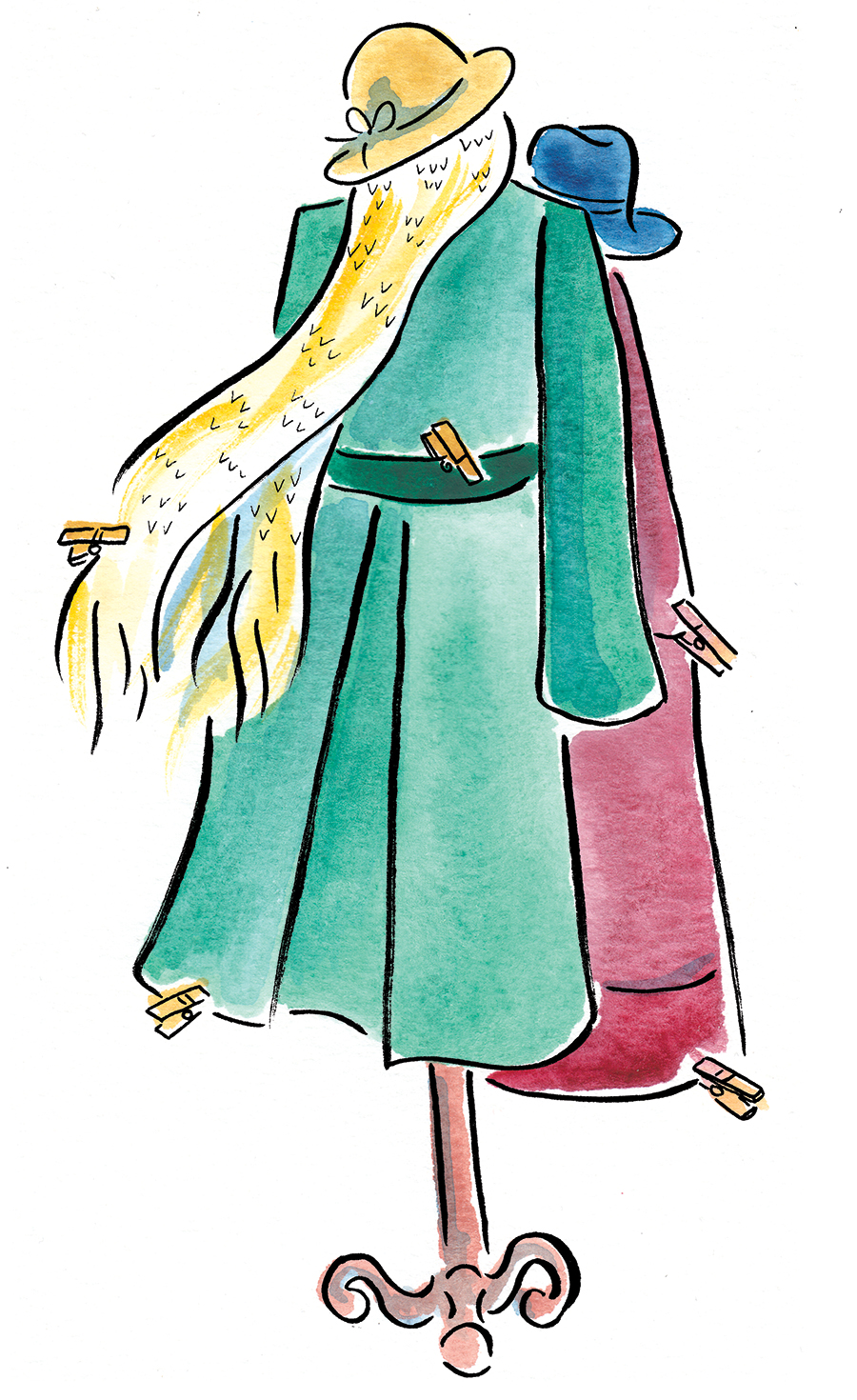
For several years, as people began to put on coats and hats and look for their car keys, the evening would wind down with a child’s whisper, “Is it time to get silly yet?” I would nod and slip her a handful of clothespins, which she quickly shared with equally mischievous cousins. Looking like innocent angels, they maneuvered among their elders, surreptitiously clipping a clothespin on the back of an uncle’s shirt, a grandparent’s sleeve, the hem of an aunt’s skirt. Soon everyone would be laughing and slapping their clothes to find the clothespin, which they immediately transferred to someone else’s scarf or hat. More than one clothespin went home on the coattail of an unsuspecting victim.

There are 26 of us now and our sit-down dinner has devolved into little plates of finger foods. The meal still ends with coffee and a Yule log elaborately decorated with meringue mushrooms, but I’ve passed the recipe on to our older granddaughter.

Some songs are dropped as new ones are added, but we’ll never drop “The Twelve Days of Christmas.” Everyone joins in on all the words except for the “gift” itself, which becomes a solo or duet, depending on how many people are here. Early on, Carl croaked out “two turtledoves” in a distinctly tone-deaf baritone, which so cracked us up that he was awarded permanent possession of the second day. With her beautiful voice, Sue was a natural for “five golden rings.” The rest of us split up the remaining days in no particular order, although my husband is rather fond of “three French hens.”

Carl left us last year and his pitch-perfect son inherited those two turtledoves. It breaks our hearts to know that this year someone else will have to sing Sue’s five golden rings. It will be a bittersweet continuation and more than one pair of eyes will glisten in the candlelight.

But laughter has always been a huge part of our tradition, too. As the first generation of grandchildren matured, their slapstick silliness faded away, but two of Sue and Carl’s great-grandchildren are now 10 and 7.

I think it’s time to slip them some clothespins.  PS

A native Tar Heel, Margaret Maron has written more than 30 novels and dozens of short stories. She was inducted into the North Carolina Literary Hall of Fame in 2016.

Southwords

Holiday Fantasies

Get on board or get out of the way

By Susan S. Kelly

My mother was having a Christmas cull one year and asked if I wanted the toilet lid cover. As one does.

This piece of church bazaar finery was my first claim as a child when the box of decorations came out every Christmas: a forest green, glitter-glued felt oval adorned with a ho-ho-hoing Santa face of pink, white and red felt with sequin eyes, a tufted cotton beard, and a clever drawstring to tighten the cover just so around the commode lid. I thought it was divine. I have it still, the outlined shapes of eyebrows becoming visible as it disintegrates, revealing the crafts-by-numbers kit it originally was. In the attic, Santa’s slowly getting de-flocked and de-felted somewhere under the Advent wreath candles that became a waxy purple unicandle during the 100-degree days of August.

The good news about Christmas, besides the obvious Good News, is that tastemakers and arbiters of Tacky are banished, or at the very least, muffled. That’s the bad news as well. Everyone is permitted his or her holiday indulgences and eccentricities. Last year my neighbor had an egg-shaped wreath on her door, and I have no idea whether it was accidental or intentional.

Flannery O’Connor famously said of William Faulkner, “Nobody wants his mule and wagon stalled on the same track the Dixie Limited is roaring down.” This sentiment applies to Christmas as well. Either get with it, or get mowed over by it. But we can agree on this sentiment: Without women, there would be no Christmas as we know it. Females are out there in the trenches, responsible for every holiday fantasy promulgated in mags and ads — caroling, cookies, gingerbread houses, the works. “I see more of the Salvation Army ringers than I do my husband,” a friend once remarked to me. Another friend drew the line in the sand, er, carpet. “I shopped, wrapped, mailed, decorated, planned, cooked, cleaned and organized,” she told her husband and two sons. “You guys have to take down the tree.” They took down the tree all right. They took it down at Easter. Another friend buys herself an additional piece of her Christmas china every time her ex-husband mentions his new wife’s name in her presence.  I suspect she’s on finger bowls by now.

As for that gingerbread house fantasy, here’s what I have to say about doing that with your children: Go for the pre-fab kits. I actually made gingerbread from scratch, spread it thinly on parchment-paper-lined baking trays, then cut it into wall shapes. Like many activities, it was cuter in the planning than the execution, never mind unappreciated. I’m still digging peppermint candy slivers out of the kitchen heating vents. Instead, keep an illustrated Hansel and Gretel book, complete with candy-covered fantasy gingerbread house, on the coffee table along with ’Twas the Night Before Christmas. Point out what really happens to bad little boys and girls, not getting switches in stockings.

I don’t understand the Fairness Doctrine of today, when couples routinely alternate Christmas between families. I get Christmas Eve, you get Christmas morning, they get Christmas Day dinner . . . logistics alone are on a par with the Normandy invasion, not to mention the emotions, prompting my next-door neighbor to wryly refer to the comings, goings and schedules as “the prisoner exchange.” To counter this trend, I had a third child after two boys — fully aware that the baby would likely be another boy — just to increase the odds that someone, someone, would come home to me at Christmas. Still, the in-laws have a powerful draw, in part because my sister-in-law concocts eggnog with five kinds of liquor, which she totes around during the holidays in a wheeled cooler. I don’t mean that the cooler holds containers of eggnog. I mean that the cooler actually holds the eggnog itself, sloshing around. Open the lid, and enticing clumps of a substance I’m afraid to ask about — Ice cream? Whipped cream? Egg whites? Butter? — float whitely on the surface. Five kinds of liquor soften, not to mention blur, the blow of absent family. And it was my mother-in-law who taught me the value of smilax at Christmas. I wrap the supple stems all through my (so-called) chandelier, and suspend papier-mâché angels from that green and leafy heaven. Ivy will not do that for you. I’ve also nurtured two smilax shrubs for years, for no other reason than to use their bright berries at Christmas, and have concluded I have two males or gender-neutral plants. Whatever their sexual preferences, they aren’t producing and I’m still using fake red berries.

Still, if I haven’t been able to fulfill every Christmas fantasy, I’ve managed to produce a few of the Christmas food fantasies out there. Clove-studded oranges: Check. Apples dipped in egg whites, then coated with granulated sugar so they appear to glisten: Check. On my friend Ginny’s birthdays, her mother would hand her some cash and say, “Run uptown and buy yourself a bathing suit for your birthday.” It’s not surprising, then, that Ginny’s ongoing fantasy for her own daughter was that she’d dash downstairs on Christmas morning, see wall-to-wall presents, and fall over in a dead faint at Santa’s largesse. If this is your fantasy, point your compass toward the North Pole of IKEA. Last I checked, a cloth tepee that covers 10 square feet of living room space was $5.99. Same for the fabric playhouse you drape over a card table. Never mind their two-hour shelf life; they come in desert browns and beiges, and jungle browns and greens. Because nothing says Christmas like camo.  PS

Susan Kelly is a blithe spirit, author of several novels, and proud grandmother.

Sporting Life

The Champion Holiday

Memories that stretch across the seasons

By Tom Bryant

The best of all gifts around any Christmas tree is the
presence of a happy family all wrapped up in each other.
— Burton Hills

As a youngster, holidays played a huge part in my life. It seemed, in those early pre-teen years, I was always in a dither, wanting to move time forward to celebrate one special occasion or another. The biggy, of course, was summer, when we were paroled from the forced halls of learning to days of fun: swimming and fishing at the beach; camping with the Scouts on Mr. Troutman’s farm; bicycling across the wilds of Pinebluff with my loyal companion, a curly coated retriever I named Smut. The lazy days seemed to stretch on forever. It was a wonderful time, until on the horizon I saw approaching interminably, like a major storm, autumn and back to school.

But with fall and the days of regimentation in classrooms where new subjects expanded our knowledge came dove season and another good reason to be in the woods. It was a wonderful time; and as a result of my being a year older, my parents extended my borders of responsibility to let me venture into the wilds and hunt from Aberdeen to Pinebluff. It worked something like this: I would catch the bus to school, and Dad, who was the superintendent at the ice plant in Aberdeen, would carry my shotgun and Smut to work with him. After school, I would hike the couple of miles to the plant located on the railroad tracks just south of Aberdeen, do my homework in his office, grab my shotgun, whistle up Smut, who was napping under the car, and hunt the tracks back to Pinebluff. I would get home just about dark and clean what game I had harvested, which could be anything from squirrels to doves to rabbits. Mother would put the day’s catch in the freezer, and later we would have a wild game feast to rival Davy Crockett’s, or so I thought at the time.

Thanksgiving opened another whole avenue of excitement. This holiday brought with it quail season, and to add to that special event, the opening of deer season. Now, to be truthful, I didn’t hunt deer in my confined areas around Moore County. I never saw a deer or any sign that a whitetail was about. But down on my granddad’s farm in South Carolina, they were plentiful and hunted, and I was part of that great adventure.

The family would always celebrate Thanksgiving, Christmas and Easter at the home place. On Thanksgiving, as soon as I was out of school for the holiday, Dad would take me down to the farm, and for a couple of days I would follow my grandfather around like a yearling puppy, asking interminable questions with the main one being, “Can I hunt this year on my own deer stand?”

Typically, my grandfather’s hunt club of about 10 or 15 members would hunt a different farm every week; and in the past, I could only accompany Granddad as a spectator. Finally, one special Thanksgiving, I was allowed to have my own deer stand, and on that day, I considered myself almost grown. I didn’t shoot a deer that season but I saw one, and it is still etched in my memory like a spectacular painting and has just grown more beautiful over the years.

Thanksgiving was a wonderful holiday, but the champion of all holidays and the one I started thinking about when the first frost whitened the broom straw fields of Pinebluff and the “bible” of toys, the Sears Roebuck catalog, arrived in the mail, was Christmas.

It was a magical occasion. What I remember most about that amazing time was the smell of newly cut cedar, wood fires, freshly baked cakes and turkeys in the oven. The excitement and anticipation of the wonderful days ahead were almost more than I could stand.

I was champion of the roost during that time and roamed far and wide in my quest for just the right Christmas greenery, which included holly with bunches of red berries and mistletoe that had to be shot down with my shotgun from the highest trees. This was quite a feat for me in those days when I would buy shotgun shells from Burney Hardware for a nickel apiece. I didn’t waste ammunition very often.

There was no one who loved Christmas more than Mom and Dad. I found out later that they would begin early in the fall to locate just the right presents for Santa to bring my sisters, brother and me. There would always be something thrilling under the tree, a shiny bicycle, a shotgun, new hunting boots or a duck hunting mackinaw. One year, the year I was working on my Boy Scout photography merit badge, Santa brought me a Kodak box camera and all the fixings to develop my own film. I made, developed and printed photos that year and still have one in our collection.

On Christmas Day, after seeing all the loot that Santa had brought, we loaded the car and headed south to the farm to celebrate with my grandparents and all the numerous uncles, aunts and cousins. A magnificent feast was prepared with roasted venison, turkey, ducks, hams and barbecue. There were all kinds of vegetables and casseroles and sweet and baked potatoes. The sideboard seemed to creak under its heavy load of pies and cakes and puddings and the most important, Grandmother’s fruitcake.

After dinner, the entire family moved to the living room, where a giant Christmas tree filled the corner, its top nearly touching the 16-foot ceiling. Presents were piled high, and particular cousins were assigned the task of passing them around. It seemed to take forever for all the presents to be opened and all the oohs and aahs to be shared before we could get back on the road to home. I mean, after all, I had a brand new bike I had to check out, and time was wasting. We needed to hurry.

Those pre-TV days were simpler, and we made the most of them. It seemed I lived outdoors more than in, and when I wasn’t creating my own adventures, I was reading about others in books such as Mark Twain’s The Adventures of Tom Sawyer and another one of his classics, The Adventures of Huckleberry Finn. And truth be known, those fellows really didn’t have a leg up, as far as I was concerned. Their only advantage was they had the Mississippi River in their neighborhood. And me?  I had Manly Wade Wellman’s book, Haunts of Drowning Creek, and Drowning Creek was my big river.

Yessir, I had a grand time as a youngster, especially at Christmas.  PS

Tom Bryant, a Southern Pines resident, is a lifelong outdoorsman and PineStraw’s Sporting Life columnist.

Almanac

The simplicity of winter has a deep moral.
The return of Nature, after such a career of splendor and prodigality, to habits so simple and austere, is not lost either upon the head or the heart. It is the philosopher coming back from the banquet and the wine to a cup of water and a crust of bread.

– John Burroughs, The Snow-Walkers, 1866

It’s been a while since you’ve come to visit, and when you see her, you gasp.

She looks different. And not just the kind of different one looks from the passing of an ordinary spring, summer and fall.

She has stories.

In the sweeping meadow, the weeping cherry is the axis about which all of life revolves. It’s always been this way, at least for as long as you have known her. Which is why you’re so shaken to discover the woodpecker drillings along her trunk and branches.

Signs of decay.

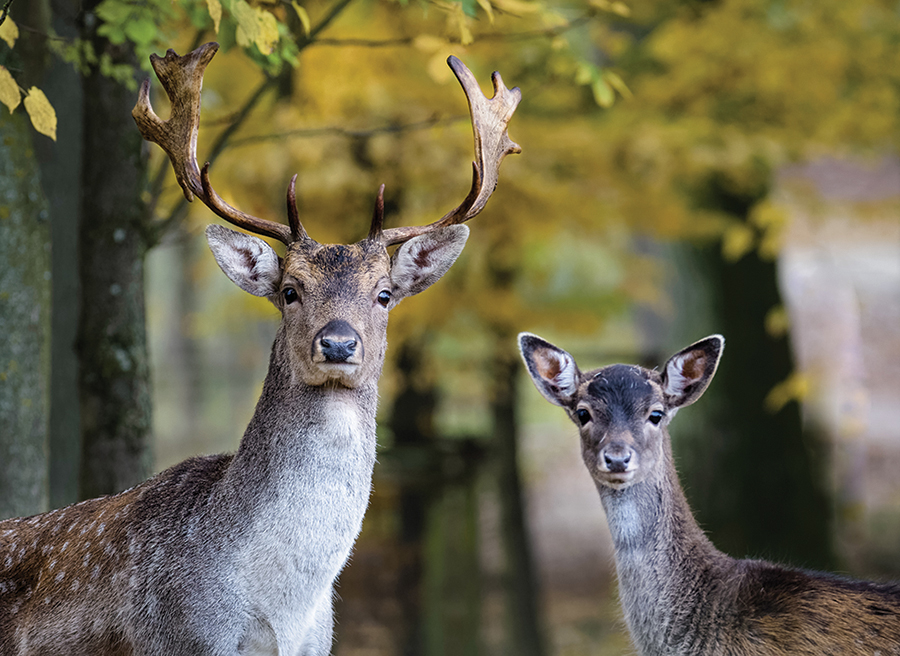
As you sit beneath her trunk, comforted by her silhouette in purple twilight, three, four, five white-tailed deer slip through the longleaf veil in the distance. Either they do not see you, or they recognize you as one of their own.

Six deer.

Seven.

You watch them graze in the meadow — just feet away now — and as the last doe brushes past, you exhale a silent prayer.

Grace is here.

You place your hands on the weeping cherry’s trunk, honoring this perfect moment, this bare-branched season, the vibrancy among decay. 

It’s time to go home now. It won’t be the same. But there are stories to share. And grace.

Spirit of the Deer

As a child, Christmas Eves were spent at my grandparents’ house, where all the cousins hoped to be the first to spot the shiny pickle ornament Papa had hidden in the tree. After evening Mass, then dinner, where soft butter rolls, pumpkin bars and scalloped potatoes were first to vanish from the spread, gifts were exchanged. Whoever found the pickle got theirs first.

And then, the hour drive home.

“Watch for deer,” Papa would say before we left.

We always saw them, frozen in the headlights on the roadside.

Three, four, five . . . six deer, seven.

I counted until drifting off to sleep.

Many ancient cultures believe that when an animal crosses your path, its spirit has a special “medicine” for you. The deer is a messenger of gentleness and serenity.

If you happen to see one in the thicket of holiday hustle and bustle, even if it’s the one you recall snacking on your hosta and pansies last spring, consider the ways you can bring more grace and kindness to yourself and the world.

Comet and Cupid

According to National Geographic’s Top 8 Must-See Sky Events for 2018, the comet eloquently named 46P/Wirtanen will travel past the luminous Pleiades and Hyades star clusters as it makes its closest approach to the Earth on Sunday, December 16 — the comet’s brightest-ever predicted passage.

Whether or not you catch the celestial show, don’t miss the chance to celebrate the “rebirth of the Sun” on Friday, December 21 — the day before the full cold moon. Call it winter solstice, Yule or midwinter, the longest night of the year is a time for gathering . . . and ritual.

In Japan, it’s tradition to take a dip in the yuzu tub, a hot bath filled with floating yellow yuzu fruit, to ward off the common cold.

Not a bad way to welcome winter.

Or around a fire with dearest friends, sharing stories and cider beneath the near-full moon.

In the Garden this Month

Rake fallen leaves for compost.

Plant hardy annuals (snapdragon, petunia, viola).

Take root cuttings from cold-sensitive perennials and plant them indoors.

Order fruit trees and grape vines for late-winter planting.

Dream up, then plan for your spring garden. 

Crossroads

Mistletoe Tree

A tradition of transition

By Claudia Watson

Strapped high up in a tupelo gum tree that was obviously more native than I was, the tree-trimmer set his pruning saw against a limb and said, “So, how’d ya get here?”

“Well, it’s the tree you’re in,” I said.

He looked down through the limbs. “This tree?”

“Yep,” I said.  “That’s why I take good care of it.”

My husband, Roger, and I were tidying up the house he was selling in Fayetteville —  his home for nearly 30 years with the Special Forces — and he suggested we take a ride to Southern Pines for my birthday lunch and to look at some property.   

I jumped at the chance for a day trip but wasn’t interested in settling any place other than Virginia. For the better part of 25 years, I’d been building a life and business there. But as we traveled the back roads from Fort Bragg to Southern Pines, the desolate beauty spellbound me. Just as we arrived in Southern Pines, a CSX train blasted its horn and crawled down the center of town. As we waited for our lunch, fluffy snowflakes began to fall.

“So, it snows in North Carolina?” I teased. Roger’s eyes flashed over the rim of his glass of sweet tea. He detested the winters and the traffic in northern Virginia. Afterward, we walked down Broad Street enjoying the sound of new fallen snow, as soft as the train whistle was loud. That’s when I saw an old, dented red pickup truck with a cardboard sign leaned against its fender and the hand-scrawled words, “Mistletoe $5.”

I thought the sign was a scam. Mistletoe comes in little white boxes tied with a red ribbon. It’s in the produce section in the grocery stores in northern Virginia during the holidays. 

“What is this?” I asked the owner of the truck as I eyed the clumps of greenery that looked more like the remains of a lousy pruning job.

The man shifted his eyes to my husband.

“It’s mistletoe,” he said.

“No way,” I challenged. “Where are the berries?”

He looked me up and down, reassuring himself that I was not from the South, pulled out a clump and showed me the waxy berries.

“Where’s it from?” I asked.

“Treetops,” the mistletoe man said.

“What do you mean, treetops?” I asked.

“We shoot it out.”

“Huh?” I groaned.

“With a shotgun,” he said, whirling away from me and raising his eyes and hands to the sky.

I looked at Roger, the North Carolinian, holding back laughter. He handed the man a five, and we walked away with a clump of mistletoe and headed back to Fayetteville.

Weeks later, Roger asked me to go back to look at the property he’d been researching while on work trips from Virginia to Fort Bragg. Over dinner, he eased a map toward me. Three lots were circled, accompanied by cryptic notes I took to be some sort of indecipherable Special Forces code.

He insisted we go back to Pinehurst. The drive down I-95 was unbearable as I sat glumly in the truck while he told me about the pros — no cons, of course — of each lot and of his home state.

We looked at all three sites. At the last one, he sprinted to the back edge of the property line and waved his arms, pointing to the golf course view, and then where the sun would rise. He pointed out the abundance of dogwoods, the old-growth longleaf pine, the sassafras, native blueberry plants, inkberry and the red-tailed hawks in the sky. I was not impressed.

While he used red string to plot out a home site, I dug in my heels under the shade of a nearby tree. It was one of the few that looked like a real tree to me.

I thought, “How did this happen?” I don’t want this. I want our home in Virginia. I looked up through the canopy of the tree. Then, I saw it, not in the top of the tree, but jutting out from the trunk only inches from my head. I saw the glossy dark green leaves and the palest berries.

If the ancient Druids thought it possessed mystical powers, warded off evil spirits and brought good luck to the household, it was good enough for me.

We moved to Pinehurst a year later, built our home, and for 14 holiday seasons, I clipped a sprig of real mistletoe for our doorway from that tree.

“You know,” my tree-trimmer said, picking up his saw, “it’s interesting you saved this tree being it’s so close to your house. It’s a tupelo gum, a native tree. Most folks rip ’em out.”

Instead, its roots grew deeper.  PS

Claudia Watson is a Pinehurst resident and a longtime contributor to PineStraw and The Pilot.

The Return of the Light

The Return of the Light

A celebration of food and faith at Pinehurst’s Temple Beth Shalom

By Jim Dodson

One morning not long ago, as shorter days and darker nights began to settle over the Sandhills, we dropped by Pinehurst’s Temple Beth Shalom to visit with the women of Carol Pierce’s cooking class.

In the aftermath of the tragic attack on the Tree of Life Synagogue in Pittsburgh during which 11 worshippers were murdered as they prayed on a Saturday morning — the worst recorded attack on Jewish people in American history — Beth Shalom’s congregation held a prayer and healing service that filled its sanctuary with people of all faiths from across the Sandhills. On the Sunday before Thanksgiving, the Temple also hosted the 13th annual interfaith service with half a dozen Christian churches from the area. As one member of the Temple family put it, “This was exactly the spiritual lift we needed, an outpouring of fellowship from our neighbors and friends — a way to bring back the light.”

Indeed, with the lights of Christmas shining brightly everywhere these days, we couldn’t think of a better moment to grow that light and celebrate the timeless messages of Hanukkah, the beloved Jewish Festival of Lights that begins on Dec. 2 and ends Dec. 10, a family-centered holiday observed by the sharing of traditional foods, ritual lighting of a special nine-candle menorah and reciting of prayers, playing games and offering gifts over eight nights and days to commemorate the restoration of the Second Jerusalem Temple in 167 BCE.

At that time, the Holy Land was ruled by the Hellenistic Seleucid Empire of Syria that forced the people of Israel to accept Syrian Greek culture and spiritual beliefs in place of their own Hebrew God. Against all odds, a small band of faithful Jews, led by a freedom fighter named Judah the Maccabee, defeated one of the mightiest armies on Earth, drove the Syrian Greeks from their land and reclaimed the Holy Temple in Jerusalem, rededicating it to the divine light of God.

When the victors sought to relight the temple’s menorah in celebration (the seven-branched candelabrum), they found only a single cruse of olive oil that had escaped contamination by the Syrian occupiers. Miraculously, they lit the menorah with a one-day supply of oil that somehow lasted for eight days until new holy oil could be prepared under conditions of ritual purity. To commemorate this miracle, Jewish sages instituted the festival of Hanukkah.

At the heart of the festival is the nightly lighting of a special nine-candle menorah called the Hanukkiah, using the shamash (“attendant”) candle to light one candle each night until all nine candles are ablaze. Special blessings and traditional prayers accompany the lightings, and songs of praise are sung after the candles are lit. Families also exchange “gelt” (everything from jelly beans to coins made of chocolate) and play “dreidel” (a game of chance played with a four-sided top), exchange small gifts and share special holiday foods cooked in oil to symbolize the endurance of the Jewish people. In observant households, lighted menorahs are placed in windows to bring light to the darkness.
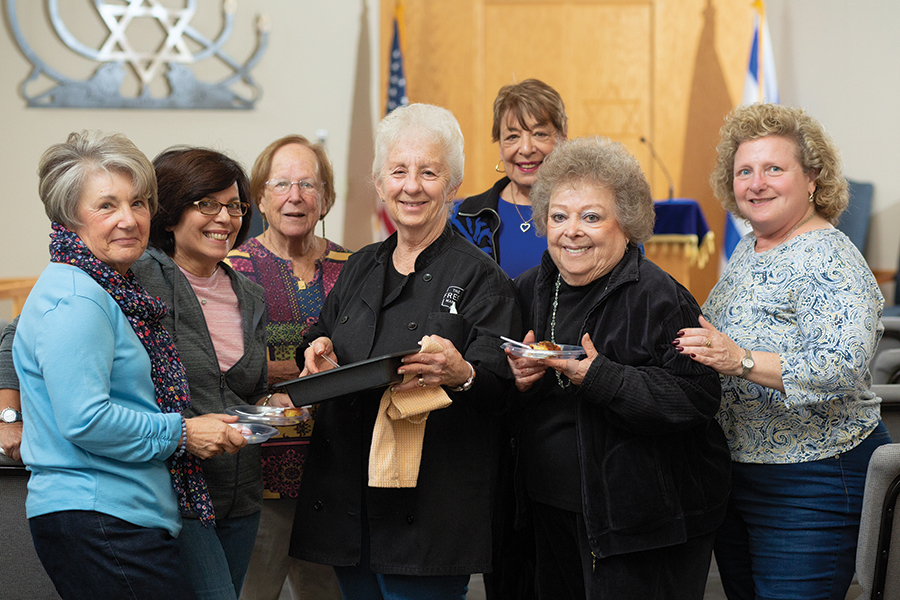
“The thing that really brings people together and best symbolizes Hanukkah is the traditional foods,” Carol Pierce explained as her students – Elaine, Nancy, Harriet, Sheila, Bonnie and Audrey — filtered into Beth Shalom’s cozy kitchen area, chatting away about the sudden turn in the weather and their own holiday preparations. “The foods of Hanukkah are fried, symbolic of the miracle of the oil that lit the lamp in the temple.”

“In other words,” someone quipped, “a heart attack on a plate.”

“Hanukkah brings back the best memories,” Elaine Schwartz was moved to say. “Everyone tends to have their own recipes for these foods, but my late mother made the best potato latkes ever. She served them warm from the oven with homemade applesauce and sour cream, and we always played the dreidel game for M&Ms. Unfortunately, she never wrote down her latke recipe and I’ve never quite found one to match it.”

These days, Schwartz added, she observes the holiday by sending her two grandchildren in Colorado gelt-filled dreidels and a nice gift for one of the nights of Hanukkah. “The holiday has changed in some respects. When I was young, my mother would give my sister and me coloring books and crayons for each night and a larger gift on the last night. But kids these days are competing with Christmas, in a way. Hanukkah has been somewhat Americanized,” she reflected. “That’s OK. The holidays share things in common — gifts, food and lights. It’s really about family time.”

Holiday traditions mean everything. As Sheila Rappaport placed her pre-made potato latkes on a cookie sheet to heat up (“You can make them well in advance and freeze them wrapped in paper towels — they keep wonderfully!”), her daughter, Audrey Shalikar, mused how her own children are now in their 30s, but she has kept her Hanukkah decorations at the ready for the expected birth of her first grandchild that is due soon. “So someday when they come to visit,” she says, “I’ll be ready with my mother’s latkes and dreidel games and the full experience of Hanukkah.”

Nancy Jacobs has a lovely story about the ecumenical appeal of a well-made latke. “My late husband, Bob, loved to make latkes,” she remembers. “Every year he spent an entire Saturday making two to three hundred latkes for the open house we always held after the Christmas tree lighting in the village of Pinehurst. Bob sang in the village chorus. He loved both holidays and the people who came to our house — always a hundred or so folks. They loved Bob’s latkes. It was a special evening.”

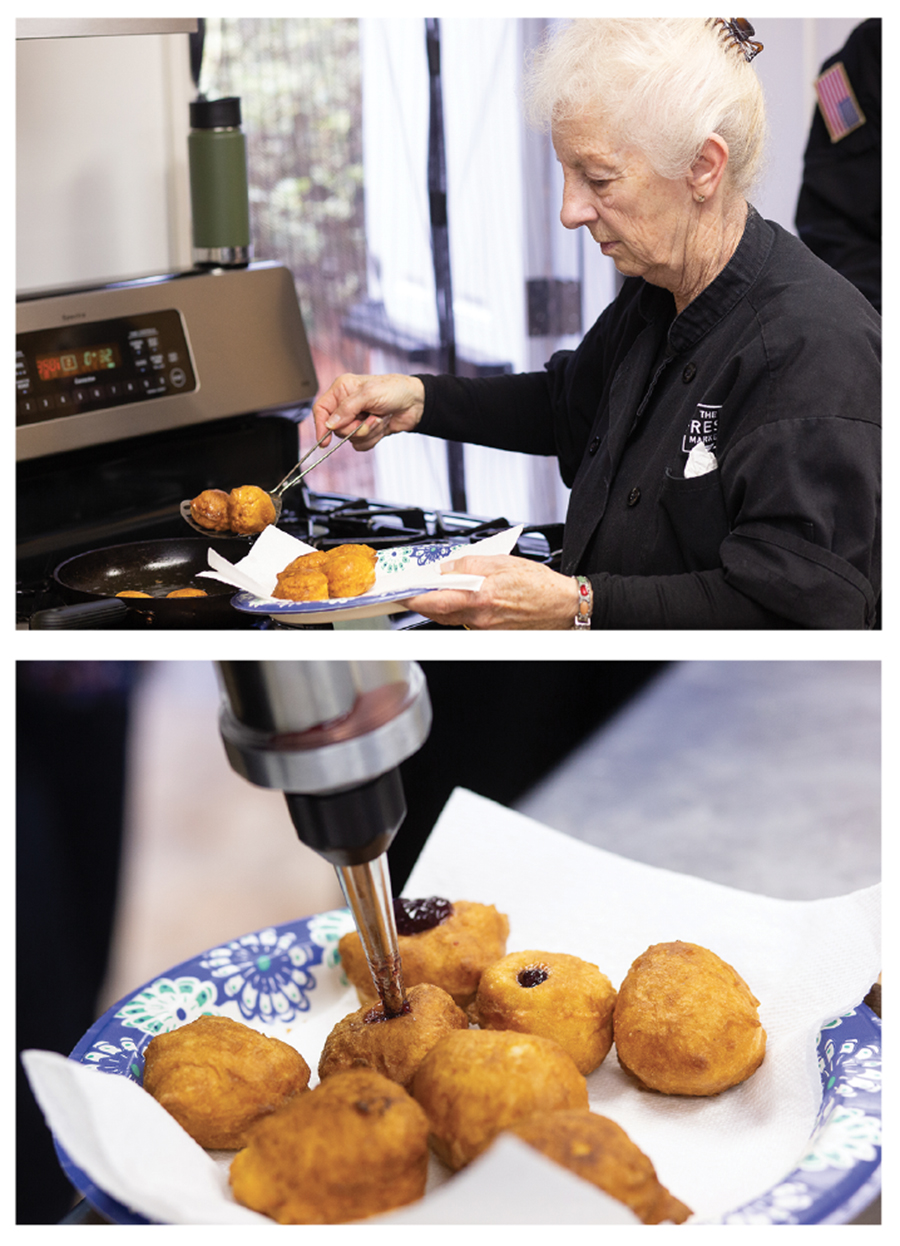
Over the next full and lively hour, the women of Beth Shalom traded laughs and sweet memories of their own Hanukkahs past as they learned an easy technique from Carol Pierce for making jelly doughnuts, latkes and a special panettone pudding from Fresh Market. There was talk of classic brisket recipes and chicken and matzo ball soup; homemade applesauce and Hanukkah cookies.

At one point Barbara Rothbeind, Beth Shalom’s energetic vice president, stuck her head in to see how the cooking group was faring. “It’s been a difficult year for Jewish people,” she reflected, “but the outpouring from people of faith across this community has been such a blessing. It shows how we stand together in a darkened time — letting our light shine. Hanukkah is all about that —food and family and fellowship.”

As we sampled a second warm and delicious jelly doughnut fresh from the kitchen’s oven, we couldn’t have agreed more.
Fresh Market Panettone Bread Pudding

1 box of Fresh Market Panettone Bread

1 cup heavy cream

1 cup whole milk

2 whole eggs

2 egg yolks

1/4 cup sugar

1 teaspoon grated orange zest

1 teaspoon vanilla extract

Preheat oven to 350 degrees. Cut panettone into 1-inch cubes and place in a 9-by-9-inch greased pan. In a large bowl whisk together remaining ingredients. Pour liquid mixture onto panettone cubes. Press cubes gently until all are saturated. Soak for five minutes. Bake for 60 minutes. Allow bread pudding to cool for 5 minutes before serving. Drizzle with caramel sauce or top with fresh whipped cream. 

Easy Potato Latkes

2 cups raw grated potatoes

1/2 cup grated onion

Pinch of baking powder

1 1/2 teaspoons salt

1 tablespoon of flour or matzo meal

2 Eggs

Peel potatoes and soak in cold water for several hours, then grate and drain. Beat eggs well and mix with other ingredients, add a little pepper if desired. Drop spoonfuls on hot greased skillet and cook until golden brown, both sides.

Keep warm in oven until ready to serve with warm applesauce

Easy 10-minute Applesauce

3 Golden Delicious apples, peeled, cored and quartered

3 Fuji apples peeled, cored and quartered

1 cup apple juice

2 tablespoons cognac or brandy (optional)

2 tablespoons butter

3 tablespoons honey

½ 1 teaspoon cinnamon

Combine apples and all other ingredients in microwave-safe container. Microwave uncovered for 10 minutes.

Use blender or potato masher to blend to desired consistency.

Serve warm or chill for later use.

Amazing Brisket

1 4–5 pound first cut brisket

1 cup dark brown sugar, lightly packed

1 package Lipton Onion Soup Mix

1 bottle Heinz Chili Sauce

Potatoes and carrots

Heat oven to 350 degrees

Place brisket in deep roasting pan. Combine sugar, soup mix and chili sauce; spoon over meat and cover pan. Cook for 2 1/2  hours, remove and cool for one hour.

Slice meat against grain, cover and cook brisket for another 2 hours, or until brisket is tender.

Add quartered red bliss or Yukon Gold potatoes (unpeeled) plus a small bag of baby carrots and cover with sauce, for the last hour.

Kugel

12 ounces noodles

1 cup cottage cheese

1 cup sour cream

3 eggs, beaten

1 stick butter, softened

Salt and pepper to taste.

Cook and drain noodles according to package directions. While still hot, add the other ingredients and stir well. Pour mixture in greased casserole and bake in preheated 350-degree oven 35 to 40 minutes.

For variety (and to make it sweet), you can add 1/2 cup sugar, 1/4 teaspoon cinnamon and a handful of raisins,

To make it savory, add only 1/2 stick of butter. Then sautée one medium chopped onion, 1/2 cup chopped mushrooms and 1/4 cup chopped celery  When veggies are browned, add to noodle mixture and bake as above. 

Pour mixture in greased casserole and bake in preheated 350-degree oven 35 to 40 minutes.

Can be frozen — defrost completely before warming in a 350-degree oven 10 minutes.

Matzo Balls

1 cup water

1 stick butter

1 cup matzo meal

Parsley, sugar, salt, paprika, ginger, nutmeg and grated onions to taste

3 eggs, separated

In a medium sauce pan combine water and butter. Heat until butter dissolves. Add matzo meal and stir until water is absorbed. Season to taste with parsley, sugar, salt, paprika, ginger, nutmeg and grated onions. Mix well.

Beat egg yolks until lemony and add to matzo mixture. In a clean bowl, with clean beater, beat egg whites until stiff; fold into matzo mixture. Chill well in covered container for at least 4 hours

To make the matzo balls, dip fingers in warm water and roll chilled mixture into balls.

If you wish to freeze, place on a cookie sheet and freeze. The frozen balls can be placed in a plastic bag until you need them. When ready to use them, drop them in boiling chicken broth and cook for 30 minutes on medium heat.

Add to your favorite soup! Yield: 27 medium/small matzo balls

Simple Chicken Soup

3 chicken breasts

4 carrots, halved

4 stalks celery, halved

1 large onion, halved

Water to cover

Salt and pepper to taste

1 teaspoon chicken bouillon granules (optional)

Put the chicken, carrots, celery and onion in a large stock pot and cover with cold water. Heat and simmer, uncovered, until the chicken meat falls off of the bones (skim off foam every so often).

Take everything out of the pot. Strain the broth. Pick the meat off the bones and chop the carrots, celery and onion. Season the broth with salt, pepper and chicken bouillon to taste, if desired. Return the chicken, carrots, celery and onion to the pot, stir together, and serve. 

Mandelbrot

(A sweet bread similar to biscotti)

3 eggs

1 cup sugar

1/3 cup vegetable oil

1 teaspoon vanilla

2 3/4 cups flour

2 teaspoons baking powder

1/2 teaspoon cinnamon

1/4  teaspoon salt

1/2  cup walnuts

Optional: chocolate chips, dried cranberries.

Beat the eggs and sugar until light and fluffy. Add the oil and vanilla and mix thoroughly.

Sift the flour, baking powder, salt and cinnamon together and add to the sugar mixture. Mix until blended, adding the nuts as the dough starts to come together.

Briefly knead the dough on a floured surface. Divide into 2 pieces and shape each into a log about 3 inches wide. (Add chocolate or cranberries at this point.)

Place logs on greased cookie sheet. Bake at 350 degrees for 30–35 minutes, until golden.

Remove from oven and let stand until cool enough to handle. Slice logs diagonally into 1/2-inch slices. Lay them on the cookie sheet cut side up and return to oven.

Bake on the top shelf for 10 minutes and then on the bottom shelf for 10 minutes until toasted and brown.

Sweet Sufganiyot

(Traditional jelly doughnuts) 

3 cups flour

2 teaspooons baking powder

2 tablespoons sugar

1/2  teaspoon vanilla

1/2  teaspoon nutmeg (optional)

2 eggs

2 cups sour cream

Oil for frying

Jelly (any preferred flavor — black raspberry a favorite)

Powdered sugar

In a bowl, blend together the flour, baking soda, sugar, vanilla, nutmeg, eggs and sour cream.

In a skillet, heat the oil, and when very hot, drop tablespoons of batter into it. When the batter puffs up and turns light brown, turn it over and cook the other side.

Set doughnuts on paper towel to cool.

Make a small hole and fill with jelly. A cooking syringe can make this easy. Sprinkle with powdered sugar and serve immediately.  PS

Hometown

Citizen’s Arrest, Citizen’s Arrest

Finding a key to the past

By Bill Fields

After a lifetime of watching Barney Fife — and more to the point, laughing at his foibles — I was beyond due.

Not too long ago, I think the lovable but bumbling deputy left Mayberry and drove the squad car to Southern Pines. And once he arrived, he was intent on making me pay up.

I should have been viewing a rerun of The Andy Griffith Show instead of having the channel on MSNBC and Lawrence O’Donnell, but Barney still had the last word.

It had been a long day — sweaty and muscle-achy tiring — of lifting and sorting, saving this and tossing that as my sisters and I emptied the old homestead. We combed through stuff at the house that had been tucked away for many years.

Some of the items had belonged to our father, who passed away in 1980 after a work life of various pursuits but that, in his last decade, had been in law enforcement. As a policeman and deputy sheriff in the 1970s, Dad accordingly had the tools of the trade.

Arriving home at the end of a shift, he would remove his duty belt just like the Cartwrights did when they stepped inside the front door of the Ponderosa. Off came his service revolver in its holster, a case with extra .38 caliber bullets, lead-filled leather sap and handcuffs.

I hadn’t seen any of those items in nearly 40 years but there, in a drawer undisturbed for nearly as long — along with a desk caddy containing pictures of his grandchildren, cufflinks, tie clips and loose change — something shiny glinted from the bottom.

At first I thought it might be one of his PaperMate ballpoint pens — he always carried two in his shirt pocket when setting out on an eight-hour shift — a shoehorn, cigarette lighter or stray metal golf spike. Then I got a closer look: handcuffs.

The restraints, like the rest of Dad’s police accessories, had been off limits way back when. It was a thrill to discover them.

“Hey, look what I found,” I said, loud enough for my sisters to hear in another room. “Handcuffs.”

They were heavy and scratched. A six-digit number was etched on the top of each. My father’s initials were on one ring, his name on the other.

It was a busy day, about noontime. I set the handcuffs aside.

Ten hours later, in the living room looking at the TV — I think I was too weary to really watch — I recalled the handcuffs, retrieved them from a banker’s box and came back to my chair to give them a closer look. I hadn’t expected to find them among all the stuff and I was curious.

One cuff appeared broken, disabled by age or intent when my father was forced to retire because of illness, its half-ring swinging back and forth freely like a mini Ferris wheel. The other metal ring, though, was functional and lockable, its teeth clicking audibly as I held it and clasped it closed several times just to hear the sound, which got my sisters’ attention as they went through photo albums at the other end of the room.

The working cuff was the one I put on my right wrist.

All I needed was Gomer Pyle’s wrist in the other metal ring and it would have been full Barney, because there was no key to go with the cuffs.

There was laughter, the way there had been laughter when Dad got a drive-in cheese dog in Archdale that came sans dog, or when my cap had been snagged by the treble hook of a lure and cast off my head and into Badin Lake.

Then there was a bit of panic. I do not have a dainty wrist, and it was being pinched pretty hard.

I decided to drive to the Southern Pines police station, steering with my free hand and resting the other on my leg. I was grateful the car was not a stick-shift model, and as I set out, I thought: Do not speed. It being late at night, the station door was locked. I pushed the intercom button and got a dispatcher.

I explained. She laughed.

Once inside, I heard the dispatcher reach an officer on the radio. Within 10 minutes, she had entered the building and was walking down the hall. I stood up and held out my right arm.

She laughed. I explained.

I can report that a handcuff key circa 2018 will unlock a handcuff circa 1978. Unshackled, I drove home and went to bed.  PS

Southern Pines native Bill Fields, who writes about golf and other things, moved north in 1986 but hasn’t lost his accent.

Character Study

Catalog of Memories

No room at the inn for the Wish Book

By Tom Allen

Say it ain’t so. Not at the most wonderful time of the year.

Recently, Sears announced they were closing 142 stores before the end of this year. At its height, America’s largest retailer boasted over 4,000 stores. Decades of lagging sales and plummeting revenues reduced the number to less than 1,000. Fingers point at everything from out of touch CEOs to blasé brands. I beg to differ. The reason? They messed with the Wish Book.

In 1993, Sears stopped publishing beloved big-book catalogs and reduced the size of the Christmas Wish Book, a holiday tradition since 1933. My generation circled Rock’em Sock’em Robots, Chatty Cathys and Electric Football games with vibrating, metal fields. We showed our parents pictures of Milton Bradley games like Barrel of Monkeys, Mousetrap and Twister. Remember Operation and “Cavity Sam,” with his red light bulb nose? Sam’s “Adam’s Apple” was easy to remove. Likewise his “Wrenched Ankle.” Going for the “Bread Basket,” worth $1,000 in play money, was the real test of hand-eye coordination and fine motor skills. Touch that metal with those tweezers — the buzzer sounded and Sam’s nose lit up. Doggone it! But we loved it. “Batteries Not Included” meant our stockings held an 8-pack of double-A Evereadys. Years later, we’d slip the same 8-pack, along with bubble gum and a pair of socks, into our kid’s stockings, just like our parents did. Thanks to the Wish Book, boys might pull out Hot Wheels; girls, Easy Bake Oven accessories.

Eventually, we ditched the Wish Book. Thought we’d outgrown it. Clothes, no longer frowned on, became acceptable under the tree. Who needed a Wish Book, we thought, when slick mail order offerings hollered at us from October until early December. As young adults we circled item numbers from Lands’ End catalogs, underlining sizes and colors to make sure whoever filled out the order form or called toll-free would get it right. We had to be at least as preppy as our best friends. We dog-eared pages from L.L. Bean’s collection of duck boots and flannel shirts, ’cause if you didn’t go for poplin and prep, try rugged and woodsy. For some, toll-free ordering from folksy towns like Dodgeville, Wisconsin, or Rockport, Maine, added to the mystique of the purchase. Am I really talking to someone who lives in Dodgeville? How cool was that?

Then along came the internet. Who needs toll-free numbers and mail order forms when you can shop online? Quick and convenient. Yes, I saved that credit card number, but they always ask for the security code. “Honey, will you hand me my wallet?” Need more choices? Hello Amazon Prime. For 120 bucks a year, get everything from toilet paper to toffee in two business days. But with convenience came overwhelming choices. Clothes shopping? Scroll through page after page of stonewashed denim or polo shirts and you still can’t find what you want. Narrow that search. Surely a middle-aged man, with a receding hairline and slight belly bulge, can find an alternative to skinny jeans. All I want is a short-sleeved navy polo — no pockets, hemmed sleeves or, Lord forbid, a monogram. Just a few colors, please. I’m fine not receiving a sweater on Christmas morning in “light beetroot red.”

In 1886, Richard Sears, a railroad worker, started selling watches through fliers and mail order catalogs. The business morphed into Sears Roebuck, selling everything from shoes to furniture to musical instruments. You could even buy a house from Sears. Exclusive brands like Kenmore, Craftsman and Diehard proliferated in American kitchens, tool sheds and cars. The Sears Tower, built in 1973 in Chicago, was once the tallest building in the world as well as the retailer’s headquarters.

By the 1980s low-price competitors like Walmart, Kmart and Target were opening big box stores. Sears tried to snag the dot-com market, acquired Lands’ End to beef up their apparel, and merged with Kmart. Nevertheless, decline continued. Sell-offs increased. The company became a shadow of itself during the ’70s and ’80s.

Last year, after listening to customers recount Christmas Wish Book memories, Sears brought the catalog back. But the print version, as well as online and mobile editions, failed to attract baby boomers who remember waiting for the iconic Christmas catalog to arrive by mail, months before Santa slid down the chimney.

Everything has its season. Sadly, perhaps Sears has had theirs. Still, memories of finding everything on my Wish Book list under the tree are priceless. Or, at least they beat the necktie with three Wise Men riding camels. I know. It’s the thought that counts.

Good luck, Sears. At Christmas, miracles still happen.  PS

Tom Allen is minister of education at First Baptist Church, Southern Pines.

The Kitchen Garden

That Old Chestnut

Making a comeback in the skillet

By Jan Leitschuh

Hot, roasted chestnuts have probably not been part of your holiday treat repertoire, despite the ubiquitous Christmas reminder in song. I would have been the same, except I first tasted chestnuts in Wisconsin, as my mother, a nostalgic World War II bride, roasted some for us kids in our living room fireplace. This was a time (cough) before gas logs.

The nuts were tasty, sweet and surprisingly soft, like a baked potato, very good with salt and the heat of the fire warming our faces. But chestnuts are neither a common nor everyday produce item, so the cold-weather treat drifted to the back burner.

The idea of chestnuts resurfaced again when our local Sandhills Farm to Table Co-op attended the international Slow Food Festival “Terre Madre” in Torino, Italy, in the fall of 2010. There we saw pushcart vendors roasting chestnuts on the streets, dumping the hot nuts into paper funnels for munching on the go or on the nearest park bench. Chestnut flour-based pastries and candied marron glacés graced bakery shop windows. Cafés featured a hot bowl of zuppa di castagne, sometimes with a grappa kicker. Late October was the season of the chestnut harvest.

As our bus drove us through the Italian countryside to our lodgings an hour south, neat farms began to sport tidy little groves of trees. Over 90 percent of Italy’s chestnuts are produced in Tuscany, and this little northern countryside had some lovely examples.

Edible chestnuts grow worldwide, including in North Carolina’s Piedmont and Sandhills regions. My first exposure to Tar Heel chestnuts came when the late environmentally active couple, Joyce and Len Tufts, gifted a generous bounty of homegrown Chinese chestnuts for Sandhills Farm to Table box subscribers. The nuts were as good as I remembered. I used them in a chestnut-sage stuffing.

This fall, local resident Ellen Marcus brought chestnuts back onto my radar. She and her family recently moved onto a property with four well-established chestnut trees bordering their front yard. It was a love-hate relationship from the start.

“The trees are perfectly climbable, picnic-worthy on a nice carpet of lush centipede grass, rich green foliage giving way to gold in autumn,” she says. “The tree’s beauty is mesmerizing and inviting.” Sounds heavenly, except for one factor Marcus hadn’t counted on: the spiny husks of the nuts that tumble each fall.

“The sharp chestnut spines can pierce soft-soled shoes,” she said. “ I can’t imagine why anyone would plant a chestnut in the front yard. The husks are mean and unforgiving, making the work of getting at the sweet meat all the more rewarding.”

And it is work. “The nuts have to be collected before the worms drill in,” she says. “They have to be refrigerated for storage. The nuts have to be scored and roasted to get them to peel easily. It almost gets to the point where you want to say, ‘Forget it, get an ax!’”

But then she relents. “The tree is reminiscent of the native chinquapin I grew up with as a kid. Chestnuts are so versatile, and make delicious cream soups, great flour, crispy toppings, and meaty stuffings.”

Chestnuts were much loved in ancient times. In fact, the Greeks and Romans used to transport an incredible amount of chestnuts in the stowage areas of ships to sell later. Before the chestnut blight in the early 20th century, the stunning American chestnut tree dominated forests of the eastern United States, blanketing the Appalachian mountains with their blossoms in the spring.

Known as the “Redwood of the East,” the American tree often reached towering heights of 150 feet. Experts estimate that at one time, one in every four hardwood trees in the East was an American chestnut. An important food source for natives, pioneers and wildlife, the American chestnut is making a small but determined comeback thanks to backcrossing efforts to introduce blight resistance.

According to the website “The Art of Manliness,” (cough, cough), one roasts chestnuts over an open fire, just as the song suggests. “Yes, you can roast chestnuts in the oven. But what would be the fun in that? A man never misses a chance to build a fire and cook over it,” the website suggests.

Instructions as follows:

To roast your chestnuts, you’ll need a pan that you can put into the fire. Long-handled popcorn or chestnut roasters make the ideal vessels for open fire chestnut roasting, as they allow you to roast the nuts without burning your face off. And their lids let you shake the chestnuts around for even roasting, instead of having to turn them over yourself or losing a few when flipping them in a lid-less pan.

If you don’t have a long-handled roaster, you can get by with a 12-inch cast-iron skillet or some other pan. Just be careful not to burn yourself. If you have an old beat-up skillet, you can turn it into a bona fide chestnut roaster by drilling 30 or so holes in the bottom.

If you don’t have a chestnut roaster or a skillet, you can also use a fireplace shovel. And I suppose you could even try sticking them individually on skewers . . . if you’re the patient type.

You can buy chestnuts at some grocery stores, but you may want to call ahead to make sure they have them. While dozens of chestnut varieties exist, most people roast Castagne and Marroni chestnuts at the holidays. Castagne are more common, while the Marroni are a more expensive specialty. The nut of the Marroni is sweeter and plumper, and it peels away from the skin more easily.

When choosing your chestnuts, look for those that are plump, smooth, shiny, and blemish-free. Moldy chestnuts are a common problem, so squeeze and shake the chestnut to see if the nut has shriveled up and pulled away from the shell.

Keep in mind that the larger the chestnut, the longer it will take to roast. Pick chestnuts that are fairly uniform in size and will thus be done at the same time.

Chestnuts are traditionally scored, their brown skin sliced to allow steam to escape when roasted. Simply take a sharp knife and cut an “X” into the flat side of each chestnut. Once your chestnuts are clean, dry and scored, roast over a nice bed of hot embers, shaking the pan to prevent burning. The brown exterior is peeled off after roasting and the hot nuts dipped in salt.

Chestnut trees prefer good drainage — avoid standing water and low-lying areas. To produce fruit, trees will also need lots of sunlight and plenty of regular watering to become established. Fall and winter are great times to add a couple of chestnut trees to your property, for wildlife and personal consumption. Revival, Carolina and Willamette are three suggested varieties that do well in North Carolina. All require pollination from another variety.

Plant at least two cultivars of the same type to ensure optimal size and production, and probably best away from where children and dogs might play, given the spiny husks. Most Chinese and hybrid chestnuts are highly resistant to the chestnut blight fungus. Many people prefer the hybrid chestnut cultivars, citing superior quality over the straight Chinese cultivars. Management is low.

If you are lucky enough to have your own chestnut tree, sort nuts for mold. Either use fresh nuts immediately or store unpeeled chestnuts in the refrigerator. To keep your chestnuts in good shape for a little longer, place them in a plastic bag and stick a few holes in the bag for airflow. Chestnuts should then keep for two or three weeks. Place them in the fridge’s crisper or vegetable storage bin.

Store freshly purchased or picked, unpeeled chestnuts at room temperature for up to one week only. Keep them in a well-ventilated and dry place.

In case you want to go beyond roasted chestnuts this holiday season, just add chocolate:

Chestnut-Chocolate Pudding

1 1/4 pound chestnuts

5 ounces dark chocolate, chopped

4 ounces butter

4 ounces sugar

Salt

Cook the chestnuts in salted water, peel and then process or sieve them. Melt the chocolate and add to the still warm chestnuts together with the sugar and butter.

Stir for some time. Line a rectangular mold with greaseproof paper and grease with butter, lay in the mixture, level off and cover with more greaseproof paper.

Leave in the fridge for at least 4 hours. Serve with cream on the side.  PS

Jan Leitschuh is a local gardener, avid eater of fresh produce and co-founder of the Sandhills Farm to Table Cooperative.

In the Spirit

Beer on Whiskey

Not so risky. And sometimes surprisingly delicious

By Tony Cross

In holidays past, I would have a moment of clarity when visiting my loved ones. It would come on suddenly, and always within 12 hours of arriving. Like clockwork. “I’ve got to get out of here and get a drink.” The members of my family are not big drinkers. I would have a beverage or two around them, but I always craved my escape drink. It’s not because my folks are hard to be around — they’re amazing. It’s because this time of year stresses me out and I turn into Mr. McJerkface after a few hours of sitting around.

Mom and Pops live near me now, but for almost a decade they didn’t. There were no close bars that could whip up a decent drink, so off to the dive bars I went. One of my favorite things to order was a beer with a whiskey back. It did the trick every time. So, for this month’s column, I teamed up with Jason Dickinson, a certified Cicerone — think sommelier for beer or, as I like to call him, “beer nerd.” We had fun pairing up a few different styles of beer with spirits. And by we I mean that I texted him the three spirits I was bringing, and he used his expertise to bring a few pairing suggestions for each. You can find Jason over at Triangle Wine, if you have any questions or recommendations. Use these pairings anytime of the year, of course, but give these a shot when you’re out of town and are drawing a blank when you run away from your family.

Sour/Blanco Tequila

For our pairing, Jason brought Dogfish Head’s Sea Quench Ale Session Sour, and I provided El Jimador. Right off the bat, I sensed this would work. I spied a picture of a lime wheel on the can, and immediately saw the word “salt” in the description. That’s a margarita all day. “I chose this because of its year-round production,” Jason said. “It’s one of the few sours that we’re going to see on draft in more places pretty soon.” The first sip was all we needed. Tart and salty. Perfect with a blanco tequila — just make sure the label has “100 percent Agave” on it. If it doesn’t, I don’t think any beer will save you. If the spot you’re frequenting doesn’t have any sour-style beers, grab a Mexican lager. As I’ve mentioned before, a can of Modelo and tequila have been good pals of mine during the summer. However, I wouldn’t discriminate against them in winter.

Milk Stout/Spiced Rum

We combined a Nitro Merlin Milk Stout with Gosling’s Black Seal Rum, and it went together quite nicely. The Merlin is light, creamy and smooth. The Nitro comes from the beer having more nitrogen gas than carbon dioxide (like most traditional beer). This also gives the beer a touch of sweetness. I picked Gosling’s because there’s more likelihood of finding it behind a bar than other rums that I would drink straight (e.g., Smith & Cross, or rhum agricole). With that said, I never drink Gosling’s on its own. The distillery owns the trademark for “Dark ‘N’ Stormy,” so there’s that. But never on its own. But boy, oh boy, these two are yummy together. The sweetness of the rum and spice complement the chocolaty creaminess of the Merlin. I would pour my shot into the beer next time. Again, the chances of your finding the Merlin at a dive bar might be slim, so if you don’t see it anywhere, grab a Guinness. “A Guinness has a dry and roasty flavor profile, so adding the sweetness of the Gosling’s will bring a nice counterbalance,” Jason says. If they don’t have a Guinness, walk out.

Porter/Whiskey

“If someone asks what an American porter is, this is it to a T,” says Jason. “This is the beer a lot of people point to as the classic one in this category. There are a couple of producers that do one — Sierra Nevada makes a good porter. But Deschutes Black Butte Porter is generally thought of as THE porter for American style. They’re usually low ABV too.” That’s news to me. And if you’re as ignorant about porters as I am, keep reading. “Because bourbon and rye have been really popular over the past decade, the breweries rest their porters in bourbon and rye barrels. So, for me, this is a no-brainer.” This is one of the reasons I like Jason. Out of the park. One gulp of the Black Butte followed by a swig of Maker’s Mark (again, pretty much a trademark whiskey in myriad bars) pulls Jason’s theory together. The porter was dry on the end and having whiskey in between sips lent an oakiness to my palate. We both agreed that this was our favorite of the night. Bourbons tend to be sweeter than rye, but rye has spice. Me likey the spice. So next time, I’m having a porter with rye, that’s a what’s up, for sure.

In the pre-Jason era, when I paired beer and spirits, I’d make up my own boilermaker — by definition a shot of whiskey dropped into a glass filled halfway with beer. It was usually an IPA and a rye whiskey. Why? Because at the time, those were my favorite styles of beer and whiskey to drink on their own. As soon as I arrived at my getaway drink spot, that’s all it took to wash my Scrooge demeanor away. Now, as the saying goes, I got options.  PS

Tony Cross is a bartender who runs cocktail catering company Reverie Cocktails in Southern Pines.