The Omnivorous Reader

The Soong Saga

North Carolina’s link to the fall of The Last Emperor

By D.G. Martin

One of North Carolina’s most interesting stories takes us back to the 1880s when a young Chinese boy winds up in Wilmington, where he converts to Christianity and then returns to China as a missionary. He becomes wealthy, and his family becomes extremely powerful. How it all happened is a saga that is almost unbelievable.

In Wilmington there is a small granite monument on the grounds of the modest, lovely Fifth Avenue Methodist Church building. It reads: “Charlie Jones Soong, father of the famous Soong family of modern China, was converted to Christianity in the old Fifth Street Methodist Church, which stood on this site. He was baptized on Nov. 7, 1880, by the Rev. T. Page Ricaud, then pastor. One of his six children, Madam Chiang Kai-shek, whose Christian influence is world-wide, is the wife of China’s devout generalissimo and president. Erected in 1944.”

Here is the report from the November 7, 1880, Wilmington Star announcing an event that would ultimately have a profound impact on modern Chinese history: “Fifth Street Methodist Church: This morning the ordinance of Baptism will be administered at this church. A Chinese convert will be one of the subjects of the solemn right (sic), being probably the first ‘Celestial’ that has ever submitted to the ordinance of Baptism in North Carolina. The pastor, Rev. T. Page Ricaud, will officiate.”

That Celestial, as some Americans then referred to a Chinese person, was Charlie Soong, a teenager, whose North Carolina Methodist sponsors arranged for his education and subsequent return to China as a missionary.

A minister in Wilmington persuaded Durham tobacco and textile manufacturer Julian Carr to take an interest in Soong. Carr brought Soong to Durham and then arranged for him to enroll as the first foreign student at Trinity College in Randolph County.

Carr and Soong developed a “father-son” lifelong friendship, despite Charlie Soong’s serious flirtation with Carr’s niece, which resulted in Charlie’s exile to Vanderbilt University for more religious training. After being ordained as a Methodist minister, Soong went back to China as a missionary. Once there he drifted into business, developing the Bible printing operation that became a springboard to greater financial success, often with Carr’s backing.

When much of China’s limited manufacturing capacity was under the control of foreigners, Soong showed that the Chinese could do it for themselves. He helped construct a platform on which China’s modern manufacturing base is built. He printed Chinese Bibles so inexpensively that they drove the competition — mostly Europeans — out of business and, in the process, became one of the country’s wealthiest and most powerful business and political insiders.

It was the last days of the Qing Dynasty and “The Last Emperor,” and China was in revolutionary turmoil. Soong helped fund the activities of the major revolutionary leader, Sun Yat-sen, sometimes called the “founder of the Chinese Republic.”

Soong sent most of his children to the United States for education. When his three daughters came back to China, they married prominent Chinese. One daughter, Ching-ling, married Sun Yat-sen and, as Madame Sun Yat-sen, remained an important figure in Chinese government long after her husband’s death. She even served under Mao Zedong as a vice-chairman of the People’s Republic from 1949 to 1975.

The oldest daughter, Ai-ling, married banker H.H. Kung, who became finance minister in the Nationalist government.

Another daughter, May-ling, married Chiang Kai-shek, who led the Nationalist government until he was driven to Taiwan by Mao’s forces in 1949. Madame Chiang Kai-shek was well known to Americans and a favorite of many until her death in 2003 at the age of 105.

One son, T.V. Soong, represented China at the founding of the United Nations in San Francisco in 1945. After the Communist takeover of China, he moved to the U.S. and became a highly successful banker.

The Soong family was so important in China that it is sometimes referred to as The Soong Dynasty, the title of the most popular and detailed version of this story, written by Sterling Seagrave and published in 1985. It presented an unfriendly version of the family history, but a review in The New York Times saw it differently. “Indeed the charm of the man often outshines Mr. Seagrave’s attempts both to debunk him and make him sinister,” said the Times.

A more recent book by former Greensboro resident Ed Haag, Charlie Soong: North Carolina’s Link to the Fall of the Last Emperor of China, gives us a more balanced account. Although the Charlie Soong story is not new, Haag dug up previously unpublished material, much of it from the Soong papers housed at the Duke University library. Haag explains better than earlier authors how Charlie Soong became so wealthy. While others have written about Soong’s missionary work leading to a business printing Bibles, his association with a flour mill in Shanghai also contributed to his success. According to Haag, Soong’s greatest wealth came from his role as a “comprador,” a fixer and go-between who helped bridge the different customs and expectations of Western suppliers and traders and their Chinese counterparts. Those North Carolinians who already know about Charlie Soong will appreciate Haag’s refinements and additions. For those who never heard of Soong, Haag’s book is a great starting point.

But the Soong family’s connection to North Carolina doesn’t end there.

On Aug. 30, 2015, his great-grandson Michael Feng came to Wilmington to be baptized in the same church where his great-grandfather received the sacrament. Feng and his wife, Winnie, are longtime active participants at The Episcopal Church of the Heavenly Rest, a historic church in New York City, at Fifth Avenue and 90th Street.

“It was the church of my grandfather, T.V. Soong, where Winnie and I were married and raised our two children,” said Feng. “I had just never gotten around to being baptized. I guess my parents were too busy when I was young. Winnie had been after me for a long time to be baptized. And when we were planning a trip to North Carolina for a wedding, we decided this would be a wonderful time and place for my baptism.”

Feng explained to the congregation at Fifth Avenue Church that his family remained grateful to the North Carolinians who provided his great-grandfather the educational, spiritual and financial resources that made the difference for Charlie Soong. “He gave these resources to his children and our family,” said Feng of a Chinese dynasty announced in a note in the Wilmington Star 135 years before.

Almost seven years after his baptism in Wilmington, Michael and Winnie Feng remain active at the Church of Heavenly Rest, where there is another North Carolina connection. The leader of that church is its rector, the Rev. Matthew Heyd, who grew up in Charlotte and was a Morehead Scholar and student body president at UNC-Chapel Hill.

Surely, Charlie Soong would be pleased.  PS

D.G. Martin hosts North Carolina Bookwatch Sunday at 3:30 p.m. and Tuesday at 5 p.m. on UNC-TV.

His favorite book is Don Quixote by Miguel de Cervantes

Golftown Journal

All About Moe

Sandhills links to a legend

By Lee Pace

It was a 20-hour drive from the outskirts of Toronto to the Florida coast town of Titusville, and dead in the middle of the drive was Pinehurst. Just as the goldfinch, sparrows and blue jays made their annual migrations in fall and spring from north to south and vice versa, so too did a curious little golf professional named Moe Norman.

Each April headed north and each October going south, Moe drove his Cadillac stuffed with golf clubs, shoes and balls and most of his worldly possessions off I-95 and ventured into the Sandhills, where he found friends, smiles and comfort at Pinehurst, Knollwood Driving Range and Pine Needles, and dropped in on village shops like Gentlemen’s Corner and Old Sport & Gallery.

“Moe was a remarkable guy,” says Eric Alpenfels, director of instruction at Pinehurst Resort and a young intern in the golf shop when he first met Norman in 1983. “He was a big history buff. I think he appreciated Pinehurst for its history. I think people in town made him feel welcome and comfortable. So every fall and every spring, you expected to get a call from Moe or just see him show up to hit balls.”

Norman was a crack Canadian golfer from the Toronto suburb of Kitchener who won back-to-back Canadian Amateurs in the late 1950s, played in the Masters, and in 1966 won five of the 12 Canadian Tour events he entered. Over his career, he shot three 59s, made 17 aces and nine double-eagles, and counted his course records at 41. But he never made a mark on the PGA Tour because with his childlike persona and eccentric ways (he routinely drank two dozen Cokes a day), he was uncomfortable in the fishbowl of tournament golf and nervous around strangers. He never sought psychological treatment, but when the movie Rain Man came out in 1988 with Dustin Hoffman portraying a middle-aged autistic man, many who knew him said, “That’s Moe.”

But he was a mythical figure among golf pros and had an insatiable appetite for hitting balls. He was so straight and so consistent he had the nickname Pipeline Moe.

“I don’t know of any player, ever, who could strike a golf ball like Moe Norman,” Lee Trevino once said. “If he had just had some sort of handler, manager, someone to handle his affairs, everyone would know the name today.”

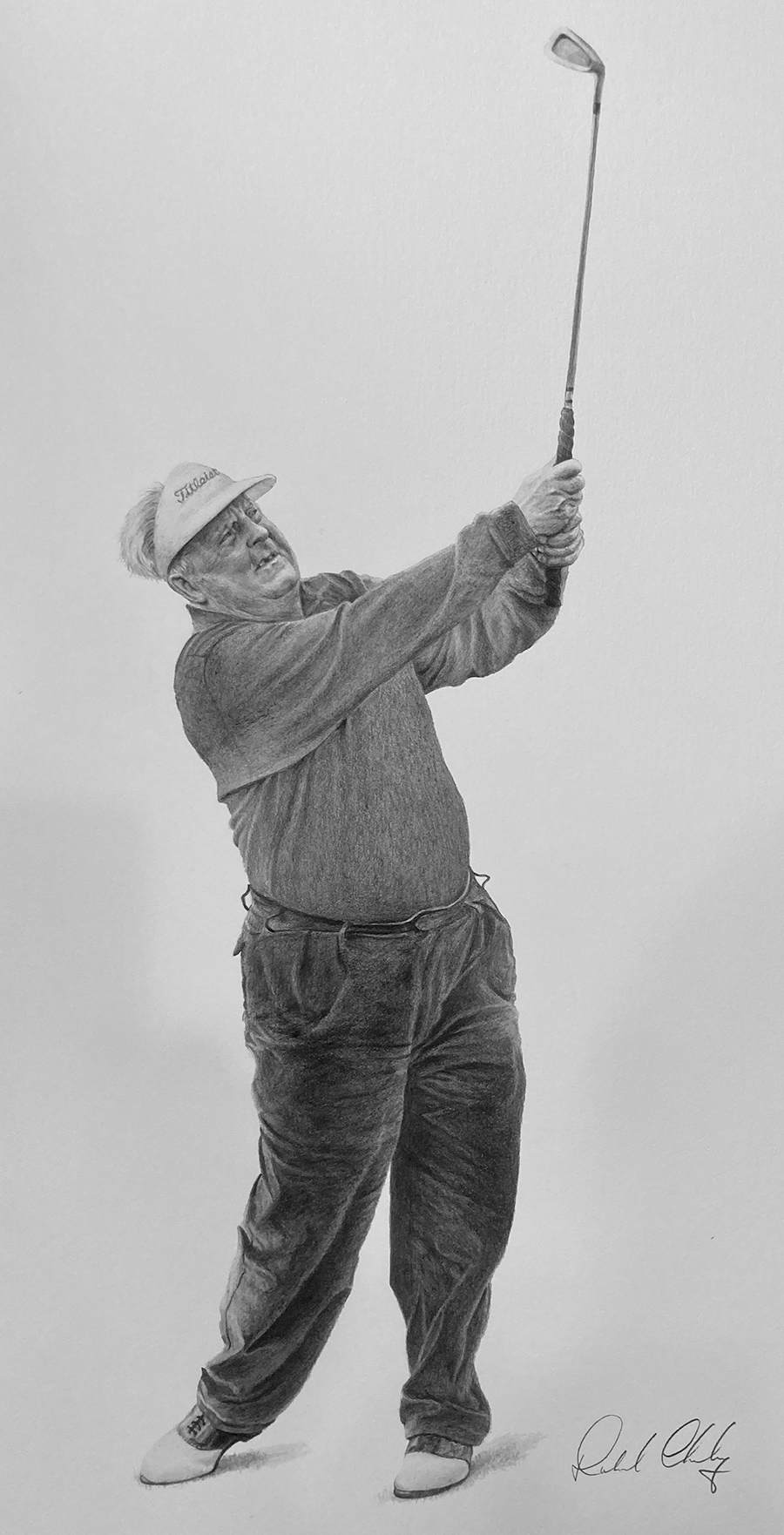
Moe was short at 5 feet, 6 inches, liked pastel colors, often mixed plaids with stripes, and wore turtlenecks in warm weather. He often said things twice and with a noted up-lilt on the final syllable. He gripped the club in his palms with a wide stance and took what looked to be a three-quarters swing on one plane, ending not with a picturesque follow-through of a limberback but with his hands and club gyrating above his head à la Arnold Palmer. He liked to say he and Ben Hogan were the only golfers who took the clubhead straight down the line exactly 22 inches. He once said he played the same wooden tee for seven years.

The stories of his ball-striking are legendary.

Moe was playing an exhibition with Sam Snead and Porky Oliver at Toronto when they came to a par-4 with a creek crossing the fairway 240 yards out. Snead advised Norman against hitting his driver, saying, “This is a lay-up hole.” 

“Not if you play for the bridge and run it across,” Moe said, and then did exactly that. 

He once hit more than 1,500 drives in a seven-hour exhibition, all landing within a 30-yard-wide landing zone. “I wish we played 30-yard fairways and out-of-bounds,” he once said. “I’d be the only guy hitting driver.”

At other times he’d fire off dozens of piercing 4-irons in succession, pause and chirp to anyone listening, “Never off-line. This swing can’t hit it crooked.”

Once Moe spent several days being filmed hitting balls and giving instructional tips on drivers, fairway woods, long irons and wedge shots. The third morning, the producers planned to ask him about long-distance putting.]

“Moe, we want you to talk about lag putts, how to manage a 50- or 60-footer.”

Norman blew them off. “I never had one. Why would you want to be 50 feet away?”

If someone told him a hole was a “driver-wedge hole,” Moe was liable to hit a wedge off the tee and a driver into the green and say, “You’re right. Driver-wedge.”

Pat McGowan, the head of instruction at Pine Needles, was playing the PGA Tour in the 1980s when he first saw Norman give an exhibition at the Canadian Open.

“Ben Crenshaw, Greg Norman, Nick Faldo, the whole golf world would stop practicing and walk over and watch Moe hit balls,” McGowan says. “I remember the first time I saw him. He hit 25 or 30 straight drives. Every one of them carried over 220 yards and stayed in a 25-yard fairway. Moe smiled at everyone and said, ‘You want me to hit 50? I’ll stay all night.’”

Alpenfels was working the counter at the Pinehurst golf shop in 1983 when someone nodded to a little man and said, “That’s Moe Norman.” Alpenfels remembered the name from conversations with Jim Hardy, his mentor in California. Alpenfels struck up a conversation, watched Norman hit balls and developed a friendship. He was invited to Norman’s winter headquarters at Royal Oak Country Club in Titusville that year to hang out.

“Moe was a brilliant ball-striker,” Alpenfels says. “He virtually could do what he said he could do. If he told you that he was going to hit five drives in a row and that all would land within a 5-foot radius, he’d pretty much do that. He was amazing. From a ball-striking standpoint, it was crazy how good he was.”

Chris Dalrymple, owner of the Gentlemen’s Corner clothing store in the village, remembers Moe would “just appear out of nowhere, sort of like a genie,” and would look around the shop, never buying anything.

“I remember he wore two watches, one on each wrist,” Dalrymple says. “I asked him why he did that. He said, ‘I just do.’”

From Pinehurst, Norman would drive down Midland Road and visit another friend, Greg Gulka, the head pro at Knollwood, and then on to Pine Needles to hit balls with Peggy Kirk Bell and Jim Suttie, the head instructor there in the 1990s.

“The first time I ever saw Moe, he was hitting drivers out of divots,” says Kelly Miller, Mrs. Bell’s son-in-law. “He was rifling golf balls down the range, one after another. They came out of that divot like a rocket.”

Moe had money problems for most of his adult life, saying he “had slept in bunkers all across Canada.” He never had a credit card or a checking account. He refused Miller’s offer for a bed at Pine Needles but would accept several hundred dollars Miller would slip in his pocket after entertaining guests at Pine Needles with an exhibition. Some thought Norman spent most of his nights in his car, but he usually had enough funds for a Motel 6 or Super 8. His finances were buttressed significantly when he met Titleist CEO Wally Uihlein at the 1995 PGA Show. Uihlein watched Norman hit balls and said Norman was a national golfing treasure and allowed that Titleist would pay him a $5,000-a-month stipend for the rest of his life. 

That lasted until September 2004, when Norman died of a heart attack.

“He had everything he needed. He had a good car, a place to stay and wonderful friends,” Alpenfels says. “He’d give you the shirt off his back if you needed it.”

A documentary film about Moe Norman’s life is in the works.

“It’s an underdog story. It’s a story about a guy who never should have succeeded, but did,” says Barry Morrow, the Oscar-winning screenwriter of Rain Man and a co-producer of the film. 

“I think he wanted to be the best at something. And hitting a golf ball was it,” adds Suttie.  PS

Lee Pace has written about golf in The Sandhills for three decades. His newest book, Good Walks — Rediscovering the Soul of Golf at 18 Top Carolinas Courses, will be available wherever you buy books.

His personal favorites include anything by P.G. Wodehouse. Tied for first are Heart of a Goof and Right Ho, Jeeves.

Bookshelf

August Books

FICTION

Damnation Spring, by Ash Davidson

For generations, Rich Gundersen’s family has chopped a livelihood out of the redwood forest along California’s rugged coast. Now, Rich and his wife, Colleen, are raising their own young son near Damnation Grove, a swath of ancient redwoods on which Rich’s employer, Sanderson Timber Co., plans to make a killing. For decades, the herbicides the logging company uses were considered harmless. But Colleen is no longer so sure. As mudslides take out clear-cut hillsides and salmon vanish from creeks, her search for answers threatens to divide a town that lives and dies on timber.

Once There Were Wolves, by Charlotte McConaghy

Inti Flynn arrives in Scotland with her twin sister, Aggie, to lead a team of biologists tasked with reintroducing 14 gray wolves into the remote Highlands. She hopes to heal not only the dying landscape but Aggie too, unmade by the terrible secrets that drove the sisters out of Alaska. Inti is not the woman she once was, either, changed by the harm she’s witnessed. As the wolves thrive, Inti begins to let her guard down, even opening herself up to the possibility of love. But, when a farmer is mauled to death, Inti knows where the town will lay blame. Unable to accept her wolves could be responsible, she makes a reckless decision to protect them. If the wolves didn’t make the kill, then is something more sinister at play?

Lightning Strike, by William Kent Krueger

Aurora is a small town nestled in the ancient forest alongside the shores of Minnesota’s Iron Lake. In the summer of 1963, it is the whole world to 12-year-old Cork O’Connor, its rhythms as familiar as his own heartbeat. When Cork stumbles upon the body of a man he revered hanging from a tree in an abandoned logging camp, it is the first in a series of events that cause him to question everything he took for granted about his hometown, his family and himself. Cork’s father, Liam O’Connor, is Aurora’s sheriff, and it is his job to confirm that the man’s death was the result of suicide. In the shadow of his father’s official investigation, Cork begins to look for answers on his own. Together, father and son face the ultimate test of choosing between what their heads tell them is true and what their hearts know is right.

Children of Dust, by Marlin Barton

In researching his family history in the year 2000, Seth Anderson discovers an unexpected story from the late 1800s. In 19th century rural Alabama, his relative, Melinda Anderson, struggles to give birth to her 10th child, tended by Annie Mae, a part-Choctaw midwife. When the infant dies just hours after birth, suspicion falls upon two women — Betsy, Annie Mae’s daughter and the mixed-race mistress of Melinda’s husband, Rafe; and Melinda herself, worn out by perpetual pregnancies and nurturing a dark anger toward her husband. Seeking to clear her own name, Melinda enlists the help of a conjure woman who dabbles in dark magic. Filled with haunts, new and old, Children of Dust is a novel about the relationship between two women allied against a violent man with secrets of his own.

NONFICTION

A Brief History of Motion: From the Wheel to the Car to What Comes Next, by Tom Standage

Beginning around 3500 BCE with the wheel — a device that didn’t catch on until a couple of thousand years after its invention — Standage zips through the eras of horsepower, trains and bicycles, revealing how each successive mode of transit embedded itself in the world we live in. Then, delving into the history of the automobile’s development, Standage explores the social resistance to cars and the upheaval that their widespread adoption required. Cars changed how the world was administered, laid out and policed, how it looked, sounded and smelled — and not always in the ways we might have preferred.

All In: An Autobiography, by Billie Jean King

An inspiring and intimate self-portrait of the champion of equality that encompasses her brilliant tennis career, unwavering activism, and an ongoing commitment to fairness and social justice. King recounts her groundbreaking tennis career — six years as the top-ranked woman in the world, 20 Wimbledon championships, 39 grand-slam titles, and her watershed defeat of Bobby Riggs in the famous Battle of the Sexes. She poignantly recalls the cultural backdrop of those years and the profound impact on her worldview from the women’s movement, the assassinations of Martin Luther King Jr. and Robert F. Kennedy, the anti-war protests of the 1960s, the civil rights movement, and, eventually, the LGBTQ+ rights movement. She describes the myriad challenges she’s faced — entrenched sexism, an eating disorder, near financial peril after being outed — and offers insights and advice on leadership, business, activism, sports, politics, marriage equality, parenting, sexuality and love.

YOUNG ADULT

Dog Island, by Jil Johnson

Willy stared out through the crisscross wires of his cage. He had figured out a few things. One, being born a spunky beagle wasn’t always cookies and naps. Two, there was no way he was staying in this barbed wire apartment. And three, as he listened to the rows of dogs barking and howling, he wasn’t going alone. (Ages 8 and up.)

CHILDREN’S BOOKS

Becoming Vanessa, by Vanessa Brantley-Newton

That first day of school can be hard on anyone, but especially if your name is looonnng and has more than one “s” and your style is a little more colorful than your new classmates. But, no matter what, it is important to be yourself. Stunning illustrations reminiscent of the brilliant Molly Bang bring this important first-day-of-school book to life. This one is a must-have for rising kindergartners. (Ages 4-6.)

T. Rexes Can’t Tie Their Shoes, by Anna Lazowski

Baby horses can stand up. Narwhals change color. And red sea urchins can live for 200 years! But nobody can do everything. Laugh out loud with the animals of the alphabet as they show what they can and cannot do in this super-cute ABC book that is perfect for story time, bedtime or anytime. (Ages 3-7.)

The Foodie Flamingo, by Vanessa Howl

At the Pink Flamingo restaurant, it’s shrimp, shrimp, shrimp, shrimp. But when Frankie the Flamingo gets a wild feather to sample something different, she becomes Foodie Flamingo. Soon everyone is sampling new things and the Pink Flamingo will never be the same! Fun with food for all ages. (Ages 3-6.)

How To Spot a Best Friend, by Bea Birdsong

It’s easy to spot a friend, but how do you know when you’ve discovered a best friend? This sweet story is the perfect read together for the night before back-to-school or any new situation. (Ages 4-7.)  PS

Compiled by Kimberly Daniels Taws and Angie Tally.

Angie’s favorite book is The Autobiography of Alice B. Tolkas by Gertrude Stein and Kimberly loves The Power of One by Bryce Courtenay.

The Omnivorous Reader

Breaking the Code

The scientific revolution that changed the world

By Stephen E. Smith

What in the world just happened?

As the pandemic wanes, that’s the question many of us are asking. But a more immediate question needs answering: What are we going to do to prepare for the next pandemic? The answer, insofar as it’s possible to predict the future, is suggested in The Code Breaker: Jennifer Doudna, Gene Editing, and the Future of the Human Race, by Walter Isaacson, a quasi-biography that raises questions about nothing less imperative than our genetic destiny.

Isaacson, a history professor at Tulane University who has written biographies of Leonardo da Vinci, Steve Jobs, Benjamin Franklin and Albert Einstein, has a gift for explicating difficult scientific concepts. His biography of Jennifer Doudna, a 57-year-old professor in the Department of Chemistry and the Department of Molecular and Cell Biology at the University of California, is the story of the development of CRISPR (clustered regularly interspaced short palindromic repeats) and the function of an enzyme (Cas9), a discovery that won Doudna and French microbiologist Emmanuelle Charpentier the 2020 Nobel Prize.

A Doudna biography could not be timelier. Her CRISPR-Cas9 genome editing technology has launched a scientific revolution that allows us to defeat viruses, cure genetic diseases and certain cancers (TV advertisements are already touting such treatments), and, perhaps, have healthier babies. She has changed our world, moving us from the digital age into a bio-life sciences revolution that will affect our lives to a greater extent than computers have or will.

Doudna was in the sixth grade when she read James Watson’s The Double Helix, initially mistaking it for a detective novel. Watson’s groundbreaking research into the human genome was a mystery so intense that it set her on a career path as a university researcher who would eventually develop an easy-to-use device to edit DNA. She helped discover a use for Cas9, a protein found in Streptococcus bacteria, which attacks the DNA of viruses and prevents the virus from infecting healthy bacterium and cells. She was quick to recognize the possibilities for controlling viruses that invade human cells by using Cas9. “These CRISPR-associated (Cas) enzymes enable the system to cut and paste new memories of viruses that attack the bacteria,” Isaacson writes. “They also create short segments of RNA, known as CRISPR RNA (crRNA), that can guide a scissors-like enzyme to a dangerous virus and cut up its genetic material. Presto! That’s how the wily bacteria create an adaptive immune system!” CRISPR allows us to create vaccines to defeat the ever-evolving structure of coronaviruses. (A new vaccine under development at Duke University has the potential to protect us from a broad variety of coronavirus infections that move, now and in the future, from animals to humans.)

Once she’d figured out the components of the CRISPR-Cas9 assembly, she knew she could program it on her own, adding a different crRNA to cut any different DNA sequence she chose. “In the history of science, there are few real eureka moments, but this came pretty close. ‘It wasn’t just some gradual process where it slowly dawned on us,’ Doudna says. ‘It was an oh-my-God moment.’”

As with most life-altering breakthroughs, ethical questions abound. Should we edit genes to make our children less susceptible to diseases such as HIV and coronavirus? Would it be morally wrong if we didn’t? Isaacson devotes a sizable portion of the biography to asking and answering the tough questions that go to the heart of the CRISPR quandary: “And what about gene edits for other fixes and enhancements that might be possible in the next few decades?” he asks. “If they turn out to be safe, should governments prevent us from using them? The issue is one of the most profound we humans have ever faced. For the first time in the evolution of life on this planet, a species has developed the capacity to edit its own genetic makeup.”

In November 2018, He Jiankui, a Chinese biophysics researcher, produced the world’s first CRISPR-altered children. His goal was to make babies immune to the virus that causes HIV, but his colleagues in China and the West termed his accomplishment “abhorrent and premature.” He was found guilty of conducting illegal medical practices, fined a hefty sum and sentenced to three years in prison. But in the wake of the 2020 coronavirus pandemic, the idea of editing our genes to make us immune to virus attacks seems a lot less shocking and a whole lot more enticing.

All of this is, of course, highly technical, but Isaacson explains much of what we need to know about CRISPR and its implications in terms that are apprehensible without dumbing down the science. Serious readers — and these days we all need to be serious readers — might peruse Doudna’s 2017 A Crack in Creation: Gene Editing and the Unthinkable Power to Control Evolution.

CRISPR will continue to change our lives — for the better, we can only hope. But science hackers are already employing CRISPR in unsupervised labs and neighborhood garages, and who knows what uses it will be put to. Will parents who have the financial resources enhance the health and IQ of their kids? Will we manufacture a class of humans whose superior strength and intellect allow them to dominate the majority? Given our history for employing new technologies, the possibilities are unsettling.  PS

Stephen E. Smith is a retired professor and the author of seven books of poetry and prose. He’s the recipient of the Poetry Northwest Young Poet’s Prize, the Zoe Kincaid Brockman Prize for poetry and four North Carolina Press Awards.

The Kitchen Garden

The Abundance Time

Get ready, here it comes

By Jan Leitschuh

This is the time for reaping. The farm stands, markets and well-diversified KGs (kitchen gardens) are brimming with vegetables, herbs, fruits and flowers.

Even the non-KG-ers may have a plethora of plump, ripe tomatoes on their pet potted plant. Or perhaps it’s sheaves of fresh basil from that small solo planting back in May.

Maybe the branches of that trio of landscaped rabbiteye blueberries are sagging to the ground with their sweet, nutritious payload. Or the farm stand sweet corn is so good you just want to save a batch for a Thanksgiving corn pudding or cornbread.

And then there’s the zucchini . . .

It’s the abundance time.

We’ve waited for it, tastebuds watering. Those first few pickings of garden-fresh produce were sublime. But the garden goods are coming thick and fast now. Soon, the kitchen counters will threaten to disappear under each day’s harvest.

What to do? What to do?

The focus right now is not on planting, with the possible exception of a later crop of bush beans, zucchini, fall tomatoes, cukes or summer squash. It’s best to pass on new plantings of sweet corn, eggplant, bell pepper or okra.

Instead, the wise kitchen gardener prepares for the overwhelming bounty of late July, when the plants pump out the produce faster than you can say “ratatouille.” So, how do you capture summer’s bounty to use on those chilly winter nights? Do you can, or are you apt to avoid steaming pots in July? Perhaps freezing, dehydration or oven-drying will be your go-to this year. Whatever method you choose, these days there are internet resources galore to help you do it right.

If you’ve never canned, it’s worth a venture into this time-honored method of food preservation. It’s a steamy summer process with its own set of paraphernalia, and one needs to set aside a morning to do it, but it offers a tangible and satisfactory result — and one that connects me, at least, to my mother, aunts and grandmothers. Sentiment and steam go hand-in-hand.

Basically, a heavy-duty canning jar is filled up with food, covered with a fitted lid and boiled for a specific time to kill potential pathogens. There’s nothing like dumping a jar of your homegrown stewed tomatoes into a batch of winter chili or opening up a quart of local July peaches for a holiday peach pie.

Jars and lids are in every supermarket this time of year. Canning kits are inexpensive and readily available and include a large pot, a jar rack, jar lifters, a wide-mouth funnel and a little magnet on a stick for picking up boiled lids and rims. My kit is over 20 years old.

If you plan to can low-acid tomatoes, beans, corn and other lower pH veggies, you need good resources and possibly a pressure cooker. Read up on how to prevent botulism spores and any other harmful organisms. Canning is not hard to do, but the process must be respected.

Jams and jellies are a good entree to canning. Jams make nice gifts, and allow for some creativity with added spices, liqueurs and flavorings. Think fig-habanero jam, blueberry Chambord or peach bourbon preserves.

How-to jam directions are very clear on the supermarket pectins that ensure the jam “sets” up. If making hot jams are not your thing on 90-plus degree days, some people freeze summer fruits to jam during cooler months when a warm kitchen is welcome. There are also easy, no-boil freezer jams. Recipes abound on the internet.

Freezing is perhaps the fastest and easiest way to preserve your harvest — if you have the space. You can also lock in nutrients from fresh produce by freezing at the peak of ripeness. Herbs, fruits and vegetables each have simple processes for preserving taste and texture when thawed.

Most fruits can be frozen raw. Blueberries and blackberries can be spread on a cookie sheet, frozen, then placed in labeled and dated heavy-duty freezer bags for winter snacking. (Spreading them out first for freezing prevents them from clumping.) Peaches can be frozen in a simple syrup, or puréed with some lemon juice to discourage discoloration, then frozen in ice cube trays for drinks or future smoothies. Don’t forget to make a few natural peach popsicles, while you’re at it.

Bell peppers and onions are easy — just chop, bag and freeze. Many vegetables freeze better if you blanch them first. Blanching involves a quick dip in boiling water to set the color and deactivate the natural enzymes that will further break down or discolor the food.

Transfer blanched veggies to an ice bath to stop the cooking. Drain and freeze in a single layer to prevent clumping, then bag, date and label. To prevent freezer burn, press out all the air, or use a straw to suck out extra air.

For sweet corn, you can freeze cobs whole but remove husk and silks first. Blanch cobs for four minutes then cool in an ice bath. Since bulky cobs take up space, you can slice the kernels off the cob when cool, then bag, date and label.

Blanch green and wax beans for three minutes. Zucchini and yellow squash slices are also three minutes. To remove the skins of peaches and tomatoes, blanch for 30 seconds or so, then put them into an ice bath. Tough tomato skins peel easier if you cut a small “x” at the bottom before plopping in hot water.

Cherry or grape tomatoes are easy to freeze. Pick out the green stem end and then freeze on trays like berries. Toss them atop winter casseroles.

Melons? Don’t keep them for long, but try a refreshing frozen granita or slushie of honeydew, lime and mint or one of cantaloupe, orange juice and Grand Marnier.

I’ve also dehydrated watermelon for hikes. Truly. You don’t end up with much but the chewy little slices are as sweet and flavorful as candy. Thin peach slices dehydrate well too. Purée with lemon and make fruit roll-ups for the kids.

Sun-dried plum tomatoes are my favorite. Slice in half, drizzle in olive oil and sprinkle with sea salt. Dry on a baking sheet in the oven at lowest heat until leathery. Freeze, or pack in oil and refrigerate. Use in pizzas, casseroles, salads, or eat as an intense, flavorful snack.

Herbs can be dried or frozen. Summer basil is probably the most popular herb to preserve for the winter. Whip up your favorite batch of pesto. I usually rinse off my basil then process it with a little good olive oil. Poured into ice cube trays, frozen, then bagged, I have a little burst of summer sunshine for any winter Italian dish, pasta or soup.

Drying is easy, just cut herbs before they flower. Strip the leaves from the stem and dry on a paper towel on a sunny table with good air circulation. Dump in a jar when absolutely crisp-dry. I dry catnip for the cat, fresh oregano and lemon thyme for seasoning, and my chocolate mint leaves for winter teas.

If you can’t eat and preserve it all, share your garden love with neighbors, friends or food banks. After all, it is the abundance time.  PS

Jan Leitschuh is a local gardener, avid eater of fresh produce and co-founder of Sandhills Farm to Table.

In the Spirit

Grab ’n Go

Your cocktails need a vacation, too

By Tony Cross

When I go to the beach on vacation, the last thing I want to do is spend my time whipping up drinks. Who wants to pack a bunch of cocktail tools with the beach towels, the sunscreen and the latest John Grisham? Other than throwing together a margarita, I’m not doing anything besides laying out in the sun and sipping. So, here are a couple of punches — the non-violent variety — that you can throw together before you shut down the laptop and head for the coast. Consider portioning them out in small drink containers: Think 8-ounce water bottles. Keep in mind that you may still want to bring a hand-held juicer. Even though you’re traveling light, you may want to add the fresh lemon and lime juices à la last minute.

Planter’s Punch

This classic punch is one of my favorites, because it’s easy to make and delicious. As Shannon Mustipher explains in her book, Tiki: Modern Tropical Cocktails, “The ingredients are simple and echo an old Barbadian recipe for a rum punch in rhyme form: ‘One of Sour/Two of Sweet/Three of Strong/Four of Weak.’ This is the holy trinity plus the addition of spice.”

8 ounces pot still Jamaican rum (Smith & Cross)

3 ounces grenadine

2 ounces fresh lime juice

2 ounces still water

6 dashes Angostura bitters

(Serves four)

If you’re batching this before you hit the road, combine all ingredients except for the lime juice; you’ll want to add that on the day of consumption. Also, if you are making this for more than four people, add your bitters last. When batching large amounts of cocktails that call for bitters, you don’t necessarily want to add the multiplied number of bitters into your batch. Start with half the amount, and then add more to taste. Lastly, make your grenadine from scratch, unless you’re buying from, let’s say, Small Hand Foods. It’s quite easy to make — equal parts POM pomegranate juice and demerara sugar; place over medium heat and stir until sugar is dissolved. Keep refrigerated after the syrup cools.

Pisco Punch

Before you go any further, order pisco online now — it’s hard to locate a bottle on any of North Carolina’s ABC shelves, but much easier after a few clicks on the web. “What is pisco?” you ask. It’s a spirit made from grapes, indigenous to Peru and Chile. If you’ve never tried a pisco sour, you haven’t lived, and if you’ve never tried the punch, well, you’re about to be reborn.

My memory is spotty, but I do believe that in his book Imbibe! David Wondrich explains how pisco punch was the only drink bars served in San Francisco’s Barbary Coast during the Gold Rush. This drink is easy to make, incredibly tasty, and unique and likely foreign to your friends and family. Use Small Hands Foods’ pineapple gum syrup — it’s killer. Years back when I bartended, I kept the punch pre-batched in my bar fridge, minus the lemon juice, of course. In Meehan’s Bartender Manual, bartender and author, Jim Meehan explains: “Pisco punch became legendary thanks to Scottish barman Duncan Nicol, who purchased San Francisco’s historic Bank Exchange Saloon — with its house punch recipe — in 1893 and kept it a secret, despite fanfare and public prying, until his dying day in 1926.”

Some speculate that Nicol’s secret ingredient wasn’t just the gum arabic, it was cocaine. Meehan says that might “explain why he permitted only two portions per patron.” Better to stick with the recipe below and imbibe safely this summer.

8 ounces Campo de Encanto pisco (did you order it yet?)

4 ounces pineapple gum syrup

3 ounces lemon juice

2 ounces pineapple juice

4 ounces still water

4 dashes Angostura bitters (optional)

(Serves four).  PS

Tony Cross is a bartender (well, ex-bartender) who runs cocktail catering company Reverie Cocktails in Southern Pines.

Golftown Journal

Junior Achievement

Another national championship in the Sandhills

By Lee Pace

The second time the USGA gathered the best boys under age 18 to compete for a national championship was 1949, and the venue was Congressional Country Club in Bethesda, Maryland. Gay Brewer and Mason Rudolph traveled together from their homes (Brewer from Kentucky and Rudolph from Tennessee) and roomed together that July week at Georgetown University. Each advanced through his bracket to the championship match, with Brewer, 17 years old, taking a leisurely 6-and-4 victory in the championship match over Rudolph, who was two years his junior.

That week cast the die for both players. Each won multiple times on the PGA Tour, with Brewer collecting the 1967 Masters and playing in two Ryder Cup matches. Rudolph won the Junior Amateur the following year, collected the 1956 Western Amateur and won five times on the pro tour.

Since then, the Junior Amateur has staged an annual audition for many elite players to come, among them Johnny Miller, Eddie Pearce, Gary Koch, David Duval, Tiger Woods, Hunter Mahan and Jordan Spieth.

“That was the first time I’d ever experienced the thrill and the chase of a USGA event,” Woods says of his three straight wins from 1991-93.

“You look at the names on the trophy and know what kind of company you’re in,” says Mahan, the 1999 victor.

“It was not as much about me winning as it is being a part of the fraternity with those guys,” adds Spieth, the champion in 2009 and 2011.

The U.S. Junior Amateur makes its debut in the golf-rich Sandhills in July with the 73rd rendition being staged at the Country Club of North Carolina, July 19-24. Yet another domino falls in the universe of elite competitive golf for Moore County, adding to the largesse of U.S. Opens (three already with one set for 2024 at Pinehurst No. 2) and U.S. Women’s Opens (three at Pine Needles with a return engagement in 2022, and one at Pinehurst No. 2). There has been a Ryder Cup, a U.S. Senior Open and three U.S. Amateurs.

And this national championship continues CCNC’s heritage of every decade or so opening its doors to some variety of high-profile tournament. Since its opening in 1963, the club has been the venue for the PGA Tour, the U.S. Amateur, the U.S. Girls Junior, six Southern Amateurs, a national father-son tournament now more than half a century old, and a host of statewide and regional competitions.

Jack Nicklaus, Hal Sutton, Ben Crenshaw, Tom Kite, Webb Simpson and Scott Hoch have collected trophies at the 36-hole golf haven and residential community located off Morganton Road, halfway between Pinehurst and Southern Pines.

“The club takes a lot of pride in all the events it’s hosted over the years — from USGA national championships to the Carolinas Golf Association events,” says Robbie Zalzneck, a USGA staff administrator and also a CCNC member. “It’s a club that likes to give back. The members have rallied behind the Junior Am. Opening the club up to competitive golf has always been in its DNA.”

CCNC was designed in tandem by Ellis Maples and Willard Byrd and opened in 1963. It was one of the original members of Golf Digest’s 100 Greatest Golf Courses and was site of the 1971 and 1972 Liggett & Myers Match Play Championship on the PGA Tour (won by Dewitt Weaver and Nicklaus) and the 1980 U.S. Amateur (won by Sutton). It has remained among the best courses in the state, and in 2021 was listed No. 16 in North Carolina in both Golf Digest and GOLF magazine rankings of the best courses in every state.

The original course was so popular the club retained Byrd to build nine more holes in 1970. Then, in the late 1970s, the club acquired some land from Robert Trent Jones (who spent time in Pinehurst in the early 1970s doing a renovation of the original Pinehurst No. 4 course) and hired him to build nine new holes, working those into the first nine to create a new course dubbed “The Cardinal” in keeping with the state of North Carolina theme.

Greg Sanfilippo, the USGA’s director of the Junior Amateur, says the two courses set up perfectly to host the best junior players from around the country. Qualifying will be held for a newly expanded field of 264 players on both courses, and match play will be held on the Dogwood.

“We structure our championships as the ultimate tests in the game,” he says. “We want to make sure we’re identifying the best players through shotmaking, testing every club in the bag, controlling spin and distance, and having the mental and physical resolve and ability to work through various situations. The courses at CCNC will really force players to execute sound judgment through each hole.”

The Dogwood Course is now five years into a major renovation directed by golf architect Kris Spence. The club spent some $10 million from 2015-16 on a capital improvement program that included the Dogwood project, construction of a new golf shop, grill room and locker room, a tennis and fitness center, and various upgrades to the existing clubhouse.

The Dogwood project included converting the greens to Champion Bermuda, and the tees and fairways to Zeon zoysia grass, a heat-tolerant strain that doesn’t need overseeding in the winter and gives golfers an outstanding surface from which to clip iron shots and fairway woods. New drainage was installed, all bunkers were rebuilt, and some tees were expanded. The tree coverage that had grown up over time was thinned out, improving air flow and sunlight.

“Dogwood had been one of the top courses in the Southeast for half a century,” says longtime Director of Golf Jeff Dotson. “We needed to set it up for the next 50 years.”

Certainly, one of the favorites for the Junior Am and a young man playing with some “home game pressure,” will be Jackson Van Paris, a 17-year-old who just graduated from Pinecrest High School and will be enrolling this fall on the golf team at Vanderbilt. The Van Paris family moved to Pinehurst from Chicago in 2017 and lives in a house alongside the sixth hole of the Cardinal Course. The club has been Van Paris’ home base as he’s built a sterling resume in junior golf that includes two firsts in the American Junior Golf Association Boys Championship. His most noteworthy achievement was becoming the second-youngest player behind Bobby Jones to win a match in the U.S. Amateur, when he advanced to the Round of 32 as a 14-year-old in 2018 at Pebble Beach.

“This has been a great club to develop my game,” Van Paris says. “I really have access to anything I need as far as practicing, and a great range and great short game facilities. And the courses are two really good golf courses.”

He knows what to expect from the USGA in terms of course setup — narrow fairways, thick rough and quick greens.

“Hitting fairways is going to be super important,” he says. “I can’t let myself get lazy on the tee by thinking, ‘I’ve hit this shot a hundred times.’ I am treating it like I’ll be playing a brand-new golf course. And the USGA always puts a premium on short game. Driver and short game are the most important things to consider.”

That and the mental game. Does it help to have intimate course knowledge and sleep in your own bed, or hurt with the pressure to perform in front of so many friends and clubmates?

“I’ll probably be more nervous than I have been in any other tournament just because it’s at home and everyone expects me to play well,” Van Paris says. “But I also think I can embrace that if I handle it the right way. I keep telling everyone I see, please come out and watch. I want as many people out there as possible. It’s part of learning to play under pressure.”

The great ones learn to thrive under the microscope, leaving the Junior Amateur as another chapter in Van Paris’s evolution — not to mention the Sandhills as a mecca for national championships.  PS

Lee Pace has written about the Sandhills golf scene for more than 30 years. Follow him on Twitter at @LeePaceTweet and contact him at leepace7@gmail.com.

Birdwatch

Taking the Plunge

The belted kingfisher dives for prey

By Susan Campbell

Often heard before they are seen, belted kingfishers are a year-round fixture here in central North Carolina. Requiring water for foraging and steep slopes for breeding, they can be found along streams, rivers and ponds — of which there is no shortage in our area. Their long, rattling call is distinctive among our familiar birds.

One of three species of kingfisher found in the United States, the belted kingfisher’s range is extensive and year-round across most of the continent. Breeding birds from Canada may migrate southward in search of open water in winter. A percentage of the North American population winters in south Florida as well as Mexico. It is assumed that most local breeding birds simply wander to where the fishing is good in the colder months, not making any real migratory flight in the fall.

Belted kingfishers are top-heavy-looking birds with powdery gray plumage and a raggedy crest. They get their name from the swath of gray plumage across their breast. These birds are one of the few species in which the female has brighter plumage than the male. Females sport an additional band of chestnut feathers just below their gray “belt.” Otherwise, these birds have a characteristic large head, thick neck and heavy, long pointed bill. They are built for plunging headfirst into the water after prey. They often sit on a convenient perch above the water, such as a branch or electric wire, and then dive when they spot prey. However, they are also capable of hovering for short periods above potential food items before descending to grab a fish. They actually have a wide prey base, feeding on all sorts of aquatic organisms but also taking other types of food, such as small birds and even berries, if the opportunity arises.

Belted kingfishers require a steep, dirt slope for nesting. Although this is usually a riverbank, they may also use human-created habitat such as tall dirt piles, which can be away from water, if they are big enough, and have a sheer drop on at least one side. This type of nesting substrate makes it difficult for terrestrial predators to reach the kingfisher’s nest. The tunnel into the nest chamber is typically several feet long and is sloped upward, presumably to protect the nest from rises in water level along rivers and streams. The kingfisher’s tunnel opening is large, at least 3 inches in diameter. Also, there will be the characteristic fishy aroma from recent droppings, separating it from other bank dwellers, such as bank or rough-winged swallows.

In spring, the belted kingfisher pair will search out a nest site. The male will probe the dirt in suitable spots until he finds the right spot. Once he is satisfied with his choice, he will signal to the female by flying back and forth from her perch to the chosen location. After the burrow has been excavated, five to eight white eggs will be incubated in the nest chamber for almost a month. Once hatched, the young will be tended to by the parents for about another month before fledging occurs. While in the nest, the young kingfishers have highly acidic stomachs and will be able to digest scales, bones and other hard parts of what they are fed. By the time they leave the nest burrow, however, the birds will be regurgitating pellets made up of those typically indigestible parts, as adults do.

So, the next time you hear a loud rattling sound coming from on high, look up. You may just catch sight of one of these energetic, fast-flying fishers! PS

Susan Campbell would love to receive your wildlife sightings and photos. She can be contacted at susan@ncaves.com.

Tea Leaf Astrologer

Cancer (June 21 – July 22)

I once watched a squirrel attempt to drag an entire loaf of bread up an oak tree. Poor thing didn’t get very far. And you, who were born under the sign of Cancer, won’t either — unless you let go of what’s holding you back. Alternatively, that could be a metaphor about your relationship with carbs. Either way, it’s likely to be an emotional month for you. But you’ve been around the sun enough times to know at least one thing: Your softness is your superpower. Happy birthday, Crabcakes. 

Tea leaf “fortunes” for the rest of you:

Leo (July 23 – August 22)

Do sunflowers mean anything to you? They should. Also, pay attention to your dreams this month.

Virgo (August 23 – September 22)

Got your next breakup album ready? Just kidding. It’s time to lighten up.

Libra (September 23 – October 22)

You’re taking one for the team this month. Deep breaths. This too shall pass. 

Scorpio (October 23 – November 21)

Drink the tea before it goes cold.  You know what I’m talking about.

Sagittarius (November 22 – December 21)

Is there a special Virgo in your life? If so, draw them a salt bath. If not, probably for the best.

Capricorn (December 22 – January 19)

Just say you’re sorry — it’s not that hard — and move on.

Aquarius (January 20 – February 18)

You’ve outgrown the shoes. That’s OK. You won’t be needing them.   

Pisces (February 19 – March 20)

Someone needs a hug. And a bubble bath. But don’t spill the nail polish this time.

Aries (March 21 – April 19)

The missing piece isn’t actually missing. But you’re working on the wrong puzzle.

Taurus (April 20 – May 20)

A new flavor will be entering your world. Two words: Moderation, darling. 

Gemini (May 21 – June 20)

This will make sense later: Wear the blue one. For now: Mind your tongue.

Zora Stellanova has been divining with tea leaves since Game of Throne’s Starbucks cup mishap of 2019. While she’s not exactly a medium, she’s far from average. She lives in the N.C. foothills with her Sphynx cat, Lyla.

Sporting Life

Waiting for a Ride

A close encounter with a hero

Jimmy, some of it’s magic,
  some of it’s tragic

But I had a good life all the way.

— From “He Went to Paris” by Jimmy Buffett

By Tom Bryant

The morning of June 24 was as promised by the folks at the Weather Channel. It was gonna be hot and humid. But after all, it was the first week of summer, and the way they talked, we should get ready for more of the same.

I was leaning against the fender of the old Bronco waiting for Sam to come out of the bank. Not knowing how long Sam’s business would take, I prudently grabbed a shady spot next to an old Ford pickup. He said he wouldn’t be long, but I took no chances.

He had called me the week before.

“Bryant, need a favor. Could you give me a lift to the VA up in Durham? Got to have an operation on my carotid artery. They say it needs to be reamed out.”

“Absolutely,” I replied. “When you gotta go?”

“Next Wednesday. You can drop me off, and the bride will pick me up when it’s time. I sure appreciate it.”

So, that’s how I ended up waiting outside the bank on the first Wednesday of summer. It would prove to be an interesting day.

Sam came out shading his eyes and ambled toward the truck. “I hope you left some money in there for me,” I said, chuckling.

Sam’s a medium size guy, losing weight to aging, but he always has a gleam in in his eye, ready for what’s next. On this morning, I noticed he walked a little slower than usual. I commented, “Hey boy, you slowing down in your old age?”

“Not on your life, Bryant. I’ve learned to walk around it rather than run over it. I thought I’d learned you that valuable lesson.” We laughed and climbed in the ancient truck and headed to Durham, where the VA hospital is located.

Sam and I go way back to the days before society became so transient. We met probably in the third grade and continued our friendship, always staying in touch over any length of time or distance. Age and circumstances weighed on us both, but more healthwise for Sam than me.

The old truck isn’t conducive to conversation when you’re roaring down the road at a blistering 55 miles an hour, but Sam and I were used to it. We carried on, shouting a bit when the wind noise threatened to shut us down.

“You gonna come outta this?” I asked, using the black humor we sported back and forth to one another all our lives. “If not, I hope you made the proper arrangements with your lawyer. I’m not driving you up here for nothing.”

“Don’t worry, Bryant, I’ll see you get a tank o’ gas out the deal. Find us a quick food joint and let’s get some lunch. I’m not hankering for hospital food for supper.”

I stopped at a Wendy’s right outside of town. There were a couple of picnic tables shaded under an oak tree, and we decided to eat outside away from the lunch crowd.

“What’re y’all doing on the Fourth?” he inquired.

“We always go up to Burlington. A group of friends get together every year to celebrate. It’s a good summer outing with folks we’ve known forever. What are y’all gonna do?”

“Don’t know yet. Depends on how this trip turns out.”

I could tell that Sam was feeling his age and also a little mortal. Who wouldn’t, going to a strange hospital for an operation that is supposedly routine but could always turn out not to be?

“Come on, Sam. This operation will be fine. You’ve got the best doctors in the country. The Duke docs run the show at the VA, I understand.”

“I know, but at my age, anything can happen. I’m not ready to get on that bus, you know, just in case they’re getting up a load,” he said.

The burgers were good, and we stowed our trash in the waste can next to the table and were on our way. In a short drive, I pulled up in front of the massive VA hospital, found a parking place again in the shade, and we got out of the Bronco.

“Thanks for the ride, partner. You don’t have to come in. I can handle all the paperwork.”

“Nah, I want to see the place just in case I have to come up here someday.”

And it was something to see. The building was huge, with large halls stretching from here to yonder. After a bit of searching, as directed by the lady at the front desk, we found where Sam was supposed to bunk. It was a ward, really, with six or eight beds in the room. He was the only one there.

“You don’t reckon they might lose you back here?” I asked, smiling as I was getting ready to leave.

“I hope not. But you better have your compass so you can find your way back to the Bronco.”

“All right, sport. You take it easy. Good luck in the morning. I’ll touch base with you tomorrow.”

I stepped out into the hall to find my way back to the entrance. Sam was right, I did need a compass. I immediately got turned around and wandered the halls right and left, totally lost. The amazing thing was there were no people. I walked past empty rooms, vacant corridors, nobody. Finally, I met a lady heading my way. She was looking lost, too.

“Ma’am, I’m trying to find the front door to this place. Can you point me in the right direction?”

“I think it’s down this hall,” she said, pointing to a long passageway to my right. “I’m new here myself, from the Duke hospital across the road, and I’m trying to find the floor nurse.”

“Good luck,” I said, and she walked away in the opposite direction.

Around the corner, down the hall, I saw a door opening outside. There was a parking area all right, but not the one where I had parked. A fellow was sitting on a bench right next to the sidewalk. He looked like he had been there for a while, so I thought I’d get directions from him.

When I walked up, he looked over at me, grinned and said, “You lost?”

“No, sir, but my truck is.”

“You came out the wrong door, Bubba. This is the back entrance. You probably parked around front.”

The man was of an indeterminate age, with iron-gray hair cut in a military brush style. He had on a sweatshirt with the sleeves cut off and a faded Marine Corps insignia on the front. He wore crisp, ironed khakis and sandals. A cane was propped on the bench. His color had a yellow cast to it, and his breathing was short, as if he had to concentrate on it. A small tattoo showing the stripes of a master sergeant was on his right arm.

“Business inside?” he asked.

“My friend. I gave him a lift up here. He has an operation scheduled tomorrow. Marine Corps?”

“Yep, 28 years, retired. You?”

“Same. Short timer. Let me guess. Gunnery sergeant?”

“Good guess. Vietnam?”

“Same era. You?”

“Three tours.”

“Good grief. Couldn’t get enough of the good times, I guess.”

“There in the beginning, helping the ARVN build firebases. Sort of an observer. Second tour, more a participant. The Southern regulars weren’t up to the task. Meant well, but would scatter like a busted covey of quail at the first shots. Third time, realized it was a politicians’ war and a wasted effort.”

He looked out at the traffic slowly driving by, lost in his thoughts.

“You a patient inside?” I asked.

“Yeah, sort of a regular. They tell me I’m about done, though. Waiting on my ride. My niece is picking me up.”

I didn’t ask what he meant by “about done.”

“Here she is now.” He pointed to a pickup that stopped at the curb. “Good talking with you.”

He slowly got up from the bench, and with the help of his cane, shuffled down the sidewalk.

“Hey, Gunny,” I said as he neared the vehicle. “Have a great Fourth. Semper Fi.”

He stuck up his thumb in the universal gesture for “everything is OK” and slowly climbed in the truck. I watched as they drove away, and as I walked around the building to find the Bronco, I couldn’t help but think about the hero I had just met. He deserved better than a bench sitting in back of an almost empty VA hospital.  PS

Tom Bryant, a Southern Pines resident, is a lifelong outdoorsman and PineStraw’s Sporting Life columnist.