Hiram Larew turns loose the syllables like steam on water in his 2021 book, Mud Ajar, from Atmosphere Press. His words do not sink up in stirred up mud. At times I feel as if I can almost see through the mud, as the poet shakes form and content to create Poetry.
In “Quiet Come” —
All is up
yes
all is sky
In “Ode to the Edge” —
all arrows lift their grateful views
sung-up like curves
the call of bogs
where edge surrounds
Listen to these few lines from “Mud Ajar,”
the title poem —
Here where beaks are barns
that loop through when
as rain lifts praise
on trill of rakes.
In “Listened Twigs” listen to Larew’s lines —
These trees a choir
in early fine
their waking limbs
When snowflakes hear within themselves
of how beginning sounds.
Every syllable sings: example, these words from “Sign a Lease” —
When the skies boil or bloom
go sweep the stoop. PS
Hiram Larew is the founder of Poetry X Hunger which inspires writers all over the world to combat hunger. In Mud Ajar, the music quakes and the sky blazes all over again.
Shelby Stephenson was poet laureate of North Carolina from 2015-18. His recent book is Praises from Main Street Rag Publishing Company.
I got a much-needed haircut recently not long after eye surgery. My vision was limited to the other eye, but that was plenty to notice the clippings on the black cape when the stylist had finished. There was enough white on the cover-up to make it seem as if a polar bear had been in the chair.
Forty years after finding my first gray hair, on my 22nd birthday, there is much more salt than pepper to be swept up after getting a trim. It’s been headed in that direction for two decades, an inexorable journey that, like achy joints after a taxing day, is just part of the landscape when you’re north of 60. As P.G. Wodehouse said, “There is only one cure for gray hair. It was invented by a Frenchman. It is called the guillotine.”
Don’t think for a minute I’m not grateful to have a head mostly full of hair at my age, regardless of its hue. I thank my maternal grandfather, B.L. Henderson, for whom a pocket comb remained a useful stocking stuffer as he made his way into his 90s, if one’s hair prospects are indeed rooted in that part of the family tree.
Plenty of men are dealt a different hand, losing their hair, or most of it, at a relatively young age. The combover can be a comical reaction — see images of former Purdue basketball coach Gene Keady for confirmation. This is the ultimate losing battle, and the willingness of more folks to go the shaved-head route when faced with a bare minimum is a victory not only for style but common sense.
I’m glad I haven’t had to make that decision. A couple of years ago while getting a haircut down South, as I sat down in the chair, I asked the barber if he could do anything about all the gray I could see in the mirror.
“Better to go gray than go gone,” he said.
Those seven words of barber philosophy have become my mantra.
If my father had heard them as he started getting lots of gray as he approached his 50th birthday, he might have avoided his brief hair dye experiment. Something looked different about his appearance as he sat down to supper one evening, but the real evidence was in the bathroom sink — black stains from the hair dye he had applied. We teased him so much that he never altered his appearance again. For the last decade of his life, he let his short flat-top go increasingly toward white, and set against his blue-green eyes it was a very handsome look.
“No play for Mr. Gray” has been a catchy line for Walt Frazier to say in the “Just for Men” television commercials, but I’m not sure how accurate it is.
If someone wants to dye his or her hair to maintain a look that has been theirs for years, more power to them. It’s none of my business. But tell me that singer Emmylou Harris doesn’t look gorgeous these days with that silvery hair of hers, and I’ll wonder what you’re smoking.
When it comes to hair color, I’m leaning toward letting time tell its story.PS
Southern Pines native Bill Fields, who writes about golf and other things, moved north in 1986 but hasn’t lost his accent.
James Walker Tufts had no grand design on a New England-style village nor wall-to-wall golf courses when he set off from Boston in the mid-1890s. He wanted warm weather and a reasonable train ride from the snowy North to establish a winter resort, and it was by pure coincidence that he happened upon some 5,000 acres of land for sale just west of Southern Pines, the suggestion coming from a Wilmington insurance man he met on the train.
Walker Taylor, legend has it, suggested that the train station in Southern Pines might be a good starting point for Tufts. It was right on two of the nation’s major north-south transportation arteries — the railroad and U.S. Highway 1. Well, “highway” might be a bit of a stretch for the 1890s, but you get the idea. There was cheap land available, and it was halfway between Boston and Florida.
“It’s an old family story,” says Walker Taylor III. “I have no way of proving its authenticity. But my grandfather always said he directed Mr. Tufts to the Sandhills. True or false, he did get the Tufts’ insurance business. He even opened an office in Pinehurst to service Mr. Tufts.”
So, how did you stumble upon Pinehurst?
Stan Bradshaw and his wife, Jean, were living in St. Louis in 1997 when they channel-surfed across a television showing of Shell’s Wonderful World of Golf. The episode featured Arnold Palmer against Jack Nicklaus, played on Pinehurst No. 2 in April 1994. Those shows were part competition and part golf travelogue, so the Bradshaws were intrigued with the history and ambience of the golf-centric village in the North Carolina Sandhills.
“You know, we ought to look at that place,” Jean said.
Stan agreed, and soon after they booked flights, rooms and golf times for themselves and Jean’s parents. They traveled to Pinehurst in November 1997, and while the men played golf, the ladies toured the village and checked out The O’Neal School, a college preparatory school on Airport Road just northeast of Pinehurst.
Stan and his father-in-law were smitten.
“But how are you going to get Jean to move to a golf resort?” Stan’s father-in-law wondered.
“I’ll figure something out,” Stan answered.
It turns out the women were so impressed with The O’Neal School that Jean was ready to move — lock, stock and barrel. Bradshaw was in the banking, capital management and hedge fund world and could “live anywhere within an hour of an airport,” and thus had the freedom to move wherever suited the family’s interests. They joined Pinehurst Resort and Country Club, bought two lots to the right of the fourth fairway of the No. 2 course in 1999, and built a house.
“We say that the three things that got us to Pinehurst would be Jack, Arnie and The O’Neal School,” Bradshaw says.
Mark Reinemann grew up in Wisconsin and as a golfer “was always looking in the spring to travel somewhere warm for golf — typically either southwest Florida or Scottsdale,” he says. He and his wife over time came to prefer the green of the South over the brown of Arizona, though Florida wasn’t their cup of tea. He visited Pinehurst in the late 1980s, loved the experience, and was introduced to the Country Club of North Carolina through a banking client and CCNC member, Jack Schwerman.
“Jack invited us to stay at his house for a long weekend in 1988 and we just fell in love with CCNC,” says Reinemann, who served seven years on the USGA executive committee and retired from the banking business in 2016. “It was one of those ‘perhaps someday we could be a member here’ moments. Fast forward and here we are.
“We love the charm of the area, the slight change in seasons, the grace and style of the people who live here and, of course, the world-class golf. We never deviated from our plan to move here full time once I retired and have absolutely no regrets. We just love it here.”
Robert “Ziggy” Zalzneck was enraptured as well by CCNC and the Sandhills, on Christmas Day in 1967. At the time, he was a young accounting intern in Raleigh a long way from his Pennsylvania home. He was given access to CCNC by his boss, club co-founder Dick Urquhart, and had the place to himself on the holiday. “I played 36 holes and it was 70 degrees,” says Zalzneck, who later joined the club and has served as president. “It was the prettiest place I’d ever been my whole life. I’ve loved the place ever since.”
Marty McKenzie is a lifelong Pinehurst resident and real estate executive who loves to wax poetic about the “magic bubble” of the village of Pinehurst — the winding streets, the thick tree canopy, the absence of visual clutter.
“As human beings, when we try to describe something to people they’ve never seen, we always use the five senses — it looks like, tastes like, feels like — whatever. When you try to describe Pinehurst to other people and you think of those senses, you can’t find anything. Nothing comes to mind. Pinehurst doesn’t look like anywhere else,” McKenzie says. “People drive into the village and they’re absolutely paralyzed. They look around and say, ‘This is the most beautiful thing I’ve ever seen. How can I be a part of it?’ We take for granted we have the same status as the Washington Monument and Mount Rushmore — all of those are National Historic Landmarks.”
That bubble once snared a first-time visitor to Pinehurst on the second-floor porch of the Magnolia Inn. It was there amid the century-old magnolia trees over Memorial Day weekend in 1994 that Jane Deaton of Sea Island, Georgia, opened her eyes to the magic of Pinehurst.
“We arrived late the night before so we didn’t really know where we were,” she says.“I walked out on the balcony the next morning and thought, ‘Oh, my God.’ It took my breath away. It was glorious. The village literally unfolded beneath me. I said, ‘I want to live here.’”
That day, Jane and Brian Deaton found a real estate agent and within the week bought a vacant lot at the intersection of Culdee and McKenzie roads, just two blocks behind the Carolina Hotel. Their new home was finished at the end of 1998.
Earl Ellis was a floor trader at the New York Stock Exchange in the 1980s and later a partner in a Wall Street specialist firm. Ellis and his wife, Anne, had a vacation home in Florida, but since Ellis, in his words, “liked Florida but didn’t love it,” they began scouting in the early 1990s for options, including the Carolinas and Georgia coasts. A friend was a founding member at Forest Creek Golf Club and suggested Ellis visit Pinehurst. The Ellises drove through town on the way back north from Florida and got a room at the Holly Inn one day in 1997.
“I just fell in love with the village,” Ellis says. “The thing that’s intriguing about Pinehurst is that if you’re in Pinehurst, you’re in Pinehurst because that’s where you wanted to go. There’s rarely someone who goes through Pinehurst to get somewhere else. So, you don’t have all this transient traffic. Everybody is playing golf and laughing it up at the bars and restaurants. There was something special about the feel of the place.
“It was like Brigadoon. It seemed too good to be true.” PS
Lee Pace has written about the Pinehurst experience for more than three decades from his home in Chapel Hill.
You know those little peppers used on Thai menus to indicate the spice level of the dish? Well, it’s a three-pepper month for you, Aries. And while that may seem mild compared with the blistering, full-body high you’re accustomed to, perhaps it’s time to shift your focus toward the subtle energies in your life. Single? No need to go sending up flares. Love always finds you. But you’re not a dish for just anyone.
Tea leaf “fortunes” for the rest of you:
Taurus (April 20 – May 20)
Get ready for a reality check. Or don’t. It’s coming for you either way.
Gemini (May 21 – June 20)
When it comes to love, you’re only fooling yourself.
Cancer (June 21 – July 22)
Somebody’s got shiny-penny syndrome.
Leo (July 23 – August 22)
The door is unlocked.
Virgo (August 23 – September 22)
You’re going to have to speak up.
Libra (September 23 – October 22)
Don’t think of it as backtracking. Think of it as recalibration.
Scorpio (October 23 – November 21)
Two words: healthy boundaries.
Sagittarius (November 22 – December 21)
You’ll want to change your shoes for this.
Capricorn (December 22 – January 19)
Does the term “energy vampire” mean anything to you?
Aquarius (January 20 – February 18)
You couldn’t wipe off that grin even if you tried.
Pisces (February 19 – March 20)
You’ve already hung the moon. Now it’s time to enjoy it. PS
Zora Stellanova has been divining with tea leaves since Game of Thrones’ Starbucks cup mishap of 2019. While she’s not exactly a medium, she’s far from average. She lives in the N.C. foothills with her Sphynx cat, Lyla.
An Easter without kids brings
a basketful of memories
By Tom Allen
I’ve never been sure when a parent qualifies as an “empty-nester.” Maybe when the only, or last, child has his or her place, when their delivery and return address changes.
The younger of our two daughters officially fledged in June of 2020 when, like her sister, she married just out of college. But from March until her wedding day, June 20, courtesy of a pandemic, the last half of her senior year at Meredith College was virtual.
With campus housing closed and classes moved online, Sarah packed up and came home. We loved it. During the day, she continued her student teaching, online, with 20-plus kindergartners. After school, we cooked, ate supper together, played board games, and during visits from her fiancé, planned for a COVID wedding, with 15 guests instead of 250.
Her presence also meant she was home at Easter, specifically, the Saturday before Easter, which in our family is egg-dyeing day. We, like many, have specific holiday traditions. Fewer, by far, at Easter than Christmas, but nonetheless beloved. Until last year, one or both daughters were home for the annual ritual. No fizzy tablets and water for us. The real deal — the sound of boiling eggs bumping against a pot, the pungent aroma of hot water and vinegar, and McCormick’s “Assorted Food Color and Egg Dye.”
Four little vials — red, yellow, green, blue. The back of the box provides instructions for classy colors like “orange sunset” and “dusty rose.” When the girls were old enough to read, we challenged them to follow directions for other hues — 24 drops of red and 16 of blue make “pretty purple”; nine of green and three of yellow give you “mint green.” Or just squeeze this many drops of whatever and this many drops of whatever and see what happens.
Traditions die hard. Soon-to-be-graduated and married Sarah, along with Mom and Dad, spread newspapers on the kitchen table. My wife boiled a dozen Dollar Tree eggs, their shells dinging against the pan when it hit that rolling boil. Sarah boiled the egg-dyeing water. Odd how the smell of boiled eggs and a teaspoon of White House Apple Cider Vinegar, like cinnamon at Christmas, becomes the smell of Easter. Lilies, boiled eggs, and vinegar. Who knew?
We mixed the vinegar and water in glass ramekins, the same ones used for years. I know. They make plastic cups for those kinds of things, but again, traditions die hard. Like a hot potato, gotta wait for the eggs to cool a bit, but soon, with newspapers spread, water and vinegar mixture ready, spoons out, the time for dunking and dying came.
I’m a McCormick purist — red, yellow, green, blue. Sarah and her mother live on the edge, mixing this with that. No matter. There was laughter and joy, the essence of Easter. We left our creations to dry in the empty Dollar Tree carton. Then, as in years past, we placed the colored eggs in a basket of plastic grass. This would be the centerpiece on our kitchen table for the next couple of weeks.
Last year, my wife and I found ourselves alone on the Saturday before Easter — empty nesters with a dozen cheap eggs.
“You wanna dye eggs?” Beverly asked.
“Sure,” I responded, admittedly without much enthusiasm. She boiled the eggs, but only six. I laid out newspapers. She heated the water. I added the vinegar. Same ramekins. Same McCormick colors. I dipped my three in red, yellow, green. She went for half-and-half colors with hers. Finally, our six dry eggs were placed in the centerpiece basket with plastic grass. We smiled. Traditions die hard.
The saying goes, “We give our children two things — roots and wings.” Roots keep them grounded; wings give them freedom to be themselves. I’ve seen the cliché attributed to Goethe, Jonas Salk and the ubiquitous “unknown.” Their words convey wisdom and truth, but watching them fly can be bittersweet. New families are formed, new traditions are established. Some holidays the house is full. Others, the nest is empty.
Fortunately, our daughters and their husbands live an hour north. The oldest is expecting our first grandchild, a boy, at the end of April. Even with an early arrival, he’ll be too young for egg-dyeing this year. Ah, but next year, sometime before Easter, we’ll probably cover a kitchen table with newspapers, boil some eggs, bring out the ramekins, vinegar, and McCormick “Assorted Food Color and Egg Dye.” Who cares what colors he chooses?Traditions live on, like Easter’s joy and laughter.PS
Tom Allen is a retired minister living in Whispering Pines.
There was one other bidder. Maybe two. But less than a minute after hitting the auction block the box was mine. That’s how the eggs came into my possession all those years ago.
Tucked away down a narrow dirt road north of Fort Bragg sit the remnants of an estate that once hosted some of America’s most powerful and wealthy families. Stately cottages, an opulent clubhouse and a Donald Ross-designed golf course welcomed guests who arrived in private railcars. Quiet and secluded, it was a paradise that many locals didn’t know existed.
Set among longleaf pine forests and winding streams, the idyllic tract known as Overhills was acquired by Percy A. Rockefeller, a nephew of Standard Oil founder John D., in the 1920s and remained in the family for nearly 80 years — first as an exclusive hunt club and later as a working farm and family retreat.
Percy’s great-grandchildren later decided to part with the beloved property, and it was sold to the U.S. Army. The sprawling acreage would provide additional training areas for Fort Bragg, but not before the barns and cottages were properly cleaned out. Which brings me to that sunny March morning in 1997.
Scores of vehicles lined the road a quarter of a mile into the grounds. Overhills was an enigma, and people were curious. I parked and headed toward the sale. Walking amid shadows of the once grand estate, I felt as if I were in another time.
Under rusting canopies, I joined the crowd inspecting odd farm implements, worn furniture and bags of golf clubs. Boxes overflowed with chipped pottery, dented pots and faded tablecloths. Not exactly priceless antiques.
A yellow and orange plaid pillow caught my eye. Beneath it was a box containing an Easter basket, several bags of plastic grass and, at the bottom, a cardboard egg carton. I pulled out the carton expecting to find mismatched halves of plastic eggs. Instead, I discovered beautifully painted eggs with intricate flowers, birds and geometric patterns detailed in rich, vibrant colors. A box of masterpieces!
I quickly closed the carton and put it back underneath the Easter grass and ugly pillow. I looked around. Does anyone else know what’s in the box? When I emerged as the winning bidder, I collected the box and made a beeline to my car.
At home I inspected my find. These were real, hollowed-out chicken eggs, certainly not Fabergé-class, but unique, and no two were alike. It wasn’t until years later that I researched and found that my “Rockefeller” eggs might very well be Pysanky.
Pysanky are hand-decorated eggs traditionally made during the Easter season throughout Eastern Europe, most notably in Poland and the Ukraine. Symbolic of the rebirth of nature after winter, they are believed to bring good luck or have special powers, such as protection from evil spirits. The eggs are not painted but inscribed with wax using a special stylus known as a kistka and dyed using natural colorants.
In the years since that day at Overhills, I often wondered about the eggs. Were they commissioned as gifts for the Rockefeller children? Picked up on a trip abroad? Created by a talented employee? I guess I’ll never know.
Recently I came across Pysanky “eggspert” Joan Brander, a Canadian artist who learned the art form from her Ukrainian grandmother and teaches it to others. She graciously interpreted some of the motifs and techniques used in their creation, pointing out the degrees of difficulty. She even included a recorded snippet of the correct pronunciation of Pysanky. It’s PEH-sen-keh. Of course, I’d been pronouncing it wrong.
Today Overhills lies hidden behind chain-link fencing, part of Fort Bragg’s Northern Training Area, the once-manicured golf course buried in overgrowth and the remaining structures crumbling from neglect. But one small piece of that fabled Overhills world lives on. Every spring, as Easter approaches, I pull out the cardboard carton and arrange the delicate treasures on a fancy platter. For a few weeks, as they have for the last quarter-century in my home, the Rockefeller eggs take center stage.PS
A native of Ohio, Pamela Phillips has called the Sandhills home since 1987. She is working on her first novel.
In simplest terms, biodiversity is the total number of animals and plants that occur in a certain area, say, a country or state. When asked, most North Carolinians would say that here in the Tar Heel State, biodiversity is highest in the mountains, with the extreme range of elevation and rugged topography, including the Great Smoky Mountains National Park. A second area of biodiversity might be the outer Coastal Plain and barrier islands (including the Outer Banks), with its species-rich pine savannas, maritime-influenced plant communities, and huge numbers of nesting birds in summer and birds that winter there in the cold weather.
Yet, when the numbers are tallied, it is the lesser known and often overlooked Sandhills region that comes out on top. And not just in one category — plants, for example — but in several others as well. This seven-county region (Cumberland, Harnett, Hoke, Lee, Moore, Richmond and Scotland), while not very large — 3,384 square miles — encompasses a wealth of natural habitat types, which in turn support high overall biodiversity.
The Sandhills region overlaps three of the four major regions of the state, encompassing parts of the Piedmont and Coastal Plain as well as the entirety of the Sandhills. Each of those regions has different geology, soil types and topography, and the natural habitats reflect that.
In the Piedmont we see rocks when we walk through the woods, and rock ledges often front rivers such as the Deep and the Cape Fear. The Raven Rock State Park in Harnett County boasts one of the biggest ledges in the state. The brownwater (nutrient-rich) rivers of the Piedmont support wonderfully tall and shady forests on floodplains.
In the Coastal Plain we have Carolina bays, some forested with pond cypress, some open ponds, which support unique plants and animals that have adapted to fluctuating water levels. We also see xeric “bay rims” (dune-like sand ridges) bordering the bays, and dry-to-xeric flatwoods elsewhere.
In the Sandhills, we encounter myriad streamheads where rainwater collects to form acidic and nutrient-poor blackwater creeks and swamps. The margins of these streamheads provide habitat for many species typical of outer Coastal Plain savannas plus endemics found nowhere else. These streamheads are embedded within some of the highest quality longleaf pine communities in the entire Southeast: Fort Bragg, Camp Mackall, Sandhills Game Land, Weymouth Woods – Sandhills Nature Preserve, Carvers Creek State Park, Walthour-Moss Foundation, Calloway Forest Preserve, Eastwood Preserve and others.
Each section of the Sandhills has its own long and complex history, and each brings many products to the biodiversity table.
Now, for the numbers. These have been generated by the ongoing North Carolina Biodiversity Project (nc-biodiversity.com), an online resource where anyone can read species accounts, see images, and view maps of the flora and fauna of North Carolina.
Vascular plants (mosses, liverworts, lichens not included): Moore County is No. 1 in N.C. with 1625 species (including non-natives that have become established); Wake is a close second with 1622; and Orange a distant third with 1548. Notably, Richmond (1475), Harnett (1450), and Cumberland (1436) counties all rank in the top 10 for plant diversity.
Butterflies: Moore tops the list with 120 documented species; Richmond (115) and Cumberland (114) are in the top five.
Dragonflies and damselflies: Richmond is king of N.C. with 119; Moore is a close second with 117; Cumberland (115) is tied for third; and Harnett (110) is seventh.
Grasshoppers and crickets: Wake is far ahead with 110 species; Moore (84) is second; and Scotland (70) is fifth.
Freshwater fishes: Richmond and Brunswick counties are tied with 91; Moore (81), Harnett (76), and Cumberland (68) make the top 10.
Moths: Madison County in the mountains is No. 1 with a whopping 1352; Moore is 12th with 860.
Birds: Inland counties cannot hold a candle to coastal ones when it comes to numbers of species of breeding and migrant birds. Dare County boasts 434 species; Wake a very impressive 343 is fifth; but, at 253, Moore is only 23.
Mammals: The Sandhills region’s best is 38 species in Moore, far down the list, which is topped by Buncombe County with 66.
Of course, these lists are not static and will change over time as biologists and naturalists document new additions. However, the fact that several Sandhills counties rank in the top 10 statewide in multiple species groups will likely not change very much. It is remarkable that the seven-county Sandhills region, which represents only 6.3 percent of the area of North Carolina, supports half of the state’s vascular plants: 2,100 out of 4,200 species.
We who live here are lucky indeed to have such diversity at our doorstep. PS
Bruce A. Sorrie is a graduate of Cornell University and the author of dozens of scientific papers, including descriptions of 13 new species. He lives in Whispering Pines.
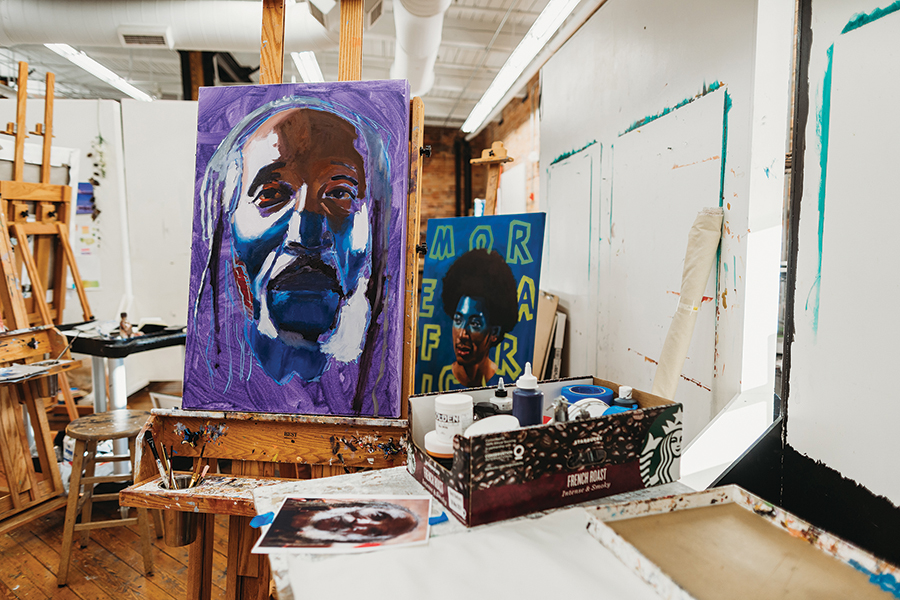
I’ve metWilliam Paul Thomas twice, both times inside an art gallery. He wasn’t present for our first meeting, but his work was. In October last year, I encountered his portrait of Alexander Manly, editor of The Daily Record, which was North Carolina’s only daily Black newspaper, as part of the Initiative 1897 exhibit at a gallery show in downtown Wilmington. The exhibit featured prominent Black civic leaders in the years preceding the 1898 race massacre, a violent coup d’état that saw Wilmington go from being one of America’s most successful Black cities to a place where racial terror and murder were used to take over Black-owned businesses and homes.
The second time I met William was in late February inside the Nasher Gallery on the campus of Duke University, where his portrait series Cyanosis was part of an exhibit titled “Reckoning and Resilience: North Carolina Art Now.” The subjects in the nine paintings in the Cyanosis exhibit are not as historically prominent as Alexander Manly, but they’re nonetheless important to William’s life. Each person is either someone he knows or someone he’s met during the course of a day, perhaps someone with whom he shared a passing conversation or a quiet moment that changed the trajectory of an afternoon.
Top row: Regine’s Brother, 2021, Lindsay’s Friend, 2018, Donna’s Son From Chicago, 2017. Second row: Le frère de Nathaly, 2019, Leticia’s Dear Friend, 2021, Kenna’s Dad, 2019. Third row: Tamara’s Father, 2019, Lydia’s Only Caregiver, 2017, Stephanie Woods’ Fiance As An Icon of Piety, 2017.
The name of the series is taken from the medical term that refers to the blue pallor skin takes on when it is not sufficiently oxygenated. The idea first took root in a portrait William painted of his young nephew Michael. He painted half of Michael’s face blue to emphasize the color of his skin. Soon, the use of blue grew to represent the presence of deep emotions — perhaps trauma, fear or uncertainty — that lie beneath the surface of people’s lives while they present a calm face to the world. In an online interview with Artsuite, William shared the unifying theme of the series: “My question through those paintings is: What would it look like if that trauma or adversity was shown on the skin? Would it invite people to be kinder to each other?”
On the day I finally met William in person inside the Nasher Gallery, Mallory, our daughters and I arrived half an hour early. While Mallory unpacked her camera gear and set off to scout the museum for places to set up, our daughters and I wandered through the exhibits with scores of other masked patrons. When we found the exhibit featuring William’s paintings, we paused and stood in front of them. The nine paintings are all closely cropped portraits of Black men in rows of three with a self-portrait of William sitting at the center. Each of the men is looking in a different direction, some of them seeming to stare right into the viewer’s eyes. Strips of blue color their faces in various places: across the eyes like a blindfold, over the nose like a mask, or covering the mouth like a gag.
William arrived, and we all introduced ourselves to one another. I’d been following his Instagram for several months — which I will later describe to him as being “delightfully weird” — and I didn’t know what to expect from an artist who is wildly experimental and playful while still remaining earnest and sincere. The dichotomy a viewer might find in William’s work also seems present in his personality; he is formal but warm, thoughtful but quick to smile. He told us he had just returned home on a flight from Chicago after spending the weekend at a family wedding with his fiancée and their newborn daughter. We joked that he looked rested and photogenic for a man who’d spent the morning lugging bags, baby and a car seat through airport terminals. His face softened for a moment at the mention of his being a new father, and then he and Mallory got to work.
Meanwhile, our 7- and 5-year-old daughters were feeling inspired after seeing the art in the museum. I tore pages loose from my notebook and fished pencils from my bag, and we found seats in the café and ordered snacks. I must have been feeling inspired myself because, like them, I began doodling on a blank page. But I couldn’t stop thinking about the faces of the men I’d just seen in William’s paintings, that strip of blue still hovering on the edges of my vision. When I thought of deoxygenated skin I thought of the videos I’d seen of Eric Garner and George Floyd, recalled their panicked voices saying, “I can’t breathe.” I looked down at my hands, one holding a pencil and the other resting on the table, the blue veins rolling atop the backs of my palms, not because my skin was deoxygenated or because I was experiencing latent trauma, but because my skin is pale and the blue veins were visible because the blood inside them was moving freely.
After we left the museum, we followed William across the Duke campus to the studio where he teaches a painting class to undergraduates, which is just one of the courses he teaches at several nearby universities. Inside the classroom, one of his students was behind an easel, working on a project from his class. He greeted her warmly by name, and then I watched him return to his work on a portrait of a man named Larry Reni Thomas, a Wilmington native known as Dr. Jazz because of his extensive knowledge of the music’s history. The two men met when William was working on Initiative 1897.
I asked William what interests him about painting people he meets. He lifted his brush from the canvas and considered my question, his eyes settling just above the top of his easel.
“For a long time, my art had been contained within an academic context,” he said, a reference to his Master of Fine Arts degree from UNC-Chapel Hill and his teaching in the undergraduate classroom. “In the portrait work, it’s important that the people that I invite (to be painted) don’t always belong to that same environment, so I’m having conversations with people who don’t necessarily have the same ties to UNC or Duke. I meet someone at the bus station and we strike up a conversation, and that’s a person I’m making a painting of. I feel like I start learning more about this area, or where I’m at, via those conversations. That’s how I’ve chosen to break away from a strictly academic environment.”
I ask him if he specifically looks for subjects outside of academic settings, and he admitted that he does, but that he’s also interested in introducing people to art who do not always think of themselves as being individuals who appreciate it.
“Sometimes I make visits to places with people because of the location. The Ackland Art Museum in Chapel Hill is right on Columbia and Franklin, and buses run all around that area. So if I was talking to somebody and having a conversation about art, there have been times — if they have the time — I’ll say, ‘Let’s take this conversation to the museum.’ Since I’ve identified museums and galleries as places I love to be as an artist and as a consumer of art, a lover of art, I don’t necessarily expect people to share that same interest, but if you tell me that you are not interested in art but you have not been inside a gallery, I question that and I challenge it and say, ‘Then let’s go check it out.’
“I have relatives, friends, people I’ve met who feel like they don’t have a direct connection to art, and I disagree right away because I’m thinking, if you dress yourself in the morning or if you like a certain model of car or if you like a certain movie, these are visual experiences where you are making choices about the visual world that suggests that you have some interest in aesthetics even if you don’t identify as an artist or a person who likes art. You can treat the museum that way, where you intuitively defer to your own tastes and go in there and judge whether or not you like whatever you see or are disinterested or feel moved by it based on your own experiences and not whatever education you have.”
When William considers how hesitant many people are to engage with art, he views his casual discussions with strangers as an opportunity that might lead them to a museum visit or to their portrait being painted: “It’s really of interest to me to engage in conversations where I try to demystify or deconstruct wherever that idea comes from.”
William is also interested in deconstructing the role art played in his own life, especially during his childhood. There could be no better representation of this than the bright pink concrete block that rested on the floor nearby. I’d already seen the block on his website, and I knew it had been painted to match a wall William’s mother had painted in the apartment where he’d grown up with his sisters in the Altgeld Garden housing project on Chicago’s South Side. He bent down and picked up the block at his feet.
“I extracted a single cinderblock as a way to represent that memory,” he said. “It became a way to carry that experience forward as a part of my narrative. How much of her decision to paint that wall influenced my decision to become an artist? This domestic alteration, how did it have an impact on the way I see the world?”
I asked him about the differences between being affected by the burden of memory and affected by the physical burden of lugging around a 40-pound block of cement.
“I did that unconsciously,” he says, referring to the burden of memory, “and now I’m doing it consciously. I’m choosing to carry this weight with me.” He smiles. “There’s never any good reason to carry a cinderblock around with you, but there might also not be a very good reason to take any traumatic or negative moments that I experienced as a child to have that affect me in the present, but nevertheless, for better or worse, the things we experience through our lives are carried with us. I’m definitely carrying home with me.”
I thought of his newborn daughter, a baby born in the Triangle, far from William’s Midwestern roots. What role would her father’s art play in her own conception of art’s role in her life? How would she carry her childhood with her?
He smiled at the questions, and then he rested the block in his lap as if it were a newborn.
“I hope she recognizes art as a normal, central fixture of her life, whether she is personally creating things or paying attention to the world around her. I hope she recognizes that it’s something valuable and precious.
“I hope she has an interest in exploring and discovery. I hope she gets to know Durham and North Carolina in a way that’s really intimate. I want her to carry with her how rich the world can be wherever she is as long as she’s paying attention.”
If William’s daughter follows the example of her father — an artist who is constantly paying attention to his surroundings with an idea toward capturing the richness of a place and the people who inhabit it — I’ll bet she’ll learn to do just that.PS
Wiley Cash is the Alumni Author-in-Residence at the University of North Carolina Asheville. His new novel, When Ghosts Come Home, is available wherever books are sold.
March markstwo years we have battled the pandemic, in several iterations. It has consumed news broadcasts and changed our lives, from how we purchase toilet paper (in laughable quantities) to how we celebrate holidays (in small groups, if at all) to how we recreate (forget movies, concerts, plays . . . hello, Scrabble and Hulu). Politicians are rated on COVID policies rather than stabilizing the economy. The absence of classroom learning may leave an indelible effect on children.
Hopefully, I’m not the only survivor whose weathered eye longs for better days and simpler things.
This began a few months ago, when I started watching season two of PBS Masterpiece Theater’s All Creatures Great and Small. I rejected the first season as borderline corny, certainly not therapeutic. The (true) story begins when a newly minted vet from Glasgow arrives in the beautiful and serene Yorkshire dales, just before World War II unleashes hell on Europe. He’s a plain lad with sincere blue eyes and a sweet smile. The haircut alone — short at the nape, Brylcreemed on top — establishes chronology. A romance ensues with a farming lass with a thick wavy mane, just enough meat on her bones, a forthright manner and the smile of an orthodontist’s daughter. Simple. Relatable. Refreshing.
Now, into season two, I watch each episode at least three times — a balm on eyes hardened by the blood and gore streaming, literally, from ambulatory corpses interspersed by real-life starving children, wildfires, floods, tornadoes, insurrections, shootings.
Simple thrives in the kitchen. Working from home, I crave homemade soup, mainly veggie beef made with chuck and a rainbow of vegetables. I call it sustenance soup, just as good for breakfast as lunch. Then, yellow split peas with grated carrot, potato and onion simmered with a smoked turkey leg. Dunk a hunk of stale artisan bread. Ahhh . . .
Thick. Flavorful. Simple.
Take-out sushi, pizza, tacos, egg rolls, nuggets, burgers get old fast. Soup is forever.
Simplify communication? Ma Bell must be tossing in her tomb. Cellphones are a miracle rivaling the light bulb. People live or die by their cells, which started out simple flips, progressed to “smart,” lately mini-computers. I learned from priests of the faith that texting has overtaken email, voice mail and direct conversation. Which means people text recipients reachable otherwise, eliminating the human voice by choice.
Makes sense when the caller is a robot, because only a robot would not worry about 5G technology interfering, perhaps even endangering, commercial aircraft. God forbid a crash blamed on improved texting.
The same applies to the automobile — another landmark invention providing a comfortable, safe, relatively simple means of getting from Point A to Point B. Now, urban apartment-dwellers not involved with sports or transporting loads are driven to drive SUVs instead of simple sedans, hatchbacks or stations wagons because . . . ?
You tell me.
Some accoutrements, like cameras watching the dog sleep in the back seat, seem dangerously distracting. Figuring out which button to push for the ice dispenser (just kidding) is problematic, not to mention the button that turns on the oven (not kidding) when you’re 10 miles from home.
The battle to simplify can be exhausting for ordinary folk who don’t live from iPhone to iPhone. I’m happy with a car that simply delivers and an oven that bakes. Flip phones did the job. I will never be convinced that air-fried chicken threatens Colonel Sanders. Even if I won the lottery I would not buy a Whiskers Litter Robot WiFi Enabled Automatic Self-Cleaning Cat Litter Box, its official name, for $549. Because cats are smarter than humans; if my two boycotted an unfamiliar litter brand heaven knows how they would react to a box that talks back.
I am not a crotchety old lady resisting progress while glamorizing the good old days before residential air conditioning and no-iron sheets. I’m all for vaccinations, organ transplants, solar power, even SUVs for large soccer-playing families with Great Danes. But I’m not about to fry an egg on my cellphone or let a self-propelled whirling dervish vacuum my floors.
You couldn’t buy me a ticket on Sir Richard Branson’s Virgin Galactic.
Because in times of trouble, simple conveys stable, at least until the crisis passes.
So go ahead . . . scoop your hummus, goat cheese, root beer and bubble gum flavored ice cream. I’ve rediscovered vanilla.
And ain’t it ever good.PS
Deborah Salomon is a writer for PineStraw and The Pilot. She may be reached at debsalomon@nc.rr.com.
This emaillanded in my inbox toward the end
of 2021:
“I’ve been following you via social media the past several months and wanted to seek your advice. I’m planning a golf trip to the Pinehurst area for the fall of 2022. What would you consider ‘must/essentials’ for this trip? I am thinking we will go to the Pinehurst Resort but also wanted your opinion and experience about other courses that might not be as popular but would provide an authentic golfing experience.”
It occurred to me in responding to this golfer from Knoxville that those of us who are local or frequent visitors take the Pinehurst experience for granted when so many have never actually ventured into Moore County. And those of us who are familiar with the wonders of the Sandhills travel scene have to stay on our toes with the constant evolution of the golf, amenity and accommodations market. As Pinehurst Resort President Tom Pashley says, “Someone who hasn’t been here in 10 years would be amazed at what they find.”
A favorite framing in my office is the quintessential drawing of the Pinehurst Golf Lad in New York’s Grand Central Station, circa the Roaring ’20s, his golf bag schlepped over this shoulder amid the nicely dressed swells with the words “Off for Pinehurst.”
Herewith, then, a nickel tour for anyone on their way to Pinehurst:
The Core (the heartbeat of Pinehurst and the Pinehurst Resort and Country Club, where courses No. 1-5 emanate) . . . soak in the history along Heritage Hall and revel in the photos and plaques of golf’s luminaries who have won here . . . pose for a photo beside the statue of Payne Stewart, captured in his exhilaration when his putt dropped to win the 1999 U.S. Open . . . walk the 6-odd miles of the premium courses, No. 2 and No. 4, feeling the taut, sandy loam beneath your feet, absorbing the cacophony of colors and edges of the holes, learning to play the bounce of the ball to an array of green complexes . . . stroll The Cradle short course with a couple of wedges and a putter, bobbing to the strains of Red Hot Chili Peppers popping through a discretely placed speaker in a tree . . . ply your putting skills on the Thistle Dhu putting course, which winds its way a hundred yards out and back over an array of humps and hollows . . . all the while slaking your thirst with a Transfusion from the Cradle Crossing beverage center.
The Village (laid out in 1895 by the landscape architecture firm of Frederick Law Olmsted to resemble a New England village; it’s void of 90-degree road intersections and dominated by white and forest green accouterments) . . . enjoy a hefty deli sandwich on the veranda at the Villager Deli in the heart of Old Town . . . pound a beverage with the locals from a rocking chair on the porch at the venerable Pine Crest Inn, once owned by golf architect Donald Ross . . . sip one of 70 brands of bourbon, rye and Scotch in the hippest bar in town, the North and South in the newly renovated Manor Inn . . . douse some smoked pork shoulder in blackberry habanero sauce at the Pinehurst Brewing Company . . . buy a cashmere sweater at The Gentlemen’s Corner or a rare painting of a Scottish golf scene at Old Sport and Gallery . . . sift through the memorabilia and display cases at the Tufts Archives in the Given Memorial Library and marvel at James Tufts’ original marble soda fountain machine, the source of the fortune from which all these golf riches flowed.
And don’t forget Broad Street, the Southern Pines version of Main Street U.S.A. . . .there’s nothing quite like a well-run, independent bookstore, and The Country Bookshop is exhibit A . . . for a great burger and pro golf on the big TV, there’s the Bell Tree Tavern, and for dessert there’s The Ice Cream Parlor and its primo location at the corner of Broad and New Hampshire . . . the Sandhills area is chock-full of interesting craft brewing venues, one of the most popular in the Broad Street neighborhood is Southern Pines Brewing Company with its corner location on Pennsylvania and Bennett, spacious outdoor seating and over 30 draft selections.
The Ross Triumvirate (a collection of three pristine Donald Ross courses under the same ownership umbrella — Mid Pines from 1921, Southern Pines Golf Club from 1923 and Pine Needles from 1928) . . . all three have come under the painstaking attention to detail of architect Kyle Franz in the last decade and the essential challenge of each burnished, from the stark crossing features at Southern Pines to the up-and-over fairways at Pine Needles to the exquisite green settings at Mid Pines and its spot nestled in a bowl of surrounding hills . . . play the Pine Needles course, where later this year it will host its fourth U.S. Women’s Open (a fresh-faced Annika Sorenstam won in 1996), dodge the ponds at Mid Pines, where Julius Boros loved to fish during pro tour stops in Greensboro, and play the out-and-back routing at Southern Pines, where Ross made the best use of the land by not shoehorning a ninth-hole return to the clubhouse.
The Outskirts (with three dozen courses within a 30-mile radius of Pinehurst) . . . Three of my favorite courses in the Sandhills are private (Forest Creek North, Country Club of North Carolina Dogwood and Dormie), so if you know someone, beg, borrow and steal for an invitation. There are no such restrictions at Tobacco Road in Sanford, a half hour north of Pinehurst, just a dearth of tee times as the popularity of this eccentric and visually stimulating course has skyrocketed during the COVID-inspired golf boom. Architect Mike Strantz cobbled it from an abandoned sand pit and farmland, and the mammoth mounds, mottled grasses, railroad ties and fescue rough accent the routing.
It’s all quite the experience. I hope our man from Knoxville has fun.
“What a place, what a cluster of golf, what a home for golf,” marvels Mike Keiser, the developer of the noted golf destination Bandon Dunes and a fan of Pinehurst. “Most of these clusters are up north, and you can’t play in the winter. Pinehurst and Pebble Beach are places you can play year around.”
What do you know? It’s the Roaring ’20s again.PS
Lee Pace has written about golf in Pinehurst and the Sandhills for more than three decades. Write him at leepace7@gmail.com and follow him @LeePaceTweet.
Used to determine whether a user is included in an A / B or Multivariate test.
18 months
_ga
ID used to identify users
2 years
_gali
Used by Google Analytics to determine which links on a page are being clicked
30 seconds
_ga_
ID used to identify users
2 years
_gid
ID used to identify users for 24 hours after last activity
24 hours
_gat
Used to monitor number of Google Analytics server requests when using Google Tag Manager
1 minute
__utmb
Used to distinguish new sessions and visits. This cookie is set when the GA.js javascript library is loaded and there is no existing __utmb cookie. The cookie is updated every time data is sent to the Google Analytics server.
30 minutes after last activity
__utmc
Used only with old Urchin versions of Google Analytics and not with GA.js. Was used to distinguish between new sessions and visits at the end of a session.
End of session (browser)
__utmz
Contains information about the traffic source or campaign that directed user to the website. The cookie is set when the GA.js javascript is loaded and updated when data is sent to the Google Anaytics server
6 months after last activity
__utmv
Contains custom information set by the web developer via the _setCustomVar method in Google Analytics. This cookie is updated every time new data is sent to the Google Analytics server.
2 years after last activity
_gac_
Contains information related to marketing campaigns of the user. These are shared with Google AdWords / Google Ads when the Google Ads and Google Analytics accounts are linked together.
90 days
__utma
ID used to identify users and sessions
2 years after last activity
__utmt
Used to monitor number of Google Analytics server requests
10 minutes
SourceBuster is used by WooCommerce for order attribution based on user source.
Name
Description
Duration
sbjs_migrations
Technical data to help with migrations between different versions of the tracking feature
session
sbjs_current_add
Timestamp, referring URL, and entry page for your visitor’s current visit to your store
session
sbjs_session
The number of page views in this session and the current page path
30 minutes
sbjs_udata
Information about the visitor’s user agent, such as IP, the browser, and the device type
session
sbjs_first
Traffic origin information for the visitor’s first visit to your store (only applicable if the visitor returns before the session expires)
session
sbjs_current
Traffic origin information for the visitor’s current visit to your store
session
sbjs_first_add
Timestamp, referring URL, and entry page for your visitor’s first visit to your store (only applicable if the visitor returns before the session expires)