Hometown

Beach Dreams

Catching a wave and a sno-cone

By Bill Fields

The town where I have lived for a long time has lovely public beaches on Long Island Sound. I’m grateful to get a sticker for my car each spring and have access to them. There have been plenty of peaceful, breezy afternoons by the water, and notwithstanding the $75 ticket for parking in a fire lane — the signage wasn’t clear — it is an upside of residing in Connecticut.

That said, these beaches are not “the beach” that I and many of my contemporaries knew growing up. For our family it meant a week away if money wasn’t tight, a long weekend if it was. Our destination for vacation was usually Ocean Drive, with a Cherry Grove or a Windy Hill thrown in every couple of years, all the rental cottages or motels being in the same flip-flop shop region known for a long time now as North Myrtle Beach.

The anticipation of these summer trips can’t be overstated, for they were Christmas without the presents, the journey itself being the gift. If I could relive those days, I wouldn’t change much except sparing my father the annual request to drive all the way to the Gay Dolphin in Myrtle Beach one night during our stay so I could empty my change purse on a plastic shark or rubber gator.

Looking back, Dad had the right idea in floating on his back just beyond the breakers, oblivious to my mother’s worries that he was out too far. We kept closer to shore, always wondering if the wave-riding would be superior with one of the rental rafts than our flimsy dime-store model.

Overall, though, there was about as much envy as sand-free sheets. I got to eat corn dogs and sno-cones and drink all the soft drinks that I wanted. For a year or two I was obsessed with a brand that wasn’t sold in the Sandhills, Topp Cola, and urged Mom and Dad to pick up a supply when they went shopping at the Red & White upon arriving in Ocean Drive.

The culinary highlight every year was dinner — we called it supper — at Hoskins, the seafood restaurant in Ocean Drive that had opened in the late-1940s. The flounder, shrimp and oysters fried there were light and tasty. The hushpuppies were sublime, not as dense as the ones I cranked out on my weekend shifts in the kitchen at Russell’s Fish House. The air conditioning felt great after a day in the sun.

Hoskins was just two blocks from the best place we stayed at the beach, a house owned by Leland and Marquita Daniels. It had a large screened-in area in the middle with bedrooms on one side, and a kitchen and living room on the other. If, after eating at Hoskins, we didn’t go back there for cards or board games, it meant that I had gotten my way and our gang was going to play miniature golf. (I still have a wooden nickel from Jungle Golf on Highway 17 that I sometimes use for a ball marker.)

Most days I would already have gotten in plenty of practice at the Putt-Putt in Ocean Drive, then located right on the oceanfront. For a couple of bucks, you could putt all you wanted until 5 p.m., nirvana for someone whose town didn’t have miniature golf. Years later, I discovered that one of the kids who was spending hours at that same Putt-Putt location around that time was Rick Baird, who in 2011 became one of the rare few to ever ace all 18 holes in a round of Putt-Putt. Our family beach mini-golf games amid the faux tigers and lions were for bragging rights and, for this budding golf nerd, a highlight of the trip, even if I didn’t develop into a world-class putter.

When the car was packed and we were heading away from the ocean, another beach trip over, it felt like watching one of those colored golf balls disappearing down the chute on the 18th hole. For a year, I’d have to put a shell to my ear and listen. PS

Southern Pines native Bill Fields, who writes about golf and other things, moved north in 1986 but hasn’t lost his accent.

Simple Life

“The Cocktail Cat”

The spirit of a roaming feline

By Jim Dodson

I have a friend who never fails to show up at cocktail time.

Wherever he’s been, whatever he’s been up to all day, he appears like clockwork as I settle into my favorite Adirondack chair under the trees to enjoy a sip of fine bourbon and observe the passing scenes of evening life.

Fortunately, he doesn’t drink bourbon. He doesn’t do much of anything, near as I can tell, except annoy the dogs and pester me well before dawn for his breakfast after a night out carousing the neighborhood, before snoozing all day on the sunny guest room bed like a house guest who won’t leave.

We call him Boo Radley after the peculiar character who saves Scout Finch in To Kill a Mockingbird. Our Boo, an old, gray tomcat who would rather watch birds than chase them, hasn’t caught a bird of any sort in years.

At cocktail hour, rain or shine, you can set your watch by Boo’s punctuality. Hopping up on the arm of my chair or the small table where I set my whiskey while I reflect on the day’s events and find pleasure in watching birds at the feeders, Boo is either too fat or too old to bother trying to catch them. Even in his salad days he was never much of a killer, though he would leave the occasional mouse on a discreet lower step of our back porch.

Like his cinematic namesake, Boo’s an oddly friendly fellow once he gets to know you, though he generally doesn’t cotton quickly to strangers. Curiously, we’re half convinced several folks in the neighborhood are secretly feeding him, because he’s beginning to resemble a bowling pin. Perhaps he has them fooled into believing that he’s actually homeless. Nothing is further from the truth. He’s managed to ditch every expensive collar and bell we’ve put on him over the past 10 years in order to keep his dining ruse going.

In fact, Boo Radley has had at least three very nice homes. The first was in Southern Pines when No. 2 son brought him home on a cold winter evening. He was just a small gray foundling you could hold in the palm of your hand, a friendly little cuss who appeared half-starved and very grateful.

Second Son named him “Nikko,” which means “daylight” in Japanese, and planned to take him off to Boston, where his new job in the hospitality industry awaited. His mom wisely interceded, pointing out that the last place a homeless kitten needed to live was with a single career guy working long and impossible hours.

So we inherited Nikko. The first thing I did was give him a new name and identity.

He seemed to like the name Boo Radley, though who can ever say what a cat is really thinking.

I suppose that’s part of that peculiar feline charm. Dogs occupy space, someone said. Cats occupy time. They act like you’re on this planet to serve them and should be damn grateful to do so. Another friend who has several cats informs me that cats know the secret of the universe. They just won’t tell anybody.

During our many years in Maine, we had a succession of barn cats who wormed their way into our affections. As a lifelong dog lover who occupies more space than time, even I came to admire their independence and pluck, somehow surviving the fierce Maine winters and coyotes.

Boo grew up with our three dogs, sometimes sleeping with them, often stealing their food, giving them a passing swat now and then as a friendly reminder of who was really in charge. Bringing up Boo was like raising a problem child.

We eventually moved to a house that had 2 acres of overgrown gardens. Boo didn’t miss a beat. He was always out in the garden, night and day, either following me around or snoozing in the shade on hot summer afternoons. A neighbor warned us there were foxes in the area.

One evening around dusk, I saw Boo sprint across the yard, chased by a young gray fox. Moments later, I saw the young fox run the opposite way, chased by Boo Radley. This game of cat-and-fox tag went on for weeks. Nature will always surprise you.

Not long after that, we moved to the Piedmont city where I grew up and Boo found a new pal in the neighborhood, a large, brown, wild rabbit that comes out every evening around cocktail time to feed on clover and seeds from our busy bird feeders.

I named him “Homer” after the author of the epic Greek poem about a fellow who wanders for 10 years trying to get home. Our Homer seems very much at home in our yard, keeping a burrow beneath my hydrangea hedge.

Boo is highly territorial about our yard — woe to any other cat that sets foot on the property — but has no issue whatsoever about sharing space with a large wild rabbit. I’ve seen the two nose-to-nose many times over the years.

Such are so many sweet mysteries in this world that we cannot explain.

But maybe we don’t always need to. Perhaps it’s enough to simply notice them.

In his splendid essay, “A Philosopher Needs a Cat,” NYU religion professor James Carse writes: “It is not accidental that the word animal comes from the Latin anima, soul. The primitive practice of representing the gods as animals may not be so primitive after all. Soul is not only the small ‘still point of the Tao’ where there is no more separation between ‘this’ and ‘that,’ it is also the presence of the unutterable within.”

A mystic would probably say it’s enough to simply pay attention as different worlds intersect when we least expect it, revealing the presence of the unutterable within.

I have no idea what Boo Radley would say about such matters, being a cat of few — or actually no — words. He’s not one for small talk.

But after so many years and miles together in each other’s company, it’s enough that Cocktail Cat never fails to sit with me as the evening fades, season after season, displaying the kind of timeless nonjudgment and spiritual detachment a Buddhist monk might envy. Boo is perfectly companionable while betraying absolutely no opinion on — or apparent interest in — the trivial matters I present to him as we watch birds feed and I sip my expensive bourbon. At the end of the day, there doesn’t seem to be much separation between his “this” and my “that.”

It also occurs that maybe I have the philosophical proposition plum backwards. Perhaps this aging, well-traveled tom cat simply needs an armchair philosopher to sit with in silence at the end of the day.

Only the Cocktail Cat knows for sure, and he ain’t telling, a perfect presence of the unutterable within.  PS

Jim Dodson can be reached at jwdauthor@gmail.com.

Birdwatch

Rare Bird Alert

Keep an eye out for the roseate spoonbill

By Susan Campbell

With its bright pink body, the roseate spoonbill is certainly the most distinctive and garishly colored bird in North America. And what about that odd bill? Although their typical range does not include North Carolina, spoonbills do stray into the extreme southeastern part of our state in late summer into early fall. So, if you keep your eyes peeled at this time of year, you may be lucky enough to spot one.

Research indicates that breeding colonies are found in parts of Florida, Louisiana and Texas. Unfortunately, the birds there are not widespread, even where they are regular. Loss of foraging habitat has restricted roseate spoonbills to protected areas such as wildlife refuges. Water quality has also reduced prey, as sedimentation and chemical pollution have inundated bays and estuaries in the Southeast.

There are several species of spoonbills worldwide, but roseate is the only one found on this continent. Their name comes from the birds’ bright red-pink plumage and spoon-shaped bill tip. Their extremely sensitive mandibles snap shut around food items such as small fish, crustaceans and insects found in the shallow waters they probe. Roseate spoonbills swing their heads side to side as they slowly walk though brackish or saltwater. The types of foods they capture result in their bright feathers.

Those amazing pink feathers put the birds at risk of extinction during the 19th century when many spectacularly colored birds were hunted for their plumes. The wings of roseate spoonbills were, unbelievably, actually sold as fans as well as for hats and other adornments.

When these amazing birds are spotted in our state, they are almost always mixed in with other waterbirds such as herons and egrets. They are extremely gregarious year-round. The best place to scan along the coast beginning in mid-July is Twin Lakes, in the Sunset Beach area. However, individual roseate spoonbills have also been found at Ocean Isle and North Topsail, as well as in the mouth of the Cape Fear in recent years.

Last summer, there were many reports of roseate spoonbills, not only inland in North Carolina but well to our north, including immature birds with their size and unusual bill as well as their pale pink plumage. One roseate spoonbill was sighted in Pinehurst and up to four in Woodlake. If you catch sight of one of these distinctive birds anywhere in the Sandhills or Piedmont, please let me know. PS

Susan Campbell would love to receive your wildlife sightings and photos. Contact her at susan@ncaves.com.

The Pleasures of Life Dept.

The Sunfish

Too small to keep. Too big to forget.

By Ashley Walshe

This isn’t a big fish story. Quite the opposite, actually. And it starts right here on Lake James, the massive hundred-year-old reservoir lapping the eastern edge of our state’s Blue Ridge Mountains.

It’s the pinnacle of summer. High on a red clay ridge, the whip-poor-will, whose incessant chanting often stretches well into the balmy morning, has gone silent. The red dog is weaving among windswept pines, and I am sitting on the wooden deck of a Coachmen RV, a sparkling sliver of lake visible a half-mile in the distance.

My grandparents used to live here. Not in this 32-foot travel trailer, home to my husband, the dog and me for a warm and watery season. But on down the meandering shoreline, in the brick and stucco home with the vaulted ceiling, lakeside gazebo and sweeping view of Shortoff Mountain.

Papaw kept his pontoon at a nearby marina. If I close my eyes, I can almost see two kids swinging their legs at the edge of his boat slip. I’m the little girl with the auburn curls and wild swath of freckles. My younger brother, all blue eyes and dimples, is perched beside me. Neither of us have fished before.

On this day, Papaw is cradling a box of live crickets, and Dad is showing us how to hook them. The black and silver schnauzer, whose feet and beard are permanently stained from the red earth, is barking at the wake as a neighboring boat glides up to dock.

Once we cover the basics (don’t snag your sibling or grandpa), we cast a few lines, jiggling the rod to make our crickets dance.

Papaw watches from the captain’s chair as Dad teaches us a ditty from his own childhood. The song changes based on who’s singing it. Mine goes like this:

Fishy, fishy in the lake, won’t you swim to Ashley’s bait?

I sing incessantly. And guess what? In no time, I feel the coveted tug of what must be a whopper at the end of my line.

I squeal. I reel. And up shimmies the smallest sunfish you’ve ever seen. A bluegill, I think. No bigger than my tiny, freckled hand.

“Can we keep it?” I ask, twitching with excitement. 

“If he’s long enough,” says Papaw. Gripping my whopper in his leathery hands, he gently slides out the hook then slips the fish into a shallow bucket of water. “We’ll measure him later.” 

My brother and I cast several more lines — first at the boat slip, then out in a quiet cove on the water. Although the song appears to have stopped working, that doesn’t deter us from our fervent chanting. We sing until the crickets are spent, my sunfish our singular catch of the day.

I know now that we had no business keeping that tiny sunfish. But it was never about the fish for Papaw.

Peering down into the bucket, my grandpa announces that the bluegill is “just big enough,” then gives me one of his signature winks. I wink back from my seat outside the camper, smiling through time at a proud little girl and her very first fish.

That night, while the rest of the family ate crappie from a previous haul, I savored every bite of my pan-fried sunfish. It didn’t look like much on the plate, but the memory has fed me for a lifetime. PS

Ashley Walshe is a former editor of O.Henry magazine and a longtime contributor to PineStraw.

Tea Leaf Astrologer

Cancer

(June 21 – July 22)

If ever you’ve ridden a drop tower — one of those gut-in-your-throat “free fall” rides at the carnival — then you can imagine what it feels like to know and love a Cancer. But only those born under the influence of this cardinal water sign know what it’s like to be perpetually at the whim of such sensational pinnacles and descents. This month will be no different, especially with that full supermoon on July 13. May as well enjoy the ride.

Tea leaf “fortunes” for the rest of you:

Leo (July 23 – August 22)

Something needs watering. Hint: It’s not a plant.

Virgo (August 23 – September 22) 

You can’t see the signs if your eyes are closed.

Libra (September 23 – October 22)

Let the tea steep.

Scorpio (October 23 – November 21)

You already know the answer.

Sagittarius (November 22 – December 21)

Keep moving. They’ll come around or they won’t.

Capricorn (December 22 – January 19)

You’re thinking the fun out of it.

Aquarius (January 20 – February 18)

The prize is never inside the box.

Pisces (February 19 – March 20)

Tell it to your dream journal.

Aries (March 21 – April 19) 

Best to get it straight from the source.

Taurus (April 20 – May 20) 

Leave your phone. Forget the umbrella. Let life happen.

Gemini (May 21 – June 20)

The invitation will be obvious.  PS

Zora Stellanova has been divining with tea leaves since Game of Thrones’ Starbucks cup mishap of 2019. While she’s not exactly a medium, she’s far from average. She lives in the N.C. foothills with her Sphynx cat, Lyla. 

In the Spirit

Rum, Anyone?

Three styles to pique your curiosity

By Tony Cross

I love rum. On its own; stirred in Ti’ Punch; shaken ice-cold in a daiquiri; in a box; with a fox.

I love rum. This probably comes as no surprise. Whenever I get a chance to splurge, I’ll order more than a few bottles online — usually brands that I already know. Over the past two years I’ve been on a Clairin kick. You remember Clairin, don’t you? It’s the sugar cane spirit from Haiti that’s high in proof and lovely on the palate. Well, I still have plenty of that left over from last year, so this go-round I decided to grab a few bottles I’m familiar with, and a few that I’m not. Here are two old favorites, and one that’s made just west of an island I grew up on.

Plantation 13 Year Jamaican Rum 2005

I’ve had the Plantation Distillery rums before and, as soon as my most recent order arrived, I grabbed a bottle and made a daiquiri. I thought I had picked their signature blend (which retails at $24.95). My daiquiri was so damn good, I immediately made another. I was floored by how tasty it was. Turns out I had dipped into the 13 year ($64.99) instead. Honest mistake: The packaging is kind of similar, but I should’ve spotted the difference. Not to worry, it was one of the best daiquiris I’ve ever had. It’s great on its own, too. Aged for 12 years in bourbon barrels in Jamaica, it’s then shipped to France to mature for another year in small cognac barrels. It’s dry on the front palate, but then hits you with fruit and a touch of funk on the back end. I noticed that the longer it sat in my glass, the easier it was to pick up notes of banana, vanilla and whatever else I can’t remember. It was delicious.

Cor Cor Okinawan Rum Red Label

I was shocked to see rum from Okinawa available online. I grew up there as a lad and have nothing but fond memories. This was also a staff pick from the website I frequent, so clearly it was a no-brainer to give it a shot. This rum is different. On the nose: dirty vodka martini. Swear to God. On my first sniff, I was like, “Whoa, that smells briny!” The sniffs that followed (I hope I never have to type that again) yielded, “Yeah, that’s a dirty martini.” Weird. On the palate it’s a little saline, light, slighty grassy. Okinawan grassy? I really don’t know. I think I need more time with this one. I’ll probably make a Ti’ Punch with it to see what a touch of sugar and acidity do to it.

El Dorado Special Reserve 21 Year Rum

This bottle was a splurge. It retails for around $100. I’ve had it a few times before and figured it was time to be a big boy and have my own bottle. Before I get into why this rum is so special, I’d like to touch on something I read from one of the website staff members who reviewed it. “While whiskey gets increasingly expensive and certain bottles become harder to find, rum’s vivid and decadent flavors are an easy jump to make for a bourbon or Scotch drinker.” Whiskey prices are ridiculous these days and, honestly, I find a lot of whiskies to be overrated relative to the cost. Maybe it’s because I live in North Carolina, but I sometimes find rum to be my little secret. I know so many people that love to chat “whiskey this, whiskey that,” but when I show them a good rum, their minds are blown. The few times I’ve enjoyed the El Dorado 21 year, it’s been as a nightcap after a lovely dinner. This is a long, slow sipper that’s meant to be enjoyed on its own. Caramel on the nose, with toffee and spices on the palate, and sweet smoke on the finish, this rum from Guyana is elegant. Consider this as a gift for a whiskey connoisseur, and you’re guaranteed to make them a rum fan. PS

Tony Cross is a bartender (well, ex-bartender) who runs cocktail catering company Reverie Cocktails in Southern Pines.

Art of the State

Super Natural

Davidson artist Elizabeth Bradford celebrates the beauty of the wild

By Liza Roberts

Photograph By Lissa Gotwals

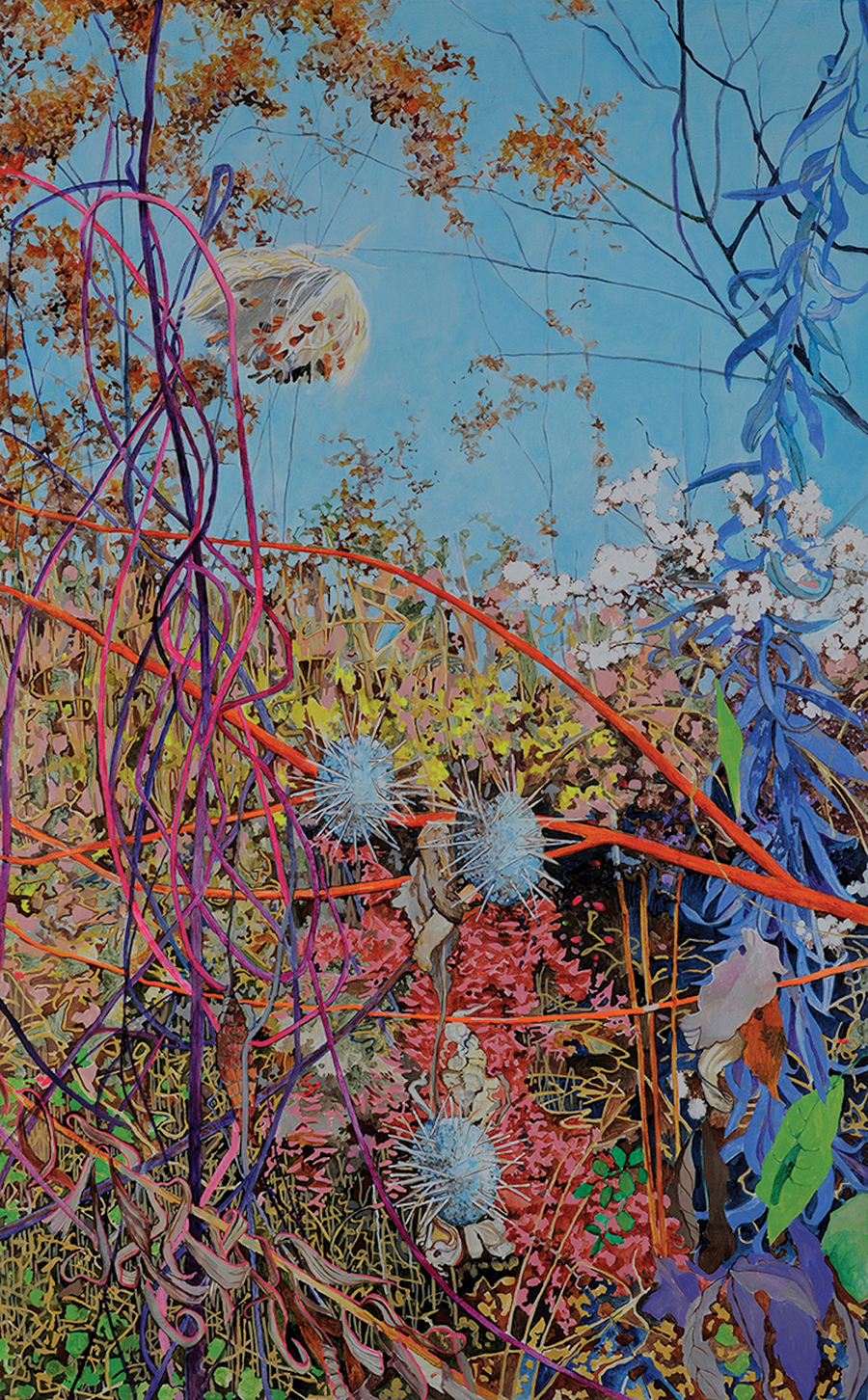
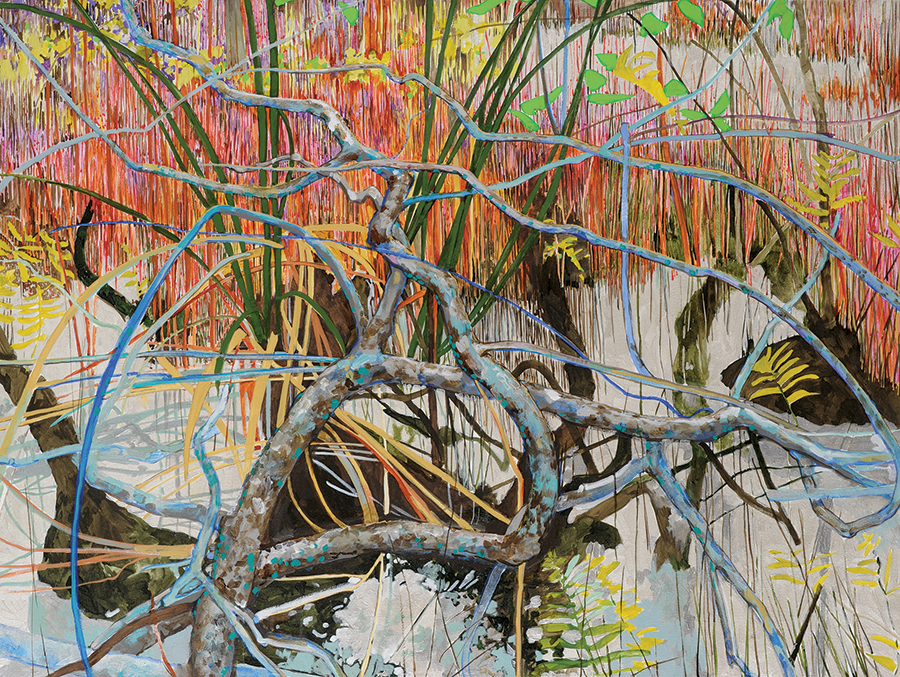
In a former cotton shed in Mecklenburg County, Elizabeth Bradford paints the natural world around her. With extraordinary, saturated colors and meticulous, zoomed-in details, her landscapes can be exotic, surprising, even strange. They are also poetic: meditative celebrations of the beauty, interconnectedness and geometry of the natural world.

On canvases nearly as tall as she is, Bradford takes countless hours over many weeks to paint the magic she finds in nature. Sometimes it’s an eddy of water. Sometimes it’s the messy bank of a receded river, where roots protrude and collide. Trees, fields, ponds, creeks: Bradford finds wonderlands in them all. Representational, but with deep, twisting tentacles into abstraction, her canvases beg the viewer to look hard.

In January 2023, Hidell Brooks Gallery in Charlotte plans a solo exhibition of her art. Wilmington’s Cameron Art Museum exhibited a powerful one-woman show of Bradford’s work, entitled A House of One Room, in 2021. Her paintings are also in the permanent collections of the Mint Museum in Charlotte, the Weatherspoon Art Museum at the University of North Carolina at Greensboro, and the Blowing Rock Art and History Museum, as well as in many top corporate collections.

This University of North Carolina at Chapel Hill graduate considers herself largely self-taught as an artist, but she also studied painting and lithography at Davidson College and worked as an art teacher before devoting herself full time to her craft.

Bradford says her work began to “develop a power” when she started backpacking in the mountains of North Carolina about nine years ago. With two friends, she started “going into a lot of obscure places, wild places, where the world is crazy,” she says. Now armed with a pole-mounted camera, she takes photos as she goes, hundreds of them in the space of a few days’ hike. These images become her inspiration when she returns to the studio. “Truth is stranger than fiction,” she says. “The wild is stranger than anything I can dream up.”


(left) Weeds at the Treadwell, (right) Cumberland Island Swamp

The truth is also more meaningful. The wilder the land, the more Bradford says she finds to care about. “I’m on a mission to sensitize people to the beauty of the earth,” she says. To take things “that aren’t obviously beautiful and to render them beautiful.” She does that in large part with unexpected, vibrant oil and sometimes embedded shards of glass, something she once eschewed as a “cheap trick.” But after a number of years of hewing as close to the actual color of the natural world as possible, she decided she was selling herself short. “Why are you being this ascetic?” she says she asked herself. “Why are you denying yourself access to something you love so much? And so I started pumping up the color. And as a result I’ve gotten more imaginative, more intuitive. More soulful.”

She brings all of that to every one of her subjects, most recently weeds. “Weed studies have introduced me to some really cool forms,” she says. “Arabesques and extravagant curves. I’ve been playing with a lot of that . . . I’m always trying to keep moving outward, not just repeating the same things. I keep looking for newness.”

Actively challenging herself has become an ingrained habit, one that began the year Bradford turned 40 and made a promise to herself: “Instead of getting bummed out about getting old, every year for my birthday I would pick something I didn’t think I could do, and I would spend a year trying to do it.” That first year, she decided she would paint a painting every day. A few years ago, she made the commitment to learn French. Lately, she’s begun renovating an 1890s farmhouse, one she discovered deep in the woods on the bank of a creek, far from roads and traffic and noise. A two-hour drive from her (also 1890s-era) Davidson home, it will serve as Bradford’s summer residence and studio. “It’s my dream,” she says.

And so as she ages, Bradford’s world gets more and more interesting — not that boring is an option. “The world is just so complicated and fascinating,” she says. “There are just not enough years of life to do everything you want to do.” PS

This is an excerpt from the forthcoming book Art of the State: Celebrating the Art of North Carolina, to be published by UNC Press this fall.

Southwords

Baking Betty

Research, research, research

By Ruth Moose

Betty Crocker and I go back a while, though I don’t go back as far as she goes. Betty Crocker, icon for General Mills, is 100 years old this year. One of the most recognized advertising symbols in the world, Betty has only gotten younger. Many up-to-date hairdos and wardrobe changes. She has kept up with the times. My relationship with her ended amiably enough, and I have my little red spoon of confidence lapel pin to prove it.

Many years ago when I lived in Charlotte in a split-level house, carpooled in a wood-paneled station wagon, and did all kinds of PTA and Boy Scout stuff, my family was a member of a very exclusive club. We were one of 500 General Mills test families across the country. I tested recipes that ended up on the backs of cereal boxes, flour packages and General Mills products, excuse the expression, in general. I wasn’t paid but was reimbursed for the cost of recipe ingredients. I figured since I baked and cooked anyway, why not make it interesting? And I like to try new recipes.

Helen Moore, my good friend as well as neighbor, was at that time food editor for the Charlotte Observer. She invited me and several other women of various ages and stations to a lunch with two home economists from General Mills. It was a lovely lunch in a nice restaurant, a real treat in the middle of the week. Good food, fun conversation, and afterward I was asked to be part of 500 families scattered across the country. The home economists explained that, though they tested recipes in their laboratory kitchens in Minneapolis, they wanted reactions from real people in real home kitchens. Where the pasta meets the road, so to speak.

During the years I tested a variety of recipes, everything from vegetable dishes (carrots cooked in frozen apple juice with fresh ginger was a good one) to cookies made with various cereals, to a whole series of recipes using wine. I saw many of these later in cookbooks. For the most part, my family was good-natured about the whole thing. They were used to seeing different things on the table when they sat down to dinner.

After I tested a recipe, I filled out forms that included what I had paid for certain ingredients, whether I had them on hand, how difficult they were to find, and so on. Other forms asked if the instructions on the recipe were clear. Was it hard to follow? How much time did it take to make it? And there was always the question of my family’s reaction. They were the ultimate arbiters. Actual people eating real food in a home kitchen. Nothing complicated. Except the time I was sent a recipe for gumbo.

No, I did not have filé powder on hand.

No, I did not keep canned okra on my pantry shelf.

I didn’t know you could even CAN okra. And it surely didn’t sound appetizing. Breaded and fried okra is food of the gods! But okra in a can? In the South yet? Sacrilege.

So, I went in search of canned okra. In those days Amazon wasn’t even a twinkle in Jeff Bezos’ eye. Managers of the A&P, Kroger’s and Harris (before there was Teeter) laughed at me. Was I some kind of nut? Canned okra? I finally found a lonely can on the bottom shelf of a tiny exotic foods market. Exotic for North Carolina, certainly.

Then I made my first and only gumbo.

My family’s reaction, after a couple of mouthfuls, was to ask if we couldn’t go to McDonalds.

We did, leaving plenty for the garbage disposal and a none-too-glowing report for Betty Crocker.

After that, whenever my sons sat down to something unfamiliar, their immediate reaction was, “Are we eating Betty Crocker?”

I probably tested recipes for Betty for six or eight years. The gumbo was the only unqualified disaster. A lot of the recipes I still make — a Wheaties cookie; many of the wine dishes, including a pot roast cooked with Burgundy.

The program was discontinued but, as a token of their appreciation, I was given a tiny version of Betty’s trademark, a small, enameled red spoon lapel pin — the Phi Beta Kappa of gumbo, I suppose — and a real conversation piece at dinner parties. PS

Ruth Moose taught creative writing at the University of North Carolina-Chapel Hill for 15 years and tacked on 10 more at Central Carolina Community College.

The Omnivorous Reader

Follow the Money

Ben Franklin’s blueprint for America

By Stephen E. Smith

How is it possible that Ken Burns’ recent four-hour Ben Franklin documentary received ho-hum reviews? Have PBS devotees grown too familiar with Burns’ still-life voiceover production style? Maybe. But the lackluster reviews are more likely the fault of the kite-flying, bifocaled purveyor of the bon mot, old Ben Franklin himself. He’s every American’s everyman, the most human of our Founding Fathers.

We grew up learning about Franklin, and most of us believe we know what needs to be known about the archetypal American Renaissance man. Historian Michael Meyer’s Benjamin Franklin’s Last Bet: The Favorite Founder’s Divisive Death, Enduring Afterlife, and Blueprint for American Prosperity is a timely reminder that there is still much to learn about the influence Franklin continues to wield in 21st century America.

When he died in 1790 at the age of 84, Franklin was not universally mourned by his countrymen. Meyer reminds readers that George Washington and the Congress refused to acknowledge attempts by the French to express their condolences at Franklin’s passing, and John Adams had little good to say about his former diplomatic partner. Among his later detractors were Mark Twain, who wrote that Franklin “early prostituted his talents to the invention of maxims and aphorisms calculated to inflict suffering upon the rising generation of all subsequent ages”, and D.H. Lawrence reveled in revising and ridiculing Franklin’s 13 virtues.

Meyer’s primary focus is on the influence of Franklin’s last will and testament. William, Franklin’s first-born son who had sided with the British during the Revolution, was left worthless property and ephemera, and his daughter and grandchildren received gifts commensurate with the esteem in which he held them. But it was his “Codicil to Last Will and Testament,” a wordy but straightforward document, that morphed into a hydra-headed legal instrument that would vex administrators, the courts and politicians who attempted to oversee and control its ongoing disbursements.

Franklin established endowments for the cities of Philadelphia and Boston. “Having myself been bred to a manual art, printing, in my native town,” Franklin dictated, “and afterwards assisted to set up my business in Philadelphia by kind loans of money from two friends there, which was the foundation of my fortune, and of all the utility in life that may be ascribed to me, I wish to be useful even after my death, if possible, in forming and advancing other young men . . . .”

Franklin left each city £1,000, or about $133,000 in today’s dollars. The funds were intended to provide small loans to manual and industrial workers — cobblers, coopers, blacksmiths, wheelwrights, carpenters, etc. — to be repaid at 5 percent interest over a 10-year period. In addition to offering a helping hand for the socioeconomic class employed in manual labor, the funds’ underlying intention was to promote good citizenship. (“I have considered, that, among artisans, good apprentices are most likely to make good citizens,” Franklin wrote.) If the principal from the bequests were properly administered, the initial investment should have yielded billions in today’s dollars, making Franklin our first billionaire philanthropist.

So, what became of Franklin’s fortune, and where did his generosity lead us? Meyer follows the money, providing a decade-by-decade accounting of the funds’ expenditures while factoring in economic trends, poor oversight by fund managers, legal squabbles, political infighting, and losses incurred during national recessions and depressions.

All of which sounds incredibly boring. But be assured there’s nothing tedious about Meyer’s chronicle. What emerges is a lively and thoroughly researched social history of the country viewed through our evolving economic affluence and the increasingly litigious nature of American society.   

The early ledgers read much like a personalized history of the country: “Turning the musty pages of each loan agreement can feel like reading an old swashbuckling story,” Meyer writes, “bringing the same sense of relief when the last line reveals that a character has made it through. Three cheers for the cabinetmaker Christopher Pigeon, who repaid his debt on time. And a compassionate wag of the head for Paul Revere’s son-in-law, one of only two Boston defaulters.”

Unfortunately, there was skullduggery aplenty in the management and disbursement of Franklin’s gifts. In 1838, Philadelphia’s Franklin Legacy treasurer John Thomason purchased Philadelphia Gas Works stock with Franklin’s bequest, thus impeding the money’s growth and transforming the fund into a tool of corruption and patronage. In 1890, Franklin’s descendants were so aggrieved they felt compelled to file a suit claiming that his bequests should revert to their control.

Boston did not suffer a similar level of financial chicanery. In 1827, William Minot, who administered the fund for 50 years, deposited much of Franklin’s principal into Nathaniel Bowditch’s Massachusetts Hospital Life Insurance Company to acquire interest, thus enabling Boston’s fund balance to surpass Philadelphia’s for the first time. Beantown never trailed again.

In the final analysis, Franklin’s bequests accomplished very little of their original intent. In the days before central banking, loans were difficult to administer in an equitable manner, and many of the later loans suffered default or were not repaid on time. By 1882, Philadelphia had only about $10,000 left in its fund. Franklin had failed to factor in even a single default, and he had no way of foretelling the emergence of liberal credit terms and the growing availability of loans charging less than 5 percent interest. In 1994, the entirety of Boston’s Franklin fund went to the Benjamin Franklin Institute of Technology. The Philadelphia Foundation continues to manage its Franklin Trust Funds for its original purpose.

At this moment of intense political division and national soul searching, Benjamin Franklin’s Last Bet is a timely reminder that we remain a generous people, and that philanthropy lives on in the hearts of ordinary Americans. The popularity of GoFundMe pages is the latest manifestation of our desire to help those in need, an example of the civic-mindedness exercised by the “good citizens” Franklin hoped to encourage.  PS

Stephen E. Smith is a retired professor and the author of seven books of poetry and prose. He’s the recipient of the Poetry Northwest Young Poet’s Prize, the Zoe Kincaid Brockman Prize for poetry and four North Carolina Press Awards.

The Creators of N.C.

From Loft to Launch

Mark Bayne sends his works to sea

By Wiley Cash

Photographs by Mallory Cash

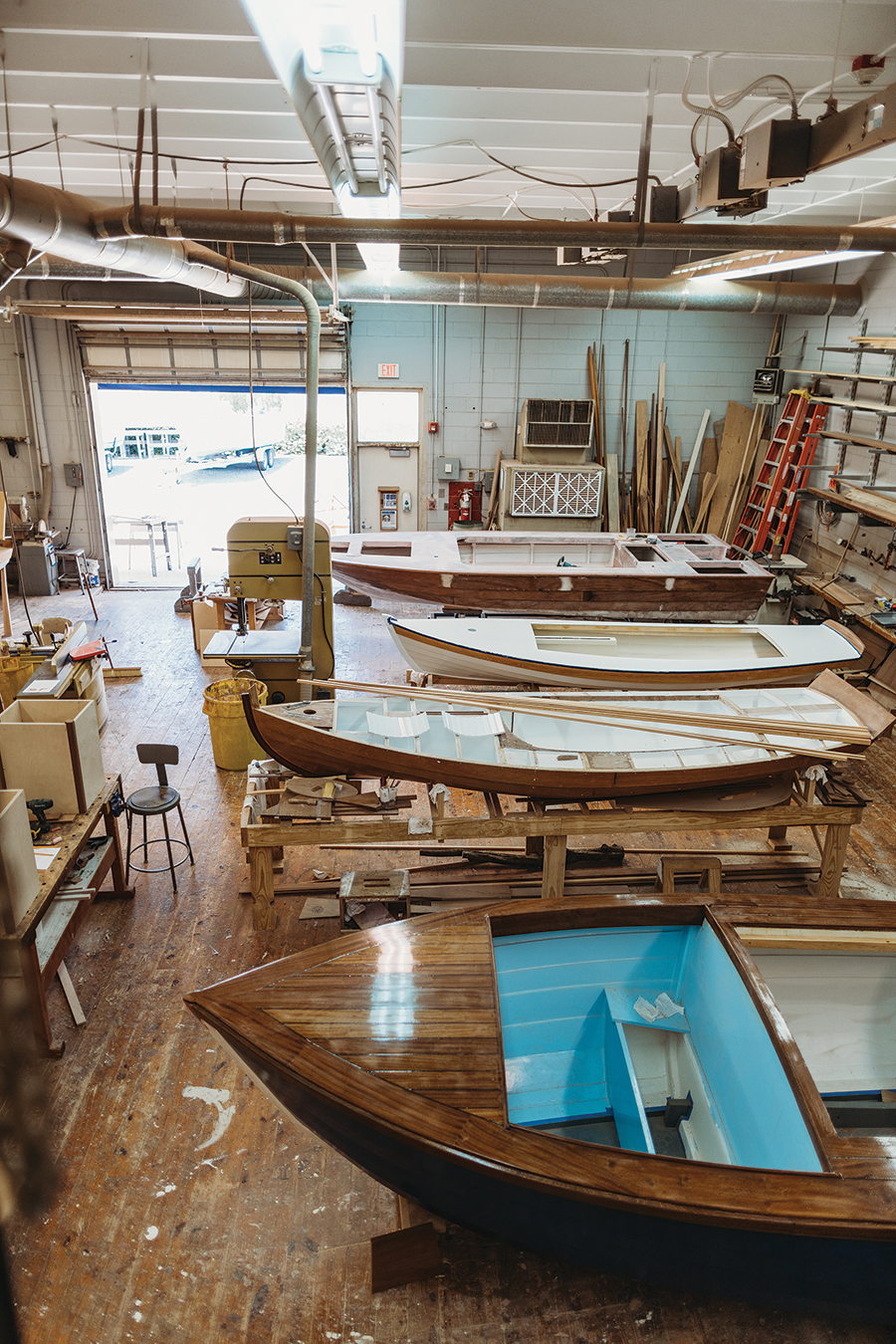
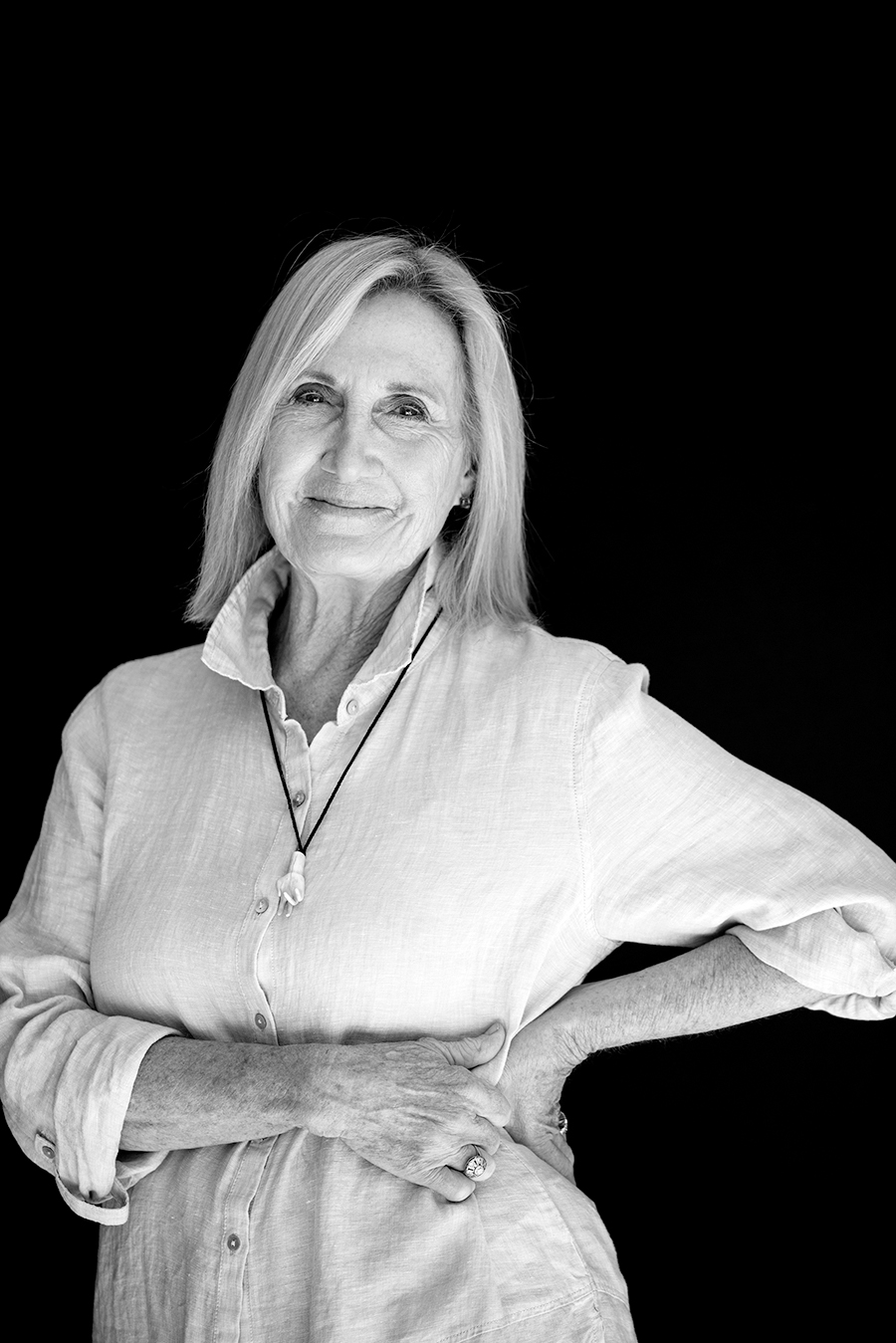
Master shipwright Mark Bayne is standing in an open bay at the workshop where he has been teaching wooden boat building at Cape Fear Community College in downtown Wilmington for the past 10 years. Over his shoulder, the murky brown Cape Fear River plods slowly eastward, where it will meet the Atlantic Ocean in just a few miles. It’s not quite summer yet, but the day is hot and bright. A stiff, warm breeze rolls in off the river, adding to the late morning’s warmth.

All around us, people are working on a half-dozen wooden boats in various stages of construction. There’s a flats boat that was specially designed so fishermen can stand with stability and cast a line from the broad deck; beside it is a beautiful, narrow melon seed just waiting for a sail; in the far corner of the workshop is a Jersey speed skiff that, as soon as it’s complete, will move next door (to the engine program) for the fall semester, where the team who built it will fit it with an inboard motor.

After decades building boats on his own and another decade of teaching people to do the same, Mark is accustomed to being surrounded by the sounds of saws and routers, the fine mist of sawdust floating through the air. He’s also accustomed to teaching others to build a variety of different kinds of wooden boats because that’s what he made a career doing before he found himself in the classroom.

“I’ve specialized in not specializing,” he says.

Mark is tall and handsome in the way that capable people often are. It’s as easy to picture him captaining a boat as it is to picture him building one. He’s quick to smile, and he’s still carrying the glow of holding a new granddaughter who was born down in Charleston, South Carolina, just a few nights before. That’s where Mark was raised, and his whole family, including his wife and their four grown children, live there now.
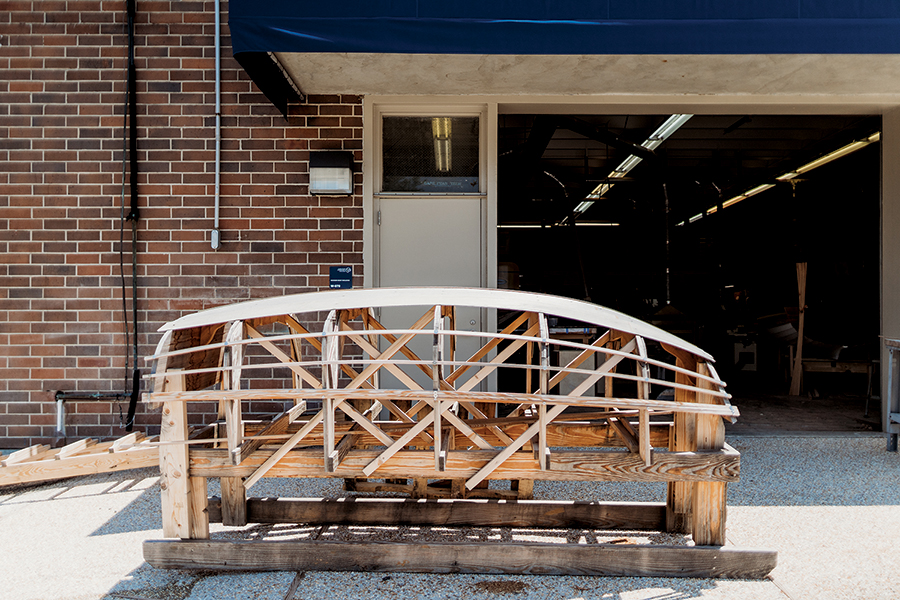
   

He splits his time between the low country and the Cape Fear, teaching at the college during the week and heading home to Isle of Palms on the weekend. His wife used to make the trips with him, but now that she’s surrounded by grandchildren she’s less likely to leave home. Bayne understands. He hears the call to home. For that reason, this is the last course he’ll teach for Cape Fear Community College’s wooden boat building program.

But in order to understand how his time at the college is ending, you have to understand how it began.

He grew up on “the backside” of Isle of Palms, South Carolina, in the marsh, sailing small boats, swimming, and crabbing with his younger brother and kids from the neighborhood. When I ask if they were ever so bold as to round the island and head for the open water, he smiles and pauses as if his mother and father are within earshot. “Officially, we did not do that,” he says, meaning, of course they did.

After a brief stint in college, Mark dropped out and worked at Mount Pleasant Boatbuilding Company as a helper in the joinery shop, where he learned to build and fit small, intricate parts to boats. He already loved boats, and he found that he also loved building and working on them. A welder in the boatyard mentioned that he’d heard about a new wooden boat building program beginning up the coast at Cape Fear Community College.

Mark enrolled in 1978 and was a member of the program’s first class. With his classmates and instructors, he literally helped build the program: They put down the hardwood floor in the workshop, and they built the workbenches from old bowling alley lanes that had been stored in a chicken coop in Southern Pines.

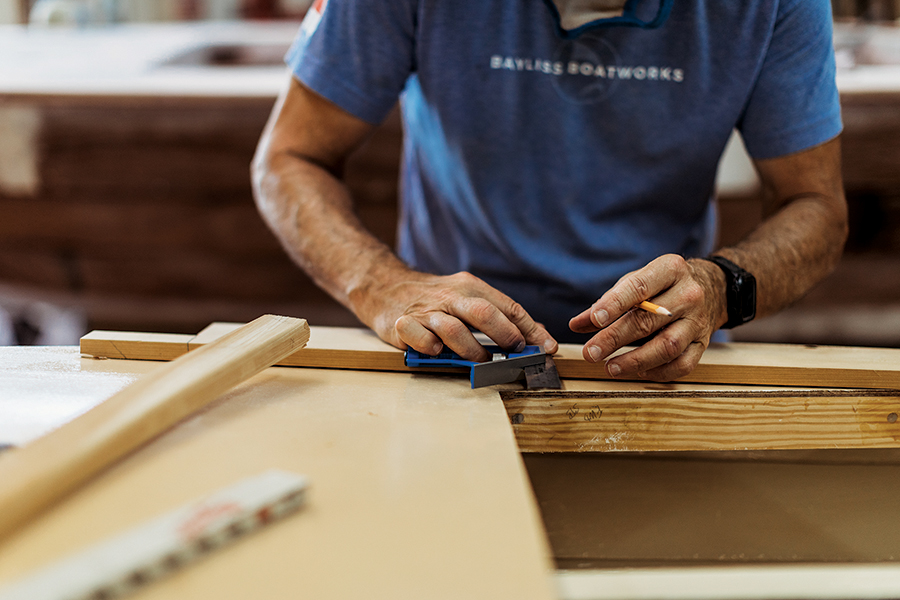
After completing the program and getting his degree, Mark went back to the Mount Pleasant Boatbuilding Company with the knowledge of how to loft boats, which is the process of drawing out plans on the floor, cutting and fitting the pieces, and constructing the boats using hand tools. On the weekends, he worked for himself, meaning he built boats apart from his work at the  boatyard. He found that he could make more money on his own while also building boats that interested and challenged him. In the late 1980s, he opened Sawdust Boatworks, and then he opened Sea Island Boatworks.

“No one has to have a boat,” Mark says, “so when someone hires you to build one, it’s a very special relationship.”

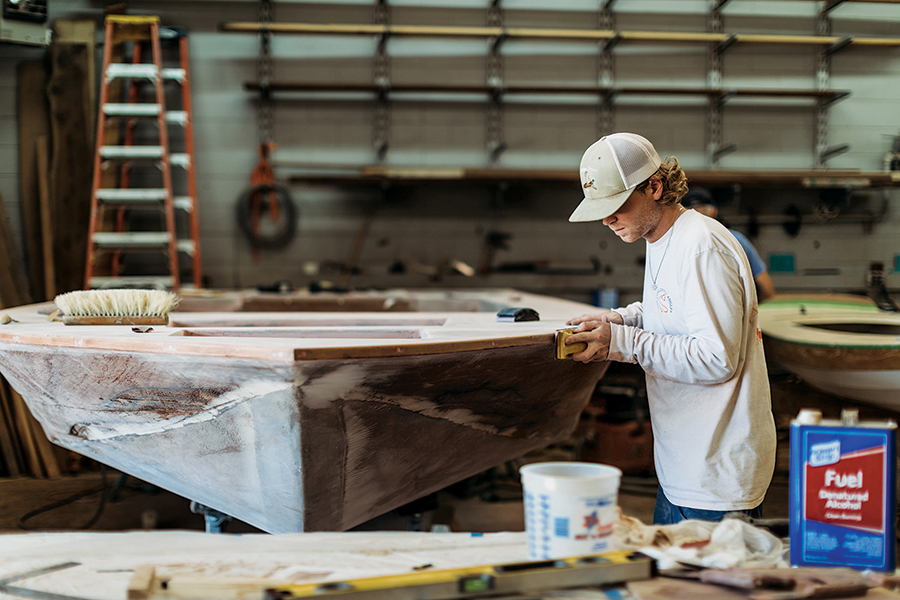
He can still remember the earliest boats he built. The first boat he built after opening Sawdust is still around; it’s a 14-foot marsh hen hunting boat. “That guy turned into a good customer,” Mark says. “I built multiple boats for him.”
.     

“I enjoy building things,” he adds, “and boat building allows you to be creative. Sometimes you build a boat to a plan that somebody else drew, and sometimes you build a boat by eye. You’ve got to know a lot. I worked with a guy in Panama City, Florida, once, and we built a 68-foot shrimp boat, just him and me. He was the master and I was the apprentice, but there was no plan, so you have to know all the construction details. When you’re doing it by hand with no plan it’s called rack of eye. It’s fun, it’s rewarding.”

Over the decades, Mark traveled up and down the East Coast, building boats from the Gulf of Mexico to the Chesapeake Bay, including the iconic Spirit of South Carolina, a tall ship that was constructed and ported in Charleston. The keel was laid in the summer of 2001, and the final plank was installed in the summer of 2006.

In 2012, Mark left the boatyards of South Carolina, as well as his life as a far-ranging boatbuilder, and returned “home” to Cape Fear Community College as head of the Wooden Boat Building program, where his professional career had started over three decades earlier. When he arrived, he found that he wanted to bring his vast experience to bear on the program’s curriculum.

“They had a good program going, but it wasn’t the way I wanted to do it,” he says. For years, the program had focused on moving students through stages of instruction on several different boats at various levels of completion. The students learned piecemeal, but that meant that they never completed a whole boat from start to finish. “I wanted students to work from lofting to launching,” he says.

“Mark has done a great job of giving this program a shot of momentum,” says Walter Atkins, an instructor in the boat building program who has decades of experience as a boatwright, his specialty building custom boat interiors. “I’ve learned a ton from Mark. It’s been awesome. We don’t use software where everything is designed on a screen. This is 1,000 percent old school.”

Over three semesters, including a summer term, students begin working with hand tools before graduating to power tools. Soon, the class moves up to the loft above the shop floor where they draw life-sized plans for the various boats they want to build.

“People slowly pair up,” Walter says. “You see the groups start to clump together.”

Recent high school graduates partner with retirees. Often, service veterans find one another, bonding over their shared experiences and their interest in boat building. It’s clear that both Walter and Mark find relationships with student-veterans important and endearing.

“I don’t ask about their service,” Mark says, “but I listen when they talk about it.”

Soon, the class moves to the shop floor, building the forms, fairing the hulls, and fitting the interior cabinetry. By the end of the program, as many as six complete boats are ready for the water. Once the boats are proven seaworthy, they’re auctioned off on a public website, where eager buyers are already lying in wait. The boats are purchased by people up and down the East Coast.

It’s clear that Mark takes pride in his students’ work, and he admits that if not for his wife, four children and growing number of grandchildren living down in the low country that he’d continue to work in the boat building program at Cape Fear. But he’s not really retiring. He’ll work some with his oldest son, Coulson, who is now building boats on his own while making good use of the family name: He decided to call his company Son of Bayne Boatworks. And there’s a 145-year-old historic schooner down in Panama City that was destroyed by Hurricane Michael that Mark wants to get his hands on. He’ll be busy, but according to him, he won’t be working.

“Boat building has never been a job,” he says. “I’ve never felt like I had a job a single day in my life.” PS

Wiley Cash is the Alumni Author-in-Residence at the University of North Carolina at Asheville. His new novel, When Ghosts Come Home, is available wherever books are sold.