
Pleasures of Life

PLEASURES OF LIFE

Fair Enough

Americana in the autumn

By Peter Doubleday

Ever dine in a Waffle House at 3 a.m.? Well, welcome to the fair.

In 50 years of announcing horse shows, I’ve attended over 30 state and county fairs, from Texas to New York, Florida to Colorado, and each and every one of them is a true slice of Americana — hold the grits.

Growing up in Syracuse, New York, my father hosted an early morning (around milkin’ time) agricultural radio show for WSRY — 570 on the dial — and served as a board member and horse show announcer at the Great New York State Fair.  He was at the radio station by 4:30 in the morning, on air from 5 to 7, then off to the fairgrounds until well into the night talking to throngs of spectators and producing the horse show.

When I was 6, I couldn’t wait to watch the train pull in from Buffalo (its county fair was the week before) like a rolling midway. Most of the rides arrived by truck, but the vast number of tents, generators, animals and all the carnies I could count traveled by train. The vagabond equipment came from James E. Strate Shows in Florida. I thought it was so cool that I created my own Strate Show train and vehicles on my HO scale train set in the basement of my house.

In those days fairs had agriculture, history and competition components, but the midway was always the centerpiece. Forget OSHA; how dizzy could you make yourself on the spinning and rattling Tilt-A-Whirl, and how many times in a row did you dare ride it? The view from the very top of the double Ferris wheel was impressive enough that it yielded my first kiss at the ripe old age of 11.

Every game on the midway had its own barker and its own tricks. Why couldn’t anyone make a basket? Was the ball too big or the hoop too small? One year the guy overseeing the ring toss felt so sorry for me he gave me a stuffed animal out of pity. At the Erie County Fair in Hamburg, New York, there was a giant tent with rows of stools and small boxes arranged like a bingo card. The speaker would call out “number one,” and people hoping to win a set of kitchen china would throw tiny red rubber balls that had as much chance of staying in box number one as a bowling ball has of floating. I couldn’t wait to see the bearded lady, the snake boy of Borneo and the alligator man. And I thought it was all real.

Features at fairs ranged from old-time stock car racing to its ultimate icon, the Demolition Derby. At a county fair in western New York the 3,000-seat grandstand was sold out, with people watching their neighbors destroy cars for nothing more than bragging rights at the local garage the next morning. The last time I watched a derby there were 75 cars and a completely superfluous announcer, since you couldn’t hear a word he said once the crunching began. The fire department got a major workout.

Every fair has a smell and aroma all its own, a combination of hundreds of different forms of food, fried in unimaginable combinations. Some of the most bizarre treats I’ve seen included a burger cooked inside a doughnut. If I could have figured out the overhead and net from selling fully loaded baked potatoes I could’ve been a millionaire.

Dairy and beef cattle, goats, sheep and pigs were judged, and the horse shows at the fair featured every imaginable breed. Every fair, it seemed, had its own “world’s largest pumpkin.” And how, exactly, does one judge a hay contest?

One of my fondest memories of the New York State Fair was the day my name was announced over the entire fairgrounds to report to the State Police exhibit in Hall A. I was 7 years old and my name had been drawn to win a German shepherd puppy. I named him Trooper. It had a better ring than Bumper Cars.

Out of the Blue

OUT OF THE BLUE

Sound It Out

A serious case of onomatopoeia

By Deborah Salomon

Lately, when trying not to think about the mess this world is in, my mind wanders to the etymology, history, development, significance of words, especially when uttered by powerful people. Words are free. Anybody can invent a word. Maybe it will enter the lexicon, maybe not. I attempt a colorful vocabulary as a writer and, before that, a student. Nothing a professor likes better than a term paper livened with 50-cent words. Spelled and used correctly, of course.

My favorite words showcase onomatopoeia . . . quite a whopper itself, meaning imitating the sound it defines. The usual illustration is Edgar Allen Poe’s “The Bells,” where sing-song repetition (and alter-whoppers like “tintinnabulation”) suggest Quasimodo pulling the ropes at Notre Dame. The cathedral, not the university. Strange how Americans pronounce those two words differently when referring to the dames residing in Paris and South Bend.

Next conundrum: Which came first, the sound or the word? My mind began spilling out more candidates than M&Ms on an assembly line — a gross exaggeration called hyperbole. Yeah, there’s right much hyperbole floating around these days.

Consider “whistle.” In order to articulate the word, one must purse the lips — as though to whistle. How about “gallop’’ which, when rhythmically repeated mimics the clip-clop of a horse’s hooves. “Soar,” dragged out a bit, allows the kite, then the voice, to rise before leveling off.

“Peck” is as staccato as a hen wandering the barnyard. “Pitter-patter” has no meaning, except how a toddler sounds running across a bare floor in his or her first real shoes. Sadly, it faces obsolescence since most contemporary kiddie footwear belongs to the rubber-soled variety, formerly sneakers until diversified to fit a variety of sports, yet stubbornly called “running” shoes.

Maybe I’m putting the cart before the clip-clop. Not if you agree that “thunder” owns an unspoken rumble that influences enunciation. Same with “scream,” commonly accompanied by a facial contortion, à la Janet Leigh in a Bates Motel shower.

Occasionally, a trope inspires physical rendering, the best being “describe a spiral staircase without using your hands.”

I even dredged up a few words that connect only to their sound, without a clear meaning, like the ocean that “laps” the shore. Lap? Maybe a kitten lapping milk from a saucer —more peaceful than a runner going once around the track in rubber-soled footwear.

Some words, of themselves, trigger action. Say “blink” without blinking.

Once upon a time, meaning what follows may be apocryphal, schools divided their curriculum into headings. My favorite was Language Arts, which likens the study of English to painting sunflowers, a lily pond, maybe a girl with a pearl earring. Right on, especially when active verbs move the brushstroke along. “Mona Lisa smiles . . . ” captures the action better than “Mona Lisa is smiling,” which she isn’t, according to cognoscenti, who mention bad teeth. “Noah fears the water” hits harder than the passive “Noah is afraid of the water.”

Good thing he got over that.

But my best word is “exacerbates,” which shivers like sharp edges clashing.

Conclusion: Words began as a collection of rumbles, splashes, whispers, clicks, chimes, growls, grunts and rustles. Written or spoken, words have become the palette, the gradations, the pictograms, an evolving commodity and, thank goodness, the only thing for which I’m rarely at a loss.

Focus on Food

FOCUS ON FOOD

A Pearfect Composition

Poire belle Hélène, compote-style

Story and Photograph by Rose Shewey

Say what you will about King Louis XIV of France — often characterized by his foes as a pompous, philandering tyrant — but he got at least one thing right: The “Sun King” declared the pear to be a royal fruit. Among his more celebrated traits was his passion for fine art and culinary excellence, and with that, the French king recognized the gastronomic value of the often underrated pear.

In the royal kitchen garden at Versailles, the Potager du Roi, Louis XIV planted over 140 different varieties of pear trees! That’s roughly 130 more than the U.S. knows today. There are only 10 key varieties grown commercially across the United States. Europe fares a tad better in this regard: While supermarket pear varieties are also limited, hundreds of heirloom pear types are conserved and fostered by private growers and boutique tree nurseries.

The story of the rise of the pear to Olympic heights continued in France — where else? When composer Jacques Offenbach premiered his hugely successful operetta La belle Hélène in 1864 in Paris, no other than Georges Auguste Escoffier, the “king of chefs and chef of kings,” took it upon himself to create a dish in celebration of the beautiful Helen, the namesake of a dessert that should be known around the globe.

The genius of the recipe for “Poire belle Hélène” lies in its simplicity: poached pears, vanilla ice cream, chocolate. Variations are numerous, and I’m adding my own, slightly simplified version. Instead of a poached whole (or half) pear, I make pear compote, which only takes minutes on the stove and boasts flavor through and through. Vanilla ice cream is hard to top, but a vanilla creme made of yogurt and heavy cream is a stellar, slightly more versatile substitute. Don’t omit any chocolate on my behalf — but cacao nibs are a lovely addition that adds some crunch, in more ways than one.

Pear Compote with Vanilla Crème

(Serves 2)

Vanilla Crème

1 vanilla bean

200 grams heavy whipping cream

1-2 tablespoons sugar

200 grams Greek yogurt

Cut vanilla bean lengthwise and scrape out seeds into a tall bowl, or the bowl of your stand mixer. Add heavy whipping cream and sugar and whip, using a hand mixer or stand mixer, until cream is semi-whipped. Start adding spoonfuls of yogurt while continuing to whip until you have a thick cream, then refrigerate.

Pear Compote

3-4 pears (about 400 grams), such as Bartlett or Red Anjou or any other variety of your choice

3 tablespoons butter

2-3 tablespoons muscovado sugar (or other dark, rich sugar)

Pinch of salt

Wash and peel pears, then cut them lengthwise into thin slices or dice, as desired. Melt butter in a heavy bottomed pan on medium/low heat and gently toss pears, until they are lightly sautéed, about 3-4 minutes. Add muscovado sugar and simmer on low heat until liquids turn syrupy and pears are softened. Add a pinch of salt and serve warm with vanilla creme.

Hometown

HOMETOWN

Keep on Truckin’

New life for old wheels

By Bill Fields

My mother drove until she was in her early 90s, an age-defying feat that made me happy until it made me scared.

I witnessed things on successive visits that caused concern. After Mom dropped me off early one morning at the Southern Pines train station to catch Amtrak’s Silver Star to New York, from the platform I noticed she lingered a long time in the parking space before leaving.

When I was in town the next time, she took more than an hour to return with a bag of groceries from Bo’s (the former A&P and now an arcade), arriving as I was calling the store to see if someone had any knowledge of her whereabouts. Mom claimed nothing was out of the ordinary, but it seemed likely she had gotten lost making the 1 1/2-mile trip home from Bo’s, a route she knew like the back of her hand.

Not too long after that incident, one of my sisters drew the unpleasant task of telling Mom it wasn’t safe for her to be behind the wheel anymore — even on the very short in-town trips that had become the extent of her driving — and that we were taking away the car keys for her safety and that of others. As our mother stewed about the blow to her independence, we children deliberated about where to hide the keys.

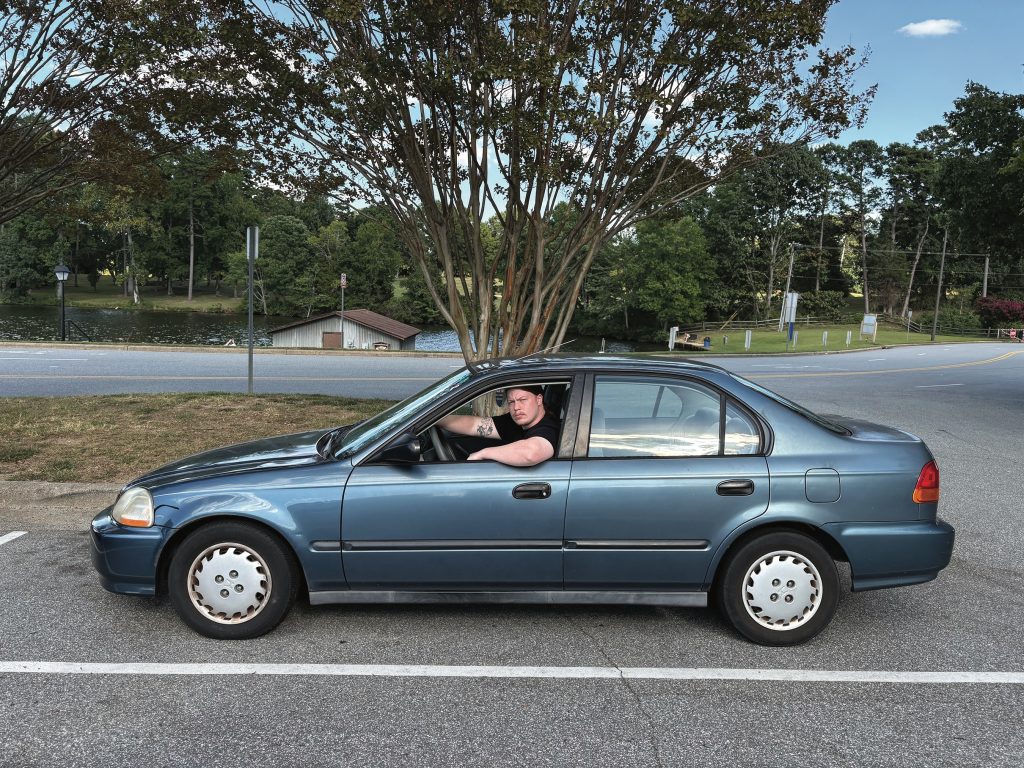
In 1982, two years after becoming a widow, Mom had upgraded from an aging Mustang to a gray Honda Civic, her first new car since our family splurged on a 1969 Ford Fairlane from Jackson Motors. She drove that Civic for a decade and a half, trading it in not long before her 75th birthday to purchase a new 1997 Honda Civic.

Mom’s second Civic, “cyclone blue metallic” in color, provided reliable transportation around Moore County and on occasional trips to visit my sister Sadie in High Point, which she was comfortable making until age 87. Once my mother stopped highway driving, I would take the Honda for an engine-exercising spin when I was home, driving north on U.S. 1, getting it up to 65 or 70 miles per hour before turning around in Dunrovin and heading back south.

More than once when taking Mom’s car to get the oil changed, I had someone ask if I was interested in selling it, so clean was the body and so low was the mileage.

I’m so glad I never entertained those offers. In 2018, a year after my mother went to live in an assisted-living facility, my nephew John and his son, Tristen, picked up the Civic, which had only 35,000 miles on the odometer. Tristen has driven “Old Blue,” as his dad calls the car, since getting his driver’s license in 2019.

Tristen is a muscular, 22-year-old college student who was an all-conference defensive lineman in high school, but he fits in the small sedan — and it has been a great fit for him. 

“I’m very blessed that my car is still working perfectly fine and giving me the transportation I need,” said Tristen, who has doubled the mileage on his great-grandmother’s former vehicle since it became his. “The only things I’ve done is gotten new tires, a new radiator and new fuel injectors. My dad talks about getting me a bigger car, but honestly I don’t need it. I enjoy my car, and I’d rather keep driving it until I can’t.”

Only 5 percent of the cars on the road today were manufactured in the late 1990s. The oldest car among Tristen’s friends is a 2012 model. He just drove the 28-year-old car on its longest journey, 400 miles to Pennsylvania and back, to attend a friend’s wedding.

“Just a couple of tanks of gas and no problems whatsoever,” Tristen reported. “I don’t have plans for another trip like that anytime soon, but if I need to, I’ll have even more faith that it’ll make it.”

I have friends with Hondas that have more than 250,000 miles. Mom’s former car might be in the family for a while, and that is fine with its second owner. “I think,” Tristen said, “I will always be an old-car guy.”

Birdwatch

BIRDWATCH

Cleanup on Aisle 9

The unparalleled scavenger

By Susan Campbell

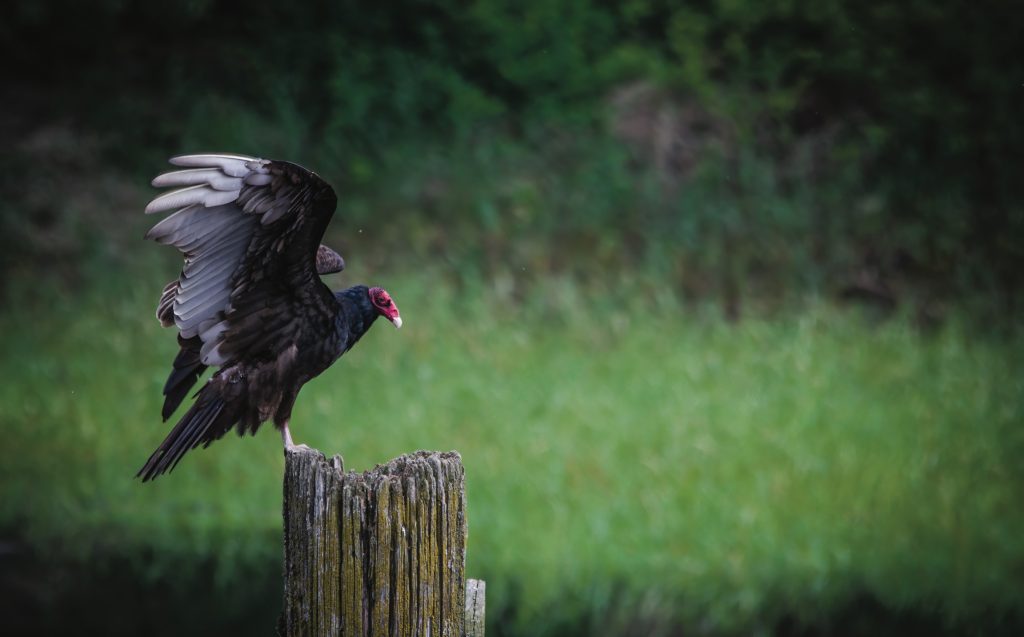
There! By the edge of the road: It’s a big, dark bird. It looks like it could be a wild turkey. But . . . is it? A closer view reveals a red head and face with a pale hooked bill, but a neck with feathers and a shorter tail. Definitely not the right look for a turkey — but perfect for a turkey vulture. This bird is also referred to as a buzzard or, for short, a “TV.”

Making an identification of these odd-looking individuals is somewhat harder these days since wild turkeys have made a good comeback in the Piedmont of North Carolina. Turkey vultures and turkeys can occasionally be seen sitting near one another in an agricultural field where they may both find food or are taking advantage of the warmth of the dark ground on a cool morning.

Turkey vultures, however, are far more likely to be seen soaring overhead or perhaps perched high in a dead tree or cell tower. They have a very large wingspan with apparent fingers, created by the feathers at the end of the wing. The tail serves as a rudder, allowing the bird to navigate effortlessly as it’s lifted and transported by thermals and currents high above the ground. These birds have an unmistakable appearance in the air, forming a deep V-shape as they circle, sometimes for hours on end.

It’s from this lofty vantage that turkey vultures travel in search of their next meal. Although their vision is poor, their sense of smell is keen. They can detect the aroma of a dead animal a mile or more away. They soar in circles, moving across the landscape with wings outstretched, sniffing all the while until a familiar odor catches their attention.

Turkey vultures are most likely to feed on dead mammals, but they will not hesitate to eat the remains of a variety of foods, including other birds, reptiles and fish. They prefer freshly dead foods but may have to wait to get through the thick hide of larger animals if there is no wound or soft tissue allowing access. Toothed scavengers such as coyotes may actually provide that opportunity. Once vultures can get to flesh, they are quick to devour their food. With no feathers on their head, there are none to become soiled as they reach into larger carcasses for the morsels deep inside.

Vulture populations are increasing across North Carolina — probably due to human activity. Roadways create feeding opportunities year-round. Landfills, believe it or not, also present easy meals. In winter, the northern population is migratory and shifts southward, so we see very large concentrations in the colder months. The large roosting aggregations can be problematic. A hundred or more large birds inhabiting a stand of mature pines or loitering on a water tower does not go unnoticed. 

Except for birdwatchers and those who live near a roost site, most people overlook these impressive birds. Often taken for granted, they are unparalleled scavengers, devouring the roadkill our highways inevitably produce.

Southwords

SOUTHWORDS

The Monster

And other commonsense solutions

By Ashley Harris

It was a delicate operation. The patient sat dejected on the floor, his “arm” dangling uselessly by his side. Just five minutes earlier, I had innocently slid the hose of my precious vacuum along the floor under the nightstand to suck up loose tumbleweeds of dog hair. Suddenly, the comforting whir of the motor was replaced by a death rattle.

“Help!” I screamed to my husband, J.P. But when I ran into the living room, I saw that he had on headphones, the protective gear worn by any baseball fan whose wife was doing loud chores. “I need you!”

“The Dodgers are playing the Padres.”

“This is an emergency!” I clenched my teeth.

Of all the vacuums I have ever owned, my 7-year-old, swivel-headed model is my favorite. We move together like Nureyev and Fonteyn, sweeping across the floor in artistic harmony.

I hauled the victim into the kitchen for triage. We peered down the dark hole of the hose and, even with the flashlight, couldn’t see anything.

“Can you think of something you might have vacuumed up that could be clear?”

Aha! I hadn’t seen the cap to my hairspray in weeks and, I confessed, it was clear.

“Congratulations,” J.P. said. “You have managed to vacuum up something that perfectly matches the diameter of the hose. That takes finesse.”

I had no time for clever remarks. “Let’s try this,” I said, handing over a steak knife. This tool remains one of my favorite commonsense solutions, useful for tasks well beyond its intended purpose. Never mind the scar I still bear on my left hand from the time, at 6 years old, I used one to pry a hardened collar of glue from my Elmer’s.

I held the hose steady while J.P. tried to jiggle the cap free, but the trusty knife did not work. We had no more luck with the screwdriver or the pliers, and the situation grew more dire with every attempt. Each tool we poked into the hose only pushed the cap even farther down, along with my heart.

“Why don’t we try the drill?” asked J.P.

For a normal person, the space between a crazy idea and better judgment is at least 30 seconds. Not for me. In my mind, this was pure genius. Why didn’t I think of it myself?

The cordless drill is J.P.’s most cherished tool, the equivalent of my vacuum. “Now, I don’t know how safe this is,” he warned. “You’re going to have to hold the hose perfectly still while I drill into the cap. If you move, the drill could damage the hose or worse, hit you. You sure you want to do this?”  

I dismissed the pesky notion that most deadly accidents happen in the home because I was as desperate as I was stupid. I held the hose, standing at arm’s length, in case J.P. slipped. And he drilled and drilled, rattling my bones with every thrust and parry. Still, the cap would not yield.

“This is going to take forever,” he said, glancing back at the Dodgers in the bottom of the seventh.

“What about The Monster?” I asked, in a wave of inspiration.

The Monster, a three-quarter inch drill bit, emerges from the toolbox only for special occasions, like when we needed to drill drainage holes in the discarded satellite dish we use for the seat in the swing we made for Tulsi, our bossy corgi.

“That could work,” J.P. said. “But we have to be very careful. You have to hold the hose, and you cannot move a muscle.”

I held on with both hands, shaking like an apprentice snake wrangler holding her first python. With one shove, that pesky cap shattered, spewing plastic shrapnel all over the kitchen. Hallelujah! We did it!

I plugged my vacuum back into the electrical outlet, and a quick flip of the on button confirmed that suction was fully restored. J.P. donned his headphones and planted himself in front of the television and I was happily vacuuming again, sucking up the shards of my sin.

PinePitch October 2025

PINEPITCH

October 2025

If It’s October, It’s AutumnFest

There’s music. There’s food. There are arts. There are crafts. There’s stuff to do. Sponsored by the Arts Council of Moore County and Southern Pines Parks & Rec, the 47th annual AutumnFest in the Downtown Park in Southern Pines, 145 S.E. Broad St., kicks off on Saturday, Oct. 4, at 9 a.m. The festivities end at 4 p.m., in time for dinner at a local bistro. For more information call (910) 692-7376.

Fabulous Farms

Prancing Horse hosts its 34th annual self-guided tour of five of the most beautiful equestrian facilities in the Sandhills from 11 a.m. to 4 p.m. on Sunday, Oct. 19. The tour begins at Prancing Horse Farm, 6045 U.S. 1, Vass, and all proceeds benefit the Prancing Horse Center for Therapeutic Horsemanship. For more information visit www.ticketmesandhills.com.

Boo!

If you have yet to witness the sight of hundreds of ghosts, goblins, witches and warlocks wandering the streets of Southern Pines, hang out for a spell on Friday, Oct. 24, when kids and parents are invited to trick-or-treat the downtown businesses from 5 – 7 p.m. After the bags and buckets are full, gather at the Downtown Park, 145 S.E. Broad St., for Halloween games, crafts and a magic show from 7 – 7:30 p.m. For more information call (910) 692-7376.

The Divine Pearl

Girl with a Pearl Earring, by Johannes Vermeer, is one of the most enduring paintings in the history of art, yet the painting itself is surrounded by mystery. Art on Screen, presented jointly by the Arts Council of Moore County and the Sunrise Theater, will show a film seeking to investigate the many unanswered questions associated with this extraordinary piece. Who was this girl? Why and how was it painted? Professor Ellen Burke will offer a pre-film lecture and discussion at the Arts Council’s Campbell House on Monday, Oct. 27, at 5:30 p.m. and a follow-up on Wednesday, Oct. 29, at 10 a.m. For more information go to www.sunrisetheater.com.

Old and Awesome

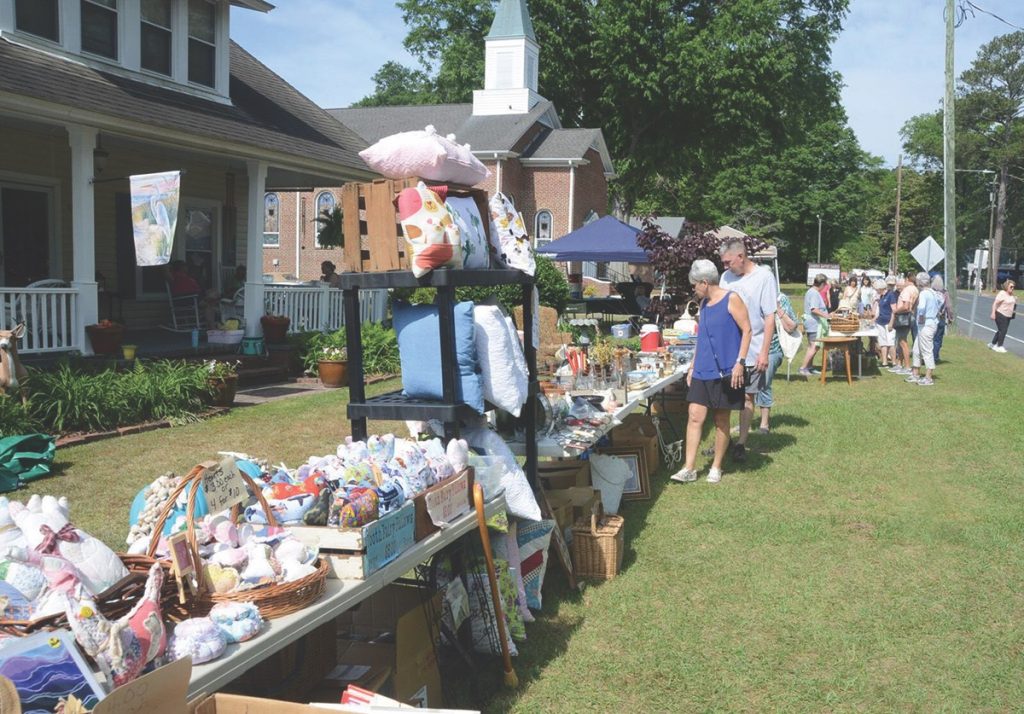
Over a hundred vendors line the streets when the two-day Cameron Antique Fair begins on Friday, Oct. 3, at 9 a.m. in the town’s historic district. The sidewalks roll up at 5 p.m. each day. There’s food and lots and lots — and lots — of stuff. For more information go to www.townofcameron.com.

First Friday

The Grateful Dead tribute band Bearly Dead brings the streets of Southern Pines to life — see what we did there? — on the greenspace next to the Sunrise Theater, 250 N.W. Broad St., on Friday, Oct. 3, from 5 – 9 p.m. Y’all know the drill. No outside alcohol — you can buy it there. Food, too. And pets larger than a gummy bear need to stay at home. For more info (as if we didn’t know what we need to know by now) you can visit www.sunrisetheater.com.

Fair of Fairs

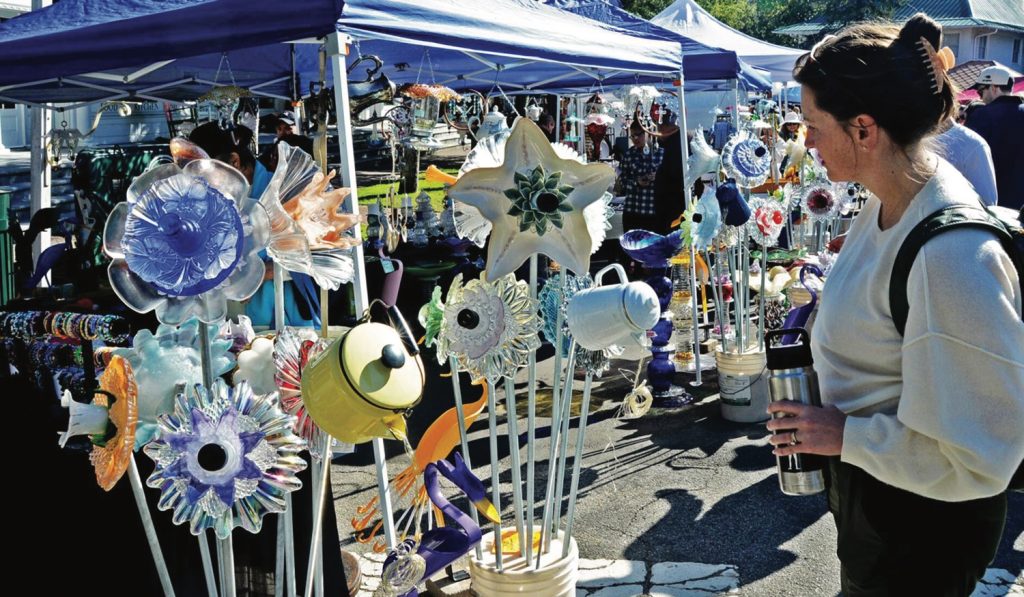
The 47th annual Holly Arts & Crafts Festival takes over the village streets in Pinehurst from 10 a.m. to 4 p.m. on Saturday, Oct. 18. The festival features over 200 crafters encompassing pretty much everything you can think of — from woodworking to glass, stitched art to lawn ornaments, hand-crafted jewelry to metal sculpture — and more. The village boutiques, shops and restaurants will have specials and sales on, too. For additional information go to www.pinehurstbusinesspartners.com

Paul Reiser Brings His Comedic Wit to BPAC

Thursday, October 16th at 7 PM

Six Questions with Paul Reiser

Will you have any leisure time to experience golf, food or something completely unexpected in Pinehurst?

PAUL: I generally don’t have any leisure time when I do these shows. I fly in and then move on. So hopefully, there’ll be food, but that should be about it. I do love barbecue.

What small, everyday detail of life still makes you smile or laugh out loud, no matter how many times you notice it?

PAUL: This is as small as you can get. When you floss, something ends up on the mirror, and there should be a way to avoid that. I haven’t figured it out yet. So, you know, a mirror should not be responsible for your dental hygiene.

If you drop your Mad About You character into 2025, what would surprise him the most about relationships today?

PAUL: You know, nothing would surprise me because I’m in the same relationship now that I was when I created Mad About You, so my marriage continues to entertain me and baffle me and challenge me and support me.

If you could go back and sit in the audience of any performance in history, whose show would you choose?

PAUL: Probably Ed Sullivan and The Beatles in 1964. Just to say I was there. That would’ve been interesting. I’m curious to see if the room was aware of the world shifting in that moment. That would’ve been interesting.

Who’s someone outside the entertainment world that has shaped the way you see your craft?

PAUL: My kids have helped me — and my wife. Certainly my wife, who likes to point out during tense moments, “You know, without me, you have no act at all.” So I owe the majority of my act to interacting with my family.

If you weren’t a comedian or actor, what career would you be most curious to try for a year?

PAUL: Open heart surgery. I imagine that would be a kick. You know, just to see the expression on the guy’s face when I show up and he goes, “Do you have any medical training?” And I go, “No, but I’m gonna take a whack at it.” I think that would be entertaining.

For more information and tickets, go to sandhillsbpac.com or ticketmesandhills.com.

The Naturalist

THE NATURALIST

The Butterfly of Death

Encountering the black witch moth

Story and Photographs by Todd Pusser

“Todd, you’re going to want to see this!” shouts Maurice Cullen from his backyard. “And bring your camera!”

I can tell by the urgency in his voice that Maurice has found something pretty cool. For the past hour, beneath the light of an August moon, I have been standing in his neighbor’s yard trying to photograph sphinx moths nectaring on flowers, and I already have my camera in hand. I race over to his backyard gate, open it, circle the swimming pool and approach Maurice, who is standing in the far corner of the yard, next to a wooden fence.

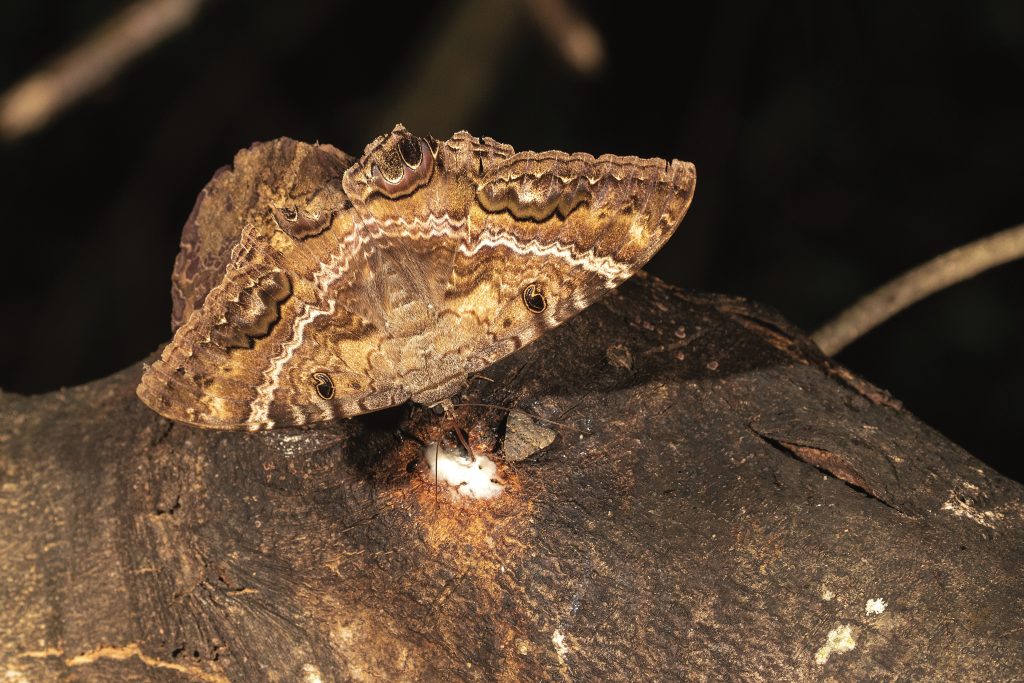
“Check this out,” he says pointing the narrow beam of a flashlight up into a Chinese privet tree. There, in the center of a large branch overhanging the fence, is an immense brown-colored moth, with sharply pointed wings.

“It’s a black witch,” says Maurice excitedly. “Take some pics before it flies away!”

Fumbling with the controls of my camera and adjusting my flash power, I frame the moth in my viewfinder. Its long proboscis is buried deep within a steady stream of sap leaking from a small crack in the tree’s bark. The sap, a natural sugary concoction that entices all manner of insects the same way blood in ocean water attracts sharks, has been leaking from various cracks along the tree’s trunk and limbs all summer, drawing in such winged wonders as red-spotted purple butterflies and giant cicada killer wasps.

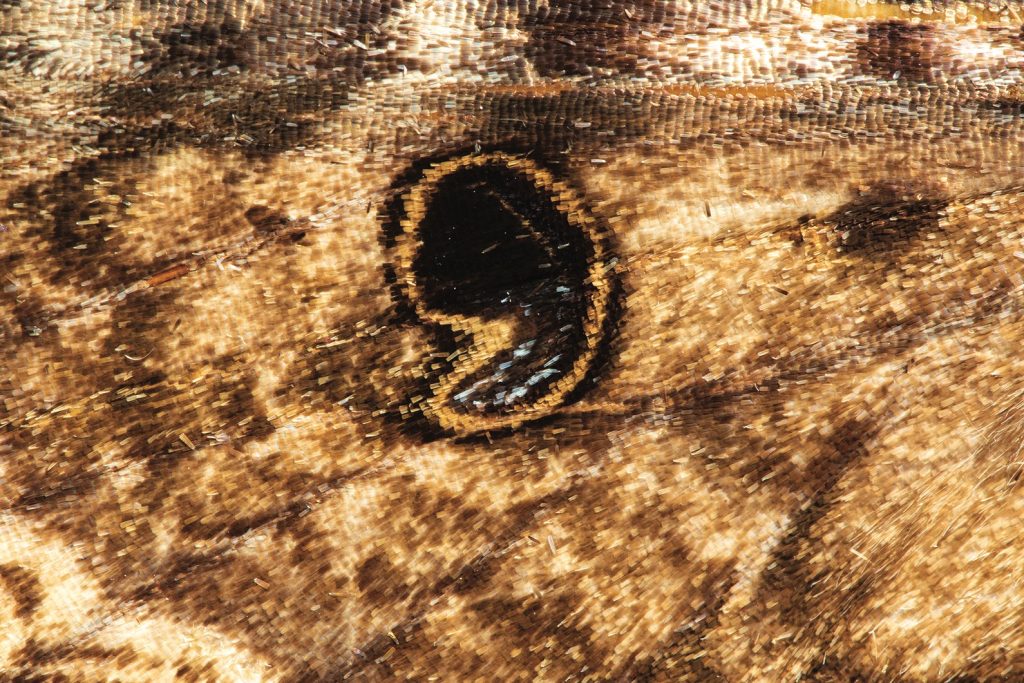
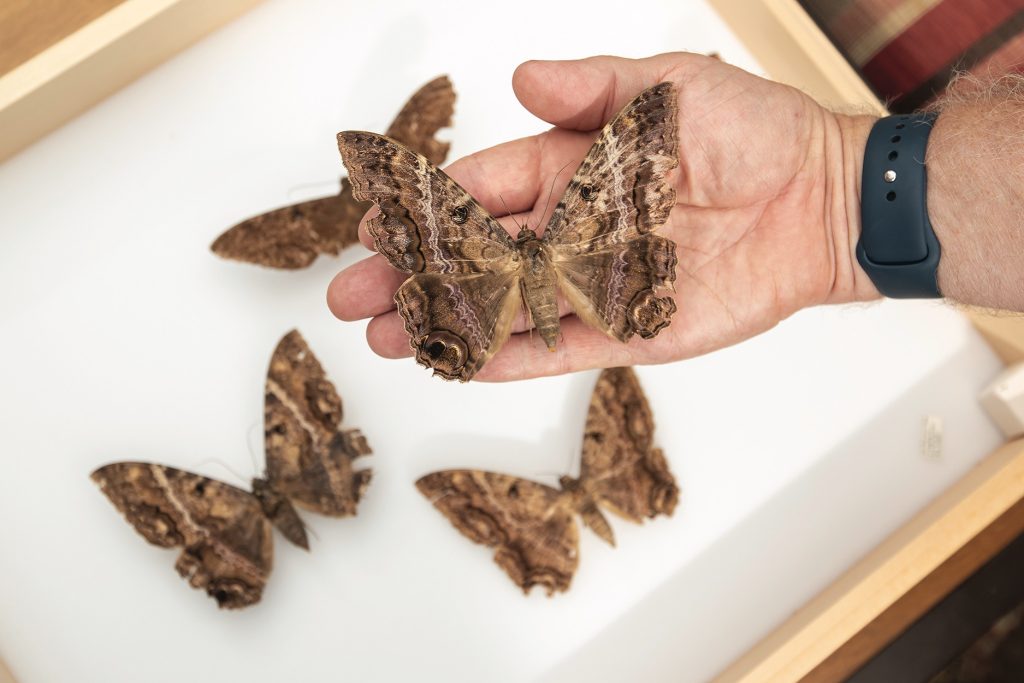
Snapping off a few frames of the witch, I note the distinctive comma-shaped marks on its forewings and a prominent white line running across its hindwings, a telltale field mark identifying this particular moth as a female. Measured from wingtip to wingtip, black witch moths are the largest insects in North America, with some having wing spans that surpass 7 inches. The one that Maurice and I are staring at is somewhat smaller, with a wingspan of “only” 6 inches or so. With such large wings, the moth resembles a bat in flight.

An hour earlier, I had seen a large moth streak across the neighbor’s yard in the fading twilight and had brushed it off as a more common silkmoth, possibly a Polyphemus moth. It was likely the black witch making a beeline for the sap well on the privet tree.

Black witch moths are found throughout the Neotropics, from the Caribbean down to Brazil. The moths are powerful migrators and frequently reach the southern United States and points farther north. Historically, they were rarely observed as far north as Virginia, where we are currently standing. Now that most people have powerful cameras buried within their phones and loaded with a plethora of citizen-science apps, like Inaturalist, black witch moths are being reported more frequently throughout the continental United States. Still, Maurice, at 66 years of age and a lifelong butterfly and moth watcher, has never seen one alive in the state. It’s a cause for celebration, albeit a cautious celebration, as few animals harbor as many myths and superstitions as the black witch moth.

In Colombia, legend states that sorceresses who have died and failed to enter the gates of heaven have been cast back to Earth in the form of black witch moths. In Mexico, the black witch moth is known as the Mariposa de la Muerte, the butterfly of death. It is believed that if one flies into someone’s home, that person will soon perish. In other parts of Mexico, people say that if a black witch moth flies over your head, you will soon lose your hair — a fate some view as worse than death. In Jamaica, the black witch moth is called a Duppy Bat, and is believed to be a lost soul. In other parts of the Caribbean, the moth is thought to be an actual witch in disguise, and to see one means someone has cast an evil spell on you.

Continuing to take photos, I stop briefly to review the images on my camera’s LCD. Glancing back up to the tree limb, the black witch moth is no longer there, having disappeared into the inky black sky like some ghostly apparition. “Ahhh, man, that’s disappointing,” sighs Maurice, who wanted more time to ogle the winged marvel. I laugh nervously, hoping that the moth has not exited the yard by flying over my head.

Lorem ipsum dolor sit amet, consectetur adipiscing elit. Ut elit tellus, luctus nec ullamco

Instead, I choose to think about the more cheerful legends surrounding the black witch moth. One in particular stands out above all others. In the Bahamas, folklore calls black witch moths Money Bats. Locals believe that if you are fortunate enough to see one, prosperity will soon follow.

Perhaps tonight on the way home from Maurice’s, I’ll stop at the local gas station and buy a Powerball ticket. 

rper mattis, pulvinar dapibus leo.

Omnivorous Reader

OMNIVOROUS READER

Getting Semi-Real

Jason Mott’s People Like Us

By Anne Blythe

Jason Mott gets one thing out of the way right off the bat in People Like Us — his latest novel is semi-fictional. Or at least that’s what the National Book Award-winning author of Hell of a Book wants you to believe.

“Whole fistfuls of this actually happened, sister!” he tells us in the forward. “So, to keep the lawyers cooling their heels instead of kicking down the front door with those high-priced Italian loafers of theirs, some names and places have been given the three-card monte treatment and this whole damned thing has been fitted with a fictional overcoat.”

People Like Us is the story of two Black authors — one on tour in the wintry climes of Minnesota after a school shooting, and the other being chauffeured around Europe, or “Euroland,” as he calls it, as the guest of a super-wealthy benefactor we know only as “Frenchie.”

They’re both exploring the idea of the American dream and whether such a notion is truly attainable within the confines of their lives. One is pondering that question from inside U.S. borders, the other from the outside.

Readers likely will notice many parallels between the real life of the acclaimed Columbus County resident and UNC Wilmington professor who’s a five-time author now. Mott started writing People Like Us as a memoir that delved into his relationship with America.

But along the way a couple of his Hell of a Book characters — Soot and The Kid — kept dropping into his story. So it evolved into this description-defying, pseudo-memoir/novel that will make you laugh out loud at its devilishly delicious humor, then sink into the grave realization that Mott is deftly addressing some serious social commentary.

Because both protagonists feel compelled to travel with concealed weapons, the gun culture in America and abroad is one such theme. So is the precarious state of the nation.

Mott is not preachy about these topics. He is subtle and inviting as he gets readers to think about American identity, and the complexities that Black Americans confront in a land where racial “othering” still exists.

One of the beauties of his writing is he can turn a phrase that will stop you dead in your tracks and force you to linger for a minute or two to admire his imagination, wit and way with words. Mott describes a scene about a seismic shift on a par with the protests that followed the murder of George Floyd this way: “It was like watching Sisyphus — a man who never skips leg day — finally get that super-size rock of his farther up the hill than he ever did before. And, just for a second, you can believe that, hell, maybe he’ll finally get it over the top.”

Mott’s prose will take you on a madcap adventure or somber journey with a cast of intriguing characters. We reconnect with Soot, the character in Hell of a Book who becomes invisible or one of “The Unseen” after witnessing his father shot by police while out on a jog. He’s an author now, in Minnesota, reckoning with the suicide death of his daughter, Mia, amid the aftermath of a school shooting.

Then there’s The Kid, who is older than he was in Hell of a Book, mysteriously seizure-prone now, living in France and going by the name Dylan — or at least the author living it up bourgeois-style in Europe believes the two are one and the same despite being told otherwise.

We get to know The Goon, the giant Black Scottish bodyguard and driver employed by the eccentric Frenchie to squire around the nameless author in a Citroën so decrepit and aged it seems like it’s “about to pull a hamstring.” 

Dylan is with them as they go from book event to book event in Italy and France. Along the way, the author, who sometimes pretends to be the better-known Colson Whitehead or Ta-Nehisi Coates, runs into Kelly, a funeral director and former girlfriend from the States. She hops in with the trio as the four of them seek a “Brown Man’s Paradise.”

Just as the gun used in an accidental shooting toward the end of the book hangs suspended in air “like a steel question mark,” so too does the notion of whether leaving America, as Mott poses, “just might be the new American dream.”

Dylan, who fled to “Euroland,” sheds light on that idea in deep conversation with the author, who is debating himself whether a comfortable home can really be had outside the homeland for people like him.

“There’s a hierarchy here, just like everywhere,” Dylan told him. “You’re either French-born White or Italian-born White or English-born White or Whatever-born Whatever . . . or you’re an Other. Well, where do the Others go? What do you do when your home doesn’t love you and all the other homes you tried to make a life in don’t love you either?”

That question lingers as Mott wraps People Like Us, fodder for one more semi-fictional book.

Art of the State

ART OF THE STATE

Taking a Breath

Daniel Johnston’s art and life find new meaning

By Liza Roberts

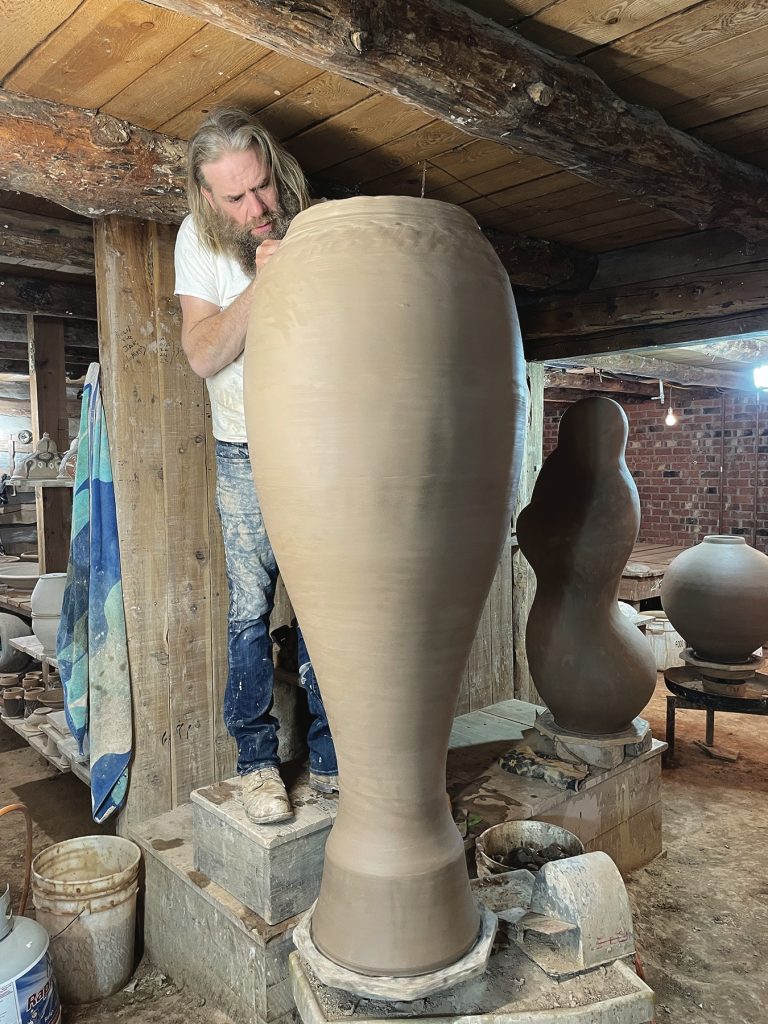
Celebrated Seagrove ceramic artist Daniel Johnston has always asked his work to carry a lot of weight. The clay vessels and pillars and bricks he forms and fires in Randolph County are beautiful; they’re also packed with a powerful purpose that has fueled his ambition for years. His works carry complicated stories about land, especially the place where he makes them and his life there. They’re dense with technical prowess, the multicultural lineage of that learning, and the demonstration of those skills. And they’re conceptual, freighted with ideas, wise to the history of art and its evolutions.

But lately, Johnston has begun making art differently. He’s thinking about it differently. The catalyst has been his marriage to artist Kelsey Wiskirchen and the February birth of their first child, Joseph Elliott Johnston.

“There’s the feeling that I have a greater purpose in life as a father,” he says. “The work, I can see, has had a bit of a breath. In a way, if it had a life of its own, it would thank me for taking the pressure off of it a bit.” If his art no longer needs to prove his human worth, Johnston muses, perhaps it can begin to speak for itself: “It frees my work up to be more mature.”

At the moment, that new work is destined for a substantial fall installation at the Gerald Peters Gallery in Santa Fe, New Mexico. He plans to install his pieces there — as many as 50 large pots and several of the wall-hung clay brick assemblages he calls “block paintings” — in a series of rooms he’ll create out of 80-odd discarded wooden walls he salvaged from the High Point Furniture Market.

Building environments for his work is not new for Johnston. “So much work that is impactful and changes people’s lives, it’s all content in context. The architecture of the room, it gives it context, and, in a way, it removes the pressure from that object. [The installation is] a bit of a Trojan horse, so that the viewer can softly let [the object] in,” he says. “If I can start controlling how you feel, then I’m able to allow you to see my work in the way I want to communicate it.”

Also on display within this context, possibly: previously unseen paintings made not of clay, but of paint on canvas or board. “This would be the first time I’ve ever exhibited paintings that weren’t three dimensional,” he says. His constructed wood-walled installation would be a good place to show them, he says, because they’d become part of a larger artistic immersion. “If you go into an installation, you are walking into an installation, you’re not walking into an exhibition of paintings.” Still, he’s not yet ready to commit. “Maybe I won’t exhibit them if I don’t feel they’re strong enough.”

Taking his time is part of his practice. Abstracted, sketch-like paintings of vessel-shaped forms have shown up on his studio walls in recent years, but the paintings he may include in the Santa Fe installation are likely to be inspired by the landscape of New Mexico and the tobacco barns of North Carolina. Some will be painted on land he owns next to Carson National Forest in New Mexico, and some will be painted at home in Seagrove. “I’m absolutely in love, architecturally, with the tobacco barn,” he says. “It’s just such a brilliant piece of architecture.”

Homeplace

Johnston lives and works in a house and studio he built with his own hands. It reflects his long-held appreciation of the tall, timbered barns traditionally used to cure tobacco. It’s a log cabin the size of two barns put together, with big pots all around it, some sunken in the grass and some on pedestals.

It sits on 10 acres of land he bought at age 16 with money he’d originally saved for a Ford Mustang — land where, at that young age, he built himself a shack to live in, alone, after he dropped out of school. Years later he felled the trees to build this house and studio.

When I first met Johnston there seven years ago, he was humble as he told his story and surveyed his place. Growing up not far from there in extreme poverty as the child of tenant farmers, “in my mind,” he says, “land was power.” He told himself early on he would make for himself a different kind of fate. 

The same could be said of his art.

About 15 years ago, after lengthy apprenticeships with potters in Thailand and England and with Seagrove’s internationally revered Mark Hewitt, Johnston became a leading American maker of big pots. He perfected a technique to turn 100-pound lumps of clay into giant vessels that could hold 40 gallons apiece and made them in huge numbers, a series of 100 pots one time, 50 pots another. The acclaim was exciting, but then became disillusioning. It broke his heart to see them carted away, one by one. It was the groupings, he realized, that held the meaning: “People had to have a piece of it. As soon as they had that jar, it had no context.”

Johnston eschews that kind of work today. Now, he’s not concerned with demonstrating his finesse or with making beautiful objects unless they have conceptual meaning. At the North Carolina Museum of Art in 2019, he sunk 183 individual wood-fired ceramic pillars in a permanent installation across the gentle hills of the park landscape to evoke an organic border, fence or outcropping. In 2021 at NC State University’s Gregg Museum of Art & Design, he built a massive wire-mesh, house-shaped frame — a temporary building at once empty and full — to hold several giant pots, many irregularly shaped, and some put together like bricks in a foundation. It was a paradox: lonely but inhabited, open but caged, refined but deformed.

“I’ve never thought of myself as a potter, and I don’t really like the title. I want to work with my mind, not my hands,” he says. “Like Duchamp’s Fountain.” He’s referring to a porcelain urinal the French conceptual artist Marcel Duchamp exhibited in 1917, considered a seminal moment in 20th-century art. Duchamp rejected what he called “retinal” art, or art designed to please the eye, and wanted his art to provoke the mind instead. “I think about that a lot,” Johnston says.

Recently, caring for his newborn son and also for his aging father, who suffers from dementia, has allowed Johnston to spend more time in thought than his typical schedule of constant studio work allows.

“I’ve been working my mind, which is really probably the place that I spent the least time before he was born,” he says. “I can look back now and see that I had filled my time with things that kept me from using that bit of my brain. And so now it’s the opposite of it. I’ve had a huge amount of space to use that part of my brain.” The result, he says, is the kind of artistic evolution that lies beyond the acquisition of skills. “The nice thing is that once you have the security of your skills and your abilities under your belt, there’s always a huge amount of room to improve. But so much of the work is mental and thought at that point. And so I have been working that way.”