Dissecting a Cocktail

DISSECTING A COCKTAIL

Big Trouble in Oaxaca

Story and Photograph by Tony Cross

Amanda Schuster’s Signature Cocktails is a beautiful cocktail recipe book that pays homage to older cocktails, as well as those that will be soon. I’ve been in the process of mentally preparing myself for a brick and mortar bar of my own, and every now and then I come across a drink that I visualize serving in my fantasy lounge. “Big Trouble in Oaxaca” is one of them, courtesy of Schuster’s book.

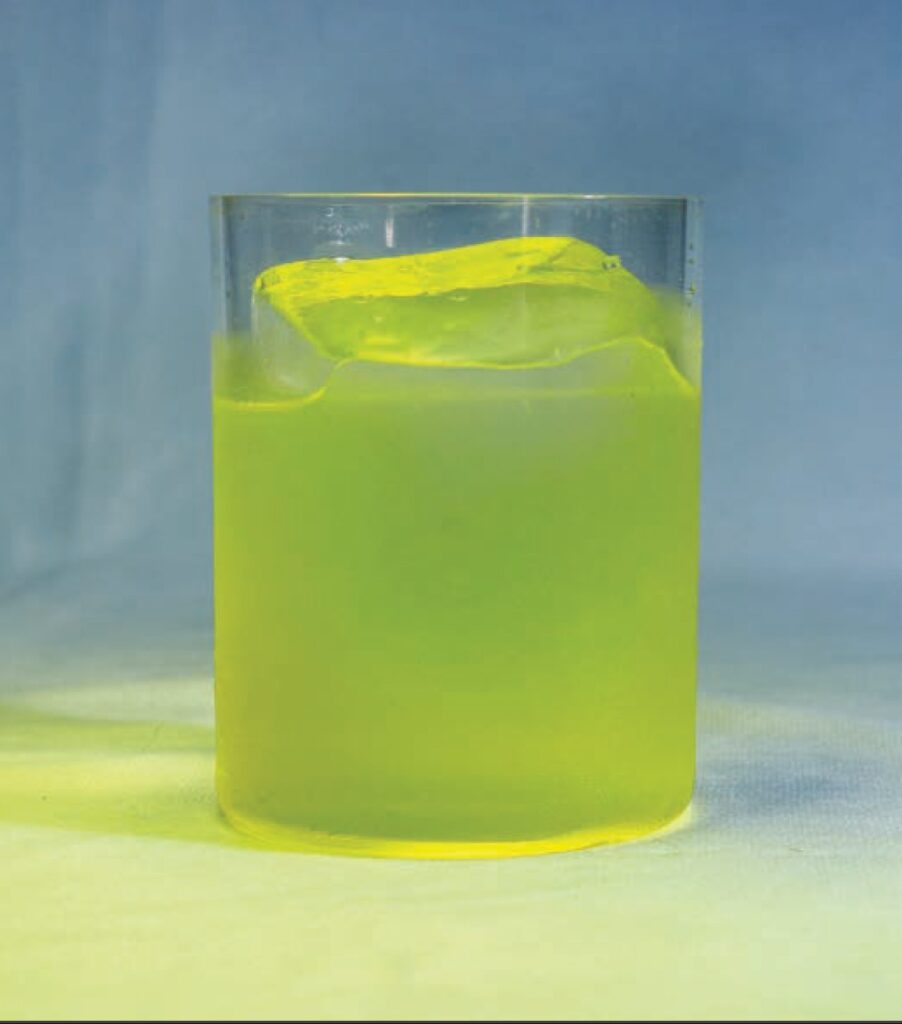
The name of the drink pays homage to the ’80s movie Big Trouble in Little China. It’s essentially a riff on a margarita, and what first got my attention is how it glowed on the page. Bright and fluorescent, its hue reminds me of when I’ve had one too many B vitamins . . . if you know, you know. Created in 2018 at the restaurant Drink Kong by bartender Livio Morena, this cocktail seems to fit the bar’s trademark ’70s and ’80s nostalgic theme. The neon color comes courtesy of Midori melon liqueur (which was first popular in the late 1970s) and was used “because in 2018 it just seemed so dated and weird that it might be the perfect way to attract attention to the bar, and also show love for Japanese culture,” says Morena.

Personally, I can see this drink catching the eye of anyone in a dimly lit cocktail lounge. The fact that it tastes amazing only solidifies the odds of me serving this one night as a drink special. Hypothetically, of course.

SPECIFICATIONS

1 1/2 ounces tequila blanco

3/4 ounce pineapple liqueur

1/2 ounce Midori liqueur

1/2 ounce green ancho chili liqueur

1 ounce fresh lemon juice

1/2 ounce sugar

EXECUTION

Combine all ingredients in a cocktail shaker, add ice and shake hard for 10 seconds. Strain into a chilled rocks glass over a large cube. No garnish. 

Pleasures of Life

PLEASURES OF LIFE

A Ghostly Story

A pint of the occult, please, barkeep

By Tony Rothwell

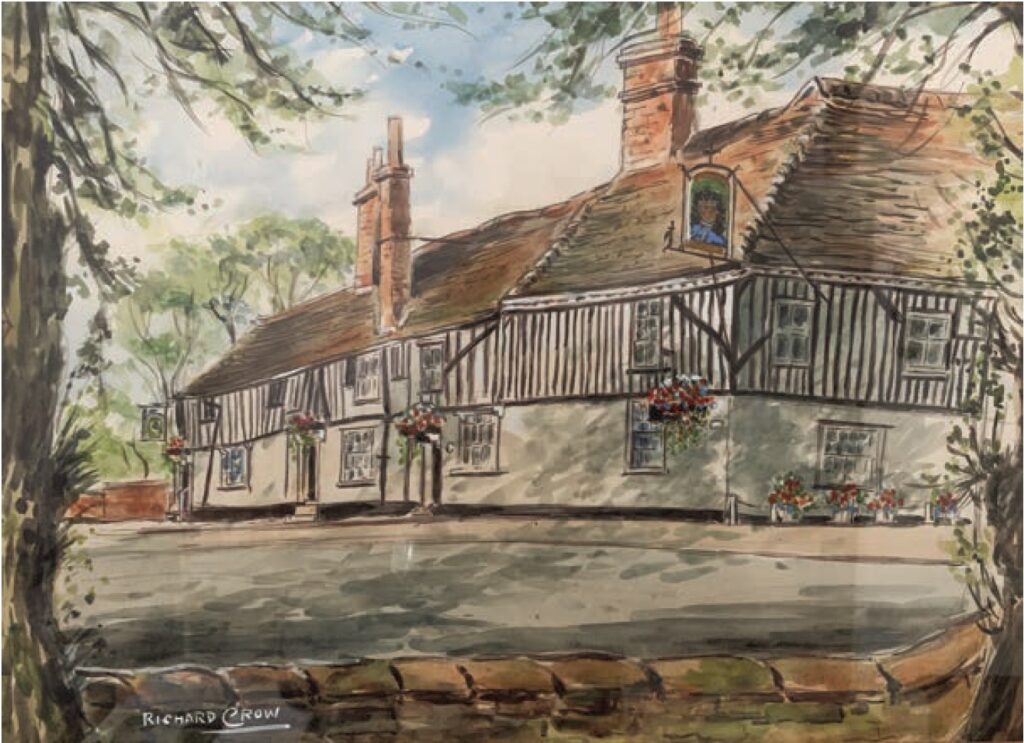
Driving out of London to the east through the beautiful rolling countryside of Essex, you may come across Dedham, a medieval village on the banks of the River Stour. There are a few shops, a handsome church, and a prominent black and white building, the Marlborough Head Hotel. Built in 1495 for a wool merchant, it was first an apothecary and then, in 1704, converted to an inn. The Duke of Marlborough (a forebear of Winston Churchill) was the hero of the day after a number of successful battles in Europe, so it was fitting that the inn should bear his name.

In November 1970, the phone rang at the inn, and a caller with an American accent booked two single rooms. The guests, a man and a woman, arrived at the Marlborough in the early evening and, after settling in, came down to the bar for a drink. Nothing unusual so far. My father, who owned the inn, was filling in behind the bar because Flip, the barmaid, was late.

The man told Dad he was a journalist, sent by Esquire magazine to write an article on English ghosts. He introduced his companion as a medium from the College for Psychical Research in London. They had heard about a ghost sighting in the village and asked my father what he knew about it.

Over the 500-plus years, thousands of stories must have been told in Marlborough’s bar; certainly the inn’s creaking, uneven floorboards, centuries-old beams, huge fireplaces and hidden passages made it the perfect setting for a ghost story.

Dad told them that the previous Saturday night, Halloween, a regular named Phil was walking home in the dark after several pints, and the last thing he remembered before collapsing to the ground was a ghost appearing in front of him. Passersby saw him lying in the road, dead to the world, and carried him back to the inn, where Dad ministered brandy. When he revived, Phil described seeing a white apparition, arms outstretched, screeching.

There was major skepticism in the village about the story, given the alcoholic intake of the storyteller, but it made regional news anyway, and somehow word reached the wider world. The man from Esquire — as luck would have it, already in London — hightailed it out with his medium in tow to investigate. It was, after all, a hot lead.

As Dad told the story, the lady took off her jacket, saying she was getting very warm and was “probably going into a trance.

The London medium started telling Dad his life story — eerily accurate in its detail — including, among other things, that he had two sons, Bill and Tony. But, she said, she was sensing a third name. Charlie.

My elder brother, Bill, got the nickname Charlie when he went away to boarding school, and when I, Tony, followed him to the same school four years later, the nickname transferred to me. There was one other thing: There would be a marriage in the family which would involve someone from Beckenham. As I was the only unmarried person in the family at that point, I took particular interest when Dad passed this bit of information on to me!

Soon the ghost-sighting story started to lose steam. It came out that some village lads had been responsible for the whole thing. They knew Phil always walked home on a Saturday evening around 11 o’clock — following the announcement of “Time gentlemen please!” — and the village, having no streetlights, would be perfect for a big, white-sheeted apparition rising out of the dark. That their prank would go “viral,” or what passed for it in those days, was strictly a bonus.

A year or so later, when I was working in London for a hotel company, I began falling for a very pretty girl, Camilla. We started going out and occasionally went down to her parents’ house in Sussex for the weekend, about 50 miles south of the city. One evening we set out on our usual route but the rush-hour traffic was solid, so Camilla suggested a different way. As we drove through this unknown-to-me territory, I asked where we were. Camilla replied, “Beckenham. We used to live here.” The car swerved a little.

“Did you say Beckenham?” I asked.

“Yes,” she answered, “I’ll show you the house where I grew up.”

I kept the medium’s prediction — now a bit of family lore divined across the bar in the Marlborough Head Hotel — to myself until after we were engaged, now some 52 wedding anniversaries ago. And all because Flip the barmaid was late for work.

Neither the barmaid nor the medium was invited to the wedding — but the story certainly made it. 

Bookshelf

BOOKSHELF

October Books

FICTION

Brightly Shining, by Ingvild Rishoi

Christmas is just around the corner, and Ronja and Melissa’s dreamer of a father is out of work again. When 10-year-old Ronja hears about a job at a Christmas tree stand near where the family lives in central Oslo, she thinks it might be the stroke of luck they all need. Soon, the fridge fills with food, and their father returns home with money in his pocket and a smile on his face. But one evening he disappears into the night under the pretense of buying Christmas gifts — and his daughters know he has gone to his favorite local pub, Stargate. Melissa decides to take his place at the Christmas tree stand, working before and after school in the December dark, and brings along Ronja, who quickly charms all the middle-class customers. The sisters dream of a brighter place of kindness and find help from some of those around them in this story that has all the markings of a magical modern classic.

The Library of Heartbeats, by Laura Imai Messina

On the peaceful Japanese island of Teshima there is a library of heartbeats, a place where the heartbeats of visitors from all around the world are collected. In this small, isolated building, the heartbeats of people who are still alive or have already passed away continue to echo. Several miles away, in the ancient city of Kamakura, two lonely souls meet: Shuichi, a 40-year-old illustrator who returns to his hometown to fix up the house of his recently deceased mother, and 8-year-old Kenta, a child who wanders like a shadow around Shuichi’s house. Day by day, the trust between Shuichi and Kenta grows, until they discover they share a bond that will tie them together for life. Enchanting, touching and emotionally riveting The Library of Heartbeats is a story about loss and hope, pain and joy, reality and imagination, and the promise of healing and overcoming the odds.

NONFICTION

Trails & Treats: A Hiker and Runner’s Guide To Great Trails and Good Eats In North Carolina, by Palmer McIntyre and Hollis Oberlies

Want to step out of the old routine and discover the beautiful landscapes of North Carolina? Trails & Treats describes 30 trails across the state, broken down into four geographical areas: the Triad, Triangle, Mountain and Charlotte regions. Not only does the book provide the distance of each trail and level of difficulty for hikers or runners, in it are recommendations for the restaurants, coffee shops, local markets and picnic areas that are worth a visit before or after the workout. A great read for seasoned hikers and runners or first-time explorers.

The Name of This Band is R.E.M: A Biography, 
by Peter Ames Carlin

In the spring of 1980, an unexpected group of musical eccentrics came together to play their very first performance at a college party in Athens, Georgia. Within a few short years, they had taken over the world with smash records like Out of Time, Automatic for the People, Monster and Green. Raw, outrageous and expressive, R.E.M.’s distinctive musical flair was unmatched, and a string of mega-successes solidified them as generational spokesmen. In this rich, intimate biography, Carlin looks beyond the sex, drugs and rock ’n’ roll to open a window into the fascinating lives of four college friends —Michael Stipe, Peter Buck, Mike Mills and Bill Berry — who stuck together at any cost, until the end.

CHILDREN’S BOOKS

Still Life, by Alex London

Of course, just when you finish creating your still life, a dragon has to jump in to stir things up! Art meets fantasy in this laugh-out-loud picture book. This one is perfect for that kid who loves jokes, riddles and a little sarcasm. (Ages 4-6.)

Name That Thing! by Gareth Moore

How many sports can you name with just the balls as clues? How many dinosaurs from just their nicknames? How many buildings from only the shape? How many dogs from their original jobs? Name That Thing! is a fun-fact quiz book for that inquisitive kid — and equally interested grownup — to investigate together. (Ages 6-12.)

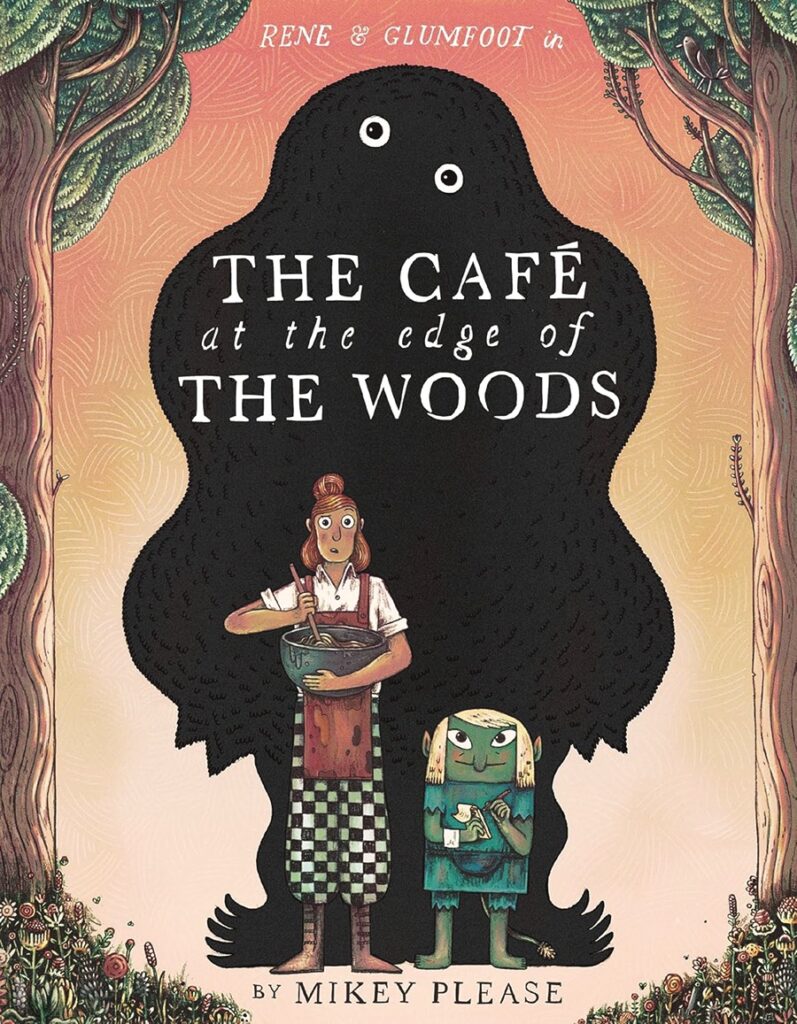
The Café at the Edge of the Woods,
by Mikey Please

Fans of Julia’s House for Lost Creatures will delight in this charming, offbeat foodie tale with a sprinkle of adventure, a side order of friendship and — oh, yeah — ogres. This one is sure to be a hit with kids who want to giggle, and adults who are game to try pickled bat and slug fondue. (Ages 4-8.)

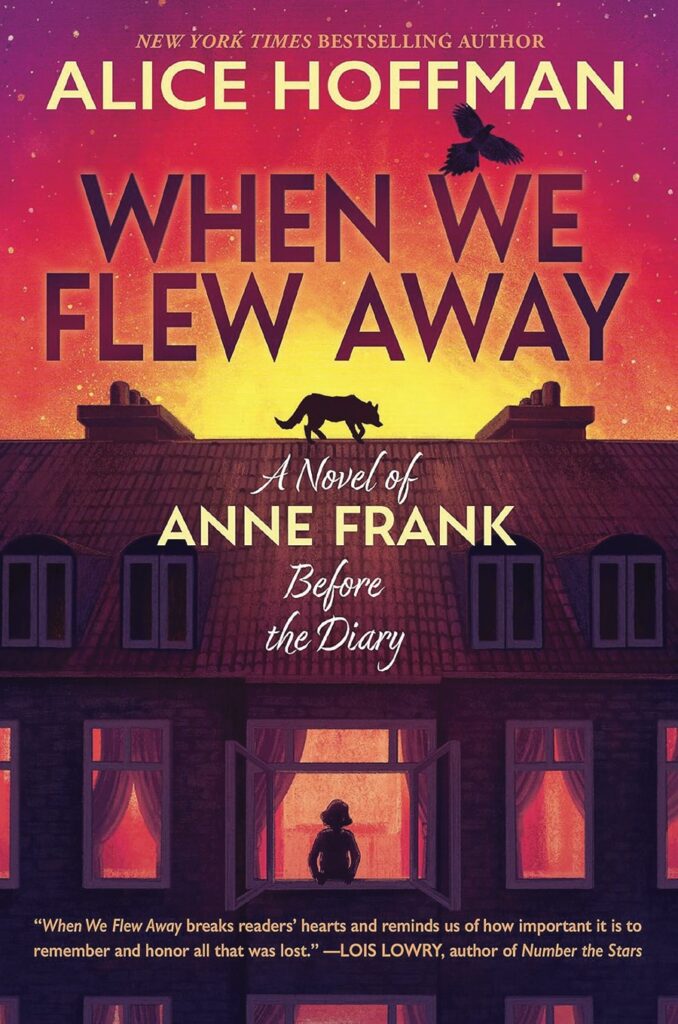
When We Flew Away, by Alice Hoffman

The ’40s gave us the Diary of a Young Girl, written by Anne Frank. In the ’50s, it became a movie, and in the 2000s a Netflix adaptation. Each succeeding generation searches for more of Anne’s story. When We Flew Away imagines Anne before the diary — the apple of her daddy’s eye, a girl with friends and a sometimes-pesky little sister, but mostly, just a girl. This important book is sure to be on the top of readers’ stacks this fall. (Ages 12 and up.)

The Last Dragon on Mars, by Scott Reintgen

Danger, fast-paced chases, secret underground military agencies, and an unexpected dragon named Doom — what more do you need? A classic adventure story, The Last Dragon on Mars is the book we’ve been waiting for. (Ages 12 and up.) 

Tea Leaf Astrologer

TEA LEAF ASTROLOGER

Libra

(September 23 – October 22)

When the shoe no longer fits, no amount of stretching or bending will change that. This year has given you loads of opportunities to release what no longer serves your highest path. And with the solar south node eclipse in your sign on October 2, suffice it to say that this month is going to be more of the same — uncomfortable yet, ultimately, liberating. A word of advice on moving forward: You’re going to want arch support.

Tea leaf “fortunes” for the rest of you:

Scorpio (October 23 – November 21)

Be the squeaky wheel.

Sagittarius (November 22 – December 21)

Dog-ear the page for later.

Capricorn (December 22 – January 19)

Best not to download the app.

Aquarius (January 20 – February 18)

Lie down if you start feeling dizzy.

Pisces (February 19 – March 20)

Hint: They can’t read your mind.

Aries (March 21 – April 19) 

Book the trip.

Taurus (April 20 – May 20)

Bypass the candy corn.

Gemini (May 21 – June 20)

It’s time to call the shots.

Cancer (June 21 – July 22)

Write a love note to yourself.

Leo (July 23 – August 22)

Prepare for liftoff.

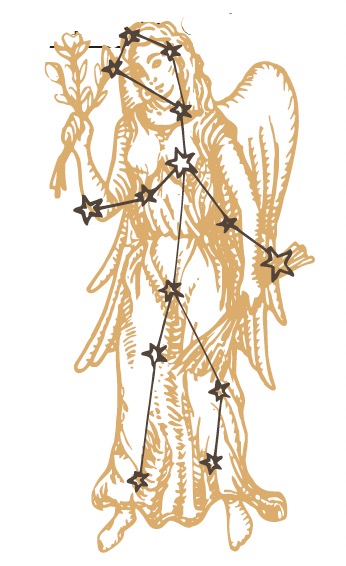
Virgo (August 23 – September 22

Sometimes more is more.

Golftown Journal

GOLFTOWN JOURNAL

We Shall Gather

There’s no need to rush

By Lee Pace

At the address of the golf swing, we talk about ball position, spine angle, grip pressure, takeaway and turn. At impact we talk about compression and clearing the hips and head position. Yet one element of the swing — under-appreciated and under-attended on the pages of golf magazines, YouTube instruction videos and Instagram golf pros — is the transition.

The top of the swing is the promised land of hitting good golf shots.

Getting too quick is kryptonite.

Taking your time is pure gold.

After all, if you’re going one direction and then want to reverse 180 degrees, you have to stop. What’s your hurry?

Renowned instructor Bob Toski tells his students to use the “Coca-Cola Swing,” employing a “pause that refreshes” at the top of the backswing.

“There should be no flash of speed at the top of your swing,” Toski says. “The club should be quiet and not bouncing. This gives you a chance to move the lower body down into the swing. You want to feel that you push the club back and pull it through. Think push, pause, pull.’”

Sean Foley, instructor over the years to noted golfers such as Tiger Woods and Justin Rose, counsels his pupils to be patient with the downswing. He uses the word “collect” in talking of the process of moving from backswing to downswing, particularly as it applies to the Englishman Rose.

“Too often, Justin gets a little tense at the top, and his transition back down to the ball is rushed,” Foley says. “Your arms should just fall from the top, rather than jerking the club down.”

Fred Couples, owner of the most liquid swing in golf and 1992 Masters champion, likes the word gather.

“Couples talks about ‘buying time’ at the top of the backswing,” says golf instructor Jim Nelford, a contemporary of Couples’ on the PGA Tour of the 1980s and ’90s. “Never be in a hurry. Take your time on your backswing. Couples will gather at the top and just let the club drop.”

Pat McGowan, a PGA Tour regular from 1980 through the early 1990s, was struggling when the tour arrived in New Orleans for the USF&G Classic in late March 1989. He was miserable throughout a practice round on the difficult Jack Nicklaus-designed English Turn Golf Club, all the penal water and sand accentuated by brisk winds. His friend and playing companion Phil Blackmar convinced McGowan to make rehearsal swings when the tournament started by swinging back to perfect position and exaggerating a pause to five seconds.

“You’ll look like an idiot, but so what?” Blackmar said, plunging the gallows humor knife as only good golf buddies can do. “You’ll look bad shooting 78. You might as well try it.”

McGowan did as suggested, shot a 68 to open the tournament, followed with a 70 and a pair of 71s for a ninth-place finish, his best of the year. You might get that story today from McGowan if you get rushed at the top on the practice tee at Pine Needles Lodge and Golf Club, where McGowan is the lead instructor.

“Some people act like the ball’s moving, that you’ve got to hit it before it runs away,” McGowan says. “The ball’s not going anywhere. Finish your backswing first. That exaggerated pause at the top during the practice swing carries over to the full swing and slows you down.”

Andrew Rice teaches that very move from his outpost at the Westin Savannah Harbor Golf Resort. He calls it the “Power Pause Drill.” At first, he’ll have a pupil swing to the top and pause for a count of three, then hit the ball. After that exaggerated feel, he’ll ask them to pause for just one second. The idea is that the feeling will become engrained.

“One thing I see is that golfers don’t complete their backswing,” Rice says. “Another is that they go jumping out of the gate with rotation, trying to get some energy running down the shaft into the clubhead. It’s a short, incomplete backswing.

“With this drill, they make a full, complete backswing and store that energy. It’s like touching home plate.”

John Marino, the longtime head pro at Old Chatham Golf Club in Durham, spent a lot of time talking golf over the years with Dick Coop, the professor at the University of North Carolina who had a sideline consulting with professional and elite amateur golfers on the mental side of the game. Coop played golf himself and was a member at Old Chatham.

“Dick liked to say, ‘If your shaft was a perch, let the bird land on it before you start your downswing,’” Marino says. “A smooth transition will help create good balance and good sequencing. Everyone wants to be ‘that guy’ at his club with perfect tempo. That idea helps you get there.”

Cameron Young is the poster boy on today’s PGA Tour for the benefits of coming to a complete stop at the top of the swing and then exploding into a massive spark of speed through the ball (he was No. 7 on the driving distance meter in 2023 with 316 yards a pop). Young learned to play golf from his father, David, who was the head pro at Sleepy Hollow Country Club, just north of New York City. As a junior golfer, Cameron struggled to match his swing plane going back and then coming through.

“Cam’s worked hard on not having a lot of rerouting during the transition, so the clubhead comes down not too far from the direction where it went up,” his father says. “He wants to get the lower body working toward the target while he pins his arms, club and upper body back, which makes it look like he’s standing still. There’s no conscious effort to pause.”

And you can find a talented and social media-conscious golfer on Instagram and YouTube today named Ben Kruper, who bills himself as “The Pause King.” Kruper developed his distinctive pause in 2023 working on his game while playing mini-tour events and developing a digital venue presence.

“I had a super quick transition and wanted to do something kind of drastic,” he says. “It’s helped my game a ton. That quick transition would get me way behind, I’d get stuck, and I’d have to flip at the ball. Under pressure, it got so out of hand.”

In one YouTube video, Kruper wields his syrupy tempo to one pure strike after another as golf instructor Grant Horvat watches.

“My God, you can’t hit it any better,” Horvat enthuses. “Perfect dollar-bill divots, one after another. You know, you’re pretty good at golf.”

With that, it’s off to the practice tee with a bottle of Coke to set beside that bucket of balls.

Hometown

HOMETOWN

The Memories Inside

Cruising past the old homestead

By Bill Fields

On a rainy afternoon not long ago, I drove by my childhood home not far from downtown Southern Pines. An old friend was with me, someone who also had grown up in town when it was its former drowsy and piney self, when “a sophisticated Mayberry” was an apt description of the place where we were lucky to live, those days now as distant as rotary phones and drugstore orangeades.

We pulled over to the curb, on the north side of the property and then on the east, our conversation seeming to take on the rhythm of the rental car’s intermittent wipers. It was easier to talk about the focus of the visit, a 1950s Cape Cod that held so much family history, than see it, which is why we assumed a couple of different vantage points and why, for me, this has been a rare excursion.

The original structure endures, but it takes some effort to get a glimpse of it, given that it’s surrounded by three “cottages” constructed on the property after we sold, one of them tall and painted a gray so dark it is nearly black. Our former five-bedroom residence is overwhelmed by the looming houses, making it seem like a shed out back of someone’s mansion.

My parents bought our home a handful of years before I was born in 1959. They had been living in Pinedene, close to Mt. Hope Cemetery. When the Highway 1 bypass was being built through their neighborhood, they were forced to move. About 10 years ago, when my mother was in her early 90s, she was in a car with me on a side street not far from the old Lob Steer Inn.

“There’s our old house,” she said. 

I thought her mind was playing tricks, but I subsequently confirmed that the Pinedene house wasn’t torn down but relocated to where Mom said it was. While some other family settled in there, my parents and two sisters moved to their new home. My siblings were off to college and their adult lives less than a decade after moving there, but 390 East New Jersey was my only address growing up.

That fact, as well as maintaining closer ties to our hometown through the years, is why I felt a closer attachment to our house than my sisters did. But we all found pleasure in being able to return there for a long time, perhaps too long if we’re being honest. Increasingly stubborn in old age, when her cognitive decline made things difficult and dangerous, Mom didn’t want to leave for a safer environment.

I won’t forget that day in 2017 when I walked her out the back door for the last time, toward the car and on to an assisted living facility. I would turn that lock dozens more times until the house wasn’t ours anymore. On those visits, I didn’t miss the volume on the television being set to a nonagenarian-without-hearing-aids level. It was nice to put a six-pack on the top shelf of the refrigerator instead of burying it in the vegetable drawer. How, though, I wished she was still there, sitting on her screened-in patio that she enjoyed so much, in a wicker chair that had been on her mother’s porch, azaleas and robins the sights and sounds beyond her favorite oasis.

It had been a home, not a house. As my friend and I chatted in the car so near yet so far from that memory, I was reminded of that.

I suppose I’m glad the structure still stands in its renovated form — that the walls that contained our hopes and fears weren’t demolished — but I will never go inside again. What went on in and around that home lives in my interior, easily recalled, the view unobstructed.

Southwords

SOUTHWORDS

Have a Good Day

Even if you’re in the slow lane

BY JENNA BITER

I point out the windshield as it closes in fast and whirs past.

“Cement trucks are pretty cool,” I say to my husband, who’s in the passenger seat. The vehicle technically mixes and delivers concrete, but “concrete truck” just doesn’t sing.

“They are,” Drew replies with a grin. Five years into marriage, he’s accustomed to my childlike musings. He may even enjoy them, or pretend to, particularly on road trips that beg the universally hated question: How much longer?

I watch the fat barrel spin round and round as it recedes into the rearview mirror.

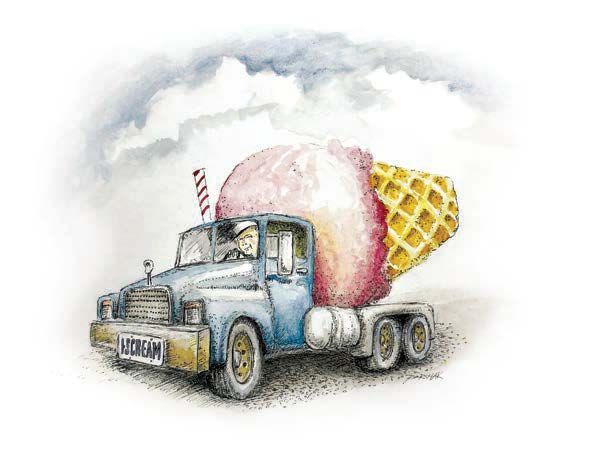
“Isn’t it amazing, though?” My eyebrows lift. “If I collected all the necessary ingredients — the sugar, the cream, the milk, some chocolate for sure, whatever — and throw them into the belly of a cement truck, do you think it would make ice cream?”

My eyebrows hit their ceiling. Drew, being the problem-solver he is, inverts my expression.

“What if they’re already doing it?” I blurt out before he can work through the physics, the mechanics, the logistics.

Maybe some of the trucks swirling around out there aren’t actually hauling concrete. Maybe they’re actually hauling ice cream, and it’s just that nobody knows, unless they’re among the very few people who do. The insiders. Maybe the whole operation is run by a do-gooding cabal of gelatieres with some well-intended but misbegotten plan for world softserve domination.

I snap out of Candyland and back into reality. Even if the trucks aren’t secretly transporting sweets, it’s incredible enough that they carry concrete. I remind myself that the invention of the cement truck, like the light bulb, air conditioning and so much else, is a testament to human ingenuity. We’ve come a long way since Richard Bodlaender of Breslau, Germany, patented the horse-drawn “mortar mixer” in 1904.

“It would need refrigeration,” Drew says, still half a conversation behind, spitballing the ice cream hypothetical.

Somewhere between that conversation and our destination, wherever it was, cement trucks morphed into a good omen. I can’t quite recall the exact moment this transformation occurred, and neither can Drew, but the chain of logic probably went something like this: Innovation is incredible; think of all the wondrous things that exist today; we hardly ever take notice; let’s start. From that day forward, for us, spotting a cement truck is like plucking a four-leaf clover.

“Cement truck,” I text my husband after an early-morning sighting. I send our catchphrase follow-up. “It’s going to be a good day.”

With all the construction in Moore County, we see at least one truck a day, which makes for a lot of good days.

“x2,” I hit send after seeing another.

Around here, the mixing trucks are usually white with red stripes, and they’re fairly slender for vehicles that have a gut. Others are matte gray, on the tubbier side, with electric teal writing. Most days they’re driving in the opposite direction, but sometimes we get stuck behind one. Even when they slow us down, it’s a happy day.

“x3,” Drew texts me back.

“It’s going to be a good day,” he writes, affi rming his membership in the club.

Every once in a while, maybe once or twice a month, we see a cement truck in action, its chute down, actively building the concrete jungle. That’s a great day, mostly because it’s rare, and there has to be a hierarchy with these types of things.

Some may disagree. They’ll say we’re witnessing the endless drone of modernity, and my country upbringing inclines me to agree, but cement truck I Spy is about choosing the glass half full.

“Another,” Drew sends.

I think our record is seven. And that’s a very good week.

Simple Life

SIMPLE LIFE

Worrying and Watering

For love of gardens and democracies

By Jim Dodson

A neighbor who walks by my house each evening like clockwork sees me sitting under the trees with a pitcher of ice water and walks over to say hello.

I invite Roger to take a seat and have a cold drink.

“It’s tough to keep moving in this heat,” he explains, sitting down. “It’s something, isn’t it? But your garden looks great.

How do you keep it so nice and green?”

“A lot of worrying and watering,” I say. “Sometimes you have to make tough choices.”

In one of the hottest and driest summers in memory, I’d decided to let my yard turn brown in favor of keeping flowering shrubs and young trees watered and green. As the late famous British landscape designer named Mirabel Osler once said to me over her afternoon gin and tonic, landscape gardening is a ruthless business, especially in a drought. Grass will eventually return, but no such luck with a shriveled shrub or a dead young tree.

“September brings relief, rain and second blooms,” I add. “I’m already in a September state of mind.”

He smiles and nods.

“Hey,” he says casually, “let me ask you something.”

I expect another question about the garden. Like the best time of the day to water your shrubs, or when it’s safe to fertilize or prune azaleas.

But it isn’t even close.

“I’m worried about America. People seem so angry these days. Why do you think Americans hate each other?”

The question takes me by surprise. I could give him a few thoughts on the subject: the woeful decline of fact-based journalism, an internet teeming with conspiracy peddlers, politicians who feed on polarization, the unholy marriage of politics and religion, and the sad absence of civility in everyday life.

Instead, I tell him a little story of rebirth.

In the spring of 1983, I telephoned my dad from the office of Vice President George Bush and told him that I no longer wanted to be a journalist. For almost seven years, I’d worked as a staff writer of the Atlanta Journal-Constitution Sunday Magazine, covering everything from presidential politics to murder and mayhem across the deep South. As a result of my work, I’d been offered my dream job in Washington, D.C., but found myself suddenly fed up with writing about crooks, con men and politicians. Bush, however, was an exception. We’d traveled extensively together during the 1980 campaign and had wonderful conversations about life, family and our shared love of everything from American history to golf. During our travels, Bush invited me to drop by his office anytime I happened to be in the nation’s capital. Unfortunately, he was traveling the day I turned down my dream job in Washington, but his secretary allowed me to use her phone. So, I called my dad and told him I planned to move to New England and learn to fly-fish.

“When was the last time you played golf?” he calmly asked.

“I think Jimmy Carter had just been elected.”

He suggested that I meet him in Raleigh the next morning.

So, I changed my flight and there he was, waiting with my dusty Haig Ultra golf clubs in his back seat. We drove to Pinehurst, played famed course No. 2 and finished on the Donald Ross porch, talking about my early midlife career crisis over a couple of beers. I’d just turned 30.

I told him that I “hated” making a living by writing about the sorrows of others, especially when it came to the increasingly shallow and mean-spirited world of politics.

“You may laugh, but here’s a thought,” the old man came back, sipping his beer. “Before you give up journalism, have you ever considered writing about things you love rather than things you don’t?”

Sadly, I did laugh. But he planted a seed in my head. A short time later, I resigned from my job in Atlanta and wound up on a trout river in Vermont, where I learned to fly-fish, started attending an old Episcopal Church and knocked the rust off my dormant golf game at an old nine-hole course where Rudyard Kipling played when he lived in the area.

I soon went to work for Yankee Magazine and spent the next decade writing about things I did love: American history, nature, boat builders, gardeners and artists — a host of dreamers and eccentrics who enriched life with their positive visions and talents.

I also got married and built my first garden on a forest hilltop near the Maine coast.

“I never looked back,” I tell Roger. “I’ve built five gardens since.”

Roger smiles.

“So, you’re telling me we all need to become gardeners?”

“Not a bad idea. Gardeners are some of the most generous people on Earth. We make good neighbors. Most of the country’s founders, by the way, were serious gardeners.”

I pour myself a little more ice water and tell him I’ve learned that gardens and democracies are a lot alike. “Both depend on the love and attention we give them. Especially in difficult times like these.”

Roger finishes his drink and stands up. “That’s something to think about. Here’s to September, cool weather and good neighbors,” he says. “Maybe by then even your grass will be green again.”

Pleasures of Life

PLEASURES OF LIFE

Over the Moon

The beauty among the beasts

By Jason Harpster

Not all Draculas are frightening.

Dracula orchids, also called monkeyface orchids, grow in Central and South America. The genus Dracula means “little dragon” and includes 144 species, many of which have fantastical names of bats, giants, monsters or mythological creatures. Whereas Dracula chimaera and Dracula vampira have appropriate names that fit their grotesque and menacing appearance, Dracula diana stands in stark contrast and is known for its beautiful white flowers.

Daughter of Jupiter and Leto, Diana is a goddess in Roman and Hellenistic religions and is identified with the moon. In Latin, Diana means goddess of light and of the moon, and is often associated with beauty or divinity. In early Roman history, Diana absorbed Artemis’ identity and was later considered a triple deity after merging with Selene and Hecate.

The flowers of Dracula diana are unique to the genus with their predominantly white flowers, which also have a yellow-gold overlay and maroon markings. Some Dracula species have flowers that look like little dragons with their mouths open. Dracula diana has more of a simian appearance; the golden yellow petals resemble eyes, and the pink saccate lip looks like a surprised smile. The flowers are as large as the plant and can reach over 6 inches in length. The native range of this species is West Colombia in cloud forests at elevations around 4,000 to 5,250 feet above sea level, where temperatures rarely exceed 75 degrees Fahrenheit. In addition to being temperature sensitive, the flowers will collapse if humidity drops below 75 percent.

Dracula diana ‘Southern Pines Deity’ AM/AOS was awarded on Oct. 21, 2023, at the Carolinas Judging Center’s monthly judging. The judges commented on how the caudae, the long delicate tips at the ends of the sepals, were gracefully displayed and noted the fullness of the sepals. The creamy white sepals are covered with fine hairs and have a crystalline texture, which makes them sparkle in the sunlight. The flowers on the plant exhibited had better form and were more proportionate than previous awards. The flowers were also the second largest on record for the species.

In consideration of these qualities, the judges awarded the plant an Award of Merit and scored 84 points, which makes ‘Southern Pines Deity’ the highest pointed award on record. It seems fitting that the best example of this species be named after such a special town.

Hometown

HOMETOWN

Repeat Offender

Sharpshooter with a ketchup packet

By Bill Fields

Around Labor Day, give or take, the long, free-range days of summer break in the Sandhills paused. Games played with everything from golf balls to basketballs, the construction of mighty forts and quenching one’s thirst from a garden hose gave way to the more structured schedule that came with the resumption of school. It was time to toe the line.

The threat of a keen switch (home) or a hefty paddle (school) was usually enough to keep me from misbehaving. My tendencies were to follow the rules and stay out of trouble, regardless of the season. I even received a DAR Good Citizens Award during a luncheon at the Country Club of North Carolina, a distinction I trumpeted on college applications as a counterpunch against terribly low math grades and board scores.

Had the fine ladies recognizing me done a more robust background check, however, someone else might have been feted over chicken cordon bleu at CCNC. They clearly hadn’t been aware of my checkered past, three occasions in childhood when I did not live up to my reputation.

We hung things on our clothesline to dry, but there were exceptions. Every so often, a trip to wash and dry bedspreads and slipcovers was necessary. There was a small laundromat located on South Bennett Street, near the rear of the A&P, not far from the intersection with Morganton Road.

One Saturday morning when I was in elementary school, I accompanied Dad there. Hearing the quarters tumble out of the coin changer was cool, but soon I was fidgeting in the plastic chair. I started to run around and loitered by the entrance, glancing at Dad.

“Don’t play by the doors!” my father said after taking a deep drag on his cigarette.

I returned inside to the heat and methodical whir of the oversize dryers and sat in one of those plastic seats that seemed to exist only in laundromats. But I returned to the glass doors, opening one side toward the parking lot. I did so a few times, until it collided with a car bumper poking over the curb. The ride home was as silent as the shattering of the glass had been loud.

Not long after that incident, I accompanied Mom and Dad to Greensboro, where one of my older sisters was going to college. She also had a part-time job, and she wanted to take us out, her treat. The restaurant of choice had two parts, fancy and casual. It being a special night, we went to the former.

I was in a brief hamburger phase, when that was my preferred supper, particularly on infrequent meals away from home. Well, the fancy side of the restaurant didn’t have hamburgers on its menu. I reacted by getting on the floor and having a tantrum, like some overwrought, overacting kid in a B movie. It is a wonder my sister ever spoke to me again.

Just months later, my good behavior went missing a third time. The setting was innocent enough as our family gathered around the kitchen table enjoying plates from Russell’s Fish House. It was a feast of flounder and all the trimmings: slaw, hushpuppies, French fries.

Aunt Blyn, my mother’s sister, was in town, visiting from her home in northeastern North Carolina. Mom to my three very cool older cousins, Blyn smoked Camels and drank Sanka, talked slowly, and dressed properly. She had sung and played the piano most of her life, and even though she couldn’t hit all the notes anymore, that did not stop her renditions of “Release Me” on the upright in our living room.

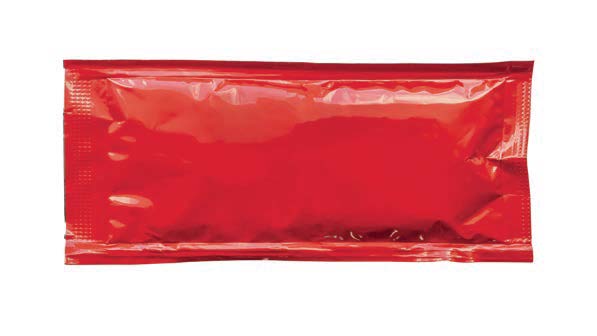
The evening we were all enjoying the takeout seafood, Aunt Blyn was seated across and slightly left from me. There was a bottle of ketchup on the table, but the meals had come with plastic packets of the condiment. I played with one as I ate, squeezing it and daring it to pop. My mother noticed and told me to stop. I did not and mashed it harder. There was presently a ketchup explosion, the red stuff shooting onto Blyn’s aghast face and the wall beyond.

“Oh, lawd,” was the last thing I heard her say as I shot out of my chair and ran from the house.

I sought cover behind a cedar bush at the end of our driveway. It wasn’t long before I looked up and saw my father. But, to my surprise and relief, he was wearing a grin instead of carrying a belt. I apologized and never squeezed another pack of ketchup.