Sporting Life

SPORTING LIFE

Game Time

What’s your favorite part of the squirrel?

By Tom Bryant

“Well, I really do have a question, Mr. Bryant. Do you actually eat all those little animals you kill?”

I knew that question, or one like it, would come when I agreed to speak at a women’s club. Some of my hunting partners that hang out at Slim’s Country Store had warned me when they heard through the grapevine about the speaking commitment. Ritter expressed it best when he said, “Bryant, those ladies gonna skin you like a possum. You know they’s against guns, hunting, fishing or almost any outdoor sport.”

The meeting with the ladies took place several years ago in a small but prestigious town right across the border in Virginia.

“Yes, ma’am. My grandfather was a stickler for eating anything we brought home. He would stress that the Good Lord gave bounty from the streams and fields for us to use and do so responsibly.

“Also, as I mentioned earlier, right after the War Between the States, folks in the South especially, used wild game to supplement food for the table.”

There was a follow-up. “What animals did you cook and eat, and how old were you?”

It looked as if it was going to be a long question and answer period. I sighed inwardly.

“I started hunting the woods on my grandfather’s farm when I was about 9 and fishing maybe 6 or 7. My first wild game was squirrels. I’d clean ’em and Grandma would cook them in a wonderful rice dish.” I could hear the muted groans in the audience of ladies who had just finished a wonderful chicken lunch.

“As a matter of fact,” I continued, “I brought this along.” I held up my well-worn wild game cookbook from L.L. Bean, simply titled The Game & Fish Cookbook. “Unfortunately, it’s out of print but can still be found, if you’re lucky, in usedbook stores. There are probably 10 or 12 great recipes in this book for squirrel, but one of my favorites is Brunswick stew.”

Turning to a well-marked page where the recipe was underlined, I quoted from the lead-in to the ingredients.

“Technically this stew is made from squirrel, but it can be made with other meats: rabbit, muskrat, beaver or combinations.”

I held the book open so the ladies of the highest social order sitting on the front row could see that I wasn’t making it up. There were considerable murmurs from the women sitting in the back rows. I didn’t know if they were accepting my story or getting ready to walk out en masse.

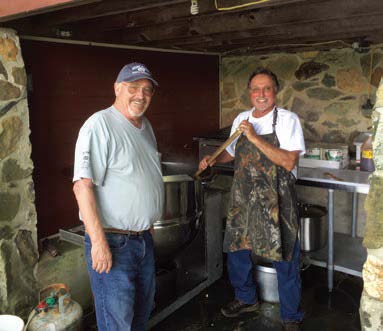
“Speaking of Brunswick stew,” I continued, “I have a couple of friends who, in the Southern vernacular, are good ol’ boys, and they make the best stew I’ve ever eaten. They make one that’s really got some shoulders on it. Edwin Clapp and Bandy Herman are what you think of when you picture hunters and fishermen who live deep in the country far away from tall buildings and sidewalks.”

One of the ladies sitting near the back raised her hand, stood up and said, “Do they use what you call wild game in their cooking?”

“I’m gonna be honest with you,” I replied. “Once, when Edwin invited me up to his farm to participate in the annual Brunswick stew cooking, he told me they would be whipping up their concoction in a 30-gallon stew pot. I told him there’s not enough squirrel in Chatham County to fill a pot that size.

“Edwin said they were giving away most of the stew, and that some of his city friends frowned on eating squirrel in anything, even Brunswick stew. So, on that occasion, just to suit the city folk, they were using grocery store fare.”

I had my iPad with me to show photos of some of the places where we hunted, and I knew there was a good shot of Edwin and Bandy cooking stew, if I could find it. The little computer was new to me — a gift from my bride, Linda — and I had yet to figure out all its intricacies.

It looked as if the ladies were in no hurry to leave, so I directed my next statement to the last questioner. “Ma’am, somewhere in this little machine I’ve got a photo of Edwin and Bandy cooking up one of their big batches of Chatham County Brunswick stew. It shows the huge stainless steel pot they use and the wooden paddle for stirring.”

Not a soul had left, and a couple of the ladies got up from their chairs and edged closer.

“Here it is. Look at the size of that pot,” I said. “And it’s almost filled to the brim.” I passed the iPad around for everyone to see. Several took a closer look before handing it back to me.

A lady on the front row said, “But Mr. Bryant, if you keep killing the animals that you hunt, will they eventually go away? I mean will you deplete the resource?”

“That’s an excellent question,” I replied, and I pulled out my Ducks Unlimited membership card and held it so they could see. “This organization is the world’s leader in wetlands and waterfowl conservation, and yet they value and enjoy the sport of hunting. The beauty of all this is that we hunters, over 700,000 of us, are the supporters of this institution.” I passed my membership card around the nearest row of ladies.

Our host, a small white-haired matron, stood, raised her hand and took over. “I believe we’ve taken enough time from Mr. Bryant,” she said. There was a smattering of applause and the ladies slowly left the room.

I grabbed my stuff, thanked the ladies in charge and exited the building posthaste. I was surprised to find the elderly matron, the one who asked about eating game, on the steps waiting for me.

“Mr. Bryant, I surely would like to get a taste of Mr. Clapp’s Brunswick stew,” she said, to my surprise.

“I’m afraid this year’s batch is probably all gone,” I said.

She handed me her card. “Well, tell him to put me on the list for next year,” she said and turned to go. “Oh,” she paused as she headed down the stairs, “you can also tell him I wouldn’t mind if it had just a taste of squirrel.”

Birdwatch

BIRDWATCH

Killdeer
Semi-Palmated Plover
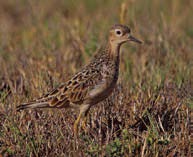
Buff-Breasted Sandpiper
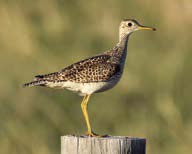
Upland Sandpiper

Southbound and Down

Grasspipers forage on farms and fields

By Susan Campbell

As the long days of summer wane here in the Piedmont and Sandhills of North Carolina, we have scores of birds preparing for that long southbound journey we refer to as fall migration. Thousands of birds pass by, both day and night, headed for wintering grounds deep in the Southern Hemisphere. Flocks of medium-bodied shorebirds, dropping down to replenish their reserves, are one seemingly unlikely sight. They may stay a few hours or a few days, depending on the weather and the abundance of food available to them. At first glance, you might think these long-legged birds are lost — far from the coast where a variety of sandpipers are commonplace. But once you take a good look, you will realize these are birds of grassland habitat, not sand flats.

Referred to as “grasspipers” by birders, these species forage on a wide variety of invertebrates found in grassy expanses. They breed in open northern terrain, in some cases all the way up into the Arctic. They are moving through as they migrate to grassland habitat in southern South America. Although some may be seen along our coastline, they are more likely to be found in flocks or loose groups at inland airports, sod farms, playing fields and perhaps even tilled croplands.

Come late August and early September, armed with binoculars or, better yet, a powerful spotting telescope, you can find these cryptically colored birds without having to travel too far from home. They are indeed easy to miss unless you know where to look at the right time. Flocks often include a mix of species, so be ready to sort through each and every bird, lest you overlook one of the rarer individuals. When it comes to shorebirds as a group, many of the dozens of species are tricky to identify so, if you’re relatively new to birding, I suggest you arrange to join a more accomplished birder to start.

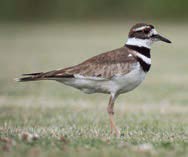
The most common and numerous species without a doubt is the killdeer. Its dark upper parts contrast with white underparts, but it’s the double neck ring that gives it away. This spunky bird, whose name is its call, nests (if you can call a rudimentary scrape in the gravel a nest) on disturbed ground such as unpaved roadways and parking lots throughout North Carolina. Flocks of hundreds of birds are not uncommon. Frequently other species are mixed in as well. In the Sandhills, the sod farm in Candor hosts large numbers of killdeer around Labor Day. Check them all and you will likely be rewarded with something different mixed in.

The plover family, to which the killdeer belongs, consists of squat, short-necked and billed birds of several species. The semipalmated plover is a close cousin. This slightly smaller species sports only a single neck ring and curiously, individuals have slightly webbed (or palmate) feet. They can actually swim short distances when in wetter habitat and are thus more versatile foragers.

The most curious are the obligate grassland shorebirds, which include the well-camouflaged buff-breasted sandpiper and the upland sandpiper. Both nest in the drier prairies of Canada and spend the winter months mainly in the pampas of Argentina. “Buffies” are a buff-brown all over and have delicate-looking heads, short, thin bills and a distinctive ring around the eye. “Uppies” are brownish and have small heads as well, but with larger eyes and both a longer bill and longer legs. These two species are thought to be declining — most likely due to habitat loss on both continents. If you miss the chance to get out in search of inland shorebirds this fall, don’t fret. They will move through again come spring, although in smaller numbers. Winter will take its toll, but those who do make it back our way will be in vibrant plumage as they wing their way northward to create yet a new generation of grasspipers north of the border.

Omnivorous Reader

OMNIVOROUS READER

A Sense of Time and Place

By Stephen E. Smith

Writers have twitches and tics of style and substance that identify them as distinctly as their DNA — and writers of exceptional talent are possessed by obsession, a focus on subject matter that elevates their work to a purity that establishes a commonality with their audience. North Carolina’s Thomas Wolfe was such a writer. So is Bland Simpson.

Simpson has earned a reputation as the chronicler of the North Carolina coast and sound country. His books include North Carolina: Land of Water, Land of Sky, The Great Dismal, and Into Sound Country, books that demonstrate his love of the state and the region where he was raised. He has appeared in numerous PBS (WUNC) documentaries, and his familiar voice graces the soundtrack to travelogues exploring the coastal region. In short, he’s the go-to guy when it comes to the history and evolution of coastal North Carolina. For many years, he’s been the Kenan Distinguished Professor of English and Creative Writing at the University of North Carolina at Chapel Hill.

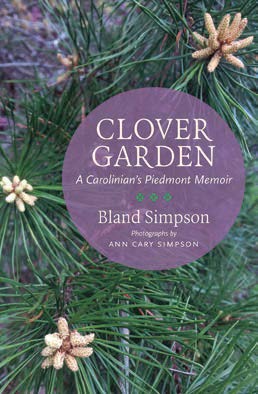
In his latest book, Clover Garden: A Carolinian’s Piedmont Memoir, Simpson remains in familiar territory — he’s writing about the state — but he’s moved his focus west to an area outside Chapel Hill where he’s lived for the last 50 years.

Where is Clover Garden?

Head west out of Carrboro until you hit N.C. 54. Drive northwest into gentle farmland until you pass the old White Oak School. If there’s a sign for Swepsonville, you’ve gone too far. You can try that, but you won’t happen upon the place name that serves as the title of Simpson’s memoir. According to Simpson, Clover Garden is closer to Carrboro than Graham. He describes it as “a small, four-square-mile country community to the old Porter Tract of the low Old Fields, lying beside the Haw River just a few miles west of Chapel Hill and Carrboro. . . .” But in truth,readers will suspect that Clover Garden is anywhere in North Carolina’s vast rolling Piedmont, any plot of land inhabited by neighbors who live harmoniously in tight-knit communities.

“Memoir” in the title is used in the loosest sense. There’s maybe a thread of chronology at work, but Simpson takes an impressionistic approach to his writing, à la Manet (not Monet). Readers who remember their art history will be reminded of the details in Music in the Tuileries and The Café-Concert, images in which all the specifics matter to the whole.
Clover Garden is divided into 45 segments — short narratives, random observations, anecdotes, even gossip — that, when taken together, comprise the “memoir” and give the readers a sense of a particular time and place. These independent segments are skillfully illustrated and enhanced with photographs by Ann Cary Simpson, whose keen eye for specific and illuminating images has enhanced Clover Garden and her husband’s previous books.

If the impressionistic comparison seems a trifle pretentious, the narratives Simpson shares are not. He writes of pool halls, pig pickings, snowstorms, country stores, great horned owls, folklore, boatwrighting, cafes and bars, stars, and riderless horses, all the bits and pieces, practical and impractical, that comprise our daily lives. And if you’ve lived in the Piedmont, there’s a good chance you’ll know a few characters who contribute color to the storytelling. If you don’t recognize any of the characters, you know them well enough at the conclusion of the memoir, or you’ll recognize their counterpart in your circle of friends and acquaintances.

Simpson’s descriptions embody an easy blending of history with a touch of nostalgia as in this sepia-tinged recollection of old friends and poolhalls (one of which was frequented by this reviewer): “In time, Jake Mills showed me his two favorite pool halls, Happy’s on Cotanche Street in Greenville and Wilbur’s on Webb Avenue in Burlington. After school in the 1950s, he and Steve Coley used to play quarter games with the textile mill hands coming off first shift and drifting into Wilbur’s straight from work. The cigarette haze hung low below the green shades, and the cry of ‘Rack!’ was in the air, and the balls clicked and clacked, and, like many a youth before them, Jake and Steve picked up pin money in this Alamance County eight-ball haven.” Even Neville’s, a long established Moore County watering hole, receives a passing mention in Simpson’s narrative explorations.

Above all else, Simpson is a master prose stylist, a poet at heart. His sentences are graceful and well-tuned — thoroughly worked on to get that “worked on” feeling out — and laced with continual surprises to save them from predictability. Simpson is always a pleasure to read, and he can transport the reader to familiar ground as if it’s being seen anew. “. . . alongside dairy cows, beeves and horses in pastures meeting deep forests of white oaks and red oaks and pines, copses of them around country churches, and straight up tulip poplars and high-crown hickories, American beech and always sweet gum, muscadine vines everywhere, willows close to the waterlines of ponds where big blue heron stalk and hunt, ponds full of bass and bream, shellcrackers and pumpkinseed and catfish prowling the bottom . . . .”

Thomas Wolfe would approve.

Focus on Food

FOCUS ON FOOD

Late Summer Blooms

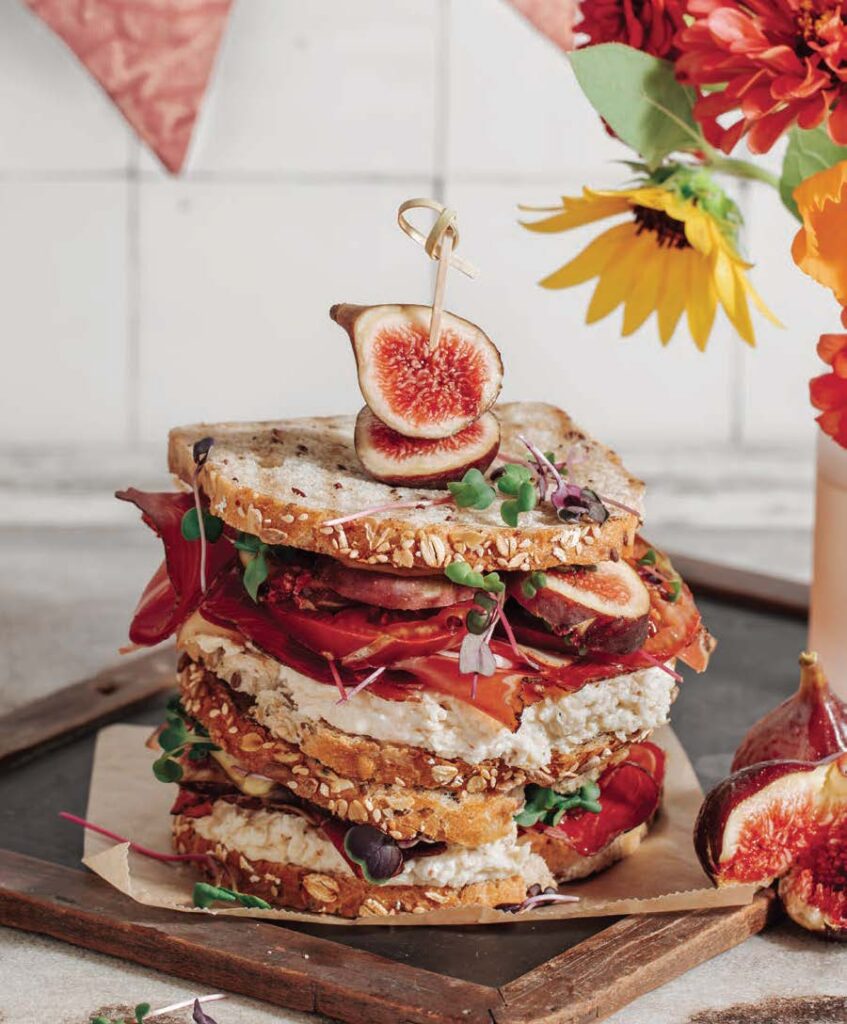
Cream cheese with a figgy twist

Story and Photograph by Rose Shewey

Many of my childhood summers were spent with my mom’s side of the family on the Adriatic coast in Croatia, where lush Mediterranean gardens grow fig trees taller than a Sandhills dogwood. In the late summer my family would harvest several pounds of figs every day from just a single tree. Those of us visiting from north of the Austrian Alps ate figs until our bellies ached.

Figs are, hands down, my favorite late-summer fruit. Or, to be botanically more accurate, inverted flower. Each seed inside a fig corresponds to one small flower contained in a bulbous stem. Call it what you will, figs, with their sweet, jammy texture and signature crunch, are darn exquisite, whichever way you want to categorize them.

To this day, I am surprised to find pricey, imported plasticcased figs in the produce aisles of food markets in North Carolina when our very own state — our own county, in fact — has proven to be an excellent host for fig trees. A local farm on the outskirts of Aberdeen has been successfully growing an entire fig tree orchard for several years, which begs the question: Why isn’t every farm growing fig trees in Moore County? My family would single-handedly keep them in business.

Even if you can’t get fresh figs, you can still enjoy them in other ways. Dried figs make an excellent addition to a homemade cream cheese. This year, I’ve used everyone’s favorite, pimento cheese, as a basis and inspiration for a cream cheese which holds all it promises — a honey- and fig-sweetened, tangy goat cheese and sharp cheddar blend that melts on your tongue. Spread it on sandwiches and crackers or eat it by the spoonful.

Fig, Honey and Goat Cream Cheese

INGREDIENTS

3-4 fresh or dried figs, minced (see notes)

2 cups freshly grated extra sharp cheddar cheese

4 ounces goat cheese

4 ounces cream cheese, cut into 1-inch cubes, room temperature

1 teaspoon honey

1⁄4 teaspoon garlic powder

1⁄4 teaspoon onion powder

Freshly ground black pepper, to taste

Salt, to taste

DIRECTIONS

In a large bowl, combine the finely minced figs with cheddar, goat cheese, cream cheese, honey, garlic powder, onion powder, and several twists of black pepper. Beat the mixture together with a hand mixer or by hand with a sturdy wooden spoon until thoroughly combined. Taste, and add more black pepper if desired, and/or salt for more flavor. Transfer the mixture to a serving bowl and serve immediately, or chill it in the refrigerator for up to 1 week. This cheese mixture hardens as it cools; let it rest for 30 minutes at room temperature before spreading it.

Notes: Dried figs work best; fresh figs can be used but the cheese will be softer overall. In a pinch, you can use 1-2 tablespoons of fig preserve instead of dried or fresh figs.

Dissecting a Cocktail

DISSECTING A COCKTAIL

The Green Beret

Story and Photograph by Tony Cross

Almost a decade ago, I began piddling around with a cocktail to honor my father. He served 20 years in the Army as a Special Forces medic. I knew before creating the drink that I wanted to call it The Green Beret. My next thought was that it seemed appropriate to include green chartreuse in the mix. And whiskey had to be the base. That was a given, since it’s my dad’s favorite spirit. I decided to create a spin on the Boulevardier using equal parts TOPO’s (a Chapel Hill distillery that is sadly no longer with us) Eight Oak Whiskey, cacao nib-infused Campari, and sweet vermouth, rinsing the inside of the rocks glass with the chartreuse. Even though the drink was a hit on our cocktail menu, I wasn’t completely happy with it — the chartreuse wasn’t adding anything to the cocktail.

So, I decided to revisit The Green Beret. This go-round, I switched a few things up. First, the whiskey. Rittenhouse Rye is a go-to when I need a whiskey with a backbone, but one that will still let other flavors come through. Next was the chocolate. Instead of infusing cacao into Campari, I opted for Angostura’s Cocoa Bitters, which wasn’t available when I originally created the drink. I fat-washed the Angostura with brown butter. This gives the bitters a creamy texture and adds nuttiness to the chocolate. Lastly, I took organic espresso beans — about one barspoon — and added them to my glass vessel when stirring all of the ingredients. That allows the oils from the espresso beans to make an appearance in the drink. I’m happy to report that The Green Beret earned its promotion.

SPECIFICATIONS

1 1/4 ounces Rittenhouse Rye

1 ounce Campari

1 ounce Carpano Antica Sweet Vermouth

4 dashes brown butter-washed Angostura Cocoa Bitters*

1 bar spoon organic espresso (or coffee) beans

2 dashes saline

Garnish: orange peel

*Brown butter-washed bitters: You can do this to regular Angostora bitters, too. Pour a 4-ounce bottle of bitters into a small glass container. Place 2 tablespoons of unsalted butter in a pan, bringing to a simmer. Continue to cook the butter until it turns brown. As soon as it does, take it immediately off the heat and pour it into the glass container. Give the bitters/butter mixture a quick stir and let cool. Once cool, seal the container and place it in the freezer. Let it sit overnight. The next day you will notice the butter has solidified. Use a knife to break a hole in the butter and strain the bitters out through a cheesecloth or coffee filter (using a coffee filter will take much longer). Pour butter-washed bitters back into its original bottle.

EXECUTION

Combine all ingredients into a chilled mixing vessel, add ice and stir until your gut tells you that it’s cold enough and properly diluted. Strain into a chilled rocks glass over ice. Express oils from an orange peel over the cocktail and place into drink.

Tea Leaf Astrologer

TEA LEAF ASTROLOGER

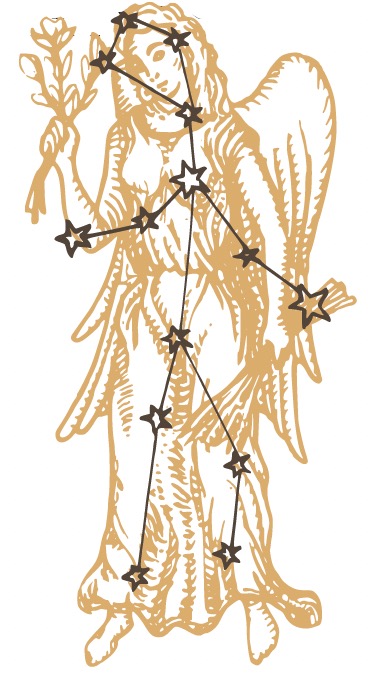
Virgo

(August 23 – September 22)

We appreciate your pragmatism. We really do. That said, it’s time to occupy the rooms in your Fifth House of Pleasure. (Note: Reorganizing the Tupperware doesn’t count.) What if there was no one to impress, no one to “fix,” nothing to accomplish? Try not trying so hard for five seconds and experience what can only be described as actual, factual joy. The Tupperware will be the icing on the cake.

Tea leaf “fortunes” for the rest of you:

Libra (September 23 – October 22)

Try clicking refresh.

Scorpio (October 23 – November 21)

Eat your greens.

Sagittarius (November 22 – December 21)

The aftertaste will be complex.

Capricorn (December 22 – January 19)

Embrace the imperfection.

Aquarius (January 20 – February 18)

There’s no going back.

Pisces (February 19 – March 20)

Conjure your own plot twist.

Aries (March 21 – April 19)

A full-bodied month with a buttery finish.

Taurus (April 20 – May 20)

Hint: The underdog wins.

Gemini (May 21 – June 20)

No need to spill all your secrets.

Cancer (June 21 – July 22)

One word: remediation.

Leo (July 23 – August 22)

Bring some cash. PS

Zora Stellanova has been divining with tea leaves since Game of Thrones’ Starbucks cup mishap of 2019. While she’s not exactly a medium, she’s far from average. She lives in the N.C. foothills with her Sphynx cat, Lyla.

Golftown Journal

GOLFTOWN JOURNAL

A Century In Linville

History in the high country

By Lee Pace

Back in the day when the summertime temperatures in the Sandhills inched into the 90s with humidity to match, and before Willis Carrier’s apparatus for cooling air had become mainstream through the handy and affordable window unit, back when you could fire a niblick or a rifle down the fairways of Pinehurst No. 2 in July with no worry of striking golfer or squirrel, the place to be was Linville.

It was 200 cooling miles northwest from the sandy loam, longleaf pines, white clapboard sidings and green trim of Pinehurst to the rocky outcroppings, rhododendron thickets and grayish buildings made of chestnut bark in Linville.

“Spend the week in Linville and make it a real vacation,” Pinehurst proprietor Richard Tufts advised in a 1942 letter to golfers promoting the Carolinas Amateur Championship, set for Linville Golf Club. “You need the rest, and there is no better place than Linville to take it.”

Pinehurst, Linville and Wilmington were three of the earliest bastions of golf in the state of North Carolina, and the names MacRae, Tufts and Ross are threads that tie them all together. In the late 1800s the MacRae family of Wilmington was instrumental in importing golf from its Scottish homeland, and after Donald MacRae Sr. developed extensive mining interests in the mountains, he believed a recreational menu that included golf would work well at the base of majestic Grandfather Mountain. MacRae and a partner named Sam Kelsey were officers in the Linville Land, Manufacturing and Mining Company, a corporation formed in 1888. Soon the company spent $22,000 to build the Eseeola Inn, which debuted amid the fanfare of bagpipe music and oxen races during a lavish grand opening on July 4, 1892.

“The Eden of the United States, a Fairy Land without a peer,” crooned an early advertisement for Linville and the Eseeola.

Linville originally had a 14-hole course that was redesigned and expanded to 18 — beginning in 1924 and reopening in 1926 — by Donald Ross, another Scotsman ensconced at Pinehurst since 1901 as its head golf professional, and who also made a tidy sum on the side in golf course design. The club and lodge were managed at one time by the Tufts family, who sent some of their staff to Linville to work when Pinehurst closed for the summer.

Wilmington native Isaac Grainger, a leading official in the Rules of Golf and USGA president in 1954-55, remembered his first trip from the coast to Linville in the early 1900s.

“By train from Wilmington to Goldsboro to Hickory to Lenoir and Edgemont, 24 hours, and then a six- or seven-hour drive by horse and buggy over the mountains at night,” he said. “That began a long series of exciting sojourns in the delightful spot which is synonymous with the name MacRae.”

Hugh MacRae II, great-grandson of the Linville founder, remembers seeing Ross as a child of 7 or 8. “He was a fine-looking man with a tweed cap and tweed suit and knickers and long stockings,” MacRae says. “He had a mustache. He was very pleasant and kindly. His Scottish brogue was very thick and difficult for a child to understand. He was very impressive.”

Though Linville is more than 4,000 miles from the western shores of Scotland, there’s more than a passing connection to the homeland of golf. Scots with names like Kirkcaldy served as early professionals. Today you can get a good breakfast or lunch just up the street at the Tartan Restaurant, and the Scottish Highland Games are an annual summertime staple. Sleep in on a Sunday morning at the Eseeola Lodge and you might be roused by the bagpipe music heralding services at the tiny Presbyterian chapel across the street.

“Little has changed at Linville from the early days,” MacRae says. “The first hole and 18th hole look nearly as they did in those days. You can drive back into Linville today and almost turn the clock back to the ’20s and ’30s.”

Today Linville Golf Club and Eseeola Lodge retain much of their Old World charm. There are neat rows of cottages lining the fairways to the first, second and 18th holes, each with the ubiquitous “Linville look” of chestnut bark siding. Grandmother Creek crosses the course a dozen times, and the fifth hole kisses against Lake Kawana, the 7-acre lake built for fishing and recreation.

There are few bunkers on the course (two holes have no sand traps at all), and the greens are small and quite the challenge. The blend of poa annua, bent, clover, blue and other indigenous strains is shaved to lightning-quick speeds in the summer, and the dips and hollows around the putting surfaces make chipping and pitching a mental and physical test of planning the angles and then executing the idea.

“Playing at Linville was always a thrill,” famed amateur Billy Joe Patton once said. “It’s a great course, one of my all-time favorites. Like all Ross designs, it’s a fine test; a wonderful, classic course that everyone can enjoy and appreciate.”

The club held a centennial celebration on June 9, marking the day a century earlier when Hugh MacRae felled the first tree as construction began on the course. Members hit balata balls with hickory shafted clubs from the plaque that rests on the right side of the first fairway.

“The slopes, the streams, with wide skies over all,” the founding MacRae said. “And here, content in pleasant sport, we meet our friends and ‘foes,’ and find them hard to beat.”

The golf course is getting a centennial tweaking at the hands of golf architect Andrew Green, who has become one of the go-to guys in the industry for classic course restorations. Green worked for 15 years in course construction, went off on his own in 2017 and was lauded for unearthing Ross’ architectural features at Oak Hill East in Rochester leading up to the 2023 PGA Championship. In a subsequent project at Scioto Golf Club in Columbus, Ohio, he met director of golf Bill Stines, who moved in 2020 to take the same job at Linville Golf Club.

A year after moving to Linville, Stineswas discussing the issue of the severely canted 10th green with Linville general manager Tom Dale and club officers, and how to solve the problem of too many putts rolling off the front of the green, 40 yards down the fairway.

“I said I would get the best expert in the business, someone who knew design, construction, agronomy and history to take a look,” Stine says. “That would be Andrew Green.”

The club retained Green in the fall of 2021 to start making plans. Working from Ross’ original course plan in 1924, Green identified the features, dimensions and undulations that had been lost over time and could be restored, ever mindful of equipment and maintenance evolution. The work needed to be done in the off-season so as not to close any part of the course during the height of the summer, so Green worked on seven holes from September 2023 to March 2024. The club is going to double-up on the construction crew this fall and knock out 10 more holes this winter. A more extensive restoration of the 17th hole to adjust fairway and green elevations is planned for the 2025-26 offseason.

That will leave the club with a course offering the ideal combination of Ross’ original design tenets paired with modern agronomy and playability in time to celebrate the 100th anniversary of the conclusion of the great architect’s original work.

“Other places, no matter what age they are, are trying to create history,” Dale says. “That happens on its own. You can’t manufacture it. You just end up with it if you’ve been around long enough.”

PinePitch September 2024

PINEPITCH

Where There Are Sparks…

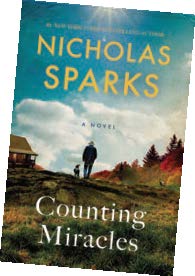
The Country Bookshop welcomes bestselling author Nicholas Sparks to discuss his latest novel, Counting Miracles, from 6:30 to 7:30 p.m. on Monday, Sept. 30, at Lee Auditorium, 250 Voit Gilmore Lane, Southern Pines. Tanner Hughes, an Army Ranger, is the proverbial rolling stone: happiest when off on his next adventure, zero desire to settle down. But when his grandmother passes away, her last words to him are find where you belong. She also drops a bombshell, telling him the name of the father he never knew — and where to find him. You can learn the rest of the story by going to www.ticketmesandhills.com.

Maybe buy the book, too?

Wildflowers of the Sandhills

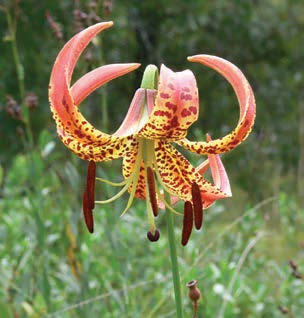
Sponsored by the Council of Gardens and the Sandhills Horticultural Society, Bruce A. Sorrie, the author of Wildfl owers of the Sandhills Region, will talk about the wildflowers, shrubs and vines in their natural Sandhills habitats in a free event Friday, Sept. 13, at 1 p.m. in the Burlingame Room of the Ball Visitor’s Center, Sandhills Horticultural Gardens, at Sandhills Community College, 3395 Airport Road, Pinehurst. For additional information and to register go to www.sandhills.edu/horticultural-gardens/upcoming-events.html.

They’ll Huff and They’ll Puff

Take a tour of the golden age of jazz with Peter Lamb and the Wolves, who bring the spirit of classic cinema to life on Sunday, Sept. 15, at the Fair Barn, 200 Beulah Hill Road S., Pinehurst. The sultry sounds of a saxophone, the soft glow of candlelight and the inviting expanse of a dance fl oor promise an evening of nostalgia and entertainment, all in support of the Linden Lodge Foundation. Call (910) 365-9890 to reserve your table of six or more or go to www.ticketmesandhills.com.

Once Around the Solar System

Elementary-aged kiddos and their caregivers can listen to Jon Caruthers, NASA’s Solar System Ambassador, give his talk “Robots in Space!” at the Southern Pines Public Library 170 W. Connecticut Ave., Southern Pines, on Sunday, Sept. 8 from 2:30 p.m. to 3:30 p.m. For more information on this STEAM — science, technology, engineering, art and math — lecture call (910) 692-8235 or contact kbroughey@sppl.net

Magic in Pairs

Local artists Pat McBride and Jenay Jarvis are co-hosts of an exhibit at the Campbell House Gallery, 482 E. Connecticut Ave., Southern Pines, titled “Strange Magic.” The exhibit of their work opens with a reception and chance to meet and speak with the artists on Sept. 6 from 6 to 8 p.m. The showing concludes on Sept. 26. For more information call (910) 692-2787 or go to www.mooreart.org/upcoming-art-exhibits.


It’s Baaaack!

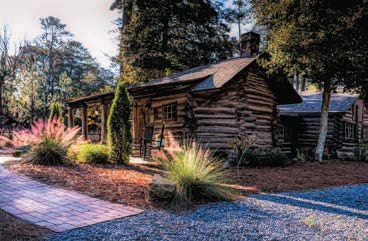
Housed in the historic 1823 cabin at 15 Azalea Road smack in the middle of the village of Pinehurst, the Sandhills Woman’s Exchange reopens for the fall season on Wednesday, Sept. 4. Hours are 10 a.m. to 3 p.m., Monday through Friday, with lunches served from 11 a.m. to 2 p.m. The gift shop will be stocked with new and unusual items for a bit of early Christmas shopping. For more information call (910) 295-4677 or go to www.sandhillswe.org.


Take a Chance on Me

Mamma Mia, the Swedish band ARRIVAL performs an ABBA tribute — see what we did with the all-caps? — at BPAC’s (yeah, OK, that’s all-caps, too. And so is OK. Oh, dear.) Owen’s Auditorium, 3395 Airport Road, Pinehurst, on Tuesday, Sept. 10. Knowing me and knowing you, tickets and information can be had at www.ticketmesandhills.com.

Flutter Up, Buttercup

Celebrate butterflies and other pollinators with a day of family fun at the Flutterby Festival at the Village Arboretum, 375 Magnolia Road, Pinehurst, on Saturday, Sept. 28, from 11 a.m. to 2 p.m. There will be live music, activities and food, plus lots of learning about monarch butterflies, birds and insects. Programs include an opportunity to interact with and feed hundreds of newly emerged monarchs in the Magical Monarch Tents. For information go to www.vopnc.org or www.ticketmesandhills.com.

Jocularity, Jocularity

Join the “Entitled Housewife,” Becky Robinson, for a comedy special at BPAC’s Owens Auditorium, 3395 Airport Road, Pinehurst, from 7 to 8 p.m. on Friday, Sept. 6. Robinson’s explosively unique character antics and viral videos have racked up millions of views and fans across social media. For information and ticketing go to www.ticketmesandhills.com.

Bookshelf

BOOKSHELF

September Books

FICTION

The Wildes: A Novel in Five Acts, by Louis Bayard

In September of 1892, Oscar Wilde and his family have retreated to the idyllic Norfolk countryside for a holiday. His wife, Constance, has every reason to be happy: two beautiful sons, her own work as an advocate for feminist causes, and a delightfully charming and affectionate husband and father to her children, who also happens to be the most sought-after author in England. But with the arrival of an unexpected houseguest, the aristocratic young poet Lord Alfred Douglas, Constance gradually — and then all at once — comes to see that her husband’s heart is elsewhere, and that the growing intensity between the two men threatens the whole foundation of their lives. The Wildes: A Novel in Five Acts takes readers on the emotional journey, moving from the Italian countryside to the trenches of World War I and an underground bar in London’s Soho, where Oscar’s sons, Cyril and Vyvyan, grapple with their father’s legacy.

The Life Impossible, by Matt Haig

When retired math teacher Grace Winters is left a run-down house on a Mediterranean island by a long lost friend, curiosity gets the better of her. She arrives in Ibiza with a one-way ticket, no guidebook and no plan. Among the rugged hills and golden beaches of the island, Winters searches for answers about her friend’s life, and how it ended. What she uncovers is stranger than she could have dreamed. But to dive into this impossible truth, she must first come to terms with her own past. Filled with wonder and wild adventure, this is a story of hope and the life-changing power of a new beginning.

CHILDREN’S BOOKS

Puppy Talk: How dogs tell us how they feel and Cat Chat: How cats tell us how they feel, by Jess French

Kids raised with pets in the home just instinctively know how to interact with animals. For others, there’s a bit of a learning curve, and these fabulous new books are simple enough for the youngest readers while detailed enough to remind anyone that animals do talk, if people know how to listen. (Ages 2-6.)

The Tryout, by Christina Soontornvat

It’s the new school year and the start of eighth grade, and the most important thing for Christina and her best friend, Megan, is trying out for the cheer squad. Making the squad is more than just playing a sport; it means being part of a team, working together, and surviving all the challenges that come with friends, families and fans. (Ages 12 and up.)

When We Flew Away: A Novel of Anne Frank Before the Diary, by Alice Hoffman

Anne Frank’s The Diary of a Young Girl has captivated and inspired readers for decades. Written while she and her family were in hiding during World War II, it has become one of the central texts of the Jewish experience during the Holocaust, as well as a work of literary genius. With the Nazi occupation of the Netherlands, the Frank family’s life is turned inside out. In the midst of impossible danger, Anne, audacious and creative and fearless, discovers who she truly is. With a wisdom far beyond her years, she will become a writer who will go on to change the world as we know it. Hoffman weaves a lyrical and heart-wrenching story of the way the world closes in on the Frank family from the moment the Nazis invade the Netherlands until they are forced into hiding, bringing Anne to bold, vivid life.

NONFICTION

Building Material: The Memoir of a Park Avenue Doorman, by Stephen Bruno

As an academically gifted Latino kid growing up in the Bronx, Bruno’s family had high aspirations for his future, but those dreams were derailed when he followed a girlfriend to Minnesota and a dead-end job. Languishing and unable to get it together, Bruno eventually moved back home. Broke and eager to make a way for himself — and away from the oppressively religious father wreaking havoc on his love life — the affable, easygoing, quickwitted Bruno lands a much-coveted job as a doorman at a highend building on Park Avenue. Hilarity and drama soon abound as he learns the dos and don’ts of being a doorman for the rich and famous, and witnesses the antics going on behind the front entrance of this swanky building.

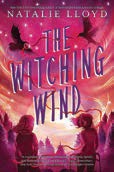
The Witching Wind, by Natalie Lloyd

Two unlikely friends live in a town with a mysterious magical wind that usually steals things, but this time it has stolen people — two people who are very important to the friends. From the author of the beloved A Snicker of Magic comes this story of friendship and family, and how things that are just a little bit weird can be quite wonderful. (Ages 10 and up.)

Popcorn, by Rob Harrell

Andrew is having a day. It’s picture day, of course, and his new shirt got ripped by the class bully, his glasses broken by a rogue basketball — and we won’t even talk about the ketchup rocket in the cafeteria — but now his grandma is missing, and Andrew’s stress meter is justabout to pop. Lots of kids deal with anxiety in different ways, but for some, it takes over. This funny, real, honest book is for them. Do an anxious kid a favor and put Popcorn in their hands. (Ages 10 and up.)

Almanac

ALMANAC

September

By Ashley Walshe

September rouses you from the gentle spell of summer.

One day, between the blackberry harvest and the mighty swell of crickets, the charm took hold. Languid and blissful, you sprawled beneath the dappled shade, eyes heavy, honeysuckle on your tongue.

Rest now, summer cooed. It’s much too hot to fuss.

And, just like that, you were under. Swaddled in sticky-sweetness. Wanting for nothing. Enchanted by the lazy lull of summer.

Until now.

Something has shifted. It’s a feeling, both subtle and seismic. At once, you’re wide awake.

The air is crisper, cooler, lighter. Colors are more vibrant. Even the birds have changed their tune.

Wake up, a skein of geese clamors overhead. There’s little time to waste!

Their frequency is a code. An ancient language. A precious remembering.

Everything will change.

The light. The trees. The pulse of the season.

Look to the maple tree, the honeybee, the frenzied gray squirrel. Life is racing toward some dark unknown. Put your ear to the warm earth and listen.

This is the threshold, the quickening, the no-going-back. The final kiss of summer.

And so, you feast with all your senses. You savor the fragrance of ginger lilies, the taste of wild muscadines, the spirit of goldenrod at magic hour. You kiss summer back.

A single leaf descends with a singing wind.

Stay open to the beauty of this moment. Stay open to the knowing that everything will change.

Harvest Moon Magic

Your eyes aren’t playing tricks. When the full harvest moon rises on the evening of Tuesday, Sept. 17, it will appear larger and brighter because it is, in fact, as close to Earth as it can be. What makes this supermoon even more spectacular is the partial lunar eclipse that will reach maximum coverage around 10:44 p.m. While only a small portion of the moon’s surface will be obscured by Earth’s shadow, this partial eclipse marks the beginning of an eclipse season. An annular solar eclipse will occur on Oct. 2. Although its “ring of fire” won’t be visible from North America, don’t be surprised if you feel its powerful energetic effects.

Seeing Stars

Look! The asters are blooming. Derived from the Latin astrum, meaning star, September’s birth flower transforms the late summer landscape with jubilant constellations of white, pink, blue or purple blossoms. Often mistaken for daisies, the aster is actually related to the sunflower. (Study its bright yellow center, composed of tiny florets, and see for yourself.)

According to one Greek myth, asters sprouted from the tears of a virgin goddess named Astraea, who wished for more stars in the sky. Instead, the brilliant “stars” began spilling across the quiet earth, as they’ve done every autumn since. Magic for the eyes. Magnets for the late-season butterflies.