April Bookshelf

April Books

FICTION

At Briarwood School for Girls, by Michael Knight

Lenore is a young student in the 1990s who finds herself pregnant as she navigates her junior year on the basketball team, in the school play, and talking through her problems with a ghost from decades past. But the very history that is revered in the region — the buildings, the grounds, the surrounding Virginia countryside — is threatened by the commercialized invasion of an imminent Disney theme park, much to the dismay of locals and students alike. Knight proves himself once again to be a spinner of a great story.

The Gulf, by Belle Boggs

The author of The Art of Waiting and Mattaponi Queen delivers a novel filled with satire, irony, warmth and wit. Two liberal atheists in need of work, along with a venture capitalist, decide to open a writing school for Christians in a decrepit motel on Florida’s Gulf Coast. Marianne is a floundering poet who finds herself in the position of administrator, getting the actual site ready and culling through the applicants, while waiting for her ex-fiancé, Eric, to return from Dubai and assist her. The result is a motley assortment of teachers and students. After a comical and rocky first few days, they manage to find common ground. It could have worked until a politician with an agenda becomes involved.

The Editor, by Steven Rowley

What if you are called by a major publishing company to meet with an editor to discuss your first novel? What if the editor who walks into the room is Jacqueline Kennedy Onassis? That’s the situation writer James Smale finds himself in. Jackie and James develop a strong working relationship as she expertly guides him through his novel while encouraging him to confront the truth about his own family. The Editor is satisfying, charming, witty, and an intuitive look at family, relationships and life — a stylish and unforgettable tribute to a stylish and unforgettable woman.

Stay Up with Hugo Best, by Erin Somers

Suave, debonair, womanizing late-night talk show host Hugo Best is ending his decades-long career with a fizzle. To 29-year-old June Bloom, writing assistant to the show, he is still an iconic figure. He unexpectedly invites her for a long weekend at his mansion — no strings attached — and she accepts. What follows are overwhelming, underwhelming, awkward comical scenarios between the characters that can make you laugh and cringe simultaneously.

The Girl He Used to Know, by Tracey Garvis Graves

The author of On the Island writes about Jonathan and Annika, who meet in the chess club at the University of Illinois and bring out the best in each other, finding the confidence and courage within themselves to plan a future together. What follows is a tumultuous yet tender love affair that withstands everything except the unforeseen tragedy that forces them apart, shattering their connection and leaving them to navigate their lives alone. A decade later, fate reunites them in Chicago. She’s living the life she wanted as a librarian. He’s a Wall Street whiz, recovering from a divorce and seeking a fresh start.

The Peacock Emporium, by Jojo Moyes

In the ’60s, Athene Forster was the most glamorous girl of her generation. Nicknamed the “Last Deb,” she was beautiful, spoiled and out of control. After she agrees to marry the gorgeous young heir Douglas Fairley-Hulme, rumors began to circulate about Athene’s affair with a young salesman. Thirty-five years later, Suzanna Peacock is struggling with her notorious mother’s legacy. The only place Suzanna finds comfort is in The Peacock Emporium, the beautiful coffee bar and shop she opens that soon enchants her little town. There she makes, perhaps, the first real friends of her life, including Alejandro, a male midwife, escaping his own ghosts.

NONFICTION

Save Me the Plums, by Ruth Reichl

The editor-in-chief of Gourmet and a New York Times best-selling author writes a memoir about her groundbreaking tenure at the top food magazine in the world, helping to create a culture of chef superstars. The story of a former Berkeley hippie who enters the corporate world, Reichl shares the insider look at running the storied magazine (and closing it).

The Second Mountain: A Quest for a Moral Life, by David Brooks

Brooks explores the four commitments that define a life of meaning and purpose: to a spouse and family; to a vocation; to a philosophy or faith; and to a community. Our personal fulfillment depends on how well we choose and execute these commitments. The New York Times columnist looks at a range of people who have lived joyous, committed lives, and who have embraced the necessity and beauty of dependence. He gathers their wisdom on how to choose a partner, how to pick a vocation, how to live out a philosophy, and how we can begin to integrate our commitments into one overriding purpose.

Maybe You Should Talk to Someone, by Lori Gottlieb

With startling wisdom and humor, therapist Lori Gottlieb invites us into her world as both clinician and patient, examining the truths and fictions we tell ourselves and others as we teeter on the tightrope between love and desire, meaning and mortality, guilt and redemption, terror and courage, hope and change. Maybe You Should Talk to Someone is revolutionary in its candor, offering a deeply personal yet universal tour of our hearts and minds and providing the rarest of gifts: a boldly revealing portrait of what it means to be human.

The Animal’s Companion, by Jacky Colliss Harvey

In The Animal’s Companion, the acclaimed author of Red: A History of the Redhead turns her keen eye for cultural investigation and her remarkable storytelling skills to a pet project: the history of animals as our companions in everyday life. It’s a history that dates as far back as 26,000 years ago to a cave in France where anthropologists discovered evidence of a boy and his dog taking a walk together. From that point forward, Colliss Harvey takes us on a sweeping journey through centuries and across continents to examine how our relationships with our pets have developed, yet stayed very much the same. Along the way she shares delightful stories of the most famous, endearing and sometimes eccentric pet owners throughout history.

CHILDREN’S BOOKS

Babymoon, by Hayley Barrett

The perfect gift for newly expectant parents. Unlike any other “new baby” book, this special little title focuses on those few, precious days parents have with their newborn as together they become a new family. (Age birth-1.)

The Little Guys, by Vera Brosgol

These little guys are just about the cutest things in all the forest, and when they band together, they can do just about anything, can take just about anything . . . can get all they need. But just how much is too much? And just where do the needs of the whole forest come in? These little guys will warm your heart as they open their hearts to the needs of others both big and little. (Ages 3-6.)

Where the Heart Is, by Jo Knowles

It’s the first day of summer and Rachel’s 13th birthday. With a summer job caring for the neighbor’s farm animals, her best friend, Micah, nearby and weeks of warm weather to look forward to, Rachel is living the dream. But when bad news threatens all she loves, Rachel must make some difficult decisions about who and what are important in her life. At once sweet, silly, sad and ultimately satisfying, Where the Heart Is is the perfect summer read. (Age 12-14.)

Ghost Boys, by Jewell Parker Rhodes

In the end, and in the beginning, all we really have are our stories. In Ghost Boys, Jerome’s story, Sarah’s story, Grandma’s and Kim’s and Emmett’s stories are all one: that only the living can make the world better. This story — their story — will haunt the reader long, long past the final page. Sure to be a winner this award season, Ghost Boys is an absolute must-read. (Ages 12-16.)

Lovely War, by Julie Berry

Clever, snarky, beautiful and completely impossible to put down, this sweeping epic love story absolutely has it all. Aphrodite, as narrator, shares a tale of absolute love and passion — a tale of four mortals from divergent backgrounds whose lives are forever connected through interactions during World War I. It’s a story that even has the gods of fire and war wiping an occasional tear from their eyes and softens the heart of the god of the underworld. (Ages 14 to adult.)  PS

Compiled by Kimberly Daniels Taws and Angie Tally

Drinking with Writers

With the Author Himself

An internal dialog

By Wiley Cash   •   Photograph by Mallory Cash

Wiley Cash and I have known one another for almost 42 years, but I do not see him very often. Work as writer-in-residence at the state university in Asheville has him driving back and forth across the state quite a bit, and if you are to believe his social media accounts, he is usually sprinting through one airport or another, behind on a writing deadline and struggling to find Wi-Fi to return students’ emails. That’s what he gets for giving up his smartphone.

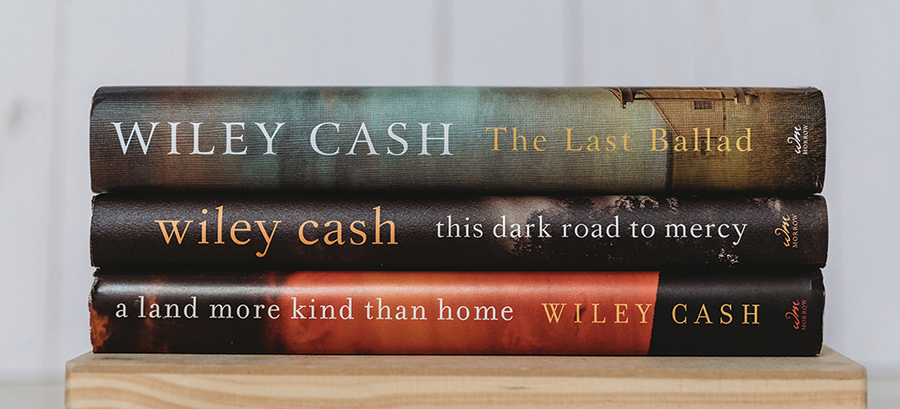
Life has been pretty busy since Wiley’s first novel, A Land More Kind Than Home, was released in the spring of 2012. Since then he has published two more novels, taken a few teaching positions, and moved a couple times. He and his wife, Mallory, who is a photographer, are also the parents of two young daughters.

A few weeks ago I sent him a text. (He can still text with a flip phone. It just takes him longer.)

Me: let’s get a beer

Wiley: high cholesterol. Been jogging. Coffee?

Me: does beer give you high cholesterol?

Wiley: beer makes it harder to jog

Me: where should we meet for coffee? Prefer a place that also serves beer.

Wiley: our house Thursday morning

Mallory meets me at the door when I arrive at their home near Carolina Beach.

“His majesty is still in his robe,” she says.

“Late night?” I ask.

“No,” she says. “He just works from home. His robe is like his employee uniform.”

“You work from home too,” I say. “You’re not wearing your pajamas.”

“Maybe the robe life is the exclusive lifestyle of authors.”

I look up and see Wiley coming down the stairs in a bright red robe and gray bedroom slippers. We shake hands.

“It’s been a while,” Wiley says. “When did you get glasses?”

“Last year,” I say.

He strokes his white beard and tucks his (graying?!) hair behind his ear.

“We’re getting old,” he says. He smiles. “At least you are.”

“I guess that means we’re having coffee instead of beer.”

He smiles and leads me down the hallway, past the kitchen, and into a sitting room that has recently been converted into his daughters’ playroom. He offers me a seat in one of two tattered yellow armchairs.

“When we bought this house we thought it would be a great place to host parties,” he says. He smiles and looks around the room. “Turns out it’s been a great place to host children’s books and games and toys.”

While Wiley makes coffee in a French press, we discuss what has kept him busy since his most recent novel, The Last Ballad, was published in the fall of 2017. He tells me about the Open Canon Book Club, an online book club he founded to introduce readers to diverse books by diverse authors, and the Land More Kind Appalachian Artists’ Residency, a retreat he and Mallory and two friends founded in West Virginia. He is also teaching, a lot: Aside from his work as writer-in-residence at the University of North Carolina-Asheville, he also teaches in the Mountainview Low-Residency MFA Program. In his spare time he is trying to work on a new novel, one that is already behind deadline.

“How are you finding the time and space to write?” I ask.

He pours me a cup of black coffee, pours one for himself, and then sits back in his chair.

“It’s hard,” he said. “I’m really busy, but everything I do is about writing in one way or another. When I teach, I teach writing. When I give a talk at a library or university, I’m talking about writing. When I’m reading books for the book club or reading through applications for the artists’ residency, I’m thinking about the written word and how it works to achieve an author’s intentions. Literally everything I do pertains to writing. My life is one huge literary conversation that never stops.”

“It all sounds like a lot of work,” I say. “Are there many rewards?”

“Aside from my mom constantly asking if my editor’s mad at me because my novel is late? Sure. There are a lot of rewards,” he says. “I’m so lucky that my one-time hobby has become my full-time occupation, or occupations.” He looks over his shoulder at a wall of glassed-in bookshelves in the living room. “Speaking of rewards,” he says, “you want to see a really cool one?”

He gets up and walks into the other room. When he returns he is carrying a small statue on a pedestal. “Meet Sir Walter Raleigh,” he says. He slides one of his girl’s chairs away from a children’s table and sets the statue on the chair. He makes a show of polishing it. “I received this a few weeks ago from the North Carolina Historical Book Club. I love it.”

“You seem like a proud father,” I say. “Speaking of fatherhood, how has it changed your writing?”

“Being a parent has deepened the experience of storytelling in ways that have really surprised me,” he says. “Our oldest, who’s 4, is obsessed with narrative. I probably tell six or seven stories a day about saber tooth tigers and early people and ghosts and pirates. A few nights ago I heard her telling Mallory about how telling stories can cause them to feel true. That left a huge impression on me because that’s what I want to do as a writer. I want to tell my readers fictional stories that they believe nonetheless.

“And our 3-year-old is really interested in telling stories. A few days ago, she told Mallory a story that began It was the first day of school. His mother came to get him. He was not sad, but quiet. Are you kidding me? I don’t write opening lines that beautiful.”

“If your girls told a story about you, what would it be?” I ask. Wiley takes a sip of his coffee and looks toward the window.

“It was the first day of writing a new novel,” he says. “His mother had already called to check on his progress. He was not sad, but tired.”

“Pretty good lines,” I say.

“Thanks,” he says. “They’re yours if you write my biography.” PS

Wiley Cash lives in Wilmington with his wife and their two daughters. His latest novel, The Last Ballad, is available wherever books are sold.

Papadaddy’s Mindfield

Getaway

Or, how to start your own Vacation Club

By Clyde Edgerton

When my wife, Kristina, was told we could get four days and three nights in a Marriott hotel luxury suite with two bedrooms, two baths, kitchen, three or four TVs in Myrtle Beach for $9 (OK: $134) if we’d sit together for a one-and-a-half-hour lecture about time-shares, I said: Goodness. Why not?

Excuse me — not time-share, but some other name, like: Marriott Vacation Worldwide Club Getaway. “Time-share” is out of fashion in some quarters . . . the name, not the concept. There’s a guy who comes on cable radio and says, “I’m a lawyer, not very smart, but mean, and I’ll get you out of your time-share contract by suing the hell out of the time-share company, and if that doesn’t work, I’ll burn down your time-share and we will split the insurance.”

But with the Marriott Vacation Worldwide Club Getaway, rather than buying a two-weeks-a-year stay at one hotel suite, apartment, small closet or room (after which other people use it for the rest of the year, and get it dirty), you — in this new kind of setup — buy the possibility of staying in a luxury hotel about anywhere in the world when you go on vacation, and you use up a certain number of points each time that happens, depending on how big your abode is. You buy so many points a year for the rest of your life. If you don’t like the deal, that’s OK because you will die and leave it to your heirs, and they can do the same, like a home. Resale value? I don’t know.

Let’s jump ahead about one hour and 15 minutes into our lecture. I asked: “What’s your return rate?”

“Excuse me?”

“How many couples out of 10 buy in?”

“Three.”

“Wow, I’m surprised it’s that high. That’s pretty good.”

Now mind you, Kristina and I had decided that there was no way we could buy in. I mean there was the very slightest chance, but we vowed we would not be swayed. 

The luxury hotel was, well, luxurious. The January weather was nice, there were several football-field-size heated pools, a Jacuzzi. Our suite was two big bedrooms, two baths, kitchen, living room, all that. We just kind of relaxed. Our kids did what they do at home: They sat on a bed and looked into a cellphone. Well, that’s not fair — they do other things. Perceptions are sometimes a product of fear.

We got there on a Friday, and on Saturday morning, while the kids sit on their beds looking into their cellphones, Kristina and I head for the lecture. On the way, we walk around, out onto the beach and back. I mean, who needs the beach when you are at a luxury hotel? There is this bevy of nice grills near the beach area (inside the gate to the beach), these big cabinets of dark wooden cubbyholes for your beach paraphernalia (inside the gate to the beach). There are beach chairs, ping-pong tables, a gym (inside the gate to the beach). Suddenly, I realized the thing you go to the beach for, the beach, was not central to a Marriott Worldwide Vacation Club Getaway. Why? A guess: Nobody makes money when you go for a walk on the beach. And the gate keeps out the undesirables who might be walking by on the beach.

Just before the lecture, we enter a large room with bar, snacks, drinks, many couches, big green plants and lamps. I’d thought other folks would be coming in. Nope. It ended up, at first, being just three of us.

A nice young man, very relaxed, open collar, sports jacket, sits down with us and says, “This is definitely going to be low key. No high-pressure stuff.” We talk about where he’s from, his brothers and sisters, where he went to school. I like him. Surely he thinks we’re not interested, I think.

It is very low pressure . . . for about 40 minutes. After about 45 minutes we have taken a little stroll past beautiful, large 3-D photos of resort areas around the world, and we are now in a very small room. A guy who looks like Pancho Villa comes in. He wears two belts of ammo, crossed on his chest. He starts putting numbers on a white board with a blue felt-tipped pen — what our payments will be for a certain number of points a year. He’s good. I will later admit to Kristina that I was almost swayed. Then I think to ask, “Is there a maintenance fee?” Well, there is. Two grand a year for the moderate package we’re examining, and I think to myself: If we get away for only four nights in a certain year, that’s $500 a night out the gate.

We say to Pancho: “We are not doing this, sir. The end.” He changes tactics, halves all the numbers on the board, unclicks the safety-guard strap on his pistol.

We persist. Pancho gives up, and they run a woman in on us. No ammo belts. She says if we call her by 1 p.m. that day, we can get three nights and four days at any Marriott luxury hotel for $199 if we promise to come together for a 1-hour, 30-minute lecture. This is true. I realize that it’s the three out of 10 that’s driving the bus. I say, no thanks. She says $149. I say no. She gives us a business card and says, “Call me if you change your mind.”

We return to our suite, relax, enjoy our stay for another day, talk about how lucky we are to be one of the seven in 10. We gather our kids and their cellphones off their beds, return to Wilmington a day early, and have a family meeting. We’re going to start spending time at the beach, and in the yard, and walking, and going to state parks. We’re going to start our own Vacation Nature Getaway Club.

Features? Yard, beach, state parks.

Cost: Nada.  PS

Clyde Edgerton is the author of 10 novels, a memoir and most recently, Papadaddy’s Book for New Fathers. He is the Thomas S. Keenan III Distinguished Professor of Creative Writing at UNCW. 

Golftown Journal

Eye of the Needles

The USGA returns to a polished gem

By Lee Pace

The continued evolution of Donald Ross’ vintage Sandhills golf courses back to a more unkempt and rugged look over the last decade will be on display in May when the United States Golf Association stages its U.S. Women’s Senior Open at Pine Needles Lodge & Golf Club in Southern Pines. The 1928 course that has hosted three U.S. Women’s Opens has come under the nipping and tucking auspices of architect Kyle Franz over the last two years and will offer a visual presentation more in keeping with what Ross cobbled from the sandy ground nearly a century ago, and certainly integrate some shot values more consistent with the Scottish designer’s original intent.

Franz ran a bulldozer and other shaping and construction implements on Pinehurst No. 2 in 2010-11 under the employ of Bill Coore and Ben Crenshaw as the course was transformed from its sleek green appearance to a sandier landscape chock full of wire grass and jagged edges. He then took his skills and initiative and pitched Kelly Miller, president of the company that owns Pine Needles and is a partner in Mid Pines Inn & Golf Club, on the idea of restoring Mid Pines, a 1921 Ross design, in a similar fashion. That job was completed in 2013 to rave reviews, including designation by Golf magazine as the Best Course Restoration of the year.

“Except for lacking the Pacific Ocean, it almost has the visual appeal of Cypress Point,” magazine course rating panelist John Dempsey said. “It almost looks like the old pictures you see of Mid Pines of people wearing coats and ties and watching a match finish on 18. I can’t say enough about it. Going out and playing nine holes in the last of the winter sunlight in late afternoon, the visuals are fabulous.”

The next step was to apply many of the same ideas to Pine Needles, across Midland Road. The hook of converting Pine Needles’ greens from bent to MiniVerde Bermuda — as they had been at Mid Pines — was a convenient base from which to operate. Pine Needles closed during the summer of 2016 for the greens conversion, and Franz used that period, as well as the following two winters, to rebuild every bunker on the course, rearrange the fairway dimensions and add some new tees.

“The old stigma on Bermuda greens is that they were grainy and slow, but that’s not true anymore with the new ultra-dwarfs,” Miller says. “We had nearly 50 days with temperatures in the 90s during the summer of 2015, and it was a struggle to keep the bent healthy. Meanwhile, the greens really thrived at Mid Pines. After watching them closely for two years, we thought it was time to pull the trigger at Pine Needles.”

Franz grew up playing golf in Oregon, and when it came time to pick a college, he knew what he wanted: Oregon State’s turf management program. One summer he landed an internship working for architect Tom Doak on Pacific Dunes, the second of five courses created at Bandon Dunes Golf Resort, and later he met Coore and Crenshaw, who were designing another course there named Bandon Trails.

“Being an Oregonian, it was a really special experience,” Franz says. “Just being able to work on a piece of land like that was really cool. It got me interested in links-style architecture, and I had always been a fan of classic courses.”

Now 37, Franz has worked in Scotland, Australia and California, and more recently was on Gil Hanse’s staff in the design and construction of the course in Rio de Janeiro used for the 2016 Olympics. He’s also just finished a multi-year project at the Country Club of Charleston, which will be the venue for the U.S. Women’s Open one week after the Pine Needles Senior Open.

Among the tweaks Franz made that golfers who played Pine Needles in 2007 and are returning for the first time a dozen years later will notice are these:

* Expanded fairways to original margins to 38 to 60 yards;

* Restored and/or reconfigured all 70 bunkers to Ross’ rolled-over style of the mid-to-late 1940s and added eight new bunkers to challenge modern length;

* Re-established what Franz calls “horse-and-blade caliber micro-contours” in the greens to add interest and challenge to the putting element;

* Removed 11 acres of Bermuda rough and replaced them with native hardpan, wire grass and pine straw;

*Replaced the uniform-looking expanses of love grass in front of many tees with a more rugged “Pine Valley” look of sand and native growth.

“Overall, it’s a little more clean and manicured look and different from Mid Pines,” Franz says. “There we went guns blazing with the native stuff around the edges. At Pine Needles now we have a cool and rugged look, but it’s a little more manicured than No. 2 and Mid Pines.”

The championship will be played May 16-19 and is the second Women’s Senior Open, christened last year at Chicago Golf Club. Laura Davies, who finished in the top five at Pine Needles in 1996 and 2007 but missed the cut in 2001, won the championship by 10 shots over Juli Inkster. The field included noted LPGA players Danielle Ammaccapane, Helen Alfredsson, Liselotte Neumann, Rosie Jones, Hollis Stacy, Amy Alcott, Betsy King, Pat Bradley and Jane Geddes. The course will play just under 6,100 yards.

“The Women’s Senior is similar to the U.S. Amateur or Walker Cup in size and scope,” Miller says. “There are basically no grandstands, though we might put one on the 18th green. There are no skyboxes. It’s a very fan-friendly event. We rope off the tees and greens, but otherwise spectators walk with the players.”

The Women’s Senior is something of a prelude to the 2022 Women’s Open at Pine Needles, and having tees that can stretch the entire course to 7,000 yards will give USGA officials adequate flexibility when they host the longer LPGA players vs. the over-50 crowd.

“I think the Bermuda greens and wider fairways will work well for both events,” Miller says. “In Ross’ era, golf was played more along the ground. Now it’s more in the air. But the Bermuda greens are firmer and offer a more challenging surface. It’s more important now to be on the proper side of the fairway to have the shot you need to knock it close.

“For ’22, they can lengthen some holes, but I don’t think you’ll see a lot more rough. I think Donald Ross would have loved testing the players with longer shots and the strategy of proper placement of the tee shot versus having penalizing rough.”

One change that embodies the new-look Needles as much as any is the bunker complex down the left side of the par-4 18th hole. The finishing hole was actually the first hole of the course as it was designed, when the St. Joseph of the Pines assisted-living facility was the original Pine Needles hotel. When Peggy Kirk Bell and husband Warren acquired the golf course in the 1950s, they reconfigured the start and finish to be more convenient to the new lodging facilities they built on the southwest side of the course. Thus the second hole became the first and the first became the 18th.

Eighteen plays downhill and before there was no trouble down the left side. Now there is a natural sandscape with miscellaneous vegetation and whatever nature might deposit there, from pine needles to cones to wire grass.

“You could hit a speed slot on that side and the ball would roll forever,” Franz says. “What was conceived as a relatively easy starting hole didn’t stand up as a finishing hole.”

Miller remembers playing the 18th when he first visited Pine Needles in 1980 with a driver and 7-iron. “And that was with a persimmon wood and balata ball,” he says. “If you looked back up the fairway from the green, it looked like a bowling alley. Ross always had great motion to his fairways. Now it’s a cool look. You don’t just see all grass and two straight lines. This will make for a memorable finish.

“The best look at the flag is from the left side of the fairway. You’ll have to pause and think how far you can go over there.”

You blink around the Sandhills and realize it’s been five years since that back-to-back Open double-header on No. 2 in 2014. The chapters keep unfolding, as they have for more than a century.  PS

Lee Pace has written about the Pinehurst-area golf scene for more than 30 years, including authoring Sandhills Classics — The Stories of Mid Pines & Pine Needles. Write him at leepace7@gmail.com

Southwords

Georgia on My Mind

Fond flashbacks from Augusta

By Jim Moriarty

In April, every golfer’s fancy turns to the Masters. In 1979 Fuzzy Zoeller and I were both rookies. Fuzzy won the Masters. I got to meet Dan Jenkins. The late, legendary Jenkins, hisownself, spent well over a year of his 90, in Augusta, Georgia, one week at a time, writing about everyone from Ben Hogan to Jordan Spieth.

Dan’s Mount Everest of attendance is well beyond anything I could contemplate but I was there for some big moments: Jack Nicklaus in ’86; Ben Crenshaw in ’95; all of Tiger Woods and Phil Mickelson. Toss in a Ballesteros, a Spieth and a Faldo or two and it was a good run. As precious as those memories are, there is something equally satisfying about the little moments, away from the fist pumping and Mickelson jumping.

There was no microphone to record Justin Leonard on the par 5 second hole — the exact year escapes me — when he went for the back left pin placement in two, landed on the green and watched as his ball finished up on the embankment among the patrons, Augusta’s oh so civilized word for badge-wielding spectator. When a ball skitters in amongst the punters at the Masters everyone knows exactly what to do. They stand, fold their chairs ever so politely and back away to form a perfect semi-circle around the player, ball and caddie.

When the pin is in the back left on the second green at Augusta National, being on the bank behind and above it is about as appetizing a spot as being in the starting gate at the top of an Olympic ski jump. If Leonard’s chip didn’t hit the pin and go in the hole it was destined to race all the way down the green, maybe off it entirely. He might as well have been Galileo trying to get his head around the effect of gravity on a free falling object.

The couple nearest Justin was an elderly man and, presumably, his wife. The gentleman had the mien of a British colonel of the 1st Bombay Grenadiers recently returned from the Second Opium War, who just happened to be married to Scarlett O’Hara. They stood at attention, more or less directly behind Leonard’s ball, clutching their folding metal and canvas chairs to their chests like gladiator shields.

As Justin and his caddie were discussing his dismal prospects, the elderly gent turned to his wife and whispered in a voice — as elderly gents are sometimes wont to do — that was a notch or two or three above your garden-variety whisper. “This is a very difficult shot,” he cautioned Scarlett.

Justin turned his head ever so slightly in their direction and, in a pitch perfect whisper of his own, said to the colonel and his wife, “I know.”

Then, there was 1987. That was the year Seve Ballesteros, Greg Norman and Larry Mize went into sudden death as a threesome. Ballesteros dropped out on the 10th hole, the first in the playoff, when he three-putted from the back fringe and trudged up the steep hill to the clubhouse, an inconsolable figure. Norman and Mize advanced to the 11th where Mize missed the green miles right with a hopelessly awful second while Norman safely found the right edge of the green, being careful not to flirt with the pond. It looked as though Greg was about to slay the white whale of his green jacket. But, as Norman later said of Mize’s position, “I didn’t think Larry would get down in two . . . and I was right.”

Having a penchant during my photography career for finding myself consistently in the wrong place at the right time, I was positioned not down with my compatriots in the photo stand but further up the hill on the side of the 11th fairway. Folks aren’t supposed to get inside the ropes at the Masters but, with a wary eye for Pinkertons and green jacketed members, I inched my way underneath, trying to be as inconspicuous as someone who’d been running around all day and no doubt smelled like a musk ox could be. Who should I pop out next to but Larry Mize’s wife, Bonnie, and their one-year-old son, David.

With Norman standing next to the green looking on, Mize — the hometown boy — prepared to play his nearly impossible pitch. All of Amen Corner went as quiet as a mausoleum. CBS even hushed up the fake bird noises. Well, it seemed that quiet. Mize, of course, pitched the ball into the hole from a spot that looked to be about halfway to the Bojangles on Washington Road and commenced to leaping and running about, all of which I missed.

When the ball went in, the valley exploded.  Shocked and scared by the sudden noise, David began to wail. Bonnie, held him close, rocked him back and forth and said, “It’s OK. It’s OK. It’s just daddy.”

I wouldn’t have traded places with anyone for all the pictures in the world.  PS

The Omnivorous Reader

Exploring the Carolinas

Early settlers and the Tuscarora War

By D.G. Martin

“In the middle of a dark September night in 1711 in Carolina, John Lawson found himself captive, tied up and flung in the center of the council ring of the Tuscarora Indian town of Catechna,” writes Scott Huler on the opening page of his book, A Delicious Country: Rediscovering the Carolinas along the Route of John Lawson’s 1700 Expedition, recently published by the University of North Carolina Press. 

Lawson did not survive. Tradition says he was tortured to death, with wooden splinters pushed into his skin and set afire. On earlier visits to American Indian villages, Lawson had witnessed and described this type of torture.

Who was this Lawson, and why did the Tuscarora put him to death?

In 1700, English-born John Lawson was a newcomer to North America. Almost immediately upon arriving, he set out on foot from Charleston to explore the endless forests of the backcountry Carolinas. The notes he took became the basis of a book, A New Voyage to Carolina, first published in 1709 and still a classic for its rich descriptions of flora and fauna and the conditions of the native peoples.

Huler wanted to follow in Lawson’s footsteps. He looked for a modern book that explained where Lawson went and described what is there today. When he found that no such book had been written and that no one had even retraced Lawson’s journey, he thought, “That’s for me!”

Huler could have made the trip of several hundred miles in a day or two in a car. But he wanted to go slow, seeing today’s landscapes and peoples at the pace Lawson traveled.

He shares his travels in his new book. Like most other readers of Lawson, Huler is impressed with his descriptions and attitudes about the native populations. Lawson visited Sewee, Santee, Sugeree, Wateree, Catawba, Waxhaw, Occaneechi and Tuscarora Indians. Huler writes, “He stayed in their wigwams, ate their food, trusted their guides. And he emerged with their stories, for some of which he is the only source in the world.”

Lawson, Huler continues, “documented native communities, buildings, agriculture, hunting, dance, trade, and culture through eyes clear, thorough, and respectful. Lawson depicts the natives as fully human — not some subspecies perceived only in comparison to European settlers.”

Lawson’s words were, “They are really better to us than we are to them.”

But Lawson found the native populations to be in a precarious situation. “The Small-Pox and Rum have made such a Destruction amongst them, that, on good grounds, I do believe, there is not the sixth Savage living within two hundred Miles of all our Settlements, as there were fifty Years ago.”

Traveling Lawson’s route through the rural Carolinas, Huler found a discouraging similarity. Contemporary rural and small town landscapes are littered with empty manufacturing plants, corporate farms and forests, empty main streets and deserted houses. Three centuries after Lawson, Huler found that “our world would teeter: a way of life dying in the countryside, implacable new forces once again balancing an entire civilization on a knife edge.”

Setting aside this discouraging report, Huler’s adventures and misadventures on the road entertain and inform. He is the best type of tour guide, one who is well-informed but not at all pompous. His wry, self-deprecating sense of humor helps his serious medicine go down smoothly.

For Lawson, his explorations and the reports about them opened the door to prominence and high positions in the young colony. That success came to a sudden end in 1711 when he was captured and executed by the Tuscarora Indians he had so greatly admired and praised.

Why did they kill him?

To find out, I turned to University of North Carolina-Wilmington professor David La Vere’s The Tuscarora War: Indians, Settlers, and the Fight for the Carolina Colonies. Lawson is one of the main characters of La Vere’s book. La Vere sets out in detail the background for the Tuscarora War that began in 1711 with Lawson’s execution and a series of attacks by the Tuscarora on the thinly populated and, for the most part, recently arrived settlers in the New Bern area.

Earlier, in the late 1600s and early 1700s, North Carolina was only sparsely settled, mainly by Virginians moving south into the lands around the Albemarle Sound. They encountered small groups of Indians and were generally able to subdue them.

However, to the south and west, the mighty Tuscarora Indian strongholds stood as a barrier.

Meanwhile, Lawson’s glowing descriptions about his travels in the colony sparked the interest of the Lords Proprietors, who were looking for ways to encourage settlement. Lawson met a minor Swiss noble, Christoph de Graffenried, who worked out a plan with the Lords Proprietors to transport groups of German refugees and Swiss paupers to lands along the Neuse River near today’s New Bern.

These lands overlapped with the territories of the Tuscarora, who became increasingly threatened by the growing European presence.

La Vere writes that after overcoming odds, “de Graffenried’s colony of Swiss and German Palatines at the mouth of the Neuse River was thriving.” Therefore, he continues, “expansion up the Neuse seemed a real possibility.”

Lawson and de Graffenried made a trip up the Neuse, through Tuscarora lands, to scout sites for future settlements.

“All the while, the Indians grew more worried and angry as the abuses against them escalated and their complaints fell on deaf ears. That spark came in mid-September 1711,” according to La Vere, with this trip up the Neuse.

The local Tuscarora king, or chief, offended and threatened that his territory had been invaded, captured Lawson and de Graffenried and put them on trial for their lives. When one of the more radical Indian leaders berated him, Lawson lost his temper. “He argued back, his anger and sarcasm apparent to all.”

Lawson, of course, was doomed and shortly executed. His companion, de Graffenried, remained in custody while the Indians planned and carried out their first attacks on September 22, 1711, appearing at first as friendly visitors to the settlers’ farms and then striking suddenly from ambush when the defenses were down.

North Carolina’s efforts to beat back the Tuscarora were unsuccessful. The colony didn’t have enough manpower, firepower, or money. Help finally came from the wealthy sister colony to the south. South Carolina sent two expeditions to relieve its northern neighbor.

The first expedition, led by John Barnwell, set out with a force of about 700 men. Only 35 were regular militia. The rest were Indian allies. The results were mixed, and the Tuscarora remained a threat. The second expedition, led by James Moore and made up of 113 militia and 760 Indians, wiped out the Tuscarora at their stronghold at Neoheroka, near present day Snow Hill in Greene County, and opened the door to settlement in the interior of North Carolina.

What explains why South Carolina so enthusiastically aided its neighbor and how the South Carolina Indians were persuaded to provide the critical manpower? “Above all,” La Vere writes,“it was a chance to enrich oneself by looting the Tuscarora towns and taking slaves, which they could sell to waiting South Carolina traders for guns and merchandise.”

This sad footnote to North Carolina’s early history shows that the colonists secured their victory in the Tuscarora War only by facilitating and participating in the enslavement and sale of captured Tuscarora.

Scott Huler’s route through today’s Carolinas following Lawson’s path

In South Carolina: Charleston, Intracoastal Waterway, Buck Hall Recreation Area, Mouth of the Santee River, Hampton Plantation, McClellanville, Jamestown, Lake Moultrie and Lake Marion, Congaree National Park, Pack’s Landing Rimini, Mill Creek County Park, Poinsett State Park, Horatio, Boykin, Camden, Hanging Rock Battleground, and Lancaster.

In North Carolina: Pineville, Charlotte, Concord, Kannapolis, Salisbury-East Spencer, High Rock Lake, Denton, Asheboro, Burlington, Saxapahaw, Hillsborough, Durham, Morrisville, Raleigh, Garner, Clayton, Flowers Crossroads, Wilson, Greenville, Washington, and Bath. PS

D.G. Martin hosts North Carolina Bookwatch, which airs Sundays at noon and Thursdays at 5 p.m. on UNC-TV.

Sporting Life

Easy Floatin’

A new canoe takes an old trip

By Tom Bryant

My new canoe slid into the blackwater river easily. I was pleased with the boat. She was quick but stable and promised to be a pleasure to paddle. It was early morning, and a soft mist drifted out of the ancient cypresses that lined the bank like river ghosts from days gone by. I tried to be extra quiet and not disturb wildlife that might be close. Downstream just around the bend, I could hear the raucous call of a wood duck; and in just a few seconds, a pair flew upriver, gaining altitude as they saw me and all my gear. They screamed indignantly at the interloper, headed toward the swamp and were gone. I’ve always had a hard time identifying a wood duck call from a hawk. They sound a lot alike.

It was a beautiful morning, not unlike the many mornings I had spent on the river long ago with my granddad. This was to be a kind of déjà vu adventure. Here I was with a new canoe on an old low country river that I hoped had not changed that much from the early times my grandfather and I paddled the same fast flowing water.

He had taught me how to paddle when I was a youngster. He had a fish camp located several miles from Galavants Ferry right on the banks of the Little Pee Dee; and during the summer when work on the farm slowed, we would get our gear together, or my granddad would, mostly. I’d be dispatched to the old catawba trees to pick fishing worms and to the tobacco fields to hustle up a bait can of tobacco worms. They were messy creatures. They had a habit of spitting tobacco juices when I plucked them off the leaves. This was way before pesticides became so prevalent, and usually I could fill up a can of worms, no pun intended, from three or four tobacco stalks. The catalpa worms were a different story. They were valued as much by fishermen farmers as their crops were, and in many cases, harvested just like their garden vegetables. The worms were superb fish bait.

Linda, my bride, had dropped me off at a boat landing I found on a map of the river and was to pick me up at Galavants Ferry later in the day. I had packed a lunch, typical of what Granddad and I would share back in those long-ago days. Sardines, Beanie Weenies, a slab of rat cheese, a loaf of crusty bread, a can of Vienna sausages, hot mustard, and for dessert, a pack of Moon Pies. Linda had given me a Yeti cooler for my birthday, and I had it filled with bottles of water, a couple of Pepsis, and a few cold beers. That was the only deviation I took from Granddad’s menu. He was a teetotaler, but I knew he would forgive my one indiscretion. I also put my small tackle box, a spinning outfit, and a bait-casting rod and reel in the bow of the canoe. I was ready for a great day on the water.

I was pleased with my new canoe, an Old Town Penobscot. She cut through the water and was really sensitive to the paddle. I could turn her on a dime, and I practiced several strokes as we floated down the fast flowing river. It’s just like riding a bicycle; once you learn, you don’t forget. I settled down and began enjoying the scenery.

The Little Pee Dee River actually starts in North Carolina. Drowning Creek is part of its headwaters and flows into the Lumber River. The Lumber flows into the Little Pee Dee, which merges with the Big Pee Dee, then next stop, the Atlantic Ocean at Georgetown, South Carolina. One time in my young carefree days, a couple of friends and I tried to paddle the entire stretch, but unfortunately, we had to pull up short due to lack of time and supplies. It was quite an adventure, though.

The river eventually moved slow but steady, and with a few strokes of the paddle, I could keep the boat in the middle and fish the banks with my spinning outfit. I caught a few bream, none big enough to keep; and after a short time, I put the rod down and just watched the wild river and the cypress trees back in the swamps as I floated south. It was just as I remembered, with the exception of maybe more trash floating in the sloughs. I was surprised at the numbers of waterfowl. I saw many wood ducks. Great blue herons were numerous, and every now and then, I could hear the plaintive cry of a pileated woodpecker.

Many years ago while floating this same stretch of water, Granddad pointed out a huge bird flying in a slow, loping style that many big woodpeckers have. It was heading across the swamp but lit on a decaying branch of a giant cypress and started pecking on the limb. Pieces of dead wood flew as if he were swinging an ax. Granddad said, “Son, that’s an ivory bill woodpecker. Wouldn’t surprise me if they don’t declare that particular bird extinct in a few years. That’s the first one I’ve seen in a long time on this river.”

I had just been letting the canoe go where it wanted with only a stroke of the paddle every now and then, but just ahead I could see the water pick up speed as it approached a tight bend to the right. I grabbed the paddle and eased the boat to the right bank to keep away from a tree that had fallen and was partially submerged, blocking the left bank route.

I don’t know who was more surprised, the old gentleman fishing off the sandbar that pushed way out in the river, or me as I silently came around the bend and was on him in an instant. The old guy had several cane poles anchored in the sand and was fishing in the lee of the bar. I moved the canoe out in the river to get out of his way and did a backstroke to slow the boat. “How they biting?” I asked.

“Well sir, they been kinda slow this morning.” I eased the boat closer to the downriver side of the bar.

“Mind if I join you for a minute?”

“Naw sir. Make yoself at home.” I dragged the canoe up on the sand and went back to talk to the ancient fisherman.

“You’ve got a nice setup here.”

“Yassir, I’ve been doing it for a lotta years. It’s restful and sometimes I catch myself some supper.” He grinned and looked up at me from the little stool he was sitting on. “You floating down the river?”

“Yep, going to Galavants Ferry. Three or four more hours, I reckon.”

“That’s about right. Watch out for blown-down timber. We suffered a might in the last big storm.”

We chatted for a little while and I found out the fisherman was a local. As a matter of fact, he had lived on the river all his life, or as he put it, “Not quite, but that’s the plan, with what I got left.” He was a happy soul.

The rest of the paddle was uneventful. I didn’t even try to fish the remainder of the trip. I had to portage around a couple of downed trees, saw a humongous cottonmouth snake that I gave plenty of room, and arrived at the ferry about 4 o’clock. Linda was waiting, and in no time, I had the canoe lashed on top of the Cruiser, and we headed down to Huntington Beach, where we were camped with the little Airstream.

Later that evening, while kicked back in a rocker under the awning of the Airstream, I thought back to the day’s adventure on the river and to the aged philosopher I met fishing. Right before I left him and paddled downstream, the old fellow and I were talking about changes in the area, good and bad. He said something that brought everything into perspective.

“Mister, this river was flowing to the ocean long befo I came along and will be flowing to the ocean long after I’s gone. The important things don’t change, I reckon.” PS

Tom Bryant, a Southern Pines resident, is a lifelong outdoorsman and PineStraw’s Sporting Life columnist.

Birdwatch

Carolina Bird Club

Come join the flock

By Susan Campbell

So, are there any bird nerds (like me!) out there wondering where you just might find others of a like mind? Then check out the Carolina Bird Club (CBC). This 82-year-old organization is a very active club with members of all ages from all walks of life who have one thing in common: They love birds. Although some in the club may be termed “birdwatchers,” those who passively enjoy the birds they see at their feeders or around their neighborhoods, are, in fact, full-fledged “birders.” The term has only been in use since about the early 1980s, just about the time I myself became a bird-crazy teenager. “Birders” have a real passion for their fine-feathered friends — some might say an addiction.

Our club (yes, I have been an active member since I moved to the Sandhills 30 years ago) has more than 1,200 members, many of whom spend hours in the field not just satisfying their own curiosity about things bird-related but gathering details that further our knowledge collectively of the region’s avifauna. Started in 1937 as the North Carolina Bird Club, it has been the one and only ornithological organizations of both North and South Carolina for well over 50 years. The results of countless hours of birding by literally thousands of Carolinabirders (not surprisingly, that’s what we call ourselves) can be found in The Chat, the club’s journal, published quarterly. There is also a quarterly newsletter that keeps members up to speed on the group’s activities, and documents interesting bird sightings and other assorted news items. Although academics and other professionals doing scientific work in the Carolinas do share their findings through the club’s publications, much of what we know has been documented by the large cadre of very serious but amateur birders. They always seem to be out there, looking for any and all birds they can find from dawn to dusk (and some even at night, for we do have a number of nocturnal species regardless of the time of year).

Three weekends a year, one in September (fall), January (winter) and late April or early May (spring), a meeting is planned somewhere particularly birdy. More than a hundred members descend to eat, drink, socialize and — wait for it! — go birding. And, as I type this, ambitious plans are well underway for the spring meeting which will be headquartered in Southern Pines. It has been 10 years since the last CBC gathering in the Sandhills — so the excitement is building among the local volunteers involved.

By meeting time in early May, dozens of species will have just arrived. Spring migration will have just peaked. All of the singing and displaying will be hard to miss. And many of our year-round avian residents will be scurrying around as they care for newly hatched nestlings. There will be more than enough activity for us birders to take in one short weekend. So, should you spot a group of us on the trails at Weymouth Woods, along Nick’s Creek Greenway or poking around at Reservoir Park with binoculars in hand and eyes to the sky, feel free to join us. You, too, can become a CBC birder. PS

For more information on the Carolina Bird Club, visit our website: www.carolinabirdclub.org

Susan would love to receive your wildlife sightings and photos. She can be contacted by email at susan@ncaves.com.

Good Natured

Return of the Dandelion

More than just a common weed

By Karen Frye

Our ancestors used their herb gardens as a medicine cabinet. There was an herb for most common maladies: catnip for the colicky baby; comfrey for healing skin and bones; mullein for coughs and colds; and many more. One of the most revered herbs in the garden was the dandelion, a perennial that comes back every spring and flourishes until the first frost.

Fast forward and the dandelion has become the enemy in the yards of modern society. Somehow, it is now a pesky “weed” that must be destroyed! But the dandelion’s usefulness hasn’t changed. The little yellow flowers that appear in spring are used to make dandelion wine. The young, tender leaves can be eaten raw in salads or juiced. You can also sauté the greens for a mixture that improves digestion. When roasted, the roots make a delicious, healthy coffee substitute, without the caffeine. It’s even available in teabag form so you don’t have to roast it yourself.

Each particular part of the plant has different medicinal value, but the root is perhaps the most helpful for many ailments. Dandelion root is revered as a tonic for the kidneys (it is a very effective diuretic). The root helps to stabilize blood sugar and prevent gallstones, cleanses the blood, lowers cholesterol, improves the functions of the spleen, stomach and pancreas. There are many reasons to keep this plant alive and thriving in our landscapes and gardens. Dandelion root is wonderful medicine for the liver, the organ that filters out toxins and manufactures several important hormones. In ancient times, doctors used dandelion to treat colds, bronchitis, pneumonia, ulcers, itching and hepatitis. Want to get rid of those age spots? Dandelion to the rescue!

This spring, if you have some growing around your yard or garden — and the area hasn’t been treated with herbicides — consider using some of the leaves in salads or juice. You can always purchase the capsules, tincture and tea if that is more convenient.

Here are two recipes to entice your taste buds.  PS

Karen Frye is the owner and founder of Nature’s Own and teaches yoga at the Bikram Yoga Studio.

Dandelion Dip

1/2 cup cottage cheese

1/4 cup yogurt

1 cup dandelion greens

garlic powder

salt

Mix cottage cheese and yogurt. Mince the greens well, and add the mixture. (Or you can use a blender). Season with garlic powder and salt to taste. Serve with veggies or crackers.

Sautéed Dandelion Greens

1 cup of washed dandelion greens per person, chopped coarsely. Sauté briefly (until wilted) in a little olive oil. You can add onions, peppers, garlic and a little ginger if you like. Sauté until slightly wilted. Add a splash of apple cider vinegar, salt and pepper to taste.

The Kitchen Garden

Sandhills CBD

The hemp landscape is moving fast

By Jan Leitschuh

The times they are a’changing. And swiftly.

You still can’t grow cannabis — that is, hemp, marijuana — in your kitchen garden, but thanks to a new December 2018 Farm Bill, it is now legal, with some tight restrictions, for farmers in the United States to grow hemp for food, clothing, products and fiber, as well as to transport their hemp-derived products across state lines, including cannabidiol (CBD) oil.

A press release from Cannetics, a South Carolina organic, industrial hemp seed and genetics company, says, “With the passage of the 2018 U.S. Farm Bill and burgeoning national hemp market, industrial hemp is primed to be an economic opportunity for new and existing farmers in the Carolinas.”

North Carolina has been ahead of the game with its special pilot program. The past several years, the state has licensed select producers to grow hemp, including at least two in Moore County last year — the McLeod Brothers Farm of Carthage and Carter Farms of Eagle Springs. This special program allowed small-scale hemp cultivation for limited purposes. Perhaps, ran the speculation, hemp could replace tobacco as a cash crop.

Thanks to North Carolina’s foresight and early start, our farmers now have a jump on the potentially lucrative and fast-moving hemp-growing train. Could hemp actually give N.C. tobacco a run for its money this year? 

“We are predicted to have the smallest tobacco crop here since the Civil War,” says Ben Priest, of Carthage, whose Priest Family Farm planted 30 acres of hemp this year under contract, with the company supplying the expensive plants. The Priests will be harvesting the buds for the company’s CBD oil products. “Five years ago we had about 135 acres of tobacco. This year we’ll have 25.”

And what of products like the medicinal CBD oil? 

“It’s all about CBD here,” says Billy Carter of Carter Farms. “Hemp here is not being grown for fiber or feed. Hemp for fiber and feed is lower value, like a grain crop. CBD is where it’s at in terms of being able to add to the farm income. And the general farm economy has been so depressed lately, if you say you’re going to have a hemp meeting, 200 guys show up.” 

One of hemp’s products, CBD oil, is currently all the rage as a non-addictive panacea for everything from arthritic aches and pains, insomnia, anxiety and migraines to epileptic seizures. CBD oil is said to give pain relief benefit without the high of marijuana. Manufacturers hope to profit from the intense public interest by adding the non-psychoactive CBD to salves, oils and edible products.

While a number of area growers are raising hemp acreage under contract for sale to outside extraction companies, one farmer, Martin McLeod, is making a value-added leap with his test crops — making extracts from high-CBD hemp grown right on his Carthage farm. 

“From seed to shelf,” says McLeod. He now produces “Farm Life Hemp,” branded CBD-infused products like salves and oils, right on the farm. “The ultimate value-added product.” 

CBD oil is a cannabis compound, but it does not contain the infamous THC, the psychoactive compound found in marijuana that gives users the “buzz,” or euphoric feeling. In fact, hemp grown for oil, food, fiber and feed must not exceed a trace (defined by law) of more than 0.3 percent of THC, the compound in the plant that gets a person stoned. In short, hemp products can’t get you high. Though legal in a number of states, high-THC products are illegal in North Carolina. 

Thanks to the 2018 Farm Bill, CBD oil is now legal in all 50 states. Proponents use it to treat glaucoma, epileptic seizures, arthritis, neurological disorders, PTSD, depression, pain and other ailments. The oil is reported to have anti-inflammatory, antioxidant and anti-nausea properties. CBD oil is sold in a number of locations locally, including McLeod Brothers’ farm store in Carthage.

The Farm Life Hemp products come in both tinctures and salves of various volumes. McLeod says his father uses it regularly: “My dad was at the point he could hardly walk due to rheumatoid arthritis, and he was on one of the strongest drugs for his condition. Now, since he’s been taking our CBD regularly, he’s off that medicine, 100 percent. He’s also got a lot more energy, more relaxed.”

Derived from industrial hemp, medicinal CBD oil is extracted from the flower bud of a high-CBD strain. McLeod’s process uses an alcohol extraction. The resulting oil is designed to be dropped under the tongue or, in some cases, rubbed directly on sore joints.  

Since ingesting CBD oil is a common way to administer it, the “edibles” industry has exploded, too — CBD-infused soft drinks, candies, gummies and chocolates are wildly popular, and growing in number — proving once again that a spoonful of sugar helps the medicine go down.

For decades, federal law didn’t distinguish hemp from other cannabis plants. All were made illegal in 1937 under the Marihuana Tax Act (with a few wartime exceptions to grow hemp for rope) and formally made illegal in 1970 under the Controlled Substances Act. That changed last December, unleashing a rush of hemp activity.

So, could hemp replace tobacco in the Sandhills? Some think it has a shot. Others believe once the dust settles, it will be just another high-value, high-input crop — like tobacco.

Public awareness of the health-damaging properties of tobacco — a major cash crop for North Carolina for generations — has led to a decline in sales and prices. This is of deep concern for farmers trying to hang on to family farms.

“My main worry was how bad the tobacco industry is getting around here,” says McLeod. “Every year the contracts get cut more, and it gets harder to sell it, and then after all that expense and work, they maybe turn down a whole truckload because its a shade different color than they want it.”

McLeod began looking for other viable cash crops, and hemp snagged his interest. “I noticed that Canada had been growing hemp since the 1990s for grain, protein and fiber,” he says. “Researching more, I started reading about the CDB side of things, and how it helped people with pain, inflammation and other ailments. The medicinal part really caught my eye.”

In early 2017, McLeod was talking with his cousin, Dr. Sandy Stewart, a former N.C. Cooperative Extension crop specialist in tobacco, who now serves as assistant commissioner for the North Carolina Department of Agriculture. He’s also a member of the N.C. Industrial Hemp Commission responsible for implementing the state’s tightly regulated pilot program for hemp. McLeod decided to jump on the hemp bandwagon and grew several of the first test plots on the family’s Carthage farm.

“We got in on the ground floor,” he says.  “A lot of people talked about it like a joke, but I knew they were growing it in other countries throughout the world. Now every farmer is trying to get in on it.”

It was a good fit. The expensive infrastructure that farmers, like the McLeods, need to grow tobacco is very similar to what’s needed for hemp. “You need greenhouses, planters and forced-air dryers . . . both crops use the same. That’s why all these investors are coming here to speak to farmers about growing hemp. We have the forced air-drying barns for the harvest. That’s probably why North Carolina has five times the acreage planted this year as last year.”

Since that infrastructure is the lure to out-of-state and Canadian contractors, the atmosphere is giddy on both sides right now. “Everything is moving so fast in this industry, or rather, endeavor,” says Carter. “It’s like being in the eye of a hurricane. It’s hard to see the big picture for the debris.”

The switch to hemp is not without its problems. Last year McLeod had some vandalism when his hemp crop was mistaken for illegal marijuana.

And then there is the steep learning curve for a new, high-value crop. “Most of last year’s crop was harvested way too early because we were trying to get it in before the hurricanes,” says Carter. “It was a difficult year. Everyone was told hemp was pest free; that it requires very little fertilizer; and to not worry about foliar (leaf) diseases — and none of that was true.”

Next hurdle is acquiring plants. “The genetics of hemp are really fascinating,” says Carter. “The genetics aren’t stable yet. You want females for the flower bud, and they have to be under that 0.3 percent THC. That’s why last year’s crop was grown mostly from clones or cuttings, and that makes it a costly production system. Clones get around the (unproductive) male problem, and unstable genetics. But for the endeavor to progress, we have to get where we can grow it for seed.” 

The giddy “gold rush” mentality on both sides — grower and contractor — could lead to overproduction. “It is a new and exciting opportunity,” says Carter, “and North Carolina is well positioned. Nevertheless, all 50 states can grow hemp now. The scarcity can’t last. Economics will not allow a void like that for long. I see it as another crop that will eventually fit into the mix. There is real upside right now, but also real risk.” 

Though the gold rush is on, the result is not necessarily pure bank. “We have all the infrastructure and equipment in hand, but hemp is still a high risk crop,” agrees McLeod. “There is no federal crop insurance for it right now, so the risk is all on you. And it’s the highest cost per acre crop in North Carolina, except maybe strawberries, and nobody grows 100 acres of strawberries.”

And then there are other unknowns: contractors from out of the area seeking hemp growers. Will they keep their commitments?

“Unlike tobacco, where we knew the reputations of buyers, we’re dealing with new players who we don’t know,” says Carter. “We’re starting to know them, but we really don’t know yet who has money to pay for product. It’s a little bit of a Wild West situation right now. And, unlike tobacco, you’re not going to get your money immediately. There is all this testing for THC content, for heavy metals, for pesticides and more, since it’s a product that’s going to be consumed orally. It’s not fast money.” And sometimes, as with a hemp cooperative startup Carter is involved with, the processing companies will work on shares of the biomass produced, so besides the testing lag, there is also a marketing lag before the money comes through.

Carter spent $15-16,000 per acre last year to grow hemp. “The crop went in the ground last May, and we don’t expect to see a return until this April,” he says. “Farmers aren’t used to waiting a year for a check. When someone enters the game who can test more quickly, and get you paid more quickly, they are really going to get the attention.”

Priest also has concerns about hemp flooding the market.  And while 2020 will bring federal crop insurance for hemp, “the government can still come onto your farm and destroy the crop if it goes hot,” he says of the potential of it reverting to a higher THC content because of wind cross-pollination due to rogue plants. “How much do you trust your neighbors?” Besides the fall hurricane risk, Priest wonders if hemp is as susceptible to the heartbreak of damaging fall freezes as tobacco has been.

“High risk,” says McLeod, “but also the possibility of high reward.”

Part of that high reward is converting the bud crop to a value-added product: CBD oil. Last year, Martin and his brother Chris went out to Oregon to learn from a hemp farmer with an on-farm extraction process. They learned to harvest the high-CBD buds in September — by hand. The buds are then set out to dry in the family’s tobacco barns. Finally, the CBD and other cannabinoids are extracted from the dried buds with ethanol (alcohol) and infused into oils.

While CBD oil is now legal to sell, some states are cracking down on the edibles made from it.  CBD edibles are seen as great alternatives to THC-based edibles, because they can offer relaxation, anti-nausea effects and pain relief without the intense high that is often felt with smoking marijuana or eating THC-based food. 

The hemp shift was so swift, laws are still being ironed out in some states. In early February, two stores in Cincinnati, Ohio, were forced to remove CBD-infused edibles from their shelves after they received visits from the Cincinnati Health Department. The Ohio Board of Pharmacy says the state’s new medical marijuana program only allows dispensaries to sell CBD products, but storeowners argue CBD and marijuana are not the same. Maine and New York have had similar crackdowns, and other states may follow suit.

“The FDA is trying to regulate more when someone is trying to make a food,” says McLeod.

In addition, CBD-infused products vary widely in quality and strength. Of course, one could simply go basic and put a dropper-full under the tongue, swishing around the mouth before swallowing. The taste is slightly grassy and mild. 

But if the regulation of retail CBD products is still being sorted out and one wanted to try to see a benefit from CBD itself, an individual could make their own edibles, for personal consumption. It’s perfectly legal, devoid of psychoactive experience and one can “dial their own dose.” The internet abounds with recipes for CBD-infused chocolates, butters and ganaches. For example, melt your favorite chocolate, remove from heat and fill individual silicone molds halfway. Add a dropper-full of your favorite CBD oil, stir with a toothpick and fill the remainder of the mold. Chill. 

“I’ve tried a few drops but I can’t say it cured all that ailed me,” says Priest. “But my mom used some hemp oil lotion on her knees and her feet when a tick-related illness made her joints ache, and thought it helped.”  PS

Jan Leitschuh is a local gardener, avid eater of fresh produce and co-founder of the Sandhills Farm to Table Cooperative.