Out of the Blue

Out of the Blue

The American Holiday

Giving thanks, both great and small

By Deborah Salomon

Just about the whole month of November will be influenced by Thanksgiving, a truly American holiday not co-opted by other countries. Yes, Canada has Thanksgiving, but it’s in October and minor, with no school closings or family gatherings. Or Black Fridays.

Columnists regularly compile “thankful” lists centering on family and friends — also football, turkey and pumpkin spice lattes — ignoring the agonies of delayed flights, resurging COVID and the price of that Butterball bearing no resemblance to the flat-chested, gamey-flavored bird the Pilgrims supposedly spit-roasted over an open fire and consumed al fresco. If they were even able to shoot one.

I’ve attended a re-enactment and, believe me, it’s no picnic.

This November initiates another ominous happening: the 12-month election countdown, promising an extra helping of vitriol, animosity, rants and ravings.

Fear not. I won’t go there. You can be thankful for that.

Instead, I am grateful for the Sandhills winter, a reward for surviving hot, humid summers, which can last six months. I recall only one uncomfortably cold day last winter: Christmas, which required my Vermont goose down parka at the Santa Project bike giveaway. Otherwise, classify local winters as “brisk,” nothing more.

I am thankful for animal lovers, who care for homeless, hungry dogs and kitties. Moore County is fortunate to have several rescue organizations, but there are never enough. I am a lifelong caregiver but won’t divulge the details. I feed the birds, too. Watching them and their humanesque behaviors (including a pair of crows raising their young ’uns every spring) is more relaxing than anything Big Pharma prescribes.

I am extremely thankful for our medical community. When I tell people who live elsewhere about the gorgeous hospital, the separate cancer and cardiac facilities, the free parking/shuttle bus, the walk-in locations, concierge service to free clinics, the Clara McLean Hospitality House for patient families, the nurse navigator service, Hospice House on a pond beside a chapel, they dismiss it as exaggeration. But I know, from writing about them, as well as needing them.

I am thankful for farmers markets and farmstands. We need one in West Southern Pines. How about an old-fashioned curb market, where farmers sell directly from their trucks?

I am thankful for my grandsons who, in a world consumed with problems impacting young adults, turned out so well. They grew up without a father, my son, who died when they were 6 and 7. Yet at 25 and 26 both are happy, healthy, outgoing, and self-supporting in careers they chose when they were still little boys: one a successful attorney, the other a certified mechanic at a fancy car dealership. Best of all, they love their Nanny and are generous with hugs.

After 15 years, I am super-thankful for my job. The Pilot and PineStraw have become beacons in an industry whose lights are fading. I’m in touch with colleagues working for faltering news organizations, while ours keeps expanding — new products, fresh young staffers, an updated workspace suitable for a thriving journalistic mini-empire.

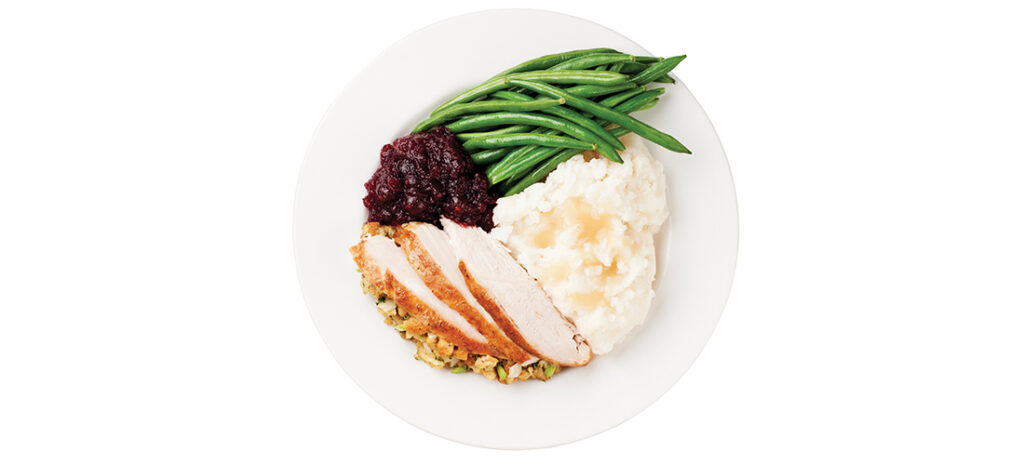
Lastly, I’m thankful for the millions of turkeys who sacrificed their lives so we could gather around a table laden with goodies. I don’t eat meat except on holidays and in the line of duty as a food writer. But on Thanksgiving I enjoy a well-done turkey thigh beside a mound of homemade cornbread stuffing, which means roasted inside, not outside, the bird, all doused with cranberry chutney.

So, bad as things may seem — war, famine, pandemics, earthquakes, fires, hurricanes — I hope everybody succeeds in putting some practical, meaningful thanks into their own Thanksgiving.  PS

Deborah Salomon is a contributing writer for PineStraw and The Pilot. She can be reached at debsalomon@nc.rr.com.

In the Spirit

In the Spirit

Barware Breakthroughs

Drink smarter, not harder

By Tony Cross

Every now and then while I’m scrolling through social media, I’ll come across a bartending or kitchen tool that catches my eye. This has become more frequent in the past couple of years as bartending/cocktail influencers flood my algorithm like a Category 4 hurricane. There are a ton of folks online who will do anything for likes and are way too flashy, but there are a few quality accounts with a passion for spirits, cocktails and hospitality. I’ve actually found new ways to make drinks easier and more fun from a couple of the better-quality sites. Since we live to serve, here are a few of my favorites:


Morgenthaler Triomphe Atomizer

Having an atomizer is nothing new when it comes to my collection of bar tools, but it’s the details of this one that made me splurge. I’ve been following longtime bartender Jeffrey Morgenthaler for years, whether it’s his bartending blog, cocktail books or YouTube videos. When he announced he was collaborating with Cocktail Kingdom, I pretty much knew that I’d be interested in whatever he was pitching. Plus, I’m a fanboy, so there you go. The main reason I purchased my first atomizer years ago was to make my Sazerac cocktails better: On busy nights, I was wasting absinthe by rinsing my rocks glasses with it. An atomizer gave me the opportunity to evenly coat the glasses by spraying a mist of absinthe inside them. Another perk was saving absinthe; having a 1- or 2-ounce atomizer makes whatever is inside it go a long way. In addition to having a fine mist, the Morgenthaler atomizer has one detail that makes it more user-friendly: a rotating, color-coded system. When I see a green dot, I know it’s absinthe; when I grab my orange dot atomizer, I know it’s Angostura. There’s also an option to turn it yellow and red. This makes grabbing the right atomizer easier without having to label them. The fact that it’s easy to fill and use makes it a great addition to my set.


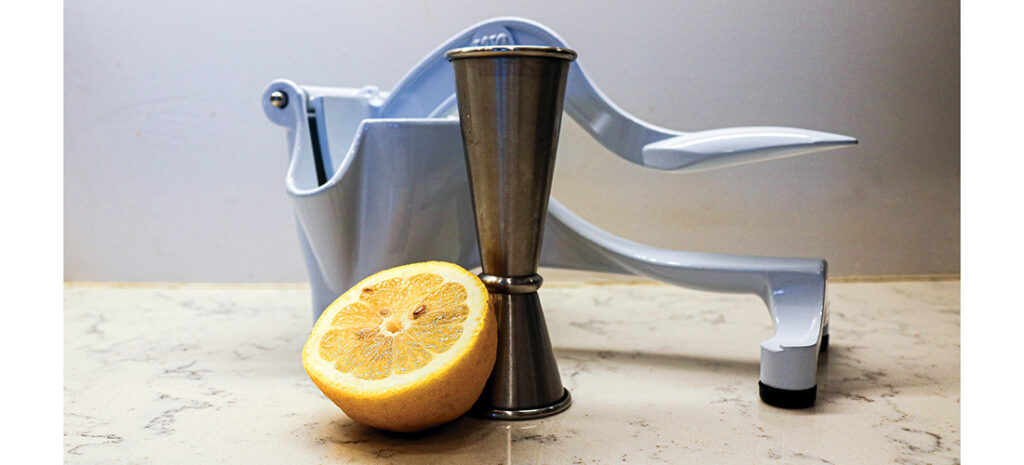
Vintage Kitchen’s “The Press”

This citrus press has gotten pretty popular, pretty damn quick. It seems like I saw it for the first time on an Instagram account and within a few months, everyone had their own — maybe not this exact brand, but a version of it. “The Press” is another way to juice your lemons and limes. What makes it different from your standard hand juicer, you ask? A couple of things. First, if you’re using a hand juicer and you press the citrus, you’re getting the juice, but the oils are lost. Using “The Press” squeezes the oils into the juice. This gives you a more flavorful fruit juice and will make your cocktails taste better. Second, hand juicers don’t allow for juicing oranges and grapefruits; they’re just too big to put in the fitting — even some lemons are hard to fit into hand juicers. This is exactly why I purchased one. Juicing grapefruits and oranges on the fly is effortless and, with the addition of the oils . . . it makes my tiki cocktails tastier and easier to make on-the-go.

 
Crew Supply Co. Crew and Chubby Bottles

The first time I came across Crew Bottles, I thought, “Why in the hell didn’t I think of that?” I was watching a bartender make a flavored syrup, and when he finished, he grabbed a glass bottle, twisted off the bottom and poured the syrup in. I had to have one. So, not only does it make adding syrups easier, it makes cleaning the glass bottles a cinch. Ever clean a bottle through just the small opening at the top? It’s more than a pain, especially if what was inside it stains and leaves an odor. Not only does Crew Supply make their syrup “Chubby” bottles, it also sells standard 750-milliliter “Crew” bottles. The same twist-bottom setup applies, but with the addition of measurements for 250, 500 and 750 milliliters. When the bottle is flipped upside down, you see graduated markings from 100 through 700 milliliters. No more guessing how much juice, spirit, syrup, or whatever else you’ve filled the bottle with, is left. Such a no-brainer moment. Even if you’re not a cocktail enthusiast, these make great gifts for anyone who spends time in the kitchen. PS

Tony Cross owns and operates Reverie Cocktails, a cocktail delivery service that delivers kegged cocktails for businesses to pour on tap — but once a bartender, always a bartender.

Creators of N.C.

Creators of N.C.

Books and Beans

Etaf Rum forges her own path in Rocky Mount

By Wiley Cash

Photographs By Mallory Cash

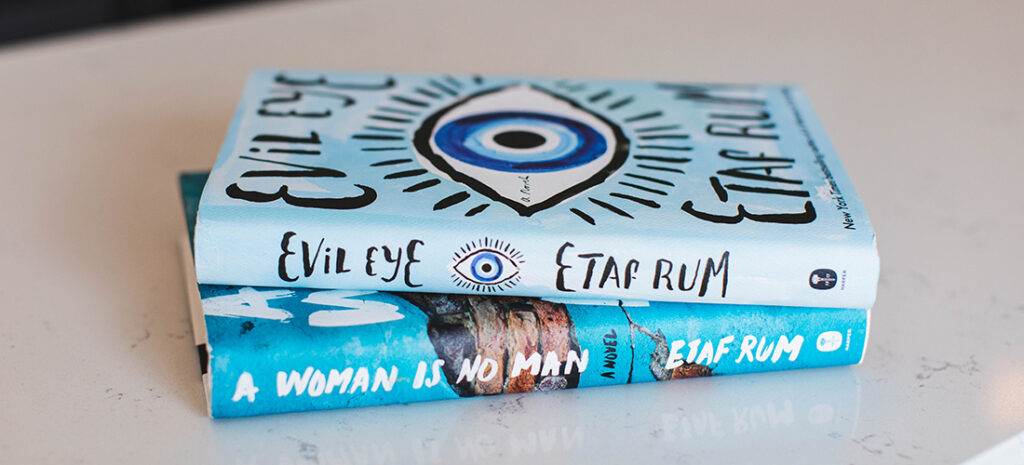
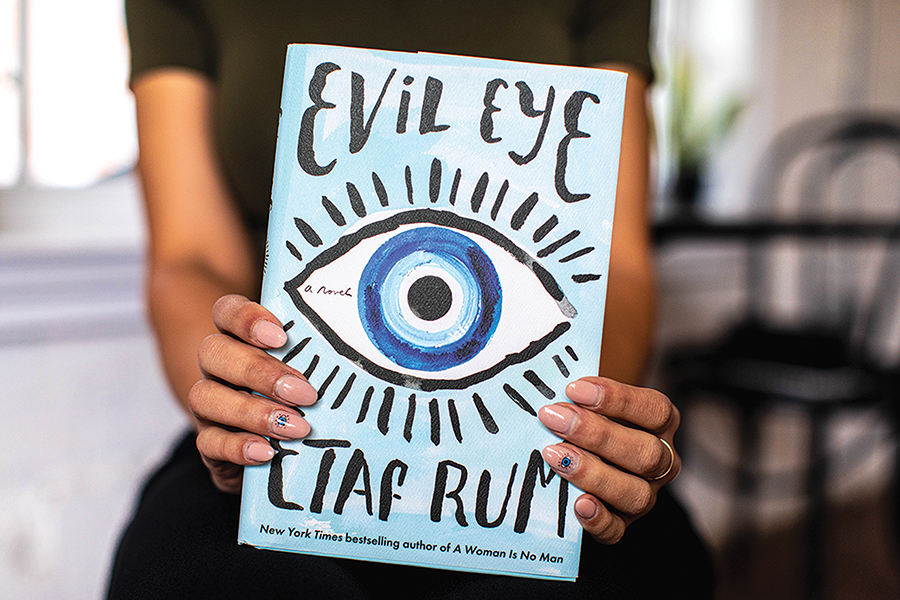
Rocky Mount-based writer Etaf Rum’s new novel, Evil Eye, is the story of a Palestinian American woman named Yara Murad who’s struggling to reconcile her identities of wife, mother, artist, professor, native Brooklynite and transplanted Southerner. From the outside, it looks like Yara has it all: a husband who supports her work at a local university; two sweet young daughters; a career teaching the art she loves. But as the novel opens, the reader watches Yara careen through her days in a silent, stifling panic, something unspoken and unfulfilled bubbling beneath the surface of her life.

Yara’s angst finds an outlet when she responds to a colleague’s shocking display of bigotry, but she isn’t prepared for the repercussions that follow. Her mother explains that Yara’s struggles are the result of an old family curse and she dismisses Yara’s frustration by saying that she should be happy that her husband has given Yara more freedoms than Yara’s father gave her.

Many writers would lean into the trope of the age-old curse to carry their plots, but Rum never relies on gimmicks or stereotypes, not in her characters, and not in her narrative. Instead, this character-driven novel investigates the ways in which we curse ourselves by settling for jobs and relationships that don’t fulfill us. Evil Eye is a book about the monotony of unfulfilled days (and nights), yet Rum has crafted this finely drawn portrait of domestic life into a page-turner.

“Actually, I felt like my first novel was a real page-turner, but one that I intentionally crafted to be so,” she says. “With Evil Eye, I did not want to write another page-turner. But as a writer you want to keep the story interesting, and you want the readers turning the pages. And I think for me, I had to challenge myself to write a character portrait.”

She is sitting at the counter at Books and Beans, a coffee shop and bookstore she owns with her husband, Brandon, in Rocky Mount. Light streams through the windows, making the white walls appear even brighter, and the terra cotta tile floors richer and more resonant.

“I was really interested in exploring the internal life of this character in an authentic way, and I hoped and I prayed that doing so would lend a readability that is relatable, authentic, and helps you get into the story. My intention was that it would be her personality and her character and all the things that we don’t know about her past that would motivate the reader to keep going.”

This reader kept going. I finished the novel in a couple of days.

But reading Evil Eye wasn’t always a comfortable experience. While we are firmly grounded in Yara’s point of view, and privy to her difficult childhood, we also have front row seats to the many anxieties she confronts in her everyday life. These anxieties are manifested in the workplace (in this case, higher education), on social media, in her role as a mother and wife, and in her struggles to pursue her passion as an artist.

“I wanted to write about these issues in the perspective of a character we haven’t seen before, a Palestinian American woman who you don’t really think about, but someone who has these universal anxieties that are so common for everyone, regardless of race, religion, ethnicity,” Rum says.

It was her hope that in seeing themselves in Yara’s story readers might see someone like Yara for the first time.

“Most readers can’t possibly connect with having an arranged marriage, but maybe they can connect with being a young mother or feeling like their dreams are unfulfilled or feeling like they’re living their lives and doing all the right things, only to wake up one day feeling so unsettled, thinking, Wait, is this actually what I want?”

In one particularly affecting scene, Yara opens Instagram, poised to post a photo in the hopes of proving that her life is more fulfilling than it actually is, but then she pauses, pondering the ways in which social media is often an aspirational portrayal of the lives we want instead of representative of the lives we’re willing to pursue. For Yara, the question in Evil Eye is whether or not she will ever reach for what she wants and deserves, or will she spend the rest of her life simmering and settling for the life she has?

“Why do we settle for what’s comfortable?” Rum asks. “Because we want to avoid the pain of growth.”

For Etaf Rum, Instagram surprisingly became a place for her to manifest her aspirations. Long before her debut novel, A Woman Is No Man, became a New York Times bestseller and a book club selection by the Today show’s Jenna Bush Hager, Rum was teaching English at Nash Community College. Before each class began, she regularly shared two of her greatest loves with her students: coffee and books.

“I would bring my students coffee and book recommendations,” she says. “And eventually they would ask, ‘What are you reading now?’ And so I created an Instagram account called Books and Beans, and it was like a joke between all of us. That was the year I started writing A Woman Is No Man.”

The Instagram page quickly garnered notice well beyond the walls of the college, and Rum soon found herself as an ambassador of the Book of the Month Club, helping them promote their selections through her Instagram account. Later, when her first novel was published in 2019, it actually included a coffee shop called Books and Beans. Writers call this foreshadowing.

This was around the time a development group was renovating Rocky Mount Mills into an 82-acre campus combining retail, dining and residences. There was a particular part of the campus Rum had her eye on. 

“They had a stand-alone old canteen building they wanted to open up as a coffee shop,” she says. “And so a bunch of people went to them and said, ‘Hey, we can open a coffee shop,’ and I was one of them. My husband, Brandon, worked in restaurants his whole life, so I said, ‘All right, you can help me with the business side of things.’”

They pitched their vision to the developers, and Books and Beans was born.

“It was my way of creating space for myself with things that I loved, and it was also my way of saying, ‘Hey, you can do whatever you want to do. There’s nothing out of reach for you. Just believe in it.’ The coffee shop was literally a manifestation of a dream that I’d had on social media, and we turned it into a physical building.”

A few years later, the shock still hasn’t worn off. Rum continually finds herself mesmerized by the fact that a Palestinian American woman born and raised in Brooklyn could create a community foothold in a small Southern town like Rocky Mount.

“Every time I walk past it I remind myself that there are girls like me who think they have no business running a shop. All it takes is believing that you could become part of something, right? If you don’t see that vision for yourself, if you don’t believe in it, then it will never happen.”

Cursed or charmed, coffee or beans, it all comes down to hard work and dreams.  PS

Wiley Cash is the executive director of Literary Arts at the University of North Carolina at Asheville and the founder of This Is Working, an online community for writers.

Hometown

Hometown

A Sight for Sore Eyes

Being thankful for the small print

By Bill Fields

I travel some for work, and some of the trips are on planes. Over the last year-and-a-half — as sure as people are determined to wedge steamer trunks into overhead compartments designed for briefcases — you would have seen me closing my left eye and training the right on something. It might be the no-smoking symbol, the lavatory locator, or a chyron on a fellow passenger’s television screen. This is not idle squinting.

I do these in-flight vision tests to reassure myself that my right eye is seeing crisply. Fortunately, it is, which is a reason I’m particularly grateful this Thanksgiving.

In early February 2022, my right eye suddenly wasn’t working properly one morning. It was as if a dark curtain was being pulled up from the bottom. I got to my ophthalmologist’s office by mid-afternoon.

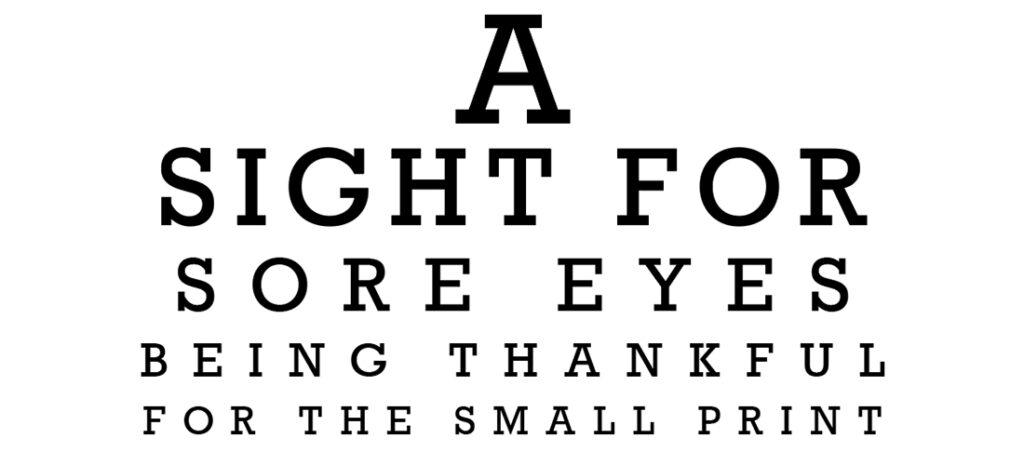
The technician who does the scans is usually cheerful and chatty but didn’t say much this time. In the exam room, looking at the eye chart confirmed why he had been mum minutes earlier.

It wasn’t that the smaller letters were blurry — they were obscured by whatever was going on inside my eye. My vision was limited to the largest letter on top, the “Big E.” I joked about Elvin Hayes, but the young man asking what I could see had no clue about my reference to a basketball star from many years ago.

In the nervous minutes waiting for the doctor to come into the room, I thought about the life of my eyes.

I didn’t even need glasses until I was in college. Covering a Carolina-State football game in Raleigh during the fall of 1979, I realized I was having trouble seeing the jersey numbers. A subsequent exam indicated nearsightedness, and I got glasses for distance.

Contact lenses came later. In my early 40s, like so many others, I began to have trouble seeing up close. I thought about my dad at the breakfast table and how he had held the newspaper increasingly farther away before finally getting a pair of magnifying readers. I recalled my mom saying, “You’re in my light” and not understanding why that was a big deal.

My moment came when I was helping a friend hook up a television on a shelf in an armoire. The back of it was a shadowy tangle of cords, and I had a hard time. I stopped at a drugstore on the way home to purchase reading glasses.

Cataract surgery on both eyes in the fall of 2020 was liberating — I was able after 40 years to ditch corrective lenses for distance. But my vision bliss was short-lived. The ophthalmologist told me I had a detached retina and presently was on the phone to a retina specialist across town. A doctor there confirmed the retina in my right eye was fully detached, and I was headed for surgery the next day.

“You were a 5 out of 10,” the surgeon told me after he had finished. “Not the easiest, not the hardest.”

He had reattached the retina and inserted a gas bubble to encourage healing. The bubble appeared as a dark circle in my vision for more than two months, getting smaller as it dissipated, from the size of a nickel to a speck of black.

For three weeks after the operation, I had to be face-down — “Looking at the Earth,” as the doctor put it — eight to 10 hours per day to maximize the bubble’s effect on the repaired retina. I rented a chair designed for such recoveries. Its mirror allowed me to watch TV, which mitigated the boredom because reading was difficult.

Through months of checkups and eye drops, vision in the surgical eye improved. After the bubble shrank enough to allow some sight, what I had was like looking through a frosted window. Over time, the vision improved and I began to be able to read the smaller lines of type on a poster across my living room couch, my at-home eye chart.

It was 20/120, then 20/80. Earlier this year, an eye test indicated even more improvement: 20/25. Being able to see the little letters is a big deal indeed.  PS

Southern Pines native Bill Fields, who writes about golf and other things, moved north in 1986 but hasn’t lost his accent.

Bookshelf

Bookshelf

November Books

FICTION

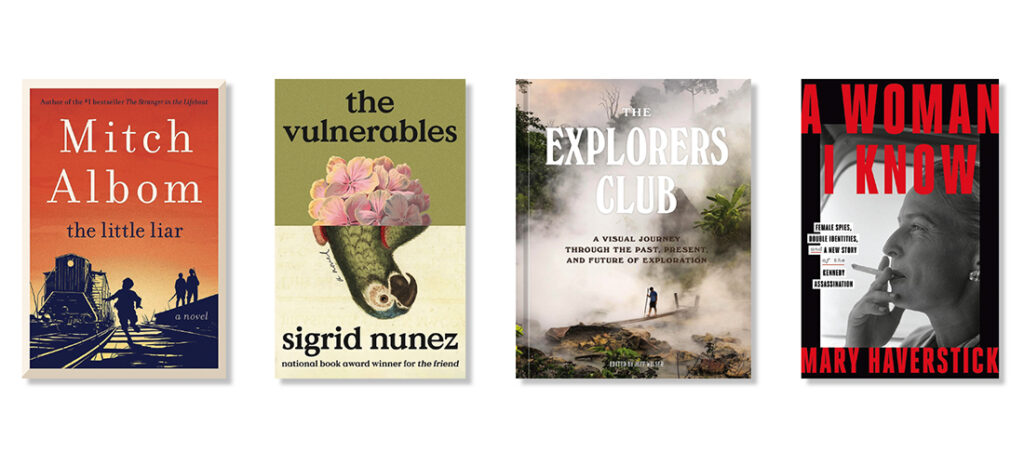
The Little Liar, by Mitch Albom

Until his 11th birthday, Nico Krispis had never told a lie. When the Nazis invade his home in Salonika, Greece, the trustworthy boy is discovered by a German officer, who offers him a chance to save his family. All Nico has to do is convince his fellow Jewish residents to board trains heading toward “the East,” where they are promised jobs and safety. Unaware that this is all a cruel ruse, the honest boy tells the frightened passengers they will be safe. But when the final train is loaded, Nico sees his family being pushed inside. Only after it is too late does he realize he has been helping send everyone he loves to their doom. He never tells the truth again. Albom interweaves the stories of Nico, who becomes a pathological liar, his brother Sebastian and their schoolmate Fannie, who survive the death camps and marry as teenagers, and Udo Graf, the Nazi officer who duped Nico into losing his soul, in this deeply moving story about the harm we inflict with our deceits, and the power of love to ultimately redeem us.

The Vulnerables, by Sigrid Nunez

Elegy plus comedy is the only way to express how we live in the world today, says a character in this New York Times bestselling author’s ninth novel. A solitary female narrator asks what it means to be alive at this complex moment in history and considers how our present reality affects the way a person looks back on her past. Humor, to be sure, is a priceless refuge. Equally vital is connection with others, who here include an adrift member of Gen Z and a spirited parrot named Eureka. The Vulnerables reveals what happens when strangers are willing to open their hearts to each other, and how far even small acts of caring can go to ease another’s distress.

NONFICTION

The Explorers Club: A Visual Journey Through the Past, Present, and Future of Exploration, edited by Jeff Wilser

The discovery of the North and South Poles. The summiting of Everest. The moon landing. The birth of climate change science. These are just some of the stories from The Explorers Club, the book released by the organization that, since its inception in 1904, has pushed the envelope of human curiosity. This guided tour of the club’s most riveting journeys includes hundreds of photos and fascinating anecdotes about its distinguished members, including Teddy Roosevelt, Neil Armstrong and Jane Goodall. From the darkest depths of the ocean to the highest points on Earth, and to outer space and beyond, this book shares the inspirational history of exploration.

A Woman I Know, by Mary Haverstick

The true story of a filmmaker whose unexpected investigation opened a new window onto the world of Cold War espionage, CIA secrets and the assassination of President John F. Kennedy. Haverstick, an independent filmmaker, thought she’d stumbled onto the project of a lifetime — a biopic of a little-known aviation legend whose story seemed to embody the hopeful spirit of the dawn of the Space Age. After receiving a mysterious warning from a government agent, what she found as she dug deeper was a darker story of double identities and female spies, a tangle of intrigue that stretched from the fields of the Congo to the shores of Cuba, from the streets of Mexico City to the dark heart of the Kennedy assassination in Dallas.


CHILDREN’S BOOKS

Illusions in Art: Animals, by Chiêu Anh Urban

Simple illustrations of a monkey, a seal, a fox, a swan contain cleverly hidden drawings of entirely different animals in this exploration of positive and negative space. Art! Animals! Together time! There couldn’t be a more perfect “sit in my lap and read” book than this. (Ages 2-4.)

I Want 100 Dogs, by Stacy McAnulty

Getting a new pet is always a delicate negotiation between the pet “wanter” and the ultimate pet “caretaker.” This delightful new “tail” tale hilariously, yet poignantly, digs into the how, what, when and why of pet ownership. Fun for anyone considering adding a furry family member. (Ages 3-7.)

Okra Stew: A Gullah Geechee Family Celebration, by Natalie Daise

You can almost smell the salt marsh in this stunning homage to Gullah culture, father-son love, and okra. With art reminiscent of Lois Ehlert or Faith Ringgold, this one is a must for all young Southern foodies. (Ages 3-7.)

There Was a Party for Langston,
by Jason Reynolds

There was a hoopla in Harlem. A whizbanger for the wordsmiths. Young readers can celebrate the joy of Langston Hughes through the verse of Jason Reynolds and the illustrations of Jerome and Jarret Pumphrey in this must-have new picture book. (Ages 3-7.)

5,000 Years of Awesome Objects: A History of Art for Children, by Aaron Rosen, Susie Hodge, Susie Brooks,
Mary Richards

Go on a trip through the Metropolitan Museum of Art and get lost in a book that features 5,000 years of the most unusual, bizarre, fascinating and awesome objects in history including Mayan jewelry, Egyptian amulets and even American baseball cards. (Ages 8 and up.)  PS


Compiled by Kimberly Daniels Taws and Angie Tally.

The Omnivorous Reader

The Omnivorous Reader

Portrait of a Genius

When art and politics collide

By Stephen E. Smith

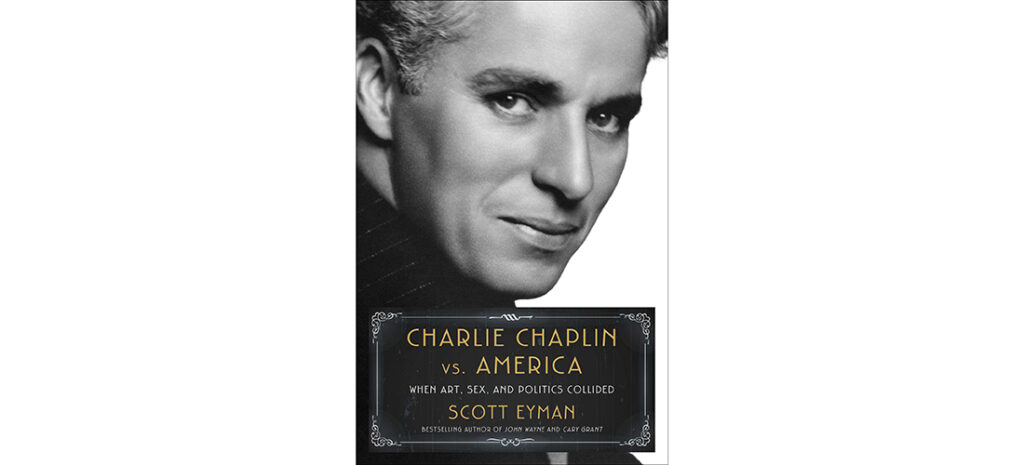
At a moment in our cultural/political history when we disagree about almost everything, you’d expect an ambitious pundit to pen a bestseller titled America vs. America: A Definitive Analysis of Our Cantankerousness. Although books aplenty attempt such revelations, it’s difficult, if not impossible, to articulate the forces at work in the here and now, but literary critic Scott Eyman has given us the next best thing to an explanation: Charlie Chaplin vs. America: When Art, Sex, and Politics Collided, an exposé/biography of a man who defined, at least in part, the last century, and who suffered the slings and arrows of an America gone wacky.

Eyman’s latest offering — he’s authored six previous books on the film industry and various movie stars — may strike readers as a story told a trifle too late. After all, Charlie Chaplin is ancient history, a wobbly, bowler-topped, black and white stick figure balanced on a rubbery cane who inexplicably entertained our grandparents with the silent knowledge that authentic comedy has its source in the concealment of anguish. The day-to-day details of Chaplin’s life notwithstanding, there’s insight aplenty in this cautionary tale of an artist whose universal popularity among Americans diminished to the point that he was run out of the country and forced to take up residence in Switzerland for the later years of his life.

Chaplin was born in England and suffered a childhood of poverty and hardship. His alcoholic father abandoned the family, and he and his brother were sent to a workhouse. His mother was committed to a mental institution when he was 14, and Chaplin was forced to find work touring theaters and music halls as a stage actor and comedian. At 19, he toured with a company that traveled the United States, where he eventually signed with Keystone Studios. By the age of 20, he was the best-known man in the world.

Chaplin co-founded United Artists and went on to write and produce The Kid, A Woman of Paris, The Gold Rush and The Circus. After the introduction of talkies, he released two silent films, City Lights and Modern Times, both film classics, followed by his first sound film, The Great Dictator, which satirized Adolf Hitler. After abandoning his Tramp persona, his later films included Monsieur Verdoux, Limelight and A King in New York. His credits and awards would fill this page, but less-than-knowledgeable readers need only grasp this basic fact: Chaplin was a creative genius who had a profound influence on popular culture and the art of filmmaking.

The focus of Eyman’s biography is Chaplin’s fall from grace. Early in his career, Chaplin was accused in a paternity suit in which he was found guilty, although blood tests proved conclusively that he was not the father (at the time, the state of California didn’t recognize blood tests as evidence); but the scandal was enough to attract the attention of gossip columnists, Hedda Hopper foremost among them, who were always collecting dirt on celebrity targets that would sell newspapers.

More destructive to Chaplin’s reputation was the public curiosity regarding his politics. Although he lived much of his life in the United States — indeed, he made most of his fortune here — he never applied for citizenship, which generated a cloud of suspicion that never quite dissipated. Chaplin claimed to be an anarchist, “not in the bomb-throwing sense,” Eyman writes, “but in his dislike of rules and a preference for as much liberty as the law allowed, and maybe just a bit more.” In truth, he was little interested in politicians and politics, outside the restraints placed on the arts by contemporaries who were politically minded.

Having suffered through a childhood of poverty, he harbored a great concern for the underprivileged, which is evident in all his films. But when he released Modern Times, which thematically explored the unending struggle against authoritarianism, and The Great Dictator, which mocked Adolf Hitler, both films, humorous but essentially didactic in intent, further thrust Chaplin into the political arena. Prior to our involvement in World War II, he publicly advocated an alliance with the Soviet Union, and members of the press and the public were scandalized by his marriage when he was 54, to 18-year-old Oona O’Neill, the daughter of playwright Eugene O’Neill.

Because of his support of Russia, Chaplin was accused of being a communist sympathizer, and the FBI opened an investigation, all of which fed into the Red Scare and McCarthyism of the early 1950s. Chaplin fell into such disfavor with the public that he was denied re-entry to the U.S. after leaving for the London premiere of his film Limelight.

Eyman’s book is a “social, political and cultural history of the crucial period in the life of a seminal twentieth-century figure — the original independent filmmaker who gradually fell into moral combat with his adopted country precisely because of the beliefs that form the core of his personality and films.”

Certainly, the activities of the press — particularly the gossip columnists who fed on Chaplin’s foibles; and the FBI, which launched a long, out-of-control investigation of Chaplin’s life — will give the thoughtful reader pause. FBI files on Chaplin ran to over 1,900 pages, mostly hearsay procured from dubious sources, material that was fed to friendly reporters who used the misinformation to besmirch Chaplin’s character and promote themselves.

Are there definitive elements in Chaplin’s life that precisely parallel the political/cultural moment in which we find ourselves? Probably not. As usual, Mark Twain is credited with having said it best: “History doesn’t repeat itself but it often rhymes,” and readers, regardless of their politics, are likely to find themselves singing along with whatever sad tune history is humming at the moment.   PS

Stephen E. Smith is a retired professor and the author of seven books of poetry and prose. He is the recipient of the Poetry Northwest Young Poet’s Prize, the Zoe Kincaid Brockman Prize for poetry and four North Carolina Press Awards.

Tea Leaf Astrologer

Change this heading to match Post Title

Scorpio

(October 23 – November 21)

Everyone knows that the greatest revenge story never told is currently playing on a loop inside the dark and secretive mind of a Scorpio sun child. Relax. While the mischievous glint in your eyes does raise some suspicion, they’ll never know what you’re really thinking. On Monday, November 13, a new moon in your sign will offer a fresh perspective. Are you ready for a plot twist? You just might surprise yourself.

Tea leaf “fortunes” for the rest of you:

Sagittarius (November 22 – December 21)

You’re going to taste that more than once.

Capricorn (December 22 – January 19)

Splurge on the fancy cheese.

Aquarius (January 20 – February 18)

Clear the cobwebs.

Pisces (February 19 – March 20)

Your eyes give you away.

Aries (March 21 – April 19) 

Two words: buffet etiquette.

Taurus (April 20 – May 20)

You’re clenching your teeth again.

Gemini (May 21 – June 20)

Leave your shoes by the door.

Cancer (June 21 – July 22)

Dress for the part you want.

Leo (July 23 – August 22)

Try chewing between bites.

Virgo (August 23 – September 22)

Make space for a new houseplant.

Libra (September 23 – October 22)

Ever tried kickboxing?

Zora Stellanova has been divining with tea leaves since Game of Thrones’ Starbucks cup mishap of 2019. While she’s not exactly a medium, she’s far from average. She lives in the N.C. foothills with her Sphynx cat, Lyla.

PinePitch November 2023

PinePitch November 2023

Question Everything

Be prepared to be transported to a world where secrets fester and the line between reality and illusion blurs when the Judson Theatre Company presents Gaslight, performed on Broadway as Angel Street, in five performances beginning at 7 p.m. on Thursday, Nov. 16, and running through a 3 p.m. matinee on Sunday, Nov. 19 at BPAC’s Owens Auditorium, 3395 Airport Road, Pinehurst. Set in a charming Victorian London townhouse, Gaslight, starring Jennifer Hope and Matthew Tyler, revolves around a seemingly perfect marriage, beneath which lies a sinister plot. Sanity is questioned and strange occurrences unfold in a heart-pounding journey to unravel a dark mystery. For more information go to www.ticketmesandhills.com.


The Last First

The Main Squeeze, an American funk band from Bloomington, Indiana, will bring down the curtain — if there was a curtain on the outdoor stage — on the First Friday concerts for 2023. The music begins at 5 p.m. and wraps at 8 p.m. on Friday, Nov. 3, on the Sunrise Square adjacent to the Sunrise Theater, 250 N.W. Broad St., Southern Pines. Everyone knows the drill. Food trucks. Check. Beer for imbibing. Check. Cujos? No so much. It’s the last one of the year, so leave your pets at home and wander by. For additional information call (910) 420-2549 or go to www.sunrisetheater.com.

 

Sugar Plums and Mouse Kings

Gary Taylor Dance presents The Nutcracker, from 7:30 p.m. to 9:30 p.m., on Friday, Nov. 24, at BPAC’s Owens Auditorium, 3395 Airport Road, Pinehurst. There will be additional performances of this holiday classic by Pyotr Ilyich Tchaikovsky on Nov. 25 and Nov. 26 at 2 p.m. For information and tickets go to www.ticketmesandhills.com.
 

Let There Be Light

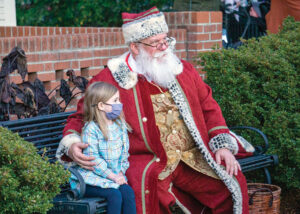
Ring in the holidays at Southern Pines’ annual tree-lighting celebration on Saturday, Nov. 25, from 4:30 p.m. to 6 p.m. In addition to block after block of colorfully decorated trees, keep an eye out for Santa Claus. He’s available for pictures. Bring your own camera but no autographs, please. For information call: (910) 692-7376.


From Apartheid to Democracy

William Lucas, a 33-year veteran of the U.S. Foreign Service, joins the Ruth Pauley Lecture Series with a talk titled “The Mandela-DeKlerk ‘Miracle’” on Thursday, Nov. 9, at BPAC’s Owens Auditorium, 3395 Airport Road, Pinehurst. Lucas was twice assigned to the U.S. Embassy in Pretoria, South Africa, as a political officer serving from 1981-83 and again from 1988-91. He was the director, African Affairs, at the National Security Council in 2006. His current projects include a book on the transition from apartheid to democracy in the ’80s and ’90s, based on interviews with key South African and American officials as well as declassified documentation obtained under the Freedom of Information Act. For additional details go to www.sandhillsbpac.com.

 

11th Hour, 11th Day, 11th Month

Downtown Southern Pines’ Veteran’s Day Parade will be from 10 a.m. to 12 p.m. on Saturday, Nov. 11. Bring the whole family to support our troops and veterans. All veterans are invited to join the parade. For more information call (910) 692-7376 or leaf through a history book. Freedom isn’t free.


Golf Talk Live

Join Southern Pines native and longtime PineStraw contributor Bill Fields in conversation with his old colleague and PineStraw editor Jim Moriarty as they discuss their decades covering golf and writing about it on Nov. 15 at 5:30 p.m. at the Weymouth Center for the Arts and  Humanities, 555 E. Connecticut Avenue, Southern Pines. Fields, who will be at Weymouth as a writer-in-residence, has contributed multiple features to PineStraw and penned over 100 of his “Hometown” columns since it first appeared in the magazine in Dec. 2014. He was born in Moore County, graduated from Pinecrest High School in 1977 and from the University of North Carolina – Chapel Hill in 1981. Fields has been a writer and editor for multiple golf publications and is currently a researcher on NBC’s golf telecasts, serving as the little voice whispering interesting facts into Dan Hicks’ ear. The program is free of charge but registration is required. For info go to www.weymouthcenter.org.


Sandhills Originals

The Artists League of the Sandhills begins its 29th Annual Art Exhibit and Sale on Friday, Nov. 3, from 5 p.m. to 7 p.m., at 129 Exchange St., Aberdeen. The show continues on Saturday with a “meet the artist” session from 11 a.m. to 3 p.m. The exhibit and sale runs through Dec. 15. For additional information go to www.artistleague.org.


Take a Deep Breath

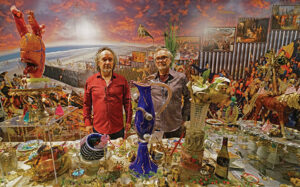
World-renowned glass artists Einar and James De La Torre will give a glass-blowing demonstration at Starworks, 100 Russell Drive, Star, from 5:30 p.m. to 7:30 p.m. on Thursday, Nov. 9. There will be live music by Laura Jane Vincent and beverages available from the Starworks Café and Taproom. The House of Odell & Luella food truck will be on-site. The event is family and pet friendly, if everyone is on a leash. Well, the pets anyway. Tickets are $5. For more information go to www.StarworksNC.org.

Simple Life

Simple Life

A Cure for the Summer Blues

And a homecoming for a flat-coated retriever

By Jim Dodson

As I write this, I’ve just returned from East Hampton, New York, where I sat on the porch of a beautiful old house that belongs to my friends, Rees Jones, the famous golf architect, and his wife, Susan. The sun had just come up and the first birds were chirping. Susan’s gardens were lush from recent rains. It was the day after Labor Day and the summer crowds were finally winding their way home.

I’d be lying if I said I was sad to see this particular summer go. It was a real doozy back home in Carolina, the hottest and driest summer I can recall, which explains why I spent many days watering my wilted gardens that seemed prepared to give up the ghost.

But I’m already in a November state of mind.

November, you see, is one of my two favorite months, when I pause to take inventory of the year, count my blessings and thank the Lord for unexpected gifts.

This year I’m starting early with a dog named Blue. He was the one great thing about summer’s end — besides summer’s end.

Up till the moment my wife, Wendy, found him, I was feeling intense lingering grief over the loss of my beloved dog Mulligan at the end of August last year.

Mully, as I called her, was 17 and had been my faithful traveling pal since the October day in 2005 when I found her running wild and free on the shoulder of a busy highway near the South Carolina line, a filthy, joyful, black pup that raced into my arms as if she knew I was there to save her — though I’m convinced it was the other way around. Whichever it was, we found each other and shared an uncommonly powerful bond to the very end.

One of the saddest moments of my life was watching her soulful brown eyes close for the last time as she lay at my feet in the garden she helped me build. Or it felt like it at the time.

Grief is such untidy business. It squeezes your heart at unexpected moments. Every time I saw a dog that looked like Mully — a flat-coated retriever and border collie mix — I found myself almost aching with returning sadness.

Even our aging and sweet old pit bull, Gracie, whom I call Piggie for the way she snorts when eating and sleeping, seemed to keenly feel Mully’s absence, despite the fact that pits are not known for displaying much emotion. 

One day last fall, I happened to open an app to Red Dog Rescue and there was a black-and-white female puppy looking for a forever home. I was sure Mully was sending her to us. So, on a lark, I filled out the paperwork and supplied proper references. A week or so later, we drove to a farm down in Asheboro to pick her up.

We named her Winnie — either after Winnie-the-Pooh or my late friend Winnie Palmer, Arnold’s wonderful wife — I’m still not sure which.

It wasn’t long before I started calling her Wild Winnie. She is an exceptionally smart and insanely joyful mix of Labrador retriever, English springer spaniel plus something her DNA results termed as “Super Mutt.” She is every bit that and more.

In truth, however, I wasn’t sure life in an old suburban city neighborhood would be sufficient for our beautiful Super Mutt’s needs.

But I was wrong. Winnie quickly attached herself to Gracie the Bull and my wife, Wendy, who took her to training classes and soon had her performing an impressive repertoire of obedient commands. Wendy also began taking Winnie to Country Park’s BarkPark, where she fell in with a band of rough-and-tumble regulars named Roger, Jack and Ellie that run, wrestle and chase each other until they drop from exhaustion.

Winnie, in short, has been a joy. Without fail, she jumps into my lap every morning to give me a soppy lick of gratitude for finding her.

But she’s clearly one of the girls. Wendy is her sun and moon. I’m just Wild Winnie’s fun playmate.

I was OK with that until the end of August, when the first anniversary of losing Mully approached.

My intuitive wife seemed to divine that my normal “summer blues” were worse than ever this year. One afternoon as we shared a cool drink beneath the shade trees, she handed me her iPhone and said, smiling, “So what do you think?”

It was a photo of a beautiful black flat-coated retriever that looked exactly like Mully.

“He’s over in Tennessee, a rescued young male who belonged to a lady who had to give him up. They say he’s sweet as can be, loves other dogs and even cats. They’re taking a load of rescued dogs to New England and will be passing through western Virginia this Friday evening. If you’re interested. I’ve already cleared our references.”

For several seconds I said nothing, just stared at the photo.

“You need your dog,” my wise wife quietly said.

So we drove to western Virginia and picked him up. On the two-hour drive home, he climbed up front and placed his head in my lap and fell asleep.

We named him Blue, my forever cure for the summer blues. After a bath, he was so black he was blue. My daughter, Maggie, suggested the name.

Blue follows me everywhere, lies at my feet and already answers to his name. Piggie and Winnie adore him. Ditto Boo Radley, the cat.

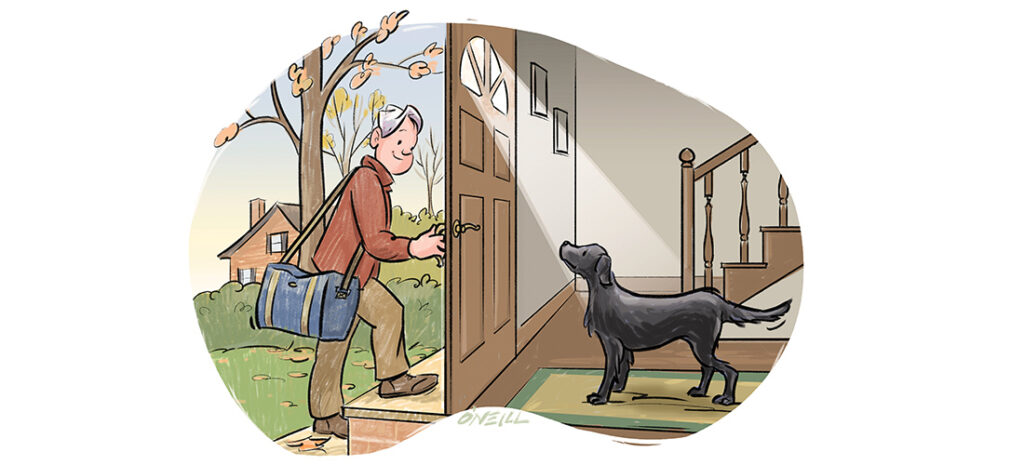
On the evening I arrived home from New York, Blue was the first one to greet me at the door, hopping up to give me a lick on the chin.

It was good to be home.

For both of us. PS

Jim Dodson can be reached at jwdauthor@gmail.com.