The Carriage House Rides Again

The Carriage House Rides Again

Style and originality reign in a chic pied-à-terre

By Deborah Salomon     Photographs by John Gessner


Somewhere, over the rainbow, James Walker Tufts and James Boyd can share a high five. They have found the perfect occupants for their respective villages: He plays golf. She rides. They are happily, healthfully retired, spending summers at their primary residence Up North — Ohio, that is. But when winter’s chill descends so do they, to Pinehurst, with her horse, of course.

“Such interesting people here,” says Linda Salvato.

As are they. Guy Salvato is an artist, graphic and otherwise, who worked at Manhattan’s slickest advertising agency during the Mad Men era. Most of his paintings are golf related. Linda was a consultant in health care marketing. Their primary Ohio home is a Cotswolds gatehouse, designed by an architect who traveled to the Cotswolds for inspiration.

Guy’s four sons are grown, married, with grandchildren of their own. So why not search out a pied-à-terre that pushed their respective buttons? Something quaint without being cloying, surrounded by a community of wine-sipping, cheese-nibbling, concert-going, philanthropic world citizens conversant in, well, just about everything.

No need for massive square footage — the great-grandchildren can stay elsewhere. Instead, a massive need for style and originality.

They were not aware of Pinehurst’s suitability until one of Guy’s sons discovered an international golf art seminar at Pine Needles Lodge & Golf Club.

Let’s go!

“I had been here in the ’90s but it was Linda’s first time,” Guy recalls.

While he was putt-erring around the village, Linda inquired if anybody kept horses. A drive down Young’s Road revealed the answer: “Perfect!” she exclaimed.

The “hunt” for lodging was on. Her requirements: stringent, including proximity to the village, with a historic component, maybe a juicy backstory.

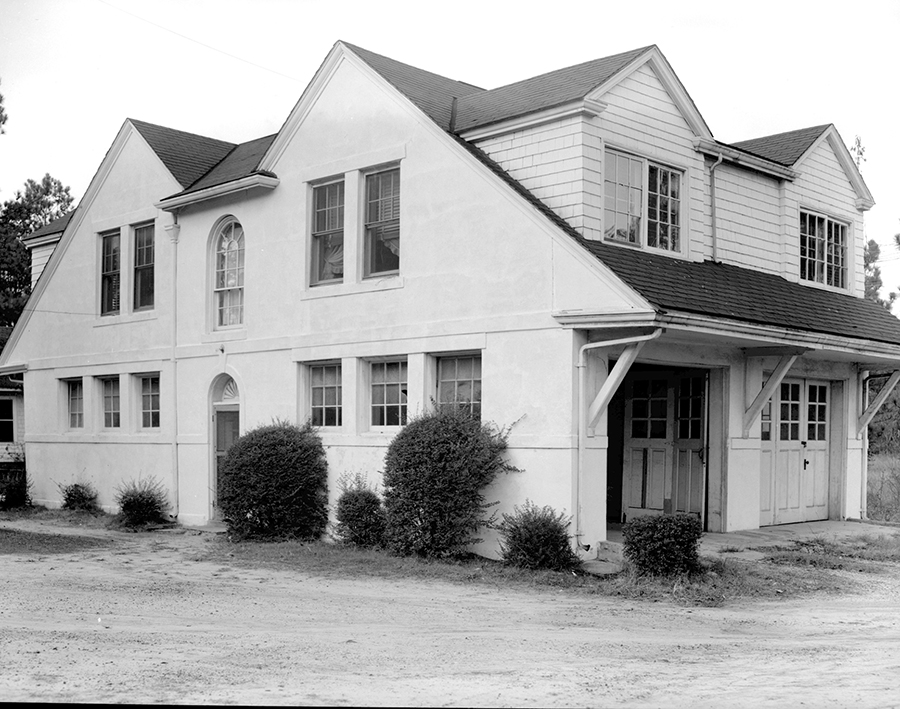
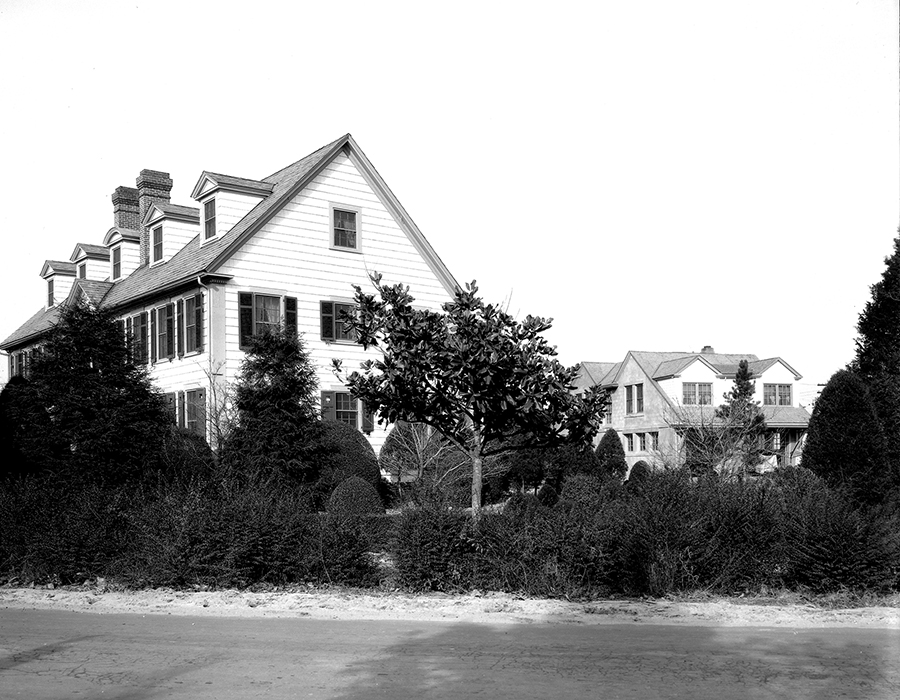
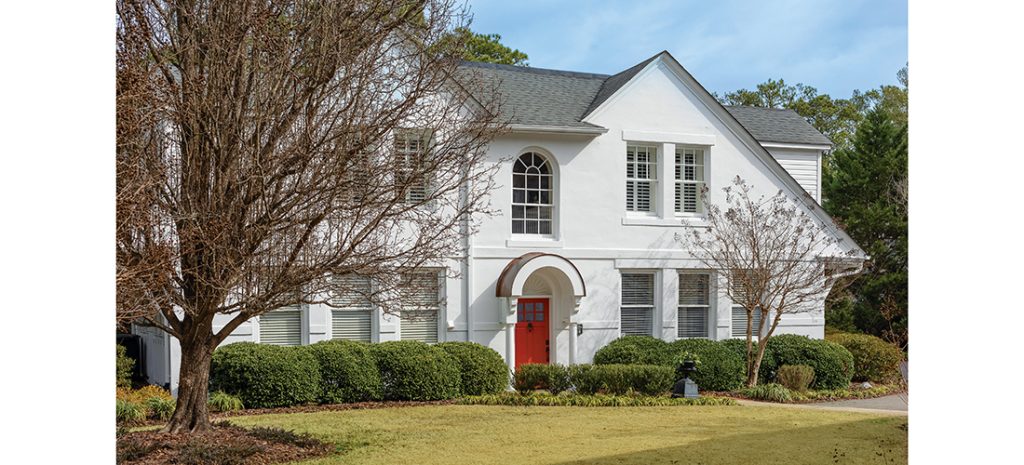
You can’t get much more historic than a wood shingle Colonial Revival multi-unit residence (sounds better than “boarding” or “apartment” house) built by Old Man Tufts himself, in 1896, the same year Pinehurst was founded. The elongated structure stretched across the corner of Palmetto and Cherokee roads. Construction cost: $1,650.


    

A carriage house with hayloft was added about 1921. When the carriage trade declined, garage doors were installed to accommodate the family roadster. Perhaps because the property attracted more transients than blue bloods, little mention of Palmetto’s history or occupants survives in the society pages.

A subsequent owner renamed it Cloverleaf, described as being located near one of four gates in a fence meant to keep out wild pigs.

The property fell into disrepair. Neighbors (and the village appearance commission) branded it an eyesore until, according to The Pilot, the owner was cajoled into slapping on a coat of paint before the 2005 U.S. Open.

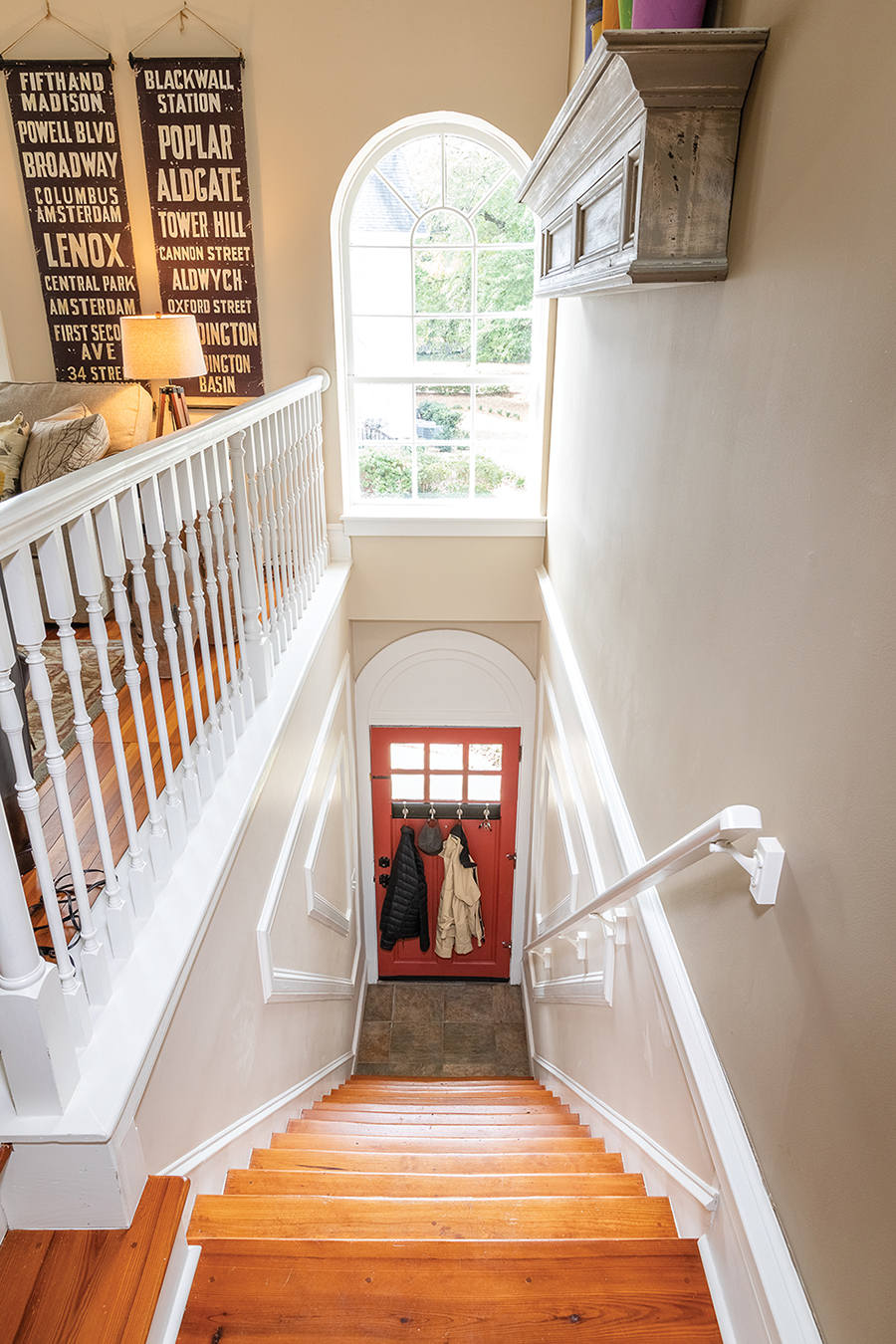
Then, in 2006, a local builder transformed the sad carriage house into two chic pieds-à-terre, adding a Palladian window to the atrium, a tiny skylight and enough moldings, paneled doors and ornate window frames with deep sills to wow a creative retired couple from Ohio.

Linda opened the door and exclaimed, “This is it!”

They snapped up Unit 10 in 2012, made some adjustments to a bathroom and moved in for the 2013 winter season.

      

Carriage houses, like Manhattan lofts, are rare, therefore precious. Never mind the steep flight of stairs or the modest 1,380 square footage. Concentrate, rather, on the character afforded by original mismatched pine floorboards, wall space for Guy’s golf paintings and a garden plot for this master gardener/cook. On the nights Guy doesn’t prepare an Italian original, village bistros are within walking distance.

Next came a wicked pleasure enjoyed by mature second homeowners: furnishing rooms from scratch in a breezy style dubbed “Online Eclectic,” with the exception of a rare Wells Fargo (stagecoach company, not bank) desk Linda found while strolling through the shops in Cameron.

“We both have decent design sense,” Guy notes, so no need for an interior designer. Shades of seafoam, sand, gray, vanilla and other pale neutrals flow into each other. Stylized patterns on bedroom fabrics add whimsy, while uncluttered surfaces throughout make small rooms appear larger.


   

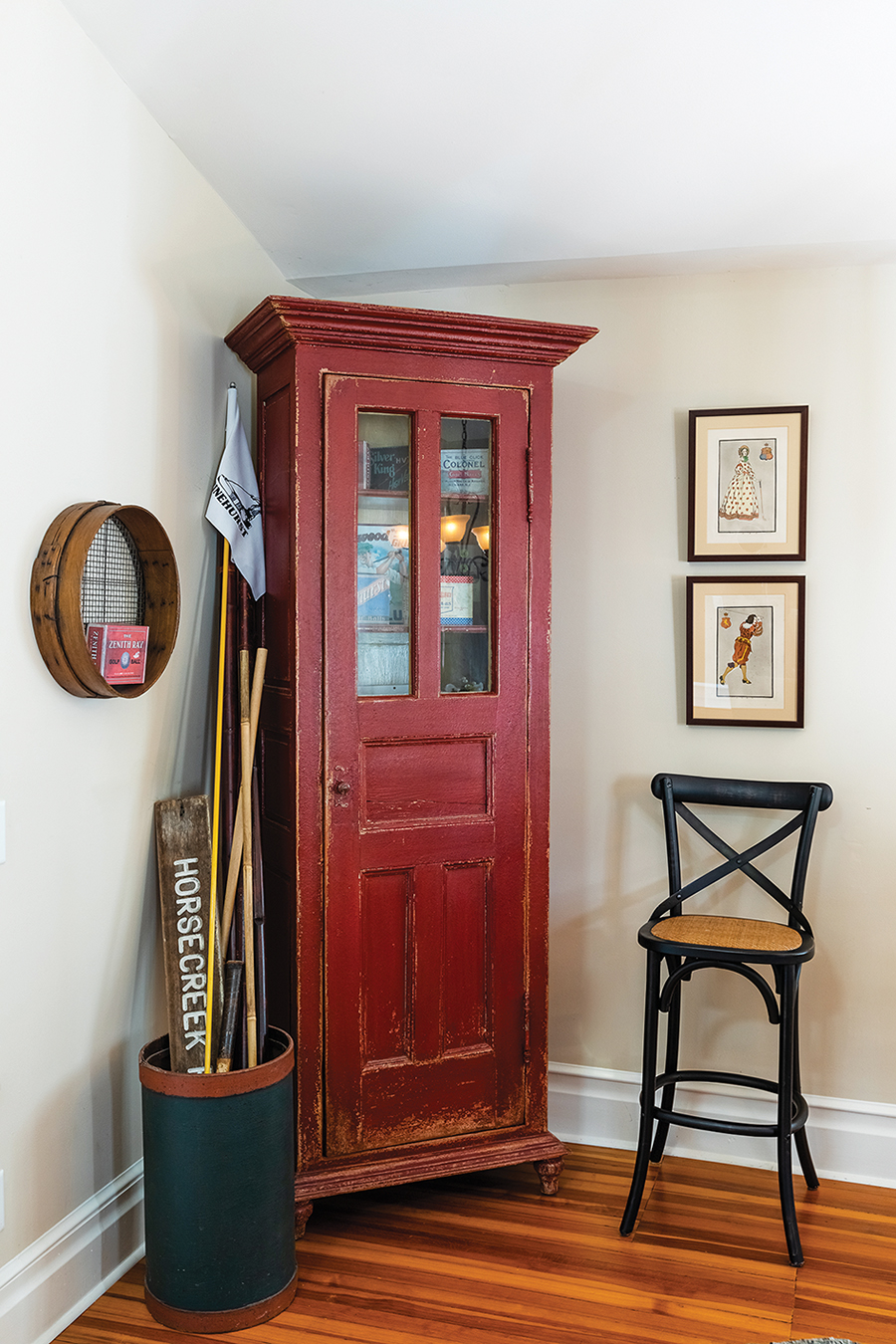
Uncluttered, however, doesn’t mean empty. Or boring. Brightly painted tin cans line one wall shelf. Wood-turned bowls, dramatic examples of craft art, sit center stage on a tall dining area table seating four but folding out to accommodate eight. The kitchen is a little gem. An old-timey Pinehurst equestrian poster speaks for Linda. A golf bag anchors a corner. Guy’s stylized golf tee painting dominates a wall. That he and Andy Warhol traveled in the same New York circles is no surprise since both worked in ad illustration. Nor is Guy’s regret for not saving some of the pop artist’s discards. In 2022, one from a Marilyn Monroe series sold at auction for $195 million.

With the plantation shutters open and sun streaming from the tiny skylight, the residence with multiple ceiling pitches and lovely landscaping feels like a treehouse. To describe interior décor as hard to describe is the ultimate compliment.


        

The Carriage House beside Palmetto House, after a century of multiple owners and iterations, finished a win-win. The Tufts-Boyd plan worked. Old Town gained another historic reclamation. And two transplants from the Midwest — plus a retired racehorse of championship lineage — discovered nothing could be finer than to winter in Carolina.

“Being here, I feel a sense of relief,” says Linda, who rides almost daily. “I feel energized to do things I wouldn’t do up north.”

“I love doing the exterior work,” and playing golf, of course, Guy adds. “I worked hard for many years. I looked forward to something like this.”

Linda’s summation: “Two beautiful homes and everything else . . . we do have a blessed life.”  PS

Hometown

In the Spirit

What’s the Rush?

Slow down and smell the Thai food

By Bill Fields

When I made late plans to travel south by car in January, I did something without hesitation for the first time. More than 35 years since the maiden drive I took along the Eastern Seaboard, I knew I was going to break up the 600-mile trip with an overnight stay going and coming. Thanks to a reservoir of hotel points, I booked a room north of Richmond on the way down and north of Baltimore on the way back — segments of roughly 400 and 200 miles in each direction.

It wasn’t a proud moment because it was an acknowledgement of the personal rather than automotive odometer, of the miles traveled since making a right turn on May Street in my Ford Escort in the fall of 1986, handwritten directions to New York City on the passenger seat. I’m sure I’ll make it in one shot again but also believe that Ashland, Virginia, and Middle River, Maryland, haven’t seen the last of me. (The tasty green curry at a Thai place a short walk from the hotel in the latter location will be a draw.)

I’ve made the drive dozens of times since that first journey north, once or twice a year, in the wake of celebration or sadness, for work and pleasure, alone and with a significant other. The early trips seem medieval. My tiny hatchback didn’t have air conditioning, and there had to be cash in the car for tolls. On the chaotic, traffic-choked approach to the George Washington Bridge during the summer heat, those two factors combined to make things fairly hellish — either sweat like a pig as you inched through the narrowing funnel of cars toward the toll-taker, or be cooler and breathe the fumes along the way.

Despite the predictable jams on Interstate 95, I’ve seldom chosen the longer, calmer, more scenic Interstate 81-U.S. Route 220 path. Perhaps I’m a glutton for punishment, but the longer, indirect, more inland trip has never been my preference. Being so groggy that I had to pull over for a few minutes near Asheboro on the home stretch once when I traveled that way might have influenced my thinking.

Going the usual way without an overnight stop, the drive from Connecticut (first Stamford, and for a long time, Fairfield) to Southern Pines or vice versa ranges from 11 to 13 hours: the fastest (9 hours, 15 minutes) and slowest (19 1/2 hours), each beginning at my customary 4 a.m. start time. I recall the first happening with extraordinarily light traffic, only a couple of quick stops and my having an unusual lead foot. The second was a nightmarish wintertime journey heading north, black ice on bridges forcing a lengthy pause before even getting into Virginia. The weather cleared until we reached southern New Jersey, where it began snowing heavily. With no hotel vacancies, we poked along in the near blizzard, stopping only to clear the ice-encrusted wipers, making it home well after midnight, as road weary as I’ve ever been.

I’ve had SiriusXM in my car the last few years, a luxury that helps the time pass on the long rides. Satellite radio and the ability to make hands-free calls are a far cry from the old days, when it took a surgeon’s touch on the dial to get an uncooperative distant station, and it felt like a win when songs outmuscled the static for a while. I fondly remember long-ago trips when I tuned in to C-SPAN Radio around Washington, D.C., for an entertaining two hours of Lyndon Johnson White House telephone recordings. (The Texan was at his earthy best in a conversation with Mr. Haggar about his needs on some custom-tailored slacks.)

On the second, shorter leg of my most recent trip south, I settled for Morning Edition on a couple of public radio stations as I drove through Virginia and North Carolina. Heading closer to the Sandhills, I was struck by how much new stuff was alongside U.S. Highway 1 near Sanford —MIRO Country Hams long gone now — north of Southern Pines, whose growth is now evident in all directions. As I exited onto Midland Road and presently pulled into Pine Needles Lodge & Golf Club eager to walk 18 holes on a sunny and mild afternoon, I could feel my older, middle-age.  PS

Southern Pines native Bill Fields, who writes about golf and other things, moved north in 1986 but hasn’t lost his accent.

Southwords

Southwords

Chocoholics Beware

Lemon might be gaining on you

By Ruth Moose

A chocoholic I am not. On a desserts table with lots of chocolate and other dark delights I can take or leave the chocolate stuff. I leave it for those who would kill their own mother for a bite of anything chocolate. Not me. I don’t even, forgive me friends, like Oreos. No. Never. I must be in the minority everywhere.

A friend told me that once in the ditch of despair during a diet, and dying for chocolate, she had not trusted herself to have even the least bit of chocolate of any kind in her house. Then, in sheer desperation, she climbed high and hunted deep in every corner of every cabinet and finally hidden behind rusted tins of Old Bay and boxes of baking soda, she laid her hands on a long forgotten and now dusty can of pure cocoa. She pried off the lid and dug in, eating every smidge with her bare hand then licking her fingers. That’s desperation. That, my friends, is a chocoholic!

I grew up with good Scottish people who, if it came to the last crumb on the plate, would fight over a caramel layer cake or, even better, a brown sugar pound cake with burnt sugar icing. I’ve seen it happen at church picnics and potluck dinners.

In a show of support for anything other than chocolate I once entered a cupcake contest sponsored by the Chapel Hill Historical Society. First prize, $100. I wanted to see if something, anything, could beat chocolate.

So I spent some weeks developing a lemon cupcake. Not just any old lemon cupcake but an over-the-top and knock-your-senses-to-the-moon lemon cupcake. I mixed. I baked. I tasted. I added. I subtracted. Until I finally ended up with marinating some mango and embedding it in the middle. I made a lemon icing, fluffy and tart, and in a flourish, sprinkled on shredded coconut. It even looked prize winning.

On the day of judging the downtown historic house had three rooms filled with tables full of cupcakes. Rows, double and triple deep, with cupcakes. Every kind of chocolate. It was chocolate heaven. The air felt heavy with the scent of chocolate, so heavy you could taste it when you breathed in.

I felt very small, greatly outnumbered, and wished I had never in a million years decided to take on the world of chocolate. I was a very small David in a room filled with cocoa Goliaths. Until, out in the front yard, filled with cupcake lovers who paid $10 for as many as they could eat, the judges announced their decisions. Third went, of course, to one of the many, many chocolate cupcakes. No surprise.

I held my breath and hugged the tiny amount of hope I still had left. Second went to . . . Shaggy Lemon Cupcakes with Marinated Mango in the Middle. Mine! I got a fancy, official award certificate and a $25 gift card from a local stationery shop. Later, one of the losers said to me out of the corner of her mouth, “Your title’s what won it.”

I didn’t care. Lemon had placed. Lemon had beaten out chocolate.

The first prize, the big prize winning cupcake — when it was announced and the 13-year-old girl went up to claim her award and get her $100 check — was a plain-Jane vanilla cupcake with plain vanilla icing. After gasping, the applause was wide and astonished. Not only had lemon beaten out chocolate, vanilla had, too. The judges praised the texture of the vanilla cupcake and, of course, the delicate but absolutely perfect flavor of vanilla.

So there you go, chocoholics. You may outnumber those of us of other persuasions, but we still sometimes win a prize or two. Sometimes.  PS

Ruth Moose taught creative writing at the University of North Carolina-Chapel Hill for 15 years and tacked on 10 more at Carolina Central Community College.

Golftown Journal

Golftown Journal

The Show Must Go On

Golf’s merchants get back to business

By Lee Pace

It was the final day of the 2020 PGA Show in Orlando when news hit American shores that the streets of the Chinese city of Wuhan had fallen silent, with some 11 million people put under tight quarantine after a mysterious illness began circulating in a wet market a month earlier. Little did the clubmakers, the apparel vendors, gadget innovators and the 40,000 visitors to the golf industry’s premier trade show realize their world would come to a screeching halt in six weeks as COVID-19 gripped the globe.

The PGA Show was canceled in 2021, ending a streak of conclaves dating to 1954, when vendors sold wares out of car trunks at a winter PGA golf tournament in Dunedin, Florida. A scaled-down version was held in 2022, with some 15,000 attendees and half the usual number of exhibitors. 

Yet the health of golf remained robust during the pandemic. A foursome in the great out-of-doors was Exhibit A for social distancing. The game has gotten even stronger — witness Pinehurst Resort saying in January that nine golf courses aren’t enough.

And the 2023 PGA Show in Orlando in late January reflected that with a remarkable rebound of its own. The Orange County Convention Center was back to near-full capacity, and the golf industry flocked en masse and sans masks to another edition of old home week. 

After two days of trekking the aisles and wagging the chin, I came away with some ideas on swinging faster, practicing more effectively and walking more comfortably.

Swing Hard: Marty Jertson is a club designer for the PING manufacturing company based in Phoenix, a PGA of America member and an occasional qualifier for PGA Tour events and major championships. He missed the cut in the 2018 PGA Championship at Bellerive Country Club and was frustrated by seeing other pros bomb tee shots a half-wedge shot farther than him. 

“I packed my bag that Friday feeling debilitated,” Jertson says. “My life’s goal was to play the weekend in a major. I knew then I didn’t stand a chance if I didn’t get some distance — a lot of distance.”

Through his work designing more than 100 clubs and balls for PING, Jertson was friends with Sasho MacKenzie, an authority in golf instruction and the biomechanics of speed generation. MacKenzie had been compiling data over several years on overspeed training (swinging a headless golf club as hard as possible) and overload training (swinging a headless club that weighs more than your driver).

They combined Jertson’s clubmaking acumen with MacKenzie’s science and created the prototype for a product that would be launched in February 2021 as The Stack System. Jertson did the work over 2018-19, qualified for the PGA at Bethpage Black in 2019, and made the cut with his newfound length.

“A year later at the PGA, I had tons of speed,” he says. “I was hitting it 30 yards longer. That was the key to me making the cut and having a dream week. It was borne out of personal frustration. Sasho had all the research, the algorithms, the data, the exercise science behind it.”

The device they have created features a training club and five weights that enable 30 unique weight combinations. The accompanying iPhone app sets up your program according to your needs and guides you through setting the club and workouts with the proper weights. Three times a week, you go through a training regimen swinging the club and training your body and mind to generate speed.

“We took my own frustration and passed it on to the market,” Jertson says. “We’ve literally helped thousands of golfers.”

Lean Left: Have trouble keeping your weight on your left side (for a right-handed golfer) on chip and pitch shots? The Chipping Plate from Why Golf is a foolproof antidote. You simply stand on the bright orange plate and address your shot with your weight on your left side. If you move off the ball, the base of the plate will tilt to the right. Instant feedback.

Why Golf is headquartered in Escondido, California, and pledges with its golf training aids to “make the hardest sport less hard.” The company’s display booth featured one sign saying, “Suck less at golf.”

“To stop chunking the s**t out of your chips, keep at least 2/3 of your weight on your front foot throughout the swing,” reads the descriptive passage on the company order page. “When you do that on the Chipping Plate, it’ll stay flat. If you don’t, it will tilt back. If you still aren’t getting it, you’d best consider taking up a different sport.”

The company’s Pressure Plate works on the same concept with the full swing and helps you transfer your weight to your left side early in the downswing. Why Golf also introduced at the PGA Show the Arm Alarm, which uses wristbands and an attached cord to give real-time feedback on arm structure while helping golfers keep their elbows close to each other throughout the swing.

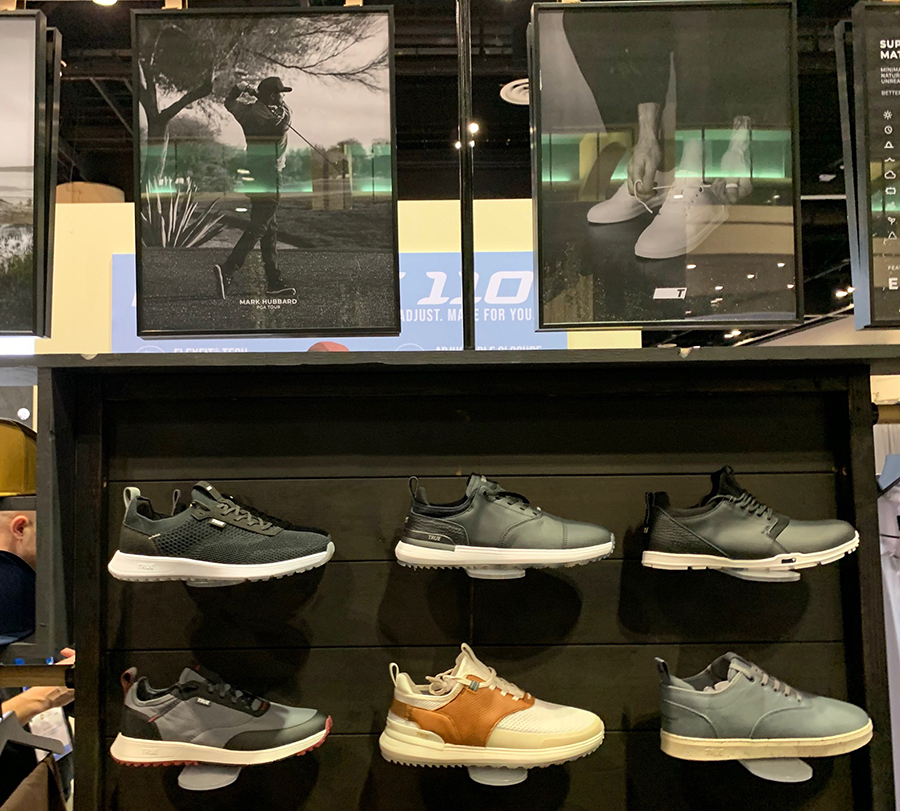
Tread Lightly: True Linkswear is the Cadillac golf shoe for the walking golfer.

The company set out in 2009 with Ryan Moore (the PGA Tour golfer) and brother Jason to make the consummate golf shoe for walkers, with Jason saying that traditional golf shoe manufacturers built “the equivalent of dress shoes — over-engineered, techy-looking foot cages.” They have built a business around selling shoes that look and feel more like an athletic shoe with outsoles designed and built so a golfer can better feel the terrain with his feet. The shoes arrive in a brown box with the words “Enjoy the Walk” printed on the top. 

“Ever had that sensation you can read the greens under your feet?” Jason asks. “These shoes allow the player to feel the course like never before.”

I met Moore at the PGA Show in 2018 while writing Good Walks and came away with a pair of the company’s headliner Knit I shoe, an ultra-lightweight shoe that the company touted as feeling like you were wearing a sock. Now the Knit III has been introduced. An enhanced midsole keeps your feet more secure during the swing, and the reinforced heel pad makes it impossible to get a blister.

“We took everything that worked in the early shoe and made it a little better,” says company executive Brandon Wallach. “There is slightly more athletic shaping. There is a new compound midsole that gives you more stability in your swing. And we’ve eliminated the chance of a slight rubbing on the heel. Thirty-six holes — no problem with this shoe.” 

The only downside of the Knit models are they are not waterproof. So if you’re playing on a Southern summer morning with the Bermuda rough heavy with dew, True’s waterproof models are a better fit. The Lux Hybrid was introduced in Orlando and is made with the same knit material so it breathes and lets air in, but it’s waterproof so it keeps the moisture out. It features a stylish leather saddle on either side of the uppers.

It’s just a slightly better mousetrap. The Orange County Convention Center was full of those at the PGA Show. It had to be to keep up with the appetite of a hearty golf market.  PS

Lee Pace has written Golftown Journal since 2008. Contact him at leepace7@gmail.com and follow him on Instagram at @leepaceunc and on Twitter @leepacetweet.

Focus on Food

Golftown Journal

Cutting Corners

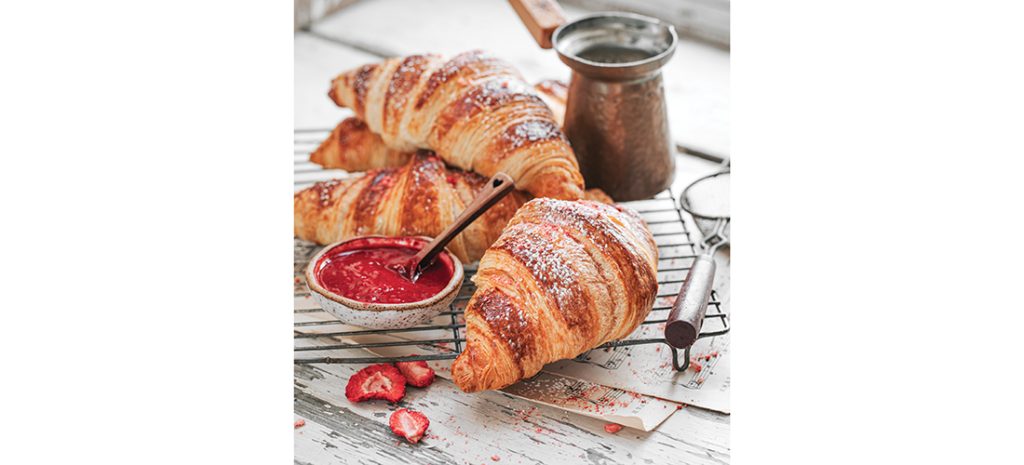
A quicker way to homemade croissants

Story and Photograph by Rose Shewey

The ink on my freshly issued driver’s license hadn’t dried yet when four of my friends and I piled into my newly acquired VW Polo to pop across the border for a casual breakfast in France. A swift hour-and-a-half later, we sat in the courtyard of a little boulangerie in Wissembourg, France, sipping café au lait while enjoying freshly baked, oven-warm butter croissants.

Ah, such sweet memories. These trips were a weekend ritual for many years with an ever-changing cast of friends, and while I no longer drink milk coffees (espresso macchiato all the way), I am still, some 25 years later, utterly obsessed with flaky, buttery croissants.

Fortunately, the Sandhills have ramped up their offering of artisan croissants, I’m happy to report. But not all croissants are created equal, and truly authentically crafted ones sell out faster than you can get out of your pajamas to drive across town to snag a few. So, what’s a girl with a passion for properly laminated butter croissants to do? Make your own, of course. But therein lies the rub.

If you read any recipe for traditional butter croissants, you could easily be led to believe that making these pastries is simple. Time consuming, perhaps, but simple. Make a dough, fold in butter, refrigerate, bake, done. Well, I am here to tell you that a decent amount of practice goes into making croissants (for the casual baker, that is), and every single mistake will affect the end result. Many years back (when cupcakes were the height of sophistication for me), my first batch leaked copious amounts of butter in the oven, and the croissants came out oily and sad looking.

While I have dramatically improved my baking skills, why invest two or even three days of your life when you can have the same delicate, honeycomb-structured butter croissants in just a few hours with a simplified method?

Necessity is the mother of invention. With a toddler taking up most of my time, I searched, tried and failed, and searched some more until I found the perfect shortcut to making perfect croissants. In a nutshell, you can make delicious croissants with one easy alteration: Instead of laminating repeatedly (folding butter into the dough), you spread butter in between layers of dough, which miraculously gives you the same flaky, pull-apart texture of the time-honored but decidedly more tedious method. The best part is, nobody will know you cut corners. Unless you tell.


Easy Butter Croissants  

(Yields 10 croissants / Imperial measures are approximate)

Basic Dough

500 grams (4 cups) all-purpose flour or T65 (preferred)

50 grams (1/4 cup) sugar

1 egg

5 grams (1.8 teaspoons) active dry yeast

20 grams (1.5 tablespoons) butter

10 grams (1.75 teaspoons) salt

210 milliliters (0.8 cups) water 

Butter Layers

225 grams (8 ounces) butter


Place all ingredients for the dough into a large bowl and knead until a ball forms and no longer sticks to the side of the bowl. Allow the dough to rest in a warm place until it doubles in size; about 1-2 hours.

Place dough on a lightly floured surface, shape into a log and cut into 10 pieces. Roll out the first piece to a rectangle, approximately 8×10 inches, and cover with a generous amount of butter. Roll out another piece of dough, set on top of your first dough-butter layer and repeat, alternating dough and butter to create a dough stack, ending with a layer of dough. Refrigerate the dough stack until fully chilled, about 2 hours.

Roll out dough into a large rectangle, about 10×20 inches. Cut dough in a zig-zag pattern to create 10 triangles and, starting with the base of the triangle, roll into croissant. Tuck the tip under so the croissants won’t come undone while baking. Refrigerate once more for at least 1-2 hours (or overnight), then allow to rise at room temperature for 1-2 additional hours before baking.

Preheat oven to 400F, apply egg wash if desired and bake for 20-22 minutes.  PS

German native Rose Shewey is a food stylist and food photographer. To see more of her work visit her website, suessholz.com.

Art of the State

Art of the State

Just Working

Antoine Williams forged his own path to bring his art to light

By Liza Roberts

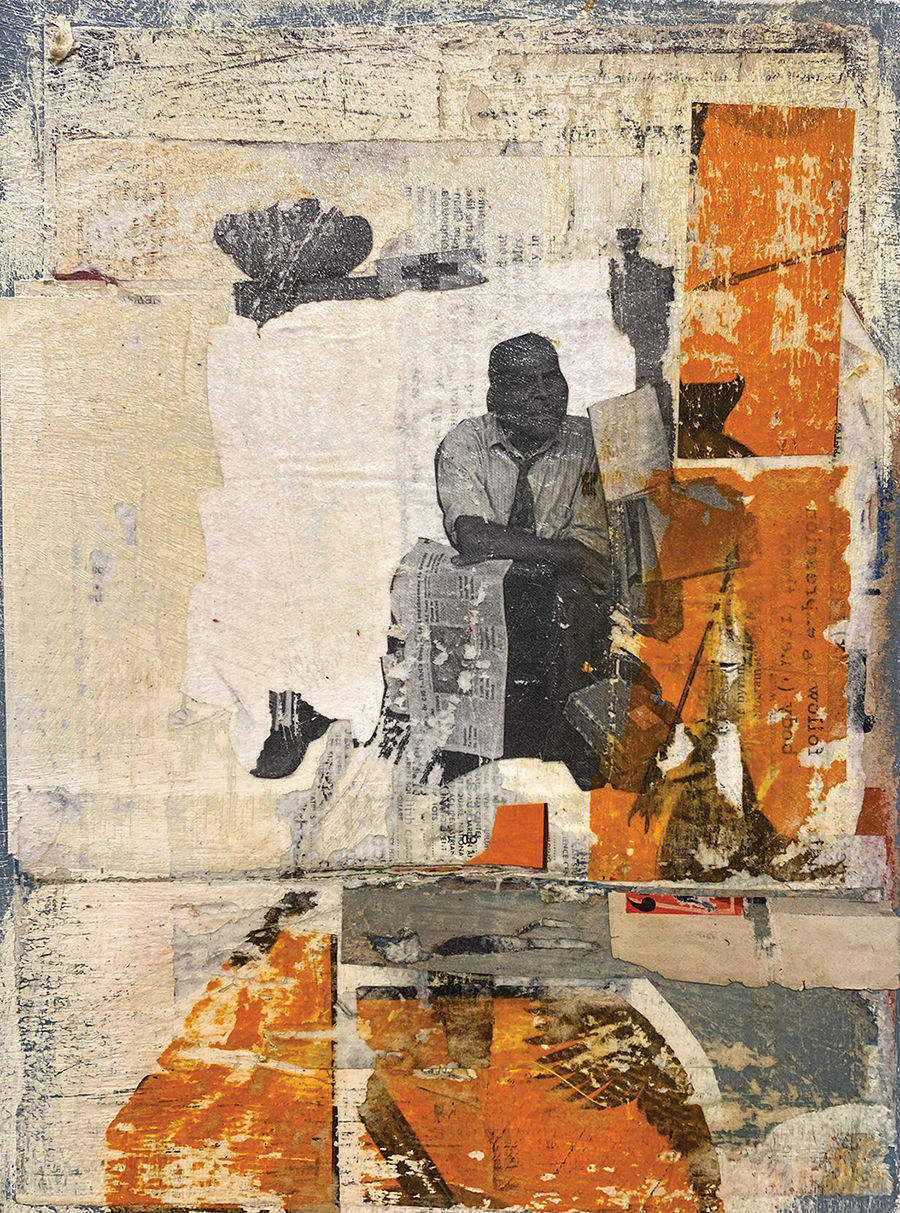
Left: There Will Be No Miracles Here, printed material and acrylic on wood panel, 2021


Antoine Williams was in his early 20s when he made an important decision: If he wanted his work to be seen, he’d have to take matters into his own hands.

He’d earned a fine arts degree from University of North Carolina at Charlotte in 2003 and was busy making mult-media work including drawings, paintings and collages that responded to the world around him: about politics, about the war on terror, about “how ridiculous all of it was.” But to Williams, the traditional gallery route seemed impenetrable. Not only to him, but to the other young artists he knew, many of them also young, politically active Black men without a network in the established world of art. “People were literally afraid of us. We were walking into galleries, and I remember one gallery. I asked: Can we do an art show? And they were like: We don’t have metal detectors,” Williams says.

His friends, including multimedia artists and illustrators Marcus Kiser, John Hairston Jr. and Wolly Vinyl, had another hurdle, too. Traditional art venues weren’t the obvious places for the audiences they sought. They wanted to connect with like-minded people who were also influenced by art, comics, music and culture. They were eager for dialogue and weren’t sure they’d find it in a traditional venue. “A museum can be a scary place if you’ve never been there,” Williams says.

Williams knew that from experience. A first-generation college student from “rural, working-class, conservative” Red Springs, North Carolina, Williams never knew an artist or much about art growing up — but his imagination was allowed to flourish. “It was cool to be a creative kid growing up in a place where you could run outside and go in the woods and play,” Williams says. “I was always daydreaming, and I was always either drawing or making stuff.”

He tapped into that wellspring when he cofounded the art collective God City in 2005 with Kiser, Hairston, Vinyl and a few other artists. The group rented industrial spaces, put together pop-up shows and got the word out with flyers. “We were really into hip-hop, politics and comic books,” says Williams. “We would do exhibitions . . . in any place that would take a bunch of young Black dudes.” Over a seven-year run, the group forged collaborations with poets, filmmakers, dancers and DJs. “It was all these groups of Black and brown people making art outside the major institutions,” says Williams. “It became a community in Charlotte . . . It was this really beautiful time.”

Left: There Will Be No Miracles Here, printed material and acrylic on wood panel, 2021


The establishment took notice. Kimberly Thomas, a curator at the Mint Museum, became a God City regular. In 2008, she included work by Williams and Hairston — as well as art from nationally recognized Black North Carolina artists like Juan Logan and the late Romare Bearden — in a 2008 exhibition about contemporary portrayals of Black masculinity called Scene in America. The exhibit included Williams’ I Wanna Kill Sam, a graphite and acrylic representation of a Black man shouting before a backdrop that could be part of an American flag. It’s about “the frustration of being caught within the system, the system that you don’t fully understand, but that you do know is not working,” says Williams.

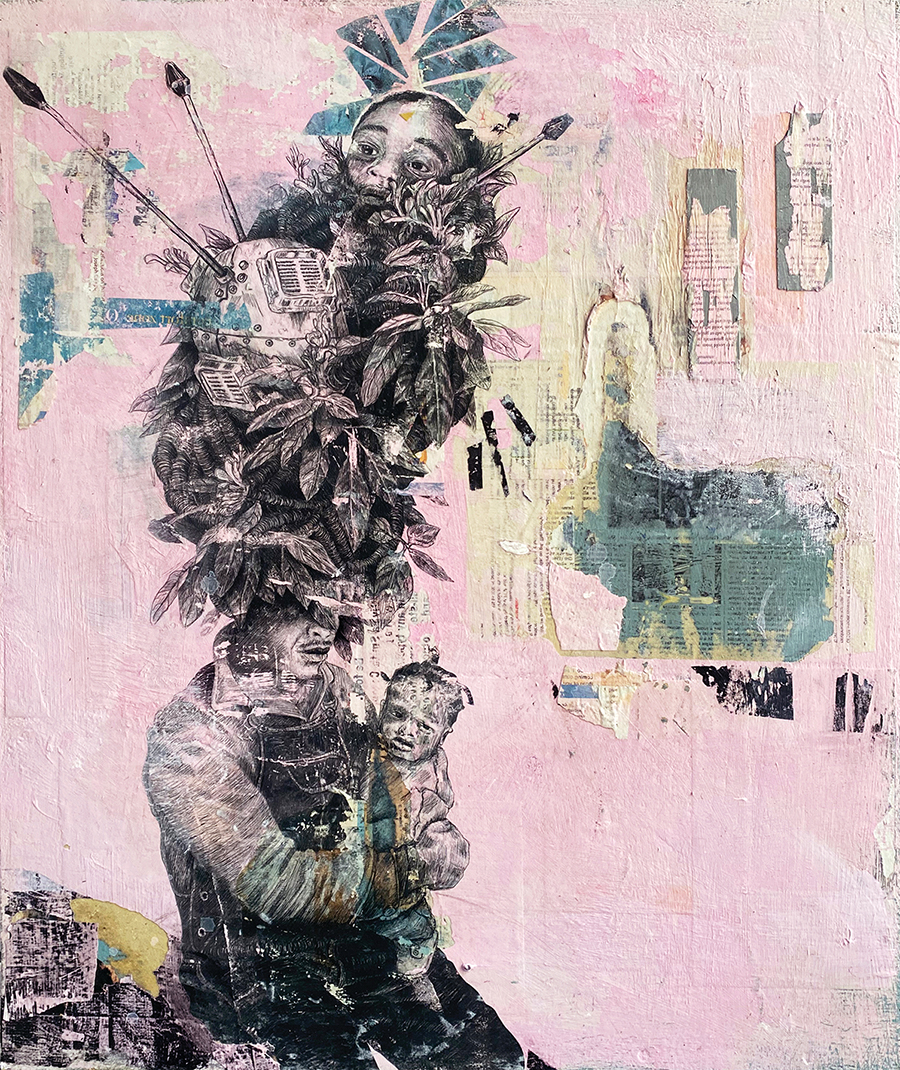
Since then, Williams has not struggled to get his art seen. Addressing cultural identity, signifiers of class, race and power, and the stories and myths society tells about them, his work incorporates drawing, painting and collage. Most recently, Williams says, he is focused on “Black folklore and other narratives” and is making art that “relates to Black people and movement to spaces of liberation.” The works shown on these pages incorporate these themes and will be exhibited at the Turner Carroll Gallery in Santa Fe, New Mexico, later this year. Also in 2023, Williams will have four murals installed in Washington, D.C,. as a recipient of the National Academy of Design’s Abbey Mural Prize.


Left: Putting Breath in the Body #1, ink, printed material, transfer, acrylic, 23.5″x 28″, 2022

Right: Putting Breath in the Body #2, ink, printed material, transfer, acrylic, 23.5″x 28″, 2022


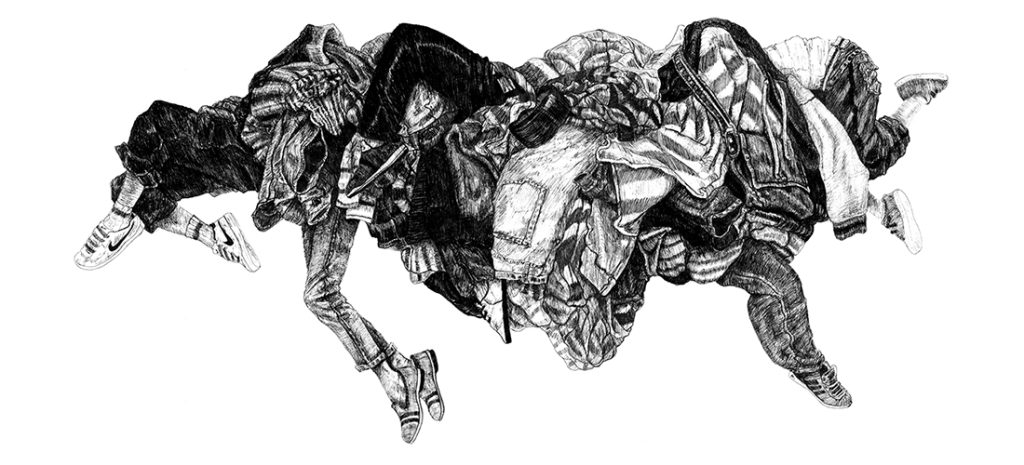
A Moment of Rest While Convincing Monsters That I Am Human, a drawn mural created for a giant wall at the entrance to the Southeastern Center for Contemporary Art (SECCA) in Winston-Salem last year, was made following the nationwide uprisings over the murders of George Floyd and Breonna Taylor, an effort to depict both the injustice and the exhaustion of that fight. “Those marches were for the bare minimum, just so that the justice system would work,” Williams says. “Not that it would do anything extraordinary — just work.” The mural depicts a man hunched over beneath a mountain of clothes, which Williams says indicates “how absurd it is, but also how exhausting it is.” Hoodies, jeans and sneakers refer to the distorted, negative stigma society puts on these signifiers of young Black men; the enormous pile indicates how they “constantly have to deal with the piling on of these perceptions.” The burdened figure persists, but pauses, “needing to take a break, and reclaim humanity,” says Williams.

Williams’ work has been exhibited at the North Carolina Museum of Art, Greensboro’s Weatherspoon Art Museum and at Raleigh’s Contemporary Art Museum (CAM). He has had prestigious residencies and fellowships at Duke University and the McColl Center. Most recently, he was an artist in residence at the Joan Mitchell Center in New Orleans, where he created sculptural work inspired by a quote from the author Octavia Butler: “There’s Nothing New / Under the Sun / But There Are New Suns.” Last July, Williams took a tenure-track job teaching art at the University of Florida.  PS

This is an excerpt from Art of the State: Celebrating the Art of North Carolina, published by UNC Press.

King Trees

King Trees

The champions of Moore County

By Tom Lillie     Photographs by John Gessner

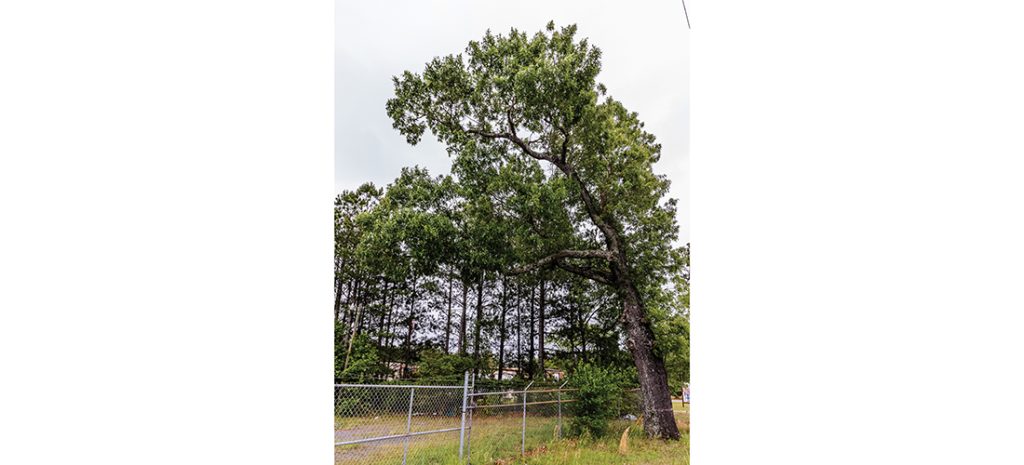
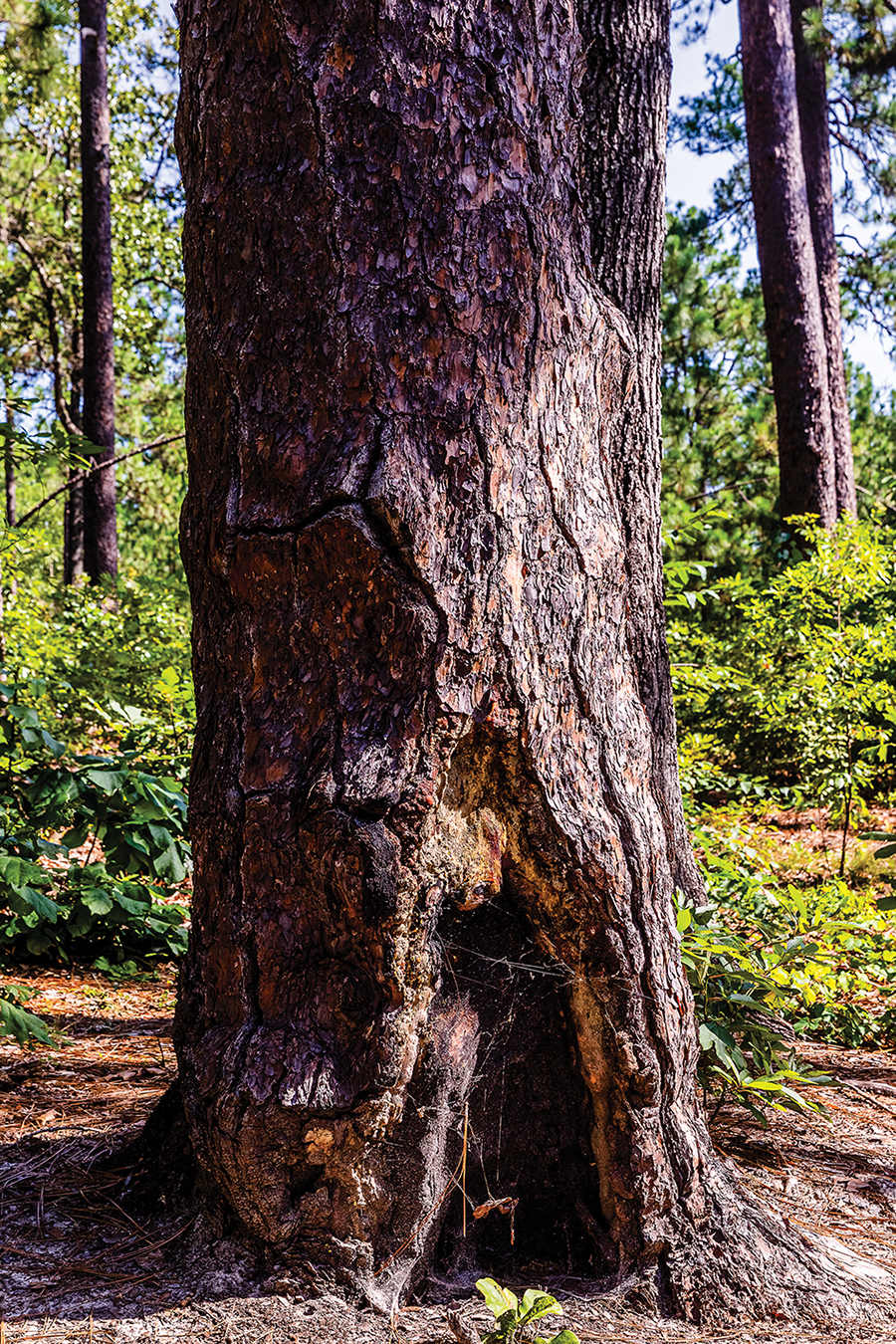
This and above Photograph: Turkey oak (Quercus laevis)

Moore County has what it takes to produce champions. The environment is ideal for building endurance and dominating the competition. Four individuals currently living in the Sandhills achieved state, national or world recognition without ever leaving the very spot where they took root and blossomed. They did not seek this recognition. In fact, they were discovered by local admirers and nominated for the crown.

The individuals I am referring to are trees. Three are famous for their size, and one is legendary for its age.

When it comes to size, a tree’s height, trunk circumference and crown spread are used to establish its position in arboreal prominence. The nonprofit group American Forests has the final say. A different process is used to document and recognize the oldest trees. Scientists called dendrochronologists extract a core sample with a special drill bit and count the growth rings to determine a tree’s age.

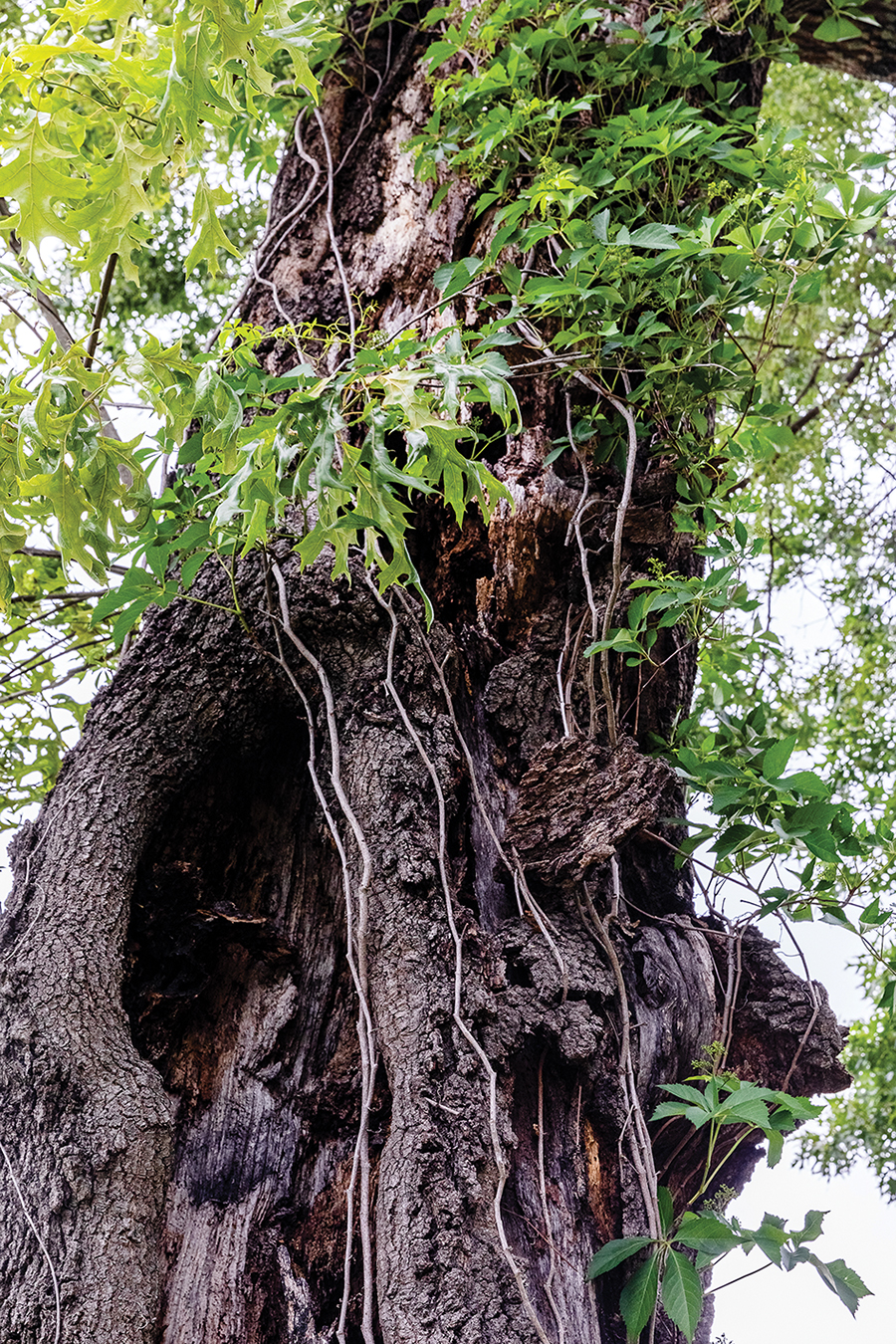
The nation’s largest turkey oak (Quercus laevis) stands at the intersection of N.C. 211 and state Road 2077 in Aberdeen. Worn and weathered, the tree is 64 feet tall with a circumference of 126 inches and a crown spread of 41 feet. Most motorists drive past the deciduous standout every day without knowing they are within sight of a titleholder, but news of plans to widen the road put the tree in the spotlight. The State Department of Transportation considered various alternatives, including rerouting the road to avoid the tree, but decided removal is the only viable option.

DOT is in the process of acquiring the necessary right of way for the project, including land occupied by the champion turkey oak. As a mitigation measure, the DOT will remove and preserve a 10-foot section of the tree for documentation and study. This champion sustained decades of automobile exhaust and inclement weather, but it will be dethroned by human progress and the chainsaw.


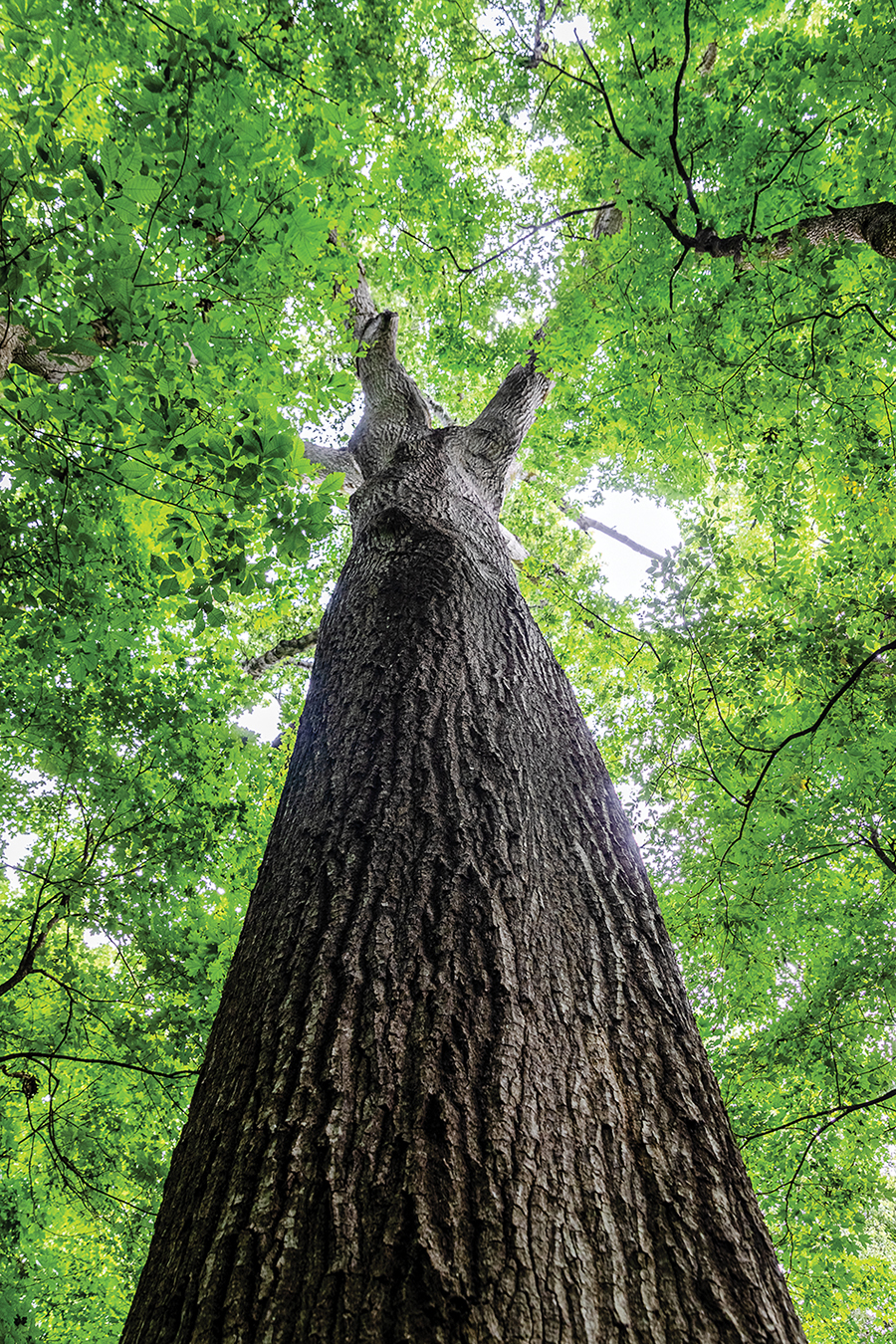
Left: Shumard oak (Quercus shumardii) 

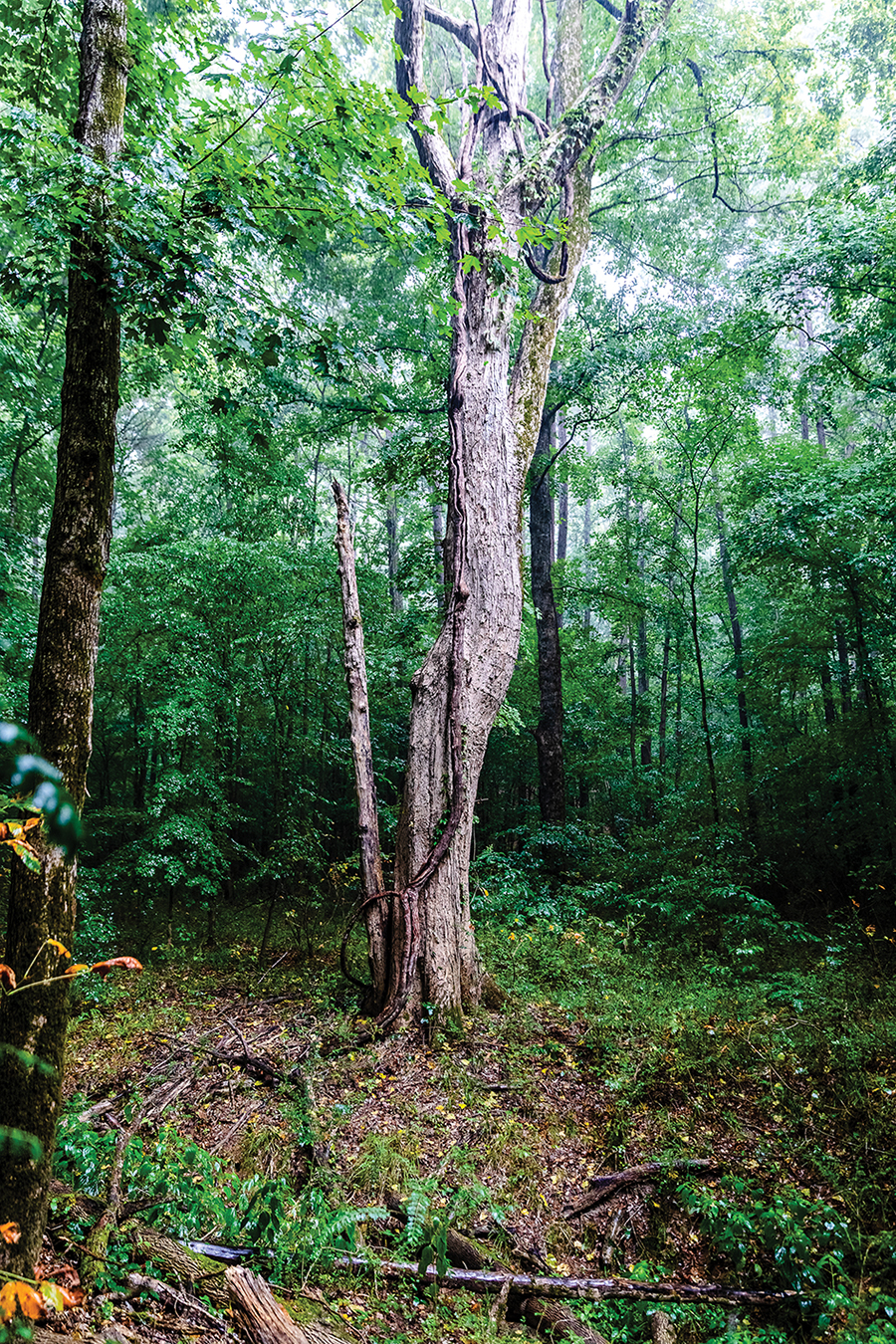
Right: Florida maple (Acer barbatum) 

Our next pair of champions are about 15 miles north of the turkey oak on property near Carthage. Both trees are recognized by the North Carolina Forest Service as the largest member of their species in the state. One is a 105-foot Florida maple (Acer barbatum) with a circumference of 113 inches and a crown spread of 70 feet. The other is a Shumard oak (Quercus shumardii) that measures 142 feet tall, 237 inches in circumference, and has a 110-foot crown spread. The future of the Florida maple and Shumard oak is relatively certain, since both grow on property that is managed by the Three Rivers Land Trust.

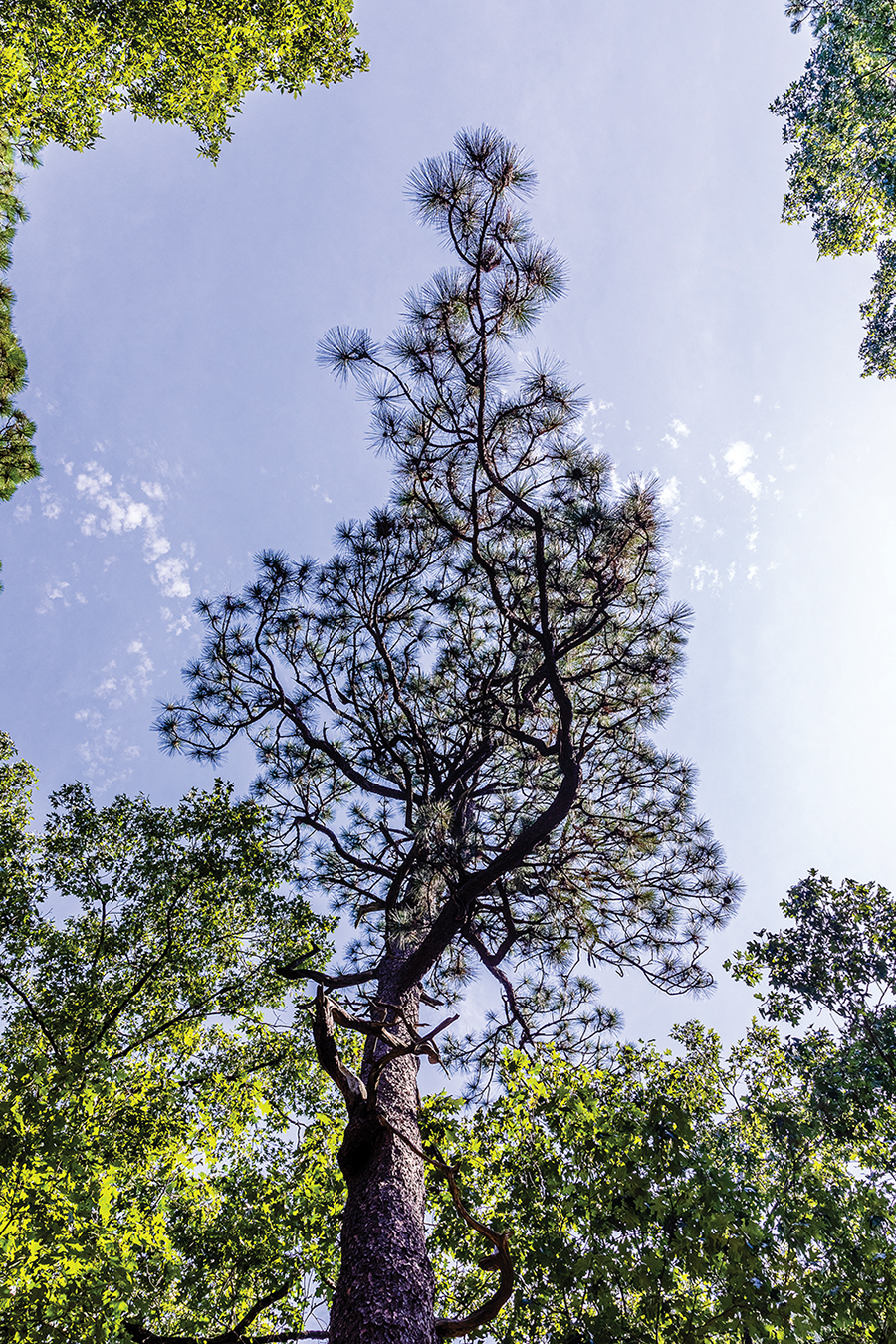
Another Moore County tree of special note is the oldest living longleaf pine (Pinus palustris) in the world. It sprouted in 1548 and became firmly rooted in the sandy soil of what is now the Boyd Tract of Weymouth Woods Sandhills Nature Preserve in Southern Pines. During 474 years of existence, this multi-centenarian somehow managed to escape predation, disease, recurring fires, storms, the ax, the chain saw, resin gathering and growth of a nation. Its age was determined by scientists from the University of North Carolina Greensboro in 2007. Each year, the state pays special tribute to the elderly evergreen by hosting an annual birthday celebration called Party for the Pine, complete with cake, games and other activities.


Left & Right: Longleaf pine (Pinus palustris)

Last year had special meaning for the champion trees of Moore County and all native trees in North Carolina. The Department of Parks and Recreation designated 2022 the Year of the Tree. Displays and educational material recognized the importance of all trees to the natural environment. Details about champion trees can be found at https://www.americanforests.org/champion-trees/ and the North Carolina database of champion trees is posted online at https://www.ncforestservice.gov/Urban/nc_champion_big_trees_database_search.asp.  PS

Tom Lillie is a military veteran and resident of Pinehurst. He received his Ph.D. in medical entomology from the University of Florida and served 26 years as a medical entomologist in the U.S. Air Force.

Saving the White Rhino

King Trees

Using technology to defeat poachers in Kruger National Park

By Jim Moriarty

Photographs courtesy of Tough Stump Technologies

One of them is called Kokwane and the other is Nyeleti. They’re not characters out of The Lion King. Kokwane is Randy Roy, and his African name means grandpa. Nyeleti is Jimmy Larsen, and his African name means night star — the star used for navigation. Together, and with a little help from their friends, they’re doing about as much as two guys nearly 8,900 miles away can do to save the white rhino from extinction.

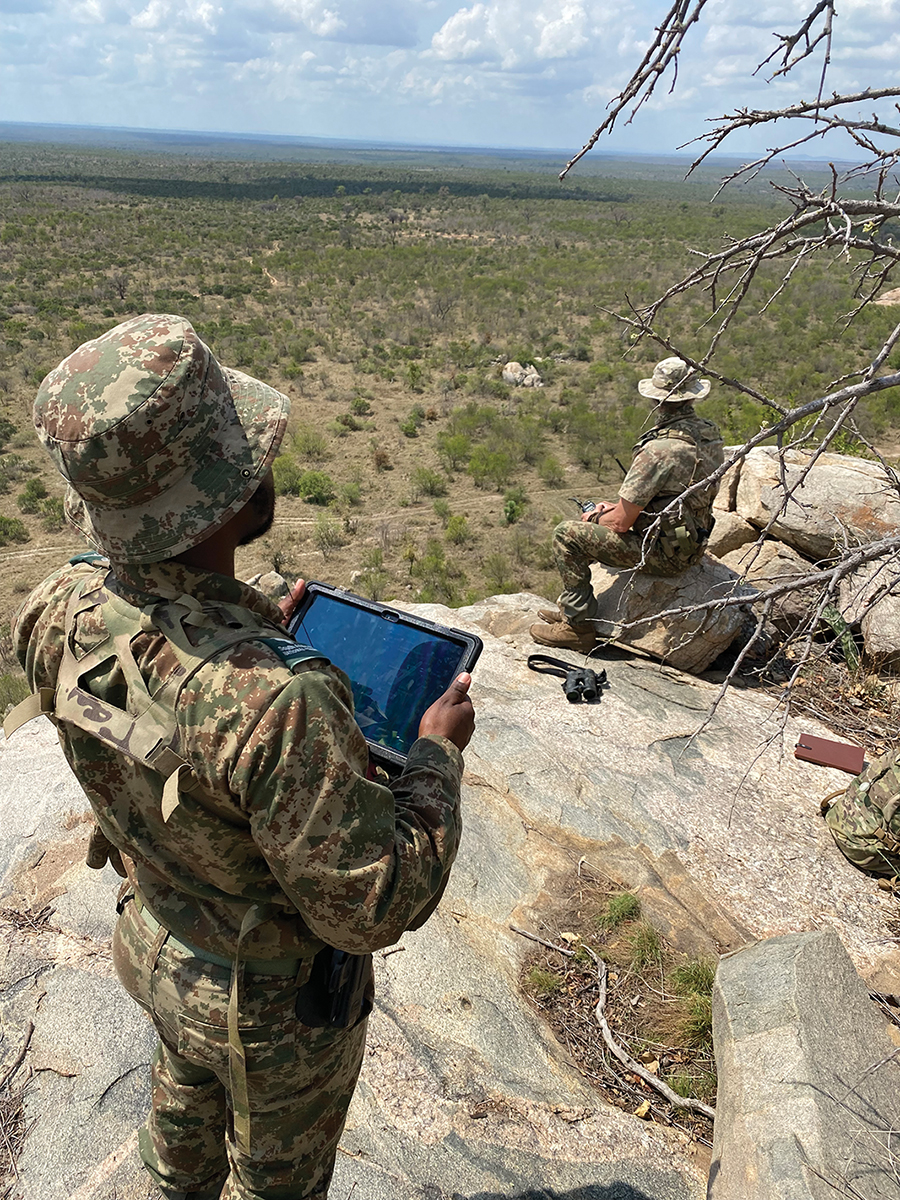
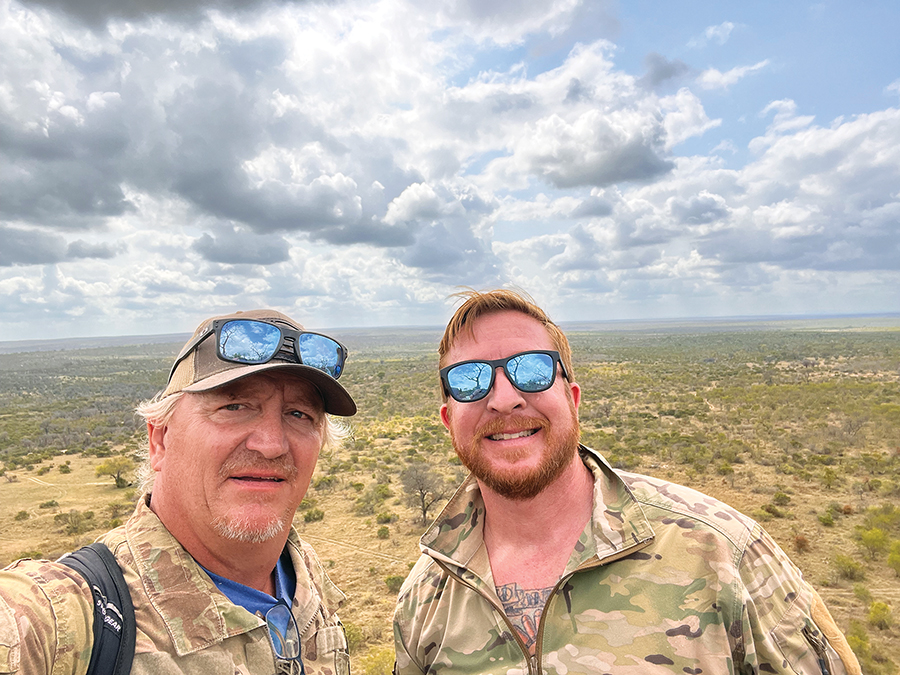
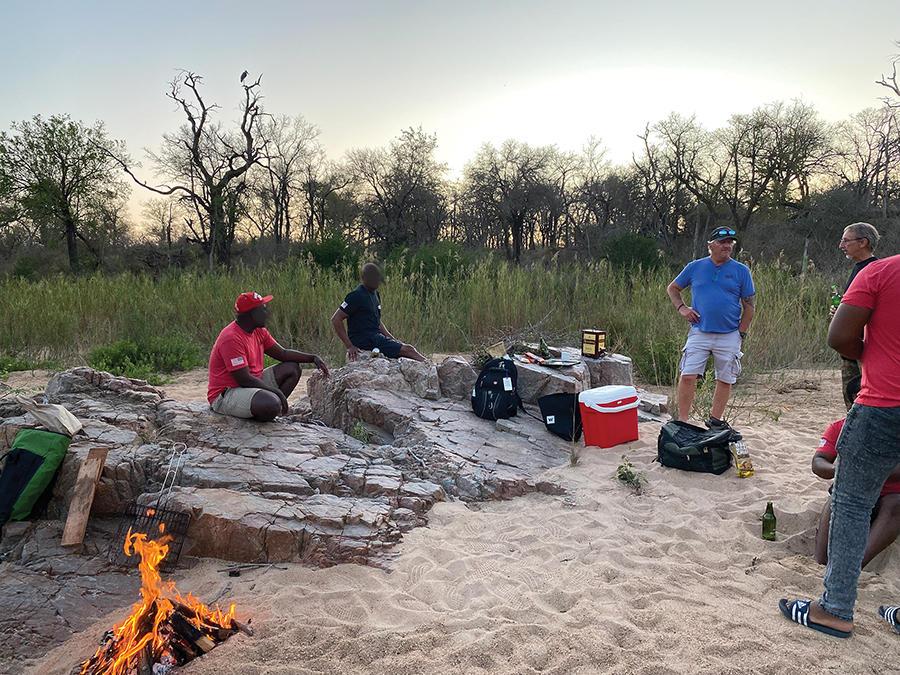
Last October, in the dark of the new moon, the pair visited Kruger National Park in South Africa to pass along some of the expertise they’d gained in the military to the park rangers who are the sole line of defense between the largest remaining population of white rhino in the world and the people who would destroy them for profit. Roy, a former policeman who worked as a dog trainer for Special Operations on Fort Bragg, made his first trip to Kruger in that advisory capacity in 2016 (though now he’s involved in drone mapping as well), while Larsen, recently retired from the Air Force, was attached to Special Operations and is an expert in telemetry.

It’s not unusual for advances of all types, be they technological or medical, made in war fighting to find peaceful uses, too. “The problem they have in South Africa is very similar to the problem we had in the military: Where the hell is everyone? Where should I go and what should I do?” says Larsen. The phases of the moon are critical because it’s during the full moon, and the days just before and after, when the barbaric poaching of rhino horns is most prevalent, so prevalent, in fact, that it’s called the Poachers Moon.

“Sixty percent of the white rhinos left in the world are located on Kruger National Park. The rhino horn is still the most lucrative commodity on Earth — more than gold, more than drugs,” says Roy.


Right: Employing and mastering new technology in Kruger National Park.


Rhino horn is coveted both for its rumored — though debunked — medicinal properties and as a status symbol, using the circular logic that possessing something so valuable is a value in itself. The poaching problem was particularly egregious during the pandemic. The national park was closed, but the poachers were open. “You’ve got the most expensive substance on the planet surrounded by some of the poorest places on the planet, protected by a few dozen people with a budget of next to nothing and a salary of about $500 a month. The fact that there are any rhino left at all is a testament to how good these guys are at their job,” says Larsen. “It’s a wicked problem.”

Kruger National Park is 7,523 square miles, 600 square miles larger than the states of Connecticut and Rhode Island combined. The poachers generally work in teams of three. One carries a rifle, one carries an ax, and one is a runner who carries water. Sometimes they enter the park on foot, easily overcoming fences, and other times they come into the park in one or two private vehicles, pretending to be a family on a day’s outing, then jumping out of the cars to stalk the animals.

The park is not unprotected. Kruger has helicopters donated to it by Warren Buffett, and roughly 300 rangers work in shifts to defeat the poachers. There are sensors that alert the rangers to the sound of a gunshot and seismic cables that can tell them if poachers are in the area. Still, it all comes down to the rangers finding the poachers — hopefully before they’ve downed a rhino and cruelly chopped off most of its face — in the dark, over great distances, when they know the people they’re about to confront are armed.

Randy Roy and Jimmy Larsen


“The poachers are hardened bushmen themselves,” says Roy. “The park is full of lions. It’s full of leopards. It’s full of cape buffalo. Those are dangerous animals. They don’t care. They go in there on foot with the chance of getting a horn. With a poached horn, all of them will make more than they would working at the gas station or working at a restaurant for an entire year.”

During the Poachers Moon park rangers sleep in tents in the bush in teams of their own waiting for an alert. Their dedication to their work is legendary. Two years ago one of them was attacked by a leopard but managed to fight it off. “He shoved his COVID mask into his jugular, wrapped the seatbelt around his neck and drove two hours to a clinic. And came back to do his job when he was healed,” says Larsen.

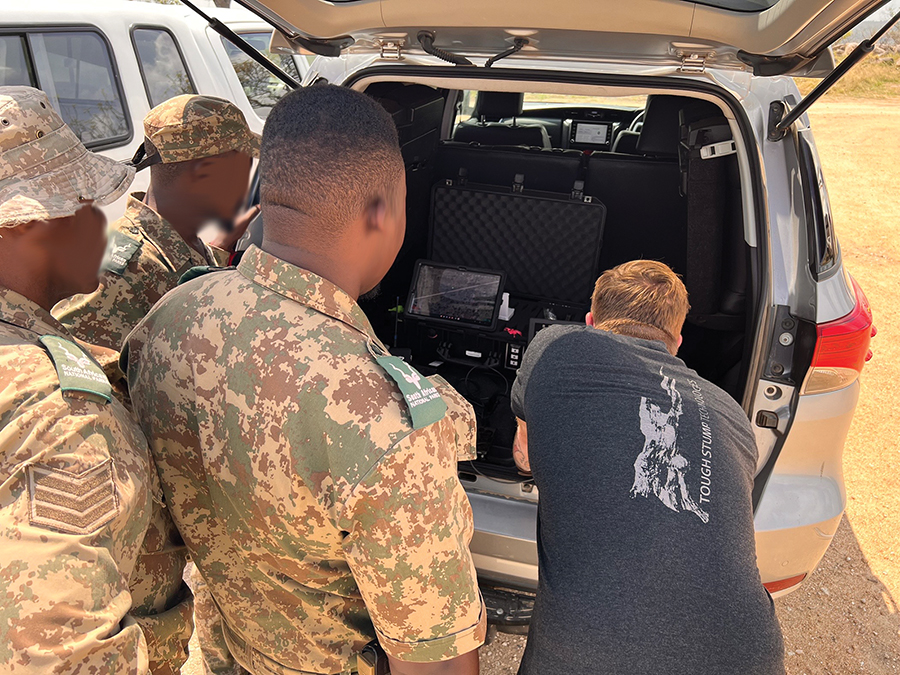
Once the rangers have received an alert is when Roy, Larsen and the company they work for now — Tough Stump Technologies — come into play. “The way the guys were operating, they had the equivalent of a paper map on a table. They say, ‘Go to a point here, a point there,’” says Larsen. With the technology Roy and Larsen left behind on a trial basis, requiring neither Wi-Fi nor cell service, the operations center can send a specific point to a ranger on his cellphone, and he can navigate to it from his position. “Before, there was a guy who talks to another guy who has two radios and one of them is talking to the operations center and the other one is talking to the closest ranger. One is speaking English and one is speaking Swahili. They don’t have coordinates; they’re talking about reference points. Based on what we’d seen (with the new equipment) during a false alarm it went from about 90 minutes to 30 minutes for them to interdict.” In fact, in December, on an actual poaching alert, the response time was five minutes.

The technology leapfrogs language barriers — most of the rangers speak English, but it’s a second or third language to their native Shangaan, Tsonga, Swahili, Afrikaans, etc. — because it’s not necessary to talk. It also minimizes the risk of injury from friendly fire, since all the rangers know where all the other rangers are.


Gathering with the park rangers, their faces obscured for their own protection.


To prosecute the poachers in South African courts, the rangers need to retrieve the gun, the horn and, of course, the poacher. The technology makes the forensics easier, too. “There’s a rhino, there’s a weapon, there’s a horn. Picture, picture, picture. It plots it on the map. There’s no disputing anything,” says Larsen.

The project came about at the suggestion of Stephen Lee, a senior scientist at the U.S. Army Research Laboratory in the Research Triangle Park. Lee, who has a Ph.D. in organic chemistry from Emery University, has traveled to and from Africa for the past 15 years engaged in educational projects and in research, mostly with elephants, whose acute sense of smell led to ways to detect the presence of explosives, narcotics and chemical and biological agents. He became active in both anti-poaching and animal conservation and, because of his Army connections, was aware of the technology Roy, Larsen and Tough Stump had. “I thought this would be ideal,” says Lee. “I thought it would revolutionize how they do counter-poaching.”

The entire technology kit fits in a backpack at a cost of roughly $50,000, money the national park doesn’t have to spare. Because of that Roy and Larsen have begun fundraising, with the help of Southern Pines Rugby Club, for both the technology and the rangers themselves. To help, go to their website, ruggersagainstpoachers.com, where contributions can be channeled through a nonprofit 501(c)3.

The illegal trafficking of rhino horns is done, essentially, by organized crime syndicates. As a result, park rangers and their families can be in extraordinary danger. Their children need to be educated far away from their villages. In this story, as in all communications about the park rangers, their faces are blotted out to protect their identities.

Just like the technology Roy and Larsen left behind, it’s a small step to protect the protectors. And maybe save one of the planet’s most needlessly endangered species.  PS

For more information about the poaching of rhino horns, watch the gritty, tough documentary Stroop: Journey into the Rhino Horn War. Jim Moriarty is the Editor of PineStraw and can be reached at jjmpinestraw@gmail.com.

Hometown

In the Spirit

A Hardwood Homily

A gym is no place for badminton

By Bill Fields

I don’t look back on my days in the Southern Pines school gymnasium without angst. There were some miserable moments in physical education class. Activities like boxing, climbing rope, mounting a pommel horse and jumping on a trampoline weren’t my thing, regardless of how they were supposed to help me grow up and become a strong, upstanding citizen. I am not ashamed to have probably performed the lamest seat drops in Moore County history. Daydreaming classmates on the perimeter of the bounce mat didn’t inspire confidence that they would save the day if something went wrong. Nor did the limp of our wonderful teacher, Mr. Wynn, whose disability had been caused by a tumbling accident years earlier.

The pursuits of P.E. period would have been dreaded regardless of where they occurred — the only thing worse was tetherball during a cold recess. That they were forced upon me within those walls, on that shiny maple floor, made them more regrettable. Even badminton and volleyball, which could be fun, seemed miscast there. A gym was for basketball.

This was so because in the winter, in the land of the Atlantic Coast Conference, basketball was my reason for being during a good portion of childhood. Watching it on television. Listening to it on the radio. Playing it, as often as possible.

Most hoops time happened in our backyard on a dirt “court” whose dimensions were decidedly cramped on the left side due to trees and the property line. My first goal was attached to an old swing set. The backboard was just a grade above cardboard, and the rim wobbled after the first week. Then, one day after I got home from school, the old set-up was gone, replaced by a new goal with a backboard of thicker wood mounted on an honest-to-goodness utility pole. Dad didn’t volunteer any details about how such a sturdy support came our way, but I privately theorized that it was paid for with a case of beer or the largest bottle of Canadian Club sold at the ABC store on Connecticut Avenue. Whatever the payment, it was worth it, because the pole survived well beyond the afternoons when I dribbled a ball in its shadow.

But despite the upgrade, it was still outdoors, a far cry from the indoor surfaces played upon by my heroes in college and the pros. Once I got a little older, the hard surface courts at the downtown park were a better substitute, but the chain nets were a long way from the real thing.

Thanks to pictures in yearbooks belonging to my older sisters, I knew what the gym at East Southern Pines High School looked like before I started first grade in 1965. I dreamed of dressing for the Blue Knights in one of those uniforms with the short shorts and satiny material, the kind the players wore in the team pictures and the posed action shots.

I signed up for midget league basketball as soon as I was eligible. We had only colored T-shirts, but those Saturday mornings in the gym weren’t diminished by lack of a complete basketball outfit. With multiple games being played on the three-quarter courts, there was a cacophony of sounds: the thud of basketballs bouncing; referees’ whistles; sneakers squeaking on the hardwood; coaches yelling for a player to pass; a player who wanted to shoot hollering for the ball. When the games were over, stepping outside to walk home was as close to cryotherapy as I’ve experienced, so jolting was the temperature after hours spent in the cozy confines.

A few years later, I made a desultory exit from that building one weekday afternoon after being cut from the junior high team. The only times I would get to shoot at the competition goals on the fiberglass backboards was during half-court games in Mr. Fitch’s ninth-grade P.E. class and later when the gym would be open during Christmas break.

Not having a gymnasium when it opened in 1969, Pinecrest played in the Blue Knights’ former space for half a dozen seasons. The Patriots of Charles Waddell, Ricky Goldston and Dexter Pride rocked the place on their way to the state 3-A title in 1971 and a runner-up finish the following year. Those were great teams and good times. If there had been a home game the evening before us squirts showed for youth play, you could still smell the popcorn. If there was a better building in town, I didn’t know about it.  PS

Southern Pines native Bill Fields, who writes about golf and other things, moved north in 1986 but hasn’t lost his accent.

Omnivorous Reader

Omnivorous Reader

Hitting the High Notes

A debut novel delivers a musical thriller

By Anne Blythe

Brendan Slocumb’s literary debut, The Violin Conspiracy has been billed as a mystery, a musical thriller that takes readers across continents on a page-turning hunt for a valuable Stradivarius violin. While the story is suspenseful enough, the whodunnit is not much of a mind-boggler in the end. The true hair-raiser revealed in this coming-of-age story is the institutional racism that persists in the classical music world and the talented musicians of color these stubborn customs threaten to mute.

Slocumb is familiar with the story. He grew up in Fayetteville, received a degree in music education from the University of North Carolina Greensboro, and has performed in symphonies, where he typically is one of few Black men playing a violin.

Only 1.8 percent of musicians performing in classical symphonies are Black, Slocumb writes in an author’s note attached to the end of the novel. Only 12 percent are people of color.

“Music is for everyone,” Slocumb writes. “It’s not — or at least shouldn’t be — an elite aristocratic club that you need a membership card to appreciate: it’s a language, it’s a means of connecting us that’s beyond color, beyond race, beyond the shape of your face or the size of your stock portfolio.

“Musicians of color, however, are severely underrepresented in the classical music world — and that’s one of the reasons I wanted to write this book.”

Readers are plunged into the story of Rayquan “Ray” McMillan, Slocumb’s protagonist, in a New York hotel room “the morning of the worst most earth-shattering day” of his life.

The aspiring violinist orders scrambled eggs, juice and coffee from room service for him and his girlfriend. Lost in thought in the shower, he ponders the fingering of Tchaikovsky’s Concerto, the piece he plans to play almost a month later at an international competition. When he prepares to leave New York on a flight home to Charlotte, he discovers that inside the case that typically holds his nearly priceless violin — a Stradivarius his grandmother (unaware of its immense worth) had given to him as her grandfather’s old fiddle — was a white Chuck Taylor shoe with a ransom note on a sheet of paper folded in thirds.

SEND $5 MILLION

IN BITCOIN FROM BISQ

TO WALLET 34U69AAV89872

Not only does the note launch an international investigation into the whereabouts of the violin, it serves as the instrument to delve back into Ray’s boyhood and the school music classes that changed the trajectory of his life.

Like Slocumb, Ray grew up in North Carolina in a family that expected him to “get a real paying job” instead of taking a path toward a classical music career in a world where few people looked like him. Instead of encouraging her son to follow his dreams, Ray’s mother told him to “stop with that noise,” take the GED and get a job at Popeyes so he could help with the family expenses.

Ray meets a music teacher who becomes a mentor who pushes him beyond such confining expectations and encourages him to join a world where he would be the quintessential underdog, an endearing and hardworking protagonist who is easy for readers to rally behind.

Ray’s grandmother, Nora, recognizes his affinity for music and pulls out an old “fiddle” from her closet for him to practice on in the summer, when the school rentals were not available. It had belonged to her grandfather, a former enslaved man, who had a musical gift, too.

That “fiddle,” spruced up and revealed for what it was, quickly drew interest from extended family members who were more interested in its value than in Ray — until he became a rising star in the classical music world and a bit of a media darling able to coax a better living than they had imagined from its strings. Not only does his own family seek to share in the value of the instrument, Ray has to fend off claims of ownership from the family that had enslaved his great-great-grandfather. None of them appreciates the questioning they face when Ray’s dilemma casts suspicion on them all.

As Ray frets over the whereabouts of his kidnapped violin, leaving most of the investigation to law enforcement and an insurance agent, he also has to continue practicing for the international Tchaikovsky competition. His musical talent transcends the bow and strings in his hands. Even without his prized hand-me-down, the unlikely competitor is a real contender, one who will not be held back by ransom notes and side dramas.

Through a cast of characters, some better developed than others, readers learn about the jockeying of musicians in the classical world, vying for bragging rights that come with lucrative invitations to perform solos and lead prestigious symphonies. Ray describes the difficulties that a Black artist — especially one from humble roots without exclusive connections from famous conservatories — faces as he pursues his passion.

“You work twice as hard,” Slocumb writes. “Even three times. For the rest of your life. It’s not fair, but that’s how it is. Some people will always see you as less than they are. So you have to be twice as good as them.”

Ray didn’t need his PopPop’s instrument on the international stage. Though the kidnapped Stradivarius remained missing during the competition, his talent shone brightly. As opportunities from around the world came his way, he got the clue that helped him — not the team of investigators he’d relied on — discover who slipped the sneaker into the violin case.

There’s a crescendo when Ray opens a door, testing his theory about who made off with the family heirloom. “PopPop’s fiddle — his own most prized Stradivarius violin — grinned up at him unharmed,” Slocum writes. “Perfect.”

In the end, without totally spoiling the whodunnit, it really doesn’t matter where the violin is throughout the pages of Slocumb’s mystery. Its presence and absence string together a tale that will strike a chord.   PS

Anne Blythe has been a reporter in North Carolina for more than three decades. She has covered city halls, higher education, the courts, crime, hurricanes, ice storms, droughts, floods, college sports, health care and many wonderful characters who make this state such an interesting place.